Thousands of Syrian police who joined the rebels are on U.S. payroll
WorldTribune | July 25, 2013
WASHINGTON — The United States has been paying thousands of Syrian police officers who deserted the regime of President Bashar Assad.
Officials said the administration of President Barack Obama has approved tens of millions of dollars to pay the salaries of police officers who joined the rebels. They said the officers were working to maintain order in rebel-controlled territory, mostly in northern Syria.
“There are literally thousands of defected police inside of Syria,” Assistant Secretary of State Rick Barton said. “They are credible in their communities because they’ve defected.”
In an address to the Aspen Security Forum on July 19, Barton, responsible for State Department stabilization operations, did not say how many Syrian police deserters were on the U.S. payroll. He said the officers were receiving about $150 per month, a significant salary in Syria.
The address marked a rare disclosure of direct U.S. aid to Sunni rebels in Syria. Congress has approved more than $50 million for the Syrian opposition, much of which has not been spent.
Barton said the police officers remained in their communities despite their defection from the Assad regime. He said the U.S. stipend was meant to ensure that they stay on the job.
“We’d rather have a trained policeman who is trusted by the community than have to bring in a new crowd or bring in an international group that doesn’t know the place,” Barton said.
Barton said the rebel movement was awaiting a range of non-lethal U.S. equipment. He cited night vision systems and medical supplies.
Nasrallah: EU giving “legal cover” for an Israeli war on Lebanon
Al-Akhbar | July 25, 2013
The European Union is paving the way for Israel to justify a war on Lebanon, Hezbollah’s general secretary said late Wednesday, two days after the 28 member states issued a decision to put Hezbollah’s military wing on its terror list.
“EU countries should know they are giving legal cover for Israel to launch any war on Lebanon because Israel can claim it is waging war on terrorists,” Sayyid Hassan Nasrallah said in a televised speech at the annual iftar ceremony held by the Women’s Committee of Islamic Resistance Support Association of Hezbollah.
“These countries make themselves undeniable allies during any Israeli aggression on Lebanon, on the resistance and on any target for the resistance [in the country],” Nasrallah added.
The EU 28-member bloc agreed Monday to blacklist Hezbollah’s military organization as a terrorist group following years of relentless US and Israeli pressure.
The EU cited accusations that the powerful Lebanese Shia movement was behind a bus bombing in Bulgaria last year which killed five Israelis and their driver, as well as the party’s involvement in the Syrian conflict.
Hezbollah has denied any involvement in the Bulgaria bombing.
Last month a new socialist-led Bulgarian government backed away from the claims of the previous administration, saying that the EU could not justify blacklisting Hezbollah solely based on the little evidence produced to implicate it in the crime.
“It is important that the (EU) decision be based not only on the bombing … because I think the evidence we have is not explicit,” Foreign Minister Kristian Vigenin had told national state radio BNR.
Nasrallah noted that the EU’s official statement will be issued within days and the party will see then what is to be discussed.
He also posed the question to the EU of why the union hadn’t considered placing Israel’s army on its terror list.
“[The EU] repeatedly admits that Israel occupies Arab land but hasn’t implemented international resolutions for ten years. The whole world has witnessed the Israeli massacres,” he said.
Nasrallah advised the member states to reconsider the decision, stating that it is doomed to fail and that “the decision wasn’t worth the ink it was written with.”
The EU’s blacklisting of Hezbollah’s military wing is merely the result of external pressure and interests, he said, instead of being based on values and principles. He added that the effect of the decision is nothing but psychological.
“In this country, resistance fighters fought the Israeli occupation, endured a lot of pressure and sacrificed martyrs. Then you come to those who are the sons of these people and say they are terrorists. This is abuse to fighters, to their people and to their successive governments,” Nasrallah stated.
“This decision aims at making us bow, at forcing us to step back and be afraid. But, I tell you that all you will get is failure and frustration,” he said, adding that anyone who thinks the resistance will be undermined by the decision is either “ignorant or delusional.”
The General Secretary hinted jokingly at having members of Hezbollah’s military wing in Lebanon’s new government, assuring viewers that the resistance has gained credibility among people in Lebanon and the Arab and Muslim world.
“The most important thing for the Lebanese resistance is to get the support of its people and to express their will, pride and view in defending their land and their sovereignty,” he said.
“The Resistance will remain and will be victorious by God’s will,” Nasrallah concluded.
How the Israel Lobby Trained a Diplomat
By Paul R. Pillar | Consortium News | July 22, 2013
David Rieff’s commentary on Samantha Power’s confirmation hearing is a trenchant account of some of the worst in what we see in the process of confirming nominees for senior positions. Even by the standards of such hearings, Power’s performance was notably obsequious.
This was an abuse of the process by the nominee, in the sense that in a proceeding ostensibly intended to learn more about the nominee we did not learn much at all except that she really, really wants the job of ambassador to the United Nations and is willing to shape her testimony in whatever way it takes to get the job.
Rieff cites the experience of Robert Bork as the master lesson for all subsequent nominees on the need to trim their views if they expect to get confirmed. That history is no doubt a factor, but to understand the pathologies of the confirmation process we should take note of the variety of ways in which that process gets abused. Many of those ways are not the work of nominees, but in at least one respect, as Power’s case illustrates, they induce from nominees’ behavior that only adds to the dysfunction.
A conspicuous and recent abuse was the attempt to cripple the work of the National Labor Relations Board and the Consumer Financial Protection Bureau by refusing to bring any nominees for those bodies to a vote in the Senate. Threats from the Senate majority leader about exercising a so-called nuclear option won a temporary reprieve from that tactic, although there is no assurance we won’t see it revived, and the chances are it will be.
One of the participants in that tactic, Senator Lindsey Graham, later acknowledged that the nominee to head the Consumer Financial Protection Bureau “was being filibustered because we don’t like the law. That’s not a reason to deny someone their appointment. We were wrong.”
Even when the objective is not to cripple an agency or effectively vacate the law that created it, it has become commonplace for the confirmation process to be the vehicle for pursuing policy agendas that have nothing to do with the nominee. This is at best an irrelevance and a drag on the process. It becomes abuse when confirmation votes may be determined by it.
The same Sen. Graham started crossing this line last week when he used questioning of Admiral James Winnefeld, nominated for another term as vice chairman of the Joint Chiefs of Staff, to push the idea that the Iranian regime is still an awful and extreme beast despite the election to the Iranian presidency of Hassan Rouhani.
At one point Graham said “this will determine how I vote for you” before asking whether Winnefeld thought Rouhani is a “moderate.” Even setting aside the issue of the substantive validity of what Graham was harping on, why should a military officer’s view on this question determine his fitness to serve as vice chairman of the Joint Chiefs?
Nominees, especially those already serving in the Executive Branch, have somehow to make their responsiveness to questions not run afoul of policies that have already been set by the president, and not to make it seem that they are getting ahead of the president, forcing his hand, or openly criticizing him. And yet senators repeatedly and knowingly put nominees in that difficult position.
At the same hearing last week of the Senate Armed Services Committee, John McCain did so with General Martin Dempsey, nominated for another term as chairman of the Joint Chiefs. McCain tenaciously tried to get Dempsey to say that the administration’s policy on Syria was one of “inaction.”
We should hope that the nation’s senior military officer is giving his best advice in private to the president on military aspects of an important problem such as Syria, and we should expect that officer not to offer discordant characterizations of the president’s policy in public. We should also hope that senior members of the Senate Armed Services Committee see the job of chairman of the Joint Chiefs in similar terms, regardless of their views about Syria or any other substantive issue.
The inherent vulnerability of nominees makes the confirmation process a vehicle for showing who’s boss. This is a form of abuse that goes beyond senators who do the voting, and it gets back to how Power conducted herself. Specifically, it gets to her comments about Israel, which as Rieff puts it were “so stridently one-sided as to be almost wholly indistinguishable from the talking points of Israeli diplomats.”
The now well-known background to this is an interview more than a decade ago, in which Power suggested that to quell Israeli-Palestinian violence at that time the United States should consider deploying a large protective force even though this might mean “alienating a domestic constituency of tremendous political and financial import.” The constituency in question, as is its custom, denounced Power as anti-Israeli.
Power’s later means of retaining her confirmability in the face of such accusations was to disavow, totally and tearfully, her own observations. A key event was a meeting with American Jewish leaders at which, according to the meeting’s organizer, she “became deeply emotional and struggled to complete her presentation as she expressed how deeply such accusations had affected her.”
This sequence has made Samantha Power a more valuable commodity to the Israel lobby than if she had never made any comments to offend the lobby in the first place. Sustaining the lobby’s power depends on repeated demonstrations of submission to that power. The lobby could not have gotten a better demonstration of submission than to have the nominated chief U.S. diplomat at the United Nations abandon all evidence of any independent thought on the issues concerned and to make herself indistinguishable from Israeli diplomats.
Besides making for more dysfunction in the confirmation process, this kind of response from a nominee, as when Power said at her hearing that the United States has “no greater friend in the world” than Israel, badly distorts the larger public discourse on important issues. To appreciate how much it is distorted, we have to listen to distinguished and experienced people who are not up for a confirmation vote, do not expect to be in the future, and thus can voice their observations in an honest and untrimmed manner.
One such person is retired Marine Corps General and former Central Command head James Mattis, who last weekend explained some of the cost to the United States of the festering Israeli-Palestinian conflict. “I paid a military security price every day as a commander of CENTCOM because the Americans were seen as biased in support of Israel,” said Mattis.
Moderate Arabs “who want to be with us,” he said, restrict their support for the United States because they “can’t come out publicly in support of people who don’t want to show respect for the Arab Palestinians.”
US, Israel launch joint aerial drill
Press TV – July 21, 2013
The United States and Israel have begun a joint aerial drill. According to a statement by the Israel military the two-week “Juniper Stallion 13” aerial exercise began Sunday morning.
An undisclosed number of F-15 and F-16 fighter jets from both sides are participating in the training event. It’s held at Uvda Base in the southern Negev Desert, during which pilots will practice air-to- air combat maneuvers, mid-air refueling, bombing runs and other missions.
The United States European Command (EUCOM) is involved in the aerial war games which will focus air-to- air combat maneuvers, mid-air refueling, bombing runs and other missions.
The exercise comes after a two-day visit to Israel on July 14 by EUCOM’s Commander General Philip M. Breedlove.
“The combined exercise is designed to improve the interoperability and cooperation between the Israeli and U.S. air forces, and has been planned for more than a year,” an Israeli military source told Xinhua.
The U.S. is Israel’s biggest ally and international supporter. It supports Tel Aviv financially, militarily and diplomatically. Washington is providing billions of dollars of military aid to Tel Aviv annually.
During Fiscal Year 2013, the U.S. is providing Israel with at least $8.5 million per day in military aid.
Meanwhile Times of Israel has reported that “Israel would receive $3.4 billion in total military aid under the 2014 U.S. budget proposal sent to Congress by President Barack Obama”. The proposal is inclusive of “$3.1 billion in general military aid for Israel, similar to 2013, plus a separate request for $220 million to finance the Iron Dome anti-rocket defense system.”
“Obama’s 2014 proposal also allocates $96 million for joint U.S.-Israel research and development projects, including the David’s Sling and Arrow missile defense systems. The overall budget proposal that Obama submitted to Congress on Wednesday totalled $3.8 trillion.”
The If Americans Knew website (http://ifamericansknew.org/stats/usaid.html) reports that “Beginning in 2007, the U.S. has increased military aid by $150 million each year. Beginning 2012, we will be sending Israel $3.1 billion a year (or an average of $8.5 million a day) and will continue to provide military aid at that level through 2018. U.S. tax dollars are subsidizing one of the most powerful foreign militaries.”
In Israel’s last two wars on the Gaza Strip alone, Operation Cast Lead (27 December 2008- 18 January 2009) and November 2012, hundreds of civilians, including many women and children were killed.
In addition to financial and military aid, the U.S. has vetoed over 40 UN resolutions that have been critical of Israel and its policies towards Palestine.
Kurdish leader says Syria Kurds not after forming own government
Press TV – July 21, 2013
A senior Syrian Kurdish leader has rejected earlier reports that Kurds are planning to establish an independent Kurdish government in northern Syria.
China’s Xinhua news agency on Sunday quoted Salih Muslim, the leader of the Democratic Union Party (PYD), as saying, “There is no intention among the Kurds to form their own government, nor to secede from Syria.”
On Saturday, Qatar-based al-Jazeera news network quoted Muslim as saying that Syria’s Kurds were planning to create a “temporary autonomous government to administer their regions in the north.”
The Syrian government has granted the Kurds a certain level of autonomy since 2012 and they are now controlling security of the region.
In recent months, Kurdish fighters, who are opposed to foreign interference in Syria, have been battling foreign-backed militants in the north.
This comes as clashes continued between PYD-linked Kurdish militants and foreign-backed Takfiri militants around several villages in northeastern Syria near the border with Turkey on Saturday.
The Kurdish militants took control of a checkpoint and also seized light weapons, ammunition, a vehicle mounted with a heavy machinegun, and a mortar launcher.
On July 17, the Kurdish fighters took control of the town of Ras al-Ain in the border province of Hasakah, forcing out the al-Qaeda-linked militants.
Foreign-sponsored militancy has taken its toll on the lives of many people, including large numbers of Syrian soldiers and security personnel, since March 2011.
Western powers and their regional allies including the Israeli regime, Turkey, Saudi Arabia and Qatar are supporting anti-Syria militant groups, including al-Qaeda-linked terrorists.
The Language of Power: Obama’s “Humanitarian Hawk” & Israel’s New Gladiator at the UN
By Nima Shirazi | Wide Asleep in America | July 18, 2013
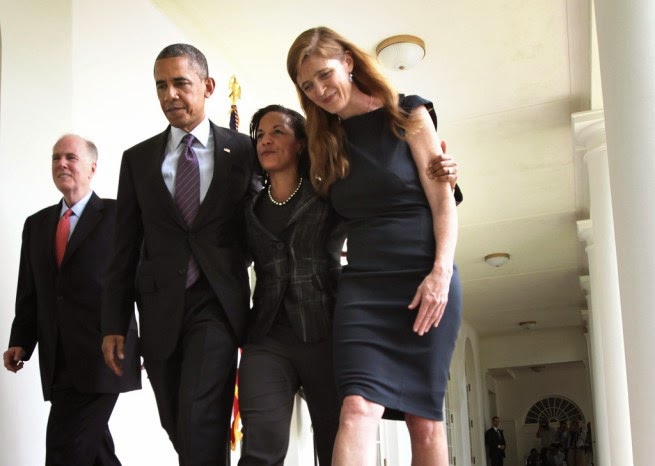
In her first appearance before the Senate Foreign Affairs Committee, Samantha Power, Obama’s pick for next U.S. Ambassador to the United Nations, made clear that she will spend her time in the role much as her predecessor Susan Rice did: acting as Israel’s consummate defender, fear-mongering about Iran, and opposing any move to champion Palestinian human rights or self-determination.
Rice, who has been appointed as Obama’s National Security Adviser, has said repeatedly that the American delegation to the UN “often works in ‘lockstep’ with the Israeli delegation” and spends “an enormous amount of time defending Israel’s right to defend itself and defending Israel’s legitimacy.”
“It’s an issue of utmost and daily concern for the United States,” she declared last year. A few months ago, she reiterated this point, insisting that her role as an apologist for the Israeli government is “a huge part of my work to the United Nations” and that the United States “will not rest in the crucial work of defending Israel’s security and legitimacy every day at the United Nations.”
Power has already proven herself a loyal replacement, disavowing any semblance of past critical thinking when it comes to Israeli human rights abuses and abrogation of international law and opposing fear-mongering about Iran’s nuclear program. It is no surprise Washington hawks and, even the Israeli government, are falling over themselves to sing her praises.
In her confirmation hearing yesterday, Power revealed her adherence to AIPAC talking points, essentially working her way down the tried and true list of boilerplate phrases. “The United States has no greater friend in the world than the State of Israel,” she said, adding, “Israel is a country with whom we share security interests and, even more fundamentally, with whom we share core values – the values of democracy, human rights, and the rule of law.”
“America has a special relationship with Israel,” she stated, to the surprise of no one and the consternation of George Washington‘s ghost. “I will stand up for Israel and work tirelessly to defend it,” she promised.
Perhaps her most disturbing comments, however, were about Iran. Shamelessly exploiting the horror of the Holocaust to fear-monger about the Islamic Republic, she declared:
“…within this organization built in the wake of the Holocaust – built in part in order to apply the lessons of the Holocaust – we also see unacceptable bias and attacks against the State of Israel. We see the absurdity of Iran chairing the UN Conference on Disarmament, despite the fact that its continued pursuit of nuclear weapons is a grave threat to international peace and security.”
With this statement, Power, in her eagerness to check off all the buzzword boxes prescribed by AIPAC, directly contradicts the consistent assessment of the United States’ own intelligence community, which has repeatedly concluded that Iran is, in fact, not pursuing a nuclear weapons as it has no nuclear weapons program.
Early last year, an unnamed U.S. intelligence official told the Washington Post that Iran has not decided to pursue nuclear weapons, explaining, “Our belief is that they are reserving judgment on whether to continue with key steps they haven’t taken regarding nuclear weapons.” At the time, Secretary of Defense Leon Panetta affirmed this position, admitting, “Are they trying to develop a nuclear weapon? No.”
Soon thereafter, the New York Times reported, “Recent assessments by American spy agencies are broadly consistent with a 2007 intelligence finding that concluded that Iran had abandoned its nuclear weapons program years earlier.” This, the paper noted, “remains the consensus view of America’s 16 intelligence agencies.”
Either Samantha Power is an idiot or she’s lying.
In fact, there was a time when Power wasn’t so confident in making such a declarative statement. In a 2008 interview with Miller-McCune, Power noted that she was “not an expert on Iran,” but condemned the “American sabre-rattling” of the George W. Bush administration. “The threats – implicit and explicit – of U.S. military action have united very diverse secular, Islamist and nationalist strands,” she said, adding that American “belligerence” had “backfired.”
When asked specifically about whether she thought “Iran is trying to create nuclear weapons,” Power replied, “It would surprise me if they weren’t, but I don’t know.”
Still, she disparaged the findings of the National Intelligence Estimate and simply assumed Iran “would see as in its interests to amass as much firepower as possible,” due to the foreign threats it faces. Nevertheless, she stated, “It does not seem as though the Iranian regime is close to possessing nuclear weapons” and said that “when U.S. leaders claim Iran poses an imminent threat, they are not currently heard as credible.”
Now, five years later, Power sounds exactly like Bush’s own UN Ambassador, perennial Iran hawk John Bolton, who in 2006, insisted to the UN Security Council that “Iran had defied the international community by continuing its pursuit of nuclear weapons” and that this “pursuit of nuclear weapons constituted a direct threat to international peace and security.”
Furthermore, Power’s incredulity regarding what she deems the “absurdity of Iran chairing the UN Conference on Disarmament,” betrays her own ignorance on Iran’s constantly repeated stance regarding nuclear nonproliferation and disarmament.
Iran has long championed a Nuclear Weapons Free Zone (NWFZ) in the Middle East and is a party to all disarmament treaties on weapons of mass destruction, including the Biological Weapons Convention, Chemical Weapons Convention, and the Nuclear Non-Proliferation Treaty. Israel, however, is not a member to any of them.
Last year, Iranian Foreign Minister Ali Akbar Salehi stated that Iran fully supports the establishment of a NWFZ, but that Israel, and its American backers, presented the “only obstacle to the creation of such a zone…due to its persistent refusal to join the NPT and to place its nuclear facilities under the IAEA safeguards system.” The United States consistently blocks crucial international conferences dedicated to nuclear non-proliferation for the sole purpose of protecting Israel’s massive nuclear arsenal from scrutiny.
Samantha Power has surely embraced her new role in Turtle Bay as Israel’s stalwart apologist.
Abe Foxman, the Anti-Defamation League’s hasbarist-in-chief, once called Susan Rice a “gladiator” fighting in the United Nations on behalf of Israel. There is no question Samantha Power will, for the sake of our “special relationship” and “shared values” with an aggressive, nuclear-armed, settler-colonial apartheid state, similarly take up the sword and continue to unleash hell on the entire Middle East.
Related articles
- Israel’s Nuke Arsenal Off-Limits (alethonews.wordpress.com)
- MEK Re-Ups 3 Year Old Nuclear Propaganda (alethonews.wordpress.com)
Benjamin & His Terrible, Horrible, No Good, Very Bad Lies: Netanyahu Cries ‘Wolf’…Again
By Nima Shirazi | Wide Asleep in America | July 16, 2013

“[An Iranian nuclear bomb] was a lot further away 15 years ago when I started talking about it. It was a lot further away 10 years ago. It was a lot further away five years. It was a lot further away five months ago. They are getting there, and they are getting very, very close.”
– Benjamin Netanyahu, March 7, 2012
“Red line, white line, black line and the like is for children. This is the level of this guy’s character.”
– Mahmoud Ahmadinejad, October 2, 2012
Israeli Prime Minister Benjamin Netanyahu took to the Sunday morning airwaves to spout tired talking points about the non-existent threat Iran’s safeguarded, civilian nuclear program poses to Israel, the United States, and presumably Neptune and Krypton.
In a renewed propaganda blitz, Netanyahu told CBS‘ Bob Schieffer on “Face the Nation” that Iran is getting “closer and closer to the bomb,” and resurrected a number of embarrassing phrases including “red line,” “credible military threat” and something about ticking clocks.
“They’re edging up to the red line,” Netanyahu said. “They haven’t crossed it yet. They’re also building faster centrifuges that would enable them to jump the line, so to speak, at a much faster rate – that is, within a few weeks.” He also said Iran is “building ICBMs [intercontinental ballistic missiles] to reach the American mainland in a few years.”
Dismissing the recent Iranian election as irrelevant to what he insists are devious Iranian intentions, Netanyahu called Hassan Rouhani, who will be inaugurated as Iran’s new president on August 3rd, “a wolf in sheep’s clothing,” whose maniacal strategy will be, “Smile and build a bomb.”
The media carried the news with headlines like “Israeli PM threatens to strike Iran” and “Israel Increases Pressure on U.S. to Act on Iran,” quoting Netanyahu as claiming that, when it comes to blah blah blah, “I won’t wait until it’s too late.” We’ve been here before.
It was boring then and it’s boring now.
“If sanctions don’t work, they have to know that you’ll be prepared to take military action — that’s the only thing that will get their attention,” Netanyahu said, suggesting that Iranians are subhumans who only understand grunts and shoves, rather than rational actors preserving and protecting their inalienable national rights and refusing to back down to offensive and illegal demands made by serially-aggressive nuclear-armed bullies.
Netanyahu urged the United States government to “make clear that the nuclear option” – whoops, Freudian slip of the war criminal’s tongue – “the military option which is on the table is truly on the table,” but lamented that there seemed to be “no sense of urgency” when it comes to stopping Iran from doing something every intelligence agency on the planet – including Israel’s – says it’s not doing.
The Israeli Prime Minister and his military and political acolytes, have repeatedly called for the United States to issue a “credible military threat” against Iran. Netanyahu did so again at a Cabinet meeting prior to his appearance on “Face the Nation.”
Threatening – let alone committing – an unprovoked attack on Iran is unquestionably a violation of the United Nations Charter.
Still, an obsession is an obsession and, at least, Netanyahu isn’t ashamed of being obsessed. “Iran is the most important, the most urgent matter of all,” he whined, before throwing up a silly hodgepodge of scary-sounding words in an attempt to be taken seriously. All the problems in the world – including Israel’s ongoing colonization of Palestine – won’t amount to a hill of beans, he cried, if the “messianic, apocalyptic, extreme regime” in Tehran acquires “atomic bombs.” Such a ghastly scenario would present “a terrible, catastrophic change for the world and for the United States,” he said, because the United States apparently isn’t part of the world. (Actually, considering the isolation the United States and Israel – along with lackey states like Palau and Micronesia – face in the United Nations, Netanyahu may be on to something here.)
Of course, the often-repeated assessment of the U.S. intelligence community that Iran is not actually building a bomb and has no nuclear weapons program went unmentioned, as did the fact that Iran has supposedly been “a year or so” away from developing nuclear weapon for roughly a decade now.
Unsurprisingly, “Face the Nation” host Bob Schieffer challenged none of Netanyahu’s assertions; all the warmongering and propaganda was given a free pass. This is especially bizarre considering, in January 2012, then-Defense Secretary Leon Panetta told Schieffer on the same program, “Are they trying to develop a nuclear weapon? No.”
Netanyahu has been leading the charge against Iran since the mid-1990s, warning of weapons programs that don’t exist and calling for sanctions and explicit military threats. His talking points since then literally have not changed – and are identical to those he used to encourage the United States to invade Iraq a decade ago.
Here’s a reminder of why the Israeli Prime Minister’s CBS interview may actually have been a rerun:
The suggestion that Iran would soon be in possession of, or be in a position to quickly manufacture, nuclear weapons has been in constant circulation for nearly three decades. In 1984, Iran was reportedly moving “very quickly” towards a nuclear weapon and could have one as early as 1986. By the early 1990’s, the CIA predicted Iran was “making progress on a nuclear arms program and could develop a nuclear weapon by 2000,” later changing their estimate to 2003.
Israeli estimates have always been of an especially hysterical quality. In March 1992, The Jerusalem Report, noting that “Israel keeps a wary watch on Teheran’s march to the Bomb,” predicted that, “[b]y the year 2000, Iran will almost certainly have the Bomb.”
A few months later, Israeli Major General Herzl Budinger insisted that, unless “Iran’s intensive effort to develop atomic weapons is not ‘disrupted,'” it would “become a nuclear power by the end of the decade.” Then-Israeli Foreign Minister Shimon Peres shared similar assessment later that year.
On November 8, 1992, the New York Times reported Israel was confident Iran would “become a nuclear power in a few years unless stopped.” An Israeli “senior army officer” feared “the Iranians may have a full nuclear capability by the end of the decade.”
In March 1993, a Washington Post report headlined “Israel seeking to convince U.S. that West is threatened by Iran” noted that Israeli leaders attempting to push their American counterparts into taking a stronger stance on Iran. The article quoted then-Israeli Prime Minister Yitzhak Rabin warning of “megalomaniacal” Iran intent on establishing “a Middle East empire.”
The alarm was still ringing a couple of years later when, on January 11, 1995, Benjamin Netanyahu told a nearly empty Knesset hearing that “within three to five years, we can assume that Iran will become autonomous in its ability to develop and produce a nuclear bomb, without having to import either the technology or the material.”
His solution to this crisis? “[The nuclear threat] must be uprooted by an international front headed by the U.S. It necessitates economic sanctions on Iran,” he declared.
By 1996, Israeli assessments put an Iranian nuclear bomb four years away. One year later, they confidently predicted it would happen by 2005. By mid-2001, Israel was still holding fast to its 2005 deadline and reaffirmed such a warning in 2003.
By 2004, however, an Israeli intelligence report determined that “within three years Iran would have the means to produce an atomic bomb by itself.” In 2005, Israel’s Defense Minister Shaul Mofaz said Iran was “less than one year away.” At the same time, Israeli Military Intelligence’s prediction was 2007, then 2008, later revised to 2012, then returned to 2008. In 2007, Israeli Military Intelligence said Iran would become nuclear weapons capable by mid-2009. A year later, the 2009 threshold referred to “an operable nuclear weapon,” rather than just capability.
When 2009 rolled around, then-Prime Ministerial candidate Benjamin Netanyahu told an American Congressional delegation that Israeli “experts” determined Iranian nuclear weapons capability “was probably only one or two years away,” while Israeli Defense Minister Ehud Barak put the window of opportunity to stop Iran from acquiring nuclear weapons at a mere six to 18 months. At the time, Mossad chief Meir Dagan insisted, “the Iranians will have by 2014 a bomb ready to be used, which would represent a concrete threat for Israel.”
Later that same year, Brigadier General Yossi Baidatz, “argued that it would take Iran one year to obtain a nuclear weapon and two and a half years to build an arsenal of three weapons. By 2012 Iran would be able to build one weapon within weeks and an arsenal within six months.” A month later, Netanyahu said, “Iran has the capability now to make one bomb or they could wait and make several bombs in a year or two.”
By 2010, some Israeli officials said Iran was only a year away from a bomb, some said it “one to three years away from having a breakout nuclear capability,” and others said it still had seven years to go. An unnamed “Israeli policy maker” revealed to Jeffrey Goldberg that Iran would have a nuclear weapon “nine months from June – in other words, March of 2011.” In early 2011, the prediction jumped to 2015.
Nevertheless, a year later, the Times of London claimed an Israeli security report assessed Iran may become a nuclear power “within a year,” a conclusion subsequently confirmed by Ehud Barak. Six months later, in mid-2012, Barak suggested that Iran would take “several years” for Iran to “turn nuclear.” Shortly thereafter, Netanyahu reportedly put the “red line” of Iranian nuclear capability at just “a few months away,” later telling the United Nations in September (along with his trusty cartoon bomb drawing) that Iran would have “enough enriched uranium for the first bomb” by mid-to-late 2013. By October, Ehud Barak added an extra “eight to 10 months” to the timeline.
Accompanying all of these predictions, of course, have been fever-pitched threats of an ever-imminent Israeli military strike on Iran and its nuclear infrastructure. In 2012, the predictions of such an illegal assault were especially incessant. Not a month went by without hysterical rumors of a new Middle East war in the offing.
This past January, a new prediction emerged. McClatchy Newspapers reported that “Israeli intelligence officials now estimate that Iran won’t be able to build a nuclear weapon before 2015 or 2016, pushing back by several years previous assessments of Iran’s nuclear ambitions.” The report is based on “[i]ntelligence briefings given to McClatchy over the last two months” which “confirmed that various officials across Israel’s military and political echelons now think it’s unrealistic that Iran could develop a nuclear weapons arsenal before 2015. Others pushed the date back even further, to the winter of 2016.”
In early March 2013, Netanyahu claimed that “Iran is getting closer” to his self-determined “red line” of nuclear weapons capability and is “putting itself in a position to cross that line very quickly once it decides to do so.” Later that same month, in a joint press conference in Jerusalem with President Obama, Netanyahu warned of “Iran’s relentless pursuit of nuclear weapons” before reiterating his position that “in order to stop Iran’s nuclear programs peacefully, diplomacy and sanctions must be augmented by a clear and credible threat of military action.” Soon thereafter, the Israeli press publicized claims by anonymous Israeli officials that “Iran could have the capability to build a nuclear bomb by July.”
Well, it’s July, so Netanyahu tells us Iran is getting “closer and closer.”
Sadly, Netanayhu’s tired propaganda never seems to elicit the glazed-over, yawning-inducing dismissal from the U.S. press that it so sorely deserves; rather, he gets to schedule high-profile interviews on major networks whenever he wants to reissue his warmongering bromides.
A diplomatic cable sent from sent from the U.S. Embassy in Tel Aviv in 2005, published by Wikileaks, noted that, despite Israeli warnings that Iran would reach a critical nuclear weapons capability within six months, some Israeli “officials admitted informally that these estimates need to be taken with caution. The head of the MFA’s [Ministry of Foreign Affairs] strategic affairs division recalled that GOI assessments from 1993 predicted that Iran would possess an atomic bomb by 1998 at the latest.”
Another cable from 2009 wondered whether “the Israelis firmly believe” their hysterical predictions about Iran’s nuclear progress “or are using worst-case estimates to raise greater urgency from the United States).”
In truth, Netanyahu himself is increasingly viewed as an Israeli Chicken Little. In early 2013, McClatchy Newspapers reported that Israeli officials “have said there’s a widening gulf between Netanyahu’s remarks and the intelligence reports he receives,” and quoted one unnamed “intelligence officer” as wondering, “Did we cry wolf too early?”
While the alarmism will surely continue unabated, the answer is obvious.
Related articles
Featured Video

New positive ivermectin evidence
or go to
Aletho News Archives – Video-Images
From the Archives
Fanatical Followers of the Covid Regime: A Jim Jones-Style Cult?
By Professor Roger Watson and Dr. Niall McCrae | The Daily Sceptic | November 15, 2021
As scholars at leading British universities over recent decades, we witnessed the replacement of critical thinking and debate by narrative: facts are discrimination and scientific method is imperialism; truth, instead, is derived from ‘progressive’ values. This educational trend may be a major contributory factor to the ease in which society has been inculcated to the Covid ‘new normal’ of masking, testing, and repeated doses of vaccines for a disease of similar risk to severe influenza.
One doesn’t need much critical reasoning to observe the flawed logic of some vaccination enthusiasts, such as people who respond to experiencing any side effects, however debilitating, by saying “at least I know it’s working”, or, after contracting the disease despite their promised inoculation (over 90% effective, according to initial drug company claims), “I’d have been worse off without the jab.” … continue
Blog Roll
 Aletho News
- EU Council Advances Chat Control 2.0 Scanning Proposal
- Ex-Greek MEP files complaint against Israeli spyware firm over alleged Pegasus surveillance
- Troubling ideas throughout the Torah, Talmud, Mishneh Torah and Tanya
- ‘Grave, alarming’: Iran mission on Trump’s UNGA ‘annihilation’ threats
- Najaf airport to reopen to Iranian flights within 24 hours: Ambassador
- From ‘How Will This End For Iran’ to ‘When America Walks Away’: A tale of two Economist covers
- Tehran blasts ‘baseless’ speculation linking Iran to alleged bomb plot at UK air base
- The Rise And… Rise Of ‘Color Revolutions’
- The Coming GOP Bloodbath?
- Arctic Scare Stories Melt Away
- If Americans Knew
- Netanyahu Asked UAE Leader to Deny Report on Oct. 7 Warning in Secret Visit, Sources Say
- CNN Chief Int’l Correspondent Clarissa Ward on Journalists in Gaza
- Democratic Party Consultants Surround Troy Jackson with Pro-Israel Donors
- Christian Leader Responds To Netanyahu’s Claims Regarding Palestinian Christians
- In Gaza, ‘Whoever Survives the Bombing Won’t Survive the Rubble’
- Israel kills more Palestinians, amid push to resettle Gaza – Daily Update
- Israel forces Gazans to live in constant peril – Daily Update
- Deconstructing Netanyahu’s pants-on-fire UN rant – Daily Update
- Trump betrayed voters with his campaign lies and prioritized a foreign country once he took office
- Netanyahu calls Israel’s war in Gaza ‘opposite of genocide’ in UN speech to near-empty hall
- No Tricks Zone
- New Study: Earth And Venus Surface Warmth Largely Explained By Convection And Lapse Rate, Not CO2 Or Radiation
- 2025 Nature Paper Claiming Worsening Global Drought Gets RETRACTED …Heavily Flawed
- New Study: ‘Global Drought Shows No Detectable Recent Acceleration Under Climate Warming’
- Economic Masterminds: German Socialists Suggest Taxing Productivity Gains Stemming From Using AI
- The South China Sea Has Not Been Cooperating With The Climate Change Narrative
- Energy Crisis: Germany Enters Heating Season With Historically Low Gas Reserve Fill Levels
- New Study: The Antarctic Ice Sheet Gained Mass From 2020-2024 Due To Staggering Snow And Ice Accumulation
- Study: Ocean Heating Rates From Thousands Of Years Ago ‘Dwarf’ Modern Ocean Heating Rates
- Climate Extremists Target, Attack Large-Scale Power Grid Infrastructure In Germany!
- New Study: Antarctic Ice Melt Has Contributed Less Than 1 Centimeter To Sea Level Rise In The Last 30 Years

