WikiLeaks: Advancing an Israeli Agenda?
By Maidhc Ó Cathail | Intifada Palestine | December 11th, 2010

Like 9/11, WikiLeaks has been singularly good for Israel.
Asked on the night of September 11, 2001 what the terrorist attacks meant for U.S.-Israel relations, Benjamin Netanyahu, the then former prime minister, tactlessly but accurately replied, “It’s very good.” And on the day after WikiLeaks’ publication of U.S. diplomatic cables, Netanyahu “strode” into a press conference at the Israeli Journalists Association, looking “undoubtedly delighted” with the group’s latest embarrassment of U.S. President Barack Obama.
“Thanks to WikiLeaks,” Aluf Benn wrote in Haaretz, “there is now no fear Washington will exert heavy pressure on Israel to freeze settlement construction or to accelerate negotiations on a withdrawal from the territories.” Instead, also courtesy of WikiLeaks, the world’s attention had been shifted exactly where a “vindicated” Netanyahu wanted it – toward Iran’s non-existent nuclear weapons programme.
“Our region has been hostage to a narrative that is the result of 60 years of propaganda, which paints Israel as the greatest threat,” Netanyahu told the assembled journalists. “In reality leaders understand that that view is bankrupt. For the first time in history there is agreement that Iran is the threat.” While there is considerable dispute about the extent to which Arab leaders share Netanyahu’s understanding of “the Iranian threat,” the Arab public overwhelmingly considers Israel to be a far greater threat.
Nevertheless, according to Haaretz columnist Ari Shavit, Julian Assange “has shattered the accepted dogma on the understanding in the Middle East in the 21st century.” WikiLeaks, crowed Shavit, “proved” that the Israeli occupation and colonisation of Palestine was not the main cause of instability in the Middle East. Instead, the secret cables “revealed” that “the entire Arab world” is concerned about “one problem only — Iran, Iran, Iran.” Thus, Shavit concluded, the only way to bring peace to the region was to deal with “Iran first.”
Strangely, the WikiLeaks founder Julian Assange seems to accept the Israeli vision of “war is peace” in the Middle East. In an interview with Time magazine, Assange singled out Netanyahu as an example of a world leader who believed the publication of Arab leaders’ provocative privately expressed comments “will lead to some kind of increase in the peace process in the Middle East and particularly in relation to Iran.”
Even more puzzling, Assange had an op-ed piece in Rupert Murdoch’s The Australian, in which he quoted something the media mogul had written in 1958: “In the race between secrecy and truth, it seems inevitable that truth will always win.” In choosing another pro-Israel apologist as a model of transparency, is it possible that Assange is ignorant of the key role played by Murdoch’s media empire in propagating the lies that led the New York Times to dub the war in Iraq “Mr. Murdoch’s War”?
Assange seems equally oblivious to the significant contribution made by the New York Times itself to the war whose conduct he now claims to oppose. On September 8, 2002, the paper of record led with a front-page story by Judith Miller and Michael Gordon, which falsely claimed that Saddam Hussein was seeking to buy aluminium tubes as part of its “worldwide hunt for materials to make an atomic bomb.” As Michael Massing later wrote, “In the following months, the tubes would become a key prop in the administration’s case for war, and the Times played a critical part in legitimizing it.” Chosen by Assange to publish its leaked documents because it is one of “the best newspapers in the world for investigative research,” the pro-Israel Times is now busily spinning the leaks to push America into an equally unnecessary but even more disastrous war with Iran.
Given that the WikiLeaks revelations have been such an unexpected “diplomatic coup” for Israel, its American lobby appears to be strangely divided over the issue. On one side, there are those like David Frum, Jeffrey Goldberg, and Michael Ledeen who delight in being able henceforth to cloak their incessant Iran warmongering behind a specious Arab cover. “Those who suggest that it’s some ‘Israel lobby’ or Jewish cabal that is driving the confrontation with Iran” should be embarrassed by the leaks, writes Frum. “WikiLeaks confirms that the region’s Arab governments express even more anxiety than Israel about the Iranian nuclear weapons program.”
Meanwhile, the most virulent attacks on WikiLeaks have come from some of Israel’s staunchest supporters. William Kristol, editor of Rupert Murdoch’s Weekly Standard, wants Congress to enable Obama to “Whack WikiLeaks.” Dianne Feinstein, chairman of the Senate Intelligence Committee, and Joe Lieberman, chairman of the Senate Homeland Security Committee, appear only too willing to oblige. Both senators have called for the prosecution of Assange under the 1917 Espionage Act. Feinstein is also working with Senator Charles Schumer on media legislation that would allow the prosecution of organizations like WikiLeaks.
How do we reconcile the Israel lobby’s apparently schizophrenic reaction to WikiLeaks? Could it be that Julian Assange has killed two birds for Israel with one document dump?
Thanks to WikiLeaks, the well-publicised remarks of a few Arab leaders provide much-needed cover for pro-Israelis as they relentlessly press America to whack Iran. At the same time, the disclosure of U.S. diplomatic secrets has given the likes of Joe Lieberman another excuse to “kill the internet” — to prevent Americans from ever finding out how they got into such a mess in the Middle East.
But just like 9/11, no matter how much WikiLeaks has benefited Israel, most observers still seem loath to consider the Tel Aviv connection.
Maidhc Ó Cathail writes extensively on U.S. foreign policy and the Middle East.
Israel, NATO Launch Spying Operation against Iran at Afghan Borders
FARS NEWS AGENCY | December 7, 2010
TEHRAN – A prominent Afghan military analyst unveiled that Israel has deployed its troops at a NATO base in Afghanistan near Iran’s border to launch joint operations against the Islamic Republic.
Speaking to FNA about NATO’s $184 million plan to upgrade Shindand Air Base in Western Afghanistan and 20 miles from the Iranian border, Javid Kohestani said, “The NATO member states are reconstructing the base in a bid to harm the Islamic Republic of Iran and to spy against Iran.”
He recalled previous reports about the deployment of Israeli forces in Shindand base, and noted, “Accordingly, the reconstruction of the base by the NATO is considered as one of the NATO’s clandestine programs to harm the Islamic Republic of Iran and promote Israel’s spying activities in the region.”
Kohestani believes that the base has been handed to Israel for conducting sabotage operations in Iran’s eastern regions.
The United States and NATO have 150,000 troops in Afghanistan, following a military surge ordered by President Barack Obama.
Senior Iranian security officials have always underlined that the terrorists who carried out terrorist attacks in Iran’s Southeastern province of Sistan and Balouchestan had certainly been funded by certain foreign countries.
WIKILEAKS REPRISED — A WHIFF OF…WHAT?
From what the press is reporting about this Wikileaks “dump,” perhaps 10% are Secret or Confidential, the rest Unclassified, and nothing is Top Secret or above.
ALAN SABROSKY – My Catbird Seat – December 8, 2010
I have followed the unfolding teapot-tempest drama of the latest Wikileaks release with a certain bemusement, accompanied by a growing suspicion shared with others that all is not as it seems with these supposed revelations. But my initial impression, based of course on what I am reading in the mainstream and alternative media and not in the cables themselves, is that it is surprising how little damaging material is there about much of the world. Secretary Clinton cannot be happy at having the UN people know what she told her people there to do, of course, and there is a great deal to whet assorted salacious appetites. More substantive issues will doubtless emerge, but I expect most if not all to be embarrassing rather than destructive.
The Cables
Perhaps the principal reason for this largely titillating, trivial aspect of so many of the released cables is the cables themselves. It is worth understanding that in the US government, even material that is taken from newspapers and clipped together can end up being classified “Secret” or “Confidential.” Really important or sensitive material (as in truly “national security” sensitive) is classified “Top Secret” or above.
From what the press is reporting about this Wikileaks “dump,” perhaps 10% are Secret or Confidential, the rest Unclassified, and nothing is Top Secret or above. This reflects the VERY low-level diplomatic “gossip column” character of much of what has been released and discussed in the media so far. But I suspect the general reaction of politicians and diplomats everywhere, all of whom send the same type of cables about others, will be a blend of public umbrage and private amusement, coupled with overtures to Ukraine for nursing support.
The Middle East Exception
The one striking exception in all of this global tour de farce <sic.> is the Middle East. Certainly, even aside from Wikileaks founder Julian Assange’s fulsome praise of Binyamin Netanyahu, what is said and what is not represent the message Israel and its partisans in the US Government (itself heavily Zionist and “Israel First” in orientation) want the world to hear, believe and accept. The message coming across in the US diplomatic cables could have been designed and drafted by Avigdor Lieberman, and who knows? It may have been….
The overt theme in the Middle East cables consists of a blend of attacks on prominent political figures in Turkey and Iran, coupled with critical and disparaging commentaries about their actual or alleged policies and ambitions. One might think that the architects of the Ottoman and Persian Empires in their times of splendor were simultaneously on the move again, with everything between them (except poor, brave, steadfast and enduring Israel, of course) trembling in fear and awe.
Complimenting this is a region-wide belief attributed to many Arab leaders of the need for stronger action, including military strikes, to thwart Iran’s regional and especially nuclear ambitions — precisely what Israel has been saying all along. Now, this may be true. I know, for example, that the Sunni leadership in many of those countries have their own concerns about Iran, just as Iran’s current leadership have with some of them.
But at least two things cause me to question this supposed thesis. One is the odd attribution in at least one of the cables to an Arab leader of a remark on Iran being an “existential threat.” Yet no one except Israel and its proponents refer to any other country as an “existential threat” to anyone, suggesting quite clearly that either some of the released cables regarding Iran are forgeries, or they were deliberately cast in terms to create an impression that Arab leaders really want the US and/or Israel to attack Iran, true or not.
And the Israeli Exception
The other part of the covert theme is the apparent absence of anything tough on Israel, which means that anything of the sort is Top Secret or better, was excised from the cables that were released, or simply doesn’t matter at all to anyone in or out of the Middle East. The Arab nations for many years have feared a real nuclear threat from Israel, not a fabricated threat by Iran, but nothing like that comes across, despite 60-plus years of hostility from most to Israel and its ambitions.
Far more significant to me is the utter lack to date of scathing commentaries on Israel and its policies, leadership and actions from SOMEWHERE in the world. Even if Arab leaders felt there was no point in doing so with the Americans, most others would not feel so constrained. Something surely must have come to the attention of the US ambassadors to (e.g.) Turkey, South Africa, Brazil and Ireland, just to name a few of the many who have bitterly condemned Israel, and especially the disgusting duo of Netanyahu and Lieberman to say nothing of their predecessors, for what they have done to Palestine and the Lebanon; for Operation Cast Lead; for the settlements; for flagrant violations of UN Resolutions and the murder of UN officials; for Israel’s hostility to the Goldstone Report; for the blockade; for land expropriation; and for sheer thuggery and brutality.
Surely something so scathing would have been communicated back to Washington, alongside which Iran and its president would come off smelling like several bouquets of roses — slightly wilted roses, perhaps, but vastly better than the Israeli stinkpot.
Reprise
But nothing like that is there, or at least has yet surfaced, which makes me increasingly inclined to see this as just another game of rhetorical smoke and mirrors, with a lot of real cables and real victims (like the poor US soldier who presumably gave Assange at least some of the cables), but with many or most of the Middle East cables “cooked” if not fabricated outright.
So these, at least, are probably the handiwork of Israeli-Americans or just Israelis putting their own spin on things, included in a mass of otherwise legitimate cables as camouflage and for validation. An Australian news website concluded that “[the] WikiLeaks cables [are] the 9/11 of world diplomacy.” Too, too true – same source, different vehicle and venue, all helping pave the road to yet another needless war in Israel’s service, this time against Iran. The gods weep — but not, presumably, Yahweh.
Alan Sabrosky (Ph.D, University of Michigan) can be contacted at docbrosk@comcast.net
Hasbara at Work: Oren Promotes Fantasies
By Ira Glunts | Palestine Chronicle | December 6, 2010
Three years ago I heard the American-born Israeli Michael B. Oren promoting his new book Power, Faith and Fantasy: America in the Middle East, 1776 to the Present at a university near my home in upstate New York.
Oren is a tall, good looking man who radiated a quiet confidence. His book had the truly fanciful goal of showing that the intense American involvement in the Middle East and especially our engagement with the idea of a renewal of Jewish sovereignty in the region was not a recent development. Oren claimed that both the Zionist idea and the friction between Americans and Muslims is an important and persistent narrative thread running through American history from very early times. For instance, he describes the military confrontations of a young American republic with the Barbary pirates as the first battles in what we now call the “War on Terror.” My own conclusion after reading his book, was that Oren’s role as a conservative Israeli think-tanker had completely subsumed any desire he may have had to be an honest American historian. I assumed that he believed that this was a good career move for someone who simultaneously lived in Israel and taught at Yale University. At that point this apparently mild-mannered, obviously intelligent scholar seemed harmless enough. Of course, it was impossible to have known then that Oren would become Prime Minister Binyamin Netanyahu’s ambassador to the United States.
Last week Michael Oren, as Israeli Ambassador to the United States, visited Atlanta in order to lay a wreath upon the grave of slain civil rights leader Dr. Martin Luther King. In addition to the wreath, Oren used his Atlanta visit to lay some of his country’s particularly odious hasbara (meaning public relations, some say propaganda) upon no doubt unsuspecting Georgians.
According to Martha Dalton of Atlanta radio station WABE, Oren exploited the ceremony honoring King by making a statement about the imminent danger Iran’s nuclear program presents to both Israel and the rest of the world. This is far from a universally accepted claim, but after having it repeated enough times in the U.S. media, most accept it as fact. The ambassador also expressed concern about fallout from the recent Wikileaks release of thousands of diplomatic cables, some of which were embarrassing to Israel. [Oren’s fantasy world hasbara at work]
In an opinion piece in the Atlanta Journal-Constitution on November 26 entitled “A 63-Year Search For Mideast Peace” Oren took full advantage of the leeway American newspaper editors give to public figures and especially to pro-Israel columns. According to Oren, Israel has been engaged in a 63-year struggle to make its neighbors and those it expelled from its territory understand that all it has ever wanted is to peacefully share the land it claims for itself with its indigenous population.
The United Nations voted to partition what is now Israel 63 years ago into Jewish and Palestinian states. The wisdom of this decision, which was rejected by the region’s Arab governments and populations, is very much in question today. However to Oren, whose views reflect his own blind faith in Israeli power and a generous serving of fantasy, the partition decision (UN resolution 181) expresses the incontestable truth that “[t]he Arab world was to welcome the Jews, after 2,000 years of exile back to their homeland.”
Surprisingly, at least according to Oren, the Arabs did not understand the imperative that they were morally obligated to welcome the Zionists and their proposed Jewish State on lands upon which the Palestinians had lived for centuries. A war ensued, in which according to Oren (repeating one of the favorite false claims of countless pro-Israel propagandists) “the weakly-armed Israeli defenders defeated the much stronger Arab armies.” This description is on its face false. Of course, the stronger army won, do you think it was God who made the Israelis triumph despite their weakness? (For an extensive and detailed description of the relative military strengths of both sides in the 1948 War see the Israeli historian, Benny Morris’ The Birth of the Palestinian Refugee Problem, 1947-1949.)
Continuing to mercilessly ladle on the hasbara (which literally means explanation in Hebrew), Oren writes that despite the Palestinians’ history of rejection of continuous Israeli goodwill, his government persists in reaching out with generous peace proposals. The ambassador points to examples of Palestinian recalcitrance in their refusal to accept the Israeli offers of “full statehood” in 2000 and 2008. The reader is not told how full statehood for the Palestinians is compatible with Israeli control of Palestinian water sources, no foreign policy, no army, and Israeli overflight rights among many other crippling limitations, which are conditions upon which the Israelis always insist. Oren also neglects to mention that this “generous offer” of statehood does not now include Gaza nor its democratically-elected government.
To this point Oren’s op-ed had been a rehash of the Israeli and pro-Israel lobby talking points. But suddenly and unexpectedly the mild mannered ex-historian turned diplomat seeks to incite his audience with an original gem of hasbara. Oren declares, “Hamas …[is a]… group dedicated to the murder of all Israelis – indeed all Jews worldwide.”
Hamas is a political party and a social service organization which was democratically elected to rule the Palestinian territories. It also is a liberation and resistance movement which has employed violence against the Israeli army of occupation, the illegal Israeli settler/colonists, and ordinary Israeli civilians. However, the general statement that Hamas is dedicated to the murder of all Israelis is as valid as saying that the Israeli occupation army is dedicated to killing all Palestinians. The second charge, that Hamas is dedicated to killing all Jews worldwide is as fantastic as Oren’s claim in Power, Faith and Fantasy that the American founding-fathers were proto-Zionists who spent inordinate amounts of resources fighting implacable Muslim enemies. Actually, Hamas explicitly rejects the use of violence against targets outside the occupied territories and Israel. Its behavior has reflected that policy.
Before Oren went to Atlanta he made an appearance at the Jewish Federations General Assembly in New Orleans. In addressing the assembly, Oren urged American Jews to make it a priority to ensure that US politicians continue to give Israel “bipartisan support” even if these same American Jews may believe that Israel’s policies are wrong. Oren insisted that it is not only the duty of American Jews to fall into line with Israel’s wishes, but he further declared, “we [Israelis] expect American Jews to refute” any criticism of Israeli policy.
Ambassador Oren wants American Jews to become hasbara agents who blindly follow Israeli government policy while simultaneously inciting them with false fears of being murdered by what for them is a totally imagined enemy. In assuming his new diplomatic role, Michael B. Oren has, unfortunately, been given the authority and platform to promote fantasies about which he could only theorize, three years ago, when I heard him merely urging his audience of college students to buy his book.
– Ira Glunts first visited the Middle East in 1972, where he taught English and physical education in a small rural community in southern Israel. He was a volunteer in the Israeli Defense Forces in 1992. Mr. Glunts lives in Madison, New York where he operates a used and rare book business, writes and is a part-time reference librarian. Contact him at: gluntsi[at]morrisville[dot]edu.
START for Israel; START against Iran
Ali Gharib | Lobe Log | November 22nd, 2010
Earlier today on National Review’s The Corner blog, Foundation for Defense of Democracies head honcho Cliff May wrote:
I’m now hearing from more than one source on the Hill that the Obama administration has just added a new argument in favor of lame-duck ratification: failure to adopt START will “hurt Israel.”
May demurs, naturally (the New START is an Obama Administration initiative, after all), then tells a joke, sets up a straw man, and knocks it down. May thinks the Obama administration scare tactic will be that without START, Russia’s nukes will start “somehow leaking out and getting into the hands of Iran’s bad boys or other terrorists.”
But that wasn’t the Israel angle played by Jewish groups later in the day — though their tack does have something to do with Iran.
Laura Rozen reports for Politico:
Both the Anti-Defamation League (ADL) and the National Jewish Democratic Council (NJDC) cited the importance of passage of the U.S.-Russian nuclear arms reduction treaty in order to maintain American-Russian cooperation in countering the Iran nuclear threat.
“We are deeply concerned that failure to ratify the New START treaty will have national security consequences far beyond the subject of the treaty itself,” the ADL said in a letter sent to every Senator Friday.
“The U.S. diplomatic strategy to prevent Iran from developing nuclear weapons requires a U.S.-Russia relationship of trust and cooperation,” ADL continues. “The severe damage that could be inflicted on that relationship by failing to ratify the treaty would inevitably hamper effective American international leadership to stop the Iranian nuclear weapons program.”
The New START treaty may indeed be a necessary step for global security, but questions should be raised about linking it to Iran. This support by pro-Israel groups may prove to haunt U.S. policy towards Iran in the future.
One might compare this tack in pushing START to the sort of message Benjamin Netanyahu took away from meeting with Barack Obama about engaging in Palestinian-Israeli peace talks: that getting the job done (or at least getting to the table) will help the U.S. isolate Iran and contain its nuclear ambitions.
How many of these bargains can Obama enter into before he must pay the piper and make the ultimate escalation against Iran? If the diplomatic strategy fails, then what?
Perhaps this is pointing out the obvious: Something is truly amiss when a treaty to limit nuclear proliferation is being sold as the way to defend and protect a country that has an ever expanding — and clandestine — nuclear arsenal.
Update:
Obama Pushes START Treaty to Top of Legislative Agenda
By Jim Lobe | IPS | December 2, 2010
WASHINGTON – With time running out before he faces a much more hostile and Republican Congress, President Barack Obama appears to have made Senate ratification of the pending New Strategic Arms Reduction Treaty (START) with Russia his top legislative priority.
Not only has he bowed to Republican demands to allocate more money for Washington’s nuclear arms programme, but he has suggested that he’s also willing to cave in to Republican demands to extend tax cuts for high-income households – despite record federal deficits – in order to gain START ratification.
And he’s getting considerable help from big guns in what remains of the Republican foreign policy Establishment, including five former secretaries of state whose service spanned the last five Republican administrations.
In an op-ed heralded by the White House on the eve of its publication in Thursday’s Washington Post, former secretaries Henry Kissinger, George Shultz, James Baker, Lawrence Eagleburger and Colin Powell concluded that the New START was “clearly in our national interest” and should be ratified. […]
Obama, who had promised during the 2008 election campaign not to raise taxes on households earning 250,000 dollars a year or less, had hoped that allowing the cuts to expire on those earning more than that would help cut the federal deficit by several hundred billion dollars over the next few years.
His apparent willingness to compromise on this issue in order to secure START is causing growing dismay among his supporters. … Full article by Jim Lobe
WIKILEAKS – MORE ISRAELI GAME THEORY WARFARE?
When waging intelligence wars, timing is often the critical factor for game-theory war planners. The outcome of the WikiLeaks release suggests a psy-ops directed at the U.S.
By Jeff Gates | My Catbird Seat | December 1, 2010
“The United States is the real victim of WikiLeaks. It’s an action aimed at discrediting them.” Franco Frattini, Foreign Minister of Italy
The impact of the WikiLeaks release of diplomatic cables fits the behavior profile of those well versed in game theory warfare.
When Israeli mathematician Robert J. Aumann received the 2005 Nobel Prize in economic science for his work on game theory, he conceded, “the entire school of thought that we have developed here in Israel” has turned “Israel into the leading authority in this field.”
The candor of this Israeli-American offered a rare insight into an enclave long known for waging war from the shadows. Israel’s most notable success to date was “fixing” the intelligence that induced the U.S. to invade Iraq in pursuit of a geopolitical agenda long sought by Tel Aviv
When waging intelligence wars, timing is often the critical factor for game-theory war planners. The outcome of the WikiLeaks release suggests a psy-ops directed at the U.S.
Why now? Tel Aviv was feeling pressure to end its six-decade occupation of Palestine. With this release, its foot-dragging on the peace process was displaced with talk of an attack on Iran.
While the U.S. bore the brunt of the damage, the target was global public opinion. To maintain the plausibility of The Clash of Civilizations, a focus must be maintained on Iran as a credible Evil Doer.
With fast-emerging transparency, Israel and pro-Israelis have been identified as the source of the intelligence that took coalition forces to war in Iraq. Thus the need to shift attention off Tel Aviv.
WikiLeaks may yet succeed in that mission.
Foreseeable Futures
Game theory war planning aims to create outcomes that are predictable—within an acceptable range of probabilities.

That’s why Israeli war planners focus on gaining traction for a plausible narrative and then advancing that storyline step by gradual step.
For the Zionist state to succeed with its expansionist agenda, Iran must remain at center stage as an essential villain in a geopolitical morality play pitting the West against Islamo Fascists.
To displace facts with false beliefs—as with belief in the intelligence that induced the invasion of Iraq—momentum must be maintained for the storyline. Lose the plot (The Clash) and peace might break out. And those deceived may identify the deceiver.
Thus the timing of this latest WikiLeaks release. Its goal: to have us believe that it is not Tel Aviv but Washington that is the forefront of geopolitical duplicity and a source of Evil Doing.
Intelligence wars rely on mathematical models to anticipate the response of those targeted. With game theory algorithms, reactions become foreseeable—within an acceptable range of probabilities.
Control enough of the variables and outcomes become a mathematical inevitability.
The WikiLeaks Motive
Was the reaction to this latest WikiLeaks foreseeable? With exquisite timing, the U.S. was discredited with an array of revelations that called into question U.S. motives and put in jeopardy U.S. relations worldwide.
As the Italian Foreign Minister summarized: “The news released by WikiLeaks will change diplomatic relations between countries.”
The hard-earned trust of the Pakistanis disappeared overnight. Attempts to engage Iran were set back. The overall effect advanced The Clash storyline. If Washington could so badly misread North Korean intentions, then why is the U.S. to be trusted when it comes to a nuclear Iran?
This Wiki-catalyzed storyline pushed Israel off the front page in favor of Iran.
Even U.S. detainees at Guantanamo are again at issue, reigniting that shameful spectacle as a provocation for extremism and terror. U.S. diplomats will now be suspected of spying and lying. What nation can now trust Americans to maintain confidences?
In short, the risks increased for everyone.
Except Israel.
Should Israel launch an attack on Iran, Tel Aviv can cite WikiLeaks as its rationale. Though an attack would be calamitous from a human, economic and financial perspective, even that foreseeable outcome would be dwarfed by the enduring hatred that would ensue.
That too is foreseeable—from a game theory perspective of those marketing The Clash.
The effect of the U.S. invasion of Iraq was predictable. King Abdullah of Saudi Arabia foresaw it, noting simply that the U.S. invasion would “give Iraq to Iran as a gift on a golden platter.”
With the elimination of Sunni leader Saddam Hussein, the numerically dominant Shiites of Iraq were drawn into the political orbit of the Shiite-dominant Iran.
Game theorists focus their manipulation of affairs on their control of key variables. Then events take on a life all their own. The impact of this discrediting release was wide-ranging and fully foreseeable.
A Mossad case officer explained Israel’s success at waging war by way of deception: “Once the orchestra starts to play, we just hum along.”
These, after all, are the leading authorities in the field.
Jeff Gates is a widely acclaimed author, attorney, investment banker, educator and consultant to government, corporate and union leaders worldwide. He served for seven years as counsel to the U.S. Senate Committee on Finance.
Wiki-Leaks Serves Israeli Agenda Of Demonizing Iran
By Joe Quinn | Sott.net | November 30, 2010
I obviously missed the momentous occasion when the mainstream media turned anti-war. But who can now deny that it is so when we see Wiki-leaks and the mainstream media joining forces to expose the ugly truth of the US invasions of Iraq, Afghanistan, and more recently, what the US state department thinks of world leaders? I mean, that is what is happening, right?
Wrong.
What is happening is that Wiki-leaks is being promoted by the media in order to sell the same old lies, except that now the lies are coming sugar-coated, with a ‘whistle-blower’ gloss to better enable digestion. The lies themselves don’t frustrate me so much anymore, and I can understand why the general public are fooled, but I have to admit to being disappointed at how effortlessly the Wiki-leaks poison is being swallowed by so many supposedly alternative news sites. Sites like Counterpunch, Global Research, Citizens for a Legitimate Government and Information Clearing House, to name but a few, are all disseminating the Wiki-leaks story without so much as a hint of critical thought it seems.
From day one, the Wiki-leaks Afghan – and then Iraq – war logs revealed little if anything that was not already publicly available:
That the US uses assassination squads in Iraq and Afghanistan? Old news. Seven years ago the Guardian informed us that not only were US ‘hit squads’ operating in Iraq, but that they were being trained by the Israelis! And in any case, is the idea that ‘hit squads’ are being used to track down the evil ‘Taliban’ in Afghanistan more appalling than the fact, splashed across American broadsheets earlier this year, that Obama signed a bill authorizing the assassination of American citizens by the CIA??
That the US pays the Iraqi and Afghan media for positive coverage is not only old news, it’s only half the story! Have we already forgotten the Lincoln Group and the precocious Christian Bailey? In 2005 the Lincoln group won (was awarded) a $100 Million contract to essentially control the entire Iraqi media via its own ‘Iraqi’ publications and the monopolization of the Iraqi advertising industry on an ongoing basis. All of these details have been carried in the mainstream press, yet they have done nothing to stop the bogus endless ‘war on terrorism’. Why then are we being encouraged to expect that the Wikileaks documents, which convey the same information, will fare any better? Is it because these details will soon be consigned to the memory hole (again) while other, more strategically important, details will be repeated ad-nauseum?
That the US has killed thousands of innocent civilians in Iraq and Afghanistan? Old news. In fact, on this one, the Wiki-leaks documents offered support for the much lower estimation of deaths in Iraq and Afghanistan by the discredited ‘Iraq Body Count’ rather than the much more realistic estimation of almost 1.5 million (in Iraq) by Just Foreign Policy
But quibbling over the number of dead Muslims is not important these days anyway, after all, they’re only Muslims, not real people, and the over-all exposure by the mainstream media of US misdeeds in Iraq and Afghanistan is, in itself, no bad thing. If Wiki-leaks left it at that, I would be more than happy to applaud the mysterious Mr Assange and the equally mysterious provenance of his documents. But the Wiki-leaks documents tell much more than arbitrary killing in wars of conquest, they also provide support for the continuation and expansion of those wars, most notably to Iran and Pakistan.
For example, the Afghan ‘war logs’ offered ‘evidence’ that Pakistan is helping the Taliban – that’s Pakistan, and not, as has been reported, the CIA:
Persistent accounts of western forces in Afghanistan using their helicopters to ferry Taleban fighters, strongly denied by the military, is feeding mistrust of the forces that are supposed to be bringing order to the country.
One such tale came from a soldier from the 209th Shahin Corps of the Afghan National Army, fighting against the growing insurgency in Kunduz province in northern Afghanistan. Over several months, he had taken part in several pitched battles against the armed opposition.
“Just when the police and army managed to surround the Taleban in a village of Qala-e-Zaal district, we saw helicopters land with support teams,” he said. “They managed to rescue their friends from our encirclement, and even to inflict defeat on the Afghan National Army.”
The UK Guardian’s summation of the Afghan war logs was this:
– How a secret “black” unit of special forces hunts down Taliban leaders for “kill or capture” without trial.
– How the US covered up evidence that the Taliban have acquired deadly surface-to-air missiles.
– How NATO commanders fear neighbouring Pakistan and Iran are fuelling the insurgency.
– How the Taliban have caused growing carnage with a massive escalation of their roadside bombing campaign, which has killed more than 2,000 civilians to date.
Are these the type of revelations that are going to cause serious problems for the US governments? Are they going to outrage the public? Having been conditioned for years to believe that the ‘Taliban’ are evil monsters, are people going to be angry or quietly proud that a ‘secret special forces unit’ is hunting the Taliban down ‘without trial’?
Does the ‘revelation’ that the Taliban acquired surface-to-air missiles damage or bolster the US government claim that they are fighting a war against a formidable foe in Afghanistan? Of what significance is it that the coalition covered up this alleged ‘fact’?
And the data that the Taliban ‘massively escalated their roadside bombing campaign, killing more than 2,000 civilians’; is this damaging to the US government, or ‘evidence’ that the US is fighting the good fight in Afghanistan?
The other English language paper that ran with the Afghan ‘war logs’ was the NY Times. Their headline summation told us:
Pakistan Spy Service Aids Insurgents, Reports Assert
The fate of Combat Outpost Keating illustrates many of the frustrations of the allied effort: low troop levels, unreliable Afghan partners and a growing insurgency.
The military and intelligence reports provide a real-time history of the Afghan war from the vantage point of American troops actually doing the fighting and reconstruction.
So, thanks to Wiki-leaks, the unlikely darling of the mainstream media, the world is being informed that the ‘enemy’ in Afghanistan is growing stronger, Pakistan and Iran are to blame, and brave US troops are engaged in ‘reconstruction’ there!
But Pakistan and the Taliban are not the main target of disinformation in these documents. As more documents are released, it becomes clear that, sitting square in the bulls-eye, is Iran. The initial round of leaks provided this sensational ‘revelation’, reported here by the UK Telegraph:
Wiki-leaks: how Iran devised new suicide vest for al-Qaeda to use in Iraq
Iranian-backed forces supplied insurgents attacking coalition troops and devised new forms of suicide vests for al-Qaeda, according to assessments released by Wiki-leaks.
Only in their wildest dreams could the war-mongers in Washington and Tel Aviv have wished for a more on-message leak of ‘secret information’.
And so to the latest raft of documents, partially released just a few days ago. When I read their contents, to say that I was shocked would be to grossly over-state my reaction. I could have written them myself:
Wiki-leaks: Iran ‘obtains North Korea missiles which can strike Europe’
This one, I have to admit, is entirely believable because, after all, everyone knows Saddam had the same capability several years ago, remember? In fact, this ‘revelation’ about Iran’s capability to threaten Europe is even more believable than the ‘sexed-up’ Iraq dossier claim, because this revelation comes from Wiki-leaks, an honest-to-god whistle blower organization, right? I mean, there’s just no way that agents working on behalf of the US and Israeli governments could possibly use such an organization to spread propaganda, right?
Is there no one in the alternative news community that can see this for what it is? North Korea supplying missiles to Iran to attack Europe?! Right when the US and Israel are involved in a protracted effort to demonize Iran to the world and the US has an aircraft carrier sitting off the Korean Coast!? Is all of this meant to be so obvious, or did my reading of ‘psychological operations for dummies’ gift me with amazing insight into how political propaganda really works?
Does anyone truly believe that the fact that someone in the US State Department thinks that Sarkozy is an ‘Emperor with no clothes’ will do any real damage? Is this meant to be a secret? It is certainly no secret to over 60% of the French public who, years ago, openly stated as much. Likewise the ‘revelation’ about Berlusconi; ‘feckless, vain and ineffective as a modern European leader’? What about ‘senile, megalomaniac, psychopath, pedophile’ this is what the Italians and most Europeans are saying, does the US State Department not read the papers before compiling ‘secret dossiers’ on foreign leaders?
And what of the the North Korean dictator Kim Jong-il? He’s a ‘flabby old chap’ according to these ‘damaging reports’. Is this meant to cause some kind of diplomatic rift between North Korea and Washington before or after the USA and its client state of South Korea bombs Kim and a few million North Koreans back to the stone age? And Iranian President Ahmadinejad – ‘Hitler’?? Does anyone expect the Obama government to want to retract that one or hide it from the public? More to the point, are we all suffering from collective amnesia? Who has repeatedly referred to Iran and it’s democratically-elected leader as Nazi Germany and a new Hitler? Anyone? Ok, here’s a hint.
Ok, so I mentioned Israel a couple of times. Why? Here’s one reason, from the horse’s mouth:
In Israel the prime minister, Benjamin Netanyahu, said that he felt vindicated by [Wiki-leaks] revelations about the extent of international and Arab concern about Iran and its nuclear programme. “Israel has not been damaged at all by the WikiLeaks publications,” Netayahu said.
“The documents show many sources backing Israel’s assessments, particularly of Iran. Our region has been hostage to a narrative that is the result of 60 years of propaganda, which paints Israel as the greatest threat. In reality leaders understand that that view is bankrupt. For the first time in history there is agreement that Iran is the threat,” he said.
There is also the fact that it is public knowledge that Israel operates an extensive and very well-entrenched network of spies in the US, including the infamous Israeli art students.
In 2005 the FBI noted, for example, that Israel maintains “an active program to gather proprietary information within the United States.” A key Israeli method, said the FBI report, is computer intrusion.
In determining the origin of the Wiki-leaks documents, we need ask ourselves but one question: in whose interest is it to put pressure on the US government through the release of documents to the press (via Wiki-leaks) that force the US to do a certain amount of damage control, while simultaneously portraying Iran as the biggest threat to world peace? Because that, in the final analysis, is the overall effect of the Wiki-leaks documents. Wiki-leaks performs so poorly in the ‘smell test’ that I feel confident in suggesting that the documents may not even be original documents; and if they are, they have very likely been amended in such a way that they serve the Israeli/Zionist agenda.
Is Israel to blame for the Iraq War?
American Goy | March 10, 2008
I am so tired of this old canard that “Israel had nothing to do with USA’s war with Iraq – in fact, it officially advised America against it”.
Bullshit.
Quoting the Guardian newspaper:
The OSP (Office of Special Plans) was an open and largely unfiltered conduit to the White House not only for the Iraqi opposition. It also forged close ties to a parallel, ad hoc intelligence operation inside Ariel Sharon’s office in Israel specifically to bypass Mossad and provide the Bush administration with more alarmist reports on Saddam’s Iraq than Mossad was prepared to authorise.
“None of the Israelis who came were cleared into the Pentagon through normal channels,” said one source familiar with the visits. Instead, they were waved in on Mr Feith’s authority without having to fill in the usual forms.
The exchange of information continued a long-standing relationship Mr Feith and other Washington neo-conservatives had with Israel’s Likud party.
What was the OSP again?
Dick Cheney’s private CIA/NSA, the Office of Special Plans, designed to sort the CIA and NSA information on Iraq and only pick those which proved that Iraq had WMD. If the CIA had a report (as they did, multiple times) that Iraq was almost destroyed and had no WMD capability, no chemical, biological nor nuclear program, that information was ignored. Only information that “proved” Iraq had WMD capability was needed… and the CIA refused to supply it, because they are both patriots and professionals.
And this is where the representatives from Israel come in – they literally came to the USA and provided the OSP with the “proof” OSP required to lie to Congress, and make Colin Powell lie to the UN.
I am sorry, but when on the one hand we have newspaper articles stating that “Israel advised the USA not to invade Iraq”, and on the other hand we have Israeli government officials visiting the USA to dump “proof” and “intelligence” that Iraq had WMD, what am I, a poor goy, supposed to think?
How about the fact that American citizens, who were American government employees in their previous jobs were advisers to the Israeli LIKUD government – did you know about that from the CNN? Perhaps there was no time to run the following story, as Britney Spears is much more important:
In 1996, he (Feith -AG) and Richard Perle – now an influential Pentagon figure – served as advisers to the then Likud leader, Binyamin Netanyahu. In a policy paper they wrote, entitled A Clean Break: A New Strategy for Securing the Realm, the two advisers said that Saddam would have to be destroyed, and Syria, Lebanon, Saudi Arabia, and Iran would have to be overthrown or destabilised, for Israel to be truly safe.
May I urge you to stop by the most important article on this blog; pretty please with sugar on top?
We have American citizens, who are United States government officials, who base ALL their decisions on one thing – is this good for Israel?
Proof?
“He (Congressman Berman -AG) said Israel “is why I went on the Foreign Affairs Committee–” he corrected himself– “it’s part of why I went on the Foreign Affairs committee in the first place. I’m a great supporter of Israel.”
How blatant can you be? I became a member of the Foreign Affairs committee to help out Israel. And he is still a US congressman? Hello, Earth to Americans?! Anybody here still cares about this country or can we just sell it all to the highest lobby money bidder?
And of course behind the scenes experts are hard at work to make America attack Iran, because as we all know, not attacking Iran is anti-semitic and racist.
We really do live in a bizzarro world now, where up is down, war is peace, and actions that clearly harm American interests must be done because otherwise one is unpatriotic!
Says Hagel (Senator Chuck Hagel): “The political reality is that… the Jewish lobby intimidates a lot of people up here.” Hagel then related a meeting he had in New York with a group of supporters of Israel who are pushing the U.S. to attack Iran. When Hagel said it hadn’t worked out that well in Iraq, a couple of members of the group said he wasn’t supportive enough of Israel.”
No shit? So how does an American react to this criticism?
When Hagel said it hadn’t worked out that well in Iraq, a couple of members of the group said he wasn’t supportive enough of Israel.
Hagel spoke firmly: “Let me clear something up here if there’s any doubt in your mind. I’m a U.S. Senator. I’m not an Israeli senator. I’m a U.S. Senator. I support Israel… But my first interest is, I take an oath to the constitution of the United States. Not to a president, not to a party, not to Israel.
Right on Mr. Hagel!
John Sununu, republican:
It’s like a handful of pebbles in the shoe. It’s there all the time, and this process of not permitting anything that’s trying to tug in the other direction, to gain root and thrive, is almost automatic. And it’s not just AIPAC, it happens all the time, everywhere. Every congressman, every senator, before they win, is being soft lobbied on the issue. Whether it’s their friend that owns 40 acres down the street whose grandfather happened to have come from Kiev, goes in and talks to him about helping him, developing a social relationship on an issue that has nothing to do with the district, begins to communicate their interest. And rightly so– pulling on their end of the rope. It happens almost invisibly. But across the board. There is nobody who has run for office in this country who has not been soft lobbied the day they announce that they are going to run and not been hard lobbied after they win.
Again, I wrote all this before, but I need to harp on this because we Americans have the attention span of a 4 year old child on a sugar high, and perhaps we need our information spoon fed us. Well, consider yourself fed, AmericanGoy style.
Our government has been hijacked by extremists, who are putting the interests of Israel above that of the United States. Something needs to be done – and the first thing is to be free to talk about it, in the open, on TV, radio, newspaper columns, blogs.
The Left Wing, the phoenix that never shall rise in America
The left wing, being as clueless as the rest of America, looks for a conspiracy theory when this is all in the open. There is no conspiracy if everything is explained, it is out there in newspaper articles, in books; it is not a conspiracy when a person can use google for 10 minutes and find this all out.
So the political left in this country latched on to the idea that this was a war for oil. Looking at it from the perspective of watching CNN, MSNBC and FOX this seems a plausible theory. After all, Iraq has supposedly 2nd most oil on the planet, 2nd only to Saudi Arabia – for the lazy or naysayers, link here.
Of course, we have the incomparable Mr. Weiss to destroy another canard for us in his analysis here.
He uses an upcoming book, Wrestling with Zion and quotes it:
This is one of those very difficult moments. Certainly one would not say that Jews have ‘taken control of U.S. foreign policy,’ but it’s certainly the case–and I think a very ominous case–that the Bush administration, to a much greater degree than any previous administration, has people in it who are ardent right-wing Zionists and who have actually been advisors in upper echelons of government. We don’t want to talk about ‘The Jews.’ But I think it is important to talk about people with a very strong militant imperialist sort of Zionist mentality.
The fact of the matter is that these people are substantially more powerful in this administration than they have been in any other. These are also the same people who are leading the United States into a kind of preemptive mode, which is so appalling and terrifying to the whole world.
I disagree with what Mitchell [Plitnick] just said on that subject. I think we have to learn ways to speak about the actualities of Zionism without falling into the abyss of anti-Semitism. That’s a very, very difficult question. It’s something that’s inhibited critique of Israel for many, many years. We have to be very forthright and say that this kind of rational critique of the Zionist project is really necessary. It’s necessary in order to prevent anti-Semitism, among other things.
Mr. Weiss explains it all:
Plitnick has succeeded in the years since the war began. He (and Stephen Zunes, and Norman Finkelstein, and Noam Chomsky) has stemmed the belief that Zionists had a role in the Iraq war policy, I believe out of fear that Jews would be persecuted if the connection were made. Other liberal Jews have gone along with this anti-intellectual ideology. Smart guys like Jerrold Nadler and Glenn Greenwald have fingered the neocons for their authorship of the war but declined to link their fervent Zionism to the war project. Jacob Heilbrunn came close to saying that the Iraq-planning neocons were motivated by Israel’s security in his book, They Knew They Were Right, but has seemed to back away from any such suggestion in his public statements on the book. Washington Post diplomatic correspondent Glenn Kessler bravely wrote, in his Condi Rice bio, that the Iraq war was planned in part to “help Israel,” but has this assertion ever been explored in the pages of the Washington Post? When Walt and Mearsheimer made that claim in their groundbreaking book, the Post repeatedly attacked them as antisemites, while the liberal Forward editorialized, “In Dark Times, Blame the Jews.”
Got all that?
No?
Conclusion
Let me then just point out the obvious – at least to me – and analyze this for you.
The Right Wing.
The pro-Israel lobby in the USA, the hardcore LIKUD sympathizers, the people who are really far to the right of the Israeli political spectrum, actively steered the USA foreign policy into a war with Iraq. These influential people were Jews, some of them American citizens, some of them Israeli citizens (those who shuttled to and from Israel to Dick Cheney’s OSP), but all working towards the same goal – to promote Israel’s goal (as understood by them), which was for America to take out Israel’s enemies.
The Left Wing.
The left wing in America – intellectuals like Finkelstein, Chomsky and Zunes, and many, many others promote the idea that the Iraq fiasco was an oil grab, and try to steer the discussion away from the fact that the neocon movement is mainly a Jewish-American movement, of a particual brand of American-Jew – that of a hard core pitiless right winger, whose main aim is to promote Israel’s goals over any other nation’s (even those that they are the citizens of – e.g. the United States).
Bonus Material – the charge of anti-semitism.
I am an American; I am an American citizen. Everything I do in the political sense has one prism – just like pro-Israel people ask themselves first and foremost “Is this good for Israel”, I ask myself always, first and foremost “Is this good for the United States of America”.
In my view, our country’s unquestioning support of Israel is not good for America.
Enough said.
One must realize, when reading articles such as the ones found on this blog, or Mr. Weiss’ blog, or Silverstein’s blog, that Americans who are Jewish have an incredible range of political opinion and it is not a monolithic blob of people, robotically following their master’s voice from Israel. There are extreme right wingers (aka LIKUD supporters), there are centrists, there are left wingers, the hippies, communists, etc etc. Just like you cannot say that because America invaded Iraq, that all Americans are evil bullies, and stupid to boot.
Just like Israelis themselves represent a whole gamut of political views, from extreme right wingers thru centrists to left wingers, hippies and communists. There were Israeli Defense Force generals and lower ranks who openly advised for the USA to NOT attack and occupy Iraq. Mossad specialists also advised the same, just like the CIA in this country.
The trouble is that the US government officials in power now, under bush jr., ARE evil, stupid bullies – hard core right wing.
The trouble is that the American Jews present in this administration, are not just sympathetic to Israel, but ARE ALSO hard core right wing LIKUD supporters type – no Finkelstein is present in that crowd, believe you me.
I believe that criticizing Israel, the country, is valid.
I believe that pointing out the influence of the pro-Israel lobby power in the United States is being a patriot and adding to the discussion.
I believe that a question needs to be posed to Clinton, Obama, John McCain, the American Congressm, in fact, all American politicians – what is your view on the United States support for Israel and what do you think the USA gets out of it?
I believe Americans need to know these facts and decide what their country should do – regarding not just Israel-Arab conflict, but a whole slew of issues.
In a democracy, secrecy is it’s greatest enemy.
Lets fight it.
Let us stop being American citizens, who watch American Idol, Lost and internet porn, and start being American Citizens, who give a damn about this nation.
After all, we live here. It is our sons and daughters dying in Iraq. It is our tax money. It is our nation.
See also:
Israel To U.S.: Don’t Delay Iraq Attack
Sharon Government Urges Prompt Action Against Saddam
CBS News, August 16 2002
Israel is urging U.S. officials not to delay a military strike against Iraq’s Saddam Hussein, an aide to Prime Minister Ariel Sharon said Friday.
Israeli intelligence officials have gathered evidence that Iraq is speeding up efforts to produce biological and chemical weapons, said Sharon aide Ranaan Gissin.
“Any postponement of an attack on Iraq at this stage will serve no purpose,” Gissin said. “It will only give him (Saddam) more of an opportunity to accelerate his program of weapons of mass destruction.” …
Cantor Crosses the Line
Way Beyond Chutzpah
By RANNIE AMIRI | CounterPunch | November 19, 2010
Even the United States Congress’ most rabid pro-Israel supporters have not dared propose what incoming House Majority Leader Rep. Eric Cantor (R-VA) has.
Cantor told the Jewish Telegraph Agency (JTA) that he wants to see Israel’s massive three billion dollar annual stipend—the largest of any U.S. aid recipient—reclassified and not considered “foreign” aid. Its enormous subsidy would no longer be the purview of the State Department, but the Pentagon. If he had his way, Israel would be directly funded by the U.S. military.
The reason is because Cantor hopes to make sweeping cuts in assistance to Middle East countries that do not operate according to “U.S. interests.” This may entail the House defunding the entire foreign operations budget. Allowing the Pentagon to control money for Israel would likewise shield it from newly-elected Tea Party members who are prepared to drastically slash the aid budget if not freeze it altogether.
“Minority Whip Cantor’s proposal is as transparent as it is reckless,” said Rep. Nita Lowery (D-NY), Chairwoman of the Foreign Operations subcommittee. She said this not because Cantor is making Israel an exception to other countries and circumventing (theoretical) congressional oversight of its assistance package, but because killing the foreign aid bill could hamper diplomatic efforts in the Middle East and ultimately hurt Israel.
Cantor may be oblivious to the fact that some military analysts—despite the perfunctory qualifications—have begun to openly question whether Israel has become a strategic liability.
General David Petraeus too had the temerity to probe the ramifications of the U.S. relationship with Israel. In prepared testimony before the Senate Armed Services Committee in March, he indicated that lack of progress in settling the Israeli-Palestinian conflict created a hostile environment for the United States, and by extension, American troops:
“The [Israeli-Palestinian] conflict foments anti-American sentiment, due to a perception of U.S. favoritism for Israel. Arab anger over the Palestinian question limits the strength and depth of U.S. partnerships with governments and peoples … and weakens the legitimacy of moderate regimes in the Arab world. Meanwhile, al-Qaeda and other militant groups exploit that anger to mobilize support.”
Beyond the gall of suggesting Israel be exempt from inclusion in the U.S. foreign aid bill, Cantor’s insolent remarks undermining the authority of the U.S. president in front of a foreign leader were equally distasteful.
Cantor met visiting Israeli Prime Minister Benjamin Netanyahu in a New York hotel on Nov. 11—prior to Netanyahu’s talks with Secretary of State Clinton. Curiously, Cantor was the only American lawmaker present.
A brief released by his office about the one-on-one meeting with Netanyahu read:
“Eric stressed that the new Republican majority will serve as a check on the Administration and what has been, up until this point, one party rule in Washington. He made clear that the Republican majority understands the special relationship between Israel and the United States and that the security of each nation is reliant upon the other.”
Ron Kampeas, Washington bureau chief of the JTA, said of the statement:
“I can’t remember an opposition leader telling a foreign leader, in a personal meeting, that he would side, as a policy, with that leader against the president … to have-a-face to face and say, in general, we will take your side against the White House—that sounds to me extraordinary.”
Is it any wonder that the notoriously intransigent Netanyahu now has even more reason to rebuff the half-hearted Middle East peace overtures made by President Obama? Knowing that the House Majority Leader has your back at his own government’s expense?
Cantor’s remarks are unconscionable. As a U.S. government representative, undermining the authority of the president in a private, face-to-face meeting with the leader of a foreign country (yes, Israeli is that) should be considered grounds for censure.
Those who have followed Cantor’s career know this is not the first time he has criticized American policy, even when on foreign soil.
When George W. Bush was in office, it was many a Republican who clamored that foreign policy should be at the president’s directive, not Congress’. Indeed, Cantor himself wrote that Nancy Pelosi, when visiting Syria in 2007, had “usurped the executive branch’s time-honored foreign-policy authority.”
It is only natural to speculate where Cantor’s loyalty lies. Readers are left to draw their own conclusion. What is clear, however, is that Cantor has crossed the line, and more than once. Unlike Israel, he must not be given a free pass.
Featured Video
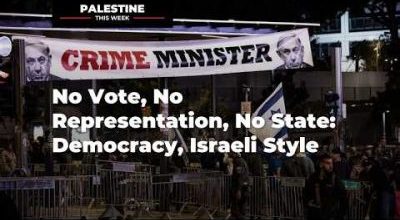
No Vote, No Representation, No State: Democracy, Israeli Style
or go to
Aletho News Archives – Video-Images
From the Archives
Sanctions, War and the Policy of Dual Containment
By SASAN FAYAZMANESH | March 17, 2008
It is now nearly three decades since the Unites States adopted the policy of dual containment of Iran and Iraq. While much has been written about the containment of Iraq, there has been very little in-depth analysis of this policy when it comes to Iran. In a book that is going to be released on March 31, 2008, entitled The United States and Iran: Sanctions, Wars and the Policy of Dual Containment (Routledge), I attempt to address this shortcoming by investigating when and why the US policy of containment of Iran came about, how it evolved, and where it stands today.[1] To the extent that Israel has been involved in US policy making, the study will also include the role that Israel has played in the containment of Iran. Also, since the fate of Iran has been inextricably linked to that of Iraq, occasionally the investigation will overlap with the containment of Iraq.
The policy of dual containment of Iran and Iraq originated during the Carter Administration, but it was not until the Clinton Administration that the expression “dual containment” became popular. … continue
Blog Roll
 Aletho News
- No Vote, No Representation, No State: Democracy, Israeli Style
- Zionist Bought Senate Blocks Information About American Citizens Killed By Israel
- While Gaza dominates the UN, these are the people keeping it alive
- New Report: “Scholasticide and Genocide in Gaza: Assessment, Testimonies and Legal Analysis”
- ‘THAAD Delusion’: Iran war exposes US missile shield limits – The Atlantic
- Moscow issues warning to NATO over Russian exclave
- Yes, the Iran war has destroyed Trump’s presidency
- The fallacy of US delusions about Iran’s economic collapse
- Hezbollah denies Syria cell link, warns of Israeli plan to sow discord
- The legacy of US sanctions, war, and occupation in Iraq
- If Americans Knew
- Mamdani releases plan to combat antisemitism and hate crimes in New York City
- Iran’s Revolutionary Guards Publish Letter to the American People
- DMFI launches $1 million ad campaign supporting Virginia’s Elaine Luria
- US Senate blocks resolution seeking report on Americans killed by Israel
- Israeli Attacks Kill Ten Palestinians in Gaza
- Massacre at Minab: The School That Became a Grave
- Israeli media: The IDF Shows It Doesn’t Turn a Blind Eye; It Actively Emboldens Settler Havoc
- As settlers ravage West Bank, Israeli forces kill 10 in Gaza – Daily Update
- New Report: “Scholasticide and Genocide in Gaza: Assessment, Testimonies and Legal Analysis”
- Ex-Biden officials are desperate for a Gaza scapegoat
- No Tricks Zone
- Green Energy Debacle: German Expert Professor Fritz Vahrenholt Warns Of Severe Economic And Social Consequences
- Two More Paleo Reconstructions Affirm Meters-Higher Sea Levels Across Ireland, Brazil 7000-6000 Years Ago
- New Study: Earth And Venus Surface Warmth Largely Explained By Convection And Lapse Rate, Not CO2 Or Radiation
- 2025 Nature Paper Claiming Worsening Global Drought Gets RETRACTED …Heavily Flawed
- New Study: ‘Global Drought Shows No Detectable Recent Acceleration Under Climate Warming’
- Economic Masterminds: German Socialists Suggest Taxing Productivity Gains Stemming From Using AI
- The South China Sea Has Not Been Cooperating With The Climate Change Narrative
- Energy Crisis: Germany Enters Heating Season With Historically Low Gas Reserve Fill Levels
- New Study: The Antarctic Ice Sheet Gained Mass From 2020-2024 Due To Staggering Snow And Ice Accumulation
- Study: Ocean Heating Rates From Thousands Of Years Ago ‘Dwarf’ Modern Ocean Heating Rates

