In response to the youth of the Gaza Strip and the West Bank rising up on March 14 and 15 to call for Palestinian political unity, both the leaders of Fatah and Hamas pledged to enter into talks aimed at reconciliation. Most recently, President Mahmoud Abbas of Fatah “met with senior Hamas officials to discuss a proposed trip to Gaza and efforts to mend internal Palestinian division by forming a unity government,” theMa’an News Agency reported.
With those talks came a spate of articles in the U.S. corporate media about the efforts at reconciliation. But in providing background on why these talks are happening, and the roots of the split between Hamas and Fatah, media outlets have deleted the crucial role the U.S. played in fomenting that split.
[Abbas had] not set foot in Gaza in the four years since a brief, bloody civil war there sent him and his Fatah colleagues fleeing to the West Bank…Hamas won Palestinian legislative elections in early 2006, and, for a brief time, Fatah and Hamas had a national unity government. But tensions between them led to the fighting and a break in communications.
Mahmoud Abbas, who heads the Fatah party that governs the West Bank, has accepted an invitation from rival Hamas to travel to the Gaza Strip. The visit would be the first since Hamas drove Fatah operatives out of Gaza in 2007 — throwing some off from the tops of buildings — in the turmoil that followed Hamas’ surprise victory in elections months earlier.
All of these accounts don’t mention where the “turmoil” and the breakup of the short-lived national unity government between Hamas and Fatah following the 2006 elections came from. The expose of the Bush administration’s role in the split by David Rose in Vanity Fair remains essential reading for those wanting to understand the roots of the split.
Some crucial excerpts:
Vanity Fair has obtained confidential documents, since corroborated by sources in the U.S. and Palestine, which lay bare a covert initiative, approved by Bush and implemented by Secretary of State Condoleezza Rice and Deputy National Security Adviser Elliott Abrams, to provoke a Palestinian civil war. The plan was for forces led by Dahlan, and armed with new weapons supplied at America’s behest, to give Fatah the muscle it needed to remove the democratically elected Hamas-led government from power. (The State Department declined to comment.)
But the secret plan backfired, resulting in a further setback for American foreign policy under Bush. Instead of driving its enemies out of power, the U.S.-backed Fatah fighters inadvertently provoked Hamas to seize total control of Gaza…
Within the Bush administration, the Palestinian policy set off a furious debate. One of its critics is David Wurmser, the avowed neoconservative, who resigned as Vice President Dick Cheney’s chief Middle East adviser in July 2007, a month after the Gaza coup.
Wurmser accuses the Bush administration of “engaging in a dirty war in an effort to provide a corrupt dictatorship [led by Abbas] with victory.” He believes that Hamas had no intention of taking Gaza until Fatah forced its hand. “It looks to me that what happened wasn’t so much a coup by Hamas but an attempted coup by Fatah that was pre-empted before it could happen,” Wurmser says…
Without this back story, why there is a bitter Hamas-Fatah split remains obscured. The least the U.S. media could do is provide a sentence explaining these facts.
Sen. Joe Lieberman suggested Sunday he would support military intervention in Syria if its president resorts to the kind of violent tactics used by Libya’s Muammar al-Qaddafi.
Dozens reportedly have been killed in protests against Syrian President Bashar al-Assad’s government, raising questions about whether the international community would get involved.
Lieberman, chairman of the Senate Homeland Security Committee, told “Fox News Sunday” that if Assad starts slaughtering his own people, he will risk other countries imposing a no-fly zone “just as we’re doing in Libya.” He urged Assad to, instead, negotiate with the “freedom fighters” in his country.
“There’s a precedent now that the world community has set in Libya, and it’s the right one,” Lieberman said.
The Obama administration, though, pushed back on suggestions that the United States could support another intervention.
Secretary of State Hillary Clinton said Sunday she doesn’t expect that to happen, describing the clashes in Syria as part of a “police action” — as opposed to a military campaign against the Syrian people.
“Each of these situations is unique,” she said on CBS’ “Face the Nation.” “Certainly we deplore the violence in Syria.”
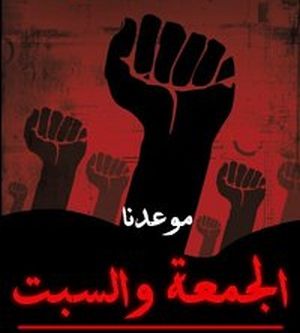
The Syrian revolution uses a strikingly familiar logo. The Otpor fist was originally used in Serbia in 2000, and handed off to the various movements trained by the US funded CANVAS organization, including the Tunisian & Egyptian youth movements- now the Syrian Youth Revolution.
“A prominent Syrian opposition figure says the country is “a bomb, ready to explode” as protesters demand freedom and an end to president Bashar al-Assad’s “cancerous regime,” reports Australia’s ABC News. This prominent Syrian opposition figure is “human rights activist” Haitham Maleh, of the Human Rights Association of Syria, recently released from a Syrian prison.
Freedom Now specializes in “political prisoners” from various regions around the world that attract the attention of globalist ambitions. Leveraging these “human rights abuses” affords the globalists a perceived moral high ground from which they can exert pressure on target nations. This is very similar to the operation being run by Chatham House globalist Robert Amsterdam of Amsterdam & Peroff, who is defending western-backed Mikhail Khodorkovsky to ratchet up pressure on Russia, and Thaksin Shinawatra to exert pressure on Thailand.
Understanding who these “human rights activists” are, who is supporting them, and the role they play in the latest round of the Western-backed “Arab Spring,” we can better understand articles like the Jerusalem Post’s ‘More than 100 killed in Syrian anti-government rallies.’ In the very first paragraph, the article concedes that the reports were cited from human rights activists and witnesses, thus a continuation of the absurd, unsubstantiated reporting seen earlier in Libya where unverified reports by the criminally irresponsible corporate media laid the groundwork for an equally criminal military intervention.
It is important to remember that Syria was included under George Bush’s “Axis of Evil” and mentioned in a 2007 speech by US General Wesley Clark as slated for destabilization and regime change.
The clownish London-based Syrian Human Rights Committee puts on a poorly staged demonstration outside the Syrian Embassy in England. As silly as the SHRC looks, a good majority of the information the mainstream media reports on from Syria comes from “human rights organizations” like this.
There is also Kamal Labwani, who in 2005 was arrested in Syria after returning from a trip to Europe and the United States where he met with government officials, journalists, and “human rights” groups in his effort to “change” the Syrian government. Amongst these officials Labwani consorted with was George Bush’s Deputy National Security Adviser J.D. Crouch.
Considering that the United States had openly declared Syria a rogue-state, and in a speech by John Bolton, was targeted by possible US military action, Syria’s accusations that Labwani was guilty of “communicating with a foreign country and inciting it to initiate aggression against Syria” doesn’t seem so far fetched. In most nations the punishment for treason is death, under Syria’s “cancerous regime” Labwani got 12 years.
Once again, we see an entire movement fomented and propelled by Western-backed opposition in tandem with the corporate owned media. This is all part of a now irrefutable larger plot consuming the Middle East and Northern Africa.
Just as we saw in Egypt and to a greater extent in Libya, the initial phases of unrest in Syria are marked by purposefully sloppy and confused reporting giving the destabilization efforts on the ground a chance to stampede the government from office. Should this stampeding fail, the truth will begin to trickle out, and the West’s involvement will become more overt.
What stood out from the first page was the tone—measured but firm, uncompromising but not strident. Every assertion seemed precisely weighed, put forth without exaggeration, flamboyance, or polemical excess. Also striking was the absence of gratuitous deference towards the opponent. There was no pulling of punches, no telltale signs of anxiety about the consequences of an argument taken too far, or indeed made at all. Such was my first reaction to reading John Mearsheimer’s and Steve Walt’s Israel Lobby paper, posted five years ago today on the website of Harvard’s Kennedy School, and published in shorter form in the London Review of Books. It had arrived at the opening of business one morning in an email from Michael Desch, then a professor at Texas A&M’s George H. W. Bush School of Government. I sent it across the hall to my colleague Kara Hopkins, a woman a generation my junior, somewhat less engaged than I by the Middle East, and certainly less persuaded that a coterie of neocons had gotten George W. Bush on a leash and were leading him this way and that. Three minutes later I walked into her office, where she had the paper up on her screen. “This is exactly what I believe,” said Kara, words that I had never heard from her before on any subject, much less this one.
American Christians who are neither ignorant nor bigots have a difficult time finding the right words to discuss Israel and its special relationship to the United States. Anyone with knowledge of European history knows of the connection between discourses about Jewish power and anti-Semitism. Inevitably this history has intruded on American discussions of Israel and its lobby. Save a handful of exceptions, mainstream dissent from the special relationship with Israel has taken the form of the dry aside or the understated sentence or two published amidst a lot of other stuff, almost as if the author hoped it would not be noticed. Occasionally public figures at the end of their careers made remarks that more resembled outbursts, the parting shot of the seventy- five year old senator or aging general. But more often than not, ever sensitive to the perils of anti-semitism, Americans let their fears of contributing to injustice shut off necessary debates. People rolled their eyes or took refuge in wry remarks: “What’s the matter with the rest of them?” said a friend upon seeing a Washington Post story about the 360 members of Congress who had showed up to pay homage at one of AIPAC’s annual gatherings.
The reasons differed for every individual, and were composite. There was the worry about offending close Jewish friends or colleagues, concerns over possible adverse professional consequences, or the general inhibitions associated with the Jewish power/leading to anti-Semitism/leading to the Holocaust nexus.* The result was that critical analysis of the special relationship was shoved to the margins of American political discourse. The discussions may have been richer and more involved on the Marxist and anti-imperialist Left than on the quasi-isolationist Old Right, but in neither case did they much influence the political mainstream. Even in the wake of the Iraq disaster, with the looming prospect of more American wars in the Middle East, Israel’s role was alluded at most in passing, but seldom really pursued.
The evasions could be almost comical.
In the second issue of The American Conservative, in the fall of 2002, we published an outstanding 8000 word essay by Paul Schroeder, a distinguished diplomatic historian, who argued that Americans had a great stake in preserving an international system which inhibited preventive wars of the sort Washington was preparing to wage against Iraq. After being granted 8000 words, Schroeder added some footnotes, the fourth of which stated, inter alia, “It is common for great powers to try to fight wars by proxy, getting smaller powers to fight for their interests. This would be the first instance I know where a great power (in fact, a superpower) would do the fighting as the proxy of a small client state.”
To Schroeder’s consternation, this footnote was the only item from his argument mentioned a few months later in a Washington Post oped, where it was cited amongst other examples of the supposed anti-semitism of Iraq war critics who had deigned to notice that the push for war was connected to Israel.
Five years ago, John Mearsheimer of the University of Chicago and Stephen Walt of Harvard stepped directly into these bogs of understatement, circumlocution and the relegation of major points to footnotes. Here are some of the points the two made in the first pages of their paper:
For the past several decades, however, and especially since the Six Day War in 1967, the centerpiece of U.S. Middle East policy has been its relationship with Israel. The combination of unwavering U.S. support for Israel and the related effort to spread democracy throughout the region has inflamed Arab and Islamic opinion and jeopardized U.S. security…
More importantly, saying that Israel and the United States are united by a shared terrorist threat has the causal relationship backwards: rather, the United States has a terrorism problem in good part because it is so closely allied with Israel, not the other way around…
This situation has no equal in American political history. Why has the United States been willing to set aside its own security in order to advance the interests of another state?
In the essay that followed, the two backed up these and other equally forceful assertions with tightly-argued, factually-based paragraphs and extensive footnotes. They were not, of course, the first pioneers in pursuing this subject from an establishment vantage point: on at least two occasions, the Israel subject had been addressed by Americans of comparable eminence. George W. Ball, probably the wisest figure to hold high positions in the Kennedy and Johnson administrations, had late in life co-authored with his son an important book on America’s “entangling alliance” with Israel —a book whose antecedent was in an article written for Foreign Affairs in the late 1970’s, proposing that America “save Israel from itself” by stopping its incipient campaign to colonize the West Bank. A few years earlier, Senator William Fulbright, probably the leading foreign policy intellectual among Americans who held elective office in the postwar era, bemoaned the Israel lobby’s influence, and pushed for an American security guarantee for Israel within the 1967 borders.
Both Fulbright and Ball came to the subject at the close of long careers. In contrast Mearsheimer and Walt published their paper during their professional primes. Their argument had none of that “Now I can finally say it” quality; instead the authors arrived with every intent of carrying their argument forward. They had tenure at two of the country’s top universities. They had reached the top of a profession which rewards clear writing and thinking, and possessed the argumentative eloquence that comes from years of lecturing before the nation’s brightest students. They were political moderates—whose careers had placed them squarely in the “vital center” of American academic foreign policy discourse. They were fully prepared to go larger, and in eighteen months turned the paper into a best-selling book.
Of course it mattered somewhat that the Israel lobby used every tool at its disposal to smear the authors and bury their argument. Every journal and newspaper that had ever felt the need to stress its “pro-Israel” credentials published a negative review of the book. (The Israel Lobby received generally far more favorable reviews in Europe and, in fact, in Israel.) But the sheer volume and intensity of the attacks on the paper may have been self-defeating. By April 2006, it seemed that everyone with an interest in foreign policy had read the article and was eager to talk about it. (I would note that in that month I went on a trip with a church group to Syria, Israel, and the occupied West Bank, on a schedule that included five or six meetings a day for ten days. Excepting the purely religious figures, it is no exaggeration to say that every single Arab intellectual, government or NGO official we met with mentioned the Mearsheimer and Walt paper. It was also the very first topic raised by Owen Harries, the very wise retired editor of The National Interest, at a private dinner I gave in his honor when he was visiting from Australia that May. )
Like the original essay, the book itself was a blend of precise analysis and exact documentation. As a resource it is unparalleled. If someone confidently asserts that Israel and its backers had nothing whatever to do with encouraging the United States to invade Iraq ( a “canard” is the usual dismissal phrase), one can find in The Israel Lobby five or six pages of quotes from television appearances and op-eds by leading Israeli political and military figures, who utilized their untrammeled media access to convey their war-mongering points to the American public. The same holds true for dozens of other subtopics of their broader subject: precise generalizations, supported by facts, authoritatively and contextually presented in a rhetoric that neither overheats nor backs down.
There are several different frames of reference in which to discuss Israel, the Palestinians, and the United States. One potentially critical new front is now being opened by some Jewish liberals, who charge that Israel’s longstanding occupation policies contravene Jewish values. But important as this argument is, it initiates a debate in which the vast majority of Americans have no standing to participate.
This underscores the achievement, and the yet unrealized potential, of Mearsheimer and Walt’s essay and book. As international relations scholars and centrist “realists,” the two examined the American relationship with Israel through the prism of American national interests and values—or at least the non-racist and democratic values America has aspired to for most of the past century. They found the Israel relationship deficient on both counts. In doing so they not only wrote a milestone paper and book— what political work in the past decade comes close to The Israel Lobby in importance? They provided the tens of millions in the vast American political center with a vocabulary and a conceptual frame to discuss a subject of critical importance to them. Non-Jews especially, for the reasons discussed above, desperately needed such a vocabulary, for without it they were all but mute. No matter that this potential remains, as yet, relatively underutilized: it is still there, ready to be deployed. In the long run, this may prove the greatest contribution of the two scholars, one which far surpass what the book has achieved thus far.
*These inhibitions included the fear of offending other non-Jews. My wife, whose father was a UN official with extensive responsibilities for Middle East peacekeeping, grew up with a far more critical attitude towards Israel than I had. It was not until my own (previously neoconservative) views began to change in the mid 90’s, fifteen years into our marriage, that she acknowledged to me some of her pro-Palestinian sympathies.
One of the key distinctions between a capitalist and a non-capitalist (socialist, feudal, absolutist state) economy is the separation of state and private enterprise. In a capitalist state, economic enterprises are supposed to operate according to market principles, seeking to maximize profits and expand market shares. The state is supposed to act on behalf of capitalist enterprises, ensuring their protection and furthering their pursuit of profits and markets.
Recent history of foreign relations provides ample evidence that the reverse is true: private corporations, especially banks have been converted into adjuncts of the US state, serving as transmission belts of US military policy, by sacrificing markets, profits and opportunities for future economic growth. Another important reason for keeping US multinational corporations out of a country. Moreover, the state both in the US and Europe have seized billions in private investment funds and dispossessed their owners, in the process scuttling major financial transactions adversely affecting the biggest Western financial houses.
The dispossession of private capitalists and the harnessing of private firms to state policy have grown in scope and depth over the current decade, revealing the growing subordination of private capitalism to a militarist imperialist state. Sacrificing private profits and free markets to the edicts of state officials has been implemented via state coercion and severe sanctions against any transgressors.
How and why the world’s biggest propagandist of “free enterprise” and de-regulated capitalism has successfully converted major international financial and industrial enterprises into tools of foreign policy at enormous costs to their bottom line is yet an untold story. Given the enormity of the historical change in the relation between state and market, the shift in power has enormous consequences for peace, prosperity and freedom.
How the State Dominates “the Market”: The Historical Context
Beginning in the 1990’s under President Clinton and escalating under Bush and Obama, the US imperial state imposed economic sanctions first in Iraq and later on Iran and more recently on Libya. In effect the state dictated to its petroleum multi-nationals and biggest banks that they should sacrifice lucrative investment opportunities, ongoing profits and markets to serve imperial state interests. Billions of dollars were lost during the 1990’s, in the face of Iraq sanctions, forcing many US oil companies to engage clandestine “third party” intermediaries, to secure a reduced share of the petrol market. The imperial state imposed severe penalties – fines, jailing’s and exclusion from the US market – to any of the CEOs and private corporations that did not abide by the sanctions. Clearly the state was in command; the corporate ruling class became the executive committee of the imperial state.
The sanctions policy applied to the Middle East under Clinton was only the beginning; it was deepened and vastly expanded under Presidents Bush and Obama, especially after 2004.
The Levey Levy: How American Zionists Freeze Financial Profits
In 2004 a little noticed administrative add-on in the US Treasury Department took place that has had world historic significance: AIPAC (American Israel Public Affairs Committee) pressured Treasury to create the position of “Undersecretary for Terrorism and Financial Intelligence”. Equally important, under strong pressure from AIPAC, a zealous Zionist of immense energy, Stuart Levey was appointed to head the new agency.
Levey used all the administrative mechanisms in the Treasury, from threats of penalties, fines and ostracism, to friendly and hostile persuasion, to line up US federal and state public and private pension funds to sacrifice lucrative investments in targeted countries, most of whom, lo and behold, were adversaries of Israeli occupation of Palestine.
Even as Levey was imposing state constraints over the operations of private investors in the US, he organized his entire staff to police the financial world abroad. Levey and his Zionist allies in the so-called “Israel lobby” called on their Congressional cronies to approve sanction policies which not only affected US banks, manufacturers and construction companies but which penalized any European, Asian and Middle Eastern bank which had economic dealings with Iran and other countries on his list (Cuba, North Korea among others).
Levey extended the sanctions to cover firms and investors with even indirect economic ties to the US: his secret financial police located funds which passed from one private bank to another which had tangential links to US banks and Levey applied and secured hundreds of millions in fines against Swiss, Chinese (Macao) English and other banks. Effectively the US imperial state via its Undersecretary of Treasury, harnessed the entire world’s financial system to serve US and Israeli foreign policy. Levey is explicit about his role in creating a state within a state. “The US Treasury is the only Treasury in the world with a fully functioning intelligence office.” He might have added that the US Treasury is the only Treasury in the world which sacrifices the economic interests of its private investors and those of its allies in pursuit of the interests of a foreign power (Israel).
The Levey regime by leveraging ties with private US financial institutions and access to US markets, effectively controls the financial transactions and market operations of European, Asian and Middle Eastern private enterprises.
What appears as merely a relatively minor administrative post in Treasury has in fact created an administrative empire which has effectively converted private international banking and manufacturing corporations into instruments of US and Israeli policy.
In office, Levey engineered the seizure of billions of dollars of overseas assets of private and public funds of adversaries. One of his last moves before leaving office (March 2011) was to seize $32 billion in Libyan funds using the pretext that the non-US bank to which the funds were entrusted invested in US Treasury notes.
Levey has clearly defined the new relation between private capital (the market) and the State: “Governments around the world see the power of these types of measures and the relevance of the private sector to the overall [imperial] effort and that is something that has changed in the last four or five years.” (Financial Times, March 10, 2011, pg. 5).
The “measures” that Levey refers to are the state sanctions and the coercion and penalties applied to the private sector to ensure their conformity with imperial and Israeli military interests at the expense of profits and markets.
The Visible Hand of the State
Levey and his Zionist colleagues have ensured that his “state within a State” will continue beyond his tenure in office. He was succeeded by David Cohen, his former law firm partner and promoter of the very same Israeli interests. Levey/Cohen have institutionalized and set in stone the mechanisms to further imperial state control over market operations. Cohen’s appointment ensures the continuation of the Zionist dynasty in the “State within the State”.
The biggest economic losers in the state centered “sanction” policies pursued by Treasury (read Levey/Cohen) have been the international banks, petroleum and gas companies and pension funds. The banks have lost access to investment funds and lucrative management fees; the petroleum companies have lost profits and access to oil fields. The military-industrial complex has lost arms sales. The agro-exporters have lost markets in food deficit oil producers. Who have been the “winners” – certainly not the Generals who are engaging in a third costly war when the sanctioners decided to escalate to the ‘military option’, once their sanctions policies failed to result in the overthrow of the Libyan regime.
On the surface the main ‘winners’ of sanction policies are their advocates in the White House, Congress, Treasury, the leaders of the two major parties and the ideologues and Islamaphobes in the mass media. And of course, the biggest winners of them all are Israel and their Zionist power configuration embedded in the key agencies of Treasury, the key committees in Congress, and their colleagues in the most influential Middle East posts in the State Department (James Steinberg, Mark Grossman, Dennis Ross, Jeffrey Feltman) and Treasury (Cohen).
If one asks the logical question why doesn’t Big Banking or Big Petroleum make a fight over policies prejudicing their economic interests and subjecting them to the harsh oversight of Levey/Cohen investigators in Treasury, the most reasonable assumption is that they are not willing to engage in a knockdown fight with three potent adversaries: the politically influential Zionists in the government who design, implement and enforce sanctions; their counterparts in the prestigious mass media who support their policies and the 300,000 active members of the 52 major American Jewish organizations who threaten to organize boycott campaigns. An implausible assumption is that the bankers and oil majors have become altruistic and patriotic and are willing to sacrifice billion dollar deals to serve our “national security” as defined by Levey/Cohen and their cohorts in AIPAC. When we speak of US ‘sanction policies’ or when we read of European bankers “following Washington’s lead” let’s be clear about what “state” within the US we are talking about and which agencies in Washington are ensuring that European banks follow “our” lead.
While we might not shed tears about an intrusive government curtailing the profit-making of Big Oil and Big Banks, or interfering with free market operations, let us not forget that “the state within the state” that dictates economic policy is not accountable to our citizens; moreover, if it dictates foreign economic policy to the multi-nationals surely it has no scruples in doing the same to ordinary Americans. Next on the AIPAC/Levey/Cohen agenda is a “request” by Israeli Prime Minister Netanyahu for an additional $20 billion dollars in “aid” to ensure Israel’s protection from the pro-democracy movements sweeping the Arab world and to finance a new batch of settlements in the West Bank.
Israel needs US aid like American taxpayers need a hole in their pockets. According to the latest study of billionaires published in the March 20 2011 of Forbes, Israel has more billionaires per capita than any country in the world.
~
James Petras’ most recent books are: What’s Left in Latin America?, coauthored with Henry Veltmeyer (Ashgate Press, 2009), and Global Depression and Regional Wars (Clarity Press, 2009).
The handing over of the Ghent Charter in Defense of Iraqi Academia by Hans von Sponeck to Ms Marie-Paule Roudil, representative of UNESCO in Brussels, during the official signing ceremony, 8 March 2011
In the past eight years hundreds of academics have been killed in Iraq. They were not accidental victims of the violence prevailing in the country, but the target of a focused and systematic campaign to destroy the Iraqi state, researchers say. In Ghent specialists from all over the world gathered to investigate the humanitarian catastrophe.
MENARG (Middle East and North African Research Group) of Ghent University, the BRussells Tribunal, and numerous other organizations brought together the cream of Iraq specialists at the Aula in Ghent. For three days they have talked about the “least known humanitarian crisis” (in the words of the UN High Commissioner for Refugees António Guterres).
These figures are staggering. The BRussells Tribunal collected 455 files on murdered academics. The number of teachers in Baghdad has fallen by 80 percent. In the two years after the start of the war in Iraq 84 percent of higher education institutions were looted, destroyed or burned. More than 335 students and staff died or were seriously injured by bombings of Al Mustansiriya University in Baghdad. Approximately 40 percent of the Iraqi middle class has fled the country.
The researchers say the destruction of academic life in Iraq is no side effect of the war. “This is the official theory of the Iraqi government. The academic community was -like the rest of Iraq- victim of ethnic and sectarian violence after the invasion. Our research shows that academics as a group are the target of violence,” said Pedro Rojo from CEOSI, who has written several books on Iraq.
Who was and is behind that violence? Pedro Rojo: “Firstly, the militias aligned to the government. They want to destroy the education system. There is also the Mossad (Israeli Security Agency, ed) that targeted scientists who have or may have had a hand in the production of weapons of mass destruction.”
Why?
But why would someone destroy the education of a country? According to the American Professor Raymond Baker Iraq is a clear case of “state ending”. The aim of the war was the destruction of the Iraqi state. The killings of academics are a part of that war strategy.
Former UN humanitarian coordinator in Iraq, Hans von Sponeck, said the attempt to destroy the Iraqi state started much earlier. “It started in 1990 with the sanctions after Iraq invaded Kuwait. The oil for food program could have been adequate, but it was not. The UN was simply abused as a tool to destroy Iraq. They could have saved at least primary education, but they did not. Then I realized that the US wanted to destroy the old Iraq to create a new Iraq,” said von Sponeck, who resigned in 2000.
The researchers in Ghent do not only want to accuse, but also try to formulate solutions. “We need a network of Iraqi and European researchers who through a thorough research can map the situation in Iraq,” said Pedro Rojo. “It is not enough to say that there is now a “blossoming” democracy in Iraq and that we can rebuild the country. The murderers are still waving the stick. Impunity is the problem. ”
Von Sponeck also calls for objective and fair research and investigation. “Non-ideological and no hidden agendas. So other people can better defend the Iraqi cause. Ending the occupation seems to be a prerequisite to have hope for change. At this time throughout the Arab world, young people are on the streets. An ideal time to those who give objective information,” said von Sponeck.
The Arab riots are encouraging. The Iraqi writer Haifa Zangana has hopes for her homeland. “Over the last two months there were constant demonstrations. Even in areas where there were never demonstrations before, like in the Kurdish provinces. The people on the streets formulate a rainbow of demands. But the repression has been merciless. 31 protesters have already been killed. And in the Western media there is a total blackout. As if there is no more occupation, as if democracy flourishes in Iraq again.”
Translation: Dirk Adriaensens, member of the BRussells Tribunal executive Committee
In a remarkable Israeli position in terms of its background and connotations, and referencing the extent of anxiety and fear the Israeli entity is witnessing in the wake of revolutions in the Arab world, Defense Minister Ehud Barak said Israel might ask the US for additional $20 billion in military assistance.
In an interview with The Wall Street Journal published Tuesday, Barak said that Israel should not fear regional changes or the risk of offering valiant concessions to the Palestinians.
Barak said that while Israel did not “face an immediate threat to its security, the issue of qualitative military aid for Israel becomes more essential for us, and I believe also more essential for you [the US]. Israel should not fear the movement of Arab societies toward modernity.”
He nevertheless stressed that the Egyptian public might influence the new leadership in such a way which could cause it to distance itself from the peace treaty with Israel.
“It might be wise to invest another $20 billion to upgrade the security of Israel for the next generation or so….A strong, responsible Israel can become a stabilizer in such a turbulent region.”
He believes it is too early to tell whether Iran is taking advantage of regional unrest to expand its influence. Barak also noted that prior to the wave of Arab protests “You could see Arab leaders starting to hedge their bets on who is the strongest leader here, Iran or the United States.” In the interview Barak said that according to a senior Egyptian official, whose name he did not mention, Israel should expect “the cold shoulder” from Cairo if it fails to advance the Palestinian peace process.
Israel spends roughly nine percent of its gross national product to guard from potential threats. Its military expenditure amounted to USD 17 billion this year, of which US aid is USD 3 billion.
Tel Aviv has kept a wary eye on a recent tidal wave of anti-government protests that has raced across the Middle East, originating with revolutions in Tunisia and Egypt, which have swept longstanding autocratic rulers from power.
Several Israeli media agencies, known for their close affiliation with Israel security and political devices, published a number of reports slamming the new interim Egyptian Prime Minister, Dr. Isam Sharaf, and described his as an “enemy to Israel”, and also described him and the new Foreign Minister as anti-smite.
Israeli TV stations, Channel 7 and Channel 10 along with The Marker and Maariv newspapers held extensive coverage of the swear-in ceremony of the new government headed by Dr. Sharaf.
They claimed that Dr. Sharaf is “known for his anti-Israel positions”, and opposes the Israeli policies towards the Palestinian people, and that Sharaf “insisted on showing his anti-Semitism by choosing another anti-Semite, the new Foreign Minister, Nabil Al Arabi”.
According to some Israeli reports, Dr. Sharaf and his new government “pose a threat to Israel and its interests, especially with Egypt”, and that he adopts stances that reject normalization with Tel Aviv.
J Street, America’s premier liberal pro-Israel lobbying group, has just wrapped up its third annual conference in Washington. There have been sessions and panels on “building peace from the ground up,” on “expanding the tent” and even some passionate condemnations of the Occupation. Amid so much good feeling it’s almost possible to lose sight of one of J Street’s fundamental missions: to promote and guarantee America’s lavish and unconditional military aid to Israel.
This may seem like a harsh assessment of the lobbying group. After all, isn’t J Street routinely attacked by neocon ultras and praised by American liberals? But hack through J Street’s verbiage about “dialogue” and “conversation” and one bumps into this blandly phrased position statement: “American assistance to Israel, including maintaining Israel’s qualitative military edge, is an important anchor for a peace process based on providing Israel with the confidence and assurance to move forward on a solution based on land for peace. J Street consistently advocates for robust US foreign aid to Israel.” This last sentence is 99% of what one needs to know about J Street.
We Americans aren’t used to talking about the one thing we are most directly responsible for in the Israel-Palestine conflict: our $3bn annual military aid package that goes almost exclusively to one of the two sides. A bit weirdly, debate about Israel/Palestine among Americans tends to leap immediately to the issue of a one-state versus a two-state solution. Or we presume to give the Palestinians tips and pointers about what degree of violence is morally acceptable, and where’s that Palestinian Gandhi? Or we vow to redouble our efforts towards a “peace process” which doesn’t quite seem to exist.
The one thing we Americans are not very good at discussing, or even acknowledging, is our already vigorous role in the conflict. Before we continue to micromanage the Palestinians, and (to a far lesser degree) the Israelis, might we first examine, and scale back, our own outsized contributions to what can only be called a war process.
We Americans badly need to understand that we are not now, nor have we ever been, a credible arbiter in the conflict between Palestinians and Israelis. Our long record of doing things like shipping free-gratis cluster bombs to the IDF, expediting them when so requested for use on Lebanon’s civilian infrastructure in 2006, has long disqualified us as “honest brokers”. Rhetoric aside, such lopsided military aid packages are our real policy.
This is not another argument against all foreign aid. There are places on the earth where America does indeed owe a blood debt: Ghana, Haiti, Nicaragua for instance, nations historically wronged by our slave trade or by long-term US military occupation. It is strange that J Street or any ostensibly liberal outfit could believe that Israel is deserving of [far] more foreign aid than the three of these impoverished nations combined.
There is a standard response to this criticism of J Street. Their half-measures may be lame, it is conceded, but they are a “comfort zone” for young liberal activists inside the American Jewish community, a space where they can get their message out. I hope it does not seem callous to view ongoing ethnic cleansing, the collective punishment of 1.3 million Gazans, and significant American security interests to be orders of magnitude more important than the sensitivities of the college students who just attended J Street’s conference.
It seems the true function of J Street is to set the acceptable outer limit to our national discourse on Israel/Palestine, and this is worrisome. For J Street has not been brave in its positions. It disapproved of the Goldstone Report; it discouraged a UN investigation into the IDF assault on the Gaza aid flotilla; it threatens to withhold its support from pols who meet with other, less Israel-centric lobbying groups–and that’s just for starters. Of course it’s super that J Street rallied behind congressional Representative Donna Edwards after she voted “present” on a resolution in support of the IDF’s attacks on Gaza in 2009. But if she had voted against the measure, how would J Street have responded? More recently Edwards voted with the majority to give an extra $205 million in emergency military funding to Israel, with only four votes against. In the midst of the worst economic crisis since the 30s and Israel’s constant flouting of international law regarding settlement construction, a gift of even more military aid seems bizarre. (J Street, predictably, welcomed the disbursement.)
True, J Street sometimes breaks with its neoconservative peers, as when it urged the US not veto last month’s UN Security Council resolution condemning Israeli colonization of the West Bank. But J Street’s sporadic compliance with minimal standards is distinctly unimpressive compared to the clear-cut policy changes urged by other advocacy groups. With Jewish Voice for Peace, the Council for the National Interest, the Committee for a Just Peace in Israel and Palestine and New Policy, the rubber meets the road when it comes to reorienting US policy on Israel/Palestine, which they advocate without equivocation. Unlike J Street, these groups are not getting large checks from George Soros and his children.
Some analysts optimistically see J Street as a sort of gateway drug that will lead its youngish adherents to eventually support a very different role for the United States in the region. I hope they are right. For now, J Street will continue to lobby for dialogue, “expanding the tent”, and $3 billion in cluster bombs, white phosphorus and other armaments from the US government to the IDF, no strings attached, year after year.
With the U.S. economy in the tank and governments at all levels facing massive budget shortfalls, politicians left and right are seeking ways to curb spending. Wisconsin Gov. Scott Walker wants to eliminate collective bargaining rights and the decent pay that goes with them. President Barack Obama’s budget includes halving the home-heating oil subsidy poor households depend on.
As Republicans and Democrats propose cuts in programs that actually benefit their increasingly impoverished constituents, though, they agree there’s one area of the budget that’s not to be touched: the annual $3 billion subsidy U.S. taxpayers provide to the Israeli military.
One of the biggest defenders of the handout is House Foreign Affairs Committee Chairwoman Ileana Ros-Lehtinen. “There will be no cuts to security assistance to the Jewish State of Israel,” her chief of staff declared in a recent letter to House Republicans. The rest of the U.S. foreign aid budget, including assistance for Iraqi refugees and food aid to the world’s poorest people, is fair game. But the Florida congresswoman insists we must help Israel maintain its “Qualitative Military Edge.”
And congressional Democrats have her back.
Illinois Democrat Jan Schakowsky, for instance – a leading member of the Congressional Progressive Caucus – has drafted a letter, cosigned by California Democrat Anna Eshoo, warning that the revolutions in Egypt and Tunisia “have the potential to add to the very real security challenges faced by Israel.” Reducing or “otherwise endangering aid to our ally” would be “unproductive,” she adds, encouraging her colleagues to tell Obama they “strongly support … providing $3.075 billion in assistance to Israel.” (For those shivering at home, that’s more assistance than Obama is proposing to offer Americans trying to keep their houses warm.)
This liberal appeal for Israeli military aid, meanwhile, is being sent out under the auspices of J Street, a group that positions itself as a left-leaning answer to AIPAC. But J Street staff we spoke with at their recent conference were hard-pressed to explain why U.S. taxpayers should fund a right-wing Israeli government that continues to build settlements and maintains an inhumane siege of Gaza.
So it’s left to folks like libertarian Congressman Ron Paul and his son, Kentucky Senator and Tea Party favorite Rand Paul, to call for ending aid to Israel. In a February 4 interview with ABC News, Rand Paul said of Israel, “I think that their per capita income is greater than probably three-fourths of the rest of the world. Should we be giving free money or welfare to a wealthy nation? I don’t think so.”
Indeed, Israel has the 24th largest economy in the world, and ranks 15th among 169 nations on the UN Human Development Index, which makes it a “very highly developed” nation.
Yet what thanks did Senator Paul get for his call to save the U.S. taxpayers billions of dollars? A torrent of criticism, even from J Street, which called on Republicans – and their donors – “to repudiate his comments and ensure American leadership around the world is not threatened by this irresponsible proposal.”
Paul’s fellow Tea Partiers aren’t any better. Of the 87 freshmen House Republicans elected on platforms of cut-baby-cut, at least three-fourths have now signed a letter declaring that, “As Israel faces threats from escalating instability in Egypt” – where have we heard that line of argument before? – “security assistance to Israel … has never been more important.” Subsidies are for militaries, you see, not poor people.
But even without U.S. funding, Israel would still spend $11 billion-plus on its military, more than all but 20 other nations in the world spend on their armed forces – and hundreds of millions of dollars more than the Islamic Republic of Iran, despite having just 1/10th the population. Throw in a couple – as in, couple hundred – little things called nuclear weapons, and, for better or worse, the Jewish state’s “Qualitative Military Advantage” isn’t going anywhere.
But you wouldn’t know that listening to the folks at J Street or to liberals like Jan Schakowsky, who hysterically cite the specter of Arab democracy to advocate billions in subsidies for a government that openly flouts international law. So much for their concern about human rights. And so much for being progressive. Indeed, with liberals like these, the Netanyahu government and its allies at AIPAC are likely asking themselves: who needs the Tea Party?
“[Obama] got on the right side of this thing when a lot of the foreign policy establishment was cautioning otherwise,” said Robert Kagan, a Brookings Institution scholar who long before the revolution helped assemble a nonpartisan group of policy experts to press for democratic change in Egypt. “And he got it right. This may strengthen his confidence the next time this kind of thing happens.”
Kagan, who co-founded the Project for a New American Century with William Kristol in 1997, was joined on that “nonpartisan group” by PNAC founding member Elliott Abrams and PNAC deputy director Ellen Bork. Bork is currently “democracy and human rights” director at PNAC’s successor, Foreign Policy Initiative, where Kagan and Kristol are directors. Not surprisingly, Kristol wrote in the Weekly Standard on January 29 that he was “in complete agreement” with his fellow PNACers’ Working Group on Egypt in its demands that the U.S. suspend aid to Mubarak.
Considering how deeply concerned PNAC was about Israel’s security, could Mubarak’s ouster really not be in the Jewish state’s strategic interest, as so many seem to believe? Appearing on ABC’s This Week, Kagan looked positively sanguine about the prospects for a post-Mubarak Egypt. Like George Soros, he seems confident that Israel has “much to gain from the spread of democracy in the Middle East.”
Update: Arianna Huffington, who praised Kagan for his prescience on ABC’s This Week, was prescient herself in a December 13, 2010 op-ed in Lebanon’s Daily Star titled “Social media will help fuel change in the Middle East.” The “progressive” media entrepreneur, who has enjoyed very profitable business ties to the Israeli arms industry, once dated Mortimer Zuckerman, the pro-Israel media magnate.
Update II: The New York Times article also quotes Kenneth Wollack:
“The stirring events in Egypt and Tunisia should reinforce what has always been a bipartisan ambition because they are vivid reminders of universal democratic aspirations and America’s role in supporting those aspirations,” said Kenneth Wollock [sic], president of the National Democratic Institute, a government-financed group affiliated with the Democratic Party that promotes civil society abroad.
From 1973 to 1980, Wollack served as legislative director of AIPAC.
When CIA-agent Raymond Davis gunned down two Pakistani civilians in broad daylight on a crowded street in Lahore, he probably never imagined that the entire Washington establishment would spring to his defense. But that’s precisely what happened. Barack Obama, Hillary Clinton, Mike Mullen, John Kerry, Leon Panetta and a number of other US bigwigs have all made appeals on Davis’s behalf. None of these stalwart defenders of “the rule of law” have shown a speck of interest in justice for the victims or of even allowing the investigation to go forward so they could know what really happened. Oh, no. What Clinton and the rest want, is to see their man Davis packed onto the next plane to Langley so he can play shoot-’em-up someplace else in the world.
Does Clinton know that after Davis shot his victims 5 times in the back, he calmly strode back to his car, grabbed his camera, and photographed the dead bodies? Does she know that the two so-called “diplomats” who came to his rescue in a Land Rover (which killed a passerby) have been secretly spirited out of the country so they won’t have to appear in court? Does she know that the families of the victims are now being threatened and attacked to keep them from testifying against Davis? Here’s a clip from Thursday’s edition of The Nation:
“Three armed men forcibly gave poisonous pills to Muhammad Sarwar, the uncle of Shumaila Kanwal, the widow of Fahim shot dead by Raymond Davis, after barging into his house in Rasool Nagar, Chak Jhumra.
Sarwar was rushed to Allied Hospital in critical condition where doctors were trying to save his life till early Thursday morning. The brother of Muhammad Sarwar told The Nation that three armed men forced their entry into the house after breaking the windowpane of one of the rooms. When they broke the glass, Muhammad Sarwar came out. The outlaws started beating him up.
The other family members, including women and children, coming out for his rescue, were taken hostage and beaten up. The three outlaws then took everyone hostage at gunpoint and forced poisonous pills down Sarwar’s throat.” (“Shumaila’s uncle forced to take poisonous pills”, The Nation)
Good show, Hillary. We’re all about the rule of law in the good old USA.
But why all the intrigue and arm-twisting? Why has the State Department invoked the Vienna Convention on Diplomatic Relations to make its case that Davis is entitled to diplomatic immunity? If Davis is innocent, then he has nothing to worry about, right? Why not let the trial go forward and stop reinforcing the widely-held belief that Davis is a vital cog in the US’s clandestine operations in Pakistan?
The truth is that Davis had been photographing sensitive installations and madrassas for some time, the kind of intelligence gathering that spies do when scouting-out prospective targets. Also, he’d been in close contact with members of terrorist organizations, which suggests a link between the CIA and terrorist incidents in Pakistan. Here’s an excerpt from Wednesday’s The Express Tribune:
“His cell phone has revealed contacts with two ancillaries of al Qaeda in Pakistan, Tehreek-e-Taliban of Pakistan (TTP) and sectarian Lashkar-e-Jhangvi (LeJ), which has led to the public conclusion that he was behind terrorism committed against Pakistan’s security personnel and its people ….This will strike people as America in cahoots with the Taliban and al Qaeda against the state of Pakistan targeting, as one official opined, Pakistan’s nuclear installations.” (“Raymond Davis: The plot thickens, The Express Tribune)
“Al Qaeda”? The CIA is working with “ancillaries of al Qaeda in Pakistan”? No wonder the US media has been keeping a wrap on this story for so long.
Naturally, most Pakistanis now believe that the US is colluding with terrorists to spread instability, weaken the state, and increase its power in the region. But isn’t that America’s M.O. everywhere?
Also, many people noticed that US drone attacks suddenly stopped as soon as Davis was arrested. Was that a coincidence? Not likely. Davis was probably getting coordinates from his new buddies in the tribal hinterland and then passing them along to the Pentagon. The drone bombings are extremely unpopular in Pakistan. More then 1400 people have been killed since August 2008, and most of them have been civilians.
And, there’s more. This is from (Pakistan’s) The Nation:
“A local lawyer has moved a petition in the court of Additional District and Sessions … contending that the accused (Davis)… was preparing a map of sensitive places in Pakistan through the GPS system installed in his car. He added that mobile phone sims, lethal weapons, and videos camera were recovered from the murder accused on January 27, 2011.” (“Davis mapped Pakistan targets court told”, The Nation)
So, Davis’s GPS chip was being used to identify targets for drone attacks in the tribal region. Most likely, he was being assisted on the other end by recruits or members of the Tehreek-e-Taliban.
A lot of extravagant claims have been made about what Davis was up to, much of which is probably just speculation. One report which appeared on ANI news service is particularly dire, but produces little evidence to support its claims. Here’s an excerpt:
“Double murder-accused US official Raymond Davis has been found in possession of top-secret CIA documents, which point to him or the feared American Task Force 373 (TF373) operating in the region, providing Al-Qaeda terrorists with “nuclear fissile material” and “biological agents,” according to a report.
Russia’s Foreign Intelligence Service (SVR) is warning that the situation on the sub-continent has turned “grave” as it appears that open warfare is about to break out between Pakistan and the United States, The European Union Times reports…..The most ominous point in this SVR report is “Pakistan’s ISI stating that top-secret CIA documents found in Davis’s possession point to his, and/or TF373, providing to al Qaeda terrorists “nuclear fissile material” and “biological agents”, which they claim are to be used against the United States itself in order to ignite an all-out war in order to re-establish the West’s hegemony over a Global economy that is warned is just months away from collapse,” the paper added. (“CIA Spy Davis was giving nuclear bomb material to Al Qaeda, says report”, ANI)
Although there’s no way to prove that this is false, it seems like a bit of a stretch. But that doesn’t mean that what Davis was up to shouldn’t be taken seriously. Quite the contrary. If Davis was working with Tehreek-e-Taliban, (as alleged in many reports) then we can assume that the war on terror is basically a ruse to advance a broader imperial agenda. According to Sify News, the president of Pakistan, Asif Ali Zardari, believes this to be the case. Here’s an excerpt:
“Zalmay Khalilzad, the former US envoy to Afghanistan, once brushed off Pakistan President Asif Ali Zardari’s claim, that the US was “arranging” the (suicide) attacks by Pakistani Taliban inside his country, as ‘madness’, and was of the view that both Zardari and Afghan President Hamid Karzai, who believed in this US conspiracy theory, were “dysfunctional” leaders.
The account of Zardari’s claim about the US’ hand in the attacks has been elaborately reproduced by US journalist Bob Woodward, on Page 116 of his famous book ‘Obama’s Wars,’ The News reported.
Woodward’s account goes like this: “One evening during the trilateral summit (in Washington, between Obama, Karzai and Zardari) Zardari had dinner with Zalmay Khalilzad, the 58-year-old former US ambassador to Afghanistan, Iraq and the UN, during the Bush presidency.
“Zardari dropped his diplomatic guard. He suggested that one of the two countries was arranging the attacks by the Pakistani Taliban inside his country: India or the US. Zardari didn’t think India could be that clever, but the US could. Karzai had told him the US was behind the attacks, confirming the claims made by the Pakistani ISI.”
“Mr President,” Khalilzad said, “what would we gain from doing this? You explain the logic to me.”
“This was a plot to destabilize Pakistan, Zardari hypothesized, so that the US could invade and seize its nuclear weapons. He could not explain the rapid expansion in violence otherwise. And the CIA had not pursued the leaders of the Pakistani Taliban, a group known as Tehreek-e-Taliban or TTP that had attacked the government. TTP was also blamed for the assassination of Zardari’s wife, Benazir Bhutto.” (“Pakistan President says CIA Involved in Plot to Destabilize Country and Seize Nukes”, Sify News)
Zardari’s claim will sound familiar to those who followed events in Iraq. Many people are convinced that the only rational explanation for the wave of bombings directed at civilians, was that the violence was caused by those groups who stood to gain from a civil war.
And who might that be?
Despite the Obama administration’s efforts to derail the investigation, the case against Davis is going forward. Whether he is punished or not is irrelevant. This isn’t about Davis anyway. It’s a question of whether the US is working hand-in-hand with the very organizations that it publicly condemns in order to advance its global agenda. If that’s the case, then the war on terror is a fraud.
Last Friday’s American veto of the United Nations Security Council resolution that would have called Israeli settlement activity on the West Bank illegal was not only shameful, it was possibly the low point of the already foundering Obama presidency. To be sure, United States UN Ambassador Susan Rice accompanied the veto with a stirring rendition of “I’ll cry tomorrow” as she described how the Obama White House really is opposed to the settlements.
Really.
It’s just that supporting or even abstaining on a resolution criticizing Israel, however mildly framed, might setback the peace process, which, as Rice well knows, died completely over six months ago. But let’s not get hung up on the details. Rice should have said instead that her boss in the White House is so afraid of the Israel Lobby that he has to ask permission when he goes to the bathroom. At least that would have been completely credible, something you can believe in from an Administration that has otherwise delivered squat to the many voters who supported Obama in hopes that he might actually be interested in peace in our times.
And Obama has a lot to be afraid of, mostly from the old knife in the back trick from the Israel boosters in his own party. “This is too clever by half,” said Representative Anthony Weiner. “Instead of doing the correct and principled thing and vetoing an inappropriate and wrong resolution, they now have opened the door to more and more anti-Israeli efforts coming to the floor of the UN.” Representative Nita Lowey agreed, “Compromising our support for Israel at the UN is not an option.”
And over at the GOP side of the House, shortly before the veto, the new Chair of the Foreign Affairs committee, Rep. Ileana Ros-Lehtinen criticized the resolution: “Support for this anti-Israel statement is a major concession to enemies of the Jewish State and other free democracies. Offering to criticize our closest ally at the UN isn’t leadership, it’s unacceptable.” Last Wednesday sixty-seven freshmen Republican House members sent a letter to their party’s leadership supporting full funding of aid to Israel. The letter cited the lawmakers’ “recognition that the national security of the United States is directly tied to the strength and security of the State of Israel.”
Nice one, Anthony, Nita, Ileana and all those new congressmen who were elected because they promised to do some budget cutting, but I don’t detect anything about what the American national interest might be, just a bit of nonsense about “support for Israel,” “our closest ally” and even more ridiculous bleating about how arming Israel makes America safer. In fact, none of you even mentioned the United States.
Excuse me, I thought you dudes were serving in the US Congress, not the Knesset, but I might be wrong about that.
And lest anyone go wobbly on support of Israel there was the usual media claque screaming outrage because Rice had dared to criticize the settlements policy even though she was casting the veto. Jennifer Rubin at the Washington Post put it nicely “The US representative, while reluctantly casting a veto, joined the pack of jackals that seek to make Israel the culprit for all that ills (sic) the Middle East.”
The 1600 Pound Gorilla
For those who have been asleep a la Rip van Winkle for the past twenty years, let us recap what has been going on in this country.
There is an extremely dangerous domestic enemy out there, and it isn’t the naturalized Muslims that the redoubtable Congressman Peter King is investigating. It is an organization that calls itself the American Israel Public Affairs Committee, better known as AIPAC.
AIPAC is the most powerful foreign policy lobby in Washington, by far. It was founded in the 1950s with the support of the Israeli Foreign Ministry to create an organization that would lobby for sustained American financial, diplomatic, and military support of Israel, but, curiously, it has never been required to register under the Foreign Agents Registration Act or FARA, which would require full public disclosure of finances – details of income and expenditures – as well as periodic reports on the nature of the relationship between the organization and the foreign government in question.
AIPAC is the focal point of the Israel Lobby in the United States.
On its website it describes itself as “America’s pro-Israel lobby.” It is located in Washington DC but has branches nationwide, has a budget of $70 million a year, and has several hundred full time employees. It hosts an annual conference, this year in May, which attracts 6000 supporters and is a required stop for politicians and civic leaders from both parties, all attending to pledge their support for Israel. Presidents, Vice Presidents, Secretaries of State, and congressional leaders all have spoken at the AIPAC conference. Hundreds of congressmen regularly attend its sessions. During the past two years the conference was focused on the issue of Iran as a threat to Israel and the world.
AIPAC wants the United States to have only one true friend in the world and that friend will be Israel. That means that uncritically supporting Israeli interests has sidelined American foreign policy objectives and led to at least one war, against Iraq, in which thousands of Americans and some hundreds of thousands of foreigners have died.
If AIPAC is successful in its desire to convince Washington to solve the Iran nuclear problem by force if necessary, it could lead to another war that almost certainly would have catastrophic global consequences.
The point of all this is that AIPAC is why the UN veto took place. AIPAC and its friends (including the powerful Anti-Defamation League (ADL), which also pressured Obama to veto the resolution, own congress, the White House, and the mainstream media in its reporting on the Middle East. They are also powerful enough to set policy or overturn initiatives that they disapprove of.
AIPAC takes the Hill
AIPAC operates by forcing all American politicians at a national level to respond to various positions supported by the Israel Lobby. Congressional candidates are carefully screened for their views on the Middle East and are coached to modify positions that are regarded as unacceptable. Those who pass the test are then vetted on their degree of reliability and, if approved, become recipients of good press from AIPAC’s friends in the media and cash contributions from the numerous PACs that have been set up to support the pro-Israel agenda.
Once in office, the politicians are bombarded with AIPAC position papers, with visits from AIPAC representatives, and are expected to conform completely to the positions taken by the organization. That is why resolutions in congress relating to Israel generally receive nearly unanimous approval no matter how frivolous or injurious to the US national interest. AIPAC lobbyist Steve Rosen once bragged that he could get the signatures of seventy senators on a napkin if he chose to do so.
AIPAC’s influence over congress and the White House is such that the centerpiece policy of successive US administrations, the so-called peace process with the Palestinians, has been essentially fraudulent. Even though it is undeniably in the US national interest to broker some kind of peace agreement, Washington has instead never failed to lean heavily towards the Israeli point of view. The recent discussion of developments in Egypt has frequently been framed in terms of what it means for Israel even though the proper line of inquiry for the US media and politicians should be what does it mean for the United States.
Other instances of AIPAC supported policies that have damaged US interests have been the acceptance of occupations of and attacks on Lebanon, the acquiescence in the January 2009 bombing of Gaza, opposition to the Goldstone Report, and silence over last year’s Mavi Marmara incident in which a US citizen was killed.
By taking positions that are lopsided and ultimately untenable, Washington’s hypocrisy has been visible to the entire world and has rightfully done much to fuel mistrust of American policies in general.
Why do office seekers and congressmen put up with the pressure? It is because they know that crossing AIPAC frequently means that the media will turn sour, funding will dry up, and a well resourced candidate will suddenly appear in opposition at the next election. Ask congressmen Paul Findley and Pete McCloskey or Senators William Fulbright and Chuck Percy, all of whom were perceived as critics of Israel and all of whom were forced from office in exactly that fashion.
Opposing AIPAC can be a political death wish.
Even the appointment of senior government officials to positions that in any way deal with the Middle East is subject to the AIPAC veto. The blackballing of the highly qualified and outspoken Chas Freeman as chairman of the National Intelligence Council was orchestrated by AIPAC and its friends in congress because Freeman had been critical of Israeli policies. Candidates for Director of Central Intelligence and Director of National Intelligence regularly have their resumes examined to determine how they stand on the Middle East.
So if we Americans are ever to regain control over our destinies we have to start by removing the poison from our body politic. A good start would be by first registering and then marginalizing AIPAC and any other organizations like it that represent pernicious foreign interests.
It would also be nice to send Weiner, Lowey, Ros-Lehtinen and the 67 GOP freshmen representatives who want to keep shoveling money to Israel packing in the next election.
And also Obama and Susan Rice since they don’t appear to know what country they live in. We really don’t need their kind of hyphenated patriotism anymore and we certainly don’t need vetoes at the UN that demonstrate to everyone that we are a nation of amoral hypocrites.
Philip Giraldi is a recognized authority on international security and counterterrorism issues. He is a former CIA counter-terrorism specialist and military intelligence officer who served 18 years overseas in Turkey, Italy, Germany, and Spain. He was Chief of Base in Barcelona from 1989 to 1992 designated as the Agency’s senior officer for Olympic Games support. He is a contributing editor to The American Conservative, a columnist with AntiWar.com, and his frequent media appearances include 60 Minutes, al-Jazeera TV, National Public Radio, and the British Broadcasting Corporation.
Part One, The Record, treats the history of garlic as evidence. From the clay garlic bulb placed in an Egyptian grave nearly six thousand years ago, through the Ebers Papyrus, through Hippocrates, Dioscorides, Pliny and Galen, the Arab physicians under Avicenna, the medieval herbals, Culpeper, and the plague years, to the last era in which Western physicians prescribed garlic as a matter of course, which ran from 1850 to 1945. It closes with the living traditions that never stopped using it, and with the folklore of charms, vampires and the evil eye.
Part Two, The Chemistry and the Evidence, sets out what is known about why a clove has no smell until it is cut, and why the order of crush, rest and heat changes the medicine. It then reads the clinical evidence against the historical record — bacteria, blood and vessels, cancer epidemiology, metals and fatigue — and names the trials that went against garlic as directly as the trials that went for it, including the 2007 Stanford trial funded by the US National Institutes of Health which found that raw garlic, garlic powder and aged garlic extract moved LDL cholesterol no more than placebo did. It then turns to onion, garlic’s closest relative, and reads the newer evidence published since 2015, before closing with the whole of the record through the terrain lens.
Part Three, Why Medicine Set It Aside, asks the question directly. One chapter contrasts the pharmaceutical model of isolating a single active compound with the folk model of combining whole plants, and reports what the garlic evidence says about which model works better. One chapter examines the economics of research on a plant that cannot be patented. One chapter — Fire Cider — tells the story of a folk preparation whose name was taken into a United States trademark by a Massachusetts company in 2012, and won back by three herbalists in 2014 who documented forty years of prior use through Rosemary Gladstar and her students into the older tradition.
Part Four, Garlic in Practice, is the working manual — the kitchen pharmacy, traditional uses by body system, a full chapter on safety and interactions, and a complaint-by-complaint practical guide. The book closes with The Trial That Was Never Run — a one-chapter reading of the whole evidential architecture.
At the back: two appendices (a traditional list of uses, and a preparation quick-reference), a full bibliography, and a live index.
This site is provided as a research and reference tool. Although we make every reasonable effort to ensure that the information and data provided at this site are useful, accurate, and current, we cannot guarantee that the information and data provided here will be error-free. By using this site, you assume all responsibility for and risk arising from your use of and reliance upon the contents of this site.
This site and the information available through it do not, and are not intended to constitute legal advice. Should you require legal advice, you should consult your own attorney.
Nothing within this site or linked to by this site constitutes investment advice or medical advice.
Materials accessible from or added to this site by third parties, such as comments posted, are strictly the responsibility of the third party who added such materials or made them accessible and we neither endorse nor undertake to control, monitor, edit or assume responsibility for any such third-party material.
The posting of stories, commentaries, reports, documents and links (embedded or otherwise) on this site does not in any way, shape or form, implied or otherwise, necessarily express or suggest endorsement or support of any of such posted material or parts therein.
The word “alleged” is deemed to occur before the word “fraud.” Since the rule of law still applies. To peasants, at least.
Fair Use
This site contains copyrighted material the use of which has not always been specifically authorized by the copyright owner. We are making such material available in our efforts to advance understanding of environmental, political, human rights, economic, democracy, scientific, and social justice issues, etc. We believe this constitutes a ‘fair use’ of any such copyrighted material as provided for in section 107 of the US Copyright Law. In accordance with Title 17 U.S.C. Section 107, the material on this site is distributed without profit to those who have expressed a prior interest in receiving the included information for research and educational purposes. For more info go to: http://www.law.cornell.edu/uscode/17/107.shtml. If you wish to use copyrighted material from this site for purposes of your own that go beyond ‘fair use’, you must obtain permission from the copyright owner.
DMCA Contact
This is information for anyone that wishes to challenge our “fair use” of copyrighted material.
If you are a legal copyright holder or a designated agent for such and you believe that content residing on or accessible through our website infringes a copyright and falls outside the boundaries of “Fair Use”, please send a notice of infringement by contacting atheonews@gmail.com.
We will respond and take necessary action immediately.
If notice is given of an alleged copyright violation we will act expeditiously to remove or disable access to the material(s) in question.
All 3rd party material posted on this website is copyright the respective owners / authors. Aletho News makes no claim of copyright on such material.

 Part One, The Record, treats the history of garlic as evidence. From the clay garlic bulb placed in an Egyptian grave nearly six thousand years ago, through the Ebers Papyrus, through Hippocrates, Dioscorides, Pliny and Galen, the Arab physicians under Avicenna, the medieval herbals, Culpeper, and the plague years, to the last era in which Western physicians prescribed garlic as a matter of course, which ran from 1850 to 1945. It closes with the living traditions that never stopped using it, and with the folklore of charms, vampires and the evil eye.
 Aletho News

