EU and Israel collaborate on cleaner, quiter and deadlier aircraft engines
David Cronin | IPS | 22 June 2010
BRUSSELS — European Union subsidies earmarked for reducing air travel’s contribution to climate change may help develop deadlier warplanes than those already found in the world’s arsenals, Brussels officials have admitted.
Some 1.6 billion euros ($2 billion) has been allocated to the EU’s Clean Sky project, which aims to develop aircraft engines that emit half as much carbon dioxide as those now in use. With the funding being divided between industry and the European taxpayer, plane and engine manufacturers have stated that the project underscores their eagerness to be more ecologically responsible.
Yet a closer look at the glossy brochures promoting the scientific research initiative reveals that the list of participants reads like a who’s who of major arms producers from Europe and further afield. These include Dassault, EADS, Safran, Israel Aerospace Industries, Saab and Westland Helicopters.
Under the terms of their involvement, individual companies may apply for patents on innovations realized during the course of their research. The European Commission, the EU’s executive branch, says that there will be nothing to stop such firms from using the technology they develop for military purposes.
Rudolf Strohmeier, deputy head of the Commission’s scientific research department, said that having EU-funded engines inserted into warplanes is “something which you can’t really exclude from the outset” as such engines are “easily switched over” from civilian to military aircraft.
“If a military airplane uses this type of technology, then it will be greener,” he told IPS. “But to my knowledge, this [potential military applications] is definitely not the objective.”
The participation of Israel Aerospace Industries (IAI) in the project has drawn criticism from some human rights advocates. This firm supplied many of the weapons used by Israel in its attacks on Gaza during late 2008 and early 2009. Even though it is not a fully-fledged member of the EU, Israel is a participant in its scientific research program and has proven more adept at drawing down grants than most of the Union’s own states.
An EU official, speaking on condition of anonymity, said that Israeli firms had recently asked the Commission to support a project explicitly focused on military aircraft but the request was turned down. While the source said that the EU’s research activities are nominally civilian, no guarantees can be given that their fruits will not have military applications. “The Israelis don’t play by the same rules as everybody else,” the source added.
Frank Slijper from the Dutch Campaign Against the Arms Trade said: “It is beyond my comprehension how Israeli arms companies get Brussels money for their research. This really is a very weird situation. As far as I know, IAI does very little civilian business, it is just an arms company. IAI has made a clear and direct contribution in the Middle East against the Palestinians and the Lebanese.”
As well as lowering their emissions of climate-changing gases, Clean Sky’s goals include the introduction of aircraft that consume less fuel and are less noisy. A project of this nature is bound to prove enticing for arms companies, Slijper added. “Mostly, they say it works the other way around: subsidies that go into European military aircraft research have a spin-off effect for civilian aircraft research work. But this could be an example where subsidies for environmental flying ultimately also benefit the military. The more silent aircraft are, the closer they can get to where they can pick their targets to bomb before anyone might notice.”
Eric Dautriat, who directs the team overseeing the implementation of Clean Sky, said “I don’t see what the problem is” with involving arms manufacturers, who will have “the same rules of participation” as the other firms and research institutes involved.
Due to be completed in 2017, Clean Sky is one of the largest research projects ever financed by the EU. Gareth Williams, a representative of Airbus, the French aviation firm, said that air traffic tends to double every 15 years and is likely to double once more in the coming 15 years. “With this growth in the sector, we must address the issues around emissions,” he told a conference held in Brussels 18 June… Full article
All rights reserved, IPS — Inter Press Service (2010).
Israel Escalating Terror in Turkey?
By Sinan | Aletho News | June 22, 2010
On the 31st of May early in the morning, almost simultaneous with the Mavi Marmara attack, a navy logistics base in Iskenderun (SE Turkey) was also attacked by the PKK. Unfortunately 7 soldiers were killed in the attack.
This was a very complicated attack and perfect intelligence was needed to attack such a big base. This attack exceeds the capabilities of the PKK. Only specially trained units can execute such an operation.
The timing of such an attack raised many questions about a possible link between the PKK and Israel. Also, it is a widely known fact that the Israeli army has trained Kurdish terrorists since 2003.
There is an article by Seymour Hersh written in 2004 in the New Yorker describing Israelis training Kurdish forces for use in Iran and Syria for information gathering, sabotage and destabilization operations. Of course these terrorists would also be used in Turkey.
Hersh also wrote that the Israeli Mistaravim teams were training those terrorists. Mistaravim teams are one of the most secretive groups of the Israeli army. Mistaravim is the plural of “mista’arev”, the Hebrew slang for “being an Arab”.
These soldiers are trained to “be an Arab” and go into the occupied territories to capture (or kill) a wanted person. These are also commonly known as the ‘Arab Platoons’.
I don’t believe in coincidences.
This attack in Iskenderun was to distract the Turkish military’s attention from Mavi Marmara. Also this naval base was the nearest base to the incident. The same thoughts were addressed by high ranking officials and ministers in Turkey. Military commanders believe there was a connection.
Were Kurdish Mistaravim teams in action in Iskenderun? Probably YES!
Looking at some high profile terrorist attacks in big cities in the last few months you can see the fingerprints of highly specialized terrorist teams in Turkey.
The latest row with Israel, and saying “no” in the UN to Iran sanctions increases the risk of an terror wave in Turkey. Clashes with PKK terrorists have increased on a daily basis lately. The terrorist threat in large cities is growing.
As this article is being written we have news of a bombing in Istanbul. Two soldiers and 17 year old daughter of an army officer were killed at the scene, 6 others were injured. The death toll rose to five when two more soldiers died in the hospital.
We should not forget that US and Israel are working together as one in the area. As the whole of Iraq is occupied by US forces, we can assume that the US is also in this game. Through their proxy organization PKK, Israel and the US are playing a very dangerous game. The whole nation knows who the real terrorists are and who is behind these attacks.
Their terror escalation policy is backfiring and uniting the different fractions in Turkey. That’s the only positive aspect.
The message is clear:
Don’t think you can be a major player in the Middle East,
Don’t think you can screw with Israel/US schemes,
Sit still as you have done since WWI,
Open your air space to Israeli planes when attacking Iran,
Obey orders, you are already too big to swallow, don’t think you can get bigger,
If you do not cooperate, a lot of blood will spill.
Shall we surrender to the threats? No and no! We will fight till the end.
We have seen this before many times in history and we know how to deal with it. The real war is not with the PKK terrorists but with the US/Israel, everybody knows that.
The months ahead will be bloody, lot of struggle and fighting is expected. I guess that’s the price we must pay for being in the way and for impeding the incessant acts of aggression and subjugation against our neighbors.
Also by Sinan, June 18, 2010:
Turkey facing the challenge
Pakistan ignores US on Iran gas deal
Press TV – June 21, 2010
Pakistan’s Foreign Minister says his country needs energy, emphasizing that Islamabad will continue a gas pipeline deal with Iran despite sanctions on Tehran.
Shah Mehmood Qureshi told reporters on Sunday that the present government has struck the gas pipeline deal with Iran in view of Pakistan’s energy requirements.
“This agreement is in the interest of Pakistan and it will only see its interests and the international laws…… the Iran-Pakistan gas pipeline agreement will not come under the ambit of the sanctions on Tehran,” he said, a Press TV correspondent reported.
Pakistan’s Foreign Minister disclosed that all the different phases of the gas pipeline agreement have been finalized and Islamabad wants it to proceed as planned.
On Sunday, Tehran and Islamabad finished signing a multi-billion-dollar contract, which supplies Pakistan with Iranian natural gas from 2014.
That same day, the US special envoy to Pakistan and Afghanistan, Richard Holbrooke, warned Islamabad that a recently signed gas pipeline deal with Iran could run afoul of new sanctions being finalized in the US Congress.
“We cautioned the Pakistanis to try to see what the (Congressional) legislation is, before deciding how to proceed because it would be a disaster if … we had a situation develop where an agreement was reached which then triggered something under the law,” he said.
Under the $7.6 billion deal, the Islamic Republic has agreed to provide 50 million cubic feet of natural gas to Pakistan on a daily basis from mid-2014.
The pipeline will account for 20 percent of the recipient’s demands once Iran’s giant South Pars gas field is connected with Pakistan’s Baluchistan province.
Iran has already constructed more than 900 kilometers of the pipeline, stating that as a country with huge gas reserves, it is capable of guaranteeing global energy security.
The project, which aims to transport gas from Iran to Pakistan through a 2,600-kilometer pipeline, was first advanced in 1994 but has been stalled by a series of disputes between Pakistan and India.
Friedman: Middle Easterners are scheming, except Israel
By Philip Weiss on June 20, 2010
Orientalism, the globalist variety: Notice how Tom Friedman, now in Istanbul, goes from describing as insane a conspiracy theory that on its face is plausible– the shocking possibility that the enemy of Israel’s new enemy is Israel’s friend– to mounting his own (mildly interesting) theory of why Erdogan used the flotilla as a radical raid on Israel.
Moreover, Erdogan has evolved from just railing against Israel’s attacks on Hamas in Gaza to spouting conspiracy theories — like the insane notion that Israel is backing the P.K.K. terrorists — as a way of consolidating his political base among conservative Muslims in Turkey and abroad…
Only two weeks before the Gaza flotilla incident, a leading poll showed Mr. Erdogan’s Justice and Development Party, known as the A.K.P., trailing his main opposition — the secularist Republican People’s Party — for the first time since the A.K.P. came to office in 2002. That is surely one reason Erdogan openly took sides with one of the most radical forces in the region, Hamas — to re-energize his political base. But did he overplay his hand?
I never forget that Friedman also dismissed as insane and conspiratorial the theory that American Zionists had anything to do with the decision to invade Iraq. Then a year or two later he essentially conceded the point to Haaretz (not his large American audience).
Turkey warns EU against Iran sanctions
Press TV – June 19, 2010
A top Turkish official warns the European Union against its recent decision to tighten the screws on Iran over its nuclear program, saying the sanctions will affect the interests of the European bloc.
Speaking to reporters on Friday at the St. Petersburg International Economic Forum in Russia, Turkish Energy Minister Taner Yildiz criticized the idea of imposing additional sanctions on Iran, saying the EU was ignoring commercial realities.
Yildiz argued that the energy sanctions on Iran were not commercially sensible as they would “ignore the world’s second-largest natural gas reserves.”
The Turkish minister went on to warn EU countries about the decision, saying the bloc is more likely to be affected by the recent sanctions than Turkey.
Yildiz also stated that the EU would likely reconsider the decision in the near future.
In addition to a resolution passed by the 15-member UN Security Council on June 9 which imposed a fourth round of sanctions on Iran over its nuclear program, EU foreign ministers have akso agreed to adopt tougher measures against Tehran.
The new EU sanctions, which could come into effect within weeks, include the financial, transport, and banking sectors as well as investments in or sale of equipment to Iranian oil and gas companies.
The EU decision comes as Tehran rejects Western accusations of seeking to develop nuclear weapons, arguing that the International Atomic Energy Agency in numerous reports has confirmed the non-diversion of nuclear material in the country.
EU firms main ‘losers’ of Iran sanctions
Press TV – June 18, 2010
Amid efforts by European states to impose unilateral sanctions on Iran, a senior Iranian official warns that confrontational policies will bear no fruit.
“The policy of imposing sanctions on Iran over its nuclear program will not help to settle the disputes but will inflict the most damage to the European firms,” Iran’s Deputy Foreign Minister Ali Ahani said in a meeting with State Secretary of the Federal Foreign Office, Wolf-Ruthart Born on Thursday. He dismissed the dual-track policy of diplomacy and sanctions as “deceitful and useless” and urged the European countries to end their confrontational approach towards Iran.
“The European Union will face an appropriate and firm response from Iran should it pursue the policy of imposing sanctions,” Ahani said. He pointed to the new resolution passed by the UN Security Council on June 9 imposing the fourth round of sanctions on Iran and said the new sanctions against Iran are counterproductive.
The Iranian deputy foreign minister added that countries which voted for the recent UN resolution only aim to undermine the interactive approach of the Tehran nuclear declaration.
Based on the declaration, issued by Iran, Brazil and Turkey on May 17, Tehran announced readiness to exchange 1,200 kg of its low enriched uranium on Turkish soil for fuel for its medical research reactor.
Born, for his part, said that Germany and the EU will pursue their diplomatic efforts to lift sanctions imposed on Iran.
What sort of Christians become Zionists?
By Stuart Littlewood | Sabbah Report | June 17, 2010
Not all Jews are Zionists. Many reject the Zionist project and fight against it.
So why on earth would a non-Jew wish to be one? Indeed, how could a genuine Christian seriously consider becoming a Zionist? It has puzzled me for a long time. The two ideas are incompatible, are they not?
So consider for a moment Anglican Friends of Israel, as an example. Their stated aims include:
- To support the people of Israel and to secure defensible borders for the State of Israel.
- To recall the Church to G-d’s Covenant with the Jewish people and to call the Church to affirm the centrality of Israel to the Jewish faith.
- To call Anglicans to repentance for the wrongs – of both word and deed – inflicted by Christians on the Jewish people and the nation of Israel.
- To fight all libels against Israel and the Jewish people and their State.
- To protect the Christian communities threatened by Islamic extremism in the Middle East.
Are they Zionists? It sounds very much like it. For them Israel can do no wrong and Christians need to apologise to the nation of Israel… er, what for?
And what makes them think that Muslims are more of a threat than Israeli extremists to Christian communities?
You should also see the sort of stuff the Anglican Friends of Israel post on their website.
AFI Press Release: The Mavi Marmara
Written by Anglican Friends of Israel
Wednesday, 02 June 2010
Anglican Friends of Israel are dismayed at international condemnation of Israel following attacks upon Israeli Defence Force personnel [by] a supposedly peaceful aid convoy… Israeli offers of peaceful means to deliver the aid into Gaza were refused. Video footage proves that the violence which tragically resulted in the deaths of some passengers and injuries to others including IDF personnel was begun by Aid convoy members… Terrorists in Gaza continue to fire rockets into Israel – over 60 this year so far – and to explode bombs in order to kill and maim Israeli citizens.
Western spokespersons might bear in mind that the terror threat to western nations springs from the same source as that faced daily by Israelis and be more circumspect in making demands on Israel before all relevant facts have emerged.
Anyone would be forgiven for thinking it was actually penned by the crapaganda unit in Tel Aviv. These Anglicans (if they are Anglicans) swallowed Israel’s poisonous concoction hook, line and sinker and re-broadcast it while the abducted flotilla aid workers – witnesses to the murderous assault and executions – were incarcerated in Israeli jails and unable to tell the outside world what really happened.
I don’t know of any danger to us from Hamas, Hezbollah or Iran, if those are the “terror” sources referred to. I doubt if groups who wish to see the Israeli nuclear threat to their region neutralised are also gunning for us, even though people like Anglican Friends of Israel and foreign secretary William Hague are doing their best to provoke them. But Israel of course wishes to make the British feel threatened and to draw us for strategic reasons into their schemes for permanent occupation and domination. There are always plenty of useful idiots to do their bidding.
A few days earlier the Anglicans issued a press release stating that the flotilla to Gaza was “a publicity stunt, not a genuine aid convoy”. The item was actually a statement by the Israeli embassy repeated word for word and containing meaningless information like… “Since last year’s January cease fire, 133 million liters of fuel entered Gaza from Israel – That’s more than enough fuel to fill the fuel tank of every car and truck in Israel!” and “Since the ceasefire, well over a million tons of humanitarian supplies entered Gaza from Israel – That’s almost a ton of aid for every man woman and child in Gaza.”
Meaningless, because the figures lacked context. You have to go to the UN for that. Whatever Israel lets in, says the UN, it’s only one-fifth of what’s needed.
Some apparently responsible people, it seems, would rather accept without question the disinformation fed them by the Israeli authorities than on-the-spot assessments and reports by the UN and various charities.
Actually Israel is letting in only a quarter of what it let in before Hamas was elected.
Without question there was a publicity angle to the voyage. The organisers had a political point to make – the whole ugly US/UK-created mess out there is a political cesspit. The Israelis couldn’t afford to see their illegal blockade breached. The evidence points to a planned execution raid on the Mavi Marmara in the dead of night with a pre-prepared hit-list.
And in a letter to the BBC these Anglicans insisted that Operation Cast Lead (Israel’s blitzkrieg on Gaza after breaking the ceasefire with Hamas, subsequently killing 1400, maiming heaven knows how many and making hundreds of thousands homeless) was an act of “self-defense”.
If you are as bewildered as I am why so-called Christians are persuaded to sign up to Zionism, a short paper explaining the phenomenon is available from Sadaka, The Ireland Palestine Alliance – see www.sadaka.ie. I found it very helpful.
“The destiny of the Jewish people is to return to the land of Israel and reclaim their inheritance promised to Abraham and his descendants forever. This inheritance extends from the River of Egypt to the Euphrates. Within their land, Jerusalem is recognised to be their exclusive, undivided and eternal capital, and therefore it cannot be shared or divided.
At the heart of Jerusalem will be the rebuilt Jewish temple, to which all the nations will come to worship God. Just prior to the return of Jesus, there will be seven years of calamities and war known as the tribulation, which will culminate in a great battle called Armageddon, during which the godless forces opposed to both God and Israel will be defeated.
Jesus will then return as the Jewish Messiah and king to reign in Jerusalem for a thousand years, and the Jewish people will enjoy a privileged status and role in the world.”
That’s the Zionist dream in a nutshell.
… Zionists claim Jerusalem is theirs by heavenly decree. However, this holiest of cities was already 2000 years old when King David captured it. It dates back 5000 years and was named after the Canaanite God of Dusk.
Historians say that Jerusalem, in its ‘City of David’ form, lasted a mere 73 years. In 928BC the kingdom divided into Israel and Judah, and in 597BC the Babylonians conquered the city and destroyed Solomon’s temple. The Jews recaptured it in 164BC but finally lost it to the Roman Empire in 63BC. Before the present-day conflict the Jews, in total, controlled Jerusalem for some 500 years, whereas it was subsequently ruled by Muslims for 1,277 years. Before the Jews it belonged to the Canaanites. And for nearly 90 years it was also a Christian kingdom. A lot of competing claims, then, which is probably why the UN declared it should be independently administered as an international city.
In 1187 Saladin restored the city to Islam while allowing Jews and Christians to remain. Today Jewish religious groups want control of the city for their spiritual centre and for a third temple to be built in accordance with ancient prophecies. The plan to make the Israeli occupation permanent threatens especially the Muslim but also the Christian holy places and serves to keep political tension boiling. It is no surprise, given Israel’s reliance on ‘black’ propaganda, that when the Iranian president quoted the late Ayatollah Khomeini as saying the unfriendly regime occupying Jerusalem “must vanish from the page of time”, he was immediately reported as wanting to wipe Israel off the map.
Sadaka puts the genuine Christian position by quoting The Jerusalem Declaration on Christian Zionism, a statement by the Latin Patriarch and Local Heads of Churches in Jerusalem issued in 2006…
We categorically reject Christian Zionist doctrines as a false teaching that corrupts the biblical message of love, justice and reconciliation.
We further reject the contemporary alliance of Christian Zionist leaders and organizations with elements in the governments of Israel and the United States that are presently imposing their unilateral pre-emptive borders and domination over Palestine. This inevitably leads to unending cycles of violence that undermine the security of all peoples of the Middle East and the rest of world.
We reject the teachings of Christian Zionism that facilitate and support these policies as they advance racial exclusivity and perpetual war rather than the gospel of universal love, redemption and reconciliation taught by Jesus Christ. Rather than condemn the world to the doom of Armageddon we call upon everyone to liberate themselves from ideologies of militarism and occupation. Instead, let them pursue the healing of the nations!
The Declaration, explains Sadaka, asserts that “Christian Zionists have aggressively imposed an aberrant expression of the Christian faith and an erroneous interpretation of the Bible, which is subservient to the political agenda of the modern State of Israel… Christian Zionism thrives on a literal and futurist hermeneutic in which Old Testament promises made to the ancient Jewish people are transferred to the contemporary State of Israel in anticipation of a final future fulfillment.”
I haven’t yet seen credible response from the Christian Zionists.
Alarmingly, the US-based Unity Coalition for Israel brings together over 200 organisations and is the largest pro-Israel network in the world. They claim to have 40 million active members and lobby on behalf of Israel through 1,700 religious radio stations, 245 Christian TV stations and 120 Christian newspapers.
The question I’d like answered is this. Are we to believe that an all-powerful supernatural Being has chosen and elevated one group of humans to a position of supremacy above all others, and has approved the use any means including murder and brutal eviction to achieve their goal, and now mobilizes millions of lesser mortals from around the globe, like those who regard themselves as upstanding Christians, to serve as tools and sing the praises of this ‘Grand Design’?
In the meantime I’m with the Churches of Jerusalem on this one.
AEI Does Syria
Demonization with Coffee and Croissaints
By FARRAH HASSEN | June 17, 2010
I knew what I was getting into when I decided to attend the Washington D.C.-based American Enterprise Institute’s Syria conference on June 10. Just look at the suggestive title: “Bashar’s Syria at Ten: Does the Eye Doctor See Straight?”
As I looked at the program I noticed that the panelists, supposedly an “international array of experts,” mainly came from the AIPAC allied Washington Institute for Near East Policy, which gave me little reason to believe that a three hour session on Syria at a conservative think tank—which housed notable cheerleaders for the 2003 invasion of Iraq, for example—would focus on the facts. AEI’s own Danielle Pletka served as a moderator on the “Terrorism” panel but mainly offered snark (and not even funny snark); female analysts were noticeably missing in action.
Despite this not-so-friendly environment for serious analysis, policy prescriptions and dare I say, dissent, I decided to attend this event because as a Syrian-American, as someone with family still living in Syria, I have a stake in U.S. Middle East policy.
I’ve met Palestinian and Iraqi refugees in Damascus, people who serve as a living testament to the consequences of war and occupation. With a Syrian filmmaker I walked around his destroyed hometown, Quneitra, in Syria’s Golan, occupied by Israel following the 1967 war. In the middle of the 2006 war between Israel and Hezbollah, I volunteered at a shelter in Damascus and served food to the thousands of Lebanese who sought temporary refuge in Syria. I’ll never forget hearing one woman say, “I hope my child doesn’t grow up to hate America,” referring to unquestioning U.S. government support for Israel.
U.S. Senator Mike Johanns (R-NE) delivered the keynote address, in which he espoused “crippling sanctions” on Iran, without acknowledging that sanctions don’t work unless they have the backing of people against their governments (and most Iranians, like Cubans, Iraqis and yes, Syrians, don’t support sanctions). He berated the Syrian “regime”—note, according to AEI, Syria has a “regime,” not a “government,” and no speaker or audience member asking a question ever deviated from this rule—and admonished the Obama administration for sending the “wrong message” to Syria by seeking engagement.
According to the senator, Syria “must completely cut off the flow of terrorists slipping into Iraq. It must stop helping the numerous terrorist groups it supports outside of Iraq. It must recognize that Israel has a right to exist, and negotiate a real peace in good faith.” Other speakers would repeat these demands during panels on “The Bashar al-Assad Doctrine,” “Assessing Engagement” and “Terrorism.”
No one mentioned Syria’s cooperation with Iraq on border security, refugees and elections. No one mentioned that Syria as early as January 2002 opposed the invasion of Iraq, and warned the U.S. about the consequences, including the rise of extremism. No one questioned the illogic of the senator’s demand that Syria recognize Israel’s right to exist, given that Syrian and Israeli officials have been in the same room together on several occasions and have attempted to negotiate peace.
David Schenker, Andrew Tabler and Scott Carpenter, all from the Washington Institute for Near East Policy, and Elliott Abrams, Tony Badran, Brian Fishman, Bill Harris and William Wunderle, from the Council on Foreign Relations, Foundation for the Defense of Democracy, New America Foundation, Otago University in New Zealand and the Pentagon, respectively, expressed their opinions freely—their right. However, on an intellectual level, their analysis and presentation of the facts left large holes.
I reminded the speakers after they finished presenting in the opening panel that none of them mentioned that Israel continues to occupy Syria’s Golan, a strange omission when discussing Syria’s foreign policy, or why Damascus views Hamas and Hezbollah as legitimate resistance movements. Israeli occupation of the Golan also relates to the larger impact that Israel’s occupation of Arab land has throughout the region.
Absence of context throughout the panels signaled to me that this AEI conference was an overall exercise in intellectual dishonesty and ideology, not serious analysis, much less discussion of U.S. policy toward Syria and the region.
For example, in making his case that President Bashar al-Assad is “worse” than the late Hafez-al-Assad, Schenker tried to score audience humor points by referring to a “bromance” between Assad and Hezbollah leader Hassan Nasrallah. In the same vein, while it is clear that Syria needs political and economic reform, Carpenter’s gloom-and-doom scenario of the human rights situation there (but not in U.S. allied Egypt, Saudi Arabia, Jordan and the UAE, for example) offered no constructive policy prescriptions.
I had hoped a panel entitled “Assessing Engagement” would actually “assess” reasons for and against engagement with Syria and cite historic precedents. Perhaps even point to examples of cooperation between Syria and the U.S., such as during the Gulf War or on intelligence sharing after 9/11, and discuss the lessons learned. Instead, Elliott Abrams, who in 1991 plead guilty to lying to Congress about the Iran-Contra affair, concluded that present U.S. policy toward Syria is “just giveaways in exchange for nothing.” AEI could have saved time and ink by nixing such a panel and replacing it with moderator Michael Rubin informing audience-goers at the outset, “No engagement with Syria because we said so.”
What did I learn after the event concluded? When someone asked the last panelists the “where do we go from here” question, no one answered it. Nor did anyone seem to want to. Why did AEI promote such an event? Based on what I heard, it wasn’t to offer probing insights on Syria rooted in scholarly research, or promote peace and security between Syria and Israel, and throughout the region; nor to improve relations between the U.S. and Syria, or elevate reform and development in Syria. Perhaps it really was just to schedule a public demonization of another country (with free coffee, croissants and fruit).
Am I more motivated now to lobby my Members of Congress to support crippling sanctions on Syria (and Iran)? No. Will I ask them to challenge President Obama’s decision to send an Ambassador to Syria? Nope.
However, I can thank AEI for reminding me to keep pushing for improved relations between the U.S. and Syria, which includes supporting peace, security and development inside and outside Damascus.
How about a conference on that?
Farrah Hassen is a writer and videographer living in Washington DC.
Turkey Accepts the Challenge; Middle East is Changing

Turkey is escalating its involvement well beyond Israel’s comfort zone.
By Ramzy Baroud | Palestine Chronicle | June 17, 2010
‘Even despots, gangsters and pirates have specific sensitiveness, (and) follow some specific morals.’
The claim was made by Turkish Prime Minister Recep Tayyip Erdogan in a recent speech, following the deadly commando raid on the humanitarian aid flotilla to Gaza on May 31. According to Erdogan, Israel doesn’t adhere to the code of conduct embraced even by the vilest of criminals.
The statement alone indicates the momentous political shift that’s currently underway in the Middle East. While the shift isn’t entirely new, one dares to claim it might now be a lasting one. To borrow from Erdogan’s own assessment of the political fallout that followed Israel’s raid, the damage is “irreparable.”
Countless analyses have emerged in the wake of the long-planned and calculated Israeli attack on the Turkish ship, Mavi Marmara, which claimed the lives of nine, mostly Turkish peace activists.
In “Turkey’s Strategic U-Turn, Israel’s Tactical Mistakes,” published in the Israeli daily Haaretz, Ofra Bengio suggested Turkey’s position was purely strategic. But he also chastised Israel for driving Turkey further and faster “toward the Arab and Muslim worlds.”
In this week’s Zaman, a Turkish publication, Bulent Kenes wrote: “As a result of the Davos (where the Turkish prime minister stormed out of a televised discussion with Israeli President Shimon Peres, after accusing him and Israel of murder), the myth that Israel is untouchable was destroyed by Erdogan, and because of that Israel nurses a hatred for Turkey.”
In fact, the Davos incident is significant not because it demonstrates that Israel can be criticized, but rather because it was Turkey — and not any other easily dismissible party — that dared to voice such criticism.
Writing in the Financial Times under the title, “Erdogan turns to face East in a delicate balancing act,” David Gardner places Turkey’s political turn within a European context. He sums up that thought in a quote uttered by no other than Robert Gates, US defense secretary: “If there is anything to the notion that Turkey is moving Eastward, it is in no small part because it was pushed, and pushed by some in Europe refusing to give Turkey the kind of organic link to the West that Turkey sought.” But what many analysts missed was the larger political and historical context, not only as pertaining to Israel and Turkey, but to the whole region and all its players, including the US itself. Only this context can help us understand the logic behind Israel’s seemingly erratic behavior.
In 1996, Israeli leaders appeared very confident. A group of neoconservative American politicians had laid out a road map for Israel to ensure complete dominance over the Middle East. In the document entitled, “A Clean Break: A New Strategy for Securing the Realm,” Turkey was mentioned four times. Each reference envisaged the country as a tool to “contain, destabilize, and roll back some of .. (the) most dangerous threats” to Israel. That very “vision” in fact served as the backbone of the larger strategy used by the US, as it carried out its heedless military adventures in the Middle East.
Frustrated by the American failure to reshape the region and unquestioningly eliminate anything and everything that Israel might perceive as a threat, Israel took matters into its own hands. However, in 2006 and between 2008 and 2009, it was in for major surprises. Superior firepower doesn’t guarantee military victory. Moreover, while Israel had once more demonstrated its capacity to inflict untold damage on people and infrastructure, the Israeli weapon was no longer strategically effective. In other words, Israel’s military advantage could no longer translate into political gains, and this was a game-changer.
There are many issues the Israeli leadership has had to wrangle with in recent years. The US, Israel’s most faithful benefactor, is now on a crisis management mode in Iraq and Afghanistan, struggling on all fronts, whether political, military or economic. That recoil has further emboldened Israel’s enemies, who are no longer intimidated by the American bogyman. Israel’s desperate attempt at using its own military to achieve its grand objectives has also failed, and miserably so.
With options growing even more limited, Israel now understands that Gaza is its last card; ending the siege or ceasing the killings could be understood as another indication of political weakness, a risk that Israel is not ready to take.
Turkey, on the other hand, was fighting — and mostly winning — its own battles. Democracy in Turkey has never been as healthy and meaningful as it is today. Turkey has also eased its chase of the proverbial dangling carrot, of EU membership, especially considering the arrogant attitude of some EU members who perceive Turkey as too large and too Muslim to be trusted. Turkey needed new platforms, new options and a more diverse strategy.
But that is where many analysts went wrong. Turkey’s popular government has not entered the Middle Eastern political foray to pick fights. On the contrary, the Turkish government has for years been trying to get involved as a peacemaker, a mediator between various parties. So, yes, Turkey’s political shift was largely strategic, but it was not ill-intentioned.
The uninvited Turkish involvement, however, is highly irritating to Israel. Turkey’s approach to its new role grew agitating to Israel when the role wasn’t confined to being that of the host — in indirect talks between Syria and Israel, for example. Instead, Turkey began to take increasingly solid and determined political stances. Thus the Davos episode.
By participating at such a high capacity in the Gaza Freedom Flotilla, with firm intentions of breaking the siege, Turkey was escalating its involvement well beyond Israel’s comfort zone. Therefore, Israel needed a decisive response that would send a message to Turkey — and any daring other — about crossing the line of what is and is not acceptable. It’s ironic how the neoconservatives’ “A Clean Break” envisaged an Israeli violation of the political and geographic boundaries of its neighbors, with the help of Turkey. Yet, 14 years later, it was Turkey, with representatives from 32 other countries, which came with a peaceful armada to breach what Israel perceived as its own political domain.
The Israeli response, as bloody as it was, can only be understood within this larger context. Erdogan’s statements and the popular support his government enjoys show that Turkey has decided to take on the Israeli challenge. The US government was exposed as ineffectual and hostage to the failing Israeli agenda in the region, thanks to the lobby. Ironically it is now the neoconservatives who are leading the charge against Turkey, the very country they had hoped would become Israel’s willing ally in its apocalyptic vision.
– Ramzy Baroud (www.ramzybaroud.net) is an internationally-syndicated columnist and the editor of PalestineChronicle.com.
Russia against unilateral Iran sanctions
Press TV – June 16, 2010
A senior Russian parliament official has expressed opposition to unilateral sanctions against Iran after EU members made a decision to unilaterally impose additional embargoes on Tehran.
Chairman of the Russian Federation Council Sergei Mironov told the weekly Novy Vzglyad that Russia is opposed to unilateral sanctions against Iran and those firms and countries working in collaboration with the country, IRNA reported.
The Russian official said such measures fall outside the framework of the UN Security Council (UNSC) resolutions against Iran.
The opposition comes as Moscow — Iran’s longtime energy and trade partner — voted in favor of a US-drafted UNSC resolution for a fourth set of sanctions against Iran over its nuclear activities.
Mironov’s comments followed that of Russian Foreign Minister Sergei Lavrov in which he warned the US and EU against imposing unilateral sanctions on Iran.
In a recent telephone conversation with US Secretary of State Hillary Clinton, the Russian minister “expressed concern over coming reports about the intentions of the US and the European Union to go beyond a collective Security Council position on Iran and to impose unilateral sanctions.”
The decision by the US and EU for the imposition of new sanctions on Iran comes as Tehran rejects Western accusations of seeking to develop nuclear weapons, arguing that the International Atomic Energy Agency in numerous reports has confirmed the non-diversion of nuclear material in the country.
Flotilla attackers to feast in Italy
Press TV – June 15, 2010

Leader of Rome’s Jewish community, Riccardo Pacifici
The leader of the Jewish community in Rome has arranged a recreational trip to Italy for two Israeli forces involved a deadly attack on a Gaza aid convoy.
Riccardo Pacifici, chief of Rome’s Jewish community, invited the Israeli navy troops to Italy during his visit to Israel, where he praised and lionized them as “heroes,” IRNA reported on Monday.
Israeli commandos killed at least 20 human rights activists and injured 50 others during a May 31 onslaught on a six-ship fleet carrying 10,000 tons of humanitarian aid and 700 international activists from 42 countries to the besieged Gaza Strip.
Israel also arrested hundreds of the civilians on board the ships of the Freedom Flotilla, which was attempting to break the years-long siege of Gaza.
The campaigners were captured and forcefully taken into Israel from the international waters where they were attacked, but were soon released under international pressure on Tel Aviv not to deepen the crisis.
The attack sparked outrage across the globe and led to a chorus of calls for lifting the siege on the impoverished Gaza Strip.
Neocon Krauthammer Sees Israel as Victim in Flotilla Massacre
Stephen Sniegoski | June 12, 2010
While the inhabitants of Gaza are suffering under a stifling blockade and a number of peace activists have been killed (bullets in the head at close range) and wounded by Israeli commandos, whom does prominent neocon columnist Charles Krauthammer view as the victim: Israel, of course. For hyper-Zionists such as Krauthammer, Israel is always the victim (Krauthammer: “Those troublesome Jews,” Washington Post, June 4, 2010).
To Krauthammer, none of the international concern is about the suffering of the Gazans because there is no suffering. Krauthammer does not even feel it necessary to try to rebut the reports from International Committee of the Red Cross, the World Health Organization, Amnesty International, the UN Relief and Works Agency for Palestine Refugees in the Near East, the UN Environmental Program and other international organizations that describe a dire situation in Gaza resulting from the blockade.
No, according to Krauthammer the international concern about Gaza, instead of being a humanitarian act, is really a conscious effort to “de-legitimize” Israel by stopping a perfectly justified blockade. Krauthammer emphasizes that the purpose of the blockade is “to simply prevent enemy rearmament” by Hamas, though, in actuality, is hardly selective, and restricts the importation of food, medicine, building supplies, and many other commodities needed for civilian society. And a recent Israeli government document reveals that the blockade is actually designed to conduct “economic warfare” against Hamas by collectively punishing the Gazan people, which will presumably cause them to turn against Hamas rule.
On the real purpose of the blockade, also see: “Recasting the Gaza blockade as a humanitarian project,
Poor little Israel, Krauthammer laments, has to resort to a blockade because the world “de-legitimizes its traditional ways of defending itself,” which included Israel’s “forward and active defense”—i.e., attacks on its neighbors. Of course, this “forward and active defense” is simply a violation of modern international law that is embodied in the UN Charter. It might be added that participating in such a “forward and active defense” got a number of German generals convicted at Nuremberg in 1945-1946…
Krauthammer bemoans that if Israel cannot maintain its blockade then it has nothing with which to defend itself. “The whole point of this relentless international campaign is to deprive Israel of any legitimate form of self-defense,” he opines. Krauthammer, however, fails to depict any lethal threat to Israel—or even that destructiveness committed against Israel compares to the lethal damage Israel has meted out to the Palestinian inhabitants of Gaza. For example, during Israel’s attack on Gaza in December 2008–January 2009 (code named Operation Cast Lead), there were 3 Israeli civilians and 10 soldiers killed, while Palestinian deaths exceeded 1000, the majority of whom were civilians.
To Krauthammer, the international assault on Israel goes far beyond the issue of Gaza.
He laments that the “Obama administration joined the jackals, and reversed four decades of U.S. practice, by signing onto a consensus document that singles out Israel’s possession of nuclear weapons — thus de-legitimizing Israel’s very last line of defense: deterrence.” But in an effort to bring about a nuclear free Middle East (and Obama has talked of a nuclear free world), it would seem perfectly appropriate to single out the only country in the region that actually has a nuclear arsenal. It is not apparent why nuclear “deterrence” should only be allowed to Israel. It could actually be more justifiably argued that it is Israel’s neighbors who need nuclear weapons to serve as deterrence against Israel’s sizable arsenal of 200-300 nuclear warheads.
Krauthammer ends his article by comparing the situation to the Holocaust. “The world is tired of these troublesome Jews, 6 million — that number again — hard by the Mediterranean, refusing every invitation to national suicide. For which they are relentlessly demonized, ghettoized and constrained from defending themselves, even as the more committed anti-Zionists — Iranian in particular — openly prepare a more final solution.”
In Krauthammer’s hysterical presentation, the fact that absolutely no actual constraints have been placed on Israel is completely omitted. Israel has only been faced with purely verbal complaints. It has essentially gotten away with a piratical raid and abduction in international waters in which it killed and wounded a significant number of innocent people with no concrete punishment. The international community has taken no forceful steps to try to stop Israel’s comprehensive blockade of Gaza. Nothing has been done about Israel’s maintenance of a nuclear arsenal, which it can rely on to threaten its neighbors. At the same time, sanctions are imposed against Iran, which essentially guarantee Israel’s regional nuclear monopoly (if, in fact, Iran were really attempting to develop nuclear weapons.)
There is no evidence whatsoever that Iran is planning for a “final solution” for Jews but Israelis and Israel’s American supporters have made repeated references to a possible Israeli air attack on Iran. Krauthammer’s contention that Israel is being “ghettoized,” while Gaza is the victim of a comprehensive Israeli blockade, is mind boggling. In short, all the physical suffering has been inflicted by Israel on others. Yet, in all of this, Krauthammer sees another Holocaust of the Jews!
It is apparent that Krauthammer, as Andrew Sullivan puts it in his article “Israel Derangement Syndrome,” has entered an “alternate reality,” which is actually an inverted reality, where things are just the opposite of how they are in the real world.
Sullivan provides an apt description of the “Israel Derangement Syndrome”:
“This is a form of derangement, or of such a passionate commitment to a foreign country that any and all normal moral rules or even basic fairness are jettisoned. And you will notice one thing as well: no regret whatsoever for the loss of human life, just as the hideous murder of so many civilians in the Gaza war had to be the responsibility of the victims, not the attackers. There is no sense of the human here; just the tribe.”
Note the Sullivan points out that Krauthammer’s only concern is his “tribe”—as opposed to concern for humanity, justice, the interests of his country (the United States), and even truth itself. One would think that educated Americans and especially liberals, with their constant preaching of universal values and denunciation of racism, would be aghast at what Krauthammer has to say. But, unfortunately, that is not the case.
Krauthammer is not a lone nut, or an exponent of a small, insignificant minority viewpoint, as some would like to believe. Of the 1840 comments on Krauthammer’s article on the Washington Post website, it appears that a substantial majority express a favorable view. Washington, DC is a politically liberal area. There are a substantial number of Jews, but they are liberal Jews who consistently vote for Democratic candidates. It would seem, therefore, that this type of thinking must resonate with many liberal Jews and others, as well.
And, of course, liberal Democratic politicos (along with almost all other elected officials in the US) have completely backed the actions of Israel, maintaining that the peace activists were responsible for their own deaths. High profile liberal Congressman Barney Frank (D-Massachusetts), for example, held that “violent force [was] in fact initiated by those whose boat was boarded.” Representative Rep. Eliot Engel (D-New York) maintained that the ships were actually “filled with hate-filled provocateurs bent on violence.” Of course, politicians, in general, are not motivated so much by their own views, as by the views of people with political power.
Sullivan realizes that Krauthammer’s type of outlook influences American foreign policy. He writes:
“Something has been wrong here for a very long time, and now it is inescapable. Until the discourse is rescued from the victims of Israel Derangement Syndrome, Israel and America will slowly be drawn into wars they cannot ultimately win, lose every other ally they ever had, and embolden and fortify the very Islamist forces we are seeking to defuse and defeat.”
For another analysis of Krauthammer’s piece, see Kevin MacDonald
In assuming that the United States and Israel will act in tandem under the influence of the “Israel Derangement Syndrome,” Sullivan essentially acknowledges the influence of the Israel lobby on American foreign policy. However, I would like to make a slight correction of what Sullivan has to say. It is not that the United States would be “drawn into wars” but that this “Israel Derangement Syndrome” will cause the US to initiate or provoke wars—such as an attack on Iran. It is clearly those afflicted with this syndrome who pose a threat to the world, while believing the entire world is attacking helpless, innocent Israel. Their influence on American political culture makes Israel’s enemies America’s enemies and embroils the United States in wars that these Israel – Firsters believe will help Israel.
Sullivan initially was a supporter of the war on Iraq, who even went so far as to imply that the United States might need to make use of nuclear weapons. However, Sullivan came, somewhat belatedly, to recognize publicly the role of the pro-Israel neocons. He would write in February 2009:
“The closer you examine it, the clearer it is that neoconservatism, in large part, is simply about enabling the most irredentist elements in Israel and sustaining a permanent war against anyone or any country who disagrees with the Israeli right. That’s the conclusion I’ve been forced to these last few years. And to insist that America adopt exactly the same constant-war-as-survival that Israelis have been slowly forced into. . . . But America is not Israel. And once that distinction is made, much of the neoconservative ideology collapses.”
Slow learners such as Andrew Sullivan are infinitely more successful than those who early on were able to discern the obvious neocon/Israel connection, which might indicate that intellectual weakness is not an explanation for their initial false analyses. Nonetheless, Sullivan now provides an excellent description of the mindset of Israel and its American supporters, and, for people in important positions who have something to lose, it is still a view that takes a significant degree of courage to mention publicly. But it is necessary that influential individuals publicly express the truth in order to prevent the United States from engaging in endless, destructive wars at the behest of people, such as Krauthammer, who are under the influence of the “Israel Derangement Syndrome.”
Featured Video
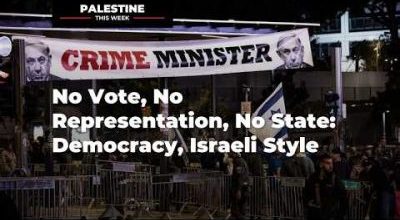
No Vote, No Representation, No State: Democracy, Israeli Style
or go to
Aletho News Archives – Video-Images
From the Archives
Sanctions, War and the Policy of Dual Containment
By SASAN FAYAZMANESH | March 17, 2008
It is now nearly three decades since the Unites States adopted the policy of dual containment of Iran and Iraq. While much has been written about the containment of Iraq, there has been very little in-depth analysis of this policy when it comes to Iran. In a book that is going to be released on March 31, 2008, entitled The United States and Iran: Sanctions, Wars and the Policy of Dual Containment (Routledge), I attempt to address this shortcoming by investigating when and why the US policy of containment of Iran came about, how it evolved, and where it stands today.[1] To the extent that Israel has been involved in US policy making, the study will also include the role that Israel has played in the containment of Iran. Also, since the fate of Iran has been inextricably linked to that of Iraq, occasionally the investigation will overlap with the containment of Iraq.
The policy of dual containment of Iran and Iraq originated during the Carter Administration, but it was not until the Clinton Administration that the expression “dual containment” became popular. … continue
Blog Roll
 Aletho News
- No Vote, No Representation, No State: Democracy, Israeli Style
- Zionist Bought Senate Blocks Information About American Citizens Killed By Israel
- While Gaza dominates the UN, these are the people keeping it alive
- New Report: “Scholasticide and Genocide in Gaza: Assessment, Testimonies and Legal Analysis”
- ‘THAAD Delusion’: Iran war exposes US missile shield limits – The Atlantic
- Moscow issues warning to NATO over Russian exclave
- Yes, the Iran war has destroyed Trump’s presidency
- The fallacy of US delusions about Iran’s economic collapse
- Hezbollah denies Syria cell link, warns of Israeli plan to sow discord
- The legacy of US sanctions, war, and occupation in Iraq
- If Americans Knew
- Mamdani releases plan to combat antisemitism and hate crimes in New York City
- Iran’s Revolutionary Guards Publish Letter to the American People
- DMFI launches $1 million ad campaign supporting Virginia’s Elaine Luria
- US Senate blocks resolution seeking report on Americans killed by Israel
- Israeli Attacks Kill Ten Palestinians in Gaza
- Massacre at Minab: The School That Became a Grave
- Israeli media: The IDF Shows It Doesn’t Turn a Blind Eye; It Actively Emboldens Settler Havoc
- As settlers ravage West Bank, Israeli forces kill 10 in Gaza – Daily Update
- New Report: “Scholasticide and Genocide in Gaza: Assessment, Testimonies and Legal Analysis”
- Ex-Biden officials are desperate for a Gaza scapegoat
- No Tricks Zone
- Green Energy Debacle: German Expert Professor Fritz Vahrenholt Warns Of Severe Economic And Social Consequences
- Two More Paleo Reconstructions Affirm Meters-Higher Sea Levels Across Ireland, Brazil 7000-6000 Years Ago
- New Study: Earth And Venus Surface Warmth Largely Explained By Convection And Lapse Rate, Not CO2 Or Radiation
- 2025 Nature Paper Claiming Worsening Global Drought Gets RETRACTED …Heavily Flawed
- New Study: ‘Global Drought Shows No Detectable Recent Acceleration Under Climate Warming’
- Economic Masterminds: German Socialists Suggest Taxing Productivity Gains Stemming From Using AI
- The South China Sea Has Not Been Cooperating With The Climate Change Narrative
- Energy Crisis: Germany Enters Heating Season With Historically Low Gas Reserve Fill Levels
- New Study: The Antarctic Ice Sheet Gained Mass From 2020-2024 Due To Staggering Snow And Ice Accumulation
- Study: Ocean Heating Rates From Thousands Of Years Ago ‘Dwarf’ Modern Ocean Heating Rates


