Europe’s Alliance with Israel
By David Cronin | March 4, 2010

Avigdor Lieberman meets Javier Solana
One of the pitfalls of specialising in European politics, as I have for the past 15 years, is that certain assumptions become hardwired in your brain. For a long time, my critical faculties shut down when I heard senior EU representatives speak of the Middle East. I happily accepted the official narrative that they were striving for a just resolution to the conflict between Israel and the Palestinians and that it would be foolish to park the so-called peace process in a “blood-soaked lay-by”, in the words of former EU commissioner Chris Patten.
Israel’s attacks on Lebanon in 2006 and on Gaza just over a year ago illustrated how naive and gullible I had been. In the first instance, Tony Blair blocked the EU from formally calling for a ceasefire because he wanted Israel to be given whatever space it perceived necessary to fight Hezbollah (Israel’s slaughter of Lebanese civilians in that 33-day war elicited no more than statements of “regret” from London).
It is true that the Union did urge a halt to the violence that Israel inflicted on Gaza’s 1.5 million inhabitants in late 2008 and early 2009. Yet by describing that attack as “disproportionate”, key EU representatives implicitly approved the Israeli version of events – that everything had been provoked by the missiles Hamas was firing on the southern Israeli towns of Ashkelon and Sderot. “Gaza was a crisis waiting to happen,” Marc Otte, the Union’s Middle East envoy, told me. “Do you think the Palestinians could continue to launch rockets on Israel without Israel reacting?”
Otte has resorted to a wilfully selective reading of recent history. Far from merely reacting to what Hamas had done, Israel had created the conditions that prompted Hamas to dust down its crude DIY weapons (no match, it must be said, for the cutting-edge killing machines in the Israeli arsenal). Until a few months earlier, Hamas had observed the cessation of hostilities between it and Israel that Egypt had brokered in June 2008. All that changed on 4 November that year, however. Because most of the world was preoccupied with how America was electing its first black president, Israel’s decision to break off the ceasefire with a raid on Gaza that killed six members of Hamas went largely unnoticed internationally. As a result, most mainstream press ignored how the rockets sent by Hamas into southern Israel were in retaliation for the November raid.
Even worse than its complicity in spreading Israeli falsehoods, the EU has failed to hold Israel to account for its war crimes. The investigation carried out by a UN-appointed team led by Richard Goldstone, a retired South African judge, into the conduct of Israel’s war on Gaza was as thorough as was possible under the circumstances (with Israeli officialdom refusing to cooperate). But when the 575-page it produced was discussed by the UN’s General Assembly in November 2009, 22 of the EU’s 27 countries refused to endorse it. A key finding that there was no “justifiable military objective” behind 10 of the 11 incidents it examined, in which civilians had been targeted by Israel, proved too unpalatable for most EU governments.

In December 2006 Ehud Olmert caused controversy when he was caught on camera instructing Italian PM Romao Prodi what to say in their joint press conference
While some headlines in 2009 conveyed the impression that there was friction between Israeli and European diplomats over everything from the status of Jerusalem to a Swedish tabloid story alleging that Israeli soldiers systematically ripped out the internal organs of Palestinian corpses, the reality is that Israel enjoys extremely cordial and profitable links with the EU. That reality was underscored by Javier Solana, making a farewell trip to Israel in the autumn, shortly before he stepped down as the EU’s foreign policy chief. “There is no country outside the European continent that has this type of relationship that Israel has with the European Union,” he said. “Israel, allow me to say, is a member of the European Union without being a member of the institutions. It’s a member of all the [EU’s] programmes, it participates in all the programmes.”
The most troubling aspect of this cooperation, in my view, is how Israeli arms companies have become eligible for EU funding. With Israel the main external participant in the Union’s “framework programme” for scientific research, the EU has become the second largest source of research grants for the country. Tel Aviv-based officials to whom I have spoken predict that Israel’s participation in the multi-annual programme, which went into operation in 2007, will be worth €500 million by the time it concludes in 2013.
The beneficiaries of these grants include Motorola Israel. Motorola is taking part in an EU-financed surveillance project known as iDetect4All, which uses sensors to detect intruders of buildings or resources of high economic value. The concept behind iDetect4All is similar to that behind a radar system that Motorola has installed in 47 Israeli settlements in the West Bank over the past five years. The Jerusalem Post has described that system as a “virtual fence” that uses thermal cameras to pinpoint people who are not authorised to enter the settlements.
Another recipient of EU grants is Israel Aerospace Industries, the manufacturer of warplanes used to terrorise Palestinian civilians. It is playing a lead role in the EU’s “Clean Sky” project, which aims to reduce aviation’s contribution to climate change by developing less polluting aircraft engines. Because IAI has been given carte blanche by the European Commission to apply for patents on any innovations realised during this project, it is entirely conceivable that planes used in the future bombardment of Palestine will have been developed with the unwitting help of the European taxpayer.
It is highly probable that Israel will be integrated even further into the Union in the near future. During 2008, the EU’s foreign ministers approved a plan to “upgrade” their relations with Israel through a “privileged partnership” that would enable Israel to become part of the Union’s single market for goods and services. Work on giving concrete effect to this upgrade has stalled since then because of the war on Gaza and unease in some European capitals at the hard-line rhetoric of Binyamin Netanyahu’s government. Nonetheless, some significant steps have been taken in the past few months. In November last, for example, an agreement on agricultural trade was finalised; under it, 80% of Israel’s fresh produce and 95% of its processed foods can be exported to the EU free of customs duties. A cooperation agreement between Europol, the EU’s police office, and Israel has also been reached (though still awaits a formal rubber-stamp from the Union’s governments). This is despite numerous reports from human rights organisations that detainees in Israel are routinely tortured and despite rules in force since 1998 that oblige Europol not to process data obtained by cruel methods.
One factor that has helped pave the way for all this cooperation is that a cottage industry of lobby groups dedicated to promoting Israel has started to flourish in Brussels. The American Jewish Committee, the European Jewish Congress and B’nai B’rith have all set up EU affairs offices over the past few years, while a cross-party alliance of MEPs (known as European Friends of Israel) was founded in 2006. These groups have responded to the widespread public revulsion at Israeli aggression by branding Israel’s critics, including left-wing Jews, as anti-Semites (an absurd claim, considering that most Palestinian solidarity activists abhor anti-Semitism). They have also contended that it is in Europe’s interest to bond with Israel because it is a prosperous economy, that has proven resilient in the face of global recession.
This well-oiled propaganda machine has helped convince policy-makers that Israel should be viewed as something akin to a Mediterranean Canada, a “normal” industrialised country with many similarities to Europe. But Israel is not a normal country; it is one that illegally occupies the land of another people.
The EU’s ever-deepening relationship with Israel cannot be divorced from the brutality meted out on daily basis to the Palestinians. The deeper that relationship gets, the more that Europe will be accommodating the oppression of Palestine. The EU cannot help solve the problems of the Middle East if it is making those problems worse.
• David Cronin’s book Europe’s Alliance with Israel: Aiding the Occupation will be published later this year by Pluto Press. This article originally appeared in the magazine ESharp! (www.esharp.eu)
General Hamid Gul Blames US for Provoking Unrest in Iran
Fars News Agency | March 3, 2010
TEHRAN – Former Director of Pakistan’s Military Intelligence Organization General Hamid Gol blamed the US for creating and training different extremist and terrorist groups in the region, saying Washington is seeking to destabilize the region, specially Iran, through the measure.
“The US intelligence agencies pursued just one goal by forming Rigi’s group which was provoking unrests and instability in Iran,” Gol told FNA on Wednesday.
Abdolmalek Rigi’s US-backed notorious terrorist group, Jundollah, whose main stronghold is in Pakistan, is responsible for carrying out several cases of kidnapping, drug-trafficking and killing innocent people in Sistan-Balouchestan province in southeastern Iran.
Iran announced last week that it had arrested Abdolmalek Rigi when he was traveling to Bishkek to meet a high-ranking US official at a nearby military base to discuss new terrorist attacks on Iranian territory.
Referring to the plots and attempts of the US and its European allies against Iran, Gol reiterated that the very aim of them is to weaken Iran’s independence and impair the relations between Tehran and Islamabad.
He also advised the Pakistani government to elude the plots hatched by the US for dominating and infiltrating the region.
In remarks broadcast on Iran’s state-run TV, Rigi confessed that the United States offered to provide him with military aid to wage an insurgency against the Islamic Republic of Iran.
“After Obama was elected, the Americans contacted us and they met me in Pakistan. They met us after (Iranian forces’) clashes with my group around March 17 in (the southeastern city of) Saharan and he (the US agent) said that Americans had requested a meeting,” Rigi said.
“They (Americans) said they would cooperate with us and would give me military equipment, arms and machine guns,” Rigi stated, adding, “They also promised to give us a base along the border with Afghanistan next to Iran.”
The Jundollah’s ringleader then revealed the US plot to support all the anti-Iran terrorist groups, saying, “One of the CIA officers said that it was too difficult for us to attack Iran militarily, but we plan to give aid and support to all anti-Iran groups that have the capability to wage war and create difficulty for Iran’s (Islamic) system.”
The Jundollah group has claimed responsibility for numerous terrorist attacks in Iran. The group has carried out mass murder, armed robbery, kidnapping, acts of sabotage and bombings. They have targeted civilians and government officials, as well as all ranks of Iran’s military.
In their latest attack on October 18, the group killed more than 40 Iranians, among them 15 members of the Islamic Revolution Guards Corps (IRGC) – including top commanders – and several tribal elders in the country’s southeastern border city of Sambas.
Israel urges US to act alone, as anti-Iran bids fail
Press TV – March 3, 2010

As US Secretary of State Hillary Clinton tours Latin America to recruit support for new international sanctions on Iran over its nuclear program, Tel Aviv urges Washington to adopt Cuba-like embargos against Tehran.
Israel and the US accuse Iran of seeking nuclear arms, as Tel Aviv threatens to attack Iranian nuclear installations and Washington warns of keeping ‘all options on the table,’ including economic sanctions and military measures.
Iran, however, says its program, which is extensively monitored by the International Atomic Energy Agency (IAEA), is directed at the civilian applications of the technology. The country has also called on all nuclear powers to abandon atomic weaponry and eliminate all such arsenal.
Clinton, meanwhile, is on a five-day tour of Latin America. She was quoted by the Associated Press as saying that Washington is working “expeditiously and thoroughly” to rally support for new Iran sanctions.
She has arrived in Brazil, a non-permanent member of the UN Security Council (UNSC), to win support for the sanctions. Brazil has repeatedly said that Iran is entitled to enrich uranium for peaceful purposes.
Although the IAEA says it continues to verify the non-diversion of Iran’s nuclear material, the UNSC has already imposed three rounds of sanctions on the country.
Amid the intensified efforts by the US to impose fresh sanctions, China has appeared to reject the calls to support such a measure. Beijing argues that more negotiations are required to resolve the nuclear issue.
Israel, meanwhile, said Tuesday that the US should impose unilateral sanctions on Iran to isolate the country the same way it acted alone on Cuba 50 years ago, Reuters reported.
“We are a little worried by the pace of developments in the international arena,” Lieberman told reporters. “I think that from now on Israel should perhaps change its Iran policy a little, and we should ask the United States to adopt the Cuban model … Here the United States alone can do everything in order to stop this (Iranian) program.”
Iranian officials have argued that favorite US pressure tactics such as sanctions are outdated and no longer relevant in the global economy as they have been proven futile in the last three attempts against the Islamic Republic. They insist that imposing new sanctions on Iran will further expose the irrelevancy of the UN as a viable international body.
The New Pickens Plan: Scare People With Arabic Ads and Sell Natural Gas
By Kirsten Korosec | Jan 15, 2010
Nothing like an old-timey billionaire’s ad campaign — flush with Arabic script, images of war and an ominous Middle Eastern music track – to get the xenophobic engine cranking and sell some good ol’ U.S. of A. natural gas. The ad campaign drummed up by T. Boone Pickens has been sold as a renewed effort by the Texas energy investor to wean the U.S. off of foreign oil and promote homegrown resources like wind and natural gas.
Pickens has spent upwards of $62 million in the past couple of years on an ad campaign pushing his plan. The aptly named Pickens Plan aims to upgrade the electrical transmission grid; use natural gas — not oil-based products — as a transportation fuel; and use wind and solar instead of coal to generate electricity.
Although as I noted Wednesday after Pickens announced plans to ditch his massive Texas wind project, that strategy has shifted a bit. Now natural gas is the go-to fuel, with wind taking a backseat. The ad, which aired on cable networks Thursday, is specifically aimed at beefing up support for the Nat Gas Act, legislation that would, in part, help pay to convert U.S. diesel-powered trucks to natural gas.
Pickens when asked said he and his aides considered, and ultimately chose to use the Arabic because any added attention would be good for the cause, according to the NYT.
“We’re infidels with most of these people and they have no use for us,” Pickens was quoted by the NYT. “We’re getting more and more dependent on the wrong people.”
I get it. Pickens was aiming for a reaction with this recent ad. Here I am writing about it, so I guess it worked. But why oh why, risk your credibility by throwing out the Arabic and war images — especially when your motivates — as an investor in domestic oil and gas — will be questioned?
The natural gas industry had gained some momentum in recent months. Let’s not forget that it was pretty much left out of the House version of climate-change legislation passed last summer. And I have faith in Americans that the fear-mongering approach won’t work, as Pollyannaish as that may sound.
I have to wonder if the natural gas industry folk are cringing over the ad? I am.
Funding Israeli Militarism, Belligerence and Occupation
By Stephen Lendman | February 2, 2010
From birth, Israel was a regional menace until America became its benefactor in the late 1960s. Now it’s a global one, powerful with a large standing army and the latest weapons and technology, nuclear armed and ready to use them. It’s belligerent on the slightest pretext or none at all, and a threat to world peace and security because US administrations since Lyndon Johnson supported a nation of 5.6 million Jews in an area the size of New Jersey, partnering in its worst crimes and abuses.
It’s due largely to the Israeli Lobby’s influence, or as John Mearsheimer and Stephen Walt wrote in their book, “The Israel Lobby and US Foreign Policy,” America’s Middle East policy is driven “almost entirely (by) US domestic politics, and especially (because of) the (Lobby’s) activities….This situation has no equal in American political history.”
In his book, “The Power of Israel in the United States,” James Petras documented its enormous influence, explaining its roots throughout government, the business community, the dominant media, academia, the clergy, and powerful wealthy Jewish families. Broad support comes from thousands of dedicated activists, including doctors, lawyers, accountants, other professionals, philanthropists, and journalists given special prominence and benefits for their unwavering pro-Israeli reporting, suppressing decades of its militarism, belligerence, and illegal occupation while vilifying Israel’s enemies.
As a result, Israel receives enormous benefits, including billions in annual aid, the latest weapons and technology, unrestricted US market access, and free entry of its immigrants. Its imperial wars, illegal occupation, and crimes of war and against humanity are supported. Harmful Security Council resolutions are vetoed and General Assembly ones ignored. As a result, it operates freely, including spying in America by covertly penetrating US military bases, the FBI, CIA, IRS, DHS and many other government agencies, remaining unaccountable for its actions.
Israel is unique as America’s largest aid recipient, on the most favorable terms, and virtually anything more requested, given openly or covertly, in violation of the 1961 US Foreign Assistance Act (as amended), stipulating that no aid be provided to governments that engage:
“in a consistent pattern of gross violations of internationally recognized human rights, including torture or cruel, inhuman, or degrading treatment or punishment, prolonged detention without charges, causing the disappearance of persons by the abduction and clandestine detention of those persons, or other flagrant denial of the right to life, liberty, and the security of person, unless such assistance will directly benefit the needy people in such country.”
In 2004, the amended Act let the president provide aid to treat orphans, other vulnerable children, those with HIV/AIDS, and to set up schools and other supportive programs.
US Aid to Israel
In November 2008, Shirl McArthur of the Washington Report on Middle East Affairs (WRMEA) used Congressional Research Report (CRS) data for a “Conservative Estimate of Total Direct US Aid to Israel” since 1949, saying it’s almost $114 billion, but explaining that determining the exact figure is impossible since parts are buried in various agency budgets, mostly the Defense Department’s (DOD) or in forms not easily quantifiable.
He states:
“It must be emphasized that this analysis is a conservative, defensible accounting of US direct aid to Israel, NOT of Israel’s cost to the US or the American taxpayer, not of the benefits to Israel of US aid. The distinction is important, because the indirect or consequential costs suffered by the US as a result of its blind support for Israel exceed by many times the substantial amount of direct aid” provided.
Besides Afghanistan and other Middle East conflicts, excluded from McArthur’s data, is the mounting Iraq invasion and occupation cost, estimated by Joseph Stiglitz and Linda Bilmes to be $3 trillion in their book titled, “The Three Trillion Dollar War: The True Cost of the Iraq Conflict.”
They include an extra $2 trillion national debt, ad infinitum interest on it, veterans’ healthcare and disability payments, the economic impact of lives lost and jobs interrupted, the higher cost of oil, the long-term economic impact, and numerous intangibles such as global anti-American sentiment, the near universal Arab world view that Washington attacked Iraq for Israel, and the US’s reduced capability to respond to other global crises and address vital homeland needs.
In his June 2003 WRMEA article titled, “The Cost to American Taxpayers of the Israeli-Palestinian Conflict,” Thomas Stauffer conservatively estimated it at around $3 trillion measured in 2002 dollars, nearly four times the amount for the Vietnam war, also in 2002 dollars.
Stauffer said US Israeli aid is way-understated:
“since much is outside of the foreign aid appropriation process or implicit in other programs. It comes to $1.8 trillion, including special trade advantages, preferential contracts, or aid buried in other accounts. In addition to the financial outlay,” about 275,000 US jobs are lost annually.
His estimates include:
— multi-fold oil price increases;
— the effect on US jobs and exports;
— economic and military aid,
— special benefits to Israel, including privileged contracts for Israeli firms, legal and illegal weapons and technology transfers, exemption from US trade protection provisions, discounted “surplus” military equipment sales, low or no-interest loans, and other undisclosed costly benefits, exclusively for Israel.
He concluded that Israeli assistance and Middle East unrest “ha(ve) proven to be very expensive for the US,” much higher than revealed figures. Their total costs “are some six times the official aid” with all related factors included such as the price of oil and burden on other regional states. “All states – not just the US – have borne the burden of conflicts in the Middle East.”
Known US aid includes:
— annual $3 billion direct appropriations;
— undisclosed additional amounts;
— millions annually to resettle immigrants;
— disclosed and unknown billions in loan guarantees;
— since 1981, economic aid in direct cash transfers, and since 1985 military aid the same way;
— Israeli military loans as grants, repayment not required; Israel wants them called loans to avoid US monitoring; according to the Congressional Budget Office (CBO), “Technically, the assistance is called loans, but as a practical matter, the military aid is (given as) grants;”
— economic aid is the same, Israel spending it as it pleases with no required accountability;
— since 1982, Economic Support Fund (ESF) cash transfers come in lump sum form at the beginning of each fiscal year, no strings attached – a benefit afforded no other country, made even greater by investing it in US Treasuries;
— special Foreign Military Sales (FMS) funding is also afforded to purchase American weapons and technology; other countries buy them through the Defense Department (DOD); Israel deals directly with US companies; other countries must comply with minimum purchase amounts; Israel has no such restriction; other countries let DOD disburse funds to suppliers; Israel pays them directly and is reimbursed by the US Treasury; under this arrangement, Israeli officials have committed serious offenses, including embezzlement and improper access to highly classified information on US weapons and technology;
— US weapons suppliers provide offsets by purchasing Israeli products and services;
— Israel may use over 26% of its aid to buy weapons, munitions and other equipment from its own companies; no other nation has this benefit; as a result, its arms industry is one of the world’s largest and most sophisticated; in 2007, it was the 8th largest supplier to developing countries;
— aid finances Israel’s defense industry;
— state-of-the-art weapons and technology are provided; and
— America guarantees Israel’s access to oil and finances its settlements – illegal under international law.
In April 1998, Washington designed Israel a “major non-NATO ally,” qualifying it to receive Excess Defense Articles (EDA) under Section 516 of the Foreign Assistance Act and Section 23(a) of the Arms Export Control Act. As a strategic US ally, it gets unmatched preferential treatment.
In FY 2009, the If Americans Knew web site said America gave Israel $7 million or more daily. Palestinians got nothing, except to police their own people, strengthen Fatah against Hamas and other competing parties, some economic aid benefitting Israel and the West, and spotty amounts through USAID and to UNRWA and US-based NGOs for projects called “humanitarian.”
In their above-mentioned book, Mearsheimer and Walt said:
“Since the October (1973) War, Washington has provided Israel with a level of support dwarfing the amounts (given) any other state. It has been the largest annual recipient of direct US economic and military assistance since 1976 and the largest total recipient since World War II. Total direct US aid to Israel amounts to well over $140 billion in 2003 dollars….In per capita terms, the United States gives each Israeli a direct subsidy worth about $500 per year.”
Over the last 20 years, Washington focused mainly on military aid, increasing it by $150 million annually since FY 2007, plus additional amounts for Israeli incursions, planned jointly with Washington.
Before 1998, Israel annually received military grants of $1.8 billion and economic ones totaling $1.2 billion. Beginning in FY 2009, by mutual agreement, economic aid is being reduced by $120 million and military grants increased by $60 million annually over 10 years. In August 2007, a memorandum of understanding afforded Israel $30 billion in aid for 10 years, plus later discovered undisclosed amounts, totaling billions.
Budgeted amounts go mostly for specific projects, such as Israel’s Merkava tank, its Arrow anti-missile missile, other anti-missile systems, and the cancelled Lavi attack fighter. Grants also go to US – Israeli scientific and business cooperation organizations, the two largest being the BIRD (Binational Research & Development) Foundation and the BARD (Binational Agriculture and Research and Development) Fund.
Congressional Research Service (CRS) Report on US Foreign Aid to Israel – December 4, 2009
Its latest report affirms Israel as “the largest cumulative recipient of US foreign assistance since World War II,” saying it gets nearly $3 billion annually, mainly as military assistance.
In August 2007, the Bush administration incrementally increased it by $6 billion over the next decade. For FY 2010, the Obama administration requested $2.775 billion in Foreign Military Financing (FMF). Congress provided $555 million of Israel’s total FY 2010 FMF in PL (Public Law) 111-32, in the FY 2009 Supplemental Appropriations Act. HR 3081 and S 1434 contain the remaining funds.
On July 9, 2009, HR 3160 was introduced, the Israeli Foreign Assistance Appropriations Act, 2010. The bill was referred to committee and awaits further action.
Recent possible military sales include:
— on September 29, 2008, the F-35 Joint Strike Fighter with associated equipment and training, a deal, if consummated, worth up to $15.2 billion; Israel wants up to 75 depending on the cost; negotiations continue, but reported disagreement was reported over its right to customize aircraft to its needs and the final per plane cost, from $100 – $200 million depending on the degree of customization;
— on September 9, 2008, Patriot Missile Fire Unit upgrades, 1,000 GBU-39 small diameter guided bombs, and 28,000 M72A7 light anti-armor weapons, in total worth about $330 million; Israel already has US-supplied Hawk and Patriot missiles as well as its own defense systems; since 1988, both countries have been developing the Arrow Anti-Missile system, a weapon with theater ballistic missile capability; Arrow became operational in 2000; Arrow II is designed to deter longer-range conventional ballistic missiles, and other systems are under development, including Arrow III;
— on July 30, 2008, nine C-130 J-30 aircraft with associated equipment and training, worth up to $1.9; billion; and
— on July 15, 2008, four Littoral combat ships, worth up to $1.9 billion, and JP-8 aviation jet fuel worth up to $1.3 billion; in 2009, Israel declined to purchase these ships over cost concerns.
American Israeli aid began in 1949 with a $100 million Export-Import Bank loan and continued modestly for the next two decades. In 1962, Israel bought its first advanced weapons system, Hawk anti-aircraft missiles. In 1968, a year after the Six Day War, the Johnson administration assured Israel’s regional military superiority. Since 1970, large-scale aid followed. In 1971, it was $545 million, and by 1974 Israel became America’s largest aid recipient, two-thirds for military purposes.
After the 1979 Camp David Accords and Israel – Egypt Peace Treaty, Washington gave both sides $7.5 billion under the 1979 Special International Security Assistance Act, allocated 3 – 2 favoring Israel. Thereafter, regular and emergency economic and military aid followed. Today, Israeli allocations far exceed amounts given Egypt or any other nation.
In 1985, Congress appropriated special economic assistance of $1.5 billion under terms of a US – Israel Joint Economic Development Group (JEDG), calling for neoliberal reforms and empowering Israel’s Finance Ministry and national Bank.
Washington and Tel Aviv colluded for two goals:
— balancing Israel’s budget; and
— cutting wages, prices, credit, public benefits, pensions, and the currency’s value as well as curbing union power and establishing an exploitable temporary worker market.
It began Israel’s race to the bottom by mass privatizations, welfare and social benefit cuts, and wealth shifted to the top as in America, the result being growing Jewish poverty, hunger and homelessness to the present.
In 1985, all US military aid became grants, what began for economic aid in 1981. Thereafter, generous supplemental aid followed, including after the Gulf and 2003 Iraq wars. The FY 2003 Emergency Supplemental Appropriations Act included $9 billion in loan guarantees over three years and $1 billion in military grants. Other amounts came earlier. They’ve continued ever since, some open, others covert, affording Israel exclusive preferential treatment.
The “special relationship” remains fixed under Obama, what he affirmed at the June 2008 AIPAC meeting that he’s “a true friend of Israel,” felt he was “among friends,” stressed that “the bond between the United States and Israel is unbreakable today, tomorrow and forever,” and, in fact, “as president, I will work with you to ensure that this bond is strengthened.” He hasn’t disappointed.
Stephen Lendman is a Research Associate of the Centre for Research on Globalization. He lives in Chicago and can be reached at lendmanstephen@sbcglobal.net.
Clinton changes tune on timing of Iran sanctions
Press TV – March 2, 2010
US Secretary of State Hillary Clinton says it could take several months to impose new sanctions on Iran over its nuclear program. She made the remarks on Monday while speaking to reporters traveling with her on a tour of South America.
Pundits say she changed her position on sanctions because of reluctance among some other members of the UN Security Council.
Last week, Clinton told the US Senate that the UN Security Council would endorse sanctions in the next 30 to 60 days. But on Monday she stressed that Washington is working “expeditiously and thoroughly” to convince UN Security Council members to impose new sanctions on Iran.
“We are moving expeditiously and thoroughly in the Security Council. I can’t give you an exact date, but I would assume sometime in the next several months,” she said before landing in the Argentine capital Buenos Aires.
Clinton said she would probably discuss the Iranian issue during talks with the presidents of Argentina and Brazil.
Last week, Clinton acknowledged that some key countries like China are opposed to new Iran sanctions.
Both China and Russia are calling for further negotiations to resolve the dispute over Iran’s nuclear program, which Tehran says is being implemented to meet the country’s growing demand for energy.
The New York Times veers neocon
Robert Parry | consortiumnews.com | March 1, 2010
Many American progressives don’t want to recognize how bad the U.S. mainstream news media has become. It’s easier to praise a few exceptions to the rule and to hope that some pendulum will swing than to undertake the challenging task of building a new and honest media infrastructure.
But the hard reality is that the U.S. news media is getting worse, with now both premier national newspapers – the New York Times and the Washington Post – decidedly sliding into the neocon camp, where the likes of the Wall Street Journal have long resided.
For the Post, this may already be an old story, given its enthusiastic cheerleading for the Iraq War. The Times, however, was a somewhat different story. Yes, it did let Judith Miller and other staff writers promote the fictions about Iraq’s WMD, but it hadn’t sunk to the depths of the Post.
That is now changing as the Times – behind executive editor Bill Keller and editorial page editor Andrew Rosenthal – tosses aside all pretense of objectivity in the cause of seeking “regime change” in Iran, today’s top priority for the neoconservatives.
At Consortiumnews.com, we have noted this trend for some months, not only in the New York Times opinion section but in its news columns where Iran’s alleged interest in acquiring a nuclear weapon is trumpeted incessantly (despite its denial of such a desire), while rogue nuclear states in the region (such as Israel, Pakistan and India) are given a pass. [See, for example, “US Media Replays Iraq Fiasco in Iran.”]
This Sunday, the Times’ bias was on display again in the lead editorial entitled, “New Think and Old Weapons,” which purported to examine the state of nuclear weapons in the world.
Fitting with the Times’ deepening neocon tendencies, Iran’s nuclear weapons (even though they don’t exist) were a major topic, while the rogue nuclear states of Israel, Pakistan and India (which have refused to sign the Nuclear Non-Proliferation Treaty) weren’t mentioned.
So, you had formulations like this: “Iran, North Korea and others have seemingly unquenchable nuclear appetites” and the need to “bolster American credibility … to rein in Iran, North Korea and other proliferators.” In all, there were four such references to North Korea and Iran, but no specific references to Israel, Pakistan and India.
The Times also observed that China was “the only major nuclear power adding to its arsenal [which] is estimated to have 100 to 200 warheads.” There was no mention of Israel, which is believed to possess one of the most sophisticated nuclear arsenals in the world, totaling some 200 or more devices.
Ironically, the Times editorial also cited problems of “hypocrisy and double standards” and noted that the Nuclear Non-Proliferation Treaty was “battered.”
The Times did not seem at all embarrassed by its own hypocrisy and double standards. Nor did it bother to note that one of the key reasons this “bedrock” treaty is in trouble is that non-signatories – like Israel, Pakistan and India – have built nukes, often with a wink and a nod from Washington.
As neocon propagandists pursue their goal of riling up the American public against some new foreign threat, that effort requires highlighting certain facts (and even fictions). But the propagandists equally must make sure that many inconvenient truths are conveniently forgotten. Otherwise the alleged threat might not seem all that unusual or threatening.
So, in the world of neocon propaganda, Iran – a treaty signatory that has no nuclear weapons and insists its nuclear program is for peaceful purposes – must be endlessly badgered, but Israel – an undeclared rogue nuclear state with a vast arsenal – must be shielded from similar criticism and pressure.
That the New York Times has now embraced these neocon biases, almost with the ardor of the Washington Post, is a serious development for the U.S. news media and for the nation.
© 2010 Consortium News
Robert Parry broke many of the Iran-Contra stories in the 1980s for the Associated Press and Newsweek.
Obama may retain Bush’s nuclear policy
Press TV – March 1, 2010

US President Barack Obama has reportedly rejected proposals to exclude pre-emptive atomic strikes from the country’s new nuclear strategy.
Obama is making his final decisions on America’s new nuclear strategy, called the ‘Nuclear Posture Review’, which is expected to permanently downsize the US nuclear arsenal.
But fears are growing that the president might follow in his predecessor Gorge W. Bush’s tracks.
Citing unnamed senior presidential aides, the daily New York Times said on Monday that the administration has rejected proposals that the United States declare it would resort to nuclear arms only once targeted by such weapons.
This would mean Obama, who has been extremely cautious in distancing himself from the former administration’s policies, may now leave open the possibility for the United States to use nuclear weapons in response to a chemical or biological attack, even against a nation that may not possess a nuclear arsenal at all, the paper noted.
The new document is supposed to commit the United States to developing no new nuclear weapons, including the nuclear bunker-busters advocated by the Bush administration.
This is while Obama has authorized billions of dollars more to be spent on updating America’s weapons laboratories.
According to Times article, the US has been bringing up with its European allies the question of whether to withdraw its Europe-based tactical nuclear weapons.
On Monday, Secretary of Defense Robert Gates was to present Obama with several options in line with a shift in US military strategy towards the use of broader missile systems, mostly arrayed within striking distance of the Persian Gulf states.
Obama’s recently published Quadrennial Defense Review also includes support for a new class of non-nuclear missiles, namely “Prompt Global Strike,” which enable the United States to hit a target anywhere in less than an hour, the Times said.
‘NYT’ Op-Ed congratulates Obama for laying off Israel ’cause solving I/P won’t solve anything
By Jeffrey Blankfort | February 28, 2010
Has the NY Times response to the complaints about Ethan Bronner led it to be even more forceful in pushing its pro-Israel agenda including getting the US to attack Iran? Apparently so. In today’s op-eds, they’ve imported the thoughts of a British Jewish professor, Efraim Karsh, (another Bernard Lewis, and a Nakba denier) who uses his abbreviated paternalistic version of Islamic history to conclude that the Arabs countries will not object to the US attacking Iran. And, in passing, he welcomes Washington’s less “imperious” attempts at bringing Israel to the bargaining table:
So, if the Muslim bloc is just as fractious as any other group of seemingly aligned nations, what does it mean for United States policy in the Islamic world?
For one, it should give us more impetus to take a harder line with Iran. Just as the Muslim governments couldn’t muster the minimum sense of commonality for holding an all-Islamic sports tournament, so they would be unlikely to rush to Iran’s aid in the event of sanctions, or even a military strike.
Beyond the customary lip service about Western imperialism and “Crusaderism,” most other Muslim countries would be quietly relieved to see the extremist regime checked. It’s worth noting that the two dominant Arab states, Egypt and Saudi Arabia, have been at the forefront of recent international efforts to contain Iran’s nuclear ambitions.
As for the Palestinian-Israeli conflict, the idea that bringing peace between the two parties will bring about a flowering of cooperation in the region and take away one of Al Qaeda’s primary gripes against the West totally misreads history and present-day politics. Muslim states threaten Israel’s existence not so much out of concern for the Palestinians, but rather as part of a holy war to prevent the loss of a part of the House of Islam.
In these circumstances, one can only welcome the latest changes in the Obama administration’s Middle Eastern policy, which combine a tougher stance on Iran’s nuclear subterfuge with a less imperious approach to the Arab-Israeli conflict.
IRAN HAS BEEN CAPABLE OF HAVING A ‘NUCLEAR WEAPON WITHIN SIX MONTHS’ FOR YEARS NOW – BUT, LIKE ‘TOMORROW’, IT NEVER COMES.
By Damian Lataan | February 28, 2010
Other periods of time have been mentioned over the three decades since the Iranian people kicked out the Shah as to how long it would take the Iranians to build a nuclear weapon, but six months seems to a very popular nominal figure. Never mind, of course, that there has not been a skerrick of evidence to even suggest that the Iranians are doing anything more than building nuclear reactors for generating electricity or creating medical isotopes for medical purposes. But that hasn’t stopped the propagandists who seem to insist that Iran is still only six months away from having a nuclear weapon.
If I started the list of claims that Iran would have a weapon within six months from back in 1980 when the Shah went, you’d still be reading it in, well… six months time! So, I’ll cut short the list and start it off with some of the earlier claims of this century.
Back in August 2003, the LA Times reported that Iran could have a ‘nuclear weapon in six months’. More than two years later in September 2005, Israel claimed Iran would have ‘nuclear weapon in six months’. Then, nearly three years later in June 2008 we were told again that Iran would have a ‘nuclear weapon in six months’. A year later, in July 2009, Ha’aretz reported that ‘Germany believes Iran could have a nuclear bomb in six months’.
 Now, in the very latest statement dated 23 February 2010, made by so-called ‘Iran weapons expert’, David Albright, Iran, in his expert opinion, is now only… wait for it; six months away from having a nuclear weapon. This is the very same David Albright that was telling us more than a year ago in February 2009; “In as quickly as a few months, Iran would be able to have enough weapons-grade uranium for nuclear weapons”. It’s also the very same David Albright who told the CBS ’60 Minutes’ show way, way back in January 1999 that Saddam Hussein was “within a few months to a year of having a nuclear weapon”.
Albright? Not very! He’s the original boy that cried ‘Wolf!’ Unfortunately, the media will continue to echo his and similar cries and there will be those that believe them. Eventually the West, led by Israel and the US, will attack Iran based on these lies, but the worst of it is; hundreds of thousands or maybe millions of dead later, the rest of world will go along with it without a murmur.
Mainstream Media Questions Inaccuracies in 9/11 Story
The Washington Times publishes story questioning official account.
By Tim King* | Salem-News.com | February 24, 2010
The mainstream press is showing interest in a taboo, however glaring subject; the inconsistencies in the Bush White House 9/11 account.
As The Washington Post reports today, “A lingering technical question about the Sept. 11 terrorist attacks still haunts some, and it has political implications: How did 200,000 tons of steel disintegrate and drop in 11 seconds? A thousand architects and engineers want to know, and are calling on Congress to order a new investigation into the destruction of the Twin Towers and Building 7 at the World Trade Center.”
The problems with the official federal stories are endless and according to some of the world’s top minds, the suggested account is impossible[1].
When we first began to write about these seemingly pressing questions, our Web Designer Matt Lintz caught the U.S. Air Force attempting to hack into Salem-News.com[2].
One person who has never let the matter fade away is Richard Gage. He’s a San Francisco architect and founder of the nonprofit Architects & Engineers for 9/11 Truth.
Gage told The Washington Times, “In order to bring down this kind of mass in such a short period of time, the material must have been artificially, exploded outwards.”
The federal government wants you to believe that fires brought the buildings to the ground, yet in all recorded history, no fire has ever toppled a skyscraper. They burn to the framework but they don’t fall down.
Even if it was possible, the World Trade Towers were the least likely candidates. The steel core design of these buildings would not have come down, even if the building collapsed.
Even when you get past that, perhaps finding ways to justify the impossible “official” circumstances, how on earth could any logical explanation account for Building 7?
This is curious, I would suggest that half of all living Americans still don’t realize that a third building also came down that day, and it wasn’t hit by an airplane. But it did contain a lot of records that certain members of the financial industry didn’t miss. Then there are the billions of dollars in missing gold evacuated just before Building 7 pancaked to the ground.
The words of Gage are reflected all over the nation in universities and engineering firms. The Trade Tower buildings were specifically designed to withstand the impact of a jet liner, specifically. Jet fuel is similar to diesel and it doesn’t burn very hot. Firefighters, talking on radios, talked about how the aircraft crash fire in one building were going to easily be extinguisher by a few firefighters.
One of our writers, Jeff Gates, suggested that the only country that benefited from the ensuing wars is Israel.
“For instance, a skilled game theorist could foresee that, in response to a 911-type mass murder, “the mark” (the U.S.) would deploy its military to avenge that attack. With phony intelligence fixed around a preset goal, a game theory algorithm could anticipate that those forces might well be redirected to invade Iraq-not to avenge 911 but to pursue the expansionist goals of Greater Israel[3].
Enforcing that thought, our writer Maidhc Ó Cathail wrote, “The day after 9/11, Benjamin Netanyahu let slip that the deaths of almost 3,000 Americans was ‘very good’ for Israel. In particular, the mass murder was very good for an emerging sector of the Israeli economy. In Laboratory for a Fortressed World, Naomi Klein detailed the post-9/11 “explosion of Israel’s homeland security sector.”[4]
Another Salem-News.com writer, Dr. Alan Sabrosky, wrote about the connection between 9/11 and Israel in the article, Treason, Betrayal and Deceit: The Road to 9/11 and Beyond, “Second, only two intelligence agencies had the expertise, assets, access and political protection to execute 9/11 in the air and on the ground: our CIA and Israel’s Mossad. Only one had the incentive, using the ‘who benefits’ principle: Mossad.”[5]
The answers remain tangled up. Many Americans believe questioning the government over this is unpatriotic, then they turn around and burn effigies of Obama at tea bagger parties. I say it is highly unpatriotic and even disingenuous, to not question facts about the integrity of this nation.
I won’t even start on Shanksville and the Pentagon; those stories are packed with more holes and in your face inconsistencies than there is time for in this report, but I have written about the Pentagon in particular, at great length[6].
The tragedy of September 11th 2001 is so far reaching that we could never truly describe it. The event was the reasoning to launch two very costly, ongoing wars. The very notion of Arab terrorists selecting the day that is synonymous with emergency response in the U.S. is as hard to believe as the “terrorists” passports recovered so conveniently on the sidewalks in New York that day.
The Washington Times cites how Gage, a member of the American Institute of Architects, managed to persuade more than a thousand of his peers to sign a new petition requesting a formal inquiry.
“The official Federal Emergency Management [Agency] and National Institute of Standards and Technology reports provide insufficient, contradictory and fraudulent accounts of the circumstances of the towers’ destruction. We are therefore calling for a grand jury investigation of NIST officials.”
Gage says technical issues surrounding the collapse of the towers have prompted years of debate, rebuttal and ridicule.
The article cites how he is particularly disturbed by the fall of the 47-story skyscraper, Building 7. This engineer says, like the other two buildings, tower 7 fell in “pure free-fall acceleration.”
He also talked about how more than a hundred first-responders observed flashes and explosions during the fall of the towers.
Even more disturbing evidence Gage says, are “multi-ton steel sections ejected laterally 600 ft. at 60 mph”. He also talked about the “mid-air pulverization of 90,000 tons of concrete & metal decking.”
Firefighters and Trade Tower employees en mass reported explosions before the buildings came down. They also talked about building closures in the weeks preceding 9/11, and men carrying large amounts of equipment into the elevator shafts.
Most experts agree that the buildings could only have come down the way they did if they were imploded. Experts who perform this type of work, common in places like Las Vegas, at least before the nation’s economic downturn, place the main explosives in the elevator shafts, but also in many other strategic locations in a building’s structure.
If you watch the World Trade Towers fall in slow motion, it is easy to observe what appear to be a series of planned explosions, running essentially the length of each building.
Gage says evidence of “advanced explosive nano-thermitic composite material” was found in the World Trade Center dust. Of course Rudy Gulliani, mayor of New York at the time, had all of the building evidence shipped away from the state almost immediately.
There is a long list of federal investigators who say they were not allowed to do their jobs or complete the investigation. Tie this to the revelations in 9/11 Commissioner John Farmer’s book: “The Ground Truth: The Story Behind America’s Defense on 9/11″, where the author builds the inescapably convincing case that the official version is almost entirely untrue, according to our writer Gordon Duff, and you just might be lifting a corner of the dirtiest rug that ever was used to suppress truth[7].
Gage says the group’s petition at ae911truth.org is already on its way to members of Congress.
He Told The Washington Times, “Government officials will be notified that ‘Misprision of Treason,’ U.S. Code 18 (Sec. 2382), is a serious federal offense, which requires those with evidence of treason to act.”
“The implications are enormous and may have profound impact on the forthcoming Khalid Shaikh Mohammed trial.”
For me, the biggest story here is that a mainstream member of the press published this article, I am amazed and encouraged. It is hard to suggest that we have perhaps been had in the biggest and worst way possible, but honesty is the only thing that matters.
Israeli Espionage – Part 1 of 4
Video link: http://www.youtube.com/watch?v=rEOecRtBU7U
Israeli Espionage – Part 2 of 4
Video link: http://www.youtube.com/watch?v=o17SSuuZDkA
Israeli Espionage – Part 3 of 4
Video link: http://www.youtube.com/watch?v=VclAeKYYvBc
Israeli Espionage – Part 4 of 4
Video link: http://www.youtube.com/watch?v=NVRsmodmCTE
Also, this video from CoreofCorruption.com which was released just over a year ago, details the information regarding four alleged “art students” who had free access to the Trade Towers, including construction passes, in the immediate weeks preceding 9/11:
Video link: http://www.youtube.com/watch?v=dA9MvV-SrCo
References:
[1] Apr-07-2006 : Huge Contradictions in Official Theories on 9/11 Crash at Pentagon – Tim King Salem-News.com
[2] Apr-16-2006: U.S. Air Force Hackers Caught in Their Tracks by Salem-News.com – Tim King Salem-News.com
[3]Oct-20-2009: How Israel Wages Game Theory Warfare – Jeff Gates Salem-News.com
[4] Jan-20-2010: The Merchants of Fear: Israel’s Profiting from Homeland Insecurity – Maidhc Ó Cathail Sabbah.biz
[5] Sep-10-2009: Treason, Betrayal and Deceit: The Road to 9/11 and Beyond – Alan Sabrosky Sabbah.biz
[6] Mar-21-2006: What Really Hit The Pentagon? – Tim King Salem-News.com
[7] Sep-11-2009: The 9/11 Commission Rejects own Report as Based on Government Lies – Gordon Duff Salem-News.com
* Tim King is a former U.S. Marine with twenty years of experience on the west coast as a television news producer, photojournalist, reporter and assignment editor. In addition to his role as a war correspondent, this Los Angeles native serves as Salem-News.com’s Executive News Editor. Tim spent the winter of 2006/07 covering the war in Afghanistan, and he was in Iraq over the summer of 2008, reporting from the war while embedded with both the U.S. Army and the Marines. Tim holds numerous awards for reporting, photography, writing and editing, including the Oregon AP Award for Spot News Photographer of the Year (2004), first place Electronic Media Award in Spot News, Las Vegas, (1998), Oregon AP Cooperation Award (1991); and several others including the 2005 Red Cross Good Neighborhood Award for reporting. Serving the community in very real terms, Salem-News.com is the nation’s only truly independent high traffic news Website. You can send Tim an email at this address: newsroom@salem-news.com
Source: Salem-news.com
Canada’s neoconservative turn
Yves Engler, The Electronic Intifada, 26 February 2010
 |
Canada’s Minister of Foreign Affairs Lawrence Cannon (right) meets with Israeli Prime Minister Benjamin Netanyahu in March 2009. (AFP) |
“An attack on Israel would be considered an attack on Canada.”
– Peter Kent, Junior Foreign minister, 12 February 2010
In my new book Canada and Israel: Building Apartheid I argue that the trajectory of this country’s foreign policy has been clear. The culmination of six decades of one-sided support, and four years into the government of Conservative Party Prime Minister Stephen Harper: Canada is (at least diplomatically) the most pro-Israel country in the world.
Since the book went to print a couple of months ago the Conservatives have launched a more extreme phase of Israel advocacy. Groups in any way associated with the Palestinian cause have been openly attacked and Ottawa has taken a more belligerent tone towards Iran.
In the beginning of February, Ottawa delighted Israeli hawks by canceling $15 million in funding for the UN agency for Palestine Refugees (UNRWA). The money has been reallocated to Palestinian Authority judicial and security reforms in the West Bank. At the same time, Canada doubled the number of troops involved in US Lt. General Keith Dayton’s mission to train a Palestinian force to strengthen Fatah against Hamas and to serve as an arm of Israel’s occupation.
Only a few weeks earlier, Israel apologists sang Harper’s praise when his government chopped $7 million from Kairos, a Christian aid organization that had received government money for 35 years. During a visit to Israel, Immigration Minister Jason Kenney said Canada had “defunded organizations, most recently like Kairos, who are taking a leadership role” in campaigns to boycott Israel. Palestinian advocacy was also the reason Ottawa failed to renew its funding for Montreal-based Alternatives, an international solidarity organization, which received most of its budget from the federal government.
The Conservatives chose a different tactic with the arm’s-length government agency Rights and Democracy. Instead of cutting its budget, they stacked the board with hard-line supporters of Israel. Last week, Maclean magazine reported that “The Rights and Democracy board is now predominantly composed of people who have devoted much of their life to an unequivocal position: that no legal challenge to Israel’s human rights record is permissible, because any such challenge is part of a global harassment campaign against Israel’s right to exist.”
The new “Israel no matter what” board members hounded the organization’s president, Remy Beauregard, until he died of a heart attack after a “vitriolic” meeting a month ago. Once in charge, the new board voted to “repudiate” three $10,000 grants given to Israeli and Palestinian human rights groups (B’Tselem, Al-Haq and Al Mezan). On Wednesday, the Toronto Star reported that the “Conservative-appointed [Rights and Democracy] board secretly decided to close the agency’s Geneva office, distancing itself from a United Nations body it viewed as anti-Israeli.”
Internationally, Harper has used his pulpit as host of this year’s G8 to pave the way for a possible US-Israeli attack on Iran. “Canada will use its G8 presidency to continue to focus international attention and action on the Iranian regime,” explained the prime minister on 9 February.
While Ottawa considers Iran’s nuclear energy program a major threat, Israel’s atomic bombs have not provoked similar condemnation. The Harper government has repeatedly abstained on votes asking Israel to place its nuclear weapons program under International Atomic Energy Agency (IAEA) controls.
A week ago Ottawa criticized China, a key trading partner of Iran, for refusing to follow Western dictates regarding the Islamic Republic. “I think China should step up to the plate and do something here,” Foreign Affairs Minister Lawrence Cannon said.
While they are silent on the appalling record of the pro-West monarchy in Saudi Arabia and the dictatorship in Egypt, Canadian officials regularly berate Iran. “This regime continues to blatantly ignore its international obligations, and this threatens global security,” Cannon said last week.
At times Canadian words have been even more menacing. A 17 February Toronto Star article was headlined: “Military action against Iran still on the table, Kent says.” Peter Kent, the junior foreign minister, explained that “It may soon be time to intensify the sanctions and to broaden those sanctions into other areas.” He added: “I think the realization [is] that it’s a dangerous situation that has been there for some time. It’s a matter of timing and it’s a matter of how long we can wait without taking more serious preemptive action.”
“Preemptive action” is likely a euphemism for a bombing campaign. Canadian naval vessels are already running provocative maneuvers off Iran’s coast and by stating that “an attack on Israel would be considered an attack on Canada,” Kent is trying to create the impression that Iran may attack Israel. But isn’t it Israel that possesses nuclear weapons and threatens to bomb Iran, not the other way around? Of course that would be a reality-based analysis, not something George W. Bush’s Canadian clones favor.
Yves Engler (http://yvesengler.wordpress.com/) is the author of the recently-released Canada and Israel: Building Apartheid and The Black Book of Canadian Foreign Policy.
Featured Video
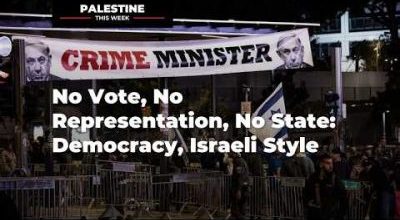
No Vote, No Representation, No State: Democracy, Israeli Style
or go to
Aletho News Archives – Video-Images
From the Archives
Sanctions, War and the Policy of Dual Containment
By SASAN FAYAZMANESH | March 17, 2008
It is now nearly three decades since the Unites States adopted the policy of dual containment of Iran and Iraq. While much has been written about the containment of Iraq, there has been very little in-depth analysis of this policy when it comes to Iran. In a book that is going to be released on March 31, 2008, entitled The United States and Iran: Sanctions, Wars and the Policy of Dual Containment (Routledge), I attempt to address this shortcoming by investigating when and why the US policy of containment of Iran came about, how it evolved, and where it stands today.[1] To the extent that Israel has been involved in US policy making, the study will also include the role that Israel has played in the containment of Iran. Also, since the fate of Iran has been inextricably linked to that of Iraq, occasionally the investigation will overlap with the containment of Iraq.
The policy of dual containment of Iran and Iraq originated during the Carter Administration, but it was not until the Clinton Administration that the expression “dual containment” became popular. … continue
Blog Roll
 Aletho News
- How Israel destabilizes the Middle East: Denying sovereignty and the right to exist
- Europe’s Establishment Is Embracing War – and Losing Voters
- NATO chief advocates war of aggression
- No Vote, No Representation, No State: Democracy, Israeli Style
- Zionist Bought Senate Blocks Information About American Citizens Killed By Israel
- While Gaza dominates the UN, these are the people keeping it alive
- New Report: “Scholasticide and Genocide in Gaza: Assessment, Testimonies and Legal Analysis”
- ‘THAAD Delusion’: Iran war exposes US missile shield limits – The Atlantic
- Moscow issues warning to NATO over Russian exclave
- Yes, the Iran war has destroyed Trump’s presidency
- If Americans Knew
- Inside Lebanon’s 200-page dossier on Israeli war crimes
- Flydubai, genocide, settler violence, Trump abuse of power to deport – Daily Update
- Counting Antisemitic Incidents: What the ADL Audit Reveals — and Obscures
- Mamdani releases plan to combat antisemitism and hate crimes in New York City
- Iran’s Revolutionary Guards Publish Letter to the American People
- DMFI launches $1 million ad campaign supporting Virginia’s Elaine Luria
- US Senate blocks resolution seeking report on Americans killed by Israel
- Israeli Attacks Kill Ten Palestinians in Gaza
- Massacre at Minab: The School That Became a Grave
- Israeli media: The IDF Shows It Doesn’t Turn a Blind Eye; It Actively Emboldens Settler Havoc
- No Tricks Zone
- Green Energy Debacle: German Expert Professor Fritz Vahrenholt Warns Of Severe Economic And Social Consequences
- Two More Paleo Reconstructions Affirm Meters-Higher Sea Levels Across Ireland, Brazil 7000-6000 Years Ago
- New Study: Earth And Venus Surface Warmth Largely Explained By Convection And Lapse Rate, Not CO2 Or Radiation
- 2025 Nature Paper Claiming Worsening Global Drought Gets RETRACTED …Heavily Flawed
- New Study: ‘Global Drought Shows No Detectable Recent Acceleration Under Climate Warming’
- Economic Masterminds: German Socialists Suggest Taxing Productivity Gains Stemming From Using AI
- The South China Sea Has Not Been Cooperating With The Climate Change Narrative
- Energy Crisis: Germany Enters Heating Season With Historically Low Gas Reserve Fill Levels
- New Study: The Antarctic Ice Sheet Gained Mass From 2020-2024 Due To Staggering Snow And Ice Accumulation
- Study: Ocean Heating Rates From Thousands Of Years Ago ‘Dwarf’ Modern Ocean Heating Rates

