Dissident Jews: Unwanted in Germany?
By Raymond Deane | Pulse Media | February 25, 2010
A European country that scapegoats a Semitic people, persecutes defenders of human rights by stripping them of employment, and denies freedom of speech to Jews: surely a description of Germany during the Third Reich?
Yes, but unfortunately also a description of Germany at the outset of the 21st century.
In the wake of German Chancellor Merkel’s craven speech to the Israeli Parliament (the Knesset) two years ago, I wrote: “a penance is being paid for Germany’s past crimes… by the Palestinians to whose plight Merkel is so indifferent…. By scapegoating the victims of its former victims, Germany is compounding its past crimes.” (Scapegoat upon Scapegoat, Electronic Intifada, 20 March 2008).
Just one year later I described the case of Hermann Dierkes, forced to resign his position as representative of Die Linke (The Left Party) on Duisburg city council after tentatively advocating a boycott of Israeli goods. I commented: “It appears that freedom of speech, supposedly one of the proudest acquisitions of post-Fascist Germany, is readily suppressed when exercised to advocate positive action against the racist, politicidal institutions and actions of the Zionist state.” (A public stoning in Germany, Electronic Intifada, March 2009).
I mentioned as something of an anomaly Thomas Assheuer’s application of the “antisemite” label to Canadian Jewish author Naomi Klein (Die Zeit, 15 January 2009) because of her support for Boycott, Divestment and Sanctions against Israel. In the light of recent developments this seems far less anomalous.
In July 2009 the Bundesverdienstkreuz (Federal Cross of Merit) was awarded to Felicia Langer, German-based Jewish lawyer and former Israeli citizen who has repeatedly defended Palestinians in Israel’s courts. There ensued a virulent if unsuccessful campaign by right-wing German Jews like Ralph Giordano, backed by the neo-conservative American Jewish Committee, to have this decision reversed. Langer called this “a campaign of defamation” designed to stifle criticism of Israel, and described Giordano as “motivated by… a bottomless hatred.”
In November 2009 the Israeli historian Ilan Pappe saw his projected lecture at Munich’s Pedagogical Institute cancelled by the municipality after protests from Zionist lobby groups. In an open letter to the Munich Mayor, Dr Pappe wrote that his father “was silenced in a similar way as a German Jew in the early 1930s”. Like himself, he wrote, his father and his friends were regarded as “‘humanist’ and ‘peacenik’ Jews whose voice had to be quashed and stopped.” Pappe professed himself “worried… about the state of freedom of speech and democracy in present day Germany”.
Norman Finkelstein’s lecture on Gaza scheduled for 26th February 2010 in Berlin, under the auspices of the Heinrich Böll Foundation, was attacked by the neo-conservative lobby group “Honestly Concerned”, which is German despite its English monicker. They described Finkelstein – a US Jewish academic who is the son of Holocaust survivors – as an antisemite engaged in “historical revisionism”. The Foundation promptly withdrew its support.
The Rosa Luxemburg Foundation, close to Die Linke and named after a murdered anti-Zionist Jewish Marxist, stepped into the breech. However, after an outcry orchestrated by the Shalom Working Circle (BAK Shalom), a youth faction within Die Linke itself, this support was also withdrawn. Despite a rescue attempt by the leftist daily newspaper junge Welt, Finkelstein cancelled his German trip with the words: “If I come to Germany to speak before a few people in a small room it will be said that free speech was not violated in Germany. I do not want to lend credibility to this lie.” (As a footnote to this: at the time of writing, junge Welt proposes to go ahead with this event anyway; speakers mooted include the abovementioned Hermann Dierkes.)
It would be a serious mistake, however, to conclude that such defamation is exclusively the province of Zionist Jews. They are backed by a slew of small groups, so far to the left that they have ended up on the right, known as the “anti-German” movement.
An understanding of this bizarre phenomenon is essential to an understanding of the political atmosphere in which events such as these can occur. The Anti-Germans reject German nationalism. This leads them to unconditional support for Israel, seen as “representing the Jews”, the main victims of that nationalism in the 1930s and 40s. Next, they offer unconditional support to the USA as Israel’s main sponsor, and to each and every war in which the USA and NATO are implicated. They define these wars in neo-conservative terms as a battle for Western civilization against the forces of barbarism. This has led the Gruppe Morgenthau, an “anti-Nazi” group that vilifies “liberal” Israeli Jews, to call for the lifting of “anti-racist taboos”. The Anti-German newspaper Bahamas has praised Jean-Marie Le Pen of the French far right Front National for his “rational objections… to unlimited Islamisation”, and a Bahamas author – Martin Blumentritt – has described criticism of the West as “the propagation of a racial struggle against the ‘white race’”.
Thus the initial rejection of fascism leads to a new racism and thence back to a kind of fascism. The absolutism with which a rational liberal position has been turned inside out suggests that the anti-Germans couldn’t be more thoroughly German.
Disturbingly, this lunatic fringe does not only thrive on the margins. There is an influential anti-German clique within Die Linke itself, represented by, among others, the above-mentioned BAK Shalom faction, one of whose spokesmen (Benjamin Krüger) wrote that “Finkelstein is internationally popular among antisemites because, merely by describing himself as a Jew and the son of Holocaust survivors, .he is accorded credibility…”, a formulation that it is tempting to describe as antisemitic.
Ralph Giordano, in opposing the award of the Bundesverdienstkreuz to Felicia Langer, accused her of being an inspiration to those Germans “who seek to relieve the pressure of their own guilt by criticizing Israel”. In fact, of course, the exact opposite is happening: unconditional support for Israel caters to the narcissism of those Germans who need constant reassurance that their “penance” – transferred to Palestinian scapegoats – is universally applauded.
Shortly after his tour of Germany in 2002 (it was possible then!), Finkelstein mocked the “operatic courage” of his German critics and accused them of engendering antisemitism among their compatriots. The antics of the anti-Germans and their ilk whip up racial tensions that can only lead to a climate reminiscent of the 1930s. Perhaps the travails of Pappe and Finkelstein may serve ultimately as a wake-up call to activists to place Germany – the most powerful country in the European Union – high on the list of Palestine’s most deadly enemies after Israel and the USA.
Raymond Deane is a composer and activist based in Ireland and Germany
China snubs US call for harsher Iran sanctions
Press TV – February 25, 2010
Beijing once again has shrugged off Washington’s call for harsher sanctions against Iran over its nuclear activities.
US Secretary of State Hillary Clinton recently said she expects the UN Security Council to impose new sanctions against Iran within the “next 30 to 60 days.”
Clinton claimed that the US administration’s overtures to Tehran have helped Washington gain greater international support for tougher sanctions against Iran over its nuclear program.
Clinton said, “Iran has left the international community little choice but to impose greater costs for its provocative steps.”
However, China’s Foreign Ministry spokesman Qin Gang said that his country believes diplomatic efforts have not yet been exhausted.
“We believe there is still diplomatic room for the Iranian nuclear issue,” Qin said.
“We hope all parties concerned can put the overall interest in their mind and enhance consultation and dialogue so as to come to a peaceful solution,” he added.
Qin said China would “continue to play a constructive role” in resolving the issue.
Aside from China, Russia — another veto-wielding member of the UN Security Council — has voiced opposition to new Iran sanctions proposed by Clinton.
Tehran has repeatedly declared that the Western-backed sanctions will not force it to give up the Iranian nation’s legitimate nuclear rights.
Barak gives his marching orders
Press TV – February 23, 2010
After failing to win support in Russia for tough sanctions against Iran, Israel turns to its closest ally, the United States, for a backup plan to curb Tehran’s enrichment program.
On Tuesday, the Israeli military radio reported that Defense Minister Ehud Barak will be travelling to Washington to share his concerns over Iran’s refusal to stop its nuclear activities.
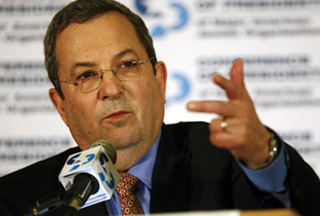 Barak will meet several US officials during his five-day tour, including US Defense Secretary Robert Gates, Secretary of State Hillary Clinton and Middle East ‘peace’ envoy George Mitchell. He is also scheduled to meet the UN Secretary General Ban Ki-moon in New York.
As part of a last-ditch effort to obstruct Iran’s nuclear program, Israel has sought to send high-ranking delegations to a number of countries, particularly Russia and China, to rally support for punitive measures against the Tehran government.
In Russia, Israeli efforts have achieved little with Kremlin officials declaring that it is much too soon to consider stringent measures against Iran. This has not stopped Tel Aviv’s effort to call for international sanctions against Iran. On the contrary, it has prompted Israeli Prime Minister Benjamin Netanyahu to go as far as demanding that the UN Security Council should be sidestepped if it cannot agree to more sanctions against Tehran.
“We must prohibit Iranian oil exports and imports to Iran of refined oil products. No other sanctions will be effective,” Netanyahu said in Jerusalem (Al-Quds) at a meeting of delegates from the Jewish Agency, an organization that encourages Jewish immigration to Israel.
Such daring rhetoric by the Tel Aviv regime comes in light of the wide belief that Israel is in possession of over 200 nuclear warheads. Additionally, Israel has refused to sign the Nuclear Non-Proliferation Treaty (NPT) and is not a member of the UN’s International Atomic Energy Agency (IAEA).
Despite its refusal to join any international atomic regulatory agency, Israel has been the most vocal in calling for international sanctions against the Islamic Republic of Iran for its IAEA-monitored nuclear program.
“We have arrived at a point where the international community has to decide if it seriously plans to stop Iran’s nuclear program,” the Israeli premier added.
This comes as the UN nuclear watchdog released a new report on Tehran’s enrichment program, criticizing Iran for a range of issues, but verifying the non-diversion of declared nuclear material in the country at the same time.
Iran says that is a signatory of the NPT and, unlike Israel, neither believes in atomic weapons nor, as a matter of religious principle, does it intend to access such weapons of mass-destruction. Tehran has also repeatedly called for the elimination of all nuclear arms throughout the globe.
Israel: Sanctions must target Iran energy sector
Press TV – February 22, 2010
Israeli Prime Minister Benjamin Netanyahu continues on his campaign for international sanctions to be imposed against Iran’s energy sector.
“We must prohibit Iranian oil exports and imports to Iran of refined oil products. No other sanctions will be effective,” Netanyahu said in Jerusalem (Al-Quds) at a meeting of delegates from the Jewish Agency, an organization that encourages Jewish immigration to Israel.
Netanyahu went so far as to say the UN Security Council should be sidestepped if it cannot agree on the move.
“We have arrived at a point where the international community has to decide if it seriously plans to stop Iran’s nuclear program,” he added.
Netanyahu’s effort to stop Iran’s nuclear program — which Tehran says is peaceful — comes while Israel is reportedly the sole possessor of nuclear arsenals in the Middle East with 200 nuclear warheads.
On a visit to Russia last week, Netanyahu insisted on the need for “biting sanctions that have the power to influence the regime, bitter sanctions that have to hit, in a convincing way, the oil industry, imports, exports and refining.”
Russia’s Foreign Ministry, however, rebuffed the call and announced that Moscow is against imposing sanctions on Iran, noting that Russia has always favored a diplomatic solution with regards to Iran’s nuclear program.
Russia’s Deputy Foreign Minister Sergei Ryabkov said Moscow was against imposing “crippling sanctions” on Iran.
The US, Israel and some Western countries accuse Iran of seeking atomic weapons under the guise of its nuclear energy program.
Iran denies that it seeks to build an atomic bomb and says it only wants to enrich uranium for civilian purposes such as generating electricity and producing medical isotopes.
Clinton avoided nuke question – student
AFP | February 22, 2010
 A SAUDI student blasted US Secretary of State Hillary Clinton for skirting her question on Israel’s nuclear arsenal during a “town hall” meeting at a Jeddah college.
“I did not get a straight answer,” Mariyam Alavi said in a letter published in Arab News on her question to the top US diplomat last Tuesday. “My question was simple and direct enough,” she wrote, but Ms Clinton’s response “was very unsatisfying.”
Alavi, a 12th grader at the International Indian School in Jeddah, attended the meeting at the elite Dar al-Hekma College with six classmates. She had asked Ms Clinton about Washington’s stance on the existence of nuclear weapons in the Middle East.
If the Americans “so vehemently oppose Iran’s nuclear programme,” she had asked, “then why isn’t the US asking Israel to give up their nuclear weapons?”
Ms Clinton gave a lengthy answer detailing the US case against Iran, but did not mention Israel. She did, however, say that “we want not only a world free of nuclear weapons, we want a Middle East free of nuclear weapons, including everyone.”
Alavi’s Arab News letter assailed US “hypocrisy” over the issue, reflecting a widely held sentiment in in the region.
“Clinton said that the United States, under the able leadership of President Barack Obama, was trying to repair and strengthen its ties with the Muslim world.
“It is high time she realised it couldn’t be done without answering the questions uppermost in the minds of the Middle East people.”
Alavi said she had been nervous about asking such a “politically provocative question” but was then encouraged by strong applause from the audience when she addressed Ms Clinton.
Ms Clinton had been on a three-day trip to Qatar and Saudi Arabia to discuss, among other things, how to confront Iran’s alleged programme to develop nuclear weapons.
‘Ecuador being punished for befriending Iran’
Press TV – February 22, 2010
Ecuadorian President Rafael Correa says his country was added to a list of states accused of lagging in the campaign against money laundering to punish it for its ties with Iran.
“This decision has nothing to do with the fight against money laundering, or the fight against the funding of terrorism… It has to do with that we have an embassy in Iran,” Correa said in the highland town of Sangolqui outside Quito on Saturday.
“So because we have misbehaved. They are giving us a smack so we don’t misbehave,” he added, describing the move as a “hypocritical punishment.”
“Instead of revising themselves, they condemn us. There is no money laundering here my friends. There is no terrorism, and no funding of terrorism. Imagine if he had money to fund terrorism, I wish I had money to build all the schools that I want to build,” he said.
The Paris-based Financial Action Task Force, or FATF, named Ecuador and Iran on a list of states that it says are failing to comply with international regulations against money laundering and financing terrorism.
However, Correa said that Ecuador’s two dozen banks had perfectly adequate legislation to protect against laundering and terrorism financing and dismissed the report as “a huge lie.”
Under Correa’s administration, Ecuador has strengthened diplomatic and commercial ties with Iran, which has opened an embassy in Quito.
In recent years, Iran has looked to increase its cooperation with Latin American states such as Ecuador, to the chagrin of Washington.
Citing a 2009 agreement between Ecuador’s Central Bank and some Iranian financial institutions, Ecuador’s private bank association said on Friday that it believed the Iran factor was behind the country’s inclusion on the FATF list.
Cut the “ambiguity”, ambassador, or pack your bags
Challenging UK support for Israeli criminals
By Stuart Littlewood | 22 February 2010
Hey, Mr Foreign Secretary Miliband,
Let me tell you something. If I were the British foreign secretary there would be no more “friendly chats”. The Israeli ambassador would have 24 hours to find a cure for his “ambiguity” or pack his bags. How dare that lawless, racist regime smugly sit in its London offices and keep us guessing whether or not they have abused our sovereignty and hijacked our passport system?
Britain is far too cosy with the Israelis. Given their thieving, power-crazed ambitions in the Middle East (and beyond), how reliable is the intelligence they are said to share with us anyway?
Our government is riddled with Zionist sympathizers right up to the top. Our most important security bodies – the Intelligence and Security Committee, the Foreign Affairs Committee and the Defence Committee – are all chaired by Israel flag-wavers. Whose bright idea was that?
Blair and Brown are patrons of the Jewish National Fund, an organization that acquires stolen Palestinian lands and helps fund illegal settlements in the occupied territories. Are they mad?
When Labour bites the dust in the elections in May, we can expect no better from the Conservatives who are waiting in the wings, if the findings of Peter Oborne’s recent Channel 4 Dispatches programme are anything to go by. Cameron has declared himself a Zionist and is also a patron of the JNF, as are the Israeli ambassador and the Chief Rabbi. So there’ll be a seamless transfer of Zionist influence to our new government and business as usual with that pseudo-democracy (yes, you can drop the pretense; everyone knows Israel is an ethnocracy with apartheid knobs on).
The Weapons of Mass Destruction Commission reports that your “true friend” Israel has a nuclear arsenal numbering in the hundreds, possibly larger than our own. It has a plutonium production reactor and reprocessing facility, and possibly a uranium enrichment capability.
You’ll also know that Israel is the only state in the region not to sign the Nuclear Non-Proliferation Treaty, nor has it signed the Biological and Toxin Weapons Convention. It has signed but not ratified the Comprehensive Nuclear Test-Ban Treaty, similarly the Chemical Weapons Convention.
Nevertheless, the rogue regime and its stooges screech their eagerness to obliterate Iran and involve us in their dirty work, even though the Islamic state as yet has no nuclear capability – unless Tehran managed to get its hands on one of the warheads rumoured to have been mislaid by the US. Is that why everyone is wetting their pants?
Back to the extra-judicial assassination in Dubai. Given all the amazing intelligence we’re supposed to receive from our “trusted allies”, any foreign secretary worth his salt would at least know if and how Britain was implicated in the crime, which, according to Sunday Times, was OK’d by your good buddy the Israeli prime minister.
Or are you seriously telling us you haven’t a clue?
Talking of atrocities, you know perfectly well that we are solemnly obligated – and rightly so – to seek and prosecute all who have allegedly committed war crimes. Your enthusiasm for changing the law of universal jurisdiction and turning the UK into a safe house for Israeli psychopaths to freely walk the streets of London, makes our country and particularly yourself a laughing stock in the civilized world.
Yes, we’ve been well and truly stitched up at government level. But here at street level we’re not so stupid.
David Brooks’s dilemma (and ours)
By Scott McConnel | February 21, 2010
Consider one of David Brooks’ dilemmas. In last Friday’s Times he wrote a pretty good column about the contemporary American power elite. As he described it, sixty and more years ago, blue blood WASPs ran America’s financial institutions and foreign policy (something of a simplification, but let it pass), ethnic bosses ran the cities, and engaging working class drunks filed the newspaper stories. Now those critical sectors are run and staffed by the meritocracy, people who did well on the bubble tests and went on to succeed at elite universities. We have, Brooks explains, “opened up opportunities for women, African-Americans, Jews, Italians, Poles, Hispanics and members of every other group. “
Then he acknowledges the new regime isn’t working out as well as expected. None of these major institutions is now doing its job adequately, and the country knows it. We need, Brooks concludes, to reevaluate our definitions of merit, and leadership because “very smart people make mistakes because they didn’t understand the context in which they were operating.” This is true, and for a newspaper column, a profound observation.
But there is a salient body of fact that Brooks elides, and therein lies a tale. While opportunities have opened up for women and all the non-Wasp groups Brooks mentioned, all groups have not rushed with equal force into the breach. If one takes, for example, the issue of Mideast diplomacy, it has been noted recently that most of the country’s important Mideast diplomats are Jews, most of writers covering the Israel-Palestine conflict for the New York Times are Jewish, as are two of three of the president’s top political advisers. Dig in a different direction, and one finds a similar kind of thing, as observed on this site, of the financial players engaged in selecting the next senator from New York.
There is no need to exaggerate the phenomenon, and indeed a need not to—outside of New York, there are plenty of rich Protestant power brokers, the South is important politically and Jews are seldom influential there, etc. But to say the least, the collapse of the WASP ascendancy has not been equally rewarding to all of the groups Brooks cites at the top of his column. Indeed for some of them, like Catholics, that collapse has probably coincided with a net reduction in cultural and political influence.
Brooks avoids mentioning this, as do virtually all writers. The reason is obvious: nearly any analysis, indeed any mention, of Jewish power is overburdened with sensitive historical associations. Unspecified but ominous reference to this history is the main polemical weapon Leon Wieseltier uses in his effort to take down Andrew Sullivan for his writing on Israel and Palestine. Some of Sullivan’s arguments, Wieseltier asserts “have a sordid history”; Sullivan is one of those who proclaim “without in any way being haunted by the history of such an idea that Jews control Washington”; Sullivan adopts an explanation which “has a provenance that should disgust all thinking people.” No need then to examine the truth or the untruth of Sullivan’s argument, a vague allusion to history suffices. Criticism of Israel is tied to the modern history of European anti-semitism, and to an extensive bibliography of generally tendentious books about Jewish power, from Alphonse de Toussenel’s Les Juifs, Rois de L’Epoch (published in 1845) forward. Of course this discourse was an auxiliary to the holocaust. About this Wieseltier (and the countless others who polemicize in this manner) are correct: discussions of Jewish power have sometimes had terrible consequences.
But where does that leave 21st century Americans? One example is the case of David Brooks, who clearly knows what he leaving out of his column about the American power elite. Brooks is Jewish, and a Zionist, and in no danger of being labeled an anti-Semite by Leon Wieseltier or anyone else. But still he is hesitant; presumably because he doesn’t want to write something that either might encourage anti-Semitism, or (more likely considering his readership) enhance public understanding of the Israel lobby. At least the first of these motives is commendable. But the reticence has a consequence: when Brooks writes a column about the American power elite and its weaknesses, he needs to avoid one of the essential aspects of his subject. That can’t really be satisfactory to him, or to his readers. It’s a dilemma with no obvious solution to it.
Some Straight Thinking About Iran
By Philip Giraldi | February 18, 2010
The Annual Threat Assessment overview was released by the office of the Director of National Intelligence on February 2nd. A forty-seven page unclassified version includes a page and a half on Iran’s proliferation threat. It raises legitimate concerns about Iran’s doubling of its number of operating centrifuges (while conceding that as many as half might not be working) and regarding what it describes as the secret nuclear facility near Qom. Apart from that, it supports the conclusions of the December 2007 National Intelligence Estimate (NIE) which concluded that Iran had abandoned its nuclear weapons program and had not made the political decision to start it up again.
One would think it would be good news that the Iranian nuclear program has not really advanced since 2007, but something strange is happening. The Obama Administration has intensified pressure on Iran with Secretary of State Hillary Clinton denouncing what she sees as the Iranian government’s increased militarization. The mainstream media, meanwhile, has not reported the conclusions of the Annual Threat Assessment while there has been instead considerable commentary about how Iran is moving closer to having a nuclear weapon together with calls for harsh sanctions. The Washington Times and Newsweek are also reporting that the US intelligence community will soon finish a second NIE on Iran that will revise the conclusions of the December 2007 document. If their information is correct, the forthcoming NIE will emphasize that Iran is moving towards the point where it will have all the technical requirements in place to put together a nuclear weapon if the country’s political leadership decides to proceed. This is a spin that is somewhat different than the Annual Threat Assessment, which is presumably written by the same analysts using the same information. Admittedly, as the political go-ahead might never be given, all the intelligence really suggests is that Iran could soon join a large number of other countries that have the technical capability to make a nuclear weapon. Of those countries there are some – mostly in Europe — that clearly have no interest in nuclear weapons development while others could move rapidly into a weapon program if their circumstances seem to demand it. Iran is far from unique. Turkey, Egypt, and Saudi Arabia all have the technological resources to develop nuclear weapons on an expedited basis if they found themselves threatened.
So the Annual Threat Assessment and the possibly forthcoming NIE would really only confirm the 2007 NIE’s judgment that Iran does not have a nuclear weapon, does not appear to have an in-place weapons program, and is still several years away from having a nuclear device even if the political decision is made to proceed. If there is a new NIE it will not really change anything, but there is clearly a political agenda playing out that is driving the process. One might even suggest that the timing is somewhat reminiscent of the infamous 2002 “slam dunk” Iraq NIE that falsely made the case for war by hyping phony evidence of weapons of mass destruction. In this case, the conclusions are not as important as the report’s appearance at a crucial time when negotiations between Tehran and the West have broken down and Washington is pushing hard to pressure Iran. The surfacing of a new assessment that is already being spun to heighten the threat will inevitably increase concerns about a possible Iranian weapons program and provide ammunition to those who are seeking a more assertive US policy. By its very existence, the new NIE will also provide a measure of credibility for the Obama administration, which has relentlessly been making the case that Iran is intent on acquiring a nuclear weapon, a conclusion that is not supported by the available intelligence.
That the drive to punish Iran has been supported in Congress and the media is perhaps no coincidence, suggesting that the effort is being coordinated by those who want war. At the end of January, by an overwhelming voice vote, the US Senate joined the House of Representatives in passing a resolution demanding sanctions on Iran’s energy imports. A joint resolution that will go to President Obama is currently being crafted and is expected soon. The resolution could well give Obama the political cover he needs to advocate even more draconian measures against Iran and its rulers. From the Iranian viewpoint, it is pretty much a declaration of war.
Why is Iran the target of so much rage even though it has not threatened the United States or any vital American interest? Influence over Congress and the media from Israel and its friends is surely a large part of the answer. How else can one explain the different treatment afforded Iran and North Korea given Pyongyang’s open development of nuclear weapons and ballistic missiles? Unlike North Korea, Iran continues to be a signatory of the Nuclear Non-Proliferation Treaty and its nuclear sites are inspected by the UN’s International Atomic Energy Agency. Iran is a developing country with a small economy and tiny defense budget and it has not invaded a neighbor since the eighteenth century. It does not even have the resources to refine its own oil for home consumption and must import the gasoline it uses. If the proposed Congressional sanctions are fully implemented the country’s economy will grind to a halt, but the damage does not stop there. Iran deals with many European and Asian companies in its energy industry, all of which would be sanctioned by the US if they do not break off relations. They might not like that and might well take commensurate steps against the United States. Ultimately, the United States Navy might have to enforce the sanctions. What would happen when a Chinese or Russian ship is stopped on the high seas? Did the US Congress really think about what it was doing and what the consequences of sanctions might be?
And the irony is that the United States has a problem with Iran that has largely been manufactured in Washington and in Tel Aviv. Even though Tehran does not actually threaten the US, Washington has been supporting terrorists and separatists who have killed hundreds of people inside Iran. Israel, which has its own secret nuclear arsenal, claims to be threatened if Iran develops even the ability to concentrate its uranium referred to as “mastering the enrichment cycle,” a point of view that has also been adopted by Washington. The White House has made repeated threats that the military option for dealing with Tehran is “on the table” while Israel has been even more explicit in its threats to attack. Meanwhile, the US mainstream media is united in its desire to come to grips with the Mullahs.
It is no wonder that Iran feels threatened, because it is. To be sure, Iran is no role model for good governance but a desire to deal with the country fairly and realistically is not an endorsement of the regime in power. Iran is engaged diplomatically and through surrogates in the entire Persian Gulf region and central Asia, supporting its friends and seeking to undermine its enemies. But that does not make it different than any of its neighbors and the United States, all of which play the same game. The bottom line is that the US has been interfering in Iran since 1978 and even before if one goes back to the overthrow of Mohammed Mossadeq by the CIA in 1953. The interference has accomplished nothing and has only created a poisonous relationship that Barack Obama has done little to improve. Indeed, Obama and Secretary of State Hillary Clinton’s harsh rhetoric suggests that when it comes to Iran the Democrats are more hardline than George W. Bush.
Imagine for a moment what might happen if Washington were to adopt a serious foreign policy based on the US national interest. That would mean strict non-interventionism in troubled regions like the Middle East where the US has everything to lose and little to gain. It would be the real change promised by Obama if Washington were to admit that it is not threatened by Tehran and were to declare that it will not interfere in Iran’s politics. It could further announce that it no longer has a military option on the table, and that it will not permit Israeli overflight of Iraq to attack Iran. Iran’s leaders just might decide that they don’t really need their own “option on the table” which has been the threat that they might seek to develop a nuclear weapon. And an Iran that feels more secure might well be willing to take some risks itself to defuse tension with its neighbors and Washington. In 2003 Iran offered to negotiate all outstanding differences with the United States, an offer that was turned down by the Bush White House.
So the big question about Iran is not whether or not it has the knowledge and resources to build an atom bomb. It does or will soon. The real issue is whether the United States is actually threatened by that knowledge and what should be done in terms of positive policies to discourage an expanded nuclear program. The United States should first of all recognize that, as the world’s only superpower, it controls the playing field. It is up to Washington to take the first steps to defuse the crisis that is building by offering Tehran the security guarantees that might undercut the influence of those in its government who seek a nuclear weapon deterrent. Punishing Iran is no solution. It will not work, closes the door to diplomacy, and will only make the worst case scenario that much more likely. Opening the door to a rapprochement by eliminating the threatening language coming out of Washington and creating incentives for cooperation is a far better course of action.
‘An attack on Israel would be considered an attack on Canada’
Peter Kent, Toronto
Photo credit Scarborough – Guildwood Conservative Association
By Steven Chase | Globe and Mail | February 16, 2010

Junior Foreign Affairs minister Peter Kent is suggesting Canada stands ready to throw its full military weight behind Israel, telling a Toronto publication that “an attack on Israel would be considered an attack on Canada.”
His office says Mr. Kent, the minister of state for Foreign Affairs of the Americas, was merely “paraphrasing” what Stephen Harper has said in the past regarding Israel.
“It’s not too far from what the [Prime Minister] has said,” Norm McIntosh, Mr. Kent’s chief of staff, told The Globe.
But the junior minister’s statement would appear to be evidence that the Harper government is shifting to an ever more solidly pro-Israel stance.
Mr. McIntosh declined to confirm whether this means that Canada would automatically declare war on an aggressor that attacked Israel.
In an interview published in Shalom Life, dated Feb. 12, Mr. Kent said: “Prime Minister Harper has made it quite clear for some time now and has regularly stated that an attack on Israel would be considered an attack on Canada.”
Mr. McIntosh pointed to Mr. Harper’s statements from May, 2008, marking the 60th anniversary of Israel, where the Prime Minister said: “Our government believes that those who threaten Israel also threaten Canada, because, as the last world war showed, hate-fuelled bigotry against some is ultimately a threat to us all, and must be resisted wherever it may lurk.”
“In this ongoing battle, Canada stands side-by-side with the State of Israel, our friend and ally in the democratic family of nations,” Mr. Harper said. “We have stood with Israel even when it has not been popular to do so, and we will continue to stand with Israel, just as I have always said we would.”
NYT Sees UN-Syria Conspiracy Theory
By Robert Parry | Consortium News | February 15, 2010
The New York Times simply refuses to deal with “enemy” Muslim states with any sense of objectivity or fairness, reaffirming its deep-seated bias again on Sunday with the publication of a one-sided article about the assassination of former Lebanese Prime Minister Rafik Hariri on its fifth anniversary.
The article entitled “A U.N. Betrayal in Beirut” by op-ed contributor Michael Young argues that the original United Nations-authorized Hariri investigation, which pointed the finger of guilt at the Syrian government and its Lebanese allies, was correct but was then undercut by U.N. officials for political reasons.
The hero of the Times op-ed is German prosecutor Detlev Mehlis, who headed the initial U.N. inquiry and was subsequently replaced by Belgian investigator Serge Brammertz, who is portrayed as an incompetent who squandered Mehlis’s supposedly courageous work. Young wrote:
“Mr. Mehlis had few doubts about Syria’s involvement, and said so in his first report. He asked for President Assad’s testimony (over Syrian protests), interviewed Syrian intelligence officers in Vienna and arrested suspects. When Mr. Mehlis stepped down from his position in December, 2005, he felt he had enough to arrest at least one of the intelligence officers.
“However, the investigation wilted under his successor. … Mr. Brammertz issued uninformative reports and displayed a lack of transparency that discouraged potential witnesses, unsure of whether he had solid evidence in hand, from coming forward; … he failed to follow through on the interviews with the Syrian officers; and though he met with President Assad, he apparently did not formally take down his testimony.”
Young’s narrative fits with the Times’ previous hostility toward the Syrians regarding the Hariri case and other issues, much as the Times regularly tilted its coverage against Iraq prior to the U.S.-led invasion in 2003 and currently slants its reporting against the government of Iran.
On the Hariri case, the Times would have its readers believe that U.N. leaders lost their nerve and dumped a brilliant prosecutor in favor of an incompetent to sabotage the case.
But what Young and the Times failed to disclose on Sunday was that Mehlis’s initial investigation amounted to a rush to judgment that relied heavily on two witnesses whose testimony was later discredited or retracted. His successor, Brammertz, had no choice but to retrace Mehlis’s steps because there had been so many slip-ups.
The murder mystery began on Feb. 14, 2005, when an explosion destroyed a car carrying Hariri through the streets of Beirut.
Because Syria was then on President George W. Bush’s hit list for “regime change” – and Syria was considered a front-line enemy of Israel – speculative evidence of Syrian guilt was an easy sell to the U.S. news media. When Mehlis’s preliminary report was issued, there was little U.S. media skepticism about its assertions of guilt regarding Syrian leaders and their Lebanese allies.
“There is probable cause to believe that the decision to assassinate former Prime Minister Rafik Hariri could not have been taken without the approval of top-ranked Syrian security officials and could not have been further organized without the collusion of their counterparts in the Lebanese security services,” declared Mehlis’s report on Oct. 20, 2005.
Despite the curiously vague wording – “probable cause to believe” the killing “could not have been taken without the approval” and “without the collusion” – Bush immediately termed the findings “very disturbing” and called for the U.N. Security Council to take action against Syria.
The U.S. press joined the stampede in assuming Syrian guilt. On Oct. 25, 2005, a New York Times editorial said the U.N. investigation had been “tough and meticulous” in establishing “some deeply troubling facts” about Hariri’s murderers. The Times demanded punishment of top Syrian officials and their Lebanese allies.
But Mehlis’s investigative report was anything but “meticulous.” Indeed, it read more like a compilation of circumstantial evidence and conspiracy theories than a dispassionate pursuit of the truth.
As a wealthy businessman with close ties to the Saudi monarchy, Hariri had many enemies who might have wanted him dead for his business or political dealings. The Syrians were not alone in having a motive to eliminate Hariri.
Indeed, after the assassination, a videotape was delivered to al-Jazeera television on which a Lebanese youth, Ahmad Abu Adass, claimed to have carried out the suicide bombing on behalf of Islamic militants angered by Hariri’s work for “the agent of the infidels” in Saudi Arabia.
However, Mehlis relied on two witnesses – Zuhair Ibn Muhammad Said Saddik and Hussam Taher Hussam – to dismiss the videotape as part of a disinformation campaign designed to deflect suspicion from Syria.
Mehlis then spun a narrative of a Syrian conspiracy to kill Hariri. Four pro-Syrian Lebanese security officials were jailed on suspicion of involvement in Hariri’s murder. Everything was falling neatly into place.
As a new U.S. press hysteria built over another case of pure evil traced to the doorstep of an American adversary in the Muslim world, holes in the U.N. report were mostly ignored. At Consortiumnews.com, we produced one of the few critical examinations of what had the looks of a rush to judgment. [See Consortiumnews.com’s “The Dangerously Incomplete Hariri Report.”]
A Case Crumbles
Much like the Bush administration’s Iraqi WMD claims – which the Times also touted uncritically – Mehlis’s Hariri case against the Syrians soon began to crumble.
One witness, Saddik, was identified by the German newsmagazine Der Spiegel as a swindler who boasted about becoming “a millionaire” from his Hariri testimony. The other one, Hussam, recanted his testimony about Syrian involvement, saying he lied to the Mehlis investigation after being kidnapped, tortured and offered $1.3 million by Lebanese officials.
Mehlis soon stepped down, as even the New York Times acknowledged that the conflicting accusations had given the investigation the feel of “a fictional spy thriller.” [NYT, Dec. 7, 2005]
Mehlis’s subsequent replacements backed away from his Syrian accusations. Brammertz began entertaining other investigative leads, examining a variety of possible motives and a number of potential perpetrators.
“Given the many different positions occupied by Mr. Hariri, and his wide range of public and private-sector activities, the [U.N.] commission was investigating a number of different motives, including political motivations, personal vendettas, financial circumstances and extremist ideologies, or any combination of those motivations,” Brammertz’s own interim report said, according to a U.N. statement on June 14, 2006.
In other words, Brammertz had dumped Mehlis’s single-minded theory that had pinned the blame on senior Syrian security officials. Though Syria’s freewheeling intelligence services and their Lebanese cohorts remained on everyone’s suspect list, Brammertz adopted a far less confrontational and accusatory tone toward Syria.
Still, the U.S. news media, which had played the initial Mehlis accusations against Syria as front-page news, barely mentioned the shift in the U.N. probe.
Virtually nothing appeared in the U.S. news media that would alert the American people to the fact that the distinct impression they got in 2005 – that the Syrian government had engineered a terrorist bombing in Beirut – was now a whole lot fuzzier.
Instead, it remained common practice for the New York Times and the rest of the mainstream U.S. news media to continue citing the Mehlis report and referring to “Syrian officials implicated in Mr. Hariri’s killing” without providing more context.
That pattern continued Sunday in Young’s article, with the online version linking to a 2005 story that trumpeted Mehlis’s initial report. Young and the Times cite no articles describing the subsequent collapse of Mehlis’s case.
Last year, the U.N. tribunal examining Hariri’s murder and other terrorist acts in Lebanon acknowledged that it lacked the evidence to indict the four Lebanese security officials who had been held without formal charges since 2005. Finally, Judge Daniel Fransen of a special international tribunal ordered the four imprisoned security officials released.
In a similar situation – say, one that involved a U.S. ally – the release would have been viewed as proof of innocence or at least the absence of significant evidence of guilt.
In this case, however, the New York Times refused to acknowledge the obvious fact that the case against Syrian complicity was weak. Instead, the Times framed the development as underscoring “the legal pitfalls of a divisive international trial.” [NYT, April 30, 2009]
That stubbornly one-sided approach has now extended to the fifth anniversary of the Hariri slaying. Instead of acknowledging the flaws in Mehlis’s initial findings – or recognizing how recklessly premature those accusations were – the Times is now promoting a conspiracy theory that U.N. officials willfully tanked the investigation.
Yet the only conspiracy that Young’s article seems to corroborate is the one in which the Times and its editors relentlessly portray Muslim governments that are out of Washington’s favor as the “bad guys.”
Featured Video
No Vote, No Representation, No State: Democracy, Israeli Style
or go to
Aletho News Archives – Video-Images
From the Archives
Sanctions, War and the Policy of Dual Containment
By SASAN FAYAZMANESH | March 17, 2008
It is now nearly three decades since the Unites States adopted the policy of dual containment of Iran and Iraq. While much has been written about the containment of Iraq, there has been very little in-depth analysis of this policy when it comes to Iran. In a book that is going to be released on March 31, 2008, entitled The United States and Iran: Sanctions, Wars and the Policy of Dual Containment (Routledge), I attempt to address this shortcoming by investigating when and why the US policy of containment of Iran came about, how it evolved, and where it stands today.[1] To the extent that Israel has been involved in US policy making, the study will also include the role that Israel has played in the containment of Iran. Also, since the fate of Iran has been inextricably linked to that of Iraq, occasionally the investigation will overlap with the containment of Iraq.
The policy of dual containment of Iran and Iraq originated during the Carter Administration, but it was not until the Clinton Administration that the expression “dual containment” became popular. … continue
Blog Roll
 Aletho News
- How Israel destabilizes the Middle East: Denying sovereignty and the right to exist
- Europe’s Establishment Is Embracing War – and Losing Voters
- NATO chief advocates war of aggression
- No Vote, No Representation, No State: Democracy, Israeli Style
- Zionist Bought Senate Blocks Information About American Citizens Killed By Israel
- While Gaza dominates the UN, these are the people keeping it alive
- New Report: “Scholasticide and Genocide in Gaza: Assessment, Testimonies and Legal Analysis”
- ‘THAAD Delusion’: Iran war exposes US missile shield limits – The Atlantic
- Moscow issues warning to NATO over Russian exclave
- Yes, the Iran war has destroyed Trump’s presidency
- If Americans Knew
- Israel map in LA Times ad includes all land from the river to the sea
- Inside Lebanon’s 200-page dossier on Israeli war crimes
- Flydubai, genocide, settler violence, Trump abuse of power to deport – Daily Update
- Counting Antisemitic Incidents: What the ADL Audit Reveals — and Obscures
- Mamdani releases plan to combat antisemitism and hate crimes in New York City
- Iran’s Revolutionary Guards Publish Letter to the American People
- DMFI launches $1 million ad campaign supporting Virginia’s Elaine Luria
- US Senate blocks resolution seeking report on Americans killed by Israel
- Israeli Attacks Kill Ten Palestinians in Gaza
- Massacre at Minab: The School That Became a Grave
- No Tricks Zone
- Green Energy Debacle: German Expert Professor Fritz Vahrenholt Warns Of Severe Economic And Social Consequences
- Two More Paleo Reconstructions Affirm Meters-Higher Sea Levels Across Ireland, Brazil 7000-6000 Years Ago
- New Study: Earth And Venus Surface Warmth Largely Explained By Convection And Lapse Rate, Not CO2 Or Radiation
- 2025 Nature Paper Claiming Worsening Global Drought Gets RETRACTED …Heavily Flawed
- New Study: ‘Global Drought Shows No Detectable Recent Acceleration Under Climate Warming’
- Economic Masterminds: German Socialists Suggest Taxing Productivity Gains Stemming From Using AI
- The South China Sea Has Not Been Cooperating With The Climate Change Narrative
- Energy Crisis: Germany Enters Heating Season With Historically Low Gas Reserve Fill Levels
- New Study: The Antarctic Ice Sheet Gained Mass From 2020-2024 Due To Staggering Snow And Ice Accumulation
- Study: Ocean Heating Rates From Thousands Of Years Ago ‘Dwarf’ Modern Ocean Heating Rates

