Tom Friedman’s Peak Confusion
Twisted Energy Politics
By ROBERT BRYCE | February 16, 2010
When it comes to energy issues, Thomas Friedman simply doesn’t care about the facts.
That reality was made apparent, once again, in Friedman’s column in the February 10 issue of the New York Times. In an otherwise mostly sensible article, written from Yemen, where Friedman was talking about the need for proper educational opportunity in the Arabic and Islamic worlds, Friedman concluded that the US will have to maintain a strong military presence in the region in order to counter al-Qaeda. But he continues, we also must “help build schools and fund scholarships to America wherever we can. And please, please, let’s end our addiction to oil, which is what gives the Saudi religious ministry and charities the money to spread anti-modernist thinking across this region.”
 Friedman has been bashing the Saudis for so long, it’s hardly worth recounting the many instances where he does so. But the fact that Friedman once again trots out the tired cliché of our “addiction to oil” and that he then immediately ties that issue to the Saudis shows that he simply doesn’t know what he’s talking about. Rather than stick to the facts, he retreats to a mindless slogan that contributes nothing to the need for a broader discussion of energy policy and the reality of the global marketplace.
The US could quit buying oil tomorrow, all oil, and it won’t put the Saudis out of business. According to the EIA, in 2008, the Saudis exported an average of 8.4 million barrels of oil per day. Of that quantity, the US accounted for about 1.5 million barrels per day.
Thus, even if the US somehow managed to segregate Saudi crude from its other oil imports, and also prevented the Saudis from selling that 1.5 million barrels per day somewhere else, Saudi Arabia would still be selling about 7 million barrels of oil on the global market. Needless to say, that 7 million barrels per day will bring the kingdom a fair bit of revenue.
Of course, Wednesday’s column isn’t the first time Friedman has shown that he cares more about polemics than facts. In August 2008, he held up Denmark as an energy model that should be copied by the US. In the wake of the 1973 Oil Embargo, Friedman claims that Denmark “responded to that crisis in such a sustained, focused and systematic way that today it is energy independent.” Friedman went on to lament America’s situation, writing that if “only we could be as energy smart as Denmark!”
Wrong. Wrong. Wrong.
Friedman clearly loves the idea of energy independence, but the data shows that Denmark is not energy independent – it’s not even close. The Danes import all of their coal. I repeat, Denmark imports all of its coal. Furthermore, those coal imports – and coal consumption – show little sign of declining even though Denmark’s wind power production capacity has increased rapidly over the past few years. And Denmark is even more dependent on coal than the US! (1)
Nor did Friedman bother to mention that thanks to the Danish government’s exorbitant taxes, the Danes now have some of the world’s most expensive electricity and most expensive motor fuel.
In 2006, the Energy Information Administration looked at residential electricity rates in 65 countries and found that Denmark’s rates were the highest, by far, at some $0.32 per kilowatt-hour. That was about 25% higher than the electricity costs in the Netherlands, which had the next-highest rates in the survey, at $0.25 per kilowatt-hour. And that’s not a new phenomenon. From 1999 through 2006, Denmark had either the highest – or the next-highest – electricity rates of the countries surveyed by the EIA. (In 1999 and 2000, Japan’s electricity rates were slightly higher than those in Denmark.) Furthermore, Denmark electricity rates are the highest in Europe – and no other country comes close. (2)
In 2008, electricity rates were even higher, with Danish residential customers were paying $0.38 per kilowatt-hour – or nearly four times as much as US residential customers who were paying about $0.10 per kilowatt-hour. And the Danes were paying more than twice as much as their counterparts in nuclear-heavy France, where residential electricity costs were $0.17 per kilowatt-hour.
While Danish homeowners are getting spanked by expensive electricity, Danish motorists are getting absolutely mugged at the service station. In late 2008, Danish drivers were paying $1.54 per liter for gasoline, while drivers in the U.K. were paying $1.44 and US motorists were paying $0.56. According to GTZ, an agency of the German government, only a handful of countries have more expensive fuel than Denmark, a list that includes Italy, Norway, Turkey and Germany.
Unfortunately, Friedman’s polemics on energy are nothing new. Back in 2006, Friedman published a column in the Times saying that the U.S. should build a wall around itself. “Build a virtual wall. End our oil addiction.” Getting rid of our need for oil will, he wrote, “protect us from the worst in the Arab-Muslim world….These regimes will never reform as long as they enjoy windfall oil profits.” The solution, he declared is for America to build “a wall of energy independence” around itself. Doing so, “will enable us to continue to engage honestly with the most progressive Arabs and Muslims on a reform agenda.”
Remember that this is the same Friedman, who, in his 2005 best-selling book, The World is Flat, declared that the world was increasingly globalized and the implications of that were obvious. In this new “flat” world, money, jobs, and opportunity, Friedman said, will “go to the countries with the best infrastructure, the best education system that produces the most educated work force, the most investor-friendly laws, and the best environment. (3)
Hmmm. So doesn’t that also mean that in our new “flat” world, that energy will be exported by the countries that have the best infrastructure for providing that energy to the world market?
Friedman’s problem is that he wants it both ways: he espouses the merits and potential of the new flat world, while also insisting that the US should withdraw into energy isolationism, and thereby surrender any participation in the world’s single biggest industry, the global energy sector. The irreconcilable contradictions in Friedman’s arguments are easily seen in the penultimate paragraph in The World is Flat where he claims that the “two greatest dangers we Americans face are an excess of protectionism – excessive fears of another 9/11 that prompt us to wall ourselves in, in search of personal security – and excessive fears of competing in a world…that prompt us to wall ourselves off, in search of economic security. Both would be a disaster for us and for the world.”
So, to summarize Friedman’s world view, he wants a “wall of energy independence” around America while simultaneously warning Americans that the two greatest dangers are a) walling “ourselves in” and b) walling “ourselves off.”
Friedman sees a flat world where walls are dangerous because they will isolate the US from other countries. But when it comes to energy, walls are good because they isolate the US from other countries. Oh, and along the way, we need to bankrupt the Saudis, because, well, they might give money to people who don’t think like we do.
Is anyone else here confused?
Robert Bryce’s fourth book, Power Hungry: The Myths of “Green” Energy and the Real Fuels of the Future, will be published in April.
Notes.
(1) BP Statistical Review of World Energy. In 2007, Denmark got 26% of its primary energy from coal while the US got 24.3%.
(2) Eurostat data. Available: http://epp.eurostat.ec.europa.eu/cache/ITY_OFFPUB/KS-QA-08-045/EN/KS-QA-08-045-EN.PDF.
Also: http://www.cbs.nl/en-GB/menu/themas/industrie-energie/publicaties/artikelen/archief/2007/2007-2187-wm.htm
(3) Yale Global Online, “’Wake Up and Face the Flat Earth’ – Thomas L. Friedman,” April 18, 2005. Available: http://yaleglobal.yale.edu/display.article?id=5581
EU biofuels significantly harming food production in developing countries
EU biofuels 10% targets cause millions of peope to go hungry and increase food prices and landlessness, says report
John Vidal | The Guardian | February 15, 2010
EU companies have taken millions of acres of land out of food production in Africa, central America and Asia to grow biofuels for transport, according to development campaigners. The consequences of European biofuel targets, said the report by ActionAid, could be up to 100 million more hungry people, increased food prices and landlessness.
The report says the 2008 decision by EU countries to obtain 10% of all transport fuels from biofuels by 2020 is proving disastrous for poor countries. Developing countries are expected to grow nearly two-thirds of the jatropha, sugar cane and palm oil crops that are mostly used for biofuels.
“To meet the EU 10% target, the total land area directly required to grow industrial biofuels in developing countries could reach 17.5m hectares, over half the size of Italy. Additional land will also be required in developed nations, displacing food and animal feed crops onto land in new areas, often in developing countries,” says the report.
Biofuels are estimated by the IMF to have been responsible for 20-30% of the global food price spike in 2008 when 125m tonnes of cereals were diverted into biofuel production. The amount of biofuels in Europe’s car fuels is expected to quadruple in the next decade.
The report attributes the massive growth in biofuel production to generous subsidies. It estimates that the EU biofuel industry has already received €4.4bn (£3.82bn) in incentives, subsidies and tax relief and that this could triple to over €13.7bn if the EU meets its 2020 target.
The greatest support to the industry is exemption from excise duties. Duty at the pump is 20 pence less per litre compared to conventional fuels although this exemption due to end in 2010, a change which supermarket Morrisons cited last week as the reason for dropping one of its biodiesel blends. In 2009, the duty on low- sulphur petrol and diesel in the UK was 54.19 pence per litre; for biodiesel and ethanol it was 34.19 pence per litre.
“Biofuels are driving a global human tragedy. Local food prices have already risen massively. As biofuel production gains pace, this can only accelerate,” said report author Tim Rice. He added that biofuels are not even an answer to climate change: “Most biofuels are worse than the fossil fuels they are supposed to replace.” . Large scale biofuel plantations can increase carbon dioxide emissions, either directly by cutting down forests or ploughing up other carbon rich habitats, or indirectly by forcing farmers to move into these areas. Separately, the UK Nuffield Council on Bioethics is currently consulting on the ethics of biofuels – how to ensure a new generation of biofuels don’t increase greenhouse gas emissions and take food from the poor to fuel cars.
The ActionAid report says Europe is just one region now greatly increasing the amount of biofuels in transport fuel. Analysis of US farm data last month by the Earth Policy Institute in Washington showed that one-quarter of all the maize and other grain crops grown in the US now ends up as biofuel in cars. The grain grown to produce the fuel in the US in 2009 was enough to feed 330 million people for one year at average world consumption levels.
If all global biofuel government targets are met, says ActionAid, food prices could rise by up to an additional 76% by 2020 with an extra 600 million extra people going hungry – six times as much as European policies alone.
Israel Violates Economic Sanctions Against Iran
By Grant Smith, February 11, 2010
The Obama administration is escalating economic sanctions against Iran. Administered by a secretive unit within the US Treasury Department, they will freeze the assets of Revolutionary Guard Gen. Rostam Qasemi as well as four subsidiaries of a construction firm that he leads. These sanctions build upon existing U.S. unilateral sanctions targeting shippers, financial institutions, and elements of the Guard Corps some believe are promoting Iran’s missile and nuclear programs.
Economic warfare expert R. Thomas Naylor extensively documents that such sanctions create black markets and spread corruption while doing relatively little to deter rogue regimes. Obvious economic dynamics create vast margins for smugglers and traders willing to bust embargoes. Unless the economy of a target country is particularly dependent upon the influence or volume of goods from any single international partner, profiteers quickly step into the breach. Sanctions typically punish legitimate traders while favoring corruption around the world.
That corrupting nature of sanctions reaches far into the US. One example is Marc Rich, indicted in the United States on federal charges of illegal oil deals with Iran during the Iran hostage crisis. Rich broke US embargoes by purchasing Iranian crude under special deals with Ayatollah Khomeini. Rich then sold them at healthy margins to legitimate traders locked out of the market by US sanctions. Forbes ranked the intrepid Rich as the 242nd richest American in 2006 with a net worth of US $1.5 billion.
Rich stayed outside the U.S. until he arranged for an unprecedented pardon from President Bill Clinton on January 20, 2001. Eric Holder, then acting as deputy attorney general, gave Clinton his “neutral, leaning towards favorable” recommendation to pardon the Switzerland-based fugitive financier after a quiet and intense campaign by the Israeli government’s Ehud Barak and Shimon Peres and the US Israel lobby.
But the temptations of sanctions busting aren’t an “elites only” affair. Under the highly problematic US-Israel Free Trade Agreement, US growers should have an advantage in supplying the $20 million Israeli pistachio market. But grower complaints meticulously documented in 2007 to the US Trade Representative reveal that Israel prefers to avoid importing American nuts while violating its own “Trading with the Enemy Act” by purchasing Iranian pistachios through Turkey. Although US growers supplied scientific test data to the US Trade Representative validating these claims, no punitive measures have been taken by Israel or the USTR (an office of the President).
History suggests that Israelis and their US lobby’s financial backers will be first in line to violate so-called “crippling sanctions” against Iran, a country over which the US has relatively little direct economic leverage. This adds insult to injury, since a real US economic sanctions regime — likely to have been highly successful in averting conditions underlying any potential Middle East nuclear arms race — has been suppressed since it was signed into law over three decades ago.
The Foreign Assistance Act of 1961 as amended by the Symington Amendment of 1976 and the Glenn Amendment of 1977 prohibiting US military assistance to countries that acquire or transfer nuclear reprocessing technology outside of international nonproliferation regimes. Israel, unlike Iran, is not a signatory to the Nuclear Non-Proliferation Treaty. The declassified US Army report titled The Joint Operating Environment 2008 identifies Israel as a nuclear weapons power in “a growing arc of nuclear powers running from Israel in the west through an emerging Iran to Pakistan, India, and on to China, North Korea, and Russia in the east.” Jimmy Carter became the first former President to confirm in 2008 that Israel had secretly financed, developed, and deployed an undeclared arsenal of nuclear weapons. Israeli Mordecai Vanunu long ago released his damning photos of Israeli nuclear weapons and facilities for which he served 18 years in prison.
If the President wishes to disburse US taxpayer-funded foreign aid to Israel in compliance with US law, he may do so only by issuing a special waiver, available for public review, as is currently the case with US aid for Pakistan. Yet every president from Ronald Reagan to Barack Obama has violated their oath of office — all refused to either withhold aid or sign the short presidential waiver that would make delivering taxpayer funded US foreign aid to Israel legal under Symington and Glenn.
If US presidents had faithfully executed this US law in order to reign in the Israeli nuclear weapons program since the 1970s, there can be little doubt that the Middle East would be a vastly better place. Israel is fully dependent on access to the US market, diplomatic cover, and vast military aid. Israel would have been motivated to negotiate in good faith a comprehensive peaceful settlement with its near and distant neighbors, none of which would feel pressure to establish a deterrent to Israel’s nuclear weapons. But in terms of political coercion, Israel’s arsenal is pointed squarely at the US. Back in 1960 the CIA estimated [PDF] that “Possession of a nuclear weapon capability, or even the prospect of achieving it, would clearly give Israel a greater sense of security, self-confidence, and assertiveness…Israel would be less inclined than ever to make concessions…”
The presidential history of capitulation to Israeli violators unmasks these new economic sanctions for what they truly are: corrupt “box checking exercises” as Israel’s lobby eagerly drives the US toward yet another needless — but long planned — military conflict which serves no legitimate American interest.
Israel Demands an Act of War

Netanyahu to EU envoys:
“In the last two days the brutal regime in Tehran has made more outrageous statements, including the implicit call for the extermination of my country. Israel expects all responsible governments, including all those represented here, to forcefully condemn these outrageous statements.”
“But I think what is required is a lot more than words, Iran is racing forward to produce nuclear weapons in brazen defiance of the international community. And the international community must decide if it is serious about neutralizing this threat to Israel, the region and the entire word. I believe that what is required right now is tough action from the international community.”
“This means not moderate sanctions or watered down sanctions, this means crippling sanctions, and these sanctions must be applied right now.” – February 9, 2010
I don’t mean to say I told you so, but…
By Stephen M. Walt | February 8, 2010
Probably the most controversial claim in my work with John Mearsheimer on the Israel lobby is our argument that it played a key role in the decision to invade Iraq in 2003. Even some readers who were generally sympathetic to our overall position found that claim hard to accept, and some left-wing critics accused us of letting Bush and Cheney off the hook or of ignoring the importance of other interests, especially oil. Of course, Israel’s defenders in the lobby took issue even more strenuously, usually by mischaracterizing our arguments and ignoring most (if not all) of the evidence we presented.
So I hope readers will forgive me if I indulge today in a bit of self-promotion, or more precisely, self-defense. This week, yet another piece of evidence surfaced that suggests we were right all along (HT to Mehdi Hasan at the New Statesman and J. Glatzer at Mondoweiss). In his testimony to the Iraq war commission in the U.K., former Prime Minister Tony Blair offered the following account of his discussions with Bush in Crawford, Texas in April 2002. Blair reveals that concerns about Israel were part of the equation and that Israel officials were involved in those discussions.
Take it away, Tony:
As I recall that discussion, it was less to do with specifics about what we were going to do on Iraq or, indeed, the Middle East, because the Israel issue was a big, big issue at the time. I think, in fact, I remember, actually, there may have been conversations that we had even with Israelis, the two of us, whilst we were there. So that was a major part of all this.”
Notice that Blair is not saying that Israel dreamed up the idea of attacking Iraq or that Bush was bent on war solely to benefit Israel or even to appease the Israel lobby here at home. But Blair is acknowledging that concerns about Israel were part of the equation, and that the Israeli government was being actively consulted in the planning for the war.
Blair’s comments fit neatly with the argument we make about the lobby and Iraq. Specifically, Professor Mearsheimer and I made it clear in our article and especially in our book that the idea of invading Iraq originated in the United States with the neoconservatives, and not with the Israeli government. But as the neoconservative pundit Max Boot once put it, steadfast support for Israel is “a key tenet of neoconservatism.” Prominent neo-conservatives occupied important positions in the Bush administration, and in the aftermath of 9/11, they played a major role in persuading Bush and Cheney to back a war against Iraq, which they had been advocating since the late 1990s. We also pointed out that Prime Minister Ariel Sharon and other Israeli officials were initially skeptical of this scheme, because they wanted the U.S. to focus on Iran, not Iraq. However, they became enthusiastic supporters of the idea of invading Iraq once the Bush administration made it clear to them that Iraq was just the first step in a broader campaign of “regional transformation” that would eventually include Iran.
At that point top Israeli leaders from across the political spectrum became cheerleaders for the invasion, and they played a prominent role in helping to sell the war here in the United States. Benjamin Netanyahu visited Washington, DC in April 2002 and spoke in the U.S. Senate, telling his audience “the urgent need to topple Saddam is paramount,” and that the campaign “deserves the unconditional support of all sane governments.” (It sure sounds like he was well aware of the discussions in Crawford, doesn’t it?) In May, foreign minister Shimon Peres said on CNN that “Saddam Hussein is as dangerous as bin Laden,” and that the United States “cannot sit and wait.” A month later, former Prime Minister Ehud Barak wrote an op-ed in the Washington Post recommending that the Bush administration “should, first of all, focus on Iraq and the removal of Saddam Hussein.”
This chorus continued through the summer and fall, with Barak and Netanyahu writing additional op-eds in the New York Times and Wall Street Journal, each calling for military action to topple Saddam. Netanyahu’s piece was titled “The Case for Toppling Saddam” and said that “nothing less than dismantling his regime will do.” Prime Minister Ariel Sharon’s official spokesman, Ra’anan Gissen, offered similar statements during this period as well, and Sharon himself told the Knesset Foreign Affairs and Defence Committee in August 2002 that Iraq was “the greatest danger facing Israel.” According to an Aug. 16 article by Aluf Benn in Ha’aretz, Sharon reportedly told the Bush administration that putting off an attack would “only give [Saddam] more of an opportunity to accelerate his program of WMD.” Foreign Minister Peres reiterated his own warnings as well, and told reporters in September 2002 that “the campaign against Saddam Hussein is a must.” (For sources, see pp. 233-38).
If that’s not enough evidence of where Israel’s leaders were in the run-up to the war, consider that former President Bill Clinton told an audience at an Aspen Institute meeting in 2006 that “every Israeli politician I knew” (and he knows a lot of them) believed that Saddam Hussein was so great a threat that he should be removed even if he did not have WMD. Nor is this testimony at all surprising, given that we are talking about the leader who had fired Scud missiles into Israel during the first Gulf War in 1991 and had been giving money to the families of suicide bombers. If the Bush administration was bent on taking him out and then turning its gun-sights on Syria and Iran, one can easily understand why Israelis would welcome it.
Now, what about key groups in the lobby itself? If the neoconservatives deserve the blame for dreaming up the idea of invading Iraq, key groups and individuals in the lobby played an important role in selling it on Capitol Hill and to the public at large. AIPAC head Howard Kohr told the New York Sun in January 2003 that one of the organization’s “success stories” over the previous year was “quietly lobbying Congress” to approve the resolution authorizing the use of force, a fact confirmed by journalists such as Nathan Guttman of the Forward, Michelle Goldberg of Salon.com, John B. Judis of the New Republic, and even Jeffrey Goldberg in The New Yorker (see p. 242). Pundits at pro-Israel think tanks like the Brookings Institutions’s Saban Center were openly backing war by the fall of 2002, with Martin Indyk, the head of the center, and Kenneth Pollack, its director of research, playing especially prominent roles.
Moreover, in this same period both the Jewish Council on Public Affairs and the Conference of Presidents of Major American Jewish Organizations voted to endorse the use of force “as a last resort.” Mortimer Zuckerman, a well-connected businessman and publisher who was then the chairman of the Conference of Presidents, was especially convinced about the futility of U.N. inspections and the need to topple Saddam, and wrote several editorials making that case in his magazine (U.S. News and World Report).
Still skeptical? Consider the following passage from an article by Matthew Berger of the Jewish Telegraph Agency, published just after President Bush’s September 2002 appearance at the United Nations, where he threatened military action if Iraq did not comply with U.N. resolutions:
Despite their caution and without specifying a formal policy, Jewish leaders predominantly expressed support for Bush’s words at the United Nations.
They said he detailed a strong case that Saddam has consistently ignored U.N. resolutions, that he was seeking to obtain weapons of mass destruction and that Saddam has shown a propensity towards using them.
“Iraq is the single most important threat right now to world peace and to our safety,” said Dr. Mandell Ganchrow, executive vice president of the Orthodox Religious Zionists of America. He described Saddam as a “maniac” who “has proven that he will gas his own people.”
“The fanaticism that exists throughout the Middle East is best addressed by first dealing with Iraq,” agreed Rabbi Eric Yoffie, president of the Reform movement’s Union of American Hebrew Congregations.
Many American Jewish leaders expressed the fear that Saddam has not been quiet for the past decade because of a loss of will, but because he has been using the time to garner weapons for an eventual attack on U.S. interests and allies.
“Do we have to wait until a target is hit, and the world says, ‘Ah, yes, he did have weapons of mass destruction,'” asked David Harris, executive director of the American Jewish Committee.”
Not to be outdone, the editor of Jewish Week, Gary Rosenblatt, wrote an editorial in mid-December 2002 saying that “Washington’s imminent war on Saddam Hussein is . . . an opportunity to rid the world of a dangerous tyrant who present a particularly horrific threat Israel.” He went on to say “the Torah instructs that when your enemy seeks to kill you kill him first. Self-defense is not permitted; it is commanded.” Even the relatively liberal Rabbi David Saperstein of the Union of Reform Judaism’s Religious Action Center told journalist Michelle Goldberg that “the Jewish community would want to see a forceful resolution to the threat that Saddam Hussein poses.” “Forceful resolution” means war, and Saperstein also offered comparisons to the Bosnian conflict and the Nazi era to reinforce his call for military action.
Finally, consider the following passage from an editorial in the Jewish newspaper Forward, published in 2004:
As President Bush attempted to sell the war .. in Iraq, America’s most important Jewish organizations rallied as one to his defense. In statement after statement community leaders stressed the need to rid the world of Saddam Hussein and his weapons of mass destruction. Some groups went even further, arguing that that the removal of the Iraqi leaders would represent a significant step toward bringing peace to the Middle East and winning America’s war on terrorism”
The editorial also noted that “concern for Israel’s safety rightfully factored into the deliberations of the main Jewish groups.”
The Forward, it is worth noting, is well-connected and has a well-deserved reputation for probity in its reporting on the American Jewish community. It is hard to see how its editors could be mistaken about such an important issue or why they would lie about it. And they never issued a retraction. We can therefore assume that the writers of this editorial knew what they were talking about: key groups in the lobby supported the war. Reasonable people can disagree about how important their influence was, of course, but at a minimum these groups reinforced the Bush administration’s resolve and made it less likely that other politicians or commentators would conduct a serious debate about the wisdom of the invasion.
Finally, it bears reiterating that I am talking about key groups and individuals in the Israel lobby, and not about the American Jewish community in toto. Indeed, my co-author and I have repeatedly pointed to surveys showing that American Jews were less supportive of the decision to invade Iraq than the American population as a whole, and we have emphasized that it would be a cardinal error (as well as dangerous) to try to “blame the Jews” for the war. Rather, blame should be reserved for Bush and Cheney (who made the ultimate decision for war), for the neoconservatives who dreamed up this foolish idea, and for the various groups and individuals — including those in the lobby — who helped sell it.
Nor am I suggesting that these individuals advocated this course because they thought it would be good for Israel but bad for the United States. Rather, they unwisely believed it would be good for both countries. And as we all know, they were tragically wrong.
That misconception helps us understand why the Israelis and their American friends who promoted the Iraq war didn’t do a better job of covering their tracks and obscuring their enthusiasm for the endeavor. I suspect it is because they genuinely believed that the war would be easy and would bring great benefits for both Israel and the United States. If the war was a smashing success, then they would reap the credit and no one would spend that much time probing the war’s origins. And even if someone did, its proponents would be hailed as strategic geniuses who had conceived and planned a stunning victory. Once the war went south, however, and numerous people began to probe how this disaster came about, an extensive dust-kicking operation to veil the role of Israel and the lobby was set in motion.
This campaign won’t work, however, because too many people already know that Israel and the lobby were cheerleaders for the war and with the passage of time, more and more evidence of their influence on the decision for war will leak out. The situation is analogous to what happened with the events surrounding the infamous Gulf of Tonkin Resolution in August 1964. The Johnson administration could dissemble and cover its tracks for a few years, but eventually the real story got out, as will happen with Iraq. Indeed, Blair’s testimony is evidence of that process at work.
For sure, many Israelis and their friends in the United States will continue to maintain that the Sharon government actually tried to stop the march to war and that groups in the lobby – including AIPAC — stayed on the sideline and did not push for war. But these post hoc fairy tales will be increasingly hard to sell to the American people, not only because there is a growing body of evidence which directly contradicts them (see pp. 261-262) , but also because the internet and the blogosphere is allowing the word to spread. Thankfully, we no longer have to rely on the mainstream media to get the story straight.
Finally, let’s not forget that while the Iraq war has been a disaster for the United States, it has also been very bad for Israel, not just because its principal patron has been stuck in a quagmire in Iraq, but also because the biggest winner from the war was Iran, which is the country that Israel fears most. All of this shows that despite the lobby’s openly-stated commitment to promoting policies that it thinks will benefit Israel, it did not work out that way with the Iraq war. Nor is it working out that way with its unyielding support of Israel’s self-destructive drive to colonize the Occupied Territories, a process that is turning Israel into an apartheid state. And the same warning applies to its efforts to keep all options-including the use of force — “on the table” vis-à-vis Iran.
Given all the problems that the lobby’s prescriptions have produced in recent years, you’d think U.S. leaders would have learned to ignore its advice. But there’s little sign of that so far, which means that these past errors are likely to be repeated. Don’t say I didn’t warn you.
Berlusconi, Israel, and The Big Brother
|
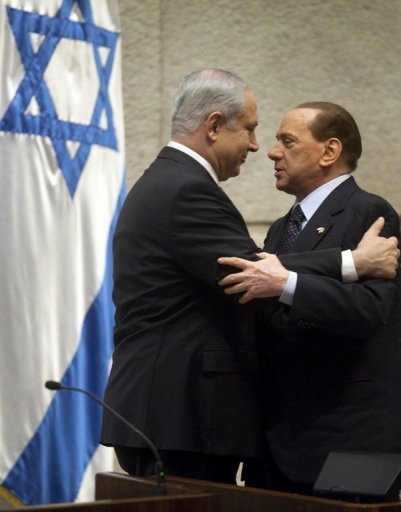
After the three-day visit of Italian Prime Minister Silvio Berlusconi to Israel and a short visit to the Occupied Palestinian Territories, a judgement is due. Berlusconi came with a large Italian ministry delegation (Foreign Minister Franco Frattini, Economy Minister Giulio Tremonti, Defense Minister Ignazio La Russa, Interior Minister Roberto Maroni, Public Works Minister Altero Matteoli and Health Minister Ferrucio Fazio) for the first Israeli-Italian joint cabinet meeting. It was the second joint-cabinet meeting for the Israeli government, after the joint German-Israeli session which was held in 2008. The same announcements and topics dominate speeches and actions of the Italian and Israeli politicians these days.
Holocaust, EU and the Big Brother
Berlusconi started his visit to Israel at Yad Vashem, the Holocaust Museum in Jerusalem. And the reference to the Holocaust pervaded the entire visit. The day before coming to Israel, Berlusconi delivered a written interview published in Haaretz on 31 January. In answer to the first question about the close relationship between his government and Israel (in a certain way new for the Italian political tradition), Berlusconi made reference to the Holocaust: “The visit I made to Auschwitz made a deep impression on me. I told myself there that it was impossible not to be Israeli.” But the most relevant nuance in Berlusconi’s words is that he presented a link between Israeli “struggle for freedom,” the process of European construction and the Holocaust. The result of that equation is that “Israel is part of Europe. It belongs to the West.” In his speech in front of the Knesset on 3 February, Berlusconi continued that “as both Pope John Paul II and Rabbi Eliyahu Tuaf said, Italy is like a ‘big brother’ to Israel, a bond which originates in the friendship and fraternity and common fate.”
In the present period when freedom of speech has become a sensitive issue in Italy with Berlusconi’s continuous attacks against journalists and when Israel restricts the possibilities for foreign journalists to enter, work and live in Israel and Palestinian Territories, the reference to Italy as a Big Brother of Israel reminds one more of the Orwellian 1984 scenario, rather than the particular “brotherhood” between Israelis and Italians.
Iran and the Economy
Iran was a top agenda topic during this visit. In his parallel between the current situation and the age of totalitarianism, Berlusconi stigmatized the Iranian president Ahmadinejad: “We must watch out,” because “we’ve already had one such madman in history,” clearly referring to Adolf Hitler. On 1 February, during the official dinner, talking about the Iranian regime, Israeli Prime Minister Benyamin Netanyahu stated that “humanity today is facing one of its most difficult challenges since World War II” and he added that “I must tell you, Silvio, my dear friend, you have a clear vision, you have determination and you have the courage of a genuine leader.”
In the Iranian chapter in the agenda of international relations, a large part is occupied by the economic issue. Meeting the Italian Prime Minister, the Israeli Foreign Minister Avigdor Lieberman asked Berlusconi on Tuesday to increase pressure on Russia to drop their opposition to economic sanctions against Teheran. Berlusconi’s personal story and career is strictly linked with business and he used that in every context: in the same Haaretz interview, he proudly declared that “for my entire life, first as an entrepreneur and later as prime minister, I have had a love of freedom.” He also proposed “the beautiful town of Arice as a location for future peace talks.” And to please the “little brother,” Berlusconi stated that from 2006, Italy has reduced trade with Iran. But Italy remains the largest European trading partner of Iran, more than 1,000 companies are involved in the Islamic Republic and prominent enterprises like Fiat, Eni and Ansaldo have offices and factories in Iran.
The Arab World
Except for Iran, during this three-day visit, the Arab world was the great absent in the political speeches and references. Even if Berlusconi states that “Italy today is an essential stop, sometimes the first, that Middle Eastern leaders make in Europe,” and that Italy is “involved in a lasting and comprehensive solution to the Palestinian question,” the marginality of the Palestinian cause and reality during this visit is clear to everybody.
Before his meeting with the Palestinian President Abu Mazen, the Italian Prime Minister denied the validity of the Goldstone report, because, according to him, Operation Cast Lead against Gaza last year was a “justified firing on Hamas’ rockets.” As the most important Italian newspaper, La Repubblica, noted, the adjective “justified” is not present in the written version of the speech spread in the Italian government website. This means that the Prime Minister voluntarily added this adjective at the eleventh hour. Moreover, during the press conference with Abu Mazen in Bethlehem, in answer to a question of what kind of feeling the Separation Wall in Bethlehem provoked in him, he replied that he didn’t see the Wall because he was too busy reading his notes.
Kissinger of Arcore
In one of the most important left-wing Italian newspapers, Il Manifesto, on 2 February, there appeared an article written by Zvi Schuldiner, professor of Political Science in the Israeli Sapir College, ironically defining Berlusconi as the “Kissinger of Arcore” (from the name of the village near Milan where Berlusconi lives). The reference to the American Secretary of State during the Nixon era is not casual: Berlusconi himself, in answer to the Haaretz correspondent’s questions, quoted Kissinger to draw a future scenario of war or peace in the Middle East: “Henry Kissinger used to say that there could never be war in the Middle East without Egypt, but no peace was possible without Syria.” However, behind these sentences, Israel knows that, despite his words and declaration, Berlusconi is one of the world’s most controversial men, morally, financially and politically. After this visit, in the next weeks and months the meaning of “brotherhood” between the Italian and Israeli governments will be revealed.
Time for an American Intifada?
By Jeff Gates | February 7, 2010
During the 1960 Christmas season, Americans flocked to the theaters to see Exodus, a 3-1/2 hour epic film featuring handsome freedom fighters and a riveting romance amidst the heroic triumph of Jewish Destiny over Arab Evil Doers. Set against a Yuletide backdrop of Biblical prophecy, moviegoers marveled as exiled Jews returned to their fabled promised land, a staple of popular culture to which Americans are first exposed as children in “Sunday school.”
Many moviegoers failed to realize that Exodus was not fact but fiction. Even now, few Americans realize the storyline was adapted for the screen from a 1958 novel by Leon Uris. The biggest bestseller since Gone with the Wind-a novel set during the Civil War of the 1860s-the filmadaptation was directed by Hollywood icon Otto Preminger. The blockbuster’s stars included a young Paul Newman with his leading lady a blond Eva Marie Saint.
The cast included character actor Lee J. Cobb and Peter Lawford, married to Pat Kennedy, a sister of John F. Kennedy who was elected president the same year. By then, Lawford was a famous member of pop culture’s high profile “Rat Pack” that included singer Frank Sinatra, Dean Martin, Sammy Davis, Jr. and Joey Bishop. Italian crooner Sal Mineo, then a teen heartthrob, received an Academy Award nomination for his portrayal of a Jewish émigré.
An Oscar should have been awarded to Israel and its supporters for portraying this extremist enclave as a legitimate nation-state when, in reality, its founding traces to an alluring storyline. Forty-five years after the release of Exodus, American naiveté was again targeted by Jewish storytellers to induce the U.S. to war in the Middle East-only this time for real.
Then as now, Americans are easily swayed by sympathetic portrayals of an enclave granted nation-state recognition by President Harry Truman, a Christian-Zionist. The Missouri Democrat had famously read the Bible cover-to-cover five times by age 15. Truman was a True Believer in the same way that fundamentalist Christians believe-truly believe-that their Messiah will not return until the “Israelites” recover their ancestral home.
Preying on similar beliefs, Republican George W. Bush, another Christian-Zionist president, was induced with phony intelligence to wage war in Iraq. The false intelligence was traceable to Israelis, pro-Israelis or assets developed for that purpose. That invasion had long been a priority goal of those who believe-truly believe-in their right to an expansionist Greater Israel.
Yet as Shlomo Sand chronicles in The Invention of the Jewish People (2009), the historical evidence is scant either for an exile or an “exodus.” As with the movie, the return of a “Jewish People” to a Jewish homeland is “a conscious ideological composition” meant “to claim a higher cultural lineage” than what can be supported by the facts.
In lieu of the novel-writing skills of Leon Uris, the Zionist narrative featured Biblical archeologists such as William F. Albright who, in the 1920s, traveled to the Holy Land to excavate artifacts that would, as Sand puts it: “reaffirm the Old Testament and thereby the New.”
By interpreting his finds in Christian-Zionist terms, Albright and his colleagues not only unearthed Biblical “facts” that shaped the Sunday school curriculum, they also helped pre-stage the perceived legitimacy of a Jewish people returning from exile to a Jewish homeland. As Sand points out, if there was no exodus, how can there be a return? If there is no “Jewish People,” how can there be a homeland?
Yet these widely held beliefs remain the premise underlying Israel’s expansionist agenda and its rationale for heaping six decades of abuse on Palestinians who have lived there for centuries.
Political Expedience or Biblical Prophecy?
White House counsel Clark Clifford cautioned Truman that his reelection was unlikely absent the funding that Jewish-Americans-with Israel’s recognition-were eager to provide. In early May 1948, General George C. Marshall, Truman’s Secretary of State, argued vigorously against recognition. Strong objections were also heard from the diplomatic corps, the fledgling Central Intelligence Agency and the Pentagon’s Joint Chiefs of Staff.
Marshall, the top-ranked U.S. military officer in WWII, was outraged that Clifford put domestic political expedience ahead of U.S. foreign policy interests. Marshall told Truman that he would vote against him if he extended sovereign status to an enclave of Zionist terrorists, religious fanatics and what Albert Einstein and Jewish philosopher Hannah Arendt called “Jewish fascists.” Marshall insisted that State Department personnel never again speak to Clifford.
In March 1948, a Joint Chiefs paper titled “Force Requirements for Palestine” predicted the “Zionist strategy will seek to involve [the U.S.] in a continuously widening and deepening series of operations intended to secure maximum Jewish objectives.” Those objectives included an expansionist agenda for Greater Israel that envisioned the taking of Arab land, ensuring armed clashes in which the U.S. was destined to become embroiled.
The Joint Chiefs listed Zionist objectives as:
– Initial Jewish sovereignty over a portion of Palestine,
– Acceptance by the great powers of the right to unlimited immigration,
– The extension of Jewish sovereignty over all of Palestine,
– The expansion of “Eretz (Greater) Israel” into Transjordan and portions of Lebanon and Syria, and
– The establishment of Jewish military and economic hegemony over the entire Middle East.
Akin to the fictional portrayal in Exodus, those Zionists lobbying Truman assured him they would remain within the initial boundaries. We now know that was a lie. They also promised that the Zionist state would not become what it quickly became: a theocratic and racist enclave-albeit widely marketed by pro-Israeli media as the “only democracy in the Middle East.”
To remove all doubt as to the extremist goals of the Zionist project, the Joint Chiefs assessment added ominously:
“All stages of this program are equally sacred to the fanatical concepts of the Jewish leaders. The program is openly admitted by some leaders, and has been privately admitted to United States officials by responsible leaders of the presently dominant Jewish group–the Jewish Agency.”
Deceit from the Outset
A beguiling combination of Hollywood fiction, manipulated beliefs and outright lies remain at the core of this entangled alliance and the U.S.-Israeli “special relationship.” The deceit deployed to advance the hegemonic goals of the Zionist project remains obscured by an undisclosed media bias reinforced by a widespread pro-Israeli influence in popular culture. As with the 1960 film, the ongoing manipulation of thought and emotion lies at the core of this duplicity a half-century later.
In The Persuasion Explosion (1985), author Art Stevens reports that Exodus was a public relations ploy launched by Edward Gottlieb who sought a novelist to improve Israel’s image in the U.S. The name Uris originates with Yerushalmi, meaning “man of Jerusalem.” The film rights to Exodus were sold in advance of the book’s publication. Translated into dozens of languages, this masterpiece of mental and emotional manipulation quickly became a global phenomenon as its created favorable impressions of Israel.
The rewards are real for those who offer aid and comfort to this trans-generational deceit. When Truman’s campaign train traversed the nation as part of a 1948 whistle-stop tour, grateful Jewish nationalists refueled his campaign coffers with a reported $400,000 in cash ($3.6 million in 2010 dollars). Those funds helped transform his anticipated loss into a victory with support from pro-Israeli editorial boards that-after recognition-boosted Truman’s sagging popularity.
The Creation of Reliable Assets
Clark Clifford was rewarded with his career goal when he emerged as a top-paid Washington lawyer. After proving himself a pliable personality, he remained a reliable asset. During the G.H.W. Bush presidency, his combination of political prominence and perceived credibility provided cover for a massive bank fraud involving the Bank of Credit and Commerce International aided by Roger Altman, his Ashkenazi law partner.
In 2009, Hollywood released an action thriller (The International) starring Clive Owen and a similar storyline involving the International Bank of Business and Credit. Neither Clifford nor Altman had experience in banking when their law firm enabled what prosecutors charged was a global criminal operation.
Media reports described the BCCI scheme as the largest bank fraud in history. This $20 billion transnational operation even featured the requisite Hollywood component: Clifford’s protégé was married to Lynda Carter, the star of Wonder Woman, a 1970s fantasy-adventure television series.
The real fantasy in this long-running geopolitical fraud lies in why U.S. lawmakers continue to befriend and defend a “nation” that has for so long-and so consistently-deceived and betrayed its most loyal ally. As a badly miscast Eva Marie Saint asked in her most memorable line in Exodus: “When will it ever end?”
The greatest wonder will be if, based on facts confirming the depth and duration of this duplicity, those lawmakers urging continued support for Israel are not charged with treason. [See: “How the Israel Lobby Took Control of U.S. Foreign Policy”]
To restore its national security, the U.S. must shake off its entangled alliance with this extremist enclave. “Shaking off” is the literal translation of “intifada.” Those who know the true facts behind this trans-generational deception are quickly reaching the conclusion that the recognition of this enclave as a legitimate state was key to this ongoing fraud. Others may be waiting for the movie, American Intifada.
US rejects EU diplomacy over Iran N program
Press TV – February 7, 2010
Leading US senators Joseph Lieberman and John Kerry inveigh against a top EU official for supporting further diplomatic talks with Iran over its nuclear program.
Speaking at the Munich Security Conference on Saturday, the two US officials criticized the European Union Foreign Policy Chief Catherine Ashto who threw her lot with more dialogue over Iran’s nuclear program.
The two went on to claim that Iran has been ‘explicitly dishonest’ over its uranium enrichment and thus does not deserve further dialogue, or diplomacy for that matter.
 “Iran comes to the international conference like this and talks in a way that is simply dishonest,” said Lieberman, who chairs the US Senate Committee on Homeland Security and Government Affairs and is known for his pro-Israeli stance on international issues.
Rather than dealing with Iran through diplomatic negotiations, Lieberman asserted that the US should try to deal with the Tehran government through other means.
“Dialogues have being going on for last six years, (and) there are always dialogues,” he said. “But the Iranians do not take the chance. I think it simply has to get a tougher economic sanction if any kind of diplomacy is over, and military will never be necessary.”
His remarks were instantly backed by John Kerry, the former US presidential candidate who now heads the Senate’s Foreign Relations Committee.
“We are united in the congress, senate house, the administration and with our allies here in Europe,” said Kerry.
This comes as Iran is trying to find a middle ground with the West in swapping its low-enriched uranium with more refined nuclear material for the Tehran research reactor.
Iranian Foreign Minister Manouchehr Mottaki expressed hope on Saturday that an agreement on the nuclear fuel proposal will soon be reached with the Western side, but with the changes that Tehran seeks.
His remarks were largely ignored by US Defense Secretary Robert Gates who has instead insisted on the imposition of fresh sanctions.
Washington accuses Iran of developing nuclear weapons and has for years levied sanctions and threatened the country with war scenarios to force the Tehran government into halting its nuclear activities.
Iran which has been under various US sanctions after the Islamic Revolution toppled a US-backed monarch in 1979 rejects the accusations as politically motivated.
Iran’s nuclear program was launched in the 1950s with the help of the United States as part of the Atoms for Peace program. After the 1979 Revolution, Western companies working on Iran’s program refused to fulfill their obligations even though they had been paid in full.
Iran is a signatory of the Nuclear Non-Proliferation Treaty and, unlike some of its regional neighbors, has opened its enrichment plants to UN inspection.
Iran near $30bn oil deals with foreign firms
Press TV – February 6, 2010
Iran is in the final stage of talks with five companies to finalize deals for the development of oil and gas fields worth $30 billion, an official says.
Seifollah Jashnsaz, Managing Director of the National Iranian Oil Company (NIOC), predicted that the deals will be finalized within two months.
Speaking to Mehr news agency, he added that five Asian and European firms are expected to invest in the Lavan gas field, Phases 13 and 14 of the South Pars gas field, the Azadegan oilfield, the Kish gas field, and two exploratory blocks in the Caspian Sea. Jashnsaz did not give further details.
Iran’s fifth five-year development plan (2010-2015) has obliged the government to invest around $155 billion in the upstream sector of the oil and gas industry.
Jashnsaz said Iran’s total revenues from oil exports stood at $78 billion during the Iranian calendar year to March 2009.
The NIOC chief also added that the government allowed the Oil Ministry to invest $11 billion from its oil sales in oil industry development.
Jashnsaz stressed that Iran needs to attract more foreign investment to keep the oil industry live. “If we do not make the necessary investment, the harm of the lack of timely investment in the oil industry will be irreversible to the country,” he pointed out.
“We must go after foreign investment, the possibility of which also exists,” he said.
Israeli hit squad that killed Hamas commander ‘had Irish passports’
The Belfast Telegraph | February 6, 2010
Members of a hit squad that assassinated a top Hamas military commander used Irish passports to enter and leave Dubai, it’s been claimed.
The suspected Israeli hit team, including at least one woman, entered the United Arab Emirates using Irish documents, police authorities said.
Mahmoud al-Mabhouh (50), held responsible by Israel for the abduction and murder of two Israeli soldiers in 1989, died in mysterious circumstances on January 20 in a Dubai hotel room.
The Irish Department of Foreign Affairs spokesman said yesterday: “We are aware of the media reports and we are in contact with authorities locally to try and determine the truth of the reports.”
Al-Mabhouh was said to have been shocked with an electric weapon held to his legs and then suffocated or poisoned.
Iran and Hamas have blamed Israel for the killing, but Israeli news media claimed al-Mabhouh had many enemies and could have been killed by other Arab factions.
Up to seven people were said to have been involved in al-Mabhouh’s killing, four of whom used Irish passports to enter Dubai and who later fled to a “European country” after the killing, according to police sources in Dubai.
Declining to reveal their identities, an official said UAE security personnel were co-ordinating with Interpol to have them extradited.
Al-Mabhouh had been out for most of the day and returned to his room only after 9pm, police said.
Pathologists were said to have determined the cause of death as asphyxiation, probably with a pillow found near the body and stained with blood. A room cleaner found his body the next day.
He had travelled to Dubai under another name.
The victim was said to have been in charge of weapons procurement for Hamas and was on a mission in Dubai.
His brother said it was not the first attempt on his life. Six months ago, he was rushed to hospital in Dubai in a coma and treated for poisoning.
Mr Mabhouh’s funeral was held in Damascus, where he had lived for 20 years with his wife and children.
In 1986, US officials, including Oliver North, reportedly used Irish passports to travel to Iran to offer missiles for hostages.
Featured Video
No Vote, No Representation, No State: Democracy, Israeli Style
or go to
Aletho News Archives – Video-Images
From the Archives
Sanctions, War and the Policy of Dual Containment
By SASAN FAYAZMANESH | March 17, 2008
It is now nearly three decades since the Unites States adopted the policy of dual containment of Iran and Iraq. While much has been written about the containment of Iraq, there has been very little in-depth analysis of this policy when it comes to Iran. In a book that is going to be released on March 31, 2008, entitled The United States and Iran: Sanctions, Wars and the Policy of Dual Containment (Routledge), I attempt to address this shortcoming by investigating when and why the US policy of containment of Iran came about, how it evolved, and where it stands today.[1] To the extent that Israel has been involved in US policy making, the study will also include the role that Israel has played in the containment of Iran. Also, since the fate of Iran has been inextricably linked to that of Iraq, occasionally the investigation will overlap with the containment of Iraq.
The policy of dual containment of Iran and Iraq originated during the Carter Administration, but it was not until the Clinton Administration that the expression “dual containment” became popular. … continue
Blog Roll
 Aletho News
- How Israel destabilizes the Middle East: Denying sovereignty and the right to exist
- Europe’s Establishment Is Embracing War – and Losing Voters
- NATO chief advocates war of aggression
- No Vote, No Representation, No State: Democracy, Israeli Style
- Zionist Bought Senate Blocks Information About American Citizens Killed By Israel
- While Gaza dominates the UN, these are the people keeping it alive
- New Report: “Scholasticide and Genocide in Gaza: Assessment, Testimonies and Legal Analysis”
- ‘THAAD Delusion’: Iran war exposes US missile shield limits – The Atlantic
- Moscow issues warning to NATO over Russian exclave
- Yes, the Iran war has destroyed Trump’s presidency
- If Americans Knew
- Israel map in LA Times ad includes all land from the river to the sea
- Inside Lebanon’s 200-page dossier on Israeli war crimes
- Flydubai, genocide, settler violence, Trump abuse of power to deport – Daily Update
- Counting Antisemitic Incidents: What the ADL Audit Reveals — and Obscures
- Mamdani releases plan to combat antisemitism and hate crimes in New York City
- Iran’s Revolutionary Guards Publish Letter to the American People
- DMFI launches $1 million ad campaign supporting Virginia’s Elaine Luria
- US Senate blocks resolution seeking report on Americans killed by Israel
- Israeli Attacks Kill Ten Palestinians in Gaza
- Massacre at Minab: The School That Became a Grave
- No Tricks Zone
- Green Energy Debacle: German Expert Professor Fritz Vahrenholt Warns Of Severe Economic And Social Consequences
- Two More Paleo Reconstructions Affirm Meters-Higher Sea Levels Across Ireland, Brazil 7000-6000 Years Ago
- New Study: Earth And Venus Surface Warmth Largely Explained By Convection And Lapse Rate, Not CO2 Or Radiation
- 2025 Nature Paper Claiming Worsening Global Drought Gets RETRACTED …Heavily Flawed
- New Study: ‘Global Drought Shows No Detectable Recent Acceleration Under Climate Warming’
- Economic Masterminds: German Socialists Suggest Taxing Productivity Gains Stemming From Using AI
- The South China Sea Has Not Been Cooperating With The Climate Change Narrative
- Energy Crisis: Germany Enters Heating Season With Historically Low Gas Reserve Fill Levels
- New Study: The Antarctic Ice Sheet Gained Mass From 2020-2024 Due To Staggering Snow And Ice Accumulation
- Study: Ocean Heating Rates From Thousands Of Years Ago ‘Dwarf’ Modern Ocean Heating Rates

