Iran offers nuke fuel deal
By Laura Rozen | Politico | January 10, 2010 07:57 PM EST
There are signs that negotiations with Iran over a nuclear fuel swap have resumed despite the expiration of the end-of-year deadline for a deal set by President Barack Obama.
While the Obama administration has stepped up talk of expanding sanctions on the regime’s Revolutionary Guards Corps, Iranian news reports and U.S. official sources say that Iran has recently returned a formal counter offer to swap low enriched uranium, or LEU, in exchange for nuclear fuel cells produced in the West.
The proposal comes as Iranian news reports say the foreign ministry has announced the halting of uranium enrichment for two months as a good-will gesture. Outside observers have not confirmed that claim.
A U.S. nonproliferation hand confirmed Sunday that Iran had offered a formal response in late December or early January. While the Iranian fuel-swap response was said to have been conveyed by the highest levels of the Iranian government, U.S. officials contacted Sunday gave no public indication that they have any interest in the counter-offer.
“The Iranians have been saying different things for weeks, but what matters is whether they will accept the IAEA’s proposed TRR deal, which they agreed to in principle on October 1 but then walked away from,” an administration official said. “They know what they need to do to satisfy the international communities concerns and to date they have not done so.”
The Tehran Research Reactor proposal, or TRR, calls on Iran to immediately send 1,200 kg of its LEU to Russia, and France would in return supply Iran with nuclear fuel cells for medical use. The plan would have left Iran without enough fissile material to enrich for use in a nuclear weapon, putting time back on the clock for international negotiations on the nation’s nuclear program.
Iran’s counter-offer also proposes sending the 1,200 kg abroad – probably to Turkey – but in batches, starting with a first shipment of 400 kg. The offer seems to establish Iran’s willingness to export the LEU out of the country, which would satisfy a key Western condition.
“My understanding is that they [U.S. officials] have not given up on the TRR deal,” one Washington Iran hand said on condition of anonymity Sunday. “They need it. So if there was a chance of salvaging something …. They still want to get a deal.”
“As long as under no situation over the next year there is enough LEU to produce a bomb, whether Iran ships out the fuel in one, two or three batches, is just a logistical issue,” he said.
NSC nuclear czar Gary Samore and his shop and the U.S. mission to the IAEA in Vienna would be best placed to handle talks about a deal, it was suggested.
One source told POLITICO that an agreement between Iran and the “P5+1” – as the group composed of China, France, Germany, Russia, the United Kingdom and the U.S. is known – could be announced in “the very near future.”
While Iranian negotiators tentatively approved the TRR deal in October, the proposal came under fire in the Iranian parliament, and Iran hadn’t until now formally replied to the offer.
The closed nature of Iran’s nuclear program and the political upheaval there since the disputed June elections have made it difficult to interpret the nature of that silence, which could be a delaying device, a failure to achieve consensus with the government, or an attempt to win domestic political points by holding out on a deal until after the deadline had passed.
The U.S., for its part, has been working to balance a level of support for political dissidents in Iran with its negotiations with the government on its nuclear program.
Buried deep in Iranian news reports last week was a quote attributed to Iran’s foreign ministry spokesman, Ramin Mehmanparast, seeming to indicate that Iran has stopped enriching uranium at all for two months as a good will gesture:
“On the request of certain impartial countries who asked Iran not to enrich uranium for two months in order to give the West some time to respond, [Mehmanparasat] said, ‘To show our goodwill to the international community, we agreed with this request, and one month has passed since that time and one month is left,’” the Tehran Times reported last Monday. “’If the other side responds to Iran’s request in the remaining time, we will start the work. Otherwise, we will make the necessary decision.’”
Nonproliferation experts contacted Sunday said they were not aware of a halt to Iran’s uranium enrichment.
In its analysis of the latest International Atomic Energy Agency report, however, the nonproliferation group ISIS noted that Iran was holding its enrichment rate steady and was not using all of the centrifuges at its Natanz enrichment facility. But it wasn’t clear if technical problems or a political decision or something else accounted for the unused centrifuges.
“There’s a lot more uncertainty now about whether the slow-down in the operation of centrifuges has its origins in technical difficulties, the change in leadership of the Iranian nuclear program, or an Iranian decision to deliberately slow the program down in order to give diplomatic solution a chance to work,” ISIS’s Jacqueline Shire told POLITICO Sunday.
The administration official did not say whether the U.S. had indications that Iran had halted or drastically slowed down its uranium enrichment.
The Iranian proposal to send the LEU to Turkey, a Muslim nation that’s been increasing its economic ties to Iran, could help set the stage for any agreement.
“I believe that Turkey can be an important player in trying to move Iran” away from what the U.S. and other nations suspect is a nuclear weapons program, President Obama said after meeting with Turkish Prime Minister Recep Tayyip Erdogan at the White House in December.
© 2009 Capitol News Company, LLC
Iran Uses Fear of Covert Nuclear Sites to Deter Attack
Analysis by Gareth Porter*
WASHINGTON, Jan 10 (IPS) – The New York Times reported Tuesday that Iran had “quietly hidden an increasingly large part of its atomic complex” in a vast network of tunnels and bunkers buried in mountainsides.
The story continued a narrative begun last September, when a second Iranian uranium enrichment facility near Qom was reported to have been discovered by U.S. and Western intelligence. The premise of that narrative is that Iran wanted secret nuclear facilities in order to be able to make a nuclear weapon without being detected by the international community.
But all the evidence indicates that the real story is exactly the opposite: far from wanting to hide the existence of nuclear facilities from the outside world, Iran has wanted Western intelligence to conclude that it was putting some of its key nuclear facilities deep underground for more than three years.
The reason for that surprising conclusion is simple: Iran’s primary problem in regard to its nuclear programme has been how to deter a U.S. or Israeli attack on its nuclear sites. To do that, Iranian officials believed they needed to convince U.S. and Israeli military planners that they wouldn’t be able to destroy some of Iran’s nuclear sites and couldn’t identify others.
The key to unraveling the confusion surrounding the Qom facility and the system of tunnel complexes is the fact that Iran knew the site at Qom was being closely watched by U.S. and other intelligence agencies both through satellite photographs and spy networks on the ground well before construction of the facility began.
The National Council of Resistance in Iran (NCRI), the political arm of the Mujahideen E Khalq anti-regime terrorist organisation, held a press conference on Dec. 20, 2005, in which it charged that four underground tunnel complexes were connected with Iran’s nuclear programme, including one near Qom.
NCRI had created very strong international pressure on Iran’s nuclear programme by revealing the existence of the Natanz enrichment facility in an August 2002 press conference. A number of its charges had been referred to the International Atomic Energy Agency (IAEA) for investigation.
It is now clear that there was nothing in the tunnel complex at Qom related to the nuclear programme when the NCRI made that charge.
Given the close ties between the MEK and both the U.S. and Israel, however, Iran’s decision makers had to be well aware that foreign intelligence agencies would focus their surveillance in Iran on the tunnel complexes that the MEK had identified.
U.S. and European officials have confirmed that systematic surveillance of the site by satellite photography began in 2006.
What happened next is a particularly important clue to Iran’s strategy. According to multiple sources, an anti-aircraft battery was moved to the base of the mountain into which the tunnel complex had been dug.
That was a clear indication that Iranian officials not only knew the site was under surveillance but wanted to draw attention to it.
That move prompted serious debate within the intelligence community. French security consultant Roland Jacquard, who had contacts in the intelligence community, recalled to Time magazine last October that some analysts suggested that it could be a “decoy”, aimed at fixing intelligence attention on that site, while the real nuclear facilities were being built elsewhere.
If Iran had believed the site was not under surveillance, there would have been no reason to move an anti-aircraft battery to it.
That anti-aircraft battery was evidently intended to ensure that foreign intelligence would be watching as construction of a new facility continued at Qom. Satellite imagery that has been obtained by the Institute for Science and International Security in Washington, D.C. shows that construction of the facility began sometime between mid-2006 and mid-2007, according to satellite imagery interpretation specialist Paul Brannan of the ISIS.
Of course intelligence analysts could not be certain of the site’s precise purpose until a later stage of construction. A senior U.S. intelligence official revealed in the Sep. 25 briefing that the analysts were not confident that it was indeed an enrichment facility until sometime in spring 2009.
Meanwhile, the Iranians were providing foreign intelligence agencies with clear evidence it would use a “passive defence strategy” to protect its nuclear facilities. In a statement on Iranian television Sept. 24, 2007, the Chairman of the Passive Defence Organisation, Gholam Reza Jalali, said the strategy would “conceal and protect the country’s important and sensitive facilities, [which] would minimise their vulnerability…”
Jalali revealed to Mehr news agency Aug. 24, 2007 that a nuclear installation monitored by the IAEA was part of the plan. As the New York Times reported Tuesday, tunnels have been built into mountains near the Isfahan uranium conversion complex.
News media have consistently reported that Iran informed the IAEA about the Qom facility in a letter Sep. 21 only because the site had been discovered by Western intelligence.
But a set of Questions and Answers issued by the Barack Obama administration the same day as the press briefing admitted, “We do not know” in answer to the question, “Why did the Iranians decide to reveal this facility at this time?”
In fact, Iran’s Sep. 21 letter the IAEA, an excerpt of which was published in the Nov. 16 IAEA report, appears to have been part of the strategy of confusing U.S. and Israeli war planners. It stated that the construction of a second enrichment facility had been “based on [its] sovereign right of safeguarding…sensitive nuclear facilities through various means such as utilization of passive defense systems…”
As Time magazine’s John Barry noted in an Oct. 2 story, the letter was read by intelligence analysts as suggesting that among the more than a dozen tunnel sites being closely monitored were more undisclosed nuclear sites.
A few days later, the Iranian daily Kayhan, which is very close to President Mahmoud Ahmadinejad, said the announcement of the site had helped to foil plans for a military strike by the West, because “the multiplicity of facilities is a very effective defensive action”.
That statement hinted that Iran was able to complicate the task of U.S. and Israeli military planners by introducing uncertainty about where additional nuclear facilities might be hidden.
The New York Times article on Iran’s tunnel complex indicates that Iran’s strategy has succeeded in influencing debates in Israel and the United States over the feasibility of a devastating blow to the Iranian nuclear programme. The Times called the tunneling system “a cloak of invisibility” that is “complicating the West’s military and geopolitical calculus”.
It said some analysts consider Iran’s “passive defense” strategy “a crucial factor” in the Obama administration’s insistence on a non-military solution.
One indication of that the Iranian strategy has had an impact on Israeli calculations is that Maj. Gen. Aharon Ze’evi Farkash, the head of intelligence for the Israeli Defense Force (IDF) from 2002 to 2006, supported an attack on Iran by the U.S. Air Force – a standard Israeli position – at a meeting at the pro-Israel Washington Institute for Near East Policy last October.
But Farkash warned that Western intelligence still may not know about all of Iran’s nuclear sites. In other statements, Farkash has opposed an Israeli strike.
*Gareth Porter is an investigative historian and journalist specialising in U.S. national security policy. The paperback edition of his latest book, “Perils of Dominance: Imbalance of Power and the Road to War in Vietnam”, was published in 2006.
Is Anyone Telling Us The Truth?
By Paul Craig Roberts | January 7, 2010
What are we to make of the failed Underwear Bomber plot, the Toothpaste, Shampoo, and Bottled Water Bomber plot, and the Shoe Bomber plot? These blundering and implausible plots to bring down an airliner seem far removed from al-Qaida’s expertise in pulling off 9/11.
If we are to believe the U.S. government, Khalid Sheikh Mohammed, the alleged al-Qaida “mastermind” behind 9/11, outwitted the CIA, the NSA, indeed all 16 U.S. intelligence agencies as well as those of all U.S. allies including Mossad, the National Security Council, NORAD, Air Traffic Control, Airport Security four times on one morning, and Dick Cheney, and with untrained and inexperienced pilots pulled off skilled piloting feats of crashing hijacked airliners into the World Trade Center towers, and the Pentagon, where a battery of state of the art air defenses somehow failed to function.
After such amazing success, al-Qaida would have attracted the best minds in the business, but, instead, it has been reduced to amateur stunts.
The Underwear Bomb plot is being played to the hilt on the TV media and especially on Fox “news.” After reading recently that The Washington Post allowed a lobbyist to write a news story that preached the lobbyist’s interest, I wondered if the manufacturers of full body scanners were behind the heavy coverage of the Underwear Bomber, if not behind the plot itself. In America, everything is for sale. Integrity is gone with the wind.
Recently I read a column by an author who has a “convenience theory” about the Underwear Bomber being a Nigerian allegedly trained by al-Qaida in Yemen. As the U.S. is involved in an undeclared war in Yemen, about which neither the American public nor Congress were informed or consulted, the Underwear Bomb plot provided a convenient excuse for Washington’s new war, regardless of whether it was a real attack or a put-up job.
Once you start to ask yourself about whose agenda is served by events and their news spin, other things come to mind. For example, last July there was a news report that the government in Yemen had disbanded a terrorist cell, which was operating under the supervision of Israeli intelligence services. According to the news report, Yemeni President Ali Abdullah Saleh told Saba news agency that a terrorist cell was arrested and that the case was referred to judicial authorities “for its links with the Israeli intelligence services.”
Could the Underwear Bomber have been one of the Israeli terrorist recruits? Certainly Israel has an interest in keeping the US fully engaged militarily against all potential foes of Israel’s territorial expansion.
The thought brought back memory of my Russian studies at Oxford University where I learned that the Tsar’s secret police set off bombs so that they could blame those whom they wanted to arrest.
I next remembered that Francesco Cossiga, the president of Italy from 1985-1992, revealed the existence of Operation Gladio, a false flag operation under NATO auspices that carried out bombings across Europe in the 1960s, 1970s, and 1980s. The bombings were blamed on communists and were used to discredit communist parties in elections.
An Italian parliamentary investigation unearthed the fact that the attacks were overseen by the CIA. Gladio agent Vincenzo Vinciguerra stated in sworn testimony that the attacks targeted innocent civilians, including women and children, in order “to force the public to turn to the state to ask for greater security.”
What a coincidence. That is exactly what 9/11 succeeded in accomplishing in the U.S.
Among the well-meaning and the gullible in the West, the supposition still exists that government represents the public interest. Political parties keep this myth alive by fighting over which party best represents the public’s interest. In truth, government represents private interests, those of the office holders themselves and those of the lobby groups that finance their political campaigns. The public is in the dark as to the real agendas.
The U.S. and its puppet state allies were led to war in the Middle East and Afghanistan entirely on the basis of lies and deception. Iraqi weapons of mass destruction did not exist and were known by the U.S. and British governments not to exist. Forged documents, such as the “yellowcake documents,” were leaked to newspapers in order to create news reporting that would bring the public along with the government’s war agenda.
Now the same thing is happening in regard to the nonexistent Iranian nuclear weapons program. Forged documents leaked to The Times (London) that indicated Iran was developing a “nuclear trigger” mechanism have been revealed as forgeries.
Who benefits? Clearly, attacking Iran is on the Israeli-U.S. agenda, and someone is creating the “evidence” to support the case, just as the leaked secret “Downing Street Memo” to the British cabinet informed Prime Minister Tony Blair’s government that President Bush had already made the decision to invade Iraq and “the intelligence and facts were being fixed around the policy.”
The willingness of people to believe their rulers and the propaganda ministries that serve the rulers is astonishing. Many Americans believe Iran has a nuclear weapons program despite the unanimous conclusion of 16 U.S. intelligence agencies to the contrary.
Vice President Dick Cheney and the neoconservatives fought hard with limited success to change the CIA’s role from intelligence agency to a political agency that manufactures facts in support of the neoconservative agenda. For the Bush Regime creating “new realities” was more important than knowing the facts.
Recently I read a proposal from a person purporting to favor an independent media that stated that we must save the print media from financial failure with government subsidies. Such a subsidy would complete the subservience of the media to government.Even in Stalinist Russia, a totalitarian political system where everyone knew that there was no free press, a gullible or intimidated public and Communist Party enabled Joseph Stalin to put the heroes of the Bolshevik Revolution on show trial and execute them as capitalist spies.
In the U.S. we are developing our own show trials. Sheikh Mohammed’s will be a big one. As Chris Hedges recently pointed out, once government uses demonized Muslims to get the new justice (sic) system going, the rest of us will be next.
Paul Craig Roberts [email him] was Assistant Secretary of the Treasury during President Reagan’s first term. He was Associate Editor of the Wall Street Journal.
US-Pakistan “diplomatic” dispute escalates
By Ein Katzenfreund | Aletho News | January 9, 2010
The neoconservative Wall Street Journal, New York Times and many other English-language media and even the Chinese news agency Xinhua just wrote in bold headlines that the US has asked Pakistan to stop “harassment” of their “diplomats”. It is quite uncommon that a country tries to escalate diplomatic differences with a friendly country over the mass media, rather than resolving it discreetly. Pakistan is an important “partner” for the United States in its struggle to dominate the Middle East, which it sells to the public as a global war on terror.
In the Wall Street Journal version and the associated Western media, the story of the diplomatic dispute is told somewhat like this: Pakistani authorities and security forces are harassing US diplomats in Pakistan by temporarily arresting them, searching their cars and systematically delaying visa requests. Due to this harassment the US now has difficulty implementing its five-year program to support civilian projects in Pakistan worth 1.5 billion US dollars annually. The Pakistani government demands direct payment so that it can spend the money where it is needed but the US doesn’t do this as it wants full administrative control. The Wall Street Journal suggests that the Pakistani intelligence service ISI is behind the harassment campaign and that the ISI is impeding peace and development in Pakistan. That’s what the story looks like in Rupert Murdoch’s Wall Street Journal. The New York Times adds that the US embassy in Islamabad has plans to increase its staff to implement its assistance program in Pakistan from 500 to 800 people and casually states that President Zardari has demanded a cessation of air strikes by US drones on Pakistani territory, and instead proposes that the US give Pakistan the drone technology.
In Pakistan the story appears a bit different. First of all, it is carefully noted in Pakistan that the US hires death squads from the notorious Blackwater outfit as “diplomats”. The US government officially denies that it uses Blackwater for assassinations, but since it was announced that the suicide attack on the secret drone base in Afghanistan’s Khost killed two mercenaries from Blackwater the official claims have been exposed as a blatant lie.
However the troubles of the US in Pakistan are even more serious. Zahid Malik explained on December 7th in the Pakistan Observer in detail that the head of the ISI, General Ahmed Shuja Pasha, personally confronted the CIA boss Leon Panetta with evidence that the US backs warlords and terrorist groups in Afghanistan and Pakistan for the purpose of destabilizing Pakistan. The role Stanley McCrystal’s JSOC terrorist group plays in this dirty war is also public knowledge. None of this surprises Pakistanis as everyone in Pakistan knows that the US runs a secret war against Pakistan. This is becoming disastrous for the US because in the eyes of the Pakistani population the US is widely decried as a state sponsor of terrorism and any Pakistani government making common cause with the United States is considered to be treasonous.
The most important point is that the United States under Obama is trying to deceive Pakistan. The US promised to fight alongside Pakistan but they secretly fought against Pakistan and they were caught. It couldn’t be worse for the US. In this situation even the $1.5 billion annual bribe won’t help them out. If the US does not maintain the cooperation of Pakistani security services there will be no reliable transit of supplies for the U.S. occupation forces in Afghanistan via Pakistan anymore. Pakistan can add to its demands whatever it wants whenever it wants, because the US is so dependent on the supply routes through Pakistan. Obama would like to increase US troops in Afghanistan by about 30 – 40,000 official soldiers. As for supply routes for his troops in Afghanistan he has the following possibilities: Pakistan, Russia, and Iran. As the US has no internal influence in Iran and Russia, these countries are not ideal options. The result is that if Pakistani supply routes are closed Obama’s occupation of Afghanistan will end and Pakistan wins influence. Until then Pakistan may ask what it wants of the US, and the US must pay whatever the price is. If the US is escalating its diplomatic dispute with Pakistan now in the media, that suggests that the US administration has just now realized what kind of an ugly trap they have fallen into in Afghanistan.
Was this really that hard to foresee? Honestly, who is stupid enough to choose to occupy Afghanistan? OK, the think tank IASPS proposed it, but they also called for war on Iraq for the reorganization of the Middle East in Israel’s favor. It is noteworthy that Barack Obama still follows this Zionist-designed war policy even though it brings nothing but predictable disaster for the US.
Iran’s Press TV is modest: it reported that five Americans were arrested because they used fake license plates, but that they were released later because the US embassy said that they were diplomats. Oh, but of course when US Marines raided the Algerian embassy in Baghdad it was something entirely different and in no way harassment or a violation of the Vienna Convention on Diplomatic Relations.
The author manages a German language news blog at – http://www.mein-parteibuch.com/
When Israel snaps its fingers British ministers jump
Stuart Littlewood | January 7, 2010
While the Viva Palestina convoy drama was being played out, a delegation of senior Israeli military officers cancelled a planned visit to the UK for fear of being arrested over alleged war crimes in Gaza.
With the insufferable arrogance we have come to expect from Israelis, deputy foreign minister Danny Ayalon demanded from Britain’s Attorney General, Baroness Scotland, an immediate solution to the “intolerable” situation.
“If the British law remains unchanged, this would undermine the good relations between the two countries who share common values and interests. The British must bear in mind that these visits serve both countries,” Ayalon is reported as saying.
“This legislation is often misused,” he added. “It initially targeted Nazi criminals, but terrorist organisations like Hamas are today using it to take democracies hostage. We have to put an end to this absurdity…”
That is typical Israeli ‘crapaganda’. Britain does not share Israel’s racist and criminal values. In fact, we have nothing in common worth mentioning. And of course Hamas is no more a terrorist organization than the Israeli regime itself.
What is absurd is that murderous Israelis, with the stench of mega-deaths on them, expect to be let into the UK.
 Last month, Tzipi Livni, now leader of Israel’s main opposition party but foreign minister at the time of the blitzkrieg against Gaza, cancelled a visit to Britain after an arrest warrant was issued by a British court. An Israeli spokesperson said: “Only actions can put an end to this absurd situation, which would have seemed a comedy of errors were it not so serious.”
The errors are all Livni’s. Her appalling crimes are not funny. Yet British prime minister Gordon Brown insists that she is welcome and says he’ll change the law that allows British courts to issue warrants for alleged war crimes suspects.
According to Baroness Scotland, speaking at the Hebrew University of Jerusalem, Israeli leaders should not face arrest for war crimes under the law of universal jurisdiction. “The government is looking urgently at ways in which the UK system might be changed to avoid this situation arising again. Israel’s leaders should always be able to travel freely to the UK.”
And David Miliband, foreign secretary, says the British government is determined that arrest threats against visitors of Ms Livni’s stature won’t happen again. “Israel is a strategic partner and a close friend of the United Kingdom. We are determined to protect and develop these ties. Israeli leaders – like leaders from other countries – must be able to visit and have a proper dialogue with the British government.”
Livni, referring to the slaughter she oversaw in Gaza a year ago, had the gall to say: “I would make the same decisions all over again.” So Miliband seems happy for even the vilest foreign criminals to walk the streets of our capital.
However, Livni is no longer a serving minister so why should even the most twisted minds in the British government consider rolling out the red carpet for her?
Israel itself was happy to use “universal jurisdiction” to try Adolf Eichmann in Jerusalem in 1961. The principle, let us remember, is that there can be no hiding place for those accused of genocide, crimes against humanity, extrajudicial executions, war crimes, torture and forced disappearances.
But it seems Brown and Miliband will go to any lengths, even as far as dismantling our solemn obligations under international law, in order to protect their unsavoury friends. They need reminding that states which are party to the Geneva Conventions are obliged to seek out and either prosecute or extradite those suspected of having committed grave breaches of the Conventions: “Each High Contracting Party shall be under the obligation to search for persons alleged to have committed or to have ordered to be committed, such grave breaches, and shall bring such persons, regardless of their nationality, before its own courts…”
“Grave breaches” means willful killing, torture or inhuman treatment, causing great suffering or serious injury to body or health, and other serious violations of the laws of war… all the atrocities committed by Israel in the Gaza Strip.
Instead of making Britain an even bigger laughing-stock, Brown, Miliband and Scotland should get busy and do their duty, not duck it. The British public’s message to Israel meanwhile is simple. If you must come here, make sure your hands are clean. War criminals are not welcome.
Stuart Littlewood
7 January 2010
Stuart Littlewood is author of the book Radio Free Palestine, which tells the plight of the Palestinians under occupation. For further information please visit http://www.radiofreepalestine.co.uk
Iran Running Out of Life-Saving Isotopes
By Thomas Erdbrink in Tehran | Spiegel Online | January 6, 2010
Trade sanctions imposed on Iran over its nuclear program are affecting treatment of people suffering from heart and kidney disease and various cancers. Some 850,000 patients are at risk because the country is running out of radioactive isotopes essential to radiotherapy.
Ruhollah Solook, 78, was dying before a donated kidney and complex radiotherapy saved his life. Recovering in an isolation room in Tehran’s oldest hospital, he expressed his joy in a telephone interview. “They saved my life already. I hope they will be able to cure me entirely now.”
But Solook’s treatment has become a race against time, as has that of 850,000 other Iranians suffering from heart and kidney disease and various cancers. Sometime after March 2010, the country will run out of technetium-99, a radioisotope crucial to the treatment of these diseases. Technetium-99 is currently produced locally in Iran.
“We recommend treatment with these products to hundreds of patients every month in our hospital alone,” said Dr. Gholamreza Pourmand, Solook’s physician. Technetium-99 is essential to radiotherapy, Pourmand said: “If we cannot help these people, some will die. It’s as simple as that.”
Rare and Precious
The impending shortage of technetium-99 is caused by the controversy surrounding the Iranian nuclear program. The sanctions imposed by the UN Security Council, aimed at moving Iran to halt its uranium enrichment program, are supposed to leave medical practice unaffected. In reality, however, Iran has become unable to procure a wide range of medical products. Body scanners cannot be imported from the US or the EU, since parts in these machines could also be useful to Iran’s nuclear program. An embargo on medical isotopes was introduced in 2007, in defiance of the medical exception clause touted as part of the trade sanctions, Iranian leaders said.
Isotopes are a rare commodity produced at only five sites worldwide. One of these, the High Flux Reactor in the Dutch town of Petten, currently accounts for 30 to 40 percent of worldwide production, but it is scheduled for retirement soon. Apart from the UN sanctions, so many restrictions — particularly American — on trade with Iran exist, that in practice nobody is willing to supply Iran with medical isotopes any longer.
Out of dire necessity, Iran now uses its 41-year-old research reactor in Tehran — originally constructed by the US — exclusively for isotope production, a job which used to take only a day a week. However, the reactor’s fuel, provided by Argentina in 1993, is quickly running out, the scientists said.
‘We Will Make Our Own’
Iranian leaders, including President Mahmoud Ahmadinejad, say that Iran might produce new fuel itself, which would prove a sensitive issue. Iran would need to enrich uranium up to 19.75 percent purity, which would not only be a gross violation of UN sanctions — it would also bring the country one step closer to the militarization of its nuclear program.
“We would prefer to buy the fuel as quickly as possible,” said Mohammad Ghannadi, vice-president of the Atomic Energy Organization of Iran (AEOI), sitting in his office in downtown Tehran. At his desk, Ghannadi had a bird’s-eye view of the experimental nuclear facility, the only functional reactor in Iran. Two chimneys on the facility belt out white smoke. “We can enrich on our own,” he said. “But we will run into technical difficulties. We also won’t be ready in time to help our patients.”
Iran’s dire need for the special fuel has led the UN International Atomic Energy Agency to put forward an unusual proposal, which might, if successful, build trust between Iran and other nations.
According to this proposal, the US would upgrade Iran’s old research reactor, and Russia and France would send the Persian nation 116 kilograms (256 pounds) of fuel. The IAEA, which already has the reactor under strict surveillance, would ensure it is not used for the production of nuclear armaments. In return, Iran would have to move most of its low-grade enriched uranium beyond its borders, leaving it with an insufficient stockpile for the production of weapons-grade uranium. Iran, however, has demanded firmer assurances that the promised fuel will actually be delivered. It also finds the time it would take to actually deliver the fuel — a year, according to the Iranians — too long.
“Every nuclear scientist understands that research reactors and medical isotopes have nothing to do with nuclear weapons,” Ghannadi said. One of his own family members recovered from breast cancer only recently with the help of medical isotopes generated in his reactor. “We’re talking about people here,” he noted. “If somebody falls ill, you give them medicine. Give us the fuel, and then we will cure the people.”
Desperate Phone Calls
It is not the first time Iran has fallen short of medical isotopes. When foreign imports came to an abrupt halt in 2007, the Iranians also tried to make their own. “But we were late,” one of Ghannadi’s assistants recalled. Patients went untreated for two months. “We got hundreds of phone calls a day. Government officials, hospitals and even patients called us asking for help,” he said.
In Tehran’s Shariati hospital, one of 120 medical facilities in Iran where nuclear technology is employed, patients are lined up waiting to use a decrepit German body scanner. In 2007, dozens of people would also wait here for treatment that didn’t come, recalled Moshen Saghari, a nuclear science professor.
“When the West talks of human rights in Iran, it should not forget about our patients,” said the doctor, a graduate of a prestigious American university. “The country that taught me everything I know is now preventing me from using that knowledge in Iran. Quite ironic.”
Iraq to pursue compensation for 1981 Israeli airstrike
DPA
January 5, 2010, 10:24 GMT
Baghdad – The Iraqi government continues to seek redress for an Israeli airstrike against a 1981 Israeli airstrike against an Iraqi nuclear reactor, an Iraqi lawmaker said in remarks published Tuesday.
‘Prime Minister Nuri al-Maliki and the Ministry of Foreign Affairs petitioned the United Nations and the UN Security Council to demand that Israel pay compensation … for the 1981 bombing an (Iraqi) nuclear reactor,’ Mohammed Naji Mohammed, a member of parliament with the United Iraqi Alliance coalition, told the al-Sabah newspaper.
Mohammed said the cabinet had on November 25 approved a plan to seek redress through diplomatic channels, and to form a ‘neutral’ committee to assess the value of the reparations it would seek.
The lawmaker is leading a campaign to seek billions of dollars in reparations for an Israeli airstrike on the Osiraq nuclear reactor, based, he said, on UN Security Council Resolution 487.
The resolution, passed in the wake of the attack, ‘strongly condemns’ Israel’s airstrike against Iraq’s Osiraq nuclear reactor in June 1981, and ‘considers that Iraq is entitled to appropriate redress for the destruction it has suffered, responsibility for which has been acknowledged by Israel.’
Israeli officials at the time said they were concerned that the reactor could eventually be used to produce nuclear weapons for the regime led at the time by Saddam Hussein.
The Security Council, however, noted at the time that the International Atomic Energy Agency (IAEA) had testified that its safeguards had been ‘satisfactorily applied’ in Iraq.
Rather, the Security Council said, the Osiraq attack constituted ‘a serious threat to the entire safeguards regime’ of the IAEA.
Two-state solution needed, and fast– for U.S. and Israel!
By Philip Weiss | January 4, 2010
A few weeks back I wrote that there are too many Jewish Israelis in the American press, and Lisa Goldman, a writer in Tel Aviv, called me an anti-Semite. I’ve been working on a big post responding to her charge, but in the meantime I was back at it again last night, when I said that the New York Review of Books should stop hiring so many Israeli writers.
How do I justify such national prejudice? Especially when I’m here in Israel, where I’m meeting a lot of amazing Israeli journos and intellectuals who have walked their talk and are trying to change their country?
I admit that it is a national prejudice on my part. It reflects these feelings: after the Iraq war, I woke up to the incredible conflation of American and Israeli interests that the neocons were pushing in the U.S. discourse. I found it extremely confusing when everyone from Tom Friedman to Bill Kristol was saying that a suicide bomber in Tel Aviv was a reason for us to invade Iraq. Those guys were themselves confused about which country they cared about more. At this time, too, Jeffrey Goldberg emerged as the most important Jewish journalist in the U.S., in some measure because he had spent time in Israel and served in the IDF. He has been replaced, or is starting to be replaced, by Gershom Gorenberg, an American-cum-Israeli, who has written for the New York Review of Books and the Weekly Standard too. Meanwhile the New York Times began printing Zev Chafets, a former Israeli gov’t spokesman, on American political trends, and the American Enterprise Institute was paying Dore Gold $98,000 a year as a scholar, notwithstanding the fact he is a former Israeli ambassador living in Jerusalem and churning out Islamophobia.
It never ends. Rahm Emanuel, who volunteered at an IDF base, became the White House chief of staff, and another Obama appointee announced that Israel is her homeland, and Harvard names as the new dean of the Law School, Martha Minow, who has published an article with an Israel co-author saying that Israel’s treatment of detainees is a model! (Sorry if that irritates; I just returned from a demonstration for Jamal Juma, who has been detained on flimsy grounds because he’s a human rights worker, and I’m reading the Goldstone report, which says that 750,000 Palestinians have been imprisoned during the Occupation, and Omar Barghouti told me at the demonstration that imprisonment has touched every Palestinian family–something Dean Minow didn’t mention.) Oh and after the Gaza war, the New York Review of Books offered itself as a forum for Israelis to hash over the war. Not a Palestinian in sight. The New York Times has an Israeli reporter in its Jerusalem bureau, and lately the Washington Post announced that its next Jerusalem correspondent would be someone who had worked at the Jerusalem Post. Then there’s the New Republic, which really is the new republic–of US and Israel. It has featured Benny Morris and Michael Oren, both Israelis, one an ambassador, explaining why Israel is so cool.
Can you see why I’m confused?
It is true that my real objection is to Zionism in the American discourse, but not all of these folks wear their Zionist ribbons on their chests, and it’s hard enough sorting out American writers’ agendas let alone Israelis’.
So yes, on this score, I admit, I’m a bit of a nativist. I apologize here to all my Israeli friends and promise to work on my issues. But the special relationship has hurt America in the Middle East and part of the price of disentangling that relationship may be some discrimination against Israelis in the American discourse. Separation, partition; call it what you will. But the U.S. and Israel need to be two states, not one.
9/11 Commission Chairman: Plane Bomber “Did Us A Favor”
Thomas Kean celebrates justification to expand war into Yemen
By Paul Joseph Watson | Prison Planet | January 4, 2010
9/11 Commission whitewash chief Thomas Kean told CNN yesterday that the Christmas Day plane bomber “did us a favor,” by allowing Obama to expand the so-called war on terror into Yemen, a startling reminder that the highly suspicious Flight 253 attack served to fulfil pre-determined U.S. geopolitical objectives.
“This guy in some respects looking at it in retrospective probably did us a favor,” Kean told CNN’s State of the Union Sunday talk show, adding that the attempted attack shifted the Obama administration’s attention away from health care and global warming and back to the war on terror.
“We weren’t really focused on Yemen and the terrible things that are happening there. Now we are and that’s a good thing,” said Kean.
“The GOP chairman’s quote raised eyebrows; by his logic, the Sept. 11, 2001 attackers may also have “done us a favor” by drawing US attention to extremism in Afghanistan,” writes Raw Story’s John Byrne.
However, Kean’s implication that Yemen was not a subject of U.S. geopolitical interest before the attempted attack drew attention to the country is completely at odds with the facts.
A December 24 BBC News report entitled Yemen: New frontier in US ‘war on terror’ revealed how the U.S. had already invested $70 million dollars over the last year on expanding the war on terror into Yemen and that “US intelligence agencies are keeping a closer and closer watch in this newly-emerging theatre in the “war on terror”.”
A week after the incident, President Obama pinned the blame for the attack on terrorists based in Yemen despite the fact that no formal investigation into the bombing had been concluded.
Obama’s statement came one day after Britain’s PM Gordon Brown called an “emergency summit” on “extremism” in Yemen. “Gordon Brown has invited key international partners to a high-level meeting in order to discuss how best to counter radicalization in Yemen,” a statement issued by Downing Street announced. “The prime minister will host the event on 28 January in London.”
The fact that the aborted plane bombing attack provided the perfect justification to expand U.S. military operations into Arabian Peninsula in the name of fighting Al-Qaeda makes the suspicious circumstances surrounding the December 25 incident all the more alarming.
As we have documented, The FBI has repeatedly changed its story in a haphazard effort to accommodate eyewitness testimony from passengers that conflicts with the official version of events.
At first the FBI denied that a second man was arrested in connection with the incident but later admitted a second man was handcuffed after Flight 253 passenger and eyewitness Kurt Haskell said he saw an Indian man being led away by authorities after sniffer dogs had found something in his luggage.
Officials then claimed that the man had not been on Flight 253 at all and was not connected with the incident, but had to reverse their statement again just days later when other eyewitnesses emerged, admitting that the man had been on the plane.
The fact that the FBI is apparently protecting accomplices involved with the bombing attempt, and thereby keeping the official story within the script necessary to pin the attack on a lone man from Yemen who was inspired by Al-Qaeda, blatantly suggests that the facts are being manipulated to fit a pre-conceived geopolitical agenda.
The US and China: One Side is Losing, the Other is Winning

Asian capitalism, notably China and South Korea are competing with the US for global power. Asian global power is driven by dynamic economic growth, while the US pursues a strategy of military-driven empire building.
James Petras | January 3, 2010
One Day’s Read of the Financial Times
Even a cursory read of a single issue of the Financial Times (December 28, 2009) illustrates the divergent strategies toward empire building. On page one, the lead article on the US is on its expanding military conflicts and its ‘war on terror’, entitled “Obama Demands Review of Terror List”. In contrast, there are two page-one articles on China, which describe China’s launching of the world’s fastest long-distance passenger train service and China’s decision to maintain its currency pegged to the US dollar as a mechanism to promote its robust export sector. While Obama turns the US focus on a fourth battle front (Yemen) in the ‘war on terror’ (after Iraq, Afghanistan and Pakistan), the Financial Times reports on the same page that a South Korean consortium has won a $20.4 billion dollar contract to develop civilian nuclear power plants for the United Arab Emirates, beating its US and European competitors.
On page two of the FT there is a longer article elaborating on the new Chinese rail system, highlighting its superiority over the US rail service: The Chinese ultra-modern train takes passengers between two major cities, 1,100 kilometers, in less than 3 hours whereas the US Amtrack ‘Express’ takes 3 ½ hours to cover 300 kilometers between Boston and New York. While the US passenger rail system deteriorates from lack of investment and maintenance, China has spent $17 billion dollars constructing its express line. China plans to construct 18,000 kilometers of new track for its ultra-modern system by 2012, while the US will spend an equivalent amount in financing its ‘military surge’ in Afghanistan and Pakistan, as well as opening a new war front in Yemen.
China builds a transport system linking producers and labor markets from the interior provinces with the manufacturing centers and ports on the coast, while on page 4 the Financial Times describes how the US is welded to its policy of confronting the ‘Islamist threat’ with an endless ‘war on terror’. The decades-long wars and occupations of Moslem countries have diverted hundreds of billions of dollars of public funds to a militarist policy with no benefit to the US, while China modernizes its civilian economy. While the White House and Congress subsidize and pander to the militarist-colonial state of Israel with its insignificant resource base and market, alienating 1.5 billion Moslems (Financial Times – page 7), China’s gross domestic product (GDP) grew 10 fold over the past 26 years (FT – page 9). While the US allocated over $1.4 trillion dollars to Wall Street and the military, increasing the fiscal and current account deficits, doubling unemployment and perpetuating the recession (FT – page 12), the Chinese government releases a stimulus package directed at its domestic manufacturing and construction sectors, leading to an 8% growth in GDP, a significant reduction of unemployment and ‘re-igniting linked economies’ in Asia, Latin America and Africa (also on page 12).
While the US was spending time, resources and personnel in running ‘elections’ for its corrupt clients in Afghanistan and Iraq, and participating in pointless mediations between its intransigent Israeli partner and its impotent Palestinian client, the South Korean government backed a consortium headed by the Korea Electric Power Corporation in its successful bid on the $20.4 billion dollar nuclear power deal, opening the way for other billion-dollar contracts in the region (FT – page 13).
While the US was spending over $60 billion dollars on internal policing and multiplying the number and size of its ‘homeland’ security agencies in pursuit of potential ‘terrorists’, China was investing $25 billion dollars in ‘cementing its energy trading relations’ with Russia (FT – page 3).
The story told by the articles and headlines in a single day’s issue of the Financial Times reflects a deeper reality, one that illustrates the great divide in the world today. The Asian countries, led by China, are reaching world power status on the basis of their massive domestic and foreign investments in manufacturing, transportation, technology and mining and mineral processing. In contrast, the US is a declining world power with a deteriorating society resulting from its military-driven empire building and its financial-speculative centered economy:
Washington pursues minor military clients in Asia; while China expands its trading and investment agreements with major economic partners – Russia, Japan, South Korea and elsewhere.Washington drains the domestic economy to finance overseas wars.
China extracts minerals and energy resources to create its domestic job market in manufacturing.
The US invests in military technology to target local insurgents challenging US client regimes; China invests in civilian technology to create competitive exports.
China begins to restructure its economy toward developing the country’s interior and allocates greater social spending to redress its gross imbalances and inequalities while the US rescues and reinforces the parasitical financial sector, which plundered industries (strips assets via mergers and acquisitions) and speculates on financial objectives with no impact on employment, productivity or competitiveness.
The US multiplies wars and troop build-ups in the Middle East, South Asia, the Horn of Africa and Caribbean; China provides investments and loans of over $25 billion dollars in building infrastructure, mineral extraction, energy production and assembly plants in Africa.
China signs multi-billion dollar trade and investment agreements with Iran, Venezuela, Brazil, Argentina, Chile, Peru and Bolivia, securing access to strategic energy, mineral and agricultural resources; Washington provides $6 billion in military aid to Colombia, secures seven military bases from President Uribe (to threaten Venezuela), backs a military coup in tiny Honduras and denounces Brazil and Bolivia for diversifying its economic ties with Iran.
China increases economic relations with dynamic Latin American economies, incorporating over 80% of the continent’s population; the US partners with the failed state of Mexico, which has the worst economic performance in the hemisphere and where powerful drug cartels control wide regions and penetrate deep into the state apparatus.
Conclusion
China is not an exceptional capitalist country. Under Chinese capitalism, labor is exploited; inequalities in wealth and access to services are rampant; peasant-farmers are displaced by mega-dam projects and Chinese companies recklessly extract minerals and other natural resources in the Third World. However, China has created scores of millions of manufacturing jobs, reduced poverty faster and for more people in the shortest time span in history. Its banks mostly finance production. China doesn’t bomb, invade or ravage other countries. In contrast, US capitalism has been harnessed to a monstrous global military machine that drains the domestic economy and lowers the domestic standard of living in order to fund its never-ending foreign wars. Finance, real estate and commercial capital undermine the manufacturing sector, drawing profits from speculation and cheap imports.
China invests in petroleum-rich countries; the US attacks them. China sells plates and bowls for Afghan wedding feasts; US drone aircraft bomb the celebrations. China invests in extractive industries, but, unlike European colonialists, it builds railroads, ports, airfields and provides easy credit. China does not finance and arm ethnic wars and ‘color rebellions’ like the US CIA. China self-finances its own growth, trade and transportation system; the US sinks under a multi trillion dollar debt to finance its endless wars, bail out its Wall Street banks and prop up other non-productive sectors while many millions remain without jobs.
China will grow and exercise power through the market; the US will engage in endless wars on its road to bankruptcy and internal decay. China’s diversified growth is linked to dynamic economic partners; US militarism has tied itself to narco-states, warlord regimes, the overseers of banana republics and the last and worst bona fide racist colonial regime, Israel.
China entices the world’s consumers. US global wars provoke terrorists here and abroad. China may encounter crises and even workers rebellions, but it has the economic resources to accommodate them. The US is in crisis and may face domestic rebellion, but it has depleted its credit and its factories are all abroad and its overseas bases and military installations are liabilities, not assets. There are fewer factories in the US to re-employ its desperate workers: A social upheaval could see the American workers occupying the empty shells of its former factories.
To become a ‘normal state’ we have to start all over: Close all investment banks and military bases abroad and return to America. We have to begin the long march toward rebuilding industry to serve our domestic needs, to living within our own natural environment and forsake empire building in favor of constructing a democratic socialist republic.
When will we pick up the Financial Times or any other daily and read about our own high-speed rail line carrying American passengers from New York to Boston in less than one hour? When will our own factories supply our hardware stores? When will we build wind, solar and ocean-based energy generators? When will we abandon our military bases and let the world’s warlords, drug traffickers and terrorists face the justice of their own people?
Will we ever read about these in the Financial Times?
In China, it all started with a revolution…
James Petras is the author of over 62 books published in 29 languages, and over 600 articles in professional journals, including the American Sociological Review, British Journal of Sociology, Social Research, and Journal of Peasant Studies. He has published over 2000 articles in nonprofessional journals such as the New York Times, The Guardian, The Nation, Christian Science Monitor, Foreign Policy, New Left Review, Partisan Review, TempsModerne, Le Monde Diplomatique, and his commentary is widely carried out in the Internet. James Petras is a former professor of Sociology at Binghamton University, New York, has a 50-year membership in the class struggle, the author is an advisor to the landless and jobless in Brazil and Argentina and is co – of Globalization Unmasked (Zed Books) and Zionism, Militarism and the Decline of U.S. Power (Clarity Press, 2008). Look for James Petras latest book Global Depression and regional wars: the United States, Latin America and the Middle East (Clarity Press, September 2009) He can be reached at: jpetras@binghamton.edu. His website is: http://www.lahaine.org/petras/index.php?p=1795&c=1
Pakistan’s Strategic Nuclear Assets: Why are they a thorn in the side of so many?
By Shahid R. Siddiqi |Axis of Logic | January 2, 2010
When India exploded its first nuclear device in 1974, culminating a program launched as far back as 1951, Western powers only reacted with customary “show of concern”. But on the other hand, Pakistan’s nuclear program, initiated in response to the Indian acquisition of nuclear weapons, evoked immediate and “serious concern” from the same Western powers. This discriminatory attitude has since persisted. Pakistan has remained under pressure from the US-led lobby to scrap its program while the Indians remained uncensored.
India has often tried to justify its nuclear program as a counter to the Chinese threat. This is preposterous. China has shown no belligerency towards India. The war of 1962 resulted from India’s arrogance in refusing to amicably settle a boundary dispute with China, just as it has done with Pakistan. And if China was such a big threat why have other countries of the region not complained or scrambled to seek nuclear umbrellas?
Bhutto and the “religious bomb”
That Western attitude was discriminatory can also be seen by the religious color it gave to Pakistan’s bomb by calling it an ‘Islamic bomb’.
One has never heard of the Israeli bomb being called a ‘Jewish Bomb’, or the Indian bomb a ‘Hindu Bomb’, or the American and British bomb a ‘Christian Bomb’ or the Soviet bomb a ‘Communist’ (or an ‘Atheist) Bomb’. The West simply used Pakistan’s bomb to make Islam and aggression synonymous, although Pakistan’s bomb was merely for defensive purposes and was not even remotely associated with Islam.
With India going nuclear soon after playing a crucial role in dismembering Pakistan in 1971 and enjoying an overwhelming conventional military superiority over Pakistan (in the ratio 4:1) a resource-strapped Pakistan was pushed to the wall. Left with no choice but to develop a nuclear deterrent to create a balance of power and ward off Indian threat, Prime Minister Zulfiqar Ali Bhutto declared: “Pakistanis will eat grass but make a nuclear bomb”. And sure enough, they did it. But soon both he and the nuclear program were to become non-grata. Amid intense pressure, sanctions and vilification campaign, Henry Kissinger personally delivered to a defiant Bhutto the American threat: “give up your nuclear program or else we will make a horrible example of you.”
And a horrible example was made of Bhutto for his defiance. Bhutto signed Pakistan’s nuclear program with his blood to enable Pakistan to become the 7th nuclear power in the world, forcing India to shun belligerency. Although there has never been real peace in South Asia, at least there has been no war since 1971.
Pakistan’s nuclear program: a deterrent to Indo-Israeli dominion
Ignoring its perspective on acquisition of strategic assets, Pakistan’s Western ‘friends’ refused to admit it to their exclusive nuclear club, pressuring it to give up nuclear ambitions instead. However, expediency made them look the other way when it suited their purpose. In 1980s and post 9/11 when Pakistan was needed to play a key role in Afghanistan as the ‘front line state’, the American spotlights on its nuclear program were switched off.
But Pakistan’s nuclear program remained under threat from the foes – India and Israel, who felt their interests were threatened. In collusion, both of them missed no opportunity to directly or indirectly malign Pakistan’s nuclear program or subvert it. Both countries having similar geo-strategic interests in their respective regions, see Pakistan as an obstacle to their designs.
India sees Pakistan as an unnatural creation which, having been carved out of its body, now refuses to submit to its diktat and obstructs its quest for unchallenged domination of South Asia and the Indian Ocean region.
Israel looks at Pakistan’s military prowess and its nukes as indirectly strengthening the hands of Arab states with which it has remained in a state of conflict and which it has continued to terrorize all these years. It is conscious that several Arab states look up to Pakistan for military support when faced with external threat to their security that comes mainly from Israel. It is unsettling for Israel to see such a state to be in possession of nuclear weapons.
Israel also cannot overlook the fact that Pakistan Air Force pilots, when flying mostly Russian aircraft, surprised the Israeli Air Force and shot down several relatively superior Israeli jets in air combat in the 1973 Arab Israel war. They shattered the myth of the invincibility of Israeli pilots who believed themselves to be too superior in skill and technology. These Pakistani pilots happened to be assigned to Jordanian, Syrian and Iraqi air forces on training missions when the war broke out and they inconspicuously joined the operations.
The foiled Israeli plan to bomb Kahuta
Having successfully bombed and destroyed the Iraqi nuclear reactor in 1981, Israelis were encouraged to launch a similar attack on Kahuta, a village to the east of Islamabad where Pakistan’s nascent nuclear research program was located. In collaboration with India, the Israelis made plans for this mission in early 1980s. Using satellite pictures and intelligence information provided by the CIA, they reportedly built a full-scale mock-up of Kahuta facility in the southern Negev Desert and pilots of F-16 and F-15 squadrons went through mock attack exercises.
According to the story published in London by The Asian Age citing revelations by journalists Adrian Levy and Catherine Scott-Clark in their book ‘Deception: Pakistan, the US and the Global Weapons Conspiracy’, the Israeli Air Force planned to launch an air attack on Kahuta in mid 1980s from Jamnagar airfield in Gujarat (India) and land and refuel at a base in northern India. The book claims that “in March 1984, Prime Minister Indira Gandhi signed off (on) the Israeli-led operation, bringing India, Pakistan and Israel to within a hairs breadth of a nuclear conflagration”.
Another report claims that Israel had planned to launch an air strike directly out of Israel. After midway and midair refueling, Israeli warplanes were to shoot down a commercial airline flight over the Indian Ocean that routinely flew into Islamabad early morning. The Israelis would have flown in a tight formation to appear as one large aircraft on radar screens preventing detection. Using the drowned airliner’s call sign they would have entered Islamabad’s air space, knocked out Kahuta and flown on to land in Jammu, an Indian airbase, to refuel and make an exit.
Reliable reports say that in mid 1980s this mission was actually launched one night. But the Israelis were in for a big surprise. They discovered that the Pakistan Air Force had already sounded an alert and had taken to the skies in anticipation of this attack. The Indo-Israeli mission had to be hurriedly called off.
Pakistan reminded the Israelis that Pakistan was no Iraq and that the Pakistan Air Force was no Iraqi Air Force. Using indirect channels, Pakistan is reported to have conveyed that an attack on Kahuta would force Pakistan to lay waste to Dimona, Israel’s nuclear reactor in the Negev Desert. Pakistan drew up contingency plans for a retaliatory strike on Dimona in case of any future Israeli misadventure. India was also warned that Islamabad would attack Trombay if its facilities in Kahuta were hit.
The above quoted book claims that “Prime Minister Indira Gandhi eventually aborted the operation despite protests from military planners in New Delhi and Jerusalem.”
This Indo-Israeli plan was also confirmed by a paper published by the Australian Institute for National Strategic Studies. It stated,
“Israeli interest in destroying Pakistan’s Kahuta reactor to scuttle the ‘Islamic bomb’ was blocked by India’s refusal to grant landing and refueling rights to Israeli warplanes in 1982.”
Clearly India wanted to see Kahuta gone but did not want to face retaliation against its own nuclear facilities at the hands of the Pakistan Air Force. Israel, on its part wanted this to be a joint Indo-Israeli strike so that Israel alone would not be held responsible.
The Reagan administration also showed reluctance to support the plan as any distraction on Pakistan’s part at that juncture would have hurt American interests in Afghanistan where Pakistan was engaged as key US ally against the Soviets.
The Propaganda Campaign
Although the two countries had to give up plans to hit Kahuta, they continued their diatribe against Pakistan’s nuclear program through an organized propaganda campaign which has been accelerated today. Israel used its clout over the American political establishment and the Western media to create hysteria. India also worked extensively to promote paranoia. Pakistan’s program was branded as unsafe, insecure and a threat to peace, although it is technically more sound, much safer and more secure than that of India and has ensured absence of war in the region.
Use of terrorists to destabilize Pakistan
The US invasion of Afghanistan provided another opening for the Indo-Israeli nexus to target Pakistan’s strategic assets. This time the strategy was to present Pakistan as an unstable state, incapable of defending itself against religious extremist insurgents, creating the specter of nuclear assets falling into their hands in Islamabad. This was achieved by creating a proxy organization – Tehrik-e-Taliban Pakistan (TTP) in the Pakistan-Afghan border areas where they recruited rogue elements and spread chaos to destabilize Pakistan through terrorism. Suggestions were floated that in view of the possibility of Pakistan succumbing to extremists, its nuclear assets should be disabled, seized or forcibly taken out by the US. Alternatively, an international agency should take them over for safe keeping. […]
The Indo-Israeli nexus is losing the initiative. But as long as the American umbrella is not denied, Afghanistan will remain a playground for these mischief mongers. It is now up to the US to walk its talk if it is sincere about its claim that it wants to see a secure and stable Pakistan. It must put an end to conspiracies to destabilize Pakistan.
Read his bio and more analyses and essays by
Axis of Logic Columnist, Shahid R. Siddiqi
© Copyright 2009 by AxisofLogic.com
Featured Video
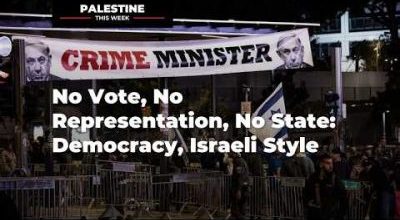
No Vote, No Representation, No State: Democracy, Israeli Style
or go to
Aletho News Archives – Video-Images
From the Archives
Sanctions, War and the Policy of Dual Containment
By SASAN FAYAZMANESH | March 17, 2008
It is now nearly three decades since the Unites States adopted the policy of dual containment of Iran and Iraq. While much has been written about the containment of Iraq, there has been very little in-depth analysis of this policy when it comes to Iran. In a book that is going to be released on March 31, 2008, entitled The United States and Iran: Sanctions, Wars and the Policy of Dual Containment (Routledge), I attempt to address this shortcoming by investigating when and why the US policy of containment of Iran came about, how it evolved, and where it stands today.[1] To the extent that Israel has been involved in US policy making, the study will also include the role that Israel has played in the containment of Iran. Also, since the fate of Iran has been inextricably linked to that of Iraq, occasionally the investigation will overlap with the containment of Iraq.
The policy of dual containment of Iran and Iraq originated during the Carter Administration, but it was not until the Clinton Administration that the expression “dual containment” became popular. … continue
Blog Roll
 Aletho News
- Americans are paying the price to preserve Israel’s nuclear hegemony
- Resistance factions are necessary to ensure a permanent US Iraq withdrawal
- How Israel destabilizes the Middle East: Denying sovereignty and the right to exist
- Europe’s Establishment Is Embracing War – and Losing Voters
- NATO chief advocates war of aggression
- No Vote, No Representation, No State: Democracy, Israeli Style
- Zionist Bought Senate Blocks Information About American Citizens Killed By Israel
- While Gaza dominates the UN, these are the people keeping it alive
- New Report: “Scholasticide and Genocide in Gaza: Assessment, Testimonies and Legal Analysis”
- ‘THAAD Delusion’: Iran war exposes US missile shield limits – The Atlantic
- If Americans Knew
- Eight Palestinians Killed in Israeli Attacks on Gaza
- Israeli former leaders and security chiefs threaten legal action over ‘Jewish terrorism’
- Israel map in LA Times ad includes all land from the river to the sea
- Inside Lebanon’s 200-page dossier on Israeli war crimes
- Flydubai, genocide, settler violence, Trump abuse of power to deport – Daily Update
- Counting Antisemitic Incidents: What the ADL Audit Reveals — and Obscures
- Mamdani releases plan to combat antisemitism and hate crimes in New York City
- Iran’s Revolutionary Guards Publish Letter to the American People
- DMFI launches $1 million ad campaign supporting Virginia’s Elaine Luria
- US Senate blocks resolution seeking report on Americans killed by Israel
- No Tricks Zone
- Green Energy Debacle: German Expert Professor Fritz Vahrenholt Warns Of Severe Economic And Social Consequences
- Two More Paleo Reconstructions Affirm Meters-Higher Sea Levels Across Ireland, Brazil 7000-6000 Years Ago
- New Study: Earth And Venus Surface Warmth Largely Explained By Convection And Lapse Rate, Not CO2 Or Radiation
- 2025 Nature Paper Claiming Worsening Global Drought Gets RETRACTED …Heavily Flawed
- New Study: ‘Global Drought Shows No Detectable Recent Acceleration Under Climate Warming’
- Economic Masterminds: German Socialists Suggest Taxing Productivity Gains Stemming From Using AI
- The South China Sea Has Not Been Cooperating With The Climate Change Narrative
- Energy Crisis: Germany Enters Heating Season With Historically Low Gas Reserve Fill Levels
- New Study: The Antarctic Ice Sheet Gained Mass From 2020-2024 Due To Staggering Snow And Ice Accumulation
- Study: Ocean Heating Rates From Thousands Of Years Ago ‘Dwarf’ Modern Ocean Heating Rates

