ISRAEL GETS DESPERATE: FAKES OSAMA TAPE
Damian Lataan | January 25, 2010
It seems Israel is becoming anxious about the American peoples commitment to Israeli Zionist dreams of creating a Greater Israel. They are so anxious that they have released a tape that they are claiming is the very dead Osama bin Laden threatening the US with acts of terrorism if they continue to support Israel.
This latest tape is the most blatantly transparent piece of nonsense that has ever emanated from the Israelis and their allies and demonstrates how fearful they are of losing the support of the American people and the West generally. The give-away for this particular piece of garbage is the way the Israelis have tried to link the al Qaeda cause to the Palestinian’s cause.
American’s, and indeed, many in the West, are becoming rapidly disillusioned by Israel’s behaviour over the past few years. In particular, since the release of the Goldstone Report that showed Israel’s warcrimes in the Gaza during Operation Cast Lead in which over a thousand Gazans were brutally murdered, people have become alerted to Israeli skulduggery and attempted cover-ups for their crimes. And, in latest developments in the West Bank, people in the West are increasingly becoming aware that the Netanyahu Zionist government has no intention whatsoever of ever allowing a Palestinian state to exist despite all the talk of talks, negotiations, roadmaps, accords, etc. As recently as this last Sunday Netanyahu said that Jewish settlements in the West Bank will remain Israeli.
Israel, by linking the Palestinian cause with Osama bin Laden is attempting to undermine the Palestinians quest for a sovereign state and in the process claim that Israel’s enemies are America’s enemies and that the struggle against ‘terrorism’ intrinsically links Palestinian fighters with al Qaeda and, therefore, the US must continue to support Israel in their fight against the Palestinians seeking their own sovereign state.
Unfortunately for the Israeli Zionists and their supporters in the West, the vast majority of the peoples of the world are unlikely to fall for this nonsense. It is only the extreme right-wing Murdoch style press that are actually pushing this nonsense as a given fact while other more progressive and realistic media sources are feeding the news of bin Laden’s latest messages as ‘purportedly of Osama bin Laden’ or ‘claiming to be from bin Laden’.
Oddly, the Los Angeles Times takes the tack that bin Laden is claiming credit for the Christmas Day bombing plot but then states that US intelligence (and I use the word ‘intelligence’ advisedly) officials have raised doubts about bin Laden’s role in the plot and suggest that it was an “attempt to score propaganda points for a plot already claimed by an increasingly independent faction of his movement in Yemen”.
Bin Laden was allegedly responsible for the most successful terrorist attack ever perpetrated destroying three major buildings and severely damaging the hub of US defence, so, even if bin Laden were alive, why on earth would he put his hand up to admit to the miserable failure of some bloke failing to blow his groin to bits with not much more than a large fire cracker that turned out to be just a damp squib? And where’s the propaganda brownie points in that?
Desperation has truly set in.
Lebanese media warns of ban if US hits out at Hezbollah TV
DPA | January 23, 2010
Beirut – The National Lebanese Council for Audio-Visual Media and the Lebanese Press Association on Saturday urged the United States to reverse a decision to take ‘punitive measures’ against a satellite broadcaster run by the Shiite militant group Hezbollah.
The Council hinted that it will resort to banning from Lebanese airwaves US-networks such as Cable News Network (CNN) and others financed by the US.
Council head Abdel Hadi Mahfouz said that if the US bill against Hezbollah’s al-Manar television was adopted, ‘we as an independent council can cut off transmissions of US-based stations such as CNN and (US-backed Arabic satellite channel) al-Houra by asking cable distributors in Lebanon not to air such channels.’
‘We have expressed our refusal for such a legal measure against al-Manar and other channels which the US has listed as Arab terrorist entities,’ said Mahfouz.
The US House of Representatives passed a bill in December 2009 calling for ‘punitive measures’ against Middle East television networks, including al-Manar, seen to be fueling anti-US sentiment.
The bill was adopted in a decisive 395 to 3 vote against media outlets that broadcast ‘anti-American incitement to violence in the Middle East.’
The networks listed in the bill include Al-Aqsa, the television station of the Islamist Palestinian movement Hamas, which broadcasts from the Gaza Strip, and Hezbollah’s al-Manar.
Hezbollah’s al-Manar broadcasts from Beirut. It was launched in 1991. In 2004 it was banned from broadcasting in the US, France, Spain and Germany.

What Robert Gates Didn’t Say – And The US Media Hides – About Blackwater In Pakistan
Two Pakistani employees of an American defense contractor engaged by the US Embassy in Islamabad have been linked to two attacks on Pakistani military and the assassination of a Brigadier. If this is not alarming, then consider that US Ambassador Anne Patterson’s name has come up in an investigation where thousands of dollars were paid in bribes to Interior Ministry to smuggle illegal weapons into Pakistan. Not to mention how Washington is empowering India in Afghanistan at Pakistan’s cost. When Pakistan takes countermeasures, US officials like Mr. Gates and Mr. Holbrooke accuse Pakistan of ‘anti-Americanism’ and harassing US diplomats. Time for some straight talk.
By AHMED QURAISHI | 23 January 2010
ISLAMABAD, Pakistan—US Defense Secretary Robert Gates admitted during an interview with a Pakistani TV station that Blackwater [now ‘Xe International’] and DynCorp are operating in Pakistan. Immediately after the statement, Pentagon tried to put a spin on his words.
But US meddling inside Pakistan –by posting private US defense contractors under diplomatic cover of the US embassy – is a reality for most Pakistanis. Some of these Americans have been caught disguised as Taliban right in the heart of Islamabad. Some Pakistanis were manhandled by some of these American militiamen on the streets of at least two Pakistani cities in recent months.
Since Pakistan is not Iraq or Afghanistan despite all the US direct and indirect misinformation, these US covert operators were arrested on several occasions.
The mainstream US media continues to keep the good American people and the world opinion in the dark about this. But this is probably one of the biggest untold stories in America’s war on terror. This is about the United States trying to put boots on the ground inside Pakistan through the help of a pro-US government in Islamabad that shares [or at least key figures in it] the US objective of containing and limiting the ability of Pakistan’s military to influence the country’s foreign policy. This is about Pakistan wanting to keep an independent foreign policy versus Pakistan blindly serving US policy on Afghanistan, India and China.
Mr. Gates tried to put a gloss on this US covert meddling when he said, ‘Well, they’re [Blackwater and DynCorp] operating as individual companies here in Pakistan, in Afghanistan and in Iraq.’
Not true. The truth is that the issue is so serious that, according to Pakistani investigators, US Ambassador to Pakistan Anne W. Patterson is a suspect in a case of bribes amounting to little over US $ 270,000 paid by DynCorp in 2009 to senior officials at the federal Interior Ministry in Pakistan. The money went in exchange for allowing illegal weapons into Pakistan to be used by private US defense contractors without informing the country’s security departments and intelligence agencies. Ms. Patterson personally lobbied Pakistani officials for this concession to DynCorp. She even wrote a letter to Pakistani officials, followed by a letter by her Deputy Head of Mission Mr. Gerald Feierstein, asking Pakistani Interior Ministry officials to issue permits for weapons to be used by DynCorp in the ‘entire territory of Pakistan.’ The US ambassador is directly linked to the probe, which has resulted in the arrest of a key aide to Pakistan’s Minister of State for the Interior. But the government of President Zardari will not dare allow Pakistani investigators to pursue the US Ambassador’s role in the scandal. A key question in the probe is how the US Embassy and DynCorp allowed the cargo of illegal weapons into Pakistan. According to one lead, a huge cache of weapons reached a Pakistani tribal leader on Pakistan’s border with Afghanistan, who in turn wrote to the Interior Ministry announcing he was ‘gifting’ the weapons to a Pakistani subcontractor of DynCorp.
Incidents like this and others raised alarm bells inside Pakistani security departments and the intelligence community. In effect, key figures in President Zardari’s government were found to have given approval for the entry of a large number of US citizens into Pakistan for ‘official US government business’ without explaining what that is. When Pakistani authorities tried to get to the bottom of how private US defense contractors ended up inside Pakistan in large numbers and what they were exactly doing here, US officials and media launched what appears to be a media trial of Pakistan, accusing the country of ‘harassing’ US diplomats and denying visas to them because of alleged anti-Americanism.
The unwillingness of the Zardari government to confront Washington and Pakistan’s generally weak media outreach skills allowed Washington to paint this as a case of anti-Americanism fueled by war on terror.
‘Conspiracy theories’ is another label that US officials and media have increasingly used recently as a cover to hide serious violations of diplomatic norms and sovereignty involving undercover private US operatives inside Pakistan.
This is how the Wall Street Journal tried to delegitimize serious Pakistani concerns raised during Mr. Gates’ visit in a report filed from Islamabad whose opening line read as follows, “U.S. Defense Secretary Robert Gates is overseeing wars with Sunni militants in Iraq and Taliban fighters in Afghanistan. In Pakistan, he’s facing a different foe: the pervasive conspiracy theories that fuel widespread anti-American feelings here.”
The truth is that there are no conspiracy theories but real events, reported and documented, that raise questions over US political, diplomtic, and covert meddling inside Pakistan. Here is a list:
1. NUCLEAR ESPIONAGE: In July 2009, four US ‘diplomats’ were arrested inside the maximum security perimeter around Pakistan’s premier nuclear facility at Kahuta. They failed to tell Pakistani investigators what they were doing there and how they managed to slip through the security checkpoints in the area. US Embassy intervened to rescue the four ‘diplomats’ after almost three hours in detention, citing diplomatic immunity. President Zardari’s government refused to let Pakistani security authorities press charges.
2. SUSPICIOUS CONDUCT: On Oct. 6, 2009, Pakistani police arrested two Dutch diplomats roaming the streets of Islamabad without a number plate carrying advanced weapons. Pakistani police were surprised when security personnel from the US Embassy reached the scene to rescue the Dutch. The Americans used their contacts within the Zardari government to get everyone released. Later, Pakistan Foreign Office summoned US and Dutch diplomats for a private meeting over the incident. But the Pakistani government refused to demand a public explanation from US and Dutch diplomats despite recommendations from police and security officials.
3. FACILITATING INDIAN ACTIVITIES: In this high profile case in May 2009, a US diplomat arranged a small meeting between an Indian diplomat and several senior Pakistani federal government officials at a private house. The invited Pakistanis worked in civilian positions, including one with access to Prime Minister’s Office. It appeared that the US diplomat was basically facilitating the Indian to meet senior officials who otherwise would be inaccessible for him. Pakistan Foreign Office took serious exception to the meeting, publicly reprimanded the Pakistani officials who attended the meeting but stopped short of seeking explanation from the US embassy. According to Pakistani investigators, for a US diplomat to indulge in facilitating possible espionage linked to an Indian diplomat was a matter of grave concern. It also fit with the US policy of exercising tremendous pressure on the pro-US government in Islamabad to give concessions to India at the expense of Pakistani strategic interests.
4. COVERT US MILITIAS IN THE HEART OF PAKISTAN: In September 2009, undercover US agents were found to have recruited a total of 100 former elite Pakistani military commandos to create rapid-intervention teams for unknown purposes. A hundred more were under training at a secret facility camouflaged as a workshop on the outskirts of the Pakistani capital when it was raided by Pakistani police. It turned out that DynCorp was training the men. US Ambassador Anne W. Patterson brought DynCorp to Pakistan by telling Pakistani officials that the private defense contractor would provide security to embassy buildings. But she never explained why DynCorp was secretly raising private militias on Pakistani soil without informing the Pakistani government or military or the intelligence agencies. Some of those who were under training at the time of the raid said that DynCorp focused on recruiting retired officers who had links and contacts within the Pakistani military and could glean information from their sources. [See video and pictures]
5. PUSHY US DIPLOMATS: The US Embassy in Islamabad has made it its business to mount pressure on owners of Pakistani newspapers to curtail or expel columnists and commentators critical of US policy. Specially targeted are those who expose how the US Embassy is meddling in Pakistani affairs and expanding the US footprint inside Pakistan. Last year, Ambassador Patterson sent a letter to one of the largest Pakistani media groups accusing a columnist of endangering American lives and succeeded in pushing her out. The US Embassy is also recruiting opinion makers within the Pakistani media, academia and military in order to promote the US agenda even at the cost of Pakistani interests, dismissing critics as ‘conspiracy theorists’ and accusing them of anti-Americanism. A senior Pakistani journalist Syed Talat Hussain exposed US activities in the following words,
“Pro-American lobby in Pakistan is growing in direct proportion to the scaling up of suspicions about the US. The main task of this lobby is to reduce the complexity of the US’s objectives towards Pakistan to romantic levels of trust (…) A motley crew of former diplomats, retired generals, socialites, slick civil society begums, self-styled analysts, businessmen, journalists, and now also lawyers — they are the darlings of the US embassy staff. They are the instruments of positive outreach and public diplomacy that US diplomats are so keen to expand in Pakistan.”
6. HARASSING PAKISTANIS: Private US security contractors, or militiamen, have been involved in at least three incidents registered by the Pakistani police where armed Americans physically assaulted unarmed ordinary Pakistanis in public places. In one case, the nephew of a senior member of President Zardari’s own government was manhandled and locked up in the toilet of a gas station by men described as armed military-looking civilian Americans.
7. RESISTING POLICE CHECKS: In at least five incidents, US ‘diplomats’ disguised as Taliban, complete with beards and Pashto language skills, were stopped at several police checkpoints in Islamabad and Peshawar. In some cases, these American ‘diplomats’ tried to speed through police barriers. In one recent case, this resulted in a brief police chase, where a Pakistani officer dragged the US ‘diplomats’ back to the police picket and forced the Americans to apologize to Pakistani police officers. Again, no charges were pressed because these private US agents carried diplomatic passports.
8. ENGINEERING DOMESTIC POLITICS: As recently as December 2009, US ambassador in Islamabad was found meeting senior Pakistani politicians at private homes of mutual friends in unannounced meetings restricted to 3 to 4 persons. The ambassador asked her guests to publicly support the embattled pro-US President Zardari. US diplomats in Islamabad and officials in Washington have been blatantly interfering in Pakistani politics. In addition to helping form the incumbent coalition government in Islamabad, made up of pro-US parties, US officials have been busy trying to save both Mr. Zardari and his key political adviser and ambassador to Washington Husain Haqqani. US officials in Washington have been briefing sympathetic US journalists about this. In one case, columnist Trudy Rubin had this to say while discussing Pakistan in an article published last month:
“Here is the first piece of good news: Pakistani President Asif Ali Zardari seems to have weathered a campaign by opponents, including the military, to force him out of office. Zardari has deep flaws, but his ouster would have hampered efforts to fight the jihadis. So would the removal, now averted, of Pakistan’s effective ambassador to Washington, Husain Haqqani, whom the Pakistani military had unfairly blamed for conditions that Congress imposed on aid to Pakistan.”
9. BRIBES AND ILLEGAL WEAPONS: This case is stunning because of the direct involvement of US Ambassador Anne W. Patterson in lobbying for DynCorp. The company ended up bribing Interior Ministry officials to smuggle banned weapons into Pakistan and then went on to raise private militias and hire retired Pakistani military officers to run rapid deployment teams and possibly even spy on the Pakistani military.
10. DEMONIZATION OF PAKISTAN: Since 2007, US officials and US media has systematically demonized Pakistan worldwide, creating false alarm over Pakistan’s strategic arsenal. US officials and media have also pushed to bracket Pakistan along with Iraq and Afghanistan in order to justify a possible military intervention. When Pakistan resisted US meddling recently, the US media again went on rampage, accusing Pakistan of ‘anti-Americanism’ and harassment of US diplomats. Additionally, there has been a marked increase of lectures and studies by US think-tanks inviting unknown separatist individuals and groups to speak and fan ethnic separatism inside Pakistan and theorize on the breakup of the country.
11. ABETTING TERROR INSIDE PAKISTAN: The suspicions about why DynCorp was secretly raising private militias inside the federal Pakistani capital almost turned real when a suspect in the attack on the Pakistani military headquarters in October 2009 was allegedly found to have been recruited by DynCorp. In a second case, another suspected DynCorp recruit was found involved in assassinating a senior Pakistani military officer as he drove to work. In other words, two Pakistani employees of a US defense contractor engaged by the US embassy have been linked to two terrorist attacks on the Pakistani military. Add to this that Pakistan’s military and intelligence are a favorite punching bag for the United States and its allies, like India and Britain, and the picture of what the US is doing in Pakistan becomes even more disturbing.
These points explain how ill-motivated the US complaints about delaying visas and alleged anti-Americanism in Pakistan are. This is what US Secretary of State Hillary Clinton, Mr. Holbrooke and Mr. Gates are loath to share with the American people and the world public opinion.
© 2007-2009. All rights reserved. AhmedQuraishi.com & PakNationalists
Verbatim copying and distribution of this entire article is permitted in any medium without royalty provided this notice is preserved.
Zionism’s destabilizing force: “Israeli Exceptionalism” reviewed
Ahmed Moor, The Electronic Intifada, 20 January 2010
 |
In his new book Israeli Exceptionalism: The Destabilizing Logic of Zionism, M. Shahid Alam successfully argues that the moral force behind the Zionist movement is a sense of Jewish, and consequently Israeli, exceptionalism. This claim of exceptionalism underpins what he calls the “destabilizing logic of Zionism.” According to Alam, Zionism “could advance only by creating and promoting conflicts between the West and the Islamicate” (p. 3). He defines the “Islamicate” as consisting of the broader Muslim world, with the Middle East at its heart.
Alam, a professor of economics at Boston’s Northeastern University, begins his book by detailing the core problem that confronted the nascent Zionist movement: the creation of a Jewish nation from disparate and scattered Jewish communities. Zionists set out to solve this problem by creating a myth of exceptionalism that could be embraced by Jews around the globe. These myths were steeped in a combination of religious mythology and ethnic nationalist exclusivism that presented the Jews as the “chosen people” (p. 9) and Palestine as their sole and God-given birthright.
These claims were expanded upon during the British mandate of Palestine and after the founding of the State of Israel. Zionists asserted that the Jewish “liberation” movement was different from other liberation movements because “the long history of Jewish suffering, the Jewish ability to outlive their enemies, their signal contributions to human civilization, and their spectacular victories against Arab armies” demonstrated the purity of their cause and their exceptionalism (p. 5). Finally, they argued that Israel was a singular case because it was surrounded and threatened by hostile and murderous Arab states and masses. Through these arguments, Alam asserts, Zionists cultivated an environment that overlooks and in some cases endorses their movement’s human rights abuses and racist policies.
In the second segment of the book, Alam examines the history of the region, reviewing the violent history of the early Zionist colonists and describing it as a core, rather than incidental, program of Zionism. Violent, racist attitudes towards the Arabs generally and the Palestinians specifically had to be nurtured by those who would make Palestine the Jewish homeland. They acted as intermediaries between the “West” and the “Islamicate” insofar as they were of the former and claimed to understand the latter. To galvanize Western support for Israel, it was vital for Zionists to create a myth of Muslim-Christian antipathy. Alam paraphrases the perceptions caused by the myth: “[I]f the Islamists vent their anger at the United States, it is not because of its policies, but because it is Christian” (p. 42). Naturally then, a Jewish state in Palestine could act both as a buffer against Muslim masses, and a projection of Western power and interests. This is the argument presented by some Zionists.
It wasn’t enough to argue that the Arabs were uncivil to gain their land. Zionists also had to align themselves with anti-Semitic elements in Europe to advance their goals. Alam writes, “In the 1930s, the Nazis banned all Jewish organizations except those with Zionist aims; they even allowed the Zionists to fly their blue-and-white flag with the Star of David at its center. In violation of the Jewish boycott of the Nazi economy, the Zionists promised cash and trade concessions to Nazi Germany if they directed Jewish emigrants to Palestine” (p. 123). This was necessary to promote Jewish emigration to Palestine. The reality was, and continues to be today, that when Jewish people from Eastern Europe are given the choice, many will choose to emigrate to Western Europe and the US before Israel.
Through these means, Zionists gained the support of a variety of surrogate mother countries across the decades. Anti-Semitism, anti-Arabism and anti-Islamism, and Jewish influence all came together to persuade the Soviet Union, France, Great Britain and of course, the United States to support Zionism.
Israeli Exceptionalism also sheds light on British, and later, American evangelical support for Zionism. Evangelical Zionists, broadly termed Christian Zionists, came into being as a result of the Great Reformation. Catholics believe that God nullified his covenant with the Jews when they rejected Jesus Christ. But when Protestants overthrew the authority of the Catholic Church, they sought to differentiate themselves by reinstating God’s covenant with the Jews and recognizing “the Jews as God’s chosen people with eternal rights to Palestine” (p. 130). Although created by Jewish Americans, the American Palestine Committee (APC) was intended to marshal Christian support for the Jewish occupation of Palestine. By 1941, the APC’s membership included “70 US senators, 120 congressmen, the Attorney General, the Secretary of Interior, 21 state governors” and other prominent individuals (p. 134). Reinhold Niebuhr and other leading Christian Zionists later created the Christian Council on Palestine to influence fellow clergymen.
Alam argues convincingly that Zionism itself is destabilizing, and the force that sustains it — tension between the West and Islamic societies — is a deliberate, not incidental, feature of Zionism. Israeli Exceptionalism manages to provide a fresh view to a vast library of literature on Zionism by dispelling the myth of Jewish disempowerment and highlighting the role of anti-Semitism and anti-Islamic sentiment inherent in Israel’s establishment. His discussion of Reformation theology is also crucial to understanding the long-standing support for a “Jewish Palestine” in American civil life, even before the founding of Israel. Alam’s straightforward and accessible discussion of the world’s last “exclusive settler colony” makes Israeli Exceptionalism an important addition to the scholarship on Israel-Palestine.
Born in the Rafah refugee camp in the Gaza Strip, Ahmed Moor graduated from university in Philadelphia, after which he spent three years working in finance in New York. He is currently based in Beirut, Lebanon.
Israeli hand in Iraq’s Abu Ghraib exposed
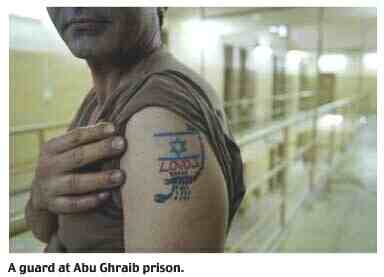
Press TV – January 20, 2010
The former American military chief of the notorious Abu Ghraib prison in Iraq reiterates the Israeli involvement in the US-run facility, where hundreds of Iraqi suspects were tortured and sexually abused by US soldiers and interrogators.
Shedding further light on the scandal that has served as a controversy-magnet for Washington ever since its emergence in 2004, the retired US army colonel Janis Karpinski says that Israeli agents were recruited by the US military at Abu Ghraib to interrogate the prisoners suspected of attacking US forces in Iraq.
The report by the Lebanese newspaper Al-Akhbar is set to fuel more debate on the matter as Karpinski had, until recently, refused to expound on the Israeli connection at Abu Ghraib despite admitting earlier to the presence of Israeli interrogators in the US-run compound.
The former high-ranking US military officer in Iraq told the British state broadcaster, the BBC, in 2004 that she had met an Israeli interrogator who was working at a secret facility in Baghdad.
The prominent American investigative journalist Seymour Hersh brought the issue out in the open on May 10, 2004, when he published the article, “Torture at Abu Ghraib,” in The New Yorker Magazine. The article served to ignite the outpouring of reports and evidences on the alleged “abuse, torture, sodomy and homicide” conducted at the facility by US military and intelligence officers.
In May of last year, more pictures of such abuses leaked out and hit the media networks showing the indiscriminate sexual orientation of American soldiers and operatives, who were shown carnally violating male and female Iraqis alike and assaulting them with nightsticks, wires and phosphorescent tubes.
Following his explosive account on the Abu Ghraib abuses, Hersh asserted that one of the Israeli pursuits in the US-run prison was to gain access to the detained members of the Iraqi secret intelligence unit that specialized in Israeli affairs.
Israel has been widely criticized by international human rights organizations for the torture and abuse of Palestinian prisoners, including women and children, during interrogations and in prison cells.
US President Barak Obama has ‘strongly’ opposed the release of more photos and imagery of the Abu Ghraib abuses by American soldiers, despite promises to the contrary when he was first elected. Obama later argued that releasing the scandalous photos, labeled classified by the Bush Administration, would inflame “the theaters of war,” jeopardize US forces, and make the life of troops based in Iraq and Afghanistan “more difficult.”
Israeli army crosses into Lebanon/Four Israeli jets seen over Lebanon
Xinhua | January 18, 2010
An Israeli army unit on Sunday crossed the borders with Lebanon in the direction of the occupied part of al-Ghajar village, Lebanon’s state-run National News Agency (NNA) reported.
“An intense Israeli build-up of forces during the past 24 hours has been observed along the eastern sector of the Blue Line, with mobile and fixed patrols,” said NNA.
It added that “Israeli tank emplacements were spotted amid intense overflights by helicopter gunships and warplanes.”
“Earlier, an Israeli mechanized infantry unit comprised of two Hummers crossed the UN-designated Blue Line for 300 meters in the direction of the occupied part of al-Ghajar village,” said NNA.
On the Lebanese side, UN Interim Force in Lebanon (UNIFIL) and Lebanese army personnel intensified patrolling activities.
The Blue Line, which is the line for Israeli withdrawal from south Lebanon in 2000, now serves as the borderline of the two countries and runs through the middle of the al-Ghajar village.
Lebanon accuses Israel of intruding its airspace on a daily basis, saying it is a violation of UN Security Council Resolution 1701. The resolution put an end to the 2006 war between Israel and Lebanese Shiite armed group Hezbollah, and mandates peacekeepers to monitor the armistice along the border.
Also:

BEIRUT, Jan 17 (KUNA) — Four Israeli fighter jets were seen flying over Lebanese airspace in violation of the Lebanese sovereignty and UN resolution 1701, a Lebanese statement said on Sunday.
The fighters were seen over a town south of Lebanon located close to the border with Israel, according to a statement by the Lebanese armed forces. The jets made a circular movement over several towns before heading back over the sea.
The statement added that Israeli fighters have been witnessed over Lebanese territory on a virtually daily basis for a few weeks lately, and this is considered a breach of the UN Security Council resolution 1701.
The UN Interim Forces in Lebanon (UNIFIL) have voiced concern over the matter on a number of occasions, criticizing the Israeli breaches on Lebanese sovereignty, and sending letters of complaint to the UN and Israeli army command.
Israel to station German nuclear submarine in Persian Gulf
Press TV – January 18, 2010
Ahead of an Israeli-German cabinet meeting in Berlin, median reports indicate that Israel intends to station one of its German-made Dolphin submarines in the waters of the Persian Gulf.
“Israel’s use of the dolphin submarine in exercises in the red sea aroused fears that Israel may seek to maintain a continued presence in the Persian Gulf as soon as it receives its submarines form Germany in 2011-2012,” the tagesspiegel said on Sunday.
The meeting, delayed in November due to Israeli Prime Minister Benjamin Netanyahu’s illness, is expected to focus on Israel’s push to buy a sixth Dolphin-class nuclear submarine from the Germans.
During the day-long trip by the centre-right government, Netanyahu seeks to expand Tel Aviv’s submarine fleet.
Israel has previously received three submarines as a donation form the government of the then German chancellor Gerhard Schroeder.
The German newspaper Berliner Zeitung in 2003 revealed that Germany`s leading shipyard company Howaldtswerke-Deutsche Werft was involved in negotiations with Israel to construct two additional Dolphin submarines.
The company confirmed the reports adding the German government had approved them. Days later the German Focus magazine reported that Tel Aviv will not be receiving the submarines as the German government had decided to halt the delivery of the two submarines to Israel.
The Dolphin submarines are among the most sophisticated and capable submarines in the world, that could be equipped with nuclear missiles. Built in German shipyards for the Israel Navy, the submarine is capable of carrying American-supplied Harpoon cruise missiles equipped with nuclear warheads.
This is while political groups opposed to Israel’s “occupation, settler and war politics” have announced plans to demonstrate near the Federal Chancellor’s Officer.
“Why is a joint cabinet session taking place with a racist, fascist, Zionist ideology?” one of the groups asked in its announcement.
After the United States, Germany is the principal donor of both economic and military aid to Israel. While restrictive German export regulations bar the sale of weapons to crisis areas, the German government has justified its actions by describing the move as “special responsibility” towards Tel Aviv.
Behind The Der Spiegel Tirades
Political Theatrics | January 17, 2010
At the beginning of the new year, German weekly magazine Der Spiegel ran a controversial report claiming that the Lebanese movement Hezbollah was involved in drug trafficking to finance its “terrorist operations against Israel”. The article proceeded to allege that individuals involved in the cartel had contacts with the central nexus of the resistance movement including its Secretary-General. Needless to state, no factual evidence was cited in support of the claims as in the case of a growing list of previous smear-campaigns.
In his widely acclaimed book, ‘Resistance is the Essence of the Islamist Revolution’, director of Conflicts Forum, Alastair Crooke, argues that the West not only suffers from a “blind spot” when it comes to comprehending ‘political Islam’, but that it regularly employs an historically potent association of Islam with violence to drive in a perception of “reason capsized into madness” when depicting present-day resistance groups. As such, these groups come to symbolise everything that an idealised West isn’t; a big-toothed bogeyman of sorts. The recent allegations made by Der Spiegel touch on these historical stereotypes, and in tune with age-old precedent, they aim to influence policy patterns in one form or another.
Before examining potential policy implications, a brief survey of Der Spiegel’s coverage of Hezbollah over recent years is instructive:
“Again and again [Nasrallah] seeks to provoke: No mention is made without any incitement against Jews.” (18.08.2006); “Hezbollah’s high-tech weapons endanger Germany Navy” (15.09.2006); “Hezbollah is not Suppenküche! It is a war party that wants to destroy Israel!” (23.03.2007); “Israel must adjust to a new wave of terrorist attacks against “Jewish targets” overseas … Hezbollah [has] activated its “sleeper” cells.” (21.07.2008), et al.
These brief snippets do not even begin to take into account the derogatory imagery – bordering on outright racist – resorted to when portraying supporters of Hezbollah. If you’re on planet Der Spiegel, these individuals are nonsensical maniacs with “crooked teeth” whose sole aptitude is sloganeering, whereas their fellow Lebanese are cultured beings whose women don “Fendi handbag[s]”.
To suggest the description ‘asinine’ fits well with this variety of journalism, far from sounding harsh, it would seem more like an understatement.
In the run-up to the June 2009 elections in Lebanon, Der Spiegel put together its most daring attack to-date against the Lebanese movement by linking it to the assassination of former PM Rafik Hariri. Less than two weeks from ballot day, the German magazine’s blinding front-page headline: “Breakthrough in Tribunal Investigation: New Evidence Points to Hezbollah in Hariri Murder”, had unmistakably clear motives. Despite the rapturous outburst, Der Spiegel was unbecomingly silent after the elections; the breakthrough that was glowingly pitched mere days earlier as an outcome of “serendipity à la Sherlock Holmes and the state-of-the-art technology used by cyber detectives” was deemed unworthy of further commentary. The story had satisfied its use.
Moving on to present, the timing for the explosive drug-cartel exposé is likewise edifying. In the US, the “Israel Lobby’s War on Al Manar TV” reflects a re-energised penchant on Capitol Hill to plaster the Lebanese movement with the dreaded “T” word. [1]
As with most, if not all, matters of relevance to the Middle East, one can trace the causes for Washington’s disposition to the not too distant Tel Aviv. The comments of Israeli Defense Minister, Ehud Barak, over the past week have heightened the possibility of a new war against Gaza, and increased the likelihood of another “July War” against Lebanon. Whilst the editors at Ha’aretz are making no secrets of an open-inclination towards an inevitable war path, their suggestion that the Israeli political-military complex calculates war decisions on the basis of whether and when all its citizens feasibly possess gas masks is rather inane, amongst other things. All in all, the prospect of war looms large over the Middle East with Hobbes’ caveat ringing loud and clear, “the nature of war, consisteth not in actual fighting; but in the known disposition thereto”. Within this context, smear-campaigns and fear-mongering have obvious ends in mind.
Far more importantly, however, Der Spiegel’s smear-campaign against Hezbollah is aimed at policy circles within the EU. Over recent months, there has been growing momentum to adopt “dialogue” as the preferred paradigm in coming to grips with resistance movements in the Middle East. Organisations that have consistently stressed the importance of mutual dialogue, such as the Conflicts Forum, will have been encouraged, no doubt, by the positive steps taken during 2009 to shift away from a “failed” policy. [2]
Of the more notable exchanges, former British Cabinet member MP Clare Short visited Damascus to hold talks with Khaled Meshal, as part of a small delegation of MPs after which she underlined the need to “talk to Hamas”. Later in the same month, MP Hussein Hajj Hassan from the Loyalty to the Resistance party affiliated to Hezbollah visited Britain to take part in a symposium dealing with issues concerning the Middle East. Three months later in June, EU foreign policy chief Javier Solana met with Hajj Hassan in Beirut, marking the first time a senior EU diplomat held talks with the political party.
The end of 2009 saw further drama for Israel. Towards the close of its rotating EU presidency role, Sweden proposed a resolution to recognize East Jerusalem as the capital of Palestine. By this time, Tel Aviv had simply seen enough. Pro-Israeli lobby groups and EU allies (primarily France and Germany) frantically pushed their weight around, and heavily watered down the draft resolution which eventually called for Jerusalem as “the future capital of the two states”. [3]
Meanwhile, Israel’s foreign ministry, which has unsurprisingly shed all considerations for diplomatic courtesy under Avigdor Lieberman, lashed out at Sweden for putting forward the resolution. “The peace process in the Middle East is not like IKEA furniture,” remarked a foreign ministry official, in reference to the Swedish furniture chain. “It takes more than a screw and a hammer, it takes a true understanding of the constraints and sensitivities of both sides, and in that Sweden failed miserably”, he sarcastically went on to add.
Israel’s take on the happenings in Brussels – putting aside the childish rattle – was manifestly clear. The obvious lesson to be derived from 2009 for Tel Aviv, as far as EU involvement in the Middle East is concerned, was similarly evident.
One must underline at this point that despite consistent pressures exerted by Israel and co., the positions adopted by a growing number of EU parliamentarians vis-à-vis the Arab-Israeli conflict has been very honourable. Earlier on Friday, a 60-member strong delegation made their way into Gaza to assess the wide-scale damage caused by Israel’s brutal war last year, as part of a bid to mount pressure for an end to the Siege.
For Israel, this sort of involvement is clearly not welcome. And hence, the appearance of baseless slander and smear-campaigns in leading European media outlets, which aim to cast resistance movements as erratic, lawless, mafia-like entities whose “sleeper cells” and “networks” pervade across the heart of Europe. Der Spiegel’s recent claims, apart from being the usual, old vituperations, should rather be viewed in the context of a wider agenda to curtail dialogue between resistance movements and western officials.
Evidently thus, there are certain stakeholders who wish to see the EU mutate into some variant of a collectivised imbecile, which keeps a measured silence on all subjects whose implicit or explicit implications reach Israeli shores. Der Spiegel’s recent tirades have set the new strategy in motion. However, if the most recent words from Gaza are any indication, Israel will need to try much, much harder.
Notes:
1. “The Israel Lobby’s War on Al Manar TV”, The Palestine Chronicle, 03 January 2010 http://palestinechronicle.com/view_article_details.php?id=15659
2. “Language – a tool to transform different into dangerous”, Conflicts Forum, 02 February 2008 http://conflictsforum.org/2008/language-a-tool-to-transform-different-into-dangerous/
3. “Jewish settlers: We’ll burn you all!”, ChamPress, 26 December 2009 http://www.champress.net/index.php?q=en/Article/view/50833
Turkish FM: We oppose Iran sanctions
Press TV – January 14, 2010 07:17:58 GMT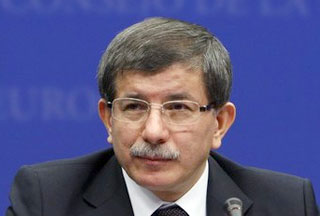
Turkish Foreign Minister Ahmet Davutoglu says Ankara is against imposing further sanctions on Iran over the country’s nuclear program.
“Every country has the right to pursue nuclear power for peaceful purposes,” Davutoglu told the Guardian newspaper during his recent visit to London.
“We also don’t want more sanctions [on Iran]. Sanctions hurt ordinary people and neighboring countries,” he added, repeating a former Turkish offer to mediate negotiations between Tehran and the West.
The Turkish Foreign Minister stressed that the current standoff could only be overcome through diplomatic efforts.
“We don’t forget the very bad experience in Iraq. We would advise intensified negotiations through diplomacy. An absence of mutual trust is the problem,” he said.
Davutoglu reiterated that Turkey was against any kind of nuclear proliferation in the Middle East, whether in Iran, Israel or anywhere else.
Israel, the US and their European allies claim that Iran is pursuing a nuclear weapon. This is while the International Atomic Energy Agency (IAEA) reports and US National Intelligence Estimates issued so far point to the contrary.
Although the published reports by the UN nuclear watchdog and the main American intelligence authority confirm Iran’s stance that it does not have a military nuclear program, Washington and Tel Aviv have not backed down from their stance.
While Iran is a signatory to the nuclear Non-Proliferation Treaty (NPT), Israel remains one of the only three regimes in the world that has not signed the international pact.
Tehran has repeatedly called for the removal of all weapons of mass destruction from across the globe.
Israel, however, is the Middle East’s sole nuclear-armed power with a stockpile that is reported to include over 200 ready-to-launch atomic warheads.
Meritocracy and Jewish kinship networks
By Philip Weiss | January 13, 2010
A lot of people are talking about David Brooks’s distastefully-smug column in the Times yesterday about Jewish achievement, in which he says that we are 2 percent of the U.S. population and 25 percent of this and that. And that we get all the patents in the Middle East while the Arabs smoke hookahs.
He asks how this can be, and talks about our incredible culture. I agree: it’s a helluva bookish culture. Though that same intellectual culture is going out the window now that the chief occupation of Jewish leadership is saying, Repeat after us, apartheid is democracy.
But I’d like to inject a realistic note here. How much of Jewish achievement reflects the fact that Jews look out for one another? When I had to get a partner on this website to keep it going, I was most comfortable getting another Jew. Years ago when I was at the Harvard Crimson newspaper, my Irish-Catholic friend Mary Ridge informed me that it was a “Jewish club”–we selected for our own kind; and the Crimson produced a lot of professional journalism talent. I have gotten most of my journalism work from Jewish bosses.
Jews have kinship networks as strong as other people’s, maybe more strong. All that Hollywood talent– producers are always aware of who is a Jew, and I am sure they feel more comfortable hiring Jews. Landsman. My parents liked the idea of my marrying a Jew because Jews are gemutlich, as my mom always says– family, kin. We know all the social cues, can finish one another’s sentences, etc.
And look at the New York Times, where Brooks works. Is it an expression of Jewish genius that most of the political columnists are Jewish? Tom Friedman, Nick Kristof, Paul Krugman, Frank Rich, David Brooks et al. Or does it maybe reflect the fact that a Jewish family has majority ownership of the newspaper and that most of the big editors have been Jewish and at some level, unconscious or otherwise, they favor Jews?
So I think some of the amazing record of Jewish achievement reflects discrimination; and Jews are powerful enough in this society that we ought to be conscious of that. Brooks has often praised the late sociologist E. Digby Baltzell, and Baltzell said as much about the last establishment; he said that WASPs favor other WASPs, and that it was hurting the American establishment.
I venture that the same thing is happening today in the Jewish portion of the establishment. We discriminate in favor of our own; and it’s doing a number on foreign policy.
What should be done about this? Jews in powerful positions should be aware of this, and seek greater diversity in their hiring.
Featured Video
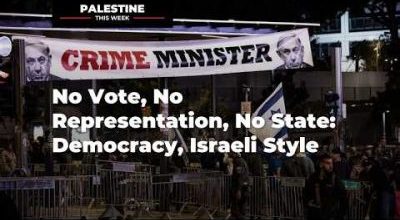
No Vote, No Representation, No State: Democracy, Israeli Style
or go to
Aletho News Archives – Video-Images
From the Archives
Sanctions, War and the Policy of Dual Containment
By SASAN FAYAZMANESH | March 17, 2008
It is now nearly three decades since the Unites States adopted the policy of dual containment of Iran and Iraq. While much has been written about the containment of Iraq, there has been very little in-depth analysis of this policy when it comes to Iran. In a book that is going to be released on March 31, 2008, entitled The United States and Iran: Sanctions, Wars and the Policy of Dual Containment (Routledge), I attempt to address this shortcoming by investigating when and why the US policy of containment of Iran came about, how it evolved, and where it stands today.[1] To the extent that Israel has been involved in US policy making, the study will also include the role that Israel has played in the containment of Iran. Also, since the fate of Iran has been inextricably linked to that of Iraq, occasionally the investigation will overlap with the containment of Iraq.
The policy of dual containment of Iran and Iraq originated during the Carter Administration, but it was not until the Clinton Administration that the expression “dual containment” became popular. … continue
Blog Roll
 Aletho News
- Americans are paying the price to preserve Israel’s nuclear hegemony
- Resistance factions are necessary to ensure a permanent US Iraq withdrawal
- How Israel destabilizes the Middle East: Denying sovereignty and the right to exist
- Europe’s Establishment Is Embracing War – and Losing Voters
- NATO chief advocates war of aggression
- No Vote, No Representation, No State: Democracy, Israeli Style
- Zionist Bought Senate Blocks Information About American Citizens Killed By Israel
- While Gaza dominates the UN, these are the people keeping it alive
- New Report: “Scholasticide and Genocide in Gaza: Assessment, Testimonies and Legal Analysis”
- ‘THAAD Delusion’: Iran war exposes US missile shield limits – The Atlantic
- If Americans Knew
- Israeli former leaders and security chiefs threaten legal action over ‘Jewish terrorism’
- Israel map in LA Times ad includes all land from the river to the sea
- Inside Lebanon’s 200-page dossier on Israeli war crimes
- Flydubai, genocide, settler violence, Trump abuse of power to deport – Daily Update
- Counting Antisemitic Incidents: What the ADL Audit Reveals — and Obscures
- Mamdani releases plan to combat antisemitism and hate crimes in New York City
- Iran’s Revolutionary Guards Publish Letter to the American People
- DMFI launches $1 million ad campaign supporting Virginia’s Elaine Luria
- US Senate blocks resolution seeking report on Americans killed by Israel
- Israeli Attacks Kill Ten Palestinians in Gaza
- No Tricks Zone
- Green Energy Debacle: German Expert Professor Fritz Vahrenholt Warns Of Severe Economic And Social Consequences
- Two More Paleo Reconstructions Affirm Meters-Higher Sea Levels Across Ireland, Brazil 7000-6000 Years Ago
- New Study: Earth And Venus Surface Warmth Largely Explained By Convection And Lapse Rate, Not CO2 Or Radiation
- 2025 Nature Paper Claiming Worsening Global Drought Gets RETRACTED …Heavily Flawed
- New Study: ‘Global Drought Shows No Detectable Recent Acceleration Under Climate Warming’
- Economic Masterminds: German Socialists Suggest Taxing Productivity Gains Stemming From Using AI
- The South China Sea Has Not Been Cooperating With The Climate Change Narrative
- Energy Crisis: Germany Enters Heating Season With Historically Low Gas Reserve Fill Levels
- New Study: The Antarctic Ice Sheet Gained Mass From 2020-2024 Due To Staggering Snow And Ice Accumulation
- Study: Ocean Heating Rates From Thousands Of Years Ago ‘Dwarf’ Modern Ocean Heating Rates

