Trump’s Retreat: How Al-Aqsa Flood Took Down the US Empire
By Kevin Barrett | October 12, 2026
On October 7, 2026, a front-page New York Times headline vaunted “Trump’s Retreat.” It wasn’t referring to Mar-a-Lago or Epstein Island.
The full headline, complete with subhead, reads:
“Trump’s Retreat: From the Gulf to Britain, American Forces Pull Back. A war that was intended to demonstrate the reach of American power has now done the opposite. It is a lesson in unintended consequences.”
The “war that was intended to demonstration the reach of American power” was, of course, Trump’s ill-fated attack on Iran that began last February 28. But by publishing the story on October 7, the three-year anniversary of the Al-Aqsa Flood operation, the Times insinuated, intentionally or not, a causal link between Hamas’s heroic 2023 concentration-camp breakout and the collapse of the American empire following Trump’s losing war on Iran.
What the Times did not come right out and say, of course, is that the US has bled itself dry fighting losing wars for Israel, and that the October 7, 2023 provocation set off Israel’s long-planned US war on the last of the “seven countries in five years” that 9/11 was designed to “take out.”
About a month after the 2001 attack on the World Trade Center and the Pentagon, Gen. Wesley Clark got word that the whole purpose of 9/11 was the destruction of Israel’s region enemies:
So I came back to see him a few weeks later, and by that time we were bombing in Afghanistan. I said, “Are we still going to war with Iraq?” And he said, “Oh, it’s worse than that.” He reached over on his desk. He picked up a piece of paper. And he said, “I just got this down from upstairs” — meaning the Secretary of Defense’s office — “today.” And he said, “This is a memo that describes how we’re going to take out seven countries in five years, starting with Iraq, and then Syria, Lebanon, Libya, Somalia, Sudan and, finishing off, Iran.”
Thanks to resistance from the people of the region, and from realists in the US national security sector, Clark’s “seven countries in five years” turned out be be “seven countries in twenty-five years.” And the seventh, Iran, is not being “taken out.” Instead, it is Iran that is “taking out” the US empire.
But it was the Palestinian Resistance, specifically its Al-Aqsa Flood concentration camp breakout, that gave Iran the opportunity to show what it could do. Absent Al-Aqsa Flood, we would be living in a very different world:
* “Normalization” with the abnormal Zionist entity would have continued apace, and the Palestinian cause marginalized.
* US military bases would have continued to permeate and surround the Middle East.
* US naval forces would have continued to swarm unimpeded through the Strait of Hormuz and all over the Persian Gulf.
* The illusion that the US could protect and control Middle Eastern energy supplies would have been maintained.
* Propped up by its Middle Eastern footprint, the US empire’s military juggernaut would have continued to intimidate the world, leading to a gradual drawdown of US political and economic power over the next few decades, rather than the rapid collapse taking place right now.
Robert Kagan, dean of the neocons, has pointed out that without Trump-n’-Yahu’s idiotic attack on Iran last February 28, the US would have continued to successfully deter Iran from taking advantage of its geography and establishing control of the Persian Gulf. That deterrence did not depend on America’s power to defeat Iran and/or keep the Strait open. America had no such power, as we are seeing now. Instead, deterrence worked by creating uncertainty in the minds of Iran’s leaders about what might happen if they aggressively moved to seize control of the Strait. It worked by convincing them that seizing the Strait might cost them their lives. Most importantly, it worked by virtue of the fact that Iran’s leaders, unlike American and Israeli ones, are morally upright and unwilling to engage in acts of aggression.
By attacking Iran, Netanyahu and his blackmailed pedo-slave Trump removed all of Iran’s incentives to remain deterred. First and most importantly, it handed Iran its right of self-defense on the proverbial silver platter. Seizing Hormuz suddenly became a defensive act, not an aggressive one.
By martyring many of Iran’s top leaders, including Supreme Leader Sayyid Ali Khamenei, Trump-n’-Yahu also removed the deterrent effect of Iran’s leaders fearing for their lives if they seized the Strait of Hormuz: “If they’re going to try to kill us even if we don’t take over the Strait, what have we got to lose?” Suddenly Iran’s perception of its best path to security radically shifted from “reason, moderation, and accommodation” to “hardline military moves aimed at transforming the regional security equation.”
Clearly, the February 28 attack on Iran was supremely irrational. Every serious analyst knew Iran would respond by seizing control of the Strait. That had been war-gamed thousands of times. And if the US lost hugely to Iran in 2003, according to the Millennium Challenge simulation, how was it going to win in 2026, after Iran had built up a powerful and impregnable drone and missile force?
How could a would-be global hegemon be so stupid? The answer, of course, is that Trump obeyed orders from Netanyahu to attack Iran. But that just passes the buck to Netanyahu. How could he be so stupid? After all, when the US is defeated and driven out of West Asia, Israel’s days will be numbered.
Netanyahu’s irrationality, like Trump’s, stems from narcissistic hubris. Both leaders are monstrously egotistical. Both see the world through the distorting prism of their own self-serving vanity.
Netanyahu’s personal project, for more than four decades, has been inciting the US to destroy Israel’s regional enemies. Often that incitement has taken the form of reckless acts of false flag terror, as FFWN co-host Wyatt Peterson observed in his recent article “Blood and Terror Flow Wherever Bibi Goes.”
Clearly Netanyahu, and his co-ethnic agents like Paul Wolfowitz, have been frustrated by the slow pace of the US march on Tehran, which should have been taken out “five years” after 9/11. Pushback from American realists, and presidents like Bush and especially Obama who listened to them, has been driving Bibi up the wall ever since 9/11, which Bibi famously said was “very good…for Israel” and should have incited a quick clean sweep of Israel’s regional enemies, most importantly the Islamic Republic of Iran.
Decades of frustration at Israel’s inability to unleash a huge regional war—as a cover for accelerating the genocide of Palestine, grabbing territory from neighboring countries, and destroying Iran—led to Netanyahu’s hubristic incitements of October 7, 2023 and February 28, 2026.
In October 2023 Netanyahu got the Hamas attack he wanted, slaughtered his own civilians to raise the body count, and charged madly into his long-desired regional Armageddon. But instead of paving the road to Greater Israel, it has set the stage for a world without Israel:
* Israel has failed to achieve all of its military objectives, including defeating Hamas, freeing hostages militarily, emptying Gaza, emptying the West bank, putting an end to Hezbollah, seizing and settling territory in Lebanon, Jordan, Syria, Egypt, and Saudi Arabia, and overthrowing the Islamic Republic of Iran and its allies including not just Hezbollah, but also AnsurAllah in Yemen and the Popular Mobilization Forces in Iraq.
* US withdrawal from the region leaves Israel naked, exposed to surrounding nations who view it as an illegitimate settler colony and recklessly expansionist threat, and who will seize every available opportunity to put an end to the genocidal Zionist experiment.
* Israel has been completely delegitimized on the world stage, as witnessed by the Nobel Committee’s decision to thumb their noses at Trump and give the prize to anti-genocide UN investigator Navi Pillay.
Netanyahu’s grotesquely irrational war, “a lesson in unintended consequences,” stems not just from Bibi’s individual psychopathy, but from the larger psychopathy of the hardline Zionist movement he leads. These people may or may not believe in Yahweh, their Bronze Age tribal god, but they certainly do believe that Yahweh gave them a real estate deed to everything between the Nile and Euphrates more than 2500 years ago, so they are going to try to steal all that land before somebody else does.
The drooling, demented Zionists aren’t thinking strategically. They’re emoting. They’re perpetually driven to hysterics by the thought that somebody somewhere might say something “antisemitic” (meaning critical of Jews or Zionism). They’re endlessly whining about real or imaginary ill-treatment from the goyim, who want them stuffed into gas chambers or driven into the sea, and who kicked them out of every country they’ve ever lived in for no reason at all.
So they feel they have a valid excuse to lie outrageously about Hamas supposedly roasting babies and raping Jewesses, and using such tall tales (along with all the other tall tales from the Torah to the Holocaust) as an excuse to hunt children for sport, train dogs to rape prisoners, and commit the world’s first-ever live streamed genocide.
It is that fundamental irrationality, the product of 2500 years of mental illness “from Yahweh to Zion,” that is driving the US empire to its destruction in West Asia. On the opposite side of the ledger, the sanity, decency, and heroism of the concentration camp prisoners who broke out of their death camp on October 7, 2023—and their brave backers in the Axis of Resistance—has brought down what used to be, just a few years ago, the world’s mightiest empire.
Seyed M. Marandi: US-Iran War Inevitable: Kuwait and Bahrain May Fall
Glenn Diesen – October 11, 2026
Prof. Seyed Mohammad Marandi is a professor at Tehran University and a former advisor to Iran’s nuclear negotiation team.
Follow Prof. Glenn Diesen:
Substack: https://glenndiesen.substack.com/
X/Twitter: https://x.com/Glenn_Diesen
Support the research by Prof. Glenn Diesen:
PayPal: https://www.paypal.com/paypalme/glenn…
Buy me a Coffee: buymeacoffee.com/gdieseng
Go Fund Me: https://gofund.me/09ea012f
Leaked: Britain’s Covert Iraqi Psyops Network
Kit Klarenberg | Global Delinquents | October 11, 2026
After 23 years, US-led occupation forces are formally leaving Iraq. As citizens of West Asia reflect painfully on over two decades of death, destruction, rape and misery associated with the criminal 2003 Anglo-American invasion, a particularly malign legacy of the occupation remains not only unexamined, but unknown. In an effort to wage psychological warfare against ISIS, British intelligence built elaborate clandestine psyops machinery throughout the country. Leaked documents reveal Baghdad’s youth-oriented “social activism” platform Yalla is a flagship component of Britain’s covert Iraqi propaganda apparatus.
Ostensibly launched by young local journalists in 2015, Yalla is one of Baghdad’s largest news and social media platforms, boasting millions of followers within the country and wider region. Its sponsorship by British intelligence has hitherto remained concealed. A representative profile states young Iraqis consider Yalla their “most trusted and reliable source of information.” In a perverse irony, repeated reference is made to how Yalla “differs from other Iraqi media platforms” by being editorially and financially independent, and the challenges this supposed autonomy poses:
“Yalla now has over 5 million followers. 92% of its followers are inside Iraq and 35% of the followers are women. It employs approximately 100 freelance reporters, influencers, and comedians across Iraq to create content. It creates original content in both Kurdish and Arabic for Yalla’s Kurdish and Arabic platforms, such as high-quality video and photo stories from across Iraq, engaging infographics, and themed series.”
In reality, leaked files reveal Britain’s secret outlay is massive, with £4,300,000 sunk into Yalla in 2019/20 alone, and a further £4 million allocated for the next year. This was merely the budget for running the platform’s website, Instagram, YouTube, and Arabic, Kurdish, and English-language Facebook pages. Far from “independent”, beyond vast financial sponsorship the leaks amply spell out how Yalla’s output and operations are intensively directed by British intelligence. Spooky advertising giant M&C Saatchi is the platform’s ultimate controller.
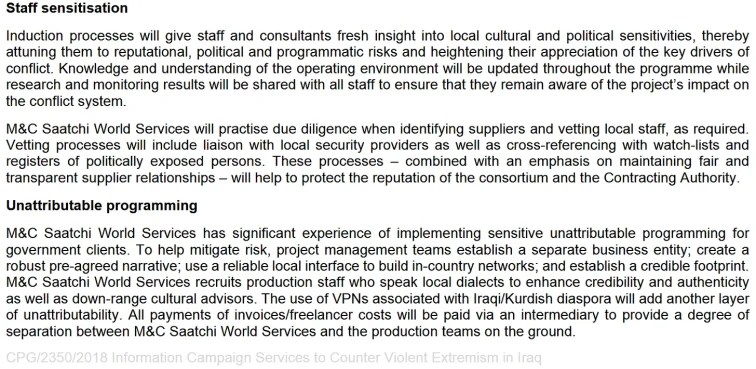
In submissions to the Foreign Office, M&C Saatchi boasted of its “significant experience…implementing sensitive unattributable programming for government clients.” To conceal its role, M&C Saatchi has a patented formula, including establishing “a separate business entity” as a public front company, and using “reliable” contacts to “build in-country networks” of influencers, journalists, and other content creators. “Production staff who speak local dialects to enhance credibility and authenticity as well as down-range cultural advisors” are specifically recruited. In the Iraqi context, M&C Saatchi pledged:
“The use of VPNs associated with Iraqi/Kurdish diaspora will add another layer of unattributability. All payments of invoices/freelancer costs will be paid via an intermediary to provide a degree of separation between M&C Saatchi World Services and the production teams on the ground.”
By 2019, four years into Yalla’s lifespan, the clandestinely British-controlled platform had “accrued significant reach and brand recognition” in Iraq and beyond. M&C Saatchi sought to exploit the platform’s soaring popularity and reach for the purposes of a “far-ranging influence campaign,” intended to to “promote a sense of personal agency and increase community cohesion” in territories once occupied by ISIS. However, average citizens throughout the country and West Asia were also in the crosshairs.
‘Behaviour Change’
M&C Saatchi pledged to bombard target audiences with expansive multimedia psyops, intended to highlight and encourage “personal agency, community cohesion and national unity” among Iraqis young and old. Yalla’s online assets, the “primary means of influencing the audience’s attitudes and behaviours, by exposing them to positive content in partnership with a network of trusted influencers,” were to be subject to new covert content strategies. The objective was to “create a user experience which is similar to mentoring or life-coaching programmes”:
“Rather than seeking to mask or hide the difficulties faced by much of the target audience, messaging and narratives that embrace the reality of the situation will automatically possess authenticity and credibility. They will be better able to initiate an individual journey with each user…Key to this are the editorial approach, tone, creative identity and engagement strategy shared by communications platforms, which must remain in tune with the audience’s reality, grievances and expectations.”
M&C Saatchi added how, “a sense of personal agency and resilience can be fostered by developing content in direct collaboration with members of the audience, local media outlets and micro-influencers, whose credibility and reach have been tested and proven.” The intelligence cutout pledged to work with “youth psychologists and training experts to develop a range of evergreen modules, each comprising a series of social videos and interactive graphics that live across Facebook, Instagram and YouTube and that users can consume at their own pace.”
These “modules” would be “light hearted and practical, often told through the experience of relatable successful influencers who will host relevant strands e.g. ‘10 things I did to become a…’.” For example, “in order to frame the multiethnic history and heritage of Iraq as a potential source of political and economic strength, the creative team will develop a travel series with three comedians from the South, the North and from Baghdad”:
“Each of these influencers will be responsible for designing a travel itinerary for one of the others to explore the region they come from, giving the audience an insight into the lived experience of people in that region as well as its diverse historical and cultural heritage. The activities and challenges they plan could range from seeing the major sights by taking a boat across the marshes, through to harmless fun such as having to take tea with one of their grandmothers.”
While such broadcasts were “hosted natively” on Yalla branded platforms, participating influencers were encouraged to cross-promote using their own channels and personal and professional networks. Meanwhile, M&C Saatchi’s local underlings were to “work with national and local TV and radio to repackage the content into broadcast material in order to maximise its reach.” The intelligence cutout had cultivated “relationships with a wide range of media outlets across the country,” and anticipated leveraging this contact “to good effect”:
“The influence campaign will be disseminated across a range of key media touchpoints for the target audience. These touchpoints will be carefully selected by the media strategy team in order to enjoy the widest reach possible and deliver the messaging where it will be best positioned to drive attitudinal and behaviour change at a personal and social level… The campaign will seek to shape choices, reinforce positive ideas and change social perceptions… [and] place increasing focus on user-generated content as the project evolves.”
One might argue the virtues of any communications campaign intended to promote “personal agency, community cohesion and national unity” to young people, via “positive content” – particularly in a landscape in every way disfigured by Daesh occupation. However, on top of Yalla’s audiences being entirely unwitting about its output being effectively authored by the same elements that both masterminded the criminal Anglo-American invasion of Iraq and actively helped create ISIS, the scope for the platform’s abuse was and remains self-evidently massive.
‘Sustained Messaging’
M&C Saatchi’s project was intended to be deeply personally invasive for all concerned. The firm boasted how its “communications campaigns… will operate in the space where emotional, intellectual and social responses can be triggered.” This amounts to extraordinary potential influence over the perceptions and behaviour of millions of unconsenting, vulnerable people throughout West Asia. Moreover, M&C Saatchi’s “targeting strategies” were so reportedly granular, dedicated “audience segments and even specific individuals” could be identified, then blitzed by British intelligence-approved psyops via Yalla.
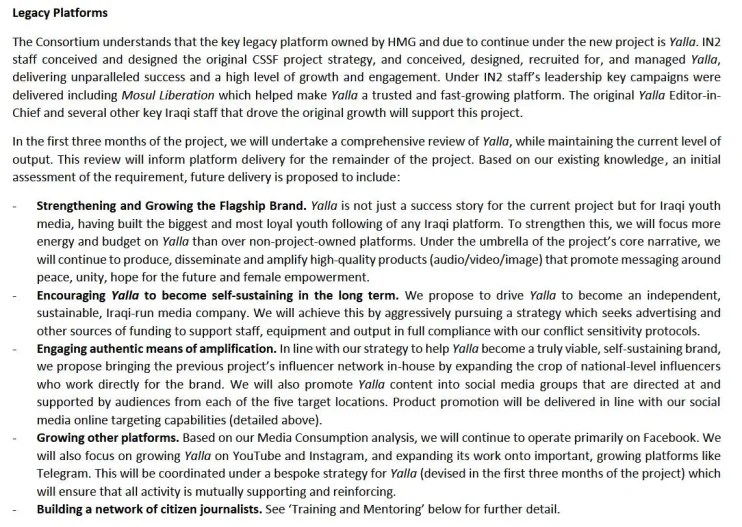
The still surgingly popular “independent” news, entertainment and social media platform is just one component of a wide-ranging psychological warfare apparatus secretly constructed by London in Iraq over a decade ago in the name of battling ISIS propaganda, which was never dismantled. Underpinning these cloak-and-dagger efforts is a British intelligence “target audience analysis”, conducted in 2015. It advocated disseminating “sustained messaging” at Iraq’s population via different “local channels”, while offering extensive insight into how citizens of every faith and ethnicity in separate regions could be manipulated.
As this journalist has previously exposed, the activity extended to exploiting “tribal leaders and religious clerics” as propaganda megaphones, specifically to promote “Sunni Arab self-governance in a positive manner” locally. Strikingly, M&C Saatchi also managed the operation. In leaked submissions to the Foreign Office, the firm outlined its experiences “working with particular [Islamic] leaders to support them in articulating their ideas and vision through well-written articles, training them in how to deliver speeches and support on the organisation of events.”
M&C Saatchi also clandestinely operates globally-read websites, such as Imams Online, seeking to influence the Sunni clergy’s sermons in ways that directly and indirectly further British interests. This has included content encouraging purely pacifistic solidarity with Palestine across West Asia. Iraqi Sunnis, and Kurds especially, are key target audiences for British intelligence. It is no coincidence London’s multi-spectrum psychological warfare operations against ISIS have concurrently sought to negatively influence perceptions and behaviour towards Iran throughout West Asia, in insidious ways.
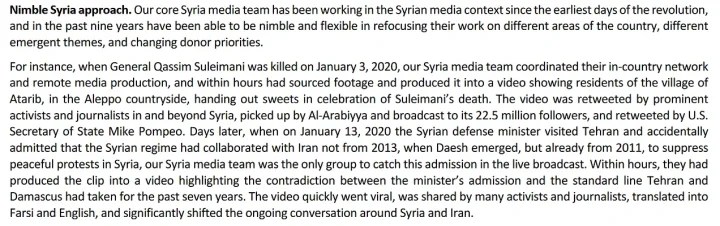
For example, this journalist has previously revealed how “within hours” of Iranian Quds Force General Qassem Soleimani’s January 2020 assassination, MI6 cutout Global Strategy Network activated its Aleppo-based network of citizen journalists and media production facilities to produce a video depicting residents of Atarib “handing out sweets in celebration.” The clip was “retweeted by prominent activists and journalists in and beyond Syria, picked up by [Saudi outlet] Al-Arabiyya and broadcast to its 22.5 million followers, and retweeted by US Secretary of State Mike Pompeo.”
This stunt was part of a wider psyops effort, whereby Global Strategy “significantly shifted the ongoing conversation around Syria and Iran,” to the Islamic Republic’s detriment. Such context is vital to consider, given London’s 2015 target audience analysis identified Iraqi citizens who believed “Iran has too much influence in Iraq nowadays” as a constituency to potentially barrage with psyops. Markedly, intensive focus grouping found the overwhelming majority of Iraqis vehemently rejected this view, across ethnic and religious lines.
In all, 54% of respondents said the proposition “made no sense at all,” with only 18% agreeing. However, 68% of Sunnis surveyed, many of them Iraqi Kurds, concurred. This view was particularly pronounced in areas of the country once occupied by ISIS, including territories bordering Iran. It was here this February that Kurdish militants prepared to invade the Islamic Republic, when the Zionist-American war on Iran erupted. Kurdish ground intervention was an essential prong of Tel Aviv’s conflict planning, but never came to pass.
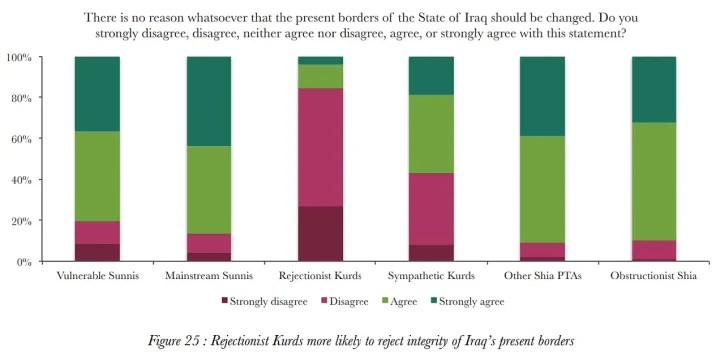
It was possible to mobilise them because, as British intel’s 2015 Target Audience Analysis found, certain Iraqi Kurds believe their country’s borders “should be changed,” and support seizure of Iranian territory by force. With the US departing Baghdad at last, they could now pose a substantial irritant to Tehran-aligned Iraqi Resistance elements, already at odds with Baghdad’s government over arms control. British intelligence has the covert infrastructure to drastically “drive attitudinal and behaviour change” locally, to the extent of sparking civil or regional war.
Yemeni Armed Forces Warn Airlines Against Using Saudi Airports, Exempt Mecca and Medina
Al-Manar | October 11, 2026
Yemeni Armed Forces reiterated on Sunday a warning to airlines, aviation personnel, airport workers, and travelers against using Saudi airports and airspace, declaring them potential targets and a theater of military operations, with the exception of airports in Mecca and Medina.
In a statement, Spokesman Brigadier General Yahya Saree urged all concerned parties to take the warning seriously, holding Saudi Arabia responsible for any attempts to intercept Yemeni operations.
The Yemeni Armed Forces reaffirmed their commitment to pursuing the strategy previously announced as “an airport for an airport, a blockade for a blockade, and escalation for escalation,” vowing to continue until their objectives are achieved.
Earlier on Saturday, Member of Yemen’s Ansarullah Politburo Mohammad Al-Bakhiti warned that Saudi regime plots to target holy sites in Mecca and Medina and to blame Yemen for attacks.
In exclusive remarks to Al-Manar on Friday, Al-Bakhiti revealed that Riyadh had supplied Saudi-backed mercenaries in Yemen with missiles and drones to carry out attacks and blame them on Yemeni Armed Forces.
Iran security chief says powers greater than US tried to conquer Iran but ended in ‘dustbin of history’
Press TV – October 11, 2026
Secretary of Iran’s Supreme National Security Council, Major General Mohsen Rezaei, says powers greater than the US have tried to conquer Iran but ultimately ended up in the “dustbin of history.”
During an exclusive interview with Press TV on Saturday, Rezaei said the “US suffered repeated defeats in its confrontation with Iran and has consequently turned to economic warfare out of desperation.”
Iran, rather than the US, would determine when the confrontation ends, he said, stressing that Tehran would continue its resistance until its rightful demands are met.
Addressing the presence of US forces in the region, Rezaei told Press TV that the withdrawal of US forces from Iraq reflected Washington’s failure to impose its military agenda on the region, describing it as a vindication of Iran’s resistance to American military presence in West Asia.
Rezaei further said that more than “30 million Iranians have registered in ‘Janfada’ (Sacrifice for Iran) Campaign to take up arms in the event of US aggression.”
On diplomacy, the official said “Tehran would not return to its previous diplomatic norms,” while stressing that “Iran would never abandon diplomacy altogether.”
The senior official warned that, if Washington launched another act of aggression against Iran, American assets could be targeted, including key data systems and artificial intelligence sensors.
Rezaei also identified Washington and its regional allies as the root of the problem surrounding the Strait of Hormuz.
Iran closed the Strait of Hormuz in response to the latest round of US-Israeli aggression, preventing US and allied ships from navigating the strategic waterway.
The move resulted in a significant increase in oil and energy prices across the globe, especially in the US, forcing Washington and the International Energy Agency (IEA) to release their strategic resources several times.
Following the signing of the Islamabad Memorandum of Understanding (MoU) between Iran and the US in June, Tehran opened the Strait of Hormuz, but after the US violated the MoU by blockading Iranian ports, Iran’s Armed Forces closed the maritime corridor once again.
Hormuz and the Looming Economic Catastrophe
The Trump administration is missing the bigger picture
By Philip Pilkington | The American Conservative | October 9, 2026
In the classic martial arts film Enter the Dragon, Bruce Lee’s character is instructing a young, aspiring fighter. Irritated at the lack of progress his student is making, he points to the sky. “It’s like a finger pointing away to the moon,” he says as the student tries to focus on what his teacher is saying. “Don’t concentrate on the finger,” Lee says, slapping him on the head, “or you will miss all that heavenly glory.” The quote is derived from an old Buddhist text called the Śūraṅgama Sūtra, and the point is clear: Sometimes if you focus on what is immediately in front of you, you can miss the point entirely.
Something like this is happening in Washington, DC, right now. For almost two weeks, the debate around the progress or lack thereof in the Iran War has been focused on activity in the Strait of Hormuz. A whole host of maritime experts have emerged suddenly to inform us that the Trump administration has succeeded in reopening the crucial waterway to shipping. Maximalists are claiming that this means the United States has effectively won the war in the Middle East. Others are making the more modest claim that this reopening of the Strait will solve the looming energy crisis.
These were the two perspectives that most people who were not deeply involved in the debate heard. There was, however, a small but vocal minority who questioned whether the Strait had been opened at all. If Iran had effective fire control over the Strait in spring and summer, they asked, then why would they suddenly lose it now? Almost immediately after this question was raised, Iran settled the debate by striking an enormous number of ships: 12 and counting in less than a week.
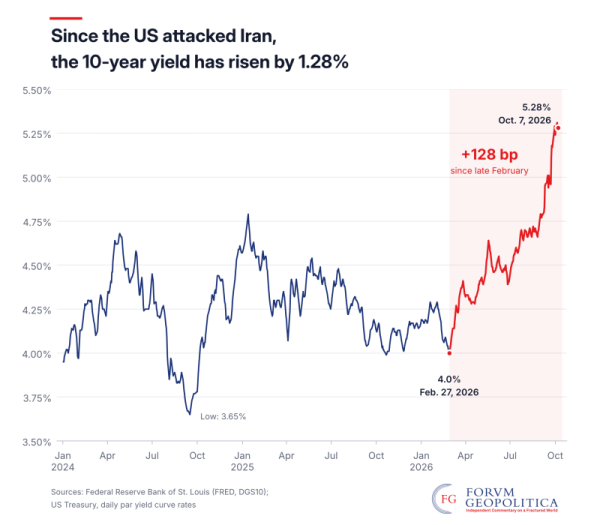
To those of us who were paying attention, the whole exercise felt like looking at Lee’s finger as he points to the moon. As these debates unfolded, the market for U.S. Treasury debt continued an epic sell-off. Bloomberg quoted an investment banker who stated that Treasuries were “trading like a meme stock.” U.S. Treasury bonds have now experienced their worst long-run returns in history.
Treasury bonds are not just any old asset. For one, they are the debt of the U.S. government. If they become uninvestable, the capacity for Washington to live beyond its means through debt issuance is open to question. Treasuries are also the benchmark asset for the entire global dollar system that has allowed the U.S. to run enormous deficits for decades. If this asset starts “trading like a meme stock” and generating awful returns, foreigners will opt for something else. This week, the president of the German central bank stated that “the case for further diversification into gold remains significant.” People are talking.
In mid-September, the speaker of the Iranian parliament, Mohammed Bagher Ghalibaf, posted an equation on X. Unusually for an obscure piece of algebra, the post garnered nearly 7 million views. The equation was a modified version of what economists call the “Taylor Rule,” a method that economists and central bankers use when setting central bank interest rates. In normal times, the equation factors in expected future inflation and how much slack is in the economy. But Ghalibaf’s equation—which he called the “Straits Taylor Rule” —included two new variables: the Strait of Hormuz and the Bab el-Mandeb, the two waterways currently under fire from Iran and the Houthis in Yemen, respectively.
The equation is a stripped-down representation of Iran’s strategy. By controlling these waterways, Iran and its allied groups have gained control over the global energy market. By squeezing these chokepoints, Iran can assert de facto control over America’s financial markets by pushing up expected inflation. Central banks like the Federal Reserve realize that this is no mere bluff and have already started raising interest rates. Ghalibaf’s equation explains, to a very large extent, why American government debt is currently trading like a meme stock.
Meanwhile, at the same time as these pressures are felt in American financial markets, the real economy is undergoing a squeeze too. Recent reports from the Energy Information Agency suggest that American heating-oil bills are expected to rise by 21 percent this winter. Diesel markets are entering into a genuine crisis, with President Donald Trump floating the prospect of banning diesel exports to ensure that there are no shortages. Diesel is the lifeblood of the American logistics chain. If there are shortages, trains and trucks will not run and goods will not be delivered to shelves. Trump has walked back the diesel export ban for now, after strong-arming the Europeans to dump their oil and diesel reserves, but there is every chance that this option appears back on the table as the crisis worsens. Food prices are rising too, with sugar prices looking particularly worrisome.
Once again, Ghalibaf outlined how this is part of Iran’s overall strategy. In an X post this week, the speaker published a rudimentary graph—coupled with a haunting image of a ghost—showing rising commodity prices and interest rates on one side, and falling consumer confidence, foreign interest in U.S. Treasuries, hyperscaler investment, and housing affordability on the other. The Iranians are not just trying to squeeze the American financial system—they are aiming to put extreme stress on the entire economy—and it looks increasingly like they intend on making this pressure felt before American voters go to the polls on November 3.
The Trump administration has become fixated on the Strait of Hormuz, seeing it as a decisive battlefield on which the U.S. can win the war. But the Strait is merely a means to an end. For Iran, that end is to slowly demolish the American economy and financial system until the pressure becomes too much and the U.S. backs off. The idea that you can “win” such a battle is delusional.
The Strait is merely the finger in Lee’s analogy. It is Iran’s overall economic strategy—the moon—that we should focus on. And when we do, we come to the worrying conclusion that by the time the Trump administration cries uncle, the damage done to the American economy and financial system will be so severe that it could take many, many years to recover.
Original article: www.thea
Dhubab offensive, media blitz and the rapid unraveling of Saudi-backed coalition’s new gambit
By Arman Shariati | Press TV | October 10, 2026
In the early hours of October 5, Saudi-backed mercenaries launched an offensive along Yemen’s southwestern coastal road toward Dhubab, which overlooks the Bab al-Mandeb Strait.
By evening, their affiliated media networks were proclaiming Dhubab’s fall. Hours later, they falsely claimed to have captured Al-Mokha as well.
Within a single day of operations, the Yemeni military forces had encircled the incursion, recaptured the ground, and released timestamped footage showing their troops standing undisturbed along the Bab al-Mandeb coastline.
Meanwhile, local residents openly ridiculed the reported advance of the Saudi mercenaries.
The attacking forces retreated to their original positions. The events along that coastal road – the assault, the media triumphalism, the rapid military reversal, and the collapse of the narrative – offer a revealing case study of how information warfare has become structurally embedded in Saudi Arabia’s disastrous military campaign in Yemen.
The Pressure Behind the Push
To understand the events of October 5, it is necessary to examine the developments that preceded them. Yemeni military had been consolidating significant territorial gains across southern and southwestern Taiz province – not marginal advances, but the seizure of areas spanning thousands of square kilometers.
The encirclement of Taiz city was tightening along its northern and eastern approaches, applying deliberate strategic pressure that could pave the way for a handover of the city from the Saudi-backed mercenary factions holding it.
More symbolically damaging still, the residence of Rashad al-Alimi, chairman of the Saudi-backed so-called Presidential Leadership Council (PLC), had fallen.
The Saudi-led coalition and its local allies were rapidly losing ground. An operation that could be portrayed as a decisive advance toward the Bab al-Mandeb Strait would offer PLC forces a much-needed military and propaganda victory.
The Bab al-Mandeb is precisely the kind of strategic objective whose association with a military operation can generate outsized media attention, regardless of what the operation actually achieves on the ground.
The attacking forces
The offensive was led by two formations: the Southern Giants Brigades (Al-Amaliqa al-Janubiyya) and the Dira’ al-Watan (Shield of the Nation) Brigades, supplemented by approximately 100 Saudi mercenary fighters, according to Saudi-affiliated media.
Both formations have histories that complicate their portrayal as straightforward Yemeni forces operating under the so-called Presidential Leadership Council (PLC). The Giants Brigades are a Salafi-oriented southern force whose origins are firmly rooted in Emirati patronage. Armed, trained, and financed by Abu Dhabi, they were institutionally shaped as part of the UAE’s parallel military architecture in Yemen – a network of forces, including separatist formations, that operated with considerable autonomy from the Saudi-led coalition’s command structure.
Their nominal realignment under the PLC framework following the UAE’s partial strategic withdrawal from the Yemeni theater has not necessarily erased the command relationships, patronage networks, or ideological orientation established during their formative years.
They remain among the coalition’s most combat-capable formations, but their relationship with the PLC is better understood through overlapping interests and patronage ties than through assumptions of unified institutional loyalty.
Dira’ al-Watan, by contrast, operates with a more direct orientation toward Riyadh, functioning closer to Saudi Arabia’s traditional mercenary structure in Yemen. The deployment of both formations along a single coastal axis, accompanied by a contingent of Saudi mercenaries, suggests a deliberately assembled force package rather than an improvised advance.
The media apparatus accompanying the operation, as we shall see, reinforces this interpretation.
The assault itself
The attacking forces advanced along the coastal road south of Al-Mokha toward Dhubab district. The coastal approach traverses relatively open terrain, and accounts of the local military disposition suggest that the Yemeni military’s forward garrison presence in the immediate coastal zone was limited. The defensive logic, under such conditions, favors concentrating forces at defensible chokepoints in the adjacent highlands rather than maintaining a thin, linear deployment across exposed ground.
Yet despite heavy Saudi supporting fire, the advancing forces failed to push beyond the outer perimeter of Dhubab along the coastal road. They reached the perimeter of Dhubab airport but did not enter Dhubab city.
At the airport perimeter, invading forces filmed themselves running over wounded members of the small Yemeni military garrison. The footage, subsequently circulated through pro-Saudi Telegram channels, appeared to have been published by the mercenaries themselves as evidence of momentum and fighting spirit.
Instead, it documented abuses against combatants in an isolated position, including the mutilation of dead bodies, turning apparent battlefield content into evidence of conduct that warrants independent human rights scrutiny.
The footage also carried a consequence beyond its grave humanitarian implications. Militarily, it documented a localized engagement against an isolated position—not a breakthrough along the coastal axis. The distinction would become critical within hours, as the broader operation stalled and the coalition’s claims of progress began to unravel. Material intended to project battlefield momentum would instead complicate the narrative surrounding an offensive whose advertised scale and strategic significance far exceeded its demonstrated territorial gains.
The encirclement and the reversal
Field sources report that within hours of the attacking force reaching the coastal road’s edge, Sana’a forces had encircled the limited area of the incursion and begun pressing to retake the ground. The timeline is critical. This was not a gradual reversal unfolding over several days. The encirclement and counterattack took place within the same operational day as the advance.
The reversal has a clear geographic dimension. Yemeni military, led by the Ansarullah movement, controls the Al-Omari mountain range and the Al-Omari base, situated east of Al-Mokha and west of Taiz. This elevated terrain offers observation over much of the coastal corridor and positions from which movement along the coastal road can be interdicted.
Any force advancing along the coast without first neutralizing Al-Omari risks operating under persistent observation, with its flanks and supply lines exposed to forces holding the dominant heights. The attacking force did not capture Al-Omari. Nor was it positioned to do so: securing the mountain range and its associated base would have required a substantially larger and more complex operation than the one assembled for the coastal advance.
At the same time as the encirclement was developing on the ground, Yemeni military forces launched missile and drone strikes against concentrations of Al-Amaliqa and Dira’ al-Watan personnel in the Ras al-Ara area. Field sources report casualties among the brigades’ ranks and the destruction of several military vehicles.
Crucially, Saudi-affiliated media correspondents were embedded with the attacking force when these strikes occurred. Some were recorded in real time on the scene. The media apparatus deployed to document a military triumph was thus capturing a very different story: an operation losing momentum under pressure, with its setbacks unfolding before the cameras intended to celebrate its success.
The media campaign
Saudi-affiliated news outlets began publishing accounts of Dhubab’s fall before any territorial gain had been consolidated on the ground. The claims escalated through the day: from entry into the airport perimeter, to control of Dhubab district, to the fall of Dhubab city, to the reported fall of Al-Mokha as well.
The maximum extent of the Saudi-backed advance against the Yemeni military was the perimeter of Dhubab airport. Located outside the district’s urban center, the airport lies on open, flat terrain adjacent to the coastal road.
Reaching its perimeter, as the attacking forces did, is materially different from establishing control over Dhubab district or the Bab al-Mandeb coastline – a distinction that Saudi-affiliated media systematically obscured in their October 5 coverage.
Sana’a’s counter-messaging response was swift. Its forces released footage showing their deployment along the Bab al-Mandeb coast and east of Al-Mokha, imagery that directly challenged claims of a lost coastline. By the time Saudi-affiliated sources began denying or walking back their claims about Al-Mokha, the damage to their credibility had already been done.
Escalation Deep Inside Saudi Arabia
Yemeni military response to the October 5 offensive extended beyond the immediate Yemeni battlefield. In a series of operations that Yemeni military officials had signaled in prior public announcements, strikes reportedly targeted military and economic facilities deep inside Saudi Arabia, including in Khamis Mushait, Riyadh, and Jeddah.
The East–West Pipeline was struck again, significantly disrupting operations. Air traffic at King Abdulaziz International Airport in Jeddah was suspended, marking another interruption to airport operations. Saudi refineries also came under separate attacks, with impacts on Aramco facilities raising the prospect of suspended refining operations and associated financial losses. The full extent of the damage, operational disruption, and economic costs are reported to be high.
Taken together, these operations widened the confrontation beyond the coastal front in Yemen, bringing Saudi military infrastructure, energy assets, and civil aviation into the broader picture.
Sana’a also formally announced the imposition of a no-fly zone over Saudi airspace. The Humanitarian Operations Coordination Center issued notices advising airlines to avoid the area, presenting the declaration as a reciprocal measure in response to intensified Saudi airstrikes against Yemeni population centers.
Regardless of its practical enforceability, the declaration carried political significance: it sought to portray Saudi airspace as a contested domain rather than an uncontested sanctuary.
It also introduced another variable into the risk calculations of third-party commercial operators, whose decisions on flight routing, insurance coverage, and overflight costs could create additional economic and political pressure on Riyadh.
The structural problem of Saudi Arabia’s military posture in Yemen
The October 5 operation failed to achieve its territorial objectives. The attacking force did not capture Dhubab, establish control over the Bab al-Mandeb coastline, or retain the ground it had temporarily entered. Within a single operational day, it had retreated to its starting positions.
The accompanying media campaign faltered alongside the military advance. The speed of the reversal was central to that failure. When a narrative collapses within the same news cycle in which it is constructed, and footage contradicting the initial claims circulates through the same information environment, the result is not simply a return to the status quo. It can produce a net loss of credibility.
In this case, the gap between the territory reportedly reached and the territory claimed exposed the central vulnerability of the messaging strategy – the declaration of victory preceded the establishment of durable control.
Once the advance stalled and the attacking forces withdrew, the initial claims became liabilities, leaving subsequent clarifications and retractions to compete with the very footage that had been intended to demonstrate success.
But the October 5 episode also illuminates a structural constraint extending well beyond a single failed operation. The Saudi-led coalition’s military options appear increasingly constrained as it struggles to reverse the Yemeni military’s territorial advances despite its substantial advantages in funding, equipment, and external support.
The pattern raises serious questions about the mercenary coalition’s ability to translate material superiority into sustained battlefield gains against a force whose strategic planning, local positioning, and combat motivation have repeatedly complicated its opponents’ campaigns. Meanwhile, reports of precision strikes against critical targets inside Saudi Arabia underscore the continuing challenge of protecting the Kingdom’s strategic infrastructure and deterring retaliatory attacks on its territory.
The Saudi-backed war on Yemen is far from resolved. Taiz remains a central point of military pressure, with the encirclement shaping the strategic calculations of the forces holding the city.
Ma’rib remains a key, and renewed fighting is a possibility in the weeks ahead. Saudi infrastructure continues to face the threat of further long-range attacks, while the operational and economic consequences of strikes require careful assessment.
The October 5 episode, meanwhile, demonstrated the limits of projecting territorial control through media messaging before that control has been secured on the ground.
For Saudi Arabia’s media apparatus, the consequences extend beyond one news cycle. Credibility cannot be restored through messaging alone; it depends on the consistency between public claims and verifiable battlefield developments.
Any subsequent operation will be judged not only by the territory it gains, but also by the gap, or alignment, between what its accompanying media campaign promises and what the evidence ultimately shows.
The battle for Yemen continues. The Bab al-Mandeb remains a strategic focal point, and the struggle to shape both the battlefield and the narrative surrounding it is far from over.
Putin Conveys to Trump Iran’s Vision on Possible Conflict Resolution – Kremlin
Sputnik – 10.10.2026
MOSCOW – Russian President Vladimir Putin conveyed to US President Donald Trump, in coordination with Iranian President Masoud Pezeshkian, Iran’s vision on a possible resolution of the conflict, Kremlin spokesman Dmitry Peskov said on Saturday.
Putin, during communication on the sidelines of the summit in Turkmenistan, held two meetings with Pezeshkian, at one of which he informed the Iranian president about the upcoming telephone conversation with the US president, the Kremlin spokesman noted.
“And then, in coordination with the Iranian president, Putin conveyed to Trump Iran’s vision on a possible resolution of the conflict,” Peskov said.
During a conversation with Trump, Putin showed understanding regarding some proposals of the US leader aimed at de-escalating the conflict in Ukraine, Peskov said.
At the initiative of Trump, most of the time in the telephone conversation between the leaders, which took place the previous evening, was devoted specifically to the Ukrainian settlement, Peskov added.
When Will This White House Madness End?
The United States competes with Israel for the “Most Hated” Distinction
By Philip Giraldi • Unz Review • October 8, 2026
It was another horrific week in Washington with President Donald Trump actually succeeding in coming out with an apparently improvised comment that equaled or maybe even exceeded his ghastly performance at the United Nations where he speculated over whether he should “annihilate” Iran and drive it back into the Stone Age. It would seem that ninety plus million dead Persians would satisfy Donald’s blood lust when it comes to killing innocent civilians, but the latest musing by our beloved leader had him addressing a campaign rally in Nebraska, where he appeared to be declaring that he might well consider wanting to continue the war against Iran even if the price to pay from the Iranians were to be retaliation consisting of eliminating some of our cities. He said “It’s a small price to pay for keeping the world safe, for keeping our country safe, and it’s going to be over with very soon. Let ’em take out Los Angeles, let ’em take out San Diego.”
Trump clearly saw the whole thing as some kind of quid pro quo expecting that even Californians would consider the price to pay worth it if it kept Iran from obtaining a nuclear weapon but he failed to make any reasonable connection between the nonexistent weapon and the good to come out of annihilation of millions of Americans. The irony is, of course, that since Iran has no nukes and nor is it even developing that resource, a point generally made by US intelligence, it could not in any event destroy either or both of the West Coast cities. But then again, Trump is not given much to deep thinking and what he tends to say is what is roiling around among the three brain cells that might actually be functioning in his oversize head at any moment.
Interestingly, the video recording the gathering shows the Nebraska crowd of MAGA supporters cheering the exchange, seemingly unaware that the war never needed to be fought, that Iran was not and is not any military threat to the United States, and that the whole bloody thing could be ended by Trump repeating his frequent declaration of “victory” before ordering all the troops home and putting an end to it. That way no one “loses” and no more innocents have to die but somehow that does not appear to be an option circulating in the White House.
In the wake of the comment, both California’s Democratic Governor Gavin Newsom and San Diego Republican Mayor Todd Gloria called out President Trump for his willingness to see Americans die in large numbers due to bad policies coming out of Washington. Newsom wrote on social media how “After sending the National Guard to occupy California, Donald Trump is now saying our foreign enemies should ‘take out’ Los Angeles and San Diego. He is deranged and dangerous.” Gloria added “San Diego is not collateral damage. We are not expendable. And we are never a ‘small price to pay.’ Keep our city out of your reckless war talk.”
The White House inevitably pushed back in support of Trump’s comments, with communications director Steven Cheung writing on social media how “The media freakout over President Trump’s comments is not rooted in reality. He was clearly stating US cities would have been threatened if a nuclear Iran hadn’t been stopped. America is safer because of the President. Iran has no nuclear, no navy, no air force, and no money.” Interestingly, Trump’s communications director, who interpreted the comment backwards by claiming falsely that the president had “stopped” an Iranian nuke, was incapable of understanding what Trump actually said and instead invented what he might have been wanting to say. All of which explains why the White House is as dysfunctional as it is.
Beyond that, something at least veering towards a bit of constructive policy did take place on September 30th when the United States completed its troop withdrawal from Iraq, which it has been de facto occupying for the past 23 years. The withdrawal, which took place after multiple requests by the Iraqi government, appears to be due to the desire to move US troops out of the effective range of some of the Iranian short range-missiles and drones which could easily reach Iraq. The soldiers and airmen will be moving to next door Jordan which means they will still be near enough to intervene if the Iraqis become naughty and do anything that is not perceived as being in American “interests.”
Some will recall that back in January 2020, then President Donald Trump ordered the assassination of the Iranian head of the Iranian Revolutionary Guards Qasim Soleimani who had just landed in Baghdad Airport to join in peace talks between his country and the Iraqis. Peace talks are not the sort of thing that Trumpists are good at, particularly if they involve actual or potential enemies of Israel, so Soleimani had to be stopped. The Iraqis are certainly aware that the departure of US soldiers does not mean an end to American intervention, which can indeed be at the point of a gun but which might also be through sanctions and other less kinetic means.
All of which is to suggest that the game is not over yet and Trump is quite capable of doing something very stupid in an attempt to salvage whatever remains from his reputation. What is behind a lot of this nonsense is the evil circle involving Trump himself and his good friends in Israel. Make no mistake that Israel is dedicated to becoming “Greater Israel” while also eliminating its potential enemies in Asia and Africa. And, unlike Iran, it is actually nuclear armed thanks to the material and technology that it stole from the United States before killing President John F Kennedy who tried to stop them. And the witless Donald will do everything in his power to help Prime Minister Benjamin Netanyahu be reelected, be it because he is being blackmailed or because he loves the man so much. Be that as it may, Trump will cooperate fully with Netanyahu or whoever succeeds him, no matter what. So too will there be the usual consensus on doing everything to please the Jewish state coming from the usual crowd of Israel firsters in Congress, in the mainstream media and among the Foundations that have come to rely on the money and “respect” that comes from inhabiting the same space as those who are beloved by Zion.
For those who are not yet aware of just how deeply the Zionist activists have inserted themselves in the body politic, I would greatly recommend an article put out by the highly respectable Quincy Institute that just appeared this past week written by Kelley Vlahos, the Editor in Chief of Responsible Statecraft. It provides the sordid details of how the Israel Lobby backed up by Jewish billionaires has been able to create and then subvert a conservative movement that originally appeared to support American interests to make them instead do Israel’s bidding. She describes how “The annual confab, [NatCon 2026] ostensibly launched for American conservatives in 2019, is in Jerusalem this week, largely focused on shoring up US support for the Jewish state.” If Israel is successful, it will bring about a proposed US-Israeli integration at the Pentagon and take its place as a “partner” of the United States in defense matters as well as in foreign policy. Make no mistake, Israel will bleed us dry and then discard our carcass without even a backward glance. It will be the end of our country. President Donald J Trump and his predecessor Joe Biden have done much to move this process along and it is to them and the cowards in Congress and the media that we the owe the deep hole that we as a once-upon-a-time proud and independent people will soon find ourselves in.
Syria May Send Troops to Saudi Arabia Amid War with Ansar Allah
By Kyle Anzalone | The Libertarian Institute | October 8, 2026
A US and Syrian official said Syria is considering sending troops to Saudi Arabia as the kingdom battles Ansar Allah in Yemen.
Reuters reported on Thursday that a US official and a Syrian defense official said that Damascus may send Syrian forces to Saudi Arabia. Riyadh has reached out to several allies for support in its war against Ansar Allah.
On Monday, Turkey and Pakistan agreed to provide military support to Saudi Arabia under the Mecca Accords, a mutual defense pact signed by the three countries earlier this year.
A joint statement released by the Mecca Accords members explained, “The Committee decided to move immediately to the practical implementation of the collective defense commitments and to take the necessary measures to provide the agreed military forces and capabilities and ensure their rapid deployment in the Kingdom, in accordance with the approved arrangements and the national legislation of the Parties, thereby enhancing readiness, military integration, and the collective capacity to confront and counter threats.”
Turkey indicated it would provide Saudi Arabia with military capabilities rather than ground troops, which would require parliamentary approval, while Pakistan did not provide details on the forces or capabilities it plans to deploy.
The statement was released following an emergency meeting of the alliance to discuss the situation in Saudi Arabia. The fighting between Ansar Allah and Saudi Arabia reignited in July after the kingdom attacked the Sanaa airport. In recent weeks, Ansar Allah has taken a significant amount of territory from the Saudi-backed forces in Yemen and attacked several energy sites in Saudi Arabia.
Riyadh has reached out to international partners for support. Crown Prince Mohammed bin Salman requested that President Donald Trump order direct attacks on Ansar Allah positions. So far, Trump has limited US involvement to intelligence sharing and battlefield planning, and refused to conduct direct strikes on Ansar Allah.
Saudi Arabia has also asked China and Pakistan to place pressure on Iran to rein in Ansar Allah. According to three Iranian sources speaking with Reuters, Beijing privately asked Tehran to rein in Ansar Allah after receiving a request from Riyadh. The sources told the outlet that Iran responded that stability in the region depended on US and Israeli aggression.
While Saudi Arabia’s ties to the US and Ansar Allah’s relationship with Tehran allow the war between the two to appear to be a part of a larger regional war, the conflict began over a decade ago. Additionally, Ansar Allah did not begin its offensive following the US and Israeli surprise attack on Iran, but rather after Saudi-backed forces attacked the Sanaa airport, prompting Ansar Allah to resume attacks on Saudi Arabia.
Western officials and media often label Ansar Allah as a proxy of Iran. However, while Iran has provided support to Ansar Allah, there is little public evidence that Tehran directs the group’s military operations.
While Syria was a long-time [resistance] ally under the rule of Bashar al-Assad and his father, Damascus fell to rebels, led by former al-Qaeda members, in 2024. Syria is now led by President Ahmed al-Sharaa, formerly known as Abu Mohammad al-Jolani, who previously led al-Qaeda’s Syrian affiliate.
Baghaei to Rubio: Distorted narratives cannot erase US record of broken commitments
Press TV – October 7, 2026
Iranian Foreign Ministry spokesman Esmaeil Baghaei has dismissed claims by US Secretary of State Marco Rubio that Tehran has repeatedly squandered chances for an agreement, saying the inversion of historical facts cannot erase Washington’s pattern of treaty-breaking from public memory.
Baghaei, responding to an IRNA question on Rubio’s assertion that “Iran has missed opportunities for an agreement multiple times,” stated on Wednesday, “The inversion of historical truths cannot remove the reality of America’s repeated breaches of commitment from the mind of public opinion.”
He pointed to Washington’s successive acts of bad faith, including its unilateral withdrawal from the nuclear deal on May 8, 2018, the sabotage of diplomatic tracks, military aggression against Iran while negotiations were underway, and the subsequent violation of the Islamabad Memorandum of Understanding Iran reached on June 18.
Baghaei held the United States responsible for the insecurity prevailing in the region and for the economic consequences felt in America and worldwide.
“Blame-shifting and contradictory statements cannot overshadow the demand of American and global public opinion that those responsible for the illegal war and the crimes committed be held to account,” he said.
On the latest developments in contacts with the United States, the spokesman said the Islamic Republic’s considerations and conditions for ending the imposed war on all fronts and restoring security to the Persian Gulf and the Strait of Hormuz have been set out explicitly and decisively.
The necessary response to the other side’s proposals will be conveyed through intermediaries. “The exchange of messages between Iran and the US is being conducted through intermediaries,” he added.
On diplomatic efforts related to regional peace and security, including commercial shipping in the Strait of Hormuz, Baghaei stressed that the security of navigation in the waterway matters more to the Islamic Republic of Iran than to any other party. Iran, in consultation with Oman as the other littoral state, has spared no effort to restore security to the Strait.
“The consultation process between Iran and Oman has proceeded successfully. In addition to agreeing on the geographical coordinates of safe two-way routes in the Strait of Hormuz, the two sides have reached an understanding on how the matter will be presented to the relevant international body, a step that will, God willing, be taken soon,” he said.
Asked about the possibility of a joint meeting involving Iran, Oman, and other Persian Gulf states, Baghaei said Iran will continue its efforts to strengthen trust and engagement among the region’s countries.
“Defenders of the homeland, in both the diplomatic arena and the field, stand shoulder to shoulder, resolute and steadfast in defending Iran’s sovereignty and securing the nation’s interests and security,” he concluded.
Johnson, Marandi say Yemen holds upper hand over Saudi Arabia
Al Mayadeen | October 7, 2026
Former CIA analyst Larry Johnson and Professor Mohammad Marandi said that Yemen holds the upper hand in its war with Saudi Arabia, and that neither Turkey nor Pakistan is likely to change that by sending forces to the kingdom’s aid.
Speaking on Al Mayadeen’s The Grand Standoff: Iran and the World on Tuesday, both guests also noted that Tehran is working on the assumption that the US will restart its war on Iran, while Johnson argued that Washington has less capacity to carry one out than its rhetoric suggests.
Yemen advances as Saudi-backed forces falter
Marandi said that the past weeks have shown a one-sided war. He stated that the Saudi camp’s claims that it could retake significant territory proved to be empty talk, as Yemeni forces, led by Ansar Allah and the Yemeni government, kept moving forward. “The liberation of Taiz is near,” he said.
Johnson stressed that Yemen “has every advantage in this war.” He put Saudi Arabia’s dependable fighting strength at about 75,000 soldiers, the Presidential Leadership Council (PLC) at another 100,000, and the Yemeni Armed Forces’ at 350,000. He described the Saudi army as “basically a group of mercenaries,” while Yemeni fighters have the motivation of defending their own land.
Johnson highlighted that the PLC’s latest offensive showed a lack of military competence. “Successful military attacks are usually not announced in advance, they usually prefer not to give the opposing side a heads up about what you’re going to do,” he said, noting that this one was announced beforehand. He added that the PLC launched it “even without what’s called close air support.”
Saudi aircraft carried out a number of bombing runs along the front lines, Johnson said, “but they were not coordinated.” He explained that “normally you want somebody on the front lines who can actually be in communication with the pilots or with the air controllers, the combat air controllers, to identify specifically along the front lines where bombs need to be dropped.”
“What we’ve seen is that [the Yemeni Armed Forces] operate at a more sophisticated level,” he said. He rejected the Western line that this is Iran’s doing. “Contrary to Western propaganda that this is all just the work of Iran, this is not the work of Iran,” he said. “Anybody that’s had any dealings at all with the Houthis knows that they are quite independent.” He said the movement sees Iran as a friend, but “they don’t let Iran dictate its choices or what it does.”
Johnson added that he believes Saudi Arabia attacked Sanaa after the funeral of Sayyed Ali Khamenei because the US encouraged it. He explained that Washington wrongly saw Yemen as a paper tiger, and described its approach to West Asia as “a combination of ignorance and arrogance.”
Turkey, Pakistan face a logistical nightmare
Both guests dismissed the idea of a Turkish or Pakistani deployment. Johnson said the announcement that Turkey and Pakistan would effectively declare war on Yemen “was laughable.”
He clarified that air power would not solve the problem either. “Dropping bombs without effective ground controllers is just, it’s a waste of bombs,” Johnson said. “It’s just punching holes in landscape without accomplishing anything.” He called the announcement “more Western hype” that “speaks to the desperation of the Saudis,” adding, “I don’t see Turkey or Pakistan intervening in any significant way.”
Marandi said he does not know whether Riyadh, Ankara and Islamabad have even decided to send forces. “It’s possible,” he said. “But as Larry said, this would be a logistical nightmare, and the cost would be extraordinary. And even troop movements inside Saudi Arabia would not be easy.”
He stated that neither country has the capacity. “Pakistan, of course, its military is on the border with India, and they have very bad relations with the Taliban in Afghanistan,” Marandi said, adding that Turkey has difficult relations with almost all of its neighbors. “The armed forces of Pakistan and Turkey are not designed for such mass movements of troops.”
Marandi asserted that Turkey and Pakistan are also harming themselves by letting the narrative spread that they stand with Saudi Arabia. “Turkey and Pakistan are not doing themselves any favors by pushing or allowing this narrative to be pushed that they are on the side of Saudi Arabia,” he said. He pointed to their stance on Gaza, which he said made them popular across the region. “They’ve become heroes across the region,” he said, and “it’s clear that their sympathies lie with [Ansar Allah].”
Saudi Arabia exposed on oil, infrastructure
“The Saudis are in real trouble,” Johnson said. He said the East-West oil pipeline is down and that reports of oil getting through, including through the Strait of Hormuz, are false. “They have lots of infrastructure that can be targeted and is being targeted by Ansar Allah,” he noted, while “Ansar Allah doesn’t sit there with an abundance of infrastructure that can be targeted by the Saudis or the Western helpers.” His conclusion was that “Yemen holds the upper hand.”
Marandi pointed to the weight of the kingdom’s finances. “The Saudis have nothing but their oil exports and their oil industry to sustain themselves, and it is a country that has very high costs,” he stressed. “The government spends a lot of money, so the economy is doing very poorly.” He warned that “the longer this war lasts, the more Saudi infrastructure will be destroyed.”
Marandi argued that the way out is obvious. “The smart thing to do would be for Saudi Arabia to end this war, to do a deal with the people of Yemen, and to lift the siege, and to recognize the government, and stop interfering in Yemen’s internal affairs,” he said. “But Mohammed bin Salman is not the wisest of leaders, to say the least.” He compared the crown prince to Trump. “I think both are very arrogant, neither are wise, and the people around them are yes-men,” he asserted. “Otherwise the Saudis would have ended this by now.”
Johnson put the responsibility on Riyadh. “This is a fight that the Saudis chose to initiate,” he insisted, adding that Ansar Allah “was content to live side by side with the Saudis” and “abiding by the ceasefire” until the Saudis broke it. For Johnson, the kingdom now has a single option. “The choice is settle, make peace with Yemen, or risk the absolute destruction of the government and the country of Saudi Arabia.”
Tehran plans for a renewed US war on Iran
Marandi told the program that Tehran is planning around the assumption that Trump will restart the war. “I’m not saying that war is inevitable, but the working assumption is definitely that we’re going to have war,” he stated. Iran “has been preparing itself for a major confrontation, a very heavy war that would take perhaps weeks,” he noted, and it has warned US-aligned countries that helped Washington that “this time around the Iranian response will be much more devastating for them as well.”
He detailed upgrades to Iran’s missile and drone capabilities, improved air defenses, expanded underground bases and strengthened command and control meant to protect its leaders from targeted strikes. The remaining question, he argued, is timing. “Will there be conflict before Netanyahu’s election, or between the two elections, or after the US midterm elections? That is basically the real question.”
Marandi also pointed to deepening energy shortages. “Trump can pretend that the Strait of Hormuz is open and that more oil is getting through than ever before,” he said. “But the reality is that that’s not the case. The shortages are accumulating.”
Flows reached 11 to 12 million barrels a day for a couple of weeks, when Iran avoided escalation around President Masoud Pezeshkian’s planned US trip, but even then they fell short of demand. Shortages of diesel, gasoline, helium, sulfur and LNG are growing faster than the oil shortage, he explained.
He questioned why Trump keeps threatening to wipe out Iran if, as Trump has claimed for over seven months, the country is already defeated. “I don’t think anyone in Iran takes him seriously anymore,” Marandi added.
Johnson points to limits on US firepower
Johnson argued that Washington’s capacity is thinner than its threats suggest. “I wouldn’t characterize it as a wider escalation, because the United States is limited in what it can do to escalate,” he stated. He noted that the US lacks a robust supply of Tomahawk and JASSM cruise missiles and that its air defense stocks are depleted. “They’ve exhausted their air defense systems. Patriot missiles and THAAD missiles are, I mean, they’re out.”
He cited the evacuation of 12 B-1 bombers from RAF Fairford as evidence. Washington blamed a possible Iranian drone threat, but Johnson countered that “if they still had an adequate number of Patriot missiles, they wouldn’t have evacuated 12 B-1 bombers from the Fairford RAF airfield.” Even against drones, he added, the US does not have enough PAC-3 missiles.
Johnson dismissed press reports of 10,000 US troops being surged to the region, pointing out that 50 to 60 percent of them are the crews of aircraft carriers, escort destroyers and a Marine Expeditionary Unit. The USS Theodore Roosevelt is replacing the USS George H.W. Bush, which is docked in Phuket, Thailand, and due to depart on October 9. “So it doesn’t look like there’s a buildup on that front,” he observed, adding that it is unclear whether the Bush will return to waters off Iran.
Johnson believes the bomber withdrawal followed a secret meeting last Friday at Camp David involving J.D. Vance, Pete Hegseth and John Ratcliffe. In his view, they recognized that “the United States really is in a limited position to carry out any kind of effective or sustained strikes against Iran that are risk-free.” He expects Iran to act preemptively if it judges strikes are imminent, for example against aircraft deployed to al-Udeid.
For Washington, he concluded, “the United States stands to lose much, much more than they’ve already lost if they decide to renew conflict and war with Iran.”
Featured Video

Iran’s Next Strike May Not Explode. It Could Shut You Down
or go to
Aletho News Archives – Video-Images
From the Archive
Zionism’s Violent Legacy
By Donald Neff | Washington Report On Middle East Affairs | January 1996
On January 4, 1948, Jewish terrorists drove a truck loaded with explosives into the center of the all Arab city of Jaffa and detonated it, killing 26 and wounding around 100 Palestinian men, women and children.[1] The attack was the work of the Irgun Zvai Leumi – the “National Military Organization,” also known by the Hebrew letters Etzel – the largest Jewish terrorist group in Palestine. The Irgun was headed by Revisionist Zionist Menachem Begin and had been killing and maiming Arabs, Britons and even Jews for the previous ten years in its efforts to establish a Jewish state.
This terror campaign meant that at the core of Revisionist Zionism there existed a philosophical embrace of violence. … continue
Blog Roll
 Aletho News
- Trump’s Iran war is on an Israeli leash
- Saudi oil boss issues global supply warning
- Riyadh Says Its Oil System Is Intact. The Numbers Say Otherwise.
- Trump and Netanyahu Want to “Finish the Job” on Iran
- US ‘one-sided dictation’ not Iran’s beliefs makes rational talks impossible: Baghaei
- Iran’s Next Strike May Not Explode. It Could Shut You Down /Col Doug Macgregor
- Iran: US political targets legitimate if assassinations return
- Iraq shuts key border crossing with Iran under US pressure: Report
- Undersea Internet cables could be targeted in retaliation for attacks on Iran: IRGC deputy chief
- EU sending ‘biased’ observers to interfere in Serbian election – president
- If Americans Knew
- The Israel Lobby’s Changing Fortunes
- AIPAC has become such a political liability that it’s shifting to a more “nimble” approach to buying politicians
- At least 160 Israeli settler attacks in 2 weeks
- Will Gaza’s Ancient Christian Community Disappear Forever?
- Israel’s vision of regional security rests on keeping Arab states weak
- Heidi Levine recounts how Palestinian youths helped save her in settler attack
- DAILY UPDATE: Latest essential news on Palestine, Israel, & region
- Trump’s Intensifying Sabotage of the ICC, for Israel’s Sake
- Israeli military detain US and UK volunteers in West Bank including Democratic NY politician Brad Lander
- Americans at National Conservatism Conference held in Israel this year criticize Israel
- No Tricks Zone
- E-Cars Reduce CO2 Emissions By Only 41% Compared To Internal Combustion Engine Vehicles
- Predictions Made By Renowned Climate Professor Over Past Decades Have Been Proven To Be Poor
- New Study Suggests Large Regions Of The Pacific Ocean Have Been Cooling For The Last 80 Years
- Germany’s Green Energy Debacle: High Energy Costs Force Kahla Porzellan to Close After 182 Years!
- New Study: 50 Years Of The Most Aggressive ‘Net Zero’ Policies Can Only Affect The Global Climate By 0.03°C
- US September “Heat” Was No Record…Many Records Set Decades Ago
- Latest European Green Energy Debacle; Portugal’s Largest Flagship Solar Park Insolvent!
- Green Energy Debacle: German Expert Professor Fritz Vahrenholt Warns Of Severe Economic And Social Consequences
- Two More Paleo Reconstructions Affirm Meters-Higher Sea Levels Across Ireland, Brazil 7000-6000 Years Ago
- New Study: Earth And Venus Surface Warmth Largely Explained By Convection And Lapse Rate, Not CO2 Or Radiation

