Department of War Awards $20.7 Billion Contract to Raytheon for Air-to-Air Missiles
By Kyle Anzalone | The Libertarian Institute | September 29, 2026
The Department of War announced a nearly $21 billion, five-year contract to produce Advanced Medium-Range Air-to-Air Missiles (AMRAAM). While AIM-120 missiles are designed for warplanes in air-to-air combat, they can also be used as ground-launched missile interceptors.
The Pentagon announced the contract on Monday. “We are working across the defense industry to ramp production and build the Arsenal of Freedom,” said Under Secretary of War for Acquisition and Sustainment Michael P. Duffey. “This award strengthens our ability to equip the Joint Force and our allies with a proven air-to-air capability, ensuring our warfighters maintain a decisive advantage.”
Raytheon, or RTX, is the primary beneficiary of the contract. The deal was issued as an undefinitized contract action, meaning details of the cost and number of missiles could change. Under the contract, Raytheon will produce up to 1,900 AMRAAM missiles annually.
The AMRAAM, or AIM-120, missiles are designed to be fired from America’s fleet of fighter jets. There are multiple variants of the AIM-120 missile, and the Pentagon announcement did not disclose how many of each variant Raytheon has been contracted to produce.
While the AIM-120 is primarily an air-to-air missile, it can also be fired from the National Advanced Surface-to-Air Missile System (NASAMS), a ground-based air defense system. The AMRAAM-ER is an extended-range variant designed specifically for ground-based air defense.
Ukraine has relied heavily on the NASAMS system for air defenses. In April, the Center for Strategic and International Studies estimated the US has between 4,000 and 4,500 AIM-120 missiles in its stockpile. It noted that the US could use the AIM-120s as a cheaper option to down Iranian drones compared to Patriot or Standard Missiles. However, the AIM-120s still cost $1 million each.
‘Distance yourselves from Israel’: IRGC urges US population to question govt policies
The Cradle | September 29, 2026
Iran’s Islamic Revolutionary Guard Corps (IRGC) released a letter on 29 September addressing the US population – urging it to “force” Washington to “distance” itself from Israel, and expressing a readiness for “coexistence and peace,” while also vowing to continue fighting for Iran’s rights.
“Our purpose in sending a letter to the US people goes beyond media propaganda and creating familiarity with Iran’s reasoning. This is not a short-term or purely promotional move … Choosing a ‘letter’ as a tool to convey our message directly and clearly was a method selected based on the realities on the ground,” said IRGC spokesman Hossein Mohebbi.
“The countries neighboring or located near the US, whether along its land or maritime borders, do not possess the military and security capabilities to pose a serious threat to the US,” he added following the letter’s release, urging US citizens to question Washington’s military expansionism and the presence of hundreds of its military bases across the globe.
Mohebbi went on to ask, “What is the purpose of deploying 800 US military bases around the world?”
The letter itself poses several questions to the US people, while urging them to “see through” the official claims made by Washington.
This included US, as well as Israeli, claims regarding the Iranian nuclear program.
“For 25 years … the [US] claimed that Iran is only … months or weeks away from building a nuclear bomb … If this were true, why has Iran not yet gone through with its plan to build a bomb? If Iran was only a little while away from making the bomb 25 years ago, when it was far less technologically advanced … then it should possess dozens of nuclear bombs today.”
It also pointed to US intelligence reports acknowledging that Tehran is not looking to weaponize its program.
Additionally, it slams US official claims and declares to the US people that Washington’s bases were “decimated” throughout the war.
This has been confirmed through satellite imagery and western media, not just Iranian outlets.
Tehran, through the letter, also repeated its longstanding declarations to the people of the US that Iran is opposed to their government and not them themselves.
“The people who burn the American flag are not hostile to the American people; it is the oppression and aggression of the American government that they are denouncing,” the letter reads.
“We can live together in peaceful coexistence. Remove from power the evil, deceitful, and violent politicians who are responsible for America’s current state. Entrust your affairs to the wise, not the wily. Make sure your politicians understand that the world has changed,” it adds.
The letter also urges the US people to “distance itself from Israel, as the occupiers of Palestine will, sooner or later, have to leave the land they occupy and return to their countries of origin.”
The letter stresses that Tehran will “continue fighting” despite “all the hardships that our enemies impose on us.”
It comes as reports indicate Washington is planning to renew bombing against Iran. Tehran has vowed much wider retaliation than before in the event of such actions.
‘Grave, alarming’: Iran mission on Trump’s UNGA ‘annihilation’ threats
Al Mayadeen | September 28, 2026
Iran has warned the United Nations that US President Donald Trump’s threats to “annihilate” the Islamic Republic constitute a grave development, particularly because the remarks were made from the podium of the UN General Assembly.
Gholamhossein Darzi, Iran’s ambassador and chargé d’affaires to the UN in New York, raised the issue in a September 27 letter addressed to UN Secretary-General António Guterres and the President of the Security Council, Jérôme Bonnafont.
Darzi’s letter came in response to Trump’s September 22 address to the 81st session of the UN General Assembly, during which the US president said he could “annihilate the Islamic Republic” if no agreement was reached with Tehran. The wording appears in the official UN transcript of Trump’s speech.
Iran says threats made at UN carry wider implications
Darzi said Trump’s remarks were neither isolated nor ambiguous, arguing that they form part of a continuing pattern of public threats against Iran by the president of a permanent member of the UN Security Council.
“These repulsive statements are not ambiguous remarks or isolated utterances. They are rather part of a sustained pattern of public threats against Iran by the head of a permanent member state of the Security Council,” Darzi wrote.
“This latest development is particularly grave and alarming because the United Nations General Assembly is not a venue for threats of annihilation,” he added.
The Iranian envoy stressed that the General Assembly serves as the UN’s principal universal forum and was established to promote international peace, cooperation, and relations among states.
In the letter, Darzi referred to several previous statements by Trump that he said demonstrated a broader pattern of threats against Iran.
He cited remarks on March 22 in which Trump threatened to “hit and obliterate” Iranian power plants, followed by statements on March 30 threatening destruction of Iran’s energy facilities and other vital infrastructure, including desalination facilities.
Iran calls for UN response to threats
Darzi argued that the issue extends beyond political rhetoric, saying an explicit threat against a sovereign UN member state raises questions concerning the UN Charter, international peace and security, and the prohibition on the threat or use of force.
He further linked the latest remarks to ongoing US-Israeli aggression against its sovereignty and territorial integrity since February 28, as well as attacks that targeted civilians and civilian infrastructure.
“The issue before the Organization is therefore not merely one of political rhetoric,” Darzi wrote, arguing that failure by the international community to respond could normalize threats against entire nations and undermine the authority of the UN Charter.
The UN has itself emphasized the need for restraint and adherence to international law during the current high-level week. In his September 22 opening address, Secretary-General António Guterres said the principle that force cannot determine whose lives and rights matter was under “profound strain” and called on world leaders to use the week for de-escalation and dialogue.
Iran reiterates right to self-defense
Darzi said Iran would continue to defend itself against any further aggression and reserved its “full and unimpeachable right to self-defense.”
He also said Tehran reserves the right to pursue legal avenues to seek accountability from states and individuals it holds responsible for losses and damage inflicted on the Iranian people.
“Regardless of whether these threats are merely delusional fantasies, they will, as in the past, never materialize or be put into action in the face of the resolute resistance and determined defense of the Iranian people and armed forces,” Darzi wrote.
The Iranian envoy requested that his letter be circulated as an official document of the UN Security Council.
Najaf airport to reopen to Iranian flights within 24 hours: Ambassador
Al Mayadeen | September 28, 2026
Iraq’s Ambassador to Tehran, Yasser Abdul-Zahra al-Hajjaj, announced that Najaf International Airport will reopen to Iranian flights within 24 hours, according to the Iraqi News Agency.
Al-Hajjaj confirmed the airport will resume receiving flights from Iran within the stated timeframe.
The suspension of Iranian flights to and from Iraqi airports, particularly Najaf International Airport, had triggered a wave of condemnation from official, factional, and religious authorities in Iraq. They called for the decision to be reversed, rejecting US dictates.
Iran submits formal complaint to ICAO over US aviation restrictions
Meanwhile, Iran has submitted a formal complaint to the International Civil Aviation Organization (ICAO) regarding US restrictions imposed on Iran’s aviation sector, the head of Iran’s Civil Aviation Organization, Abouzar Shiroudi, announced on Monday.
Shiroudi said the organization held consultations with the Ministry of Foreign Affairs before filing the complaint, as part of efforts aimed at restoring air routes. In remarks carried by the Iranian news agency IRNA, he said, “It is necessary to use diplomatic and legal potential to protect the rights of the country’s aviation sector.”
He added that “Iran’s Civil Aviation Organization, using all legal tools and in close coordination with the country’s diplomatic apparatus, prioritizes the follow-up of necessary measures to remove obstacles and resume all flights on routes that previously operated.”
The remarks follow US Treasury Secretary Scott Bessent’s announcement on September 21 that Iranian airlines “will effectively be forced to cease operations as of September 23, due to secondary sanctions imposed on aviation service providers.”
From ‘How Will This End For Iran’ to ‘When America Walks Away’: A tale of two Economist covers
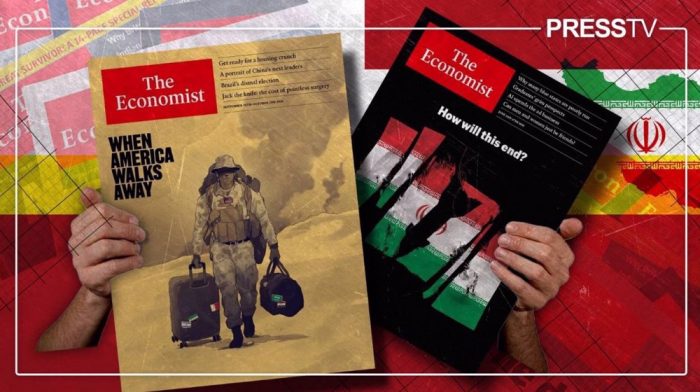
By Maya Kareen | Press TV | September 28, 2026
Nearly 466 days ago, just seven days into the unprovoked and illegal US-backed Israeli military aggression against Iran, The Economist provocatively placed a torn Iranian flag on its cover and asked: “How will this end?”
The image was widely interpreted as a metaphor for the possible collapse or fragmentation of the Islamic Republic in the face of overwhelming military force.
At the time, the narrative surrounding Iran was dominated by predictions of its imminent defeat, the weakening of its leadership, and even the possible collapse of the Islamic Republic under the weight of an aggression that came amid Iran-US indirect nuclear talks.
The article went on to ask whether what it described as Israel’s first war against Iran “will also be the last,” or whether it would “lead to a series of Iran-Israel wars that mire” West Asia in years, if not decades, of further violence.
Written before the United States directly joined the war of aggression by illegally bombing Iran’s Fordow, Natanz, and Isfahan nuclear facilities on June 22, the article also suggested that Washington should move beyond “merely defending Israel and deterring Iran” and join the occupying regime in attacking Iran’s peaceful nuclear program.
Yet even then, The Economist warned that such a war could spiral into a broader regional war, sending energy prices soaring by targeting Saudi Arabia’s oil infrastructure or blocking the Strait of Hormuz, a vital artery for global energy supplies.
Iran, however, did not turn the war into a regional war at that stage, nor did it close the Strait of Hormuz. It retaliated decisively and inflicted massive damage on the Zionist regime.
Following a powerful wave of retaliatory strikes against Israeli-occupied territories, the Islamic Republic demonstrated that it retained the ability to impose high costs on its adversaries.
After 12 days of war, Israel and the United States ultimately agreed to a ceasefire. The confrontation and US hostility, however, were far from over.
On February 1, the martyred Leader of the Islamic Revolution, Ayatollah Seyyed Ali Khamenei, warned that any new war initiated by the United States against Iran would inevitably become a regional war, engulfing all countries across the region.
Less than a month later, on February 28, Washington and Tel Aviv launched a second round of military aggression against Iran, again in the middle of nuclear diplomacy.
On the very first day, the United States and Israel assassinated Iran’s Leader and several senior commanders, apparently calculating that “decapitating” the country’s leadership would pave the way for the rapid collapse of the Islamic Republic and the so-called “regime change.”
That calculation, however, once again proved wrong.
Iranian armed forces mounted a sustained and forceful response, launching wave after wave of retaliatory strikes against Israeli-occupied territories and US military bases across the region.
Far from collapsing under the pressure, Iran demonstrated its capacity to absorb the initial shock, reorganize its command structure, and continue fighting on multiple fronts.
The war eventually reached the Strait of Hormuz, as Iran asserted its control over the strategic waterway, leading to severe disruption in global energy markets and exposing the vulnerability of one of the world’s most strategically important chokepoints.
After 40 days of war, the United States and Israel were once again compelled to accept a ceasefire. This time, the Trump administration even agreed to an Iranian proposal to end the imposed war.
The outcome was a striking departure from the expectations that had accompanied the opening hours of the aggression: instead of so-called “regime change,” Washington and Tel Aviv found themselves confronting an Iran that had endured the assassination of its senior leadership, absorbed unprecedented attacks and continued to resist and inflict blows on the enemy.
Since the April 8 ceasefire, exchanges of fire have continued intermittently, while the Strait of Hormuz has remained largely closed to hostile vessels.
Having failed to achieve its objectives through military means, Washington has increasingly turned to economic pressure, imposing new sanctions and pursuing a naval and aerial blockade against Iran. Yet the Islamic Republic has continued to withstand the pressure.
Also, despite sanctions, threats, political pressure and military aggression, Tehran has maintained that the Strait of Hormuz will only be reopened once the United States ends the imposed war on all fronts.
And now, more than 15 months after that torn Iranian flag appeared on its cover, The Economist has returned with an image that could hardly be more different.
Gone is the question of how Iran will end. Instead, the magazine has placed a new question at the center of its latest cover: “WHEN AMERICA WALKS AWAY.”
The change in imagery reflects a striking shift in the narrative. In June 2025, the focus was on Iran’s survival. Today, the question being raised is about the future of American power in West Asia.
But the transformation in the narrative is not limited to the language used on The Economist’s covers.
Over the past 15 months, the war has also produced a growing record of military, financial and strategic costs for the United States and its military-industrial complex.
Washington launched the war on Iran with many ambitious objectives, including crippling Iran’s nuclear and missile capabilities in order to undermine and weaken the Islamic Republic.
Yet months of war have instead left the United States facing tens of billions of dollars in expenses, damaged military facilities across the region, depleted stocks of some of its most sophisticated interceptors and other munitions, and casualties among its service members.
The following figures and assessments, many of them coming from US government agencies, American media outlets and Western think tanks, offer a picture of the price Washington has paid for the war — and of the widening gap between the objectives announced at its outset and the situation that has emerged months later.
$43.6 billion — and the bill is still rising
On September 18, The Washington Post reported that the US Central Command (CENTCOM) had estimated the cost of the war at $43.6 billion as of early September.
The figure included $28 billion to replace munitions expended during the war on Iran and more than $4.3 billion for equipment lost or damaged. The breakdown also put Air Force operating costs at more than $6.6 billion, Navy costs at about $2.2 billion, and Army costs at roughly $1.6 billion.
Crucially, the $43.6 billion estimate does not include the future cost of rebuilding or repairing damaged US military facilities across West Asia, according to the report.
The Congressional Budget Office (CBO) also published its own assessment on September 15, estimating that the war on Iran had already cost the Department of War approximately $38 billion as of August 1.
CBO said the figure included the replacement of expended munitions and equipment lost in battle, increased flying hours, other operational costs, and additional fuel costs.
But the most important part of the CBO assessment was its warning about the continuing cost.
It said if the war remained at the relatively low intensity seen in May and June, another month of fighting would cost approximately $2 billion. If fighting returned to the intensity seen in July, the monthly cost could rise to approximately $3 billion.
CBO also stressed that its $38 billion estimate did not include all costs borne by other parts of the federal government and did not include certain costs already incorporated into the regular military budget.
At least 228 US military assets damaged
The financial bill was accompanied by substantial physical damage to US military infrastructure.
On May 6, The Washington Post published a satellite-image investigation finding that Iranian attacks had destroyed at least 228 structures or pieces of equipment at 15 US military sites across West Asia.
The Post’s analysis identified 217 structures and 11 pieces of equipment that had been damaged or destroyed. The targets included hangars, barracks, fuel depots, aircraft, radar systems, communications equipment and air-defense systems.
The newspaper examined more than 100 high-resolution satellite images released by Iranian media and independently verified 109 of those images against imagery from the European Union’s Copernicus satellite system and commercial satellite imagery where available.
It found no evidence that the Iranian imagery had been manipulated. The Post also reported that the destruction was “far larger” than what had been publicly acknowledged by the US government.
The extent of the damage was subsequently reinforced by the US government’s own watchdog. In a report released on September 14, the Pentagon Inspector General provided what the Associated Press said was the most comprehensive official accounting to date of the war’s impact on US military facilities.
The report said Iranian attacks had damaged or destroyed hundreds of buildings and other structures at US bases in Kuwait, Bahrain, Qatar, the United Arab Emirates, Saudi Arabia, Iraq, Oman and Jordan.
The significance of this finding is that the damage was no longer based solely on satellite analysis or Iranian reports. It was acknowledged in an official US government assessment.
Dozens of MQ-9 Reapers and other aircraft lost or damaged
The Pentagon Inspector General’s findings also provided a clearer picture of damage to American aircraft.
According to Stars and Stripes on September 15, the war had resulted in damage to or destruction of as many as 30 MQ-9 Reaper drones, along with four F-15 fighter aircraft and more than six KC-135 tanker aircraft.
The report also noted that the cost of repairing or replacing some of these assets had not yet been incorporated into the Pentagon’s overall war-cost estimate.
In other words, even the $43.6 billion figure should not necessarily be regarded as the final bill.
The actual figure, however, is much higher. More than 50 MQ-9 Reapers have disappeared over Iranian skies, according to independent estimates.
The war has depleted America’s missile-defense stockpiles
Perhaps more consequential than the dollar value of the weapons fired is the depletion of America’s stockpile of advanced interceptors.
In its May 6 report, The Washington Post, citing an analysis by the Center for Strategic and International Studies (CSIS), reported that between February 28 and April 8 the US military had used at least 190 THAAD interceptors and 1,060 Patriot interceptors.
Those numbers represented approximately 53 percent of the US prewar THAAD inventory and 43 percent of its Patriot inventory. By September, the assessment had become even more concerning.
The Stimson Center, in a report published on September 22, said that by August the United States had used approximately 80 percent of its THAAD inventory and around half of its Patriot interceptors.
The same report said the Army had used “virtually all” of its ATACMS and Precision Strike Missiles (PrSM) — long-range weapons that would also be important in a potential conflict involving China.
According to Stimson’s assessment, replenishing some of these stocks could take years. CSIS estimated that Tomahawk inventories might not return to prewar levels until late 2030 or early 2031, while Patriot and THAAD inventories could take at least three years to recover.
The costs extend beyond the battlefield
The financial impact has also spread beyond the Pentagon. The CBO said on September 15 that the disruption of oil and gas shipments through the Strait of Hormuz had increased global energy prices, contributing to higher prices for gasoline, diesel and jet fuel in the United States.
CBO estimated that the war would leave US inflation in the first quarter of 2027 0.5 percentage points higher than it had projected in February 2026, while core PCE inflation was projected to be 0.3 percentage points higher.
The agency also estimated that three-month Treasury bill rates would be nearly 0.2 percentage points higher in 2026 than previously projected.
The Stimson Center went further, estimating the direct and indirect cost of the war at approximately $220 billion and putting the average household’s share at roughly $1,650. It attributed much of that wider economic burden to higher energy prices.
Stimson said that by September 15, average US gasoline prices had reached $4.32 per gallon, a 45 percent increase since the war began, while diesel prices had risen by approximately 70 percent.
Damage to US military facilities
Beyond the billions spent on weapons, operations and damaged military equipment, Washington also incurred substantial military, diplomatic and emergency expenses.
On September 14, the Pentagon Inspector General, as reported by The Washington Post, said Iranian attacks had caused approximately $184 million in damage to US military and diplomatic facilities in Iraq, Kuwait, Saudi Arabia and the UAE.
Separately, the US State Department reported around $113 million in war-related and emergency expenses, nearly $80 million of which was associated with the evacuation of diplomats, their families and other US citizens and eligible individuals.
Around 9,000 US citizens were evacuated from the region during the war against Iran.
Iran’s missile program has begun rebuilding
The depletion of American interceptor stocks becomes particularly significant when considered alongside the continued resilience of Iran’s missile program.
On September 10, The Wall Street Journal reported that Iran had resumed production of ballistic missiles, despite the extensive US and Israeli attacks on its missile infrastructure during the opening phase of the war.
According to the report, US and regional officials said Iran was assembling both liquid- and solid-fuel missiles using stockpiled components at underground facilities.
Intelligence pointed to activity at several underground sites, including the Khojir missile facility, while Iran was also working on new underground assembly locations.
The report concluded that the renewed production underscored the difficulty of fully dismantling Iran’s missile program — one of the stated objectives of the war.
Six months on, the original objectives remain out of reach
This brings the military expenditure back to the central question: what did all of this cost actually achieve? Washington continues to describe the war on Iran as having severely degraded the country’s military capabilities.
But independent Western assessments point to a substantial gap between the original objectives and the situation that has emerged.
The Stimson Center, in its September 22 assessment, said the administration initially went to war with objectives that included ending Iran’s nuclear program, destroying its missile industry, annihilating its navy, and ending its support for the Axis of Resistance.
It concluded that the United States had failed to achieve those objectives. Instead, Stimson said, the mission subsequently narrowed to the reopening of the Strait of Hormuz — a goal that became necessary precisely because the war itself had disrupted shipping through the waterway.
“Six months later, little progress toward those goals has been made, while the mission has largely narrowed to the single task of reopening the Strait of Hormuz, a waterway the war itself closed.”
The figures tell the story of that widening gap: $43.6 billion in US military costs; $28 billion needed merely to replace expended munitions; more than 4.3 billion dollars in damaged or lost equipment; hundreds of damaged military structures; depleted THAAD and Patriot stocks; and a weapons-production system facing years of replenishment.
And yet, according to the Wall Street Journal, Iran is already rebuilding parts of its ballistic-missile production capability.
That contrast — between the scale of resources committed by Washington and the difficulty of translating military force into its original political and strategic objectives — is perhaps the most important evidence behind the dramatic change in the narrative surrounding the war.
And now, back to The Economist
This is where the latest Economist cover becomes particularly relevant.
More than 15 months after the magazine placed a torn Iranian flag on its cover alongside the question “How will this end?” the question on its new cover is no longer centered on Iran.
It asks: “WHEN AMERICA WALKS AWAY.”
“America seems to be stuck in the Middle East. It has no easy way out of its war with Iran. Yet the conflict, however it ends, will in fact mark something quite different: the moment when America pulls back from the region—in the sense that it finally relinquishes its hegemony there,” the article reads.
In a September 25 editorial, The Economist’s Deputy Editor Robert Guest makes a similar assessment, writing that the United States has enjoyed decades of dominance in the region, but that this era is now coming to an end.
“Now, as Mr Trump seeks a way out of his ill-planned war, something momentous is occurring. As we describe in our cover package, American hegemony in the Middle East is ending,” Guest writes.
Tehran blasts ‘baseless’ speculation linking Iran to alleged bomb plot at UK air base
The Cradle | September 28, 2026
The Iranian Embassy in London announced on 28 September its “categorical rejection” and strong condemnation of speculation regarding Tehran’s involvement in an alleged plot to attack a British military air base used by US forces.
In a post on X, the embassy criticized “recent baseless and malicious speculation circulated by certain individuals and British media outlets attempting to link Iran” to the incident, which occurred in the early hours of Sunday.
Gloucestershire Police had announced on Sunday that a “major incident” was taking place in the Welford area of western England, leading to the evacuation of several buildings near the RAF Fairford air base.
Police stated that army explosive ordnance disposal experts were examining several vehicles and that five men had been detained on suspicion of offenses under the Explosives Act.
Residents were evacuated from 85 homes in the area near the base on Sunday as army bomb-disposal experts used a robot to examine three white vans.
The five men detained in connection with the alleged bomb plot, all British citizens, were released on bail on Monday, suggesting the incident is not serious, in contrast to early claims.
The men will remain under investigation, according to the head of counterterrorism policing, Laurence Taylor.
UK authorities continue to “explore multiple lines of inquiry” regarding the incident, Taylor added.
RAF Fairford has been used as a base by the US Air Force to launch bombing operations against Iran during the war that began in February.
The UK authorized the US to use the base for missions involving B-1B and B-52 bombers.
Britain did not join the US-Israeli war on Iran and initially denied President Donald Trump’s request to use bases in the UK.
However, then-prime minister Keir Starmer soon reversed course, announcing days later that he had agreed to let the US use bases in Britain for what he claimed were “defensive” operations against Iran’s missiles and their launch sites following Iranian attacks on UK interests and Britain’s Gulf allies.
The Coming GOP Bloodbath?
By Ron Paul | September 28, 2026
Most indicators suggest that the Republicans in the House and Senate are going to face a brutal backlash from the American people in November. Polling with generic ballots suggest a big win for the Democrats and likely the loss of Republican control of both houses of Congress.
There is little reason to cheer a Democratic party victory, however Republicans in charge have for the most part earned what is coming to them. They have refused to uphold their Constitutional obligation to take leading responsibility for war powers.
Earlier this year, President Trump launched what is the most unpopular war in US history when on February 28th he ordered a full US assault on Iran. Iran had not attacked or even threatened the United States and our own intelligence community continued – and continues – to claim that Iran is not building nuclear weapons.
The February attack followed last June’s US bombing of Iran after which the president claimed that the country’s nuclear program was “completely obliterated.”
Congress over too many years has been used to allowing the President to have his own way on matters of war and peace. Members bask in the false patriotism promoted by the media and special interests as the people “rally around the flag.” Eventually, when the war has gone on for years without “victory” – as in Iraq and Afghanistan – many claim they were never really for the war in the first place.
This time is different. There was no propaganda blitz. There were no attempts to convince the American people that the “smoking gun” could be a “mushroom cloud” as we were told in the run up to the 2003 Iraq war. The majority of Americans were against the war on Iran before it started and only became more opposed over time.
As the war drags on, we have seen the national debt pass $40 trillion, diesel fuel prices at the highest ever, and inflation hitting the middle class and poor even harder. The “cakewalk” again failed to materialize.
Incumbent Republicans seeking re-election are in such a panic over voter anger about the war that they have taken to calling for a quick end to it while on the campaign trail. When they get back inside the Beltway, however, they vote to keep the war going for fear of President Trump’s anger.
This is not leadership.
Late last week the Iranian delegation in New York for the UN General Assembly meeting offered an off-ramp. Essentially it was the same Memorandum of Understanding that President Trump signed last June and promptly disregarded, but on a shorter timeline. By Sunday, the President announced that he would reject the deal – a deal like one he already signed.
There is no strategy for winning this disastrous war, it is clear. From over-confidence on decapitation strikes to certainty of a quick military victory, the Administration is now promising that they will win by crippling Iran’s economy. The problem is that Iran has been operating under “crippling” sanctions for decades and has a high economic pain tolerance.
Unfortunately, both parties in DC are war parties, so again it is hard to cheer the likely Republican losses. But sometimes electoral losses can serve as wake-up calls. Eventually we may see the re-emergence of antiwar Republicans in the spirit of the late Sen. Robert Taft and a restoration of the Constitution.
Burnham’s UN debut… A masterclass in British disinformation
By Finian Cunningham | Strategic Culture Foundation | September 26, 2026
So, “Britain is back” and ready to provide glorious leadership to the rest of the world, to “solve shared problems we face.”
British Prime Minister Andy Burnham made his debut at the United Nations this week, addressing the 81st session of the General Assembly in New York.
“You can count on us,” assured Burnham. “Count on us to stand up for those long-standing British values of fairness and justice – our shared values – and for the UN Charter.”
Please, don’t make me vomit. Burnham was oozing noble values on the podium of the UN while Saudi warplanes were massacring Yemeni civilians in their homes – warplanes that are directed and refuelled by Britain (and the United States).
This week, Yemeni media reported that over 100 people, including women and children, were killed as Saudi F-15 and Typhoon fighter jets intensified air strikes on residential areas in the Red Sea cities of Mocha and Taiz. Al Masirah TV showed bloody images of two children killed by a Saudi airstrike in Mocha
On his way to the UN, Burnham announced that he had ordered the deployment of RAF refuelling planes to enable the Saudi air assault on Yemen. Of course, the British media described the move as “defensive aid”.
Earlier this month, Downing Street also approved the dispatch of British military advisors to Saudi Arabia. American advisors are also stationed there to assist in the war of aggression against its southern neighbor.
Yemen’s armed forces and the Ansar Allah militia are hitting back hard. They have overrun Saudi forces in key Red Sea positions and have shut down the Saudi oil industry and pipelines with drone and missile attacks.
But make no mistake, this is a Saudi war of genocidal aggression fully supported by the United States and Britain. The war has been going on since 2015, together with a blockade on Yemen that has resulted in an estimated 400,000 Yemeni deaths. A lull in fighting from 2022 was broken when the Saudis launched air strikes on the Yemeni capital’s airport in July. The Yemenis have hit back with a vengeance, targeting Saudi oil installations.
The Saudi monarchy has begged Trump to give more military assistance. But Trump is bogged down and out of his depth with his losing seven-month war with Iran.
This is where Burnham has entered the fray, responding to Saudi pleas for help by signing off on military deployment. This could prove to be a disastrous strategic blunder. No doubt Burnham is trying to ingratiate himself with Washington. His decision to send the RAF into battle this week came ahead of his first meeting with Trump on the sidelines of the UN. The American president gave him a symbolic pat on the head, saying, “he’s going to be a great prime minister.”
Trump had often ridiculed Burnham’s predecessor, Keir Starmer, for supposedly not offering more military support to the U.S. war aims in the Middle East. Burnham is showing himself to be more amenable, that is, pliable.
The British Butler is slaughtering his way into favor with Washington. Women and children are sacrificed in Yemen all to satisfy the sick “special relationship” between the U.S. and Britain.
Burnham is a fraud with this working-class Manchester accent and glib talk about the “need to do more to help people with the everyday cost of living.”
If you can bear to listen to his speech at the UN, it is a masterclass in British disinformation. It takes a special kind of person to deliver such arrant nonsense with a pose of sincerity.
The thrust of his whole address was to blame Russia for everything. From poverty and inequality in British society, to seething discontent among Britons towards their ruling class, to the war in Ukraine. It truly was a consummate performance in misdirection, the kind of charade that British politicians excel at.
He announced that Britain was launching a new National Centre for Information Defence, purportedly to combat Russian disinformation, which he claimed was “a poisonous tide” sowing division and instability among Britons.
According to Burnham, all that is broken and dysfunctional in British society is due to Russian infiltration. Nothing was said about bankrupt British capitalism and the warmongering of the British state fuelling a proxy war in Ukraine or aggression in the Middle East at the expense of social conditions in Britain.
Burnham’s “solution” to Britain’s endemic problems is to increase “national security” and state control over public information – all under the guise of “defending” Britons from being manipulated by Russian propaganda.
The Orwellian condition that Britain is sliding into is awesome.
This British prime minister dares to speak about British values and leadership and condemn Russia while he is approving the supply of long-range air strikes against Russia with British cruise missiles and drones.
The proof of Burnham’s fraudulence and moral bankruptcy is his decision to materially support Saudi warplanes in committing atrocities in Yemen. Murderous aggression is labelled “defense”.
Burnham’s dubious asset as a politician is his ability to articulate justification for slaughter and war with empty platitudes.
A particularly odious point in his UN speech was his claim that English workers allied with Abraham Lincoln in the American Civil War against slavery. As if English mill workers were representative of British “values”. What Burnham conveniently omitted was the much more heinous role of the British ruling class in creating the Atlantic slave trade.
Britain’s historic role in global exploitation and waging genocidal wars is something that damns its governments forever. Its ongoing role in enabling the slaughter in Ukraine and in Yemen is but two of the latest episodes of this British systemic criminality.
These are the British “values” that Burnham deftly concealed this week with his performative debut at the UN.
Iran flights continue despite US aviation sanctions
Al Mayadeen | September 26, 2026
International flights from Iran to several destinations remain operational despite the expansion of US sanctions targeting the country’s aviation sector, according to Tehran’s Imam Khomeini International Airport.
The airport said Saturday that flights to Turkey, Malaysia, China, Pakistan, Vietnam, and Afghanistan were continuing according to their previously announced schedules.
The announcement comes as Washington escalates economic pressure on Iran and seeks to restrict the ability of Iranian airlines to maintain international operations.
Iranian flights continue despite sanctions
Imam Khomeini International Airport said that, aside from flights already canceled, no additional cancellations had been announced.
The canceled services include flights involving the United Arab Emirates, Iraq, Oman, and Georgia.
The airport also said it was working to restore suspended air connections as soon as possible.
The continued operation of several international routes comes despite growing restrictions on Iranian aviation following a new round of US sanctions announced on September 8.
The measures have affected Iranian airlines as well as companies and intermediaries involved in providing services to the country’s aviation sector.
Recent reporting indicates that Iranian carriers have continued operating some international services despite the sanctions, including flights to China, Turkey, Thailand, and Afghanistan.
US measures target Iran’s aviation sector
The US Treasury Department announced sanctions on September 8 against 36 targets linked to Iran’s aviation sector, including 27 Iranian airlines. Washington described the measures as an effort to target what it considers Iran’s remaining unsanctioned carriers and the networks supporting them.
The sanctions form part of a broader US campaign to restrict Iran’s access to international financial and commercial networks.
The measures have also placed pressure on foreign companies providing Iranian carriers with fuel, ground handling, aircraft-related services, and other forms of support.
The consequences, however, have varied by country. While some governments and companies have restricted Iranian aviation connections, other countries have continued to facilitate flights.
Iraq restrictions trigger backlash
In Iraq, the suspension of Iranian flights, particularly through Najaf International Airport, has triggered criticism from official, political, factional, and religious quarters.
Several Iraqi parties and figures have called for the decision to be reversed and rejected what they described as US pressure on Baghdad.
The Iraqi government is also moving toward dialogue with Washington in an effort to secure an exemption that would allow air links with Iran to resume.
Ali Akbar Velayati, international affairs advisor to Iran’s Leader, said the restrictions on Iranian flights were part of an effort by Iran’s enemies to compensate for their battlefield defeat by attempting to dismantle the “unity of the fronts” from within.
The Iranian Ambassador to Iraq, Mohammad Kazem Al-Sadegh, further told Iran’s ISNA news agency that a new decision surrounding Iranian flights to Iraq is likely to be announced soon.
He added that Iran is in contact with Iraqi officials and proposals on the matter have been submitted.
Al-e Sadegh noted that roughly 12,000 to 13,000 people travel between Iraq and Iran via Iranian airlines.
China maintains air links with Iran
China has maintained its opposition to unilateral US sanctions and continued to receive Iranian flights.
Flight-tracking data cited in recent reports showed Iranian services continuing to operate to Chinese destinations after the latest US measures took effect.
The continued connections with China also reflect the broader geopolitical divide over Washington’s unilateral sanctions policy, with Beijing maintaining economic and diplomatic ties with Tehran despite US pressure.
The day-after at the White House: USA and Xi Jinping
Agreements at no cost
By Lorenzo Maria Pacini – Strategic Culture Foundation – September 26, 2026
Xi Jinping left Washington on Friday, September 25, bid farewell by a 21-gun salute and the administration’s top officials lined up at the airport. A three-day state visit organized with a level of attention to detail that the White House rarely reserves for a systemic rival: the welcome at the foot of the aircraft stairs, a three-hour meeting in the Oval Office, the state dinner, tea with the spouses, and a visit to the National Archives. A Schramsberg was chosen for dinner – the same winery that provided the wine for the 1972 toast between Nixon and Zhou Enlai. At the table sat half of the American business community: Musk, Jensen Huang, Zuckerberg, Tim Cook, Bezos, Pichai, Dimon, Fink, as well as three Supreme Court justices, the Federal Reserve chair, and half the Cabinet.
Then there is the real conversation, which must be read between the lines. Beijing immediately released its own account of the talks. On the American side, in the early hours, there was no official statement: only remarks from officials and a president who chose not to answer questions on the substance of the matter. This asymmetry in documentation alone reveals who wanted to set the terms of the meeting in writing.
On the Iran issue, administration sources presented an alignment on three points as “significant progress”: Iran must never acquire nuclear weapons; the Strait of Hormuz must remain open; and there must be no tolls in the strait. Taken one by one, these three points coincide with positions that Beijing had been advocating even before boarding the plane. China holds a permanent seat on the Security Council and is a signatory to the 2015 JCPOA: Iranian nonproliferation has been its official policy for over a decade. An open Strait of Hormuz is in China’s interest even more than it is in America’s, because East Asia consumes the largest share of the crude oil passing through the strait, and China pays more than anyone else for Brent crude that remains above $100 per barrel. As for tolls, a transit fee imposed by Tehran would hit oil tankers bound for Chinese ports first and foremost.
Washington has thus secured Xi’s signature on three statements that Beijing would have endorsed in any forum. The actual gain is more limited, but it exists. China’s distancing itself from Iran’s demand for tolls weakens a card that Tehran is playing in the New York negotiations, where discussions center on a phased exit from the crisis (reopening of the strait, simultaneous lifting of the U.S. naval blockade, followed by the unfreezing of frozen assets), and where the Iranian delegation is reportedly aiming to transfer the issue of transit rights to a separate annex.
Independent accounts fill in what the American version leaves out. Xi asked Trump for an immediate return to the Islamabad Memorandum of Understanding and the resumption of negotiations “as soon as possible,” leading to a comprehensive agreement that includes the nuclear issue. Trump did not say yes. Rather than being resolved at the summit, the Iranian issue was kept off the summit agenda.
Tehran and Taiwan
Regarding Chinese support for Iran, the officials themselves admit that the picture is incomplete: “There has been indirect support, we believe, but no direct evidence.” The United States says it is “very concerned” but is unable to prove it. Trump reportedly told Xi in person, however, that any aid to Tehran – “whether direct or indirect, in the form of intelligence, components, or military equipment” – is “totally unacceptable.”
A warning is only as strong as the tool that backs it up, and here the tool is nowhere to be seen. During the same period, flight tracking data recorded a Mahan Air flight landing as scheduled in Guangzhou, and no measures were taken against Chinese airports or operators: the no-fly zone around Iran has failed precisely where it matters most. The term “indirect,” moreover, remains deliberately vague. If it included the purchase of Iranian crude oil, it would strike at the heart of Sino-Iranian trade; if it does not include it, it is reduced to military supplies that Washington, by its own admission, cannot substantiate. The ambiguity serves both sides: the Americans to keep the threat hanging in the air, and the Chinese to continue operating in the gray zone. My assessment is that action by the Treasury against Chinese entities linked to Iran is unlikely before the trade agreement is finalized, with a moderate degree of confidence.
Washington insists that pressure on Iran is a separate issue, unrelated to arms supplies to Taiwan or any other negotiations. This separation has its own domestic logic. With less than six weeks until the November 3 midterm elections, the administration cannot risk being accused of trading Taipei for Chinese cooperation in the Gulf.
The point is that this separation is unilateral. In the Chinese account, Xi described Beijing’s position on reunification and territorial integrity as clear-cut; he called on the United States to oppose Taiwan’s independence and to handle the issue with caution, noting that doing so would lay a solid foundation for strategic cooperation between the two countries. Taiwan is not just another issue among many; it is the condition underpinning them all, including Iran. Beijing will be watching to see how Washington translates its statements into concrete actions, and that response will remain the primary indicator of American seriousness. The result is a clear asymmetry: the United States is giving up using Taiwan as leverage, while China retains it as a precondition.
What about the option of a trade truce?
On the economic front, the summit resulted in the extension of the trade truce until January 10 – which averts an immediate return to much higher tariffs – and the announcement of a managed trade agreement, the details of which are expected on Monday following weeks of negotiations. No breakthrough on tariffs, rare earths, or technology controls. The very term echoes the “Phase One” model from January 2020: quantified purchase commitments – that is, managing the symptoms of a rivalry whose structural causes remain unchanged.
On artificial intelligence, the positions remained distinct. Xi proposed dialogue on risks, human oversight of technologies, and cooperation against abuses, inviting both sides to build on their respective strengths rather than monitor one another. Trump acknowledged that AI concerns the future of humanity, but made it clear that he prefers the current status quo to remain largely unchanged. No common rules, no mechanisms. The two capitals limited themselves to confirming mutual support for the APEC summit and the G20 summit they will host this year, thereby setting the schedule for upcoming meetings.
Taken together, the U.S. outcome consists of a declarative convergence on three already-shared principles, a verbal warning, and a trade agreement yet to be reviewed. Beijing takes home more: a truce until January, no new technological restrictions, Taiwan reaffirmed as the foundation of the relationship, and, above all, the U.S. adoption of the Chinese formula for a “constructive relationship of strategic stability,” agreed upon in May and now revived. Robert Lawrence Kuhn provided the most honest summary: the summit’s main outcome is a longer planning horizon. For a power convinced that time is on its side, that longer horizon is the reward.
There is one objection that must be taken seriously. Xi’s public distancing from the concessions isolates Tehran just as an internal front is opening up in Iran, with an impeachment motion filed in parliament against Foreign Minister Araghchi, accused of negotiating with the Americans without the green light from the Supreme National Security Council. But this very situation highlights the limitations of that gain. The question in Tehran is no longer just what to offer, but who has the authority to offer it; and on this point, Chinese pressure regarding the tolls changes nothing.
There are few but concrete indicators to watch in the coming weeks. The text of Monday’s agreement will reveal whether the trade deal extends to rare earths or is limited to agricultural and energy purchases. The New York channel will indicate whether the phased exchange – involving shipping through the Strait of Hormuz in exchange for the lifting of the blockade – becomes operational. The six ballistic missiles launched by Ansarallah toward Yanbu and Taif – targeting the terminal of the only major Saudi route bypassing the strait – demonstrate just how narrow the margin is before the price of crude oil pushes Trump, on the eve of the election, toward military options. Finally, a potential designation of Chinese entities by the Treasury would lend real weight to the warning from the Oval Office.
As long as none of these signals change, we can say that the summit has stabilized Sino-American relations without stabilizing the Gulf – and regarding the Gulf, Beijing has offered words, not leverage.
The Geopolitical Balance in the Red Sea: The UAE Being Displaced by New Players
By Samyar Rostami – New Eastern Outlook – September 26, 2026
The persistence of current geopolitical alignments, the attention of Eastern actors to the region, the strengthening of Sanaa’s position in the Red Sea, and the expansion of regional opposition to the UAE’s role will diminish Abu Dhabi’s role in the region.
For the past ten years, the Southern Red Sea has been a pivotal factor in the UAE’s foreign policy. Over the past decade, the UAE has built a layered maritime, air, and commercial infrastructure network, including military bases, in the Red Sea or near Yemen, Somaliland, Somalia and Sudan, starting from 2015.
According to some estimates, the value of UAE investments along Africa’s coastal regions and the Arabian Peninsula amounts to $60 billion.
In September 2015, the UAE established its first military base in Africa, in Eritrea. These bases possessed strategic advantages: the ‘protection of interests’ and control over the security and economic architecture of international maritime routes.
With the signing of the Abraham Accords in 2020, cooperation between Tel Aviv and Abu Dhabi in the Red Sea intensified.
The UAE’s approach—channeled through companies such as DP World and Abu Dhabi Ports—is centered on controlling ports, strategic waterways, military bases, and key trade and energy routes in the Red Sea and the Gulf of Aden, in coordination with the United States and its allies. Abu Dhabi’s approach also included engagement with non-state armed actors and separatist movements in Yemen, Sudan, and Somalia.
Factors Behind the UAE’s Diminishing Role
Over the past decade, the UAE emerged as a party to the conflicts in the southern Red Sea. However, geopolitical developments over the past year signal a gradual decline in the UAE’s role in the southern Red Sea.
Several factors are also significant, stemming from US and Israeli military strikes against Iran, the war between Sanaa and Saudi Arabia, Saudi-Emirati rivalry in the region, and disputes among African states.
Sudan’s value lies in its geopolitics. With 853 kilometres of coastline and several key ports, Sudan constitutes a vital link in the Red Sea.
The Sudan war since April 2023 has created conditions for the expansion of the UAE’s role. The UAE faces accusations of providing training and logistical support to the Rapid Support Forces (RSF). Human rights and political demands against the UAE has increased.
The UAE also maintains bases inside Sudanese territory. However, the ongoing war in Sudan and the support of allies for the Sudanese government have led to increased pressure on the UAE.
Riyadh regards the Red Sea as part of its strategic interests and its exclusive backyard. Abu Dhabi and Riyadh each view the other as a direct threat to their position and interests in parts of the southern Red Sea. Thus, the reduction of the UAE’s footprint in the southern Red Sea constitutes a strategic gain for Riyadh. Riyadh has effectively sought to weaken Abu Dhabi’s role.
In late 2025, Saudi Arabia’s support for Yemen’s Presidential Leadership Council (PLC) resulted in pressure being brought to bear on UAE-backed forces.
In July 2026, Saudi Arabia hosted talks among 14 countries—including Egypt, Djibouti, Sudan, and Somalia—which established a multinational maritime defence alliance. The UAE and Ethiopia were excluded from the list.
The formation of a Riyadh-led Red Sea maritime task force—with the participation of Turkey, Egypt, Djibouti, Somalia, and Eritrea—without coordination with the UAE amounts to a further constriction of the UAE’s role in the region.
Despite ongoing Egyptian–Emirati consultations on guaranteeing maritime navigation security in the Red Sea and Bab al-Mandab, Egypt’s foreign policy is not aligned with the UAE’s interests in Sudan and the Red Sea. Additionally, the alignment and coordination among Israel, India, the UAE, and Ethiopia are not particularly consonant with Egypt’s interests in Ethiopia and the Red Sea.
Until last September, the UAE played a significant role in the southern Yemeni islands of the Red Sea and in southwestern Yemen. However, Sanaa’s advance in the eastern Red Sea—the port of Mokha, Mayun Island, and other archipelagos north of the Bab al-Mandab Strait—in September 2026 inflicted negative and fundamental consequences on the UAE’s regional role.
Sanaa’s advance amounts to the nullification of the presence of Emirati actors in Yemen’s future political sphere. Sanaa is seeking to consolidate itself as a strategic “node” within the Iran-led Axis of Resistance.
Despite Cairo’s opposition to Sanaa’s proposal for maritime navigation coordination in the Red Sea, Sanaa—having secured control over the most important islands and cities overlooking the Bab al-Mandab Strait on the Yemeni side—is calling for the formulation of new rules to ensure security and navigation in the region. Ansar Allah’s control over Bab al-Mandab could put the UAE under pressure. Any expansion of Sanaa’s role in Sudan could likewise prove detrimental to the UAE.
Amid tensions between the United States and Iran, Abu Dhabi finds itself facing a more constrained strategic space.
The UAE’s alignment with the United States is, in a sense, also an intensification of Abu Dhabi’s tensions with Iran in areas such as the Red Sea. Unlike the UAE, Iran is seeking better relations with the Sudanese government. Many in Iran believe that Israel and the UAE are devising an economic and geopolitical plan to control the vital routes of the Red Sea and Yemen’s ports.
With Israel’s formal recognition of Somaliland in December 2025, many in the countries of the southern Red Sea have linked it to the UAE.
After years, Eritrea revoked the UAE’s access to its military infrastructure. Eritrean officials have recently made sharp statements about the UAE and Israel—particularly regarding Tel Aviv’s recognition of Somaliland.
Eritrea is providing frontline support to the Sudanese Armed Forces. Any deeper alliance between Eritrea and Sudan, Iran, Russia, China, and Sanaa could diminish the UAE’s regional role in the Red Sea. Additionally, some countries and actors near the Red Sea also hold a negative view of the UAE’s regional role.
The Somali government’s decision in January 2026 to sever relations with the UAE is, in a sense, a counter to the UAE’s role in the Somaliland and Puntland regions. Somalia has revoked all agreements with the UAE, including cooperation as well as security and defence arrangements. This move has negative implications for the UAE’s role in the southern Red Sea.
Moreover, the southern Red Sea plays a pivotal role in the regional strategy of Russia and Beijing. For example, apart from China’s role in Djibouti, Beijing is Eritrea’s principal creditor and has expanded its influence in Sudan.
The developments of the past year have also contributed to a decline in the standing of the UAE’s allies in the region.
Outlook
The US presence in the Red Sea’s African states is rooted in counter-terrorism and anti-piracy operations.
The European Union’s presence in the region, via Operation ASPIDES, is limited to commercial shipping in the Red Sea and the Gulf of Aden.
Despite the UAE’s formal withdrawal from some bases, its economic and security influence, as well as its soft-power instruments, remain strong.
A decrease in UAE military deployments in the region could negatively impact its support for allies in Yemen, Libya, and Sudan.
The UAE continues to have significant economic potential, secure partnerships, and influence in the southern Red Sea. In a way, this is considered a threat and a risk to certain African nations in the Red Sea region.
Certainly, a more extensive Sanaa presence over Bab al-Mandab, strategic coasts, and islands could confront Abu Dhabi’s maneuver and role in the southern Red Sea with a structural challenge.
The UAE’s approach in ports, logistics, energy, and other strategic infrastructure—along with deeper defense and security coordination with the West in the southern Red Sea—is likely to continue. However, the expansion of the UAE’s role also requires an extensive US presence in the Red Sea.
Moreover, the persistence of current geopolitical alignments, the attention of Eastern actors to the region, the strengthening of Sanaa’s position in the Red Sea, and the expansion of regional opposition to the UAE’s role will diminish Abu Dhabi’s role in the region.
Samyar Rostami is а political observer and senior researcher in international relations.
Follow new articles on our Telegram channel
Featured Video

Iran’s Next Strike May Not Explode. It Could Shut You Down
or go to
Aletho News Archives – Video-Images
From the Archive
Zionism’s Violent Legacy
By Donald Neff | Washington Report On Middle East Affairs | January 1996
On January 4, 1948, Jewish terrorists drove a truck loaded with explosives into the center of the all Arab city of Jaffa and detonated it, killing 26 and wounding around 100 Palestinian men, women and children.[1] The attack was the work of the Irgun Zvai Leumi – the “National Military Organization,” also known by the Hebrew letters Etzel – the largest Jewish terrorist group in Palestine. The Irgun was headed by Revisionist Zionist Menachem Begin and had been killing and maiming Arabs, Britons and even Jews for the previous ten years in its efforts to establish a Jewish state.
This terror campaign meant that at the core of Revisionist Zionism there existed a philosophical embrace of violence. … continue
Blog Roll
 Aletho News
- Trump’s Iran war is on an Israeli leash
- Saudi oil boss issues global supply warning
- Riyadh Says Its Oil System Is Intact. The Numbers Say Otherwise.
- Trump and Netanyahu Want to “Finish the Job” on Iran
- US ‘one-sided dictation’ not Iran’s beliefs makes rational talks impossible: Baghaei
- Iran’s Next Strike May Not Explode. It Could Shut You Down /Col Doug Macgregor
- Iran: US political targets legitimate if assassinations return
- Iraq shuts key border crossing with Iran under US pressure: Report
- Undersea Internet cables could be targeted in retaliation for attacks on Iran: IRGC deputy chief
- EU sending ‘biased’ observers to interfere in Serbian election – president
- If Americans Knew
- The Israel Lobby’s Changing Fortunes
- AIPAC has become such a political liability that it’s shifting to a more “nimble” approach to buying politicians
- At least 160 Israeli settler attacks in 2 weeks
- Will Gaza’s Ancient Christian Community Disappear Forever?
- Israel’s vision of regional security rests on keeping Arab states weak
- Heidi Levine recounts how Palestinian youths helped save her in settler attack
- DAILY UPDATE: Latest essential news on Palestine, Israel, & region
- Trump’s Intensifying Sabotage of the ICC, for Israel’s Sake
- Israeli military detain US and UK volunteers in West Bank including Democratic NY politician Brad Lander
- Americans at National Conservatism Conference held in Israel this year criticize Israel
- No Tricks Zone
- E-Cars Reduce CO2 Emissions By Only 41% Compared To Internal Combustion Engine Vehicles
- Predictions Made By Renowned Climate Professor Over Past Decades Have Been Proven To Be Poor
- New Study Suggests Large Regions Of The Pacific Ocean Have Been Cooling For The Last 80 Years
- Germany’s Green Energy Debacle: High Energy Costs Force Kahla Porzellan to Close After 182 Years!
- New Study: 50 Years Of The Most Aggressive ‘Net Zero’ Policies Can Only Affect The Global Climate By 0.03°C
- US September “Heat” Was No Record…Many Records Set Decades Ago
- Latest European Green Energy Debacle; Portugal’s Largest Flagship Solar Park Insolvent!
- Green Energy Debacle: German Expert Professor Fritz Vahrenholt Warns Of Severe Economic And Social Consequences
- Two More Paleo Reconstructions Affirm Meters-Higher Sea Levels Across Ireland, Brazil 7000-6000 Years Ago
- New Study: Earth And Venus Surface Warmth Largely Explained By Convection And Lapse Rate, Not CO2 Or Radiation

