Israel and the politics of fragmentation: The hidden hand behind secessionist projects in Yemen, Somalia, and Libya
By Ahmed Asmar | MEMO | January 3, 2026
Israel’s malicious, meddling role in the Arab countries has long extended beyond direct military confrontation, as seen in Palestine, Lebanon, and Syria. For long, Tel Aviv has pursued a quieter yet dangerous strategy of encouraging fragmentation, weakening central states, and cultivating ties with separatist actors in fragile and war-torn countries. Today, this pattern is increasingly clear and visible in Yemen, Somalia, and Libya; three countries that suffer from prolonged conflicts, administrative collapse, and foreign interference. In each case, Israel’s footprint is not accidental; it serves a broader strategic doctrine aimed at dividing Arab countries, controlling critical waterways, and reshaping the regional balance of power to its advantage and dominance.
Yemen: secession as a gateway to normalisation
In Yemen, Israel’s indirect involvement surfaces through its alignment with the so-called Southern Transitional Council (STC), a secessionist entity seeking to reestablish an independent state in southern Yemen. While the Yemeni conflict is often framed as a regional proxy war, the STC’s leader, Aidarous al-Zubaidi, has openly, and on several occasions, signaled willingness to normalize relations with Israel. He publicly declared that recognizing Israel is not an obstacle if southern Yemen’s independence is achieved; an extraordinary statement that was slammed by many Yemeni public figures and politicians.
This declaration is not merely rhetorical. Yemen’s southern geography grants access to some of the most sensitive maritime corridors in the world, particularly near the Bab al-Mandeb Strait. For Israel, influence over forces operating near this chokepoint aligns with its long-standing objective of securing Red Sea navigation and countering its perceived regional adversaries. Supporting or encouraging secessionist forces in southern Yemen offers Israel a strategic foothold without formal military deployment, turning internal Yemeni fragmentation into a geopolitical asset, and posing a direct threat against the Arab countries, especially the littoral countries of the Red Sea – Egypt and Saudi Arabia.
Somalia: Somaliland and the militarisation of recognition
Somalia presents an even clearer case of Israel exploiting separatism for strategic gain. The self-declared Republic of Somaliland, unrecognised by the international community, has actively sought foreign backing to legitimise its secession. Israel’s contacts and recognition of Somaliland’s de-facto authorities mark a dangerous precedent in international relations, and against the international law and the UN charter.
The strategic motivation is transparent. Somaliland’s coastline also overlooks the Bab al-Mandeb Strait and the Gulf of Aden, one of the world’s most critical maritime corridors. Somalia’s President Hassan Sheikh Mohamud warned of the Israeli malicious plan behind such recognition, where he said that Israel seeks from recognising Somaliland to resettle Palestinians from Gaza, who experienced a two-year genocide, and most importantly, to host an Israeli military or intelligence base. These plans are added to the dangers of undermining Somalia’s territorial integrity and encouraging further fragmentations across the Horn of Africa.
Israel’s move to recognize a secessionist entity reflects how Israel exploits weak entities and divided states to move ahead with its expansionist and dominance strategies at the expense of the region and its people.
Libya: Haftar and the normalisation through the back door
Not far from the examples in Yemen and Somalia, in Libya, Israel’s role is more discreet but visible too. General Khalifa Haftar, who controls eastern Libya and has long sought international legitimacy, reportedly maintained contacts with Israeli officials as part of efforts to secure external backing. These interactions fit within a wider pattern of covert normalization between Israel and authoritarian or factional actors seeking foreign support in exchange for political concessions.
Libya’s fragmentation has turned it into fertile ground for foreign manipulation. Israel’s engagement with Haftar is surely not about peace or stability, but about influence, leverage, and having a close foot near its surrounding Arab countries.
Fragmentation as a strategic doctrine
Altogether, Yemen, Somalia, and Libya illustrate a consistent Israeli strategy: exploiting internal conflicts to advance a regional agenda based on fragmentation. This approach intersects with Israel’s ongoing territorial expansion and military aggression, from its occupation of Palestinian land to its violations of sovereignty in Syria and Lebanon. Fragmented Arab states are less capable of resisting Israeli policies and more exposed to normalization under opportunistic conditions.
Israel’s encouragement of secessionist movements is not about supporting self-determination; it is about redrawing the region into weaker, smaller entities incapable of collective action. This strategy directly threatens Arab national security as a whole, adding a new dimension to Israel’s expansionism.
At a time when the Arab world faces unprecedented challenges, recognising and confronting this hidden hand of fragmentation is essential. While ignoring Israel’s role in these secessionist projects risks allowing instability to become permanent, solely in favor of Israel in the region and beyond.
U.S. Ambassador To Israel, Mike Huckabee, Boasts That Regime Change In Venezuela Is Good For Israel.
The Dissident | January 3, 2026
On a recent appearance on Newsmax, the American Christian Zionist ambassador to Israel, Mike Huckabee, boasted that Trump’s recent kidnapping of Venezuela’s president, Nicolas Maduro, was good for Israel.
In the interview, Huckabee boasted, “A lot of people may not make the connection as to why this matters to us in the Middle East, what they don’t know is that Hezbollah is very active in Venezuela, there has been a 20-year partnership between Iran and Venezuela… the ties are deep.”
Huckabee boasted that Trump’s regime change operation “Is going to make life for us much safer in the Middle East.”
Israel’s support for American wars in the Middle East is well known, but its support for war in Venezuela is often less discussed.
But just as Israel wants to take out states in the Middle East that were too sympathetic to Palestinians, they have also wanted to take out Venezuela due to the country’s support for Palestinians and Palestinian resistance under Hugo Chavez and his successor, Nicolas Maduro.
As Middle East Eye noted in 2019, “Israel wants to see Maduro overthrown in Venezuela”.
The outlet noted that, “the US-Israeli support for overthrowing Maduro is part of a larger agenda to cement an anti-Palestinian campaign in Latin America at the expense of the Venezuelan people.”
The outlet noted that this was because “Solidarity with the Palestinian struggle for self-determination was at its height during the Chavez years up until today, with the leadership making outspoken criticism of Israel’s flagrant violations of international law. Venezuela severed diplomatic ties with Israel in 2009 over its military campaign in Gaza.”
A recent article in the outlet Israel Hayom, an Israeli newspaper funded by Zionist mega donor Miriam Addison- who Trump recently boasted “gave my campaign $250 million”- explained why Israel wants regime change in Venezuela, writing, “Since Hugo Chávez’s rise to power, Venezuela has become one of the most hostile countries to Israel and Zionism in Latin America” adding that Chavez, “severed diplomatic relations with Israel during Operation Cast Lead in 2009, accused Israel of ‘genocide against the Palestinian people’ and compared its policies to Nazi conduct”.
The outlet added that Maduro, “continued the anti-Israeli line with even more intensity. Thus, Venezuela, which previously maintained warm relations with Israel and even purchased security technologies from it, became a center of hostile propaganda toward Zionism”.
For this reason, Israel long cultivated a close relationship with Maria Corina Machado the U.S. asset in Venezuela who was used as a tool to advance Trump’s recent kidnapping of Maduro, and who hoped to be installed by the U.S. and Israel, only to be snubbed by Trump who said after the operation that she, “doesn’t have the support” to be installed as the leader of Venezuela.
Israel’s ruling Likud party, as far back as 2020, signed a cooperation agreement with Machado’s Vente Venezuela party, which promised to “bring the people of Israel closer to the people of Venezuela while advancing, together, the Western values to which both parties subscribe: freedom, liberty, and a market economy.”
In the aforementioned article in Israel Hayom, Machado promised that Venezuela will be “Israel’s closest ally in Latin America” if Maduro is removed and even heavily implied that Israel was directly taking part in the regime change operation, saying, “We rely on Israel’s support in dismantling Maduro’s crime regime”.
When asked by Israel Hayom how “Israel can support freedom movements in Venezuela without being accused of interference,” Machado signalled that Israel was already interfering in Venezuela and taking part in the regime change operation, saying, “Defending freedom, individual liberties, and democracy isn’t interference … Israel understands this”.
While oil is the most obvious motivation behind the kidnapping of Maduro, getting rid of one of the” hostile countries to Israel and Zionism in Latin America” and returning Venezuela to when it “maintained warm relations with Israel and even purchased security technologies from it” has undoubtedly played a role as well.
Proxy Regime: Understanding the UAE-Israeli Conspiracy in Yemen, Saudi Arabia
By Robert Inlakesh | The Palestine Chronicle | January 2, 2026
The reason why the recent feud between the UAE and Saudi Arabia in Yemen is important is that it paves the way to a totally different reality on the ground.
The United Arab Emirates (UAE) and Saudi Arabia were once viewed as a unified power in Yemen; any semblance of such an alliance is now crumbling. As Riyadh and Abu Dhabi remain at loggerheads, it is clear that Tel Aviv is a key driver of the escalation across Yemeni territory.
Saudi Arabia had recently released a sternly worded statement condemning their Gulf neighbors in the United Arab Emirates, following the armed takeover of the Hadramaut and al-Mahra provinces by the Emirati-backed Southern Transitional Council (STC) forces. Saudi airstrikes were also launched, largely on soft targets as a warning, which prompted the UAE to announce the withdrawal of all its forces from the country.
The war in Yemen is one of the most underreported and misrepresented conflicts in the region, which often makes it difficult to decipher what is truly transpiring. What is important to understand here is that Abu Dhabi’s role inside Yemen is in large part driven by Israeli interests, which will not only potentially lead to blowback against the UAE itself, but also aims to destabilize the entire Arabian Peninsula. This is part and parcel of forging a way forward toward the “Greater Israel Project”.
The reason why the recent feud between the UAE and Saudi Arabia in Yemen is important is that it paves the way to a totally different reality on the ground. In 2015, the Ansarallah movement took over the Yemeni capital of Sana’a and received the backing of roughly two-thirds of the nation’s armed forces in doing so.
As a revolutionary Islamic movement, Ansarallah’s seizure of power was interpreted as an immediate challenge to the rulers across Arabia. Considering the long history of violence between Yemen and Saudi Arabia in particular, it was no surprise that tensions immediately rose. Yet, the Saudi-led coalition that initiated the war on Yemen to overthrow the newly ushered in Ansarallah leadership (often incorrectly referred to as “the Houthis”), was not driven by its own interests alone.
In fact, the US, UK, and Israel were in the picture from the very start and it was former American President Barack Obama who gave the green light for the war, which eventually resulted in the deaths of around 400,000 people. Saudi Arabia, for its part, decided to back the deposed president of Yemen, Abd Rabbuh Mansour Hadi, using his position and control over what is called the “internationally recognized government” of Yemen as its excuse for legitimacy for action inside the country.
The United Arab Emirates had instead thrown its weight behind southern separatists in Yemen’s south, with the goal of securing the strategic port city of Aden. Prior to 1990, Yemen was divided between north and south, yet there has always been the presence of separatist elements there. Without delving into the nation’s long history, the British had strategically occupied southern Yemen, utilizing the strategic port of Aden as a tool of empire; the UAE clearly sees the geostrategic weight of this location also.
After years of horrifying war, mass starvation due to the Saudi-US-imposed blockade, and a situation that began to come to a stalemate, by early 2022 Yemen’s Ansarallah-led government had not only established a strong, rooted rule, but the Yemeni Armed Forces under its command had clearly made breakthroughs in military technology. It had launched devastating long-range drone and missile attacks against not only Saudi Arabia, but also the UAE, even making a point of striking the Emiratis while Israeli President Isaac Herzog visited.
It wasn’t long until a ceasefire was reached, brokered by the United Nations, one that has largely held until now. Following the ceasefire, in April of 2022, the Saudi government created what is known as the Presidential Leadership Council (PLC). The PLC’s leader, sometimes referred to as the internationally recognized president of Yemen, is a man named Rashad al-Alimi, presiding over an eight-member council that is not elected by the Yemeni people.
The PLC, or “internationally recognized government,” was then based in Aden, and three of its seats were granted to members of the Emirati proxy group called the STC, the separatist militia that Abu Dhabi backed to seize Aden. Despite promising prosperity to the people in southern Yemen and not being under the same sanctions as Ansarallah’s government in Sana’a, the living conditions in the south continued to deteriorate and have since led to countless protests and even riots.
In early December, the STC suddenly swept over the eastern provinces of al-Mahra and Hadramaut, even forcing some Saudi-backed PLC officials to flee Aden. The Emirati proxy separatists have since openly declared their intent to divide Yemen and separate southern Yemen from the north, which is controlled by Ansarallah. This takeover meant that some 80% of the country’s oil resources fell into the hands of the Emirati-backed STC.
The takeover of these provinces also proved a massive threat to both Saudi and Omani security in the eyes of their leadership. The primary armed faction that fights for the southern separatist cause is called the “Southern Giants Brigades”, a large element of which are Salafist extremists, with former Al-Qaeda fighters forming the most experienced core of the militant organization.
Just as the UAE has been backing ISIS-linked gangs in the Gaza Strip to fight Hamas, it utilizes Salafist extremists in Yemen to fight its battles for it also. Evidently, such a powerful militia force is viewed rightly as a threat to regional stability.
Riyadh saw these recent developments as a major challenge to its regional project and stability. Not only because of the potential issues along its border, but also the birth of a new reality on the ground inside Yemen that will further weaken the “internationally recognized government” that they back.
If the UAE’s proxy forces succeed, despite the Emiratis withdrawing their own forces, then the STC will push for separation and undermine the Saudis’ role entirely. There is also a good chance that the Emirati proxy forces will launch an offensive aimed at seizing the Red Sea port city of Hodeidah from Ansarallah. Israel was seeking this outcome in early 2025, when it convinced the Trump administration to fight Ansarallah on its behalf, an attack which resulted in a resounding failure.
The Israelis not only maintain close ties with the Emirati-backed STC but have also directly participated in training their forces. Israel and the UAE have also established joint military positions in areas of Yemen, like the island of Socotra.
Recently, Israel became the first country to recognize Somaliland as a nation. Little attention has been paid to the fact that the UAE has quietly recognized Somaliland also; in fact, the UAE-Israeli cooperation and support for the separatist movement in Somalia goes well beyond recognition.
The Somaliland connection is key here. Some analysts have mentioned the value of the Berbera Port area to Israel and focused on the Israeli desire to build a military presence there for the sake of attacking Yemen. While this is true, it was actually the UAE that began to build the Berbera airbase in Somaliland back in 2017 and has invested greatly in establishing a military foothold there.
The UAE-Israeli alliance to establish dominance in North Africa and the Horn of Africa is directly tied to Yemen. So much so that the Emiratis used militants from Sudan’s Rapid Support Forces (RSF)—who are currently carrying out genocidal acts against the people of their own country—to fight in Yemen against Ansarallah.
All of this being said, if the UAE proxy forces succeed, it will certainly prove a major issue and lead to enormous bloodshed, yet the STC will not likely defeat Ansarallah, even with high-altitude air support provided by Israel. In fact, once Saudi Arabia is effectively out of the picture, Ansarallah will have one primary enemy to confront with full force: the United Arab Emirates.
The UAE, unlike Saudi Arabia, is a tiny country that is primarily made up of immigrants and foreign workers; it does not have a capable military, despite its Hollywood-style parades that it uses to try and demonstrate this. A sustained missile and drone attack campaign from the Yemeni Armed Forces will very likely be enough to force the UAE to wave the white flag.
Even if some kind of agreement is eventually reached as a result of the UAE being battered into submission—one that does not bring about an Ansarallah takeover that unifies the country—the Saudis will end up having to sign an agreement with Sana’a to properly end the conflict.
Riyadh understood this all well, which is why it quickly acted to draw red lines. It is more in Saudi Arabia’s interests to keep the status quo for now, because the UAE’s moves could end up creating a nightmare situation for it in the future. Saudi Arabia does not want a strong, unified Yemen under the control of Ansarallah; it will only accept a Yemeni leadership that bows to it, and like past Yemeni governments, bows to the West, while refusing to utilize the nation’s immense resource wealth and harness the power of its location.
Israel, on the other hand, most certainly will not accept a united Yemen under Ansarallah’s rule, but is adamant about “making them pay” for daring to impose a Red Sea blockade and fight in defense of Gaza. Therefore, the Israelis are willing to work with the UAE to totally destabilize the region in order to take a stab at dealing a major blow to Ansarallah and asserting their dominance.
It is unclear where exactly this is all heading, but it is possible that we may eventually see a drastic change in the situation on the ground, one which will perhaps lead to Saudi Arabia adopting a different posture toward the UAE altogether. It also appears that Tel Aviv is angry about Riyadh refusing to normalize ties, which could well have factored into this latest move. It is important to consider that the Emiratis will not move a fingernail without Israeli approval in this regard; they are, in essence, a proxy regime of Tel Aviv at this point.
– Robert Inlakesh is a journalist, writer, and documentary filmmaker. He focuses on the Middle East, specializing in Palestine.
An Israeli role in the Trump-Epstein files controversy?
By Robert Inlakesh | Al Mayadeen | January 2, 2026
Given the gravity of the newly emerging evidence about US President Donald Trump’s connections to the infamous Jeffrey Epstein, many questions are now being posed about the implications of this case on the American leader’s conduct. Of specific concern is whether the Israelis have any hand in influencing Washington in this matter.
Although the recent groundbreaking revelations, proving Jeffrey Epstein’s dealings with the Israeli regime, have been completely ignored by the Western corporate media, the facts are the facts. Long branded nothing more than “conspiracy theories”, leaked documents, first obtained by the Handala hacker group, prove that amongst other affiliations, the infamous child sex trafficker and financer had made efforts to help former Israeli Premier, Ehud Barak, to overthrow the then Syrian government.
These documents, reported upon only in the independent media, should raise alarm bells about just how far the Israeli rabbit hole goes. It is clear by now that Epstein himself was a staunch supporter of the Israeli regime, maintained close ties to it and its officials, even going as far as helping to draft op-eds for a former Israeli Prime Minister.
On the other hand, as more information emerges about Donald Trump’s relationship with the infamous pedophile financier, the potential implications for his role grow increasingly serious. Trump, for his part, has throughout this year decided to shrug off the Epstein Files issue, arguing that it is a “hoax” and snapping at reporters when the issue is brought up. The American President has also claimed that it is mainly Democrats who were guilty in this case, an allegation he makes when he isn’t labelling it a “Democrat hoax”.
Trump’s usual antics of pivoting to blame “the Democrats” aren’t paying off for him in this instance however, as his base quarrel with the facts that continue to emerge. For example, back in 2024, Trump had claimed that “I was never on Epstein’s plane”, only for this to be disproven later. More recently, it was revealed that he had been on board the child sex trafficker’s plane far more times than previously believed.
Evidently, there is not enough evidence to deem the US President actually guilty and lock him in jail, but the documents do indeed beg further questions to say the least. For example, a letter was recently released, handwritten by Epstein and addressed to convicted child molester Larry Nassar, in which he wrote of Trump that he ‘shares our love for young, nubile girls’.
There was even a document alleging that Trump and Epstein had raped a girl. Although the Department Of Justice (DOJ) has downplayed the claim, said to date back decades, the allegation is made more disturbing by reports that the alleged victim was later found dead. While there is no way to substantiate this accusation, it doesn’t exactly look good for the President.
There are currently countless theories being spread about the Trump-Epstein case, one of the most popular is that the US President was caught up in a blackmail scheme. For this specific allegation, there is no documented evidence. Yet, it is certainly a natural conclusion to come to.
At the very least, it would certainly suit Israeli interests to leverage the negative press surrounding the Epstein Files to push the President into conceding to further demands, or even use the issue as media coverage for their own aggressive actions.
Although this theory is currently unproven, if the Israeli intelligence or even US intelligence, had any knowledge of the Epstein Files, or had managed to collect incriminating material from the pro-Israeli child sex trafficker, they could certainly be willing to use that information to their benefit. The worst-case scenario here would be that the theories regarding Epstein being a Mossad agent, used to secure blackmail on power people, is true, then that would certainly mean that the US is in for a world of trouble.
Unproven theories aside, the evidence is certainly shocking and it is clear that Epstein did indeed have ties to Israelis, while Trump’s campaign was bankrolled by a who’s who of Zionist Billionaire’s, including the infamous Miriam Adelson. In less than a year, Trump had already bombed Iran, fought a small war against Yemen, cracked down on his own people’s First Amendment rights, while implementing a vision for Gaza that makes him the de facto dictator there and uses US forces to do the dirty work of the Israelis.
If anything, Donald Trump has shown himself to be an extremely weak President, one that is easily bullied into submission, so even without the Epstein Files, he has been willing to toss the American Constitution and International Law in the bin. All of this does beg the question as to whether the Israelis will be able to effectively weaponize the Epstein debacle to their favor and extract their demands.
Did Netanyahu just ask Trump for another war — and get it?
By Trita Parsi – Responsible Statecraft – December 30, 2025
During a meeting with Israeli Prime Minister Benjamin Netanyahu, President Trump said that he will allow Israel to attack Iran once again to strike its ballistic missiles.
But what exactly does that mean? Will the U.S. be involved in the actual strikes? Will it “limit” its involvement to shooting down Iran’s retaliatory missiles?
If the former, Trump is not just “allowing” Israel to strike; the U.S. will actually be at war with Iran. This would be a betrayal of his promise to his base to keep America out of wars (he has, of course, violated that already).
Moreover, unlike the nuclear program, which incorporates a small number of known facilities, the missile program is spread throughout the country in a large number of hidden facilities, many of them probably unknown to the U.S./Israel.
Thus, Trump will likely not be able to frame this as mere “military action” rather than war. Nor will he likely be able to negotiate with Tehran a limited Iranian response since the missiles are Iran’s last line of defense — the last leg of its deterrence.
Tehran has gone to great lengths to avoid a military confrontation with Washington, but just because it has shown restraint in the past does not mean that it can afford to do so in this scenario. Indeed, given that Iran will be totally exposed without its missiles, it will likely reckon that it has no choice but to strike directly at U.S. targets.
Even if Trump opts to “only” support Israel defensively in yet another Israeli choice of war — which is the position Biden took — it nevertheless incentivizes Israel to restart war, as the U.S. is lessening the cost for Israel to do so.
The cost to the United States is great even in this scenario. Washington depleted 25% of its THAAD interceptors in the course of 12 days this past summer — for Israel’s war of choice, in a region four American Presidents have declared no longer is vital to U.S. national security.
As I wrote last week, every time Trump caves to Netanyahu and agrees to another war, it only prompts Israel to come back to Trump after a few months with another war plan for Americans to give their blood and tax dollars to.
This will go on endlessly until Trump decides to end it.
Trita Parsi is an Iranian-born Swedish writer and activist, co-founder and executive vice president of the Quincy Institute for Responsible Statecraft, and founder and former president of the National Iranian American Council
Trump Says Hamas Will Be Given a ‘Short Period of Time’ to Disarm
By Kyle Anzalone | The Libertarian Institute | December 30, 2025
President Donald Trump said that Hamas will be given a short period of time to disarm, threatening to be “hell to pay” if the Palestinian group refuses.
During a Press conference with Israeli Prime Minister Benjamin Netanyahu, Trump was asked about demilitarizing Hamas. “They will be given a very short period of time to disarm. If they don’t disarm, as they agreed to do, there will be hell to pay,” he said. If Hamas does not disarm, “it will be horrible for them, horrible. It’s going to be really, really bad for them.”
Trump suggested that Hamas would be disarmed by Middle Eastern countries, rather than the US or Israel, which are willing to commit forces to demilitarize Gaza.
However, Hamas did not agree to disarm under the October agreement. At the time, a US official told Fox News that the Israel and Hamas ceasefire agreement was negotiated at “lightning speed” and did not address several key issues. Two outstanding questions are what group will secure Gaza and whether Hamas will disarm.
Hamas has maintained that it will only disarm if it is in the process of creating an independent Palestinian state.
Since the signing of the truce earlier this year, Tel Aviv has taken several steps to block the creation of a Palestinian state, and Prime Minister Netanyahu has repeated his long-standing position against the two-state solution.
Is Israel About to Return to Genocide? Three Scenarios for What Comes Next
By Robert Inlakesh | The Palestine Chronicle | December 30, 2025
With Tel Aviv openly rejecting withdrawal and insisting on disarmament, the “ceasefire” risks sliding into either renewed mass killing or a slow-motion attempt to impose control and displacement.
Debate rages on over what Phase Two of the Gaza Ceasefire will look like, as US President Donald Trump demands the disarmament of the Palestinian resistance. Meanwhile, Gaza refuses to hand over its weapons. Most analyses are, however, missing the mark when it comes to reading Tel Aviv’s calculations.
The so-called Gaza Ceasefire has proven itself to be little more than an extended pause in the mass slaughter of civilians. While it is still described as a ceasefire, there were three major changes to the predicament on the ground that took hold during “Phase One,” as the war continued to rage on.
The first major change, perhaps the most notable, was that the Israelis committed to no longer killing an average of around 100 civilians on a daily basis. The second was that more aid entered Gaza, although nowhere near the amount required or agreed to. The third was a mutual prisoner exchange.
Assessing the strength and direction of the ceasefire in its first phase is important to reading what the second phase may have in store, if it is even reached.
To the Israelis, the benefits of the partial implementation of Phase One were numerous. To begin with, the least consequential element, they relieved themselves of the burden of releasing their captives. This was important for Israeli Prime Minister Benjamin Netanyahu, in that he managed to clear the topic of returning the captives, especially as he heads into a new election cycle.
Then we have the other benefits for the Israelis. Gaza exited the international headlines, as daily killings appeared too low to even register as a major issue in the biased Western press. Meanwhile, Israeli soldiers were able to continue doing the exact same work inside Gaza that has constituted the majority of its military operations throughout the genocide: building demolition work.
These demolition missions, for which a privatized Israeli workforce has been employed to operate alongside the occupation army’s engineering units, have constituted the vast majority of the military’s efforts on the ground. Face-to-face combat on the ground has never been a notable feature of the Israeli genocide; they simply refused to actually fight the Palestinian resistance groups.
One thing that troubled the Israelis was that this demolition work, which sometimes included destroying entrances to tunnels, came with a high risk of running into armed ambushes. The Palestinian fighters would prepare traps and set up ambush operations for their forces, especially when Israel would invade or reinvade any new area they had not retained a permanent presence in.
Phase One of the Gaza Ceasefire agreement, therefore, guaranteed that soldiers were not going to be subjected to the same dangers as before, as the Palestinian resistance groups would halt all operations against the invading army.
It is important that this reality is established when analyzing Israel’s decision-making, because what is being done to Gaza is a genocide, not a conventional war. Israel’s intent is to wipe out Gaza, ensuring that it becomes totally uninhabitable, with the intention of mass expulsion in mind. This is also why they rarely targeted the armed wings of the Palestinian factions, focusing on maximum damage to the civilian population instead.
Any other way of framing this issue is misleading and whitewashes what the Israeli regime has committed since October 7, 2023. It also robs any analyst of his or her ability to assess Israel’s calculations critically.
With this in mind, consider that the Israelis have now had over two months where their armed forces have still been working, but have had a break from any fighting or the fear of being ambushed. Israeli tanks, armored personnel carriers, and other equipment were also being repaired, as the decision-makers in Tel Aviv and Washington designed new plans for their fronts against Iran, Yemen, and Lebanon.
They also needed fewer soldiers for security reasons, as a so-called Civil-Military Coordination Center (CMCC) took over in monitoring the situation and helping shape the realities imposed on the ground. Every country involved in the CMCC was therefore made complicit in the genocide.
This phase came with the additional benefit for the Israelis that they now had the space to experiment with new approaches, conjure up more conspiracies, and seek to find a way to ensure the ethnic cleansing of the Gaza Strip occurs. As Israeli Defense Minister Israel Katz has explicitly stated, his army has no intention of withdrawing from the besieged coastal territory.
Phase Two and What It Will Show Us
If we establish the fact that the Israelis are adamant on achieving ethnic cleansing, that their military operations have always sought to achieve this goal, and that they are continuing to conspire to achieve this, then we have arrived at the starting point from which to assess the implementation of a so-called Phase Two.
During the first phase, the groundwork was laid for a new set of conspiracies against the people of Gaza. The population was subjected to countless pressures, which the criminal CMCC oversaw, including the deprivation of sustainable living conditions, with only a handful of its nongovernmental organizations even raising issues about it.
Despite the best efforts of the Hamas-affiliated government security forces to restore order, they were dealing with an impossible situation. Over a million people live in tents that are unstable or susceptible to dire weather conditions, a lack of adequate medical supplies, sanitary supplies, and many food items are even restricted. Amid this, most people don’t have jobs, few have adequate salaries coming in, and even for those in a better economic standing, they remain traumatized and unable to return to their homes. Inevitably, this leads to social issues that no regular security force can fully repel.
Meanwhile, the Israelis expand the so-called Yellow Line, behind which they were supposed to remain, instead using this line to execute anyone who comes within a few hundred meters of it, thus deterring them from returning to their own homes or land, where they could possibly plant small crops. Behind this ever-expanding occupying line, the Israeli military and private contractors destroy more and more infrastructure. All of this is monitored by the US-Israeli-led CMCC.
The plan is rather overt in its goals, but still vague in its precise stages of implementation. Both US and Israeli officials have made it crystal clear that they seek reconstruction only inside the Israeli-controlled portion of the Gaza Strip, where five ISIS-linked death squads are being strengthened by Israel and the United Arab Emirates (UAE).
The UN’s most shameful Resolution 2803, passed by the United Nations Security Council (UNSC) in November, makes it apparent that the goal is to implement a “Board of Peace” (BoP) and International Stabilization Force (ISF). The BoP makes Donald Trump the de facto ruler of Gaza, and the ISF is set to be a multinational invasion force tasked with fighting the Palestinian resistance factions.
This Monday, the new spokesperson for the Qassam Brigades of Hamas, who has also taken on the alias Abu Obeida, announced a staunch opposition to disarmament, instead calling on the Israelis to disarm, as they are the ones responsible for committing a genocide. All the Palestinian factions, with the exception of the mainstream branch of Fatah, which controls the Palestinian Authority (PA), are united on this issue.
The PA is in favor of Donald Trump’s plan for him to rule the Gaza Strip and disarm the resistance by force, but it is irrelevant in terms of representing Palestinians. This authority only continues to exist because it is propped up by the Israelis, Americans, Saudis, and Europeans, and its popularity, beyond its base of employees, is in the single digits among the Palestinian people. It does not even represent the sentiments of the majority of Fatah supporters anymore.
All of this is to say that if any Phase Two is going to be implemented, neither side is going to be in agreement about it. Netanyahu’s government demands disarmament, while the Palestinian factions demand Gaza’s self-governance and will only disarm by handing over their weapons to a newly established Palestinian state. Hamas is clear that it would allow a technocratic administration to take over Gaza and is not demanding that it remain as the government of Gaza.
Considering that neither side can agree upon the basis on which a Phase Two can begin, keeping in mind that Israel and the US are the sides with military dominance, there are three ways that this will unfold:
The US and Israel will proceed with aggressively implementing their plan, as laid out in the shameful UNSC Resolution 2803. They will begin deploying a regime change force and attempt to implement a number of schemes to start a slow ethnic cleansing of the territory amid this.
Israel will restart its full-scale genocide.
The shaky ceasefire will continue, but remain in limbo. This will mean periodic spats of violence, as the Israelis and the US attempt to slowly and partially implement the ISF-BoP agenda. This will be a process during which the people of Gaza will be subjected to more pressure, but not enough to collapse the agreement altogether.
An Aggressive Phase Two?
The first means of implementing the next phase of the Gaza Ceasefire initiative would likely buckle under the immense pressures destined to befall it. If we look at the ISF alone, it is a recipe for total disaster.
Forcing the “International Stabilization Force” aggressively on the people of Gaza means that it will start going after Palestinian resistance factions. Two major issues will immediately pop up. The resistance will certainly kill some of these foreign soldiers, who will return to their home nations in body bags and cause domestic chaos. A heavy-handed approach here would also likely result in civilians being killed, another major debacle in its own right.
The Israelis are adamant that Türkiye, Qatar, and other Muslim-majority nations they take issue with cannot deploy their armed forces in Gaza. Whether they get their way or not, consider that this armed force would mean gathering a few hundred soldiers from one country, a few thousand from another, and so on.
If this kind of ISF was sent into Gaza aggressively, considering that so far there has been no agreement concerning how to implement this invasion initiative or which countries will participate, it will be thrust into a complex urban warfare environment. They all speak different languages, work off different military doctrines, are ill-prepared, likely ill-equipped for their tasks, and, according to reports, will only number in the tens of thousands.
Donald Trump recently boasted that the nations which, he says, are participating in his so-called “peace plan” will work to destroy Hamas if it refuses to disarm, even bragging that Israel would not be required to act and that foreign invading forces would do all the work for them.
In order to conduct a regime change operation of this nature, the ISF would have to be at least 250,000 men strong. Bear in mind that mobilizing a multinational invasion force of this kind would take many months, an enormous amount of funding, and the key feature would be that it actually fights, unlike the Israeli army, which refused to go after the Palestinian resistance factions on the ground.
If an ISF that numbers only in the tens of thousands is going to try and defeat the Palestinian resistance, it will suffer heavier casualties than the Israeli military did. Any Arab or Muslim-majority nation deploying forces could experience mass protests or rebellions against their role in the genocide. Without going into the fine details, it makes no sense and if it is tried, it will quickly fail. Even the Egyptians, who along with Israel will be the guarantors of the strategy, have been advocating for a force equivalent to Lebanon’s UNIFIL to enter Gaza, which is not what UNSC Resolution 2803 approved.
Israel Collapses the Ceasefire
The next way this can go is that Benjamin Netanyahu decides to collapse the ceasefire altogether. Some argue this wouldn’t happen because the US is committed to its “peace plan.” This is not a serious argument. Donald Trump has demonstrated that he will go along with whatever the Israelis choose. He isn’t a strong leader on this question and clearly possesses a level of knowledge about the region that you would expect of a public high school student who took history and didn’t really bother to listen.
There are only two circumstances under which the Israelis will collapse the ceasefire in its entirety. They no longer believe that any of the schemes they sought to implement under the so-called ceasefire will work, and there is some kind of political benefit to returning to all-out combat. The second reason is that they are scared that the Palestinian resistance may launch some kind of offensive while the Israeli army is also battling Hezbollah and Iran.
Collapsing the ceasefire demonstrates that the Israelis are without any direction and lack a coherent plan to actually end the fighting on the Gaza front. It means that they are simply reverting to all-out genocide, with the hope that eventually an opportunity arises which will allow a mass ethnic cleansing event, or a slow process of ethnic cleansing as they exterminate tens of thousands more civilians.
Stuck Between Phase One and Phase Two
Another option is for the Israelis and Americans to stall the collapse of the ceasefire. It would mean placing the situation in limbo, not allowing its total collapse, but undergoing a process of trial and error, whereby it slowly attempts to force elements of “Phase Two” into reality.
This is a very likely outcome, designed to keep the Gaza front closed while focusing more on Iran, Lebanon, and perhaps even Yemen. We could therefore expect to see the ISF deployed in a less meaningful capacity than is currently envisaged in Washington, disastrous plots implemented involving private military contractors and aid distribution, and attempts to ethnically cleanse the population slowly here and there. All of these schemes will fall flat on their faces, but not without inflicting suffering on the civilian population of Gaza.
In the meantime, the US-Israeli alliance will have Tehran in its sights. The thinking behind this would be to squeeze the civilian population of Gaza, while prioritizing Iran and Hezbollah as their major strategic threats.
Israel’s Failure Hedges against Iran and Hezbollah
The conspiracies of Washington and Tel Aviv against Gaza can be defeated, but this hinges upon Hezbollah and Iran for the most part. If Iran and Hezbollah manage to deal enormous blows to the Israelis, refusing to play their game of fighting short defensive conflicts, then Israel will be dragged into deep waters.
All that is required of Hezbollah and Iran is that they don’t stop firing, no matter the degree of carnage exacted against their people. If Hezbollah drags the Israeli military into Lebanese lands and refuses the calls for a ceasefire, instead forcing the Israelis into a war that it intends to fight for many months, and Iran does the same, the Israelis will be in a major crisis.
The details of such conflicts are a topic for different pieces and many outcomes could occur, yet it suffices to say that major moves from Lebanon and Iran could put the Israelis in a very weak position, one that even enables major action from Gaza also.
If Iran and Hezbollah are either defeated or taken out of the picture for an even longer period after agreeing to meaningless ceasefires, after short rounds of fighting, also suffering the assassinations of major figures, this is the most favorable outcome for Benjamin Netanyahu. Victories in these arenas will open the door to ethnically cleansing the Gaza Strip, even if slowly rather than in a stampede into the Sinai Peninsula. This is, of course, assuming there are no other major fronts which suddenly open to preoccupy them.
As things stand, the Israelis are in a very weak position, having failed to defeat any of their enemies. The only exception is the fall of the previous Syrian regime, which was not directly fighting Israel, but was a major land bridge for the Iranian-led Axis of Resistance. For now, Syria can be considered a victim of Israel, but poses no immediate threat.
Ultimately, Israel has fought for over two years and failed to defeat the Palestinian resistance, Hezbollah, Ansarallah, Iran, or any of its other adversaries, even after dealing varying degrees of blows against each of them. Netanyahu’s long-sought-after “total victory” does not appear likely, yet he still continues to double down on attempting to achieve this goal. The primary reason for this is the refusal of the people of Gaza, and also Lebanon, to give up.
Robert Inlakesh is a journalist, writer, and documentary filmmaker. He focuses on the Middle East, specializing in Palestine.
Israeli-UAE Aggression In Yemen Could Backfire Enormously
By Robert Inlakesh | The Palestine Chronicle |December 26, 2025
Although the Yemeni Armed Forces have halted their ballistic missile and drone attacks against Israel, adhering to the Gaza ceasefire, officials in Tel Aviv are continuing to insist that their front against Sana’a is not over.
Meanwhile, the United Arab Emirates (UAE) backed Southern Transitional Council (STC) has been busy seizing territory from Saudi-backed forces and signalling an intent to declare southern Yemen’s independence. Far from simply domestic disputes between armed groups, these developments will have major regional implications.
On December 3, the STC seized Hadramout province from forces aligned with Saudi Arabia, followed by a takeover of al-Mahra province. The UAE-backed separatists even went a step further, with a number of officials declaring their intent to break away and declare southern Yemen an independent state.
For context here, the UAE and Saudi proxies in Yemen were operating a joint governing body out of southern Yemen’s port city of Aden. For years, the Saudi-led coalition had attempted to prop up deposed Yemeni President, Abdrabbuh Mansur Hadi, with the backing of the US, UK, and Israel. Hadi was therefore referred to as the “internationally recognised” leader of the Yemeni State, when in reality he had no such power.
Despite the glaringly obvious fact that Ansarallah had set up and was operating a government in the nation’s capital, enjoying a lot of popular support, the United Nations continued to play along with the West’s demands to recognise Saudi’s puppet proxy regime. In 2022, Riyadh then created what is known as the Presidential Leadership Council (PLC), which was endowed with the powers of the Presidency and serves as the “internationally recognised government”.
The head of the PLC is a man named Rashad al-Alimi, who is an unelected leader and is part of the eight-member body. As of May 2023, three of the eight seats in the PLC were handed to officials belonging to the UAE-backed STC, which recently ran Saudi-backed officials out of Aden.
The STC’s recent territorial gains have posed an active security threat to Saudi Arabia and Oman, deepening the ongoing feud between Abu Dhabi and Riyadh. The UAE, for its part, also appears to have been sizing up an offensive campaign against Ansarallah at some stage, as it acts in coordination with the Israelis.
The recent developments in Yemen have triggered anxiety amongst Zionist analysts in Washington, as they see a UAE-Saudi conflict in Yemen between their proxies as detrimental to the fight against Ansarallah in Sana’a. In line with this way of thinking, the Washington Institute for Near East Policy (WINEP) recently published a Policy Analysis piece arguing that such a UAE-Saudi conflict should be avoided and instead both should focus on Ansarallah.
It is clear that the primary goal of the Israelis is to see their Emirati allies use the STC to try and seize the port city of Hodeidah, thus securing dominance over the Red Sea. This is important to Tel Aviv as it means weakening the Yemeni Armed Forces and preventing them from being able to effectively impose a blockade on their ships. Israel even pushed the Trump administration to launch a war in Yemen for over a month in an attempt to break the blockade in the Red Sea, which resulted in resounding failure.
The Zionist think-tank WINEP has warned that any conflict between Saudi proxies and Emirati proxies could open the door for Ansarallah’s forces to seize the oil-rich region of Marib, a major catastrophe for the Israelis and Americans. Yet, so far, no UAE-Saudi understandings appear to have come about to find any solution to their competition in Yemen.
Instead, the major agreement that was just brokered came between the Yemeni government in Sana’a and Saudi Arabia, the largest prisoner exchange deal since the beginning of the war. This meant agreeing upon the release of 1,700 Ansarallah detainees in exchange for 1,200 opposition prisoners.
Another important clarification is that the Ansarallah government is often labelled “the Houthis” in the Western media, and the Saudi proxy opposition is called the “Yemeni government”. This can sometimes get confusing, but it is important to point out that this propagandistic rhetoric is used to shape the conflict in a way that reflects Western bias, not the objective reality on the ground.
Some will try to argue that the Saudi proxy opposition is the “internationally recognised government” according to the United Nations, which is true, but again, this has little bearing on the reality on the ground. There simply aren’t enough powerful States or even smaller nations that are willing to bat for recognising the government in Sana’a, therefore the West and their Arab allies have managed to prevent any reflection of reality reaching the United Nations or even the international media.
At this phase, the UAE’s STC appears to be in control of the majority of opposition-held territory in Yemen, greatly undermining Saudi Arabia’s role. However, the STC is not exactly a movement with the popular support to sustain and operate a lasting, or stable, southern Yemeni State. The STC has faced countless protests against their rule, after failing to deliver even basic services to the people living under its control. Blatant corruption, combined with criminal activities and a lack of basic governing skills, has left people with very little. Even in the Hadramout and al-Mahra provinces, there is significant opposition that could lead to their swift overthrow.
Amidst this, if the STC decides to commit to offensives against the Yemeni Armed Forces of Ansarallah, the strategy to defeat the UAE-proxy forces is rather simple. Ansarallah will not only most likely batter these armed militants on the ground, but need only direct drone and missile fire towards the real headquarters of the STC, Dubai. If ballistic and cruise missiles, along with drones, flood Dubai and Abu Dhabi, the Emirati plot will quickly collapse.
When it comes to Saudi Arabia, it is a much larger nation and has the capacity to endure a lot more than the much smaller Emirates, making Riyadh a more formidable foe than Abu Dhabi. If the STC proxy forces become the main opposition and Saudi Arabia can no longer maintain any significant foothold in Yemen, the recipe for Yemeni unification becomes much simpler.
A war between Ansarallah and the STC has a very easy solution: flooding the UAE with missiles and drones for a sustained period, which will force them to give up and depart from Yemen. If this happens, Riyadh will have no choice but to reach a broader agreement with Sana’a, effectively ending the war altogether.
In the eyes of the Israelis and the United States, this outcome would be a catastrophe. If Ansarallah, even under a power-sharing styled agreement, reigned supreme over all of Yemen and became its officially recognised leadership, it would significantly increase its power and pose an even greater threat to Israel. In Tel Aviv’s eyes, this would be Iran 2.0 in the Arab World, an Islamic government that is openly hostile to Israel and a staunch supporter of the Palestinian resistance.
No matter which way you slice it, the US and Israel have no answer for the predicament they face in Yemen. The only option is to try and keep the nation in perpetual war, tightening the sanctions and ensuring immense suffering amongst its civilian population, all to avoid the inevitable rise of an Ansarallah-controlled Yemeni State, equipped with a military arsenal that will continue to develop.
The Rebirth of ISIS, Israel and the Continuation of Syria’s Civil War
By Robert Inlakesh | Palestine Chronicle | December 25, 2025
The chaotic predicament in which Syria now finds itself was, in many ways, predictable, yet this makes it nonetheless tragic. Despite the recent removal of the US’s crushing Caesar Act sanctions, the challenges ahead are so numerous as to render this a minor victory for the country.
In order to begin to understand what is happening inside Syria, we first have to begin to comprehend what happened following the fall of Bashar al-Assad. Although the moment that Hayat Tahrir al-Sham (HTS) entered Damascus, and Ahmed al-Shara’a declared himself leader, was dubbed a liberation of the country, thus interpreted as the end to the nation’s civil war, what had really happened was the birth of a new chapter in the Syrian war.
On December 8, 2024, the Israeli air force saw its opportunity and hatched a long-planned strategy to destroy Syria’s strategic arsenal and occupy key portions of territory in the south of the nation. That day, however, much of the Arabic language world’s media completely ignored the historic event and refused to cover its ramifications.
Another key point was that, beyond Israel’s land grab, the country’s territory still remained divided, as the US-backed Kurdish-led Syrian Democratic Forces (SDF) maintained its control over the northeast of the country. This movement believes that the territory it controls, with Washington’s backing, is called Rojava and is part of the land of Kurdistan.
Türkiye, to the north, views the Kurdish movement as a strategic threat and treats the SDF as an extension of other Kurdish organizations it deems terrorist groups. The majority of the people living inside SDF-controlled territory are Arabs, an issue that can also not be overlooked.
HTS Ascendant and the Collapse of the State
Then we have the HTS government that took over Damascus, which originally pledged to rule for all Syrians and not just the Sunni majority. However, HTS is a rebranding of Jabhat al-Nusra, al-Qaeda’s Syrian offshoot. Understanding this fact is key, because HTS was the de facto government in the territory called Idlib, in northwestern Syria; although a secular leadership was on paper, supposed to be the ruling authority.
In 2018, when Bashar al-Assad’s forces halted their offensive and sent all the armed groups opposing them on “Green Buses” to the Idlib enclave, Ahmed al-Shara’a, who called himself Abu Mohammed al-Jolani at the time, had started to consolidate power. This led to HTS establishing its own prisons and undergoing a process whereby it managed to control various al-Qaeda-affiliated Salafist armed groups inside the territory.
When HTS took Damascus, it did so with a ragtag army composed of militants from dozens of armed groups from inside Idlib, including many former ISIS fighters and others from different groups that were given the options to join forces with HTS, lay down their weapons, or face fierce crackdowns.
The way these crackdowns on dissidents were carried out, along with corruption in the governance of Idlib, even led to protests inside the province against HTS. Many hardline militants had also accused al-Shara’a of providing the US with details on the whereabouts of former ISIS leader Abu Bakr al-Baghdadi.
Keep in mind now that when HTS took over Damascus, they did so without a fight and the former regime simply collapsed in on itself. So here was HTS, now tasked with managing the majority of Syria and had to do so without any army, because the Syrian Arab Army (SAA) had been disbanded.
Many elements of the former government, intelligence, and military under Bashar al-Assad were told they had been granted amnesty, yet forces aligned with HTS, and in some cases those within it, decided to take the law into their own hands through brutal field executions.
This eventually led to a group of former SAA fighters in the coastal region taking up arms against the new HTS security forces, triggering a response from a broad range of sectarian groups and others who were seeking “revenge” in blood feuds. The result was the mass murder of Alawite civilians across the coast.
Israel, the Druze File, and Syria’s External Fronts
Earlier this year, Israel also took advantage of tensions between Syria’s Druze community and sectarian militants aligned with Damascus, backing Druze separatist militias. This had been a strategy that Tel Aviv attempted to implement all the way back in 2013, when Israel began backing some dozen opposition groups, including al-Qaeda- and ISIS-linked militants that were committing massacres against the Druze.
The Syrian Druze population is primarily situated in the Sweida province in southern Syria. Israel long sought to create a Druze rump state there, which would serve as a land bridge to the Euphrates and allow for the total Israeli domination of the south. The Israelis are also allied with the SDF, although not as overtly as the Americans are, meaning that if their strategy works, then they have secured their domination all the way through to the Iraqi border.
This Monday, tensions again flared up between the Syrian forces aligned with Damascus and HTS in eastern Aleppo, with both sides blaming each other for the violence. Periodically, tensions continue to escalate in Sweida, yet come short of the large-scale sectarian battles we saw earlier this year.
Meanwhile, US forces have now expanded their footprint throughout Syria and have taken over more military air bases, even working alongside Damascus as a partner in the “fight against ISIS,” or “Operation Inherent Resolve.”
On December 13, an attack that killed three US servicemembers was blamed on a lone-wolf ISIS fighter. In response, the US then declared it was launching a retaliatory bombing campaign across the country.
The narratives of both Washington and Damascus make little sense, regarding this being a lone-wolf ISIS attack. Instead, the evidence suggests that the attack was carried out by a member of the HTS security forces, but this is perhaps a story for another day.
Now we hear report after report about the rise of ISIS. And while it is certainly true that ISIS is on its way back, even if in a weaker state, the context is never mentioned.
Internal Fractures, ISIS, and an Unstable Future
Not only has the current Syrian administration managed to play right into Israel’s hands with the management of the situation in Sweida, set up a shadow governance model that is even more corrupt than the previous regime, while isolating all of Syria’s minority communities in one way or another, but it has also effectively turned many of its own allies against it.
There is no actual “Syrian Army” to be spoken of right now, at least there isn’t one that is professionally trained or big enough to handle any major war. Instead, the Syrian state will rely on its allies, like major tribes and a range of militant groups. However, as time goes on, more and more of HTS’s allies and even many who now fill the ranks of its own security forces are growing tired of the government’s antics.
A large component of their anger comes from issues concerning tight Syrian relations with the US, leading to the hunting down of Sunni militants across the country, but particularly in and around Idlib. As mentioned above, HTS had integrated many ISIS fighters and those belonging to other hardline Salafist Takfiri fighting groups, but many of these militants have never been willing to sacrifice their core beliefs for a secular state.
For years, the man they knew as Jolani had preached against the United States and Israel, yet, after taking power, he began cozying up with them and targeting Sunni militants alongside the US military. In addition to this, the large number of foreign fighters inside the country have not been granted citizenship and feel as if their futures are threatened.
In other words, the conditions are ripe for some kind of revolt, and Ahmed al-Shara’a is surrounded by countless threats. If ISIS were to begin gaining traction, there is a good chance many of these fighters, currently allying themselves with the Damascus government, will switch sides. In fact, this is something that has already been happening, although in small numbers and isolated cases.
What we see is a recipe for disaster, one which could explode in any direction, triggering a much larger chain of events in its wake. So far, it appears as if there are four primary threats to the stability of the HTS government. These are the Sweida front, the Israel front, the SDF front, and the potential for an internal insurgency.
Mike Huckabee, the US ambassador to Israel, recently gave an interview during which he commented that Ahmed al-Shara’a “does know that any pathway for stability in Syria, his pathway for survival, is that he has to be able to have peace with Israel.”
It is important to understand that the two most powerful influences on Damascus are Washington and Ankara, yet it is clear that the US has the edge and could quickly overthrow the HTS regime at any time of its choosing.
Türkiye now has enormous influence inside Syria, where it is competing with the Israelis and attempting to set red lines, yet has failed to impose any equations as of yet. Perhaps the only way that the Turkish state could deter the Israelis is through backing a resistance front in the south of the country, yet it is clear that the US will not allow such a scenario to develop.
Even if a rather weak resistance group, or collection of groups, were to be formed and pose little strategic threat to Israel, this could also end up presenting a challenge to the rule of HTS in the long run. This is because such a resistance organization would enjoy enormous popular support and likely encourage other armed actors inside the country to join forces, creating a Lebanon-style system, whereby the forces of the state are incapable of confronting the occupier, and instead a resistance group would handle security.
The United States and Israel would never permit something like this to evolve, likely moving to commit regime change before such a plot is even conceived.
This leaves Ahmed al-Shara’a in an impossible position. He has no confidence in him as a ruler from the country’s minorities, growing anguish amongst the majority Sunni population, and no real army to be spoken of. Instead of resisting the Israelis, as his men and population at large seek, he sends his officials to sit around the table with them, while Syria’s official social media pages publish images of Syria without including the occupied Golan Heights.
Since 1967, most of the Syrian Druze living in the occupied Golan Heights had refused to take Israeli citizenship. After the sectarian bloodshed that occurred earlier this year, these Syrian Druze began applying for Israeli citizenship en masse. This is the impact that the rulers in Damascus have had on their own people; they have pushed Syrians who resisted Israeli citizenship for decades to switch sides, playing right into Tel Aviv’s hands.
Meanwhile, little is being done to reassure the disillusioned militants who had fought alongside HTS and believed they were fighting for a liberation cause and/or Islamic Caliphate, only to realize that they fought for a regime that negotiates with Israel and bows to the White House. Therefore, it is no wonder that when a group like ISIS appeals to them through its propaganda, it manages to convince them to join the organization’s fight.
What’s more is that this outcome was barely difficult to predict; only days after the fall of Bashar al-Assad, militants from Idlib were posting photos on Facebook of themselves holding up pictures of Abu Bakr al-Baghdadi in the Umayyad Mosque, the most important mosque to Sunni Muslims in Syria.
Not only this, while ISIS networks on social media were, in the past, blocked almost instantly, they began popping up in the open on places like Facebook again. This begs the question as to why such obvious ISIS glorification and supporters were permitted to begin operating so openly online during this period.
When it comes to Takfiri Salafist doctrine, whether someone is affiliated with ISIS or al-Qaeda offshoots, they do not simply abandon this ideology overnight because of changing political circumstances.
Now, Takfiri militants idolize a man named Mohammed ibn Abd al-Wahhab, which is why these Salafi groups are often referred to as Wahhabis. Historically speaking, this ideology was the bedrock on which the Saudi family launched their offensives to conquer Arabia, declaring the Ottomans kafir (disbelievers) and justifying their alliance with Britain, against other Muslims, on this basis. Therefore, some may justify the actions of al-Shara’a on the basis of their doctrine, but only to a certain extent.
When HTS began killing fellow Sunni Muslims, alongside the United States and cozying up to individuals responsible for the mass murder of their co-religionists, this started to become a major problem. It could no longer be branded an “alliance with the people of the book,” especially when fellow Salafists were kidnapped and killed by HTS government forces.
Some attention has recently been placed on the comments of the US envoy to Syria, Tom Barrack, who remarked that Syria should not be a democracy and instead a monarchy, even explicitly stating that this plan could include merging Syria with Lebanon. Such a system would certainly please many allies of al-Shara’a, and comments like these could be made in the interest of restoring faith in the leader.
Nonetheless, the current system is still operating on a knife-edge and is far from achieving a monarchy that rules the northern Sham region. In the distance, the Israelis are watching on and simply waiting for the next opportunity to achieve even more of their goals.
This is all because the war in Syria never truly ended; the only thing that changed is that Bashar al-Assad’s government fell, and perhaps if that had occurred during the first years of the war, there wouldn’t have been so many issues.
As is normally the case with human psychology, we seek to frame things in a favorable way to our worldview, meaning that we simply ignore evidence to the contrary. Yet, the case of Syria is really not all that dissimilar from the post-US-backed regime change realities currently existing in Libya, although there are key differences, of course.
So long as Syria remains without an effective resistance front against the Israelis, it will never recover and remain trapped. In Lebanon, it took years before such a resistance force truly took off in the south, and even then, it took decades to expel and then deter the Israelis. Syria is a much more complex picture, which makes predicting outcomes even more difficult.
– Robert Inlakesh is a journalist, writer, and documentary filmmaker. He focuses on the Middle East, specializing in Palestine.
Iran says no basis for inspection of bombed nuclear sites
Press TV – December 24, 2025
Head of the Atomic Energy Organization of Iran (AEOI) says that political and psychological pressure over inspection of damaged nuclear facilities will have no effect, calling for clear procedures to be established for such occasions.
Speaking to reporters on the sidelines of a cabinet meeting on Wednesday, Mohammad Eslami said there is currently no codified instruction for inspecting nuclear facilities that have been damaged by military attacks.
“Until this issue is clarified, political and psychological pressure and irrelevant follow-ups aimed at re-inspecting bombed facilities and completing the enemy’s operations are unacceptable and will not be responded to,” he said.
Back in June, during the US-Israeli aggression against Iran, the US bombed three Iranian nuclear facilities in Fordow, Natanz, and Isfahan, in a clear violation of international law and the Nuclear Non-Proliferation Treaty (NPT).
Eslami noted that Article 68 of the Safeguards Agreement refers only to natural accidents and damage, not military attacks or war.
“If the IAEA considers military attacks on safeguarded nuclear facilities acceptable, it must explicitly approve and declare that,” he said. “But if such attacks are illegal, they must be condemned, and the post-war procedures must be clearly defined.”
He added that until such conditions are formally defined by the agency, Iran will not accept demands for renewed inspections of damaged sites.
On Iran’s cooperation with the International Atomic Energy Agency (IAEA), Eslami said no country in history has cooperated with the agency to the extent Iran has.
“The most extensive and intensive inspections ever conducted have been imposed on Iran’s nuclear industry, and there is not a single report indicating non-compliance or diversion from safeguards,” he said.
He characterized current pressure as politically motivated and aimed at harming and weakening the Iranian people, stressing that Iran’s nuclear activities remain entirely peaceful.
Referring to the UN Security Council meeting held on Tuesday, Eslami said the discussions no longer merely warranted regret but instead exposed the reality of long-standing US pressure on Iran’s nuclear industry.
He noted that Washington has openly stated in its national security strategy that it does not pursue its interests through international organizations and, instead, relies on “the law of the jungle and the use of force.”
Eslami described the report, statements, and references made during the Security Council session as “completely unprofessional and non-legal.”
He emphasized that UN Security Council Resolution 2231 has expired, and even if it were to be cited, its procedural requirements were not followed.
Claims that Iran’s alleged non-compliance with the JCPOA justifies the reinstatement of previous UN sanctions, he said, are “entirely rejected and unacceptable.”
He added that China and Russia, both permanent members of the Security Council with veto power, have explicitly rejected these claims, stating that the push by the three European countries and the United States—backed by Israeli lobbying—has no legal standing and is not enforceable.
Elsewhere in his remarks, Eslami announced the launch of a nationwide multimedia festival titled “Nuclear Technology for Life,” organized jointly with Iran’s national broadcaster.
He said the initiative aims to counter misinformation and distorted narratives about Iran’s nuclear program by presenting multi-layered accounts through public and media participation.
US Weighs Port Restrictions on Spain Over Israel Arms Transit Ban
teleSUR | December 20, 2025
The United States is considering restrictive measures against Spanish-flagged vessels following Spain’s decision to block the transit of US military cargo bound for Israel through its territory, prompting a formal investigation by US maritime authorities.
In late September this year, the Spanish government led by Prime Minister Pedro Sánchez prohibited the transit of US aircraft and ships carrying weapons, ammunition, or military equipment destined for Israel through the military bases of Rota, in Cádiz, and Morón de la Frontera, in Seville. The measure was adopted in protest against Israel’s war in the Gaza Strip.
The Joint Spanish–US Committee confirmed the decision, clarifying that the ban applies both to aircraft and vessels heading directly to Israel and to those bound for the country after intermediate stopovers.
Washington responded on Friday through the Federal Maritime Commission (FMC), which said it is considering closing US ports to Spanish ships while it investigates Spain’s refusal to allow US cargo vessels carrying arms to Israel to dock at the port of Algeciras, in southern Spain.
In a statement, the FMC said it is examining options that include cargo limitations, denial of entry to vessels operating under the Spanish flag, or fines of up to $2.3 million per voyage for Spanish-flagged ships.
Spain has prohibited the transfer of US weapons to Israel through the military bases of Rota and Morón, facilities located on Spanish territory but used by the United States under bilateral defense agreements.
US authorities view Spain’s stance as a challenge. The FMC said it is gathering information on “the current policy of Spain of denying or rejecting port access to certain vessels carrying cargo to or from Israel,” which, according to the commission, may be creating “unfavorable general or special conditions for maritime transport in US foreign trade.” The FMC, which is independent of the US government, stressed the urgency of completing its investigation to determine what “corrective measures may be appropriate to address such conditions.”
According to sources from Spain’s Ministry of Defense cited by Europa Press in September, the Defense Cooperation Agreement governing military collaboration between the two countries will not be amended. As a result, US-operated military bases in Spain remain excluded from arms embargoes.
Under Article 32 of the agreement, the United States must obtain authorization from the Permanent Committee, which operates under Spain’s Ministry of Defense, for operations involving the loading or unloading of munitions and explosives, as well as their transport by land, sea, or air within Spanish territory. However, the United States is not required to disclose the final destination of such cargo when stopovers are involved.
Spain reaffirmed in September its decision to halt arms sales to Israel, a move that has been questioned by some reports. The country has also taken broader diplomatic steps critical of Israel’s actions in the occupied Palestinian territories.
In late May 2024, Madrid formally recognized the State of Palestine and later joined South Africa’s case against Israel at the International Court of Justice, accusing it of committing genocide in the besieged Gaza Strip.
Sexual Blackmail Makes the World Go ‘Round
Jeffrey Epstein may be dead, but the network that created him is still screwing us all
Helen of desTroy | December 17, 2025
American democracy has devolved into a humiliation ritual in which we are expected to pledge support for people who hate us so they can steal our property, molest our children, and punish us for talking about their crimes. In election after election we are pressured to declare allegiance to one morally bankrupt criminal, simply because the other morally bankrupt criminal in the race might be even worse, thus becoming complicit in the election of a morally bankrupt criminal. Casting that vote on an electronic voting machine that even the government’s own intelligence director has admitted is totally hackable only strengthens the power of the ritual. Americans feel dumber every time we feed our choices into the ballot scanner and pray not to be disenfranchised, as if our selections made a difference in a contest that has been limited to the “lesser of two evils” for years. Standing up for ourselves and refusing to participate in such demeaning pageantry is denigrated as un-American, and our sentimental attachment to the democratic ideal masks the understanding that no change is actually possible within a system designed to deprive us of agency, so we legitimize a corrupt system with our participation instead. Like the teenage victims of Jeffrey Epstein, who returned to his mansions again and again even as they felt the humiliating experience draining their life force because they’d become convinced they could expect nothing better out of life, we have grown so accustomed to having our faces rubbed in outrageous and self-evident lies that we are starting to think we deserve the abuse.
Trump voters in particular have had a difficult year. Spooked back in July by a trickle of leaks suggesting he had been closer with Epstein than he claimed, the president raged at his supporters for demanding the release of the government’s remaining files on the case, despite repeated promises to release them during his 2024 reelection campaign. He sent FBI chief Kash Patel — who had also called for Epstein transparency before joining the Trump administration and acquiring his own Mossad handler (you gonna sue me, Kash?) — to inform the public that Epstein trafficked hundreds if not thousands of girls to absolutely nobody, despite copious documentation including an actual client list featuring at least 20 boldface names in FBI possession. The humiliation ritual was an encore performance for Patel, who had already appeared alongside his deputy Dan Bongino earlier in the year in an infamous clip where the pair, looking more uncomfortable than the stars of the average hostage video, reassured the public that Epstein had killed himself after all — case closed!
Having publicly disavowed the support of anyone still concerned how an intelligence operative working for Israel and the US was able to fly planeloads of teenage girls around the world for sex and lend them out to a who’s who of the global elite, maintaining a trove of compromising video footage of the aforementioned, without authorities lifting a finger in protest or (supposedly) finding the resulting videos, Trump spent several months trying to block the release of the files. He only took time out from railing against what was now declared a “Democrat hoax” to relocate Epstein’s partner-in-crime Ghislaine Maxwell, currently serving a 20-year sentence, to a minimum-security facility, in violation of prison sex-offender protocols. He even teased a pardon for the alleged Mossad asset, whose victims remember her as even more abusive than Epstein himself. Trump targeted Kentucky Republican Thomas Massie — perhaps the most respected man in American politics — with his next social media tantrum, condemning him as a “loser” for co-authoring a bipartisan bill to release the files, then turned his rage on Marjorie Taylor Greene, excoriating the Georgia Republican who was once among his most loyal supporters as a “traitor” because she hosted a press conference with a group of Epstein survivors in support of Massie’s transparency bill. The president even announced he’d host his first fundraiser of the 2026 season to reelect notoriously closeted warmonger Lindsey Graham, South Carolina’s Israel-First senator. By the time Trump finally dropped his opposition to the file release — which predictably showed he had been much cozier with the billionaire child trafficker than he’d admitted in the past — he had effectively alienated most of his base with seemingly unforced blunders that made no political sense.
Rosetta Stone
Unlike most political scandals, which only expose one aspect of the machinery behind the scenes, the Epstein case and its incompetent coverup provide all the intellectual tools needed to understand how the sausage is made. Like the apocryphal apple that fell on Sir Isaac Newton’s head and alerted him to the existence of gravity, the revelation that a multinational intelligence operation rooted in organized crime had for decades trafficked teen girls by the thousands as a means to secure global control not only of politics but of science, technology, industry, and the arts, with full knowledge and even cooperation of multiple law enforcement agencies, highlighted a force that most people had never considered was influencing current events. The phenomenon of Jeffrey Epstein — and the others like him who are still blithely ruining kids’ lives to secure leverage over power — finally makes sense of what for many on the dark side of the informational iron curtain had been a hopelessly scrambled puzzle.
This is why the Epstein files won’t go away, no matter how many distractions are dumped into the news cycle. The Epstein case and the ongoing efforts to bury its implications constitute a geopolitical decoder ring allowing anyone to understand how vibrant, thriving democratic societies are reduced to kakistocratic loosh farms with seeming impunity. Seen through the lens of Epstein — the real-world equivalent of the glasses from They Live — the narrative deceptions and limited-hangout misdirections become transparent, the proximity alarms surrounding “dangerous” thoughts are defused, and one can see right into the beady little eyes of the organized crime ring masquerading as a country masquerading as a religion, headquartered in modern-day Israel, that has its tentacles in every boardroom (and bedroom) in the West. While the source of its power was once a closely-guarded secret — journalist Danny Casolaro was famously murdered for investigating aspects of the network, which he called “The Octopus” — it has more recently leaned into the power of ritual humiliation in cementing its dominance, and can frequently be found flaunting its impunity. This is “Big Parasite” (think Big Pharma or Big Oil), an empire built through the covert extortion of resources from its host.
Because the first rule of Pedo Club is you don’t talk about Pedo Club, it’s difficult to determine when this tactic became widespread as a means of coercion. Whitney Webb credits the Prohibition-era Jewish mafia, who used it on the law enforcement agencies that were supposed to be pursuing them, earning years of peace while the mortified cops looked the other way. But it has certainly reached its nadir in modern Israel, where soldiers who gang-rape Palestinian prisoners are celebrated as heroes while rabbis campaigning for peace are arrested for bringing food to starving people. Built by terrorists, criminals, and Nazi-collaborators to provide a secure base of operations and diplomatic cover for their illegal enterprises, forced down the world’s throat through the judicious application of blackmail and bribery, Israel quickly became the ultimate money-laundering front and an extradition-proof haven for pedophiles. It has secured de facto exemption from nearly every international treaty, human rights convention, international arms agreement, and social norm that binds the civilized world, using a muscular and deep-pocketed propaganda apparatus to escape accountability by blaming its enemies and bribing or threatening allies to look the other way. Its victims are preemptively accused of the crimes committed against them so that when they do contact authorities, they appear suspect. Its trained assassins will kill another nation’s citizens anytime, anywhere to remove an obstacle to further consolidation of power, and whenever the central bank needs a top-up, the US and Europe will fight each other for the privilege of handing over their last pennies to the country that has everything (except a soul).
While a Venn Diagram depicting Big Parasite and “The Jews” would partially overlap, it would also show a serious imbalance in power driven by what “ex-Jew” Gilad Atzmon calls pre-traumatic stress syndrome — a pathological reaction to a feared (but nonexistent) trauma. Big Parasite, conflating Zionism with Judaism to justify the existence of its criminal outpost in the Middle East, claims to speak for all Jews while advocating the ethnic cleansing of “Greater Israel” and other war crimes. The resulting international condemnation of Zionist aggression, spun as a surge in anti-Jewish hate by a media establishment in the pocket of the thugs doing the killing, frightens “the Jews” — who’ve been propagandized from the cradle to believe that everyone wants them dead simply because they’re Jewish — back into the arms of their Zionist manipulators. But while it is undeniable that Jews in the West enjoy some privilege as a trickle-down benefit from their leaders’ influence, it has long baffled me why more of them don’t condemn those leaders’ crimes, at least for self-preservation’s sake, since they reflect so poorly on the entire group. When a serious effort is finally made to rip the Zionist facehugger off Lady Liberty, Americans will remember who it was that pimped her out and then cut out the people’s tongues to stop their complaining.
But Jewish apathy toward going down with the Zionist ship makes more sense as a manifestation of learned helplessness, itself the product of the very real trauma of epidemic child sexual abuse within the Orthodox tradition. Those who try to blow the whistle are ostracized as traitors, so the majority keep silent, becoming complicit in the abuse and even developing a Stockholm Syndrome-like loyalty to the group. The powerful Chabad Lubavitch sect, which counts Epstein lawyer Alan “I kept my underwear on” Dershowitz and Jared Kushner as adherents, is particularly notorious for protecting child abusers, shuttling offenders between cities (a tactic also used to protect Catholic predators within the priesthood), colluding with secular authorities to bury the charges, and ostracizing parents of victims. One popular Chabad rabbi admitted in 2013 that most of the children in its programs had been sexually abused at some point and even defended the practice as harmless, arguing it was up to the victims how they felt about the experience. Tunnels discovered beneath the group’s Brooklyn headquarters in a police raid last year contained stained child-sized mattresses and other kiddie furniture. Ghislaine Maxwell, half-Jewish only on her father’s side, officially converted in prison to access privileges supplied by a Chabad-linked group. The absence of a strong cultural taboo against child predation in many Jewish communities means that even if some amoral entity were to entrap Netanyahu himself in bed with a dead girl or a live boy, it’s unlikely that he would lose the support of diaspora Zionists. Big Parasite itself is thus all but immune to the pedophilic blackmail it has weaponized against the world, and only this can explain its staying power.
Child-Trafficking As Statecraft
Epstein began working for this pedocentric network in the 1980s with the CIA, and by 1983 was working with media baron and Israeli spy Robert Maxwell, according to former Israeli intelligence officer Ari Ben Menashe. While the US and Israel were already running multiple trafficking rings that used underage children to compromise powerful figures as part of their Iran-Contra operations, Israel’s military intelligence directorate Aman had selected Epstein to deal with a more serious threat: the US was considering making peace with the Palestinians and had to be stopped, Epstein was told, with orders to set up his own ring and blackmail presidential candidate Bill Clinton with underage girls. Through L Brands and Victoria’s Secret owner Les Wexner, a billionaire faithful to the Zionist cause with mafia ties hidden beneath his respectable clothing business, Epstein was outfitted with a massive Manhattan townhouse outfitted with state-of-the-art surveillance in every room, a seemingly bottomless bank account, and a low-effort cover story that cast him as money manager for Wexner, who as co-founder of the Mega Group, a “philanthropic club” where 20 of the wealthiest and most powerful Zionists could focus on advancing the cause of Jewish supremacy, had a potentially unlimited amount of power and influence at his fingertips.
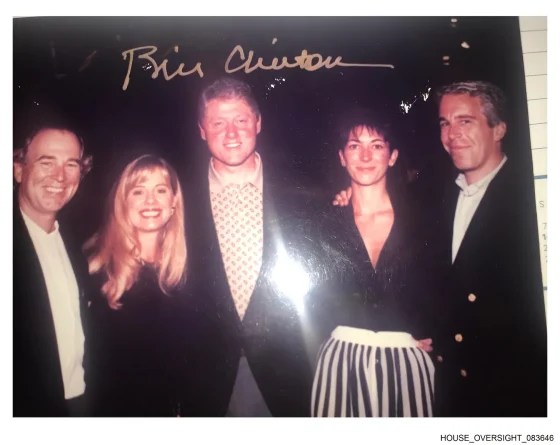
Dumb and horny, just like we like ‘em!
While Clinton was such an enthusiastic participant in his own compromising that it’s impossible to say which honeypot (Monica Lewinsky being the most famous) secured his cooperation, a nation that views the peaceful solution to a conflict as a greater evil than child-trafficking has clearly lost the plot. By the time Epstein’s operation was in full swing in 2000, Israel was literally run by (“alleged”) rapists. Ehud Barak, who would later be accused by Virginia Giuffre of raping her so violently she bled for hours and becoming aroused by her terror as she begged for her life, was prime minister, while Moshe Katsev, who would later be convicted of raping one of his employees, was president. That same year, the nation welcomed back Arie Scher, its disgraced vice-consul of Rio de Janeiro, after he was found to be trafficking children to Israeli tourists in Brazil, not only not prosecuting him but handing him a promotion as Consul of Canberra (Australia, in a rare show of good judgment, wouldn’t let him in). Another Israeli child trafficking ring was exposed in 2018 in Colombia, operating with protection from local authorities.
Barak seemed genuinely surprised when his friendship with Epstein, whom he would continue to visit at least 30 times in the US after the pedophile’s 2008 conviction required him to register as a sex offender, became a sticking point for voters during his attempted return as Prime Minister in 2019. Unwilling to believe Israelis had suddenly started caring about rape, especially rape of impoverished shiksas, Barak blamed his opponent Benjamin Netanyahu for ginning up a “poisoned atmosphere” to distract from the multiple corruption charges pending against him. Barak had a point — Israel had officially declared itself a Jewish supremacist state the previous year, abdicating any responsibility to protect its second-class citizens. After a 2024 UN report condemned Israel’s acceptance of the use of sexual humiliation, harassment and torture against Palestinian prisoners, 10 IDF soldiers were arrested for gang-raping a Palestinian man being held without evidence as a Hamas fighter. The backlash was immediate as government officials — led by Security Minister Itamar Ben Gvir, who called the rapists “heroes” — rallied to secure their release and demand those who ordered the arrest be punished. The soldiers’ lawyers even argued they had acted in self-defense.
Revelation of the Method
Unlike most intelligence agency honeytraps, Epstein’s trafficking ring included a public relations aspect, with glossy media profiles depicting him as a suave, mysterious, Jay Gatsby-by-way-of-James Bond playboy jet-setting around the world with princes and presidents, a bevy of (near)-babies surrounding him at all times. It is absurd to believe that it took a decade after survivor Maria Farmer first reported Epstein and Maxwell to the FBI for the agency to build a case against him even as he carried on with the same behaviors, or that the agency only found time to interview Farmer in 2006 after Palm Beach police made them look bad by charging the pedophile with abusing a 14-year-old girl. When the Palm Beach case landed in their lap as well, they waited until it was resolved in that jurisdiction, then wrote to victims falsely claiming a “thorough investigation” was underway. The agency’s behavior is less baffling given the FBI has been sexually compromised from its very beginnings, with founder J. Edgar Hoover blackmailed out of the gate by the same organized crime syndicate the agency was established to police, forcing him to deny the very existence of the Mafia for years. One can attribute the same motive to Kash Patel’s “who’re you going to believe, me or your lying eyes?” wide-eyed denials of reality.
Nor was the FBI the only law enforcement agency to mysteriously drop the ball on the 52-page indictment. Palm Beach State Attorney Barry Krischer abandoned the charges that could have put Epstein away for life after meeting with his defense team, deciding probation and a psychological evaluation would be sufficient punishment given that the girls were “prostitutes.” Krischer, who retired the following year, was in charge of the state’s Crime Against Children unit, yet had habitually refused to prosecute cases of men raping teenage girls even when his inaction led to further harm coming to the girls. His true motives were likely revealed in the award he would receive 10 years later from the Anti-Defamation League, an organization that was literally founded to protect Jewish pedophile and murderer Leo Frank from justice after he was found guilty of murdering his 13-year-old factory employee Mary Phagan. Bellowing the quiet part out loud, the ADL’s “Jurisprudence Award” is supposed to recognize “an outstanding contribution to the legal profession and to the community at large, while exemplifying the principles upon which the Anti-Defamation League was founded.” It certainly did that last part.
Palm Beach police chief Michael Reiter kicked the case up to US Attorney Alex Acosta, who also fumbled it, agreeing with Epstein’s lawyers to an infuriating no-prosecution deal on a single charge of soliciting a teen prostitute that would allow him to serve just 18 months in jail with day release. Victims were not told of the agreement, in violation of federal law. Acosta would later admit when he was interviewed by the Trump transition team for a cabinet post that he had been ordered to back off Epstein because “he belongs to intelligence,” but this was apparently acceptable to the incoming administration, which appointed him Secretary of Labor. Only when the public learned of the interaction was he pressured to resign.
Epstein had briefly considered fleeing to Israel like so many pedophiles before him in order to escape conviction, even complaining to friends that an “antisemitic conspiracy” in Palm Beach was to blame for his prosecution, a notion other Palm Beach Jews who didn’t spend their days molesting children found ludicrous. But instead, he embraced his new routine, leaving his cell each day to go to “work” and sneaking girls into his “office,” and served just 13 months of his sentence. He ignored the requirement that he register as a sex offender and was never asked to, nor did his wealthy and powerful friends drop him over his conviction.
As an asset of both US and Israeli intelligence, insulated in the personal wealth of mafia-affiliated Mega Group billionaires, surrounded by the wealthiest, most influential, and most powerful people he and Maxwell could lure into their nest, a retinue of nymphets obediently attending to his every need, Epstein likely believed that truly “getting caught” was impossible and thus resumed flaunting his lifestyle after weaseling out of the 2006 charges. Indeed, it’s the flaunting of the crime that makes for such an effective humiliation ritual. Confronted with such a towering miscarriage of justice, it is impossible to believe in the integrity of the US political system, and the destabilization of society advances by leaps and bounds.
Sex Slaves Breed Thought Slaves
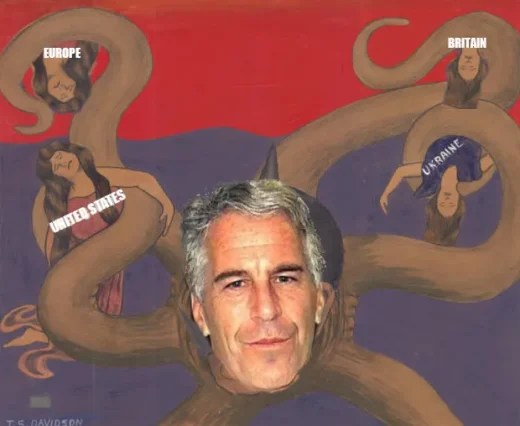
The reason for the treason
Only by recognizing the role of sexual blackmail and the networks that run it can Americans understand the generational betrayal that has reduced our political system to just another asset-stripping mechanism. Decades under the thumb of Big Parasite have withered the US from a proud world power to a desiccated husk, one unethical compromise at a time. Dignity and patriotism left the building when, fresh off a starring role in the assassination of JFK, Israel persuaded his successor Lyndon Johnson to look the other way as it attempted to sink the naval intelligence ship USS Liberty, killing hundreds of Americans to drag Washington into its war with Egypt. Johnson, repeatedly blocking rescue efforts so as to leave no survivors to tell the truth about the attack, inaugurated a traitorous tradition that subsequent presidents have followed religiously. Israel will be permitted to violate everything from international law to the laws of physics, while the US will stand by to enforce its lunatic demands. Americans, reduced to serfs on an Israeli plantation, embraced the scam of Christian Zionism to try to make some moral sense of the situation, a coping mechanism the Israeli lobby has eagerly exploited with propaganda campaigns aimed at turning American churches into recruiters for what is ultimately a self-effacing death cult. As the US’ national debt spirals uncontrollably alongside its foreign aid bill, it is a wonder Big Parasite has not instituted a debt forgiveness program that allows Americans to offer up their nubile young daughters as payment. What do you get the nation that has everything, besides shame?
Only when the role of institutionalized pedophilia as the driving force within the halls of power is taken into account does the behavior of American politicians, uniting in lockstep to tear up the Bill of Rights so Israel’s feelings aren’t hurt, make any sense. Mere avarice or lust for power cannot account for the anti-human, shortsighted cravenness that defines the political class. Warehouses full of video recordings of these people and their associates schtupping 14-year-olds can.
When a State Department official praises Israel over the US and brags about sporting a Star of David necklace despite being Italian, it’s not because they don’t understand optics. When the Democratic Party commits political Seppuku by embracing a “hug Bibi” pro-Israel strategy in the middle of a genocide, it’s not because they love the wildly corrupt Israeli PM more than their jobs. When BlackRock-controlled brands like Bud Light and Jaguar clamber on board the LGBT bandwagon in the most tone-deaf way possible, offending their entire customer base and tanking their stock price with commercials that constitute aesthetic terrorism, it’s not because they love gay people or hate money. These are acts of ritual humiliation that provide Big Parasite with spiritual nourishment. Many of Epstein’s victims report that he and Maxwell seemed to take as much pleasure in their fear and distress as they did in the sex itself. Like the girls, blackmailed politicians must betray themselves anew with every assignment, cringing through life like a kicked dog knowing somewhere in a nondescript warehouse sits evidence of crimes that could put them away for a very long time. It’s kiss the Wailing Wall or kiss their ass goodbye.
Destroying Something Beautiful
While the media has lazily followed Alan Dershowitz’s lead in characterizing Epstein’s victims as trailer-trash juvenile delinquents barely on the wrong side of the age of consent, Epstein and his associates were in fact very picky about their prey, spending at least as much time strategizing the ruination of the flower of gentile feminity (the absence of Jewish girls from the “sisterhood,” confirmed by Maria Farmer and also notable among the victims of producer Harvey Weinstein, is notable given the ethnic-supremacist ideology of the parasite class) as they did on compromising VIPs — though admittedly it wasn’t rocket science getting a prince or a president to drop his zipper in the presence of underage beauties. They wanted “white girls” who appeared “prepubescent” and demure, according to survivor Courtney Wild, while another report specified their ideal type as “nymphishly thin, with no tattoos.” Maxwell insisted the girls should be “as young as possible.” Not only were they required to be virginal and disease-free (on pain of death), but they were forbidden from drinking, smoking, and using drugs and put on strict diets if they started to gain weight. Academic achievement and artistic talent were a bonus. Youth and beauty were important, but it was purity and innocence they were targeting.
Epstein was ideally placed to recruit girls — and charm their wealthy parents — from his first job, having been installed as math and science teacher at the prestigious Dalton School despite lacking even a college degree in what was likely an intelligence posting designed to position him in New York high society. He leveraged his financial benefactor Les Wexner’s Victoria’s Secret brand to great effect, enticing girls to his townhouse by pretending to be a model scout. At Interlochen Center for the Arts, where he had attended a youth music camp, his name emblazoned on the “Jeffrey Epstein Scholarship Lodge” helped him pick up musicians, while New York Academy of Art’s dean of students Lisa Guggenheim allegedly pimped out her choicest young students to him, among them Maria Farmer, the painter who would first report Epstein to the FBI.
So innocent when she first met Epstein at a gallery show that she actually believed his explanation that the steady trickle of young girls (many in school uniforms) in and out of his townhouse were Victoria’s Secret models on casting calls, Farmer, hooked with the promise of helping her art career, reluctantly agreed to travel to brand owner Les Wexner’s Ohio estate to work as an artist in residence. Trapped on the well-guarded property and verbally abused by Wexner’s wife Abigail, she was kept under constant surveillance and forbidden to eat at the “Jewish-only” country club on the property, losing 20 pounds as she gradually lost her will to resist.
Farmer only snapped out of her despondency when Epstein and Maxwell sexually assaulted her during a visit to the estate. The pair had set their sights on her younger sister Annie after spotting a nude photo of her that Farmer had used for a painting, and Farmer realized she had been bundled off to Wexner’s so that they could have full access to the younger girl. While she ultimately escaped and reunited with her sister, her art career had been destroyed, not helped, by her association with Epstein, who had forced her to turn down a Hollywood painting commission so she could be locked away in Ohio instead. He and Maxwell threatened to cut her off from “art related opportunities,” and she fled the city to get away from them. Despite her pre-Epstein success selling $20,000 paintings and showing in galleries, she stopped painting for 20 years, explaining to Whitney Webb, “They destroyed me on purpose.”

Farmer’s painting depicting Epstein-world as a “diagram” for the clueless FBI
While one can only speculate on how many other talented young girls had their creativity deliberately snuffed out, or why this was so important to Epstein and Maxwell, it is clear that many brilliant works of art, music, and literature that could have uplifted humanity were not made because their creators were made to give up. This has left space for Big Parasite, with its chokehold on the entertainment industry, to aesthetically terrorize the population with soulless mediocrity without having to worry about competition. Under their guidance, music and other forms of popular entertainment have become not a celebration of life but a grooming tool, with Diddy’s “freakouts” only the latest sexual blackmail scandal to surface in an ecosystem that was literally built by organized crime. The sexualization of young girls by popular culture and the normalization of pornography have inspired epic pearl-clutching by politicians willing to look at everything except the source. The role of Epstein’s virgin sacrifices in the runaway success of Big Parasite in its cultural warfare against the West should thus not be underestimated.
Playing the Box
The surest route to long-term compliance with an unconscionable order is tricking the target into active participation in enforcing it, a strategy Epstein himself called “playing the box.” Only when their own participation in the trafficking ring had ceased with Epstein’s death did institutional enablers like JP Morgan Chase and the Virgin Islands government experience attacks of conscience over what they’d facilitated for so many years, though both stopped short of taking accountability and blamed the other for allowing their cooperation to be bought. Journalists who had obediently spiked negative coverage of the pedophile during his life marked his death with disingenuous bewilderment at why the media never looked into the girls.
Efforts to defuse the Epstein bomb by grooming the media were underway long before the pedophile was rearrested and “suicided.” Israeli intelligence operatives poisoned the epistemological well in 2017, priming the American public to reject future political pedophilia scandals by seeding 4chan and other social media platforms with the QAnon psy-op. Q recast Trump — whose mentor had been Roy Cohn, perhaps the most famous sexual blackmailer in US history — as a real-life superhero saving trafficked children from Deep State pedophiles. Smothering its kernel of truth (the rich and powerful are in fact preying on children on an industrial scale) in a bath of bullshit (JFK Jr faked his death and is coming back any minute now! here’s Hillary Clinton in a snuff film!), it suggested Trump was only pretending to sell out to the Deep State while secretly outflanking them in “5-D chess” ordinary folks weren’t smart enough to understand. The narrative punch was further spiked with promises that hundreds of sealed indictments dropping any minute now would send Hillary Clinton and other prominent Democrats off to Guantanamo Bay for life, and the cryptic post format encouraged followers to waste hours hunting for hidden messages, effectively making them participants in deceiving themselves. It should surprise no one that both QAnon itself and the 4chan /pol/ board where it originated were confirmed as Israeli intelligence honeypots earlier this year, with half of all /pol/ posts originating from IP addresses in that country. The Q narrative was tailor-made to pacify millions of Americans with hopium — why rise up against the government when there was a chance the “white hats” within the administration might be engaged in deeply heroic feats of child-rescue behind the scenes? — while ensuring the Epstein revelations would be met with yawns and disbelief by “real” journalists.

Who wouldn’t want to be associated with this?
Victims were also tricked into complicity with their abuse with the order to recruit other girls for pay, a dynamic that ensured their silence and kept many in Epstein’s thrall for months or years. What Palm Beach police described as a “sexual abuse pyramid scheme” was far more effective than threats alone. Many girls dutifully came back with friends, needing the money or believing the false promises of career advancement that had lured them to the property in the first place, even as they gradually lost their will to resist under repeated assaults by Epstein and Maxwell. These encounters were designed to humiliate and strip the girls of agency, and the pressure to recruit other girls blurred the line between victim and perpetrator so effectively that some opted to remain silent out of fear of prosecution, a valid concern given the aggressive legal tactics of Epstein’s defense team. Courtney Wild, who recalls bringing as many as 80 girls — all underage — to Epstein for $200-$300 per girl during the three years she spent in his orbit in Palm Beach, says the money kept her out of homelessness, but at a price. When she met Epstein at 14, she was an A student and captain of the cheerleading team despite a troubled home life. Deemed too old for the predator’s tastes at 17, she drifted into stripping and began using drugs, eventually spending time in prison while her abuser continued feeding on her peers.
The same model of grooming that saw Epstein’s victims evolve from shocked repulsion at the public sex acts performed on his properties to reluctant participation and ultimately to gathering juicy details on the VIPs they were loaned out to can be observed in any society under parasitic exploitation. A wet-behind-the-ears politician initially appalled at the feeding frenzy of lobbyists bidding on his integrity will soon be hooked on their money, perhaps even coming to enjoy the quarterly debriefing with the “AIPAC babysitter” the Israeli group has apparently assigned to everyone in Congress except Thomas Massie. Americans who protested George W. Bush’s illegal invasion of Iraq in 2003 didn’t even raise an eyebrow when his successor Barack Obama, Nobel Peace Prize in hand, began bombing five more countries, and later freaked out when Trump threatened to end the war in Ukraine. Repeat an atrocity enough times and it becomes business as usual.
All Wars are Pedos’ Wars
It’s hard not to compare Epstein’s girls — thrown away once they aged out of jailbait, having given their best years in servitude to masters who saw them as “trash” — with the (mostly) male victims of the US military-industrial complex. These, too, are often left broke and broken on the streets after too much killing has rendered them “unfit for polite society” (in the cringeworthy words of Pete Hegseth). War historically harvests the cream of the generational crop, sacrificing the strongest and bravest boys to enrich a ruling class whose own children always dodge conscription, and while voluntary service has lowered the profile of such systematic abuse, poor kids with no prospects are easily enticed into joining the armed forces the same way girls were sucked into Epstein’s world: promises of good pay, good education, and the opportunity to achieve their dreams. Through the ur-humiliation ritual of boot camp, they become aggressive little golems eager to wipe their asses with international law (and their own self-preservation instincts) for America’s Best Friend, blasting brown civilians until they end up losing a limb or their mind and get sent home, the realization finally dawning that they’ve been used and thrown away. Reading US Third Air Force Commander Lt. Gen Richard Clark tell the Jerusalem Post (once owned by Robert Maxwell) that US troops would be ready and willing to die for Israel, how many veterans felt like General Patton, horror dawning that they have defeated the wrong enemy and doomed the world? Certainly, Israel’s continued existence as a nuclear-armed ethnostate determined to achieve the ultimate loosh harvest by conducting the world’s first live-streamed genocide in Gaza — gorging themselves on the suffering not only of the Palestinians but of everyone who watches the violence knowing that it’s funded by their tax dollars and that there’s nothing they can do about it —is not going to leave many survivors.
While war for its own sake is beloved by Big Parasite, it too has a parallel pedocentric motive: extracting foreign nations’ nubile natural resources for financial and sexual exploitation through UN “peacekeepers” and private military contractors. Sex trafficking by UN peacekeepers is so common it has its own Wikipedia article. The peacekeeping force seems tailor-made for predators, as they are not governed by local laws, and their home country is unlikely to follow up on a claim against them by a foreigner halfway around the world. Abusers caught in the act are merely sent home. The UN has promised to beef up accountability for decades, but no change has been forthcoming, suggesting the widespread child rape is a feature, not a bug. In Haiti, where Hillary Clinton infamously intervened in 2010 to reduce the sentence of missionary Laura Silsby after Silsby was caught attempting to kidnap 33 children from the country, rape by peacekeepers has become so common that a 2017 investigation found only one woman in 12 who’ve been raped by a UN peacekeeper even bothers to report the abuse anymore, knowing nothing will be done. Wars and natural disasters both provide an ideal environment for stealing children, as populations are displaced and authorities distracted while the presence of foreign do-gooder operations is seen as normal, even desirable, by outsiders.
Because private military contractors are not subject to US or military law when operating overseas, they are extremely popular with intelligence agencies in need of plausible deniability for their black ops. They have also become synonymous with human trafficking. The CIA’s preferred contractor Dyncorp was forced to fire several employees in Bosnia in 1999 after two separate whistleblowers revealed the company was operating a sex trafficking ring with the help of the Serbian mafia, flying girls as young as 12 from Serbia, Russia, Ukraine, Moldova, and Romania into local brothels and sex clubs where they were trafficked to Dyncorp personnel as well as UN, NATO, and human rights NGO workers. Dyncorp was involved in all areas of the operation, forging documents, smuggling the girls through checkpoints, and tipping off brothel owners to raids. Despite an abundance of evidence that included the company’s Bosnia site director making a home video of himself raping two of the girls, no one was prosecuted, the girls were sent back home, and Dyncorp even kept its contract to provide police forces to the UN. However, the whistleblowers were fired. The plane Dyncorp used to bring the girls to Bosnia shared a tail number with a helicopter owned by Epstein, who was known to have purchased his own Yugoslavian sex slave Nadia Marcinkova during the civil war.
In 2004, Dyncorp contract workers at an airbase in Colombia filmed themselves molesting local kids and distributed the video in the streets of Bogota, suggesting self-blackmail may be de rigueur at the company as a form of mutually assured destruction. Another incriminating video leaked online in 2010 showing Dyncorp employees who’d been contracted to train the Afghan police force enjoying lapdances from a young boy dressed as a female. Pizzagate princess Hillary Clinton herself helped squash the story, though the scandal would ultimately leak again in a Wikileaks cable dump. Sex trafficking by military contractors is so common the Pentagon’s effort to ban it (presumably due to the bad publicity) was shot down by industry lobbyists.
In the glorified money laundering operation that is Vladimir Zelensky’s Ukraine, an entire generation of men has been sacrificed so the parasitic elite can indulge their perversions. White Angel, a paramilitary offshoot of the Israeli-funded neo-Nazi group Azov Battalion, has trafficked tens of thousands of children out of the country under orders from Zelensky’s government, taking advantage of demoralized and confused parents’ willingness to hand over their kids to “any person in military or police uniform” amid the fog of war. Paid $2,000 for each stolen child, the state-sponsored predators were deployed daily in villages across eastern Ukraine in a bid to strip its assets before the inevitable Russian victory, given orders to use violence against parents who would not voluntarily hand over their kids. Ending up an Israeli billionaire’s sex slave might actually be the more desirable of the options open to kidnapped Ukrainian children, however — many were allegedly sold for parts, with organ trafficking such big business in the country that the Verkhovna Rada literally legalized organ theft in 2021, removing the requirement for consent from a donor or relative. While the people of Ukraine have long since soured on their corrupt government, it is clear Zelensky and his puppet-masters are unwilling to permit the end of the war because of the sharp drop in income it would entail.
While Big Parasite consolidated itself under the cover of “Israel” when that nation was created, taking advantage of international sympathy towards Jews post-WW2 to ethnically cleanse its new home with shocking viciousness, it has always been a global network whose only real loyalty is to itself. Organized child sex trafficking is not a recent innovation. An attempted crackdown on “white slavery” in Eastern Europe in the late 19th century raised familiar questions regarding impoverished female victims’ agency in the sex trade, tolerance and even regulation of the trade by the authorities, and the ethnic dynamics of Jewish traders trafficking Polish and Galician nubiles — often tempted with promises of “real” jobs and wealthy husbands, or at least financial freedom — to slave auctions and Middle Eastern harems, their earnings heavily taxed or confiscated. Like Alan Dershowitz, modern apologists for the white slavers argue that desperate families’ willing sale of their daughters — some of whom might have already had sexual experience — in order to pay their debts constituted consensual prostitution, dismissing the stereotype of predatory Jewish slavers as a blood libel because Polish and Galician pimps existed as well and that if Jews hadn’t stepped in to run the sex trade with better business acumen, it would still have existed. Epstein, who bragged about buying “sex slave” Nadia Marcinkova from her parents in Yugoslavia, would be proud.
Pedo-Futurism

Palantir’s Alex Karp, giving a biiiiiig welcome to the technocratic dystopia
It is not only our present that has been hijacked by this criminal gang, but our future. Seemingly driven by the same pre-traumatic stress syndrome that leads them to see a Shoah in every shoelace, agents of Big Parasite have flooded the communications and technology sector with backdoored equipment and spyware so completely that surveillance is the expectation, not the exception. It is not an exaggeration to say that their quest for omniscience created the modern surveillance state, and that this process has been driven, enabled, and protected by sexual blackmailers. Robert Maxwell sold backdoored PROMIS communication software to 42 governments including the US in the 1980s, opening up the mother of all eavesdropping channels. Ghislaine’s sister Christine sold Chiliad datamining software to the FBI to enable its “War on Terror” through aggressive surveillance of Israel’s enemies, guiding US foreign policy off a cliff. Palantir, the CIA-funded pre-crime program that was recently handed centralized control over all US government systems, began as an extension of PROMIS and has blossomed into a dystopian surveillance behemoth whose executives openly boast about killing people and telegraph their allegiances by reminding the world that they “defer to Israel.” Ghislaine’s other sister Isabel opened the door to Big Parasite’s takeover of the internet by convincing Silicon Valley investors to pour funding into Israeli startups in the 1990s, leading to the success of companies like Commtouch, now a ubiquitous and hidden part of email systems used by Google and Microsoft (whose founder, Bill Gates, has been a friend of Epstein since the 1990s). Israeli startups acquired by US tech giants can easily take control of the company’s direction from within without disturbing the public-facing image of the company as all-American, and this has become standard operating procedure for Israel’s military intelligence Unit 8200, which has turned industry giants like Microsoft and Intel into espionage bonanzas even as their products degrade in quality, burdened and bloated with snitchware. When Netanyahu reminded smartphone users that they were “holding a piece of Israel,” he was not exaggerating — Israeli companies like Pegasus, Candiru and Ehud Barak’s Epstein-funded Carbyne911 have perfected the transformation of personal communications device into personal surveillance device.
Every elite sex trafficking scandal that becomes public is reported in a vacuum, as if there have not been hundreds if not thousands more not mentioned here. Evidence of similar rings can be found anywhere humanity’s baser instincts are exploited. Every time we fail to interrogate the “why” of these scandals beyond “powerful men are into forbidden fruit” and keep silent out of fear of offending the boot wedged firmly on our necks, we are giving our agency over to these predators. As long as there are assets left to strip, Big Parasite will be there, luxuriating in our cowardice while it grows fat off our distress. Epstein may be dead and gone, but the network that created him is still screwing us all.
Featured Video
Elijah Magnier: Yemen’s strikes are shattering Saudi Arabia’s long-term strategy
or go to
Aletho News Archives – Video-Images
From the Archives
British weapons and personnel doing much of the killing in Yemen
Press TV – June 18, 2019
A detailed report published by the Guardian newspaper has shown how Britain is massively contributing to Saudi Arabia’s devastating war on Yemen as it suggests that London is not only supplying the bombs that fall on Yemenis, but it provides the personnel and expertise that keep the war going.
The comprehensive report by Arron Merat published on Tuesday showed that Britain was doing much of the killing in Yemen as the country continues to provide Saudi Arabia with everything it needs to turn its southern impoverished neighbor into a graveyard.
“Every day Yemen is hit by British bombs – dropped by British planes that are flown by British-trained pilots and maintained and prepared inside Saudi Arabia by thousands of British contractors,” said Merat in the report. … continue
Blog Roll
 Aletho News
- Netizens condemn Japanese drama for projecting Japan’s wartime atrocities onto Chinese characters
- Racist Seinfeld Dances for Joy as Bibi Unveils His New Map
- A West Bank War for Netanyahu’s Election Campaign, Could It Backfire?
- Yemen denounces European Parliament’s ‘hypocritical’ push to blacklist Ansarullah
- Qalibaf: UAE’s UN bid aims to ‘clear the runway’ for ‘Greater Israel’, whitewash genocide
- Pakistan reopens Iran border after boosting security: Report
- Why are so many Brazilians voting for Flávio Bolsonaro?
- Democrats Put Anti-Russia Agenda Ahead of American Workers
- Elijah Magnier: Yemen’s Strikes Are Shattering Saudi Arabia’s Long-Term Strategy
- Pentagon designates Chinese cultural centers national security threat
- If Americans Knew
- An error has occurred; the feed is probably down. Try again later.
- No Tricks Zone
- Sudden Stratospheric Warming, Powerful El Niño Combination May Lead To Extreme Europe Cold, Energy Crisis!
- Two New Studies Find Thwaites Glacier Melt Cannot Be Driven By Human Activity Or A Warming Ocean
- E-Cars Reduce CO2 Emissions By Only 41% Compared To Internal Combustion Engine Vehicles
- Predictions Made By Renowned Climate Professor Over Past Decades Have Been Proven To Be Poor
- New Study Suggests Large Regions Of The Pacific Ocean Have Been Cooling For The Last 80 Years
- Germany’s Green Energy Debacle: High Energy Costs Force Kahla Porzellan to Close After 182 Years!
- New Study: 50 Years Of The Most Aggressive ‘Net Zero’ Policies Can Only Affect The Global Climate By 0.03°C
- US September “Heat” Was No Record…Many Records Set Decades Ago
- Latest European Green Energy Debacle; Portugal’s Largest Flagship Solar Park Insolvent!
- Green Energy Debacle: German Expert Professor Fritz Vahrenholt Warns Of Severe Economic And Social Consequences

