The Only Way For America To ‘Help’ Iran Is To Lift the Crushing Sanctions
The Dissident | January 12, 2026
On Truth Social, Donald Trump recently promised to “help” protestors in Iran, saying, “Iran is looking at FREEDOM, perhaps like never before, The USA stands ready to help!!”
By “help”, Trump meant unleashing a new American/Israeli bombing campaign in the country to enact regime change. According to the New York Times, “President Trump has been briefed in recent days on new options for military strikes in Iran as he considers following through on his threat to attack the country for cracking down on protesters, according to multiple U.S. officials familiar with the matter.”
In reality, the only way Trump can “help” the people of Iran is by removing the sanctions on the country, which were placed on the country with the explicit goal of causing economic collapse and a mass uprising, leading to regime change in Iran.
In its early days, the Obama administration ramped up sanctions on Iran in a “maximum pressure” campaign.
As journalist Max Blumenthal uncovered, Richard Nephew, who coordinated the sanctions on Iran under the Biden administration, in his sadistic book, “The Art of Sanctions” boasted that because of the sanctions, “Iran’s economy went from GDP growth of 3 percent to a 6.6 percent contraction between 2011 and 2012 . Iranian unemployment and inflation remained in the double digits. In 2012, Iran’s currency depreciated threefold in a matter of weeks, resulting in the hemorrhaging of Iranian hard-currency reserves.”
Nephew boasted in the book that the intention was to destroy Iran’s economy, while running propaganda operations designed to trigger unrest against the government due to the economic situation, writing:
The United States took its surgical sanctions approach a step further in June 2013 with a carefully structured set of sanctions on Iran’s automotive sector, denying Iran the ability to import manufacturing assistance but not spare parts for existing autos or whole cars themselves. Iranian manufacturing jobs and export revenue were the targets of this sanction, undermining the Iranian government’s attempt to find non-oil export sectors and ways of employing 500,000 Iranians.
All the while, the United States expanded the ability of U.S. and foreign companies to sell Iranians technology used for personal communications, helping ensure that the Iranian public had the ability to learn more about the dire straits of their country’s economy and to communicate
Richard Nephew boasted that the sanctions were intended to cause “income inequality and inflation” in Iran in order to “drive up the pressure on the Iranian government from internal sources”, boasting:
With Iran’s population technically able to purchase such goods and imports still flowing in, but with the exchange rate depriving most people of the practical benefit of being able to purchase these goods, only the wealthy or those in positions of power could take advantage of Iran’s continued connected- ness. Hard currency streamed out of the country while luxuries streamed in, and stories began to emerge from Iran of intensified income inequality and inflation . This was a choice, a decision made on the basis of helping to drive up the the pressure on the Iranian government from internal sources.
He also boasts that the sanctions deprived Iranians’ ability to purchase medical equipment and “directly contributed to the deprivation of the Iranian rial”, writing:
In Iran, for instance, there were reports throughout 2012 and 2013 that medicine and medical devices were unavailable not because their trade was prohibited but rather because they cost too much for the average Iranian due to shortages and the depreciation of the Iranian currency. The United States and its partners, through sanctions, directly contributed to the depreciation of the Iranian rial and, consequently, played some part – even if unintentional- in the creation of this problem.
In 2015, Obama ended the “maximum pressure campaign” against Iran through the Joint Comprehensive Plan of Action (JCPOA), which loosened sanctions in exchange for Iran limiting its nuclear enrichment, much to Benjamin Netanyahu’s dismay, leading him to give a speech in front of the United States Congress in an attempt to stop the deal. [The US failed to actually implement their side of the deal. In the end the EU never resumed normal trade either.]
Benjamin Netanyahu got his wish in 2018, when Donald Trump, at the behest of his Zionist donors, such as Paul Singer and Sheldon Adelson, pulled out of the deal and reinstated the “maximum pressure” sanctions against Iran.
Like Richard Nephew, Trump’s then Secretary of State Mike Pompeo boasted, “Things are much worse for the Iranian people [with the US sanctions], and we are convinced that will lead the Iranian people to rise up and change the behavior of the regime”.
Human Rights Watch documented at the time that the renewed sanctions on Iran were, “severely limiting Iranian companies and hospitals from purchasing essential medicines and medical equipment from outside Iran that residents depend upon for critical medical care” and “directly impacted families’ purchasing power, contributing to inflation rates of around 30 percent”.
This time, as Human Rights Watch documented, the sanctions were even harsher than the previous sanctions under the Obama administration, “including doing things like designating some Iranian financial institutions not previously designated and that were previously used to facilitate food, medicine and medical imports”.
Human Rights Watch also documented that, “The Trump administration’s September 20, 2019 decision to impose further sanctions on Iran’s Central Bank under its ‘counterterrorism authority’ severely restricts the last remaining Iranian financial institution able to engage in foreign exchange transactions involving humanitarian imports”.
Elliott Abrams, the Zionist architect of the Trump’s administration’s Iran sanctions, boasted to Israel Hayom that because of the Trump administration’s sanctions, “At the end of Trump’s term, Iran was facing bankruptcy” adding, “If Trump had received four more years, the regime would have faced a choice between economic collapse and mass uprising or halting the nuclear program.”
The Biden administration continued Trump’s sanctions on Iran at the behest of the Israel lobby, never renegotiating the Iran deal.
Since getting into office, Trump has ramped up the sanctions on Iran even further, signing an executive order in February that sanctioned any country that buys oil from Iran with the intention to “drive Iran’s export of oil to zero”. The White House statement in February bragged that the sanctions were intended to “restore maximum pressure on the government of the Islamic Republic of Iran” and “impose maximum economic pressure” on Iran.
In June Al-Monitor reported, “The Trump administration announced … what it called its most extensive set of Iran-related sanctions since 2018, targeting a ‘vast shipping empire’ involved in transporting oil and petroleum products from Iran and Russia” which, “target more than 115 individuals, entities and vessels across 17 different jurisdictions, including the United Arab Emirates, India, Turkey, Singapore and Switzerland.”
Just as Richard Nephew, Mike Pompeo, and Elliott Abrams boasted would happen, the sanctions helped cause the economic collapse that sparked the current protests, which were soon exploited by the U.S. and Israel to enact their desired regime change campaign.
If, Trump really cared about helping Iranians, he would end his “maximum pressure” campaign on the country, but instead, he cares about launching a regime change war at the behest of Benjamin Netanyahu.
Israel’s ‘Ceasefire’ In Gaza Turns Out To Be A Ruse
Israel Is Planning To Resume The Full Scale Genocide In Gaza Starting In March
The Dissident | January 11, 2026
Israeli officials are now admitting that the so-called ceasefire in Gaza was a ruse, and they plan to resume the full-scale genocide and ethnic cleansing of Gaza in March.
According to a report in the Times of Israel, “The Israel Defense Forces has drawn up plans to launch renewed intensive military operations in Gaza in March, with an offensive targeting Gaza City aimed at expanding the part of the Strip controlled by Israel”.
The Times of Israel boasted that the ceasefire was a ruse to make it easier to bombard all of Gaza without killing Israeli prisoners of war, quoting the research fellow at the Israel Center for Grand Strategy, Erez Winner saying, “an offensive against Hamas would now be easier for Israel because it no longer has to worry about putting hostages at risk, now that all the living hostages and all but one hostage’s body have been returned.”
This confirmed what many had already speculated, that Israel was never serious about committing to the ceasefire agreed to in October and always planned to resume the genocide in Gaza.
As the former deputy commander of the IDF’s Gaza Division, Amir Avivi admitted to Israel’s Channel 14, Israel only agreed to the ceasefire because, “After two years of fighting, the tools are worn out. We want to refresh the forces, to establish the defense line”.
Furthermore, Israel never actually adhered to the ceasefire or ended the genocide, only slowed it down, with Gaza’s health ministry documenting that, “442 people have been killed and 1,236 injured since October 11 – the date the Gaza truce entered into force.”
Furthermore, Israel never ended the blockade in Gaza, and has planned to ramp it up by the time it resumes the full-scale genocide in March, by blocking 37 aid groups operating in Gaza, including Doctors Without Borders, effective March 1st.
The Israeli human rights organization B’Tselem documented in December that, “only 57% of the 556 aid missions planned by the UN and its partners were carried out, including the delivery of vital aid and equipment, medical evacuations, and infrastructure repairs” adding, “Israel’s genocidal campaign in Gaza did not end with the ‘ceasefire’ declaration. Blocking humanitarian aid, alongside ongoing airstrikes and shootings, is a direct continuation of the assault on Gaza’s population.”
Now Israel plans to resume the genocide and genocidal starvation siege in Gaza in March.
Along with the fact that the Israeli prisoners of war being released will make it easier for Israel to indiscriminately bomb Gaza and the fact that it gives them the chance to “refresh the forces”, there are other calculations from Israel which will make their genocidal ethnic cleansing plan easier by March.
Gila Gamliel, Israel’s Science and Technology Minister, who was previously Israel’s Intelligence Minister admitted that Israel’s ultimate plan is to, “make the Gaza Strip uninhabitable until the population leaves”.
Now Israel has a dumping ground for ethnically cleansed Palestinians after making Gaza “uninhabitable”- Somaliland.
In late December, Israel became the first UN nation to recognize Somaliland, a breakaway separatist region of Somalia, as a state.
This was done in part because – as Israeli journalist Amit Segal boasted – because “Somaliland was supposed to – and may still – absorb Gazans”.
The Israeli paper Ynet noted at the time, “The territory has recently been mentioned as a possible destination for Gazans, with officials there saying they would be willing to absorb ‘one million Gazans’”adding that, “Israeli intelligence officials say the Mossad has been active in Somaliland for years, laying the groundwork for the recognition through long-standing, discreet relationships with senior figures there.”
Dan Diker, the president of the Likud connected Jerusalem Center for Security and Foreign Affairs admitted, “our friends in Somaliland made a very generous offer privately … of their willingness to absorb or to create communities for hundreds of thousands even beyond a million up to a million and half Gazans” adding, “Somaliland, in our understanding, is really the only country, now country, that stepped up to the plate to absorb Gazans”.
According to Somalia’s Defence Minister Ahmed Moalim Fiqi, “Somalia has confirmed information that Israel has a plan to transfer Palestinians and to send them to Somaliland.”
Furthermore, Israel is undoubtedly hoping that by March, it, along with the U.S., will have carried out regime change in Iran, further isolating the Palestinians and cutting off a key ally of resistance groups Hamas, Hezbollah, and Ansar Allah, which would be a bulwark to Israel’s resumption of genocide and ethnic cleansing in Gaza.
Israel, through social media campaigns and apparent Mossad agents on the ground, has been encouraging the current riots unfolding in Iran, hoping they will lead to regime change.
Along with this, they are pushing Trump to support another regime change bombing in Iran in response to a government crackdown on the riots, with Trump repeatedly threatening to “hit them (Iran) very hard” and, saying, “If Iran shoots and violently kills peaceful protesters, which is their custom, the United States of America will come to their rescue. We are locked and loaded and ready to go.”
Through regime change in Iran, Israel hopes to take out one of the last allies of Palestinian resistance, paving the way for its ethnic cleansing plan.
What Does Venezuela Have to Do with Israel?
It may have friends that Netanyahu does not like
By Philip Giraldi • Unz Review • January 9, 2026
It is interesting to observe how United States foreign policy, such as it is, often appears to have an Israeli back story that explains at least in part how Donald Trump’s mindless aggression against much of the world is driven by Zionist imperatives rather than actual American interests. Ukraine is supported by Israel and the US Israel Lobby in part because the roots of many diaspora and Israeli Jews are “Kazarian,” i.e. they derive from that part of Eastern Europe. Plus, Ukraine’s acting head of state Volodymyr Zelensky is a Jew whose mother and father reportedly live in Israel in a posh residence paid for by the money stolen by their son from US and European donations to Kiev to fight Russia. Also, the Jewish antipathy towards Moscow in large part derives from the belief that Imperial Russia was the source of many pogroms in the nineteenth and early twentieth centuries. That narrative fails, however, to mention how Russian Jews turned Bolshevik and, becoming enforcers of the Communist Revolution, subsequently got their revenge a hundred-fold on Russian and other Eastern European Christians.
And, of course, it has been frequently observed how US policy in the Middle East is essentially dictated by war criminal Prime Minister Benjamin Netanyahu, who de facto controls both Trump and the US Congress. The Israel Lobby also has significant input into what goes on at state and local government levels and has considerable control over what appears in the national media, which they increasingly own thanks to the efforts of Jewish billionaires like Larry Ellison. This ability to use money to manipulate politics and government has been manifested in the ability to suppress free speech in the United States when the topic is Israel’s abhorrent behavior towards the Palestinians and its other neighbors. Criminalizing antisemitism, which includes any criticism of Israel, has become the crime du jour to silence opposition to pro-Zionist agendas at both federal and state levels and it has also been used to eliminate Palestinian support at universities and through the job market. Beyond that, the US State Department is now demanding access to the social media of visa applicants so that those who are supporters of the Palestinian cause can be blocked from entry into the United States. This is what Jewish power in America is all about.
It is interesting to note the somewhat unexpected Israeli and Jewish hand in recent US aggression directed particularly against Venezuela. There are several main reasons for the Venezuela hit. Caracas developed a close relationship with Iran through its negotiations over BRICS and has unambiguously sided with Palestine in denouncing the Zionist war crimes and crimes against humanity. This clearly was impressed upon Donald Trump and his consiglieri by the Israelis and members of the Israeli Lobby like Miriam Adelson and Laura Loomer who have full access to the president and who no doubt were able to convince the Orangeman that he would be able to benefit by striking against an ally of a common enemy of the US and Israel with one fell swoop.
Trump could and did plead nevertheless that he was only applying his heavily promoted “corollary to the Monroe Doctrine,” which he inevitably dubbed the “Donroe Doctrine,” and which was explicit in the new National Security Strategy. But he surely knew that he would also at the same time be satisfying the demands of his Jewish donors and Netanyahu himself, who undoubtedly raised the issue of Venezuela with the president and his staff on his recent visit to Florida.
So the possibility that there just might be a relationship between Venezuela and Iran has become something that is exploitable by the Israel Lobby and also by Trump. On his recent visit, Benjamin Netanyahu was quick to identify the issue and no doubt also personally pushed for Trump to do something right away. Bibi also appeared on US television and told one interviewer that Iran is “exporting terrorism… to Venezuela. They’re in cahoots with the Maduro regime… this has got to change.” The Israelis also see ties between Caracas and both Hamas and Hezbollah, a claim that has been echoed in the US national-Zionist-at-all-times media.
To cite only one example of how it works, Fox News has published an article claiming Maduro’s Venezuela has become “Hezbollah’s most important base of operations in the Western Hemisphere, strengthened by Iran’s growing footprint and the Maduro regime’s protection.” Ultra-Zionist US Ambassador to Israel Mike Huckabee, not to be outdone, later doubled down, stating publicly that the US overthrow of Maduro was good news for Israel because of Venezuela’s partnership with Iran and Hezbollah.
The New York Times meanwhile has soft-pedaled its news coverage of the Caracas attack and instead has featured several prominent Zionist opinion contributors who have argued that for those Middle Eastern connections alone Venezuela has deserved everything that it has so far received at the hands of the US military. The always reliable Israeli firster Bret Stephens opined that There Were Good Reasons to Depose Maduro citing the Venezuelan Vice-and-Acting President Delcy Rodríguez having “claimed Maduro’s capture had ‘Zionist undertones,’ suggesting that her grip on reality may not be what the [Trump] administration hopes.”
And on the same day in The Times there appeared good old reliable Elliott Abrams in his A Defense of US Intervention in Venezuela claiming that he knows things about the threat posed by Venezuela that no one else seems to be aware of aside from him and his Zionist buddies. He states that “… they have invited into Venezuela Cuban thugs, and Hezbollah and Iran, as well as Russia and China. So, it’s a security issue for the whole region, again, including for the United States. For Hezbollah, for example, and Iran, we know that the Maduro regime gave them blank passports so that agents of Iran and Hezbollah could be moving around Latin America and elsewhere under false identities. We know that Iran has helped not only give drones to the Venezuelan military, but helped them learn how to build drones. We know from the Israeli experience with Iran, drones can go a very long distance now. We’re talking about drones that can hit not only Puerto Rico, but hit the continental United States. When I was in the State Department doing this about five years ago, Iran was contemplating giving intermediate-range missiles, which could reach the United States, to the Maduro regime in Venezuela. So this is an actual security threat in Latin America and to us.”
So Israel and its friends were no doubt delighted when Donald Trump decided to attack Venezuela and kidnap its president Nicolas Maduros. Netanyahu personally thanked Washington after the Venezuela attack took place, tweeting that “Congratulations, President @realDonaldTrump for your bold and historic leadership on behalf of freedom and justice. I salute your decisive resolve and the brilliant action of your brave soldiers.”
Perhaps this extra agenda in support of Israel explains why Venezuelan Acting President Delcy Rodriguez has herself gone on television to say her country will not be “cowed” by Washington. As Bret Stephens maintains, she also believes that “Venezuela is the victim and target of an attack of this nature, which undoubtedly has Zionist undertones. It is truly shameful.” To be sure there is one thing that is true, that as Venezuela is critical of Israeli war crimes, its government has broken diplomatic relations with Tel Aviv and recognized Palestinian statehood. It might therefore very plausibly be suggested that Netanyahu, speaking for his government, which in return has been openly supporting regime change in Venezuela, played the decisive role in convincing his pliable tool Trump to move on Caracas sooner rather than later when they met recently in Mar-del-Lago.
So the attack on Venezuela has opened the door to all kinds of complications and intrigue. Given the ability of the Israelis to manipulate an ignorant and confused Trump, who now claims his policies are guided only by his “morality” rather than “international rule of law,” the next developments will almost certainly include a joint Israel-US attack on Iran. And when that initiative has run out there will certainly be still more enemies of Israel to confront. And what will be the benefit for the average American when all the costs and deaths are counted after it is all over? As usual, “Nothing!”
Philip M. Giraldi, Ph.D., is Executive Director of the Council for the National Interest, a 501(c)3 tax deductible educational foundation (Federal ID Number #52-1739023) that seeks a more interests-based U.S. foreign policy in the Middle East. Website is https://councilforthenationalinterest.org address is P.O. Box 2157, Purcellville VA 20134 and its email is inform@cnionline.org
Inside Israel’s Support For Reza Pahlavi
Israel Wants The Son Of Iran’s Former Shah In Power After A Regime Change War
The Dissident | January 10, 2026
Recently, Reza Pahlavi, the son of the former U.S./Israeli backs Shah of Iran- who was installed after the U.S. backed a coup against Iran’s democratically elected president Mohammad Mosaddegh in 1953, and overthrown in the Iranian Revolution in 1979- has been encouraging increasingly violent protests with the goal of regime change in Iran.
Pahlavi, who lives in Washington, has been cheering on pro-regime change protests saying in a message to protestors , “I am certain that by making our street presence more targeted, and at the same time cutting off the financial lifelines, we will completely bring the Islamic Republic and its worn-out and fragile repression apparatus to its knees”.
He went on to call for protestors to seize cities in Iran with the eventual goal of regime change, saying, “In this regard, I invite workers and employees in key sectors of the economy – especially transportation, oil, gas, and energy – to begin a nationwide strike. I also ask all of you today and tomorrow, Saturday and Sunday (January 10 and 11), from 6 p.m., to come to the streets with flags, images, and national symbols and claim public spaces as your own. Our goal is no longer merely to come to the streets; the goal is to prepare for seizing the centers of cities and holding them” adding, “I, too, am preparing to return to the homeland so that at the time of our national revolution’s victory, I can be beside you, the great nation of Iran. I believe that day is very near. Long live Iran”.
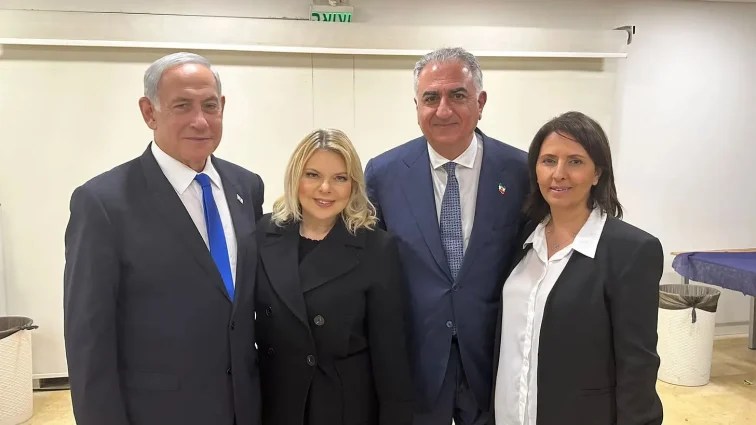
What is not as well known is that Reza Pahlavi is deeply connected to Israel, and that Israeli intelligence has run propaganda campaigns in an attempt to promote Pahlavi, who they want to prop up after enacting regime change in Iran.
In 2023, Reza Pahlavi made an official visit to Israel, at the behest of its then Intelligence Minister, Gila Gamlie, where he met with Benjamin Netanyahu and Israeli President Isaac Herzog.
During the visit, he called for Iran to move towards Israel and away from supporting Palestinian resistance. As Forward noted, “In April 2023, Pahlavi traveled to Israel, where he met with Prime Minister Benjamin Netanyahu and President Isaac Herzog, and paid a visit to the Western Wall, where he said he prayed ‘for the day when the good people of Iran and Israel can renew our historic friendship.’ He even consulted Israeli water management scientists, whom he dubbed the ‘best experts in the field,’ to help him develop a plan of action for Iran’s water crisis, which has also been a major point of contention for protestors.”
The Likud-connected Jerusalem Centre for Security and Foreign Affairs wrote at the time of the visit, “The main message of his visit was the possibility and urgency of peace between the two ancient nations of Israel and Iran. However, this will not happen unless the Iranian people can succeed in overthrowing the Islamic Republic, the common enemy that cements the relationship between a majority of Iranians and Israel.”
In other words, Israel wants regime change in Iran and to install Reza Pahlavi, so it can continue it’s ethnic cleansing plan in Gaza and the West Bank and further greater Israel expansion, without facing any roadblocks from Iran, and to cut off a supporter of resistance to Israeli expansion.
During the visit, Reza Pahlavi promised to further this Israeli goal if he were installed in power, saying, “The biblical relationship we have with Israel was long before it became a state”.
Following the visit, Israeli intelligence launched a propaganda campaign online, designed to promote Reza Pahlavi and support for him being installed into power in Iran.
The Israeli newspaper Haaretz reported that following the visit, “a large-scale digital influence campaign in Persian was underway, operated out of Israel and funded by a private entity that receives government support,” adding, “The campaign promotes Pahlavi’s public image and amplifies calls for restoring the monarchy. The campaign relies on ‘avatars,’ fake online personas posing as Iranian citizens on social media.”
Haaretz went on to report:
According to five sources with direct knowledge of the project, native Persian speakers were recruited for the operation. Three of the sources confirmed the connection between the project and this specific campaign, and said they witnessed the network advancing pro-Pahlavi messaging.
According to the sources, the campaign included fake accounts on platforms such as X and Instagram and used artificial intelligence tools to help disseminate key narratives, craft its messages, and generate content.
The report added, “While Pahlavi declares that he’s not running for any position, in recent years a social media campaign has been calling for the monarchy’s restoration, with Reza on the throne. According to the sources, part of this effort is based on a network of fake accounts originating in Israel.”
Similarly, before the current unrest in Iran, Israeli intelligence used social media in an attempt to foment violent riots that would lead to regime change in Iran.
The University of Toronto’s Citizen Lab uncovered another social media campaign in Persian operated through Israeli intelligence, which “advanced a narrative of regime change in Iran”.
During the Israel/American bombing of Iran in June of the last year, the Israeli accounts, were, “sharing images and videos of alleged civil unrest and instability in Iran”, “published a series of posts highlighting the alleged economic upheaval in Iran after the first few rounds of bombings” and “told followers to head to ATMs to withdraw money, emphasized that the Islamic Republic was ‘stealing our money to escape with its officials,’ and urged followers to rise up against the regime.”
They also, “urged followers to get on their balconies at 8 p.m. each evening and shout ‘Death to Khamenei’” and “appeared to make another push to trigger unrest by questioning the ceasefire”.
Along with this, the Israeli bot accounts shared “several instances of videos edited and shared to mislead viewers about protest activity occurring in Iran” and shared fake news headline that claimed, “Officials flee the country; High-ranking officials leave Iran one after another”.
After the bombing, the Israeli bot accounts, “pivoted to content related to the country’s ongoing water and energy crisis” in an attempt to, “escalate these tensions by creating and sharing content related to these issues”.
The report noted that the bot network is “still consistently posting about both the water crisis and energy shortage, in a likely attempt to continue to escalate tensions between Iranian citizens and their government.”
During the current protests, which began as peaceful protests around Iran’s mismanagement of the economy, but were taken over by a violent regime change element, Israeli and American officials have openly boasted that there are Mossad agents on the ground, attempting to push the protests in a pro-regime change direction.
Israel’s Heritage Minister Amichai Eliyahu boasted that, “we have some of our people operating there (in Iran) right now”, while a Mossad linked X account claimed that the Mossad was, “with you in the field as well” to Iranian protestors and the former CIA director and Secretary of State Mike Pompeo wrote , “Happy New Year to every Iranian in the streets. Also, to every Mossad agent walking beside them.”
Israel’s puppet, Reza Pahlavi, cheering on regime change riots in Iran, needs to be seen as a part of Israel’s broader plan- enacted after the 2023 visit, to install him after carrying out its longtime goal of regime change.
Wary US Oil Giants Dodge Venezuela Investment Pitch
Sputnik – 10.01.2026
American oil majors left a White House meeting without signing up for a fast money push into Venezuela’s oil sector following the capture of the country’s legitimate President Nicolas Maduro, reports Axios.
The Trump administration has floated a $100 billion investment figure, promising “security” and “direct deals” with the US. But executives kept their distance.
- Exxon CEO Darren Woods bluntly called Venezuela “uninvestable” under current legal and commercial conditions
- ConocoPhillips’s Ryan Lance stressed the need to talk with banks — likely including the US Export-Import Bank – on how to restructure debt “to deliver the billions of dollars that are required to restore their energy infrastructure”
- Chevron — the only US major still operating in Venezuela — stuck to cautious language, focusing on employee safety and “compliance with all laws and regulations applicable to its business, as well as the sanctions frameworks provided for by the US government”
A handful of independents reportedly signaled interest, but with Venezuela’s output at around 800,000 barrels per day – still far below its past peaks – and legal risks front of mind, Wall Street’s oil titans aren’t exactly racing back in.
Getting back to the 3.5 million barrels per day level of the late 1990s could require much more than $100 billion worth of investment over a significant number of years, according to analysts cited by the outlet.
Oil prices are currently low, with WTI crude hovering around $59 per barrel, which also plays a significant factor in the reluctance — major investments in Venezuela’s heavy crude projects would require much higher sustained prices to justify the risks and capital investments.
Kidnapped By the Washington Cartel
By Eric Striker • Unz Review • January 8, 2026
Washington’s snatching of Venezuelan president Nicolas Maduro and his visibly brutalized wife, Cilia, has been widely condemned as naked criminality. Supporters of US interventionism have taken to justifying the attack under the guise of the Monroe, or “Donroe,” Doctrine, while leaders of the American left such as Bernie Sanders have largely ignored the moral implications by fixating on the legalistic aspect of the spectacle.
Practically nothing substantial has been presented to the public justifying military intervention in Venezuela. US officials have made half-hearted attempts at blowing the cobwebs off the Reagan-era Cold War boogeyman trope, but the Venezuelan state of Maduro last year spent only 18% of its GDP on public expenditures, making the US (37%) twice as “communist.” It should also be noted that Venezuela’s Communist Party has long been part of the heterogenous US-backed anti-Maduro opposition and is perceived inside the country as a front for the CIA.
The next ginned up fable accuses Maduro, in a Brooklyn federal court case overseen by 92-year-old Zionist Jew Alvin Hellerstein, of being a global cocaine kingpin.
The original Department of Justice case was cobbled together during Trump’s first term but was pursued heavily by the successive Biden administration, which introduced a $25 million dollar bounty in hopes that someone inside the regime would capture Maduro for them. Critics have dismissed the charges as both baseless and hypocritical, pointing out that several current US-installed leaders in Latin America are running actual narco regimes. The well of irony goes deeper: the very Delta Force unit responsible for capturing Maduro is itself a violent cocaine trafficking ring, as journalists documenting JSOC operator’s use of military planes to import millions of dollars worth of cocaine from Colombia to Fort Bragg for both personal use and illicit profit have shown.
The last excuse, tossed to the nihilists in the MAGA base as red meat, is that America wants to steal the oil to make gas prices cheaper. During World War II, the United States strong-armed Venezuelan oil into the hands of American businesses to fuel the Allied war effort, but the 30 to 50 million barrels of oil Trump is demanding for America is only enough to last two months. Venezuela’s low-quality crude requires refining infrastructure that experts believe could cost 10s of billions of dollars in investment and potentially a decade to come to fruition, meaning that the US would have to pay a hefty price to produce the product in order to “steal” it.
Military action for oil makes no sense. For nearly a decade, Maduro’s government has been desperately reaching out to the US to negotiate an end to the devastating sanctions crippling the Venezuelan economy and bring back American oil companies, with extraordinary gestures such as a $500,000 donation to Trump’s 2017 inauguration festivities. These overtures were ignored.
Realist arguments for removing opponents of the American empire from the Western Hemisphere also seem inadequate. Many nations that have strong links to Russia and China, such as Hungary, also have close relations to the Trump administration. Neither Russia or China are interested in or able to meddle in the Western Hemisphere, as the May 2024 8,000 word Sino-Russian joint statement calling for non-interventionism reveals.
The remaining outstanding issue, what separates friend-to-all Hungary from Venezuela and is likely real cause of the conflict is Maduro’s militant anti-Zionism, which has been put into practice through Hugo Chavez-era infrastructure of sanctions-busting trade with Iran, who the Zionist hawks in Washington are trying to isolate further. Venezuela has become an outlier in Latin America, where regimes propped up by the US are rapidly embracing the pro-Israel Isaac’s Accords. What exactly the Israelis want in Latin America remains a matter of speculation, but this question is important enough to compel Venezuelan opposition leader Maria Corina Machado to repeatedly declare her devotion to the Jewish state and openly plan to make Israel a central focus of her potential future government.
The notion that Trump was settling accounts on behalf of Israel, rather than America, appears to be taken for granted by both Secretary of State Marco Rubio, who cited the security interests of Israel for cause, as well as Maduro’s successor Delcy Rodriguez, who has publicly declared that the president’s kidnapping has “Zionist undertones.”
It is not yet clear if the British and French educated lawyer Rodriguez, the daughter of a communist guerrilla tortured to death by the CIA, is herself an American asset tasked with gradually taking apart the Bolivarian revolution from within, but the decision to keep her in power was made by the same group that murdered her father. The new president was initially purged from Hugo Chavez’s political circle in 2006, only to be brought back by Maduro in 2013 for her magical ability to operate around American sanctions and defeat diplomatic onslaughts.
Delcy’s power within the Maduro government grew after she was able to single-handedly defeat an attempt by the Organization of American States to officially ostracize Venezuela in 2017. She has been able to broker large sanctions violating underground financial transactions on behalf of her country in Europe and, as head of Venezuela’s oil sector, has been actively lobbying the US to return to take it over. She has been criticized in socialist circles for her campaign re-dollarizing the Venezuelan economy, which has exacerbated poverty and inequality in the country. Her links to enemies of Venezuela are an open secret and include secret meetings with mercenary leader Erik Prince even as his outfit was actively trying to overthrow Maduro. Her years of unusual unofficial welcome in Washington and the wealth it has provided some corrupt elements in the world of Chavismo has allowed her to accumulate enough power domestically to, over the years, root out elements suspicious of her rise.
For now, Rodriguez is urging calm and the armed forces appear to be taking her at her word that she is a good faith pragmatist rather than a traitor. The next six months of her presidency will be crucial as a boots on the ground intervention by America continues to loom.
The flood of fake videos on social media of showing celebrations of Maduro’s removal do not reflect the reality on the ground. Approval for Trump’s actions is a minority opinion in both the United States and Venezuela. General sentiment is that the populations of both America and Venezuela will suffer the consequences of yet another Washington military adventure if the Trump administration goes any further.
Supporters of American imperialism — again, a minority opinion — have sought to distance themselves from the spoiled “neo-conservative” brand and argue that this new emphasis on Latin America will be different from the disastrous War On Terror. But interventions of the kind just witnessed with Maduro in the Western Hemisphere have historically fared no better than Iraq.
A case that comes to mind is the 2009 US overthrow of President Manuel Zelaya, who like Maduro, was abducted and taken to face trial in Costa Rica on flimsy drug charges. Successive American backed governments (including an actual cocaine trafficking president Trump recently pardoned) mismanaged Honduras to the point of making it the most violent country in the world. This situation provoked a massive exodus to the US, producing a large percentage of the hundreds of thousands of so-called Northern Triangle illegal immigrants, with Honduras regularly populating the bulk of the notorious migrant caravans. From 2010 and 2020, the Honduran population in the United States increased from 490,000 to at least 1.3 million, and this is only those we know of. More than 10% of Honduras’ population now lives in America, many of them illegally.
The removal of Maduro is a regime change campaign going back 20 years, with the blame for this latest conflict shared by Democrats and Republicans equally. The substance of Washington’s global terrorism is decided by permanent bureaucrats and high finance, with the president only serving to influence the style and execution.
Somaliland and the ‘Greater Israel’ project
By Robert Inlakesh | Al Mayadeen | January 7, 2026
More than a simple recognition of Somaliland, “Israel” is hatching a scheme alongside its Emirati allies aimed at a regional expansion agenda. For the so-called “Greater Israel” vision to come alive, dominance must be secured not only across West Asia and North Africa, but also throughout the Horn of Africa.
The recent decision by the occupying entity in “Tel Aviv” to recognize Somaliland as a State has triggered outrage across Africa and much of the Islamic World, while drawing condemnations from most Arab capitals, with the notable exception of Abu Dhabi.
For the most part, analysts have pointed to “Israel’s” desire to use Somaliland as a staging ground for aggression against Yemen as a primary motivation behind the move. Some have further noted that officials of the Zionist regime have expressed interest in ethnically cleansing Gaza’s people and forcibly transferring them to Somaliland. While these factors evidently inform Israeli decision-making, they do not exhaust its strategic calculus; yet the conspiracy goes much deeper.
On November 24, 2025, the influential Israeli think-tank Institute for National Security Studies (INSS) released a report detailing both the benefits and drawbacks of recognizing Somaliland. While the report acknowledged multiple strategic incentives for such a move, it ultimately advised against proceeding before the United States had done so.
The INSS had advocated against the move, hedging that such a declaration would further isolate “Israel” within the framework of the so-called “Abraham Accords”, triggering backlash on the international stage regarding the issue of Palestinian statehood.
So what changed since the Israeli think tank report?
Understanding the Israeli thinking here, such a move would not be made if they saw it as a net negative. Instead, the recognition was offered in a very public and brazen manner. In order to make sense, we therefore have to look at the broader picture.
To begin with, the normalization drive [“Abraham Accords”] has clearly stalled, at least in terms of any major developments in this regard. The last country to enter into the fold of the broader Trump administration-led normalization movement was Kazakhstan. For context, Astana already normalized ties with the Zionist regime back in 1992.
Although US President Donald Trump announced Kazakhstan’s declaration as a development of great significance, the move was clearly seen as a weak attempt at keeping the normalization project alive amid the conspicuous absence of Saudi Arabia. In parallel, an increasingly desperate Israeli entity has launched what it calls the “Isaac Accords”, a separate normalization project with Latin American nations that are client regimes of the US.
In other words, the Israelis were not actually in a position where they necessarily viewed recognition of Somaliland as an impediment to their normalization agenda. In fact, through projecting power in the Horn of Africa, they may even see it as an advancement of this project, especially given that some 6 million people who identify as belonging ethnically to Somaliland are Muslims.
Another element of the move is to assert their dominance and to lash out internationally over the wave of recognition, last September, for the state of Palestine.
In addition, the elephant in the room here is that the Israelis are currently pursuing a joint agenda with the United Arab Emirates, particularly in both the Horn of Africa and Northern Africa. This alliance seeks to co-opt sectarian movements, separatist groups, and to weaponize warlords in order to reshape the continent as a whole.
The Emirati and Israeli agendas are one in this regard. They are inseparable and connected on almost every conceivable level, this is to the point that the de facto head of intelligence operations for the UAE has long been a man named Mohammed Dahlan, well known for his alleged involvement with Mossad and the CIA; particularly in Africa.
The UAE’s proxy in Yemen, the Southern Transitional Council (STC), seized the Hadhramaut and al-Mahra provinces from Saudi-backed forces in early December, bringing around 80% of Yemen’s oil resources under their control. The STC’s militants have even been trained by “Israel”. The UAE’s move, which would not have come without Zionist backing, now threatens the stability of the Arabian Peninsula and triggered major backlash from Riyadh.
While “Israel” is reportedly seeking to build up a military presence near the strategically located port of Berbera in Somalia’s Somaliland, the UAE began constructing the Berbera airbase as early as 2017, securing access to it for a period of 25 years. Similarly, the UAE–Israeli alliance has extended to the establishment of a joint military presence on Yemen’s strategically located island of Socotra.
It is speculated that the Emirati-backed STC, in southern Yemen, may launch an offensive aimed at capturing the Ansar Allah-controlled port city of Hodeidah, likely receiving Israeli aerial support. The coastline of Somaliland lies only 300 to 500 kilometers from Ansar Allah-controlled lands, making such an air campaign much more manageable than launching strikes from occupied Palestine.
Furthermore, turning to “Israel’s” agenda in Somalia itself, it is clear that this is a calculated move that targets Türkiye. Ankara maintains enormous influence in Somalia and remains a strong proponent of the “One Somalia” agenda. Therefore, at a time of heightened regional tensions, especially in Syria, where both Turkish and Israeli forces are seeking to carve out zones of influence and establish red lines, “Tel Aviv’s” move appears to be another attempt to land a strategic blow on Ankara.
Together, the Emiratis and Israelis are adamant about combating the Muslim Brotherhood and any Islamic governments or groups that voice their concerns for the Palestinians, which is why they are lobbying Western governments so hard on these issues and running non-stop propaganda campaigns against so-called “radical Islam”.
In reality, the Israeli-UAE-backed militias in Yemen are riddled with al-Qaeda-linked fighters and hardline Takfiri Salafists. The STC’s toughest fighting force, known as the Southern Giants Brigades, is reportedly led by the core of experienced militants who are former al-Qaeda fighters. In Gaza, meanwhile, the UAE and the Zionist Entity are also backing five separate proxy militias with alleged links to ISIS.
The Emiratis and Israelis are huge fans of these Salafist militants, who are totally obedient to them and adopt a mass Takfir doctrine that they use to justify the mass slaughter of Muslims. This was the same exact strategy adopted inside Syria by the Zionists, using Wahhabi extremists to do their bidding, while dividing the Muslim World and paving the way for their expansionist agenda.
If the Zionist Entity is to achieve “Greater Israel”, the common misconception is that they wish to directly occupy the entire region between the River Nile and the Euphrates. According to the Zionist vision, they would rule as an empire instead, whereby they enter into formal alliances with countries broken up into ethno-regimes and sectarian rump States. Divide and conquer.
So, dividing Somalia, in order to help the Emirati proxy-militias secure a southern Yemeni State, is precisely in line with the Zionist agenda. They will attempt to rule these territories through proxy support, using their puppets to destroy the Palestinian cause. In the case of Somaliland, if they are to succeed, they would also certainly attempt to ethnically cleanse the population of Gaza there. In other words, Somaliland recognition isn’t a small, isolated move; it is a piece being strategically positioned on their wider chessboard.
Pakistan, the Gulf, and the high cost of Zionist alignment
By Junaid S. Ahmad | MEMO | January 6, 2026
Geopolitics is most dangerous not when it erupts, but when it reorganises quietly — when the ground shifts beneath familiar alliances while elites continue to speak the language of yesterday. The Gulf today is in precisely such a moment. What once masqueraded as a coherent bloc has fractured into rival power models, incompatible strategic visions, and diverging relationships to empire, Israel, and popular legitimacy. And Pakistan, true to form, is responding not with strategic intelligence but with institutional reflex — confusing obedience with balance and habit with foresight.
The rift between Saudi Arabia and the United Arab Emirates is no longer a matter of speculation or diplomatic gossip. It is an open contradiction — political, military, and infrastructural. Yemen has exposed it. Israel has radicalised it. The United States, particularly under Trumpism, has weaponised it. And Pakistan’s ruling elite — military and civilian alike — has chosen to drift toward the most toxic pole of this fracture while reassuring itself that it is merely being “pragmatic.” It is not. It is being complicit.
Two Gulf projects, one moral abyss
Saudi Arabia and the UAE are still lazily grouped together by analysts who mistake shared authoritarianism for shared strategy. This is intellectual malpractice. The two monarchies are pursuing fundamentally different regional projects.
Saudi Arabia’s current posture — hardly virtuous, often cynical, and deeply reactionary — nevertheless reflects a begrudging recognition of reality. After years of disastrous interventionism, Riyadh wants consolidation. It wants borders quieted, fires contained, and regional fragmentation slowed. Its outreach to Iran, cautious engagement with the
Houthis, and growing hostility to separatist militias are not gestures of enlightenment but acts of self-preservation. Endless chaos undermines Saudi ambitions at home.
The Emirati project is the opposite — and far more dangerous. Abu Dhabi does not seek order through states; it seeks domination through fragments. Ports, islands, militias, mercenaries, logistics corridors, surveillance hubs — these are its tools. Sovereignty is irrelevant. Fragmentation is not a failure; it is a business model.
If Saudi Arabia is a reactionary status-quo power, the UAE is a hyperactive destabiliser — an empire of nodes, happy to burn regions so long as trade flows and leverage compounds.
Yemen: Where the lie finally died
Yemen is where the fiction of Gulf unity collapsed beyond repair. What began as a joint intervention has devolved into a struggle over whether Yemen will exist at all as a state. The House of Saud — bloodied, embarrassed, and exposed — now insists on a unified Yemeni authority capable of enforcing borders and agreements. The UAE has invested
instead in carving out a southern enclave: separatist militias, port control, island bases, and economic chokeholds.
For Riyadh, this is existential. A fragmented Yemen exports instability directly into Saudi territory and sabotages any negotiated settlement with the Houthis. For Abu Dhabi, fragmentation is leverage — control of chokepoints matters more than Yemen’s survival as a polity.
That Saudi Arabia has now openly bombed weapons shipments linked to UAE-backed forces and issued public warnings is extraordinary. Gulf disputes are traditionally smothered in silence. When they go kinetic and public, it signals not a spat but a structural rupture. Pakistan’s establishment sees this — and chooses denial.
Israel: The cancer at the core
To understand the Emirati recklessness, one must confront the real axis around which it revolves: Apartheid, genocidal Israel.
The Abraham Accords were not peace agreements; they were an integration pact into Zionist regional supremacy. Israel does not merely occupy Palestine; it exports a model — militarised impunity, surveillance capitalism, permanent war dressed as security. The UAE did not normalize with Israel reluctantly. It embraced Israel as a force multiplier.
Israel provides Abu Dhabi with access to Washington’s coercive machinery, advanced surveillance, cyberwarfare, and a propaganda ecosystem that converts mass death into “stability.” In return, the UAE provides geography, ports, islands, mercenaries, and political insulation — doing Israel’s dirty work where Tel Aviv prefers not to appear.
Sudan. Somaliland. Socotra. Cyprus. The Red Sea. These are not isolated projects; they are components of a Zionist–Emirati expansion strategy designed to insulate Israel from economic pressure and accountability while strangling any resistance corridor before it matures.
Israel is the disease. The UAE is its most enthusiastic carrier.
Pakistan’s elite: Zionism in uniform and suits
Pakistan’s tragedy is not that it lacks options. It is that its ruling elite lacks dignity.
Rather than reassess its position amid this fracture, Pakistan’s military–civilian elite clings to the rhetoric of “balance” while deepening structural entanglement with the Emirati–Israeli axis. Ports, airports, logistics terminals, military-linked corporations — these are not neutral investments. They are instruments of alignment.
Pakistan’s generals and their civilian accessories imagine they are playing geopolitics. In reality, they are being used as infrastructure — cheap, deniable, disposable. Their behaviour is not naïveté. It is covert Zionism: collaboration without confession, obedience without ideological honesty. They mouth solidarity with Palestine while embedding Pakistan’s economy and security apparatus deeper into a regional order built to protect Israel from consequences. This is not pragmatism. It is moral and strategic bankruptcy.
Venezuela: When empire drops the mask
The illusion that empire prefers subtlety should have died long ago. Venezuela put the lie to it.
When sanctions failed and proxy pressure proved insufficient, the United States escalated —directly. US special forces were involved in a scandalous operation that culminated in the kidnapping of Venezuelan President Nicolás Maduro. This was not deniable proxy warfare. It was naked imperial contempt for sovereignty.
And what happens if Washington’s decapitation move fails at complete regime change in Caracas? Silence. Zero accountability. Empire simply moves on.
This is the future Pakistan’s elite is courting. When alignment fails to deliver stability, the costs will not be borne by Washington, Tel Aviv, or Abu Dhabi. They will be borne by Pakistan. Empire does not protect collaborators. It discards them.
Saudi Arabia: A lesser evil, still an evil
Saudi Arabia deserves no absolution. The House of Saud remains a reactionary monarchy, structurally hostile to popular sovereignty and deeply entangled with empire. Its version of “stability” is still oppression — merely quieter than the Emirati inferno.
Yet the difference matters. Saudi Arabia understands that Zionist expansionism generates perpetual instability. The UAE celebrates it. Riyadh conceals its servitude; Abu Dhabi flaunts it.
Pakistan’s elite has chosen to tilt slightly more towards the louder master.
Trumpism: Empire without shame
Hovering over this landscape is Trumpism — the ideological nakedness of empire. Trump dispenses with liberal hypocrisy entirely. Loyalty is transactional. Morality is a joke. Strongmen are preferred to institutions. Israel is sacred. Everyone else is expendable.
The UAE fits this worldview perfectly: ruthless, efficient, unburdened by public opinion. Pakistan’s rulers mistake proximity to this axis for relevance. In truth, it entrenches their subordination.
When things go wrong — as they inevitably will — Trumpism will shrug. Pakistan will bleed.
The reckoning Pakistan is avoiding
The Gulf is not merely fracturing; it is sorting. States will be forced to choose — between sovereignty and fragmentation, between justice and normalisation, between dignity and managed submission.
Pakistan’s establishment has already chosen. It just lacks the courage to admit it. History will not judge Pakistan for failing to be the Mafia Don of West Asia. It will judge it for failing to recognise a moral and strategic crossroads when it stood directly upon it.
The UAE will continue to burn regions in service of Zionism. Israel will continue its genocidal project. The United States will continue to kidnap, sanction, and discard. Saudi Arabia will continue to pretend restraint equals virtue.
And Pakistan — unless it breaks from habit — will continue confusing servitude for strategy.
Prof. Marandi on Iran & Venezuela: What’s Next?
TMJ News Network | January 5, 2026
Professor Mohammad Marandi joins TMJ News to break down the latest developments in Iran and Venezuela, unpacking how economic protests, sanctions, and media narratives are being weaponized once again to push long-standing U.S.-Israeli regime change agendas.
Israeli Intrigue in Venezuela?
By W.M. Peterson | Truth Blitzkrieg |January 5, 2026
“The question is: who’s really in charge? I know President Trump appears to be. I’m not convinced that’s the case because remember… you had this giant Israeli flag suddenly appear in the middle of the Republican convention. And certainly in my lifetime… I don’t know of a single instance where either the Democratic or Republican parties held a convention and hoisted a giant foreign flag… I’ve never heard of that before.” — Col. Douglas Macgregor on the Judging Freedom podcast with Judge Andrew Napolitano (Jan. 3, 2026)
Just four days after Benjamin Netanyahu appeared as a guest on Newsmax’s The Record with Greta van Sustern and informed the insufferable newscaster that Iran is “exporting terrorism… to Venezuela. They’re in cahoots with the Maduro regime… this has got to change,” it was announced that U.S. military forces had carried out a large scale operation against Venezuela, capturing President Nicolas Maduro and his wife Cilia Flores, who will both “face the full wrath of American justice” after being indicted on drugs and weapons charges in the U.S. District Court for the Southern District of New York.
The capture of Maduro occurred exactly 36 years to the day after US Delta Forces captured Panamanian President/CIA informant Manuel Noriega, and it’s unlikely that Netanyahu’s recent visit to the U.S.– the fifth in 2025 by the international fugitive — and the American operation are unrelated. While talk of ‘stolen oil’ and ‘narco-terrorism’ currently dominates the mainstream discourse, the fact that Israel has been seeking regime change in Venezuela since the days of Hugo Chavez has gone virtually unreported.
Prior to Maduro’s predecessor Chavez winning Venezuela’s 1998 presidential election, relations between the naturally wealthy South American country and Israel had been relatively good. Venezuela voted in favor of the United Nations Partition Plan for Palestine in 1947 — which allocated 55% of historic Palestine to the as-yet-unfounded Jewish state — and two years later voted in favor of Israeli membership to the UN. By the mid 1960s, Venezuela boasted a robust Jewish population equipped with an impressive communal structure of schools, synagogues and cultural centers organized by middle-to-upper-class members of the community. In 1967, Jewish ethnic solidarity inspired a large number of Venezuelan Jews to travel to Israel to fight alongside their co-religionists in the Six-Day War. Following the conflict, a large influx of Sephardic Jews from Morocco arrived and settled in Caracas contributing to the largest Jewish population in Venezuela’s history, numbering 30,000 at its peak, evenly split between Sephardim and Askenazim.
By the mid-2000s, however, relations between Venezuela and the Synagogue began to fray.
The first notable rift occurred in late 2004 following the assassination of Venezuelan state prosecutor Danilo Anderson, who was killed by a car bomb at age 38. 1
At the time of his death Anderson had been investigating more than 400 people suspected of involvement in the Llaguno Overpass shootout and the failed 2002 coup d’état, during which Chavez was ousted from office for two days before being restored to power by popular support and a number of loyal military men. (Accusations of Jewish involvement in the coup were made at the time by pro-government newspaper Diario VEA, and later by Venezuela’s ambassador to Russia, Alexis Navarro.)
Suspicions of a possible Mossad dimension to the assassination plot were already high when Venezuelan authorities received a tip suggesting that weapons and explosives connected to the murder may have been transferred from the Club Magnum shooting range to the Colegio Hebraica Jewish school in Caracas, prompting Chavez to authorize his investigative police force DISIP to conduct an armed raid on the school on the morning of November 29, 2004. Chavez’s investigators intercepted busloads of kids and evacuated 1,500 students from the building while searching for any materials related to Anderson’s assassination. Ultimately nothing of value was found and the incident was loudly condemned by local and international Jewish organizations like the Simon Wiesenthal Center, who referred to it in typically melodramatic fashion as a “pogrom.”
Throughout the next two years Chavez’s rhetoric concerning Jewish power and influence became considerably more pointed, especially following Israel’s invasion of Lebanon in 2006. It was during this time that Chavez recalled his country’s ambassador to Israel and threatened to sever diplomatic ties with the Jewish state in protest of its military operation, describing it as a “new Holocaust” and “similar or, perhaps worse… than what the Nazis did.” Chavez further inflamed the sensibilities of Jews at home and abroad by traveling to Tehran and affirming that Venezuela would “stand by Iran at any time and under any condition.” 2
In January 2009, Chavez finally made good on his threat when Venezuela severed all diplomatic ties with the Jewish state due to its conduct in the 2009 Gaza War which left 1,400 Palestinians dead and over 5,000 wounded. Once again referring to the violence as a “Holocaust” and a “flagrant violation of International Law,” Chavez expelled Israel’s ambassador to Venezuela and called for Prime Minister Ehud Olmert to be tried for war crimes in the International Criminal Court. Shortly thereafter, foreign minister Nicolas Maduro met in Caracas with representatives from the Palestinian National Authority and Venezuela officially recognized the existence of a Palestinian State on April 27, 2009.
By this time Chavez was facing tremendous pressure from the international Jewish cabal and it was clear he had a target on his back. During a nationally broadcast speech in June 2010, Chavez condemned Israel as a “terrorist and murderous state,” and affirmed that “Israel is financing the Venezuelan opposition. There are even groups of Israeli terrorists, of the Mossad, who are after me trying to kill me.” Hugo Chavez died on March 5, 2013 at the age of 58 after a two year battle with cancer. He was succeeded as President of the United Socialist Party of Venezuela by Nicolas Maduro who blamed his predecessor’s death on “a US plot.” 3
“Narco-Terrorism”
For months the Trump administration has been trying to claim that Maduro is responsible for trafficking boatloads of drugs into the United States; using the unfounded claim to justify deadly strikes on more than 30 small vessels in the Caribbean and what Trump referred to as “the dock area where they load the boats up with drugs.” Initially ‘The Donald’ tried claiming the boats were carrying fentanyl and that each extra-judicial U.S. strike would save 25,000 American lives. However, this outlandish conspiracy theory was hampered by the fact that no evidence exists showing that any significant level of fentanyl is produced in South America, as confirmed by the United Nations Office on Drugs and Crime (UNODC).
With the fentanyl narrative sinking faster than Maduro’s purported drug boats, the Trump administration pivoted seamlessly to talk of purloined oil and cocaine trafficking. While it’s true Venezuela plays a role in the international cocaine trade, the US doesn’t appear to be a significant destination as no direct trade route via sea is known to exist between the countries. In reality, far more cocaine and fentanyl enters America through Mexico and yet, curiously, socialist president Claudia Sheinbaum’s “narco-government” has thus far failed to register a blip anywhere near as noteworthy as Venezuela’s on Uncle Sam’s regime change radar.
Another overt contradiction in Trump’s ‘war on drugs’ narrative is the federal pardon he granted ex-president of Honduras Juan Orlando Hernandez, who had just recently begun serving a 45-year sentence after being convicted in a New York federal court for drug trafficking and firearms offenses and for receiving millions of dollars in bribes from drug cartels, including a $1 million bribe from Joaquin “El Chapo” Guzman. Despite having trafficked an estimated 400 tons of cocaine into the United States over a period of 18 years, Hernandez walked out of prison a free man on December 1, 2025, just days before the Honduran general election in which Trump endorsed Nasry Asfura, the candidate from Hernandez’s Honduran National Party, who himself was indicted by authorities in 2020 on charges of money laundering, embezzling public funds, fraud, and abuse of authority.
Trump’s support for Juan Orlando Hernandez and Nasry Asfura shouldn’t raise any eyebrows coming as it does from the man who pardoned Israeli spy Jonathan Pollard’s handler and is currently engaged in running interference for an international child sex trafficking ring. Indeed, Trump’s entire life has been spent swimming in the same swamp he promised to drain and now he’s being used as a tool for regime change in Venezuela and soon Iran. Disgraced attorney Alan Dershowitz, who staunchly defended Pollard in his 1991 book Chutzpah, recently told the media that “If President Trump wants to be known as the peace president, he has to be in support of regime change.”
I’m familiar with the arguments put forth by starry-eyed MAGA optimists suggesting there’s some America First motivation informing Trump’s decision-making. However, it seems more likely there’s a deeper play involving Israel that’s the driving force behind the conflict. This was hinted at when Fox News published an article claiming Maduro’s Venezuela has become “Hezbollah’s most important base of operations in the Western Hemisphere, strengthened by Iran’s growing footprint and the Maduro regime’s protection” and again when ultra-Zionist Ambassador Mike Huckabee informed the world that the US overthrow of Maduro was good news for Israel because of his country’s partnership with Iran and Hezbollah. Perhaps this explains why Venezuelan Vice President Delcy Rodriguez believes the operation was imbued with a ‘Zionist tint’? When viewed in its entirety it’s hard to disagree. Capturing Venezuela’s vast oil reserves might even portend an immediate escalation in the Middle East by diminishing Iran’s primary geopolitical leverage, e.g., blocking the Strait of Hormuz, and I expect to see an escalation on that front in the coming weeks and months.
Whatever the case may be, you can rest assured knowing that the Trump administration is not waging a war on “narco-terrorism,” a completely meaningless propaganda term designed chiefly to promote regime change in Latin America. The illegal narcotics destroying the bodies and minds of Americans young and old are undoubtedly entering the country under CIA and Mossad auspices, just as they were in the 1980s during Iran-Contra when Arkansas Governor Bill Clinton — a “terrific guy” according to Trump — permitted the use of his Mena airstrip for the transport of an extraordinary amount of cocaine into the United States. A highly-placed conspirator within the Iran-Contra nexus was Jewish neoconservative Elliott Abrams (Trump’s US Special Representative for Venezuela from 2019 – 2021), who recently advocated for regime change in Venezuela for the purpose of — among other things — reducing drug trafficking! Abrams, who crafted the 1998 PNAC letter demanding the removal of Saddam Hussein, was convicted in 1991 on two misdemeanor counts for his role in the Iran-Contra affair after entering into a plea agreement to avoid felony charges of perjury.
Evidentially, international gun/drug running isn’t much of a concern for Trump, so long as the perpetrators play for the right team. But hey, MAGA, be of good cheer, your white knight’s attack on Venezuela isn’t without its supporters…
NOTES:
- The Jewish Telegraph Agency reported on December 7, 2004 that Anderson “was assassinated in his car by a remote bomb planted in his cell phone… Comparisons of the style of Anderson’s assassination to Israeli targeted killings carried out by Israeli commandos abounded. In the best-known example, Israelis assassinated Hamas bomb-maker Yehiya Ayyash in 1996 using a booby-trapped cell phone.” ↩︎
- According to the World Conference Against Anti-Semitism, Chavez’s pro-government media published “an average of 45 [anti-Semitic] pieces per month” in 2008 and “more than five per day” during the January 2009 Operation Cast Lead in Gaza. In early 2013 dozens of documents were leaked to the press showing that SEBIN, Venezuela’s premier intelligence agency, had been collecting “private information on prominent Venezuelan Jews, local Jewish organizations and Israeli diplomats in Latin America.” ↩︎
- The current leader of Venezuela’s opposition party, the Nobel Peace Prize winner Maria Machado, has said that she is ready to take power. In a recent interview with the newspaper Israel Hayom, Machado was quoted as saying: “Venezuela will be Israel’s closest ally in Latin America. We rely on Israel’s support in dismantling Maduro’s crime regime and in the transition to democracy. Together we’ll lead a global struggle against crime and terror.” ↩︎
Israel is Having a Party After the Capture of Nicolás Maduro
José Niño Unfiltered | January 4, 2026
The recent capture of Nicolás Maduro served as a stark reminder that the true center of gravity in Western power politics is not the White House or the Pentagon, but the interests of a globally dispersed Zionist network that views nation-states as mere instruments in their quest to make the world safe for Jewish supremacy.
Israeli officials across the political spectrum rallied behind President Donald Trump’s successful operation to extract Maduro, with government ministers and opposition figures in the Israeli political establishment celebrating the move as a devastating blow to Iran’s global influence operations.
Prime Minister Benjamin Netanyahu led the praise, posting congratulations on social media that saluted Trump’s “decisive resolve and the brilliant action of your brave soldiers.” Netanyahu’s statement referenced “bold and historic leadership on behalf of freedom and justice” without explicitly naming the Venezuela operation, though the timing left little doubt about his message.
In another press conference, Netanyahu continued to praise the United States’ operation in Venezuela. He proclaimed:
“I express the full support of the Israeli government for the determined decision and decisive action of the United States regarding Venezuela.
This is about restoring freedom and justice to another region of the world.
Across Latin America, we are witnessing a historic shift — countries returning to the American axis and renewing ties with Israel.”
As previously recorded by this author, the strategic reorientation Netanyahu has mentioned is nowhere more evident than in the Isaac Accords, an initiative whose underlying objective is the normalization of a regional order that guarantees Jewish primacy in the Western Hemisphere.
Foreign Minister Gideon Sa’ar issued the most comprehensive endorsement from Tel Aviv, commending what he called America’s role as “leader of the free world” in executing the operation. Sa’ar specifically expressed hope for renewed diplomatic relations between Israel and Venezuela, which Caracas severed in 2009 over Israel’s Operation Cast Lead in Gaza.
“Israel commends the United States’ operation, led by President Trump, which acted as the leader of the free world,” Sa’ar wrote. “At this historic moment, Israel stands alongside the freedom-loving Venezuelan people, who have suffered under Maduro’s illegal tyranny.”
The foreign minister continued with pointed language about regional security threats. “Israel welcomes the removal of the dictator who led a network of drugs and terror and hopes for the return of democracy to the country and for friendly relations between the states,” he stated. “The people of Venezuela deserve to exercise their democratic rights. South America deserves a future free from the axis of terror and drugs.”
Diaspora Affairs Minister Amichai Chikli from the ruling Likud Party drew the most explicit connections between Maduro’s capture and threats facing Israel, framing the operation as a direct message to Iran’s Supreme Leader Ali Khamenei.
“The capture of Nicolás Maduro is not only good news for the people dwelling in Caracas; it is also a devastating blow to the global axis of evil and a clear message to Khamenei,” Chikli declared. He elaborated on Venezuela’s alleged role in funding Iranian proxy networks. “Maduro did not run a country; he ran a criminal and drug empire that directly fueled Hezbollah and Iran.”
Chikli praised Trump’s approach as validation of hardline foreign policy. “President Trump’s decisive steps have once again proven that strong leadership is the only way to subdue dictators,” he wrote. “This is a direct battle between the values of freedom and the West and the dangerous alliance of radical Islam and communism.” He concluded simply that “the world is a safer place today.”
Opposition leader and former Prime Minister Yair Lapid of the Yesh Atid Party joined the chorus with his own warning to Tehran. “The regime in Iran should pay close attention to what is happening in Venezuela,” Lapid posted, issuing what analysts interpreted as a veiled threat amid ongoing protests in Iran over economic collapse.
Israeli security analysts view Maduro’s removal as potentially restricting Iranian Revolutionary Guard operations against Israeli targets throughout Latin America, cutting off weapons flows to the continent, and disrupting extensive oil smuggling operations between Venezuela and Iran that have helped Tehran evade sanctions.
The American political establishment, whose policies are demonstrably subservient to world Jewry, responded with equally fervent praise, viewing the capture of Nicolas Maduro as a significant strategic victory for the state of Israel.
U.S. Ambassador to Israel Mike Huckabee delivered some of the most forceful American praise for the operation, explicitly linking the Venezuela action to security concerns in his diplomatic posting. Speaking on Newsmax, Huckabee opened his reaction with religious fervor. “Well, my first reaction was to say, praise the Lord and thank you, President Trump,” the ambassador stated.
He then explained why Americans should view Venezuela through a Middle Eastern security lens. “A lot of people may not make the connection as to why this matters to us in the Middle East,” Huckabee said. “What they don’t know is that Hezbollah is very active in Venezuela.” The ambassador detailed the Iran connection that Israeli officials had emphasized. “There has been a 20-year partnership between Iran and Venezuela,” he explained. “The ties are deep, and Hezbollah operates in 12 different countries throughout South America.” In his conclusion remarks, Huckabee contended that the operation represented a global victory. “Good news for America, good news for the world,” he declared.
Welcome to Empire Judaica.
The chorus of approval from Israel and its advocates lays bare the grim reality for the American people: they are not citizens of a sovereign nation but unwitting actors in a geopolitical drama where they play supporting roles in a global imperium built for and by organized Jewry.
Featured Video
Elijah Magnier: Yemen’s strikes are shattering Saudi Arabia’s long-term strategy
or go to
Aletho News Archives – Video-Images
From the Archives
British weapons and personnel doing much of the killing in Yemen
Press TV – June 18, 2019
A detailed report published by the Guardian newspaper has shown how Britain is massively contributing to Saudi Arabia’s devastating war on Yemen as it suggests that London is not only supplying the bombs that fall on Yemenis, but it provides the personnel and expertise that keep the war going.
The comprehensive report by Arron Merat published on Tuesday showed that Britain was doing much of the killing in Yemen as the country continues to provide Saudi Arabia with everything it needs to turn its southern impoverished neighbor into a graveyard.
“Every day Yemen is hit by British bombs – dropped by British planes that are flown by British-trained pilots and maintained and prepared inside Saudi Arabia by thousands of British contractors,” said Merat in the report. … continue
Blog Roll
 Aletho News
- Netizens condemn Japanese drama for projecting Japan’s wartime atrocities onto Chinese characters
- Racist Seinfeld Dances for Joy as Bibi Unveils His New Map
- A West Bank War for Netanyahu’s Election Campaign, Could It Backfire?
- Yemen denounces European Parliament’s ‘hypocritical’ push to blacklist Ansarullah
- Qalibaf: UAE’s UN bid aims to ‘clear the runway’ for ‘Greater Israel’, whitewash genocide
- Pakistan reopens Iran border after boosting security: Report
- Why are so many Brazilians voting for Flávio Bolsonaro?
- Democrats Put Anti-Russia Agenda Ahead of American Workers
- Elijah Magnier: Yemen’s Strikes Are Shattering Saudi Arabia’s Long-Term Strategy
- Pentagon designates Chinese cultural centers national security threat
- If Americans Knew
- An error has occurred; the feed is probably down. Try again later.
- No Tricks Zone
- Sudden Stratospheric Warming, Powerful El Niño Combination May Lead To Extreme Europe Cold, Energy Crisis!
- Two New Studies Find Thwaites Glacier Melt Cannot Be Driven By Human Activity Or A Warming Ocean
- E-Cars Reduce CO2 Emissions By Only 41% Compared To Internal Combustion Engine Vehicles
- Predictions Made By Renowned Climate Professor Over Past Decades Have Been Proven To Be Poor
- New Study Suggests Large Regions Of The Pacific Ocean Have Been Cooling For The Last 80 Years
- Germany’s Green Energy Debacle: High Energy Costs Force Kahla Porzellan to Close After 182 Years!
- New Study: 50 Years Of The Most Aggressive ‘Net Zero’ Policies Can Only Affect The Global Climate By 0.03°C
- US September “Heat” Was No Record…Many Records Set Decades Ago
- Latest European Green Energy Debacle; Portugal’s Largest Flagship Solar Park Insolvent!
- Green Energy Debacle: German Expert Professor Fritz Vahrenholt Warns Of Severe Economic And Social Consequences

