Regime Change In Iran Is The Final Phase Of The ‘Clean Break’ Strategy
The Dissident | January 21, 2026
Lindsey Graham, the Neo-con Republican Senator, at the Zionist Tzedek conference, gave the real reason for America’s policy of regime change in Iran, namely to isolate the Palestinians in the Middle East and pave the way for Israeli domination.
Graham, referring to regime change in Iran said, “If we can pull this off, it would be the biggest change in the Middle East in a thousand years: Hamas, Hezbollah gone, the Houthis gone, the Iranian people an ally not an enemy, the Arab world moving towards Israel without fear, Saudi-Israel normalize, no more October the 7th”.
In other words, Lindsey Graham and the U.S. believe that regime change in Iran would lead to the collapse of Palestinian resistance and allied groups Hezbollah and Ansar Allah and lead Middle Eastern powers to normalize with Israel without any concessions to Palestinians, thus paving the way for the ethnic cleansing of Gaza and the West Bank, and further expansion into Syria and Lebanon in service of the Greater Israel project.
This motive is not only driving the desire for regime change in Iran, but has been the main motive for U.S. foreign policy in the Middle East since 9/11, not fighting a “war on terror”.
In 1996, key figures who ended up in high level positions in the Bush administration, such as Richard Perle, Douglas Feith and David Wurmser, who were at the time advising the newly elected Benjamin Netanyahu, sent him a letter titled, “A Clean Break: A New Strategy for Securing the Realm”, which called on him to make a “clean break” from peace talks with Palestinians and instead focus on isolating them in the region, first a for-most by, “removing Saddam Hussein from power in Iraq — an important Israeli strategic objective in its own right”.
Netanyahu kept to his word and made his “Clean Break” from the Oslo Accords during his first term as Prime Minister, later boasting:
how he forced former U.S. Secretary of State Warren Christopher to agree to let Israel alone determine which parts of the West Bank were to be defined as military zones. ‘They didn’t want to give me that letter,’ Netanyahu said, ‘so I didn’t give them the Hebron agreement [the agreement giving Hebron back to the Palestinians]. I cut the cabinet meeting short and said, ‘I’m not signing.’ Only when the letter came, during that meeting, to me and to Arafat, did I ratify the Hebron agreement. Why is this important? Because from that moment on, I de facto put an end to the Oslo accords.”
Soon after, the authors of the clean break document became key advisors on the Middle East in the George W. Bush administration.
After 9/11, they used the attack to carry out the “important Israeli strategic objective” of “removing Saddam Hussein from power in Iraq”, who was seen as too sympathetic to Palestinians.
As David Wurmser, one of the authors of the clean break document and the Middle East Adviser to former US Vice President Dick Cheney, later admitted , “In terms of Israel, we wanted Yasser Arafat not to have the cavalry over the horizon in terms of Saddam”.
George W. Bush aide, Philip Zelikow said , “the real threat (from Iraq) (is) the threat against Israel”, “this is the threat that dare not speak its name, because the Europeans don’t care deeply about that threat”, “the American government doesn’t want to lean too hard on it rhetorically, because it is not a popular sell”.
But for Israel and the Bush administration, the war in Iraq was just the first phase of the “clean break strategy”, to take out all of Israel’s enemies in the Middle East.
As the U.S. General Wesley Clark revealed the clean break went from a plan to take out Saddam Hussein in Iraq to a plan to “take out seven countries in five years, starting with Iraq, and then Syria, Lebanon, Libya, Somalia, Sudan, and, finishing off, Iran”. (Emphasis added)
As Clark later explained on the Piers Morgan show, the list came from a study which was “paid for by the Israelis” and said, “if you want to protect Israel, and you want Israel to succeed… you’ve got to get rid of the states that are surrounding”.
With every other country on the hit list either weakened (Lebanon, Somalia, Sudan) or taken out (Iraq, Libya, Syria) from the ensuing years of U.S. and Israeli intervention, Neo-cons and Zionists see Iran as the last bulwark in the way of carrying out the Clean Break plan.
How many regime change wars before we wake up?
By Robert Inlakesh | Al Mayadeen | January 21, 2026
It was truly astonishing, the speed with which online influencers, including many self-styled anti-war leftists, took to social media in order to espouse regime change propaganda against Iran over the past few weeks. This then begs the question as to how many times this has to happen before people finally wake up?
For each regime change war waged by the West in the MENA region, it is almost as if the collective memory of the Western anti-war movement somehow dissipates. As a result, some principled activists and honest journalists, who retain their memories, are forced to go around in circles, arguing that the latest war is wrong, just like the last one and that lies are being pushed to justify a moral outrage.
The US and “Israel” pick a new target. The same decades old propaganda is pulled out of the draw, and then serious people have to argue endlessly, as they are attacked as “regime defenders”, simply for establishing basic truths. What is perhaps the saddest part of this is that over two years of genocide in Gaza, which the Western Left has collectively come together to oppose, has seemingly failed to impress upon them that their government never cares about human rights or so-called “international law”.
When it comes to the recent series of allegations made against the Islamic Republic of Iran, it is nearly impossible to even engage in rational dialogue, as the pro-regime change crowd appear to be living in a parallel universe. This time, just like the last, they buy that the West is genuinely concerned by the alleged suffering of a foreign civilian population. However, in order to demonstrate just how ridiculous the latest round of propaganda has been, it is necessary to preface that with a little bit of history.
The same old pro-war lies again
If you are to listen to the mainstream corporate media and Western politicians, their portrayal of the Islamic Republic of Iran is of a “malevolent regime” that is negative in every conceivable way. That’s why none of them can ever mention something about Iran that is positive, or address the political climate of the country in any considerable kind of depth.
The primary excuses you’ll hear for why Iran needs a US-led regime change are that it will bring about “women’s rights”, “democracy”, “stop them developing weapons of mass destruction” and that the Iranian government is “killing its own people”.
Remember when we were told that Afghanistan had to be invaded and that the US had to kill innocent people as “collateral damage” in order to “free the women of Afghanistan”? The US invaded and remained there for 20 years, spent over 2 trillion dollars, and the government it built immediately fled the moment the Americans withdrew their forces.
These Colonial Feminist arguments aren’t even worth considering when it comes to the Islamic Republic of Iran, because they are disingenuous to begin with. The Israelis and elements of the Trump administration argue for re-installing the son of the deposed Shah of Iran. The Shah and his views on women were outright repulsive, yet the US government didn’t care about the repression of women’s rights when the Shah was in power, just like it didn’t care while Saudi Arabia prevented its women from driving cars.
Often, you may see people share old footage from Iran, in which women are seen in swimsuits on the beach, advertised as a magical time when the country was “free”. What you are watching is the former Iranian elite, a small segment of the economically advantaged who benefited from a repressive system.
But this all aside, just like was the case with the invasion of Afghanistan, it never had anything to do with women’s rights. Equally, you will see that the US’s soft power institutions use the issue of women’s rights as a means of social control and coercion. It’s not about empowering women, it’s about imperialism.
Iran is also accused of developing weapons of mass destruction. It is a well-established fact that when the US and UK claimed that former Iraqi leader, Saddam Hussein, possessed such weapons, it was a lie.
Some may then come along and cite human rights groups for various statistics they provide regarding the death toll amongst protesters and rioters in Iran. Amnesty International even labelled the protests as “largely peaceful”. Bear in mind here that Amnesty also helped spread and give credibility to the claim that the Iraqi military had thrown 300 babies out of incubators, one of the key lies used to justify the First Gulf War.
While this isn’t to simply discredit all human rights reports, it suffices to say that we must still check their sources and accept the reality that they are not beyond political pressure and the power of their donors. Recently, the major human rights groups have proven extremely diligent on the question of Palestine in particular, but one should note that this hasn’t always been the case, it is instead a newer phenomenon that the likes of Human Rights Watch and Amnesty International have taken such brave stances, particularly beginning in 2021.
Therefore, we should always be critical of everything we see when it comes to claims without any credible sources behind them, especially surrounding the buildup and justifications provided for regime change wars. In Libya, Afghanistan, Syria and even in Gaza, these human rights organizations and UN human rights reports have aided in justifying the arguments for interventionism and the alleged Israeli “right to self defense”.
Then we come to the next popular argument, which is Identity Politics at its core. This is the “listen to Iranians”. By this, of course, what is implied is that you only listen to a select group of Iranians who are in favour of bombing and destroying their own country.
Simply put, this is no different to the “ex-Muslims” who are paid to talk about how bad Muslims are, it is an argument devoid of any logic and relies purely upon emotion. This time it is “listen to Iranians”, in the past we were told to listen to members of the Iraqi, Afghan, Syrian and Libyan diaspora who would be paraded across all major broadcast media platforms to tell their extremely biased and personalised stories in order to argue in favour of regime change.
There is no difference between Iranians going on the BBC or CNN to argue for more sanctions and intervention, and Iraqis doing the exact same thing in the lead up to the US invasion of Iraq in 2003. Many Palestinians are also given jobs by pro-war think tanks and invited to tell their stories in the corporate media, if they simply choose to side with Israel over Hamas.
‘It’s a monstrous regime, but…’
Another popular argument you will see made, is one that automatically accepts all the propaganda used to justify illegal wars of aggression, before going on to make the counter point that “we still shouldn’t support this war”. In essence, this is a coward’s way out of being criticized and labelled.
This tactic is something we saw on display when it came to addressing the Israeli genocide against the people of Gaza. The entire Western media establishment demanded the condemnation of Hamas by any journalist or activist arguing in favour of the Palestinians. Many simply went along with this, blindly accepting much of the propaganda about Hamas without actually knowing anything about the group. Very few dared to go into the details of Operation Al-Aqsa Flood and point out the lies about it.
By starting with a condemnation of Iran, or the Palestinian Resistance, you immediately cede to the US-Israeli propaganda framing. These Western media ghouls do not actually care about the details, or the loss of human life on any side, they simply seek to frame the situation in a very specific way. They work to manufacture a controlled media environment, one in which anyone who refuses to utter condemnation is deemed an “extremist” and lacking in credibility.
If you don’t understand the accusations, the best course of action is to refrain from discussing something out of your depth. Alternatively, if you do understand the issue in depth, then explain it in its proper context.
The lies against Iran
There is no need to beat around the bush here, the riots that we saw on January 8-10 were part of an Israeli backed war on Iran. On December 28, legitimate protests began against the government’s mismanagement of the financial crisis, resulting in no violence and no arrests. One day later, suddenly, the former Prime Minister of the Zionist regime, Naftali Bennett, releases a video encouraging a nation-wide Iranian uprising to overthrow the government, something that would not begin until January.
What also occurred at the end of December was that Israeli PM Benjamin Netanyahu had just arrived in the US, where according to sources cited by Axios News, he was urging the US President to strike Iran. All of a sudden, violent rioters just so happened to hijack the totally peaceful protests and ignite a campaign of utter chaos.
The Western corporate media claims that the rioters, whom they refer to as “protesters”, were overwhelmingly peaceful and were subjected to massacres. They also acknowledge that over 160 Iranian security force members were killed over only a matter of days. Which begs the question, during which peaceful protest movements in history have there been so many members of the security forces killed over such a short period of time?
It’s not only police officers, as many civilians were brutally beaten to death by the rioters, as others were burned alive, and there were even cases of beheadings; women and children were also murdered by these rioters.
Peaceful protesters don’t attack 250 mosques, 20 religious centers, thousands of private vehicles, 364 large stores, 419 small shops, 182 ambulances, 4,700 bank branches, 1,400 ATM’s, 265 schools, 3 major libraries, 8 cultural heritage and tourism sites and 4 cinemas. They also don’t burn the Quran in the streets, destroy bus stops, the metro stations, burn down buses, or carry firearms and explosive devices. Although the exact statistics are difficult to ascertain and cannot yet be confirmed, these are the ones provided from sources inside Iran. At the very least, there is video evidence to confirm attacks on these targets.
The evidence about what just happened is there for the world to see. The statistics for the overall death toll range so dramatically that determining it at this moment has been rendered impossible. From the videos and photos of the bodies in morgues, it would appear as if hundreds are dead at the least.
There was no anti-government protest that numbered more than into the tens of thousands, at most, it was more likely only thousands, according to the footage available. Most of these riots and gatherings were small, not more than a few hundred, and in some cases, there were only small teams of men who showed up to cause chaos and then quickly ran away.
On the other hand, the pro-government protests numbered in the millions across the country. Initially, some tried to deny the footage and make up all kinds of lies about it. Everything from “that’s old” to “that’s AI” was claimed. Finally, when these excuses wore out, the pro-regime change media pivoted to “they were coerced”.
Days after the anti-government riots and protests had ended, the Western corporate media and Zionist social media influencers were still sharing old footage to claim that their imaginary “revolution” was still ongoing.
Without going into every minute detail, it suffices to say that the pro-regime change media and social media influencers are simply living in a parallel universe when it comes to this topic. It is impossible to even argue with them, they make up anything they choose and care not for objective realities.
As in any country, there are legitimate grievances from the people against their government in Iran, but these riots had nothing to do with the popular will and beliefs of the masses, this was an Israeli Mossad backed attempt to destabilize the country, then used to justify military intervention.
For saying this, you will be labelled, just as we were labelled before. But the truth is the truth: regime change in Iran serves the Israelis. Iran is the only country, along with the Ansar Allah government in Yemen, that has backed the Palestinians and retaliated against “Israel”. Tehran backs the Palestinian Resistance, which is why it is being targeted for regime change. If it were to abandon its values and the Palestinian cause tomorrow, the regime change threats against it would cease outright.
What a War on Iran Would Really Look Like — Beyond the Regime-Change Fantasy
By Robert Inlakesh | The Palestine Chronicle | January 19, 2026
While the corporate media and social media influencers run non-stop regime change propaganda, replete with unverified statistics, fabricated claims, and the denial of objective reality, it is important to cut through this and ask the more important question: What will a regime change war on Iran look like?
The following analysis must be first prefaced by stating that the unrelenting wave of regime change propaganda currently being disseminated with the implicit intent of manufacturing consent for war is, in essence, no different from the claims and rhetoric used over decades to justify various other wars of aggression.
Last year, Israel attacked Iran in a blatant violation of the United Nations Charter, and was later followed by the United States, which also participated in illegal aggression. Although it should be noted that using the metrics of International Law is at this stage redundant, as it has been rendered null and void by the US-Israeli alliance since October 7, 2023.
In the immediate aftermath of last June’s 12-Day-War, US-based pro-war think-tanks ranging from the Washington Institute for Near East Policy (WINEP), Foundation for the Defense of Democracies (FDD) all the way to the Atlantic Council, all began scheming about what the next round should constitute and its intended outcomes. Meanwhile, on July 7, Axios News cited its sources claiming that Israel was already seeking a greenlight for a new attack and that it believed the US would grant it.
Fast forward to December 28, 2025, when peaceful protests erupted in Iran over government mismanagement of the worsening economic crisis, caused by Western economic sanctions. The very next day, December 29, former Israeli Prime Minister Naftali Bennett posted a video talking about a mass anti-government uprising, which had not yet happened. His message was accompanied by countless old videos and AI-generated footage depicting such a rebellion.
As this was happening, Israeli Prime Minister Benjamin Netanyahu was visiting US President Donald Trump at Mar-a-Lago, where, according to several media reports, he was requesting an American attack on Iran and had received everything he had asked for. At the beginning of January 2026, violent elements suddenly emerged, and protests calling for the fall of the government began.
On January 8, 9, and 10, the situation dramatically escalated as Iran shut off the internet across the country. The footage revealed that the largest crowds participating in the riots and protests numbered only in the tens of thousands, yet numerous rioting groups emerged throughout the country.
The Western media and pro-Israeli social media influencers had by this time constructed their own narratives that deemed what was happening a “revolution” of “millions across Iran” and that peaceful protesters were being slaughtered for standing up for their freedom.
Without going into the fine details, it suffices to say that what we see portrayed in the corporate media about Iran is a reflection of a parallel universe. There is a total denial of any nuance, an inability to accept mass pro-government demonstrations that were bigger than the riots that occurred, a refusal to air the countless videos of armed militants on the streets and mass destruction caused by rioters.
Instead, Iran is an “evil regime” that is “slaughtering its own people” for absolutely no reason beyond that they are peacefully protesting for their freedom. There is also a particular focus on women’s rights when it comes to this propaganda. Even those who accept that over 160 members of the Iranian security forces were killed, including some who were beheaded and set on fire, still uphold that a peaceful revolution occurred. One that they all claimed would topple the government in days or weeks.
You need only look back over the past decades to see the same regime change scripts in action. The Colonial Feminism employed to justify these wars of aggression has been apparent throughout, especially in the case of Afghanistan. Yet, after 20 years of war and 2 trillion dollars in taxpayer dollars later, it was clear that the US’s longest war had nothing to do with “liberating the women of Afghanistan”.
Bear in mind also that atrocity propaganda can come from so-called trusted sources, especially when used to drum up support for such a major foreign policy objective as overthrowing the Iranian government. For example, Amnesty International gave credit to totally fabricated claims that Iraqi soldiers had thrown babies out of incubators in the lead-up to the First Gulf War.
Former Libyan President Muammar Gaddafi was also accused of “killing his own people” as the justification for NATO intervention, while it was claimed that peaceful protesters sought to achieve democracy. Then came a tirade of totally fabricated statistics and outlandish stories, none of which the corporate media dare challenge.
Every time it’s the same cycle, a totally fictitious narrative is constructed as a means of justifying a kind of “humanitarian intervention”, after which everyone will later acknowledge much of it was exaggerated or outright false. Then, anyone challenging this is labelled a “regime puppet” and called names to delegitimise their arguments. Disgruntled members of that nation’s diaspora are also employed to come up with sob stories and advocate regime change, a cheap identity politics trick.
What Will A War On Iran Look Like
A war with Iran could go in many different directions, depending on a large number of variables and how countless actions factor into decision-making on all sides. Therefore, the first point of entry into this brief analysis should be the reality inside Iran and separating this from the fictional depictions provided by the corporate media.
Iran is not Venezuela, nor is it Syria. The Islamic Republic of Iran, for a start, possesses military capabilities that are beyond any other player in West Asia, with exceptions of the Israelis and Turkish militaries. Even in these cases, they do not possess the volume of ballistic missiles, cruise missiles, or drones that Iran has mass-manufactured.
What Tehran lacks in terms of the latest in technological development, it makes up for with its offensive missile and drone arsenal, enabling it to hit the Israelis and US bases across the region. These capabilities are now tried and tested on the battlefield.
On the ground, Iran has its Islamic Revolutionary Guard Corps (IRGC) along with its regular army. The conservative estimates put the total active personnel of the IRGC at around 190,000 men strong, while the regular army is said to have 420,000 active duty members. In addition to this, there is a volunteer paramilitary force known as the Basij, which is said to be able to mobilise over a million fighters if needed.
The Iranian military is well trained, well armed and is constantly running exercises designed to combat insurgencies and foreign invasion forces. Iran’s terrain is also mountainous and vast, meaning that even in the event that mistakes are made, there is room for them to then regain lost ground. All previous US war games estimated that an invasion of Iran in the early 2000’s would have been a disaster for American forces. This was before the Iranians developed militarily in the way they have over the past decade or so.
Millions of Iranians who have demonstrated they will come to the streets in order to protest in solidarity with their government is also a strong sign of the base of support behind the current government. Although survey data is scarce, a large portion of the Iranian population is indeed socially conservative and believes in the religious doctrine of the Islamic Republic.
Another element to consider here is that the Iranian opposition has no real leader. The son of the Shah has a very small base of support inside Iran and is widely regarded as no more than an Israeli puppet. Then we have the Iranian minorities, who have managed to coexist much better under the Islamic Republic than the former Shah’s rule, as the Shia religious system does not rule for the Persian majority alone and does not have the same ethno-supremacist tendencies as previous Iranian leaderships.
On top of Iran’s own forces, there are also its regional allies. These include Ansarallah in Yemen, the Iraqi Hashd al-Shaabi, the Afghan Fatimeyoun, Pakistani Zeinabiyoun, the entire Palestinian resistance, and Hezbollah in Lebanon. These are the main players, but there are also various other groups that they have partnered with.
There is also a question mark surrounding what role China will play in support of Iran, while it is expected that Russia will also provide some kind of assistance. Beijing, in particular, cannot afford the fallout of losing Iranian oil and has already signed an economic partnership deal with Tehran.
Understanding all, there are clearly various cards that the Iranians have to play, and the idea that the government would simply fall without a fight and that its leadership would flee is pure fantasy. Several scenarios could play out given a war opens, including the following:
- Iran initiates a preemptive series of strikes.
- The US bombs Iran symbolically and tries to fight a limited conflict.
- An Israeli-US total regime change plot is hatched.
To address the first way this could unfold, it may be possible that, given the failure of the riots to create major fractures in the Islamic Republic’s system and drag the country to civil war, the US and Israelis may be trying to bait Iran into attacking first. The reason for this would be so they are able to gauge how broad the confrontation will be from the opening round of strikes and then adjust their own offensive from there. This kind of conflict would likely be limited.
The next option would be a US air campaign designed to deal a blow to Iran, with the hope that it could also lead to a change of events that results in regime change, but primarily to send a message and extend the conflict to another round. Such an exchange could end up getting out of hand, depending upon how both sides choose to retaliate against each other’s actions, yet the goal would be to avoid a long war.
If these kinds of 12-Day-War style rounds are to keep occurring each year or so, then this would greatly favour Iran. This is the case as Iran replaces its stockpiles infinitely quicker than the US and Israel.
Then there is the worst-case scenario, an all-out regime change war. Whether this arrives through a series of waves of attacks, both from the air and using militants on the ground, or through a tit-for-tat escalation that leads to it, expect enormous death and destruction on all sides.
There can be no disputing the US military edge here from the air, although an air campaign alone will not topple the government. If this happens, the worst-case scenario will be that the US will strike Iran repeatedly, perhaps alongside Israel’s attacks, assassinating political and military leaders, taking out weapons depots, missile launch sites, infrastructure targets, government buildings, and cultural sites. If Iran is unable to effectively defend from such an assault, it should be expected that it will take around 4 days to get on its feet.
This being said, such an assault would likely radicalise the population and make them double down. If the US and Israel succeed at assassinating Ayatollah Seyyed Ali Khamenei, then we should expect an unprecedented war that may even extend beyond the region. More than being the Iranian Supreme Leader, he is also a Shia Spiritual leader, meaning his role transcends that of a leader of a country. It would be the equivalent of assassinating the Pope.
Iran itself has several options: to pound American bases, strike US aircraft carriers, launch much larger waves of ballistic missiles into Israel, and at this point, it is likely its allies would have mobilised. The Iranians themselves could shut down the Persian Gulf by locking the Gulf of Hormuz, inflicting a global economic crisis.
Hezbollah, Ansarallah, the Hashd al-Shaabi, Zeinabiyoun, Fatemeyoun, and Palestinian factions could all then participate in an all-out war, one from which there is no turning back. For the Shia in particular, their ideology is not one of backing down in these situations; they will very likely interpret such circumstances as their equivalent to the battle of Karbala, where the Prophet of Islam’s grandson Hussein was martyred.
If this becomes an all-out battle, everyone will take the gloves off, and the only way the Israelis will likely prove capable of escaping is to begin using nuclear weapons, which may not even work.
Although the doomsday scenario is possible, it is likely the war will end before it gets to that stage, and although all of Iran’s allies may participate this time, it would appear the US would like to refrain from entering a long, unpopular, and unwinnable war of aggression. The Trump administration likes quick wars that don’t take much time and runs away when things don’t go their way, as we saw with their attack on Yemen.
It should be expected that the Israelis and their Western allies throw the kitchen sink at Iran in an attempt to manufacture civil war, also. So far, the Syriaization of Iran has failed, but this isn’t to say they will give up on implementing such an agenda.
All of this is to say that regime change in Iran is not a simple matter of committing a few airstrikes; it is an ideologically driven State with mass support and a large number of allies willing to fight on its side. Therefore, the likelihood of the Islamic Republic of Iran falling in a few days or weeks is outlandish to say the least.
– Robert Inlakesh is a journalist, writer, and documentary filmmaker. He focuses on the Middle East, specializing in Palestine. He contributed this article to The Palestine Chronicle.
Scott Ritter Hiding the Dominant Minority Behind Geopolitics?
Peace Activists Forced to Hide the Jewish Geopolitical Dots?
By Geurt de Wit | Ruling Elite Studies | January 18, 2026
Introduction
All political scientists and historians agree that some minorities have historically been able to dominate their host nations. Notable modern examples include the Spanish in South America, overseas Chinese in Southeast Asia, and Tutsis in Central Africa. Sometimes host nations rise against a dominant minority, as seen in Southeast Asia, where local populations have implemented various quotas and measures—such as Malaysia’s Bumiputera policies—to curb the economic and social influence of the ethnic Chinese community.
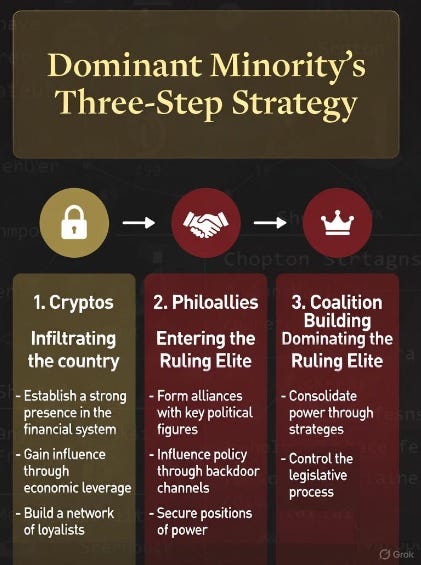
Jews
There is another significant example of a dominant minority, yet naming it remains a taboo: the Jewish elite in the West. This group exerts influence through economic and media power, a “Culture of Critique,” and its maneuvers within the geopolitical “Great Game”. U.S. foreign policy, for instance, appears heavily influenced by Jewish Zionists, compelling even the supposedly “America First” Trump administration to adopt “Israel First” policies. While parts of the peace movement have begun to note the Jewish role in fomenting conflicts also beyond the Middle East, many activists still fail to see the broader connections. The conflicts in Ukraine and Taiwan are directly linked to the crisis in the Middle East.
The reason is simple: Jewish led neoconservative and neoliberal forces aligned with Israel seek to weaken Russia and China, both of which support Iran and the Shia “Axis of Resistance” in the Middle East. Consequently, the West attempts to encircle Russia and China with military bases and hostile alliances while undermining their economies through sanctions and high tariffs to facilitate regime change.
This is nothing new. For centuries, Jews have viewed Russia and China as “antisemitic” for opposing Jewish attempts to become a dominant minority within their borders. Historically, this has manifested as a prolonged struggle. Jewish elite dynasties like the Rothschilds, Sassoons and Kadooreis, for example, pushed Western empires to subjugate China during its “Century of Humiliation.” Similarly, they managed to organize various wars against Russia including the first Crimean War in the 1850’s and then later the Jewish led Bolshevik and Oligarch takeovers in the 1920’s and 90’s. The present Ukraine War is just the latest in a series of conflicts and wars between Jews and Russia going back a millennium.
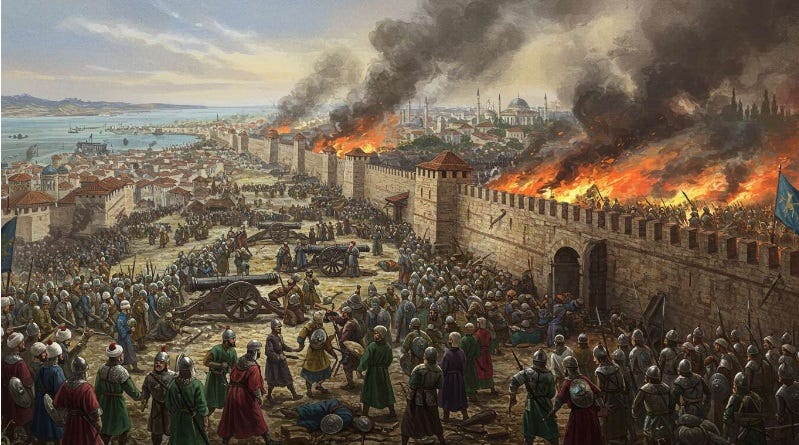
The obvious Jewish role in geopolitics and various wars has always been known to political scientists and historians. It is also common knowledge in many parts of the world such as in Eastern Europe, China and the Arab world. However, in America the Jewish dominant minority has achieved such power that both academia and media now avoid the subject entirely. Only occasionally does the American public hear about it through random outbursts, such as Mel Gibson’s criticism of the Jewish role in instigating wars.
Putin and Xi
Under the leadership of Vladimir Putin and Xi Jinping, Russia and China have regained their independence and power. Their geopolitical support for the Axis of Resistance has drawn the ire of Zionist Jews running Great Game geopolitics, while their nationalist anti-liberal policies have alienated liberal Jewish factions running the Culture of Critique movements. As a result, the Jewish dominated Western academia and media has totally demonized both nations, while Jewish led neoconservatives and neoliberals push for their encirclement and the targeting of their global allies.
The influence of Jewish dominant minority behind these conflicts remains such a taboo that even peace activists often ignore it. This gives Zionists a carte blanche to pursue military and cultural wars, regime change operations and proxy wars aimed at isolating Russia and China. By refusing to “connect the dots,” Western peace activists effectively allow this dominant minority to continue pushing for perpetual war.
Scott Ritter
In recent years, the peace movement has been bolstered by former UN weapons inspector Scott Ritter. A prolific advocate, Ritter has tirelessly warned against the dangers of nuclear war, organized demonstrations and personally lobbied Congress. Despite his background as a leftist philosemitic Democrat, he has significantly influenced the Republican “MAGA” movement toward anti-war policies.
Ritter has gained a massive following as a commentator on the Ukraine War. However, during the conflict’s first year, he remained silent on the Jewish and even Israeli connection, blaming only the CIA, MI6 and the U.S. and British governments. In this, he was joined by libertarian figures like Andrew Napolitano and Lew Rockwell, who focus on American “Primacists” rather than identifying a dominant minority.
Traditionally, both leftists and libertarians have avoided identifying the Jewish dominant minority to avoid being labeled as antisemitic. It was only during the recent genocide in Gaza that Ritter began to explicitly critique Israel’s geopolitical role, though he has yet to identify the dominant minority or even connect these dots to the broader global landscape.
Silent Peace Activists
Some suggest that platform policies, such as those on YouTube, drive this reticence. Peace activists like Andrew Napolitano, Alexander Mercouris, and Danny Haiphong reach hundreds of thousands of viewers daily through their Youtube channels. Openly discussing Jewish dominant minority and connecting Jewish geopolitical dots could lead to deplatforming and lost revenue. However, this doesn’t fully explain the silence, as they could simultaneously use alternative platforms like Rumble, X or Locals—a strategy successfully employed by the famous anti-Zionist, Candace Owens. Unsurprisingly she has been branded an “anti-Semite” by many Jewish organizations.

Alexander Mercouris
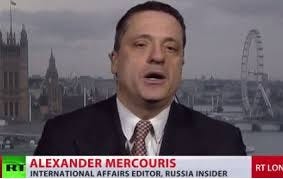
Another explanation is ideological. Many activists from leftist or libertarian backgrounds may instinctively view the concept of a “dominant minority” as inherently racist. The most dramatic example of this is the leftist peace activist and popular YouTube commentator Alexander Mercouris, who for years was oblivious to the Jewish connection. However, a few months ago, due to audience feedback, he admitted on his channel that he had never even thought about a possible connection between the Ukraine War and the Middle East Crises.
Afterward, he has not talked about the subject anymore, though he does seem to increasingly speak in code. For example, he repeatedly emphasizes that his channel will be shut down if he analyzes the Epstein case too deeply. At the same time, he seems to spell “Epstein” in the Jewish-German way, making Epstein’s ethnic background clearer. Mercouris also has the revealing habit of always following the arch-neocon warmonger Lindsey Graham’s name with the name Richard Blumenthal, possibly hinting that Graham is influenced by him and other Jews to a significant extent.
The third explanation for not openly noticing the dominant minority is that many prominent peace activists hope to attract the support of wealthy, anti-Zionist Jewish donors to finance the movement, a development that has yet to materialize.
Debanking
Certainly, the fourth and most important explanation is fear. Leading peace activists face tremendous pressure from various sides. Ironically, this pressure appears stronger in America than in Europe, despite stricter official censorship in Europe. However, Europeans benefit from strong employment and social security protections against firings and debanking. In America, people’s lives are more precarious and heavily dependent on high incomes, making it easier to intimidate them with threats to their reputation, job, income, or even bank accounts. The American media rarely discusses this, but hundreds of politically incorrect individuals have been debanked—not only in Canada but also in the U.S. Scott Ritter has now joined their ranks.
In the above video Scott Ritter recalls his days as a highly connected American intelligence operative, working closely with the CIA, Israelis, and even the White House. He emphasizes that he was once the “Golden Boy” of intelligence, privy to “everything.” Clearly, he must be aware of America’s dominant minority and their potential to ignite a nuclear war. Yet, despite recent escalations in Eastern Europe and the Middle East, Ritter in this video claims that the main problem is America itself, with Trump as a “prisoner of the CIA”—not the Mossad, Israel, or even the Zionists.
The next day, however, Ritter appeared in an interview with Andrew Napolitano. He admitted that after being debanked, he fell into depression and briefly felt hopeless, especially as his wife had grown weary of the persecution that had affected their entire family for decades. At that point, Napolitano played a clip of Jonathan Greenblatt, the Jewish ADL’s chairman, boasting about the organization’s role in training American police and officials. This ignited Ritter, who then openly declared that Zionists are running the American government.
Trump’s chess moves
At the same time, Ritter suggested there might still be hope. He noted that many parts of the government resent Zionist dominance, and even Donald Trump could be among them. That wouldn’t be surprising, given Trump’s ego—he can’t be pleased with how Netanyahu and many other Jews publicly humiliate him. Being Israel’s bitch cannot be fun.
It could even be that Trump is deliberately undermining American influence abroad through his erratic behavior, bullying threats, and tariffs. After all, U.S. foreign policy is thoroughly dominated by Zionists, so disrupting the entire system might be the only way to halt it. For instance, threatening to annex Greenland would certainly fracture or weaken NATO, making it harder for EU NATO countries to sustain their warmongering. Perhaps Trump truly seeks peace through a “Fortress America” approach, dividing the world among American, Russian and Chinese spheres of influence. Maybe he’s really playing four-dimensional chess, with method to his madness. Of course, the alternative is that he’s simply a madman. As Scott Ritter admits, he doesn’t know—and neither does anyone else. Probably not even Trump himself.
People worldwide are deeply divided over Donald Trump. Some view him as a mastermind playing four-dimensional chess to save the world, while others see him as a narcissistic bumbler who sows chaos wherever he goes. So, which perspective aligns more closely with the truth? We do not know but let’s first assume that Donald Trump is a rational player in do…
Conclusion
Many in the peace movement believe that concealing the Jewish dominant minority and obscuring its role in numerous wars is essential for peace. However, this strategy may backfire, giving that minority a free hand to escalate proxy conflicts and try again and again to push the world toward “limited” nuclear war.
People often demand perfection from their heroes, which is counterproductive. No one is a superman—not even Scott Ritter. Of course, he must consider his family. Of course, he has been reticent about exposing Jewish power. The same applies to all other peace activists. But gradually, things are changing on both the left and right. They are beginning to point out the man and group behind the curtain.
In any case, peace activists perform invaluable work and deserve unwavering support. After all, they do what they humanly can. Without them—especially Scott Ritter—a nuclear war might already have begun.
Latest US-backed regime change operation in Iran hits the wall
By Samuel Geddes | Al Mayadeen | January 17, 2026
Having bombed the country in 2025, “Israel” and the US seemed to think that provoking street violence would have more success at collapsing the Iranian state. Instead, it fizzled almost instantly.
We have been here at least half a dozen times in the past two decades. Street protests in Iran over an internal economic, social or political issue emerge, gather a degree of momentum in urban areas and the Western propaganda system declares that the protests have “shifted” from their initial focus, to calls for the repudiation of the Islamic Revolution and the end of the political system it created. European and American politicians issue their empty statements of solidarity with the Iranian people and unilaterally decide that the Islamic Republic has “lost its legitimacy,” that its fall is simply a matter of “when,” not “if.” We have seen this narrative played out often enough to recognize it never survives contact with the real world.
The source of the persistent delusion that the Islamic Republic is about to fall comes not only from the Euro-American elite class wishing it to be so, but also from its deferral to the “analysis” of segments of the diaspora whose own political objectives are detached from reality.
Whether it is protests over the government’s handling of the economy, energy blackouts, or the water crisis, most external observers are incapable of viewing each individual issue through any lens other than that of regime change.
This time around the US and Israelis, in coopting the protests to destabilize the country through street violence, have not even bothered to hide their involvement. It has also not helped the West’s case that it is now feigning “humanitarian concern” for the rights of Iranian citizens while it has spent more than two years facilitating the ongoing slaughter and starvation of Gaza’s population. Any observer following both issues can detect the dissonance and conclude what is motivating the frantic calls to escalate the situation into military intervention. That is, the desire to crush a state and society that has resisted Western dominance for more than four-and-a-half decades.
The brazenness of the West’s affected concern for the well-being of the Iranian public is particularly galling in light of the sanctions. If Iranians’ living standards were really of any concern to Washington, London or Brussels, they would start by unconditionally ending their economic strangulation in effect against the country. The truth is that the suffering and misery engendered by the sanctions is entirely the point. As well as stifling the development of an independent state outside the globalized-Western economy, the siege is specifically intended to make living conditions unbearable for the average Iranian so that they are incentivized to undermine the Islamic Republic. The continuation of the sanctions is a barely disguised punishment of the Iranian public for not pursuing the West’s geopolitical goal of regime-change for them.
Were it not glaringly obvious to the Trump administration before the latest unrest, it surely is now that the exiled political diaspora most actively pushing for the fall of the Islamic Republic through Western military action are entirely incapable of political organization. Even the least crazed fan of the defunct Pahlavi dynasty is pathologically hostile to the terrorist personality cult of the MEK, as much as they are to the Islamic Republic itself. There simply is no political alternative, to say nothing of whether it even has any domestic support, waiting to replace the Islamic Republic.
Flush from the “success” of his abducting Venezuelan president Maduro, Trump seemed temporarily convinced he might have a similar option here, to carry out a meaningless military stunt for which he can take credit and declare “victory.” His problem is that there is no level of open military action against Iran that would allow him to do this without igniting a regional war that destroys the global economy.
This realization, if he has come to it, would explain his backtracking on the red lines he set, that any executions would trigger US attacks. If a controlled, stage-managed performance is his goal, as it almost always is, then the confrontation with Iran leaves him with no viable option but to back down.
The absence of any realistic military option has now seen both the US and Europe revert to their standard tactic; the intensification of the sanctions they have used to punish the Iranian people. Trump’s latest declaration of a 25% tariff on any country trading with Iran is his way of giving himself an off-ramp, for now, from a crisis that is largely of his making.
“Real men go to Tehran” — The Zion-Con fantasy of regime change in Iran
By Junaid S. Ahmad | MEMO | January 16, 2026
“Anyone can go to Baghdad. Real men go to Tehran.”
It is difficult to imagine a sentence that more perfectly distils the arrested adolescence of American neoconservatism. Equal parts locker-room bravado and imperial hallucination, the phrase belongs to the same intellectual ecosystem as Rambo sequels, Tom Clancy paperbacks, and the enduring belief that history naturally submits to men armed with air superiority and a television-ready talking point.
The slogan has circulated for decades among Washington’s most aggressively incurious minds. Iraq was merely the appetizer. Tehran was always the entrée — the Everest of regime change, the final boss in a video game played by men who have never once paid the price of defeat.
Iran is not different merely because of its size, its population, or its terrain — though the Zagros Mountains are far less forgiving than the streets of Fallujah. Iran is different because it has refused, stubbornly and at enormous cost, to internalise the post–Cold War catechism: accept American primacy, subcontract your sovereignty, and call the arrangement “integration into the international order.”
For the ‘Zion-Cons’ — Zionist neoconservatives — this refusal is not simply strategic defiance. It is psychological heresy.
The theology of regime change
Neoconservatism is not a foreign-policy framework. It is a belief system. Like all theologies, it comes equipped with sacred texts, sanctioned demons, and end-times fantasies. Iran occupies a unique place in this cosmology: simultaneously an ideological abomination and a geopolitical temptation too intoxicating to abandon.
The Islamic Republic represents everything neocon thought cannot tolerate — an independent regional power immune to Western legitimacy rituals, rooted in a civilizational memory more than a millennium older than Washington itself. That it is also openly hostile to Israel, and persistently aligned with Palestinian resistance, elevates Iran from problem to obsession.
This obsession is always framed as concern. Concern for democracy. Concern for women’s rights. Concern for regional stability. Yet the concern follows a suspiciously selective pattern. It spikes when Iranian women protest. It flattens when women in Gaza are buried beneath concrete and shrapnel. It demands sanctions in the name of “helping the Iranian people” while celebrating the annihilation of Iran’s middle class as a strategic achievement.
This is not hypocrisy. It is architecture.
Sanctions are not a failed alternative to regime change; they are its slow-motion variant. When bombing proves politically inconvenient, starvation becomes policy. When diplomacy threatens stabilisation, diplomacy must be sabotaged. Engagement is dangerous precisely because it works. The objective is not reform. The objective is obliteration.
Israel’s strategic mirage
For Israel’s security establishment, Iran is the final unresolved obstacle in a region otherwise disciplined into submission. Egypt neutralised. Syria pulverised. Iraq shattered and held together with duct tape. Lebanon perpetually destabilised. Only Iran remains intact and intolerably autonomous.
The idea that Israel’s posture toward Iran has ever been defensive borders on parody. The fear is not that Iran will strike tomorrow; it is that Iran will exist coherently ten years from now.
This explains the fixation on Iran’s air defences, its scientists, its infrastructure. The logic is brutally simple: a state that cannot defend itself cannot act independently. A state that cannot act independently can eventually be wrecked, partitioned, and remade.
But here the fantasy collides with reality. Iran is not Syria. It is not Libya. It is not Iraq circa 2003 — hollowed out by sanctions and ruled by a dictatorship so despised that collapse felt like relief. Iran, like all societies, contains fractures and rivalries. But fragmented societies do not automatically disintegrate. Quite often — especially under existential threat — they consolidate. External assault does not reliably dissolve states. Sometimes it forges them.
The opposition mirage
Every regime-change project requires a hero. In Iran’s case, while ritualistic nods are made toward protesters with genuine grievances, the starring role is awkwardly reserved for an exile aristocracy whose Twitter/X followings vastly exceed their domestic relevance.
Reza Pahlavi is marketed like a Silicon Valley prototype: sleek, Western-approved, and permanently “almost ready.” His appeal thrives in think tanks, donor salons, and Israeli conference halls. Inside Iran, his name provokes neither mass devotion nor visceral hatred — just indifference at best, uncontrollable laughter at worst.
This is the core contradiction of Washington’s Iran policy: regime change without revolution; installation without legitimacy; democracy without the inconvenience of mass politics.
The resulting strategy is perversely elegant in its cynicism — wait for collapse while ensuring no alternative survives long enough to govern.
Civil war option
What follows regime collapse? Zion-Con discourse treats the question like a software update users will sort out later. Something, it is assumed, will emerge. Something manageable. Something vaguely liberal.
History offers no such reassurance
Iran’s disintegration would not yield a liberal republic — and it is not meant to. It would yield precisely what Zion-Cons privately welcome: centrifugal violence, ethnic fragmentation, militia economies, refugee flows that would make Syria look like a rehearsal dinner. Kurdish separatism. Baloch insurgency. Nuclear insecurity. The scenario reads less like a transition plan than a controlled demolition spiralling out of control.
For Washington and Tel Aviv, this is not a deterrent. It is an acceptable – perhaps even desirable – outcome. A broken Iran is preferable to a strong one, even if the shards cut indiscriminately.
The masculinity problem
“Real men go to Tehran” is not merely rhetoric. It is theatre. It reflects a masculinity crisis at the heart of American empire — a compulsion to prove relevance through violence because legitimacy has evaporated.
Short wars. Clean optics. Cinematic strikes. The problem with Iran is that it refuses to follow the script. There is no “Mission Accomplished” banner waiting in the Persian Gulf. There is only attrition, retaliation, and the dawning realisation that power is not a substitute for strategy.
The endgame nobody admits
The scarcely concealed truth is that regime change in Iran is not primarily about Iran. It is about preserving Zionist hegemony in the region. An Iran that survives sanctions, absorbs pressure, and refuses submission is contagious. It teaches others that defiance is survivable.
That lesson is intolerable
So, the fantasy endures. The slogans recycle. The men who went to Baghdad insist they are wiser now — just before deliberately repeating the same catastrophe, only on a grander scale.
But Tehran is not a sequel. It is a reckoning. And this time, the audience will not be so forgiving.
US Sending Troops to Middle East Over Trump’s Threats Against Iran – Reports
Sputnik – 16.01.2026
WASHINGTON – The United States is sending troops to the Middle East over the consideration of potential strikes on Iran by President Donald Trump, Fox News reported on Thursday, citing military sources.
At least one US aircraft carrier is moving toward the region amid the growing tensions, the report said.
“US military assets are preparing to move to the Middle East, likely to include at least one aircraft carrier and additional missile defense systems that will operate from air, land and sea,” Fox News’ Chief National Security Correspondent Jennifer Griffin said on air.
However, it is unknown whether it is USS Abraham Lincoln, which is currently operating in the South China Sea, or one of the two carriers that left US bases earlier this week, the report added.
President Donald Trump has been presented with military options and favors any action being “swift and decisive,” while avoiding a wider regional war, according to the report.
Iranian state media, cited by Fox News, issued a warning to Washington: “You hit. We hit.”
Report: Kurdish Fighters Have Been Entering Iran From Iraq and Clashing With the IRGC
By Dave DeCamp | The Libertarian Institute | January 14, 2026
Turkish intelligence has warned Iran’s Islamic Revolutionary Guard Corps (IRGC) that Kurdish fighters have been entering Iran from Iraq amid protests inside Iran, Reuters reported on Wednesday.
An unnamed senior Iranian official speaking to the outlet said that the IRGC has been clashing with armed Kurdish fighters dispatched from both Iraq and Turkey. The Kurdistan Freedom Party, or PAK, a Kurdish Iranian separatist group mainly based in Iraq, has been claiming that its armed wing has been conducting operations against Iranian forces.
On Tuesday, the PAK claimed its forces launched an attack on an IRGC base in western Iran. The Reuters report and claims of Kurdish attacks come as Tehran is accusing the US and Israel of arming “terorrists” inside Iran who have attacked Iranian security forces.
The US has a significant presence in Iraqi Kurdistan, including a military base and an $800 million consulate compound that it opened in December. The Israeli Mossad is also known for having a presence in the area, and Iran claimed that it attacked a Mossad base in Iraqi Kurdistan in 2024.
The Mossad has a long history of covert operations inside Iran, and a Farsi-language X account affiliated with the Israeli spy agency suggested it had operatives on the ground in Iran when the protests first broke out. “Let’s come out to the streets together. The time has come. We are with you. Not just from afar and verbally. We are with you in the field as well,” the account said on December 29.
Israel’s Channel 14 has reported that “foreign actors” have armed protesters in Iran and said that’s the reason why hundreds of Iranian security personnel have been killed.
“We reported tonight on Channel 14: foreign actors are arming the protesters in Iran with live firearms, which is the reason for the hundreds of regime personnel killed,” Channel 14 reporter Tamir Morag wrote on X on Tuesday. “Everyone is free to guess who is behind it.”
Iran protest-riots can only achieve US-Israeli intervention, ‘shadow CIA’ concludes
By Max Blumenthal | The Grayzone | January 13, 2026
Stratfor, the “shadow CIA” which contracts for US intelligence and advises US-backed opposition movements, published an important assessment of the protest-riots in Iran this January 7.
Stratfor concluded that the ultimate utility of the unrest is to create an opening for a US-Israeli bombing campaign:
“While unlikely to collapse the regime, the ongoing unrest could open the door for Israel or the United States to conduct covert or overt activities aimed at further destabilizing the Iranian government, either indirectly by encouraging the protests or directly via military action against Iranian leaders.”
The private spying contractor explained that the external, US-backed Iranian opposition is too fractious and weak to affect change inside Iran, and that the institutions of the Islamic Republic remain united. Therefore, the only impact the protest-riots can achieve is to ease the path for a military campaign by the US and Israel.
Stratfor’s assessment ends by predicting that “renewed military strikes on Iran would also likely put an end to the current protest movement by leading instead to a wider display of Iranian nationalism and unity, a pattern observed after U.S. and Israeli strikes in 2025.”
This is one of the more sober pieces of analysis of the unrest in Iran to emerge from any US intel-aligned outfit. However, with CIA director and “Mossad stenographer” John Ratcliffe controlling Trump’s Iran briefings alongside White House chief of staff and former Netanyahu campaign advisor Suzie Wiles, the president may not have the benefit of such clarity.
The Coming War on Iran: What Has Really Been Happening?
By Robert Inlakesh | The Palestine Chronicle | January 13, 2026
The unrest inside Iran was effectively brought to a halt by the authorities, culminating in mass pro-government demonstrations in the millions across the country. Yet, the specter of a US-Israeli regime change operation continues to lie in the wake.
If you have been following the course of the protests/riots inside Iran on social media or in the corporate press, the impression given since the beginning of the year has been that Tehran is on the verge of collapse. Countless false claims were issued regarding the fall of entire cities, the collapse of the Islamic Revolutionary Guard Corps (IRGC), a massacre of peaceful protesters and even that Ayatollah Khamenei was seeking to escape to Moscow.
Evidently, the reality on the ground couldn’t have been more opposite of what the pro-regime change news outlets and social media influence operations have been portraying. Therefore, to understand what is happening, it is important to understand what truly transpired.
The Road to another Regime Change War
Ever since the conclusion of the 12-Day War between Iran and Israel last June, foreign policy hawks have made it abundantly clear that another round of fighting was only a matter of time. In fact, on July 7, 2025, Axios News reported that Israeli officials were already seeking a green-light, from the US President for them to attack Iran again.
Influential pro-Israeli Washington-based think tanks – such as the Foundation for Defense of Democracies (FDD), Washington Institute for Near East Policy (WINEP), and the Atlantic Council – all agreed that another round would be necessary, yet argued in different ways that the next round would have to result in the closure of the conflict for the foreseeable future.
The reasoning behind this was clear: if the next round was to mirror the 12-Day War, then another round would again become an inevitability. This scenario would mean that every 6-12 months, the conflict would go from Cold to Hot, a predicament that would actually heavily favour Iran.
If Tehran manages to keep repeating a similar series of rounds to what we saw in June of 2025, the Israelis will be at an enormous disadvantage. Not only does Israel have a smaller territory in which to operate, making taking out vital infrastructure easier, but it cannot produce weapons and rebuild at the rate Iran can. For example, the air defence munitions it depleted last year have still not been fully replenished, and many of the sites struck in Tel Aviv remain in ruins.
Iran, on the other hand, has been able to mass-produce ballistic missiles and drones. Western publicly released estimates greatly vary, but often indicate that the Iranians have replenished their arsenals, whereas the indications coming from Iran itself appear to suggest that they have superseded what they previously possessed, both in quantity and quality.
The US and Israel, nevertheless, have clearly been threatening to attack Iran once again for months, using varying excuses about why. Israeli PM Benjamin Netanyahu has recently been complaining about Iran’s missile program, which quickly became a talking point of the Trump administration, too.
Yet, the moment to attack Iran clearly hadn’t presented itself. There were simply too many variables, too many unknowns, and too many doubts for them to commit any action. We also saw this when it came to Israeli threats against Hezbollah in Lebanon. Even got to the point late last year that Hezbollah’s Secretary General, Naim Qassem, publicly stated that Israel is just bluffing and that although something may happen in the new year, he essentially told the Israelis to shut up and just attack if they were set on doing so.
Why didn’t Israel attack Lebanon? Perhaps the biggest reason why they didn’t is because of Iran and the fear of how far such a war could go. The Israelis attempted assassinations and ramped up their air attacks as a means of attempting to draw a retaliatory strike from Hezbollah, but this failed. Instead, the option left on the table was full-scale war or no war at all.
Then came the pivot to Iran, at least in terms of public propaganda and ramping up rhetoric.
Riots In Iran as A Prelude to War
On December 28, the Israelis spotted a new opportunity. Protests erupted throughout cities across Iran, as mainly shopkeepers took to the streets in order to express their outrage at government mismanagement amidst the ongoing sanctions-induced economic crisis.
To be clear, these protests were totally organic and genuine; they had the backing of major Unions inside the country, and the Iranian government appeared to be quickly engaging with them in order to reach concessions. There was no violence at these protests initially. Even when suspected agent provocateurs had attempted to chant for regime change, shopkeeper protesters had forced them out of their crowds.
By December 29, former Israeli Prime Minister Naftali Bennett then posted a video on social media, in which he claimed that Israel was standing with the Iranians “rising up” against their government. Bear in mind that when this address was issued, the situation in Iran was in fact relatively calm, and the widespread riots had not yet taken place.
However, on social media, old videos and AI-generated clips were suddenly spread like wildfire, in a clearly coordinated campaign led by the Israelis and their Iranian opposition allies.
Almost out of nowhere, rioters began to spring up in small groups, primarily in the West of Iran. Some of these rioters carried weapons, but most just committed vandalism and burned down cars or shops. At this point, the protests over the economic crisis began to reduce, to be replaced by anti-government protests. Despite the violence and escalating rhetoric, the authorities in Tehran made sure to distinguish between rioters and legitimate protesters, not bringing down full force against them.
Then came the first day of the New Year, when the violence suddenly exploded. Iranian opposition channels began claiming cities had fallen, which never happened; they claimed millions were rising against the government, which also was not the case. On January 1, two Iranian police officers were murdered, and rioters even executed a young man who belonged to the Basij paramilitary force in the country.
The day after saw all the major Unions condemn the violent rioters, as Israel’s official Persian-language account posted AI-generated images depicting Iran’s police forces hosing down peaceful protesters. Again, the riots escalated and more members of the security forces were murdered, as rioters committed arson attacks.
All of this ended up coming to a head on January 8, as the riots escalated dramatically and this led to Iran shutting down the internet across the country as it took the gloves off and sent its IRGC forces in to stabilise the situation.
The largest recorded anti-government protests, as one called for by the Shah’s son from the comfort of California, numbered no more than in the tens of thousands. It is estimated that at their peak, there were around 40,000 that showed up.
The footage that began emerging from the streets of Tehran and elsewhere was nothing short of shocking, mass destruction and arson against public transit, the burning of mosques, attacks on schools, medical clinics, shops, homes and streets left in ruins as dumpsters were overturned and set alight, along with all the vehicles in sight.
In total, Iran claims that over 100 members of its security forces were murdered, 350 Mosques were set ablaze and 150 ambulances were damaged or destroyed. Civilians were also brutally murdered by the rioters, reportedly including a three-year-old child and a nurse who was burned to death; multiple police officers were also burned alive.
Without needing to go any further, there is copious evidence of armed militants firing on security forces and mass violence committed against civilian infrastructure. What started as a totally normal and organic series of protests was hijacked and turned into an Israeli-backed riot campaign. This was not comparable to the likes of the 2022 or 2009 unrest, which were evidently taken advantage of by Iran’s enemies, but had support from a sizable portion of the population nonetheless.
In the end, it appeared that by January 12, when millions of Iranians came to the streets across the country in solidarity with their government and against the rioters, the Israeli-backed operation had failed.
Yet, the US government had begun to ramp up its direct threats of intervention as the riots died down. Leaving the question open as to when the next round of American strikes would occur, following Donald Trump’s decision to bomb Iran last year.
The real question is whether these riots were a desperate and failed regime change attempt in and of themselves, or this was simply a prelude to what’s coming next. If the Israelis were truly betting on these riots equalling regime change, then perhaps the calculation is for the US to attack in order to revive the riots on the ground.
Alternatively, the instability was only for the purpose of setting up a larger attack, which would mean a much larger war could have been planned. In order for the US and Israel to achieve their desired outcome, that being either regime change or a massive blow that will end the war between Israel and Iran for the foreseeable future, they will likely go after Iran’s infrastructure.
In such a scenario, expect the kitchen sink to be thrown at Iran. Armed terrorist militia insurgencies, airstrikes, agents on the ground, and more riot activity. In particular, attacks on the electrical grid, water, oil, agriculture, and everything that makes the economy function. In other words, an attempt to achieve regime change this way, or to simply make war so costly that Iran won’t seek it for some time afterwards. Perhaps the goal could be to weaken Iran to a degree where it would negotiate on US terms, yet this is highly unlikely.
Iran dealt with these threats by issuing its own, doubling down and adopting an ultra-aggressive posture. What comes next could go many ways, so we are left to wait and see.
– Robert Inlakesh is a journalist, writer, and documentary filmmaker. He focuses on the Middle East, specializing in Palestine. He contributed this article to The Palestine Chronicle.
Iran’s Mass Protests /Patrick Henningsen & Lt Col Daniel Davis
Daniel Davis / Deep Dive – January 12, 2026
UAE begins ‘hurried evacuation’ from Somali air base: Report
The Cradle | January 12, 2026
The UAE has begun evacuating security personnel and heavy military equipment from Somalia, after officials in Mogadishu reportedly suspended Emirati use of their territory and airspace for military operations, Middle East Eye (MEE) reported on 12 January.
The Somali government informed the Emiratis that “all their military activities in Somalia, including the use of airspace and the landing of cargo military aircraft in Bosaso, Berbera and Mogadishu, had been suspended,” a senior Somali official told MEE, speaking on condition of anonymity.
The official said the UAE now appears to be evacuating its security personnel and military equipment to neighboring Ethiopia.
Citing flight-tracking data and two eyewitnesses, MEE reported that an average of six IL-76 cargo aircraft have arrived and departed the air base in Bosaso – the port city in Somalia’s Puntland – each day over recent days.
One source speaking with the UK news outlet described the flights as “resembling a hurried evacuation.”
“Unlike previous operations, where incoming cargo would be immediately transferred to another aircraft on standby, these planes have been arriving over several days, loaded with heavy military equipment, and departed without delay,” a source at Bosaso air base told MEE, describing the activity as highly unusual.
The UAE has long used Somalia as a rear operational base for its military engagements in both Sudan and Yemen. It had been using Bosaso’s port and airport in recent years to send weapons, mercenaries, and supplies to Sudan’s paramilitary Rapid Support Forces (RSF), which is fighting a civil war against Sudan’s military.
Bosaso is part of a cluster of airfields the UAE has constructed in an effort to dominate the southern end of the Red Sea, the Bab al-Mandab Strait, and the Gulf of Aden.
According to a source in Somalia’s federal government, Mogadishu has revoked the agreement allowing the UAE to use the Bosaso air base and other facilities in the country.
Somali authorities opened an investigation into Emirati activities at Bosaso after the UAE used the air base to help a Yemeni separatist leader escape to the Gulf nation.
The separatist leader, Aidarus al-Zubaidi, is the president of the UAE-backed Southern Transitional Council (STC).
He was wanted by Saudi Arabia amid fighting between the STC and Saudi-backed forces in Yemen that began in December. The UAE was supporting the STC’s bid to take territory from the Saudi-backed Presidential Leadership Council (PLC) in hopes of creating an independent state in southern Yemen.
Zubaidi was supposed to travel to Saudi Arabia for talks to end the violence, but the UAE secretly helped him escape to Abu Dhabi. He first traveled by ship to the breakaway region of Somaliland, then boarded a plane at the Bosaso air base to travel to the UAE.
After helping Zubaidi escape, the Somali government informed the Emiratis that all their military activities in Somalia were suspended.
Saudi Arabia and the UAE are increasingly competing for influence in both Yemen and Somalia.
The UAE is closely aligned with Israel, which has supported Somaliland in its effort to gain formal independence from Somalia.
In contrast, Saudi Arabia has supported Somalia’s unity and established closer relations with officials in Mogadishu.
Saudi officials held an Organisation of Islamic Cooperation conference on Somalia over the weekend and rallied the Arab League and Gulf Cooperation Council (GCC) to issue statements in support of Somalia’s unity after Israel recognized Somaliland.
Featured Video
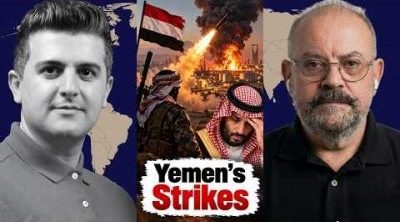
Elijah Magnier: Yemen’s strikes are shattering Saudi Arabia’s long-term strategy
or go to
Aletho News Archives – Video-Images
From the Archives
British weapons and personnel doing much of the killing in Yemen
Press TV – June 18, 2019
A detailed report published by the Guardian newspaper has shown how Britain is massively contributing to Saudi Arabia’s devastating war on Yemen as it suggests that London is not only supplying the bombs that fall on Yemenis, but it provides the personnel and expertise that keep the war going.
The comprehensive report by Arron Merat published on Tuesday showed that Britain was doing much of the killing in Yemen as the country continues to provide Saudi Arabia with everything it needs to turn its southern impoverished neighbor into a graveyard.
“Every day Yemen is hit by British bombs – dropped by British planes that are flown by British-trained pilots and maintained and prepared inside Saudi Arabia by thousands of British contractors,” said Merat in the report. … continue
Blog Roll
 Aletho News
- Netizens condemn Japanese drama for projecting Japan’s wartime atrocities onto Chinese characters
- Racist Seinfeld Dances for Joy as Bibi Unveils His New Map
- A West Bank War for Netanyahu’s Election Campaign, Could It Backfire?
- Yemen denounces European Parliament’s ‘hypocritical’ push to blacklist Ansarullah
- Qalibaf: UAE’s UN bid aims to ‘clear the runway’ for ‘Greater Israel’, whitewash genocide
- Pakistan reopens Iran border after boosting security: Report
- Why are so many Brazilians voting for Flávio Bolsonaro?
- Democrats Put Anti-Russia Agenda Ahead of American Workers
- Elijah Magnier: Yemen’s Strikes Are Shattering Saudi Arabia’s Long-Term Strategy
- Pentagon designates Chinese cultural centers national security threat
- If Americans Knew
- An error has occurred; the feed is probably down. Try again later.
- No Tricks Zone
- Sudden Stratospheric Warming, Powerful El Niño Combination May Lead To Extreme Europe Cold, Energy Crisis!
- Two New Studies Find Thwaites Glacier Melt Cannot Be Driven By Human Activity Or A Warming Ocean
- E-Cars Reduce CO2 Emissions By Only 41% Compared To Internal Combustion Engine Vehicles
- Predictions Made By Renowned Climate Professor Over Past Decades Have Been Proven To Be Poor
- New Study Suggests Large Regions Of The Pacific Ocean Have Been Cooling For The Last 80 Years
- Germany’s Green Energy Debacle: High Energy Costs Force Kahla Porzellan to Close After 182 Years!
- New Study: 50 Years Of The Most Aggressive ‘Net Zero’ Policies Can Only Affect The Global Climate By 0.03°C
- US September “Heat” Was No Record…Many Records Set Decades Ago
- Latest European Green Energy Debacle; Portugal’s Largest Flagship Solar Park Insolvent!
- Green Energy Debacle: German Expert Professor Fritz Vahrenholt Warns Of Severe Economic And Social Consequences

