Bari Weiss’ New CBS Hire List Is Full Of Zionists
Zionist Installed Editor of CBS News Has Hired A Long Line Of Hardline Contributors
The Dissident | January 27, 2026
CBS News, under the editorial control of hardline Zionist Bari Weiss, has added 19 new contributors to the network, many of whom- unsurprisingly-are hardline Zionists denying the Gaza genocide and pushing for war with Iran.
In this article, I will go over some of the most egregious new hires.
Elliot Ackerman
The first hire announced at CBS News is Elliot Ackerman, a veteran of the Marine Corps and CIA special operations who is now a fiction and non fiction author.
Like most of the new contributors, he is a hardline Zionist.
On X, he has gone after the New York Times of all outlets for not being subservient enough to the Israeli propaganda line on Iran.
In response to a New York Times article with a subhead that read, “Iran says Israel wants to trap it to a direct conflict by bombing Hezbollah, even as a new Iranian president tries outreach to the West”, Ackerman wrote, “Poor Iran … all it wants is peace.”
He also took issue with the fact that the New York Times wrote, “Iran has so far refused to be goaded by Israel into a larger regional war” responding by saying, “‘Goaded by Israel …’ this is insane.”
He is also an advocate of the U.S. backing Israel and fighting wars in the Middle East on its behalf.
In the Atlantic, he wrote , “ in the name of ‘ending America’s forever wars,’ our leaders have proved reluctant to call enemies ‘enemies’ and friends ‘friends.’ If America wishes to remain at peace, or at least not find itself in an active war, we must speak clearly in defense of our friends. This remains uniquely true in the case of Israel.”
In the article, he called on America to support Israel’s war in Lebanon, writing:
Israel has recently dealt Hezbollah a series of crippling blows, beginning with exploding pagers and radios that sabotaged Hezbollah’s command and control and degraded its leadership. This has culminated with the strike against Nasrallah. Hezbollah has been forced onto its back foot, as has the Iranian regime. This creates an opening, one that Israel will likely exploit and that the United States, Israel’s ally, must support, lest we squander a precious opportunity in this broader war.
The United States can’t afford to make the same mistake with Israel. Now is the time to stand decisively behind our ally and against Hamas, Hezbollah, Iran, Russia, China, and the axis of authoritarian nations that continue to menace the liberal world.
Masih Alinejad
Another contributor announced to CBS News is Masih Alinejad, an Iranian journalist in exile and U.S. government asset pushing for war with Iran.
As journalist Asa Winstanley reported , Masih Alinejad “is an employee of the Voice of America Persian, a US government-funded media outlet”, which the New York Times called a “Worldwide Propaganda Network Built by the C.I.A”.
Furthermore, as Winstanley noted, “Predictability, as an enemy of a government that has steadfastly supported Palestinian resistance since 1979, Alinejad is also rabidly pro-Israel. In June she gave a talk for an Israel lobby group in the US, calling for a future ‘democratic’ Iran to normalise relations with Israel.”
He added that, “Government documents show that Alinejad has been the recipient of more than $628,000 in US federal funding since 2015.”
A state department cable from 2009, when Masih Alinejad was still in Iran, indentified her as a U.S. intel asset.
As a U.S. asset, Masih Alinejad openly supports a U.S. regime change war in Iran, undoubtedly the reason behind her being hired as a contributor at CBS News.
Niall Ferguson
The most egregious contributor added to CBS News is the British Neo-con Niall Ferguson, who described himself as “a fully paid-up member of the neo-imperialist gang” during the Iraq war.
Ferguson denied the fact that Israel committed genocide in Gaza, quoting the Israeli propagandist John Spencer’s genocide denial, and claiming that he is an authority because he has “embedded with the IDF” and “interviewed the prime minister, the defence minister, the chief of staff, the Southern Command leadership”.
Niall Ferguson also supports a U.S. war on Iran for Israel, saying that “The U.S. Should Finish the Job in Iran”.
Ferguson is also a contributor to Bari Weiss’ “The Free Press”, where he once wrote an article alongside Yoav Gallant, the former Minister of Defence of Israel who is indicted by the ICC on war crimes charges where they pushed for a U.S. war on Iran, writing, “Israel has moved and continues to move with determination and dispatch. The support of allies, first and foremost the United States, has been crucial. Now, with a single exertion of its unmatched military strength, the United States can shorten the war, prevent wider escalation, and end the principal threat to Middle Eastern stability. It can also send a signal to those other authoritarian powers who have been Iran’s enablers that American deterrence is back. This is a rare moment when strategic alignment and operational momentum converge. It must not be missed.”
Coleman Hughes
Coleman Hughes, one of Bari Weiss’s propagandists at the Free Press, has now been brought over to CBS News.
On the payroll of Weiss, Coleman Hughes has written genocide denial columns, denying Israel’s well-documented atrocities in Gaza.
In an article for the Free Press, Hughes claimed that “when an IDF soldier goes berserk, he is subject to criminal punishment”, despite the fact that multiple IDF soldiers have said that “You can do almost whatever you want when it comes to Gazans, honestly, I think that is how Israeli society has been dehumanizing Palestinians for years” and “This thing called killing innocent people – it’s been normalized” and despite the fact that, “88% of Israeli Military Investigations Into Gaza War Crimes Stalled or Closed Without Findings”.
HR McMaster
Another contributor added to CBS News is HR McMaster, the U.S. General who served as the United States National Security Advisor from 2017 to 2018 and now serves as a senior fellow at the neo-con Hoover Institution.
McMaster is a hardline Zionist, saying in 2024 that “the U.S. needs to offer stronger backing to Israel and stop pushing for what he described as premature and foolhardy ceasefire agreements”.
HR McMaster is also a strong proponent of war with Iran for Israel, saying in 2018 when he was National Security Advisor, “What’s particularly concerning is that this network of proxies is becoming more and more capable, as Iran seeds more and more… destructive weapons into these networks, So the time is now, we think, to act against Iran”.
In a 2024 article for Bari Weiss’ propaganda blog, the Free Press, McMaster hoped that Trump would go to war with Iran during his new term, saying, “We have a sense of how Trump will respond to Iranian aggression. He frequently told me ‘everywhere I see problems [in the Middle East] there is Iran.’ He knows what the return address is for the violence not only against Israel but also in Syria, Iraq, and Yemen. He is certain to ramp up sanctions enforcement against Tehran to limit the resources available for Iran’s proxy militias and terrorist organizations.”
He cheered on the U.S/Israeli bombing of Iran in June of last year writing, “But even more importantly, the Israeli and U.S. military operations directly against the Islamic Republic and its warmaking apparatus reminded officials in Tehran that they cannot antagonize their adversaries in the region with impunity—and reminded officials in Washington that Iran’s theocratic dictatorship cannot be conciliated. “De-escalation” was never a path to peace—it was an approach that perpetuated war on the Iranians’ terms.”
Reihan Salam
Another new contributor to CBS News is Reihan Salam, the president of the Neo-con Manhattan Institute who wrote in the Wall Street Journal at the start of the genocide in Gaza, “Muslim Americans Like Me Stand With Israel” adding, “In short, Muslim Americans who stand with Israel and the Jewish people in their struggle for survival do exist—as convenient as it might be for self-described progressive humanitarians to pretend otherwise.”
Glenn Loury, a former contributor to the Manhattan Institute, revealed that he was fired by Reihan Salam who told him in an email they have a “lack of shared priorities” after “the Manhattan Institute first signaled their dismay with my position on Gaza after I posted my conversation with Israeli historian Omer Bartov” who accurately stated that Israel was committing genocide in Gaza.
Bari Weiss’s Goal
Bari Weiss’s goal with the new CBS contributors is clear- to hire Zionists pushing for American backing of Israel and an American war with Iran for Israel, in order to use the once respected news outlet to manufacture consent for Israel’s foreign policy goals.
Attack on Iran would backfire, causing great losses for US, warns European think-tank
Press TV – January 28, 2026
The US faces serious risks if it attacks Iran again, which held back much of its military strength during the 12-day June 2025 war, and any future aggression could provoke a far stronger response, warns the European Council on Foreign Relations (ECFR).
A report from ECFR published on Tuesday highlights Iran’s unmatched combination of size, population, and military capability, saying, “With over 90 million citizens and territory nearly four times the size of Iraq, Iran presents a logistical and operational challenge far exceeding previous US interventions.”
Libya’s population during NATO’s 2011 aggression was fifteen times smaller than Iran’s, while Iraq’s population at the 2003 invasion was less than one-third of today’s Iranian population, the report said.
ECFR notes that such scale, combined with Iran’s geographic diversity, makes any attempt to overthrow Iran’s government extremely difficult.
During the June 2025 war, Iran deliberately refrained from using much of its military arsenal. ECFR analysts observe that Tehran “could deploy weapons and strategies it has so far held in reserve if its national security were threatened.”
This deliberate restraint illustrates Iran’s strategic patience and credible deterrence, signaling that further US escalation would encounter formidable resistance, according to the report.
Iran also benefits from a network of regional allies, including resistance groups in Iraq, Lebanon, and Yemen, which could coordinate defensive or retaliatory actions against potential aggressors.
According to the report, Tehran’s military readiness extends beyond conventional forces as it is capable of protecting critical oil infrastructure and controlling the Strait of Hormuz, a strategic chokepoint for global energy supplies. Any disruption there could cause severe economic consequences worldwide.
Historical experience reinforces ECFR’s warnings. Past US interventions in Libya and Syria, launched under the pretext of protecting civilians, instead resulted in prolonged instability, economic collapse, and widespread chaos.
Similar tactics applied in Iran would backfire, causing greater losses for Washington while leaving Iranian sovereignty intact, ECFR noted.
This comes as European and regional powers have urged caution, emphasizing that Iran’s thirteen land and maritime borders make any large-scale conflict highly destabilizing.
“Iran’s combination of population, territory, and disciplined military forces ensures that external powers cannot easily impose their will,” the report emphasizes.
Iran has demonstrated restraint during prior conflicts, along with its military capabilities, which would give it a strategic advantage in deterring foreign intervention, ECFR concluded.
Idea of limited, fast strike on Iran misjudges our capabilities: IRGC
Al Mayadeen | January 27, 2026
The notion of carrying out a “limited, rapid, and clean” operation against Iran stems from flawed assumptions and a poor judgment of Tehran’s defensive and offensive capabilities, a senior military official at Iran’s Khatam al-Anbiya Central Headquarters of the Iranian Islamic Revolution Guard Corps (IRGC) stated in response to threats levelled by the United States and “Israel”.
The official emphasized that the Iranian armed forces “do not monitor enemy movements only during the execution phase; they carefully track early indicators of any threat to the nation’s security.”
“Operational decisions will be made based on field assessments at the appropriate time,” he asserted.
He cautioned that any scenario “designed around surprise or control over the scope of conflict will spiral out of control from the very first stages,” noting that “the presence of US aircraft carriers and military equipment in the region has been exaggerated.”
Highlighting Iran’s strategic advantage in its waters, he said, “The maritime environment surrounding Iran is familiar and fully monitored by the Iranian armed forces. The concentration of forces and equipment from outside the region in such an environment will not serve as a deterrent; rather, it increases their vulnerability and makes them accessible targets.”
The official further asserted that, over recent years, “Iran has relied on its local naval capabilities, its asymmetric defense doctrine, and unique geopolitical strengths, shaping military equations in the Gulf and the Sea of Oman in a way that prevents any aggressor from assuming the security of its forces and bases is guaranteed.”
No attempt to undermine Iran will succeed
Referring to past attempts to influence Iran’s internal affairs or undermine its political structure, he noted that “whether through political and economic pressure, military threats, or psychological warfare, such efforts have always failed, and this flawed approach will not succeed in the future either.”
“Iran will not be the initiator of any war, but it will not allow any threat to its national security to progress to the execution stage, even at its earliest phases,” he stressed.
The official placed full responsibility for any unintended consequences “directly on parties that jeopardize the stability of the entire region, whether through provocative and interventionist presence or through direct and indirect support.”
This closely follows remarks by the head of the Iranian Journalists’ Association and member of the Government Media Council, Masha’Allah Shams al-Wa’izin, who told Al Mayadeen that Washington has conveyed, through a third party, that Iranian facilities could be targeted by attacks, while expecting Tehran to absorb any such strikes “without a severe response.”
Shams al-Wa’izin stressed, however, that from Iran’s perspective, any so-called limited strike would be treated as a full-scale war, dramatically increasing the cost for any potential aggressor. He further claimed that the United States and “Israel” had orchestrated recent events involving armed riots inside the country following what he described as the failure of a 12-day war on Iran.
He also dismissed what he called “conflated and false” reports circulated by opposition groups regarding alleged developments in Iran, saying they originated from “armed opposition based in Tel Aviv and Paris.”
“The United States wants Iran to surrender,” Shams al-Wa’izin said, adding that no self-respecting nation could accept such threats. He described the recent US military buildup in the region as political signaling by President Donald Trump toward Iran’s leadership, while underscoring that Tehran possesses multiple leverage points and capabilities to respond to any form of pressure.
US Military Buildup on Land, Air, and Sea Raises Fears of Imminent Attack on Iran – Expert
Sputnik – 27.01.2026
The US and Israel “have outlined a plan for the next phase in resolving the Iranian issue… The level of military readiness at all levels in Iran is high and has reached a red line,” Lebanese expert Brigadier General Malik Ayub tells Sputnik.
However, Israel is unlikely to participate in a war against the country, Ayub notes. Its involvement would be a “serious mistake,” given its inability to withstand the previous confrontation with Iran.
The expert suggests that if war breaks out, Iran will strike Israel to use it as leverage against the US, and if Israel joins the conflict, the war will be devastating and with unpredictable outcomes.
As for the American military bases in the region, Iran will consider them US territory, not Arab land, Ayub believes.
He also mentions that Hezbollah could use a war as a “golden opportunity” to liberate five positions in southern Lebanon, shifting the balance of power both domestically and internationally.
Speaking about Iran’s allies in the region, Ayub notes that the conflict would threaten the Gulf states’ interests, particularly Saudi Arabia, by jeopardizing the Strait of Hormuz and disrupting access to significant oil supplies and global maritime trade.
Trump and Iran, War or Negotiations?
By Samyar Rostami – New Eastern Outlook – January 26, 2026
Although the likelihood of a US attack on Iran has greatly increased. If Iran shows widespread strength and resistance, the Americans will retreat. Iran’s response to military attacks will certainly be more severe and comprehensive than in previous cases.
In the national security document published in Trump’s second administration, like the previous two documents, the national defense of the United States is characterized, as it includes the defense of the territory, the defense of the people, the defense of the political system, and the defense of the economy.
Iran’s position was also prominent in previous documents. In that document, the name of Iran was repeated six times, and it was one of the greatest threats to US national security. It was proposed, and in addition, in two other cases, it referred to the threat of Iran.
In the latest document, the number of these references has been reduced to three. In the new document, direct reference to Iran’s nuclear program has been almost eliminated. But the issue and role of waterways is still prominent in this document; in fact, this time the name of the Strait of Hormuz is explicitly mentioned and emphasized in the new document.
The new US national security document depicts Iran in the general framework of “weakening” and does not actually mention Iran as a fundamental threat. But this does not mean that the United States no longer considers Iran a threat.
War or negotiations
The behavior of the Trump administration, namely in recent months, has been not only in rhetoric but also in practice anti-Iranian, from pressuring European governments to activate the snapback mechanism to supporting Israeli military actions, seizing ships suspected of carrying weapons to Iran, and even actions such as seizing ships off the coast of Venezuela.
Given the current state of US-Iran relations, the US has two options: moving towards an agreement or adopting a military option, but Washington’s desire is to stop Iran’s nuclear capability without falling into the quagmire of eternal wars.
The issue of negotiations had been stalled since the 12-day war because Tehran refuses to return to negotiations before receiving the necessary guarantees from the US about not starting another attack against Iran by Israel or the US and having the right to enrich uranium.
Not all Trump officials and aides share the same view and approach, and some believe that negotiating with Tehran will increase Iran’s legitimacy. Within the administration, it seems that some are willing not to move towards a military option before diplomatic solutions are exhausted.
Also, the United States, which previously adopted a policy of “maximum pressure campaign,” still claims to protect the rights of the Iranian people. In this regard, Donald Trump has now imposed a 25% customs tariff on any country that has trade relations with Iran, which could have a negative impact on Iran’s economic relations. Trump also called for illegal actions, including the occupation of government institutions, by asking Iranian protesters to continue the protests and even promised that help was on the way.
The United States is also using the protests inside Iran as a tool to gain more concessions from Tehran in any possible agreement.
Iran’s readiness for diplomacy and defense
Previously, Iranian Foreign Minister Abbas Araghchi had emphasized that the United States and the regime would not achieve a different result by repeating the previous failed experience. “Iran is much more prepared than the 12-day war,” he said, adding, “I hope the wise option will be chosen. We will prepare diplomatic and economic options.”
In a situation where an average of $10 billion was allocated annually for the import of basic goods, the government came to the conclusion that economic surgery should be performed in this area; the preferential currency should be eliminated for consumers.
The protests in Iran have been carried out peacefully since early January by a group of people and trades in response to currency fluctuations and the living conditions. The government announced that it recognizes these protests and efforts to address these concerns are ongoing. However, after a week and on January 8-9, the protests by terrorist elements turned into riots in cities, destroying government, public, relief, and mosques.
Iranian authorities have made mass arrests of terrorist elements in team houses and terrorist cells, and they even have documents about the connections between these terrorist elements and the United States and Israel.
In the view of government spokeswoman Fatemeh Mohajerani, the peaceful protests of the people were subjected to a terrorist attack. Also, Brigadier General Ahmad Ali Goodarzi, Commander of the Faraj Border Guard, announced the identification and destruction of 3 terrorist teams before they entered the country at the country’s borders and the discovery of weapons and ammunition from them.
Amir Saeed Iravani, Ambassador and Permanent Representative of Iran in the United Nations, stated in a letter to the Security Council and the Secretary-General of the UN: “The Islamic Republic strongly condemns the continuous, illegal, and irresponsible behavior of the United States of America in coordination with Israel to interfere in Iran’s internal affairs through threats, incitement, and deliberate encouragement of instability and violence.”
Also, internal cohesion among political groups and figures in Iran is established and stable. Apart from the words and positions of the Leader of Iran, the representatives of the Islamic Consultative Assembly (Parliament) considered the government’s decision (end of the consumption chain) a courageous act and an important step.
The parliament speaker, Mohammad Bagher Ghalibaf, said, “At this time, the responsibility of us as Iranian officials is to confront the enemy in the economic war.”
From the perspective of Hassan Rouhani, if a foreign aggressor wants to abuse the protest within the family, the family members will put aside the difference and break the aggressor’s hand.
In fact, from Tehran’s perspective, Iran is ready for both war and negotiation. That means fair, honorable, and equal negotiations with mutual respect and based on mutual interests are still the priority, not giving orders and dictating. Iran also has preconditions.
Although the US has greatly increased its forces in the region. Iran’s military forces are also at the peak of defensive readiness and are ready to confront any aggression and evil of the enemy against Iran. Therefore, any action must face retaliation from Iran.
The amount of oil sales in the past 14 months in the form of export shipments has been record-breaking. The creation of new restrictions on the sale of Iranian oil does not create any serious restrictions on Iran’s oil sales processes.
Outlook
It seems that the US is paying special attention to shaping a soft transformation and a colorful and internal revolution in Iran, along with hard threats as a means of pressure. But internal cohesion among political groups and figures in Iran is established and stable.
Although the likelihood of a US attack on Iran has greatly increased. If Iran shows widespread strength and resistance, the Americans will retreat. Iran’s response to military attacks will certainly be more severe and comprehensive than in previous cases.
In the meantime, Washington’s failure in the direction of the hard programs could make the path of interaction or resolution of issues between Iran and the United States, in the new framework, more complex.
Samyar Rostami is а political observer and senior researcher in international relations.
Follow new articles on our Telegram channel
Building Disney Land on the Moon More Likely than Kushner’s Gaza Plan
By Robert Inlakesh | The Palestine Chronicle | January 25, 2026
On Thursday, Donald Trump’s son-in-law, Jared Kushner, presented his Gaza “master plan.” “We have no Plan B,” he remarked, pre-empting queries regarding what happens if the project fails.
In the more than three months since the Gaza ceasefire was implemented, this is all the Trump administration has to show for its alleged “hard work.” The reality is, the plan is flat out ridiculous.
To break down what was just presented in Davos, Switzerland, we need only use common sense. No geopolitical mastermind is required to figure out that the project just outlined is not only disconnected from reality, but flat-out cruel.
The sticking point here is that the US and Israeli governments are demanding that Hamas, along with the other Palestinian resistance groups, disarm. Without disarmament, as Kushner made clear, there can be no reconstruction.
In other words, either surrender or the genocide will start once again – but perhaps in a different form this time.
It is important to consider the following stances adopted by the Palestinian and Israeli sides. Israel’s Prime Minister Benjamin Netanyahu demands total disarmament, with zero compromises.
On the other side, Hamas and the rest of the resistance say that they will store their weapons, but will not disarm until a Palestinian state is created. Only to a Palestinian state military will they hand over their weapons.
The so-called “Board of Peace,” which makes Trump the de facto Supreme Leader of Gaza, is tasked with a nation-building endeavour – something that contradicts the White House National Security Strategy doctrine.
Its military wing will be provided in the form of the “International Stabilisation Force” (ISF).
The ISF has not yet been formed, but is projected to be composed of tens of thousands of soldiers. It is set to be a multinational force, which will be headed up by the US military, coordinate with Israel, and run certain details by Egypt.
One enormous issue the ISF will face is that, in the event it is used to inflict regime change by attempting to disarm Hamas, it will not have the soldiers necessary.
It will be hundreds of soldiers from one country, perhaps thousands or dozens from others, who will be roughly the same in total manpower as the Palestinian resistance.
For a little perspective, when Israel announced its Operation “Gideon’s Chariots 2,” a mission to occupy Gaza City, Israeli military experts projected that a minimum of 150,000 soldiers would be required to complete such a task and that it could take up to a decade to achieve their goals.
Even if private military contractors, the five ISIS-linked militias Israel created in Gaza, and some form of a new Palestinian police force are used to do this, it is a messy, long-term, and costly mission – one that will undoubtedly result in foreign soldiers returning to their home nations in coffins.
Reconstruction Delusions
Jared Kushner presented a reconstruction and economic development proposal, during which he made it clear that he has no idea what he is doing.
The slides he displayed — which appear to have come from an early proposal floated around weeks ago — featured futuristic skyscrapers along the beaches of Gaza, which they claim will be for tourism.
The figure presented for what this will cost is around $25 billion, and they say it will be completed in a decade.
Let’s assume Hamas disarms, or that Israel agrees to allow the Palestinian resistance to store its weapons. Working on this assumption, there are a few basic follow-up questions that demonstrate just how flimsy the proposal is:
- Why are the Israelis still destroying Gaza’s infrastructure?
- What happens to the Palestinians?
- How are the Israelis going to tolerate such a city’s existence, if at all?
To address the first question, which is in part rhetorical, the Israeli military has not stopped its military operations aimed at totally erasing the Gaza Strip’s remaining infrastructure since the so-called ceasefire came into effect.
If they were truly seeking to allow Palestinians to remain there and to permit reconstruction, then why continue a process — which is continuing as you read this article — of eliminating civilian infrastructure?
Is it plausible that Israel has spent over two years committing a genocide, mass displacing the civilian population, and destroying every square inch of Gaza’s infrastructure, all to allow a high-tech billionaire’s paradise to be built in Gaza?
To allow 500,000 Palestinians to take on the jobs built there? Will this be a Palestinian city?
Everyone can draw their own conclusions about how plausible that seems when the majority of the Israeli cabinet is in favor of ethnic cleansing and/or settlement construction.
This then brings us to what truly happens to the Palestinian people during this process. Israel has not even allowed mobile homes and basic materials to enter Gaza that would allow people to at least escape being forced to live in ever-deteriorating tents.
These tents are easily torn to pieces or worn out by moderate changes in weather conditions, let alone events like floods.
Is the plan to build a super city and let everyone live in tents? Do they want to displace the people into Egypt for a period of a decade?
If the people leave, can they return? What is to become of their homes? Can they not decide what happens to their own buildings and neighbourhoods, or have any say in their own future?
The questions here could go on for days.
If you look at the AI-generated images of what the “New Gaza” will look like, it is more impressive than Tel Aviv, let alone Israeli-controlled cities closer to Gaza like Ashkelon (Askalan) or Ashdod (Isdud).
Are we supposed to believe that Palestinians are going to build a massive city that resembles Dubai or Singapore, while the Israeli Jewish supremacist population living next to them remains in cities that don’t even come close to comparing?
The majority of Israeli society is genocidal. They hate Palestinians with such a passion that they seek to see them wiped off the face of the earth. Nothing is off limits when committing acts against the civilian population of Gaza.
Yet we are supposed to believe that they and their government are going to allow Gaza to become a territory that is more impressive than the stolen lands on which Israelis live?
Bringing us back to reality for a moment, the Israelis have killed around 500 Palestinians since the ceasefire. They refuse to withdraw even to the territory designated to them under the agreement they signed.
Instead, the Israelis continue their military operations as if no agreement is in place, with the only exception being that they are no longer murdering over 100 civilians per day.
Meanwhile, Phase 2 of the ceasefire was supposed to have started months ago, but somehow never seems to come about. Now we are told there will be another 30-day period in which Hamas will be forced to disarm, or there will be military action against them.
It is crystal clear why there are no detailed proposals, why everything is so incredibly flimsy and disorganised, and why they are kicking the can down the road.
The people of Gaza are being presented with a vague image of living in a super city. They are also being told that there is an unelected ex–Palestinian Authority figure being imposed upon them.
No one knows what is happening, and nobody has any answers for them.
Why? Because the US and Israelis are simply toying with the people of Gaza, demonstrating pure sadism. There is no genuine attempt to better their lives. If there were, the US would have put together meaningful plans.
Yet the Zionist son-in-law of the US President doesn’t even bother dedicating enough time in his day to put together anything coherent.
The message is to submit or feel our wrath, reviving the decades-old claim that “Gaza could have become Singapore.”
Another thing to point out here is that every country participating in this colonial-style “Board of Peace” is now complicit in genocide, just as all of the nations that participated in the Civil-Military Coordination Center (CMCC).
Leaders without backbones, who refuse to stand up to the US, even by simply leaving the CMCC for its failures or refusing to join the BoP without guarantees.
It may not be nice to hear, but history will record every individual who participated in this board, designed to reward Israel for genocide.
So, where does this go from here? Either Israel decides to continue its genocide, or the BoP works to keep the situation in a state of pause for a longer period of time, during which the people of Gaza suffer.
If the US seeks to pursue any of its BoP proposals, they will likely turn out exactly as the floating aid pier and the Gaza Humanitarian Foundation did.
– Robert Inlakesh is a journalist, writer, and documentary filmmaker. He focuses on the Middle East, specializing in Palestine.
From Proxy to Disposable: The US Betrayal of the Syrian Kurds
By Robert Inlakesh | The Palestine Chronicle | January 24, 2026
A collapse of the Kurdish-led Syrian Democratic Forces in northeastern Syria, at the hands of the Syrian army, should be a lesson for all regional movements siding with the United States. This should serve as a warning to supporters of the current Syrian government as well.
The United States had supported the rise of the Kurdish-led Syrian Democratic Forces (SDF) in 2015. That support has now come to an end. For the Kurdish movement inside northeastern Syria, the aim was autonomy, and the territory they captured was viewed as Rojava, part of historic Kurdistan. The primary enemy of Kurdish national movements has been Türkiye, and their project spans Turkish, Syrian, Iraqi, and Iranian territory.
Unfortunately for the Kurds, this meant that their cause was treated as something to be exploited by the US, Israel, and various other actors. In Syria’s case, the US helped establish SDF rule in October 2015, backing its forces against ISIS almost immediately after Russia entered the Syrian war on the side of the government in Damascus at the end of September that year.
The Syrian Arab Army (SAA), with Russian air support, quickly turned the tables on ISIS and began pushing toward the western banks of the Euphrates River. On the other side lay the al-Omar oil fields, home to the vast majority of Syria’s natural resources, which at the time were being exploited by ISIS.
Washington’s project in Syria since 2012, through initiatives such as CIA Operation Timber Sycamore, was to back anti-government forces to effect regime change in Damascus. For a long time, the situation inside Syria appeared as though forces loyal to then-President Bashar al-Assad were on the verge of defeat. This left Kurdish-majority regions without protection and exposed to the brutality of takfiri militants.
When the SAA began pushing ISIS back and appeared capable of reclaiming Syria’s oil fields and fertile agricultural lands, the Americans suddenly launched a major air campaign against ISIS and aided the formation of the SDF as their ground force. Put simply, the SDF was formed to serve as Washington’s proxy, ensuring that the government in Damascus could not regain access to the nation’s breadbasket and natural resources.
The SDF made major advances on the ground and gained control over much of the Syrian-Turkish border region. In Ankara’s eyes, this Kurdish force inside Syria posed a major security threat and was linked to groups such as the PKK, which Türkiye designates as a terrorist organization.
In January 2018, Türkiye launched Operation Olive Branch to seize Afrin from the Kurdish-led SDF. What did the US do? It withdrew its forces and backed off, completely abandoning its allies. Then, in October 2019, the Turkish military launched another operation called Operation Peace Spring, capturing additional border territory in northeastern Syria. Once again, the US abandoned the SDF.
After these betrayals, it should have been clear that the relationship between the United States and the SDF was one of master and proxy, not mutual partnership. Many on the Left argued that the SDF’s project was just and sought to liberate the Kurdish people in their ancestral lands, while others argued that Arab-majority territory should not be ruled by a Kurdish minority. Regardless of which argument carried more moral weight, the United States was never interested in this debate.
When Bashar al-Assad was deposed, and Ahmed al-Shara’a entered Damascus, the usefulness of the SDF evaporated. US support for the Kurdish movement had always been about keeping Syria’s agricultural lands and resources out of the central government’s hands, ensuring the effectiveness of Caesar Act sanctions. The strategy was one of pure cynicism, dangling self-determination before a people to economically strangle the rest of Syria.
The moment Washington achieved its goal of installing a pro-US and pro-Western government in Damascus, it immediately abandoned the ally it had backed for a decade. The lesson is clear: siding with the United States does not bring liberation, only chaos, death, and destruction.
Former Iraqi President Saddam Hussein’s rise was supported by the CIA, after which he became one of Washington’s favored dictators in West Asia. He fought Iran on US orders and used chemical weapons supplied by the West against the Kurdish population. Western media then attempted to blame Iran. When his usefulness ended, he was destroyed.
The same pattern applies to Iran’s former Shah, a US favorite to such an extent that Washington sent currency printing plates to Tehran and used its embassy there as a hub for CIA operations across Asia. After the Iranian people overthrew his brutal dictatorship, the Shah died in exile in Egypt.
Unfortunately, due to the Kurdish-led SDF and parts of the Kurdish movements in Iraq and Iran, strong ties developed with Israel and Israeli intelligence. This has fostered the stereotype that Kurdish movements are inherently pro-Israel, which is untrue. In fact, the PKK would not have emerged as a major force without Palestinian resistance groups.
The PKK ordered its forces to fight Israel during the 1982 invasion of Lebanon, even against the advice of some Palestinian leaders who feared they would suffer heavily due to inexperience at the time. It was the Popular Front for the Liberation of Palestine and the Democratic Front for the Liberation of Palestine that were chiefly responsible for training the PKK in the Lebanese Beqaa Valley, while even Fatah provided support.
There is a shared history of Kurdish movements and Palestinian resistance working together, although this relationship is not as widespread today. What it demonstrates, however, is that organic and pragmatic alliances between regional movements are possible. The United States is never present to deliver freedom. It is there to extract what it wants and then dispose of its proxies.
This lesson should resonate with many Syrians who currently support their leaders’ alignment with the United States. Just as many among the Kurdish population allowed emotions to cloud judgment and failed to see what was in front of them, the same risk now applies to supporters of Ahmed al-Shara’a.
A serious question must be asked. If the United States could so easily abandon a group it helped create, arm, and work with for a decade, one that made enormous efforts to align itself with Western liberal democracy, why would it side with the leadership of Hayat Tahrir al-Sham as a matter of principle? There is no principle involved, only strategic calculation, and it is the Syrian people who will ultimately pay the price.
– Robert Inlakesh is a journalist, writer, and documentary filmmaker. He focuses on the Middle East, specializing in Palestine.
US pledges to ‘starve’ Iraq of oil revenue if pro-Iran parties join new government
The Cradle | January 23, 2026
Washington has threatened to block Iraq’s access to its own oil revenue held in the Federal Reserve Bank of New York if representatives of Shia armed parties enjoying support from Iran are included in the next government, Reuters reported on 23 January.
“The US warning was delivered repeatedly over the past two months by the US Charges d’Affaires in Baghdad, Joshua Harris, in conversations with Iraqi officials and influential Shi’ite leaders,” Reuters reported, citing three Iraqi officials and one source familiar with the matter.
The threat is part of US President Donald Trump’s effort to weaken Iran through a “maximum pressure” campaign of economic sanctions, including on the Islamic Republic’s oil exports.
Trump also bombed Iran’s nuclear sites as part of Israel’s unprovoked 12-day war on Iran in June.
Because of US sanctions, few countries can trade with Iran, increasing its reliance on Iraqi markets for exports and on Baghdad’s banking system as a monetary outlet to the rest of the world.
As punishment, the US government has restricted the flow of dollars to Iraqi banks on several occasions in recent years, raising the price of imports for Iraqi consumers and making it difficult for Iraq to pay for desperately needed natural gas imports from Iran.
However, this is the first time the US has threatened to cut off the flow of dollars from the New York Federal Reserve to the Central Bank of Iraq.
Officials in Washington can threaten Baghdad in this way because the country was forced to place all revenues from oil sales into an account at the New York Fed following the US military’s invasion of the country in 2003.
This gives Washington strong leverage against Baghdad, as oil revenue accounts for 90 percent of the Iraqi government’s budget.
While occupying Iraq for decades and controlling its oil revenues, Washington accuses Iran of infringing on Iraq’s sovereignty.
“The United States supports Iraqi sovereignty, and the sovereignty of every country in the region. That leaves absolutely no role for Iran-backed militias that pursue malign interests, cause sectarian division, and spread terrorism across the region,” a US State Department spokesperson told Reuters.
Some Shia political parties, including several that make up the Coordination Framework (CF), are linked to the Popular Mobilization Units (PMU), anti-terror militias formed in 2014 with Iranian support to fight ISIS and later incorporated into the Iraqi armed forces.
Iraq held parliamentary elections in November and is still in the process of forming the next government.
Prime Minister Muhammad Shia al-Sudani, who enjoyed good relations with both Washington and Tehran, has decided not to contend for another term as premier.
The decision has cleared the way for Nouri al-Maliki, of the State of Law Coalition and the Dawa Party, to potentially return to power.
Maliki, who enjoys support from the PMU-linked parties, served as prime minister between 2006 and 2014, including when ISIS invaded western Iraq and conquered large swathes of the country.
Trump threatened a new bombing campaign against Iran following several weeks of violent riots and attacks on security forces organized and incited by Israeli intelligence.
Trump allegedly called off the bombing after Israeli Prime Minister Benjamin Netanyahu warned him that Tel Aviv’s air defenses were not prepared for a new confrontation with Iran.
During the war in June, Iran retaliated against Israel by launching barrages of ballistic missiles and drones, which did severe damage to Israeli military sites, including in Tel Aviv.
Why is the US using Jordan as the main base in possible Iran attack?
By Ali Jezzini | Al Mayadeen | January 23, 2026
US forces have amassed in Jordan ahead of a possible war on Iran, aiming to shift early retaliation away from Israelis, and exploit US airpower, while risking strategic miscalculation and overreach.
Over the past week, the United States has significantly reinforced its military footprint in West Asia amid rising tensions with Iran, deploying F-15 fighter jets and KC-135 tanker aircraft to Jordan’s Muwaffaq Salti Air Base as part of a broader repositioning of airpower ahead of a potential attack on Iran.
This buildup, which can be tracked using publicly available satellite images, comes against the backdrop of Iranian warnings to retaliate against American bases in the region should Washington — or its allies — launch an attack on Iranian territory. It also follows movements of US forces and dependents at several regional posts as a staging for possible offensive operations. The intensification of US deployments has thrust installations like Muwaffaq Salti, long a strategic node in Western forces’ deployment in West Asia, into the spotlight as both a potential launch point for attacks and a possible target in any wider conflict.
Why Jordan’s Muwaffaq Salti Air Base?
Part of the United States’ increasing focus on Jordan’s Muwaffaq Salti Air Base is not simply due to its distance from Iran’s most accurate short-range ballistic missiles, approximately 800–900 kilometers from Iran’s borders, but also because it may be intended to function as a primary Iranian target, or punching bag, in any initial phase of a wider war.
What follows is an attempt to analyze American strategic thinking, though it does not claim that events will necessarily unfold in this precise manner. From Washington’s perspective, “Israel” remains the crown jewel of the imperial order, an extension of US polity itself. During the most recent phase of confrontation, “Israel” encountered serious difficulties intercepting Iranian ballistic missiles, threats it now equates with nuclear weapons in strategic gravity. This urgency explains the current haste, as Iranians ought to possess much greater defensive capabilities in the future, coupled with the baptism by fire they endured during the June 12-day war.
Destroying Iran’s missile program outright is unrealistic, since large parts of the supply and production chains are dispersed in highly fortified underground facilities. As a result, targeting the Islamic system itself, seeking regime change, and sustaining what the US deems as acceptable costs may appear more logical to American planners. In their calculation, such an outcome would justify heavy losses, provided it ends the conflict definitively.
Israeli claims regarding the self-sufficiency and effectiveness of their air defenses are among the most exaggerated on earth. In reality, NATO intelligence and military capabilities played a decisive role in interception efforts, operating out of Jordan. This included US, Jordanian, and French air forces taking off from Jordanian bases, in addition to extensive intelligence, logistics, and aerial refueling missions done by NATO countries, including the UK.
Israeli leadership attempted to strike early under ideal surprise conditions before defensive gaps accumulated and before they were drawn into a prolonged escalation cycle they could not sustain. Even internal measures, such as preventing Israeli settlers from leaving during the war, reflected an acute awareness of how fragile the situation could become if panic spread; that kind of optics is strategically disastrous for a regime that sells itself as secure, resilient, and permanent.
Most interception during the last confrontation in June 2025 was conducted by US naval assets using SM-3 interceptors and THAAD systems. Roughly 25 percent of all THAAD interceptors ever produced were reportedly consumed in that single episode. The persistent exaggeration of Israeli offensive and defensive capabilities, while significant but short-winded, serves two purposes:
- First, it counters the internal Israeli narrative that the United States “saved Israel” after October 7, a deeply sensitive issue tied to Israeli national security self-perception that panics at the idea of having such a level of dependency on the US.
- Second, it preserves an image of invincibility before regional actors, enhancing the regime’s deterrence.
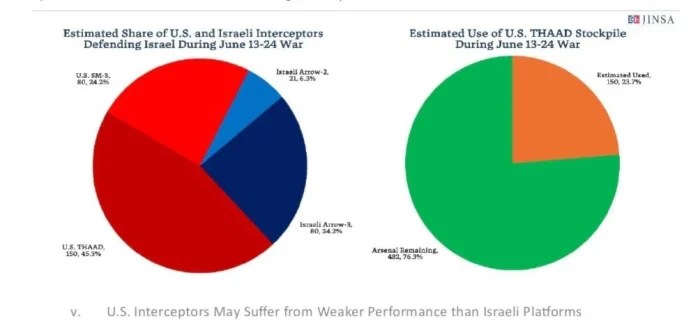
Returning to Jordan: American planners show little concern for Jordanian costs or the consequences for the base itself, which is situated around 70km from the capital Amman. From this perspective, it may even be deemed acceptable for the US if Iran expends part of its ballistic arsenal striking the base, even at the cost of Jordanian casualties.
The American assumption is that they would then be able to launch a major air campaign to destroy Iranian missile production, storage, and launch sites. This would pave the way for an Israeli entry into a second phase of the war, one in which it would no longer face missile volumes it cannot absorb, as it almost did in the June war, as it was running out of interceptors after a presumed US airpower success in weakening the system and reducing launch capacity.
From Iran’s standpoint, directly starting with “Israel” may actually be more rational. An Israeli participation in any war appears almost inevitable, either immediately or at a later stage, for multiple reasons.
Despite the massive US buildup, which includes more than 36 F-15Es, an aircraft carrier, and several destroyers with capabilities to launch cruise missiles, Israelis still retain greater immediate regional firepower than the United States, but it seeks to avoid sudden, large-scale damage to its own infrastructure.
American intentions likely go beyond limited bombings, assassinations, or “decapitation” strikes, as seen previously, if their attack would make sense in terms of weighing gains and possible losses. They may include direct strikes targeting the Iranian leadership, severe economic and energy infrastructure degradation, and long-term destabilization designed to enable internal regime change, added to the sanctions.
The withdrawal of American aircraft from Gulf bases was not only due to their vulnerability to short-range, high-precision weapons that Iran’s arsenal is full of, but also to protect Gulf oil production in the event of war. Gulf states, for their part, would publicly distance themselves from hostilities to shield their economies and prevent market shocks, particularly to avoid upsetting Trump amid any market volatility.
While it is possible to disrupt US operations at Muwaffaq Salti Air Base, expending large numbers of ballistic missiles there, missiles that could instead strike high-value counter force and counter value Israeli targets, may be less strategically viable than other options if the US is prepared to escalate toward total confrontation regardless. Completely and permanently disabling the base would be difficult, and the strategic outcome would likely remain unchanged.
American planners appear convinced that Iran will avoid targeting Jordanian state infrastructure or attempting to destabilize the Jordanian monarchy, as such actions can be used for counterpropaganda. They assume Iran will focus on Western and Israeli forces, confining hostilities to sparsely populated desert areas that Jordan can absorb.
Jordan, governed by a monarchy heavily dependent on Western and Gulf countries’ political and economic support, appears to share this assessment. King Abdullah likely believes his rule faces no serious internal risk and that alignment with Western strategy is the safer course, as his country was credited for being “Israel’s” shield against Iranian drones in the June 2025 war.
Under this framework, the US would launch an air campaign using aircraft operating from Jordan to strike western Iran, while carrier-based aircraft in the Arabian Sea attempt to open corridors toward central Iran from the Gulf. This would allow heavy bombers from Diego Garcia to penetrate deeper and strike strategic targets. The Israeli occupation would then enter at a later stage.
The simplest counter-strategy is to do precisely what the Americans do not expect, and to inflict maximum cost. The theory that remains largely unrefuted: Trump is risk-averse. As Western media itself jokes, TACO (Trump Always Chickens Out), he dislikes long wars, favors last-minute, flashy interventions, and avoids sustained attrition. This suggests a vulnerability: American short-termism and reluctance to absorb prolonged pain, particularly when multiple theaters remain active.
Some may ask why Iran does not simply launch a preemptive strike. This is a clear option, but not an uncomplicated one. An initial Iranian strike could rally American public opinion behind a longer war, granting Trump broader authority, resources, and popular support. While it would disrupt US planning and cause early damage, it might ultimately strengthen Washington’s domestic position. By contrast, an American-initiated war, prolonged, unpopular, and costly, would be far more vulnerable to internal pressure, especially if American losses mount.
Adding to the complexity, two Emirati Il-76 cargo aircraft reportedly landed in Tel Aviv before flying on to Turkmenistan. These aircraft are known to be used by the UAE to supply proxy forces with weapons, particularly in Sudan and Somalia, raising the possibility that they were transporting drones or intelligence equipment for regional operations.
The picture remains highly complex, and it is entirely possible that nothing will happen. Still, based on current force deployments and escalation patterns, the probability of a US attack appears to have risen beyond a 50-50 threshold.
This analysis reflects what American planners may be thinking, not what will necessarily occur. It should be noted that after the previous war, many US and Israeli officials declared that Iran’s nuclear and missile programs had been torpedoed, and the system effectively destroyed, assessments that quickly proved false. Now, only months later, they appear to believe that an even more violent war is required to achieve what the last one supposedly already accomplished.
On the other hand, if endurance is possible and the United States is forced to retreat, Trump TACOs or abandon Israelis mid-conflict — an outcome not inconceivable under a president like Trump — the cumulative effects of “Israel’s” recent dominance and coercion across the region may yet be reversed.
As mentioned earlier, the US buildup is not sufficient to start a prolonged attack against Iran with the high goals of regime change. The buildup still does seem as defensive posturing shielding the Israelis, so a chance the Israelis might initiate and use the limited US and Western buildup as a shield is still significant. A scenario similar to what happened in the last war, but that does entail Israeli losses in the opening phase.
Conclusion
What emerges from this assessment is a US strategy built on supposed escalation control, risk displacement, and the assumption that others will behave within predefined limits. Washington appears to believe it can shape the battlefield geographically, pushing early phases of the war away from the fragile “Israel”, absorbing initial retaliation through peripheral bases, and then intervening decisively to reshape the balance before handing the fight back to Israelis under more favorable conditions. This is not a strategy aimed at victory in the classical sense, but at managing exposure and buying time.
The weakness in this thinking lies in its dependence on predictability. It assumes Iran will refrain from actions that collapse the carefully constructed sequencing of the war, that regional systems will remain stable under strain, and that American political leadership will tolerate the costs long enough to reach a decisive point. None of these assumptions is guaranteed. If any one of them fails, the entire escalation ladder becomes unstable.
Ultimately, the outcome of any confrontation will not be decided by the opening phase or by claims of technological superiority, but by endurance, political cohesion, and the ability to impose sustained costs on an adversary unwilling to absorb them.
The United States may possess overwhelming firepower, but it remains constrained by limited strategic patience and domestic vulnerability. If those constraints are effectively exploited, the very war designed to resolve the Iranian question may instead deepen American entanglement and erode the regional order it seeks to preserve.
US sanctions Popular Conference for Palestinians Abroad over alleged Hamas links
MEMO | January 23, 2026
The United States has imposed sanctions on the Popular Conference for Palestinians Abroad, accusing the organisation of supporting Hamas and engaging in deceptive fundraising practices, according to a decision announced on Wednesday.
The sanctions, which also target six charitable organisations operating in the Gaza Strip, include freezing any assets held within the United States and prohibiting US citizens and companies from conducting transactions with the listed entities.
According to the US Treasury Department, the Popular Conference for Palestinians Abroad was “founded and operated by elements linked to Hamas,” claiming that the movement exercises control over the organisation’s strategic and operational activities. The department also cited the presence of individuals within the conference who have previously been placed on US sanctions lists.
Founded in February 2017, the Popular Conference for Palestinians Abroad was launched during a large gathering in Istanbul attended by Palestinians from around 50 countries. The organisation describes itself as a grassroots framework aimed at unifying Palestinians in the diaspora, enhancing their political engagement, and reinforcing their role in the Palestinian national movement.
Based in Lebanon, the conference has organized events and conferences in several countries, including Turkey, and has participated in political and popular initiatives related to the Palestinian cause. Its founders say the conference serves as a coordinating umbrella for hundreds of Palestinian institutions worldwide and stress that it does not seek to replace the Palestine Liberation Organisation, but rather to complement its role.
In response to the US decision, the conference has described itself as an independent and open organisation representing a broad spectrum of Palestinian political affiliations. It rejected the accusations, stating that its activities are public and focus on political advocacy, popular mobilisation, and humanitarian support.
The sanctions decision comes amid heightened US scrutiny of organizations accused of links to Hamas, particularly in the context of the ongoing war in Gaza.
How Syria’s Kurds were erased from the US-led endgame
Paris marked the moment Washington quietly aligned with Ankara and Tel Aviv to close the Kurdish chapter in Syria’s war
By Musa Ozugurlu | The Cradle | January 21, 2026
For nearly 15 years, US flags flew over Syrian territory with near-total impunity – from Kurdish towns to oil-rich outposts. In the northeast, the Kurdish-led Syrian Democratic Forces (SDF) manned checkpoints, American convoys moved freely, and local councils governed as if the arrangement was permanent.
The occupation was not formal, but it did not need to be. So long as Washington stayed, the Autonomous Administration of North and East Syria (AANES) had a state in everything but name.
Then, in the first week of January, that illusion was broken. What had passed for a military partnership was quietly dismantled in a Paris backroom – without Kurdish participation, without warning, and without resistance. Within days, Washington’s most loyal proxy in Syria no longer had its protection.
A collapse that looked sudden only from the outside
Since late last year, Syria’s political and military terrain shifted with startling speed. Former Syrian president Bashar al-Assad’s rule came to an end, and shortly afterward, the SDF – long portrayed as the most disciplined and organized force in the country – followed the same trajectory.
To outside or casual observers, the SDF collapse appeared abrupt, even shocking. For many Syrians, particularly Syrian Kurds, the psychology of victory that had defined the past 14 years evaporated in days. What replaced it was confusion, fear, and a growing realization that the guarantees they had relied on were never guarantees at all.
Hayat Tahrir al-Sham (HTS) – an extremist militant group stemming from the Nusra Front – advanced with unexpected momentum, achieving gains few analysts had predicted. But the real story was the absence of resistance from forces that, until recently, had been told they were indispensable.
The question, then, is not how this happened so quickly, but why the ground had already been cleared.
The illusion of fixed positions
To understand the outcome, it is necessary to revisit the assumptions each actor carried into this phase of the war.
The SDF emerged in the immediate aftermath of the US-led intervention against Damascus. It was never intended to be a purely Kurdish formation. From the outset, its leadership understood that ethnic exclusivity would doom its international standing. Arab tribes and other non-Kurdish components were incorporated to project the image of a multi-ethnic, representative force.
Ironically, those same tribal elements would later become one of the fault lines that accelerated the SDF’s disintegration.
Militarily, the group benefited enormously from circumstance. As the Syrian Arab Army fought on multiple fronts and redeployed forces toward strategic battles – particularly around Aleppo – the SDF expanded with minimal resistance. Territory was acquired less through confrontation than through absence.
Washington’s decision to enter Syria under the banner of fighting Assad and later ISIS provided the SDF with its most valuable asset: international legitimacy. Under US protection, the Kurdish movement translated decades of regional political experience into a functioning de facto autonomous administration.
It looked like history was bending in their favor.
Turkiye’s red line never moved
From Ankara’s perspective, Syria was always about two objectives. The first was the removal of Assad, a goal for which Turkiye was willing to cooperate with almost anyone, including Kurdish actors. Channels opened, and messages were exchanged. At times, the possibility of accommodation seemed real.
But the Kurdish leadership made a strategic choice. Believing their US alliance gave them leverage, they closed the door and insisted on pursuing their own agenda.
Turkiye’s second objective never wavered: preventing the emergence of any Kurdish political status in Syria. A recognized Kurdish entity next door threatened to shift regional balances and, more importantly, embolden Kurdish aspirations inside Turkiye itself.
That concern would eventually align Turkiye’s interests with actors it had previously opposed.
Washington’s priorities were never ambiguous
The US did not hide its hierarchy of interests in West Asia. Preserving strategic footholds mattered. But above all else stood Israel’s security.
Hamas’s Operation Al-Aqsa Flood in October 2023 handed Washington and Tel Aviv a rare opportunity. As the Gaza genocidal war unfolded and the Axis of Resistance absorbed sustained pressure, the US gained a new and more flexible partner in Syria alongside the Kurds: HTS leader Ahmad al-Sharaa, formerly known as Abu Muhammad al-Julani when he was an Al-Qaeda chief.
Sharaa’s profile checked every box. His positions on Israel and Palestine posed no challenge. His sectarian background reassured regional capitals. His political outlook promised stability without resistance. Where the Assads had generated five decades of friction, Sharaa offered predictability.
For Washington and Tel Aviv, he represented a cleaner solution.
Designing a Syria without resistance
With Sharaa in place, Israel found itself operating in Syrian territory with unprecedented ease. Airstrikes intensified. Targets that once risked escalation now passed without response. Israeli soldiers skied on Mount Hermon and posted selfies from positions that had been inaccessible for decades.
Damascus, for the first time in modern history, posed no strategic discomfort.
More importantly, Syria under Sharaa became fully accessible to global capital. Sanctions narratives softened while reconstruction frameworks emerged. The war’s political economy entered a new phase.
In this equation, a Syria without the SDF suited everyone who mattered. For Turkiye, it meant eliminating the Kurdish question. For Israel, it meant a northern border stripped of resistance. For Washington, it meant a redesigned Syrian state aligned with its regional architecture.
The name they all converged on was the same.
Paris: Where the decision was formalized
On 6 January, Syrian and Israeli delegations met in Paris under US mediation. It was the first such encounter in the history of bilateral relations. Publicly, the meeting was framed around familiar issues: Israeli withdrawal, border security, and demilitarized zones. But those headlines were cosmetic.
Instead, the joint statement spoke of permanent arrangements, intelligence sharing, and continuous coordination mechanisms.
Yet these points were also clearly peripheral. The real content of the talks is evident in the outcomes now unfolding. Consider the following excerpt from the statement:
“The Sides reaffirm their commitment to strive toward achieving lasting security and stability arrangements for both countries. Both Sides have decided to establish a joint fusion mechanism – a dedicated communication cell – to facilitate immediate and ongoing coordination on their intelligence sharing, military de-escalation, diplomatic engagement, and commercial opportunities under the supervision of the United States.”
Following this, Israeli Prime Minister Benjamin Netanyahu’s office “stressed … the need to advance economic cooperation for the benefit of both countries.”
Journalist Sterk Gulo was among the first to note the implications, writing that “An alliance was formed against the Autonomous Administration at the meeting held in Paris.”
From that moment, the SDF’s fate was sealed.
Ankara’s pressure campaign
Turkiye had spent years working toward this outcome. Reports suggest that a late-2025 agreement to integrate SDF units into the Syrian army at the division level was blocked at the last minute due to Ankara’s objections. Even Sharaa’s temporary disappearance from the public eye – which sparked rumors of an assassination attempt – was linked by some to internal confrontations over this issue.
According to multiple accounts, Turkiye’s Ambassador Tom Barrack was present at meetings in Damascus where pro-SDF clauses were rejected outright. Physical confrontations followed. Sharaa vanished until he could reappear without explaining the dispute.
Turkish Foreign Minister Hakan Fidan was present in Paris and played an active role in the negotiations. Its demands were clear: US support for the SDF must end, and the so-called “David Corridor” must be blocked. In exchange, Turkiye would not obstruct Israeli operations in southern Syria.
It was a transactional alignment – and it worked.
Removing the last obstacle
With the SDF sidelined, Sharaa’s consolidation of power became possible. Control over northeastern Syria allowed Damascus to focus on unresolved files elsewhere, including the Druze question.
What followed was predictable. Clashes in Aleppo before the new year were test runs. The pattern had been seen before.
In 2018, during Turkiye’s Olive Branch operation, the SDF announced it would defend Afrin. Damascus offered to take control of the area and organize its defense. The offer was refused – likely under US pressure. On the night resistance was expected, the SDF withdrew.
The same script replayed in Sheikh Maqsoud and Ashrafieh. Resistance lasted days. Supplies from east of the Euphrates never arrived. Withdrawal followed.
The American exit, again
Many assumed that the Euphrates line still mattered. That HTS advances west of the river would not be repeated in the east. That Washington would intervene when its Kurdish partner was directly threatened.
The shock came when HTS moved toward Deir Ezzor, and Arab tribes defected en masse. These tribes had been on the US payroll. The message was unmistakable: salaries would now come from elsewhere.
Meanwhile, meetings between Sharaa and the Kurds, which were expected to formalize agreements, were delayed twice, and clashes broke out immediately after.
Washington had already decided.
US officials attempted to sell a new vision to Kurdish leaders: participation in a unified Syrian state without distinct political status. The SDF rejected this, and demanded constitutional guarantees. It also refused to dissolve its forces, citing security concerns.
The Kurdish group’s mistake was believing history would not repeat itself.
Afghanistan should have been enough of a warning.
What remains
Syria has entered a new phase. Power is now organized around a Turkiye–Israel–US triangle, with Damascus as the administrative center of a project designed elsewhere.
The Druze are next. If Israel’s security is guaranteed under the Paris framework, HTS forces will eventually push toward Suwayda.
The Alawites remain – isolated and exposed.
The fallout is ongoing. On 20 January, the SDF announced its withdrawal from Al-Hawl Camp – a detention center for thousands of ISIS prisoners and their families – citing the international community’s failure to assist.
Damascus accused the Kurds of deliberately releasing detainees. The US, whose base sits just two kilometers from the site of a major prison break, declined to intervene.
Washington’s silence in the face of chaos near its own installations only confirmed what the Kurds are now forced to accept: the alliance is over.
Ultimately, it was not just a force that collapsed. It was a whole strategy of survival built on the hope that imperial interests might someday align with Kurdish aspirations.
Trump presses aides to draw up ‘decisive options’ for strikes on Iran: Report
The Cradle | January 21, 2026
US President Donald Trump is pressing his team to draw up “decisive” options for an attack on the Islamic Republic of Iran, after canceling a planned strike earlier this month, the Wall Street Journal (WSJ) reported on 20 January.
Officials told the outlet that Trump repeatedly used the word “decisive” when telling his aides what desired outcome he wanted from striking Iran.
As a result, the Pentagon has devised several scenarios including attacks that aim to overthrow the Iranian government, the report said.
One of the options is described as more limited, however, and includes strikes on Iran’s Islamic Revolutionary Guard Corps (IRGC) facilities.
The officials added that Trump has not yet authorized an attack and that his final decision is still unclear at this point.
Washington is moving the USS Abraham Lincoln aircraft carrier toward West Asia after redeploying it from the South China Sea.
Aerial refueling tankers and additional squadrons of fighter jets are also being moved to the region.
The report coincides with Iranian Foreign Minister Abbas Araghchi’s most stern warning yet, which was conveyed in his own op-ed for the WSJ.
“Unlike the restraint Iran showed in June 2025, our powerful armed forces have no qualms about firing back with everything we have if we come under renewed attack. This isn’t a threat, but a reality I feel I need to convey explicitly, because as a diplomat and a veteran, I abhor war,” Araghchi said.
He also commented on the recent unrest in Iran. “The White House ought to be impervious to the wave of demonstrably false stories in western media about recent events in Iran, but it may be necessary to clarify some points. The protests began peacefully and were recognized as legitimate by the Iranian government.”
“They suddenly turned violent when foreign and domestic terrorist actors entered the scene, so blocking communication among organizers of the rioters and terrorists was an imperative. As those cells are being wrapped up by our intelligence and security agencies, the internet and all communications are slowly being restored,” the foreign minister added.
Over the past few weeks, Iran faced widespread riots after protests turned violent following the collapse of the Iranian currency, caused by years of brutal US sanctions.
Western-based rights groups claim thousands of peaceful protesters have been killed. Iran has detained hundreds of armed rioters, many of whom have been found with links to the Mossad, and are behind the killing of scores of civilians.
A former CIA director recently admitted that Mossad agents were on the ground in the protests.
Multiple reports confirmed Iran’s use of military-grade GPS jammers to shut off Starlink, which had been deployed to Iran in a US-backed effort to ‘aid’ protesters amid an internet shutdown.
As a result, Iran was able to significantly reduce riots and foreign-backed sabotage operations – which included the killing of over 100 security forces and police officers. Tens of thousands of Starlink devices were seized or shut off.
“The Americans and Israelis are shocked,” former MI6 agent Alastair Crooke, previously a British diplomat as well, told The Cradle in an interview.
Trump called off his planned attack on Iran earlier this month, after vowing to hit the country “hard” and “rescue” protesters. The president claimed he changed his mind after Iran decided against executing hundreds of detained rioters.
Abd al-Bary Atwan, a Palestinian-British journalist and editor of Rai al-Youm newspaper, said Trump “was forced to call off his attack” after US-Israeli destabilization efforts failed to weaken the government.
According to the WSJ, Israel requested that Trump call off the strike because Tel Aviv was not prepared for an Iranian retaliation.
Featured Video
Elijah Magnier: Yemen’s strikes are shattering Saudi Arabia’s long-term strategy
or go to
Aletho News Archives – Video-Images
From the Archives
British weapons and personnel doing much of the killing in Yemen
Press TV – June 18, 2019
A detailed report published by the Guardian newspaper has shown how Britain is massively contributing to Saudi Arabia’s devastating war on Yemen as it suggests that London is not only supplying the bombs that fall on Yemenis, but it provides the personnel and expertise that keep the war going.
The comprehensive report by Arron Merat published on Tuesday showed that Britain was doing much of the killing in Yemen as the country continues to provide Saudi Arabia with everything it needs to turn its southern impoverished neighbor into a graveyard.
“Every day Yemen is hit by British bombs – dropped by British planes that are flown by British-trained pilots and maintained and prepared inside Saudi Arabia by thousands of British contractors,” said Merat in the report. … continue
Blog Roll
 Aletho News
- Racist Seinfeld Dances for Joy as Bibi Unveils His New Map
- A West Bank War for Netanyahu’s Election Campaign, Could It Backfire?
- Yemen denounces European Parliament’s ‘hypocritical’ push to blacklist Ansarullah
- Qalibaf: UAE’s UN bid aims to ‘clear the runway’ for ‘Greater Israel’, whitewash genocide
- Pakistan reopens Iran border after boosting security: Report
- Why are so many Brazilians voting for Flávio Bolsonaro?
- Democrats Put Anti-Russia Agenda Ahead of American Workers
- Elijah Magnier: Yemen’s Strikes Are Shattering Saudi Arabia’s Long-Term Strategy
- Pentagon designates Chinese cultural centers national security threat
- Israel Demolishes Home Of Lebanese Journalist Whose Viral Film Exposed Pager Attack
- If Americans Knew
- An error has occurred; the feed is probably down. Try again later.
- No Tricks Zone
- Sudden Stratospheric Warming, Powerful El Niño Combination May Lead To Extreme Europe Cold, Energy Crisis!
- Two New Studies Find Thwaites Glacier Melt Cannot Be Driven By Human Activity Or A Warming Ocean
- E-Cars Reduce CO2 Emissions By Only 41% Compared To Internal Combustion Engine Vehicles
- Predictions Made By Renowned Climate Professor Over Past Decades Have Been Proven To Be Poor
- New Study Suggests Large Regions Of The Pacific Ocean Have Been Cooling For The Last 80 Years
- Germany’s Green Energy Debacle: High Energy Costs Force Kahla Porzellan to Close After 182 Years!
- New Study: 50 Years Of The Most Aggressive ‘Net Zero’ Policies Can Only Affect The Global Climate By 0.03°C
- US September “Heat” Was No Record…Many Records Set Decades Ago
- Latest European Green Energy Debacle; Portugal’s Largest Flagship Solar Park Insolvent!
- Green Energy Debacle: German Expert Professor Fritz Vahrenholt Warns Of Severe Economic And Social Consequences

