Sen. Schumer: I Will Continue to Fight to Give Israel All the Aid It Needs
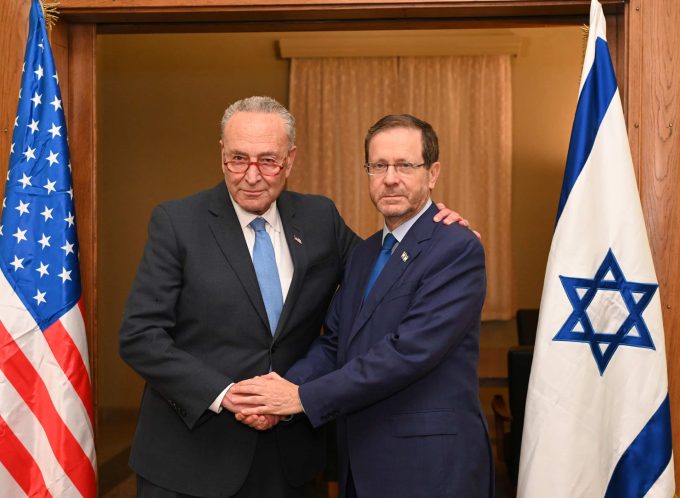
Photo by : Haim Zach / GPO
By Kyle Anzalone | The Libertarian Institute | February 4, 2026
Senator Chuck Schumer said that he would fight to get Israel “all the aid that it needs.”
“I will fight for aid to Israel. All the aid that Israel needs. I will continue to fight for it,” the Senate minority leader said on Saturday. He went on to refer to Israel aid as his “baby.”
The US has provided hundreds of billions in security assistance to Israel and fought several wars in the Middle East for Tel Aviv. Following the October 7, 2023, Hamas attack on Israel, the US sent Israel $14 billion in arms that were used to conduct a genocide in Gaza.
Schumer touted his role in passing that aid package to Israel. “We delivered more security assistance to Israel, our ally, under my leadership than ever, ever before. We will keep doing that,” he told the conference of Jewish-Americans. “As long as I’m in the Senate. This program will continue to grow from strength to strength, and we won’t let anyone attack it or undo it.”
The Democratic leader of the Upper Chamber also said that he hopes the ceasefire in Gaza turns into a lasting peace. However, Israel is undermining the truce with daily strikes on Gaza. Since Saturday, Israel has killed over 60 Palestinians.
While the US holds significant leverage over Israel via military assistance, statements like Schumer’s make it clear to Tel Aviv that Washington is unprepared to threaten Prime Minister Benjamin Netanyahu that if he does not comply with the ceasefire, Washington will end the flow of aid.
Newly surfaced Epstein email ties him to Israel–UAE strategy targeting Qatar
MEMO | February 3, 2026
Newly uncovered emails dated July 2017 reveal disgraced sex trafficker Jeffrey Epstein, long accused of acting on behalf of Israeli intelligence, lobbying for political and financial pressure to be applied against Qatar at the height of the Gulf diplomatic crisis.
The email exchange, dated 6th July 2017, sees Epstein accusing Qatar of “terrorism financing,” describing its leadership as “dangerous,” and demanding that it be made to “come out against terrorism and not just say it.” He proposes creating a billion-dollar “victim fund” for terrorism survivors to be administered by the US, UK and UN, while calling on Qatar to either contribute financially or recognise Israel—framing both as tests of its sincerity in opposing terrorism.
Epstein outlines a strategy of reputational damage and financial pressure, proposing a Western-administered fund that would publicly test Qatar’s stance on terrorism. His language reflects the broader Israel–UAE effort at the time to isolate Qatar over its support for Palestinian rights and refusal to normalise relations with Israel.
The message was sent just weeks after the blockade on Qatar was launched by the UAE, Saudi Arabia and Bahrain in June 2017. Though publicly framed as a crackdown on terrorism and the Muslim Brotherhood, the blockade was seen as part of a broader effort to force Qatar to abandon its support for Palestine, close Al Jazeera, cut ties with Iran, and expel Turkish forces, demands that aligned directly with Israeli priorities.
As MEMO first reported in 2017, leaked emails from the UAE Ambassador Yousef Al-Otaiba revealed coordination with staunch pro-Israel figures in Washington, including Elliott Abrams and Dennis Ross, on strategies to “punish” Qatar. At one point, Abrams suggested that conquering Qatar would “solve everyone’s problems.” Al-Otaiba responded: “It would be an easy lift”.
Former German Foreign Minister Sigmar Gabriel later confirmed that the UAE had drawn up plans for a military invasion of Qatar. What prevented the assault was not US President Donald Trump, who publicly backed the blockade initially and called Qatar a “terrorism funder,” but then-Secretary of State Rex Tillerson, who intervened after being tipped off by Qatari intelligence, making over 20 calls in a frantic attempt to stop the invasion.
Throughout the crisis, Israeli and Emirati lobbyists jointly pressured US lawmakers to label Qatar a state sponsor of terrorism. The Foundation for Defense of Democracies, a pro-Israel neo-conservative outfit backed by billionaire and Benjamin Netanyahu ally Sheldon Adelson, worked closely with UAE officials to frame the narrative in Washington. Netanyahu himself met with UAE and Bahraini diplomats to coordinate efforts behind the scenes.
The email places Epstein—widely considered to have been a Mossad asset involved in sophisticated blackmail operations—squarely within the broader effort to isolate Qatar during the 2017 blockade. His proposals echo the strategy pursued by Israel and the UAE to punish Doha for its support of Palestinian rights and refusal to normalise relations with Israel
‘No nuclear program, no ballistic missiles, no support for resistance’: Israel sets red lines ahead of Iran–US talks
The Cradle | February 3, 2026
Israel is pushing the US to maintain the “three no’s” in upcoming talks with Iran, Israeli media reported – referring to the demand that Tehran end enrichment and give up its nuclear program, end its ballistic missile program, and halt support for resistance groups in the region.
“Israel is expected to call for the US to uphold ‘three no’s’ during the talks with Iran. These demands are that under any deal with the US, Iran agree to have no nuclear program, no ballistic missile program, and to give no support to armed proxy groups,” the Times of Israel said.
The report says the message will be delivered during a meeting with Israeli Prime Minister Benjamin Netanyahu ahead of US envoy Steve Witkoff’s expected engagement later this week with Iran’s top diplomat.
According to Israel’s Channel 12, the chiefs of Mossad and the Israeli army will be present at the meeting, as well as other security officials.
Iranian President Masoud Pezeshkian has announced that Tehran has agreed to hold a round of nuclear talks with Washington – in an effort to de-escalate tensions – on the condition that threats be halted and that “fair and equitable” negotiations take place.
“I have instructed my Minister of Foreign Affairs, provided that a suitable environment exists – one free from threats and unreasonable expectations – to pursue fair and equitable negotiations, guided by the principles of dignity, prudence, and expediency,” he said.
Iranian Foreign Minister Abbas Aragchi will meet Witkoff in Ankara on Friday.
Despite agreeing to hold talks, Tehran has categorically refused to capitulate to the “three no’s” demand.
“Iran’s defense is non-negotiable,” an Iranian source told Reuters.
Ali Shamkhani, senior advisor to Iran’s supreme leader, said the same thing in an interview with Al Mayadeen. He also said the US must “set aside unreasonable demands.”
He said Iran could potentially reduce enrichment, as was reported last year and hinted at by some officials.
“If the US attacks us, we will automatically regard Israel as a party to it, and we will inevitably respond accordingly. Any aggression against Iran, no matter how limited, will be turned into a very serious crisis, far greater than others imagine.” he added.
The Islamic Republic’s Supreme Leader, Ali Khamenei, has warned of a “regional war” if Iran is attacked. Officials have vowed that Tehran will strike Israel and US military bases across the region if the US decides to bomb.
Resistance groups in West Asia, including Lebanon’s Hezbollah, have warned that an attack on Iran would ignite the region.
Washington’s aircraft carrier, the USS Abraham Lincoln, has arrived in West Asia with several accompanying warships. Washington has also deployed additional fighter jet squadrons to the region.
Last week, Trump said that a “beautiful armada” is headed toward Iran, calling on the Islamic Republic to capitulate to US terms.
“If Iran doesn’t come to the talks on Friday with tangible things, it could find itself very quickly in a very bad situation,” a top official from a mediating country told Axios.
Araghchi recently said, “Let’s not talk about impossible things” when asked about the three main US-Israeli demands.
Fantasies of Fragmenting Iran Only Serve Israeli Interests
By José Niño | The Libertarian Institute | February 2, 2026
A troubling convergence has emerged among Western think tanks, Israeli politicians, and exiled opposition figures advocating for the partition of Iran along ethnic and sectarian lines. This strategy represents a dangerous escalation from traditional regime change toward what can only be described as regime destruction, a policy shift that would benefit Israeli regional ambitions while catastrophically destabilizing the Middle East and creating humanitarian disasters that would dwarf the Syrian refugee crisis.
Iran’s demographic reality forms the pretext for these proposals. Persians constitute between 51 and 61% of the population, while Azerbaijanis comprise 16 to 24%, Kurds represent 7 to 10%, with smaller populations of Arabs, Baloch, Lurs, and Turkmen rounding out the nation’s ethnic composition. Rather than viewing this diversity as a national strength, Balkanization advocates frame it as a strategic vulnerability ripe for exploitation.
The Foundation for Defense of Democracies, a rabid neoconservative organization, has positioned itself at the forefront of this campaign. Analyst Brenda Shaffer has explicitly promoted Iran’s fragmentation comparable to Yugoslavia’s violent collapse, while maintaining undisclosed financial ties to Azerbaijan’s state oil company SOCAR. Her advocacy centers on promoting secession of Iranian Azerbaijan, revealing fundamental misunderstanding of Iranian internal dynamics. Both Supreme Leader Ayatollah Ali Khamenei and President Massoud Pezeshkian are Azerbaijani, thoroughly undermining narratives of Persian ethnic hegemony driving separatist sentiment.
Media outlets have amplified these calls with alarming explicitness. In June 2025, The Jerusalem Post editorial board urged formation of a “Middle East coalition for Iran’s partition,” proposing “security guarantees to Sunni, Kurdish and Balochi minority regions willing to break away.” The editorial advocated federalization or complete partition, explicitly comparing Iran’s potential dismemberment to Yugoslavia’s breakup. The Wall Street Journal similarly published arguments that a fractured Iran could frustrate Russian and Chinese interests while reducing threats to Israel, downplaying catastrophic risks.
Israeli political circles have demonstrated institutional support for partition. In 2023, thirty-two members of Parliament signed a declaration calling for Iran’s disintegration into six parts, advocating territorial separation from Tehran to Iranian Azerbaijan, merger of Iranian Kurdistan with Iraqi Kurdish regions, independence for Ahwaz, and alignment of Baluchistan with Pakistan. Though most lawmakers later rescinded signatures following backlash, the episode exposed significant appetite for fragmentation strategies within Israeli political establishment.
The ideological foundation for these proposals traces directly to the 1982 Yinon Plan, a strategic memorandum by Israeli journalist Oded Yinon advocating division of Middle Eastern states along ethnic and sectarian lines. The plan explicitly stated Israel must effect “the division of the whole area into small states by the dissolution of all existing Arab states,” operating on the premise that smaller states are weaker states and therefore easier to dominate. While the original document focused primarily on Arab states, contemporary partition advocacy has extrapolated these principles to Iran, effectively creating a Yinon Plan for the Iranosphere.
This represents the logical culmination of a strategy that has already produced catastrophic results across the region. Iraq’s 2003 invasion and subsequent sectarian fragmentation created hundreds of thousands of civilian deaths, millions of refugees, and the rise of ISIS rather than the democratic transformation promised. Syria’s fragmentation generated over half a million deaths and displaced half the pre-war population. Libya’s post-intervention collapse created ungoverned spaces exploited by terrorist networks and human traffickers. The pattern is consistent: balkanization produces chaos, humanitarian catastrophe, and conditions favoring extremist groups rather than stability or democracy.
For Iran specifically, partition would serve exclusively Israeli strategic interests while harming American national security. Israel seeks to leave Iran fragmented and dotted by warring statelets incapable of posing coherent challenge to greater Israeli regional ambitions. A broken Iran cannot develop nuclear capabilities, cannot support resistance movements, cannot project power beyond its borders. The United States has no corresponding interest in such outcomes. Iranian fragmentation would create massive refugee flows destabilizing neighboring states and requiring international humanitarian intervention. It would generate ungoverned territories exploited by terrorist organizations.
Turkey will never tolerate Western support for Kurdish separatism in Iran given its decades-long struggle with the Kurdistan Workers’ Party. Pakistan, already facing a Baloch insurgency movement, would view Western meddling in Iranian Balochistan as direct threat to its territorial integrity. Russia and China, both managing ethnic minority regions, would interpret Iran partition as validating their darkest suspicions about Western intentions, accelerating formation of anti-Western coalitions and hardening domestic crackdowns.
American efforts against Iran have already demonstrated the futility of maximum pressure approaches. Decades of sanctions have not produced regime change but rather entrenched hardliners and strengthened nationalist resistance. Covert operations including assassinations of nuclear scientists, Stuxnet cyberattacks, and support for exile groups have failed to alter Iranian strategic calculations. Direct military strikes destroyed facilities temporarily rebuilt within years. The historical record shows Iranian society rallies around the flag when facing external aggression rather than fragmenting along ethnic lines.
Iranian nationalism represents a powerful unifying force transcending ethnic divisions. Iran claims status as one of the world’s oldest continuous civilizations, with national identity predating modern ethnic categories. Unlike Iraq or Syria where borders reflected colonial cartography, Iran constitutes a historically integrated entity where internal diversity has coexisted with strong national consciousness for millennia.
The alternative to destructive partition fantasies requires sober policy recognizing previous failures. The United States needs fundamental strategic reorientation away from Middle Eastern interventions toward addressing genuine national security priorities. Border security in the Western Hemisphere, managing peaceful co-existence China, and rebuilding domestic infrastructure represent core American interests unrelated to fragmenting Iran.
Non-interventionism and restraint acknowledge that Iranian political evolution must emerge from internal dynamics rather than external manipulation. The lessons from Iraq, Syria, and Libya are unambiguous. Military intervention and support for fragmentation produce humanitarian catastrophes, empower extremist factions, and create conditions requiring prolonged American involvement rather than enabling withdrawal. The Middle East does not need another failed state generating refugee crises and terrorist safe havens. The American people deserve foreign policy serving national interests rather than outsourcing strategic decision-making to regional allies [?] pursuing incompatible objectives.
Iran’s partition would not take the country off the geopolitical chessboard as advocates claim. It would set that board on fire, creating unpredictable cascades of violence, displacement, and great power competition in one of the world’s most volatile regions. The humanitarian costs would be staggering, the strategic consequences counterproductive, and the benefits accruing exclusively to Israel rather than the United States or the Iranian people themselves.
A responsible approach recognizes Iran’s ninety million citizens deserve to determine their own political future, but such transformation cannot be imposed through external fragmentation. The path forward requires restraint, non-interventionism, and acknowledgment that decades of sanctions, covert operations, and military threats have consistently failed while strengthening the very regime they aimed to weaken.
Mike Pompeo admits Washington ‘directly helped’ rioters in Iran
Press TV – February 2, 2026
Former CIA director Mike Pompeo has admitted that Washington played a direct role in recent violent riots in Iran, saying the United States “directly helped” the rioters.
In an interview with Israeli Channel 13 on Monday, the interviewer referred to US President Donald Trump’s promises of support for the rioters and suggested that such help never materialized.
Pompeo rejected that view, responding, “I do not think so. Help did come … a lot of help. We may not see it all … We may not know about it all, But the United States is actively trying to help [them].”
When asked whether Trump had missed the opportunity to “overthrow” the Iranian government, Pompeo again disagreed.
His remarks revealed that despite the Trump administration’s repeated statements about pursuing a peaceful solution with Iran, Washington was in practice working toward “regime change” in Tehran.
Pompeo had previously linked the riots in Iran to American and Israeli intelligence agencies. During the riots on January 2, he wrote on the social media platform X, “Happy New Year to every Iranian on the streets. Also to every Mossad agent walking beside them.”
Peaceful protests began in late December in Iran’s commercial districts following the depreciation of the rial against the US dollar.
By early January, however, the situation escalated into violent riots after terrorists linked to Israel and the US infiltrated the gatherings, using live ammunition against security personnel and civilians.
In response, and to protect ordinary people, Iranian security forces and intelligence units intervened decisively and detained the ringleaders behind the violence.
On January 12, millions took part in nationwide demonstrations in support of the Islamic Republic, after which the riots quickly subsided.
Iranian FM reveals ‘fruitful’ indirect talks with US in push for de-escalation
The Cradle | February 2, 2026
Iranian Foreign Minister Abbas Araghchi said in an interview on 1 February that a nuclear agreement with the US was still possible, while warning that a war would engulf the entire region.
Speaking to CNN, Araghchi said indirect communications through regional intermediaries have been “fruitful,” stressing that negotiations must focus strictly on Iran’s nuclear program rather than missiles or regional allies. “Unfortunately, we have lost our trust (in) the US as a negotiating partner.”
In June last year, Iran was attacked by Israel in the middle of nuclear negotiations. US President Donald Trump pretended to favor diplomacy while secretly plotting war with the Israeli leadership.
When asked about halting support for resistance groups in West Asia and a cap on the ballistic missile program, which Washington is demanding, Araghchi told CNN, “Let’s not talk about impossible things.”
“And not lose the opportunity to achieve a fair and equitable deal to ensure no nuclear weapons. That, as I said, is achievable even in a short period of time,” he added. “Of course, in return, we expect sanction lifting.”
Araghchi went on to say that “war would be a disaster for everybody,” given that US military bases were scattered “all over the region.”
He added that Iran has learned lessons from the 12-day war in June and is ready to defend itself from any attack.
“And I think we are now very well prepared. But again, being prepared doesn’t mean that we want war. We want to prevent a war.”
The foreign minister also condemned the foreign-backed “terrorist” riots in Iran last month, and denied Trump’s claims that the execution of protesters was canceled, prompting the US president to halt his planned attack.
“There was no plan for the execution or hanging. I can affirm that the right to each and every person who is arrested and detained would be observed and guaranteed,” he stressed.
“We consider these three days as the continuation of those 12 days of war that was an operation led by Mossad from outside, and of course, we crushed that operation.”
Washington’s aircraft carrier, the USS Abraham Lincoln, has arrived in West Asia with several accompanying warships. Washington has also deployed additional fighter jet squadrons to the region.
Last week, Trump said that a “beautiful armada” is headed toward Iran, calling on the Islamic Republic to capitulate to US terms and come to the negotiating table.
The Iranian military and several other officials say both Israel and the regional countries hosting US bases will be targeted if Washington attacks.
Araghchi’s comments to CNN came after Iran’s Supreme Leader Ali Khamenei warned that a “regional war” would erupt if the US decides to launch an attack against the Islamic Republic.
“The US should know that if they start a war this time, it would be a regional war. Of course, we are not the initiators of war. We do not seek to oppress anyone. We do not seek to attack any country. However, anyone who seeks to attack or cause harm will face a decisive blow,” the leader said.
Resistance groups in West Asia, including Lebanon’s Hezbollah, have warned that an attack on Iran would ignite the region.
Over the weekend, Ali Larijani, head of Iran’s Supreme National Security Council, said, “Contrary to the atmosphere being created by artificial media warfare, the formation of a structure for negotiations is underway.”
On Friday, Araghchi held de-escalation talks in Ankara with his Turkish counterpart Hakan Fidan, who said that Turkiye opposes military action against Iran.
From Iraq war crimes to Gaza’s ‘board of peace’: Why Tony Blair belongs in The Hague
By David Miller | Press TV | February 1, 2026
In the grotesque circus of international power plays, few performers rival Tony Blair for sheer audacity. The former British Prime Minister (1997-2007), once celebrated for his “Cool Britannia” sheen and Third Way politics, is now indelibly stained by the Iraq War debacle, a war built on deception that claimed hundreds of thousands of lives and shattered the region.
Yet in January 2026, Donald Trump appointed him to the Board of Peace, a White House-created entity chaired indefinitely by Trump himself to oversee Gaza’s “reconstruction” under a controversial 20-point plan.
The board’s founding executive includes heavyweights like Marco Rubio, Jared Kushner, Steve Witkoff, Marc Rowan, Ajay Banga, and Robert Gabriel—figures tied to Trumpworld and Zionist interests, with no Palestinian representation.
Blair’s role is lending “statesmanlike” cover to what is seen as a colonial oversight mechanism that could facilitate displacement and control in Gaza. This isn’t redemption; it’s impunity on steroids.
Blair belongs in The Hague facing charges for aggression and complicity in atrocities—not jet-setting as a “peace” architect. This article lays bare his record, his Zionist alliances, his profit-driven institute, his billionaire backer, and why his latest gig risks making him complicit in Gaza’s ongoing nightmare.
Blair’s war crimes: Lies, invasion, and bloodshed
Blair’s gravest sin remains the 2003 Iraq invasion, sold on bogus claims of weapons of mass destruction (WMDs) and Saddam Hussein’s imminent threat.
The Chilcot Inquiry (2016), an exhaustive British investigation, demolished his case: “We have concluded that the UK chose to join the invasion of Iraq before the peaceful options for disarmament had been exhausted. Military action at that time was not a last resort.”
It highlighted “flawed intelligence” that went “unchallenged” and Blair’s overestimation of his influence on George W. Bush. The infamous “dodgy dossier” asserted Iraq could deploy WMDs in 45 minutes—a claim later exposed as hyped and unreliable.
Under the Rome Statute, Blair could face ICC charges for:
- Crime of aggression: Planning and executing an illegal war without UN Security Council approval, violating the UN Charter.
- War crimes: Complicity in detainee abuses, including British forces’ role in cases like the death of Baha Mousa in custody.
- Crimes against humanity: Contribution to systematic civilian harm via indiscriminate tactics, with excess Iraqi deaths estimated in the hundreds of thousands. For example, studies estimated over 650,000 by 2006, as reported by The Guardian, citing a study in The Lancet medical journal. Later estimates put the toll at over a million.
What has been Blair’s response? “I did not mislead this country, I made a decision in good faith,” as he stated post-Chilcot. Prosecutors have tried—private attempts failed due to political barriers, as reported by the BBC on the High Court’s rejection of a 2017 bid by an Iraqi general—but the evidence mounts: the war was unnecessary, illegal, and devastating.
Blair’s Zionist ties: PM to quartet envoy, always ‘Israel First’
Blair’s pro-Israel stance is longstanding and blatant. As the British PM, he cultivated ties with Labour Friends of Israel (LFI) and accepted funding from Zionist-linked donors. He defended Israel’s actions during the Second Intifada, prioritising “security” while downplaying occupation and settlements.
Blair’s inner circle was riddled with pro-Israel influencers. Take Lord Michael Levy, a former record producer, dubbed “Lord Cashpoint” for his fundraising prowess: Introduced to Blair in 1994, Levy raised millions for New Labour, including from pro-Israel sources, and became Blair’s Middle East envoy post-2007.
Levy praised Blair’s “solid and committed support of the State of Israel,” as reported by Mishpacha Magazine. Another key figure was Sir Trevor Chinn, a major donor to Blair’s campaigns and LFI, who also funded Conservative Friends of Israel—showing cross-party Zionist commitment.
Chinn donated six-figure sums to keep Blair in power, as Lobster Magazine detailed. Then there’s Peter Mandelson, Blair’s spin master and a self-proclaimed pro-Israel advocate with family ties to the Jewish Chronicle—his father was the paper’s advertising manager as the Chronicle itself reported.
Mandelson revealed in his memoirs his “pro-Israel sentiments”, and close alliance with Levy in shaping Blair’s foreign policy. Most recently, in September 2025, Mandelson was sacked as British Ambassador to the US by Prime Minister Keir Starmer because of the disclosure of new information on his closeness to paedophile financier and Zionist intel asset Jeffrey Epstein.
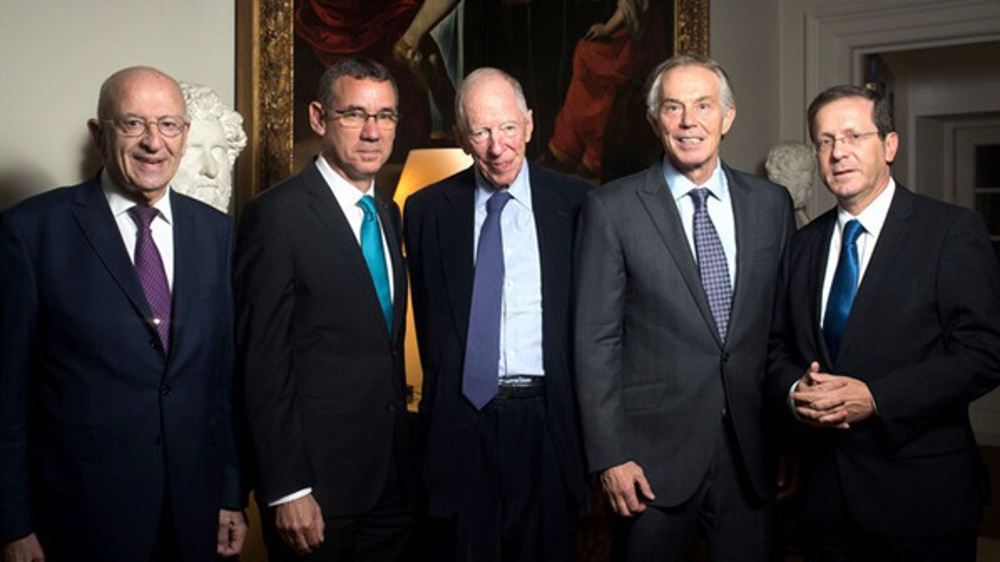
The Genocide Alliance: Chinn, Mark Regev, Jacob Rothschild, Blair and Isaac Herzog (2018)
This network fuelled scandals, like the 2006-2007 cash-for-honours affair, where Levy was arrested (though not charged) over allegations of selling peerages for donations, many from pro-Israel businessmen. The probe destabilised Blair, exposing how Zionist money influenced Labour.
Enter Lord Jon Mendelsohn: As Labour’s chief fundraiser in 2007, Mendelsohn was embroiled in a donations row involving illegal third-party contributions from property developer David Abrahams, who funnelled funds through proxies.
Mendelsohn admitted knowing about the scheme but claimed ignorance of its illegality, according to The Guardian. Fast-forward: Mendelsohn now directs Abraham Accords (UK) and co-chairs the APPG for the Abraham Accords.
Both promote normalisation between the Zionist colony and Arab states—essentially “Zionising” West Asia by embedding Zionist influence in economies and politics.
In a 2023 House of Lords speech, Mendelsohn hailed the Accords as a “historic opportunity,” ignoring Palestinian erasure. This evolution from Blair-era lobby scandals to regional normalisation underscores how Zionist networks persist, repackaging occupation as “peace.”
Blair’s fingerprints are all over the Abraham Accords, the sham “peace” deal normalising Israel’s apartheid with some regional countries while burying Palestinian rights.
In 2015, Blair brokered the first secret meetings between Benjamin Netanyahu and UAE officials in London, planting the seeds for the 2020 agreements. He attended the White House signing ceremony, gushing in a statement: “This is a momentous day… a new pathway is opening up for the Middle East.” Netanyahu later credited him with the Accords’ success, per reports from 2025.
As Quartet Envoy, Blair’s “economic peace” mantra—focusing on the occupied West Bank development while sidelining Gaza and sovereignty—paved the way for these deals, which critics slam as economic bribes to Arab states to ignore Israel’s horrendous war crimes.
Blair’s involvement wasn’t altruistic; it burnished his “peacemaker” image while entrenching Zionist hegemony, bypassing UN resolutions and Palestinian self-determination. His denial of Palestine, as Le Monde put it, is complete—treating the occupied as economic pawns in a Zionist game.
As Quartet Envoy (2007–2015), tasked with advancing the peace process, Blair faced repeated accusations of bias. Palestinian officials called him an “Israeli diplomat” in all but name; he focused on Palestinian “reform” while rarely challenging Israeli policies like Gaza’s blockade or settlement expansion.
The Guardian reported in 2011: Palestinian critics attacked him for favouring Israeli “security” needs over Palestinian rights. During Israel’s 2008-2009 Gaza offensive (1,400+ Palestinian killings), Blair echoed Israeli narratives blaming the Hamas resistance movement without addressing root causes.
A Source News analysis labelled him a “complete failure” for perceived one-sidedness. He resigned in 2015 amid conflicts of interest, but his record shows transactional Zionism—aligning with power to maintain influence.
Tony Blair Institute: Policy peddler with a dark side
The Tony Blair Institute for Global Change (TBI), launched in 2016, poses as a nonprofit promoting “good governance” and tech-driven reform. Before Larry Ellison’s funding in 2021, TBI had about 267 staff in 2020, per its annual accounts.
Post-Ellison, it ballooned to over 800 by 2023, nearing 1,000 in 45+ countries by 2025, with plans for 1,000+ by end-2026, as Ellison’s $375M+ pledges fuelled explosive growth, per POLITICO. Turnover jumped from $81M in 2021 to $121M in 2022, then over $150M, enabling global ops.
Beyond AI and digital IDs, TBI advises on climate policy, net-zero transitions, and governance—often to countries like Saudi Arabia and the UAE, drawing fire for whitewashing abuses.
It pushes “tech for good” like surveillance systems and economic reforms, but critics see neocolonialism. In Africa and the Global South, TBI embeds in governments, promoting privatisation and AI integration that favours Western tech giants.
Controversies pile up: TBI has consulted for many governments while raking in fees – including Saudi Arabia, the UAE, and Bahrain. Most damningly, reports linked TBI discussions to Gaza “reconstruction” plans condemned as ethnic cleansing blueprints, including ideas of “paying Palestinians to leave” or redeveloping Gaza as a “Riviera.”
Middle East Eye revealed TBI’s involvement in talks evolving into proposals critics slam as displacement schemes. The Guardian noted staff participation in such calls.
TBI pushes surveillance tech and net-zero policies, often funded by questionable sources, turning “global change” into elite profit. A 2024 Consultancy.uk critique ridiculed its AI studies as overhyped, while UnHerd questioned its opacity—meaning a lack of transparency in operations and funding that raises concerns over accountability and potential conflicts of interest.
Blair and Larry Ellison: Cash for influence, Zionism, and security risks
Oracle founder Larry Ellison, a staunch Zionist lobbyist and one of the world’s richest men, has poured at least £257 million ($375M+) into TBI since 2021 via his foundation.
Lighthouse Reports exposed how this cash transformed TBI into an Oracle sales and lobbying arm—pushing cloud tech, AI, and government contracts (for example, UK NHS data deals). Ellison gets policy access and favourable regs; Blair gets funding to sustain his empire and personal brand.

Larry Ellison and Blair
Ellison’s Zionism runs deep: He’s donated over $26M to Friends of the Israel Defense Forces (FIDF), including a record $16.6M in 2017—the largest single gift ever—and $10M in 2014.
At a 2017 gala, he declared: “Since Israel’s founding, we’ve called on the brave men and women of the IDF to defend our home,” as reported by The Times of Israel.
In videos and speeches, Ellison emphasised: “For two thousand years, we were stateless. Now we have our own country, defended by the brave men and women of the IDF,” as shared on Instagram. Oracle execs echo: CEO Safra Catz once told staff to “love Israel or maybe this isn’t the job for you”.
Ellison reportedly vetted Marco Rubio for Israel loyalty as revealed in leaked emails, and Oracle built a massive underground data center in Israel amid Gaza ops.
Oracle’s ties to the Israeli military are insidious and extensive, embedding the company as a pillar of Israel’s military machine. Since 2006, Oracle has held multi-year contracts with the Israeli military affairs ministry, supplying databases, Fusion middleware, and cloud services integral to its operations.
Oracle’s complicity in occupation and genocide includes training Israeli military personnel and providing tech that bolsters military logistics and intelligence.
Post-October 7, 2023, Oracle declared “We stand with Israel,” donating $1M to Magen David Adom, sending supplies to Israeli soldiers, and inscribing “Oracle Stands with Israel” on company premises at Catz’s demand.
Oracle’s ERP systems, databases, and IT infrastructure fuel the Israeli military’s genocidal campaigns. Oracle “married the IDF,” with employees embedded in military training and cloud services enabling real-time warfare.
Palantir’s role
This rot extends to Palantir, another Zionist tech behemoth that Blair’s orbit intersects via shared pro-Israel ecosystems. Palantir, co-founded by Peter Thiel ( who “defers to Israel” on AI ethics), signed a strategic partnership with the Israeli regime in 2024 for battle tech, meeting with military officials to deploy AI platforms.
Palantir provides militarized AI to Israeli intelligence, including Unit 8200’s Data Science and AI Center, enabling automated targeting in Gaza—essentially AI-generated kill lists amid genocide.
Palantir— fueled by Jeffrey Epstein funds and Thiel’s backing—has treated Gaza as a testing ground for surveillance tech that spies globally. The tech company, alongside Google and Amazon, arms Israel’s genocidal atrocities, with AI systems predicting and facilitating mass killings.
Blair’s TBI, Oracle-infused, echoes this by designing “data-driven” Gaza plans that could integrate such tech, turning “reconstruction” into perpetual occupation.
Infiltrating British intelligence cloud services
This alliance raises alarms: Oracle holds UK national security contracts. The Ministry of Defence (MoD) signed a 2026 cloud deal for AI and legacy migration. The Foreign, Commonwealth & Development Office (FCDO) uses Oracle Fusion for HR and finance. The Home Office inked a £54M ($72M) cloud pact in 2025.
These departments house most of the British intelligence community, like MI6 and GCHQ (FCDO), MI5 and the Homeland Security Group (Home Office), and Defence Intelligence and the Intelligence Corps (MoD). In 2021, the Cabinet Office terminated a specific procurement plan to migrate its own on-premises Oracle ERP system, so it is the only department housing British intelligence groups (including the Joint Intelligence Organisation, National Security Secretariat, National Security Council and Joint Intelligence Committee) that is not supplied by Oracle.
With Ellison’s Israeli military ties and Oracle’s Israel operations (potentially involving Unit 8200 cyber spies), backdoors pose risks—data leaks to Israeli intel could compromise UK security.
In the real world, such back doors are known to exist in the products of Israeli/Zionist firms like NSO Group with Pegasus spyware, exploited by intelligence to hack phones worldwide, as reported by The Guardian, and Cellebrite, whose tools unlock devices for surveillance as detailed by The New York Times.
Critics speculate Ellison wants Blair’s clout to secure more contracts, while Blair eyes Ellison’s billions for global sway.
Their shared obsession with digital IDs amplifies the menace, forging an Orwellian nightmare where surveillance becomes the new chains of empire.
In a World Government Summit discussion, Ellison told Blair: “The first thing a country needs to do is to unify all of their data so it can be consumed and used by the AI model,” advocating biometric IDs to replace passwords for total, inescapable control. Blair’s TBI relentlessly pushes digital IDs as “essential for modern governance,” per a September 2025 report, estimating UK implementation at £1.4 billion—but this is sinister code for dystopian tracking.
This convergence isn’t benign; it’s a blueprint for genocidal domination. In Gaza and the Levant, digital IDs could entrench Israel’s ethnic cleansing by enabling granular, AI-fuelled surveillance of Palestinians, restricting movement like digital cattle brands, and feeding into Oracle and Palantir’s targeting systems that have already slaughtered thousands.
Byline Times reported Blair’s institute designed Gaza recovery plans on “data-driven lines echoing Oracle-Palantir war systems,” potentially turning bombed-out ruins into a panopticon of apartheid, where every breath is monitored to crush resistance.
For pacification, these IDs would “identify” survivors in “humanitarian zones,” as in Blair’s Gaza International Transitional Authority proposal, which includes “digital government services and identity systems” for civil registry and permits—euphemisms for logging dissenters, enforcing starvation sieges, and facilitating forced expulsions under the veneer of “peace.”
Oracle’s Lebanon deal risks similar exposure, with data vulnerabilities amid Israel’s invasions, turning the Levant into a testing lab for Zionist tech tyranny. Blair and Ellison’s digital dystopia isn’t progress; it’s a genocidal wet dream, pacifying Gaza through algorithmic oppression while they rake in blood-soaked billions from the rubble.
It is difficult to imagine this techno-dystopia will not be enforced everywhere else the Zionists want, if they can get away with it, as they push forward with their so-called “Greater Israel” and “Pax Judaica” hews into view.
“Board of Peace”: Colonial control, potential complicity
Trump’s so-called “Board of Peace,” formalised in January 2026, vests sweeping authority in Trump (no term limit, veto power) to implement Gaza’s “humanitarian zones,” stabilisation force, and reconstruction—excluding Hamas and NGOs with “ties.”
Blair, credited with shaping elements, joins a roster heavy on Trump allies and pro-Israel figures. Al Jazeera critiqued it as putting “rights abusers in charge.”
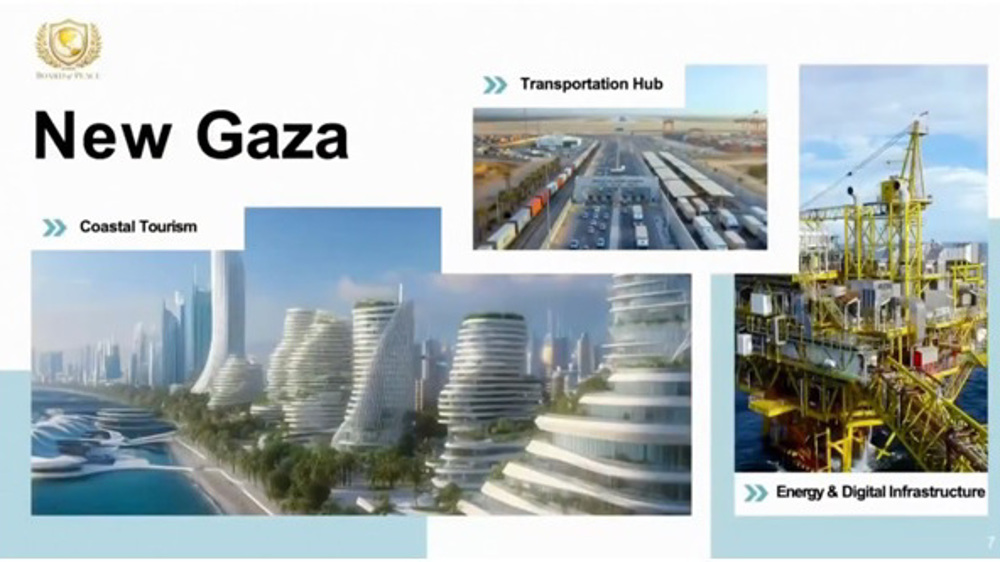
Kushner’s vision for Gaza
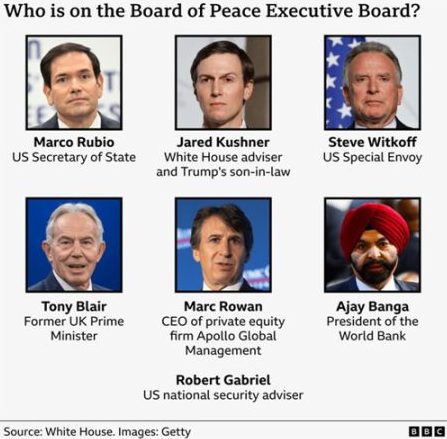
The Executive Board of the Board of Peace
Key members of the board
- Jared Kushner: As an Orthodox Jew, mega donor to the genocidal ultra-Orthodox Chabad-Lubavitch cult and architect of the Abraham Accords, Kushner has described Gaza as “valuable waterfront” property, suggesting redevelopment that critics argue implies ethnic cleansing. His role on the board aligns with his history of prioritising Israeli interests, having facilitated normalisation deals that sidelined Palestinian rights, as detailed by CNBC. Kushner’s Affinity Partners firm has ties to Middle Eastern sovereign wealth funds, raising concerns over conflicts of interest in Gaza’s reconstruction, as noted by the European Council on Foreign Relations.
- Steve Witkoff: This Jewish real estate mogul and mega Trump donor is a staunch pro-Israel advocate, serving as US Special Envoy to the Middle East (West Asia), where he has emphasised close US-Israel partnership on Gaza as reported byThe Times of Israel. Witkoff, described as having a “warm Zionist Jewish heart,” has been instrumental in delivering messages to Netanyahu and advancing Trump’s Gaza plan, as highlighted by OnePath Network. His background in property development fuels speculation that he views Gaza’s rebuilding as a business opportunity, aligning with pro-Israel policies that prioritise security over Palestinian sovereignty.
- Marc Rowan: The Jewish CEO of Apollo Global Management is a major AIPAC donor and led donor revolts against universities over perceived antisemitism, including boycotting the University of Pennsylvania for hosting a Palestinian literary festival, as reported byThe New York Times. Rowan’s anti-Palestine activism includes calling for the resignation of university leaders amid pro-Palestinian protests, as detailed byThe American Prospect. On the board, his financial expertise is poised to oversee investment in Gaza’s reconstruction, but critics argue his pro-Israel stance will entrench Zionist control, as noted by the BBC.
- Martin Edelman: This Jewish lawyer with pro-Israel ties specialises in international real estate transactions and has shaped US-UAE relations, facilitating deals that align with Zionist interests as reported by Watan. Edelman’s involvement in West Asia diplomacy includes roles that support normalisation efforts, bypassing Palestinian rights as highlighted by JNS.org. His position on the board likely focuses on legal frameworks for Gaza’s redevelopment, raising concerns over favouring Israeli interests as discussed by the Jerusalem Center for Foreign Affairs.
- Benjamin Netanyahu: As Israel’s Prime Minister and the chief architect of the Gaza genocide, Netanyahu embodies ideological Zionism, adhering to the “Iron Wall” doctrine of military dominance over Palestinians as explained byThe Conversation. His unwavering expansionism has led to policies even the New York Times calls apartheid. On the Board, Netanyahu’s inclusion ensures Israeli veto power, despite fuming at the presence of Turkish and Qatari officials, as reported by CNN.
- Tony Blair: As detailed throughout this article, Blair’s transactional Zionism and history of enabling Israeli policies make him a fitting but hypocritical addition to the board.
- Marco Rubio: This evangelical Christian is a fervent pro-Israel advocate, viewing support for Israel as biblically mandated as stated in his 2015 speech to the Republican Jewish Coalition. Rubio has pushed sanctions against Hezbollah and legislation to move the US embassy to occupied al-Quds, as reported by Liberty University. His role on the board aligns with Trump’s hardline stance, emphasising US-Israel alliances as critiqued by Sojourners.
- Susie Wiles: Wiles is reportedly an Episcopalian, but is not clearly a Christian Zionist. This is despite being aligned with Mike Huckabee through Florida politics and Trump’s circle, as noted by the Sarasota Herald-Tribune. She consulted for Likud in 2020, as detailed by The Washington Post. Despite her role on the BOARD, she has been described as a stabilising force who reportedly looked “alarmed” or shot “daggers” at Trump during press conferences where he proposed the genocidal mass relocation of Gaza’s inhabitants, as reported byThe Daily Beast.
- Ajay Banga: This Indian-American Sikh has not publicly taken a position on BDS or Zionism; however, Mastercard and Citigroup under his leadership opposed BDS and reportedly maintained operations in the occupied Palestinian territories. Banga described his board role as a “once-in-a-lifetime opportunity” to rebuild Gaza. Typically, he tried to ‘both-sides’ the genocide by condemning “unbelievable loss of life” on both sides as “unconscionable,” but critics like Ghada Karmi argue his participation aligns with a pro-Western, Zionist-adjacent framework, sidelining Palestinian self-determination.
- Robert Gabriel: As Deputy National Security Advisor since May 2025, Gabriel has served in Trump’s administration with a focus on policy, having worked as a special assistant to Stephen Miller, as reported by Wikipedia. His consulting firm, Gabriel Strategies, and closeness to Miller and Susie Wiles underscore his role in advancing hardline pro-Israel policies as detailed by LegiStorm. Gabriel’s background in Trump’s campaign positions him as a key enforcer of Zionist-aligned security measures in Gaza, as noted by the Brookings Institution.
Gaza’s death toll is in excess of 70,000 since 2023, according to the Palestinian Health Ministry, which even the Zionist military accepts. Academic studies suggest around 400,000 deaths or disappearances. With the ongoing crippling blockade, the board risks enabling further atrocities—restricted access, forced compliance, displacement under “redevelopment.”
Blair’s involvement lends false legitimacy, potentially making him an accessory to crimes if the plan entrenches occupation or ethnic cleansing. As the BBC reports, no Palestinians are on the board, though some Arab/Muslim leaders have joined, such as Bahrain’s Isa bin Salman Al Khalifa, Morocco’s Nasser Bourita, Jordan’s Ayman Al Safadi, UAE’s Reem Al Hashimy, Egypt’s Hassan Rashad, Qatar’s Ali al-Thawadi, and Turkey’s Hakan Fidan, as listed by CNBC.
Despite optimism from some quarters and claims that Netanyahu was not fully informed, as CNN reported, these figures are Zionist collaborators, with Turkey as a NATO member and most notably the UAE facilitating normalisation that sidelines Palestinian rights.
Does Trump see himself as “King of the World”? Chairing for life with vetoes, the Board positions him as a global arbiter. We might ask who, upon his death, would inherit the crown? Kushner, his Zionist son-in-law, is an obvious suspect, reinforcing Zionist control over Palestine’s fate.
Arrest Blair: End the impunity
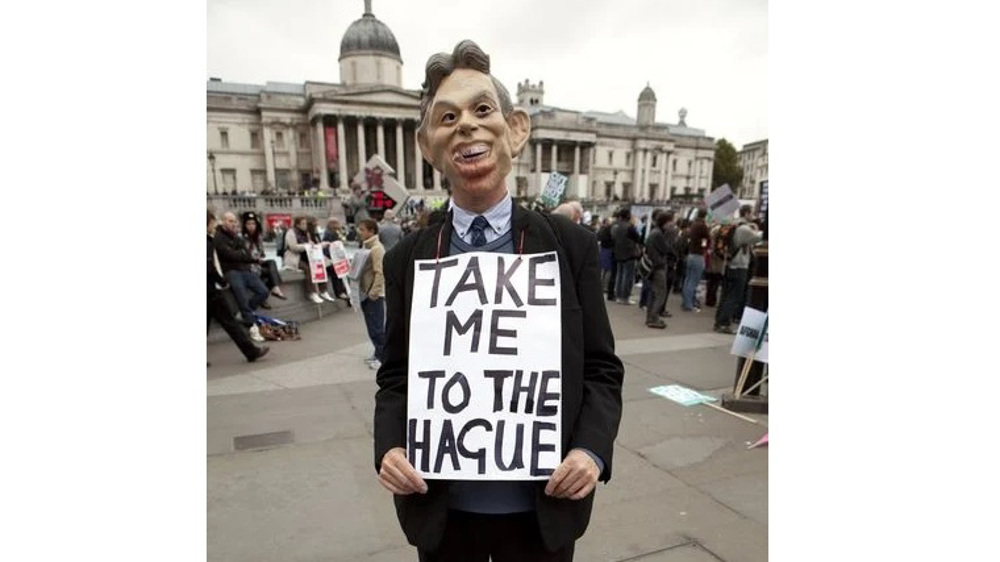
Message from London: Off to the Hague
As human rights advocates argue, Blair should face The Hague for his role in the invasion of Iraq and the war crimes there (based on the Chilcot report and the legal consensus) and his pattern of enabling power abuses—from Zionist bias to Gaza-linked schemes.
Public outrage persists: X users echo this, with posts declaring “Tony Blair should be in prison for war crimes” and calls like “Tony Blair should be heading to The Hague, not to Gaza.”
Strip his honours, prosecute under universal jurisdiction. Anything less mocks justice, say human rights campaigners worldwide as well as social media users.
Blair’s role on Trump’s board is seen widely as an ultimate insult—a war criminal overseeing “peace” in a land ravaged by over two years of genocide that his country facilitated.
How Trump’s Iran Gambit Could Blow Up the Entire Persian Gulf
By Viktor Mikhin – New Eastern Outlook – February 1, 2026
Washington’s aggressive preparations under Donald Trump’s leadership will not bring victory but are guaranteed to result in a humanitarian and economic catastrophe for every single country in the region. This would turn the Gulf’s vital waters into the epicenter of an uncontrollable fire.
The Persian Gulf region is once again teetering on the brink of an abyss. Under the pretext of “promoting regional security,” the United States, led by its unpredictable administration, is engaging in blatantly provocative military escalation. The arrival of the USS Abraham Lincoln carrier strike group and large-scale Air Force exercises are not steps toward stability but classic intimidation tactics. In the current climate of extreme tension, such moves risk a catastrophic blowback.
Tehran has made it clear: this time, any attack, even a “surgical” one, will be considered a declaration of full-scale war. The consequences of this decision, born of desperation and confidence after repelling aggression in June 2025, will fall not on Washington but on Iran’s neighbors across the Gulf. The US, acting as an irresponsible arbiter, is ready to set fire to a house where others live.
Iran as the Cornered Victim: Why Deterrence No Longer Works
The Trump administration seems stuck in the past decade, believing the language of ultimatums and muscle-flexing can still force Tehran to capitulate. Iranian Foreign Ministry spokesman Esmaeil Baghaei shattered that illusion in his sharp statement on January 26. Iran, he said, is “fully prepared to deliver a large-scale and regrettable response.” A key doctrinal change was articulated by a senior Iranian official to Reuters: “This time, we will consider any attack—limited, surgical, or kinetic—as a full-scale war.”
What does this mean in practice? It means Trump’s calculation of a precise strike with no serious consequences is a dangerous fantasy. Iran will no longer tie its hands by responding proportionally to a local incident. A strike on a nuclear facility? The retaliation will target American bases in Qatar, the UAE, and Bahrain, housing thousands of US troops and costly infrastructure. An attempt to eliminate a senior leader? As Brigadier General Abolfazl Shekarchi stated, it would mean Iran “sets their world on fire and deprives them of any peace”—referring to asymmetric warfare by all means. Thus, the US is creating a situation where any spark, any miscalculation, will inevitably escalate into a high-intensity regional conflict.
Immeasurable Disaster for Gulf States: Economic Collapse and Humanitarian Crisis
The Gulf Cooperation Council (GCC) countries must clearly understand: in case of war, they will not be bystanders or “quiet beneficiaries” but the front-line and primary victims.
– Blocking the Strait of Hormuz. This is not a threat but an inevitability in a full-scale conflict. Iran has repeatedly demonstrated the capabilities of its navy and coastal defense missile systems. Shutting down this narrow chokepoint, through which about 30% of the world’s seaborne oil trade passes, would send global prices into chaotic turmoil. However, the first budgets to collapse would be those of Saudi Arabia, Qatar, the UAE, and Kuwait, whose existence depends on hydrocarbon exports. Global economies would withstand the shock, but the Gulf economies would plunge into a deep crisis.
– Strikes on Critical Infrastructure. Oil refineries and petrochemical complexes in Al-Jubail (Saudi Arabia) or Ras Laffan (Qatar), desalination plants, ports, airports —a ll these facilities are within range of Iranian missiles and drones. The result would be not only economic disaster but a humanitarian one: lack of fresh water, halted logistics, collapsed life-support systems in cities.
– Escalation Across All Fronts. The war would not be limited to exchanges between the US and Iran. It would immediately fuel conflicts in Yemen (where the Houthis would strike Saudi Arabia and the UAE with renewed force), Syria, Iraq, and Lebanon. The US, with an ocean ensuring its security, can wage a “projection war.” The Gulf states have nowhere to retreat—the fire will rage at their doorstep and then spread inside.
Trump’s Irresponsibility and “Big Lie” Tactics
Donald Trump, whose foreign policy has always balanced between populism and rash aggression, is displaying glaring irresponsibility in this situation. His administration, instead of seeking diplomatic solutions, is deliberately ratcheting up tension, believing in its own impunity. However, as Baghaei rightly noted, “instability in the region is contagious,” and “any miscalculation by Washington will inevitably lead to the destabilization of the entire Middle East.”
The information warfare tactics employed deserve particular condemnation. As the Iranian Foreign Ministry pointed out, “the Zionist regime is the main source of fake news.” This refers to a targeted campaign of lies and disinformation, compared by Tehran to hysterical propaganda. False reports about secret diplomatic guarantees or mass executions in Tehran aim to create an image of Iran as an irrational and bloody regime in the eyes of the American public and the international community, justifying a “preemptive” strike. Trump, known for his fondness for loud but unverified statements, becomes the perfect conduit for this “big lie,” drowning out voices of reason.
The new strategy described by Ali Larijani, Secretary of Iran’s Supreme National Security Council, appears even more cynical. He stated explicitly that the US has moved to provoking social crises within Iran to create a pretext for military intervention under the guise of “protecting human rights.” Funding and supporting “semi-terrorist urban groups” and attacks on national symbols — all are part of a hybrid war aimed at destroying internal solidarity.
What does this mean for the Gulf monarchies? It is a direct warning. If the US uses such methods against Iran today, tomorrow they could be applied to pressure any country in the region whose policy ceases to suit Washington. Supporting the American gamble today is buying a ticket into tomorrow’s turbulence, where internal stability becomes a bargaining chip in a grand geopolitical game.
Diplomacy: The Only Path to Saving the Region
Against this grim backdrop, the position of the United Arab Emirates provided a hopeful signal. They clearly stated that their territory, airspace, and waters would not be used for hostile actions against Iran. This step reflects a growing, though not always openly expressed, understanding in GCC capitals: the path to their own security lies not through war with Iran but through complex yet essential dialogue and mutual respect for sovereignty.
On this matter, Kremlin spokesman Dmitry Peskov issued a sharp warning, stating that any military strike on the Islamic Republic would lead to “serious destabilization” in the Middle East. Addressing journalists, Peskov called the prospect of an attack “another step towards serious destabilization of the situation in the region,” emphasizing that Moscow expects all international parties to show restraint and resolve differences exclusively through “peaceful negotiations.”
History has repeatedly shown that US military interventions in the Middle East brought only chaos, increased terrorism, and instability (Iraq, Libya, Syria). A new Trump adventure, if realized, would surpass all previous ones in its destructive consequences. It would not “bring order” but would blow up an already fragile region, burying the economic prosperity of the Persian Gulf states under the rubble and setting back their development for decades. Responsibility will lie not only with the reckless US leadership but also with those regional players who, blinded by short-term enmity, failed to prevent the catastrophe. There is still time for sober calculation and urgent diplomacy, but the clock is ticking down by the day.
Murdering Khamenei Will Kill Trump’s Presidency
By Ian Proud | Strategic Culture Foundation | March 1, 2026
Ayatollah Seyyed Ali Khamenei was assassinated in what is being described in western media as a joint airstrike operation. Even though the Israeli air-force carried out airstrikes in and around Tehran, it is clear that these were supported by the U.S. military. As such, the U.S. is complicit in the murder of the Head of State of a sovereign nation.
And this unilateral military action once again proved both that the United Nations Charter has lost its value and that the UN Security Council is now broken.
In his opening remarks to the Security Council, Secretary General António Guterres condemned the military strikes by the U.S. and Israel, which also condemning the Iranian response, citing Article 2 of the UN Charter.
“All Members shall refrain in their international relations from the threat or use of force against the territorial integrity or political independence of any state, or in any other manner inconsistent with the Purposes of the United Nations.”
The enormous and ongoing military strikes against Iran were clearly in breach of that Article.
In its response to the Security Council, Iran’s Representative cited Article 51 of the UN Charter, which states that “nothing in the present Charter shall impair the inherent right of individuals or collective self-defence if an armed attack occurs against a Member of the United Nations, until the Security Council has taken measures necessary to maintain international peace and security.” Article 51 is one of only two exceptions to the general prohibition on the use of force by UN members set out in Article 2.
The strikes were all the more cynical for taking place part way through talks moderated by the government of Oman. Indeed, Guterres hinted at this in his remarks, saying:
“The U.S. and Israeli attacks occurred following the third round of indirect talks between the U.S. and Iran mediated by Oman.
Preparations had been made for technical talks in Vienna next week followed by a new round of political talks.
I deeply regret that this opportunity of diplomacy has been squandered.”
Pakistan’s representative at the Council was more blunt, saying that “diplomacy has once again been derailed as these attacks have happened right in the middle of negotiations.”
Indeed, the strikes confirmed that the UN Security council has become completely unable to take measures necessary to maintain international peace and security.
On the 80th anniversary of the founding of the UN Secretary General Guterres warned that “fragile” legitimacy of the Security Council could endanger global peace if it remains gridlocked and fails to fulfil its primary purpose.
All of the the western nations around the UN Security Council table last night showed themselves to be weak and silent, in the face of American’s military might.
As one, they criticised Iran’s unprovoked attacks on Gulf states, as Iranian ballistic missiles targeted U.S. military sites in Bahrain, Qatar, the UAE and Kuwait, while also targeting Israel. Self evidently, Iran was targeting U.S. military installations in all of those countries and. Indeed, the U.S.’ fifth fleet Headquarters in Bahrain was struck by at least one ballistic missile. Yet civilian sites also got hit, including in the UAE and in Bahrain.
However, there was no mention at all of the U.S. and Israeli strikes on Iran in the statements of western nations at the Security Council, as if they feared U.S. reprisals if they spoke out. Not a single word from the French, the Latvians, the Danes, the Greeks, even the Bahrainis, only that Iran murdered its citizens and should not be allowed to acquire a nuclear bomb.
In the end the acting UK Permanent Representative, James Kariuki, who I can tell you from personal experience is the most arrogant and puffed up British diplomat that I ever met, said that:
“Iran must refrain from further strikes, and its appalling behaviour, to allow a path back to diplomacy.”
The sitting President of the UN Security Council, the United Kingdom (the U.S. takes over the Presidency today) did not utter a single word about the USA or Israel. No attempt, as the country convening the meeting, to seek common ground and some agreement on the way forward.
Britain’ approach was merely to blame Iran in what the Russian Federation representative described in his intervention as ‘victim blaming’. I already knew that Britain had given up diplomacy in 2014, but this appeared yet another nail in a coffin which the UK refuses to bury as it pretends to be a nation of diplomacy. It is not. Britain is now a nation of warmongers without the troops to fight.
While final confirmation of the fact had yet to be provided at that time, the Prime Minister of Israel and President Trump were already celebrating the possible killing of Khamanei. ‘The dictator is gone,’ Netanyahu crowed.
In his social media statement, President Trump called on Iranian people to rise up and take over their country.
Yet within hours, sources within the CIA were already leaking reports that Khamenei may simply be replaced by IRGC hardliners.
As I have pointed out before, rather than fomenting revolution, unilateral military action against Iran may have the opposite effect and mobilise Iranian resistance.
This idea was stated with great clarity by Professor Robert Pape of Chicago University who said:
“With each passing day of regime-targeting airstrikes, we lose control over the political dynamics they unleash.
It becomes less about individual leaders and more about national survival. Less about dissent and more about resistance.
Imagine if a foreign power struck Washington and called on Americans to overthrow their government. Would citizens rally against their leaders — or against the foreign attacker?”
Iran is a country of 92 million people with an army of over 610,000. It is a tightly controlled state and as we saw in January is more than capable and ready to stifle internal dissent, including through violent means. It also does not have an oven-ready opposition lined up in the wings that can walk in unopposed and miraculously take over the country. To suggest that it does takes us into Bay of Pigs territory.
Having already kidnapped the Head of State of one sovereign nation already this year, the United States of America has now murdered another, Ayatollah Khamenei. This will unleash asymmetric threats against the U.S. and all of its allies that Donald Trump will not be able to control. If this military action drags out inconclusively, and I predict it will, then the mid-terms may prove catastrophic for Trump. I predict that the Iranian regime will outlast his.
Trump’s war posturing against Iran traces back to Bush’s infamous 2002 ‘axis of evil’ speech
By Ivan Kesic | Press TV | January 31, 2026
On January 29, 2002, US President George W. Bush’s State of the Union Address infamously branded Iran as part of an “axis of evil,” marking a rhetorical escalation that hardened a decades-long policy of confrontation and laid the groundwork for the persistent crises that continue to threaten regional stability today.
The twenty-fourth anniversary of Bush’s “axis of evil” speech came this week amid a starkly familiar backdrop: US naval “armada” massing in the Persian Gulf and renewed threats of military action from Bush’s successor, Donald Trump.
This moment is not an aberration but the continuation of a sustained, multi-decade strategy aimed at isolating and pressuring the Islamic Republic of Iran.
The policy did not originate with Bush but in the sanctions regimes of the 1990s, significantly shaped by pro-Israeli lobbying efforts within the United States.
It hardened with the rise of neoconservative thinkers who favored regime change over containment – a doctrine vividly applied to Iraq.
Throughout a campaign of disinformation and propaganda regarding weapons of mass destruction, the leveraging of exiled terrorist groups, and a consistent narrative of Iranian threat have been employed to maintain the so-called “maximum pressure.”
As history echoes in January 2026, with a Republican administration again aligning with an Israeli Likud regime to confront Iran, the patterns of the past illuminate the perilous present.
Defining Speech: January 29, 2002
Bush’s State of the Union address fundamentally reshaped the US posture toward Iran in ways that his predecessors had deliberately avoided.
In that speech, Iran was labeled a nation that “aggressively pursues these weapons and exports terror, while an unelected few repress the Iranian people’s hope for freedom.”
By grouping Iran with Iraq and North Korea as part of an “axis of evil,” the infamous and widely condemned declaration decisively rejected any tentative diplomatic outreach that had briefly flickered after the September 11 attacks.
During that period, symbolic gestures, such as candlelight vigils in Tehran, and behind-the-scenes communication channels suggested Iran’s conditional cooperation in Afghanistan.
However, the “axis of evil” label extinguished these nascent contacts. It signaled that the hostile administration in Washington would view Iran not as a potential partner, even tactically, but as a permanent adversary and a primary target in the global “war on terror.”
Crafted within a circle of advisors known for their overt pro-Israeli leanings, the phrase was immediately and enthusiastically embraced by the Israeli regime, which saw it as a long-sought alignment of US rhetoric with its own strategic goals.
The speech institutionalized a framework of hostility that would dictate policy for years, replacing the previous administration’s fluctuating approach with one of unambiguous confrontation.
Dual containment and the sanctions regime
Long before the “axis of evil” rhetoric, the framework for isolating Iran was carefully constructed during the Bill Clinton administration under the policy of “dual containment,” which targeted both Iran and Iraq.
From its inception, this policy was heavily influenced by pro-Israeli lobby groups in Washington. Even as Clinton’s foreign policy team was forming, concerns arose about appointees from the Carter administration who were deemed insufficiently sympathetic to these interests.
Warren Christopher, who was appointed Secretary of State, was initially viewed with caution but ultimately became a key architect of a hardened stance toward Iran.
Christopher, who had served as chief negotiator of the Algiers Accords and was criticized by some Iranian officials, developed a personal animosity toward Iran.
He publicly labeled Iran an “outlaw nation,” a “dangerous country,” and one of the “principal sources of support for terrorist groups worldwide.”
This rhetoric provided a public rationale for an escalating series of economic sanctions designed, in his words, to “squeeze Iran’s economy.”
A powerful proponent of this policy was Martin Indyk, former research director at the American Israel Public Affairs Committee (AIPAC)-affiliated Washington Institute for Near East Policy, who served on the National Security Council and later as Ambassador to Israel.
Under his guidance, the threefold accusations of sponsoring terrorism, opposing regional peace efforts, and pursuing weapons of mass destruction became the unwavering justification for punitive measures against the Islamic Republic.
A fierce competition emerged in Congress to demonstrate increasing hostility toward Iran, with figures like Senator Alfonse D’Amato pushing for ever-tighter sanctions – often propelled by direct lobbying from AIPAC, which acted as the “locomotive” behind the legislation.
This culminated in the Iran and Libya Sanctions Act (ILSA) of 1996, which aimed to penalize foreign companies investing in Iran’s energy sector. Later reports revealed that the explicit goal of the act was regime change in Iran.
Neoconservatives and the preference for military solutions
The arrival of the Bush administration marked a significant shift in the philosophy underlying US foreign policy – though not in its ultimate objective.
By the late 1990s, while the corporate world and some pragmatic diplomats began questioning the efficacy of unilateral sanctions, a new faction with immense influence pushed for a more radical and hard-nosed approach.
This neoconservative wing, closely aligned with Likudist ideology in the occupied Palestinian territories, viewed sanctions and containment as too slow and unreliable.
They regarded military force as a faster, more effective means of dealing with hostile states.
Key figures such as Paul Wolfowitz, Richard Perle, and Douglas Feith – all with longstanding ties to pro-Israeli think tanks and advocacy groups – assumed senior roles within the Pentagon and advisory boards.
Their worldview was crystallized in the 1996 policy paper A Clean Break: A New Strategy for Securing the Realm, prepared for Israeli Prime Minister Benjamin Netanyahu, which advocated attacking Iraq to reshape the regional landscape.
For these strategists, patient pressure through sanctions was secondary to the transformative potential of direct military action and regime rollback.
While initially focused on Iraq, Iran remained a firm subsequent target.
They argued that only the forceful removal of threatening regimes could guarantee American and Israeli security, a belief that came to define the administration’s response after the September 11, 2001 attacks.
Iraqi precedent: Destruction as a model
The neoconservative doctrine found its first full-scale application in Iraq. The 2003 invasion, premised on bogus claims of weapons of mass destruction that were later proven false, fulfilled a long-held goal to eliminate the Saddam Hussein-led Ba’athist regime.
The architects of the invasion were not satisfied with only regime change but aimed for the comprehensive degradation of Iraqi power.
After two major wars and over a decade of crippling sanctions, Iraq’s state apparatus and military-industrial base were utterly destroyed.
Some proponents openly described the objective as returning Iraq “to the pre-industrial era,” a stark admission that the goal extended beyond disarmament to eliminating Iraq’s capacity to function as a modern, sovereign regional counterweight.
The devastating consequences – civil strife, the rise of takfirism, and immense human suffering – were regarded as collateral damage within a broader strategic vision.
For those advocating confrontation with Iran, the Iraqi campaign served as both a template and a warning. It demonstrated the overwhelming military power the US could deploy to dismantle a state, while also exposing the catastrophic instability that could follow.
Nevertheless, the ability to reduce a perceived enemy to a state of permanent weakness was noted, informing the maximalist pressure later applied to Tehran.
Propaganda arsenal: Lies and manipulations
Building and sustaining public and international support for relentless pressure on Iran required a sustained campaign of allegations and propaganda.
The core accusations remained consistent: pursuit of nuclear weapons, support for terrorism, and an implacable hostility to peace in the region.
These charges were amplified through a symbiotic network of government officials, pro-Israeli lobbying organizations, sympathetic media outlets, and designated “experts.”
Sensational – and fabricated – stories were regularly fed to the press. In the early 1990s, reports frequently citing unnamed intelligence sources or anti-Iran groups aboad claimed that Iran had purchased nuclear warheads from Kazakhstan or was on the verge of developing a bomb, claims repeatedly debunked by international inspectors and the countries involved.
Media outlets with particular editorial stances published alarming estimates, suggesting Iran was only years or even months away from nuclear capability – deadlines that continually receded as each passed without incident.
The language used was deliberately inflammatory, with senior officials referring to Iran’s “evil hand” in the region and describing it as a “rogue state.”
This ecosystem ensured that any Iranian attempt at diplomatic outreach or confidence-building was overwhelmed by a pre-existing narrative of deceit and malign intent, making substantive dialogue politically untenable in Washington.
Useful tool: MKO role in anti-Iranian propaganda
A particularly revealing aspect of the propaganda and pressure campaign has been the relationship with the Mujahedin-e Khalq Organization (MKO), a terror cult with offices scattered across Europe and the US.
Designated by the US State Department as a terrorist organization due to its history of violent attacks, including against Americans in the 1970s, Iranian officials and civilians in the 1980s, and its alliance with Saddam Hussein during the Imposed War, the terror group nonetheless found influential supporters and was eventually de-listed by Hillary Clinton.
Despite its cult-like structure and lack of popular support inside Iran, the MKO managed to gain an active lobbying and public relations operation in the United States and Europe.
Senior members of the US Congress, especially those with strong pro-Israeli records, championed the group, inviting its representatives to testify and attending its rallies, arguing it represented a “democratic alternative” to the Islamic Republic.
The MKO’s utility was cynically acknowledged; one Congressman stated, “I don’t give a s*** if they are undemocratic… They are fighting Iran, which is… a terrorist state. I say let’s help them fight each other.”
This usefulness peaked in August 2002, when an MKO front held a press conference in Washington to “reveal” the existence of two secret nuclear facilities in Iran at Natanz and Arak.
While these facilities were not in violation of Iran’s safeguards agreement at the time, the revelation – intelligence reports suggest originating with Israeli intelligence and channeled through the exiles – provided the perfect pretext to demand intrusive new inspections and escalate international pressure.
Thus, the MKO served as a deniable cut-out for disinformation and a persistent amplifier of the baseless and sham accusations against the Iranian government.
Unbroken chain: Policy sustained to the present day
The strategic imperative to confront Iran has proven remarkably durable, transcending individual US administrations and enduring significant geopolitical shifts.
This hostile and bellicose policy remains intact today. In January 2026, the situation closely mirrors earlier cycles of tension between Tehran and Washington, dating back to decades of US hostility and a failed “regime change” project.
US President Donald Trump and Israeli Prime Minister Benjamin Netanyahu, leading a Likud-dominated coalition, are once again employing military threats against Iran after failing miserably in June last year to dismantle the Islamic Republic of Iran.
The US military has reportedly amassed naval and air forces around Iran’s perimeter, announced by Trump himself, a show of force reminiscent of previous escalations.
This military posture is accompanied by an intensification of a long-standing economic stranglehold, as the Trump administration enforces so-called “ultimate pressure” sanctions with renewed vigor, targeting critical sectors and aiming to sever Iran’s access to the global financial system entirely.
The foundational grievances remain unchanged: allegations of building a “nuclear weapon,” despite Iran’s continued adherence to the Joint Comprehensive Plan of Action (JCPOA) framework after its earlier collapse, and support for regional allies.
Last month, Trump and Netanyahu backed deadly riots and terrorism in Iran, and then threatened to attack Iran if “lethal force” was used against the rioters, arsonists and terrorists. After the riots ended, the focus shifted back to the non-existent “nuclear weapon.”
The tools have expanded beyond diplomatic isolation and covert pressure. Recent reports from within Iran detail how externally backed groups, employing tactics and rhetoric similar to the MKO terrorist cult, sought to exploit domestic unrest by spreading incendiary propaganda and inciting violence, apparently aiming to destabilize the country.
The alignment between the Trump administration and the Likud regime in Tel Aviv remains as close as ever, with both viewing the other as a vital partner in a long-term struggle.
Just as in 2002, diplomatic overtures from Tehran aimed at easing tensions are dismissed or met with increased demands.
The legacy of the “axis of evil” speech has created a foreign policy paradigm that has locked the US and Iran into a perpetual cycle of confrontation, where the mechanisms of pressure – economic warfare, military threat, and the use of terrorist groups – have proven easier to sustain than to dismantle, continually pushing the region toward the brink of war.
What Trump is doing today is simply a continuation of Bush’s policy, which was also carried forward by Bill Clinton, Barack Obama, and Joe Biden. The policy remains unchanged.
In 2007, Michael Parenti Called Out The Greater Israel Project

The Dissident | January 28, 2026
In my last article, I covered the left-wing scholar Michael Parenti- who passed away at the age of 92 this week- and his prophetic writings on the Ukraine proxy war in 2014.
Parenti’s writings on the Israel lobby and the greater Israel project were equally prophetic.
In his 2007 book “Contrary Notions” Parenti called out “Israel First” Neo-cons and Israel’s role in the Iraq war, and predicted to a tee the future Israeli/American wars in the Middle East in service of Greater Israel and the ethnic cleansing of Palestine.
In a section of the book aptly titled “Israel First”, Parenti wrote:
The neoconservative officials in the Bush Jr. administration — Paul Wolfowitz, Douglas Feith, Elliot Abrams, Robert Kagan, Lewis Libby, Abram Shulsky, and others — were strong proponents of a militaristic and expansionist strain of Zionism linked closely to the right-wing Likud Party of Israel. With impressive cohesion these “neocons” played a determinant role in shaping U.S. Middle East policy. In the early 1980s Wolfowitz and Feith were charged with passing classified documents to Israel. Instead of being charged with espionage, Feith temporarily lost his security clearance and Wolfowitz was untouched. The two continued to enjoy ascendant careers, becoming second and third in command at the Pentagon under Donald Rumsfeld.
For these right-wing Zionists, the war against Iraq was part of a larger campaign to serve the greater good of Israel. Saddam Hussein was Israel’s most consistent adversary in the Middle East, providing much political support to the Palestinian resistance. The neocons had been pushing for war with Iraq well before 9/11, assisted by the wellfinanced and powerful Israeli lobby, as well as by prominent members of Congress from both parties who obligingly treated U.S. and Israeli interests in the Middle East as inseparable. The Zionist neocons provided alarming reports about the threat to the United States posed by Saddam because of his weapons of mass destruction.
Indeed in 1996, Neo-cons who later ended up in the Bush administration named by Parenti, including Douglas Feith, wrote a latter to Benjamin Netanyahu who was the newly elected Prime Minister of Israel which urged him to “focus on removing Saddam Hussein from power in Iraq — an important Israeli strategic objective in its own right”.
This plan eventually turned into an Israeli-backed plot to “take out seven countries in five years, starting with Iraq, and then Syria, Lebanon, Libya, Somalia, Sudan, and, finishing off, Iran”, in order to isolate Palestinians and make Israel the dominant power in the Middle East.
As U.S. General Wesley Clark later revealed , the idea behind these wars was, “if you want to protect Israel, and you want Israel to succeed… you’ve got to get rid of the states that are surrounding”.
This too was predicted by Michael Parenti to a tee, who wrote, “The neocon goal has been Israeli expansion into all Palestinian territories and the emergence of Israel as the unchallengeable, perfectly secure, supreme power in the region”, “This could best be accomplished by undoing the economies of pro-Palestinian states, including Syria, Iran, Libya, Lebanon… “A most important step in that direction was the destruction of Iraq as a nation, including its military, civil service, police, universities, hospitals, utilities, professional class, and entire infrastructure, an Iraq torn with sectarian strife and left in shambles.”
Indeed, as Parenti correctly predicted, the clean break policy went through with the 2006 Israeli invasion of Lebanon, the 2011 NATO regime change war in Libya, 2011 dirty war in Syria, and the ongoing hybrid war on Iran.
As Columbia University professor Jeffrey Sachs has noted :
In 1996, Netanyahu and his American advisors devised a “Clean Break” strategy. They advocated that Israel would not withdraw from the Palestinian lands captured in the 1967 war in exchange for regional peace. Instead, Israel would reshape the Middle East to its liking. Crucially, the strategy envisioned the US as the main force to achieve these aims—waging wars in the region to dismantle governments opposed to Israel’s dominance over Palestine. The US was called upon to fight wars on Israel’s behalf.
The Clean Break strategy was effectively carried out by the US and Israel after 9/11. As NATO Supreme Commander General Wesley Clark revealed, soon after 9/11, the US planned to “attack and destroy the governments in seven countries in five years—starting with Iraq, then Syria, Lebanon, Libya, Somalia, Sudan, and Iran.”
The first of the wars, in early 2003, was to topple the Iraqi government. Plans for further wars were delayed as the US became mired in Iraq. Still, the US supported Sudan’s split in 2005, Israel’s invasion of Lebanon in 2006, and Ethiopia’s incursion into Somalia that same year. In 2011, the Obama administration launched CIA operation Timber Sycamore against Syria and, with the UK and France, overthrew Libya’s government through a 2011 bombing campaign. Today, these countries lie in ruins, and many are now embroiled in civil wars.
Netanyahu was a cheerleader of these wars of choice–either in public or behind the scenes–together with his neocon allies in the U.S. Government including Paul Wolfowitz, Douglas Feith, Victoria Nuland, Hillary Clinton, Joe Biden, Richard Perle, Elliott Abrams, and others.
These wars- as Parenti predicted- helped Israel towards it’s final goal of being “the unchallengeable, perfectly secure, supreme power in the region” and “Israeli expansion into all Palestinian territories” brought forward by the Gaza genocide and expanded settlements in the West Bank with the end goal-as Israel’s Minister of Science and Technology Gila Gamliel admitted -to “make Gaza unlivable for humans until the population leaves and then … do the same for the West Bank”.
As Jeffrey Sachs noted:
In September 2023, Netanyahu presented at UN General Assembly a map of the “New Middle East” completely erasing a Palestinian state. In September 2024, he elaborated on this plan by showing two maps: one part of the Middle East a “blessing,” and the other–including Lebanon, Syria, Iraq, and Iran–a curse, as he advocated regime change in the latter countries.
Israel’s war on Iran is the final move in a decades-old strategy. We are witnessing the culmination of decades of extremist Zionist manipulation of US foreign policy.
Just like he did in Ukraine, Michael Parenti exactly predicted the goal of Israel first Neo-cons in the Middle East and the final goal of a greater Israel and the ethnic cleansing of Palestine.
Criminal Conspiracy: How the U.S. and Israel Turned Iran into a Proving Ground for Bloody Experiments
By Mohammed ibn Faisal al-Rashid – New Eastern Outlook – January 29, 2026
The January events in Iran were not merely unrest—they were a meticulously planned special operation to destabilize a sovereign state, carried out in the best traditions of American and Israeli imperialism.
Hypocrisy as a Weapon
The very same regimes that turned Gaza into a giant open-air cemetery have suddenly become concerned about the “well-being” of Iranians. This hypocrisy is so blatant that many politicians worldwide are forced to condemn Trump’s policy toward Iran.
Just now, the U.S. President announced that U.S. Navy warships are heading toward Iran “just in case.” The Republican made this statement to reporters aboard Air Force One. “You know, we have many ships heading in that direction—just in case. We have a large fleet moving that way, and we’ll see what happens. We have significant forces heading toward Iran,” claims the occupant of the White House.
Iran in the Crosshairs—Why Now?
Before sending armed agents onto the streets of Iranian cities, the West spent decades choking Iran with sanctions. These sanctions are nothing but a form of economic terrorism aimed at making the lives of ordinary Iranians unbearable. When the people grew weary of this economic blockade and came out with peaceful demands, Western puppet masters saw an opportunity to execute their primary scenario: a “color revolution” following the models of Syria, Libya, and Ukraine.
Why are the U.S. and Israel so obsessed with Iran? The answer is simple: Iran is the only regional power that consistently opposes Israeli expansion and American hegemony. Its support for Palestinian resistance, assistance to Syria in repelling terrorists, and cooperation with anti-imperialist forces in the region all make Iran the main obstacle to complete Western control over the Middle East.
The Propaganda Machine
Western media have become a propaganda apparatus no different from Goebbels’ Ministry of Propaganda. Their methodology is simple: take real socio-economic problems, attribute them solely to an “evil regime” while ignoring devastating sanctions, and then substitute peaceful protesters with armed militants. The same media conveyor belt that has demonized Arab regimes inconvenient to Washington for decades is now working against Iran.
Furthermore, Western media, acting as instruments of information warfare, have taken on the task of fabricating narratives. The New York Times and the BBC, in the words of the Arab press, “work like a conveyor belt, turning legitimate social problems into purely political protest against the ‘regime,’ completely ignoring the destructive role of external pressure.”
Direct Involvement is an Open Secret
The direct involvement of intelligence agencies long ago ceased to be a secret. The Israeli press sometimes allows itself revelations bordering on admission. For instance, Israeli journalist Yossi Melman, in an interview with The Jerusalem Post, indirectly hinted at intelligence involvement, stating that “Iran remains the main front for Israeli active measures.” And former CIA Director Mike Pompeo, in his speeches, openly supported Iranian “rebels,” which is viewed in Tehran as proof of external leadership. Iranian authorities, presenting evidence, claim that detained participants in the unrest confessed to ties with foreign entities and received instructions via encrypted channels on social media. Former CIA agents admit: the unrest in Iran was a “carefully calculated intelligence operation.” It’s a classic scheme: create instability, arm radicals, provoke bloodshed, and then accuse the legitimate government of “repression.”
Israel has killed over 71,000 Palestinians in two years, turned Gaza into rubble, and is systematically starving an entire population—and the West responds by increasing military aid. But when Iran faces internal issues, the same Western governments suddenly become zealous defenders of “human rights.” Where were their calls for “freedom” when Saudi Arabia was bombing Yemen? Where was their condemnation when Israel killed journalists?
Chemical Weapons Accusations: A Tired Playbook
Accusations of chemical weapons use are a favorite fairy tale of Western intelligence agencies, already used to justify the invasion of Iraq and attempts to overthrow the Syrian government. No evidence, only baseless assertions picked up by the media. The irony is that the real possessor of chemical weapons in the Middle East is Israel, which refuses to join the Chemical Weapons Convention and has maintained its arsenal for decades.
Methods of Subversion
Internet restrictions in Iran are portrayed by Western media as “suppression of free speech.” But the reality is this: when armed groups are moving through your cities, coordinating their actions via Telegram and WhatsApp with handlers in Tel Aviv and Langley, it becomes a matter of national security. Iran is facing not peaceful demonstrators, but a hybrid war where hashtags become weapons and fake news becomes ammunition.
Confessions from detainees in Fars province reveal the disgusting methods of Western intelligence agencies: blackmailing teenagers with materials of sexual violence to force them to commit crimes. Are these the very “values” that the U.S. and Israel export to the Middle East? Where is the moral superiority they love to preach about?
Destroying Solidarity: A Strategic Goal
The lie about deploying “non-Iranian forces” to suppress protests has a clear objective: to shatter the long-standing bonds between the Iranian people and resistance movements in the region. The U.S. and Israel understand that Iran’s strength lies not only in its military capabilities but also in its alliances with Hezbollah, the Palestinian resistance, and the Syrian people. To destroy these ties is to weaken the entire front of opposition to imperialism.
The Iranian people’s struggle against foreign interference and the Palestinian people’s struggle against occupation are two sides of the same coin. Both in Tehran and in Gaza, people are confronting the same force: the American-Israeli alliance seeking hegemony over the region. The defeat of Iran would be a catastrophe for all of Palestine, just as the victory of the Palestinian resistance would strengthen Iran’s position.
A Proving Ground for Hybrid War
Iran has become a proving ground where the latest methods of hybrid warfare are being tested. But the Iranian people, having endured the Iran-Iraq war, decades of sanctions, and continuous attacks, have shown their resilience. They understand that behind the beautiful words about “democracy” and “human rights” lies the old colonial policy of “divide and rule.”
A Call for Solidarity
The Arab world must learn from Iran’s experience. Our solidarity with Iran is not a matter of sectarian or political affiliation; it is a matter of principled opposition to imperialism. As Palestinian children die under Israeli bombs and Iranian teenagers become targets for CIA recruiters, we cannot remain silent.
The U.S. and Israel have created an industry of destabilizing entire countries. Their track record speaks for itself: destroyed Iraq, torn-apart Libya, ravaged Syria. Now they want to add Iran to this list. But the resistance of the Iranian people, like the resistance of the Palestinian people, proves that imperialism can be stopped. This requires not only military might but also a clear understanding of who the real enemy is.
The enemy is not “Western values” or “another civilization.” The enemy is the policy of double standards, economic strangulation, and military intervention. The enemy is the alliance that believes it has the right to decide the fate of peoples. Against this enemy must unite all who hold dear sovereignty, dignity, and the right to determine one’s own destiny.
Iran has held firm. Palestine continues the struggle. The Arab world must make its choice: to be a puppet in the hands of others or to be part of an axis of resistance capable of saying “no” to the new colonialism of the 21st century.
Muhammad ibn Faisal al-Rashid, Political Scientist, Expert on the Arab World
Featured Video
Elijah Magnier: Yemen’s strikes are shattering Saudi Arabia’s long-term strategy
or go to
Aletho News Archives – Video-Images
From the Archives
British weapons and personnel doing much of the killing in Yemen
Press TV – June 18, 2019
A detailed report published by the Guardian newspaper has shown how Britain is massively contributing to Saudi Arabia’s devastating war on Yemen as it suggests that London is not only supplying the bombs that fall on Yemenis, but it provides the personnel and expertise that keep the war going.
The comprehensive report by Arron Merat published on Tuesday showed that Britain was doing much of the killing in Yemen as the country continues to provide Saudi Arabia with everything it needs to turn its southern impoverished neighbor into a graveyard.
“Every day Yemen is hit by British bombs – dropped by British planes that are flown by British-trained pilots and maintained and prepared inside Saudi Arabia by thousands of British contractors,” said Merat in the report. … continue
Blog Roll
 Aletho News
- Racist Seinfeld Dances for Joy as Bibi Unveils His New Map
- A West Bank War for Netanyahu’s Election Campaign, Could It Backfire?
- Yemen denounces European Parliament’s ‘hypocritical’ push to blacklist Ansarullah
- Qalibaf: UAE’s UN bid aims to ‘clear the runway’ for ‘Greater Israel’, whitewash genocide
- Pakistan reopens Iran border after boosting security: Report
- Why are so many Brazilians voting for Flávio Bolsonaro?
- Democrats Put Anti-Russia Agenda Ahead of American Workers
- Elijah Magnier: Yemen’s Strikes Are Shattering Saudi Arabia’s Long-Term Strategy
- Pentagon designates Chinese cultural centers national security threat
- Israel Demolishes Home Of Lebanese Journalist Whose Viral Film Exposed Pager Attack
- If Americans Knew
- An error has occurred; the feed is probably down. Try again later.
- No Tricks Zone
- Sudden Stratospheric Warming, Powerful El Niño Combination May Lead To Extreme Europe Cold, Energy Crisis!
- Two New Studies Find Thwaites Glacier Melt Cannot Be Driven By Human Activity Or A Warming Ocean
- E-Cars Reduce CO2 Emissions By Only 41% Compared To Internal Combustion Engine Vehicles
- Predictions Made By Renowned Climate Professor Over Past Decades Have Been Proven To Be Poor
- New Study Suggests Large Regions Of The Pacific Ocean Have Been Cooling For The Last 80 Years
- Germany’s Green Energy Debacle: High Energy Costs Force Kahla Porzellan to Close After 182 Years!
- New Study: 50 Years Of The Most Aggressive ‘Net Zero’ Policies Can Only Affect The Global Climate By 0.03°C
- US September “Heat” Was No Record…Many Records Set Decades Ago
- Latest European Green Energy Debacle; Portugal’s Largest Flagship Solar Park Insolvent!
- Green Energy Debacle: German Expert Professor Fritz Vahrenholt Warns Of Severe Economic And Social Consequences

