US President Donald Trump meets with New York Mayor-elect Zohran Mamdani in the White House in Washington, DC, on November 21, 2025. (Photo by Jim WATSON / AFP)
In a meeting with US President Donald Trump, the newly elected New York City mayor, Zohran Mamdani, raised the issue of US funding for the Israeli genocidal war on Gaza.
The meeting at the White House on Friday was the first in-person meeting for the political opposites, who have clashed over everything from immigration to economic policy.
The 34-year-old mayor told reporters that when he spoke to New Yorkers who supported both Trump and him, the two main reasons given were a desire to “end forever wars” and an “end to the taxpayer dollars we had funding violations of human rights.”
Answering a reporter’s question, the mayor-elect reiterated that Israel has been “committing genocide” in Gaza and his assertion that US taxpayers’ dollars are helping fund it.
Mamdani clarified that he had “spoken about the Israeli [regime] committing genocide and I’ve spoken about our government funding it.”
“I shared with the president in our meeting about the concern that many New Yorkers have about wanting their tax dollars to go toward the benefit of New Yorkers and their ability to afford basic dignity,” Mamdani said.
“There’s a desperate need not only for the following of human rights but also the following through on the promises we’ve made New Yorkers.”
“I appreciate all efforts toward peace,” he added. “We’re tired of seeing our tax dollars fund endless wars, and I also believe that we have to follow through on the international human rights, and I know that still today those are being violated, and that continues to be work that has to be done, no matter where we’re speaking of.”
Trump did not comment on the matter, beyond noting that he and Mamdani feel “very strongly about peace” in West Asia.
Trump also said that he and Mamdani did not discuss the latter’s pledge to arrest Israeli Prime Minister Benjamin Netanyahu if he came to the Big Apple.
Trump had previously called the incoming New York City mayor a “radical left lunatic,” a communist, and a “Jew hater.”
As Mamdani surged in the polls to victory, Trump, a Republican, issued threats to strip federal funding from the biggest US city.
The mayor-elect has regularly criticized a range of Trump’s policies, including plans to ramp up federal immigration enforcement efforts in New York City, where four in ten residents are foreign-born.
November 22, 2025
Posted by aletho |
Militarism, Wars for Israel | Gaza, Human rights, Israel, Palestine, United States, Zionism |
Leave a comment
Russia and China have, in the strongest terms, rebuked a recent anti-Iran resolution passed by the Board of Governors of the International Atomic Energy Agency (IAEA), calling for the settlement of the Islamic Republic’s nuclear issue through dialogue and cooperation.
Drafted by France, Germany, the United Kingdom and the United States and approved 19–3 with 12 abstentions on Thursday, the resolution sought to pressure Tehran by demanding it “without delay” account for its enriched uranium stocks and facilities damaged in the June attacks by the United States and Israel.
Russian Foreign Ministry Spokesperson Maria Zakharova announced at a press conference in Moscow that Russia continues to firmly emphasize finding political and diplomatic solutions to the issue of Iran’s nuclear program.
Asked about a recent telephone conversation between the Russian and Iranian foreign ministers, during which the issue of Iran’s nuclear program and related talks were discussed, Zakharova was cited by TASS as saying that Moscow is consistently committed to actively seeking political and diplomatic solutions to the Iranian nuclear issue.
The spokeswoman added that Moscow has repeatedly warned about the dangers of “military actions” that threaten the stability and security of West Asia, underlining that any military attack on nuclear facilities, especially those under the monitoring of the IAEA, is “unacceptable.”
Zakharova also said the US aggression against Iran’s nuclear sites undermined the principles the Non-Proliferation Treaty (NPT) — a treaty to which Iran has always been fully committed and which the IAEA has confirmed.
The Russian Foreign Ministry spokeswoman went on to say that despite the efforts on the part of some foreign actors to create chaos and trouble in Iranian society, Tehran still prefers the path of dialogue over war and believes that national interests can be secured based on equal dialogue and by taking into account mutual concerns.
She stressed that in order to resume the talks, Iran needs “serious guarantees” that its nuclear facilities will not be targeted by missile or air attacks again.
Zakharova further underlined that the West must put aside threats of sanctions and military threats and return to diplomacy with Iran.
IAEA urged to create ‘favorable conditions for cooperation’
Li Song, China’s permanent representative to the IAEA, told the Board of Governors on Thursday that pushing through a counterproductive resolution against Iran will “only make things worse,” stressing that the US, Israel, and key European states are fueling the ongoing crisis surrounding Tehran’s nuclear file.
“Countries that have recklessly resorted to the use of force and obsessively pursued confrontation and pressure are responsible for the current situation of the Iranian nuclear issue,” Li said.
The Chinese envoy stressed that Israel and the United States attacked Iranian nuclear facilities safeguarded by the IAEA in June, which led to a “fundamental change in the situation of the Iranian nuclear issue.”
“Such an act should be strongly condemned by the international community and the IAEA,” he said.
On the Cairo agreement reached between Iran and the IAEA in September, Li emphasized that the pact was “a positive development” and “an important opportunity” to fully revive safeguards cooperation.
He said the activation of the snapback mechanism by the UK, France, and Germany had “seriously undermined the good momentum of cooperation” between Tehran and the Agency.
Li added that the Iranian nuclear issue “can only be properly resolved” by respecting Iran’s legitimate NPT rights and ensuring the peaceful nature of its program through political, diplomatic, and safeguards mechanisms.
The envoy called on the BoG to “create favorable conditions for cooperation and dialogue” and to avoid “provoking confrontation.”
November 21, 2025
Posted by aletho |
Wars for Israel | France, Germany, Iran, Israel, Sanctions against Iran, UK, United States, Zionism |
Leave a comment
Iran notified the International Atomic Energy Agency (IAEA) on 20 November that it is terminating the cooperation agreement signed in Cairo in retaliation for the UN nuclear watchdog adopting a new resolution demanding expanded access and information on Iran’s nuclear facilities.
Iran’s envoy to the agency, Reza Najafi, said the resolution “will not add anything to the current situation” and described it as “counterproductive” shortly after the Board of Governors approved the text.
He warned that it would have “a negative impact on the cooperation that has already started between Iran and the agency.”
According to diplomats who attended the closed session, the 35-member board passed the resolution with 19 votes in favor, three against, and 12 abstentions.
The text requires Iran to report “without delay” on the status of its enriched uranium stock and on its nuclear sites that were bombed by Israel and the US during the 12-day war on Iran in June.
It also urges Iran to “comply fully and without delay” with its obligations under UN Security Council (UNSC) resolutions and to provide all information and access requested by the agency.
Western members of the board stated that “Iran must resolve its safeguards issues without delay” and called for “practical cooperation through access, answers, restoration of monitoring.”
Iran maintains that its nuclear program is peaceful and had earlier cautioned that the resolution would “adversely affect” ongoing cooperation. Najafi noted that Iran had already granted access to “all undamaged facilities,” while inspectors have not been to sites such as Fordow and Natanz since they were hit in the June war.
The agency says verification of Iran’s uranium stock is “long overdue,” and that it cannot inspect the bombed facilities until Tehran submits updated reports.
Iranian Foreign Minister Abbas Araghchi said the IAEA resolution was “unlawful and politically motivated,” initiated by the US and the European troika, and pushed through despite the 15 members voting against or abstaining.
He said the move ignored Iran’s goodwill, undermined the agency’s credibility and independence, and would disrupt cooperation.
The Foreign Minister had previously said that the Cairo agreement with the IAEA was defunct after Europe triggered snapback sanctions, but added that a negotiated solution remains possible if the opposing side acts in good faith.
Araghchi confirmed that he informed IAEA chief Rafael Grossi in a formal letter that the agreement is now considered terminated.
When Israeli attacks began in June, the IAEA estimated Iran held 440.9 kilograms of uranium enriched up to 60 percent.
Iran and several allied states argued that issuing another resolution would jeopardize efforts to advance dialogue.
Tehran has declared that the September inspection agreement with the IAEA is void, and Najafi said the new resolution “will have its own consequences,” adding that Iran would announce them later.
November 20, 2025
Posted by aletho |
Wars for Israel | France, Germany, IAEA, Iran, Sanctions against Iran, UK, United States, Zionism |
Leave a comment
Many were taken aback by the recent visit of Syrian President Ahmed Al-Sharaa to the White House, causing immense debate over whether it should have happened at all, if it benefits either side, and if this new relationship between Damascus and Washington will be significant.
Analysts and commentators from across the political spectrum have attempted to grapple with Syria’s collaboration with the United States. On the one hand, a former ISIS commander who went on to lead Syria’s Al-Qaeda branch, now joining the official US-led coalition against ISIS, has bewildered many. Yet for those who have a depth of knowledge on the course of the Syrian War, this comes as little surprise.
In the United States, there are what can only be labelled as two camps of liars and lunatics: One being a contingent of anti-Muslim advocates who are obsessed with “Islamic Extremism”; the other is the base of die hard supporters of the new regime in Damascus.
The first group used Ahmad Al-Sharaa’s visit to the White House, at the invitation of US President Donald Trump, to fearmonger about some kind of Muslim plot and that the US leader was being fooled. This narrative, spread primarily by paid Zionist propagandists, is simply part and parcel of a campaign designed to attack all Muslims and fear mongers about “Islamic Extremist” plots as a means of channeling right-wing anger away from the Israelis.
The other group consists of a range of figures, some of whom are paid to espouse their propaganda, then there are the delusional types and sectarian minded people whose tribalism rules their political outlet. Paid agents are slaves to their pay masters, whereas the sectarian tribalists are unreachable with logic. Only the misled can be reached from this crowd, which is who needs addressing.
The White House slave
Now is time to reconcile with the fact that Ahmad al-Sharaa is a creation of the West. This statement is not meant to be provocative, nor is it hyperbole. Syria’s current leader is the product of those who own him, hence why I said Ahmad al-Sharaa and not his former alias, Abu Mohammed al-Jolani.
For those of us who covered the horrifying and bloody war in Syria, we know the new President as al-Jolani, the man who led Jabhat al-Nusra. This organisation not only committed countless civilian massacres, allied itself in certain battles with ISIS, ran its own torture centers in Idlib, recruited child soldiers, and committed various other war crimes. To some, however, it later became the “saving grace” of a “blessed revolution” to overthrow a tyrant.
These two narratives evidently don’t have many grey areas, but as often has shown to be the case in Syria, nothing truly makes complete sense. The war revealed that almost anything is possible. At the same time, black and white thinking is very much prevalent amongst many when it comes to this issue.
So instead of arguing the merits of whatever side one chooses to fall on, let us deal in facts as means of dispelling illusion.
There was a reason why the United States launched Operation Timber Sycamore, one of the most costly CIA operations in its history, with the intent of backing anyone to overthrow Bashar al-Assad. There is also a reason why the Israelis began backing at least a dozen Syrian opposition groups, beginning in 2013, including al-Jolani’s Jabhat al-Nusra, with funds, arms, and medical support.
Neither the US, nor the Israelis, cared for the civilian population of Syria. Although their propaganda machines churned out nonsense about their opposition to dictatorship, civilian massacres and mass incarceration, their involvement was never to do with any of this.
You want proof that the US, its Western allies and “Israel” didn’t care? They are all normalising, collaborating with and hosting frequent meetings with a man who is not democratically elected, has built a regime that is more corrupt than his predecessor, and is standing by as sectarian violence takes thousands of lives.
Their goals were clear: They sought to collapse Syria into a number of opposing sectarian groups who rule their own territory based upon ethnicity or religious affiliation; loot its resources; bankrupt the country to tie it to the IMF and World Bank [because Syria was previously self sufficient]; conquer the Golan Heights; permanently destroy its strategic military capabilities; end Syria’s role in backing or facilitating the Palestinian Resistance; stop the flow of weapons to Hezbollah and end Iran’s role in the country; in addition to installing a puppet leadership. All of these goals were achieved.
The narrative that al-Jolani’s Hayat Tahrir al-Sham (the rebrand of al-Nusra) defeated Bashar al-Assad is false. There wasn’t a battle to take Damascus, there was a deal struck that enabled a handover of power. It wasn’t a “war of liberation”; it was a regime transfer.
According to the Syrian Observatory for Human Rights, nearly 9,000 civilians have been murdered across the country since the new government came to power. These are considered to be conservative figures also, as other sources put the death toll much higher, especially due to the sectarian mass extermination campaign that targeted Alawites and other minorities along the coast earlier this year.
The cost of living in Syria is getting worse, gangsters and sectarian lunatics parade through the streets, kidnappings are rampant, the murder rate is through the roof, and there is still no long promised democracy in sight. Meanwhile, the Israelis are pushing deeper into southern Syrian lands, occupying more territory, setting up checkpoints, bombing wherever they choose on a routine basis, and are even arming Druze separatist militias.
Washington, for its part, is taking over two air bases, openly collaborates with the Syrian authorities on missions inside the country, and CENTCOM is busy playing basketball with al-Sharaa. Israelis, who would once be executed should they step foot in Syria, are openly arriving in Damascus, getting taken on tours around sensitive military sites for their documentaries.
All this as Damascus has cracked down, kicked out, and disbanded all the Palestinian Resistance groups that once operated in Syria, instead choosing to hand over the body of an Israeli soldier captured in 1982, along with the belongings of infamous Israeli spy Eli Cohen.
Now, the argument that some make in favour of this regime, to ignore all of the facts stated above, is that Ahmad al-Sharaa is doing this to lift the sanctions and repair his country.
To address this, let us ask the question: Has all of this collaboration, selling out the Palestinian cause, collaborating with those committing a genocide in Gaza, and meeting for basketball practice ended the sanctions on Syria permanently, or even triggered economic revival? No, of course not.
So you are now left with two possible explanations: Either Ahmad al-Sharaa is so politically incapable that he believes in this so-called “economic revival” master plan, or he is part of a project used to secure the aims of the US, its Western allies, and the Zionist entity. If you chose option one, he isn’t fit to be a political leader and should perhaps be placed in control of a Shawarma store instead.
Under Ahmad al-Sharaa, there is no Syrian leadership, there is simply a group of slaves who were let into the house; in this case the White House. They aren’t to be compared to other Arab regimes either, as they have no autonomy at all, nothing they do is independent as the sanctions are only ever going to be temporarily lifted in order to keep them in line. Under this model, Donald Trump is Syria’s President, not Ahmad al-Sharaa.
In fact, none of this is even about al-Jolani at all. If Bashar al-Assad would have been willing to invite the Americans in, kick out Iran and the Palestinian resistance, stop the flow of weapons to Hezbollah, negotiate a deal with the Israelis, hand them the Golan Heights, and give over his strategic weapons arsenal, it would have been him in the White House. This is because the Western powers and Israelis have no standards at all, they will deal with anyone of any ideology that bows down to them.
If you argue this all to those who still back the new Syrian leadership, they will come back with deflective arguments such as “we are tired” and notions about “the Syrian people”. The same such sentiments can be heard from Yasser Abu Shabab’s ISIS-linked gangsters in Gaza, who work with the enemy of their people because they want material goods and are willing to fight against their own nation’s causes in order to secure this for themselves.
This argument is the “being a slave in the house isn’t so bad” argument, but discounts the fact that the majority of Syrians don’t qualify for house slave status, they will instead remain field slaves, some of whom will be abused more than others, but are nonetheless field slaves. The same applies to those who choose to be slaves in Lebanon, or Palestine, or wherever else in the region. Everyone is being subjected to the “Greater Israel Project”, which means that the “prosperity” that US envoy Thomas Barrack carries on about is not in the plan for them.
Keep in mind that even when you are a good slave, you are never actually your master’s friend. You need only look to the example of the deposed Iranian Shah Reza Pahlavi, who was only granted asylum and later died in Egypt. Despite his closeness to Washington, his value only came from the usefulness of his regime, nothing less and nothing more.
None of this is to say that there are not legitimate grievances from all sides across regional conflicts, this is undoubtedly true as wars bring out the very worst in people. Yet it is simply delusional to conclude that anything good comes out of being a slave. There is a reason why generation after generation across the Arab World has set the Palestinian cause as the litmus test for whether a government or movement is behaving in their interests, it is because it is a proven fact that collaborating with the enemy leads to chaos and destruction.
If the Israelis and US intended to “let Syrians live”, they would have done so since day one of the new regime. Instead, Washington greenlit the largest ever Israeli aerial assault across Syria and the occupation of more Syrian lands. Why? Because this was always the plan from the beginning, and everyone who fell for the promises of the new Syrian leadership were simply deceived.
November 18, 2025
Posted by aletho |
Ethnic Cleansing, Racism, Zionism, War Crimes, Wars for Israel | Israel, Palestine, Syria, United States, Zionism |
Leave a comment
The US is looking to “forgo” the stage of the Gaza ceasefire initiative, which involves deploying an international security force to the strip to disarm Hamas and other Palestinian resistance factions, Israeli media reported over the weekend.
The October ceasefire agreement remains in its first stage as talks continue to stall over the issue of Hamas’s disarmament and post-war administration of Gaza.
This potential change in US direction is causing ongoing negotiations to “deadlock,” an Israeli security source told Hebrew news outlet Channel 13.
The source said Washington is struggling to get commitments from countries to directly participate in disarming the factions.
As a result, it has started to look for “interim solutions, which are currently unacceptable to Israel.”
“This interim solution is the worst there is,” the source added, referring to the plan to forgo disarmament and skip ahead to reconstruction.
“Hamas has been strengthening in recent weeks since the end of the war. There can be no rehabilitation before demilitarization. It is contrary to Trump’s plan. Gaza must be demilitarized,” the Israeli source went on to say.
Channel 13 notes that there has been a collapse in ceasefire talks over Washington’s inability to form the international force – referred to in Donald Trump’s ‘peace plan’ as the International Stabilization Force (ISF).
The US recently submitted a draft for the establishment of the force, and is seeking UN backing to implement the plan along with the rest of Trump’s 20-point ceasefire initiative.
The draft includes a broad mandate for Washington to govern Gaza for at least two years. It also mentions that the ISF will be established in coordination with the Gaza ‘Board of Peace,’ which Trump will head.
Russia has proposed its own draft, which entirely removes the ‘Board of Peace’ clause and calls on the UN to identify “options” for the ISF.
The US draft is expected to be put to a vote at the UN on Monday. On 14 November, the US, Saudi Arabia, Qatar, Egypt, the UAE, Indonesia, Pakistan, Jordan, and Turkiye issued a joint statement backing the US draft. That day, Indonesia said it had readied 20,000 troops for the plan.
Arab and Islamic states have “leaned toward supporting the US draft because Washington is the only party capable of enforcing its resolution on the ground and pressuring Israel to implement it,” a source told Asharq al-Awsat, adding that there is “firm American intent to deploy forces soon, even if that requires sending a multinational force should Moscow use its veto.”
However, multiple reports in western and Hebrew media over the past several days have revealed an Arab unwillingness to directly force Hamas’s disarmament through a confrontation.
“Most countries that have expressed interest in participating in the ISF have said they would not be willing to enforce the disarmament … and would only act as a peacekeeping force,” Times of Israel wrote.
Israel’s Broadcasting Corporation (KAN) reported on Saturday that Tel Aviv is expecting the resolution to pass, and is preparing for the entry of thousands of foreign soldiers into Gaza.
November 16, 2025
Posted by aletho |
Ethnic Cleansing, Racism, Zionism, Wars for Israel | Egypt, Hamas, Israel, Middle East, Palestine, Saudi Arabia, Turkiye, United States, Zionism |
Leave a comment
Hayat Tahrir al-Sham (HTS) has reportedly deployed foreign Takfiri fighters from northern Syria to the border with Lebanon, sparking renewed concern over the group’s destabilizing activities and growing presence in the region.
According to sources cited by The Cradle, foreign militants affiliated with HTS were transferred in recent days from the Harem area in Idlib province to the city of al-Qusayr, near the Syrian–Lebanese border.
The movement reportedly coincided with the transfer of heavy military equipment, including armored vehicles and other hardware.
“At the same time, forces affiliated with the Ministry of Defense of the ‘Syrian Transitional Government’ attempted to advance and take positions inside Lebanese territory, specifically in the Wadi al-Thalajat area of Ras al-Maara, along the Syrian–Lebanese border in the Damascus countryside,” the sources said, referring to barren areas where the Lebanese army is not present.
These reports emerge shortly after Washington announced Syria’s participation in the US occupying coalition in the Arab country, as Abu Mohammed al-Jolani — once affiliated with al-Qaeda and Daesh — arrived in Washington on Sunday.
The HTS military remains deeply infiltrated by extremist elements. Many of its current commanders and officers are known former members of al-Qaeda and Daesh factions.
The reported buildup of HTS-linked forces near Lebanon coincides with renewed US threats that such militias could be deployed against Hezbollah.
On Friday, US envoy Tom Barrack said that “Damascus will now actively assist us in confronting and dismantling the remnants of ISIS, the IRGC (Islamic Revolution Guards Corps), Hamas, Hezbollah, and other terrorist networks, and will stand as a committed partner in the global effort to secure peace.”
Analysts warn that the alignment of US policy with extremist-leaning Syrian factions such as HTS risks reigniting cross-border violence and undermining the security achieved by Hezbollah and the Lebanese Armed Forces after expelling Daesh and al-Qaeda elements from Lebanon’s eastern border in 2017.
Jolani told the Washington Post in an interview that “good” progress has been made in direct talks to reach an agreement with Israel, while boasting about weakening the Axis of Resistance on behalf of Tel Aviv.
“Israel has always claimed that it has concerns about Syria because it is afraid of the threats that the Iranian militias and Hezbollah represent. We are the ones who expelled those forces out of Syria,” he said.
“The US is with us in these negotiations, and so many international parties support our perspective in this regard. Today, we found that Mr. Trump supports our perspective as well, and he will push as quickly as possible in order to reach a solution for this,” he added.
Jolani also met with US-based Syrian rabbi Yosef Hamra.
Hebrew reports have revealed that a main part of the agreement will likely involve HTS–Israeli intelligence sharing and cooperation against the Axis of Resistance, specifically Iran and Hezbollah – which helped the former government recapture large swathes of Syria from al-Qaeda and Deash.
Israel carried out heavy strikes in Damascus and elsewhere in southern Syria earlier this year, under the pretext of protecting the Druze minority from Jolani’s extremist forces.
Now, it continues to carry out incursions, seize territory, and expand the occupation it established after the fall of former Syrian president Bashar al-Assad’s government last year.
Yet Jolani and other HTS officials have repeatedly signaled that they pose no threat to Tel Aviv.
The deployment of Takfiri fighters along the Lebanese border serves as a pretext for confronting resistance groups and advancing Israeli interests, coming as Israel continues its repeated acts of aggression across Syrian territory following the collapse of former President Bashar al-Assad’s government late last year.
Analysts are asking why al-Jolani does not deploy any forces against Israel, which continues to attack and occupy parts of Syria almost daily.
The HTS-led regime will reportedly hand over the occupied Golan Heights to Israel as part of a looming normalization deal with the illegal entity.
Since taking power, HTS has committed widespread war crimes and brutal repression, particularly against minority communities such as the Alawites, who have faced targeted violence, as Syria has experienced waves of sectarian and regional unrest under the group’s control.
November 13, 2025
Posted by aletho |
Ethnic Cleansing, Racism, Zionism, Wars for Israel | al-Qaeda, Da’esh, Hezbollah, Israel, Lebanon, Syria, United States, Zionism |
Leave a comment
US envoy Tom Barrack said on 13 November that the extremist-led government in Damascus will “actively assist” Washington and Tel Aviv in confronting Hezbollah in Lebanon.
“I had the profound honor of accompanying Syrian President Ahmad al-Sharaa to the White House, where he became the first Syrian Head of State ever to visit since Syria gained its independence in 1946,” Barrack said on X.
He also hailed the former Al-Qaeda chief’s “commitment” to joining Washington’s ‘anti-ISIS’ coalition, “marking Syria’s transition from a source of terrorism to a counterterrorism partner – a commitment to rebuild, to cooperate, and to contribute to the stability of an entire region.”
“Damascus will now actively assist us in confronting and dismantling the remnants of ISIS, the IRGC, Hamas, Hezbollah, and other terrorist networks, and will stand as a committed partner in the global effort to secure peace,” the envoy added.
Barrack’s comments are the latest in a series of recent threats made by the envoy against Lebanon.
He had said just last month that Lebanon would soon face a broad Israeli campaign unless it moved to fully disarm Hezbollah immediately.
Since then, Israel has killed at least 44 Lebanese people.
Lebanon’s army has been dismantling Hezbollah infrastructure south of the Litani River since the start of this year, in line with the November 2024 ceasefire agreement, which Israel has violated every day for the past year.
But Tel Aviv claims Hezbollah is rearming and rebuilding its presence faster than the Lebanese army is dismantling, threatening escalation and vowing not to withdraw its forces occupying south Lebanon until the resistance surrenders all its arms.
Washington has publicly backed Tel Aviv’s position.
Barrack’s comments on Friday were not his first threats of Syrian military action against Lebanon. In July, he said Syria views Lebanon as its “beach resort” and would carry out an assault against the country unless Hezbollah disarmed.
Clashes broke out between the Lebanese army and Syrian troops earlier this year, after Damascus’s forces advanced against the border under the pretext of dealing with smuggling.
The fighting ended after talks between Beirut and Damascus.
The envoy’s new threat came just two days after former Al-Qaeda chief and self-appointed Syrian President Ahmad al-Sharaa boasted to the Washington Post about the help his extremist forces have given Israel.
“Israel has always claimed that it has concerns about Syria because it is afraid of the threats that the Iranian militias and [Lebanon’s] Hezbollah represent. We are the ones who expelled those forces out of Syria,” he said.
Hezbollah fought in Syria for years alongside the former government, and took part in the recapture of several parts of the country from groups including Al-Qaeda’s Nusra Front, Ahrar al-Sham, and others who were at the time considered the Syrian opposition. The Nusra Front was later rebranded into Hayat Tahrir al-Sham (HTS), the group that toppled former Syrian president Bashar al-Assad’s government in 2024 and now dominates Syria’s Defense Ministry.
The Nusra Front occupied large swathes of the northern and eastern Lebanese border region for years at the start of the Syrian war, and was eventually expelled by Hezbollah and the Lebanese Armed Forces (LAF) in 2017.
The Nusra Front, headed by Sharaa, was responsible for numerous bombings and killings inside Lebanon, including the capital, Beirut.
Direct negotiations have been taking place between Sharaa’s government and Israel over the past several months. In September, Barrack said a Syrian–Israeli security deal was nearly complete.
Hebrew reports have revealed that a main part of the agreement will likely involve Syrian–Israeli intelligence sharing and cooperation against the Axis of Resistance, specifically Iran and Hezbollah.
November 13, 2025
Posted by aletho |
Ethnic Cleansing, Racism, Zionism, Wars for Israel | al-Qaeda, Hezbollah, Israel, Lebanon, Syria, United States, Zionism |
Leave a comment
Israel wants to strike a 20-year security agreement with the US, doubling the duration of the previous one and emphasizing “cooperation” between the two nations rather than one-sided reception of military aid, Axios has reported, citing officials familiar with the matter.
The current 10-year framework agreement for long-term security assistance to Israel is set to expire in 2028. The $38 billion deal was signed under the Obama administration, making it the third in a string of ever-growing security packages for Israel. The two previous deals were worth some $21 and $32 billion, respectively.
The US poured additional military aid into Israel during the conflict with the Palestinian militant group Hamas. According to recent estimates by the Costs of War project at Brown University’s Watson School of International and Public Affairs, the additional assistance amounted to nearly $22 billion. Moreover, the Pentagon spent up to $12 billion to prop up Israeli operations across the Middle East during the conflict.
West Jerusalem would like to sign the deal next year and has reportedly added unspecified ‘America First’ provisions to appease the Trump administration.
“This is out-of-the-box thinking. We want to change the way we handled past agreements and put more emphasis on US-Israel cooperation. The Americans like this idea,” an unnamed Israeli official told the outlet.
Israel reportedly proposed using some of the funds allocated under the pact for joint research and development, rather than funneling it all into direct military aid. The research areas could involve AI-related defense tech, as well as the Golden Dome missile defense initiative, an Israeli official told Axios.
US President Donald Trump announced his Golden Dome initiative, whose name is reminiscent of the Israeli Iron Dome anti-aircraft system, early this year. The system is envisioned as a space-integrated shield capable of intercepting missiles from anywhere in the world and is expected to involve space-based components and options for preemptive strikes. The Congressional Budget Office has projected the program’s cost could exceed $542 billion over two decades.
November 13, 2025
Posted by aletho |
Corruption, Ethnic Cleansing, Racism, Zionism, Militarism, Wars for Israel | Israel, Obama, Palestine, United States, Zionism |
Leave a comment
Since the conclusion of the Iranian-Israeli war this June, pro-war think tanks responsible for influencing US government policy have been signalling the need for a second round of attacks against Iran and its nuclear program. Now they are picking up the heat.
Despite the boisterous and triumphant remarks coming from officials within the Trump administration, confidently claiming the complete destruction of Iranian nuclear facilities, behind the scenes Washington’s key think tanks appear to uphold a consensus view that the job is not done.
Think tank panels, analysis, and policy recommendations for the US government’s next steps towards Iran have centred around the understanding that, short of an agreement which spells Iran’s declaration of regional defeat, another round of direct warfare will eventually be necessary. Yet, they often caveat this with the disclaimer that the next round must close the conflict for a long time and not drag things out until another round occurs.
In the interim period between wars, the role of these think tanks is crucial to shaping Washington’s understanding of the tasks at hand. Although by nature, what they are saying is always going to be propagandistic and pursuing a specific agenda; segments of their analyses and certain statements from conference panelists are far more useful than most stories published about Iran in the corporate media. If you pay attention to these think tanks, reading between the lines, it makes the logic behind US and Israeli policy make more sense.
On November 5, Kenneth M. Pollack and Reuel Marc Gerecht recently spoke at a panel hosted by the Washington-based pro-“Israel” Foundation for the Defense of Democracies (FDD) think tank, where they addressed the issue of linking US lessons from Iraq, in the post-Gulf War setting, to Iran after the 12-day war.
A few takeaways here were that while regime change should be a target, they also commented on the differences in confronting Iran, drawing key distinctions between Iranian leader Ayatollah Khamenei and former Iraqi President Saddam Hussein. Gerecht, a resident FDD scholar, makes it clear that Khamenei’s strategic thinking is much more complex, intelligent, and hence difficult to deal with.
Instead of advocating a repeat of the invasion of Iraq, they focus on strategies to weaken and isolate the Islamic Republic, including the aggressive pursuit of disarming Hezbollah in Lebanon and getting heavily involved in Iraq through the upcoming election cycle.
A policy brief published by the FDD on November 7 specifically looks at the potential opportunities for the United States inside Iraq, framing the election as an influence battle between Tehran and Washington. It is clear that the ultimate goal is to pursue the disarmament of the Hashd al-Shaabi.
Interestingly, despite the propaganda often produced for think tanks like the Heritage Foundation, depicting the Islamic Republic as being at the brink of collapse and that the Iranian public will play a key role in this, the FDD’s Gerecht paints a starkly different picture. It appears as if his calculation is built on the assumption that the anti-government Iranian diaspora are not to be relied upon to achieve regime change.
Gerecht also labels the son of the deposed Iranian dictator, Shah Reza Pahlavi, “Baby Shah”, as neither of the panelists appear to put great faith in the pro-regime change Iranian opposition, expressing the frustrations that often come along with working with them.
Meanwhile, the Washington Institute for Near East Policy (WINEP) has argued that Iran must be confronted over its growing confidence following the June war with “Israel”. The policy analysis entitled “Iran’s Self-Confidence Returns?” lays out the argument that Tehran’s ballistic missile program appears to be the backbone of its defense strategy over that of using its allies.
This article centres around the public statements of Khamenei and the post-war assessments offered by senior Iranian officials, in addition to factoring in the strength and rebuilding process of Tehran’s ballistic missile program.
Without openly stating it, the WINEP piece appears to be getting at the idea that Iran must again be militarily punished due to its growing confidence and that a political deal, which Donald Trump voices interest in, is not a possibility. Overall, the piece makes a number of mistakes in its framing of Iranian confidence over the months, but also is a sober enough analysis to admit that Iran managed to land significant and damaging blows against the Israelis.
It is clear that the Israelis are currently in a difficult spot when it comes to carrying out a new series of attacks against Iran, and this comes down to the number of potential cards that Tehran has to play. This is especially the case in the event that the conflict expands and becomes regional.
Therefore, at least outwardly, the Israelis themselves appeared poised to target Lebanon next, an attempt to weaken the Lebanese Resistance significantly and thus isolate Iran in the event of a future prolonged confrontation.
Meanwhile, think tanks based in Washington are busy forging arguments as to why the United States must get involved in any future Israeli-Iranian war, understanding that this is necessary for “Tel Aviv” to achieve any kind of victory against an enemy that is too powerful for it to deal with alone.
November 12, 2025
Posted by aletho |
Ethnic Cleansing, Racism, Zionism, Wars for Israel | Hezbollah, Iran, Israel, Lebanon, United States, Zionism |
Leave a comment
Iran’s top security official says the West is using the country’s missile capabilities as a means of pressure, stressing it is in no position to comment on the issue.
“The current debate on Iran’s missiles is not out of genuine security concerns but rather serves as a tool to exert pressure and restrict the country’s defensive power,” Secretary of Iran’s Supreme National Security Council Ali Larijani said on Monday.
He added that it is irrelevant for the West to comment on the range of Iran’s missiles, questioning their involvement in the matter.
“What does it have to do with the West that it comments on the range of Iran’s missiles?” he asked.
Larijani, who was a former nuclear negotiator, emphasized that Western countries also use the nuclear issue as a pretext to harbor animosity towards the Iranian nation, saying the US and Europe are raising issues about the range of Iran’s missiles with the aim of imposing control and dominance.
“No country is entitled to interfere in the Iranian nation’s defensive power,” which is a matter of independence, Larijani pointed out.
The United States and its European allies have repeatedly called for any future agreement on Iran’s nuclear activities to include its ballistic missile program as well.
Tehran has consistently rejected that demand, saying its military capabilities are non-negotiable.
Iran held five rounds of talks on a replacement for the 2015 nuclear deal prior to the US-Israeli airstrikes on the country and its nuclear facilities in mid-June.
In his remarks, Larijani further pointed to Iran-West relations and the Islamic Revolution’s stance on the country’s political, cultural, and economic independence, adding, “Iran is neither seeking control [over other nations] nor is submissive to the dominance of any power.”
Larijani further pointed to Iran-West relations and the Islamic Revolution’s stance on the country’s political, cultural, and economic independence, adding, “Iran is neither imperialistic nor submissive to the dominance of any power.”
Since the victory of the Islamic Revolution, Iran has increased its trade relations with the East, Muslim countries, and the neighbors, although for years the West was Iran’s primary trading partner, the SNSC secretary noted.
He slammed the West’s arrogant policies with respect to political and security issues, saying the policy resulted in a crisis in its cooperation with Iran.
Larijani stressed the importance of maintaining Iran’s independence “because freedom, culture, and economy will not remain stable in the absence of independence.”
The West, under the guise of advocating human rights and peace, has been the main obstacle to the independence of nations for centuries, he asserted.
Iran’s top security official described national unity as the “greatest asset” of the country, warning of plots to weaken the will of the Iranian people.
He said the Iranian nation has proved over the past four decades, particularly during the US-Israeli war in mid-June, that it will never compromise over its independence.
“Iran will not retreat from its path of independence and dignity, even if it means facing full-scale confrontation,” he emphasized.
He reaffirmed the Iranian nation’s will to stand strong and rational in the face of “modern brutality.”
November 10, 2025
Posted by aletho |
Wars for Israel | Iran, Israel, Sanctions against Iran, United States, Zionism |
Leave a comment
Iran has set a new record in its oil exports despite the continued pressure of US and UN sanctions, according to the latest data from a leading energy analytics firm.
The Tankers Trackers said in a post on its X account on Sunday that Iran had exported an average of 2.3 million barrels per day (bpd) of crude oil over the past four weeks.
“These are numbers we haven’t seen since the early half of 2018,” the post said.
Iran’s oil exports came under sweeping US sanctions in May 2018, when Washington withdrew from a landmark international deal on Iran’s nuclear program, known as the JCPOA.
The sanctions affected Iranian oil shipments when they were tightened in May 2019, but they gradually became ineffective as Iran managed to restore and expand its exports, particularly to private buyers in China.
The Tanker Trackers had already reported a seven-year record in Iran’s oil exports in September when shipments reached nearly 2 million bpd.
That report came just before the United Nations re-imposed six sanction resolutions on Iran that had been lifted in 2015 when the country signed the JCPOA with world powers.
The US and allies in Europe, who triggered the so-called snapback of UN sanctions on Iran, had expected that the sanctions could curb the flow of oil from Iran to major customers like China.
However, experts and authorities in Iran have consistently downplayed concerns raised about the country’s oil exports, arguing that UN sanctions wouldn’t affect Iran’s oil trade or its access to international markets.
Iranian Oil Minister Mohsen Paknejad said in early October that UN sanctions would not add any new pressure on the country’s oil exports as he insisted that the country had overcome some of the harshest American sanctions targeting its oil industry in recent years.
November 9, 2025
Posted by aletho |
Economics, Wars for Israel | China, Iran, Sanctions against Iran, United States |
Leave a comment
Revolutions are funny things. They start out almost imperceptible. The final straw itself may be as inconsequential as a single voice in the crowd whose words unleash a tidal wave that sweeps aside the seemingly intractable old order forever.
Even as the cracks in the Eastern Bloc began to materialize in 1989, starting in June in Hungary, Nicolae and Elena Ceausescu’s Romania seemed impervious to the winds of change. They maintained a cult-like grip on power aided by the notorious and ubiquitous Securitate, the secret police.
On 21 December 1989 Ceausescu decided that the best way to quell a bubbling cauldron of unrest in Transylvania over the past several weeks was to appear, himself, with his wife Elena, above Bucharest’s Palace Square. Workers were bussed in and given red banners to wave in support of the regime. It was to be a show of force that would solidify the existing order.
After all, no one would dare challenge Ceausescu to his face.
As he confidently approached the microphone from the balcony and began mechanically repeating the tired old slogans of communism, suddenly a voice broke through with a high pitched scream, followed by an increasing din. The discordant sounds of protest rendered Ceausescu speechless and confused.
That second, when the false edifice of his rule was punctured and the impossibility of his position exposed, communist rule died in Romania.
America’s foreign policy has been a lot like the rule of Nicolae and Elena Ceausescu. Since President Reagan opened the door to the gang of “former” Trotskyites from New York who were hell bent on worldwide revolution while being ideologically driven by their absolute devotion to the state of Israel, US foreign policy has been dominated by an equivalent of Ceausescu’s Partidul Comunist Român.
Anyone who attempted to challenge the neocon dominance over US foreign policy was drummed out of society by the equivalent of Ceausescu’s Securitate. One by one, Pat Buchanan, Joseph Sobran, Sam Francis, the John Birch Society, Ron Paul, and any voice raised in opposition to neocon dominance over foreign policy was brutally attacked by the likes of William F. Buckley, Jr. and his minions of enforcers in the media and the think tanks, and the corridors of power and influence.
Trotsky is reputed – perhaps apocryphally – to have said that, “to oppose the state is to die a slow starvation,” and that is certainly true for any foreign policy analyst over the past 40-plus years who has spoken out against neocon dominance. No jobs, no publications, no way to be heard or even exist.
But suddenly that Berlin Wall has fallen.
Future history may record America’s “Ceausescu Moment” as November 6th, 2025.
The same mainstream/”alt” media and conservatism-industrial-complex that has refused to acknowledge Turning Point USA founder Charlie Kirk’s sharp turn against neocon, pro-Israel foreign policy have done their best to harness and re-direct the Charlie-less TPUSA back onto the foreign policy reservation. With a doubting Charlie conveniently gone, they assumed they could ascend the “Palace Square Bucharest” balcony, grab the microphone, and return America’s conservative youth to the “wisdom” of Bill Kristol, Marco Rubio, Lindsey Graham, John Bolton, Dick Cheney, Mark Levin, and the rest of the blood-soaked dinosaurs.
However our own “high-pitched scream” that deflated Ceausescu came on November 6th not from a Mamdani “communist,” or from an “America-hating” Muslim, nor Hamas-devoted foreign student, nor tortured trans-genderist…or even a generic leftist.
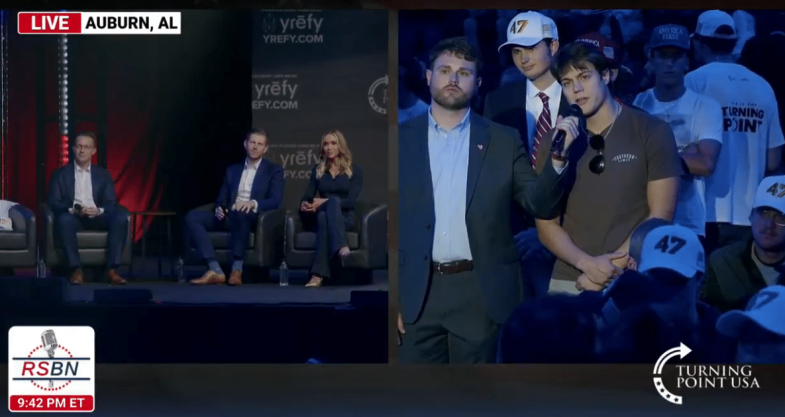
No, it came from a corn-fed, conservative, earnest, American student at Auburn University in Alabama with the slow drawl of our great country’s 250 year history. In other words, the epitome of the Red, White, and Blue that burns in the soul of every American patriot.
The young man approached the open microphone and addressed President Trump’s son Eric and his wife Laura – ambassadors of the President’s claim to be the most pro-Israel Administration in US history – with a respectful set of questions.
I’d like to ask about your father’s relationship with Israel. He’s taken over $230 million from pro-Israel groups. In the summer even though the US advised against it, Israel attacked Iran and the US still bombed on behalf of Israel…Israel has not been a good ally to the US since the 1960s when they bombed the USS Liberty.
The crowd of CONSERVATIVE young Americans erupted into wild applause.
Israel is a nation where Christians are constantly under attack… We talk about America first and defending Christians, but how can we do this if we align ourselves with a nation that does not do that itself?
At this point the applause among TPUSA’s conservative youth was deafening.
Deer-in-the-headlights Eric Trump does a Ceaucescu, repeating the slogans of the old order and hoping their magic will still quell the restive population.
You have a nation chanting ‘death to America’ every single day on the streets of Tehran. You have a nation that will develop a nuclear weapon and that will use that nuclear weapon.
These are standard Benjamin Netanyahu talking points from 30 years ago. Laura looked like Elena. Arranging her perfect hair as the crowd remained silent at Eric Trump’s well-rehearsed applause lines. Silence. They’ve heard it all before and they have done their own research and know that these are neocon lies.
Guys: Iran wanted to destroy our way of live they wanted to hurt us they wanted to inflict real pain.
Silence. They’ve done their own research.
Eric then repeats the absurd claim that his father solved eight wars (involving countries whose names he cannot pronounce) and the silence continued. The bumper sticker slogans no longer worked with Charlie Kirk’s kids just as Ceaucescu’s slogans no longer worked with a Romania sick to death with it’s subservience to a dying Communist bloc.
This is a genie that can no longer be put back into the bottle. Toothpaste out of the tube. The same social media harnessed early on by the US “regime change” operatives seeking to fulfil the neocon project has been captured by young American conservatives who are revolting against the destructive “Israel-first” party line of their boomer forebears and no underhanded sale of TikTok to pro-Israel fanatics will change the fact.
From this point on, like Ceaucescu, Trump’s people dare not address openly the number one youth movement of their ideological base. They dare not risk stop after stop being questioned by earnest young conservatives about America’s toxic and self-destructive supplication to the state of Israel. They will go back into Nicolae Ceaucescu’s bunker. Terrified of the very “America First” movement they have launched.
Daniel McAdams
Executive Director of the Ron Paul Institute for Peace and Prosperity and co-Producer/co-Host, Ron Paul Liberty Report. Daniel served as the foreign affairs, civil liberties, and defense/intel policy advisor to U.S. Congressman Ron Paul, MD (R-Texas) from 2001 until Dr. Paul’s retirement at the end of 2012. From 1993-1999 he worked as a journalist based in Budapest, Hungary, and traveled through the former communist bloc as a human rights monitor and election observer.
November 8, 2025
Posted by aletho |
Ethnic Cleansing, Racism, Zionism, Wars for Israel | Israel, United States, Zionism |
Leave a comment