Nations ‘monitoring’ Gaza’s ceasefire implicated in daily violations
By Robert Inlakesh | Al Mayadeen | November 5, 2025
Over a dozen nations are willingly participating and overseeing Israeli ceasefire violations, including the mass slaughter of civilians in Gaza and the blocking of aid. All of those involved need to be held to account as they no longer have plausible deniability.
Around five days after the implementation of the so-called ceasefire agreement in the Gaza Strip, a multinational group calling itself the Civil-Military Coordination Center (CMCC) was set up in southern occupied Palestine. It quickly attracted at least 14 countries and over 20 non-governmental organizations, which jumped at the opportunity to participate.
The CMCC was supposedly set up to monitor ceasefire violations, coordinate on issues like aid entry, and help enforce the ceasefire on all sides. So far, it has only worked in favor of the Israelis, and not a single nation has successfully put its foot down amid countless Israeli violations of the deal.
Nations like the US, France, Jordan, the UK, Germany, Denmark, Canada, Australia, Spain, and the United Arab Emirates all joined the CMCC. According to US CENTCOM, as part of this mission, the Egyptians even deployed teams of specialists to aid in finding the bodies of Israeli captives in Gaza, who are buried under the rubble caused by the Israeli Air Force’s own bombs.
While the CMCC’s Arab and Western members quickly moved to help achieve Israeli objectives, they have not moved a finger to grant the Palestinian civilians in the Gaza Strip the bare minimum required under the ceasefire.
The Zionist entity, as per the ceasefire it signed, agreed to allow at least 400 aid trucks to enter Gaza for the first five days of the deal, before allowing an unlimited amount afterward. Weeks in, they had only allowed an average of 90 trucks per day, even after signaling they would permit the entrance of 600 every day, the actual minimum required for the population to meet the bare necessities.
If the Israelis aren’t even being pressured to let the bare minimum amounts of desperately needed humanitarian aid into the Gaza Strip by the CMCC, then why does it even exist to begin with?
Evidently, it only exists to play the role of aiding the Zionist regime in fulfilling its genocidal goals. The US has already sent hundreds of soldiers as so-called “advisors”, while flying its reconnaissance drones in the skies of the besieged coastal territory.
Every single day, the Israelis not only violate the ceasefire through bombing civilian areas and using their soldiers and drones to snipe civilians dead in cold blood, but they are also carrying out ongoing military operations through their engineering units and civilian private contractors to demolish the remaining civilian infrastructure in the territories the Israeli army remains inside.
Where is the CMCC when it comes to four Israeli-armed and well-fed ISIS-linked militias operating in the Gaza Strip? Did they object to these groups raiding and looting civilian businesses? Have they objected or left the CMCC in protest after the Israelis slaughtered 104 people, including 46 children, in a single day?
Are the nations belonging to the CMCC completely blind to what the entire world has been witnessing live-streamed on their phones day in and day out? No, of course they are not. The leadership of the nations involved in this should be held criminally liable; they are watching on and playing ball with the Israelis as they violate the ceasefire and commit daily war crimes.
While NGOs are also involved in the CMCC, they evidently have less power, and their role is to do work that is not part of the military sphere. The question that must be posed to everyone involved is: When you are part of a coordination committee set up to monitor and help enforce the ceasefire, at what point is it enough before some kind of action is taken?
Meanwhile, the US-Israeli plan to put together a so-called International Stabilization Force (ISF) appears to be the priority when it comes to the Gaza ceasefire agreement. Already, a range of Arab nations have rejected participating directly in the ISF due to fears surrounding Gaza’s security situation and that Israeli airstrikes could endanger their soldiers. They could also be forced into confrontations with Palestinian Resistance groups.
US Vice President JD Vance has already expressed that the ISF will be tasked with disarming Hamas, which, in essence, makes it an invasion and regime change force, not a stabilization force as its name suggests. Due to this overtly being the ISF’s mission, according to US officials, this is why they are now approaching nations in East Asia to join the force in order to replace some Arab nations that had previously expressed interest in the project.
The United States’ Central Command is also putting forth draft proposals for a Palestinian “police force” to take over the Gaza Strip, one which would be trained and vetted by the US, Jordan, and Egypt.
All of the focus is being placed solely upon how to remove Hamas and the other Palestinian Resistance groups by force, in other words, achieving the goal behind the Israeli war. There is simply no concern for Palestinians being murdered on a daily basis, the continued Israeli expansion of its so-called “Yellow Line”, the ISIS-linked Death Squads, the refusal to allow reconstruction in the populated areas of Gaza, or the blocking of aid from entering the enclave.
Everything that is being done now is completely on Israeli terms, even down to the Zionist regime demanding that the ISF cannot include Turkish soldiers. This is not a ceasefire; it is an international scheme that has been hatched in order to achieve the goals that the Zionist entity failed to complete during two years of genocide. All of those involved in this project must be held to account, as their silence is complicity.
Yemen between two wars: A fragile truce and the shadow of a regional escalation
By Mawadda Iskandar | The Cradle | November 4, 2025
Since mid-October, Yemen has returned to the forefront of the regional scene. Political and military activity has intensified across several governorates, exposing the limits of the current ceasefire. From Sanaa’s view, the phase of “no war and no peace” cannot continue.
Any attack, it warns, will be met with a direct response. Deterrence, it insists, is now part of its core strategy.
Saudi Arabia, meanwhile, is trying to juggle two tracks – military pressure and renewed dialogue through Omani mediation. Riyadh wants to keep its weight on the ground while testing the possibility of a broader settlement.
The US and Israel have again inserted themselves into the mix, each working to block a negotiated outcome that might strengthen the Sanaa government. Washington has revived coordination channels with the coalition, while Tel Aviv watches the Red Sea front and pushes for the containment of Ansarallah-aligned armed forces. Yemen has once more become an overlapping arena of peace talks, foreign manoeuvring, and military threats.
Negotiations under fire
Oman has returned as the main regional mediator, moving to calm tensions after both Sanaa and Riyadh accused each other of violating the 2024 economic truce – the backbone of the UN “road map.” On 28 October, Muscat announced new diplomatic efforts to prevent a wider clash and reopen a political track.
But the situation on the ground shows little restraint. In Saada governorate alone, monitors recorded 947 violations this year, leaving 153 dead and nearly 900 injured. On 29 October, Saudi artillery shelled border villages in Razeh.
Sanaa affirmed that the “reciprocal equation” remains in place, staging a large military parade near Najran to display readiness. Riyadh, in turn, tested civil-defence sirens in its major cities – a move mocked by Ansarallah figure Hizam al-Assad, who said no siren would protect Saudi cities while the aggression and siege continue.
Speaking to The Cradle, Adel al-Hassani, head of the Peace Forum, points out that the crisis is worsening due to the deterioration of the economic situation and sanctions, which have affected more than 25 million Yemenis, while Oman is intervening as a mediator for the de-escalation.
According to Hasani, the roadmap includes two phases: the first is humanitarian, including the lifting of the blockade, the payment of salaries, and the resumption of oil exports; the second is political – to form a unity or coalition government that would coincide with a declared coalition withdrawal. Only that, he says, could stabilize the situation.
Washington and Tel Aviv’s new strategy
After Operation Al-Aqsa Flood and the ensuing war on Gaza, the US-Israeli approach to Yemen has shifted toward hybrid operations – mobilizing local partners, information warfare, and targeted strikes rather than any open intervention.
Sanaa’s recent warning about hitting Saudi oil sites came after detecting moves to create a US-Israeli front against Ansarallah. Israeli Prime Minister Benjamin Netanyahu called the resistance movement “a very big threat,” and Defense Minister Israel Katz threatened airstrikes on Sanaa itself.
The idea is to keep Saudi Arabia under pressure while allowing Israel to act indirectly. Israeli Finance Minister Bezalel Smotrich said the “Yemeni threat” is unresolved and urged Arab allies to take part in containing it.
Western think tanks have echoed this, urging Washington to rebuild Riyadh’s military role after the failure of the Red Sea naval alliance. The head of Eilat Port, Gideon Golber, admitted that maritime trade has been badly hit, adding that “We need a victory image by restarting the port.” A US Naval Institute report also noted that despite spending over $1 billion on air defense and joint operations, control over the corridor remains weak.
Between November 2023 and September 2025, Yemeni forces carried out more than 750 operations in the Red Sea, Gulf of Aden, and Indian Ocean – part of what Sanaa calls a defensive response. Head of the Supreme Political Council, Mahdi al-Mashat, urged Saudi Arabia to “move from the stage of de-escalation to ending aggression, siege, and occupation and implementing the clear entitlements of peace.”
He further accused Washington of using regional tensions to serve Israel. National Council member Hamid Assem added that an earlier de-escalation deal, signed a year and a half ago in Sanaa, was dropped by Riyadh under US direction after Operation Al-Aqsa Flood.
A source close to Sanaa tells The Cradle:
“The movement’s leadership is firmly convinced that the responsibility for these tools cannot be separated from those who created, armed, and trained them since 2015. Therefore, Sanaa affirms that any movement of these tools in Marib, the west coast, or the south of the country will not remain isolated, and will carry with it direct consequences that will affect the parties that supported and supervised the preparation of these groups.”
The source adds that:
“America has long experience with Yemen and may be inclined to avoid direct ground intervention, as its priorities appear to be focused on protecting Israel by striking Ansarallah’s missile and naval capability without extensive land friction. Therefore, it has begun to implement a plan that adopts hybrid warfare: intensifying media pumping, distortion, information operations, and psychological warfare, in addition to logistical and coordination preparations to move internal fronts through local pro-coalition tools.”
This hybrid strategy may coincide with Israeli military and media steps, the source points out, through threats and statements by officials in Tel Aviv, so that the desired goal becomes to “blow up the scene from within” and weaken Sanaa through internal chaos that paves the way for pressing options or strikes targeting its arsenal without direct American ground intervention.
US and UAE movements in the south
Throughout October, the US, Saudi Arabia, and the UAE expanded their presence in the south, west coast, and Al-Mahra to reorganize coalition factions and tighten control. US and Emirati officers arrived in Lahj Governorate, supervising the restructuring of Southern Transitional Council (STC) units from Al-Kibsi Camp in Al-Raha to Al-Mallah district. Security around these areas was reinforced with barriers and fortifications.
In Shabwa and Hadhramaut, joint committees of American and Emirati officers inspected Ataq Airport and nearby camps, counting recruits, running medical checks, reviewing weapons stock, and mapping command chains. Sources say Latin American contractors and private military firms assisted, ensuring resources stayed under external supervision.
In Taiz, another committee visited Jabal al-Nar to evaluate the Giants Brigades, their numbers, and armaments. On the west coast – from Bab al-Mandab to Zuqar Island – construction work is ongoing: terraces, fortifications, and outposts operated by “joint forces” hostile to Sanaa, including Tariq Saleh’s formations. Coordination reportedly extended to naval meetings aboard the Italian destroyer ‘ITS Caio Duilio’ to secure sea routes and “protect Israeli interests” in the Red Sea.
Hasani, who follows these movements, informs The Cradle that “These committees are evaluation and supervisory, not training, and are directly supervised by the US to ensure the readiness of the forces and perhaps as a signal to pressure Sanaa.”
He adds that British teams have appeared in Al-Mahra, while groups trained on Socotra Island are being redeployed to Sudan and Libya under UAE management.
Saudi-aligned Salafi units known as “Homeland Shield” now operate from Al-Mahra to Abyan and Hadhramaut. “These forces are today a pillar of the coalition to reduce the ability of Ansarallah, taking advantage of its religious beliefs, as part of the coalition’s tendency to turn the conflict into a sectarian war,” Hasani explains.
In Al-Mahra, local discontent is growing. Ali Mubarak Mohamed, spokesman for the Peaceful Sit-in Committee, tells The Cradle that Al-Ghaydah Airport remains closed after being converted into a joint US-British base.
“The committee continues to escalate peacefully through field trips and meetings with sheikhs to raise awareness of the community about the danger of militias,” he says, noting that the US presence has been ongoing since the coalition was established, though the exact nature of its presence is unknown.
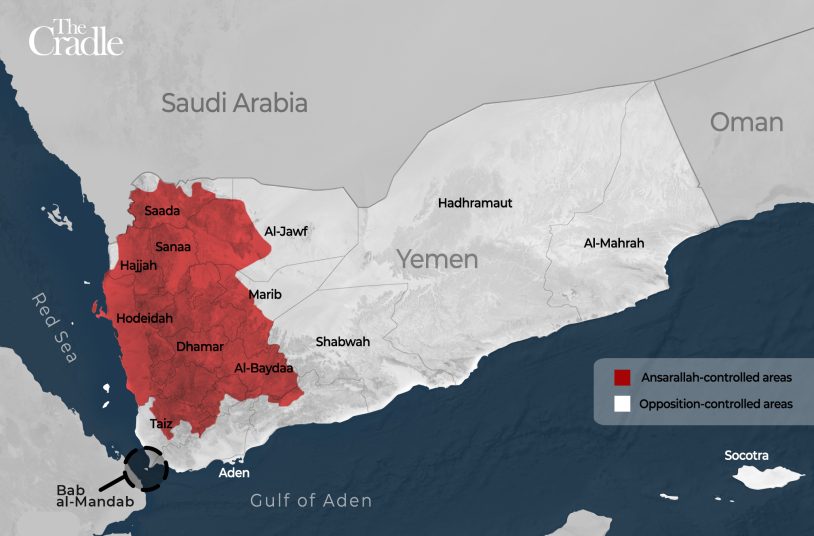
A map showing the distribution of control in Yemen
Where is Yemen heading?
These field movements are taking place as Washington and Abu Dhabi coordinate more closely with Tel Aviv. After meetings in October between the US CENTCOM commander and the Israeli chief of staff, a new plan began to take shape: build a joint ground network across southern Yemen to contain Sanaa and safeguard the Bab al-Mandab Strait – one of the world’s most critical shipping lanes.
At the same time, the US State Department appointed its ambassador to Aden’s Saudi-backed government, Steven Fagin, to lead a “Civil-Military Coordination Center” (CMCC) linked to ceasefire efforts in Gaza. Regional observers see this as a move to integrate the Palestinian and Yemeni fronts into one framework of US security control stretching from the Mediterranean to the Arabian Sea.
Reports circulating in Shabwa and Al-Rayyan say Emirati officers have been dispatched to Gaza to help organize local brigades – a claim still unconfirmed but consistent with the UAE’s wider operational pattern. Investigations by Sky News Arabia noted similarities in the slogans and structure of UAE-backed militias in Yemen and armed factions in Gaza, hinting at shared logistics and training links.
Adnan Bawazir, head of the Southern National Salvation Council in Hadhramaut, tells The Cradle that the scenario of recruiting mercenaries to fight in Gaza is not proven, but is possible – especially with the assignment of the interim administration in Gaza by Fagin, linking local moves to broader regional plans.
In Hadhramaut, Fagin’s visits to Seiyun, which includes the First Military Region, indicate preparations for a possible confrontation, especially since the area is still under the Saudi-backed Islah’s control in the face of the STC conflict, while Riyadh seeks to reduce Islah’s influence by transferring brigades and changing leadership.
Bawazir also points to suspicious movements in Shabwa and at Ataq airport, where field reports indicate flights transporting weapons to strengthen the front, given the governorate’s proximity to Marib and the contact fronts with Ansarallah, which makes it a hinge point for any regional or local escalation.
The moves are therefore part of three interrelated scenarios.
First, shifting pressure from Gaza to Yemen to compensate for the political and moral losses of Tel Aviv and Washington, while using the pro-coalition factions as a pressure arena against Sanaa. Second, preparing for possible military action in the event of the failure of the negotiations. Third, reorganizing the pro-coalition factions and building a central command that can be directed by Washington, thus turning the brigades into executive tools, ready to escalate the situation internally with a sectarian character.
Each scenario positions Yemen once again as a test field for foreign ambitions. The country remains divided between two trajectories: the possibility of a political settlement through Oman’s diplomacy, and the risk of a new conflict fed by regional competition and foreign control over its coasts and resources.
Whether the coming months bring a deal or another war will depend less on what Yemenis want and more on how their neighbors choose to use their soil.
Iraq links disarmament of resistance groups to US withdrawal amid Washington’s threats
Press TV – November 4, 2025
Iraqi Prime Minister Mohammed Shia al-Sudani has declared that resistance groups will only disarm once US forces leave the country, reaffirming plans for a full coalition withdrawal by 2026 amid threats from Washington.
Sudani emphasized Monday that a plan is still in place to have foreign forces purportedly fighting Daesh completely leave Iraq by September 2026 because the threat from terrorist groups have eased considerably.
“There is no Daesh. Security and stability? Thank God it’s there … so give me the excuse for the presence of 86 states (in a coalition),” he said, referring to the number of countries that have participated in the “coalition” since it was formed in 2014.
“Then, for sure there will be a clear program to end any arms outside of state institutions. This is the demand of all,” Reuters quoted him as saying, noting that factions could enter official security forces or get into politics by laying down their arms.
Washington wants Sudani to disband resistance groups affiliated with the Iraqi Popular Mobilization Forces, an umbrella group of anti-terror factions that has been formally integrated into Iraqi government forces.
Sudani’s remarks came as Iraqi Defense Minister Thabit al-Abbasi revealed that the United States has delivered its “final” and “most serious” warning to Iraq concerning the activities of resistance factions in the country.
In an interview over the weekend, Abbasi said that Washington’s latest message “concerns armed factions and includes a direct threat in the event that those factions carry out any operations in response to what Washington intends to do in the region near Iraq in the coming days.”
He explained that the warning was conveyed during a phone call with US Secretary of War Pete Hegseth, adding that Hegseth concluded the conversation by saying, “This is your final warning… and you know very well how the current administration will respond.”
US President Donald Trump recently appointed a supporter of his 2024 presidential campaign—who has no government experience and previously ran only a chain of marijuana dispensaries—as his administration’s new special envoy to Iraq to help “advance the interests” of the United States.
In his fist official statement published on his X account last week, Mark Savaya said his mission is to help Iraq shun resistance groups and free it from what it called “external interference”.
Iran’s Foreign Ministry spokesman Esmaeil Baghaei said during a press conference on Monday that Tehran views recent US threats as an attempt to interfere in Iraq’s domestic affairs, particularly ahead of its elections.
“In this context, we consider these threats a form of interference in Iraq’s internal affairs, especially as they are made on the eve of elections with the aim of creating tension and influencing the internal processes of an independent country,” Baghaei said.
He noted that such threats violate the principles of national sovereignty and respect for Iraq’s independence, reflecting the “interventionist and aggressive nature” of the United States.
Baghaei underscored that “these actions and attempts to create tension will have no impact on the determination of the Iraqi people, who are resolved to decide and act based on what they deem beneficial for their nation’s security and interests.”
Washington and Baghdad have agreed on a phased withdrawal of US forces, with a full withdrawal expected by the end of 2026. The initial withdrawal of troops began in 2025.
“Iraq is clear in its stances to maintain security and stability and that state institutions have the decision over war and peace, and that no side can pull Iraq to war or conflict,” said Sudani in the interview.
How Many Americans Killed by Israel? [Answer Will SHOCK You]
If Americans Knew
CJ Werleman is a journalist, author, and political commentator who has been published in Byline Times, TRT World, Middle East Eye. In this video he provides information on the many Americans he says that Israel has killed. Below is additional information on each.
RELATED INFORMATION:
- A Costly Friendship
- Neo-Conservatives And The Israeli Lobby Are Promoting War With Iran, As They Did With Iraq
- WATCH: How Pro-Israel Neocons Pushed for War in Iraq (Alison Weir)
- Rachel Corrie
- Shireen Abu Akleh
- Israel was part of the conspiracy to kill JFK
- Author Martin Sandler says Mossad may have assassinated JFK
- Israel Honors Egyptian Spies 50 Years After Fiasco
- When Eisenhower and Nixon reined in Israel and defied the lobby
- If Americans Knew Receives Death Threat
- USS Liberty
- If Americans Knew videos
- Voters Against Billions to Israel – an online statement for Americans to sign stating that they will not vote for any politician who sends U.S. tax money to Israel.
The UAE’s War on Muslims: From Sudan to the Gaza Genocide
By Robert Inlakesh | The Palestine Chronicle | October 30, 2025
While the United Arab Emirates advertises itself as both a peacemaker and opponent of so-called “Islamic radicalism”, it is currently involved in genocide in both Gaza and Sudan. Connecting these dots is key to understanding the overarching goals of the regime.
The United Arab Emirates has created its image in the world as an innovator, a builder, and a peacemaker, a carefully calibrated illusion as artificial as the buildings that mesmerize onlookers in Dubai. But behind the architecture and lavish outer shell is a rotten core that continues to aid in the erosion of the surrounding region.
While claiming to oppose “radical Islam” and paying talentless influencers to attack groups like the Muslim Brotherhood, they foster extremist ideologies and back ISIS-linked militant groups to carry out their regional ambitions.
For all of the critiques that can be offered of groups like the Muslim Brotherhood and of Qatar, they are nothing like the orientalist depictions of them that are spread far and wide through Emirati propaganda.
The reason why the UAE attacks the ideology belonging to groups that are either linked to or part of the Muslim Brotherhood has nothing to do with their religious motivations and everything to do with the Emirati opposition to their political agenda.
For them, they fear any politically engaged Islamic movement that is capable of successfully leading a country and organizing democratic institutions, because they are a dictatorship fully beholden to their Western handlers, including Israel.
The reason why the Islamic element of such movements threatens them the most is that it is popular and the religion that the majority of the region adheres to in some shape or form.
If any Islamic anti-imperialist movement proves successful and leads a democratic process, then this could threaten their rule. So, they seek to undermine, infiltrate, and destroy these movements wherever they rear their heads, including inside the Gaza Strip.
Hamas, or the Islamic Resistance Movement, was an outgrowth of the Egyptian Muslim Brotherhood. Its origins begin in the 1970s and the formation of the social/civil-society movement known as the Mujamma al-Islamiyya in the Gaza Strip, at the time colloquially referred to as the Muslim Brotherhood, as it represented Palestine’s wing of the movement.
Therefore, the success and popularity of Hamas, as part of what is viewed by the Emiratis as a wider body of Islamic political movements, is interpreted as a threat to its rule in the region.
As a means of dismantling the prospects of Democratic oriented Islamic political leaderships, the UAE has engaged in military confrontations and intense propaganda campaigns. On the propaganda front, they are joined by other Gulf leaderships who have their own agendas, also and not only fund direct anti-Hamas or anti-Muslim Brotherhood propaganda, but also fuel religious division.
One of the most powerful means of divisive propaganda is directly targeting Muslims themselves, in particular the Sunni Muslim majority of the region. While they certainly push sectarian rhetoric against the Shia too, they seek to pacify the Sunni population, deter them from engaging in anti-imperialist and anti-occupation struggles, or redirect their anger at fellow Muslims.
They do this through pushing divisions between mainstream Sunni schools of thought and employing their Madkhali propagandists to deter action against the so-called Muslim rulers. Without going too deep into the Madkhalis, as with each group of Muslims, there is always nuance; they are a group of Salafist Muslims who adhere to the dictates of their rulers and sometimes will even justify actions taken by those rulers that are prohibited in Islam.
The primary goal here is to fund and fuel division across the Muslim world, channeling hatred and creating debates around any issue that can distract from what Israel, the United States, and their allies are doing to the region. Another major tactic employed here is to Takfir (declare a disbeliever) or undermine any Muslim group that sides with the likes of Iran, Hezbollah, Ansarallah, or any other Shia groups.
Again, none of this opposition has anything to do with any substance that may be behind said arguments they make; these are well-funded propaganda campaigns designed for political purposes to undermine resistance to imperialism, occupation, and genocide. This is where we can begin looking at Gaza and then Sudan.
The UAE professes to oppose so-called “Islamic radicalism”, yet it now stands accused of providing support to the ISIS-linked gangs operating in the Israeli-occupied portion of the Gaza Strip. Not only has the UAE been accused of directly coordinating with these militia groups – composed of hardline Salafists who have links to ISIS and al-Qaeda, drug traffickers and murderers – but there is even evidence of these death squad members driving around in vehicles with registered UAE license plates.
In opposition to Hamas, the UAE is more than happy to back Israeli proxy collaborator groups that contain ISIS and Al-Qaeda minded elements within them.
Going back to the sorts of divisive propaganda that is encouraged by the Emiratis, a leading member of the Israel-backed so-called “Popular Forces” militia in Gaza, Ghassan Duhine, has openly cited ISIS Fatwas declaring Hamas apostates as a justification for killing them. ISIS officially declared war on Hamas back in 2018.
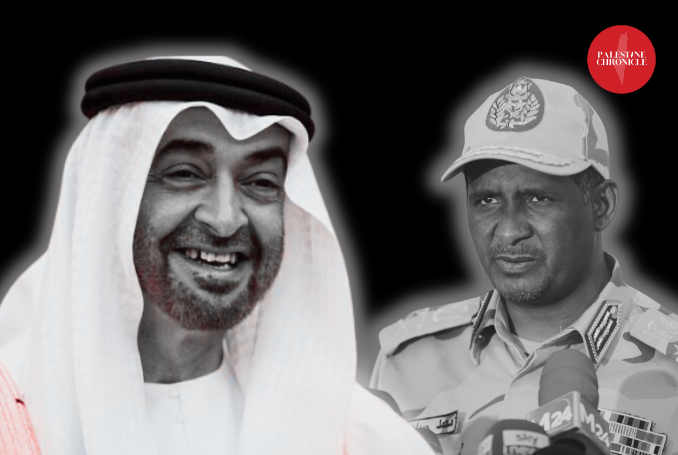
Meanwhile, the UAE has long been backing the Rapid Support Forces (RSF) in Sudan, the group currently accused of committing genocide, and which has re-entered the headlines after it captured Al-Fasher and other areas in North Darfur, resulting in the murder of around 527 people, including civilians who were butchered while sheltering in refugee camps.
RSF leader, Mohamed Hamdan Dagalo (Hemedti), has long collaborated with the Emiratis, and it was even previously pointed out that his official Facebook page was controlled out of the UAE.
Without getting into all of the complexities of the Sudanese civil war, Hemedti is a warlord who has long maintained power over the majority of Sudan’s Gold Mines, slaughtering anyone who dares to get in his way.
His forces have also been accused by the UN and prominent rights groups of committing widespread mass sexual violence, including horrific forms of rape.
Hemedti was additionally supplied with battle-changing technologies through his Israeli Mossad contacts, and despite there being documented rights violations on both the Sudanese Army and RSF sides of the war, there is no doubt that Hemedti’s forces have the most blood on their hands and carry out the most horrific crimes seen in the conflict.
The UAE is not just one of many actors involved in Sudan; it is the primary supporter of the RSF. According to a scoop published by The Guardian this Tuesday, British weapons sold to the United Arab Emirates were even discovered to have been used by the RSF to carry out its genocide.
Despite the United States declaring the horrors in Sudan as a genocide, during the Biden administration, no action has been taken against the UAE for its role in fueling the war. Similarly, the UAE has been involved in countless crimes committed throughout the Horn of Africa and in North Africa too, backing a whole range of extremist militant groups who stand accused of indiscriminately targeting civilians.
Although it is also hidden from the Western corporate media, the UAE even used members of the Sudanese RSF to fight on its behalf as proxy forces against Ansarallah in Yemen, where they were accused of playing a role in what many declared a genocide. Keep in mind that nearly 400,000 people in Yemen were killed due to the inhuman blockade and war of aggression, led by both the UAE and Saudi Arabia.
The Emiratis push propaganda about the Sudanese Military being “Islamists”, accusing them of being part of the Muslim Brotherhood and then linking them to all sorts of other organizations. Ansarallah in Yemen is also branded as “Islamists”, but in their case are accused of being “Iranian proxies”. In essence, this line of propaganda is the typical Israeli-style Hasbara argument for committing egregious war crimes.
Throughout the Gaza genocide, the UAE was one of the only nations that continued its routine flights to Ben Gurion airport and transported materials to aid the Israelis. The Emiratis also turned Dubai into an Israeli safe haven, where soldiers implicated in genocide can go to party, engage in activities like consuming narcotics or hiring escorts, and live in luxury.
The UAE did not lift a finger to force the Israelis to let aid into Gaza, as they blocked all humanitarian aid trucks entering for around three months earlier this year, but will then point to the trickles of aid that they do supply as proof they are helping the people. In their defense, they argue that they were key in achieving a ceasefire, for which there is no evidence, just like there was no evidence that they stopped West Bank annexation when normalized ties with Israel.
Viewing the Emiratis as operating on their own whims, blaming them solely for the actions they commit, is incorrect. These are rulers installed by the West, who work for the West and are simply used as pawns to do the bidding of their masters. If any of their leaders stand up to the crimes that the UAE is inflicting, they will be assassinated and replaced with other members of the ruling bloodline who choose to play ball. They are hostages, posing as rulers and playing their part in the dismantlement of the surrounding region.
Constructing chaos: Tel Aviv’s hand in Syria’s sectarian slaughter
The Cradle | October 29, 2025
On 7 March, Syrian security forces and affiliated armed factions perpetrated the massacre of more than 1,500 Alawite civilians, including many elderly, women, and children, in 58 separate locations on the Syrian coast.
Though the killings were executed by sectarian forces loyal to Syrian president Ahmad al-Sharaa (Abu Mohammad al-Julani), a former Al-Qaeda commander, the path to the massacre was paved by a covert Israeli strategy aimed at inciting an Alawite uprising.
Israel’s plan hinged on pushing Alawites into the “trap” of launching an armed rebellion, with false promises of external support, only to give Sharaa’s forces the pretext to carry out the mass slaughter of Alawite civilians in “response.”
Israel’s goal was consistent with its long-standing aim, articulated in the infamous Yinon Plan: to dismantle Syria and reshape it into “weak, decentralized ethnic regions,” following former Syrian president Bashar al-Assad’s fall.
Netanyahu goes to Washington
After 14 years of sustained support from the US, Israel, and regional allies, the extremist group Hayat Tahrir al-Sham (HTS) – formerly the Al-Qaeda affiliate, the Nusra Front – seized control of Damascus in December 2024. Its leader, Julani, rebranded as Ahmad al-Sharaa, swiftly assumed the presidency.
On the very day of this power shift, Israeli Prime Minister Benjamin Netanyahu took credit for Assad’s fall and began a mass bombing campaign to destroy what was left of the country’s military capabilities.
However, toppling Syria’s government and destroying its army was not the end of Israel’s plan for Syria.
On 9 January, Netanyahu’s cabinet met to discuss organizing an international conference to “divide Syria into cantons,” Israeli news outlet i24 News reported.
“Any proposal deemed Israeli will be viewed unfavorably in Syria, which necessitates an international conference to advance the matter,” the outlet noted.
In other words, to be successful, Israel’s project to divide Syria needed to originate, or seem to originate, from Syrians themselves.
Less than a month later, on 2 February, Netanyahu visited Washington to present a “white paper” regarding Syria to US officials.
After Netanyahu’s visit, Reuters reported that “Israel is lobbying the United States to keep Syria weak and decentralized, including by letting Russia keep its military bases there to counter Turkey’s influence.”
The Times of Israel later commented that Israel was lobbying the “US to buck Sharaa’s fledgling government in favor of establishing a decentralized series of autonomous ethnic regions, with the southern one bordering Israel being demilitarized.”
Reports later leaked into political circles about a meeting two days later, on 4 February, between US officials and a representative of the most influential Druze religious leader in Syria, Sheikh Hikmat al-Hijri, in Washington, DC.
Al-Jumhuriya reported that according to Syrian and American sources with direct knowledge of the meetings, discussions revolved around “a plan for an armed rebellion against the government of Ahmad al-Sharaa.”
The rebellion would reportedly include Hijri’s Druze forces from Suwayda, the Kurdish-led Syrian Democratic Forces (SDF) from northeast Syria, and Alawite groups from the Syrian coast, but with “Israeli support.”
When asked about the meeting, Hijri’s representative confirmed to Al-Jumhuriya that it had taken place but stated that the proposal for a rebellion had not come from the Druze.
“The proposal originated from a state, not from any Syrian faction,” Hijri’s representative clarified, in a likely reference to Israel.
Inventing the insurgency: Meqdad Fatiha
Just two days later, on 6 February, an Alawite resistance group, the “Coastal Shield Brigade,” was allegedly formed.
A video announcing the group’s establishment claimed its fighters would respond to sectarian massacres carried out by HTS-led security forces against Alawites since December, including in the village of Fahel, where 15 former officers in the Syrian army were killed, and the village of Arzeh, where 15 people were killed as well, including a child and an elderly woman.
In both villages, former officers in Assad’s army had given up their weapons and completed a reconciliation process with the new authorities in Damascus, but were nevertheless murdered in their homes by militants linked to Syria’s new extremist-led security forces.
The Coastal Shield Brigades was allegedly led by Meqdad Fatiha, a former member of the 25th Special Forces and the Republican Guard of the Assad government.
Activists on social media circulated the video, which allegedly showed Fatiha declaring the establishment of the brigade from a base in the Latakia Mountains.
However, there was no evidence that the group was real. Fatiha’s face was covered by a black balaclava in the video, making it impossible to verify whether he was really the person speaking. This was odd, given that his appearance was already known from his Facebook profile.
The theatrics pointed to an intelligence fabrication – likely Israeli – designed to present the illusion of an organic Alawite insurgency.
A meeting in Najaf?
Just five days later, the narrative of an organized Alawite insurgency was reinforced by reports in Turkiye Gazetesi, an Islamist-leaning pro-government newspaper in Turkiye.
The report claimed that Iranian generals and former commanders in the Syrian army under Assad had met in the Shia holy city of Najaf in Iraq to plan a major uprising against Sharaa in Syria.
The scheme reportedly involved Druze factions, the Kurdish-led SDF, Alawite insurgents on the coast, Lebanese Hezbollah, and, improbably, ISIS.
Large amounts of weapons were allegedly being sent by land from Iraq and by sea from Lebanon to the Syrian coast, the report added.
“Some surprising events were expected to occur in Syria in the near future,” the Iranian generals allegedly in attendance said.
While “surprising events” did occur one month later with the massacre of Alawites on 7 March, the reports of the Najaf meeting are likely fabricated.
It is unlikely that a Turkish newspaper would have access to a detailed account of a secret meeting taking place between top Iranian generals and former Syrian officers.
It is also unlikely, and even ridiculous, that Iran and Hezbollah would be coordinating with their long-time enemy, ISIS, or with the US-backed SDF.
Kurdish-Syrian commentator Samir Matini amplified the narrative through widely viewed livestreams, pushing the idea of “surprising events” to come. The aim: to pin Israel’s plan on Iran and Hezbollah and create a smokescreen of chaos.
Sectarian killings fuel resistance
Amid the propaganda claiming a foreign-backed Alawite insurgency was being organized, Julani’s security forces stepped up attacks against Alawite civilians in the coastal region.
Syrian journalist Ammar Dayoub reported in Al-Araby al-Jadeed that Alawites were often targeted solely based on their religious identity, rather than because they were “remnants of the regime.”
Dayoub observed that “these violations have targeted people who opposed the previous regime, and young people who were only children in that period, as well as academics and women.”
In response to the sectarian killings, Alawites began to defend themselves.
One key event occurred on 8 January, when armed men linked to the Damascus government killed three Alawite farmers in the village of Ain al-Sharqiyah in the coastal region of Jableh. The men were working their lands across from the Brigade 107 base when they were killed.
In response, a local man named Bassam Hossam al-Din gathered a group of local men, arming them with light weapons. They attacked members of Julani’s internal security forces, known as General Security, killing one and abducting seven more, before barricading themselves in an Alawite religious shrine.
The General Security launched a campaign against them, swiftly killing Hossam al-Din and his group.
A former intelligence officer of the Assad government, speaking with The Cradle, says these killings motivated him and others to fight back:
“All this fueled enormous resentment in the area, which grew worse day by day. After Bassam Hossam al-Din’s death, some people here – including former government military personnel and civilians – began to gather.”
Crucially, they were “encouraged by reports and promises [of help] they received from outside.”
They were told they would receive support, including by sea, from the US-led international coalition, in coordination with the Druze in Suwayda and Kurds in northeastern Syria.
“They were given hope of escaping this miserable situation,” the former intelligence officer tells The Cradle.
In the following weeks, Alawites continued to clash with Syrian security forces in an effort to defend themselves from raids and arrests.
In late February, Alawite insurgents attacked a police station in Assad’s hometown of Qardaha, located in the mountains overlooking the coastal town of Latakia.
According to Qardaha residents and activists who spoke to Reuters, “the incident began when members of security forces tried to enter a house without permission, sparking opposition from residents.”
“One person was killed by gunfire, with locals accusing the security forces of the shooting,” Reuters added, further suggesting that local Alawite men were acting in self-defense.
What happened in Datour?
The simmering conflict escalated further on 4 March. Reuters reported that, according to Syrian state media, two members of the Defense Ministry had been killed in the Datour neighborhood in Latakia city by “groups of Assad militia remnants,” and that security forces had mounted a campaign to arrest them.
One Datour resident told Reuters there had been heavy gunfire in the early hours and that security forces in numerous vehicles had surrounded the neighborhood.
A security source speaking with the news agency blamed the violence on a “proliferation of arms” among former security and army personnel who had refused to enter into reconciliation agreements with the new authorities.
The source said that local Alawite leaders had, in some cases, cooperated with security forces to hand over former personnel suspected of committing crimes during the period of Assad’s rule in hopes of staving off “crack downs and potential civil unrest.”
Testimonies from residents of Datour collected by Syrians for Truth and Justice (STJ) indicated that security forces carried out random arrests in Datour and indiscriminately fired at civilian homes, resulting in several deaths, including that of a child.
The campaign was “marked by sectarian rhetoric and intense hate speech directed against the Alawite sect,” STJ added.
A source from Datour speaking with The Cradle reveals that Julani’s government used a prominent local Alawite family to create the proliferation of weapons needed to justify a crackdown.
The Aslan family had previously been close to Maher al-Assad, Bashar’s brother and commander of the army’s elite 4th Division, but quickly established good relations with the new government after it came to power in December.
It became common to see General Security members from Idlib spending time at the Aslan-owned businesses on Thawra Street at the entrance to Datour.
When residents complained to the General Security about criminal activity by the Aslan family, such as stealing money and confiscating homes, the General Security took no action against the family.
The source speaking with The Cradle says that on 4 and 5 March, members of the Aslan family distributed weapons to Alawite men in the neighborhood, encouraging them to take up arms against the General Security.
This was, of course, strange given the close relationship between the Aslans and the General Security, as well as because such a rebellion had little chance of success.
“Why would the Aslan family distribute weapons to fellow Alawites in Datour while knowing a rebellion would fail?” the source asks.
What happened in Daliyah?
On 6 March, a major clash erupted in the Alawite villages of Daliyah and Beit Ana, which lie adjacent to one another in the mountains of the Jableh countryside.
Sources from Daliyah speaking with The Cradle confirm that a large General Security convoy entered the village that morning to arrest a local man, Ali Ahmad, who had written posts against the Julani government on Facebook.
General Security members took Ahmad from his work at the local mini bus station and executed him at the entrance of the village.
The General Security members then entered the nearby house of a retired army officer, Taha Saad, in the adjacent village of Beit Ana, killing his two adult sons.
In response to the killings, local men from the village gathered light weapons and attacked the General Security members. After the General Security called for reinforcements, a convoy of 20 vehicles arrived to assist the government forces in the fight.
The sources in Daliyah speaking with The Cradle state that around 20 members of the General Security and 17 men from the village were killed in the gun battle.
As the clashes continued, Damascus sent helicopters to drop bombs on Daliyah and Beit Ana until a Russian plane forced the helicopters to withdraw.
Julani’s army escalated further by firing artillery at multiple Alawite villages in the mountain areas from the military academy in Rumaylah on the coast, near Jableh city.
A source from Jableh speaking to The Cradle says that the bombings made Alawites “go crazy,” especially because Daliyah is home to an important Alawite religious shrine.
The massacre and its beneficiaries
When the Russian plane appeared over Daliyah and Beit Ana, “People thought that this was ‘the moment,’ so they rose up on that basis,” stated the former intelligence officer speaking with The Cradle.
Alawite insurgents attacked General Security and army positions in various areas across the coast, including Brigade 107 near Ayn al-Sharqiyah, where Bassam Hossam al-Din’s group abducted the General Security members before being killed in January.
“There was no Meqdad Fatiha or anyone else from outside, no Iranians or any others. It was purely a popular force rising up against this situation,” the former intelligence officer explains.
However, they were emboldened by promises of outside help from the US-led coalition, the Druze, and the Kurds.
The clashes at the Brigade 107 base lasted all night, but the Alawite insurgents paused the attack early the next morning, on 7 March, thinking that coalition forces would come to their aid and bomb the brigade.
“They waited two hours, but no strikes came, no support arrived. Their morale collapsed, they realized it was all lies, just a trap,” the source goes on to say.
After the fighting stopped, disillusionment spread, and the Alawite insurgents attacking the base withdrew and returned to their villages.
Al Jazeera’s role
As the fighting still raged on 6 March, Al Jazeera repeated the false reports from Turkish media claiming Alawite insurgents were receiving massive external support from Iran, Hezbollah, the Kurdish SDF, and even Assad.
The news outlet’s propaganda gave Damascus the pretext to mobilize not only formal members of military units from the Ministry of Defense, but also many informal armed factions who responded to calls from mosques to fight “jihad” against Alawites.
On the morning of 7 March, convoys of military vehicles filled with tens of thousands of Sharaa’s extremist fighters began arriving at the coast.
Because the Alawite insurgency was weak and disorganized, with no help from abroad, it was not able to provide any protection to Alawite civilians as the massacres unfolded.
Facing no resistance, Julani’s forces began systematically slaughtering any Alawite men they could find, as well as many women and children, in cities, towns, and villages across the coast, including in Jableh, Al-Mukhtariyah, Snobar, Al-Shir, and the neighborhoods of Al-Qusour in Baniyas and Datour in Latakia.
The massive scope and systematic nature of the massacres, involving such large numbers of armed men in so many locations, suggests pre-planning by Julani and his Defense Minister, Murhaf Abu Qasra – a former commander-in-chief of the HTS military wing.
A media creation
The mobilization of Julani’s forces was also aided on 6 March by new videos appearing online claiming to show Meqdad Fatiha and members of the Coastal Shield Brigade vowing to fight against the new government.
In one video, the man claiming to be Fatiha was masked (this time dressed like a character from the popular video game, Mortal Kombat, and standing against a blank background), making it impossible to know who he was and whether he was in the mountains of Latakia or in a television studio in Tel Aviv or Doha.
In a separate video, Fatiha was masked and dressed just like an ISIS militant beheading Christians on video in Libya in 2015, leading to speculation the video was fake and had been created using artificial intelligence (AI).
Another video was later released in which Fatiha appeared without a mask, saying that previous videos of him were indeed real, and not created using AI. However, the new video also appeared fake, his face, shoulders, and eyes moving in an unnatural way as he spoke.
During multiple visits to the Syrian coast, The Cradle was not able to find any Alawites who expressed support for Fatiha or believed his group was real.
The source from Daliyah states that, “No one here supports Meqdad Fatiha. We all believe he works for Julani. The Coastal Shield Brigade is fabricated.”
A former Alawite officer in Assad’s army from the Syrian coast tells The Cradle, “We only see videos of Meqdad Fatiha online. We believe he is just a media creation.”
After showing The Cradle his rotting teeth, the former officer remarks, “Do you think we are getting help from Iran or Hezbollah? I don’t even have money to fix my teeth.”
An Alawite woman whose husband and two grown sons were murdered on 7 March suggests to The Cradle that Fatiha is a fictitious person, only existing on Facebook and created by the authorities to justify the massacres.
“Who is he? Julani created him. It’s a lie,” she explains.
General Security fatalities
The mobilization of Sharaa’s extremist forces from across the country was also aided by claims that Alawite insurgents had killed 236 members of the General Security in attacks on 6 April.
Some General Security members were certainly killed, but Syrian authorities never provided any evidence for this large number, suggesting it was vastly inflated to heighten sectarian anger. When Reuters requested the names or an updated tally, Syrian officials refused to provide them.
In one case, the pro-HTS “Euphrates Shield” Telegram channel published a photo collage allegedly showing General Security members killed by “regime remnants” during the fighting.
However, one of the fighters shown in the photos quickly posted a story on his Instagram with a “laugh out loud” emoji to show he was still alive, the Syrian Democratic Observatory showed.
Israeli ambitions
On 10 March, before the victims of the massacres had been buried, i24 News published a letter claiming to be written by Alawite leaders, asking Netanyahu to send his military to protect them.
“If you come to the Syrian coast, which is predominantly Alawite, you will be greeted with songs and flowers,” the letter stated.
It also called on Israel to unite against the “Islamic tide led by Turkiye,” while asking for help in separating from “this extremist state.”
When Israel secretly “greenlit” Julani’s massacre of Druze in Suwayda in July, the goal of dividing Syria was further advanced. Many Druze are aware of the covert relationship between Damascus and Tel Aviv, but, fearing extermination, feel they have little choice but to call on Israel for protection and to establish an autonomous region in south Syria.
Three weeks after the massacres of Alawites in March, an Israeli general quietly admitted that sectarian violence in Syria benefits Tel Aviv.
“This thing where everyone is fighting everyone, and there’s an agreement with the Kurds one day, and a massacre of the Alawites the second day, and a threat to the Druze on the third day, and Israeli strikes in the south. All this chaos is, to some extent, actually good for Israel,” stated Tamir Hayman while speaking with Israeli Army Radio.
“Wish all sides good luck (but) do it quietly. Don’t talk about it,” the general added.
Iran needs up to $180bn to meet oil production targets: Official
Press TV – October 29, 2025
An Iranian Oil Ministry official says that the country requires up to $180 billion in investment to increase its oil production by at least 1 million barrels per day (bpd) by 2028, as outlined in its national development plan.
Nasrollah Zarei, who serves as CEO of Petroleum Engineering and Development Company, said on Wednesday that Iran’s Seventh National Development Plan targets an output of 4.8 million bpd within three years.
However, Zarei said that the target may be out of reach due to financial constraints caused by foreign sanctions.
He said that even a more modest target of 4.5 million bpd would require $170 to $180 billion in investment, of which the government can only allocate $10 billion. He called for an immediate revision of funding schemes for oil projects in Iran, saying the country’s sovereign wealth fund could play a larger role in financing such projects.
Despite stringent US sanctions that restrict oil sales and reinvestment, Iran has maintained its production at approximately 3.5 million bpd in recent years. Nearly 2 million bpd are exported, with the remainder used for domestic fuel and petrochemical production.
While Iran has faced challenges in meeting its oil output targets, it has achieved significant breakthroughs in the production of natural gas. The country is now the world’s third-largest gas producer, with a daily output of nearly 1 billion cubic meters, which experts believe is equivalent to approximately 6.3 million barrels of oil.
This solidifies Iran’s position as a leading hydrocarbon supplier, whose petroleum industry has a key role to play in global energy markets.
Chairman of Iran’s Geological Society, Mansour Ghorbani, said on Wednesday that the country holds some 36 trillion cubic meters of gas, representing 16% of global reserves, adding that the figure could rise to 50 trillion cubic meters with new discoveries.
Ghorbani also said that Iran’s oil reserves are estimated at 157 billion barrels, ranking among the world’s largest.
Who Are the US Candidates Refusing AIPAC Money?

By Robert Inlakesh | Palestine Chronicle | October 28, 2025
The litmus test for whether a politician is truly interested in representing the people who elect them to power is becoming their stance on Palestine, more specifically, Gaza.
As American public opinion continues to shift against Israel, the US political landscape is also undergoing a dramatic transformation. AIPAC, once viewed as an asset to aid in election races, is now becoming a liability, giving birth to a new generation of politicians who are demonstrating their sincerity through a refusal to be bought by the Israel Lobby.
While New York Mayoral candidate Zohran Mamdani has perhaps received the most attention for his pro-Palestinian stances, he is in no way alone. In fact, he is joined by countless others who use their anti-genocide stances as a means of connecting with their voter bases.
All authoritative polling data suggests the majority of Democratic Party supporters currently hold a more favorable view of the Palestinians than Israel. According to a recent Gallup poll, 92 percent of all Democrats said they oppose the war in Gaza. Yet, the ability of candidates to reject funding from the Israel Lobby and freely speak their mind on the issue transcends a simple agreement with constituents on a single foreign policy issue.
Instead, refusing to take AIPAC money is rapidly becoming a prerequisite in order to be viewed as authentic, and it drives belief amongst the public that any given candidate will actually work to achieve key campaign promises. In other words, AIPAC equals corruption, and being pro-Palestinian equates to authenticity.
One of the most successful campaigns, coming from this new generation of politicians, is that of Graham Platner, who is a Democrat running for a seat in the US Senate for Maine. In his campaign ads, he promotes a “Mainers First” mentality, centering the working class and also explicitly opposing Washington’s support for the genocide in Gaza. He has publicly rejected funds from AIPAC, as opposed to Senator Susan Collins, who has taken at least $647,758 from the Israel Lobby.
Platner is a Marine Corps veteran who did four combat tours and also worked as an Oysterman. Despite countless attempts, from within the Democratic Party establishment and the Israel Lobby, to stir up controversies and undermine his campaign, the progressive candidate is still polling above his Democratic primary opponent and Maine Governor, Janet Mills.
Although the uptick in pro-Palestinian sentiment is more prominent amongst Democrats, there is also a notable shift amongst Republicans. Pew Research polling data shows that, while unfavorable views amongst Republicans overall stand at around 23 percent, amongst those aged 18-49, a whopping 50 percent said they viewed Israel unfavorably.
Harnessing the energy of the shift, the likes of Rep. Marjorie Taylor Greene, Rep. Thomas Massie, and Rep. Matt Gaetz have all explicitly come out in opposition to AIPAC. Their messaging around the issue is to assert that they are “America First”, as opposed to their Republican colleagues, whom they accuse of being “Israel First”. These representatives align themselves with popular conservative commentators like Candace Owens and Tucker Carlson, amongst others, who also carry the same rhetoric.
Ultimately, the idea of America First and slogans like Mainers First transcend partisan lines. The idea of prioritizing Americans above the interests of Israel has long been taboo, yet we saw this collapse during the Democratic primary campaign for the Mayor of New York.
When Zohran Mamdani was asked where he would first visit as Mayor, he answered calmly that “I would stay in New York City. My plans are to address New Yorkers across the five boroughs and focus on them.” Although he was then challenged repeatedly and asked to recognize Israel as a Jewish State, which he refused to do based upon opposition to systems of ethnic or religious hierarchy, the clip of his answer went viral, receiving broad agreement amongst both Democrats and Republicans.
Other politicians running for Congress, who are explicitly anti-AIPAC, include the following candidates:
Robb Ryerse for Arkansas’s Third District, who is seeking to unseat Steve Womack, funded to the tune of $142,030 by the Israel Lobby. In California, there is Chris Bennet running for the Sixth District, Mai Vang for the Seventh District, Saikat Chakrabarti for the Eleventh District, Chris Ahuja for the Thirty-Second District, as well as Angela Gonzales-Torres for the Thirty-Fourth District.
In Colorado, there is Melat Kiros for the First District, as well as John Padora for the Fourth District. Within Florida, there is also Bernard Taylor running for the Twenty-First District, Elijah Manley for the Twentieth District, Marialana Kinter for the Seventh District, and Oliver Larkin for the Twenty-Third District.
Running in Illinois, there is Robert Peters for the Second District, Junaid Ahmed for the Eighth District, Morgan Coghill for the Tenth District and Dylan Blaha for the Thirteenth District. Meanwhile, in Indiana, there is Jackson Franklin, who is running for Congressional District Five and, in Massachusetts, Jeromie Whalen is running for the First District.
Seeking to win Maryland’s Fourth District is Jakeya Johnson, while Donavan McKinney is running for Michigan’s Thirteenth District and Kyle Blomquist is competing for its First District. Crossing over to Missouri, there is a well-known progressive candidate, Cori Bush, for its First District and Hartzell Gray for Missouri’s Fourth District.
For New Hampshire’s First District, Heath Howard is in the running, while, in New Jersey, Katie Bansil is running for the Sixth District. Meanwhile, there is James Lally running for Nevada’s Third District, Aftyn Behn for Tennessee’s Seventh District and Zeefshan Hafeez for Texas’s Thirty-Third District.
Also contending for Washington’s Ninth District is Kshama Sawant, while Aaron Wojchiechowski is running for Wisconsin’s Fifth District and Brit Aguirre is contesting for West Virginia’s First District.
Meanwhile, Abdul El-Sayed is running for Senate in Michigan, and Karishma Manzur is a Senate Candidate in New Hampshire, both of whom reject AIPAC funding and oppose the ongoing genocide.
It is important to note that new projects, like AIPAC Tracker, are also now promoting candidates who refuse to take funding from the Israel Lobby and have set up a page whereby citizens can donate to these anti-AIPAC politicians. AIPAC Tracker has played a particularly important role in educating the public, through graphics, showing how much the Israel Lobby has given to individual politicians.
Despite the majority of the anti-AIPAC campaigns being led by progressive Democrats, it is clear that the infamy of the Israel Lobby is having a major impact on mainstream Democrats, too.
For example, earlier this month, AIPAC appeared to be experiencing an existential crisis following an announcement from prominent lawmaker, Seth Moulton, who declared he would not receive funds from the Lobby group and would even be returning their contributions.
In an official statement, Moulton claimed to be making his move due to AIPAC’s alignment with the Israeli government of Benjamin Netanyahu, in particular. For such a right-leaning Democrat, on foreign affairs, to be publicly disavowing AIPAC, it signaled the toxicity of its brand more than anything.
Back in 2024, AIPAC claimed victory after it managed to unseat progressive Democratic Party Representative, Jamaal Bowman, over his pro-Palestinian stances, in the “most expensive House primary ever” in US history. At the time, AIPAC had spent at least $14.5 million on anti-Bowman ads through its PAC, United Democracy Project, alone.
Just over a year later, it appears as if the Israel Lobby had forked out tens of millions for what can be labeled, in hindsight, as a pyrrhic victory. Although the Zionist Lobby groups have injected unprecedented funding into continuing their purchase of American elected officials, their strategy appears to be collapsing.
Over time, more and more Americans from across the aisle are beginning to correlate support for Israel with political corruption. The litmus test for whether a politician is truly interested in representing the people who elect them to power is becoming their stance on Palestine, more specifically, Gaza.
The more Israel interferes in American domestic affairs, demands free speech crackdowns, unconstitutional legislation, billions in taxpayer dollars to fund their wars of aggression, unlawful deportations of Israel critics and drags the US into more conflict overseas, the more the American opposition to the Israel Lobby grows.
Recently, Illinois-based journalist Matthew Eadie uncovered that AIPAC is now employing new tactics to get around its own toxic brand, by “driving donations without any transparency” through Unique ID campaigns.
One series of “AIPAC secret campaigns” has been in support of Minority Leader of the US House, Hakeem Jeffries, nicknamed “AIPAC Shakur” by popular radio-show host, ‘Charlamagne tha god’, whereby certain links to donate were shared and will not pop up as direct AIPAC contributions, yet are still traceable by the Israel Lobby and directed by them.
Social media activists are not letting these tactics slip and are actively pointing out what they claim to be deceptive tactics, only fuelling more anger at the Lobby, in general. Yet, such tactics appear to prove desperation on AIPAC’s behalf, especially amidst growing calls for them to register as a foreign agent.
China will act if its interests are harmed by Iran sanctions: Envoy
Press TV – October 27, 2025
China will act to respond to the sanctions imposed against Iran if they harm its interests, the country’s ambassador to Iran has said.
Cong Peiwu said on Monday during a press conference in Tehran that China will not hesitate to act if its economic interests are affected by restrictions imposed on trade with Iran.
Cong made the remarks in response to questions about China’s way of dealing with recent United Nations sanctions on Iran, which were re-imposed in late September after European parties to a 2015 nuclear deal between Iran and world powers accused Tehran of failing to observe its obligations under the agreement.
Along with Russia and Iran, China believes that the move by Britain, France, and Germany to return UN sanctions on Iran was illegal, signaling that it would not necessarily abide by the UN sanctions.
The Chinese ambassador said that Beijing seeks closer cooperation with Tehran as he reiterated that Iran and China share a common stance opposing unilateralism in the world.
China is Iran’s largest trading partner, as it buys 29% of Iran’s total non-oil exports while being responsible for 25% of imports into the country.
Estimates suggest that more than 92% of Iran’s oil exports also end up in China, despite a harsh regime of US sanctions that imposes heavy penalties on buyers of Iranian oil.
Those estimates show that China’s total trade with Iran, including its oil purchases, amount to $65-70 billion per year.
Experts believe China counts on the smooth and affordable supply of oil from Iran for maintaining growth in its industrial sector.
Figures published in late August showed that China had relied on Iran for 13.6% of its total oil imports in the first half of 2025 as shipments reached an average of 1.38 million barrels per day (bpd) over the period.
Privately-owned refiners receive the bulk of Iranian oil shipments arriving in China as they enjoy discounts of up to 8% per barrel offered by Iran to circumvent US sanctions.
Recent data by international tanker tracking services suggest Iran’s oil exports to China reached records of more than 1.8 million bpd in September.
Iran, Russia, China send letter to IAEA chief declaring UNSC Resolution 2231 terminated
Press TV – October 24, 2025
Iran, China, and Russia have written a joint letter to the UN nuclear watchdog chief, affirming the termination of Security Council Resolution 2231 and the agency’s reporting concerning the Islamic Republic’s nuclear energy program.
In a post on his X account on Friday, Iran’s Deputy Foreign Minister for Legal and International Affairs, Kazem Gharibabadi, said ambassadors and permanent representatives of China, Iran and Russia sent a letter to Director General of the International Atomic Energy Agency (IAEA) Rafael Mariano Grossi.
It came after the three countries’ joint letter to the Secretary General of the United Nations and President of the Security Council declaring the termination of Resolution 2231 on October 18, he added.
In the letter to the IAEA chief, he noted, the three countries reaffirmed the “illegal” move by the European trio — Britain, France and Germany — to invoke the so-called snapback mechanism and the expiration of all provisions of Resolution 2231 on October 18, 2025.
“But there is another key point which relates to the end of the mandate of the IAEA Director General’s reporting on verification and monitoring under the Resolution 2231 and the implementation of the JCPOA,” Gharibabadi emphasized, referring to the 2015 nuclear deal, formally known as the Joint Comprehensive Plan of Action.
According to the Iranian diplomat, the letter asserted that in the IAEA, “the implementation of the JCPOA, as well as verification and monitoring in the Islamic Republic of Iran in light of UNSCR 2231, were enacted by the resolution of the Board of Governors of 15 December 2015(GOV/2015/72).”
He said, “Operative paragraph 14 of this Resolution unequivocally stipulates that the Board ‘decides to remain seized of the matter until ten years after the JCPOA Adoption Day or until the date on which the Director General reports that the Agency has reached the broader conclusion for Iran, whichever is earlier’.”
“Consequently, as of 18 October 2025, the related agenda item has been automatically removed from the agenda of the Board of Governors, and no further action is required in this regard,” Gharibabadi pointed out.
Iran has rejected the legality of E3’s triggering the snapback of UN sanctions, calling the mechanism “null and void” and a “fabricated” term.
On October 18, Tehran declared an end to all UN restrictions on its nuclear program following the expiration of Security Council resolution 2231.
Iran has faced sustained economic pressure in recent years, particularly after the United States unilaterally withdrew from the JCPOA in 2018 and re-imposed sweeping sanctions under the so-called “maximum pressure” policy.
Despite these pressures, Iran has sought to adapt through increased domestic production, non-dollar trade mechanisms, and expanding economic ties with partners in Asia and neighboring states.
US as Israel’s indispensable partner and accomplice in Gaza genocide
By Elham Abedini | Press TV | October 24, 2025
In the aftermath of the Israeli carpet bombing of Gaza that began on October 7, 2023, mass demonstrations across the United States shattered any remaining illusions about Washington’s ironclad relationship with Israel.
Protesters openly condemned US economic and military assistance to the Israeli regime, the extensive trade between the two, and Washington’s all-encompassing and unconditional political support for Tel Aviv.
This is an issue the Leader of the Islamic Revolution Ayatollah Seyyed Ali Khamenei has repeatedly highlighted in recent years.
In his most recent speech, he reminded the world that “without a doubt, the United States is the principal partner in the Gaza war.”
He has previously referred to the US and the Zionist regime as a “criminal gang,” describing Washington as a definitive accomplice to Israel’s genocidal crimes.
This statement reflects a broader historical pattern: Washington’s deep and evident complicity in Israel’s wars—military, financial, political, intelligence-based, and even in shaping the narratives.
It is important to examine the various aspects and layers of this partnership.
Military partnership
Since the launch of the genocidal war on Gaza over two years ago, Washington has acted not as a neutral mediator but as a direct military partner of Israel.
According to ABC News, the United States has provided at least $21.7 billion in military assistance to Israel since October 2023.
In May 2025, Israel’s ministry of military affairs confirmed that 90,000 tons of weapons and equipment had been delivered from the US via 800 cargo flights and 140 ships, a supply line that sustained the bombardment of Gaza.
Israel remains one of the world’s largest aggregate recipients of American arms.
As of April 2025, it held 751 active Foreign Military Sales (FMS) cases with a total value of about $39 billion, and it alone enjoys a special exemption allowing the use of US grant money to buy from Israeli rather than American contractors.
Before the latest war, American aid constituted roughly 20 percent of Israel’s military budget. Both sides also co‑finance $500 million annually in joint missile‑defense projects—Iron Dome, David’s Sling, Arrow I‑III, Iron Beam—at every stage from research and development to production. Lockheed Martin’s participation in Iron Beam epitomizes this fusion.
Only days after the genocidal war began on October 7, 2023, American carriers Gerald R. Ford and Dwight D. Eisenhower moved into the eastern Mediterranean.
During the twelve‑day war of aggression imposed on Iran, US naval and air‑defense assets even intercepted missiles aimed at the Zionist entity, expending 20 percent of America’s THAAD stockpile—nearly $800 million in cost.
Israel Hayom confirmed hundreds of aerial refueling missions performed by US tankers to sustain Israeli fighter jets attacking Iran, while over 30 additional KC‑135 and KC‑46 aircraft were redeployed from bases in Europe and the US to that theater.
At the same time, the Al‑Udeid Air Base in Qatar, the biggest American military base in West Asia, functioned as a command‑and‑control hub transferring early‑warning data from its AN/TPY‑2 radars directly to Israeli systems.
Economic reinforcement
Economically, Israel has long been the largest cumulative recipient of US foreign aid, surpassing $300 billion (inflation‑adjusted) in total assistance.
After the events of October 7, 2023, US Congress adopted three packages worth $16.3 billion in additional support. These included the April 2024 supplemental of $8.7 billion and annual $3.8 billion tranches under the 10‑year MOU framework, of which $6.7 billion funded missile systems.
US has also offered $9 billion in sovereign loan guarantees, facilitating Israel’s issuance of $5 billion in “war bonds”—purchased by US state and municipal investors—at below‑market rates to finance operations in Gaza.
Meanwhile, through USAID and the US Department of Energy, Washington intensified joint ventures in artificial intelligence, cybersecurity, and defense technology, effectively underwriting Israel’s economic and tech sustainability.
Political patronage
Politically and diplomatically, the US has provided a protective shield to the child-murdering regime, wielded its veto in the UN Security Council at least six times (most recently September 2025) to block calls for ceasefire, humanitarian access, or accountability. This ensured Israel’s strategic freedom of action.
When the International Criminal Court (ICC) issued arrest warrants for Prime Minister Benjamin Netanyahu and his former military affairs minister Yoav Gallant in November 2024, Washington imposed sanctions on five ICC judges and prosecutors (February 2025) and later warned member states against executing the warrants, threatening economic retaliation.
Trump administration simultaneously withdrew US funding from several UN bodies—including the Human Rights Council, UNESCO, and UNRWA—under the pretext of “anti‑Israeli bias,” while pressing Arab and Muslim governments to normalize ties with Israel under the so-called Abraham Accords framework.
One of its first acts was rescinding sanctions on violent settler groups in the occupied West Bank.
Intelligence collaboration
Immediately afterthe events or October 7, Pentagon sent US Special Operations units and intelligence officers to the occupied territories to assist in missions to rescue captives and targeted killings of top Hamas leaders like Yahya Sinwar.
During the twelve‑day war on Iran, Israeli intelligence officers were reported inside the Pentagon command center itself, participating in classified briefings and, according to Tucker Carlson’s October 2 2025 broadcast, even issuing directions to American personnel—an extraordinary breach of protocol.
Throughout the war, US intelligence sharing intensified, providing Israel with real‑time surveillance, satellite imagery, and SIGINT.
The private sector also joined in: Microsoft confirmed delivering AI and cloud‑computing services to Israel’s ministry of military affairs as “limited emergency support.”
Media and narrative warfare
Despite the Israeli-American war resulting in nearly 60,000 fatalities in Gaza, and even the UN confirming it’s a genocide, American officials and media figures persist in exonerating Israel, whitewashing its horrendous war crimes.
On CBS 60 Minutes (October 2025), Trump’s envoys Steve Witkoff and Jared Kushner denied that the Gaza bombing campaign constituted genocide—illustrating continued moral cover for Israel’s actions.
In the early days of the war, major US media outlets disseminated fabricated atrocity claims, including the infamous story of “40 beheaded babies.”
Then US-president Joe Biden himself echoed false allegations that Hamas rockets caused the Al‑Ahli Hospital explosion—statements later disproved.
Through repetition of such false narratives, Washington’s political and media elites built a moral firewall around Israel’s conduct, transforming deliberate mass violence into the rhetoric of “self‑defense.”
Across all dimensions—military, economic, political, intelligence, and media—the evidence is overwhelming. US is not a neutral actor but a principal architect and enabler of Israel’s genocidal aggression.
Its resources sustain the war machine, its vetoes erase accountability, its intelligence sharpens the targeting, and its narratives neutralize outrage.
The direct financial commitment in the past two years alone is quantified at over $21.7 billion in direct military aid, supplemented by sovereign guarantees of $9 billion and diplomatic insulation that has prevented any meaningful international intervention or sanctioning mechanism from taking hold.
The structural integration is so deep that the cessation of US support would necessitate an immediate and dramatic operational pause by the Israeli occupation forces due to supply chain dependency on American components.
In moral, political, and legal terms, Washington stands shoulder to shoulder with Tel Aviv, as an indispensable accomplice in war crimes.
Elham Abedini is a Tehran-based international relations analyst.
Excessive US demands prevent return to negotiations: Iran FM
Press TV – October 22, 2025
Foreign Minister Abbas Araghchi says Iran will not return to negotiations with the United States so long as Washington continues its policy of excessive demands.
“Until the Americans abandon their excessive and maximalist policy and stop making unreasonable demands of us, we will not return to the negotiating table,” Araghchi told reporters upon arrival at Mashhad’s Hasheminejad Airport on Wednesday, where he was attending a provincial diplomacy conference.
The foreign minister said the previous talks collapsed precisely due to Washington’s overreach.
“The negotiations that were previously underway with the Americans, as well as the New York talks, were stopped and did not progress due to the excessive demands of the American side,” he said, referring to five rounds of nuclear talks before the US-Israeli aggression against Iran in June.
Araghchi said the two sides could also reach a “reasonable, mutually beneficial solution” during the recent annual UN General Assembly meeting in New York, but that opportunity was also lost due to a similar reason.
Araghchi said Iran has consistently demonstrated its commitment to peace and diplomacy, even while facing an adversary unwilling to honor such principles.
“We have shown we are always committed to diplomatic solutions, but this does not mean giving up the rights of the Iranian people.”
“Wherever the interests of the Iranian people and the higher interests of the country can be secured through diplomacy, we have acted. But we are dealing with those who have never adhered to diplomacy,” Araghchi said.
He said Iran recently exchanged messages and contacts with US negotiator Steve Witkoff through intermediaries, but he made it clear that Iran will not re-enter talks unless the US fundamentally changes its approach.
“As long as this spirit exists in negotiations with the Americans, naturally, there is no possibility of returning to negotiations, unless the American approach changes and they accept that negotiations must be based on mutual respect and from equal positions.”
The Iranian minister said Washington’s failed strategies will yield no results. “They have tried other paths and have not succeeded, and if they continue on this path again, they will once more achieve nothing.”
For the first time, Israel and the United States launched large-scale strikes on Iran in June, hitting nuclear and military facilities.
Iran retaliated with missile and drone attacks on the Israeli-occupied territories and a major US military base in Qatar.
US President Donald Trump claimed afterward that Iran was close to producing nuclear bombs, but without providing any proof for his claim. Iran says it does not seek nuclear weapons.
In the previous nuclear talks, the Trump administration repeatedly asked Iran to dismantle its nuclear and missile development infrastructure altogether, a demand Tehran rejects.
Featured Video
Elijah Magnier: Yemen’s strikes are shattering Saudi Arabia’s long-term strategy
or go to
Aletho News Archives – Video-Images
From the Archives
British weapons and personnel doing much of the killing in Yemen
Press TV – June 18, 2019
A detailed report published by the Guardian newspaper has shown how Britain is massively contributing to Saudi Arabia’s devastating war on Yemen as it suggests that London is not only supplying the bombs that fall on Yemenis, but it provides the personnel and expertise that keep the war going.
The comprehensive report by Arron Merat published on Tuesday showed that Britain was doing much of the killing in Yemen as the country continues to provide Saudi Arabia with everything it needs to turn its southern impoverished neighbor into a graveyard.
“Every day Yemen is hit by British bombs – dropped by British planes that are flown by British-trained pilots and maintained and prepared inside Saudi Arabia by thousands of British contractors,” said Merat in the report. … continue
Blog Roll
 Aletho News
- Netizens condemn Japanese drama for projecting Japan’s wartime atrocities onto Chinese characters
- Racist Seinfeld Dances for Joy as Bibi Unveils His New Map
- A West Bank War for Netanyahu’s Election Campaign, Could It Backfire?
- Yemen denounces European Parliament’s ‘hypocritical’ push to blacklist Ansarullah
- Qalibaf: UAE’s UN bid aims to ‘clear the runway’ for ‘Greater Israel’, whitewash genocide
- Pakistan reopens Iran border after boosting security: Report
- Why are so many Brazilians voting for Flávio Bolsonaro?
- Democrats Put Anti-Russia Agenda Ahead of American Workers
- Elijah Magnier: Yemen’s Strikes Are Shattering Saudi Arabia’s Long-Term Strategy
- Pentagon designates Chinese cultural centers national security threat
- If Americans Knew
- Latest updates from Israeli assault on West Bank
- Tourism Ministry launches free food truck tour in US
- “So Much Worse Than People Realize”: Never-Before-Seen Images Reveal Damage at U.S. Bases as Troops Describe Being Abandoned
- UK Bell Review Confirms Only Anti-Israel Attitudes Are Rising, Not Antisemitism
- DAILY UPDATE: Latest essential news on Palestine, Israel, & region
- DAILY UPDATE: Latest essential news on Palestine, Israel, & region
- Damning report shows the media must confront its failures on Gaza
- BBC senior broadcaster speaks out on Gaza coverage
- Netanyahu vows vast West Bank invasion in response to 20-minute skirmish that left 2 Israeli soldiers and 2 Palestinian fighters dead
- Tied up and tortured: Israel using US-made electroshock weapons on Palestinian detainees
- No Tricks Zone
- Sudden Stratospheric Warming, Powerful El Niño Combination May Lead To Extreme Europe Cold, Energy Crisis!
- Two New Studies Find Thwaites Glacier Melt Cannot Be Driven By Human Activity Or A Warming Ocean
- E-Cars Reduce CO2 Emissions By Only 41% Compared To Internal Combustion Engine Vehicles
- Predictions Made By Renowned Climate Professor Over Past Decades Have Been Proven To Be Poor
- New Study Suggests Large Regions Of The Pacific Ocean Have Been Cooling For The Last 80 Years
- Germany’s Green Energy Debacle: High Energy Costs Force Kahla Porzellan to Close After 182 Years!
- New Study: 50 Years Of The Most Aggressive ‘Net Zero’ Policies Can Only Affect The Global Climate By 0.03°C
- US September “Heat” Was No Record…Many Records Set Decades Ago
- Latest European Green Energy Debacle; Portugal’s Largest Flagship Solar Park Insolvent!
- Green Energy Debacle: German Expert Professor Fritz Vahrenholt Warns Of Severe Economic And Social Consequences

