US envoy says Syria ‘back to our side’ after joint raid with extremist-led govt forces
The Cradle | October 20, 2025
US envoy to Syria Tom Barrack declared on 19 October that Syria and the US are once again allies.
In a post on X, Barrack said, “Syria is back to our side,” following reports of a joint US-Syrian security operation near Damascus, allegedly to detain an ISIS member.
Barrack commented on a post by Qatar-funded analyst Charles Lister claiming that US special forces launched a helicopter-borne raid into the town of Dumayr in the desert northwest of Damascus on 18 October. The operation was carried out in cooperation with Syrian counter-terror units to capture an ISIS operative.
However, the raid raises questions about its authenticity, as the ISIS operative detained during the operation, Ahmed Abdullah al-Badri, was openly living in Dumayr and enjoyed close ties with officials in the current Syrian government, led by self-declared president and former ISIS commander Ahmad al-Sharaa.
Kurdish-Syrian journalist Scharo Maroof reported that Badri had invited the governor of Damascus, Mohammed Amer, to his guest house in September. Maroof pointed to a photo showing Badri walking alongside the governor and his delegation during their visit to Badri’s home.
The Syrian government has carried out several fake raids against ISIS cells since coming to power in December, including after allegedly foiling an ISIS attack on the Sayyida Zaynab Shrine in southern Damascus in January, and following a suicide bombing at the Mar Elias Church in Damascus in June.
It was later revealed that members of Sharaa’s General Security Service (GSS) carried out the suicide attack that killed 25 worshipers and injured 52 more at the church in the Duweila district of Damascus.
The logic behind targeting Christians and blaming the attack on ISIS was explained by a former founder of Al-Qaeda in Syria (Nusra Front), Saleh al‑Hamwi.
While promoting the narrative that ISIS was responsible for the Mar Elias attack, he stated on the social media site X that, as a result, “The international community will rally around [the Syrian government], it will receive significant support, and it will join the international coalition against ISIS.”
He added that the government was releasing ISIS leaders from prisons in Idlib and exploiting “the ISIS file internationally in exchange for lifting sanctions.”
The US and Israel have a long history of supporting Al-Qaeda linked groups such as the Nusra Front and ISIS in Syria as part of the CIA-led operation known as Timber Sycamore.
Starting in 2011, the US, Israel, and allied countries sparked anti-government protests in Syria while flooding the country with Al-Qaeda operatives from Iraq and Lebanon, to topple the government of Bashar al-Assad for his anti-Israel foreign policies.
In 2012, Jake Sullivan, advisor to then-secretary of state Hillary Clinton, wrote in a leaked email that “AQ [Al-Qaeda] is on our side in Syria.”
Israeli officials later acknowledged supporting Al-Qaeda groups by paying their salaries, shipping them weapons, and allowing them to cross into Israel for treatment at Israeli hospitals.
The operation was finally successful on 8 December of last year as Assad was toppled and replaced by Sharaa, the head of the Nusra Front (rebranded as Hayat Tahir al-Sham, HTS).
The same day, Israeli Prime Minister Benjamin Netanyahu quickly took credit for Sharaa’s rise, stating that the events in Syria were the “direct result of the blows we have inflicted on Iran and Hezbollah, the main supporters of the Assad regime,” since 7 October 2023.
US envoy renews threats against Lebanon as Israeli warplanes strike south
The Cradle | October 20, 2025
US envoy Tom Barrack renewed threats against Lebanon on 20 October in an opinion piece published on his social media account, warning that Beirut must “act” or face an “inevitable” Israeli assault.
The US “must assist Lebanon in decisively distancing itself from Hezbollah before the country is overtaken by a growing global shift toward zero tolerance for terrorist organizations.”
“If Beirut fails to act, Hezbollah’s military wing will inevitably face a major confrontation with Israel, at a moment when Israel is at peak strength and Iranian support for Hezbollah is at its weakest,” the US envoy added.
Barrack went on to say that disarming Hezbollah “is not only a security necessity for Israel, but also Lebanon’s opportunity for renewal, the restoration of sovereignty, and a chance for economic recovery.”
This was not the US envoy’s first threat to Lebanon.
In late September, Barrack confirmed Washington’s intention of placing the Lebanese Armed Forces (LAF) in a direct confrontation with the resistance.
“Who are they going to fight? We’re gonna arm them so they can fight Israel? I don’t think so. So, you’re arming them so they can fight their own people. Hezbollah,” he said. He also warned Lebanon to commit to disarming Hezbollah or face a new Israeli war, while confirming that Israeli forces will not withdraw from south Lebanon until the resistance gives up its arms.
Barrack’s newest comments on 20 October came the same day Israeli warplanes carried out violent strikes on the Al-Mahmoudiya–Jarmaq area in south Lebanon. Israeli drones also buzzed over the capital at low altitude.
A few days earlier, Israel launched its heaviest strikes on Lebanon since the ceasefire, destroying millions of dollars’ worth of reconstruction equipment.
Over 300 people, including scores of civilians, have been killed by Israeli attacks on the country since the ceasefire was reached in November last year. Israel has also expanded the occupation it established during the ceasefire in violation of the deal, and Tel Aviv has said that it will not consider withdrawal until Hezbollah is disarmed first. Washington has publicly backed Israel’s position more than once.
The Lebanese government adopted a decision to disarm Hezbollah in August under heavy pressure from the US.
Hezbollah has rejected the decision. It says it is open to discussing a national defense strategy, which would see its weapons incorporated into the Lebanese army and be available for use in defending the country if needed.
Yet the resistance group has emphasized that these talks cannot take place while Israel continues to attack Lebanon and occupy its territory in the south.
In early September, Lebanese army chief Rudolphe Haikal presented his disarmament plan to the government after being tasked to draft a strategy following the 5 August cabinet decision to disarm the resistance, which Hezbollah continues to reject. Deliberations have been kept confidential, and the army has been ordered to present monthly updates about the implementation.
Given the confidentiality, the timelines of the plan remain unclear. Some Lebanese media reports have said that the government “backtracked” from its decision.
Last month, Barrack said, “the Lebanese … all they do is talk.”
Iran confirms UN Resolution 2231 expired, condemns US, E3 violation
Al Mayadeen | October 18, 2025
In a letter addressed to the UN Secretary-General and the Presidency of the Security Council, Iranian Foreign Minister Abbas Araghchi affirmed that UN Security Council Resolution 2231 has expired and fully ceased to be in effect as of today, in accordance with its explicit provisions.
He underscored that the nuclear agreement reflected the international community’s shared belief that diplomacy and multilateral engagement remain the most effective means to resolve conflicts.
Araghchi recalled that Washington initially refrained from fulfilling its commitments before withdrawing from the agreement, reimposing what he described as illegal and unilateral sanctions, and even expanding them. “These coercive measures,” he noted, “constituted a grave violation of international law and the UN Charter, causing severe disruption in the implementation of the agreement.”
In his letter, Araghchi added that the E3 failed to fulfill their obligations and instead imposed additional illegal sanctions on Iranian individuals and institutions. Despite this, he said, Iran demonstrated the utmost restraint in the face of repeated and fundamental violations, making extensive efforts to restore balance and preserve the agreement.
After a full year of Iran’s continued compliance, Araghchi explained, Iran began implementing gradual, proportionate, and reversible compensatory steps in line with its recognized rights under the deal.
‘E3’s snapback attempt lacks legal validity’
Iran’s top diplomat stated that the E3’s attempt to activate the snapback mechanism by directly resorting to the UN Security Council disregarded the dispute settlement process stipulated in the nuclear agreement, stressing that the attempt suffers from procedural flaws and lacks any legal validity or authority.
“No action taken in violation of UN Security Council Resolution 2231 can create any legal obligation upon member states,” Araghchi affirmed, emphasizing that any claim to “revive” or “reimpose” expired resolutions is null and void, lacking legal basis and producing no binding effect.
Araghchi highlighted that the Non-Aligned Movement, during its 19th Meeting of Foreign Ministers, reaffirmed in its final document that Resolution 2231 had expired on its scheduled date. He also referred to the two Security Council voting sessions held on 19 and 26 September 2025, which demonstrated the absence of consensus among Council members regarding the validity of the notification to trigger the “snapback” mechanism.
Iran warns against unauthorized UN Secretariat actions
Araghchi asserted that Resolution 2231 does not grant the Secretary-General or the UN Secretariat any authority or mandate to determine, announce, reactivate, or reinstate resolutions that have expired under operative paragraph 8.
He added that any such action would exceed the legal authority conferred by the UN Charter and contradict the purely administrative and neutral role of the Secretariat. “Any ‘notification of snapback activation’ or ‘confirmation’ issued by the Secretariat is legally void and undermines the credibility of the organization,” he wrote.
Araghchi concluded that no member state, the Secretariat, or any official may take legal action in this regard without a new and explicit resolution from the Security Council.
Earlier last week, Araghchi condemned Trump, accusing him of spreading falsehoods about Iran’s nuclear program and being misled by Israeli deception. His remarks followed an earlier statement by the Iranian Ministry of Foreign Affairs, which condemned Trump’s address at the Israeli Knesset as “irresponsible and shameful.”
In a post on X, Araghchi said it was “more than clear” that Trump had been “badly fed the fake line” that Iran’s peaceful nuclear program was on the verge of weaponization. He described this claim as a “BIG LIE”, emphasizing that even the US intelligence community had confirmed there was “zero proof” of such allegations.
“The real bully of the Middle East, Mr. President, is the same parasitic actor that has long been bullying and milking the United States,” Araghchi declared, referring to “Israel”.
Victor Davis Hanson Exposed
The Voice of Zionist and Israeli Propaganda in America
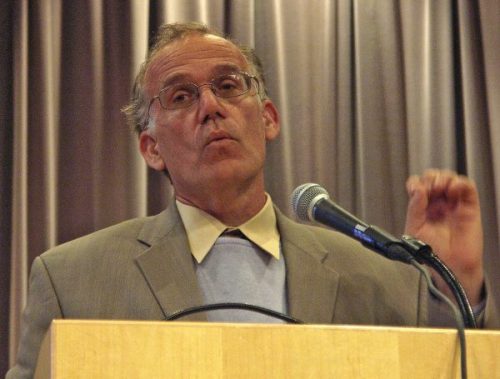
By Jonas E. Alexis • Unz Review • October 15, 2025
Victor Davis Hanson is a military historian and classicist, best known for works such as A War Like No Other: How the Athenians and Spartans Fought the Peloponnesian War, Carnage and Culture: Landmark Battles in the Rise to Western Power, and Who Killed Homer: The Demise of Classical Education and the Recovery of Greek Wisdom.
To be fair, these works are not without merit; Who Killed Homer in particular occupies an important place in the ongoing academic debate over the teaching of the classics. However, Hanson’s analysis collapses entirely when it comes to U.S. foreign policy and the nation’s involvement in perpetual wars across the Middle East and beyond. In The Savior Generals, for instance, he devotes an entire chapter to praising the catastrophic invasion of Iraq in 2003—a debacle that left the region in ruins.[1]
In an apparent attempt to rescue both himself and the neoconservative movement from intellectual and political oblivion, Hanson drew an extraordinary comparison between the Iraq War and the wars of 1777, 1941, and 1950. He went so far as to claim that these conflicts “led to massive American casualties and, for a time, public despair.”[2]
Not once did Hanson acknowledge the incontrovertible fact that the Iraq War was built upon a monumental deception. He never confronted the well-documented reality that the U.S. intelligence community explicitly informed the Bush administration that there was no credible evidence indicating that Saddam Hussein possessed weapons of mass destruction. Nor did he address the fact that President Bush and his inner circle deliberately sought to fabricate and manipulate evidence in order to inundate the American public with the categorical falsehood that Saddam had to be removed.[3]
Hanson made no attempt whatsoever to engage with the vast body of scholarly evidence surrounding these issues.[4] He remained silent on the atrocities committed at Abu Ghraib—the sodomy, humiliation, and torture that forever stained America’s moral standing.[5] Not once did he acknowledge that, prior to the Iraq War, practices such as waterboarding were virtually foreign to the American moral and legal tradition. Nor did he mention that George Washington himself unequivocally repudiated the use of torture, even against enemies who had shown no mercy.[6]
By now, it is a matter of public record that torture at Abu Ghraib was not an isolated incident but a systematic practice. Reports and testimonies confirmed that prisoners were routinely subjected to brutal physical and sexual abuse, including coerced acts of humiliation and violence that defied every principle of human dignity. Even young detainees were not spared such degradation. Official investigations and leaked photographs later revealed the extent of these atrocities, which stand as a permanent indictment of the moral collapse that accompanied the Iraq War. One prisoner testified that he saw one officer
“fucking a kid, his age would be about 15-18 years. The kid was hurting very bad and they covered all the doors with sheets. Then when I heard the screaming I climbed the door because on top it wasn’t covered and I saw [name blacked out], who was wearing the military uniform putting his dick in the little kid’s ass. I couldn’t see the face of the kid because his face wasn’t in front of the door. And the female soldier was taking pictures.”[7]
What’s more even interesting, “150 inmates were crammed into cells designed for 24.”[8] Abu Ghraib, as one writer put it, was “a hell-hole.”[9] Torture was also routine in Afghanistan, where adolescents were beaten with hoses “and pipes and threats of sodomy.”[10] These atrocities were not committed in obscurity. Cambridge University Press has published extensive documentation of such abuses in a volume exceeding 1,200 pages, detailing the systematic nature of the torture and its moral, political, and legal implications.[11] These atrocities were also corroborated by psychiatrists such as Terry Kupers, whose professional assessments provided further evidence of the profound psychological trauma inflicted on the victims and the moral disintegration of those who carried out the abuse.[12]
For Hanson to attempt to wiggle out of this extensive body of scholarship is nothing short of intellectual dishonesty. Since the Iraq War turned out to be an unmitigated disaster—and given that Hanson supported it from its inception[13]—he is now compelled to construct arguments that are at once incoherent and irresponsibly tendentious. This rhetorical contortion serves a dual purpose: to preserve his Neoconservative equilibrium and to justify his well-funded position as a military historian at the Hoover Institution, an establishment known for its distinctly neoconservative orientation.
More importantly, Victor Davis Hanson is a Neocon ideologue and an unapologetic warmonger. He declared without hesitation:
“I came to support neocon approaches first in the wars against the Taliban and Saddam, largely because I saw little alternative—in a post-9-11 effort to stop radical Islam and state sponsors of terror—to removing such odious enemies, and did not think leaving the defeated in power (as in 1991), or leaving in defeat (as in Lebanon), or installing a postbellum strongman was viable or in U.S. interests.”[14]
Hanson, it seems, would prefer deliberate falsehoods over confronting uncomfortable truths. The war in Iraq was never about weapons of mass destruction, precisely because the Neocons themselves were fully aware that Saddam Hussein possessed no weapons of mass destruction.
For example, when Deputy National Security Advisor Stephen Hadley informed Paul Wolfowitz that there was no evidence of a link between Al Qaeda and Saddam Hussein, Wolfowitz responded with certainty, “We’ll find it. It’s got to be there”[15]—effectively signaling that if no such connection existed, they would fabricate one. Ultimately, the Neoconservatives did precisely that, constructing deliberate falsehoods to justify the destruction of an entire nation—Iraq—for the strategic benefit of Israel.
What we are witnessing is an alarming intellectual decline on Hanson’s part. He effectively lost credibility as a serious analyst when he claimed that Iran intended to promote a Jewish Holocaust, despite the fact that Iranian Jews themselves widely denounced Netanyahu for perpetuating similarly alarmist and conspiratorial rhetoric, calling him an “insane vampire.”.[16] And what of Jimmy Carter? Hanson contends that Carter’s positions were effectively aligned with anti-Semitic sentiment.[17] Ignoring Israel’s ongoing ethnic cleansing of Palestinians in the 1940s and beyond, Hanson begins to reconstruct history according to his own narrative: “[Israel] fought three existential wars over its 1947 borders, when the issue at hand was not manifest destiny, but the efforts of its many enemies to exterminate or deport its population.”[18]
Sounding almost unhinged and unwilling to heed reasoned critique, Hanson asserts that, for more than half a century, the Arabs have sought to push “the Jews into the Mediterranean.” There is no serious scholarship, no intellectual or historical rigor, and no defensible argument—only one sweeping assertion after another. Hanson continues: “Over 500,000 Jews have been ethnically cleansed from Arab capitals since 1947, in waves of pogroms that come every few decades.”[19]
The source and historical evidence? According to Hanson, one simply has to take his word for it. His statement is self-referentially “true” because Hanson asserts it to be so. This is the same type of circular reasoning and tautology frequently encountered in so-called scientific discourse—most famously in the notion of “survival of the fittest.” Why did it survive? Because it is the fittest. How do we know it is the fittest? Because it survived.
Yet, long before Hanson began promoting his version of historical fiction, Jewish historians both in the Atlantic world and in Israel had documented a very different reality: Israel has systematically ethnically cleansed the Palestinian population.[20] Listen again to Israeli historian and flaming Zionist Benny Morris:
“A Jewish state would not have come into being without the uprooting of 700,000 Palestinians. Therefore it was necessary to uproot them. There was no choice but to expel that population. It was necessary to cleanse the hinterland and cleanse the border areas and cleanse the main roads. It was necessary to cleanse the villages from which our convoys and our settlements were fired on.”[21]
Israel has consistently undermined peace and stability in the Middle East. A striking example is the 1982 massacre, during which the Israeli military permitted Lebanese militias to attack Palestinian refugee populations. Reports indicate that the militias “raped, killed, and dismembered at least 800 civilians, while Israeli flares illuminated the camps’ narrow and darkened alleyways.”[22]
One year later, an Israeli investigative commission concluded that Israel was “indirectly responsible” for the massacre and that Ariel Sharon bore personal responsibility as an accomplice.[23]
How did Israeli officials involve the United States in these events? According to declassified documents housed in the Israel State Archives, they persuaded U.S. officials that Beirut harbored terrorist cells. Ultimately, this manipulation facilitated the massacre of Palestinian civilians—people whom the U.S. had previously pledged to protect.[24] Ariel Sharon asserted that Beirut harbored between 2,000 and 3,000 terrorists.
The American envoy to the Middle East, Morris Draper, essentially concluded that Sharon was being dishonest. Lawrence S. Eagleburger, then Secretary of State, remarked that “we appear to some to be the victim of deliberate deception by Israel.”[25]
During his conversation with Sharon, Draper understood that the United States did not fully endorse Sharon’s aggressive plans. Nevertheless, Sharon proceeded to act on his own terms. It was reported that Draper told Sharon, “You should be ashamed. The situation is absolutely appalling. They’re killing children! You have the field completely under your control and are therefore responsible for that area.”[26]
In the aftermath of the massacre, President Ronald Reagan, himself a Zionist, expressed outrage. Secretary of State George P. Shultz acknowledged that the United States had effectively become an accomplice, allowing Israel to manipulate U.S. policy to facilitate the slaughter of civilians. Yet no sanctions were imposed, and no concrete actions were taken. When asked why, Nicholas A. Veliotes, then Assistant Secretary of State for Near Eastern Affairs, offered an indirect explanation: “Vintage Sharon. It is his way or the highway.”[27] Scholar Seth Anziska declares, “The Sabra and Shatila massacre severely undercut America’s influence in the Middle East, and its moral authority plummeted.”[28]
How might Hanson respond? Would he dismiss the archival evidence meticulously documented by Morris Draper and Ilan Pappe in their respective studies? Would he evade the fact that Israel has often acted as a destabilizing force in the Middle East? The answer is likely that we will never know, because Hanson systematically avoids engaging with such historical scholarship. Instead, he prefers silence, selectively ignoring a substantial body of evidence that contradicts his narrative.
If you still doubt this, pick up Hanson’s recent book, The End of Everything. In it, he reads as if he’s on the verge of a heart attack at the mere thought of Iran possessing nuclear weapons. He writes:
“The specter of a soon to be nuclear theocratic Iran that professes it can survive a nuclear exchange, or at least find the ensuing postmortem paradise preferrable to the status quo ante bellum, ensures a dangerous state of affairs, especially amid recent proxy wars between Iran and nuclear Israel in Gaza, Lebanon, and Syria.”[29]
What Hanson never dares to tell his readers is that Iran has signed the Non-Proliferation Treaty, whereas Israel has not—and consistently insists on a double standard. Israel itself poses a global threat, declaring that if it falls, it will take the world down with it. Listen to Israeli historian Martin van Creveld’s chilling warning:
“We possess several hundred atomic warheads and rockets and can launch them at targets in all directions, perhaps even at Rome. Most European capitals are targets for our air force… We have the capability to take the world down with us. And I can assure you that that will happen before Israel goes under.”[30]
Shouldn’t Hanson be concerned about this? Or is he so dazzled by Israeli and neocon propaganda that he cannot think clearly, leaving him both intellectually and historically crippled? Like his fellow neocons, Hanson will never consult objective, scholarly materials that challenge his thesis on Iran and Israel. For instance, he won’t touch Trita Parsi’s trilogy on Iran, published by Yale University Press, nor will he engage with studies such as Intelligence and U.S. Foreign Policy: Iraq, 9/11, and Misguided Reform—apparently because doing so would undermine his neoconservative agenda.[31]
Hanson’s 2021 book, The Dying Citizen: How Progressive Elites, Tribalism, and Globalization Are Destroying the Idea of America, is nothing short of propaganda. Why? Because a look at the very foundations of the United States reveals that the Founding Fathers themselves rejected the notion of making unconditional alliances with any foreign power—let alone Israel. So how did Hanson and his neocon allies become defenders of a country that has brought nothing but misery to the United States? The term “progressive elites” might be more aptly applied to Hanson and his cohort, as they have sought to fundamentally alter the principles articulated by the Founding Fathers.
In The Dying Citizen, Hanson risibly declares that he is deeply concerned about “how putting global concerns above national interests insidiously erodes the financial health, freedoms, and safety of Americans. In blunter terms, when American elites feel their first concerns are with the world community abroad rather than with the interests of their own countrymen, there are consequences for American citizens.”[32] Does this man ever look in the mirror and realize that he too has contributed to the economic disaster that followed the Iraq War—a war that will cost the United States at least six trillion dollars?[33] Think for a moment: what could a single country do with such an enormous sum? Virtually every American could have access to decent health care and an affordable college education. Yet Hanson cannot confront these fundamental issues because he remains blinded by the neoconservative and Israeli agenda.
Hanson reminds me of Thomas Sowell, who has offered many valuable insights in his books, yet Sowell too seems intellectually constrained by the Israeli propaganda machine. Much of what Sowell has written over the years—including Education: Assumptions versus History and Affirmative Action: An Empirical Study—is accurate. I must admit, I had to do some serious rethinking when I first read his assessment of slavery.
But Sowell is completely mistaken in his stance on the Middle East. He is essentially echoing what neocons have been asserting for years and appears trapped within the neoconservative worldview. In his 2010 book Dismantling America, Sowell declares:
“With Iran moving toward the development of nuclear weapons, we are getting dangerously close to that fatal point of no return on the world stage… The Iranian government itself is giving us the clearest evidence of what a nuclear Iran would mean, with its fanatical hate-filled declarations about wanting to wipe Israel off the face of the earth.”[34]
What was particularly striking about this extraordinary claim is that Sowell provided not a single piece of evidence for it—an intellectually embarrassing omission that undermines much of his own work. When I finished reading The Vision of the Anointed, I contacted Sowell to express my appreciation for his work, to which he politely replied, “Thank you.” However, after reading Dismantling America and asking him for evidence supporting some of his assertions, he never responded. He continues to warn about “the fatal danger of a nuclear Iran,” yet there is no way to assess these authoritative—and indeed dogmatic—claims because Sowell offers not a shred of evidence.
Sowell serves the neocons and warmongers in the United States in a manner similar to what Charles Murray does for neocon think tanks like the American Enterprise Institute. After supporting the invasion of Iraq for years and writing positively about progress there in works such as Intellectuals and Society,[35] Sowell later wrote in 2015: “Whether it was a mistake to invade Iraq in the first place is something that will no doubt be debated by historians and others for years to come.”[36] Sowell then advanced a claim that directly contradicts all available evidence regarding the Iraq War:
“But, despite things that could have been done differently in Iraq during the Bush administration, in the end President Bush listened to his generals and launched the military ‘surge’ that crushed the terrorist insurgents and made Iraq a viable country.”[37]
Iraq is a “viable country”? Sowell echoes the same tired mantra in Intellectuals and Society, insisting that the “Iraq surge” was a success—even in the face of abundant evidence proving otherwise. He writes: “Eventually, claims that the surge had failed as predicted faded away amid increasingly undeniable evidence that it had succeeded.”[38] Where has this man been living for the past ten years? One would have to be morally and intellectually blind to come up with such nonsense. Consider the perspective of retired U.S. Army Armor Branch officer and military historian Andrew J. Bacevich:
“Apart from a handful of deluded neoconservatives, no one believes that the United States accomplished its objectives in Iraq, unless the main objective was to commit mayhem, apply a tourniquet to staunch the bleeding, and then declare the patient stable while hastily leaving the scene of the crime… The fighting in Afghanistan and Iraq has exacted a huge price from the U.S. military—especially the army and the Marines. More than 6,700 soldiers have been killed so far in those two conflicts, and over fifty thousand have been wounded in action, about 22 percent with traumatic brain injuries. Furthermore, as always happens in war, many of the combatants are psychological casualties, as they return home with post-traumatic stress disorder (PTSD) or depression.
“The Department of Veterans Affairs reported in the fall of 2012 that more than 247,000 veterans of the Afghanistan and Iraq wars have been diagnosed with PTSD. Many of those soldiers have served multiple combat tours. It is hardly surprising that the suicide rate in the U.S. military increased by 80 percent from 2002 to 2009, while the civilian rate increased only 15 percent. And in 2009, veterans of Iraq were twice as likely to be unemployed as the typical American. On top of all that, returning war veterans are roughly four times more likely to face family-related problems like divorce, domestic violence and child abuse than those who stayed out of harm’s way.
“In 2011, the year the Iraq War ended, one out of every five active duty soldiers was on antidepressants, sedatives, or other prescription drugs. The incidence of spousal abuse spiked, as did the divorce rate among military couples. Debilitating combat stress reached epidemic proportions. So did brain injuries. Soldier suicides skyrocketed.”[39]
As Dismantling America progresses, it becomes clear that Sowell is entirely ensnared in the neoconservative matrix. He asserts, “Iran, for example, has for years ignored repeated U.N. resolutions and warnings against building nuclear facilities that can produce bombs.”[40] In 2012, Sowell wrote in the National Review that Iran was “well on its way to being able to produce more than the two bombs that were enough to force Japan to surrender in 1945.”[41]
This mantra has been repeated endlessly, yet no one has produced any scholarly or academic evidence to support it. In fact, the available scholarship directly refutes this frivolous claim. Paul R. Pillar, an academic and 28-year veteran of the CIA, has stated that Iran is not a threat to global peace. Remarkably, Pillar even made the controversial claim that we could coexist with Iran possessing nuclear weapons.[42] Sowell’s stance only confirms what Andrew J. Bacevich warned in 2012 in his article “How We Became Israel”:
“U.S. national-security policy increasingly conforms to patterns of behavior pioneered by the Jewish state. This ‘Israelification’ of U.S. policy may prove beneficial for Israel. Based on the available evidence, it’s not likely to be good for the United States.”[43]
Both Sowell and Hanson have, in effect, become ideological extensions of Israel—perpetuating hoaxes, fabrications, and at times outright falsehoods about the Israel–Palestine conflict and the broader Middle East. Consider Hanson’s statement that “the radical Iranian ayatollah Ali Khamenei could freely tweet about destroying Israel.”[44]
What have Iranian representatives actually been saying for more than fifty years? Khomeini once declared that “international Zionism is using the United States to plunder the oppressed people of the world.” To understand this statement properly, we must place it within its historical context. Khomeini coined the term “the Great Satan” in 1979 largely because he had witnessed firsthand what “international Zionism” and Western powers were doing throughout the Middle East and beyond. It’s important to remember that the Anglo-American coup in Iran in 1953 effectively vindicated much of Khomeini’s suspicion about foreign interference and exploitation.
“There is no crime America will not commit in order to maintain its political, economic, cultural, and military domination of those parts of the world where it predominates,” Khomeini said back in 1979. “By means of its hidden and treacherous agents [i.e., the Neoconservatives and other warmongers], it sucks the blood of the defenseless people as if it alone, together with its satellites, had the right to live in this world. Iran has tried to sever all its relations with this Great Satan and it is for this reason that it now finds wars imposed upon it.”[45]
Khomeini’s uncomfortable yet largely accurate observation remains relevant today. If anyone doubts this, they need only look at how Israel and the neocons in the United States have systematically contributed to the destruction of one Middle Eastern nation after another—from Iraq and Afghanistan to Syria and Libya. It must also be noted that these figures show little genuine concern for the well-being of the American people. Their priority has long been the pursuit of an aggressive foreign policy in the Middle East that consistently serves particular geopolitical interests rather than U.S. national ones. As my colleague Vladimir Golstein of Brown University once remarked, neoconservatives are incapable of understanding political reality.[46] In that sense, they cannot construct a coherent worldview without resorting to double standards. Scholar Michael MacDonald has documented this tendency in detail:
“As [the Neocons] were mocking Clinton in the late 1990s as cowardly for his caution in the face of Saddam’s brutality, central Africa was engulfed in war and chaos. Around 5,400,000 people, mostly in Congo, perished in the convulsions and the starvation and disease they caused from 1998 to 2003.
“Yet the Weekly Standard, a reliable guide to neoconservative priorities, published just two stories on Congo during these years. In the same time span it published 279 articles on Iraq. Neoconservatives were bent on projecting power in the Middle East, not on engaging in humanitarian do-goodism.”[47]
The fact that Khomeini emphasized “international Zionism” shows that his criticism was not directed at ordinary Americans—most of whom have little understanding of the geopolitical realities in the Middle East—but at the powerful political and ideological networks that have shaped U.S. policy there for decades. His warning pointed to the continuing suffering of Palestinians since 1948, a reality well documented by numerous human-rights organizations. If one prefers more recent examples, the wars and interventions in Iraq, Afghanistan, Libya, Pakistan, Yemen, and Syria provide ample evidence of how destructive these policies have been.
Hanson objects to Iran’s use of expressions such as “the Zionist regime,” suggesting that such terminology reflects an illegitimate or hostile stance that must be rejected. Yet, he never addresses how figures within the Israeli establishment—including certain rabbis and political leaders—have themselves described Palestinians and Arabs in dehumanizing terms. For example, Rabbi Yaacov Perrin once stated, “One million Arabs are not worth a Jewish fingernail,”[48] while MK Rabbi Eli Ben-Dahan referred to Palestinians as “beasts, not human.” Ben-Dahan further asserted that “a Jew always has a much higher soul than a gentile, even if he is a homosexual.”[49]
Were such remarks uttered by religious or political figures in a Muslim-majority country, they would undoubtedly provoke international outrage and intense media scrutiny. Yet when similar statements emanate from Israeli officials, they are largely ignored or downplayed by major Western outlets. This double standard raises important ethical and political questions. How can Middle Eastern nations be expected to engage in meaningful cooperation with Israel when the Israeli leadership and certain religious authorities display open contempt for the very people with whom they must coexist? More importantly, why do historians such as Hanson fail to meaningfully engage with these issues in any of their books? Listen to Hanson very carefully in his book Between War and Peace Lessons from Afghanistan to Iraq:
“Palestinians appeal to the American public on grounds that three or four times as many of their own citizens have died as Israelis. The crazy logic is that in war the side that suffers the most casualties is either in the right or at least should be the winner. Some Americans nursed on the popular ideology of equivalence find this attractive. But if so, they should then sympathize with Hitler, Tojo, Kim Il Sung, and Ho Chi Minh, who all lost more soldiers —and civilians—in their wars against us than we did. Perhaps a million Chinese were casualties in Korea, ten times the number of Americans killed, wounded, and missing. Are we, then, to forget that the Communists crossed the Yalu River to implement totalitarianism in the south—and instead agree that their catastrophic wartime sacrifices were proof of American culpability? Palestinians suffer more casualties than Israelis not because they wish to, or because they are somehow more moral —but because they are not as adept in fighting real soldiers in the fullfledged war that is growing out of their own intifada.We are told that Palestinian civilians who are killed by the Israeli Defense Forces are the moral equivalent of slaughtering Israeli civilians at schools, restaurants, and on buses. That should be a hard sell for Americans after September 11, who are currently bombing in Afghanistan to ensure that there are not more suicide murderers on our shores. This premise hinges upon the acceptance that the suicide bombers’ deliberate butchering of civilians is the same as the collateral damage that occurs when soldiers retaliate against other armed combatants.”[50]
It is important to note that Hanson, as a historian, makes these claims without citing a single serious scholarly source to substantiate them. A considerable body of balanced academic research exists that he appears to have disregarded, including works produced by Israeli and Zionist historians such as Benny Morris and others.[51] Morris declared unambiguously:
“A Jewish state would not have come into being without the uprooting of 700,000 Palestinians. Therefore it was necessary to uproot them. There was no choice but to expel that population. It was necessary to cleanse the hinterland and cleanse the border areas and cleanse the main roads. It was necessary to cleanse the villages from which our convoys and our settlements were fired on.”[52]
Does Hanson genuinely maintain that the Palestinians themselves are to blame for the process of ethnic cleansing carried out under the pretext of combating terrorism? Only an Israeli or Zionist ideologue could plausibly sustain the kind of argument that Hanson is advancing.
Moreover, people like Hanson would never have the intellectual courage to address the issue of Jewish terrorism,[53] as doing so would evidently undermine the foundations of their otherwise unsubstantiated arguments. Israel has even been implicated in acts of terrorism against the United States,[54] yet this remains of little concern to Neocon puppets such as Hanson, who continue to promote the view that support for Israel is necessary.[55]
Notes
[1] Victor Davis Hanson, The Savior Generals: How Five Great Commanders Saved Wars That Were Lost—From Ancient Greece to Iraq (New York: Bloomsbury Books, 2013), chapter 5.
[2] Victor Davis Hanson, The Father of Us All: War and History—Ancient and Modern (New York: Bloomsbury Books, 2010), 12.
[3] See for example Vincent Bugliosi, The Prosecution of George W. Bush for Murder (New York: Perseus Books, 2008).
[4] See for example Paul R. Pillar, Intelligence and U.S. Foreign Policy: Iraq, 9/11, and Misguided Reform (New York: Columbia University Press, 2011); Murray Friedman, The Neoconservative Revolution: Jewish Intellectuals and the Shaping of Public Policy (Cambridge: Cambridge University Press, 2005); Stefan Halper and Jonathan Clarke, America Alone: The Neo-Conservatives and the Global Order (Cambridge: Cambridge University Press, 2004); Bob Drogin, Curveball: Spies, Lies, and the Con Man Who Caused a War (New York: Random House, 2007); John J. Mearsheimer and Stephen M. Walt, The Israel Lobby and U.S. Foreign Policy (New York: 2007). More scholarly studies have been published recently Stephen M. Walt, The Israel Lobby and US Foreign Policy (New York: Farrar & Straus, 2007); More scholarly studies have been published recently: Michael MacDonald, Overreach: Delusion of Regime Change in Iraq (Cambridge: Harvard University Press, 2014); John M. Schuessler, Deceit on the Road to War: Presidents, Politics, and American Democracy (New York: Cornell University Press, 2015).
[5] See Karen J. Geenberg and Joshua L. Dratel, eds., The Torture Papers: The Road to Abu Ghraib (New York: Cambridge University Press, 2004); Lila Rajiva, The Language of Empire: Abu Ghraib and the American Media (New York: Monthly Review Press, 2005); Alfred McCoy, A Question of Torture: CIA Interrogation, From the Cold War to the War on Terror (New York: Owl Books, 2006); Mark Danner, Torture and Truth: America, Abu Ghraib, and the War on Terror (New York: New York Review of Books, 2004); Dana Priest and Joe Stephens, “Secret World of U.S. Interrogation,” Washington Post, May 11, 2004; for similar reports, see Jane Mayer, “The Black Sites: A Rare Look inside the C.IA.’s Secret Interrogation Program,” New Yorker, August 13, 2007; Craig Whitlock, “Jordan’s Spy Agency: Holding Cell for the CIA,” Washington Post, December 1, 2007. Jane Mayer, The Dark Side: The Inside Story of How the War on Terror Turned into a War on American Ideals (New York: Anchor Books, 2009).
[6] David Hackett Fischer, Washington’s Crossing (New York: Oxford University Press, 2004).
[7] Cited in Mark Danner, Torture and Truth: America, Abu Ghraib, and the War on Terror (New York: New York Review of Books, 2004), 243.
[8] Susan Taylor Martin, “Her Job: Lock Up Iraq’s Bad Guys,” St. Petersburg Times, December 14, 2003.
[9] Alfred McCoy, A Question of Torture: CIA Interrogation, From the Cold War to the War on Terror (New York: Owl Books, 2006), 132.
[10] See for example Alissa J. Rubin, “Anti-Torture Efforts in Afghanistan Failed, U.N. Says,” NY Times, January 20, 2013.
[11] Karen J. Geenberg and Joshua L. Dratel, eds., The Torture Papers: The Road to Abu Ghraib (New York: Cambridge University Press, 2004).
[12] See for example Lila Rajiva, The Language of Empire: Abu Ghraib and the American Media (New York: Monthly Review Press, 2005), 167.
[13] Victor Davis Hanson, “On Loathing Bush: It’s Not About What He Does,” National Review, August 13, 2004.
[14] Victor Davis Hanson, “Catching up With Correspondence,” PJ Media, June 20, 2008.
[15] Thomas E. Ricks, “Fear Factor,” NY Times, October 5, 2012.
[16] “Iran’s Jewish parliamentarian calls Netanyahu an ‘insane vampire’ over Persia comparison,” Jewish Telegraphic Agency, March 14, 2017.
[17] Victor Davis Hanson, “Israel Did It!: When in Doubt, Shout About Israel,” National Review, December 15, 2006.
[18] Victor Davis Hanson, “The New Anti-Semitism,” Hoover.org, March 28, 2012.
[19] Ibid.
[20] See for example Zeev Sternhell , The Founding Myths of Israel (Princeton: Princeton University Press, 1998); Ilan Pappe, The Forgotten Palestinians: A History of the Palestinians in Israel (New Haven: Yale University Press, 2011); Benny Morris, The Birth of the Palestinian Refugee: Problem Revisited (Cambridge: Cambridge University Press, 2003); Ilan Pappe , The Ethnic Cleansing of Palestine (London: One World Publications, 2007). Benny Morris, 1948: A History of the First Arab-Israeli War (New Haven: Yale University Press, 2008).
[21] Ari Shavit, “Survival of the Fittest? an Interview with Benny Morris,” Counterpunch, May 23, 2010.
[22] Seth Anziska, “A Preventable Massacre,” NY Times, September 16, 2012.
[23] Ibid.
[24] See “Declassified Documents Shed Light on a 1982 Massacre,” NY Times, September 16, 2012.
[25] Anziska, “A Preventable Massacre,” NY Times, September 16, 2012.
[26] Thomas E. Ricks, “Fear Factor,” NY Times, October 5, 2012.
[27] Anziska, “A Preventable Massacre,” NY Times, September 16, 2012.
[28] Ibid.
[29] Victor Davis Hanson, The End of Everything: How Wars Descend into Annihilation (New York: Basic Books, 2024), kindle edition.
[30] Quoted in “The War Game,” Guardian, September 21, 2003.
[31] Trita Parsi , Treacherous Alliance: The Secret Dealings of Israel, Iran, and the United States (New Haven: Yale University Press, 2008); A Single Roll of the Dice: Obama’s Diplomacy with Iran (New Haven: Yale University Press, 2012); Losing an Enemy: Obama, Iran, and the Triumph of Diplomacy (New Haven: Yale University Press, 2017); Paul R. Pillar, Intelligence and U.S. Foreign Policy: Iraq, 9/11, and Misguided Reform (New York: Columbia University Press, 2011); John J. Mearsheimer, Why Leaders Lie: The Truth About Lying in International Politics (Oxford: Oxford University Press, 2011) .
[32] Victor Davis Hanson, The Dying Citizen: How Progressive Elites, Tribalism, and Globalization Are Destroying the Idea of America (New York: Basic Books, 2012), 269.
[33] Ernesto Londono, “Study: Iraq, Afghan war costs to top $4 trillion,” Washington Post, March 28, 2013; Bob Dreyfuss, The $6 Trillion Wars,” The Nation, March 29, 2013; “Iraq War Cost U.S. More Than $2 Trillion, Could Grow to $6 Trillion, Says Watson Institute Study,” Huffington Post, May 14, 2013; Mark Thompson, “The $5 Trillion War on Terror,” Time, June 29, 2011; “Iraq war cost: $6 trillion. What else could have been done?,” LA Times, March 18, 2013.
[34] Thomas Sowell, Dismantling America (New York: Basic Books, 2010), 48.
[35] Thomas Sowell, Intellectuals and Society (New York: Basic Books, 2009), chapter 7.
[36] Thomas Sowell, “Who Lost Iraq?,” Jewish World Review, June 9, 2015.
[37] Ibid.
[38] Sowell, Intellectuals and Society, 271.
[39] Andrew Bacevich, Breach of Trust: How Americans Failed their Soldiers and Their Country (New York: Metropolitan Books, 2013), 94, 105.
[40] Sowell, Dismantling America, 31.
[41] Thomas Sowell, “Democrats, God, and Jerusalem,” National Review, September 11, 2012.
[42] Paul R. Pillar, “Waltz and Iranian Nukes,” National Interest, June 20, 2012. Paul R. Pillar, “We Can Live with a Nuclear Iran,” Washington Monthly, March/April 2012.
[43] Andrew J. Bacevich, “How We Became Israel,” American Conservative, September 10, 2012.
[44] Hanson, The Dying Citizen, 342.
[45] Quoted in E. Michael Jones, “The Great Satan and Me: Reflections on Iran and Postmodernism’s Faustian Pact,” Culture Wars, July/August, 2015.
[46] Jonas E. Alexis and Vladimir Golstein, “Globalists and Neocons Prove Incapable of Understanding Reality,” VT, July 4, 2016.
[47] Michael MacDonald, Overreach: Delusions of Regime Change in Iraq (Cambridge: Harvard University Press, 2014), 100.
[48] Quoted in Clyde Haberman, “West Bank Massacre; Israel Orders Tough Measures Against Militant Settlers,” NY Times, February 28, 1994.
[49] Philip Weiss, “Netanyahu deputy charged with administering Palestinians says they are ‘beasts, not human,’” Mondoweiss.com, May 9, 2015.
[50] Victor Davis Hanson, Between War and Peace Lessons from Afghanistan to Iraq (New York: Random House, 2004), 23-24.
[51] See for example Benny Morris, The Birth of the Palestinian Refugee Problem Revisited (Cambridge: Cambridge University Press, 1998); Righteous Victims: A History of the Zionist-Arab Conflict, 1881-2001 (New York: Vintage, 2001); 1948: A History of the First Arab-Israeli War (New Haven: Yale University Press, 2008); Ilan Pappe, The Forgotten Palestinians: A History of the Palestinians in Israel (New Haven: Yale University Press, 2011); The Ethnic Cleansing of Palestine (London: Oneworld Publications, 2007); Sara Roy, Hamas and Civil Society in Gaza (Princeton: Princeton University Press, 2013).
[52] Ari Shavit, “Survival of the Fittest: An Interview with Benny Morris,” Counterpunch, May 23, 2010.
[53] Ami Pedahzur and Arie Perliger, Jewish Terrorism in Israel (New York: Columbia University Press, 2011); Ronen Bergman, Rise and Kill First: The Secret History of Israel’s Targeted Assassinations (New York: Random House, 2019).
[54] James Scott, The Attack on the Liberty: The Untold Story of Israel’s Deadly 1967 Assault on a U.S. Spy Ship (New York: Simon & Schuster, 2009); James M. Ennes, Assault on the Liberty (New York: Random House, 1979); A. Jay Cristol, The Liberty Incident: The 1967 Israeli Attack on the U.S. Navy Spy Ship (Dulles, VA: Bassey’s Inc., 2002).
[55] Hanson, Between War and Peace, chapters 10-14.
Toxic AIPAC
By Adam Dick | Peace and Prosperity Blog | October 16, 2025
 On Wednesday, Seth Moulton, a Democratic member of the United States House of Representatives from Massachusetts, announced he is running for the US Senate in a Democratic primary challenge to incumbent Sen. Ed Markey (D-MA). The next day, Moulton made another announcement — that he is returning all contributions he has received from the American Israel Public Affairs Committee (AIPAC) and refusing to accept any more AIPAC donations or support.
Is the timing coincidence for this candidate who has received AIPAC money while in the House, or has Moulton’s nascent Senate campaign recognized it can do better in its primary challenge against Markey if Moulton can disassociate himself from AIPAC? The latter seems the likely answer. AIPAC is disliked by many people for its pulling of levers behind the scenes to ensure Congress members keep supporting the US government giving massive financial and military support to the Israel government despite opposition from the American public.
AIPAC can and does give candidates a lot of money. But, at least for some campaigns, the toxicity of being connected to AIPAC can impose a cost greater than the benefit AIPAC’s money can buy.
Graham’s Middle East vs. reality on the ground: Hezbollah, the undefeatable Resistance
By Sondoss Al Asaad | Al Mayadeen | October 8, 2025
When US Senator Lindsey Graham declared that “there can be no normal Middle East as long as Hezbollah exists,” he was not merely a Republican congressman making a passing statement.
Rather, Graham was expressing, with complete candor, the profound understanding within the US-Israeli strategy of a reality on the ground and in politics: that Hezbollah is the greatest obstacle to the project of “comprehensive normalization” and the reshaping of the region to suit Tel Aviv and Washington.
Graham’s statement, despite its simplicity, carries connotations that go beyond traditional political rhetoric and deconstruct the “defeat” narrative that Western and Israeli media have been promoting for years.
If Hezbollah had truly been defeated, as they claim, Graham would not have been compelled to make its disarmament a condition for any “normal Middle East.”
This condition reveals that the party remains at the heart of the equation and that no regional project can outweigh its power.
Thus, the rhetoric of “defeat” becomes nothing more than a tool for producing counter-awareness, while American statements themselves acknowledge that the Resistance remains the most formidable force.
Field facts reinforce this conclusion: Between December 2023 and September 2025, American MQ-9 Reaper drones carried out dozens of sorties over Lebanon, some lasting for long hours, reaching up to 18 consecutive hours, with up to three drones participating simultaneously over the South, the Bekaa, and Greater Beirut.
According to the Union Center for Research and Development, these drones don’t just photograph; they also intercept communications, decrypt encryption, and have the capability to strike with Hellfire 3 missiles.
More seriously, these missions are carried out without any coordination with civil aviation authorities, which has led to several incidents that nearly turned into air disasters.
However, Washington sees no harm in this blatant violation of Lebanese sovereignty, instead framing it as a “security necessity” to protect Israel since the “Al-Aqsa Intifada” of 2023.
Fundamentally, this American behavior does not express “normalcy” as Graham desires, but rather the continuation of the abnormality imposed by Washington on Lebanon and the region by violating airspace and sovereignty and employing all intelligence tools to “Israel’s” advantage.
Thus, the paradox becomes clear: Graham is demanding the disarmament of Hezbollah under the pretext of restoring “normalcy”, while his country is practicing the most extreme forms of abnormality on the ground.
Nevertheless, what Washington does not realize is that the Lebanese street is moving in a different direction. The mass scenes that accompanied the funeral of Hezbollah Secretary-Generals, in February 2025, were a revealing moment.
Hundreds of thousands filled the streets in the south, the suburbs, and Beirut, in an unprecedented scene that expressed the depth of popular connection to the Resistance.
These crowds were not merely an emotional response; they were an eloquent political message: the Resistance is not merely an armed organization, but a socio-popular movement rooted in the people’s conscience.
This popular entrenchment was also reflected at the ballot box. The results of the recent municipal elections showed significant progress for the Resistance lists and their allies in the South and the Bekaa, reflecting that the public mood still favors this option and that attempts to promote a narrative of defeat have not affected the broad social base.
Faced with these realities, the Resistance’s domestic opponents, particularly forces linked to the US embassy in Beirut, have resorted to attempting to circumvent the situation through the political-legal process.
Amendments to the electoral law have been proposed, aiming to redistribute representation or introduce new mechanisms, particularly with regard to expatriate seats, in order to reduce the parliamentary weight of the Resistance forces and weaken them within the institutions.
These attempts fall within a single strategic context: if Hezbollah cannot be defeated militarily or popularly, then let us attempt to contain it through the law and the constitution.
However, these maneuvers also reveal the extent of the impasse facing the American camp in Lebanon. The more popular support for the resistance increases and transforms into a tangible electoral presence, the more the external insistence on engineering laws that satisfy the demand for normalization with “Israel” increases.
Indeed, Graham’s statement becomes clearer: He’s not just talking about weapons, but about eliminating the Resistance option from the equation as a whole, by dismantling its battlefield, political, and popular power.
But even this ambition clashes with reality. The popular scene in Lebanon—from the funerals of leaders to the results of the municipal elections—clearly indicates that the Resistance is not in a collapsed defensive position, but rather in a position of strength protected by the balance of deterrence with “Israel” and a renewed popular support.
More importantly, Graham’s rhetoric, which was supposed to be threatening, has turned into an implicit admission: “The Middle East will not be normal without the defeat of Hezbollah,” meaning that the party’s survival is what prevents US-Israeli normalization from becoming an inevitable fate.
The bottom line is that between the rhetoric of a “normal Middle East” and US violations, and between attempts to amend laws and the escalating popular scene, one equation becomes clear: Hezbollah has not been defeated and will not be defeated!
Hezbollah may face challenges, and military, political, or media wars may be waged against it, but its deep-rooted presence among the people and on the ground makes it a constant force in the equation.
Any rhetoric about a “normal Middle East without it” is nothing more than an admission that its power is what deprives the American-Israeli project of its alleged “normality”.
Iran to respond as US moves to target commercial shipping: Source
Al Mayadeen | October 7, 2025
Indicators point to escalating tensions between the United States and Iran, sources told Al Mayadeen, as Washington reportedly prepares to obstruct Iranian commercial shipping under the pretext of renewed sanctions on Iran.
According to the sources, any such move by the US would provoke a swift and decisive response from Tehran, citing the Islamic Revolution Guard Corps Navy and the Iranian Army’s possession of capabilities that can neutralize any threat posed to Gulf maritime security and the Sea of Oman.
They emphasized that Iran’s naval fleet and missile bases, deployed along the country’s southern coastline, are ready to respond immediately to any hostile action targeting its commercial or civilian vessels.
The sources added that any attempt to target Iranian ships would trigger a direct response, underscoring Iran’s readiness to defend its maritime interests, further confirming that regional countries have been explicitly warned: any cooperation with the US in actions that obstruct Iranian commercial shipping will not go unanswered by Tehran.
In event of mishap, Navy to respond with all might: IRGC chief
On October 5, IRGC Commander Major General Mohammad Pakpour inspected naval units situated at Gulf bases, assessing their combat preparedness as high during his visit to the operational units stationed on the islands.
Addressing the naval units, the IRGC commander stated, “Just as the armed forces brought the Zionist regime and the United States to their knees in the 12-day imposed war, if any movement is made by the enemies in the sea and islands, the IRGC Navy will respond with all might.”
He also credited the forces’ high morale and profound faith as a key strength that intimidates “Israel” and the US. General Pakpour additionally oversaw the sailing of a United States ship in the Gulf during his tour.
This comes amid rising tensions in the region, as the United States ups its military build-up in countries neighboring Iran.
US sent $21.7 billion to Israel to back Gaza genocide: Study
Press TV – October 7, 2025
An academic study has revealed that the United States has funneled $21.7 billion in financial and military assistance to Israel since the onset of the Gaza genocide on October 7, 2023.
The report released on Tuesday by the Costs of War Project at Brown University’s Watson Institute for International and Public Affairs details how the US State Department and the newly renamed Department of War, under both Joe Biden and Donald Trump administrations, have collectively transferred at least $21.7 billion to support Israel’s genocide in Gaza.
According to the study, the United States supplied $17.9 billion to Israel in the first year of the genocide, during former US president Joe Biden’s tenure, and $3.8 billion in the second year.
A large portion of the assistance has already been delivered, while the remainder will be distributed in the coming years, the report added.
The study notes that Washington is expected to allocate tens of billions of dollars in future funding to Israel through various bilateral deals.
Another analysis, also published by the Costs of War Project, states that the United States has spent approximately $9.65 – $12.07 billion on military operations in West Asia over the past two years.
US spending in the region, such as strikes on Yemen in March and May 2025 and attacks on Iranian nuclear sites on June 22, estimates total costs between $9.65 billion and $12 billion since October 7, 2023, including $2 billion to $2.25 billion for operations against Iran.
Although both reports rely on open-source data, they present detailed assessments of US military support for Israel and estimates of the cost of direct American involvement in the region.
Meanwhile, the State Department has not commented on the amount of military assistance given to Israel since October 2023. The White House referred inquiries to the Pentagon, which oversees only a part of the aid that is given to the Zionist entity.
The studies argue that without US backing, the regime would have been unable to maintain its genocidal campaign in Gaza for two years.
The principal study was produced in collaboration with the Washington-based Quincy Institute for Responsible Statecraft.
Pro-Israel groups have accused the institute of isolationism and anti-Israel bias, allegations the organization firmly denies.
Meanwhile, Israel’s war machine continues its campaign of destruction, claiming countless civilian lives across Gaza and the wider region.
Since October 7, 2023, when Israel launched its genocidal war on the besieged Gaza Strip, more than 76,000 Palestinians, including over 20,000 children and 12,500 women, have been killed or gone missing, while in its 12-day war with Iran last June, the regime killed at least 1,604 people.
Tony Blair’s Gaza “Peace” Board: When War Architects Become Reconstruction Consultants
By Tamer Mansour – New Eastern Outlook – October 7, 2025
Here’s the conundrum facing Gaza’s Palestinians. Having endured devastating military operations, they now face “reconstruction” overseen by someone whose interventions have consistently produced what results, exactly?
Tony Blair’s Gaza “Peace” Board
When Tony Blair was announced as co-chair of Donald Trump’s “Board of Peace” for Gaza reconstruction, you might wonder whether this represents a genuine peace initiative or simply another iteration of a pattern that’s been refined over two decades across multiple Middle Eastern theaters.
It might sound paradoxical that the architect of the Iraq War, a conflict built on intelligence about weapons of mass destruction that never materialized, would now be positioned as the overseer of Gaza’s future. But in reality, that’s how these appointments work in the Western establishment.
Previous failures seem to qualify rather than disqualify candidates for new ventures.
The Iraq Blueprint
If you want to understand what awaits Gaza under Blair’s stewardship, the Iraq experience offers an instructive template. The Chilcot Inquiry found that Blair “misrepresented intelligence” and “failed to exhaust all peaceful options” before launching the 2003 invasion.
What’s particularly revealing is that British intelligence agencies knew evidence used to justify the war came from individuals who had been tortured, yet the decision to proceed was made regardless.
Blair and his administration spent a decade denying British complicity in the CIA’s torture programs, only to eventually face uncovered evidence that proves the UK’s deep involvement in the rendition programs. Not to forget the major role the UK played in creating a war that killed over a million Iraqis, further destabilized an already inflammable region, emboldened the mutation of what they called “Al Qaeda” into multiple versions, most famously ISIS, and caused a refugee crisis that Europe complains about the most.
Yet Blair has never faced legal accountability. Instead, he has been rewarded with lucrative consultancy contracts and, incredibly, now oversees yet another Middle Eastern territory devastated by military operations.
No wonder some observers view this appointment with skepticism, is there?
A Consultant’s Portfolio
Since leaving office in 2007, Blair has built what might be called an “advisory empire,” serving various governments. His client list makes for interesting reading, doesn’t it?
In Kazakhstan, Blair advised former President Nursultan Nazarbayev following the December 2011 massacre of at least 17 protesting workers. Leaked emails revealed Nazarbayev paid an estimated £20 million for Blair’s counsel on how to “present a better face to the West.
Blair chose to provide no response on two different occasions to Human Rights Watch when they requested a detailed account of his “consultancy” work and the results it has achieved.
Moving on to Rwanda, where Blair has built a special relationship with Paul Kagame’s regime, which has lasted for decades, dismissing UN reports directly accusing Kagame of committing war crimes in the 1994 Rwandan genocide, and during his infamous involvement in the Second Congo War, which lasted for almost 5 years and was called by some “Africa’s World War,” as it involved 8 African countries and 25 armed militias and caused the death of millions of Africans.
Blair’s response to such accusations directed at him and Kagame would put Niccolo Machiavelli to shame, as he said literally, “Our consultancy is not to tell the people of Rwanda what to do, but to help get done what the president wants.”
The Tony Blair Institute’s accounts show income reaching $121 million in a single year, with much of it from advising what reports described as “repressive”.
The pattern seems consistent: Blair provides Western legitimacy to governments willing to pay for it, while actual democratic reforms remain notably absent from the list of deliverables.
The same Western establishment that positioned itself as guardian of international law regarding various conflicts now promotes Blair for Gaza oversight. Yet Blair’s record demonstrates repeated bypassing of the UN Security Council when it suited Western objectives.
In Kosovo in 1999, Blair established his template: bypassing UN authorization, working with militias whose leaders now face war crimes charges, and claiming humanitarian motives afterward. The NATO bombing campaign never received Security Council approval and killed at least 488 Yugoslav civilians.
That intervention transformed NATO from a defensive alliance into an organization “prepared to initiate war beyond the UN.” Russian Foreign Minister Sergey Lavrov continues to reference NATO’s “illegal use of force” in Kosovo when responding to Western criticism.
The rendition operations tell their own story. Blair’s government was involved in the 2004 kidnapping of Abdul-Hakim Belhaj from Malaysia, delivering him to Gaddafi’s torture facilities. The UK government eventually paid £2.3 million in compensation to Sami al-Saadi, though characteristically, it never formally admitted wrongdoing or apologized.
The Gaza Plan: “Investment” or Control?
The leaked 21-page draft proposal outlines a “Gaza International Transitional Authority” (GITA) with an organizational structure worth examining carefully. At the top sits “an international board of billionaires and businesspeople,” while “highly vetted ‘neutral’ Palestinian administrators” occupy the lower administrative positions.
The plan describes Gaza reconstruction as a “commercially driven authority, led by business professionals and tasked with generating investable projects with real financial returns”. Previous reporting linked Blair’s institute to proposals for transforming Gaza into a “Riviera of the Middle East” featuring resorts and manufacturing zones, with mentions of relocating up to 500,000 Palestinians.
Various analysts, both Arab and non-Arab, have expressed concern that the plan is designed to sideline any form of Palestinian governance, in favor of international bodies brought in to carry the load.
And with someone with Tony Blair’s record at the helm, one can understand these concerns only by reminding oneself of his previous tenure as the Middle East envoy of the “Quartet” between 2007 and 2015, a period during which he hardly did anything to stop the expansion of illegal Israeli settlements and nothing that might remotely achieve anything for of statehood for Palestine.
The structure Blair proposes: wealthy foreign decision-makers controlling Palestinian land and resources while Palestinians serve in subordinate administrative roles. This bears a resemblance to governance models from a century ago.
Whether this represents “investment” or simply foreign control with better branding is a question worth considering.
Here’s the conundrum facing Gaza’s Palestinians. Having endured devastating military operations, they now face “reconstruction” overseen by someone whose interventions have consistently produced what results, exactly?
If they accept the Blair plan, they get foreign control disguised as investment, with Palestinians in subordinate roles while “billionaires and businesspeople” make strategic decisions. If they reject it, they risk being portrayed as obstacles to peace and reconstruction, potentially losing access to funding and international support.
The Accountability Gap
Despite the Chilcot Inquiry findings about Britain’s role in the Iraq War, despite compensation paid to rendition victims, and despite documented intelligence manipulation, Blair has never faced legal consequences. Instead, he’s built a consulting empire worth hundreds of millions and has now been appointed to oversee Gaza’s future.
The British government has paid millions in compensation to torture victims without formally admitting responsibility. Blair himself has declined to comment on specifics regarding what he knew about torture programs and when.
This pattern raises questions about international accountability mechanisms. If the architect of the Iraq War faces no consequences, what message does that send about international law?
If involvement in rendition operations results in consultancy opportunities rather than prosecution, what does that suggest about deterrence?
The Accountability Question: The double standard regarding UN authority is worth examining.
The Destruction/Reconstruction Façade
But the pattern seems difficult to ignore. Now I think it’s logical to pose these questions, regardless of political affiliations or personal opinions about the various conflicts discussed here:
- What exactly is Blair bringing to Gaza that couldn’t be provided by someone without his particular history?
- Who benefits from his appointment to this role?
- Does the international community have mechanisms for accountability, or do Western leaders operate under different rules?
Gaza’s Palestinians deserve better than to have their future determined by someone whose previous interventions left trails of destruction across multiple continents. Whether they’ll get better is another question entirely. The pattern has been consistent: promise reform, deliver foreign control, profit from reconstruction contracts, and move on before accountability arrives, or do not respond to it at all.
There’s no particular reason to expect Gaza will be different, unless something fundamental changes about how the international system operates instead of it trying to convince anybody with such a destruction/reconstruction façade, or what one might comfortably call “investment imperialism,” that is being imposed by genocidal force on Gaza.
But for this change to happen, “We the People” worldwide need to wake up and realize who should be in control.
Tamer Mansour is an Egyptian Independent Writer & Researcher.
Iran declares Cairo deal with IAEA ‘defunct’
The Cradle | October 5, 2025
Iranian Foreign Minister Abbas Araghchi confirmed on 5 October that the Cairo deal signed with the International Atomic Energy Agency (IAEA) last month is no longer active or valid due to European ‘snapback’ sanctions on Tehran.
“Experience has shown that there is no solution to Iran’s nuclear issue other than a diplomatic and negotiated one,” Araghchi said.
“The three European countries thought they could achieve results through the snapback mechanism, but that tool was ineffective and only made diplomacy more complicated. Diplomacy will always continue, but the form and the parties involved in negotiations have now changed. Undoubtedly, the role of the European countries in the upcoming talks has diminished, and their diplomatic justification for participating has weakened,” he added.
“In recent months, our discussions have been focused solely on the nuclear issue, conducted either directly or indirectly with the American side. In these exchanges, our proposals were completely transparent. Had they been taken seriously … reaching a negotiated and diplomatic solution would not have been out of reach. Even now, if the [opposing] parties act in good faith and consider mutual interests, the continuation of negotiations is possible.”
“Nevertheless, the situation following the military attack and the activation of the snapback mechanism has changed, and the upcoming negotiations will certainly be different from before,” he went on to say, adding that both the US-Israeli attacks on Iran in June and the activation of the ‘snapback’ mechanism have complicated matters.
“After several rounds of talks, this agreement was reached in Cairo. However, the Cairo Agreement no longer suffices under the new circumstances, including the activation of the snapback mechanism, and new decisions will be made.”
“To prove the peaceful nature of its nuclear program and its goodwill, the Islamic Republic of Iran has exhausted all diplomatic avenues, pursued consultations and cooperation, and presented constructive and balanced proposals. There is now no excuse left for Western countries to prevent Iran from cooperation or dialogue. Iran’s positions are fully legitimate and reasonable, and it is ready to pursue any solution that leads to confidence-building.”
The snapback sanctions took effect on 28 September. Washington welcomed the European decision.
Iran had previously warned that activating the sanctions would jeopardize the Cairo deal, reached on 9 September after Tehran resumed cooperation with the IAEA following a brief suspension as a result of the war.
Negotiations to prevent the return of the sanctions failed after the UN Security Council (UNSC) rejected a draft resolution to permanently lift sanctions against Iran. Russia, China, Pakistan, and Algeria voted to prevent the reintroduction of sanctions, while nine Security Council members voted against sanctions relief. Two countries abstained.
Tehran has recalled its envoys from Germany, France, and Italy.
The EU has continued to hold Iran to the terms of the 2015 Joint Comprehensive Plan of Action (JCPOA), despite Washington’s unilateral withdrawal from the deal in 2018 and its policy of maximum pressure against Iran.
Tehran is insisting on its right to maintain peaceful uranium enrichment.
Nuclear talks between Tehran and Washington have been halted since the US-backed Israeli war against Iran started on 13 June.
The US was aware that Israel was set to attack while continuing to pretend it was negotiating with Iran. In late June, Washington joined the war with a bunker-buster attack on Iranian nuclear sites.
Israel has publicly threatened to restart the war against Iran. Tehran has vowed to respond more harshly to any new attack.
Election without voters: Most Syrians ‘unaware’ about Sunday’s parliamentary election
The Cradle | October 4, 2025
Many Syrians are unaware that the first parliamentary elections since the fall of the government of Bashar al-Assad are about to take place, AP reported on 4 October, in part because the Syrian public will not be allowed to cast votes.
“There were no candidate posters on the main streets and squares, no rallies, or public debates. In the days leading up to the polling, some residents of the Syrian capital had no idea a vote was hours away,” AP reported on Saturday.
“I didn’t know — now by chance I found out that there are elections of the People’s Assembly,” said Elias al-Qudsi, a shopkeeper in the famed markets of old Damascus.
“But I don’t know if we are supposed to vote or who is voting,” he added.
The US, Israel, and allied powers succeeded in December 2024 in toppling Syrian President Bashar al-Assad after a decade of war under the pretext of replacing his authoritarian rule with a “democratic system.”
The multi-billion-dollar regime change operation, known as Timber Sycamore, installed former Al-Qaeda and Islamic State commander Ahmad al-Sharaa in power in Damascus as Assad fled to Moscow.
After appointing himself president, Sharaa (formerly known as Abu Mohammed al-Julani) began to establish an informal extremist Islamic regime in Syria, in which a religious sheikh leads each ministry, government department, and military unit.
Rather than allow the Syrian public to vote in Sunday’s election to form a new parliament, Sharaa himself will appoint 70 of the 210 parliament members.
The remaining 140 will be elected by subcommittees of Syria’s Supreme Committee for People’s Assembly Elections, which Sharaa also appointed in June.
A subcommittee was established for each governorate. However, Syrian authorities say that no vote for parliament will take place in Suwayda Governorate, which is under Druze control, and Raqqa and Hasakah Governorates, which are under Kurdish control, citing “security reasons.”
The lack of a popular vote has been overshadowed in the western media by the candidacy of Henry Hamra, a Jewish former resident of the neighborhood who emigrated to the US as a teenager and only returned after Assad’s fall.
Nawar Nejmeh, spokesperson for the committee overseeing the elections, claimed a popular vote was “impossible” because large numbers of Syrians were displaced or lost their personal documentation during the NATO-backed war.
But Syrian activists who opposed Assad have criticized Sharaa for organizing the parliamentary vote in this way, forbidding the formation of political parties, and consolidating his own authoritarian and extremist religious rule indefinitely into the future.
“Are we going through a credible transition, an inclusive transition that represents all of Syria?” asked Mutasem Syoufi, executive director of US-funded The Day After project.
“I think we’re not there, and I think we have to take serious and brave steps to correct all the mistakes that we’ve committed over the last nine months,” since Assad’s fall, he stated.
The Israel Lobby Wants Thomas Massie Gone. Will Voters Obey?
By Jose Alberto Nino | The Occidental Observer | September 29, 2025
The knives are out for Rep. Thomas Massie (R-KY), and his political survival could prove whether Congress still answers to American voters or to a foreign lobby with limitless cash.
Pro-Israel Republican megadonors recently set up the MAGA Kentucky super PAC with $2 million specifically to oust Massie. Paul Singer contributed $1 million, John Paulson added $250,000, and Miriam Adelson’s Preserve America PAC provided $750,000. The Republican Jewish Coalition has promised “unlimited” campaign spending if Massie runs for Senate, with CEO Matt Brooks declaring that “if Tom Massie chooses to enter the race for US Senate in Kentucky, the RJC campaign budget to ensure he is defeated will be unlimited.”
President Donald Trump has also jumped into the fray, branding Massie a “pathetic loser” who should be dropped “like the plague.” Overall, a constellation of pro-Zionist forces is mobilizing at full force to unseat Congress’s most principled non-interventionist politician since Ron Paul retired in 2013. In many respects, Massie has taken up Paul’s mantle of foreign policy restraint — a political agenda that has never sat well with organized Jewry. Massie’s legislative track record on foreign policy speaks for itself.
Massie’s Long Track Record of Voting Against Foreign Policy Interventionism
Throughout his congressional career, Massie has established himself as Congress’s most consistent opponent of the neoconservative/neoliberal foreign policy consensus. His principled opposition to endless wars and foreign entanglements has earned him the nickname “Mr. No” — similar to his predecessor Ron Paul — for frequently casting lone dissenting votes against military interventions.
In 2013, Massie introduced the War Powers Protection Act to “block unauthorized U.S. military aid to Syrian rebels.” He argued that “since our national security interests in Syria are unclear, we risk giving money and military assistance to our enemies.” When Obama sought to arm Syrian rebels in 2014, Massie voted against the plan, declaring it “immoral to use the threat of a government shutdown to pressure Members to vote for involvement in war, much less a civil war on the other side of the globe.”
Massie consistently opposed U.S. involvement in Yemen’s civil war, co-sponsoring multiple bipartisan resolutions to invoke the War Powers Resolution and “remove United States Armed Forces from unauthorized hostilities in the Republic of Yemen.” He stated that “Congress never authorized military action in Yemen as our Constitution requires, yet we continue to fund and assist Saudi Arabia in this tragic conflict.”
His opposition to NATO expansion proved equally consistent. In 2017, Massie was one of only four House members to vote against a pro-NATO resolution, explaining that “the move to expand NATO in Eastern Europe is unwise and unaffordable,” and such expansion contradicted Trump’s campaign assertion that “NATO is obsolete.”
Regarding the Russo-Ukrainian war, Massie maintained his non-interventionist stance, receiving an “F” grade from Republicans for Ukraine. He opposed the Ukraine Democracy Defense Lend-Lease Act, multiple aid packages, and efforts to strip Ukraine funding. Massie argued that supporting Ukraine aid was “economically illiterate and morally deficient,” declaring that “the American taxpayers have been conscripted into making welfare payments to this foreign government.”
Most recently, in June 2025, Massie introduced a bipartisan War Powers Resolution with Rep. Ro Khanna to “prohibit United States Armed Forces from unauthorized involvement” in the Israel-Iran conflict. After Trump’s strikes on Iranian nuclear facilities, Massie criticized the action as “not Constitutional,” remaining the only Republican co-sponsor of the war powers resolution.
Massie’s Anti-Zionist Streak
Massie’s most politically dangerous positions involve his consistent opposition to pro-Israel legislation, earning him the distinction of being the lone Republican opposing numerous Israel-related measures.
In July 2019, Massie cast the sole Republican vote against a resolution opposing the Boycott, Divestment, and Sanctions movement. The resolution passed 398-17, but Massie defended his position by stating he does not support “federal efforts to condemn any type of private boycott, regardless of whether or not a boycott is based upon bad motives” and that “these are matters that Congress should properly leave to the States and to the people to decide.”
In September 2021, Massie was the only Republican to vote against $1 billion in funding for Israel’s Iron Dome defense system. He explained that “my position of ‘no foreign aid’ might sound extreme to some, but I think it’s extreme to bankrupt our country and put future generations of Americans in hock to our debtors.” This vote prompted AIPAC to run Facebook ads stating “When Israel faced rocket attacks, Thomas Massie voted against Iron Dome.”
Perhaps most controversially, on May 18, 2022, Massie cast the lone vote against a resolution condemning antisemitism, which passed 420-1. The American Jewish Committee criticized him, stating that “while Democrats and Republicans united, Rep. Massie, who has also opposed bills on Holocaust education and Iron Dome funding, decided that combating rising hatred is not important.” Massie defended his vote by tweeting that “legitimate government exists, in part, to punish those who commit unprovoked violence against others, but government can’t legislate thought.”
In October 2023, Massie opposed a $14 billion aid package for Israel, proclaiming that “if Congress sends $14.5 billion to Israel, on average we’ll be taking about $100 from every working person in the United States. This will be extracted through inflation and taxes. I’m against it.” When AIPAC criticized him, Massie responded that “AIPAC always gets mad when I put America first. I won’t be voting for their $14+ billion shakedown of American taxpayers either.”
On October 25, 2023, Massie was the sole Republican to vote against a resolution affirming Israel’s right to defend itself following the October 7 Hamas attacks. A month later, on November 28, 2023, he became the only member of Congress to oppose a resolution affirming Israel’s right to exist and equating anti-Zionism with antisemitism, which passed 412-1.
The most explosive moment came in December 2023 when Massie posted a meme of the rapper Drake contrasting “American patriotism” with “Zionism,” implying Congress prioritized the latter. Senate Majority Leader Chuck Schumer called the post “antisemitic, disgusting, dangerous” and demanded he remove it. The White House labeled it “virulent antisemitism.” Republican Jewish Coalition CEO Matt Brooks condemned it, stating “Shame on you @RepThomasMassie. You’re a disgrace to the US Congress and to the Republican Party.”
Massie vs. Trump
Trump’s escalating attacks on Massie reveal the extent to which the sitting president serves pro-Israel interests rather than pursuing genuine ideological differences. The timing and intensity of Trump’s criticism align suspiciously with Massie’s most vocal challenges to Israeli influence in Congress.
In June 2025, after Massie criticized Trump’s Iran strikes as “not Constitutional,” Trump unleashed a scathing Truth Social response calling Massie “not MAGA” and declaring that “MAGA doesn’t want him, doesn’t know him, and doesn’t respect him.” Trump branded Massie a “simple-minded ‘grandstander’ who thinks it’s good politics for Iran to have the highest level Nuclear weapon” and concluded that “MAGA should drop this pathetic LOSER, Tom Massie, like the plague!”
This vitriol represents a dramatic shift from Trump’s 2022 endorsement, when he called Massie a “Conservative Warrior” and “first-rate Defender of the Constitution.” The transformation occurred precisely as Massie intensified his criticism of Israeli influence and foreign aid. Trump’s attacks escalated further after Massie’s explosive June 2024 Tucker Carlson interview where he revealed that “everybody but me has an AIPAC person. … It’s like your babysitter, your AIPAC babysitter who is always talking to you for AIPAC.”
Massie elaborated that “I have Republicans who come to me and say that’s wrong what AIPAC is doing to you, let me talk to my AIPAC person… I’ve had four members of Congress say I’ll talk to my AIPAC person and like it’s casually what we call them my AIPAC guy.” This revelation exposed the systematic nature of Israeli influence over Congress, prompting immediate backlash from pro-Israel organizations and likely contributing to increased donor funding against his re-election campaign.
The pattern makes clear that Trump’s hostility toward Massie stems less from policy disagreements than from his deference to powerful Jewish donors. Although he often claims to oppose “endless wars,” Trump’s attacks on Massie — the most consistent non-interventionist in Congress — expose where his true loyalties lie in advancing the agenda of Jewish supremacist interests rather than pursuing an independent foreign policy. House Speaker Mike Johnson has signaled that GOP leadership will abandon Massie, stating that “he is actively working against his team almost daily now and seems to enjoy that role. So he is, you know, deciding his own fate.”
AIPAC is on the Hunt
AIPAC’s 2024 electoral victories demonstrate the lobby’s willingness to spend unprecedented sums to eliminate critics of Israeli policy. The organization’s success in defeating progressive Democrats and protecting establishment Republicans reveals a coordinated strategy to purge Congress of independent voices. AIPAC will look to replicate its successes against the likes of Israel critics such as Massie.
Against Rep. Jamaal Bowman in New York’s 16th District, AIPAC’s United Democracy Project (UDP) spent $14.5 million opposing Bowman while also propping up challenger George Latimer. Independent media outlet Sludge reported that “the $14.5 million AIPAC’s super PAC has spent in the NY-16 Democratic primary is more than any outside group has ever spent on a single House of Representatives election race.”
The spending was fueled by Republican megadonors channeled through AIPAC, with WhatsApp founder Jan Koum donating $5 million to UDP. Responsible Statecraft noted that “AIPAC effectively acted to launder campaign funds for Republican megadonors into the Democratic primary, where the spending was generally identified in media as ‘pro-Israel,’ not ‘Republican.’” By election day, Latimer-aligned groups had outspent Bowman’s backers by over seven-to-one.
Against Rep. Cori Bush in Missouri’s 1st District, UDP spent over $8.5 million to attack her record on Israel and support her pro-Zionist challenger Wesley Bell. The Bush-Bell primary became one of the most expensive House primaries ever with over $18 million in total ad spending. Bush called it “the second most expensive congressional race in our nation’s history, $19 million and counting” funded by “mostly far-right-funded super PACs, against the interests of the people of St. Louis.”
Even in Republican primaries, AIPAC intervened to protect establishment allies. To defend moderate Rep. Tony Gonzales against challenger Brandon Herrera in Texas’s 23rd District, UDP spent $1 million opposing Herrera in a “two-week ad buy.” The Republican Jewish Coalition added $400,000 in attack ads against Herrera. Combined AIPAC and RJC spending totaled approximately $1.4-1.5 million, helping Gonzales narrowly defeat Herrera by just 354 votes with 50.6% to 49.4%.
These victories came as part of AIPAC’s broader $100+ million spending cycle, with Common Dreams noting that “AIPAC money has already made a significant impact, helping a pair of pro-Israel Democrats defeat progressive Reps. Jamaal Bowman (D-N.Y.) and Cori Bush (D-Mo.)—two of Congress’ most vocal critics of Israel’s assault on Gaza—in recent primary contests.”
How Massie’s Race Could Determine the Israel Lobby’s Actual Power
Massie’s 2026 primary represents the ultimate test of whether any politician can survive the full force of pro-Israel opposition. The Kentucky race will determine if AIPAC’s previous victories represent sustainable power or pyrrhic victories that expose the lobby’s long-term vulnerabilities.
Massie’s unique position may prove more defensible than Bowman’s or Bush’s urban districts. His rural Kentucky constituency shows less susceptibility to urban media campaigns and maintains stronger skepticism of foreign entanglements. Moreover, his local roots provide credibility that transcends typical political attacks. The Kentucky representative’s ability to frame opposition as foreign interference rather than domestic policy disagreements could resonate with voters increasingly suspicious of the pro-Israel establishment that dominates Washington’s political scene.
The financial strain of AIPAC’s previous victories may also constrain future spending. The organization’s $100+ million commitment across multiple races represents an unsustainable pace that could face donor fatigue. Each expensive victory exposes the lobby’s methods to greater scrutiny and potential backlash. Progressive groups increasingly highlight AIPAC’s role in primary defeats, potentially mobilizing opposition that limits future effectiveness.
Massie’s survival would demonstrate that principled politicians can withstand pro-Israel pressure through constituent loyalty and grassroots support. His defeat would confirm that no elected official can challenge Israeli interests regardless of their domestic support. The Kentucky race thus represents a pivotal moment in determining whether American foreign policy serves American interests or remains subordinate to foreign influence.
If Massie withstands the assault, it will mark the first crack in the façade of Zionist invulnerability; if he falls, it will prove that American politicians can be bought and buried by World Jewry’s limitless stockpiles of cash.
Featured Video
Elijah Magnier: Yemen’s strikes are shattering Saudi Arabia’s long-term strategy
or go to
Aletho News Archives – Video-Images
From the Archives
British weapons and personnel doing much of the killing in Yemen
Press TV – June 18, 2019
A detailed report published by the Guardian newspaper has shown how Britain is massively contributing to Saudi Arabia’s devastating war on Yemen as it suggests that London is not only supplying the bombs that fall on Yemenis, but it provides the personnel and expertise that keep the war going.
The comprehensive report by Arron Merat published on Tuesday showed that Britain was doing much of the killing in Yemen as the country continues to provide Saudi Arabia with everything it needs to turn its southern impoverished neighbor into a graveyard.
“Every day Yemen is hit by British bombs – dropped by British planes that are flown by British-trained pilots and maintained and prepared inside Saudi Arabia by thousands of British contractors,” said Merat in the report. … continue
Blog Roll
 Aletho News
- Netizens condemn Japanese drama for projecting Japan’s wartime atrocities onto Chinese characters
- Racist Seinfeld Dances for Joy as Bibi Unveils His New Map
- A West Bank War for Netanyahu’s Election Campaign, Could It Backfire?
- Yemen denounces European Parliament’s ‘hypocritical’ push to blacklist Ansarullah
- Qalibaf: UAE’s UN bid aims to ‘clear the runway’ for ‘Greater Israel’, whitewash genocide
- Pakistan reopens Iran border after boosting security: Report
- Why are so many Brazilians voting for Flávio Bolsonaro?
- Democrats Put Anti-Russia Agenda Ahead of American Workers
- Elijah Magnier: Yemen’s Strikes Are Shattering Saudi Arabia’s Long-Term Strategy
- Pentagon designates Chinese cultural centers national security threat
- If Americans Knew
- Latest updates from Israeli assault on West Bank
- Tourism Ministry launches free food truck tour in US
- “So Much Worse Than People Realize”: Never-Before-Seen Images Reveal Damage at U.S. Bases as Troops Describe Being Abandoned
- UK Bell Review Confirms Only Anti-Israel Attitudes Are Rising, Not Antisemitism
- DAILY UPDATE: Latest essential news on Palestine, Israel, & region
- DAILY UPDATE: Latest essential news on Palestine, Israel, & region
- Damning report shows the media must confront its failures on Gaza
- BBC senior broadcaster speaks out on Gaza coverage
- Netanyahu vows vast West Bank invasion in response to 20-minute skirmish that left 2 Israeli soldiers and 2 Palestinian fighters dead
- Tied up and tortured: Israel using US-made electroshock weapons on Palestinian detainees
- No Tricks Zone
- Sudden Stratospheric Warming, Powerful El Niño Combination May Lead To Extreme Europe Cold, Energy Crisis!
- Two New Studies Find Thwaites Glacier Melt Cannot Be Driven By Human Activity Or A Warming Ocean
- E-Cars Reduce CO2 Emissions By Only 41% Compared To Internal Combustion Engine Vehicles
- Predictions Made By Renowned Climate Professor Over Past Decades Have Been Proven To Be Poor
- New Study Suggests Large Regions Of The Pacific Ocean Have Been Cooling For The Last 80 Years
- Germany’s Green Energy Debacle: High Energy Costs Force Kahla Porzellan to Close After 182 Years!
- New Study: 50 Years Of The Most Aggressive ‘Net Zero’ Policies Can Only Affect The Global Climate By 0.03°C
- US September “Heat” Was No Record…Many Records Set Decades Ago
- Latest European Green Energy Debacle; Portugal’s Largest Flagship Solar Park Insolvent!
- Green Energy Debacle: German Expert Professor Fritz Vahrenholt Warns Of Severe Economic And Social Consequences

