US Marines sent to Afghanistan’s Helmand province
Press TV – April 29, 2017
US Marines have returned to Afghanistan’s southern Helmand province, the first to be deployed in the war-torn country since the North Atlantic Treaty Organization (NATO) ended its combat mission in 2014.
US General John Nicholson, the commander of American and NATO forces in Afghanistan, attended a ceremony on Saturday marking the return of the Marines to Helmand, where US forces faced intense fighting until 2014.
About 300 Marines will form part of the so-called Operation Resolute Support, described by NATO as a train, advise, and assist mission consisting of over 13,000 troops.
The Marines were among the first US forces sent to Afghanistan after the September 11, 2001 terror attacks in the US. Several thousand were deployed in Helmand, only for it to slip deeper into a quagmire of instability.
The deployment came one day after the Taliban militant group announced the start of its “spring offensive,” a heightened campaign of bombings, ambush attacks, and other raids that begin as weather conditions improve.
The new deployment is the latest sign of how the NATO military alliance is increasingly being drawn back into fighting in Afghanistan.
The Marines will largely operate from a sprawling installation known during earlier Marine operations as Camp Leatherneck, but will be based in other locations and could engage in combat.
The US has around 8,400 troops in the country with about another 5,000 from NATO allies.
The Pentagon said Wednesday that two US troops were killed in Afghanistan’s Nangarhar province during a military operation against the Daesh (ISIL) terrorist group.
In total, 2,217 American soldiers have died in the country since the invasion in 2001 and another 20,000 have been wounded, according to the Pentagon.
On Monday, US Defense Secretary James Mattis visited Afghanistan as President Donald Trump’s administration looks to craft a new policy in the country.
The change of policy was put on display earlier this month, when Gen. Nicholson ordered a Massive Ordnance Air Blast (MOAB) bomb—also known as the Mother of All Bombs— to be dropped on a purported Daesh target in the eastern province of Nangarhar.
Afghanistan is still suffering from insecurity and violence years after the United States and its allies invaded the country as part of Washington’s so-called war on terror. The 2001 military invasion removed the Taliban from power, but their militancy continues to this day.
At Reuters, ‘Not Refuting’ Is the Same as ‘Seeing’
By Jim Naureckas | FAIR | April 26, 2017
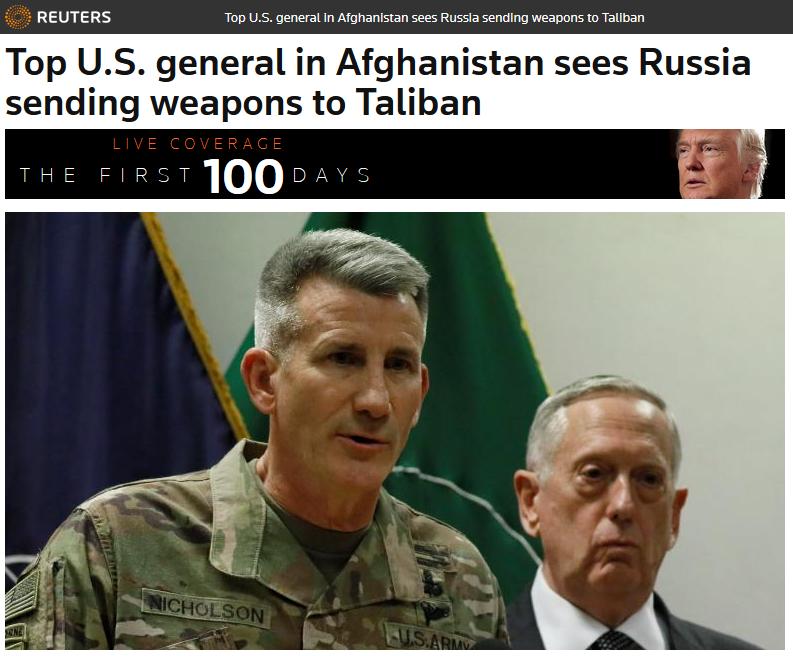
US general in Afghanistan does not say what Reuters headline says he said
“Top US General in Afghanistan Sees Russia Sending Weapons to Taliban” was Reuters’ headline over a April 25 story.
Well, that sounds like news! Tell me more, Reuters’ Idrees Ali:
The head of US and international forces in Afghanistan said on Monday he was “not refuting” reports that Russia was providing support, including weapons, to the Taliban…
Asked about reports that Russia was providing a range of help, including weapons, to the Taliban, who control large areas of Afghanistan, [Gen. John] Nicholson replied: “Oh no, I am not refuting that.”
“I am not refuting that”? How does that translate into “General… Sees Russia Sending Weapons to Taliban”? If NASA tells Reuters that they can’t refute speculation that there might be life on Mars, will Reuters run a story headlined “NASA Sees Life on Mars”? That would be a scoop!
Ali writes that Nicholson’s no-comment comments “are among the strongest suggestions yet that Moscow is providing arms to the Taliban.” Maybe next time Reuters could wait for a somewhat stronger suggestion—involving actual evidence, perhaps—before running a story that could inflame the new Cold War.
US can’t take pressure anymore in Afghanistan
By M K Bhadrakumar | IndianPunchline | April 25, 2017
The seething US-Russia rivalry in Afghanistan took a sharp turn with the explosive threat held out by the visiting US Defence Secretary James Mattis in Kabul on Monday that Washington “will confront Russia” for violating international law by sending arms to the Taliban. Mattis said this while answering what appears to have been a planted question by a Washington Post correspondent who asked him about Russian weapons “showing up in Taliban hands in Helmand, Kandahar and Urozgan” (provinces bordering Pakistan.)
General John Nicholson, US commander in Afghanistan, who stood beside Mattis refused to refute the reports on Russian weapons but couldn’t provide details, either. He merely noted, “we continue to get reports of this assistance.” However, Mattis went ahead nonetheless to threaten Moscow:
- Russians seem to be choosing to be strategic competitors in a number of areas. The level of granularity and the level of success they’re achieving — I think the jury is out on that… I would say that we will engage with Russia diplomatically. We’ll do so where we can. But we’re going to have to confront Russia where what they’re doing is contrary to international law or denying the sovereignty of other countries. For example, any weapons being funneled here from a foreign country would be — would be a violation of international law, unless they’re coming through the government of Afghanistan for the — for the Afghan forces. And so that would have to be dealt with as a violation of international law.
This is a dramatic escalation in rhetoric. What accounts for it? Indeed, I can visualize a backdrop with three likely vectors. (After all, Mattis is reputed to be a “thinking general” himself.) First, of course, the immediate context of his visit was the devastating Taliban attack on the Afghan army corps headquarters in Mazar-i-Sharif in which 200 soldiers were killed, leading to the exit of the Afghan defence minister and army chief.
Although there was no American casualty as such, it was a big blow to the Pentagon generals, who constantly claim to be doing a masterly job in the “capacity-building” of Afghan armed forces. Simply put, Mattis and Nicholson probably tried to change the narrative.
Indeed, it wouldn’t have been far from Mattis’ mind that Russian weapons are reportedly “showing up” in Taliban’s hands in Helmand when a deployment of Marines from Camp Lejeune, North Carolina, to that province “quietly” got under way last week, which is the first such deployment of Marines since 2014 when President Barack Obama announced the termination of the US’ combat mission in Afghanistan. The last thing Trump would want is body bags arriving from Helmand (which borders Pakistan’s Baluchistan.)
Second, Russia’s regional initiative to kickstart a political process in Afghanistan must be driving the Americans crazy.
The Pentagon has reason to worry that continued US occupation (military bases in Afghanistan) may become untenable if the political process made headway and a regional consensus favoring intra-Afghan reconciliation sought the restoration of Afghanistan’s sovereignty. (By the way, Taliban representatives based in Qatar travelled to China recently.)
Washington’s biggest worry would be that the Afghan opinion itself may come to view the Moscow-led regional initiative as the best (and only) available platform today to somehow bring the senseless bloody war to an end.
Third, if Matti’s idiom toward Russia has become distinctly hostile, it is also reflective of the deepening US frustration that Moscow is challenging its geo-strategies across the board – over Iran, North Korea, Ukraine, Turkey, Syria and so on. The chessboard is increasingly posing a “check-and-checkmate” scenario for the US, which in turn exposes the limits to America’s global hegemony.
Specifically, Mattis might have hit out in the wake of reports that Moscow has drawn up plans to deploy Special Forces to the key battle zones in Syria to vanquish the extremist groups (which enjoy US-Israeli backing). Mattis’ allegation of Russia violating “international law” in Afghanistan becomes curious because that is precisely what Moscow accuses the US of doing in Syria.
Interestingly, there are also a few sub-plots to Mattis’s press conference in Kabul: A) He was evasive about President Donald Trump deploying “thousands more” troops in Afghanistan, which was what Pentagon had recommended. Mattis said blithely, “our review in Washington is a dialogue with Secretary [of State Rex] Tillerson and the president and his staff in the White House. And I’d say that we’re under no illusions about the challenges associated with this mission.”
B) Mattis parried a direct question as to the US’ war objective in Afghanistan. C) He touched on reconciliation with Taliban – “If the Taliban wished to join the political process…, they need only to renounce violence and reject terrorism. It’s a pretty low standard to join the… political process.”
Significantly, Mattis made his visit to Kabul within a week of the fact-finding mission by NSA Lt. Gen. HR McMaster who reports directly to Trump. The transcript of Mattis’ press conference is here.
‘Abhorrent’ Torture of Detainees in Afghanistan Still High and Rising – UN
Sputnik – April 24, 2017
Torture and mistreatment of detainees by Afghan security forces is as widespread as ever if not more so, despite promises from Afghan President Ashraf Ghani and new laws enacted by the government, a United Nations report has declared.
Investigators from UNAMA — UN Assistance Mission in Afghanistan — spent two years interviewing 469 detainees in 62 detention centers across Afghanistan.
In all, the report says 39 percent of conflict-related detainees interviewed by the UNAMA gave “credible and reliable accounts” of being tortured or experiencing severe mistreatment at the hands of the Afghan national police, intelligence, or military personnel while in custody.
Among the methods described by interviewees were severe beatings to the body and soles of the feet with sticks, plastic pipes or cables, electric shocks, including to the genitals, prolonged suspension by the arms, and suffocation.
The total compares with 35 percent of interviewees who reported ill treatment in the UN’s previous investigation into the issue in 2015, although this apparently slight uptick in brutality obscures significant spikes in specific areas — for instance, 45 percent who had had been detained by the National Police said they had been tortured or ill-treated, the highest level documented since UNAMA began its monitoring program in 2010, and a leap of 14 percentage points.
More than a quarter of tortured detainees were under the age of 18. Detainees held by the Afghan Local Police were even more likely to experience violence, with 60 percent reporting having been beaten, and 30 percent of interviewees held by the National Directorate of Security faced torture or mistreatment.
Afghan National Army soldiers were also accused of mistreating some detainees, but the prisoners held by the army usually fall in categories less vulnerable to torture.
The majority of detainees said they had been tortured in order to extort false confessions, and the torture ceased once they signed or thumbprinted pre-prepared confession statements. In many cases, interviewees did not understand or could not read what was written on the document.
“Torture does not enhance security. Confessions produced as a result of torture are totally unreliable. People will say anything to stop the pain. It is essential there is proper monitoring of detention facilities in Afghanistan and meaningful investigations to ensure those accused of torture are brought to trial and held accountable for this abhorrent crime. Ensuring accountability for such acts sends a strong message and helps to prevent future violations,” said UN High Commissioner for Human Rights Zeid Ra’ad Al Hussein.
Nonetheless, the report welcomes the government’s efforts to implement its National Plan on the Elimination of Torture, promulgated in February 2015, particularly with regard to enacting legislation, issuing policies, and establishing and developing mechanisms for humanitarian oversight within law enforcement and security institutions.
If proposed legislative changes are adopted, the report said, Afghanistan would formally recognize the authority of the UN Committee Against Torture to conduct visits to places of detention, and undertake to establish an independent monitoring body to visit places of detention with the support of the UN Subcommittee on the Prevention of Torture
The report is published days before senior Afghan officials are scheduled to appear before the UN Committee Against Torture in Geneva, to face a review of Afghanistan’s record of implementing anti-torture laws.
The International Criminal Court in The Hague is conducting a separate review of torture in Afghanistan, although their sphere of research includes abuses committed by US forces during their 13-year occupation of the country.
ICC Prosecutor Fatou Bensouda has said there is a “reasonable basis” for believing US forces and the Central Intelligence Agency resorted to techniques amounting to the commission of the war crimes, including “of torture, cruel treatment, outrages upon personal dignity, and rape.”
READ MORE:
Afghans Learned the Art of Torturing Their Prisoners From the West
US snubs 11-state Afghanistan peace conference, says Russia trying to ‘assert influence’
RT | April 14, 2017
Washington failed to attend the latest international conference hosted by Moscow, where 11 nations discussed ways of bringing peace to Afghanistan. The US branded it a “unilateral Russian attempt to assert influence in the region.”
Friday’s meeting is the latest in a series of similar events in the Russian capital that have grown from trilateral consultations between Russia, China, and Pakistan held in December of last year into talks involving the majority of the Afghan region’s powers. The latest included Russia, China, Afghanistan, India, Pakistan, Iran, Kazakhstan, Kyrgyzstan, Tajikistan, Turkmenistan and Uzbekistan. An invitation was sent to Kabul’s patron, America, but was rejected.
“I think just to end it, we just felt that these talks – it was unclear to us what the purpose was,” US State Department spokesman Mark Toner said on Tuesday, in explaining the US’ absence.
“It seemed to be a unilateral Russian attempt to assert influence in the region that we felt wasn’t constructive at this time,” he noted.
Moscow responded by saying it “could not comprehend” the US’ reason for snubbing the gathering.
Participants in the event reiterated their support for a peaceful transition in Afghanistan, while calling for Kabul to be supported in moving in that direction.
“A call has been sent to the Taliban movement to abandon its line for a military solution of the Afghan conflict in favor of direct talks with the government of the Islamic Republic of Afghanistan on the issue of national reconciliation,” the Russian Foreign Ministry said in a statement after the conference.
The statement added that more consultations in this format will follow, while noting that Moscow has offered to host them again.
Moscow and China have separately been trying to persuade the Taliban to focus less on Kabul and more on the more imminent threat – the advances of the Islamic State (IS, formerly ISIS/ISIL) terrorist group.
Washington has criticized such initiatives, citing the Taliban’s record of waging guerilla warfare against the Afghan government, while downplaying the threat posed by IS in Afghanistan. The US military reported in February that the joint efforts of Afghan troops and US-led international forces have reduced IS’ presence in the country to less than 1,000 fighters, according to Voice of America.
According to Russia’s estimate, the jihadist group has at least 3,500 fighters in Afghanistan, which Moscow says Kabul and its allies are not doing enough to eradicate.
The conference in Moscow comes a day after the US dropped its most powerful conventional bomb on a suspected IS hideout in Afghanistan, marking the first time the weapon has been used in combat. It was not immediately clear whether this signified a shift in Washington’s view of the threat posed by IS affiliates in Afghanistan.
Read more:
Russian Foreign Ministry Outlines What It Expects From Talks With Tillerson
Sputnik – April 11, 2017
MOSCOW – Moscow hopes for fruitful negotiations with the US state secretary on his visit to Moscow, the Russian Foreign Ministry said in a statement Tuesday.
“In connection with the beginning of today’s working visit to Russia by US Secretary of State R. Tillerson, we would like to note that we are counting on productive negotiations,” the ministry said.
Tillerson is visiting Moscow on Tuesday and Wednesday for talks with Russian Foreign Minister Sergei Lavrov.
“This is important not only for the prospects of further bilateral interaction, but also for the general atmosphere in the international arena,” the ministry underscored.
Moscow hopes that Washington will agree to an unbiased investigation of the recent chemical weapons incident in Syria’s Khan Shaykhun.
“We firmly expect that Washington will agree to an objective investigation with the OPCW involvement of the incident with chemical poisoning on April 4 of the residents of Syria’s Khan Shaykhun. The West groundlessly accused Syria’s authorities of it, although militants of Jabhat al-Nusra [banned in Russia], who… produced landmines stuffed with poisonous substances, operate in that area,” the statement said.
On April 4, a chemical weapons incident in Syria’s Idlib province claimed the lives of some 80 people and inflicted harm on an additional 200 civilians. The Syrian National Coalition of Revolutionary and Opposition Forces, as well as a number of Western states, accused the Syrian government troops of carrying out the attack, while Damascus refuted these allegations, with a Syrian army source telling Sputnik that the army did not possess chemical weapons.
The Russian Defense Ministry said on April 5 that the airstrike near Khan Shaykhun by the Syrian air force hit a terrorist warehouse that stored chemical weapons slated for delivery to Iraq, and called on the UN Security Council to launch a proper investigation into the incident.
Russian President Vladimir Putin said April 6 that groundless accusations in the chemical weapons incident in Syria’s Idlib were unacceptable before the investigation into the matter had been carried out.
However, the incident was used as pretext for a US missile strike against the Ash Sha’irat airbase carried out late on April 6. US President Donald Trump characterized the strike as a response to the alleged use of chemical weapons by the Syrian government troops while Russian Foreign Minister Sergei Lavrov said it was a violation of the international law. Iranian Supreme Leader Ayatollah Ali Khamenei described the US missile strike against the Syrian airfield as a strategic mistake.
Moscow expects Tillerson to detail Washington’s plans in Libya.
“We expect to hear what the US plans to do in Libya, which has in fact become shattered as a result of NATO’s military intervention, like Iraq,” the ministry said.
Libya has been in a state of turmoil since 2011, when a civil war broke out in the country and long-standing leader Muammar Gaddafi was overthrown, and the country was contested by two rival governments: the internationally-recognized Council of Deputies based in Tobruk and the Tripoli-based General National Congress.
In March 2011, several NATO states, including France, launched a military intervention in Libya aimed at ending all attacks against the civilians and establishing a ceasefire. Then-President of France Nicolas Sarkozy played an important part in promoting the EU sanctions against Gaddafi and urging for the intervention.
Russia awaits from the United States coherent clarifications on the whole range of issues of strategic stability and security in the Euro-Atlantic region.
“We await coherent clarifications of the US course on the whole range of issues of ensuring strategic stability and security in the Euro-Atlantic,” the statement read.
Russia is concerned that the United States hints at the possibility of a military scenario regarding North Korea.
“We are very much concerned over what Washington has conceived about the DPRK, hinting at the possibility of a unilateral military scenario. It is important to understand how this correlates with collective obligations on the issue of the denuclearization of the Korean Peninsula in the UN Security Council resolutions,” the ministry said.
On Wednesday, North Korea reportedly launched a ballistic missile from Sinpho, South Hamgyong province, in the direction of the Sea of Japan.
On Saturday, US officials announced that aircraft carrier strike group was sent to the Korean peninsula amid rising tensions. On Sunday, US National Security Adviser Lt. Gen. Herbert McMaster said that US President Donald Trump had ordered preparation of all possible options in order to protect the United States and its partners from North Korean threat.
Since the beginning of 2016, North Korea has carried out a number of missile launches and nuclear tests, prompting worldwide criticism. As a result, the UN Security Council tightened the sanctions regime for North Korea in an attempt to force Pyongyang to stop ballistic missile launches and nuclear tests, including imposing a measure intended to affect the country’s trade, export of natural resources, arms trade and the banking sector.
Moscow is preparing for constructive cooperation instead of confrontation, but stands ready for any developments.
“We are ready for any eventuality, however proceed from the favorability of such work that will reduce international tension rather than raising it,” the statement said.
It added that “we are preparing not for confrontation, but for constructive cooperation. We hope the US side wants the same.”
Moscow hopes the United States does not refuse to take part in international consultations on Afghanistan this Friday.
“We hope that the US will not refuse to participate in international consultations on Afghanistan, whose next round will be held in Moscow on April 14,” the ministry said.
State Department spokesman Mark Toner told Sputnik last month that the US “does not plan to participate” in the international talks involving 12 countries. Russian Foreign Ministry spokeswoman Maria Zakharova said Moscow regretted Washington’s refusal to participate.
Afghanistan is in a state of political and social turmoil, with government forces fighting the continuing Taliban insurgency. The instability has persisted in the country since the 2001 US-led invasion to defeat the Taliban and al-Qaeda in the wake of the 9/11 attacks in the United States.
The lack of control and instability turned the country into home to the largest opium poppy production and distribution network in the world.
The Russian Foreign Ministry expressed hope that the United States would urge the Ukrainian government to adhere to the Minsk agreements.
“We especially hope that the United States will be able to neutralize the revanchist moods of the Ukrainian ‘party of war’ by using its influence on Kiev. Washington could also persuade the Kiev authorities to adhere strictly to their obligations under the Minsk agreements,” the statement read.
The Donbass conflict erupted in April 2014 as a local counter-reaction to the West-sponsored Maidan coup in Kiev that had toppled President Viktor Yanukovych in February. Residents of the Donetsk and Lugansk regions held independence referendums and proclaimed the People’s Republics of Donetsk and Lugansk. Kiev has since been conducting a military operation, encountering stiff local resistance.
In February 2015, Kiev forces and Donbass independence supporters signed a peace agreement in the Belarusian capital of Minsk. The deal stipulates a full ceasefire, weapons withdrawal from the line of contact in Donbass, as well as constitutional reforms that would give a special status to the Donetsk and Lugansk People’s Republics. Despite the agreement brokered by the Normandy Four states (Russia, France, Germany and Ukraine), the ceasefire regime is regularly violated, with both sides accusing each other of multiple breaches, undermining the terms of the accord.
UAE expands military presence in Africa, Mideast: Report
Press TV – May 1, 2017
The United Arab Emirates is quietly expanding its military presence into Africa and elsewhere in the Middle East, a US report says.
According to the Associated Press, the UAE has new overseas bases on the African continent after deploying expeditionary forces to Yemen and Afghanistan.
The UAE is taking part in a Saudi war on Yemen to restore a former government to power, which has killed about 12,000 people so far.
Yemeni sources have revealed that the United Arab Emirates is trying to establish control over the strategic island of Socotra in the Arabian Sea, which Yemen’s resigned president Abd Rabbuh Mansur Hadi had rented out to the Persian Gulf kingdom for nearly a century.
According to IHS Jane’s Defense Weekly, the UAE is building an airstrip on Perim or Mayun Island, a volcanic island in Yemen that sits in a waterway between Eritrea and Djibouti in the strategic Bab al-Mandab Strait.
UAE military bases in Africa
The UAE has also been building up a military presence in the Eritrean port of Assab, the US-based private intelligence firm Stratfor has said.
Satellite images show new construction at a once-deserted airfield, which Stratfor links to the UAE. It also reported development at the port and the deployment of tanks and aircraft, including warplanes, helicopters and drones.
“The scale of the undertaking suggests that the UAE military is in Eritrea for more than just a short-term logistical mission supporting operations across the Red Sea,” Stratfor said in December.
South of Eritrea, the UAE agreed with the authorities of Somalia’s breakaway northern territory of Somaliland in February to open a naval base in the port town of Berbera.
Previously, the UAE international ports operator DP World reached an agreement to manage Somaliland’s largest port nearby.
Moreover, the UAE is suspected of launching air raids in Libya and operating out of a small air base in the North African country’s east, near the Egyptian border.
The seven-state federation also deployed special forces troops in Afghanistan following the September 11, 2001 attacks to support the US-led alleged war against the Taliban.
The UAE, currently, hosts Western forces, including American and French forces, at its military bases.
The UAE has seen its military grow in recent years. Back in 2011, it confirmed working with private military contractors, including a firm reportedly tied to Erik Prince, the founder of the infamous US security firm, formerly known as Blackwater, to build up its military.
The Associated Press also cited Colombia’s media reports as saying that Colombian mercenaries were serving in the UAE’s military.
In 2014, the UAE introduced compulsory military service for all Emirati males aged between 18 and 30. The training is optional for Emirati women.
Taliban’s Quetta Shura, Haqqanis check out peace talks
By M K Bhadrakumar | Indian Punchline | March 24, 2017
A US state department official told the Associated Press on Thursday that Washington wants to work with Moscow on regional efforts to end the 16-year Afghan war and Secretary of State Rex Tillerson would be discussing this during his visit to the Russian capital on April 12.
The Trump administration’s idea of seeking Russian cooperation to bring about national reconciliation in Afghanistan signifies a radical departure from the consistently negative approach taken by the Barack Obama presidency aimed at keeping Moscow out of the Afghan problem as far and as long as possible. This is of course brilliant news. (See my recent opinion piece in the Tribune titled The grand bargain.)
However, Trump’s best-laid plans in this direction are surely going to run into big headwinds. NATO’s Supreme Allied Commander in Europe, US Army General Curtis Scapparotti may have already made a valiant attempt to raise dust by saying on Thursday that he has seen “increased influence” of Russia of late in Afghanistan “and perhaps even supply to the Taliban.” Hot-shot generals do not usually speculate, and the word “perhaps” has simply no place in their vocabulary, but then, this is politics with the objective of caricaturing Russia in adversarial terms.
The Russians promptly hit back saying that the accusation by the general is “absolutely false.” A top Russian diplomat heading the Afghan desk in the foreign ministry, Ambassador Zamir Kabulov retorted that “these statements are fabrications designed to justify the failure of the US military and politicians in the Afghan campaign, we cannot find any other explanation.” (Sputnik )
Indeed, the NATO general could have been indulging in a blame game. The point is, Scapparotti spoke soon after reports appeared that the Taliban have captured the strategically-located Sangin district in the southern Helmand province. It is a humiliating setback for the US and NATO since more of their soldiers had been killed in Sangin during the war than in any of the 400-odd districts in the country. (Read a BBC commentary here on the significance of Sangin in the chronicle of the Afghan war.)
But, coming back to Tillerson’s talks in Moscow, it is significant that Trump is taking his time to announce his strategy for Afghanistan. He is apparently pondering over the wisdom of deployment of additional troops to Afghanistan in the absence of an exit strategy. Under the circumstances, there is a good possibility that Trump would sense the rationale behind the regional initiative taken by Russia on Afghan national reconciliation.
Pakistan announced today its intention to take part in the forthcoming Moscow conference. Afghanistan has already stated its participation. Presumably, Iran, China and India also will attend the conference. Meanwhile, AP reported today that Pakistan brought together seven top Taliban leaders for a meeting in Islamabad last week “to try and press them into peace talks ahead of a multi-nation meeting in April in Moscow.”
The Taliban leaders who attended the meeting included key figures in the leadership such as Mullah Muhammed Abbas (who took part in direct talks with the Afghan government in July 2015 in Pakistan), Amir Khan Muttaqi, Mullah Muhammed Turabi, Mullah Saaduddin (from the Quetta shura), Mullah Daud (Peshawar shura) – and, most important, Yahya, a senior member of the Haqqani network, and Latif Mansour, secretary of the Taliban leadership council.
This would suggest that the Taliban could be tiptoeing toward the regional format on Afghanistan soon. Of course, there will be hiccups on the way to the conference table, since some Taliban factions could be counting on an outright military victory and a takeover in Kabul. Pakistan will have to do the heavy lifting, ultimately.
Featured Video
Saudi Led Destruction of Yemen’s heritage
or go to
Aletho News Archives – Video-Images
From the Archives
Israel: Strategic Ally or Liability?
By Stephen Sniegoski | My Catbird Seat | June 12, 2010
The claim that Israel serves as a valuable ally for the United States is made by both pro-Zionists and much of the anti-war and anti-Zionist Left that is influenced by Noam Chomsky. As a result of the Gaza flotilla massacre, which has caused a world-wide uproar against Israel, the value of Israel to the United States is being publicly questioned in more mainstream foreign policy forums. … continue
Blog Roll
 Aletho News
- Four in five new UK jobs taken by foreigners – report
- Here’s what Trump’s latest U-turn really means for Russia and Ukraine
- The Houthis Are Not an Iranian Proxy
- Europe’s Energy Hypocrisy, Russian LNG Profits and US Dependence
- ICC ignored ‘very well-documented’ NATO crimes – ex-Libyan minister
- SNSC secretary dismisses US response to Iran’s conditions as ‘inadequate’
- Sanaa says Taiz roads open, secure for residents, warns Saudi forces
- Iraqi resistance group urges Saudi leadership to admit defeat, lift Yemen siege
- Trump’s Retreat: How Al-Aqsa Flood Took Down the US Empire
- Israel’s Military Actions in Lebanon Grossly Violate International Law — Lavrov
- If Americans Knew
- Israeli occupation forces using social media surveillance unit to target hundreds of Palestinians in the West Bank
- Israel’s New – and Terrifying – Security Doctrine
- Israeli Attacks Kill Five in Gaza, Including a four-year-old and a woman
- Air Force Major Who Called for Trump’s Impeachment Held in Solitary Confinement
- It’s a Genocide, I’m Into It’: Seinfeld Mocks Protest over Palestinian Children Killed
- Universities fire dozens amid pressure from Zionist billionaires
- Gaza’s buildings are collapsing on top of us. But there’s nowhere else to shelter
- Israel kills four-year-old Gaza child – Daily Update
- After Oct 7, IDF policy allowed civilian casualties for even the lowest-ranking targets
- Israel’s Destruction of Southern Lebanon Intensified After the Cease-Fire
- No Tricks Zone
- New Study Suggests Large Regions Of The Pacific Ocean Have Been Cooling For The Last 80 Years
- Germany’s Green Energy Debacle: High Energy Costs Force Kahla Porzellan to Close After 182 Years!
- New Study: 50 Years Of The Most Aggressive ‘Net Zero’ Policies Can Only Affect The Global Climate By 0.03°C
- US September “Heat” Was No Record…Many Records Set Decades Ago
- Latest European Green Energy Debacle; Portugal’s Largest Flagship Solar Park Insolvent!
- Green Energy Debacle: German Expert Professor Fritz Vahrenholt Warns Of Severe Economic And Social Consequences
- Two More Paleo Reconstructions Affirm Meters-Higher Sea Levels Across Ireland, Brazil 7000-6000 Years Ago
- New Study: Earth And Venus Surface Warmth Largely Explained By Convection And Lapse Rate, Not CO2 Or Radiation
- 2025 Nature Paper Claiming Worsening Global Drought Gets RETRACTED …Heavily Flawed
- New Study: ‘Global Drought Shows No Detectable Recent Acceleration Under Climate Warming’

