What Happened to Aafia Siddiqui and Where is She Now?
By Judy Bello | The Deconstructed Globe | March 30, 2015
A Pakistani Woman named Aafia Siddiqui was abducted from a taxi in Karachi, Pakistan along with her 3 children 12 years ago on March 30, 2003. At the time she was vulnerable, recently divorced from an abusive husband; living with her mother; her father had just died of a heart attack. The youngest child was an infant. Following her abduction, Aafia Siddiqui and her children disappeared from view for 5 years. She spent those years in US Black Site prisons in Afghanistan and Pakistan. One can only imagine the torment she suffered there, in a system created to enable the torture and abuse of terrorism suspects. She was a woman alone. They took her children, and threatened them when personal torture was not enough to gain her acquiescence.
They say other women came and went from Bagram and the secret prisons in Afghanistan, but Aafia Siddiqui is the only one whose story is known. This is true in part because she had lived, studied and worked in the United States for more than a decade, but even more so because of the devoted persistence of her family, her mother Ismet, and sister Fowzia, who never for one moment ceased their efforts to find her and bring her home. Using their standing as an upper middle class family in Karachi, a conservative Muslim family, well educated, known for their involvement in various aspects of civil society during, the Siddiqui women engaged with the government at all levels, engaged the press to publicize Aafia’s disappearance and to investigate her whereabouts and the circumstances of her disappearance.
Ismet says that shortly after her daughter’s disappearance, a man came to her door and threatened her. He told her to drop the search for her missing daughter or ‘else’. The two women, Ismet and Fowzia, were convinced that Aafia and her children had been detained by either Pakistani Intelligence (ISI) or the CIA. This is not surprising because Pakistani citizens were frequently disappeared during that period, mostly by the Pakistani Secret Police and Intelligence forces complicit with the American CIA and FBI who were casting a broad net to fish for ‘terrorists’ after 9/11/2001. Thousands were abducted and imprisoned for long or short periods of time. A few eventually landed in Guantanamo, but who knows what happened to the rest?. Many never returned. Thousands of Muslim immigrants were rounded up and questioned here in the United States as well. Many of them were tortured. Many were held for months and years with no accessto legal aid or their families. Many were eventually deported despite having committed no crime.
No, Aafia Siddiqui wasn’t the only person rendered during the first years of the Global War on Terror, nor was she the only Pakistani disappeared under the Musharraf regime. We now know that thousands were rendered from the streets of Pakistan and around the globe during the first years following the 9/11 attacks on the World Trade Center and Pentagon. We know that torture was ubiquitous during that period, while brutal violence against civilians characterized the wars in Afghanistan and Iraq. What is extraordinary about Aafia Siddiqui’s case is that she was a woman, and was taken with her children. Also somewhat unusual is the fact that she had spent many years in the US where she went to college and eventually obtained a PhD from Brandeis, married a Pakistani Doctor and had 2 children; and worked for various charities generally leading a conscientious life of good will. She sent Qurans to prisoners, and taught children at a Mosque in an impoverished city neighborhood.
But after 9/11 it all fell apart. She and her husband were not abducted, but they were interrogated. A young Saudi the government was pursuing had stayed for a while in their apartment building. Her husband had used his credit card to buy night vision goggles, he said for hunting. The marriage was becoming increasingly stressed and at times, violent. Aafia had a long scar on her cheek from a cut caused by a baby bottle her husband admitted to throwing at her. Aafia took her children and returned to her parents’ home in Karachi. She was pregnant with their third child when her husband divorced her and remarried. We are told she seemed nervous and agitated during this period. Who wouldn’t be nervous and agitated under those circumstances? And then, one day she set out for a family visit with her uncle, got in the taxi with her children, and disappeared.
In July of 2008, Aafia Siddiqui arrived in Manhattan a week after abdominal surgery to remove a couple of bullets from her intestines, and was brought directly into a courtroom in her wheelchair for arraignment on charges of attacking US military personnel in Afghanistan. After a highly publicized trial during which the press consistently referred to her as ‘Lady al Qaeda’, she was sentenced to 86 years in prison and sent to Carswell Medical Center, a high security federal prison in Texas, where she remains to this day, so we are told.
At the trial, no physical evidence was presented by the prosecution. There was none. Basic questions related to context were neither asked nor answered. Where was Aafia Siddiqui between the time of her disappearance 5 years earlier, and her encounter with the soldiers in Ghazni, Afghanistan? Why wasn’t she believed when she said she had been rendered and tortured? Why did the Pakistani Government allow her to be extradited from Afghanistan, then pay a small fortune for lawyers for her, lawyers that she did not want or trust because, whatever their qualifications, they had been selected and paid for by the Pakistani government? Why, when a fragile woman, who was obviously physically and mentally broken, said that she had been tortured, did no one investigate her story?
Between 2003 and 2008, US officials repeatedly denied having Aafia Siddiqui in custody. They insisted that she was not in the system anywhere. But, when she showed up in 2008, they had a story all ready to tell about her involvement with al Qaeda, conferring with Khalid Sheikh Mohammed and some of his associates. They actually said she was married to his nephew Ammar al Baluchi, a charge her family absolutely denies. She was only recently divorced, and had just birthed a child when she disappeared. The specific accusation against Siddiqui was that she had got a mailbox in Maryland for Majid Khan, a young man who had associated with Khalid Sheikh Muhammed in Karachi. He had allowed his visa to lapse while he was visiting family in Karachi, and needed a US mailbox address to reapply for it so he could return to the US. Khan was accused of plotting to commit terrorist attacks on returning to the USA.
But this isn’t the crime Aafia Siddiqui was tried for, just a story leaked to the press. Majid Khan was detained a few weeks before Aafia Siddiqui and her children were. Like her, he had lived in the United States for some years and had attended high school here. Raised in a middle class suburb of Baltimore, he was restless and unable to decide what to do with his life, so he went to Karachi to visit the extended family and married there. Members of his family were initially detained with him, then later released. According to his brother, Majid Khan was tortured and beaten during this period, and coerced into making unreliable and false confessions

Majid Khan
Although he may have known KSM and his nephew, Khan was never proven to do anything other than talk and spin stories. After touring the black sites and being tortured for a couple of years, Khan landed in Guantanamo where he apparently continued talking and spinning stories. Majid Khan was eventually able to arrange a plea deal for early release from Guantanamo in 2012 in exchange for testimony against Khalid Sheikh Muhammad, Ammar Al Baluchi and others. Perhaps Siddiqui did help Majid Khan with his immigration problem. He was a kid who needed help. That is an immigration violation that might keep her from returning to the US. But we don’t even know for sure that she even did that. We do know that Khan told a lot of stories in return for a plea deal in 2012 that capped his sentence at 19 years.
The government, however, claimed that Aafia Siddiqui spent the 5 years she was missing in a terrorist cell developing chemical and biological weapons. She was a scientist, after all, with a PhD. When she was arrested in Pakistan, there were some chemicals in her bag along with some recipes for biological and chemical weapons written in her handwriting and a picture of the statue of liberty, an odd choice for someone who had lived many years in Boston area and Texas before that. These items were brought into evidence. Again, when Aafia Siddiqui explained that she wasn’t that kind of scientist, that she was an educator, she was ignored. Her PhD was in neuroscience as it pertains to learning capabilities. This is a matter of public record at Brandeis University. She was Dr. Aafia Siddiqui, but neither a physician, a chemist nor even a biologist except in a narrow tangential sense. She said she wrote in the documents what she was told to write by men who threatened to harm her children if she did not do as they wished.
Aafia Siddiqui suffered from severe PTSD which made it difficult for her to present a consistently calm and pleasant demeanor during trial. She told the court she had been tortured during the time she was missing, but this testimony was dismissed as untrue and irrelevant. The government, of course, had denied it. She didn’t want the highly paid lawyers hired on her behalf by the Pakistani government because she didn’t trust the motivation of the Pakistani government, and she didn’t like the way they were building her case. But the judge chose to ignore her protest and allowed those lawyers to continue. Judge Berman was privately informed of the details the US held against Siddiqui. The story was apparently leaked to the press as well. But it wasn’t told in open court where she might have refuted it. The jury convicted despite the lack of physical evidence on charges normally bringing a sentence of around 15 years. They did not convict on the charge of premeditation, but Judge Berman added a ‘terrorism’ enhancement to her verdict, and sentenced Aafia Siddiqui to 86 years in a federal prison.
Today, Aafia Siddiqui remains in the psychiatric division of Carswell, seven years into her 86 year sentence. She had a hard time early on, and apparently was beaten at one point, by the guards? Other inmates? That we don’t know. We do know she was in solitary after that. She hasn’t been allowed to receive mail. I, myself, have sent her many letters, all returned. Early on they came back unopened, marked ‘undeliverable’. When I called the prison to inquire whether I had the wrong address, the person who answered went off to ask advice on what to tell me. He said, when he returned to the phone, that she refused her mail. A few months later when I was in jail myself (for direct action protest at the gate of Hancock AFB) I received a letter from my attorney, and realized that they have to open your mail and inspect it before offering it to you. After I called again to question this issue, my letters started coming back opened.
Aafia Siddiqui hasn’t spoken to her family in more than a year. She has a brother, also in Texas, but he has not been able to see her. No one has had contact with her for over a year now. The last time she was given a chance to talk to her family, to her mother and sister, and the 2 children returned to them after she was imprisoned in the US, was following a national press conference outside the Pakistani Embassy in Washington DC and a well-publicized protest outside Carswell Prison. At the time, Fowzia asked her why she was refusing her mail, and she replied ‘What mail?”
Last year Robert Boyle, a new attorney hired by the family, submitted a motion to vacate to Judge Berrman, requesting that he throw out the verdict because Aafia’s repeated requests for an adjournment of the proceedings so she could find an acceptable attorney were ignored. The motion lays out a detailed argument that Siddiqui’s request was sane and reasonable, and described the potential bias of the Pakistani government and the ways in which their choice of attorneys, even well-known human rights lawyers, might not have been in her best interest. Judge Berman called the lawyers in a few days later and said that Aafia Siddiqui had written a letter to him, asking that the motion be dismissed, and that he was therefore required to dismiss it. He went on to say that he had, in any case, no intention of granting the motion.
Since then, another six months have passed with no word to anyone from Aafia Siddiqui. It’s true she is likely depressed. Is she sick? Is she being heavily medicated? Is she alive? An appeal that had earlier been rejected which focused on procedural issues. This motion that Judge Berman says she asked to have dismissed very directly mirrored her own concerns at the time of the trial. It’s true; she may have done this out of depression or despair. But if she was too disturbed for the Judge to support her initial request in the court room, why was her current request honored without a hearing?
Aafia Siddiqui said that she had been tortured and raped. Why her assertion was dismissed as a fabrication with no investigation, and why were any investigations into her claims treated as collateral conspiracy theories? How did she neatly fall into the hands of US soldiers just as the family felt their sources were near locating her? Why did the Pakistani Government allow her to be extradited if they thought she was innocent? Where is Aafia Siddiqui now and what is her status?
The fact is that Aafia Siddiqui’s story is not so different than many of the other Pakistani, Afghan and Arab men swept up after 9/11. Why is it so unbelievable? All of the evidence is in her favor except for the ‘secret’ evidence and the fact that the US denies her assertions. Would we expect anything different from them? We have heard the stories of others illegally swept up in the rendition program. But maybe we don’t want to believe they would do that to a woman. We’ve heard a lot of stories about horrors visited on women by US soldiers in Iraq and Afghanistan, in Vietnam, but maybe we don’t want to think that might happen to a vulnerable middle class housewife with a PhD in Education. What would they do to cover up committing these atrocities against this kind, well educated, English speaking woman who had spent nearly half her life in the US when she was detained? And to cover up the cover up?
Body Count Report Reveals At Least 1.3 Million Lives Lost to US-Led War on Terror
Although a conservative estimate, physicians’ groups say the figure ‘is approximately 10 times greater’ than typically reported
By Sarah Lazare | Common Dreams | March 26, 2015
How do you calculate the human costs of the U.S.-led War on Terror?
On the 12th anniversary of the invasion of Iraq, groups of physicians attempted to arrive at a partial answer to this question by counting the dead.
In their joint report— Body Count: Casualty Figures after 10 Years of the ‘War on Terror—Physicians for Social Responsibility, Physicians for Global Survival, and the Nobel Prize-winning International Physicians for the Prevention of Nuclear War concluded that this number is staggering, with at least 1.3 million lives lost in Iraq, Afghanistan, and Pakistan alone since the onset of the war following September 11, 2001.
However, the report notes, this is a conservative estimate, and the total number killed in the three countries “could also be in excess of 2 million, whereas a figure below 1 million is extremely unlikely.”
Furthermore, the researchers do not look at other countries targeted by U.S.-led war, including Yemen, Somalia, Libya, Syria, and beyond.
Even still, the report states the figure “is approximately 10 times greater than that of which the public, experts and decision makers are aware of and propagated by the media and major NGOs.
In Iraq, at least 1 million lives have been lost during and since 2003, a figure that accounts for five percent of the nation’s total population. This does not include deaths among the estimated 3 million Iraqi refugees, many of whom were subject to dangerous conditions during this past winter.
Furthermore, an estimated 220,000 people have been killed in Afghanistan and 80,000 in Pakistan, note the researchers. The findings follow a United Nations report which finds that civilian deaths in Afghanistan in 2014 were at their highest levels since the global body began making reports in 2009.
The researchers identified direct and indirect deaths based on UN, government, and NGO data, as well as individual studies. While the specific number is difficult to peg, researchers say they hope to convey the large-scale of death and loss.
Speaking with Democracy Now! on Thursday, Dr. Robert Gould, president of the San Francisco Bay Area chapter of Physicians for Social Responsibility and co-author of the forward to the report, said:
“[A]t a time when we’re contemplating at this point cutting off our removal of troops from Afghanistan and contemplating new military authorization for increasing our operations in Syria and Iraq, this insulation from the real impacts serves our government in being able to continue to conduct these wars in the name of the war on terror, with not only horrendous cost to the people in the region, but we in the United States suffer from what the budgetary costs of unending war are.”
According to Gould’s forward, co-authored with Dr. Tim Takaro, the public is purposefully kept in the dark about this toll.
“A politically useful option for U.S. political elites has been to attribute the on-going violence to internecine conflicts of various types, including historical religious animosities, as if the resurgence and brutality of such conflicts is unrelated to the destabilization cause by decades of outside military intervention,” they write. “As such, under-reporting of the human toll attributed to ongoing Western interventions, whether deliberate of through self-censorship, has been key to removing the ‘fingerprints’ of responsibility.”
The Golden Age of Black Ops
Special Ops Missions Already in 105 Countries in 2015
By Nick Turse | TomDispatch | January 20, 2015
In the dead of night, they swept in aboard V-22 Osprey tilt-rotor aircraft. Landing in a remote region of one of the most volatile countries on the planet, they raided a village and soon found themselves in a life-or-death firefight. It was the second time in two weeks that elite U.S. Navy SEALs had attempted to rescue American photojournalist Luke Somers. And it was the second time they failed.
On December 6, 2014, approximately 36 of America’s top commandos, heavily armed, operating with intelligence from satellites, drones, and high-tech eavesdropping, outfitted with night vision goggles, and backed up by elite Yemeni troops, went toe-to-toe with about six militants from al-Qaeda in the Arabian Peninsula. When it was over, Somers was dead, along with Pierre Korkie, a South African teacher due to be set free the next day. Eight civilians were also killed by the commandos, according to local reports. Most of the militants escaped.
That blood-soaked episode was, depending on your vantage point, an ignominious end to a year that saw U.S. Special Operations forces deployed at near record levels, or an inauspicious beginning to a new year already on track to reach similar heights, if not exceed them.
During the fiscal year that ended on September 30, 2014, U.S. Special Operations forces (SOF) deployed to 133 countries — roughly 70% of the nations on the planet — according to Lieutenant Colonel Robert Bockholt, a public affairs officer with U.S. Special Operations Command (SOCOM). This capped a three-year span in which the country’s most elite forces were active in more than 150 different countries around the world, conducting missions ranging from kill/capture night raids to training exercises. And this year could be a record-breaker. Only a day before the failed raid that ended Luke Somers life — just 66 days into fiscal 2015 — America’s most elite troops had already set foot in 105 nations, approximately 80% of 2014’s total.
Despite its massive scale and scope, this secret global war across much of the planet is unknown to most Americans. Unlike the December debacle in Yemen, the vast majority of special ops missions remain completely in the shadows, hidden from external oversight or press scrutiny. In fact, aside from modest amounts of information disclosed through highly-selective coverage by military media, official White House leaks, SEALs with something to sell, and a few cherry-picked journalists reporting on cherry-picked opportunities, much of what America’s special operators do is never subjected to meaningful examination, which only increases the chances of unforeseen blowback and catastrophic consequences.
The Golden Age
“The command is at its absolute zenith. And it is indeed a golden age for special operations.” Those were the words of Army General Joseph Votel III, a West Point graduate and Army Ranger, as he assumed command of SOCOM last August.
His rhetoric may have been high-flown, but it wasn’t hyperbole. Since September 11, 2001, U.S. Special Operations forces have grown in every conceivable way, including their numbers, their budget, their clout in Washington, and their place in the country’s popular imagination. The command has, for example, more than doubled its personnel from about 33,000 in 2001 to nearly 70,000 today, including a jump of roughly 8,000 during the three-year tenure of recently retired SOCOM chief Admiral William McRaven.
Those numbers, impressive as they are, don’t give a full sense of the nature of the expansion and growing global reach of America’s most elite forces in these years. For that, a rundown of the acronym-ridden structure of the ever-expanding Special Operations Command is in order. The list may be mind-numbing, but there is no other way to fully grasp its scope.
The lion’s share of SOCOM’s troops are Rangers, Green Berets, and other soldiers from the Army, followed by Air Force air commandos, SEALs, Special Warfare Combatant-Craft Crewmen and support personnel from the Navy, as well as a smaller contingent of Marines. But you only get a sense of the expansiveness of the command when you consider the full range of “sub-unified commands” that these special ops troops are divided among: the self-explanatory SOCAFRICA; SOCEUR, the European contingent; SOCKOR, which is devoted strictly to Korea; SOCPAC, which covers the rest of the Asia-Pacific region; SOCSOUTH, which conducts missions in Central America, South America, and the Caribbean; SOCCENT, the sub-unified command of U.S. Central Command (CENTCOM) in the Middle East; SOCNORTH, which is devoted to “homeland defense”; and the globe-trotting Joint Special Operations Command or JSOC — a clandestine sub-command (formerly headed by McRaven and then Votel) made up of personnel from each service branch, including SEALs, Air Force special tactics airmen, and the Army’s Delta Force, that specializes in tracking and killing suspected terrorists.
And don’t think that’s the end of it, either. As a result of McRaven’s push to create “a Global SOF network of like-minded interagency allies and partners,” Special Operations liaison officers, or SOLOs, are now embedded in 14 key U.S. embassies to assist in advising the special forces of various allied nations. Already operating in Australia, Brazil, Canada, Colombia, El Salvador, France, Israel, Italy, Jordan, Kenya, Poland, Peru, Turkey, and the United Kingdom, the SOLO program is poised, according to Votel, to expand to 40 countries by 2019. The command, and especially JSOC, has also forged close ties with the Central Intelligence Agency, the Federal Bureau of Investigation, and the National Security Agency, among others.
Shadow Ops
Special Operations Command’s global reach extends further still, with smaller, more agile elements operating in the shadows from bases in the United States to remote parts of Southeast Asia, from Middle Eastern outposts to austere African camps. Since 2002, SOCOM has also been authorized to create its own Joint Task Forces, a prerogative normally limited to larger combatant commands like CENTCOM. Take, for instance, Joint Special Operations Task Force-Philippines (JSOTF-P) which, at its peak, had roughly 600 U.S. personnel supporting counterterrorist operations by Filipino allies against insurgent groups like Abu Sayyaf. After more than a decade spent battling that group, its numbers have been diminished, but it continues to be active, while violence in the region remains virtually unaltered.
A phase-out of the task force was actually announced in June 2014. “JSOTF-P will deactivate and the named operation OEF-P [Operation Enduring Freedom-Philippines] will conclude in Fiscal Year 2015,” Votel told the Senate Armed Services Committee the next month. “A smaller number of U.S. military personnel operating as part of a PACOM [U.S. Pacific Command] Augmentation Team will continue to improve the abilities of the PSF [Philippine Special Forces] to conduct their CT [counterterrorism] missions…” Months later, however, Joint Special Operations Task Force-Philippines remained up and running. “JSOTF-P is still active although the number of personnel assigned has been reduced,” Army spokesperson Kari McEwen told reporter Joseph Trevithick of War Is Boring.
Another unit, Special Operations Joint Task Force-Bragg, remained in the shadows for years before its first official mention by the Pentagon in early 2014. Its role, according to SOCOM’s Bockholt, is to “train and equip U.S. service members preparing for deployment to Afghanistan to support Special Operations Joint Task Force-Afghanistan.” That latter force, in turn, spent more than a decade conducting covert or “black” ops “to prevent insurgent activities from threatening the authority and sovereignty of” the Afghan government. This meant night raids and kill/capture missions — often in concert with elite Afghan forces — that led to the deaths of unknown numbers of combatants and civilians. In response to popular outrage against the raids, Afghan President Hamid Karzai largely banned them in 2013.
U.S. Special Operations forces were to move into a support role in 2014, letting elite Afghan troops take charge. “We’re trying to let them run the show,” Colonel Patrick Roberson of the Afghanistan task force told USA Today. But according to LaDonna Davis, a spokesperson with the task force, America’s special operators were still leading missions last year. The force refuses to say how many missions were led by Americans or even how many operations its commandos were involved in, though Afghan special operations forces reportedly carried out as many as 150 missions each month in 2014. “I will not be able to discuss the specific number of operations that have taken place,” Major Loren Bymer of Special Operations Joint Task Force-Afghanistan told TomDispatch. “However, Afghans currently lead 96% of special operations and we continue to train, advise, and assist our partners to ensure their success.”
And lest you think that that’s where the special forces organizational chart ends, Special Operations Joint Task Force-Afghanistan has five Special Operations Advisory Groups “focused on mentoring and advising our ASSF [Afghan Special Security Force] partners,” according to Votel. “In order to ensure our ASSF partners continue to take the fight to our enemies, U.S. SOF must be able to continue to do some advising at the tactical level post-2014 with select units in select locations,” he told the Senate Armed Services Committee. Indeed, last November, Karzai’s successor Ashraf Ghani quietly lifted the night raid ban, opening the door once again to missions with U.S. advisors in 2015.
There will, however, be fewer U.S. special ops troops available for tactical missions. According to then Rear-, now Vice-Admiral Sean Pybus, SOCOM’s Deputy Commander, about half the SEAL platoons deployed in Afghanistan were, by the end of last month, to be withdrawn and redeployed to support “the pivot in Asia, or work the Mediterranean, or the Gulf of Guinea, or into the Persian Gulf.” Still, Colonel Christopher Riga, commander of the 7th Special Forces Group, whose troops served with the Combined Joint Special Operations Task Force-Afghanistan near Kandahar last year, vowed to soldier on. “There’s a lot of fighting that is still going on in Afghanistan that is going to continue,” he said at an awards ceremony late last year. “We’re still going to continue to kill the enemy, until we are told to leave.”
Add to those task forces the Special Operations Command Forward (SOC FWD) elements, small teams which, according to the military, “shape and coordinate special operations forces security cooperation and engagement in support of theater special operations command, geographic combatant command, and country team goals and objectives.” SOCOM declined to confirm the existence of SOC FWDs, even though there has been ample official evidence on the subject and so it would not provide a count of how many teams are currently deployed across the world. But those that are known are clustered in favored black ops stomping grounds, including SOC FWD Pakistan, SOC FWD Yemen, and SOC FWD Lebanon, as well as SOC FWD East Africa, SOC FWD Central Africa, and SOC FWD West Africa.
Africa has, in fact, become a prime locale for shadowy covert missions by America’s special operators. “This particular unit has done impressive things. Whether it’s across Europe or Africa taking on a variety of contingencies, you are all contributing in a very significant way,” SOCOM’s commander, General Votel, told members of the 352nd Special Operations Group at their base in England last fall.
The Air Commandos are hardly alone in their exploits on that continent. Over the last years, for example, SEALs carried out a successful hostage rescue mission in Somalia and a kidnap raid there that went awry. In Libya, Delta Force commandos successfully captured an al-Qaeda militant in an early morning raid, while SEALs commandeered an oil tanker with cargo from Libya that the weak U.S.-backed government there considered stolen. Additionally, SEALs conducted a failed evacuation mission in South Sudan in which its members were wounded when the aircraft in which they were flying was hit by small arms fire. Meanwhile, an elite quick-response force known as Naval Special Warfare Unit 10 (NSWU-10) has been engaged with “strategic countries” such as Uganda, Somalia, and Nigeria.
A clandestine Special Ops training effort in Libya imploded when militia or “terrorist” forces twice raided its camp, guarded by the Libyan military, and looted large quantities of high-tech American equipment, hundreds of weapons — including Glock pistols, and M4 rifles — as well as night vision devices and specialized lasers that can only be seen with such equipment. As a result, the mission was scuttled and the camp was abandoned. It was then reportedly taken over by a militia.
In February of last year, elite troops traveled to Niger for three weeks of military drills as part of Flintlock 2014, an annual Special Ops counterterrorism exercise that brought together the forces of the host nation, Canada, Chad, France, Mauritania, the Netherlands, Nigeria, Senegal, the United Kingdom, and Burkina Faso. Several months later, an officer from Burkina Faso, who received counterterrorism training in the U.S. under the auspices of SOCOM’s Joint Special Operations University in 2012, seized power in a coup. Special Ops forces, however, remained undaunted. Late last year, for example, under the auspices of SOC FWD West Africa, members of 5th Battalion, 19th Special Forces Group, partnered with elite Moroccan troops for training at a base outside of Marrakech.
A World of Opportunities
Deployments to African nations have, however, been just a part of the rapid growth of the Special Operations Command’s overseas reach. In the waning days of the Bush presidency, under then-SOCOM chief Admiral Eric Olson, Special Operations forces were reportedly deployed in about 60 countries around the world. By 2010, that number had swelled to 75, according to Karen DeYoung and Greg Jaffe of the Washington Post. In 2011, SOCOM spokesman Colonel Tim Nye told TomDispatch that the total would reach 120 by the end of the year. With Admiral William McRaven in charge in 2013, then-Major Robert Bockholt told TomDispatch that the number had jumped to 134. Under the command of McRaven and Votel in 2014, according to Bockholt, the total slipped ever-so-slightly to 133. Outgoing Defense Secretary Chuck Hagel noted, however, that under McRaven’s command — which lasted from August 2011 to August 2014 — special ops forces deployed to more than 150 different countries. “In fact, SOCOM and the entire U.S. military are more engaged internationally than ever before — in more places and with a wider variety of missions,” he said in an August 2014 speech.
He wasn’t kidding. Just over two months into fiscal 2015, the number of countries with Special Ops deployments has already clocked in at 105, according to Bockholt.
SOCOM refused to comment on the nature of its missions or the benefits of operating in so many nations. The command would not even name a single country where U.S. special operations forces deployed in the last three years. A glance at just some of the operations, exercises, and activities that have come to light, however, paints a picture of a globetrotting command in constant churn with alliances in every corner of the planet.
In January and February, for example, members of the 7th Special Forces Group and the 160th Special Operations Aviation Regiment conducted a month-long Joint Combined Exchange Training (JCET) with forces from Trinidad and Tobago, while troops from the 353rd Special Operations Group joined members of the Royal Thai Air Force for Exercise Teak Torch in Udon Thani, Thailand. In February and March, Green Berets from the 20th Special Forces Group trained with elite troops in the Dominican Republic as part of a JCET.
In March, members of Marine Special Operations Command and Naval Special Warfare Unit 1 took part in maneuvers aboard the guided-missile cruiser USS Cowpens as part of Multi-Sail 2014, an annual exercise designed to support “security and stability in the Indo-Asia-Pacific region.” That same month, elite soldiers, sailors, airmen, and marines took part in a training exercise code-named Fused Response with members of the Belizean military. “Exercises like this build rapport and bonds between U.S. forces and Belize,” said Air Force Lieutenant Colonel Heber Toro of Special Operations Command South afterward.
In April, soldiers from the 7th Special Forces Group joined with Honduran airborne troops for jump training — parachuting over that country’s Soto Cano Air Base. Soldiers from that same unit, serving with the Afghanistan task force, also carried out shadowy ops in the southern part of that country in the spring of 2014. In June, members of the 19th Special Forces Group carried out a JCET in Albania, while operators from Delta Force took part in the mission that secured the release of Army Sergeant Bowe Bergdahl in Afghanistan. That same month, Delta Force commandos helped kidnap Ahmed Abu Khattala, a suspected “ringleader” in the 2012 terrorist attacks in Benghazi, Libya, that killed four Americans, while Green Berets deployed to Iraq as advisors in the fight against the Islamic State.
In June and July, 26 members of the 522nd Special Operations Squadron carried out a 28,000-mile, four-week, five-continent mission which took them to Sri Lanka, Tanzania, and Japan, among other nations, to escort three “single-engine [Air Force Special Operations Command] aircraft to a destination in the Pacific Area of Responsibility.” In July, U.S. Special Operations forces traveled to Tolemaida, Colombia, to compete against elite troops from 16 other nations — in events like sniper stalking, shooting, and an obstacle course race — at the annual Fuerzas Comando competition.
In August, soldiers from the 20th Special Forces Group conducted a JCET with elite units from Suriname. “We’ve made a lot of progress together in a month. If we ever have to operate together in the future, we know we’ve made partners and friends we can depend upon,” said a senior noncommissioned officer from that unit. In Iraq that month, Green Berets conducted a reconnaissance mission on Mount Sinjar as part an effort to protect ethnic Yazidis from Islamic State militants, while Delta Force commandos raided an oil refinery in northern Syria in a bid to save American journalist James Foley and other hostages held by the same group. That mission was a bust and Foley was brutally executed shortly thereafter.
In September, about 1,200 U.S. special operators and support personnel joined with elite troops from the Netherlands, the Czech Republic, Finland, Great Britain, Lithuania, Norway, Poland, Sweden, and Slovenia for Jackal Stone, a training exercise that focused on everything from close quarters combat and sniper tactics to small boat operations and hostage rescue missions. In September and October, Rangers from the 3rd Battalion, 75th Ranger Regiment deployed to South Korea to practice small unit tactics like clearing trenches and knocking out bunkers. During October, Air Force air commandos also conducted simulated hostage rescue missions at the Stanford Training Area near Thetford, England. Meanwhile, in international waters south of Cyprus, Navy SEALs commandeered that tanker full of oil loaded at a rebel-held port in Libya. In November, U.S. commandos conducted a raid in Yemen that freed eight foreign hostages. The next month, SEALs carried out the blood-soaked mission that left two hostages, including Luke Somers, and eight civilians dead. And these, of course, are only some of the missions that managed to make it into the news or in some other way onto the record.
Everywhere They Want to Be
To America’s black ops chiefs, the globe is as unstable as it is interconnected. “I guarantee you what happens in Latin America affects what happens in West Africa, which affects what happens in Southern Europe, which affects what happens in Southwest Asia,” McRaven told last year’s Geolnt, an annual gathering of surveillance-industry executives and military personnel. Their solution to interlocked instability? More missions in more nations — in more than three-quarters of the world’s countries, in fact — during McRaven’s tenure. And the stage appears set for yet more of the same in the years ahead. “We want to be everywhere,” said Votel at Geolnt. His forces are already well on their way in 2015.
“Our nation has very high expectations of SOF,” he told special operators in England last fall. “They look to us to do the very hard missions in very difficult conditions.” The nature and whereabouts of most of those “hard missions,” however, remain unknown to Americans. And Votel apparently isn’t interested in shedding light on them. “Sorry, but no,” was SOCOM’s response to TomDispatch’s request for an interview with the special ops chief about current and future operations. In fact, the command refused to make any personnel available for a discussion of what it’s doing in America’s name and with taxpayer dollars. It’s not hard to guess why.
Votel now sits atop one of the major success stories of a post-9/11 military that has been mired in winless wars, intervention blowback, rampant criminal activity, repeated leaks of embarrassing secrets, and all manner of shocking scandals. Through a deft combination of bravado and secrecy, well-placed leaks, adroit marketing and public relations efforts, the skillful cultivation of a superman mystique (with a dollop of tortured fragility on the side), and one extremely popular, high-profile, targeted killing, Special Operations forces have become the darlings of American popular culture, while the command has been a consistent winner in Washington’s bare-knuckled budget battles.
This is particularly striking given what’s actually occurred in the field: in Africa, the arming and outfitting of militants and the training of a coup leader; in Iraq, America’s most elite forces were implicated in torture, the destruction of homes, and the killing and wounding of innocents; in Afghanistan, it was a similar story, with repeated reports of civilian deaths; while in Yemen, Pakistan, and Somalia it’s been more of the same. And this only scratches the surface of special ops miscues.
In 2001, before U.S. black ops forces began their massive, multi-front clandestine war against terrorism, there were 33,000 members of Special Operations Command and about 1,800 members of the elite of the elite, the Joint Special Operations Command. There were then also 23 terrorist groups — from Hamas to the Real Irish Republican Army — as recognized by the State Department, including al-Qaeda, whose membership was estimated at anywhere from 200 to 1,000. That group was primarily based in Afghanistan and Pakistan, although small cells had operated in numerous countries including Germany and the United States.
After more than a decade of secret wars, massive surveillance, untold numbers of night raids, detentions, and assassinations, not to mention billions upon billions of dollars spent, the results speak for themselves. SOCOM has more than doubled in size and the secretive JSOC may be almost as large as SOCOM was in 2001. Since September of that year, 36 new terror groups have sprung up, including multiple al-Qaeda franchises, offshoots, and allies. Today, these groups still operate in Afghanistan and Pakistan — there are now 11 recognized al-Qaeda affiliates in the latter nation, five in the former — as well as in Mali and Tunisia, Libya and Morocco, Nigeria and Somalia, Lebanon and Yemen, among other countries. One offshoot was born of the American invasion of Iraq, was nurtured in a U.S. prison camp, and, now known as the Islamic State, controls a wide swath of that country and neighboring Syria, a proto-caliphate in the heart of the Middle East that was only the stuff of jihadi dreams back in 2001. That group, alone, has an estimated strength of around 30,000 and managed to take over a huge swath of territory, including Iraq’s second largest city, despite being relentlessly targeted in its infancy by JSOC.
“We need to continue to synchronize the deployment of SOF throughout the globe,” says Votel. “We all need to be synched up, coordinated, and prepared throughout the command.” Left out of sync are the American people who have consistently been kept in the dark about what America’s special operators are doing and where they’re doing it, not to mention the checkered results of, and blowback from, what they’ve done. But if history is any guide, the black ops blackout will help ensure that this continues to be a “golden age” for U.S. Special Operations Command.
Copyright 2015 Nick Turse
Neocons Guided Petraeus on Afghan War
By Robert Parry | Consortium News | December 19, 2012
Even after the Iraq War disaster and Barack Obama’s election in 2008, neoconservatives retained their influence over U.S. war policies in Afghanistan through their close ties to George W. Bush’s national security holdovers, such as Gen. David Petraeus who partnered with neocon war hawks in escalating the Afghan War.
How tight Petraeus’s relationship was with two neocons in particular, Frederick and Kimberly Kagan, was explored in a Washington Post article by war correspondent Rajiv Chandrasekaran who described how Petraeus installed the husband-and-wife team in U.S. offices in Kabul, granted them top-secret clearances and let them berate military officers about war strategy.
Though the Kagans received no pay from the U.S. government, they drew salaries from their respective think tanks which are supported by large corporations, including military contractors with interests in extending the Afghan War. Frederick Kagan works for the American Enterprise Institute, and Kimberly Kagan founded the Institute for the Study of War [ISW] in 2007 and is its current president.
According to ISW’s 2011 annual report, its original supporters were mostly right-wing foundations, such as the Smith-Richardson Foundation and the Lynde and Harry Bradley Foundation, but it was later backed by national security contractors, including major ones like General Dynamics, Northrop Grumman and CACI, as well as lesser-known firms such as DynCorp International, which provides training for Afghan police, and Palantir, a technology company founded with the backing of the CIA’s venture-capital arm, In-Q-Tel. Palantir supplies software to U.S. military intelligence in Afghanistan.
In her official bio at the ISW’s Web site, Kimberly Kagan touts her work “in Kabul for fifteen months in 2010 and 2011 as a ‘directed telescope’ to General David H. Petraeus and subsequently General John Allen, working on special projects for these commanders of the International Security Assistance Force.”
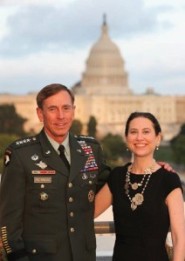 In the ISW’s 2011 annual report, Petraeus praises Kagan as “a barracuda at some times,” hails her leadership and poses with her for several photographs, including one in his dress uniform with the U.S. Capitol in the background.
The Post article noted that “For Kim Kagan, spending so many months away from research and advocacy work in Washington could have annoyed many donors to the Institute for the Study of War. But her major backers appear to have been pleased that she cultivated such close ties with Petraeus, who went from Kabul to head the CIA before resigning this fall over his affair with [biographer Paula] Broadwell. …
“On Aug. 8, 2011, a month after he relinquished command in Afghanistan to take over at the CIA, Petraeus spoke at the institute’s first ‘President’s Circle’ dinner, where he accepted an award from Kim Kagan. … ‘What the Kagans do is they grade my work on a daily basis,’ Petraeus said, prompting chortles from the audience. ‘There’s some suspicion that there’s a hand up my back, and it makes my lips talk, and it’s operated by one of the Doctors Kagan.’ …
“At the August 2011 dinner honoring Petraeus, Kagan thanked executives from two defense contractors who sit on her institute’s corporate council, DynCorp International and CACI International. The event was sponsored by General Dynamics. All three firms have business interests in the Afghan war.
“Kagan told the audience that their funding allowed her to assist Petraeus. ‘The ability to have a 15-month deployment essentially in the service of those who needed some help — and the ability to go at a moment’s notice — that’s something you all have sponsored,’ she said.”
Earlier Warning Signs
Though the Post article provides new details about Petraeus’s coziness to Washington’s neocons, there have been warning signs about this relationship for several years. In 2010, I wrote articles describing how Petraeus and other holdovers from George W. Bush’s administration, such as Defense Secretary Robert Gates, had trapped the inexperienced Obama into expanding the Afghan War.
On Sept. 27, 2010, I noted that “after his solid victory in November 2008, Obama rebuffed recommendations from some national security experts that he clean house by installing a team more in line with his campaign pledge of ‘change you can believe in.’ He accepted instead the counsel of Establishment Democrats who warned against any disruption to the war-fighting hierarchy and who were especially supportive of keeping Gates. …
“Before Obama’s decision to dispatch [an additional] 30,000 troops [in an Afghan War ‘surge’ in 2009], the Bush holdovers … sought to hem in the President’s choices by working with allies in the Washington news media and in think tanks. …
“For instance, early in 2009, Petraeus personally arranged for Max Boot [a neocon on the Council on Foreign Relations], Frederick Kagan and Kimberly Kagan to get extraordinary access during a trip to Afghanistan. … Their access paid dividends for Petraeus when they penned a glowing report in the Weekly Standard about the prospects for success in Afghanistan – if only President Obama sent more troops and committed the United States to stay in the war for the long haul. …
“‘Fears of impending disaster are hard to sustain, … if you actually spend some time in Afghanistan, as we did recently at the invitation of General David Petraeus, chief of U.S. Central Command,’ they wrote upon their return.
“‘Using helicopters, fixed-wing aircraft, and bone-jarring armored vehicles, we spent eight days traveling from the snow-capped peaks of Kunar province near the border with Pakistan in the east to the wind-blown deserts of Farah province in the west near the border with Iran. Along the way we talked with countless coalition soldiers, ranging from privates to a four-star general,’ the trio said.”
Update 2015: (Frederick Kagan is the brother of Robert Kagan, a co-founder of the neoconservative Project for the New American Century, which began the drive in 1998 for invading Iraq. Robert Kagan, now with the Brookings Institution and a columnist for the Washington Post, is married to Assistant Secretary of State for European Affairs Victoria Nuland, who oversaw last year’s coup in Ukraine. For more on the outsized influence of the Kagans, see Consortiumnews.com’s “Obama’s True Foreign Policy ‘Weakness.’”)
Trapping the President
How Obama was manipulated by Bush’s holdovers – with the help of the neocons – was chronicled, too, in Bob Woodward’s 2010 book, Obama’s Wars, which revealed that Bush’s old team made sure Obama was given no option other than to escalate troop levels in Afghanistan. The Bush holdovers also lobbied for the troop increase behind Obama’s back.
Woodward’s book notes that “in September 2009, Petraeus called a Washington Post columnist to say that the war would be unsuccessful if the president held back on troops. Later that month, [Joint Chiefs of Staff Chairman, Adm. Mike] Mullen repeated much the same sentiment in Senate testimony, and in October, [Gen. Stanley] McChrystal asserted in a speech in London that a scaled-back effort against Afghan terrorists would not work.”
This back-door campaign infuriated Obama’s aides, including White House chief of staff Rahm Emanuel, Woodward reported. “Filling his rant with expletives, Emanuel said, ‘Between the chairman [Mullen] and Petraeus, everyone’s come out and publicly endorsed the notion of more troops. The president hasn’t even had a chance!’” Woodward reported.
According to Woodward’s book, Gates, Petraeus and Mullen refused to even prepare an early-exit option that Obama had requested. Instead, they offered up only plans for their desired escalation of about 40,000 troops.
Woodward wrote: “For two exhausting months, [Obama] had been asking military advisers to give him a range of options for the war in Afghanistan. Instead, he felt that they were steering him toward one outcome and thwarting his search for an exit plan. He would later tell his White House aides that military leaders were ‘really cooking this thing in the direction they wanted.’”
Woodward identified Gates, Petraeus and Mullen as “unrelenting advocates for 40,000 more troops and an expanded mission that seemed to have no clear end.”
The Bush holdovers even resisted passing along a “hybrid” plan that came from outside their group, from Vice President Joe Biden who had worked with JCS vice chairman, Gen. James Cartwright. The plan envisioned a 20,000 troop increase and a more limited mission of hunting Taliban insurgents and training Afghan government forces.
Woodward reported, “When Mullen learned of the hybrid option, he didn’t want to take it to Obama. ‘We’re not providing that,’ he told Cartwright, a Marine known around the White House as Obama’s favorite general. Cartwright objected. ‘I’m just not in the business of withholding options,’ he told Mullen. ‘I have an oath, and when asked for advice I’m going to provide it.’”
Rigged War Game
Later, Obama told Gates and Mullen to present the hybrid option as one possibility, but instead the Bush holdovers sabotaged the idea by organizing a classified war game, code-named Poignant Vision, that some military insiders felt was rigged to discredit the hybrid option, Woodward reported.
According to Woodward’s book, Petraeus cited the results of the war game to Obama at the Nov. 11, 2009, meeting as proof the hybrid option would fail, prompting a plaintive question from a disappointed President, “so, 20,000 is not really a viable option?” Without telling Obama about the limits of the war game, Mullen, Petraeus, Gates and then-field commander McChrystal asserted that the hybrid option would lead to mission failure.
“Okay,” Obama said, “if you tell me that we can’t do that, and you war-gamed it, I’ll accept that,” according to Woodward’s book.
Faced with this resistance from the Bush holdovers – and unaware that their war game may have been fixed – Obama finally devised his own option that gave Gates, Petraeus and Mullen most of what they wanted – 30,000 additional troops on top of the 21,000 that Obama had dispatched shortly after taking office.
Obama did try to bind the Pentagon to a more limited commitment to Afghanistan, including setting a date of July 2011 for the beginning of a U.S. drawdown. Though Obama required all the key participants to sign off on his compromise, it soon became clear that the Bush holdovers had no intention to comply, Woodward reported.
Backstabbing
The incoming Obama administration was warned of this possibility of backstabbing by Gates, Petraeus and other Bush appointees when it was lining up personnel for national security jobs.
As I wrote in November 2008, “if Obama does keep Gates on, the new President will be employing someone who embodies many of the worst elements of U.S. national security policy over the past three decades, including responsibility for what Obama himself has fingered as a chief concern, ‘politicized intelligence.’ … It was Gates – as a senior CIA official in the 1980s – who broke the back of the CIA analytical division’s commitment to objective intelligence.”
More than any CIA official, Gates was responsible for the agency’s failure to detect the collapse of the Soviet Union, in large part because Gates had ridden roughshod over the CIA analysts on behalf of the Reagan administration’s desire to justify a massive military buildup by stressing Soviet ascendance and ignoring evidence of its disintegration.
As chief of the CIA’s analytical division and then deputy CIA director, Gates promoted pliable CIA careerists to top positions, while analysts with an independent streak were sidelined or pushed out of the agency.
“In the mid-1980s, the three senior [Soviet division] office managers who actually anticipated the decline of the Soviet Union and Moscow’s interest in closer relations with the United States were demoted,” wrote longtime CIA analyst Melvin A. Goodman in his book, Failure of Intelligence: The Decline and Fall of the CIA.
Instead of heeding these warnings, Obama’s team listened to Establishment Democrats like former Rep. Lee Hamilton and former Sen. David Boren, who were big fans of Gates. [For more on Gates’s role, see Robert Parry’s America’s Stolen Narrative.]
Petraeus was much the same story. A favorite of Official Washington and especially the influential neocons, he was credited with supposedly winning the war in Iraq by implementing the “surge” in 2007, which was advocated strongly by Frederick Kagan and other key neocons.
However, in reality, all Petraeus did was extend that misguided war for another few years – at the cost of nearly 1,000 more U.S. dead and countless more dead Iraqis – thus giving President Bush and Vice President Dick Cheney time to get out of Washington before the ultimate failure of the mission became obvious. The last U.S. troops were forced to leave Iraq at the end of 2011.
Begging Boot
Petraeus had such close ties to the neocons that he relied on them to pull him out of difficult political spots. In one embarrassing example in 2010, e-mails surfaced showing the four-star general groveling before Max Boot, seeking the neocon pundit’s help heading off a controversy over Petraeus’s prepared testimony to Congress which contained a mild criticism of Israel.
The e-mails from Petraeus to Boot revealed Petraeus renouncing his own congressional testimony in March 2010 because it included the observation that “the enduring hostilities between Israel and some of its neighbors present distinct challenges to our ability to advance our interests” in the Middle East.
Petraeus’s testimony continued, “Israeli-Palestinian tensions often flare into violence and large-scale armed confrontations. The conflict foments anti-American sentiment, due to a perception of U.S. favoritism for Israel. … Meanwhile, al-Qaeda and other militant groups exploit that anger to mobilize support.”
Though the testimony was obviously true, many neocons regard any suggestion that Israeli intransigence on Palestinian peace talks contributed to the dangers faced by American soldiers in Iraq and Afghanistan – or by the U.S. public from acts of terrorism at home – as a “blood libel” against Israel.
So, when Petraeus’s testimony began getting traction on the Internet, the general turned to Boot at the high-powered Council on Foreign Relations, and began backtracking on the testimony. “As you know, I didn’t say that,” Petraeus said, according to one e-mail to Boot timed off at 2:27 p.m., March 18. “It’s in a written submission for the record.”
In other words, Petraeus was saying the comments were only in his formal testimony submitted to the Senate Armed Services Committee and were not repeated by him in his brief oral opening statement. However, written testimony is treated as part of the official record at congressional hearings with no meaningful distinction from oral testimony.
In another e-mail, as Petraeus solicited Boot’s help in tamping down any controversy over the Israeli remarks, the general ended the message with a military “Roger” and a sideways happy face, made from a colon, a dash and a closed parenthesis, “:-)”.
The e-mails were made public by James Morris, who runs a Web site called Neocon Zionist Threat to America. He said he apparently got them by accident when he sent a March 19 e-mail congratulating Petraeus for his testimony and Petraeus responded by forwarding one of Boot’s blog posts that knocked down the story of the general’s implicit criticism of Israel.
Petraeus forwarded Boot’s blog item, entitled “A Lie: David Petraeus, Anti-Israel,” which had been posted at the Commentary magazine site at 3:11 p.m. on March 18. However, Petraeus apparently forgot to delete some of the other exchanges between him and Boot at the bottom of the e-mail.
~
Investigative reporter Robert Parry broke many of the Iran-Contra stories for The Associated Press and Newsweek in the 1980s. You can buy his latest book, America’s Stolen Narrative, either in print here or as an e-book (from Amazon and barnesandnoble.com).
UN Reveals ‘Credible and Reliable’ Evidence of US Military Torture in Afghanistan
By Sarah Lazare | Common Dreams | February 26, 2015
The United Nations revealed Wednesday it has “credible and reliable” evidence that people recently detained at U.S. military prisons in Afghanistan have faced torture and abuse.
The UN’s Assistance Mission and High Commissioner for Human Rights exposed the findings in a report based on interviews with 790 “conflict-related detainees” between February 2013 and December 2014.
According to the investigation, two detainees “provided sufficiently credible and reliable accounts of torture in a U.S. facility in Maydan Wardak in September 2013 and a U.S. Special Forces facility at Baghlan in April 2013.”
The report states that the allegations of torture were investigated by “relevant authorities” but provided no information about the outcome of the alleged probes or the nature of the mistreatment.
This is not the first public disclosure of evidence of torture during the U.S. war in Afghanistan, now into its 14th year. The U.S. military’s Bagram Prison, which was shuttered late last year, was notorious for torture, including beatings, sexual assault, and sleep deprivation, and further atrocities were confirmed in the Senate report (pdf) on CIA torture, released late last year in a partially-redacted form. Afghan residents have repeatedly spoken out against torture and abuse by U.S., international, and Afghan forces.
The Senate report on CIA torture, released late last year in a partially-redacted form, exposes U.S. torture at black sites in Afghanistan and around the world.
Moreover, residents of Afghanistan have testified to—and protested—torture by U.S., international, and Afghan forces.
Beyond U.S.-run facilities, the UN report finds that torture and abuse have slightly declined over recent years but remain “persistent” throughout detention centers run by the U.S.-backed Afghan government, including police, military, and intelligence officials. Of people detained for conflict-related reasons, 35 percent of them faced torture and abuse at the hands of their Afghan government captors, the report states.
The Destabilization Doctrine: ISIS, Proxies and Patsies

By Brandon Martinez | Non-Aligned Media | February 22, 2015
“Islam and the West at War,” reads a recent New York Times headline.
It would certainly seem that way if one were to take at face value the putrid assertions of Western governments that are not particularly known for their honesty or integrity. But astute observers of history and geopolitics can spot a deception when they see one, and the latest theatrical performances being marketed to the masses as real, organic occurrences remind one of a Monty Python sketch.
In the past week we have witnessed a number of expedient events that were designed to legitimize the West’s imperialist foreign policies in the minds of the masses. On Feb. 15 the Islamic State (also known as ISIS) released another highly choreographed and visually striking video allegedly depicting the beheading of 21 Egyptian Coptic Christians. Shortly following the video’s release, the Egyptian dictator Abdel Fattah el-Sissi launched air strikes against ISIS targets in Libya where the execution video was allegedly filmed, although experts are now saying that the production was faked.
ISIS’s continued provocations in the form of carefully crafted, emotionally impactful execution videos (real or faked), such as the recent immolation of a caged Jordanian pilot, cannot possibly be the work of rational actors seeking a military victory in any capacity. The videos only ever work to ISIS’s disadvantage, solidifying the resolve of their current ‘coalition’ opponents as well as creating new enemies upon every release.
Sixty-two countries and groups are presently fighting in the dubious ‘coalition’ against ISIS, most of which have modern militaries with advanced air and ground forces. Why in the world does ISIS continue to entice more countries to join the already over-crowded alliance against them? Why a group that purports to want to establish a ‘state’ which will ostensibly govern millions of people is deliberately seeking more and more enemies and a constant state of war with them beggars belief.
Does ISIS think it can do battle with the whole planet and achieve victory, culminating in world domination? How do people who harbor such ridiculous delusions have the wherewithal and resources at their disposal to organize and recruit thousands of fighters from around the world to an utterly ludicrous cause doomed to sheer failure? How can this be anything but a contrived prank of an operation?
The only logical conclusion that many analysts have come to is that ISIS does not represent a grassroots, organic movement, but rather operates entirely as a cat’s paw of Western foreign policy in the Middle East and North Africa, which is concurrently under the domination of Israel. ISIS’s actions expressly benefit Muslims least of all and Israel/the West most of all, the extent of which increases with every new atrocity and outrage ISIS inflicts upon innocents in Iraq and Syria that gets endless play in Western media. In fact, the Western media’s obsession with ISIS is in and of itself an effective form of PR for the group. Western media outlets are consciously performing an unqualified service for ISIS’s recruiting efforts by affording the terrorist group ‘premium level branding’ that will attract criminally-inclined degenerates, Wahhabist religious zealots and disaffected, suicidal lowlifes from around the world to join a cause predestined to abject failure.
This senile ‘ISIS vs. The World’ spectacle is little more than a melodramatic screenplay engineered in a boardroom by professional propagandists and marketing aficionados. It resembles a classic ‘problem, reaction, solution’ dialectic of deceit. Who in their right mind believes the rancid mythology surrounding this orchestrated ‘good vs. evil’ Hollywood blockbuster?
Proxy Warriors: Cannon Fodder for the Empire
The West is not sincerely at odds with ISIS nor is it seeking to “degrade and destroy” the group, as US President Barrack Obama claims. One piece of information that undermines this good cop/bad cop puppet show is the West’s clandestine support of ISIS beginning with the artificial uprising in Libya. In 2011, the West openly sought to depose Libyan strongman Muammar Gaddafi, and did so by backing ISIS and al-Qaeda-affiliated rebel groups to do it. The maniac rebels who sodomized and then murdered Gaddafi in the street like a dog were hailed as ‘freedom fighters’ by the repellant thugs in Washington, Paris and London, and were fully aided and abetted with NATO air strikes against Gaddafi’s forces. The rebel victory in Libya was only made possible through Western military intervention. “We came, we saw, he died,” said Obama’s former Secretary of State Hilary Clinton in reference to the assassination of Gaddafi by Washington’s foot soldiers, cackling like a witch at the demise of the Libyan potentate.
In a Nov. 19, 2014, article for Global Research, analyst Tony Cartalucci noted that the “so-called ‘rebels’ NATO had backed [in Libya] were revealed to be terrorists led by Al Qaeda factions including the Libyan Islamic Fighting Group (LIFG) and Al-Qaeda in the Islamic Maghreb (AQIM).” During the manufactured ‘uprising’ Gaddafi routinely declared in public speeches that al-Qaeda was leading the way. “Gaddafi blames uprising on al-Qaeda,” read one Al Jazeera headline from February 2011. A March 2011 Guardian report spoke of how “hundreds of convicted members of the Libyan Islamic Fighting Group (LIFG), an al-Qaida affiliate, have been freed and pardoned” under a “reform and repent” program headed by Gaddafi’s son Saif al-Islam. The same article acknowledged that the LIFG, which was established in Afghanistan in the 1990s, “has assassinated dozens of Libyan soldiers and policemen” since its founding and that Britain’s MI6 had previously supported the group. That group formed the backbone of the anti-Gaddafi insurgency, and received all manner of support from the West and allied Gulf sheikhdoms.
In the aforesaid Global Research article, Cartalucci outlines how the synthetic insurrection in Libya was spearheaded by al-Qaeda franchises that were later subsumed into ISIS. A February 2015 CNN report entitled “ISIS finds support in Libya” revealed that since the fall of Gaddafi, ISIS has established a large and menacing presence throughout the North African country. “The black flag of ISIS flies over government buildings,” according to CNN’s reportage. “Police cars carry the group’s insignia. The local football stadium is used for public executions.” It adds that, “Fighters loyal to the Islamic State in Iraq and Syria are now in complete control of the city of Derna, population of about 100,000, not far from the Egyptian border and just about 200 miles from the southern shores of the European Union.”
NATO effectively carpet-bombed Libya into rubble, paving a path of blood for ISIS and al-Qaeda death squads to seize power and institute their medieval ideology. That’s the reward for falling afoul of ‘the West’ and whatever drives it. Cartalucci further proved in another report entitled “Libyan Terrorists Are Invading Syria” that as soon as Gaddafi’s regime collapsed and rebel gangs emerged triumphant, thousands of battle-hardened and fanatical jihadist fighters took their Western training and weapons over to Syria to fight Bashar al-Assad in accordance with Washington’s ‘bait and switch’ scheme. Apparently, these hired mercenaries behave a lot like wild dogs chasing a piece of raw meat.
An absolutely identical scenario unfolded in Syria where Washington and its regional puppets led by Saudi Arabia, Qatar and Turkey have been subsidizing the Islamist guerrillas from the outset. “Do you know of any major Arab ally of the US that embraces ISIL?” US Senator Lindsey Graham facetiously asked General Martin Dempsey at a Senate Armed Services Committee in 2014. To Graham’s surprise, Dempsey responded: “I know major Arab allies who fund them.” US Vice President Joe Biden himself confirmed this in an October 2014 speech wherein he told students at Harvard University that America’s Gulf allies – the Saudis and Qataris especially – were backing ISIS and Jahbat al-Nusra (an al-Qaeda affiliate) with substantive sums of arms and funds. A former US General, Thomas McInerney, told Fox News that the US government helped “build ISIS” by “backing some of the wrong people” and by facilitating weapons to al-Qaeda-linked Libyan rebels which ended up in the hands of ISIS militants in Syria. Retired US General and former NATO Supreme Allied Commander, Wesley Clark, repeated this view in a February 2015 interview with CNN, saying that “ISIS got started through funding from our friends and allies [in the Gulf]” who sought to use religious fanatics to assail the Shia alliance of Syria, Iran and Hezbollah. “It’s like a Frankenstein,” he concluded.
A June 17, 2014, World Net Daily report highlights how Americans trained Syrian rebels who later joined ISIS in a secret base located in Jordan. Jordanian officials told WND’s Aaron Klein that “dozens of future ISIS members were trained [in a US run training facility in Jordan] at the time as part of covert aid to the insurgents targeting the regime of Syrian President Bashar al-Assad in Syria.” Reports in Der Spiegel, the Guardian, Reuters and other mainstream outlets all confirmed that the US, Britain, France and their regional allies were training militants in secret bases in Jordan and Turkey as part of the West’s proxy war against the Assad regime.
The West has attempted to cover-up its support of ISIS and al-Qaeda elements by running a ‘two degrees of separation’ gambit. Washington claims to only provide support to ‘moderate, vetted’ rebel groupings, namely the Free Syrian Army (FSA), but this amounts to a calculated ruse to confound the credulous masses. FSA is the nom de gerre of a loose collection of rebel bandits who don’t operate under a central command framework or authority, rather acting independently or under the umbrella of other factions. Aron Lund, an expert on Syrian rebel groups, discerned in a March 2013 article titled “The Free Syrian Army Doesn’t Exist” that from the very beginning the FSA has been nothing more than a fictional branding operation.
During the initial stages of the insurgency, any militant faction in Syria looking for Western military aid called itself FSA and then took the weapons they received from the West straight to ISIS and Jahbat al-Nusra. The FSA functions as a conduit between Western governments and the Takfiri terrorists fighting Assad as well as an arms distribution network for them. In the aforesaid article, Lund explains that the FSA’s General Staff was set up in Turkey in 2012 “as a flag to rally the Western/Gulf-backed factions around, and probably also a funding channel and an arms distribution network, rather than as an actual command hierarchy.” Thousands of militants fighting under the FSA rubric have since joined or pledged allegiance to ISIS and al-Nusra.
Western governments know this and are apparently totally comfortable with it, revealing their bare complicity and collaboration with the Takfiri insurgents hell-bent on beheading their way to power in Syria and Iraq.
The Counterfeit Campaign
This inevitably creates confusion for people not studied in imperial geopolitics, especially after the West and its Gulf allies ‘declared war’ on ISIS in late 2014. The counterfeit campaign cannot be seen as anything other than a convenient, disingenuous volte-face maneuver designed to whitewash all of the aforementioned facts about the West’s dirty hands behind ISIS. Average plebs who receive all of their information from TV news channels won’t know about the West’s clandestine activities that effectively spawned ISIS and facilitated its rise to prominence in Iraq, Syria and Libya, so they will naturally take the West’s phony confrontation with ISIS at face value.
The West’s crusade to “degrade and destroy” ISIS is a preposterous hoax. In fact, evidence suggests that the West continues to covertly support ISIS with airdrops of weapons and supplies, whilst concurrently ‘bombing’ them in sketchy and deliberately ineffective air strikes.
Iran’s President Hassan Rohani called the US-led anti-ISIS coalition ‘a joke’ considering how many of its participants significantly helped bolster the terrorist group since its inception. In a January 2015 report, Iran’s Fars News Agency quotes a number of Iranian generals and Iraqi MPs who believe that the US is continuing to surreptitiously support ISIS with airdrops of weapons caches and other supplies. General Mohammad Reza Naqdi, a commander of Iran’s Basij (volunteer) Force, said that the US embassy in Baghdad is the “command center” for ISIS in the country. “The US directly supports the ISIL in Iraq and the US planes drop the needed aids and weapons for ISIL,” General Naqdi told a group of Basij forces in Tehran. Fars News cited Majid al-Gharawia, an Iraqi Parliamentary Security and Defense Commission MP, who said that the US are supplying ISIS with weapons and ammunition in a number of Iraqi jurisdictions.
An Iraqi security commission spoke of unidentified aircraft making drops to ISIS militants in Tikrit. Another senior Iraqi lawmaker, Nahlah al-Hababi, echoed these claims about US planes and other unidentified aircraft making deliveries to ISIS. She opined that, “The international coalition is not serious about air strikes on ISIL terrorists and is even seeking to take out the popular Basij (voluntary) forces from the battlefield against the Takfiris so that the problem with ISIL remains unsolved in the near future.” General Massoud Jazayeri, the Deputy Chief of Staff of Iran’s Armed Forces, called the US-led coalition against ISIS a farce. “The US and the so-called anti-ISIL coalition claim that they have launched a campaign against this terrorist and criminal group – while supplying them with weapons, food and medicine in Jalawla region (a town in Diyala Governorate, Iraq). This explicitly displays the falsity of the coalition’s and the US’ claims,” the general said.
The US military claims these air deliveries are mistakenly ending up in ISIS’s possession and that they were intended for Kurdish fighters, but such a ridiculous assertion rings hollow among the true opponents of ISIS – Iran, Syria, Hezbollah and Shiite volunteers in Iraq. Meanwhile, the laughable nature of Washington’s anti-ISIS gambit is underscored by the fact that its initial air strikes against ISIS’s stronghold in Raqqa, Syria, in September 2014 did little more than destroy a bunch of empty buildings. CNN let slip that ISIS fighters had evacuated their command centers in the city 15 to 20 days before US air strikes commenced, indicating that they were probably tipped off. A Syrian opposition activist told ARA News that “the targeted places [in Raqqa], especially refineries, were set on fire, pointing out that IS militants evacuated their strongholds in the last two days to avoid the U.S.-led strikes.”
The Hidden Hand of Zionism
The sham rebellion in Syria was devised and executed by outsiders to serve a nefarious anti-Syrian agenda. All of this seems very confusing if one doesn’t take into consideration the destructive proclivities of the state of Israel in the region.
Israel has essentially used the United States as a cat’s paw in the Middle East, manipulating America’s Leviathan military to smash up her enemies. The formidable Israeli lobby inside the US and its neoconservative lackeys who are a dominant force in the war-making apparatus of the US Military Industrial Complex is a key factor driving the Washington foreign policy establishment’s intransigent approach to the Middle East. When it comes to Middle East policy, the Israelis always get their way. “America is a thing you can move very easily… in the right direction,” Israeli PM Benjamin Netanyahu once bragged. “Don’t worry about American pressure on Israel. We control America,” the former Israeli PM Ariel Sharon boasted.
The destruction of Iraq, Syria, Iran, Lebanon, Libya, Egypt and other Middle Eastern and North African states is a long-standing Zionist policy plan dating back to the 1950s. In 1982 a stunning Israeli strategy paper was published which outlined with remarkable candor a vast conspiracy to weaken, subjugate and ultimately destroy all of Israel’s military rivals. The document was called “A Strategy for Israel in the 1980s,” authored by Oded Yinon, a prominent thinker in Israeli Likud circles. In the vein of the Ottoman millet system, Yinon envisioned the dissolution of Israel’s neighbors and a new Middle East made up of fractured and fragmented Arab/Muslim countries divided into multiple polities along ethnic and religious lines. In Yinon’s mind, the less unified the Arabs and Muslims are the better for Israel’s designs. Better yet, have the Arabs and Muslims fight each other over land and partition themselves into obscurity. Yinon suggests a way to accomplish this, primarily by instigating civil strife in the Arab/Muslim countries which will eventually lead to their dismemberment.
In the document, Yinon specifically recommended:
Lebanon’s total dissolution into five provinces serves as a precedent for the entire Arab world including Egypt, Syria, Iraq and the Arabian peninsula and is already following that track. The dissolution of Syria and Iraq later on into ethnically or religiously unique areas such as in Lebanon, is Israel’s primary target on the Eastern front in the long run, while the dissolution of the military power of those states serves as the primary short term target. Syria will fall apart, in accordance with its ethnic and religious structure, into several states such as in present day Lebanon, so that there will be a Shi’ite Alawi state along its coast, a Sunni state in the Aleppo area, another Sunni state in Damascus hostile to its northern neighbor, and the Druzes who will set up a state, maybe even in our Golan, and certainly in the Hauran and in northern Jordan. This state of affairs will be the guarantee for peace and security in the area in the long run, and that aim is already within our reach today.
He later singled out Iraq as Israel’s most formidable enemy at the time, and outlined its downfall in these terms:
Iraq, rich in oil on the one hand and internally torn on the other, is guaranteed as a candidate for Israel’s targets. Its dissolution is even more important for us than that of Syria. Iraq is stronger than Syria. In the short run it is Iraqi power which constitutes the greatest threat to Israel. An Iraqi-Iranian war will tear Iraq apart and cause its downfall at home even before it is able to organize a struggle on a wide front against us. Every kind of inter-Arab confrontation will assist us in the short run and will shorten the way to the more important aim of breaking up Iraq into denominations as in Syria and in Lebanon. In Iraq, a division into provinces along ethnic/religious lines as in Syria during Ottoman times is possible. So, three (or more) states will exist around the three major cities: Basra, Baghdad and Mosul, and Shi’ite areas in the south will separate from the Sunni and Kurdish north. It is possible that the present Iranian-Iraqi confrontation will deepen this polarization.
Yinon’s vision seems to be unfolding rapidly in Iraq which is today on the verge of partition with the Sunni extremists of ISIS seizing vast swaths of territory for their ‘caliphate’ and the Northern Kurds still battling for independence from Baghdad which is ruled by a Shia clique headed by Haider al-Abadi and Nour al-Maliki. Syria too looks to be falling victim to Yinon’s venomous whims as ISIS has wrested control of large chunks of Syrian territory and presently enforces its brutal sectarianism on the Eastern population of the country.
The themes and ideas in Yinon’s Machiavellian manifesto are still held dear today by the Likudnik rulers in Israel and their neocon patrons in the West. Pro-Israel neocons basically replicated Yinon’s proposals in a 1996 strategy paper intended as advice for Benjamin Netanyahu, although in less direct language. Their report titled “A Clean Break: A New Strategy for Securing the Realm” spoke of “removing Saddam Hussein from power in Iraq” as an “important Israeli strategic objective” that serves as a means of weakening Syria. The Clean Break authors advised that Israel should militarily engage Hezbollah, Syria and Iran along its Northern border. They go on to suggest air strikes on Syrian targets in Lebanon as well as inside Syria-proper. They also stipulate that, “Syrian territory is not immune to attacks emanating from Lebanon by Israeli proxy forces.”
These neocon recommendations seem to be playing out today like a perfectly gauged game of chess. The Syria crisis has unveiled Israel’s plans for destabilizing the region to their benefit. At many points since the unrest in Syria began in 2011, Israel has conducted air strikes on Syrian military sites, just as the Clean Break criminals encouraged. In a January 2015 interview with Foreign Affairs magazine, Syria’s President Bashar al-Assad made note of Israel’s incessant attacks against Syrian army installations during the conflict: “[Tel Aviv is] supporting the rebels in Syria. It’s very clear. Because whenever we make advances in some place, they make an attack in order to undermine the army.” Assad further described Israel as “al-Qaeda’s air force.”
Israel’s support of the Takfiri militants inside Syria goes beyond periodic air strikes in their favor. According to a 2014 UN report, Israel has been providing sanctuary and hospital care to thousands of anti-Assad terrorists, including those of ISIS and al-Nusra, and then dispatching them back into the fight. A Russia Today report on the issue headlined “UN details Israel helping Syrian rebels at Golan Heights” noted: “Israeli security forces have kept steady contacts with the Syrian rebels over the past 18 months, mainly treating wounded fighters but possibly supplying them with arms, UN observers at the Israeli-Syrian border reported.”
Israel’s gains in this situation are manifold. Tel Aviv has been using the fog of war to weaken its primary adversary in Damascus and consequently draw its other foes – Iran and Hezbollah – into the quandary, thereby diminishing their collective resolve to fight Israel itself. The Zionist regime not only views the Takfiris of ISIS and al-Nusra as a “lesser enemy,” but also as proxy mercenaries against Damascus, a strategy explicated in the neocons’ Clean Break document. In fact, Tel Aviv doesn’t view the Takfiris as much of a threat at all; a point that was validated by ISIS itself which declared that it is “not interested” in fighting Israel. “ISIS: Fighting ‘Infidels’ Takes Precedence Over Fighting Israel,” reads an August 2014 headline in Arutz Sheva, an Israeli news outlet.
The former Israeli ambassador to the US, Michael Oren, substantiated all of this in a September 2013 interview with the Jerusalem Post. “’Bad guys’ backed by Iran are worse for Israel than ‘bad guys’ who are not supported by the Islamic Republic,” he told the Post, adding that the “greatest danger” to Israel is “the strategic arc that extends from Tehran, to Damascus to Beirut. And we saw the Assad regime as the keystone in that arc. That is a position we had well before the outbreak of hostilities in Syria. With the outbreak of hostilities we continued to want Assad to go.” Oren further remarked with glee about the total capitulation of the Gulf sheikhdoms – Saudi Arabia, Qatar and the United Arab Emirates – to Israel’s itinerary vis-à-vis Syria, Iran and the Palestinian issue, observing that “in the last 64 years there has probably never been a greater confluence of interest between us and several Gulf States. With these Gulf States we have agreements on Syria, on Egypt, on the Palestinian issue. We certainly have agreements on Iran. This is one of those opportunities presented by the Arab Spring.”
Roland Dumas, France’s former foreign minister, confirmed Israeli intrigue behind Syria’s internal woes. In a June 15, 2013, article for Global Research, journalist Gearóid Ó Colmáin quotes Dumas who told a French TV channel that the turmoil in Syria, which has cost the lives of more than 100,000 Syrians, was planned several years in advance. Dumas claimed that he met with British officials two years before the violence erupted in Damascus in 2011 and at the meeting they confessed to him “that they were organizing an invasion of rebels into Syria.” When asked for his support in the endeavor, Dumas declined, saying, “I’m French, that doesn’t interest me.’’ Dumas further pinpointed the architects of the madness as Israeli Zionists, suggesting that the Syria destabilization operation “goes way back. It was prepared, preconceived and planned [by the Israeli regime].” Dumas noted that Syria’s anti-Israel stance sealed its fate in this respect and also revealed that a former Israeli prime minister once told him “we’ll try to get on with our neighbours but those who don’t agree with us will be destroyed.”
“Israel planned this war of annihilation years ago in accordance with the Yinon Plan, which advocates balkanization of all states that pose a threat to Israel,” writes Gearóid Ó Colmáin in the aforesaid piece. “The Zionist entity is using Britain and France to goad the reluctant Obama administration into sending more American troops to their death in Syria on behalf of Tel Aviv.”
Ó Colmáin argues that the West “are doing [Israel’s] bidding by attempting to drag [the United States] into another ruinous war so that Israel can get control of the Middle East’s energy reserves, eventually replacing the United States as the ruling state in the world. It has also been necessary for Tel Aviv to remain silent so as not to expose their role in the ‘revolutions’, given the fact that the Jihadist fanatics don’t realize they are fighting for Israel.”
ISIS: A Repository of Patsies for the False Flaggers
At long last, this brings us to the ‘second phase’ of the ISIS psyop: scaring Westerners into submission.
It’s no coincidence that the notorious belligerence of ISIS in its quest for a ‘caliphate’ aligns perfectly with the neocon agenda which aims to inculcate in the minds of the masses the myth of a ‘clash of civilizations’ between the West and Islam. In its official magazine, Dabiq, ISIS ideologues advanced a parallel attitude with the neocon desire for a civilizational conflict. Is that merely happenstance? Or has ISIS been manufactured by the neocons to serve as the ultimate boogeyman and straw man caricature of ‘Islamic radicalism’?
The godfather of neoconservatism, Leo Strauss, espoused a dogma of deception, stipulating that in order to corral society behind the wishes of an elite vanguard an ‘external enemy’ must be fashioned. This ‘enemy’ could be real, but enemies usually exist in the eye of the beholder and in the minds of those seeking opposition. Strauss made it clear that if this societal ‘enemy’ did not exist or was not formidable enough to generate an adequate amount of fear required to paralyze and manipulate the masses, then one should be invented or inflated and then advertised to the populace as a real, pressing danger.
For the neocons, this phantom nemesis forms the crux of their strategy of subjugation. Without it, the public would never consent to their lunatic foreign policies, nor would anyone feel threatened enough to willingly relinquish their freedoms in the name of security. This is what ISIS is all about.
As demonstrated earlier, ISIS was cultivated by our own governments to destabilize and ultimately overthrow various regimes in the Middle East and North Africa that fell astray of the Globalist-Zionist program. The Western media has purposely marketed the ISIS ‘brand’ across the globe, making it a household name. The Zionist globalists built up ISIS to do their bidding abroad, but despite media sensationalism the group is not nearly strong enough to pose any serious threat to Western countries. So while ISIS represents no legitimate military threat to the West, its global reputation for brutality and obscene violence is seen as a fantastic propaganda tool to frighten Western populations into consenting to the extirpation of their freedoms at home.
The Zionist globalists have put that carefully crafted ISIS image to work, fabricating a series of perfectly timed ‘terror events’ inside Western countries which have been used to curtail freedoms under the guise of ‘keeping us safe from the terrorists.’ What the gullible commoners don’t realize is that these ‘terrorists’ are controlled by our own governments and are being wielded against us to vindicate the construction of an Orwellian police state.
The string of ‘lone-wolf’ attacks that hit Ottawa, Sydney, Paris and now Copenhagen over the past five months since the West first ‘declared war’ on ISIS are all part of an organized neocon strategy of tension. The intelligence agencies of the West and Israel stand behind them all. In every case, the ‘terrorists’ had long histories of mental illness and/or frequent run-ins with the law; the standard rap-sheet of a patsy whose innumerable weaknesses are exploited by government agents to produce a type-cast ‘fall guy’ to play the part of the ‘wily gunman’ who ‘hates our freedoms.’ ISIS therefore in effect provides the false flag con artists who control our governments with an inexhaustible wellspring of patsies for their operations.
As the researcher Joshua Blakeney pointed out, “Some peasant in Yemen may be angry [enough at the West to want to harm it] but he [could] never [physically carry out] such an attack without it being made possible by the false-flag planners.” A ‘let it happen’ or a ‘made it happen’ scenario amounts to the same thing – without the connivance of the government in question there is no ‘attack’ to even discuss. Since ISIS is a ‘global’ phenomenon, according to our controlled media, authorities don’t even have to prove that these deranged individuals are even members of the group. All they have to say is that they were ‘inspired’ by the group’s message which can be accessed online, and that’s enough to indict them in the court of public opinion. Even if all that were true, it still wouldn’t eliminate potential state involvement, which usually comes in the form of equipping the dupe with the necessary armaments to execute the plot and preventing well-meaning police and intelligence people from intervening to stop it. These are the kinds of queries the West’s big media patently refuses to pursue, knowing full well that the state is almost always complicit with, and keen to exploit, whatever tragedy befalls their population.
All of the latest traumatic terror events in Western capitals have been instantly branded by lying, cynical politicians as attacks on ‘free speech’ and the ‘values of Western civilization,’ a familiar trope first trotted out by George W. Bush and his neocon puppet masters after the false flag attacks of 9/11.
However, what many are starting to realize is that whatever threat some mind controlled junkie might pose to our lives, our own governments are a markedly more dangerous menace to our liberties, well being and way of life. They prove this point every single day with a manifold of new freedom-busting laws that they pass using the comical excuse of protecting us from their own Frankenstein.
That’s the simple truth of the matter that the neocon false flaggers seek to suppress at all costs as they desperately hold up the façade of their artificial power which will inevitably collapse under its own weight.
Brandon Martinez is an independent writer and journalist from Canada who specializes in foreign policy issues, international affairs and 20th and 21st century history. He is the co-founder of Non-Aligned Media and the author of the 2014 books Grand Deceptions and Hidden History. Readers can contact him at martinezperspective[at]hotmail.com or visit his blog at http://martinezperspective.com
Copyright 2015 Brandon Martinez
Taliban slams UN report on Afghan civilian casualties
Press TV – February 19, 2015
The Taliban militants have censured the United Nations for what they describe as its “unjust and political motives” in attributing a rise in the number of Afghan civilian casualties in 2014 to the group’s militancy.
“The findings of the report are unjust and we refute them,” the Taliban militant group declared in a Thursday statement, claiming that Afghan government forces may have also contributed to the high civilian toll in the war-ravaged country in the past year.
The development came after the United Nations announced in a Wednesday report that 72 percent of the overall civilian casualties throughout Afghanistan were attributed to the Taliban and other militant groups.
“The United Nations does not show the crimes that the Afghan military under the Kabul administration is committing against civilians,” the Taliban statement further said.
According to the United Nations Assistance Mission in Afghanistan, more than 10,000 civilian casualties were recorded across the Asian country during 2014, reflecting a 22-percent hike compared to figures from the previous year.
“Rising civilian deaths and injuries in 2014 attests to a failure to fulfill commitments to protect Afghan civilians from harm,” said Nicholas Haysom, UN Secretary General Ban Ki-moon’s special representative for Afghanistan.
The report, however, does not attribute any civilian casualties in the war-torn country to the US-led foreign forces, most of which withdrew from the country by the end of 2014.
Washington’s assassination drone strikes and other air raids and military operations conducted by the US-led forces have been widely blamed for large number of civilian casualties since the foreign troops began their military invasion of the country in 2001.
Afghan civilians have been bearing the brunt of the 13-year war in Afghanistan since the US-led occupation of the country under the pretext of a “war on terror.”
Obama the War President
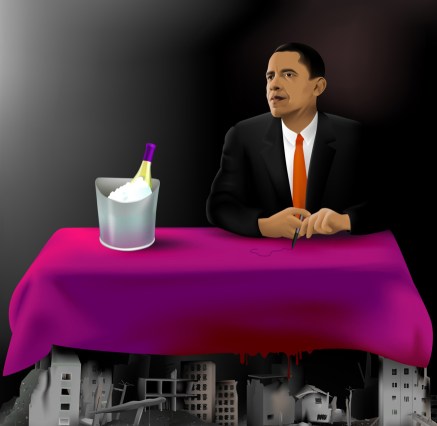
By Dave Lindorff | This Can’t Be Happening! | February 6, 2015
The Nobel Peace Laureate President Barack Obama, the guy who once campaigned claiming one US war — the one against Iraq — was a “bad” one, and the other — against Afghanistan — was a “good” one, turns out to be a man who, once anointed commander-in-chief, can’t seem to find a war he doesn’t consider to be a “good” idea.
Obama turned out, on taking office, to have a hard time saying good-bye to the occupation of Iraq, only leaving when he was forced out by an Iraqi government that refused to continue giving US forces legal immunity for killing Iraqi civilians. In Afghanistan, he decided to copy the same “surge” — a massive increase in targeted assassinations and violence — that he had once condemned in Iraq. Then he stepped up drone-launched rocket attacks and bombings in seven other countries.
More recently he has begun an air war against Syria (okay, he says it’s against the so-called Islamic State, but the whole world, with the exception of a lot of ill-informed US citizens, knows it’s ultimately against the Syrian government), and now his Secretary of Defense (sic) Ashton Carter and his Secretary of State John Kerry are pushing for sending heavy arms and, inevitably, US “advisors” to Ukraine to escalate US involvement in the civil war there. What makes that latest war particularly dangerous is that all the while, Peace Laureate Obama makes it clear that the “enemy” is Russian President Vladimir Putin and the Russian military.
Never mind that it is the US that originally orchestrated and encouraged the fascist coup that overthrew the elected government of Ukraine, setting in motion a huge pogrom against ethnic Russians in the east of that country and provoking the current armed conflict, and never mind that Russian concern about the Ukraine stems from a decades long history of the US pushing NATO ever closer to Russia’s western border, with Ukraine kind of the last straw.
Anyone looking objectively at the warmaking and war-promotion of this administration would have to conclude that President Obama is one of the most bellicose Chief Executives in the history of the United States.
If you don’t believe me, just look at the US military budget President Obama has proposed for FY2016. At $585.3 billion, it would if approved by Congress represent an increase in spending of $24.9 billion, or about 4%, over the 2015 budget, and that is despite a decline in what, since the Bush/Cheney years, has euphemistically been called Overseas Contingency Operations spending, or spending on actual wars. The proposed OCO budget for 2016 in this “peace” president’s budget is “just” $50.9 billion, down about $13.3 billion from 2015 thanks to what the president, in one whopper offered during his State of the Union address, called the “end of combat” in Afghanistan (that war is actually continuing, with some 12,000 US troops expected to remain stationed in that country indefinitely).
The thing about OCO funding is that it is really not predictive of anything. It could soar way beyond that $50.9-billion level, for example, in a flash if the US follows through and escalates the war in Ukraine — especially if Russian troops are drawn directly into that conflict and the US responds by upping its own involvement.
In fact, the OCO part of the budget has been used by the Pentagon and the administration over the last few years to get around the constraints of an ongoing Congressional “sequestration” requirement that cuts so-called discretionary spending, both military and non-military. Congress, ever mindful and solicitous of the country’s imperial ambitions, provided an exemption for ongoing military conflicts, and the Pentagon has since been deceptively slipping all kinds of other spending under the OCO heading now ever since the loophole was created.
But the Obama administration’s warmongering stance, in terms of the budget, isn’t told just by looking at the official Pentagon budget. There is much more spending that is really all about war. Not included in that $585.3 billion figure is $70.2 billion in discretionary spending for Veterans Affairs (that’s in addition to $90 billion in mandated spending). This is money to pay for the damages of the nation’s warmaking — the injured or ailing veterans who served or are now serving in the nation’s armed forces. Then there’s the intelligence agencies’ budgets — the CIA, the NSA, the FBI, the DIA, the DEA, the ATF and Homeland Security, etc. — most of which is really part of part of the war machine, thanks to the so-called “War on Terror,” which has re-defined the US itself as part of a global war zone. While much of that intelligence budget is concealed from the public on the spurious grounds of “national security,” it is known to exceed $100 billion a year. Add to that the $24-billion share of the Department of Energy budget that is weapons and war related, and you have a real military budget for 2016 of $707 billion. That’s out of a $1.2 trillion total discretionary spending budget (the rest of the $4 trillion proposed 2016 budget is called mandatory because it is debt repayment or spending on mandated things like Social Security and Medicare, which are funded by dedicated payroll taxes, not income taxes and other federal taxes, and which are promised to recipients like retirees and the sick.
What this means is that when you look closely, some 59% of the entire discretionary budget of the federal government – things that are funded each year by money that Congress has to appropriate — is being spent on the military. Given that the total amount of taxes collected by the federal government (income, corporate profits, exist, inheritance, etc.) also comes in at about $1.2 trillion, we’re saying that taxpayers this coming year will be pouring not just $707 billion, but 59 cents of every tax dollar in to war, planning for war, or paying for war. But it’s actually worse than that because actually the US government operates at a deficit, and doesn’t ever finance its wars on a pay-as-you-go basis. Instead, it borrows the money and then pays interest on that debt. Every year that interest comes to about $240 billion, and roughly half that is for borrowing to pay for past wars and past and current military spending. So add $120 billion to the $707 total and it become $827 billion.
In other words, it’s really 68.9% of every tax dollar you pay this April 15 that’s going to pay for America’s wars and its obsession with militarism.
No wonder our schools and universities, our parks, our roads, our once-vaunted global scientific leadership, our environment, our health and safety, our family budgets and even our life expectancy, have been going to hell! The only thing that’s really getting funded in this country is war.
By the way, the reason you may not have realized how much you are paying for war out of your taxes is that the government, and the corporate media, carefully avoid letting you know. They do this by sleight of hand. You see, they never really break out just the “discretionary” budget, or point out the parts of the budget that are outside the Pentagon but that are still really military-related, like spending on nuclear weapons and weapons development, nuclear research and cleanup, decommissioning of nuclear processing plants, and of course veterans affairs and benefits. They also do it by lumping the huge outlays for Social Security benefits and Medicare into the overall spending budget, though actually those benefits are funded not by income taxes but by a Trust fund of some $1.7 trillion that was created over the years by specially-dedicated payroll taxes separately paid by workers and their employers over the working life of each person. Adding those items into the national budget, while leaving out things like spending on veterans, nukes and war debt, appears to reduce military spending to a much less troubling 6.8% of the budget.
But it’s a fraud.
If we want to revitalize the US, the only way to do it is to end militarism and war, and to generously fund human needs.
To do that, we need a real peace president and a peace congress, not the Nobel Laureate warmonger we have now in the White House, and the bi-partisan war chorus we have in the Congress.
Court presses US govt to act on withheld photos of post-9/11 detainee abuse
RT | February 5, 2015
A federal court insists it wants the Department of Defense to supplement the 2,100 pictures showing US military abuse of detainees in Iraq and Afghanistan with an individual reason for not making each of them public.
Judge Alvin Hellerstein gave a week to the government on Wednesday either to submit a written estimate of how long it might take to comply with the August 2014 ruling and list individual exemptions for the disclosure of the photographs, or to appeal the court’s decision.
“I have a feeling where we are at this point – to make up a phrase – at a line in the sand,” Hellerstein said, as cited by the Guardian.
The photographs in question depict abuse at US detention facilities in Iraq and Afghanistan following 9/11 attacks. They are believed to be more disturbing than the notorious images of torture and humiliation of detainees at Abu Ghraib prison.
The legal battle for making the classified cache of 2,100 abuse photos public has been led by the American Civil Liberties Union (ACLU) since 2004. The watchdog initiated the case after it was denied the release of photos under the Freedom of Information Act (FOIA).
Hellerstein ruled in 2005 that the government had to make the pictures public. The ruling was supported by the Second Circuit Court of Appeals in 2008.
However, a bill passed by the US Congress in 2009 made it possible for the Department of Defense to conceal images it deemed dangerous for Americans. That same year, President Obama denied the release of the photographs on the grounds they would “further inflame anti-American opinion and … put our troops in greater danger.”
The bulk concealment of abuse pictures is something judge Hellerstein believes wrong. That’s why he ruled in August 2014 that individual reasons should be given for the non-disclosure of each of the photos.
The government has not complied, providing instead a general assessment of the photos, done by associate deputy general counsel Megan M. Weis. She sorted the photos into three categories based on the extent of injury suffered by the detainee, if a US service member was depicted and the location of the photograph. Weis then took samples from each of the categories and showed them to a group of senior military officials, who recommended that CIA Director Leon Panetta keep the images secret.
“I could give you more time to satisfy my ruling…but I am not changing my view,” Hellerstein told the government on Wednesday, as cited by Newsweek.
“Some are harmless” he said of the pictures, while describing others as “highly prejudicial.”
Hellerstein also offered looking through the images with the government, as a way of complying with the court ruling.
In December, the intelligence committee of the US Senate released report detailing the CIA’s use of torture on prisoners in the wake of the September 11, 2001 terrorist attacks.
Sleep deprivation and the simulated-drowning practice known as waterboarding were listed among the so-called enhanced interrogation techniques used by the CIA.
The report released to the public consists of only a 524-page summary out of the full 6,000-page document. It has most of the details blacked out, such as the names of those involved.
The UN and major human rights groups have urged prosecution of those responsible US officials, listed in the Senate’s report. The Justice Department however said it would not pursue charges.
READ MORE:
Legacy of Endless Afghan War Includes Nation Plagued by Unexploded Bombs
By Jon Queally | Common Dreams | January 29, 2015
As seen in other abandoned battlefields in the anals of U.S. wars overseas, new reporting out of Afghanistan shows that among the other deadly legacies left behind by foreign troops are tens of thousands unexploded munitions dropped from the sky or left in the ground that will continue to kill and maim civilians long after the “official” fighting has stopped.
Reporting from the Afghan city of Khost, Guardian foreign correspondent Sune Engel Rasmussen reviewed data and spoke with members of the UN’s Mine Action Coordination Centre of Afghanistan (Macca) to learn that unexploded bombs and shells in Afghanistan “are killing and maiming people at a rate of more than one a day”—the vast majority of whom are children.
Citing MACCA statistics from 2014, Rasmussen reports “there were 369 casualties in the past year, including 89 deaths. The rate rose significantly in October and November when 93 people were injured, 84 of them children. Twenty died.”
Offering a tragic account of siblings from a single family, Rasmussen relays the story of 10-year-old Mohammad Yunus and his eight-year-old sister, Sahar Bibi. “The grenades that killed Mohammad and Sahar, as they were combing through dry branches to collect firewood for their family, should have detonated long before they were picked up. Instead, the shells exploded in the children’s hands and ripped through their bodies, killing them instantly. The blasts also injured their two brothers, aged five and 12.”
In a war that has spanned more than twelve years—with no end in sight—it is not surprising that the number of unexploded ordnances (UXOs) has risen to alarming rates, but as was true in the U.S. war in southeast Asia—where the nations of Laos, Vietnam, and Cambodia continue to suffer the consequences of years of carpet bombing by the U.S. military—the problem will not go away just because the war is at some point declared over.
As the Guardian reports:
Though first steps have been taken to tackle [UXO], agencies complain the US-led forces are withholding information about where they may have dropped explosives.
“We ask for information about battlefields that may have UXO, but we have received coordinates for only 300 locations. It’s not enough,” said Mohammad Sediq Rashid, director of Macca.
Colonel Calvin Hudson, Nato’s Combined Joint Task Force chief engineer in Kabul, says Nato gives as much information to mine-clearing agencies as possible without compromising operational operational security – coordinates for areas where Afghan forces continue their operations are withheld.
Much of the fighting in Afghanistan has taken place in and around residential areas, increasing the risk of civilian casualties in the aftermath of the war. UK and US diplomats emphasise that international law does not give their countries a responsibility to clear battlefields. But that does not absolve Nato countries of their duty to clean up after themselves, said Rashid.
Featured Video
Why Hamas Really Attacked Israel on Oct. 7
or go to
Aletho News Archives – Video-Images
From the Archives
Israel: Strategic Ally or Liability?
By Stephen Sniegoski | My Catbird Seat | June 12, 2010
The claim that Israel serves as a valuable ally for the United States is made by both pro-Zionists and much of the anti-war and anti-Zionist Left that is influenced by Noam Chomsky. As a result of the Gaza flotilla massacre, which has caused a world-wide uproar against Israel, the value of Israel to the United States is being publicly questioned in more mainstream foreign policy forums. … continue
Blog Roll
 Aletho News
- Why Hamas Really Attacked Israel on Oct. 7
- Declassified UK exposes British man who fought for ‘Israel’ in Gaza
- West’s death cult in a theater near you
- How the Yandex ‘Russian bots’ lie fell apart
- Burnham’s ‘Russia did Brexit’ ruse crumbles
- Estonia making movies and games to encourage war against Russia
- Four in five new UK jobs taken by foreigners – report
- Here’s what Trump’s latest U-turn really means for Russia and Ukraine
- The Houthis Are Not an Iranian Proxy
- Europe’s Energy Hypocrisy, Russian LNG Profits and US Dependence
- If Americans Knew
- Activists Abused By Israel Return to New Freedom Flotilla Mission
- 60 Minutes won’t tell the full truth about Israeli settler violence
- Nearly 50,000 women, girls killed or severely injured in Gaza since October 2023: UN Women
- ADL is working with AI companies to suppress alleged ‘antisemitism’
- Israeli occupation forces using social media surveillance unit to target hundreds of Palestinians in the West Bank
- Israel’s New – and Terrifying – Security Doctrine
- Israeli Attacks Kill Five in Gaza, Including a four-year-old and a woman
- Air Force Major Who Called for Trump’s Impeachment Held in Solitary Confinement
- It’s a Genocide, I’m Into It’: Seinfeld Mocks Protest over Palestinian Children Killed
- Universities fire dozens amid pressure from Zionist billionaires
- No Tricks Zone
- New Study Suggests Large Regions Of The Pacific Ocean Have Been Cooling For The Last 80 Years
- Germany’s Green Energy Debacle: High Energy Costs Force Kahla Porzellan to Close After 182 Years!
- New Study: 50 Years Of The Most Aggressive ‘Net Zero’ Policies Can Only Affect The Global Climate By 0.03°C
- US September “Heat” Was No Record…Many Records Set Decades Ago
- Latest European Green Energy Debacle; Portugal’s Largest Flagship Solar Park Insolvent!
- Green Energy Debacle: German Expert Professor Fritz Vahrenholt Warns Of Severe Economic And Social Consequences
- Two More Paleo Reconstructions Affirm Meters-Higher Sea Levels Across Ireland, Brazil 7000-6000 Years Ago
- New Study: Earth And Venus Surface Warmth Largely Explained By Convection And Lapse Rate, Not CO2 Or Radiation
- 2025 Nature Paper Claiming Worsening Global Drought Gets RETRACTED …Heavily Flawed
- New Study: ‘Global Drought Shows No Detectable Recent Acceleration Under Climate Warming’

