Taking Responsibility for Drone Killings
By BRIAN TERRALL | CounterPunch | May 26, 2015
When President Barack Obama apologized on April 23 to the families of Warren Weinstein and Giovanni Lo Porto, an American and an Italian, both hostages killed in a drone attack in Pakistan in January, he blamed their tragic deaths on the “fog of war.”
“This operation was fully consistent with the guidelines under which we conduct counterterrorism efforts in the region,” he said, and based on “hundreds of hours of surveillance, we believed that this (the building targeted and destroyed by drone launched missiles) was an al Qaeda compound; that no civilians were present.” Even with the best of intentions and most stringent of safeguards, the president said, “it is a cruel and bitter truth that in the fog of war generally and our fight against terrorists specifically, mistakes — sometimes deadly mistakes — can occur.”
The term “fog of war,” Nebel des Krieges in German, was introduced by the Prussian military analyst Carl von Clausewitz in 1832, to describe the uncertainty experienced by commanders and soldiers on the battlefield. It is often used to explain or excuse “friendly fire” and other unintended deaths in the heat and confusion of combat. The term raises vivid images of chaos and ambiguity. Fog of war describes incredible noise and trauma, volleys of bullets and artillery shells, bone jarring explosions, screams of the wounded, orders shouted out and countermanded, vision limited and distorted by clouds of gas, smoke and debris.
War itself is a crime and war is hell, and in its fog soldiers can suffer from emotional, sensory and physical overload. In the fog of war, fatigued past the point of endurance and fearful both for their own lives and for those of their comrades, soldiers must often make split second decisions of life and death. In such deplorable conditions, it is unavoidable that “mistakes — sometimes deadly mistakes — can occur.”
But Warren Weinstein and Giovanni Lo Porto were not killed in the fog of war. They were not killed in war at all, not in any way war has been understood until now. They were killed in a country where the United States is not at war. No one was fighting at the compound where they died. The soldiers who fired the missiles that killed these two men were thousands of miles away in the United States and in no danger, even if anyone were firing back. These soldiers watched the compound go up in smoke under their missiles, but they did not hear the explosion nor the cries of the wounded, nor were they subjected to the concussion of its blast. That night, as the night before this attack, it can be assumed that they slept at home in their own beds.
The president attests that those missiles were fired only after “hundreds of hours of surveillance” were carefully studied by defense and intelligence analysts. The decision that lead to the deaths of Warren Weinstein and Giovanni Lo Porto was not reached in the crucible of combat but in the comfort and safety of offices and conference rooms. Their line of sight was not clouded by smoke and debris but was enhanced by the most advanced “Gorgon Stare” surveillance technology of the Reaper drones.

Protest at Beale Air Force Base.
The same day as the president’s announcement the White House Press Secretary also issued a release with this news: “We have concluded that Ahmed Farouq, an American who was an al-Qa’ida leader, was killed in the same operation that resulted in the deaths of Dr. Weinstein and Mr. Lo Porto. We have also concluded that Adam Gadahn, an American who became a prominent member of al-Qa’ida, was killed in January, likely in a separate U.S. Government counterterrorism operation. While both Farouq and Gadahn were al-Qa’ida members, neither was specifically targeted, and we did not have information indicating their presence at the sites of these operations.” If the president’s drone assassination program sometimes accidently kills hostages, it also sometimes accidently kills Americans alleged to be members of al-Qa’ida and apparently the White House expects us to take some consolation in this fact.
“Hundreds of hours of surveillance” notwithstanding, and despite being “fully consistent with the guidelines under which we conduct counterterrorism efforts,” the order to attack the compound was given in the absence of any indication that Ahmed Farouq was there or that Warren Weinstein was not. Three months after the fact, the United States government admits that they blew up a building that they had been watching for days without the slightest idea who was in it.
The “cruel and bitter truth” is actually that Warren Weinstein and Giovanni Lo Porto were not killed in a “counterterrorism effort” at all, but in an act of terrorism by the United States government. They died in a gangland style hit that went awry. Killed in a high-tech drive-by shooting, they are victims of negligent homicide at best, if not of outright murder.
Another “cruel and bitter truth” is that people who are executed by drones far from a battlefield for crimes they have not been tried for or convicted of, such as Ahmed Farouq and Adam Gadahn were, are not enemies lawfully killed in combat. They are victims of lynching by remote control.
“Predators and Reapers are useless in a contested environment,” admitted General Mike Hostage, chief of the Air Force’s Air Combat Command in a speech in September, 2013. Drones have proven useful, he said, at “hunting down” al Qa’ida but are no good in actual combat. Since al Qa’ida and other terrorist organizations have only flourished and multiplied since Obama’s drone campaigns took off in 2009, one might take issue with the general’s claim for their usefulness on any front, but it is a fact that the use of lethal force by a military unit outside of a contested environment, outside of a battlefield, is a war crime. It might follow that even the possession of a weapon that is useful only in an uncontested environment is a crime, as well.
The deaths of two western hostages, one an American citizen, are indeed tragic, but no more so than the deaths of thousands of Yemeni, Pakistani, Afghan, Somali and Libyan children, women and men murdered by these same drones. Both the president and his press secretary assure us that the events in Pakistan last January were “fully consistent with the guidelines under which we conduct counterterrorism efforts,” business as usual in other words. It seems that in the president’s view, death is only tragic when it is inconveniently discovered that western non-Muslim people are killed.
“As President and as Commander-in-Chief, I take full responsibility for all our counterterrorism operations, including the one that inadvertently took the lives of Warren and Giovanni,” said President Obama on April 23. From the time President Ronald Reagan took full responsibility for the Iran-Contra arms deal to the present, it is clear that a presidential admission of responsibility means that no one will be held accountable and that nothing will change. The responsibility that President Obama accepts for only two of his victims is too paltry for consideration and, along with his partial apology, is an insult to their memories. In these days of governmental evasions and official cowardice, it is crucial that there are some who do take full responsibility for all of those killed and act to stop these acts of reckless and provocative violence.
Five days after the president’s announcement of Weinstein’s and Lo Porto’s murders, on April 28, I was privileged to be in California with a dedicated community of activists outside of Beale Air Force Base, home of the Global Hawk surveillance drone. Sixteen of us were arrested blocking the entrance to the base, reciting the names of children who have also been killed in drone attacks but without a presidential apology or even, for that matter, any admission that they died at all. On May 17, I was with another group of anti-drone activists at Whiteman Air Force Base in Missouri and in early March, in the Nevada desert with more than one hundred resisting drone murders from Creech Air Force Base. Responsible citizens are protesting at drone bases in Wisconsin, Michigan, Iowa, New York at RAF Waddington in the United Kingdom, at the CIA headquarters in Langley, Virginia, at the White House and other scenes of these crimes against humanity.
In Yemen and in Pakistan, too, people are speaking out against the murders taking place in their own countries and at great risk to themselves. Lawyers from Reprieve and the European Center for Constitutional and Human Rights have filed suit in a German court, charging that the German government has violated its own constitution by allowing the U.S. to use a satellite relay station at Ramstein Air Base in Germany for drone murders in Yemen.
Perhaps one day President Obama will be held responsible for these murders. In the meantime, the responsibility that he and his administration shirks belongs to all of us. He cannot hide behind a fog of war and neither can we.
Brian Terrell is a co-coordinator for Voices for Creative Nonviolence and event coordinator for the Nevada Desert Experience. He can be reached at: brian@vcnv.org.
The Ethics of Climate Change
Calls for massive reductions in global greenhouse gas emissions ignore the impacts on the poor
By Bob Lyman | Watts Up With That? | May 23, 2015

People who believe in the theory of catastrophic human-induced global warming claim that they want to “save the planet” and that this is the moral thing to do. They insist, however, that saving the planet requires stringent reductions in people’s use of fossil fuel energy to reduce greenhouse gas emissions. They never talk about what that means to the poor. I think that, before people decide on the ethics of the debate, they need to consider what the impact would be of sharply reducing energy consumption on the wellbeing of world’s population, and especially on the poor.
In 2014, the International Energy Agency (IEA) issued a Special Report entitled “Modern Energy for All”. In it, the IEA stated that modern energy services are:
…crucial to human wellbeing” and to a country’s economic development.
Access to modern energy is essential for the provision of clean water, sanitation and healthcare and for the provision of reliable and efficient lighting heating, cooking, mechanical power, transport and telecommunications services.”
Today billions of people lack access to the most basic energy services. Nearly 1.3 billion people are without access to electricity and 2.7 billion people rely on traditional use of biomass (wood, charcoal and animal dung) for cooking, which causes harmful indoor air pollution.
Pause to think about that for a few minutes. Hundreds of millions of people are without the modern energy services that were available to our ancestors who lived in the nineteenth century. They get up with the dawn and go to bed close to nightfall because they have no electrical lighting. They have to go a river or well (if they are lucky) for water to drink or wash in. They have no way to power an appliance, including a refrigerator, so all food has to be eaten quickly or it may go bad. They have to walk long distances everyday to search for firewood or dried animal dung. There is no light to extend the day to provide time for reading or entertainment. They have no telephones. They have no way to pump water for irrigating crops. They have no motorized transportation, so they cannot go very far. Almost all their time is spent simply doing the simple tasks that in Canada and other advanced countries are done by machines. Worse, every day they breathe in the fumes from the dirty cooking fires, developing lung disorders. In fact, according to the IEA, every year 4.3 million premature deaths can be attributed to household air pollution resulting from the use of traditional biomass fuels for cooking.
The international community has long been aware of the close correlation between income levels and access to modern energy; not surprisingly, countries with a large proportion of the population living on an income of $2 per day tend to have low electrification rates and few motorized vehicles. The problem is spread throughout the developing world, but it is particularly severe in sub-Saharan Africa and developing Asia, which together account for 95% of people in abject energy poverty.
The latent demand for electricity is immense. An estimated 400 million people in India still lack access to electricity. A recent study looked at the expansion of electricity that would be needed on an economy-wide basis in sub-Saharan Africa to comprehensively address energy access. To reach moderate access, where electricity generation capacity is around 200-400 megawatts (MW) per million people, the region would need a total of 374 MW of installed capacity. That’s about twelve times the level of capacity in the region today. All energy sources would be needed to help provide that much capacity.
This is where aspiration runs into reality. In desperately poor countries, they do not have the luxury to spend millions of dollars on energy. Renewable energy sources like wind and solar energy can sometimes be useful where there is no electricity transmission system to take centrally-generated power to rural areas, but it is expensive and often requires technology to install and operate. Further, wind and solar are “intermittent” sources, meaning that they only produce energy when the wind blows or the sun shines respectively. Electrical energy is expensive to store and this can only be done in small amounts.
For reliable electrical energy supply for any possibility of industrial development and for transportation, developing countries need large scale power generation based on low cost, generally available fuels. In India, and in many parts of Africa, this means coal.
Coal reserves are available in almost every country worldwide, with recoverable reserves in around 70 countries. In fact, coal is the backbone of modern electricity in most parts of the world. It now provides about 30% of the primary energy and 41% of global electricity generation. It is plentiful and relatively cheap. Over the decade from 2000 to 2010, China showed the world how massive expansion of coal-fired electricity generation could modernize its economy and bring electrification to almost all parts of the country. As a result, hundreds of millions of Chinese have lifted themselves out of energy and economic poverty and dramatically improved both their income and quality of life.
Yet, coal is the most carbon-intensive of fossil fuels. It is the fuel source most despised by those who want to drastically reduce emissions. The Obama Administration in the United States has, as part of its climate change agenda, pressured the World Bank to stop lending to coal-fired electricity projects and the World Bank has complied. The U.S. Administration has also withdrawn funding from the Export-Import Bank for such projects. Fortunately for the developing countries, a new Asian Infrastructure Investment Bank has been established with major funding from China, which will include funding of new coal projects.
Those pursuing the climate change political agenda are prepared to condemn the world’s poor living without modern energy to remain in their backward situation. For them, billions of blighted lives are preferable to increasing greenhouse gas emissions.
Even in the developed countries, the policies advanced for climate reasons fall heavily on the poor.
Electricity prices continue to surge in Europe where costs are often triple those in the U.S. EU governments have various schemes, taxes, subsidies, and mandates, such as Cap and Trade, feed-in tariffs, and surcharges that make Europeans pay more for power. Perhaps the best (worst?) example is Germany, where nearly 20% of families now live in “fuel poverty,” spending more than 10% of household income on energy. Germany’s energy transition (“Energiewende”) is expected to cost an astounding $735 billion, and many are demanding changes. Overall in Europe, 1.4 million more households are expected to be in fuel poverty by 2020.
In the name of climate change, governments are forcing utilities to sign long-term contracts paying as much as four times the going wholesale electricity rate for renewables. Power markets have become so distorted that wind farms in the UK and in Ontario, for instance, have been paid millions to NOT produce electricity.
Supporters of “green” energy policies keep saying that poverty will be reduced if only efficiency would improve, but that position doesn’t hold up. Energy efficiency in the EU has improved around 20% since 2005. In the UK, for instance, energy efficiency has increased nearly 30% since 2003, yet electricity prices have almost doubled and homes in fuel poverty have nearly quadrupled. Europe’s main fuel poverty problem isn’t a lack of efficiency, it’s soaring prices.
Apart from the higher prices, another meaningful measure of energy poverty in Germany is the number of supply stoppages (“power cuts”) ordered by utility companies. Basic suppliers are entitled to interrupt their electricity or gas deliveries in the event of arrears in payment of more than 100 euros after a warning notice followed by a repeated threat to terminate service. According to a survey of the German Network Agency (Bundesnetzagentur), in 2013 warnings of electricity supply termination were issued to 5.7 million private households in Germany. The supply of electricity was actually interrupted to roughly 320,000 households.
There are many different moral standards to which one might refer in defining what is the most “ethical” way for people to act when considering their use of energy and other goods to improve their lives. Those environmentalists who claim that “nature” is more important than humans and that any measure, regardless of how costly, should be taken to reduce the effects of humans on the planet will never be satisfied. In my view, human wellbeing, and especially the plight of the world’s poor, deserves a prominent place in judgments about what is ethical behavior. Sharply reducing fossil fuel use means reducing economic development, condemning poor societies to remain poor, and requiring the poor people of today to sacrifice for the sake of addressing an unproven problem in a distant future — this is truly immoral.
US frowns at India-Iran port deal
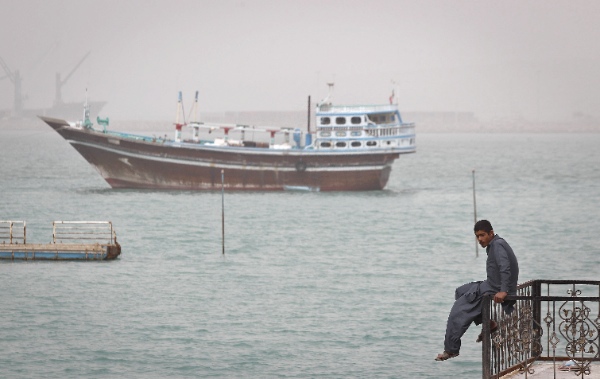
An Iranian man sits on the beach in the port city of Chabahar, southeastern Iran, on March 7, 2015 [Xinhua]
The BRICS Post | May 7, 2015
As New Delhi aims to take advantage of a thaw in Tehran’s relations with world powers, India and Iran have reached a deal on Wednesday to develop a strategic port in southeast Iran.
Abbas Ahmad Akhoundi, Iranian Minister for Transport and Urban Development and his Indian counterpart Nitin Gadkari signed an inter-Governmental Memorandum of Understanding (MoU) regarding India’s participation in the development of the Chabahar Port in Iran.
“With the signing of this MoU, Indian and Iranian commercial entities will now be in a position to commence negotiations towards finalisation of a commercial contract under which Indian firms will lease two existing berths at the port and operationalise them as container and multi-purpose cargo terminals,” the Indian Foreign Ministry said in a statement.
Richard Verma, US Ambassador in India, cautioned against “rushing in” with the deal saying there is no guarantee that a final deal will be secured with Tehran by a June 30 deadline.
India intends to lease two berths at Chabahar for 10 years. The port will be developed through a special purpose vehicle (SPV) which will invest $85.21 million to convert the berths into a container terminal and a multi-purpose cargo terminal.
The port of Chabahar in southeast Iran is central to India’s efforts to open up a route to landlocked Afghanistan where it has developed close security ties and economic interests.
“The availability of a functional container and multipurpose cargo terminal at Chabahar Port would provide Afghanistan’s garland road network system alternate access to a sea port, significantly enhancing Afghanistan’s overall connectivity to regional and global markets, and providing a fillip to the ongoing reconstruction and humanitarian efforts in the country,” said the Indian Foreign Ministry late on Wednesday evening.
Iranian President Hassan Rouhani, in his meeting with the Indian Minister in Tehran said, “Resumption of Iran-India cooperation in the southeastern Iranian port city of Chabahar would lead to a new chapter in relations of two countries.”
Meanwhile, India’s fellow BRICS member, South Africa is sending a delegation headed by its Foreign Minister for talks with Iranian leaders.
South Africa hopes to restore energy ties with Iran, its energy minister, Tina Joemat-Pettersson, said on Sunday.
How to Turn a Nightmare into a Fairy Tale
40 Years Later, Will the End Games in Iraq and Afghanistan Follow the Vietnam Playbook?
By Christian Appy | TomDispatch | April 26, 2015
If our wars in the Greater Middle East ever end, it’s a pretty safe bet that they will end badly — and it won’t be the first time. The “fall of Saigon” in 1975 was the quintessential bitter end to a war. Oddly enough, however, we’ve since found ways to re-imagine that denouement which miraculously transformed a failed and brutal war of American aggression into a tragic humanitarian rescue mission. Our most popular Vietnam end-stories bury the long, ghastly history that preceded the “fall,” while managing to absolve us of our primary responsibility for creating the disaster. Think of them as silver-lining tributes to good intentions and last-ditch heroism that may come in handy in the years ahead.
The trick, it turned out, was to separate the final act from the rest of the play. To be sure, the ending in Vietnam was not a happy one, at least not for many Americans and their South Vietnamese allies. This week we mark the 40th anniversary of those final days of the war. We will once again surely see the searing images of terrified refugees, desperate evacuations, and final defeat. But even that grim tale offers a lesson to those who will someday memorialize our present round of disastrous wars: toss out the historical background and you can recast any U.S. mission as a flawed but honorable, if not noble, effort by good-guy rescuers to save innocents from the rampaging forces of aggression. In the Vietnamese case, of course, the rescue was so incomplete and the defeat so total that many Americans concluded their country had “abandoned” its cause and “betrayed” its allies. By focusing on the gloomy conclusion, however, you could at least stop dwelling on the far more incriminating tale of the war’s origins and expansion, and the ruthless way the U.S. waged it.
Here’s another way to feel better about America’s role in starting and fighting bad wars: make sure U.S. troops leave the stage for a decent interval before the final debacle. That way, in the last act, they can swoop back in with a new and less objectionable mission. Instead of once again waging brutal counterinsurgencies on behalf of despised governments, American troops can concentrate on a humanitarian effort most war-weary citizens and soldiers would welcome: evacuation and escape.
Phony Endings and Actual Ones
An American president announces an honorable end to our longest war. The last U.S. troops are headed for home. Media executives shut down their war zone bureaus. The faraway country where the war took place, once a synonym for slaughter, disappears from TV screens and public consciousness. Attention shifts to home-front scandals and sensations. So it was in the United States in 1973 and 1974, years when most Americans mistakenly believed that the Vietnam War was over.
In many ways, eerily enough, this could be a story from our own time. After all, a few years ago, we had reason to hope that our seemingly endless wars — this time in distant Iraq and Afghanistan — were finally over or soon would be. In December 2011, in front of U.S. troops at Fort Bragg, North Carolina, President Obama proclaimed an end to the American war in Iraq. “We’re leaving behind a sovereign, stable, and self-reliant Iraq,” he said proudly. “This is an extraordinary achievement.” In a similar fashion, last December the president announced that in Afghanistan “the longest war in American history is coming to a responsible conclusion.”
If only. Instead, warfare, strife, and suffering of every kind continue in both countries, while spreading across ever more of the Greater Middle East. American troops are still dying in Afghanistan and in Iraq the U.S. military is back, once again bombing and advising, this time against the Islamic State (or Daesh), an extremist spin-off from its predecessor al-Qaeda in Iraq, an organization that only came to life well after (and in reaction to) the U.S. invasion and occupation of that country. It now seems likely that the nightmare of war in Iraq and Afghanistan, which began decades ago, will simply drag on with no end in sight.
The Vietnam War, long as it was, did finally come to a decisive conclusion. When Vietnam screamed back into the headlines in early 1975, 14 North Vietnamese divisions were racing toward Saigon, virtually unopposed. Tens of thousands of South Vietnamese troops (shades of the Iraqi army in 2014) were stripping off their military uniforms, abandoning their American equipment, and fleeing. With the massive U.S. military presence gone, what had once been a brutal stalemate was now a rout, stunning evidence that “nation-building” by the U.S. military in South Vietnam had utterly failed (as it would in the twenty-first century in Iraq and Afghanistan).
On April 30, 1975, a Communist tank crashed through the gates of Independence Palace in the southern capital of Saigon, a dramatic and triumphant conclusion to a 30-year-long Vietnamese struggle to achieve national independence and reunification. The blood-soaked American effort to construct a permanent non-Communist nation called South Vietnam ended in humiliating defeat.
It’s hard now to imagine such a climactic conclusion in Iraq and Afghanistan. Unlike Vietnam, where the Communists successfully tapped a deep vein of nationalist and revolutionary fervor throughout the country, in neither Iraq nor Afghanistan has any faction, party, or government had such success or the kind of appeal that might lead it to gain full and uncontested control of the country. Yet in Iraq, there have at least been a series of mass evacuations and displacements reminiscent of the final days in Vietnam. In fact, the region, including Syria, is now engulfed in a refugee crisis of staggering proportions with millions seeking sanctuary across national boundaries and millions more homeless and displaced internally.
Last August, U.S. forces returned to Iraq (as in Vietnam four decades earlier) on the basis of a “humanitarian” mission. Some 40,000 Iraqis of the Yazidi sect, threatened with slaughter, had been stranded on Mount Sinjar in northern Iraq surrounded by Islamic State militants. While most of the Yazidi were, in fact, successfully evacuated by Kurdish fighters via ground trails, small groups were flown out on helicopters by the Iraqi military with U.S. help. When one of those choppers went down wounding many of its passengers but killing only the pilot, General Majid Ahmed Saadi, New York Times reporter Alissa Rubin, injured in the crash, praised his heroism. Before his death, he had told her that the evacuation missions were “the most important thing he had done in his life, the most significant thing he had done in his 35 years of flying.”
In this way, a tortured history inconceivable without the American invasion of 2003 and almost a decade of excesses, including the torture and abuse at Abu Ghraib, as well as counterinsurgency warfare, finally produced a heroic tale of American humanitarian intervention to rescue victims of murderous extremists. The model for that kind of story had been well established in 1975.
Stripping the Fall of Saigon of Historical Context
Defeat in Vietnam might have been the occasion for a full-scale reckoning on the entire horrific war, but we preferred stories that sought to salvage some faith in American virtue amid the wreckage. For the most riveting recent example, we need look no further than Rory Kennedy’s 2014 Academy Award-nominated documentary Last Days in Vietnam. The film focuses on a handful of Americans and a few Vietnamese who, in defiance of orders, helped expedite and expand a belated and inadequate evacuation of South Vietnamese who had hitched their lives to the American cause.
The film’s cast of humanitarian heroes felt obligated to carry out their ad hoc rescue missions because the U.S. ambassador in Saigon, Graham Martin, refused to believe that defeat was inevitable. Whenever aides begged him to initiate an evacuation, he responded with comments like, “It’s not so bleak. I won’t have this negative talk.” Only when North Vietnamese tanks reached the outskirts of Saigon did he order the grandiloquently titled Operation Frequent Wind — the helicopter evacuation of the city — to begin.
By that time, Army Captain Stuart Herrington and others like him had already led secret “black ops” missions to help South Vietnamese army officers and their families get aboard outgoing aircraft and ships. Prior to the official evacuation, the U.S. government explicitly forbade the evacuation of South Vietnamese military personnel who were under orders to remain in the country and continue fighting. But, as Herrington puts it in the film, “sometimes there’s an issue not of legal and illegal, but right and wrong.” Although the war itself failed to provide U.S. troops with a compelling moral cause, Last Days in Vietnam produces one. The film’s heroic rescuers are willing to risk their careers for the just cause of evacuating their allies.
The drama and danger are amped up by the film’s insistence that all Vietnamese linked to the Americans were in mortal peril. Several of the witnesses invoke the specter of a Communist “bloodbath,” a staple of pro-war propaganda since the 1960s. (President Richard Nixon, for instance, once warned that the Communists would massacre civilians “by the millions” if the U.S. pulled out.) Herrington refers to the South Vietnamese officers he helped evacuate as “dead men walking.” Another of the American rescuers, Paul Jacobs, used his Navy ship without authorization to escort dozens of South Vietnamese vessels, crammed with some 30,000 people, to the Philippines. Had he ordered the ships back to Vietnam, he claims in the film, the Communists “woulda killed ‘em all.”
The Communist victors were certainly not merciful. They imprisoned hundreds of thousands of people in “re-education camps” and subjected them to brutal treatment. The predicted bloodbath, however, was a figment of the American imagination. No program of systematic execution of significant numbers of people who had collaborated with the Americans ever happened.
Following another script that first emerged in U.S. wartime propaganda, the film implies that South Vietnam was vehemently anti-communist. To illustrate, we are shown a map in which North Vietnamese red ink floods ever downward over an all-white South — as if the war were a Communist invasion instead of a countrywide struggle that began in the South in opposition to an American-backed government.
Had the South been uniformly and fervently anti-Communist, the war might well have had a different outcome, but the Saigon regime was vulnerable primarily because many southern Vietnamese fought tooth and nail to defeat it and many others were unwilling to put their lives on the line to defend it. In truth, significant parts of the South had been “red” since the 1940s. The U.S. blocked reunification elections in 1956 exactly because it feared that southerners might vote in Communist leader Ho Chi Minh as president. Put another way, the U.S. betrayed the people of Vietnam and their right to self-determination not by pulling out of the country, but by going in.
Last Days in Vietnam may be the best silver-lining story of the fall of Saigon ever told, but it is by no means the first. Well before the end of April 1975, when crowds of terrified Vietnamese surrounded the U.S. embassy in Saigon begging for admission or trying to scale its fences, the media was on the lookout for feel-good stories that might take some of the sting out of the unremitting tableaus of fear and failure.
They thought they found just the thing in Operation Babylift. A month before ordering the final evacuation of Vietnam, Ambassador Martin approved an airlift of thousands of South Vietnamese orphans to the United States where they were to be adopted by Americans. Although he stubbornly refused to accept that the end was near, he hoped the sight of all those children embraced by their new American parents might move Congress to allocate additional funds to support the crumbling South Vietnamese government.
Commenting on Operation Babylift, pro-war political scientist Lucien Pye said, “We want to know we’re still good, we’re still decent.” It did not go as planned. The first plane full of children and aid workers crashed and 138 of its passengers died. And while thousands of children did eventually make it to the U.S., a significant portion of them were not orphans. In war-ravaged South Vietnam some parents placed their children in orphanages for protection, fully intending to reclaim them in safer times. Critics claimed the operation was tantamount to kidnapping.
Nor did Operation Babylift move Congress to send additional aid, which was hardly surprising since virtually no one in the United States wanted to continue to fight the war. Indeed, the most prevalent emotion was stunned resignation. But there did remain a pervasive need to salvage some sense of national virtue as the house of cards collapsed and the story of those “babies,” no matter how tarnished, nonetheless proved helpful in the process.
Putting the Fall of Saigon Back in Context
For most Vietnamese — in the South as well as the North — the end was not a time of fear and flight, but joy and relief. Finally, the much-reviled, American-backed government in Saigon had been overthrown and the country reunited. After three decades of turmoil and war, peace had come at last. The South was not united in accepting the Communist victory as an unambiguous “liberation,” but there did remain broad and bitter revulsion over the wreckage the Americans had brought to their land.
Indeed, throughout the South and particularly in the countryside, most people viewed the Americans not as saviors but as destroyers. And with good reason. The U.S. military dropped four million tons of bombs on South Vietnam, the very land it claimed to be saving, making it by far the most bombed country in history. Much of that bombing was indiscriminate. Though policymakers blathered on about the necessity of “winning the hearts and minds” of the Vietnamese, the ruthlessness of their war-making drove many southerners into the arms of the Viet Cong, the local revolutionaries. It wasn’t Communist hordes from the North that such Vietnamese feared, but the Americans and their South Vietnamese military allies.
The many refugees who fled Vietnam at war’s end and after, ultimately a million or more of them, not only lost a war, they lost their home, and their traumatic experiences are not to be minimized. Yet we should also remember the suffering of the far greater number of South Vietnamese who were driven off their land by U.S. wartime policies. Because many southern peasants supported the Communist-led insurgency with food, shelter, intelligence, and recruits, the U.S. military decided that it had to deprive the Viet Cong of its rural base. What followed was a long series of forced relocations designed to remove peasants en masse from their lands and relocate them to places where they could more easily be controlled and indoctrinated.
The most conservative estimate of internal refugees created by such policies (with anodyne names like the “strategic hamlet program” or “Operation Cedar Falls”) is 5 million, but the real figure may have been 10 million or more in a country of less than 20 million. Keep in mind that, in these years, the U.S. military listed “refugees generated” — that is, Vietnamese purposely forced off their lands — as a metric of “progress,” a sign of declining support for the enemy.
Our vivid collective memories are of Vietnamese refugees fleeing their homeland at war’s end. Gone is any broad awareness of how the U.S. burned down, plowed under, or bombed into oblivion thousands of Vietnamese villages, and herded survivors into refugee camps. The destroyed villages were then declared “free fire zones” where Americans claimed the right to kill anything that moved.
In 1967, Jim Soular was a flight chief on a gigantic Chinook helicopter. One of his main missions was the forced relocation of Vietnamese peasants. Here’s the sort of memory that you won’t find in Miss Saigon, Last Days in Vietnam, or much of anything else that purports to let us know about the war that ended in 1975. This is not the sort of thing you’re likely to see much of this week in any 40th anniversary media musings.
“On one mission where we were depopulating a village we packed about sixty people into my Chinook. They’d never been near this kind of machine and were really scared but they had people forcing them in with M-16s. Even at that time I felt within myself that the forced dislocation of these people was a real tragedy. I never flew refugees back in. It was always out. Quite often they would find their own way back into those free-fire zones. We didn’t understand that their ancestors were buried there, that it was very important to their culture and religion to be with their ancestors. They had no say in what was happening. I could see the terror in their faces. They were defecating and urinating and completely freaked out. It was horrible. Everything I’d been raised to believe in was contrary to what I saw in Vietnam. We might have learned so much from them instead of learning nothing and doing so much damage.”
What Will We Forget If Baghdad “Falls”?
The time may come, if it hasn’t already, when many of us will forget, Vietnam-style, that our leaders sent us to war in Iraq falsely claiming that Saddam Hussein possessed weapons of mass destruction he intended to use against us; that he had a “sinister nexus” with the al-Qaeda terrorists who attacked on 9/11; that the war would essentially pay for itself; that it would be over in “weeks rather than months”; that the Iraqis would greet us as liberators; or that we would build an Iraqi democracy that would be a model for the entire region. And will we also forget that in the process nearly 4,500 Americans were killed along with perhaps 500,000 Iraqis, that millions of Iraqis were displaced from their homes into internal exile or forced from the country itself, and that by almost every measure civil society has failed to return to pre-war levels of stability and security?
The picture is no less grim in Afghanistan. What silver linings can possibly emerge from our endless wars? If history is any guide, I’m sure we’ll think of something.
Christian Appy, professor of history at the University of Massachusetts, is the author of three books about the Vietnam War, including the just-published American Reckoning: The Vietnam War and Our National Identity (Viking).
Copyright 2015 Christian Appy

What Happened to $1.3 Billion of Taxpayer Money Sent Directly to U.S. Military Officers in Afghanistan? Pentagon won’t Say
By Steve Straehley | AllGov | April 27, 2015
The Department of Defense (DOD) refuses to detail what it did with $1.3 billion that was supposed to be used on urgent humanitarian and reconstruction projects.
A report (pdf) from Special Inspector General for Afghan Reconstruction (SIGAR) John Sopko pointed out that $2.26 billion had been put into the Commander’s Emergency Response Program (CERP). That funding is meant to be used primarily for small projects estimated to cost less than $500,000 involving such issues as transportation, electricity and education. This year, most of the money will be used for condolence payments when civilians are killed or injured or property is damaged by U.S. forces and to increase security for communities that happen to be located near active U.S. military bases.
However, according to the SIGAR report, the Defense Department is given “broad authority to spend CERP funds notwithstanding other provisions of law. As a result, projects supported by CERP funds are not bound by procurement laws or the Federal Acquisition Regulation.”
The Army’s official guidance on CERP projects is “CERP is a quick and effective method that provides an immediate, positive impact on the local population while other larger reconstruction projects are still getting off the ground. The keys to project selection are: Execute quickly; Employ many people from the local population; Benefit the local population; Be highly visible.”
But the SIGAR report said “DOD could only provide financial information relating to the disbursement of funds for CERP projects totaling $890 million (40%) of the approximately $2.2 billion in obligated funds at that time.” The other $1.3 billion of the CERP money that has been sent to Afghanistan has been spent on projects classified as “unknown.”
What’s worse is that according to the Pentagon’s response to the report, some of the money went to war-fighting instead of helping Afghan civilians. “Although the report is technically accurate, it did not discuss the Counter Insurgency (COIN) strategies in relationship to CERP. In addition, the 20 users [sic] of CERP funds, it was also used as a tool for COIN. CERP funds were, and continue to be used to build goodwill between the people of Iraq and/or Afghanistan and the United States in an effort to gain their support in fighting the insurgency. In many cases CERP’s main effort was the COIN aspect verse the actual project being procured.”
So, from the part of that statement that makes any sense, it would appear that the money was siphoned off from approved uses and into counter insurgency, which is not among the 20 approved uses for CERP funds.
To Learn More:
Pentagon Can’t Account for $1 Billion in Afghan Reconstruction Aid (by James Rosen, McClatchy )
Department of Defense Commander’s Emergency Response Program (CERP): Priorities and Spending in Afghanistan for Fiscal Years 2004-2014 (Special Inspector General for Afghan Reconstruction) (pdf)
Commander’s Emergency Response Program (Center for Army Lessons Learned)
After 6 Years, Obama’s Pentagon Suddenly Declares Details of Afghanistan War “Classified” (by Noel Brinkerhoff, AllGov )
U.S. Wasted $7.6 Billion to Fight Poppy Cultivation in Afghanistan…Which is Now at an All-Time High (by Noel Brinkerhoff, AllGov )
U.S. Wasted $34 Million Pushing Soybeans on Afghanistan (by Noel Brinkerhoff, AllGov )
Pentagon Leads PR Campaign to Counter Critical Inspector General Reports on Afghanistan (by Noel Brinkerhoff and Danny Biederman, AllGov )
Harsh Inspector General Report Says 0 of 16 Afghan Agencies can be Trusted with U.S. Aid (by Noel Brinkerhoff and Danny Biederman, AllGov )
U.S. Funded Industrial Park in Afghanistan Found With Only One Business and No Electricity . . . And Missing Records
By Jonathon Turley | April 23, 2015
We have yet another example of how we are wasting billions of dollars in Afghanistan where a combination of incompetence and corruption continues to drain the U.S. treasury. This week, SIGAR released two reports showing how, an inspection of the $7.8 million Shorandam Industrial Park in Kandahar is an utter failure and how the money to create a sustainable source of power for Kandahar City has left the city literally in the dark. Once again, there is no indication of any discipline or action taken against those who approve such projects and oversee such failures.
I have previously written about the waste of billions of dollars by the government without any significant discipline of government officials. We have become accustomed to reports of unimaginable corruption and waste in Afghanistan from bags of money delivered to officials to constructing huge buildings immediately torn down to buying aircraft that cannot be used to buildings that seem to “melt away”. Much like our useless campaign against poppy production where we continued to spend billions because no one had the courage to end or change the program.
In this latest case, SIGAR found only one active Afghan business at the park, which was designed to accommodate 48 businesses. Notably, SIGAR inspectors found that they could not full assess the site because there was a lack of electricity and the contract files were mysteriously missing — leaving them also both literally and figuratively in the dark.
The missing contract files are a signature for our contractors in Afghanistan. An inspection of USAID-funded facility at Gorimar Industrial Park in Balkh province also found the files missing.
Government watchdog doubts $400 million USAID program for Afghan women is working
RT | April 3, 2015
A $416 million program to empower Afghan women may leave them “without any tangible benefit” instead, a government watchdog warned, urging USAID to provide more data on the controversial project.
The Promoting Gender Equity in National Priority Programs – Promote, for short – was announced last November as part of US reconstruction efforts in Afghanistan. Its stated intent is to empower some 75,000 Afghan women between the ages of 18 and 30 to become political, business and civil service leaders, and engage girls ages 14 through 18 in “leadership development programs.”
However, the Special Inspector General for Afghanistan Reconstruction (SIGAR) warned that the US Agency for International Development (USAID) has not shown what the program would actually do, provided for adequate safeguards and controls of the contractors involved, or even accounted for half the funding Promote is supposed to receive.
“I am concerned that some very basic programmatic issues remain unresolved and that the Afghan women engaged in the program may be left without any tangible benefit upon completion,” John F. Sopko wrote in a letter to the USAID acting administrator, made public Thursday.
“I do hope that we are not going to fall again into the game of contracting and sub-contracting and the routine of workshops and training sessions generating a lot of certificates on paper and little else,” Sopko said, quoting the words of Afghanistan’s First Lady, Rula Ghani, from a November 2014 conference.
Though his staff was briefed on Promote in late February, Sopko wrote, “USAID could not provide the audit team a list of all the agency’s projects, programs, and initiatives intended to support Afghan women, or how much the agency spent on each effort.”
“USAID was also unable to provide data demonstrating a causal relationship or correlation between the agency’s efforts to support Afghan women and improvements in Afghan women’s lives,” he added.
In October 2014, USAID announced the award of five-year, “indefinite-delivery/indefinite quantity” contracts for Promote to three companies: Chemonics International, Development Alternatives and Tetra Tech. According to the agency, USAID would provide $216 million for the program, while another $200 million would come from unspecified foreign donors.
The SIGAR is questioning the basis of this estimate, since USAID failed to produce any supporting documentation, including any memorandum of the understanding between the three contractors and the Afghan government.
“Of this $416 million, how much will be spent in Afghanistan on Afghan women, and how much will be spent on security and overhead costs for the three contractors and program implementers?” the SIGAR asked. Sopko also raised the issue of USAID’s “sustainability plan,” asking whether any steps were taken to ensure the program survived past the US withdrawal from Afghanistan.
Read more: Expensive chaos: Billions of dollars meant for Afghanistan development wasted
Conservatives will ‘rip up’ human rights laws, halt war crime claims, say Tory ministers
RT | April 1, 2015
Soldiers will be safe from the “persistent human rights claims” that have dogged the British military for years because the Conservatives will “rip up” human rights legislation if they win the general election, two top Tories have pledged.
Defence Secretary Michael Fallon called for an end to what he called the “abuse” of the Human Rights Act to bring about costly inquiries into the conduct of British soldiers during wartime operations in Iraq and Afghanistan.
He warned that legal claims such as those emerging from the Iraq War had undermined the military’s work and had cost the taxpayer millions of pounds.
Fallon told the Daily Mail : “This abuse has got to stop and the next Tory government will limit the reach of human rights cases to the UK so our forces overseas are not subject to persistent human rights claims.”
Justice Secretary Chris Grayling MP added his voice on Tuesday, telling the Mail: ‘We can’t go on with a situation where our boys are hamstrung by human rights laws … I made it clear last year that I want to rip up Labour’s Human Rights Act and that it is only the Conservatives who will make real changes to the human rights framework to restore some common sense.”
The pledge reflects a broader Tory commitment to remove the UK from the European Convention on Human Rights (ECHR) and instead develop a British Bill of Rights in its place.
It is said this would then govern the actions of UK troops on operations and take proper account of the pressures faced by service personnel in wartime if legal cases arise.
The MP’s comments come in the wake of a study by a right-wing think tank released on Monday
It argued that Britain must scrap the European Convention on Human Rights (ECHR) in times of warfare because British soldiers cannot fight under the restraints of “judicial imperialism.”
Offering enemy combatants the right to sue the British government and expecting soldiers on the battlefield to operate with the same level of caution as police patrolling London streets will render future foreign combat operations unworkable, the report by Policy Exchange said.
The British military establishment has been dogged by inquiries into allegations of human rights abuses on the battlefield perpetrated by UK forces.
Although the Al Sweady investigation into allegations of murder and mutilation of Iraqis by British troops in 2004 found the majority of accusations “completely baseless” in December last year, there are still cases pending.
Last month, the High Court ruled that grieving families of Iraqis gunned down by British soldiers in Iraq may sue Britain’s Ministry of Defence (MoD) for violating international law.
The milestone ruling could pave the way for over 1,200 claims, brought by Iraqi families.
British law firm Public Interest Lawyers (PIL), which specializes in judicial review cases relating to human rights violations, would represent the claimants.
Featured Video

Why Hamas Really Attacked Israel on Oct. 7
or go to
Aletho News Archives – Video-Images
From the Archives
Israel: Strategic Ally or Liability?
By Stephen Sniegoski | My Catbird Seat | June 12, 2010
The claim that Israel serves as a valuable ally for the United States is made by both pro-Zionists and much of the anti-war and anti-Zionist Left that is influenced by Noam Chomsky. As a result of the Gaza flotilla massacre, which has caused a world-wide uproar against Israel, the value of Israel to the United States is being publicly questioned in more mainstream foreign policy forums. … continue
Blog Roll
 Aletho News
- Why Hamas Really Attacked Israel on Oct. 7
- Declassified UK exposes British man who fought for ‘Israel’ in Gaza
- West’s death cult in a theater near you
- How the Yandex ‘Russian bots’ lie fell apart
- Burnham’s ‘Russia did Brexit’ ruse crumbles
- Estonia making movies and games to encourage war against Russia
- Four in five new UK jobs taken by foreigners – report
- Here’s what Trump’s latest U-turn really means for Russia and Ukraine
- The Houthis Are Not an Iranian Proxy
- Europe’s Energy Hypocrisy, Russian LNG Profits and US Dependence
- If Americans Knew
- Activists Abused By Israel Return to New Freedom Flotilla Mission
- 60 Minutes won’t tell the full truth about Israeli settler violence
- Nearly 50,000 women, girls killed or severely injured in Gaza since October 2023: UN Women
- ADL is working with AI companies to suppress alleged ‘antisemitism’
- Israeli occupation forces using social media surveillance unit to target hundreds of Palestinians in the West Bank
- Israel’s New – and Terrifying – Security Doctrine
- Israeli Attacks Kill Five in Gaza, Including a four-year-old and a woman
- Air Force Major Who Called for Trump’s Impeachment Held in Solitary Confinement
- It’s a Genocide, I’m Into It’: Seinfeld Mocks Protest over Palestinian Children Killed
- Universities fire dozens amid pressure from Zionist billionaires
- No Tricks Zone
- New Study Suggests Large Regions Of The Pacific Ocean Have Been Cooling For The Last 80 Years
- Germany’s Green Energy Debacle: High Energy Costs Force Kahla Porzellan to Close After 182 Years!
- New Study: 50 Years Of The Most Aggressive ‘Net Zero’ Policies Can Only Affect The Global Climate By 0.03°C
- US September “Heat” Was No Record…Many Records Set Decades Ago
- Latest European Green Energy Debacle; Portugal’s Largest Flagship Solar Park Insolvent!
- Green Energy Debacle: German Expert Professor Fritz Vahrenholt Warns Of Severe Economic And Social Consequences
- Two More Paleo Reconstructions Affirm Meters-Higher Sea Levels Across Ireland, Brazil 7000-6000 Years Ago
- New Study: Earth And Venus Surface Warmth Largely Explained By Convection And Lapse Rate, Not CO2 Or Radiation
- 2025 Nature Paper Claiming Worsening Global Drought Gets RETRACTED …Heavily Flawed
- New Study: ‘Global Drought Shows No Detectable Recent Acceleration Under Climate Warming’

