Wolf Pack vs. Bear
By Anne Williamson | LewRockwell | April 16, 2015
Having now had a year’s time to get better acquainted with their new Ukrainian friends and the neighborhood overall, Europeans are losing their taste for economic sanctions on Russia.
Contrary to American assurances, economic warfare against Russia meant to compel the return of Crimea to Ukraine hasn’t worked. Nor did the Ukrainian military’s campaign against the Donbas tame the Russian “aggression” mainstream media shouts about daily. All Europe has achieved to date is tens of billions in lost trade and Russia’s abandonment of the South Stream pipeline.
The Russians were building South Stream to insure the – politely put – “integrity” of gas flows to Europe while in transit across Ukraine, and put an end to the country’s 24-year racket of holding Russia’s energy commerce with Europe hostage by virtue of having inherited a key segment of the Soviet pipeline network. The loss of jobs and transit revenues their participation in the construction and operation of South Stream promised was keenly felt in Hungary, Bulgaria, Serbia, Slovenia, Croatia, Macedonia and Bosnia-Herzegovina. Austria, France, Italy, Cyprus, Luxembourg, the Czech Republic and Germany have all taken serious losses thanks to the trade sanctions as well.
Trade and employment losses coupled with some USD 40 billions more in IMF loans to Kiev, whose proceeds are most likely to be spent – at the US’s insistence – on yet more war, and the growing misery of all the Ukrainian people are typical of the now familiar results of US-organized sedition abroad. However, those results are usually observed in militarily weak, third world nations the US chooses to undermine for whatever reasons, and certainly not on the continent their most loyal and most capable allies occupy.
Besides which, the whole cockamamie story the US has been pushing vis a vis Crimea is falling apart. The fact that one year on there are no Crimean protests and no “Back to Kiev!” grass root committees has undermined the entire premise of the sanctions. Even year long multiple polling by western agencies has shown that large majorities of Crimeans have no regrets concerning the 2014 reunification with their motherland of some 300 years.
In truth, the world owes a debt of gratitude to the Russians. While US State Department operatives busied themselves in Kiev with constructing an interim, post-coup government of fascist stooges and native oligarchs, the Russians’ deft and lightening re-absorption of a willing Crimea took the meat right off the table. The American greenhorns in Kiev were left dumbfounded, and hopping mad.
With the Black Sea port of Sevastopol safely in Russian hands, and the country’s immediate strategic interests secure, there was no need for war. Given time, the Russians know Ukraine as presently constituted will defeat Ukraine, and that not even a Himalaya of dollars and the sacrifices of several generations of Ukrainians will put the country back together again. Default will be Ukraine’s only escape route.
But it is the antics of hyperbolic NATO operatives (Dragoon Ride, a Conga line of armored Stryker vehicles and troops rolling across Europe from the Baltics to central Europe in a “show of force,”) the bloviating of chest-beating US generals (the only way “to turn the tide” is “to start killing Russians”) and the dumb bellicosity of the US Congress for having authorized the export of lethal weaponry to Kiev that finally got the EU leadership looking sideways at one another. Just exactly what has the US gotten them into?
But it was the EU itself who bought, by bits and by pieces, into America’s scheme. The events in Ukraine have left the European Union naked before her own members’ populations, exposed as a highly-bureaucratized system of US vassalage so thoroughly in harness individual nations actually agreed to harm their own economies in pursuit of US policies. There’s a reason for the EU’s acquiescence: The EU and its leadership stands to gain should State Department neoconservatives deliver on their promises. The EU will get bigger and its artificial and suffocating institutions more deeply entrenched.
How so?
The only direction in which the EU can expand is to the East. Ukraine, Moldova, Transdniestr, Armenia and Georgia were all believed ripe for the taking, and each is or was being pursued with EU “association agreements,” which subvert each country to EU dictates while holding the prize of EU membership in abeyance.
Absorbing such contrarily-organized lands is the work of decades. No matter. Their capture alone will enable the ECB to go on an immediate super-binge of vendor financing, which it is believed will conjure up jobs, export profits, and, the ECB (European Central Bank) hopes, a new round of euro-based credit expansion and piratization that will, in the fullness of time, strip the newly “associated” lands and their citizens of their savings and property. Once the fiat money-engineered boom begins to fade, the expectation is that ongoing economic warfare against Russia, directed and policed by the US, will at last bear fruit. Only a small shove and a slight push will be needed to topple and then shatter Russia into bite-sized pieces for the west’s further consumption.
So set upon this course is the US that the White House’s recent offer of a slippery framework to Iran to conclude the Israeli-manufactured dispute over the country’s nuclear enrichment program has the look of arbitrage, indicating there are limits to just how much havoc Washington can create and oversee abroad. Besides, Iran is currently useful in the conflict with the US-created ISIS. With sanctions lifted, the flood of Iranian oil and gas coming to market would further harm Russia’s economic interests while supporting the building of new pipelines to Europe originating in the Middle East and North Africa (under indirect US control) and sparing any further need for US ally Saudi Arabia to continue pumping low-priced oil for which there is insufficient global demand.
As long as Angela Merkel keeps Germany on board, and Germany continues to fund the stagnant EU, the US’s high-tech version of a medieval siege of the Kremlin can proceed.
With new multilateral treaties agreed under cover of tax and banking transparency (FATCA) now in place, the US is well on its way to being able to track in real time every currency unit on the planet that is emitted, earned, deposited, withdrawn, spent, invested, loaned, and borrowed by means of the banks, long seen as a US-engineered globalism’s most effective police force. European governments’ war on cash is meant to insure all commerce will flow through the banks and therefore be recorded. These new surveillance capabilities will be exploited to the maximum in the case of both Russia and hesitant Europeans for the purposes of blackmail, extortion, and control.
In a digital battlescape staffed by the west’s soldiers of finance, winter will not save the Russians.
Another attack strategy the US is about to deploy, drawn not from history but from nature, is that of the wolf pack. Though NATO troops will bedevil Russia’s borders, no western troops will actually set foot on Russian territory prior to the country’s imminent collapse. That would be dangerous, but the more proxy wars and political upheavals the US can stir up along Russia’s periphery while the motherland suffers and declines under the west’s economic blockade, the better.
Necessary and experienced personnel are being appointed and NGOs beefed up in preparation for brewing new crises and rainbow revolutions along Russia’s “soft, underbelly”: the Nagorno-Karabakh enclave, which both Armenia and Azerbaijan claim, in Kyrgyzstan where the south and the north are alienated from one another, in Uzbekistan where control of the Fergana Valley is in dispute with Kyrgyzstan, and in Georgia, which hopes for the return of Ossetia and Abkhazia. Carrots and sticks will miraculously set many a fire.
Keeping those flames under control will seriously tax Russia’s resources.
US objectives include busting up the Collective Security Treaty Organization (CSTO), whose members include Armenia, Belarus, Kazakhstan, Kyrgyzstan, Russia and Tajikistan, the Shanghai Cooperation Organization (SCO), whose members include China, Kazakhstan, Kyrgyzstan, Tajikistan, Uzbekistan, and Russia, and the Eurasian Economic Union (EAEU), whose members – to date – include Armenia, Belarus, Kazakhstan, Kyrgyzstan, and Russia.
However, there are problems with the above scenarios unfolding as planned.
US foreign policy assumes everyone on the planet wants to be an American, or – second best – a recipient of American interest and munificence, a notion which the state has successfully sold only to movie-mad foreign teenagers and naive Americans. Rather than being an advertisement for the benefits of American intervention, the Ukraine America is building might better serve as one for the beneficial avoidance of same through membership in the EAEU.
Russia is hardly new to the protection game. Armenia and Georgia, the first Christian nations on earth, soon found themselves unmoored in a sea of Islam. Each petitioned the Kremlin for inclusion into the empire. They wanted and needed the protection of the “Third Rome,” and they got it. Today Armenia wisely continues to huddle close to Russia, eschewing the opportunity of becoming a battle station in any anti-Azeri US campaign, while a US-enamored Georgia still chafes at the protection the US provides their former proxy, the corrupt Saakashvili regime. Azerbaijan has but to look at Iran to see what misfortune the US is quite willing to hand round. Uzbekistan and Kyrgyzstan have the example of their war torn neighbor, US-occupied Afghanistan, to contemplate.
US foreign policy further assumes that targets will stand still and only stare into the blinding glare of America’s oncoming headlights.
Russia’s abrupt shut down of the South Stream gas pipeline’s construction and the rapid replacement of European entry points and participants with a single exit point in Turkey from which Russian gas will flow to the rest of Europe through Greece along pipes it is now the EU’s responsibility to finance and build has put paid to that assumption. It is not only Russia that has an exploitable “soft underbelly.”
Despite the mainstream media’s shameless dissemination of western governments’ fatuous propaganda, and of what is sure to be an exploding supply of tit for tat, sufficient information is available to anyone who cares to look to determine who is destroying and who is trying to build, who is seeking peaceful co-operation and increasing trade and commerce between nations and who is demanding obedience to its diktat while waving a mailed fist.
To paraphrase Mae West, “Democracy has nothin’ to do with it.”
It is certainly an irony of history, wild and raw, that Vladimir Putin, a man who once described himself as “a pure and utterly successful product of a Soviet patriotic education,” is today seen by an increasing number of alarmed citizens worldwide as liberty’s if not civilization’s best, if inadvertent and imperfect, hope. But those souls should have no illusions. Whatever the Russian president does, he will do for Russia’s sake, not ours.
But if Russia cannot stand, we will all sink together into tyranny or eternity.
The American Aggression Enablement Act and the US’ Eurasian Thrust (II)
By Andrew KORYBKO | Oriental Review | August 1, 2014
Part II: Destabilization by Design
The second thrust of the US’ aggression in Eurasia is the purposeful destabilization of Russia’s interests in the Near Abroad. Specifically, the AAEA’s provisions would lead to an endangered security situation for Belarus, mayhem in Moldova, and an aggravation of the Nagorno-Karabakh situation between Azerbaijan and Armenia. All of these work against Russian interests and place Moscow on the strategic defensive.
Bunkering in Belarus:
One of the US’ designs is to bunker Belarus in and surround it with offensive NATO military capabilities. American aggression against Belarus is old news, going back most sensationally to the mid-2000s when Condoleeza Rice declared the country to be the “last dictatorship in Europe”, thereby putting its head on the chopping block for regime change. Although unsuccessful in overthrowing the government via a Color Revolution, Washington still pumps millions of dollars into the country to support “democracy” (likely in the same vein and with the same intended result as it did in Ukraine with its $5 billion investment). If the AAEA’s goal of placing permanent NATO bases in Poland and the Baltics comes to fruition, as well as the goal of Shadow NATO integration of Ukraine, Belarus could very well find itself almost surrounded by hostile forces pressuring it to accede to their demands. Making the situation even more high-risk, Belarus and Russia have a mutual security agreement via the CSTO, meaning that any act of force against Belarus will be treated as an act against Russia itself. This remarkably raises the stakes of NATO’s power play and increases the chance of direct conflict with Russia.
Moldovan Meltdown:

Flying largely under the radar of most analysts, Moldova is prime for a full-scale meltdown as it is rushed into Western institutions. First and foremost, the country already signed the EU Association Agreement in late June and, for the first time in its history, will be sending a representative to the upcoming NATO summit in September. Although nominal neutrality is a hallmark of the country’s constitution, this does not mean that it cannot enter Shadow NATO via major non-NATO ally designation or potentially enact a ‘referendum’ to change this statute.
What is critical here is that there are two ticking time bombs in Moldova that will likely go off as Western ‘integration’ proceeds at record speed; Transnistria and the lesser-known Gagauzia. The former is the renowned frozen conflict from the 1990s where Russia still has over a thousand troops stationed. It voted to join the Russian Federation in 2006 but to no avail. In May, Deputy PM Dmitry Rogozin was harassed by Moldovan security after he visited Transnistria to collect signatures in favor of reunification with Russia. His plane was forced to land in Chisinau after Ukrainian and Moldovan authorities restricted their airspace to him, creating a diplomatic incident which would be unthinkable to do to a Western politician, let alone of such stature. Moreover, the territory is currently experiencing a blockade by both Moldova and Ukraine. Transnistria does not accept the authority of Chisinau and sees no attraction to the EU, instead preferring the Russian-led Eurasian Union. These radically divergent paths, coupled with NATO’s ambitions and Russia’s existing military position, place Moldova on the brink of destabilization.
Not only that, but Gagauzia is also a simmering issue waiting to boil over. Ari Rusila conducted research on this relatively unknown entity back in April and found that, just like Transnistria, it too is moving closer to Russia. Just as fast as Moldova is moving westward, Gagauzia appears to be moving eastward, and it is asserting its self-determination with every step of the way. He writes that it held a February 2014 referendum to join the Customs Union and that it also voted to place independence on the table if Moldova loses or surrenders its sovereignty. These two options could be taken to mean joining the EU or merging with Romania, and if Gagauzia officially moves away from the centralized Moldovan state, it could lead to military reprisals by Chisinau. All that it takes to set off the two Transnistrian and Gagauzian time bombs is to shove Moldova into the EU and NATO, both of which are already being fast-tracked by the West.
Asphyxiating Armenia:
Lost in the mix of the more headline-grabbing aspects of the AAEA, the legislation also mandates that the US increase its military cooperation with Azerbaijan and provide the same amount of security assistance to it, in league with NATO, as it would to the major non-NATO allies and Balkan states. This is an exceptionally important detail that mustn’t be overlooked by any observer. Armenia, Azerbaijan’s bitter rival, made the fateful decision to turn its back on the EU and move towards the Eurasian Union, much to the ire of Brussels. Hillary Clinton, speaking on behalf of the State Department in late-2012, made known her country’s intention to “figure out effective ways to slow down or prevent” Eurasian integration, signaling that Armenia, after having made its decision to move in this direction, will now be targeted just like Ukraine was.
 Azerbaijan and Armenia are locked in the Nagorno-Karabakh conflict which, although frozen, threatens to heat up at any moment. By throwing its hat squarely behind Azerbaijan, the US is showing that it is not a neutral party to the conflict and cannot be trusted within the OSCE Minsk Group. The move for a more clearly defined and open US-Azeri military alliance has been a long time in coming, however. The US has been using Azerbaijan as a geostrategic energy outpost between Russia and Iran since the 1990s, and the creation of the BTC pipeline only increased its significance in the eyes of Western decision makers. Baku is also close friends with Israel, supplying about 40% of its oil, and it has been rumored to host Israeli drone bases for use against Iran. The Jerusalem Post also reports that Israel sells “hundreds of millions of dollars worth of arms” to the country, further cementing their military-strategic relationship.
Armenia, on the other hand, has a mutual security guarantee with Russia through the CSTO, just like Belarus does. It is a traditional Russia ally and even hosts the 102nd military base outside the capital of Yerevan. Armenia has been blockaded by both Turkey and Azerbaijan since the early 1990s, and the vast majority of its foreign trade must move through Georgia before going to Russia or to other countries via port. With Georgia trying to join the EU, the scenario could arise where costly tariffs are enacted against outside (Armenian) goods entering the Union, even if they are only transiting through, further strangling the already weakened Armenian economy and promoting social unrest. To put things into perspective, Azerbaijan’s defense budget is larger than the entire state budget of Armenia, and Azeri President Aliyev has a track record of threatening military force to retake Nagorno Karabkah.
In sum, any renewed outbreak of war between Azerbaijan (now close to becoming a US military ally) and Armenia (protected under Russia’s defense umbrella) would be a de-facto US-Russian proxy war that could quickly draw in both powers. What’s more, Azerbaijan closely cooperates with Turkey, with whom it has close ethnic, cultural, and linguistic ties, and Ankara’s involvement in any future conflict could quickly draw in the entire NATO alliance. By cozying up so closely with Azerbaijan and working to asphyxiate Armenia, the US is pushing itself closer to a direct conflict with Russia.
Concluding Thoughts
It has been definitively established that the US’ so-called ‘Russian Aggression Prevention Act’ is nothing more than Orwellian Doublespeak for an American Aggression Enablement Act. Aside from the more well-known aspects of the proposal, the lesser-known ones are just as significant in throwing America and its NATO clique closer to war with Russia. By rabidly expanding NATO at all costs via indirect means, the US is plainly showing that it does not care whatsoever for Russia’s security concerns. In fact, it wants to push the envelope and expand NATO in as many simultaneous directions as it can. The swallowing of the Balkans, the staging ground of Russia’s strategic South Stream project, and the movement to incorporate Sweden and Finland into NATO are Washington’s way of imposing full dominance over the continent’s last nominally neutral areas, a move which will surely lead to a determined Russian push back, especially as regards the defense of Serbia and NATO expansion into Finland.
Furthermore, the AAEA aims to threaten Russian interests in Belarus, Moldova, and Armenia, three countries where Moscow has deployed troops and two of which are mutual security partners. This is a calculated attempt at weakening Russia’s position in the Near Abroad and continuing to place it on the strategic defense. All together, everything within the American Aggression Enablement Act clearly shows that the US has strapped up its boots and is eager to go on the offensive against Russia. The ‘Reset’ was nothing more than an underhanded way to buy the necessary time to organize this campaign against all of Russia’s interests on its western flank, and it appears to be in full swing. If it passes into law, the bill will be seen in hindsight as the one action which single-handedly ushered in the ‘New Cold War’ and could quite possibly revert Europe back to the powder keg that it once was 100 years ago.
US Probes South Caucasus’ Attitude to Iran
Nezavisimaya Gazeta | October 18, 2012
Eric Rubin, US Deputy Assistant Secretary of State for Europe and Eurasian Affairs, is touring Azerbaijan, Georgia and Armenia to promote democracy and cooperation and develop partnership on the issues of Syria and Iran.
The media in Azerbaijan reports that Rubin’s visit to Georgia focused on economic issues, civil freedoms and Nagorno-Karabakh.
The US Embassy in Armenia’s press service said Rubin would attend a meeting of the US-Armenian group on economic cooperation to discuss stimulating investment in energy and trade, as well as nuclear power.
The agenda for high-ranking Washington officials’ visits to the South Caucasus seldom varies, and this is not simply because Azerbaijan, Georgia and Armenia face largely similar problems, but also for ethical reasons. Washington wants to convince them that they are all equal partners. Therefore, if Rubin talked about Iran in Georgia, he did or will do the same in the other two South Caucasus states.
“During the meetings with the President and future Prime Minister of Georgia, we discussed the international community’s efforts to prevent Iran from developing nuclear weapons,” Rubin told a press briefing at the US Embassy in Tbilisi as quoted by Azernews. “We are broadly cooperating over the Turkish-Syrian issue, and Georgia is called upon to play a peacekeeping role in the region.”
However, some Georgian experts believe that Rubin met with Mikheil Saakashvili and Bidzina Ivanishvili to probe Georgia’s attitude to Iran, where Washington will want Georgia to play a special role if the situation escalates.
Georgian politician Irina Sarishvili said before Rubin’s visit that many hospitals built in Georgia recently under a presidential program bear an alarming likeness to standard US military hospitals. Considering the speedy modernization and construction of airports for heavy transport planes and other infrastructure improvements, this could be more than straightforward concern for the Georgians.
Eric Rubin also said in Tbilisi, clearly referring to Russian bases in Abkhazia and South Ossetia that “the US position regarding the obligations that Russia undertook in 2008 to withdraw its troops from the Georgian territory remain unchanged.” He said the US stance on the sovereignty and territorial integrity of Georgia is firm and clear.
Commenting on the recent parliamentary election, Rubin congratulated Ivanishvili on the victory and praised Saakashvili’s personal contribution to positive developments in Georgia. He said the world can see that democracy in Georgia is real, and that the country can become a model for the region.
Rubin also met with ministerial nominees, notably Irakly Alasania who is slated to become the Defense Minister. Alasania assured him that Georgia would honor its commitments in Afghanistan. In response, Rubin said that Washington would redouble its efforts to promote Georgia’s rapprochement with NATO.
The US official refused to comment on Ivanishvili’s plans to participate in the Sochi Winter Olympics in 2014. He said he was pleased with Saakashvili’s assurances that Georgia is committed to strengthening ties with Euro-Atlantic organizations and the United States, and to guaranteeing press freedom.
Featured Video
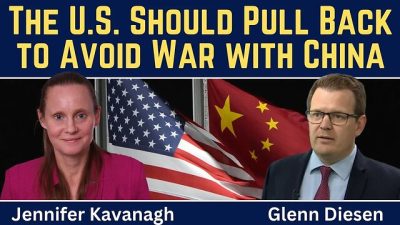
Why the U.S. Should Pull Back From the First Island Chain
or go to
Aletho News Archives – Video-Images
Book Review
‘Why Fauci Must Rot in Prison’: A Tale of Two Diaries
By Jill Erzen | The Defender | October 13, 2026
Dr. Anthony Fauci’s private diary reveals a “mind-numbing” contradiction between what the former top U.S. infectious disease official knew about COVID-19 and what he told the public, senior White House adviser Peter Navarro, Ph.D., said last week on “American Thought Leaders.”
In his new book, “Why Fauci Must Rot in Prison,” due out Oct. 20, Navarro compares Fauci’s private entries to his own pandemic-era diary, and uses what he calls “a tale of two diaries” to argue that Fauci should face criminal prosecution.
“I show, actually, how a prosecution can and should happen … at the state level, most likely,” Navarro said. “He should wind up in prison, and we’ve got the receipts in this book to put him there.”
Navarro said Fauci repeatedly acknowledged important facts in private, then publicly pursued policies that contradicted those facts — with devastating consequences.
“What he says many times privately in his diary is so at odds with both his public behavior and public statements that it’s mind-numbing,” Navarro said.
Navarro examines the lasting damage caused by lockdowns and other pandemic policies, and the ongoing toll of long COVID.
His book also addresses questions about vaccine safety, including why healthy young people faced COVID-19 vaccination mandates despite concerns about myocarditis, and why women were not warned about miscarriage risks linked to the shots. … continue
Blog Roll
 Aletho News
- Jennifer Kavanagh: Why the U.S. Should Pull Back From the First Island Chain
- Yemen denounces international community’s silence on Saudi aggression, siege
- UAE and Saudi Arabia move toward renewed coordination against Sanaa
- How Iran’s two-week retaliatory strikes exposed cracks in US military architecture in Persian Gulf
- The mother of all propaganda: Why the hype over US MOAB strike against Iran is nothing but theater
- Iran says it possesses technology behind US 14-ton GBU bunker-buster
- Trump asks Iran not to retaliate after he strikes Pickaxe Mountain – w/ Prof. Marandi
- Vice President J.D. Vance’s Deceptive ‘Antiwar’ Campaign Speech
- Iran: Palestinians’ rights must not be compromised in Gaza’s future; US, Israel to blame for Hormuz situation
- Ongoing tales of Syrian chemical weapons
- If Americans Knew
- Israeli rabbi permits occupiers to steal Palestinian olive harvest in West Bank
- Netanyahu’s spin on latest settler attack is laughable – Daily Update
- Israeli soldiers debunk Israel’s talking points
- In West Bank, Israeli settlers are totally out of control – Daily Update
- NPR investigation finds evidence of widespread fraud at mall kiosks tied to Israeli skincare brand
- Tucker Carlson exposes Israeli Lies about the Oct 7th attack, Charlie Kirk, and the U.S.
- Israel has detained thousands of Palestinian children since Oct 7th – over half spent time in solitary, many uncharged
- Israeli Analysis: Is Netanyahu Planning an ‘October Surprise’ Attack Before Israel’s Election?
- Israeli settlers brutally attack Palestinians and Washington Post female photographer, 65
- Words Have Changed, Occupation Continues: The Reality of the Gaza Ceasefire
- No Tricks Zone
- Predictions Made By Renowned Climate Proifessor Over Past Decades Have Been Proven To Be Poor
- New Study Suggests Large Regions Of The Pacific Ocean Have Been Cooling For The Last 80 Years
- Germany’s Green Energy Debacle: High Energy Costs Force Kahla Porzellan to Close After 182 Years!
- New Study: 50 Years Of The Most Aggressive ‘Net Zero’ Policies Can Only Affect The Global Climate By 0.03°C
- US September “Heat” Was No Record…Many Records Set Decades Ago
- Latest European Green Energy Debacle; Portugal’s Largest Flagship Solar Park Insolvent!
- Green Energy Debacle: German Expert Professor Fritz Vahrenholt Warns Of Severe Economic And Social Consequences
- Two More Paleo Reconstructions Affirm Meters-Higher Sea Levels Across Ireland, Brazil 7000-6000 Years Ago
- New Study: Earth And Venus Surface Warmth Largely Explained By Convection And Lapse Rate, Not CO2 Or Radiation
- 2025 Nature Paper Claiming Worsening Global Drought Gets RETRACTED …Heavily Flawed

