Israelis Linked to Settler Terrorism were from U.S. Families
By Steve Straehley and Noel Brinkerhoff | AllGov | September 9, 2015
A horrific act of terrorism in the West Bank this summer is suspected to have been perpetrated by Israeli extremists with American roots.
In the village of Duma on July 31, the home of a Palestinian family was firebombed, killing an 18-month-old child, Ali Dawabsheh, who was burned to death, according to media reports. The child’s father, Sa’ed and four-year-old brother Ahmed suffered serious burns, but survived. Ali’s mother, Riham, died Sunday of her burns. Their home was sprayed with graffiti reading “revenge” in Hebrew and featured a Star of David.
“All available evidence suggests that the blaze was a deliberate act of settler terrorism,” Sara Yael Hirschhorn wrote at The New York Times. “More disturbingly, several of the alleged instigators, currently being detained indefinitely, are not native-born Israelis — they have American roots.”
Although not so far charged with the fire that killed the Dawabshehs, four youths believed to be connected to settler terrorism have been incarcerated by Israeli officials. They are Meir Ettinger, 24, grandson of Meir Kahane, a radical American rabbi who served in Israel’s parliament; Mordechai Meyer, 18, the son of American immigrants; American Ephraim Khantsis; and Eviatar Slonim, the child of Australian Jews.
The fire is thought to be a so-called “price tag” attack. Radical Israeli settlers commit such crimes as a response to their government’s efforts to dismantle illegal West Bank Jewish settlements.
To Learn More:
Israeli Terrorists, Born in the U.S.A. (by Sara Yael Hirschhorn, New York Times )
How the Killing of an 18-Month-Old Boy in the West Bank Exposed the Israeli Authorities Failure to Stem Tide of Jewish Extremists (by Ben Lynfield, The Independent )
Israelis Killed more Palestinians Last Year than in any Year since 1967 (by David Wallechinsky and Steve Straehley, AllGov )
U.S. Only Country of 47 to Vote against Investigating Possible Human Rights Violations during Israeli Occupation of Gaza (by Noel Brinkerhoff, AllGov )
Moscow ready for more sanctions, regardless of Ukraine crisis – Foreign Ministry
RT | September 9, 2015
Russia has no illusion about sanctions being lifted and expects them to be stiffened in future, regardless of developments in Eastern Ukraine. That’s according to a leading Russian diplomat, who says Moscow can live under continuous western pressure.
“We believe that in certain directions, notwithstanding of the developments in Donbass, we should expect toughening of the sanctions pressure,” Russian Deputy Foreign Minister Sergey Ryabkov said at the Russia Arms Expo 2015 in Nizhny Tagil on Wednesday.
According to Ryabkov, the new set of sanctions introduced by Washington last week against Russian companies, including arms exporter Rosoboronexport, “mirrors the policy of complicating operations of the Russian military-industrial complex and all of the mechanism of government.”
Sanctions come in handy as a “true instrument of aggressive foreign policy” aimed at Russia, the diplomat said.
“Russia’s independent and self-sufficient foreign policy, its decisiveness to protect its sovereignty, and the consolidation of the people with the country’s leadership serve as a thorn in the side of our opponents,” Ryabkov said.
“We presume that the sanctions are there for the long haul,” Ryabkov said. “There are no reasons or illusions that sanctions are going to be lifted in the short term, at least not in the Foreign Ministry.”
“When it comes to international financial services, our colleagues from the US and the EU are set to expand their effort to seal off all capabilities. We understand that and we have to learn how to operate in the given situation,” Ryabkov said, insisting that sanctions will fail to gain the desired effect.
“We’re sorry the US has not learned that truth so far.”
Russian Economic Development Minister Aleksey Ulyukaev said Moscow is going to seek a “symmetrical answer” to American sanctions imposed on September 2.
Washington imposed sanctions on a number of Russian, Chinese, Syrian, Turkish, Sudanese and Iranian companies, believed to be involved in activities which, according to Washington, go against its Nonproliferation Act in regard to Iran and Syria.
“These are not sectoral sanctions, they are personalized, therefore we would consider some kind of a symmetrical answer,” Ulyukaev said.
In March 2014, the EU, the US and some other countries imposed individual sanctions against 21 Russian and Ukrainian officials, subjecting them to asset freezes and travel bans. Within a year, the list was extended to 150 people, including Russian Deputy Prime Ministers Dmitry Kozak and Dmitry Rogozin, as well as presidential aide Vladislav Surkov and 37 entities that, according to the EU, are “responsible for actions which undermine or threaten the territorial integrity, sovereignty and independence of Ukraine.”
The restrictions have been prolonged until January 31, 2016.
To reciprocate, in August 2014 Moscow introduced a ban on importing meat, dairy, fruit, and vegetable products from countries that have imposed sanctions on Russia over the Ukraine conflict. The countries included EU member states and Norway, US, Canada and Australia.
European Union sanctions against Russia include restrictions on lending to major Russian state-owned banks, as well as defense and oil companies. In addition, Brussels imposed restrictions on the supply of weapons and military equipment to Russia as well as military technology, dual-use technologies, high-tech equipment and technologies for oil production. No sanctions were imposed against Russia’s gas industry.
Aussie cop charged for leaking footage of fellow officers beating detainee
RT | August 24, 2015
Gold Coast police officer Sergeant Rick Flori may spend up to seven years behind bars for leaking CCTV footage showing his fellow officers brutalizing a young chef, Noa Begic, while he was handcuffed in the Surfers Paradise Police Station basement.
Flori, who leaked the footage of the dramatic incident to the Brisbane Courier-Mail, was formally charged with misconduct in public office after being summoned to police headquarters in Brisbane last week, the newspaper reported. The footage taken in 2012 shows police officers slamming Begic’s face into the concrete floor before the 21-year-old is shoved into the back of a van and brutally punched a number of times by one cop while another holds him.
The video then shows Begic’s blood being routinely washed away by a senior-sergeant who would later quit the force before any adverse findings were made by internal investigators. The senior-constable who threw the punches was only given a suspended dismissal, according to the Courier-Mail. The other two officers involved were reportedly not disciplined at all.
According to Sydney Criminal Lawyers, police allege that Flori, who had spent a quarter of a century in the Queensland Police Force until he was suspended earlier this year, committed the offence by ‘inappropriately obtain[ing]’ confidential surveillance footage from the police CCTV room.
Section 91A of the Queensland Criminal Code 1899 makes it an offence for a public officer, including a police officer, to release information gained as a result of their office. The prosecution must now prove that the act was done with the intention of dishonestly gaining a benefit for Flori or another person, or dishonestly causing a detriment to another person, Sydney Criminal Lawyers report.
The victim of the bashing, Begic, was arrested and charged with ‘public nuisance’ and ‘obstructing police’. The charges against him were later dropped and he won a confidential settlement from the Queensland Police Service, the newspaper reported. After his charges were dropped in June 2012, Begic said it would be “a disgrace” if the officer who leaked the video was punished.
A complaint has been made by Council of Civil Liberties (a voluntary organization concerned with the protection of individual rights and civil liberties) to the Crime and Corruption Commission (CCC) which, according to Sydney Criminal Lawyers, is the same body that made the decision not to prosecute the officers involved in the bashing.
“How is it that the police who were shown on the video as belting the crap out of this particular person have not been charged and yet the person who has leaked it is now being charged with an offence which could put him in jail?” Deputy President Terry O’Gorman told the team of lawyers.
The acting chair of the CCC said she had asked staff involved in the incident to compile details about the matter.
“I accept that needs to be looked at and we agree that police excessive use of force is one of the top five problems with police and we will be looking at that,” she told ABC radio.
Last month supporters of Flori gathered outside the Southport Magistrates Court to praise the officer and show outrage over the four involved in the incident.
Aussie cop charged for leaking footage of fellow officers beating detainee
RT | August 24, 2015
Gold Coast police officer Sergeant Rick Flori may spend up to seven years behind bars for leaking CCTV footage showing his fellow officers brutalizing a young chef, Noa Begic, while he was handcuffed in the Surfers Paradise Police Station basement.
Flori, who leaked the footage of the dramatic incident to the Brisbane Courier-Mail, was formally charged with misconduct in public office after being summoned to police headquarters in Brisbane last week, the newspaper reported. The footage taken in 2012 shows police officers slamming Begic’s face into the concrete floor before the 21-year-old is shoved into the back of a van and brutally punched a number of times by one cop while another holds him.
The video then shows Begic’s blood being routinely washed away by a senior-sergeant who would later quit the force before any adverse findings were made by internal investigators. The senior-constable who threw the punches was only given a suspended dismissal, according to the Courier-Mail. The other two officers involved were reportedly not disciplined at all.
According to Sydney Criminal Lawyers, police allege that Flori, who had spent a quarter of a century in the Queensland Police Force until he was suspended earlier this year, committed the offence by ‘inappropriately obtain[ing]’ confidential surveillance footage from the police CCTV room.
Section 91A of the Queensland Criminal Code 1899 makes it an offence for a public officer, including a police officer, to release information gained as a result of their office. The prosecution must now prove that the act was done with the intention of dishonestly gaining a benefit for Flori or another person, or dishonestly causing a detriment to another person, Sydney Criminal Lawyers report.
The victim of the bashing, Begic, was arrested and charged with ‘public nuisance’ and ‘obstructing police’. The charges against him were later dropped and he won a confidential settlement from the Queensland Police Service, the newspaper reported. After his charges were dropped in June 2012, Begic said it would be “a disgrace” if the officer who leaked the video was punished.
A complaint has been made by Council of Civil Liberties (a voluntary organization concerned with the protection of individual rights and civil liberties) to the Crime and Corruption Commission (CCC) which, according to Sydney Criminal Lawyers, is the same body that made the decision not to prosecute the officers involved in the bashing.
“How is it that the police who were shown on the video as belting the crap out of this particular person have not been charged and yet the person who has leaked it is now being charged with an offence which could put him in jail?” Deputy President Terry O’Gorman told the team of lawyers.
The acting chair of the CCC said she had asked staff involved in the incident to compile details about the matter.
“I accept that needs to be looked at and we agree that police excessive use of force is one of the top five problems with police and we will be looking at that,” she told ABC radio.
Last month supporters of Flori gathered outside the Southport Magistrates Court to praise the officer and show outrage over the four involved in the incident.
China, India, Russia largest shareholders in China-led bank
The BRICS Post | June 29, 2015
Fifty countries on Monday signed the articles of agreement for the new China-led Asian Infrastructure Investment Bank, the first major global financial instrument independent from the Bretton Woods system.
Seven remaining countries out of the 57 that have applied to be founding members, Denmark, Kuwait, Malaysia, Philippines, Holland, South Africa and Thailand, are awaiting domestic approval.
“This will be a significant event. The constitution will lay a solid foundation for the establishment and operation of the AIIB,” said Chinese Finance Minister Lou Jiwei.
The AIIB will have an authorized capital of $100 billion, divided into shares that have a value of $100,000.
BRICS members China, India and Russia are the three largest shareholders, with a voting share of 26.06 per cent, 7.5 per cent and 5.92 per cent, respectively.
Following the signing of the bank’s charter, the agreement on the $100 billion AIIB will now have to be ratified by the parliaments of the founding members.
Asian countries will contribute up to 75 per cent of the total capital and be allocated a share of the quota based on their economic size.
Chinese Vice Finance Minister Shi Yaobin said China’s initial stake and voting share are “natural results” of current rules, and may be diluted as more members join.
Australia was first to sign the agreement in the Great Hall of the People in Beijing on Monday, state media reports said.
The Bank will base its headquarters in Beijing.
The Chinese Finance Ministry said the new lender will start operations by the end of 2015 under two preconditions: At least 10 prospective members ratify the agreement, and the initial subscribed capital is no less than 50 per cent of the authorized capital.
The AIIB will extend China’s financial reach and compete not only with the World Bank, but also with the Asian Development Bank, which is heavily dominated by Japan.
China and other emerging economies, including BRICS, have long protested against their limited voice at other multilateral development banks, including the World Bank, International Monetary Fund and Asian Development Bank (ADB).
China is grouped in the ‘Category II’ voting bloc at the World Bank while at the Asian Development Bank, China with a 5.5 per cent share is far outdone by America’s 15.7 per cent and Japan’s 15.6 per cent share.
The ADB has estimated that in the next decade Asian countries will need $8 trillion in infrastructure investments to maintain the current economic growth rate.
China scholar Asit Biswas at the Lee Kuan Yew School of Public Policy, Singapore, says Washington’s criticism of the China-led Bank is “childish”.
“Some critics argue that the AIIB will reduce the environmental, social and procurement standards in a race to the bottom. This is a childish criticism, especially because China has invited other governments to help with funding and governance,” he writes.
The US and Japan have not applied for the membership in the AIIB.
However, despite US pressures on its allies not to join the bank, Britain, France, Germany, Italy among others have signed on as founding members of the China-led Bank.
Meanwhile, New Zealand and Australia have already announced that they will invest $87.27 million and $718 million respectively as paid-in capital to the AIIB.
The new lender will finance infrastructure projects like the construction of roads, railways, and airports in the Asia-Pacific Region.
Iran, 49 states sign Asia bank charter
Press TV June 29, 2015
Iran on Monday joined 49 countries in signing up to the Asian Infrastructure Investment Bank (AIIB), bringing Asia’s largest financial lender a step closer to existence.
Finance and Economy Minister Ali Tayebnia put Iran’s signature to the bank’s articles of association at a ceremony in Beijing’s Great Hall of the People, which capped six months of intense negotiations.
In April, China accepted Iran as a founding member of the Asian Infrastructure Investment Bank being seen as a rival to the US-led World Bank, the International Monetary Fund (IMF) and the Asian Development Bank.
With the signing which amounted to the creation of AIIB’s legal framework, China’s Finance Minister Lou Jiwei said he was confident the bank could start functioning before the end of the year.
Seven more founding members would ink the articles after approval by their respective governments.
The bank will have a capital of $100 billion in the form of shares, each worth $100,000, distributed among the members. Beijing will be by far the largest shareholder at about 30%, followed by India at 8.4% and Russia at 6.5%.
China will also have 26% of the votes which are not enough to give it a veto on decision-making, while smaller members will have larger voice.
Singapore’s Senior Minister for Finance and Transport Josephine Teo said the bank will provide new opportunities for its members’ businesses and promote sustainable growth in Asia.
Seventy-five percent of AIIB’s shares are distributed within the Asian region while the rest is assigned among countries beyond it.
Germany, France and Brazil are among the non-Asian members of the bank despite US efforts to dissuade allies from joining it. Another US ally joining AIIB is Australia but Japan has stayed away from it.
Countries beyond the region can expand their share but the portion cannot be bigger than 30%. Public procurement of the AIIB will be open to all countries around the world.
But the president of the bank will have to be chosen from the Asian region for a maximum of two consecutive five-year terms.
The bank will be headquartered in Beijing and its lean structure will be overseen by an unpaid, non-resident board of directors which, architects say, would save it money and friction in decision-making.
Earlier this month, former Federal Reserve chairman Ben Bernanke rebuked US lawmakers for allowing China to found the new bank, which threatens to upend Washington’s domination over the world economic order.
He said lawmakers were to blame because they refused to agree 2010 reforms that would have given greater clout to China and other emerging powers in the International Monetary Fund.
NSA Spying Ruled Illegal, But Will Congress Save the Program Anyway?
By Ron Paul | May 10, 2015
This week the Sixth Circuit Court of Appeals ruled that the NSA’s metadata collection program was not authorized in US law. The PATRIOT Act, under which the program began, was too vague, the court found. But the truth is the Act was intended to be vague so that the government could interpret it in the broadest possible way.
But this is really more of a technicality, because illegality and unconstitutionality are really two very different things. Even if Congress had explicitly authorized the government to collect our phone records, that law would still be unconstitutional because the Constitution does not grant government the power to access our personal information without a valid search warrant.
Even though the court found the NSA program illegal, it did not demand that the government stop collecting our information in this manner. Instead, the court kicked the ball back in Congress’ court, as these provisions of the PATRIOT Act are set to expire at the end of the month and the Appeals Court decided to let Congress decide how to re-authorize this spying program.
Unfortunately, this is where there is not much to cheer. If past practice is any lesson, Congress will wait until the spying program is about to expire and then in a panic try to frighten Americans into accepting more intrusions on their privacy. Senate Majority Leader Mitch McConnell has already put forth a new bill as a stop-gap measure to allow time for a fuller debate on the issue. His stop-gap? A five year re-authorization with no changes to the current program!
The main reform bill being floated, the FREEDOM Act, is little better. Pretending to be a step in the right direction, the FREEDOM Act may actually be worse for our privacy and liberties than the PATRIOT Act!
One silver lining in the court decision is that it should exonerate Ed Snowden, who risked it all to expose what the courts have now found was illegal US government activity. That is the definition of a whistleblower. Shouldn’t he be welcomed back home as a hero instead of being threatened with treason charges? We shouldn’t hold our breath!
This week Snowden addressed a conference in Melbourne, Australia, informing citizens that the Australian government watches all its citizens “all the time.” Australia’s program allows the government to “collect everyone’s communications in advance of criminal suspicion,” he told the conference. That means the government is no longer in the business of prosecuting crimes, but instead is collecting information in case crimes someday occur.
How is it that the Australian government can collect and track “pre-crime” information on its citizens? Last month Australia passed a law requiring telecommunications companies to retain metadata information on their customers for two years.
Why do Australia’s oppressive laws matter to us? Because the NSA “reform” legislation before Congress, the FREEDOM Act, does exactly what the Australian law does: it mandates that US telecommunications companies retain their customers’ metadata information so that the NSA can access the information as it wishes.
Some argue that this metadata information is harmless and that civil libertarians are over-reacting. But, as Ed Snowden told the Melbourne conference, “under these mandatory metadata laws you can immediately see who journalists are contacting, from which you can derive who their sources are.”
This one example of what happens when the government forces corporations to assist it in spying on the people should be a red flag. How can an independent media exist in the US if the government knows exactly whom journalists contact for information? It would be the end of any future whistleblowers.
The only reform of the PATRIOT Act is a total repeal. Accept nothing less.
The Trans-Pacific Sellout
Guaranteed profits—at any price
By Jason Hirthler | Dissident Voice | April 26, 2015
Last Tuesday, President Barack Obama told beltway bullhorn Chris Matthews that Senator Elizabeth Warren was “wrong” about the Trans-Pacific Partnership (TPP), the largest trade deal in American history, linking United States and Australia, Brunei, Canada, Chile, Japan, Malaysia, Mexico, New Zealand, Peru, Singapore and Vietnam in a pervasive and binding treaty. The president was referring to Warren’s claim that the trade treaty will license corporations to sue governments, and her contention that this was, to put it mildly, a bad idea.
Warren isn’t wrong, Obama is. And he knows it. The entire TPP, as understood, is based on a single overarching idea: that regulation must not hinder profiteering. This is a fundamentally anti-democratic concept that—if implemented—would effectively eliminate the power of a demos to make its own law. The final authority on any law’s validity would rest elsewhere, beyond the reach of popular sovereignty. From the TPP point-of-view, democracy is just another barrier to trade, and the corporate forces behind the draft treaty are intent on removing that barrier. Simple as that.
That’s why the entire deal has been negotiated in conclave, deliberately beyond the public purview, since the president and his trade representatives know that exposing the deal to the unforgiving light of popular scrutiny would doom it to failure. That’s why the president, like his mentor President Clinton, has lobbied hard for Trade Promotion Authority, or Fast Track, which reduces the Congressional role in the passage of the bill to a ‘yea’ or ‘nay.’
Cracks have begun to show in the formidable cloak behind which the deal has been structured. A coalition of advocacy groups advanced on the U.S. Trade Representatives office this week. Wikileaks has obtained and released chapters from the draft document. Senator Harry Reid declared his position on Fast Track as “… not only no, but hell no.” Warren has proved to be a persistent thorn in the side of White House efforts to smooth over troubling issues with the deal. But the monied interests that rule the beltway have all pressed for passage. And as a Fast Track draft makes its way through Congress, stakes are high. The TPP is, in the apt estimation of political activist Jim Hightower, a “corporate coup d’état.”
Not for the first time, the president and his Republican enemies are yoked by the bipartisan appeal of privilege against this faltering fence of protest. The marriage of convenience was described in last Friday’s sub-head to a New York Times article on TPP: “G.O.P. Is Allied With President Against His Own Party.”
All The Usual Suspects
Who else supports the TPP? Aside from this odd confection of neoliberals, the corporations that rule the beltway feverishly back the TPP. From the leak of Sony digital data we learn that it and its media peers have enthusiastically pressed for the passage of the deal. Sony is joined by major agricultural beneficiaries (Monsanto), mining companies like Infinito Gold, currently suing Costa Rica to keep an ecology-harming mine pit active, as well as pharmaceutical coalitions negotiating stiff intellectual property rights unpopular even in Congress, and various other technology and consumer goods groups. And don’t forget nicotine kingpins like Philip Morris.
Obama reinforces the corporate line: “We have the opportunity to open even more new markets to goods and services backed by three proud words: Made in America.” Perhaps he isn’t aware that our leading export is the workforce that once took pride in that moniker. We’ve exported five million manufacturing jobs since 1994, largely thanks to NAFTA, the model on which the TPP is built. The TPP will only continue that sad trend. The only jobs not being offshored are the ones that can’t be: bartenders and waitresses and health care assistants. That’s the Obama economy: a surfeit of low-wage service jobs filled by debt-saddled degree holders. As Paul Craig Roberts argued in The Failure of Laissez Faire Capitalism, between 2007 and 2014, some eight million students would graduate from American universities and likely seek jobs in the United States. A mere one million degree-requiring jobs would await them. The irony of Obama’s statement is that the TPP would actually move to strip the use of labels like, “Buy American,” since they unduly advocate for local goods.
In truth, the authors of the treaty already know all this. The bill concedes as much, with Democrats building in some throwaway provisions of unspecified aid to workers whose jobs have been offshored, and a tax credit to ostensibly help those ex-workers purchase health insurance. Cold comfort for the jobless, as they are exhorted by the gutless paladins of globalization to ‘toughen up’ and deal with the harsh realities of a globalized economy. As neoliberal stooge Thomas Friedman has said, companies in the glorious global marketplace never hire before they ask, “Can this person add value every hour, every day — more than a worker in India, a robot or a computer?” Of course, the answer is invariably no, so the job goes to Bangladesh or a robot. No moral equation ever enters the picture. Just market discipline for the vulnerable and ingenious efforts by a captive state to shelter capital from the market dynamics it would force on others.
The Investment Chapter
Despite Obama’s disingenuous clichés about “… fully enforceable protections for workers’ rights, the environment and a free and open Internet,” the trade deal makes it clear that labor law and environmental law are both barriers to profitability. We know this thanks to Wikileaks, which once again proved its inestimable value by acquiring and releasing another chapter from the cloak-and-dagger negotiations. This time it was the investment chapter, in which so much of the treaty’s raison d’etre is expressed.
As Public Citizen points out in its lengthy analysis of the chapter, any domestic policy that infringes on an investor’s “right” to a regulatory framework that conforms to their “expectations,” is grounds for a suit. Namely, the suit may be pressed to “the extent to which the government action interferes with distinct, reasonable investment-backed expectations.”
Here’s what the TPP says about such legislation as it relates to investor expectations:
For greater certainty, whether an investor’s investment-backed expectations are reasonable depends, to the extent relevant, on factors such as whether the government provided the investor with binding written assurances and the nature and extent of governmental regulation or the potential for government regulation in the relevant sector.
Try putting that tax on financial transactions. Forget it. Barrier to a reasonable return. Don’t believe it? Just read the TPP investment protocols that would ban capital controls, which is what a financial tax is considered to be by TPP proponents. Try passing that environmental legislation. Not a chance. Hindrance to maximum shareholder value. Just ask Germany how it felt when a Swiss company sued it for shutting down its nuclear industry after Fukushima. Try enacting that youth safety law banning tobacco advertising. Sorry. Needless barrier to profits. Just ask Australia, which is being sued by Philip Morris for trying to protect kids from tar and nicotine.
Public Citizen has tabulated that, “The TPP would newly empower about 9,000 foreign-owned firms in the United States to launch ISDS cases against the U.S. government, while empowering more than 18,000 additional U.S.-owned firms to launch ISDS cases against other signatory governments.” It found that “foreign investors launched at least 50 ISDS claims each year from 2011 through 2013, and another 42 claims in 2014.” If these numbers seem small, recall that for a crucial piece of labor legislation to be struck down, only one firm need win in arbitration in order to financially hamstring a government and set a precedent that would likely ice the reformist urge of future legislatures.
As noted earlier, the text also appears to suggest to ban the practice of promoting domestic goods over foreign—another hurdle to shareholder value. This would effectively prohibit a country from implementing an import-substitution economy without threat of being sued. Governments would be relieved of tools, like tariffs, historically used to protect fledgling native industries. This is exactly what IMF prescriptions often produce—agricultural reforms, for instance, that wipe out native crop production and substitute for it the production of, say, cheap Arabica coffee beans, for export to the global north. Meanwhile, that producer nation must then accept costly IMF lending regimes to pay to import food it might have grown itself.
Of course, it is rarely mentioned that protectionism is how the United States and Britain both built their industrial economies. Or that removing competitor market protections is how they’ve exploited developing economies ever since. The TPP would effectively lock in globalization. It’s a wedge that forces markets open to foreign trade—the textual equivalent of Commodore Perry sailing his gunships into Tokyo Harbor.
ISDS Tribunals
The bill’s backers point to language in which natural resources, human and animal life, and public welfare are all dutifully addressed in the document. The leaked chapter explicitly says that it is not intended to prevent laws relating to these core concerns from being implemented. So then, what’s the problem? The problem is that these tepid inclusions lack the teeth of sanctions or punitive fines. They are mere rhetorical asides designed to help corporate Democrats rationalize their support of the TPP. If lawmakers really cared about the public welfare, they’d move to strip the treaty of its various qualifiers that privilege trade over domestic law. By all means, implement your labor protection, but just ensure “… that such measures are not applied in an arbitrary or unjustifiable manner, or do not constitute a disguised restriction on international trade or investment.”
If lawmakers cared about national sovereignty, they wouldn’t outsource dispute settlement to unelected arbitration panels, more fittingly referred to as, “tribunals.” (Think of scrofulous democracy hunched in the dock, peppered with unanswerable legalese by a corporate lawyer, a surreal twist on the Nuremberg Trials.) Just have a glance at Section B of the investment chapter. Suits will be handled using the Investor-State Dispute Settlement (ISDS) model, itself predicated on the tribunal precedent. And in the event a government lost a suit or settled one, legal costs would be picked up by taxpayers, having been fleeced by an unelected committee whose laws it has no recourse to challenge.
Perhaps investor protections like ISDS were once intended to encourage cross-border investment by affording companies a modicum of reassurance that their investments would be safeguarded by international trade law. But the ISDS has been used for far more than that. The ISDS tribunals have a lovely track record of success (first implemented in a treaty between Germany and Pakistan in 1959). Here’s Public Citizen:
Under U.S. “free trade” agreements (FTAs) alone, foreign firms have already pocketed more than $440 million in taxpayer money via investor-state cases. This includes cases against natural resource policies, environmental protections, health and safety measures and more. ISDS tribunals have ordered more than $3.6 billion in compensation to investors under all U.S. FTAs and Bilateral Investment Treaties (BITs). More than $38 billion remains in pending ISDS claims under these pacts, nearly all of which relate to environmental, energy, financial regulation, public health, land use and transportation policies.
New Era, New Priorities
Now the ISDS is a chisel being used to destroy the regulatory function of governments. All of this is being negotiated by corporate trade representatives and their government lackeys, which appear to have no qualms about the deleterious effects the TPP will have on the general population. But then the corporations these suits represent have long since discarded any sense of patriotic duty to their native nation-states, and with it any obligation to regulate their activities to protect vulnerable citizenries. That loyalty has been replaced by a pitiless commitment to profits. In America, there may have been a time when “what was good for Ford was good for America,” as memorably put by Henry Ford. But not anymore. Now what’s good for shareholders is good for Ford. This was best articulated a couple of years ago by former Exxon CEO Lee Raymond, who bluntly reminded an interviewer, “I’m not a U.S. company, and I don’t make decisions based on what’s good for the U.S.” Those decisions usually include offshoring, liberalizing the labor market, practicing labor arbitrage, relocating production to “business friendly climates” with lax regulatory structures, the most vulpine forms of tax evasion, and so on—all practices that ultimately harm the American worker.
Apple says it feels no obligation to solve America’s problems nor, one would assume, any gratitude to the U.S. taxpayer for funding essential research that Apple brilliantly combined in the iPod and iPhone. Former Labor Secretary Robert Reich finally admits corporations don’t want Americans to make higher wages. The U.S. Chamber of Commerce encourages shipping American jobs abroad. World Bank chiefs point to the economic logic of sending toxic waste to developing nations. Wherever you look, there seems to be little if any concern for citizenry.
The Financial Times refers to ISDS as, “investor protection.” But what it really is, is a profitability guarantee, a legal bulwark against democracy expressed as regulation. Forgive me for thinking that navigating a fluid legislative environment was a standard investment risk. Evidently the champions of free trade can’t be bothered to practice it. Still the White House croons that it has our best interests at heart. If that were true, it would release the full text, launch public charettes to debate its finer points, or perhaps just stage a referendum asking the American people to forfeit their hard-won sovereignty. No such thing will ever happen, of course. As it turns out, democracy is the price of corporate plunder. After all, the greatest risk of all is that the mob might vote the wrong way. And, as the language of the TPP makes explicitly obvious, there are some risks that should be avoided at all costs.
Jason Hirthler can be reached at: jasonhirthler@gmail.com.
Protests Mark Australia’s Invasion Day
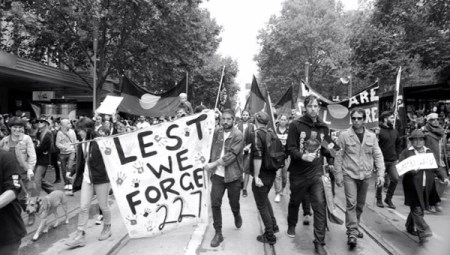
Invasion Day, Melbourne | Photo: Tim Dunn
teleSUR | January 26, 2015
In Melbourne, Australia on Sunday, around 800 people marched to mark Invasion day. Other protests, actions, and cultural events were also held around the country, while national and local governments organized formal celebrations of “Australia Day.”
On January 26, 1788, the first British fleet arrived on Australian coasts, marking the beginning of the invasion of that land, and the deliberate policies of genocide, slavery, child stealing, land stealing, and discrimination against the Indigenous peoples, as well as over 500 unpunished deaths in custody.
The Melbourne Invasion Day march this year marched to the official Australia Day march and pushed aside the barricades and occupied the space. Attendees reported that those at the official march “didn’t seam to know what to do.” Some members of the Invasion Day march chatted to those in the official march and explained the history behind the date. Some activists, according to GreenLeft Weekly, reported that there was some sympathy from those in the official march, who joined the Invasion Day march instead.
“No pride in genocide,” was one of the chants of the Invasion Day march.
“Today was the best Invasion Day protest I have ever been to. There was a real feeling of Aboriginal pride and resistance,” stated march participant and Socialist Alliance councilor, Sue Bolton.
Organizers of the Invasion Day march stated that the day “is a day of mourning for us Indigenous people, but its also a day to make our voices heard, to take a stand … to demonstrate our resistance to colonization and genocide. We have never ceded our sovereignty, and remain committed to the cause of decolonization.”
According to the ABC, in Sydney 10,000 people participated in the Yabun Festival, held to celebrate 40,000 years of Indigenous culture. In inner city Sydney, around 1,000 people marched for Indigenous land rights.
Australian private and mainstream media coverage has been biased against the Invasion Day marches. The Age headlined, “Aboriginal rights protest disrupts Australia Day Parade in Melbourne” while the Herald Sun said the marches had “interrupted” and “mar(ed)” events, but did not use the same language for official Australia Day events. Other media ignored the Indigenous rights marches.
Reflections on MH17
RT Documentary | January 16, 2015
The tragedy of MH17 in which 298 people lost their lives, made the conflict in Ukraine real for many other countries. While the international community awaits the outcome of the crash investigation, speculation in the media continues to fuel the blame game. RTD travels far and wide to interview international experts on what has hindered the investigation, what procedures were needed to collect vital evidence and what might have brought down the ill-fated Boeing 777.
~
OCSE monitor mentions bullet holes in MH17
Original source http://www.cbc.ca/news/world/malaysia… – OCSE monitor Michael Bociurkiw mentions bullet holes in #MH17, not able to find any missile so far.
Why the Secrecy on the Mh17 Investigation?
By JAMES O’NEIL | CounterPunch | December 19, 2014
On 17 July 2014 Malaysian Airlines Flight MH17 en route from Amsterdam to Kuala Lumpur was shot down over the Eastern Ukraine.
Although the precise circumstances were at that point unknown the western media were quick to blame Ukrainian “rebels”. The means by which MH17 was destroyed, the media alleged, was a surface to air BUK missile supplied to the “rebels” by Russia. For a host of reasons it was almost certainly not a BUK missile that caused the crash. The stage was set however, for a demonization of Russia in general as the alleged supplier of the missile, and President Vladimir Putin in particular. The relentless propaganda enforcing this view has continued unabated to this day, although the evidential foundation for the allegations remains at best remote.
The Russians produced an initial denial of involvement. Four days after the tragedy however, as anti-Russian hysteria was escalating to extreme levels, the Russian military held a press presentation. The fact of this presentation was barely reported in the western media. The content, more importantly, was either ignored or misrepresented.
The Russians disclosed, inter alia, their radar and satellite data. These data showed that MH17 had been diverted from its scheduled route so that it flew directly over the war zone in eastern Ukraine. They asked for an explanation but one has never been forthcoming. These data also showed that MH17 had been shadowed during its last minutes by two SU25 fighter jets, a model flown by the Ukrainian air force. Again the Russians asked why this had happened.
The main response was a claim that the SU25 could not fly above 10,000 metres. Not only is this untrue, as an examination of military resources readily demonstrates, but the Wikipedia entry on the SU25 had been altered days before the shoot down to claim that the SU25’s operating ceiling was only 7000 metres. Again the western media ignored this obvious alarm bell.
The Russians further disclosed that at the precise time of the shoot down an American spy satellite was directly overhead the scene and would have recorded the sequence of events. The Russians invited the Americans to share these data with the official investigation that had been launched, but to date the Americans have failed to do so. Again, the western media are singularly incurious as to the reason for this lack of cooperation.
Under IATA Rules, the parties responsible for the investigation would be the Malaysians, as owners of the plane and home country of the airline, and the Ukrainians over whose territory the atrocity occurred. It was the Dutch however, who took the lead role, citing two facts: the plane had departed from Amsterdam; and they had suffered the largest number of their nationals as victims. The Malaysians were initially excluded from the inquiry for reasons that have never been satisfactorily explained. They were finally invited to join the Joint Inquiry on 2 December 2014.
Instead, the initial inquiry group consisted of Ukraine, the Netherlands, Australia and Belgium. The Australians suffered the third largest loss of life but had no standing to be one of the investigatory nations, and certainly less of a claim than the Malaysians. The Australian Prime Minister and some other politicians had been at the forefront of making extreme allegations against Russia and President Putin. Why Belgium was included remains a mystery.
On 8 August 2014 these four investigating nations signed an agreement that the results of the investigation would not be published unless all four countries agreed. This gave one of the prime suspects in the atrocity, Ukraine, an effective veto over any investigations result that attributed blame to them. This is an astonishing situation and probably without precedent in modern air crash investigations.
More significantly however, is that the existence of this secret agreement was not announced by the Australian government, nor to the best of my knowledge has any report about the existence of the agreement or its extraordinary terms, been published in any mainstream publication.
The Dutch magazine Elsevier, under Dutch Freedom of Information laws, sought a copy of the agreement. On 19 November they announced that the request had been refused on the grounds that it “could endanger the relations with other countries involved.”
An Australian citizen (name redacted) wrote to the Minister for Infrastructure and Regional Development (Deputy Prime Minister Warren Truss) seeking a copy of the agreement. By letter dated 15 October 2014 the Department of Foreign Affairs and Trade (DFAT) replied on behalf of the Minister, refusing the requester a copy of the agreement as its contents were “classified.”
The present writer wrote to DFAT on 21 August 2014 seeking a copy of the agreement of 8 August 2014 under the Freedom of Information Act. The department declaimed responsibility and said that they had passed my request on to the Attorney-General’s Department. This was odd, but even odder was advice from the Attorney General that my request had been passed in turn to the Australian Federal Police who were the responsible body.
This must be the first time in Australian history since 1901 that negotiations and agreements between sovereign nations had been conducted on Australia’s behalf by the Federal Police.
On 2 December 2014 the Australian Federal Police finally gave their decision on the FOI request. It was declined on the basis that disclosure of the document (which they acknowledged existed) under section 33 would, or could reasonably be expected to, cause damage to:
(i) the security of the Commonwealth; or
(ii) the defence of the Commonwealth; or
(iii) the international relations of the Commonwealth.
The refusal also relied upon section 37(1)(a) of the Act which exempts a document if it could reasonably be said to prejudice the conduct of an investigation.
Thirdly, the Federal Police relied upon section 37(1) (c) where disclosure could reasonably be expected to endanger the life or physical safety of a person.
The fourth ground of refusal was under section 37(2)(b) which exempts disclosure where it might reasonably be expected to prejudice an investigation by disclosing methods of investigation or detection of unlawful activity.
In the circumstances of this case it is very difficult to see how any of those provisions would apply. The agreement, it should be remembered, is to give any one of the four investigating countries a veto over publication of the results. A final report would be entitled to withhold details of the investigation that would truly prejudice matters of national security.
An investigation of a crash of an aeroplane is however, carried out under IATA Rules and its procedures are well established and well documented. Whose life or safety might be endangered by releasing the agreement is unspecified.
One is left with the conclusion that 33 (iii) is the real ground and the “international relations” referred to are the difficulty Australia and other nations have got themselves into by prematurely blaming Russia when all of the emerging evidence points squarely at Ukraine.
Given the existence of this agreement it is difficult to see how anyone can have any confidence in whatever final report is published by the Dutch. The preliminary report was careful not to apportion blame or even state the cause of the crash other than to say that the plane was hit a by a large number of “high velocity objects” which were undefined.
Another major question is why have the mainstream media kept up a barrage of misinformation up to and including the recent G20 debacle, when they know, or ought to know that the investigation is a sham?
It is also difficult to see how the continued demonization of Russia and Mr Putin for manifestly geo-political reasons (and the probable reasons for the shoot down in the first place) represents any form of justice for the families of the 298 victims and in particular the 37 who were Australian citizens or residents.
It is clear that the Government’s professed support for Security Council Resolution 2116 (2014) for a “full, thorough, and independent international investigation into the incident in accordance with international civil aviation guidelines” is no more than window dressing for a much wider geopolitical agenda.
James O’Neill is a former academic who has practiced as a barrister for the past 30 years. He has a special interest in international human rights issues. He may be contacted at j.oneill@bigpond.net.au
Zionist Attorney-General Refuses to Answer Questions About “Anti-Terrorism” Laws
By Joshua Blakeney | Non-Aligned Media | November 27, 2014
 Recently Israel’s department for her colonies of Australia and Canada dispatched new “anti-terror” legislation which will make it illegal for Australian and Canadian subjects of the Israeli Empire to “condone” so called “terrorism”.
In the above video Australia’s Zionist Attorney-General, George Brandis, can be viewed enabling such farcical anti-free-speech laws to be foisted upon the people of Australia without oversight, by refusing to answer critical questions from senators about the controversial legislation.
That Canada and Australia are governed out of the same colonial office in Tel Aviv was suggested when it was revealed that Prime Ministers John Howard and Stephen Harper had been given the same pro-Iraq-war script to read in 2003 (see below).
US helping Israel boycott Geneva summit on occupied territories – diplomatic sources
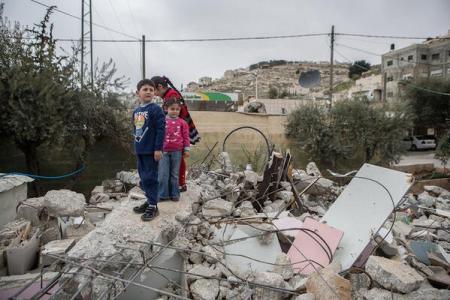
RT | November 27, 2014
Switzerland is under diplomatic pressure from Israel, the US, Canada and Australia, which are trying to prevent an international conference in Geneva from taking place in mid-December on Israel’s occupation of Palestinian territories, Haaretz reports.
Delegations from nearly 200 countries are expected to head to Geneva to discuss the situation in the West Bank, Gaza Strip and East Jerusalem. Yet, according to Haaretz, Israeli and Western diplomats are ready to go for broke to prevent the gathering from taking place.
Switzerland, as the main sponsor of the summit, is bearing the brunt of diplomatic pressure from all sides.
Israeli authorities told the media outlet that Palestinians and Arab states are also pressing Swiss officials to send out letters of invitation to the conference within a matter of days, the Israeli daily reported on Wednesday.
It was in early April when Israel announced plans of constructing 700 new houses in occupied East Jerusalem, a move that pushed Palestinian Authority President Mahmoud Abbas to ask 15 international conventions to join them in the name of the Palestinian state.
One of those was the Fourth Geneva Convention (signed 1949, came into force 1950), which specifically addresses protection of civilians in war zones and territories under military occupation.
Washington finally accepted that its efforts to extend peace talks between Israel and the Palestinians have been torpedoed. Several weeks later, Palestinians and the Arab League sent an official request to Switzerland to hold an international conference of the Fourth Geneva Convention signatory states on the issues of the Israeli occupation of the West Bank and East Jerusalem, together with the damage caused by Israel’s armed forces to civilians in Gaza.
The last time the signatories to the Fourth Geneva Convention gathered in regard to the Israeli-Palestinian conflict was in 2001, after the outbreak of the second intifada. That conference was boycotted by Israel and the United States.
After that summit there have been four fruitless attempts to gather the Fourth Geneva Convention on the issue of Israeli-Palestinian relations. Even the bloody Israeli military Operation Cast Lead in the Gaza Strip in 2009 failed to raise broad international support for holding such a conference, according to the Swiss Foreign Ministry at the time.
The necessity to call the new conference has been not evident this time, too, so Swiss diplomats asked every Fourth Geneva Convention signatory separately whether the time had come to hold a summit.
What the Swiss diplomats have proposed is a three-hour conference at an ambassadorial level, no discussions and no media coverage except for a final press statement. The conference is set to be focused on implementation of the international humanitarian law in troubled Israeli-Palestinian relations.
“We made it clear we didn’t want a political event or debate club, or a conference that would blame or criticize one of the sides,” a Swiss diplomat said.
However small the scale of the proposed event is, Israel strongly objected to it. Israeli diplomats reportedly conducted negotiations in Bern and Geneva, trying to persuade Swiss counterparts to call off the initiative and threatening to boycott it anyway.
“They told us that holding the conference would help a one-sided Palestinian move intended to make Israel look bad and attack it in an international forum,” the Swiss diplomat said.
The US and Canada told Switzerland they are going to boycott the conference, too.
“We strongly oppose the convening of the High Contracting Parties to the Geneva Conventions and have made our opposition unmistakably clear,” a spokesman for the US State Department, Edgar Vasquez, told Haaretz.
It is true that the conference will have no authority to make any binding decisions, yet its work could engender further international criticism of Israel’s settlement policy on the occupied Palestinian territories.
Besides that, once Israeli diplomats received an updated draft of the conference’s proposed contents, they found out that the updated draft text had been phrased in a politicized way, directly naming Israel and going into detail on the issue of West Bank settlements.
Israeli Foreign Minister Avigdor Lieberman has reportedly been ringing colleagues around the globe, attempting to talk them into declaring a boycott to the conference. Part of this work has been delegated to Israeli ambassadors worldwide.
With all due support on the part of the US, Canada and Australia, these efforts are likely to be in vain, and the Swiss diplomacy is decisive to go on with the plan and announce the conference officially soon.
The Fourth Geneva Convention prohibits harming those uninvolved in a conflict, be they civilians, wounded soldiers or POWs, as well as obliging the occupying side to maintain human rights and decent living conditions of an occupied civilian population.
Israel joined the convention, but has never ratified it legislatively. The Israeli government regards the West Bank and East Jerusalem as ‘disputed’, not occupied, areas, therefore considering Israeli settlements as not violating the treaty.
Featured Video
“Historic Russia”: The Land Putin Will Not Give Back
or go to
Aletho News Archives – Video-Images
Book Review
Why the War on Conspiracy Theories Is Bad Public Policy
By Kevin Barrett • Unz Review • February 1, 2019
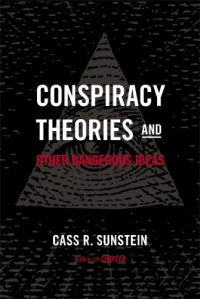 A Review of Conspiracy Theories and Other Dangerous Ideas by Cass Sunstein (based on an earlier paper co-authored with Adrian Vermeule); In Defense of Troublemakers: The Power of Dissent in Life and Business by Charlan Nemeth; and Conspiracy Theories and the People Who Believe Them, edited by Joseph E. Uscinski
On January 25 2018 YouTube unleashed the latest salvo in the war on conspiracy theories, saying “we’ll begin reducing recommendations of borderline content and content that could misinform users in harmful ways—such as videos promoting a phony miracle cure for a serious illness, claiming the earth is flat, or making blatantly false claims about historic events like 9/11.”
At first glance that sounds reasonable. Nobody wants YouTube or anyone else to recommend bad information. And almost everyone agrees that phony miracle cures, flat earthism, and blatantly false claims about 9/11 and other historical events are undesirable.
But if we stop and seriously consider those words, we notice a couple of problems. First, the word “recommend” is not just misleading but mendacious. YouTube obviously doesn’t really recommend anything. When it says it does, it is lying. … continue
Blog Roll
 Aletho News
- BRITAIN’S WARNING: PREPARE FOR WAR
- “Historic Russia”: The Land Putin Will Not Give Back
- How the Cambridge Analytica scandal still haunts Mark Zuckerberg
- The Ongoing Cancellation Campaign Against a Dissenting Academic in Norway
- Yemen and ‘the Houthis’: Challenging Sami Hamdi’s Narrative
- No, Christians did not invent Zionism
- AIPAC-led lobbying network opens branches in Cypriot, Greek parliaments
- Araghchi blasts ‘parasitic’ alliance as US taxpayers pay for Israel’s war on Iran
- Easy fix for Europe’s chaos? Stop fueling war against Russia
- Putin’s key remarks on peace talks and Europe’s ‘schizophrenia’
- If Americans Knew
- An error has occurred; the feed is probably down. Try again later.
- No Tricks Zone
- Two New Studies Find Thwaites Glacier Melt Cannot Be Driven By Human Activity Or A Warming Ocean
- E-Cars Reduce CO2 Emissions By Only 41% Compared To Internal Combustion Engine Vehicles
- Predictions Made By Renowned Climate Professor Over Past Decades Have Been Proven To Be Poor
- New Study Suggests Large Regions Of The Pacific Ocean Have Been Cooling For The Last 80 Years
- Germany’s Green Energy Debacle: High Energy Costs Force Kahla Porzellan to Close After 182 Years!
- New Study: 50 Years Of The Most Aggressive ‘Net Zero’ Policies Can Only Affect The Global Climate By 0.03°C
- US September “Heat” Was No Record…Many Records Set Decades Ago
- Latest European Green Energy Debacle; Portugal’s Largest Flagship Solar Park Insolvent!
- Green Energy Debacle: German Expert Professor Fritz Vahrenholt Warns Of Severe Economic And Social Consequences
- Two More Paleo Reconstructions Affirm Meters-Higher Sea Levels Across Ireland, Brazil 7000-6000 Years Ago

