British Foreign Policy and the UK Weapons Trade

By Matthew JAMISON | Strategic Culture Foundation | 24.02.2017
Back in the halcyon days of the election of the first Labour Government in Britain in over 18 years, the New Labour Foreign Secretary Robin Cook expounded a radical shift in British foreign policy making, declaring that the Labour Government of Tony Blair would put human rights at the heart of it’s foreign policy with an «ethical dimension». This was quickly christened by the British media as New Labour’s «ethical foreign policy». Questions were raised at the time how a country with such a large weapons export industry could conduct an ethical foreign policy and that question is as pertinent today as it was back in 1997. In his party conference speech, the first as British Foreign Secretary, Boris Johnson, paid ritual homage as many British Foreign Secretaries have before him, to his belief in human rights and reflected that: «After a long post-war period in which the world was broadly getting more peaceful the number of deaths in conflict has risen from 49,000 in 2010 to 167,000 last year».
Sadly, Britain has contributed to many of these deaths. According to a study carried out with official UK Government figures by the Independent newspaper, Britain is now the second largest exporter of arms around the world, and according to Freedom House since 2010 has sold weapons to 39 of the 51 countries ranked by Freedom House as «not free». What is even more disturbing is that out of the 30 countries ranked on the British Government’s own human rights watch list, the British Government authorizes the sale of weapons to 22 of those. Indeed, according to statistics from the UK Government’s own Trade and Investment body the UK has sold more weapons on average over the last ten years than Russia, China and France combined. All exports of British manufactured bombs, bullets, weapons and other munitions must be signed off and approved by UK Government Ministers with licenses granted.
Most of these arms are sold to Middle Eastern regimes, which have serious human rights issues, if one were to apply the standards the UK Government sets on human rights. In 2016 alone Britain sold over 3 billion pounds worth of weapons to Saudi Arabia. It is odd how the British Government which constantly lectures other countries on their human rights records can sell weapons of mass destruction to regimes like the Saudis who carry out routine be-headings and lashings of their own citizens as part of their penal code; subject women to severe restrictions such as forbidding them to drive; provide funding to Madrassas that indoctrinate and radicalise young Muslims in the ways of jihad etc. The list of human rights violations could go on. But the British Government, despite wrapping itself in the language of human rights, feels very comfortable within its own «ethical conscience» in allowing shipments of British manufactured BL-755 cluster munitions to be used by the Saudi Government in its war in Yemen. Unexploded remnants of cluster munitions have proved deadly for Yemenis, killing or injuring at least 85 civilians, including children.
Since March 2015, the UK Government has approved £3.3 billion in military sales to Saudi Arabia, yet in November, the UK Foreign and Commonwealth Office concluded, despite considerable evidence to the contrary, that there was no «clear risk» of serious Saudi breaches of international humanitarian law in Yemen. The British Government has continued to sell arms to Saudi Arabia despite the Saudi Government’s vastly different approach and record regarding human rights which is incompatible with the British Government’s professed commitment to «universal human rights» and the problems that emanate from Saudi Arabia regarding Islamist extremist terrorism and radicalisation such as the fact that fifteen of the nineteen 9/11 hijackers where from Saudi Arabia and the emerging information that certain sections of the Saudi Government may have been complicit in the funding and training of the 9/11 hijackers. Saudi Arabia is not the only regime that does not conform to the UK’s own professed beliefs and standards in human rights that the British supply dangerous and destructive weapons of death to.
The UK Government sells arms to Bahrain which has used British arms to quell internal dissent; Burundi, which is being investigated by the UN for human rights violations and The Maldives, which in 2015 jailed its former President, Mohamed Nasheed, for 13 years following what critics said was a politically motivated show trial. The UK Government has also authorised the sale of massive amounts of arms to Egypt despite the coup against the democratically elected President Mohammad Morsi and the violent crackdown on the Muslim Brotherhood that followed. The British Government approved licences for the sale of £7.7bn of arms in 2015 alone. Then there have been weapons scandals in the past involving the British Government and the UK arms industry. There was the shocking Arms-to-Iraq affair of the 1990s when it came to light that the British Government had endorsed and advised on the sale of arms by British companies to Iraq, then under the rule of Saddam Hussein. Ironically, some of these British made and exported weapons to Saddam Hussein’s Iraq had been used by the Iraqi regime during the first Gulf War of 1991.
All of this raises serious questions regarding how the British Government can profess to on the one hand be a force for human rights and run a foreign policy based on «universal human values», upholding democracy, human rights and the rule of law and yet on the other hand maintain a massive arms trade of deadly weapons around the world, arming regimes that are the exact opposite of what the British Government professes to believe in and defend when it comes to human rights. At the heart of the British Government’s position on «human rights» is hypocrisy when examined within context of UK arms sales. The British Government maintains a saintly image of itself and believes its own rhetoric that it is a great force for «universal human rights» around the world despite the contradictions in its policies and behaviour and that the British have higher standards and more noble beliefs than other cultures and countries when in reality this is not the truth. What the British Government hates above all else is to have its self-image shattered and exposed for the two-faced hypocrisy that it is. They are unable to effectively answer the inconsistencies and contradictions of their rhetorical image on the one hand and the reality of their behaviour, policies and practices on the other when confronted with reality. It is high time for the British Government, if is serious about its rhetoric on human rights, to scale back its domestic weapons export industry.
UK covered up intelligence training with Bahrain’s police, amid death sentence
Reprieve | February 5, 2017
UK authorities trained Bahrain’s police how to gather intelligence on protestors, and then tried to cover up the scheme, international human rights group Reprieve has found. The project took place after protestors in the Gulf kingdom were rounded up and sentenced to death.
Britain’s Foreign Office paid for half a dozen Bahraini police officers to visit Belfast in August 2015, where the Police Service of Northern Ireland (PSNI) shared its expertise on gathering intelligence ahead of demonstrations.
Protestors in Bahrain, such as Mohammed Ramadan, have been targeted by police and tortured into falsely confessing to capital crimes. Mr Ramadan, a father of three young children, is now on death row and could be executed at any time.
The training, which also included sessions on water cannons, dog handling and public order tactics, was kept secret. The UK government has repeatedly denied providing public order training to Bahrain.
The Cabinet Office claimed that “The UK does not fund any programmes in Bahrain focused on public order”. However, documents obtained by Reprieve show that Bahrain’s police received an “Introduction to Combined Operational Training with a focus on Public Order.”
The training was prepared by Northern Irish police officers during a week-long “scoping visit” to Bahrain over April-May 2015, where they assessed Bahrain’s public order systems. The Stormont-owned company NI-CO played a key role in organising all the training.
It has also emerged that Bahrain’s Chief of Police and his deputies visited Belfast in June 2014. The itinerary included another session with the PSNI on “Community Intelligence”. The police chief attended a “demonstration of PSNI Public Order systems” and received a “Tour of North and West Belfast ‘Flashpoints’ with 2 or 3 PSNI Armoured Vehicles”.
Bahrain’s Chief of Police had to postpone a visit to Belfast earlier in 2014 because there was a “security emergency in Bahrain at the moment and it is felt that the Chief of Police and other senior officers cannot leave the country at this critical time.” This was a month after death-row prisoner Mohammed Ramadan was tortured. “The situation on the ground is becoming increasingly tense”, an email explained.
Bahrain’s Chief of Police has command level responsibility for violations carried out by lower ranking officers. Months after the police chief visited Belfast for training, teenager Ali al-Singace was arrested and tortured by Bahrain’s police with electric shocks, until he made a false confession to a capital crime. He was executed by firing squad in January 2017.
Commenting, Maya Foa, a director of Reprieve, said:
“It is outrageous that the government has covered up this project, which risks supporting the execution of protesters in Bahrain.
“Bahrain is notorious for arresting, torturing and sentencing to death people involved in protests – such as Mohammed Ramadan, a father of three who is held on death row and faces execution at any moment.
“By training Bahrain’s police how to gather intelligence on protesters, there is a serious risk that Britain is helping them arrest and execute people who are guilty of nothing more than calling for reform. It is scandalous that the Government has sought to sweep this under the carpet.”
UK in panic over Johnson’s remarks against Saudi regime
Press TV – December 11, 2016
UK Foreign Secretary Boris Johnson’s recent criticism of Saudi Arabia has worried British officials, with various government figures trying to gloss them over as Johnson’s own personal views.
During a conference in Rome last week, Johnson blasted the Riyadh regime over its “proxy wars” in the Middle East and its unprovoked military aggression against Yemen, which has killed over 11,000 Yemenis since March 2015.
UK Prime Minister Theresa May’s spokeswoman immediately rebuked the remarks back then, saying the comments did not reflect “the government’s views on Saudi and its role in the region.”
Johnson’s statements divided the UK Parliament, with many of the lawmakers saying that he was stating the truth and should not face public chastisement.
UK Defense Minister Michael Fallon lashed out at the media on Sunday, for blowing the story out of proportions and confecting an artificial row between Johnson and the Downing Street.
“Let’s be very clear about this. The way some of his remarks were reported seemed to imply that we didn’t support the right of Saudi Arabia to defend itself… and didn’t support what Saudi Arabia is doing in leading the campaign to restore the legitimate government of Yemen,” Fallon said during a BBC interview.
“Some of the reporting led people to think that,” he added. “The way it was interpreted left people with the impression that we didn’t support Saudi Arabia and we do.”
Fallon said the months-long Saudi invasion against its impoverished southern neighbor was in self-defense, a right that London thought Riyadh was entitled to.
“The government’s view is absolutely clear – that what Saudi Arabia is entitled to do is defend itself from these attacks across its own border,” he said.
Johnson’s remarks came at a time when May was in the Middle East, trying to cement military and economic ties with [Persian] Gulf Cooperation Council nations – Saudi Arabia, the United Arab Emirates, Kuwait, Oman, Bahrain and Qatar.
Besides helping Bahrain with a heavy-handed crackdown on its popular uprising, Britain has also been providing weapons and intelligence to Saudis in the attacks against civilian targets in Yemen.
UK think tank covertly funded by Bahrain royal family – leaked papers
RT | December 7, 2016
The International Institute of Strategic Studies, an influential UK diplomacy and security think tank run by prominent military, political, and business figures, has received over $38mn in secret donations from Bahrain.
Bahrain, a former British colony and oil-rich Arab country which accommodates the US Navy’s Fifth Fleet, had secretly donated more than $38 million (£30 million) to the International Institute of Strategic Studies (IISS), a reputed UK think tank which positions itself as a leading global military and security research consultancy, according to human rights group Bahrain Watch.
The donations, which the IISS received over the course of five years, were said to form around a quarter of the think tank’s budget, or over $7.6 million (£6 million) per year, Bahrain Watch said citing confidential documents it obtained in cooperation with the Guardian.
Money from the Bahrain government was received in large part under a secret memorandum of understanding (MoU) between IISS head John Chipman and Bahraini Foreign Minister Sheikh Khalid Bin Ahmed Al Khalifa, who had previously served as ambassador to the UK.
The IISS and Bahrain agreed to “take all necessary steps to keep confidential all classified information which is disclosed or obtained in relation to this MoU, and neither shall divulge such information to any third party.”
The leak comes amid UK Prime Minister Theresa May’s two-day trip to Bahrain to discuss post-Brexit trade with Gulf leaders. UK Foreign Secretary Boris Johnson is also expected to arrive in the Bahraini capital Manama on Friday to address a Middle East-related conference organized by the IISS.
The event itself, called the Manama Dialogue, was financed by Bahrain’s ruling family, which is paying for all the delegates to stay at the Ritz-Carlton Hotel, the report said. Since 2011, the ruling family has donated $19 million (£14.9 million) to fund the conference, which is attended by influential figures from the Gulf and western nations, among others, the leaked papers show.
In a statement to the Guardian, the IISS said its agreement with the Bahraini rulers “expressly gives the IISS full freedom to develop the agenda and invite participants in line with priorities it judges to be important to encourage strong debate on regional issues and facilitate important diplomatic contacts.”
“The IISS for a number of years has received funding from a wide range of governments for conferences and major international summits,” it added.
“The Bahraini government is willing to spend so much on the IISS and the Manama Dialogues because they allow the government to portray itself as modern, liberal and business-friendly, in contradiction to the evidence of torture, abuse and political disenfranchisement,” Bahrain Watch said in turn.
In April, a report for the Foreign Affairs Select Committee blasted Bahrain’s poor human rights record, not least during the violent suppression of the Arab Spring protests, with direct support from another controversial UK ally – Saudi Arabia.
Earlier, Amnesty International accused London of “whitewashing” Bahrain’s record in the United Nations, having never condemned the country’s human rights abuses. The Bahraini royal family has enjoyed a close relationship with the British monarchy for several decades.
In mid-November, a new Royal Navy base in Bahrain was inaugurated by Prince Charles, with construction mostly funded by the Bahrainis. The US Naval Forces Central Command (NAVCENT) is also headquartered in the country, guiding the operations of the Fifth Fleet.
The IISS advisory board features high-ranking Western military brass, politicians, and business leaders, including George Robertson, former secretary-general of NATO, Field Marshal Charles Guthrie, former chief of the UK General Staff, Marillyn Hewson, CEO of Lockheed Martin, Amos Yadin, former chief of Israeli military intelligence, as well as Carl Bildt, Sweden’s ex-foreign minister.
Founded in 1958, the IISS describes itself as a primary source of information on international strategic issues for “politicians and diplomats, foreign affairs analysts, international business, economists, the military, defense commentators, journalists and academics.”
Apart from the Manama Dialogue, the institute hosts the Shangri-La Dialogue, an annual meeting of Asia-Pacific region defense ministers in Singapore.
It also publishes ‘The Military Balance,’ a comprehensive annual assessment of each country’s military capabilities. A 2015 Global Think Tank Index compiled by the University of Pennsylvania ranked IISS as the fourth-best non-US research institution.
UK to open permanent military base in Bahrain: Report

Britain’s then Foreign Secretary Philip Hammond boards a UK military ship docked in Manama, Bahrain, in November 2015.
Press TV – October 29, 2016
The United Kingdom will open a massive permanent military base in Bahrain and deploy warships in the Persian Gulf, a new report has revealed.
The military base, which is the first such facility being opened by Britain in 40 years in the Persian Gulf region, will be launched next month, Britain’s Express newspaper reported on Saturday.
Britain will station around 600 military forces at the Royal Navy Facility and will deploy its warships to patrol the surrounding waters and guard oil and gas shipments in the waters.
The base located in Bahrain’s Mina Salman Port, will also be used by Special forces, Navy destroyers and frigates to launch operations against the Daesh takfiri terrorist group in the region, according to the report.
“The project could save the Ministry of Defense millions because they won’t have to travel back to the UK,” the newspaper quoted unnamed diplomatic sources as saying.
The base, which will be used as a weapons store, will allow Britain to take part in any possible emergency operation if any country tries to block UK commercial ships from passing through the Strait of Hormuz, said a navy source.
“If we miss out on too much oil and gas then the lights will start to go out,” the source added.
When Britain kicked off the project in 2014, Defense Secretary Michael Fallon described it as “a permanent expansion of the Royal Navy’s footprint” in the Persian Gulf.
“It will enable Britain to send more and larger ships to reinforce stability in the [Persian] Gulf,” he said.
Critics, however, raised concerns over the legality of the base, saying the project had not been discussed in Bahrain’s parliament.
Human rights campaigners criticized the plan at the time, arguing that the Royal Navy named HMS Juffair, is reminiscent of the colonial era because it’s named after a previous naval base, Britain maintained in the country during colonial times.
Opposition activists also said Britain’s move strengthens the ruling al Khalifa family which, has long been carrying out crackdown on human rights activists in the kingdom.
Scores of people have been killed and hundreds of others injured or arrested in the Bahraini crackdown on the anti-regime activists, who have been holding protests on an almost daily basis since February 14, 2011.
Protest against Bahraini king’s visit to Downing Street halted by police
RT | October 26, 2016
The Kingdom of Bahrain’s authoritarian ruler King Hamad bin Isa Al Khalifa visited British Prime Minister Theresa May at Downing Street on Wednesday, despite outcry from human rights and anti-arms trade groups.
The Gulf regime is a close ally of both the UK and Saudi Arabia, as well as being a major UK arms customer, and is currently bearing much of the cost for building the Royal Navy’s new Mina Salman naval base.
Human rights groups have highlighted widespread abuses committed by Bahraini government forces against pro-democracy activists during the 2011 Arab Spring.
The king’s visit was met with protests by the Bahrain Institute for Rights and Democracy, and Campaign against the Arms Trade (CAAT) on Wednesday afternoon. Two activists were escorted away by police.
Already in 2016, senior British Royals, who are known for their closeness to the Gulf monarchies, have been criticized for meeting the Bahraini monarchy both in the UK and during trips to the nation.
The Prince of Wales and Duchess of Cornwall will soon visit Bahrain on behalf of the UK government, despite long-standing concerns over human rights abuses and UK arms sales.
In April, a report for the Foreign Affairs Select Committee blasted Bahrain’s record on human rights abuses, not least during the violent crushing of Arab Spring protests with the direct support of another controversial UK ally, Saudi Arabia.
The report also argued that human rights had effectively been downgraded by the UK government in a bid to shore up relations with the authoritarian state, which enjoys arms trading and security arrangements with Britain.
A broad campaign is currently underway, including MPs, to put a halt to UK arms sales to the Saudi regime in light of repeated reports of war crimes in its UK-assisted aerial bombing campaign in Yemen.
Bahraini FM’s praise for Peres sparks outcry
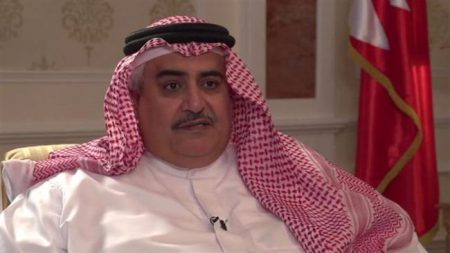
Bahrain Foreign Minister Sheikh Khalid bin Ahmed al-Khalifa
Press TV – September 29, 2016
The Bahraini foreign minister’s surprising tribute to former Israeli president Shimon Peres who died Wednesday has triggered a wave of outcry in the region where he is known as a criminal.
“Rest in Peace President Shimon Peres, a Man of War and a Man of the still elusive Peace in the Middle East,” Sheikh Khaled bin Ahmed al-Khalifa posted on his Twitter account.
The tribute drew the ire of many online users as well as opposition figures, given that a large number of Arabs view Peres as the man responsible for the successive wars that have rocked the Middle East.
“The foreign minister is paying tribute and praying for the Zionist terrorist and the killer of children,” complained former opposition lawmaker Jalal Fairooz.
Another critic, Khalil Buhazaa, tweeted, “Diplomacy does not mean rudeness.”
Manama does not have diplomatic relations with Tel Aviv but some Arab states, chiefly Saudi Arabia, have recently moved to warm relations with the Israeli regime.
Bahrain is under the heavy influence of Saudi Arabia which is spearheading the push for rapprochement with Israel.
Among Arab leaders, only Palestinian Authority President Mahmoud Abbas has offered condolences to Peres’s family, describing him as a partner in peace.
However, many across the world would remember Peres as a “war criminal” especially in light of the 1996 Qana massacre. In that Israeli attack on a southern Lebanese village, at least 106 people were killed. Peres was then prime minister.
Born in Poland in 1923, Peres emigrated to what was then British-mandated Palestine when he was 11. He joined the Zionist movement and met David Ben-Gurion, who would become his mentor and Israel’s first prime minister.
Peres became director general of the nascent ministry of military affairs at just 29. He was also seen as a driving force in the development of the Israel’s undeclared nuclear program.
Palestinians say Peres has their blood on his hands. Like other Zionist leaders, Peres also allowed Israeli settlement construction to take place in Palestinian land during his years in leadership positions.
The impoverished Gaza Strip witnessed two full-scale wars under Peres’s tenure as president, which claimed the lives of more than 3,700 Palestinians in total.
The Palestinian resistance movement Hamas has called on Palestinians to hold a “Day of Rage” on Friday which will coincide with the funeral of Peres.
The call is meant to mark the one-year anniversary of the beginning of what is described as the third Intifada throughout the occupied West Bank and Jerusalem al-Quds.
Canadian firm sells Bahrain software to censor Internet
Press TV – September 24, 2016
A Canadian company has sold Bahrain technology used to block opposition websites and human rights content on the Internet, Canadian activists say.
Specialists from internet watchdog Citizen Lab said in a report that Canadian Netsweeper website-blocking applications had been identified on nine internet service providers (ISPs) in Bahrain.
The report further disclosed that testing on the ISP of the state-run Bahrain Telecommunication Company (Batelco) showed that at least one of the Netsweeper installations was in use in the small Persian Gulf kingdom.
Citizen Lab researchers highlighted that the installations appear to have become active between May and July of this year.
That is “a few months after the release of a public tender by Bahrain’s Telecommunications Regulatory Authority in January 2016 indicating Netsweeper won a bid to provide a ‘national website filtering solution.’”
The contract is worth either 1.1 million or 3.1 million dollars, the researchers said.
Citizen Lab said, “The sale of technology used to censor political speech and other forms of legitimate expression, to a state with a highly problematic human rights record, raises serious questions.”
Since February 14, 2011, thousands of anti-regime protesters have held numerous demonstrations in Bahrain on an almost daily basis, calling on the Al Khalifah family to relinquish power.
Manama has been relentlessly cracking down on dissent. Troops from Saudi Arabia and the United Arab Emirates have been deployed to the country to assist in the crackdown on peaceful protests.
Scores of people have been killed and hundreds of others injured or arrested in the Bahraini crackdown on the anti-regime activists.
UK police under fire for training Bahraini forces
Press TV – August 14, 2016
A British parliamentary committee has criticized UK police for training Bahraini forces who are accused of ruthlessly suppressing public protests and dissent.
Under a confidential agreement in 2015 obtained by the Observer, the UK’s College of Policing agreed to train forces of Bahrain’s Interior Ministry.
The deal, however, does not mention human rights issues.
The UK parliament’s home affairs select committee has slammed the college’s agreements with regimes that have poor human rights records. The committee also blasted UK’s Foreign Office for refusing to disclose such contracts.
The committee said “opaque” agreements with foreign governments, which have been criticized for human rights abuses, “threaten the integrity of the very brand of British policing that the college is trying to promote”.
A law firm representing a tortured Bahraini activist has written a letter to the Foreign Office, saying the agreement with Bahrain raises concerns about the UK’s commitment to protecting human rights.
“We know the college provides a wide range of training programmes domestically that are of potential concern, such as the use of communications data obtained by telecoms operators, the use of interception material, surveillance and undercover policing, and the scope of its courses to overseas customers is not limited in any accountable way,” said Daniel Carey, of DPG Law.
He also argued that the college must have acquired the parliament’s approval for its profit-making activities. “The College of Policing is doing something unusual for government in selling services overseas.”
Anti-regime protesters have staged numerous demonstrations in Bahrain on an almost daily basis since February 14, 2011, calling on the Al Khalifah regime to relinquish power.
Troops from Saudi Arabia and the United Arab Emirates — themselves repressive Arab regimes — were deployed to the country in March that year to assist the Manama government in its crackdown on peaceful and pro-democracy rallies.
Scores of people have been killed and hundreds of others injured or arrested in Manama’s crackdown on the anti-regime activists.
Featured Video
Yemen joins the war – Red Sea could be blocked next – Saudi regime at risk
or go to
Aletho News Archives – Video-Images
From the Archives
A superpower and “the world’s sickest warrior state”
By Paul J. Balles | March 8, 2010
Living through five or six major wars has hardened me to what I thought were the extremes of inhuman cruelty and brutality.
Two things made those extremes almost bearable: the brutality always revealed – at least according to the media coverage – the viciousness of the enemy. It was therefore quite understandable when our “brave men and women” pulverized the enemy.
Films of Japanese torturing captive Americans somehow justified holding Japanese Americans in internment camps during World War II; and only a small percentage of Americans found the bombing of Hiroshima and Nagasaki unreasonably vengeful at best, at worst, depraved.
The media giants in America portrayed the North Koreans as barbaric beasts with their captives, quite unlike their southern counterpoints – our allies during the Korean War. No one ever felt the need to explain how the South Koreans were a civilized breed while the North Koreans were absolute savages, at least according to the official line.
In Vietnam, our warriors justifiably (or so the media made us believe) dropped napalm on the North Vietnamese who had the gall to hide in villages and tunnels to ravage our invaders. At least it was accepted practice until some rogue photojournalist filmed a young girl screaming down a Vietnamese road in flames. … continue
Blog Roll
 Aletho News
- Russian tanker approaches Cuba despite US oil blockade
- Marandi: Yemen joins the war – Red Sea could be blocked next – Saudi regime at risk
- Pro-Palestinian French member of European Parliament denied entry to Canada
- Pakistan to Host US-Iran Talks
- How Indonesia’s tilt toward the US left it stranded in the Strait of Hormuz
- US has no choice but to retreat from Iranian borders: Top commander
- Iran Retaliation Strikes Chemical Plant Near Dimona
- AWACS’ Destruction is a Major Loss for US Military – Ex-DoW Analyst
- Israel’s Iran Strategy Uses US Military & Gulf States as Its Pawns
- Iran: Trump wanted regime change, now just begging for Hormuz to open
- If Americans Knew
- Israeli police block Catholic cardinal from entering Church of the Holy Sepulchre on Palm Sunday
- Israel is assassinating journalists again, more than any other nation, anywhere, ever – Not a ceasefire Day 170
- Over 300 US service members wounded, majority have brain injuries – Not a ceasefire Day 169
- Researchers at Human Rights Watch Resign Over Blocked Report on Palestinian Refugee Return
- Jewish Groups Are Backing a War Americans Don’t Want
- Eric Fingerhut Thinks He’s the President of the Jews
- Top Jewish Philanthropists, Rabbis Urge Israeli President to Take Action Against ‘Jewish Extremists’
- Don’t Be Fooled. Zionist Leaders Have Always Wanted to Control Southern Lebanon
- Israel’s widespread use of torture is a core element of its genocide against the Palestinian people
- In Israel’s War on Iran, Many Middle East US Bases Rendered “All But Uninhabitable”
- No Tricks Zone
- New Study Finds Warming Saves Lives…Cold Temperatures 12 Times More Deadly Than Excess Heat
- German Science Blog Accuses PIK Climate Institute Of Hallucinating Climate Tipping Points
- Devastating Assessment Of Comirnaty Vaccine By Former Senior Pfizer Europe Toxicologist
- New Study: CO2 Is ‘Effectively Negligible’ As An Explanatory Climate Change Factor Since 2000
- Former Pfizer Toxicologist Dr. Helmut Sterz Tells Bundestag Hearing Pfizer Vaccine Should Have Never Been Approved
- Energy Expert: Germany’s Nuclear Phaseout Was A “500 Billion Euro Mistake”
- New Research: South Australia’s Mid-Holocene Sea Surface Temperatures Were 4°C Warmer Than Today
- Storing Green Energy To Last Germany 10 Days Would Require A 60-Million Tonne Battery
- New Studies: UK Sea Levels Were 4 Meters Higher Than Today During The Mid-Holocene
- Destructive Green New Deal: German Energy And Metal Group Warns Of Drastic Crisis
 Aletho News