Report reveals UK exploiting Qatar crisis for own profit through arms exports
Press TV – September 10, 2017
Britain is exploiting a rift between several Arab countries of the Persian Gulf and Qatar through designating both sides as the “priority markets” for its arms sales, a report suggests.
The Middle East Eye (MEE) report cited a list of 46 states highlighted by the UK Department for International Trade Defense and Security Organization as potentially lucrative markets for weapons exports.
The list included Qatar as well as Saudi Arabia, the United Arab Emirates (UAE) and Bahrain, which cut ties with Doha three months ago.
This is while many of the countries identified as key targets for the British arms sales are included in the government’s own “human rights priority registers.”
The list comes ahead of the Defense & Security Equipment International (DSEI) arms fair scheduled to be held in London on September 12-15.
“The fact that, despite current tensions, Saudi Arabia and Qatar are both on the list tells us everything we need to know,” Andrew Smith, spokesperson of the UK-based Campaign Against Arms Trade organization, told the MEE.
Britain, he said, has “made clear that it will pull out all stops to sell arms to” both sides of the Qatar crisis.
Back in June, Saudi Arabia, Egypt, Bahrain and the UAE imposed a trade and diplomatic embargo on Qatar, accusing Doha of supporting terrorism.
They presented Qatar with a list of 13 wide-ranging demands and gave it an ultimatum to comply with them or face unspecified consequences.
Doha, however, refused to meet the demands and said that they were meant to force the country to surrender its sovereignty.
UK arms fair hosts despots
In a relevant development, the UK government published its official guest list for DSEI, comprising 56 countries, among them Saudi Arabia, the UAE, Bahrain, Egypt and Qatar.
Smith said the list included “a roll call of despots, dictatorships and human rights abusers. They will be greeted by civil servants and government ministers who are there for one reason only: to promote weapons.”
MP Caroline Lucas, UK Green Party co-leader, also called for the closure of the London arms fair.
“DSEI is a dark stain on our country’s already tarnished reputation. It’s time that this festival of violence was shut down for good – and for the UK to engage in peace-building rather
70,000 Tonnes of Hubris
By Craig Murray | June 27, 2017
There is no defensive purpose to an aircraft carrier. Its entire purpose is to move aircraft to a position where they can attack other countries. As soon as they are equipped with attack aircraft, these carriers will spend most of their time around the Middle East, including at the UK’s brand new naval base in the vicious despotism of Bahrain. Having spent £7 billion on these behemoths, politicians will seek to enhance their prestige and demonstrate that they control a nation which is a “major power”, by using them. The very fact of their existence will make bombing attacks such as those we saw on Syria, Libya and Iraq more likely.
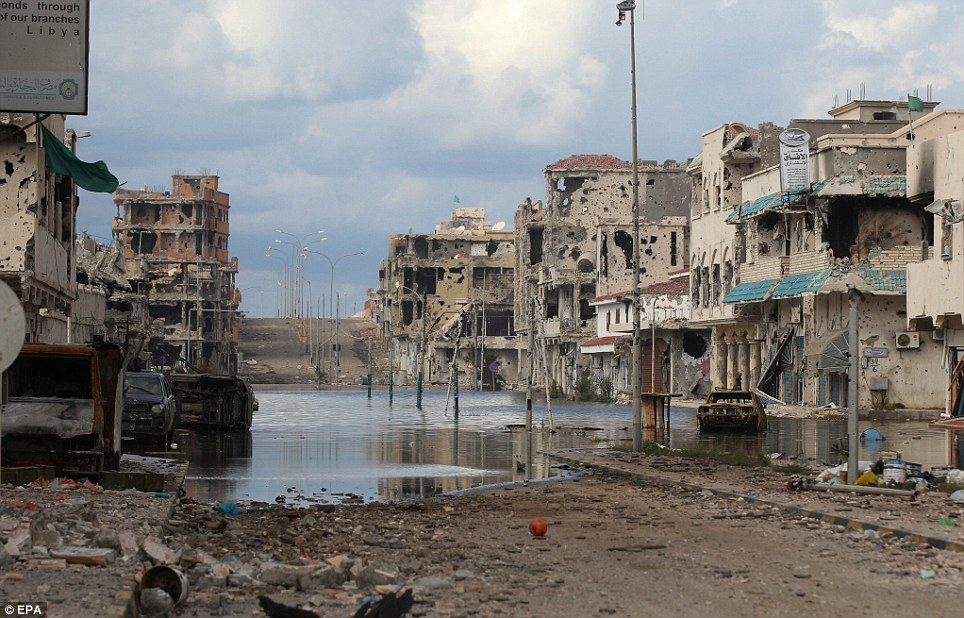
Sirte, Libya, after NATO bombing
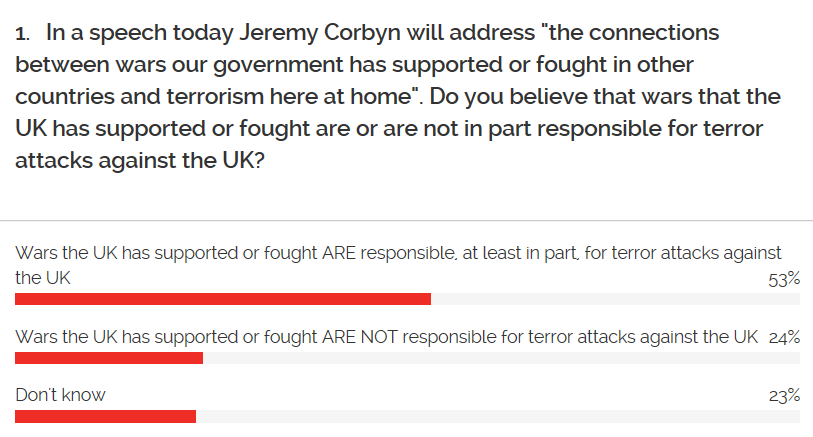
That further twist in the cycle of violence will lead to more terrorist attacks in the UK. There is no sense in which this aircraft carrier is anything to do with defending the United Kingdom. It is a device to attack foreign countries. The result is it makes us a lot less safe at home.
When they think about it, people understand that, as YouGov demonstrated during the recent election campaign. The politicians will be trying to whip up feelings of jingoism and national pride around this huge hunk of floating hubris, to stop us thinking about that.
There is no money for our schools and hospitals, but unlimited sums for the armaments industry. The United Kingdom is not just a dysfunctional state, it is a rogue state and a danger to the peace of the world.
Bahrain to jail Qatar sympathisers
Middle East Online | June 8, 2017
MANAMA – Bahrain Thursday followed the United Arab Emirates in announcing that expressing sympathy for Qatar over sanctions imposed by its Gulf neighbours was an offence punishable by a lengthy jail term.
Saudi Arabia, the UAE, Bahrain and Egypt on Monday cut diplomatic ties with Qatar over accusations that the emirate is a champion of extremist groups in the region.
Qatar firmly denies the allegations.
“Any expression of sympathy with the government of Qatar or opposition to the measures taken by the government of Bahrain, whether through social media, Twitter or any other form of communication, is a criminal offence punishable by up to five years in prison and a fine,” a Bahraini interior ministry statement said.
The UAE on Wednesday announced a similar decision, warning that offenders could face between three and 15 years in prison and a fine of 500,000 dirhams ($136,125, 120,715 euros) should they criticise the decision to boycott Qatar.
Bahrain, home to the US Navy’s Fifth Fleet, has been rocked by unrest since security forces crushed Shiite-led protests in 2011 demanding a constitutional monarchy and an elected prime minister.
The authorities accuse Iran of backing the protesters and aiming to incite unrest in Shiite-majority Bahrain, a charge Tehran denies.
Sunni-ruled Bahrain’s strict cyber crime law prohibits the expression of dissent online, including via social media.
Nabeel Rajab, one of the country’s most high-profile activists, is currently on trial for a series of tweets criticising a Saudi-led Arab military campaign in Yemen.
Saudi, UAE, Bahrain, Egypt cut ties with Qatar
Press TV – June 5, 2017
Saudi Arabia, the UAE, Bahrain and Egypt have cut diplomatic ties and all land, sea and air contacts with Qatar, accusing the Persian Gulf country of supporting terrorism and interfering in their internal affairs.
Riyadh took the lead on Monday to sever relations and other countries fell in line after an official source said the kingdom “urges all brotherly countries and companies to do the same.”
A Saudi official cited by SPA said the country decided to “sever diplomatic and consular ties with Qatar, and to close all land, sea and aviation ports” in order to “protect its national security from the dangers of terrorism and extremism.”
The “decisive” measure, the Saudi statement said, was due to “gross violations committed by authorities in Qatar over the past years.”
The United Arab Emirates gave Qatari diplomats 48 hours to leave the country, citing their “support, funding and embrace of terrorist, extremist and sectarian organizations,” state news agency WAM reported.
Bahrain News Agency said the tiny kingdom was cutting ties with Doha over its insistence on “shaking the security and stability of Bahrain and meddling in its affairs.”
Egypt accused Qatar of supporting “terrorist” organizations, including the Muslim Brotherhood which it has been cracking down on since the 2013 coup against the country’s first ever democratically-elected leader, Mohamed Morsi.
Meanwhile, a Saudi “coalition” waging a war in Yemen said it was ending Qatar’s membership. The measure, it said, was due to Doha’s “practices that strengthen terrorism, and its support to organizations in Yemen, including al-Qaeda and Daesh, as well as dealing with the rebel militias.”
Qatar regretted the decision, saying “the measures are unjustified and are based on claims and allegations that have no basis in fact.” Doha-based Al Jazeera TV quoted Foreign Ministry as saying that the decisions would “not affect the normal lives of citizens and residents.”
“The aim is clear, and it is to impose guardianship on the state. This by itself is a violation of its (Qatar’s) sovereignty as a state,” the ministry said in a statement, referring to the severance of ties as an “incitement campaign based on fabrications, which reflects an intention to harm Qatar.”
Pakistan, another member of the “coalition” which has recently tried to distance itself from the Saudi group’s anti-Iran agenda, made it clear that the country had no plans to cut diplomatic ties with Qatar.
UAE carriers Etihad, Emirates and flydubai said they would suspend flights to and from Doha from Tuesday. Qatar Airways said it has suspended all flights to Saudi Arabia with immediate affect.
Trump factor
The crisis follows US President Donald Trump’s visit to the region last month, marked by the signing of a record $110-billion arms deal with Saudi Arabia.
US Secretary of State Rex Tillerson said the visit was aimed at getting Saudi Arabia and other Arab nations in the region to stand in “unity” with Israel and confront Iran.
After Trump’s visit, tensions escalated between Riyadh and Doha because of an article in Qatar’s state-run news agency in which the emir was quoted as criticizing the US, Saudi Arabia, and their client states for attempting to stir up tensions with “Islamic power” Iran.
The Qatari government quickly deleted the comments, saying the state agency had been hacked but the official denial failed to stop the rift between the Persian Gulf Arab countries from widening.
Saudi media then viciously attacked Qatar, accusing it of having “betrayed” the other Arab countries particularly at a time when they had attempted to stage a show of “unity” against Iran in a much-publicized and extravagant series of events in Riyadh.
Saudi Arabia and the United Arab Emirates also blocked Qatari websites and broadcasters. Qatari Foreign Minister Mohammed bin Abdulrahman Al Thani later said the country was being targeted in a “hostile media campaign, which we will confront.”
Prelude to invasion?
Qatar, home to the forward headquarters of the US military’s Central Command and some 10,000 American troops, long has faced criticism from its Arab neighbors over its support of the Muslim Brotherhood which has another admirer in Turkey.
Western officials have also accused Qatar of allowing or even encouraging funding of Takfiri extremists like al-Qaeda’s branch in Syria, once known as the Nusra Front. Saudi Arabia and the UAE similarly stand accused of supporting other Takfiri groups and the escalation exposes an underlying bitter rivalry among the neighbors for influence.
Former Yemeni president Ali Abdullah Saleh was quoted as saying that the conflict between Saudi Arabia and Qatar is rooted in “accumulated differences from the past even though both countries are followers of the Wahhabi school.”
Wahhabism is the radical ideology dominating Saudi Arabia, which is freely preached by government-backed clerics there and inspiring terrorist groups such as Daesh and al-Qaeda.
Prominent Palestinian journalist Abdel Bari Atwan said in a Twitter post that the diplomatic rupture is a “prelude” to a military action against Qatar.
“The next move may be a military offensive to change the regime in Qatar. It’s a war planned months ago,” wrote the editor-in-chief of the Rai al-Youm news website.
Saudi Arabia, UAE falling out over Yemen?
Recent reports have suggested Saudi Arabia and the United Arab Emirates were divided over their role in Yemen on which they have been waging a deadly war for more than two years now.
In a recent interview with Middle East Eye online news portal, Saudi-backed former Yemeni president Abd Rabbuh Mansour Hadi accused the UAE of acting “like an occupation power in Yemen rather than a force of liberation.”
Yemeni sources have revealed that the United Arab Emirates was trying to establish control over the strategic island of Socotra in the Arabian Sea, which Hadi had rented out to the country for nearly a century.
Tensions have taken a turn for worse under Saudi Arabia’s new rulers who have adopted an aggressive policy, waging a destructive war on Yemen, severing relations with Iran and assisting militants in Iraq and Syria to topple their governments.
Hezbollah: Qassem’s jail a ‘state crime’ by Bahrain regime
Press TV – May 22, 2017
Lebanese resistance movement Hezbollah has lambasted a suspended jail term given by a Bahraini regime court on Sunday to the country’s Shia majority leader Sheikh Isa Qassem.
The court convicted the spiritual leader of illegal collection of funds and money laundering and sentenced him to one year in jail suspended for three years. It also ordered him to pay $265,266 in fines.
“This sentence is a new crime added to a series of crimes against humanity perpetrated by the [Bahraini] regime,” a Hezbollah statement said.
The charges emanate from the collection of an Islamic donation called Khums, which in Shia Islam is collected and spent by a senior cleric in the interests of the needy.
Qassem also faces expulsion from the kingdom after authorities revoked his citizenship last year. His defense lawyers refused to attend the hearings, which they saw as an attack on the country’s Shia Muslims.
Since 2011, the kingdom has been the scene of peaceful anti-regime protests against the systematic abuse of the Shia population and discrimination against them.
The Bahraini regime has responded to the protests with excessive and lethal force, which has drawn international criticism.
Bahrain’s perennial rulers are allies of the West, including the US which has its Fifth naval fleet based in the tiny Persian Gulf country.
On Sunday, hundreds of protesters marched in the capital Manama after the verdict was issued against Sheikh Qassem.
Qassem’s residence in his native village of Diraz is under siege by regime forces in the face of a sit-in held outside the building ever since the regime revoked his citizenship.
US, Israel two sides of same coin, trying to destroy Yemen: Houthi
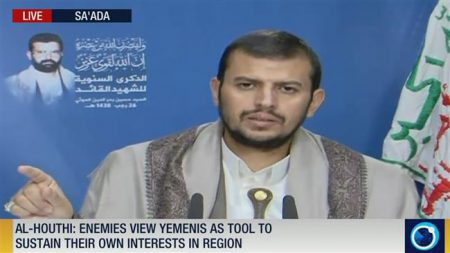
Leader of Yemen’s Houthi Ansarullah movement, Abdul-Malik Badreddin al-Houthi, speaks during a televised speech in Sa’ada, on April 23, 2017.
Press TV – April 23, 2017
Leader of Yemen’s Houthi Ansarullah movement, Abdul-Malik Badreddin al-Houthi, says the United States and the Israeli regime are two sides of the same coin and together they seek to destroy Yemen through a brutal military campaign launched by Saudi Arabia.
Addressing a group of Yemenis in Sa’ada, thorough a video conference, Houthi further said on Sunday that the US, Israel and their allies are trying to impose their values on regional nations, adding that enemies view Yemenis as a worthless tool to sustain their own interests in the region.
“Independent forces in the region from Yemen to Syria, Lebanon and Iraq are considered as rogue from the American perspective, and sympathy for the oppressed in these countries is viewed as a crime,” he said, adding that Washington is trying hard to turn regional players into its own puppets.
The Yemeni leader also noted that collusion in the atrocities committed against the Yemeni people is not an issue in the eyes of the American leaders, but when the oppressed and independent forces cooperate with each other, the US perceives it as a crime.
He called on all Yemenis to stand united against the aggressors and defend their country.
“[When] anyone says Israel is a threat to our nation, the United States and its allies say they are supporters of Iran, and with the help of this false justification, they (Washington and allies) target anyone that does not accept adopting a hostile attitude towards Iran,” he added.
He also said the only sin committed by Iran, from the perspective of the United States, was that it freed itself from being a puppet country in the 1979 Islamic Revolution.
‘US, Israel main source of terrorism worldwide’
The Yemeni leader added that Washington considers regional or international threats all those countries that are not its ally, “but the reality is that the US and Israel are themselves the main source of terrorism worldwide.”
Elsewhere in his remarks, Houthi said the Yemeni nation, from all walks of life, should boost their awareness of the realities of regional developments and use it as a tool to battle the US propaganda against the Arab country. Ignorance, he said, makes people an easy target for the US and the Zionists.
Houthi also stated that only Yemenis can decide about their future and the internal affairs of their country and that absolutely no other country or organization, even the United Nations and the Arab League, can impose their so-called solutions to the crisis in Yemen.
He described as utterly ridiculous Washington and Riyadh’s claim that they want to liberate Yemeni cities from “Yemeni occupation.”
“You are Yemenis, who have occupied the capital Sana’a? The US wants to liberate Sana’a from Yemenis?!” he asked.
Houthi reiterated that the Yemeni nation’s resistance against the Riyadh regime’s incessant attacks was deeply rooted in religious orders and was meant to safeguard national sovereignty and freedom.
Saudi Arabia launched its deadly campaign against Yemen in March 2015 to push back the Houthi Ansarullah fighters from Sana’a and to bring back to power Abd Rabbuh Mansur Hadi, Yemen’s president who has resigned and is a staunch ally of Riyadh.
The campaign, which lacks any international mandate and has faced increasing criticism, has claimed the lives of more than 12,000 people, most of them civilians.
Certain Arab countries, including the United Arab Emirates, Bahrain and Qatar, are partners to the military aggression.
Bahrain approves military trials for civilians
Press TV – March 5, 2017
Bahrain has approved trial of civilians at military tribunals in a measure blasted by human rights campaigners as being tantamount to imposition of an undeclared martial law countrywide.
The Consultative Council, the upper house of the Bahraini parliament, voted for the measure Sunday, less than two weeks after it was approved by the Council of Representatives, the lower house.
The move saw Manama manipulating part of its constitution, which defines the identities of those who can stand trial at such courts.
Neighboring Saudi Arabia, whose influence radically sways Bahrain, has likewise redefined its anti-terror laws to expand the powers of its security forces in the face of political dissent.
Bahrain has been witnessing peaceful anti-regime protests since 2011. High-handed suppression of the rallies has led to widespread imprisonments and scores of deaths.
Hundreds of the detainees have already faced summary proceedings at military courts.
Britain ignores Bahrain’s human rights record to pursue business interests with dictatorship
By Marwa Osman | RT | March 5, 2017
Britain’s multi-million pound trade and aid strategy for programs in Bahrain needs exposed as the tiny gulf kingdom continues its chain of tyranny and torture against the Shia majority.
The British government’s unreserved condemnation of torture and inhumane treatment and punishment seems to vanish when it comes to making more money. As kidnaps, imprisonments and political executions are on the rise in Bahrain, activists and Bahraini opposition figures are troubled by the fact that the UK government is spending taxpayers’ money on these trade and aid programs, especially given the clear risk of complicity in abuse.
Habib Mohamed Habib is the latest Bahraini civilian to be kidnapped from his home the morning of Friday March 3rd 2017 as security forces deployed armored vehicles in and around Diraz, in a continuation of the Al Khalifa Monarchy’s oppression against the Shiite Friday prayers as part of their uninterrupted crackdown on civilians since 2011 in the Bahraini capital Manama.
As Habib’s family struggle to know the whereabouts of their son, traveling in and around Diraz is nothing less than a nightmare with traffic jams at every entry point of the town, which is witnessing an increase in tightened security at its checkpoints.
Meanwhile, since last June the citizens of Diraz have been experiencing an internet blockade every day between 7pm and 1am as a result of a service restriction order from the Bahraini authorities. The citizens of Diraz are increasingly being cut off from the outside world. They cannot even contact emergency services, and if somebody is caught aiding a fellow citizen he/she will disappear like Habib and hundreds of others like him.
Last week alone, the Bahrain Center for Human Rights BHRC documented a total of 17 arbitrary arrests, among whom were six children. In the same week, 129 marches took place in 40 villages in Bahrain to denounce the chain of repressions and kidnappings targeting peaceful protestors and Friday prayers’ attendees. BHRC reported that 26 marches during the same week were attacked by the Bahraini riot police and a total of 19 persons were judged in 6 politically motivated cases.
It is an open secret in Bahrain that after 6 years of constant crackdowns on millions of protestors who clamored for social justice and political self-determination, the ruling Al Khalifa regime has managed to get away with brutalizing, imprisoning, torturing and killing their own civilians under nonsensical pretexts. Although the monarchy has often expressed its desire to negotiate a political solution, promises of change have translated on the ground to a systematic crackdown.
The Al Khalifa regime has utterly failed to bear its responsibility in creating a space of dialogue in order to foster harmony, cohesion and tolerance. Instead of pushing for respect of cultural diversities amongst its citizens as a fundamental basis of democracy and peace-building, the authorities have politicized freedom of religion and successfully used it as a pretext for the incitement of hatred, violence and racial discrimination against groups of individuals and religious minorities.
International community’s deafening silence
Despite the fact that the Bahraini authorities have been only tightening restrictions on the rights to freedom of expression and association and continuing to curtail the right to peaceful assembly while detaining and charging several human rights defenders, banning others from traveling abroad, dissolving the main opposition group and stripping more than 80 people of their Bahraini citizenship, the United Nations Human Rights Council (UNHRC) has largely remained silent on the situation in Bahrain.
According to a joint NGO letter to Permanent Representatives of Member and Observer States of the UN Human Rights Council, Bahrain’s courts continued to play a key role last year in issuing repressive orders and granting the authorities broad discretionary powers to revoke Bahrainis’ citizenship, in some cases leaving them stateless.
The ultimate repressive order was issued on January 9, 2017 by Bahrain’s Court of Cassation upheld death sentences against three protestors convicted of killing police including three police officers in a bomb attack.
Sami Mushaima (42), Ali Al-Singace (21) and Abbas Al-Samea (27), who were executed on the morning of January 15, 2017 by firing squad, were reported by Bahrain Center for Human Rights BHRC to have been tortured during interrogation to force them to confess to the bomb attack. According to the BHRC, the lawyers of the executed men were not given access to all the hearings against the defendants, nor allowed to cross-examine prosecution witnesses during court hearings.
The shocking part about the atrocities inflicting the Bahrainis is no longer the blatant violations of the Al Khalifa monarchy as much as it is the international community turning a blind eye to the Bahraini people’s legitimate struggle for democratic rights.
UK government complicit in oppression
The US and the UK are two major western states supposedly committed to supporting human rights, democratic values, free speech and political self-determination, while, at the same time, are flagrantly partnering with dictatorships like that of the Bahraini Monarchy to advance their foreign agenda.
For instance, the government of the United Kingdom signed what the Foreign and Commonwealth Office (FCO) called a “landmark defense agreement” with the Gulf island kingdom of Bahrain in 2014. Clearly ongoing human rights abuses committed by those partners on their own citizens are not considered a shared strategic and regional threat especially when Bahrain is home to a major Royal Navy base. The multi-million-pound Royal Navy facility in Bahrain, which was founded in November 2016 housing up to 600 UK military personnel, became the staging-post for Britain in the Middle East and is designed to assert influence over the Gulf. Bahrain has paid most of the £30million-plus cost, with the UK contributing around £7.5million.
During the opening of the new Naval Support Facility (NSF) in Manama, Britain’s first permanent military base in the region since 1971, the Telegraph published an OpEd by Fawaz bin Mohamed Al Khalifa, Bahrain’s Ambassador to London, who claimed that King Hamad bin Isa Al Khalifa outlined the Gulf Cooperation Council’s interest in a free trade agreement between the UK and the GCC, which would significantly increase the UK’s access to the GCC’s £1.3 trillion market; a market estimated to grow by a further £400 billion by 2020.
Relative to its size, Bahrain already hosts a large number of British companies. The Bahraini Ambassador to London put the figures at “500 British brands, 90 British company branches, and 350 Bahraini-British business partnerships”. These businesses operate in some of Bahrain’s key sectors, including banking, accounting, law and industry. Meanwhile bilateral trade between Bahrain and the UK generated a staggering £432 million in 2015 alone, which would simply explain why the UK would choose to remain silent on all the human rights violations in the tiny gulf kingdom.
These bilateral relations are signed and sealed with Bahraini blood, says Ali Alaswad, former Bahraini Member of Parliament who was elected in October 2010, but resigned in February 2011 in response to the Governments’ crackdown on peaceful democracy protesters.
After his home was targeted by security forces, AlAswad left Bahrain and now resides in London where he continues his political work to achieve a democratic Bahrain. As I spoke with MP AlAswad, he emphasized that the UK’s current disappointing stance towards ignoring the human rights violations in Bahrain provides “a green light to the Bahraini government to abuse the basic human rights of the civilians which permits it to become more violent against the Shia majority and the Bahraini opposition.”
AlAswad told me “it doesn’t matter who you are in Bahrain, if you dare to demand for your basic rights then you will be in grave danger, which is why if the UK government as a strategic ally to the Bahraini government doesn’t use its ties as a strong card to support the oppressed Bahraini people to at least secure their basic human rights as enlisted in the declaration of human rights, then the UK is whitewashing the Bahraini authorities’ shocking human rights record by deliberately blocking official criticism of the Kingdom especially at international forums like the UN”.
The UK government is now seen by human rights activists and Bahraini opposition figures as a complicit in the tiny gulf kingdom’s tyranny against the outcry of the legitimate and basic demands of the Bahraini civilians until an official statement is issued from the UK government to condemn the acts of oppression of the Bahraini monarchy against its people.
“How do you expect the majority of the population to react when they see their leaders and clerics being detained, unlawfully imprisoned and even sometimes deported from their own country?” asks MP AlAswad.
Sheikh Ali Salman, a Shiite cleric and head of the Al-Wefaq opposition party, is now sentenced to serve nine years in jail for allegedly inciting hatred and calling for regime change by force.
The Bahraini authorities then went overboard when they stripped the highest religious authority in the country Sheikh Isa Qassim, a 79-year-old cleric, of his citizenship in June 2016 over accusations that he used his position to serve foreign interests and promote sectarianism and violence. This happened a week after the government of Bahrain suspended the Shia opposition group al-Wefaq.
The implications of this arrest is sending shockwaves on the streets of Manama, Diraz, Sanabes, Karbabad, Karzakan and Barbar with protestors refusing to back down. This resistance is prompting even more oppression and kidnapping from the Bahraini authorities.
Earlier this week, Al-Wefaq Deputy Secretary General, Sheikh Hussein al-Daihi, said through his twitter account, that targeting Ayatollah Qassim is triggered by his brave and firm stances, to demand legitimate rights for the oppressed Bahraini people. The deputy SG also stressed that Ayatollah Qassim is a red line, and the repercussions of crossing that line would go beyond the country’s borders.
Ms. Marwa Osman. PhD Candidate located in Beirut, Lebanon. University Lecturer at the Lebanese International University and Maaref University. Political writer/commentator on Middle East issues with many international and regional media outlets.
British Foreign Policy and the UK Weapons Trade

By Matthew JAMISON | Strategic Culture Foundation | 24.02.2017
Back in the halcyon days of the election of the first Labour Government in Britain in over 18 years, the New Labour Foreign Secretary Robin Cook expounded a radical shift in British foreign policy making, declaring that the Labour Government of Tony Blair would put human rights at the heart of it’s foreign policy with an «ethical dimension». This was quickly christened by the British media as New Labour’s «ethical foreign policy». Questions were raised at the time how a country with such a large weapons export industry could conduct an ethical foreign policy and that question is as pertinent today as it was back in 1997. In his party conference speech, the first as British Foreign Secretary, Boris Johnson, paid ritual homage as many British Foreign Secretaries have before him, to his belief in human rights and reflected that: «After a long post-war period in which the world was broadly getting more peaceful the number of deaths in conflict has risen from 49,000 in 2010 to 167,000 last year».
Sadly, Britain has contributed to many of these deaths. According to a study carried out with official UK Government figures by the Independent newspaper, Britain is now the second largest exporter of arms around the world, and according to Freedom House since 2010 has sold weapons to 39 of the 51 countries ranked by Freedom House as «not free». What is even more disturbing is that out of the 30 countries ranked on the British Government’s own human rights watch list, the British Government authorizes the sale of weapons to 22 of those. Indeed, according to statistics from the UK Government’s own Trade and Investment body the UK has sold more weapons on average over the last ten years than Russia, China and France combined. All exports of British manufactured bombs, bullets, weapons and other munitions must be signed off and approved by UK Government Ministers with licenses granted.
Most of these arms are sold to Middle Eastern regimes, which have serious human rights issues, if one were to apply the standards the UK Government sets on human rights. In 2016 alone Britain sold over 3 billion pounds worth of weapons to Saudi Arabia. It is odd how the British Government which constantly lectures other countries on their human rights records can sell weapons of mass destruction to regimes like the Saudis who carry out routine be-headings and lashings of their own citizens as part of their penal code; subject women to severe restrictions such as forbidding them to drive; provide funding to Madrassas that indoctrinate and radicalise young Muslims in the ways of jihad etc. The list of human rights violations could go on. But the British Government, despite wrapping itself in the language of human rights, feels very comfortable within its own «ethical conscience» in allowing shipments of British manufactured BL-755 cluster munitions to be used by the Saudi Government in its war in Yemen. Unexploded remnants of cluster munitions have proved deadly for Yemenis, killing or injuring at least 85 civilians, including children.
Since March 2015, the UK Government has approved £3.3 billion in military sales to Saudi Arabia, yet in November, the UK Foreign and Commonwealth Office concluded, despite considerable evidence to the contrary, that there was no «clear risk» of serious Saudi breaches of international humanitarian law in Yemen. The British Government has continued to sell arms to Saudi Arabia despite the Saudi Government’s vastly different approach and record regarding human rights which is incompatible with the British Government’s professed commitment to «universal human rights» and the problems that emanate from Saudi Arabia regarding Islamist extremist terrorism and radicalisation such as the fact that fifteen of the nineteen 9/11 hijackers where from Saudi Arabia and the emerging information that certain sections of the Saudi Government may have been complicit in the funding and training of the 9/11 hijackers. Saudi Arabia is not the only regime that does not conform to the UK’s own professed beliefs and standards in human rights that the British supply dangerous and destructive weapons of death to.
The UK Government sells arms to Bahrain which has used British arms to quell internal dissent; Burundi, which is being investigated by the UN for human rights violations and The Maldives, which in 2015 jailed its former President, Mohamed Nasheed, for 13 years following what critics said was a politically motivated show trial. The UK Government has also authorised the sale of massive amounts of arms to Egypt despite the coup against the democratically elected President Mohammad Morsi and the violent crackdown on the Muslim Brotherhood that followed. The British Government approved licences for the sale of £7.7bn of arms in 2015 alone. Then there have been weapons scandals in the past involving the British Government and the UK arms industry. There was the shocking Arms-to-Iraq affair of the 1990s when it came to light that the British Government had endorsed and advised on the sale of arms by British companies to Iraq, then under the rule of Saddam Hussein. Ironically, some of these British made and exported weapons to Saddam Hussein’s Iraq had been used by the Iraqi regime during the first Gulf War of 1991.
All of this raises serious questions regarding how the British Government can profess to on the one hand be a force for human rights and run a foreign policy based on «universal human values», upholding democracy, human rights and the rule of law and yet on the other hand maintain a massive arms trade of deadly weapons around the world, arming regimes that are the exact opposite of what the British Government professes to believe in and defend when it comes to human rights. At the heart of the British Government’s position on «human rights» is hypocrisy when examined within context of UK arms sales. The British Government maintains a saintly image of itself and believes its own rhetoric that it is a great force for «universal human rights» around the world despite the contradictions in its policies and behaviour and that the British have higher standards and more noble beliefs than other cultures and countries when in reality this is not the truth. What the British Government hates above all else is to have its self-image shattered and exposed for the two-faced hypocrisy that it is. They are unable to effectively answer the inconsistencies and contradictions of their rhetorical image on the one hand and the reality of their behaviour, policies and practices on the other when confronted with reality. It is high time for the British Government, if is serious about its rhetoric on human rights, to scale back its domestic weapons export industry.
UK covered up intelligence training with Bahrain’s police, amid death sentence
Reprieve | February 5, 2017
UK authorities trained Bahrain’s police how to gather intelligence on protestors, and then tried to cover up the scheme, international human rights group Reprieve has found. The project took place after protestors in the Gulf kingdom were rounded up and sentenced to death.
Britain’s Foreign Office paid for half a dozen Bahraini police officers to visit Belfast in August 2015, where the Police Service of Northern Ireland (PSNI) shared its expertise on gathering intelligence ahead of demonstrations.
Protestors in Bahrain, such as Mohammed Ramadan, have been targeted by police and tortured into falsely confessing to capital crimes. Mr Ramadan, a father of three young children, is now on death row and could be executed at any time.
The training, which also included sessions on water cannons, dog handling and public order tactics, was kept secret. The UK government has repeatedly denied providing public order training to Bahrain.
The Cabinet Office claimed that “The UK does not fund any programmes in Bahrain focused on public order”. However, documents obtained by Reprieve show that Bahrain’s police received an “Introduction to Combined Operational Training with a focus on Public Order.”
The training was prepared by Northern Irish police officers during a week-long “scoping visit” to Bahrain over April-May 2015, where they assessed Bahrain’s public order systems. The Stormont-owned company NI-CO played a key role in organising all the training.
It has also emerged that Bahrain’s Chief of Police and his deputies visited Belfast in June 2014. The itinerary included another session with the PSNI on “Community Intelligence”. The police chief attended a “demonstration of PSNI Public Order systems” and received a “Tour of North and West Belfast ‘Flashpoints’ with 2 or 3 PSNI Armoured Vehicles”.
Bahrain’s Chief of Police had to postpone a visit to Belfast earlier in 2014 because there was a “security emergency in Bahrain at the moment and it is felt that the Chief of Police and other senior officers cannot leave the country at this critical time.” This was a month after death-row prisoner Mohammed Ramadan was tortured. “The situation on the ground is becoming increasingly tense”, an email explained.
Bahrain’s Chief of Police has command level responsibility for violations carried out by lower ranking officers. Months after the police chief visited Belfast for training, teenager Ali al-Singace was arrested and tortured by Bahrain’s police with electric shocks, until he made a false confession to a capital crime. He was executed by firing squad in January 2017.
Commenting, Maya Foa, a director of Reprieve, said:
“It is outrageous that the government has covered up this project, which risks supporting the execution of protesters in Bahrain.
“Bahrain is notorious for arresting, torturing and sentencing to death people involved in protests – such as Mohammed Ramadan, a father of three who is held on death row and faces execution at any moment.
“By training Bahrain’s police how to gather intelligence on protesters, there is a serious risk that Britain is helping them arrest and execute people who are guilty of nothing more than calling for reform. It is scandalous that the Government has sought to sweep this under the carpet.”
UK in panic over Johnson’s remarks against Saudi regime
Press TV – December 11, 2016
UK Foreign Secretary Boris Johnson’s recent criticism of Saudi Arabia has worried British officials, with various government figures trying to gloss them over as Johnson’s own personal views.
During a conference in Rome last week, Johnson blasted the Riyadh regime over its “proxy wars” in the Middle East and its unprovoked military aggression against Yemen, which has killed over 11,000 Yemenis since March 2015.
UK Prime Minister Theresa May’s spokeswoman immediately rebuked the remarks back then, saying the comments did not reflect “the government’s views on Saudi and its role in the region.”
Johnson’s statements divided the UK Parliament, with many of the lawmakers saying that he was stating the truth and should not face public chastisement.
UK Defense Minister Michael Fallon lashed out at the media on Sunday, for blowing the story out of proportions and confecting an artificial row between Johnson and the Downing Street.
“Let’s be very clear about this. The way some of his remarks were reported seemed to imply that we didn’t support the right of Saudi Arabia to defend itself… and didn’t support what Saudi Arabia is doing in leading the campaign to restore the legitimate government of Yemen,” Fallon said during a BBC interview.
“Some of the reporting led people to think that,” he added. “The way it was interpreted left people with the impression that we didn’t support Saudi Arabia and we do.”
Fallon said the months-long Saudi invasion against its impoverished southern neighbor was in self-defense, a right that London thought Riyadh was entitled to.
“The government’s view is absolutely clear – that what Saudi Arabia is entitled to do is defend itself from these attacks across its own border,” he said.
Johnson’s remarks came at a time when May was in the Middle East, trying to cement military and economic ties with [Persian] Gulf Cooperation Council nations – Saudi Arabia, the United Arab Emirates, Kuwait, Oman, Bahrain and Qatar.
Besides helping Bahrain with a heavy-handed crackdown on its popular uprising, Britain has also been providing weapons and intelligence to Saudis in the attacks against civilian targets in Yemen.
Featured Video

Trump asks Iran not to retaliate after he strikes Pickaxe Mountain
or go to
Aletho News Archives – Video-Images
Book Review
‘Why Fauci Must Rot in Prison’: A Tale of Two Diaries
By Jill Erzen | The Defender | October 13, 2026
Dr. Anthony Fauci’s private diary reveals a “mind-numbing” contradiction between what the former top U.S. infectious disease official knew about COVID-19 and what he told the public, senior White House adviser Peter Navarro, Ph.D., said last week on “American Thought Leaders.”
In his new book, “Why Fauci Must Rot in Prison,” due out Oct. 20, Navarro compares Fauci’s private entries to his own pandemic-era diary, and uses what he calls “a tale of two diaries” to argue that Fauci should face criminal prosecution.
“I show, actually, how a prosecution can and should happen … at the state level, most likely,” Navarro said. “He should wind up in prison, and we’ve got the receipts in this book to put him there.”
Navarro said Fauci repeatedly acknowledged important facts in private, then publicly pursued policies that contradicted those facts — with devastating consequences.
“What he says many times privately in his diary is so at odds with both his public behavior and public statements that it’s mind-numbing,” Navarro said.
Navarro examines the lasting damage caused by lockdowns and other pandemic policies, and the ongoing toll of long COVID.
His book also addresses questions about vaccine safety, including why healthy young people faced COVID-19 vaccination mandates despite concerns about myocarditis, and why women were not warned about miscarriage risks linked to the shots. … continue
Blog Roll
 Aletho News
- Trump asks Iran not to retaliate after he strikes Pickaxe Mountain – w/ Prof. Marandi
- Vice President J.D. Vance’s Deceptive ‘Antiwar’ Campaign Speech
- Iran: Palestinians’ rights must not be compromised in Gaza’s future; US, Israel to blame for Hormuz situation
- Ongoing tales of Syrian chemical weapons
- Moscow blasts UN for ignoring torture of Russian POWs
- Millions of Books Could Have Been Destroyed in Lebanon During Israeli Bombings
- Moscow warns of ‘hunt for Russians’
- Calling of an Angel: The True Story of Rene Caisse and an Indian Herbal Medicine Called Essiac (1988)
- South Korean Assistance to the U.S. in the War with Iran: Between Allied Duty and National Interests
- Pharma- and Gates-Funded GAVI Seeks to Assure Parents
- If Americans Knew
- Israeli soldiers debunk Israel’s talking points
- In West Bank, Israeli settlers are totally out of control – Daily Update
- NPR investigation finds evidence of widespread fraud at mall kiosks tied to Israeli skincare brand
- Tucker Carlson exposes Israeli Lies about the Oct 7th attack, Charlie Kirk, and the U.S.
- Israel has detained thousands of Palestinian children since Oct 7th – over half spent time in solitary, many uncharged
- Israeli Analysis: Is Netanyahu Planning an ‘October Surprise’ Attack Before Israel’s Election?
- Israeli settlers brutally attack Palestinians and Washington Post female photographer, 65
- Words Have Changed, Occupation Continues: The Reality of the Gaza Ceasefire
- Gaza’s child amputees are growing faster than their prosthetics allow
- Israel keeps Palestinians struggling just to survive–Daily Update
- No Tricks Zone
- New Study Suggests Large Regions Of The Pacific Ocean Have Been Cooling For The Last 80 Years
- Germany’s Green Energy Debacle: High Energy Costs Force Kahla Porzellan to Close After 182 Years!
- New Study: 50 Years Of The Most Aggressive ‘Net Zero’ Policies Can Only Affect The Global Climate By 0.03°C
- US September “Heat” Was No Record…Many Records Set Decades Ago
- Latest European Green Energy Debacle; Portugal’s Largest Flagship Solar Park Insolvent!
- Green Energy Debacle: German Expert Professor Fritz Vahrenholt Warns Of Severe Economic And Social Consequences
- Two More Paleo Reconstructions Affirm Meters-Higher Sea Levels Across Ireland, Brazil 7000-6000 Years Ago
- New Study: Earth And Venus Surface Warmth Largely Explained By Convection And Lapse Rate, Not CO2 Or Radiation
- 2025 Nature Paper Claiming Worsening Global Drought Gets RETRACTED …Heavily Flawed
- New Study: ‘Global Drought Shows No Detectable Recent Acceleration Under Climate Warming’

