UK think tank covertly funded by Bahrain royal family – leaked papers
RT | December 7, 2016
The International Institute of Strategic Studies, an influential UK diplomacy and security think tank run by prominent military, political, and business figures, has received over $38mn in secret donations from Bahrain.
Bahrain, a former British colony and oil-rich Arab country which accommodates the US Navy’s Fifth Fleet, had secretly donated more than $38 million (£30 million) to the International Institute of Strategic Studies (IISS), a reputed UK think tank which positions itself as a leading global military and security research consultancy, according to human rights group Bahrain Watch.
The donations, which the IISS received over the course of five years, were said to form around a quarter of the think tank’s budget, or over $7.6 million (£6 million) per year, Bahrain Watch said citing confidential documents it obtained in cooperation with the Guardian.
Money from the Bahrain government was received in large part under a secret memorandum of understanding (MoU) between IISS head John Chipman and Bahraini Foreign Minister Sheikh Khalid Bin Ahmed Al Khalifa, who had previously served as ambassador to the UK.
The IISS and Bahrain agreed to “take all necessary steps to keep confidential all classified information which is disclosed or obtained in relation to this MoU, and neither shall divulge such information to any third party.”
The leak comes amid UK Prime Minister Theresa May’s two-day trip to Bahrain to discuss post-Brexit trade with Gulf leaders. UK Foreign Secretary Boris Johnson is also expected to arrive in the Bahraini capital Manama on Friday to address a Middle East-related conference organized by the IISS.
The event itself, called the Manama Dialogue, was financed by Bahrain’s ruling family, which is paying for all the delegates to stay at the Ritz-Carlton Hotel, the report said. Since 2011, the ruling family has donated $19 million (£14.9 million) to fund the conference, which is attended by influential figures from the Gulf and western nations, among others, the leaked papers show.
In a statement to the Guardian, the IISS said its agreement with the Bahraini rulers “expressly gives the IISS full freedom to develop the agenda and invite participants in line with priorities it judges to be important to encourage strong debate on regional issues and facilitate important diplomatic contacts.”
“The IISS for a number of years has received funding from a wide range of governments for conferences and major international summits,” it added.
“The Bahraini government is willing to spend so much on the IISS and the Manama Dialogues because they allow the government to portray itself as modern, liberal and business-friendly, in contradiction to the evidence of torture, abuse and political disenfranchisement,” Bahrain Watch said in turn.
In April, a report for the Foreign Affairs Select Committee blasted Bahrain’s poor human rights record, not least during the violent suppression of the Arab Spring protests, with direct support from another controversial UK ally – Saudi Arabia.
Earlier, Amnesty International accused London of “whitewashing” Bahrain’s record in the United Nations, having never condemned the country’s human rights abuses. The Bahraini royal family has enjoyed a close relationship with the British monarchy for several decades.
In mid-November, a new Royal Navy base in Bahrain was inaugurated by Prince Charles, with construction mostly funded by the Bahrainis. The US Naval Forces Central Command (NAVCENT) is also headquartered in the country, guiding the operations of the Fifth Fleet.
The IISS advisory board features high-ranking Western military brass, politicians, and business leaders, including George Robertson, former secretary-general of NATO, Field Marshal Charles Guthrie, former chief of the UK General Staff, Marillyn Hewson, CEO of Lockheed Martin, Amos Yadin, former chief of Israeli military intelligence, as well as Carl Bildt, Sweden’s ex-foreign minister.
Founded in 1958, the IISS describes itself as a primary source of information on international strategic issues for “politicians and diplomats, foreign affairs analysts, international business, economists, the military, defense commentators, journalists and academics.”
Apart from the Manama Dialogue, the institute hosts the Shangri-La Dialogue, an annual meeting of Asia-Pacific region defense ministers in Singapore.
It also publishes ‘The Military Balance,’ a comprehensive annual assessment of each country’s military capabilities. A 2015 Global Think Tank Index compiled by the University of Pennsylvania ranked IISS as the fourth-best non-US research institution.
UK to open permanent military base in Bahrain: Report

Britain’s then Foreign Secretary Philip Hammond boards a UK military ship docked in Manama, Bahrain, in November 2015.
Press TV – October 29, 2016
The United Kingdom will open a massive permanent military base in Bahrain and deploy warships in the Persian Gulf, a new report has revealed.
The military base, which is the first such facility being opened by Britain in 40 years in the Persian Gulf region, will be launched next month, Britain’s Express newspaper reported on Saturday.
Britain will station around 600 military forces at the Royal Navy Facility and will deploy its warships to patrol the surrounding waters and guard oil and gas shipments in the waters.
The base located in Bahrain’s Mina Salman Port, will also be used by Special forces, Navy destroyers and frigates to launch operations against the Daesh takfiri terrorist group in the region, according to the report.
“The project could save the Ministry of Defense millions because they won’t have to travel back to the UK,” the newspaper quoted unnamed diplomatic sources as saying.
The base, which will be used as a weapons store, will allow Britain to take part in any possible emergency operation if any country tries to block UK commercial ships from passing through the Strait of Hormuz, said a navy source.
“If we miss out on too much oil and gas then the lights will start to go out,” the source added.
When Britain kicked off the project in 2014, Defense Secretary Michael Fallon described it as “a permanent expansion of the Royal Navy’s footprint” in the Persian Gulf.
“It will enable Britain to send more and larger ships to reinforce stability in the [Persian] Gulf,” he said.
Critics, however, raised concerns over the legality of the base, saying the project had not been discussed in Bahrain’s parliament.
Human rights campaigners criticized the plan at the time, arguing that the Royal Navy named HMS Juffair, is reminiscent of the colonial era because it’s named after a previous naval base, Britain maintained in the country during colonial times.
Opposition activists also said Britain’s move strengthens the ruling al Khalifa family which, has long been carrying out crackdown on human rights activists in the kingdom.
Scores of people have been killed and hundreds of others injured or arrested in the Bahraini crackdown on the anti-regime activists, who have been holding protests on an almost daily basis since February 14, 2011.
Protest against Bahraini king’s visit to Downing Street halted by police
RT | October 26, 2016
The Kingdom of Bahrain’s authoritarian ruler King Hamad bin Isa Al Khalifa visited British Prime Minister Theresa May at Downing Street on Wednesday, despite outcry from human rights and anti-arms trade groups.
The Gulf regime is a close ally of both the UK and Saudi Arabia, as well as being a major UK arms customer, and is currently bearing much of the cost for building the Royal Navy’s new Mina Salman naval base.
Human rights groups have highlighted widespread abuses committed by Bahraini government forces against pro-democracy activists during the 2011 Arab Spring.
The king’s visit was met with protests by the Bahrain Institute for Rights and Democracy, and Campaign against the Arms Trade (CAAT) on Wednesday afternoon. Two activists were escorted away by police.
Already in 2016, senior British Royals, who are known for their closeness to the Gulf monarchies, have been criticized for meeting the Bahraini monarchy both in the UK and during trips to the nation.
The Prince of Wales and Duchess of Cornwall will soon visit Bahrain on behalf of the UK government, despite long-standing concerns over human rights abuses and UK arms sales.
In April, a report for the Foreign Affairs Select Committee blasted Bahrain’s record on human rights abuses, not least during the violent crushing of Arab Spring protests with the direct support of another controversial UK ally, Saudi Arabia.
The report also argued that human rights had effectively been downgraded by the UK government in a bid to shore up relations with the authoritarian state, which enjoys arms trading and security arrangements with Britain.
A broad campaign is currently underway, including MPs, to put a halt to UK arms sales to the Saudi regime in light of repeated reports of war crimes in its UK-assisted aerial bombing campaign in Yemen.
Bahraini FM’s praise for Peres sparks outcry
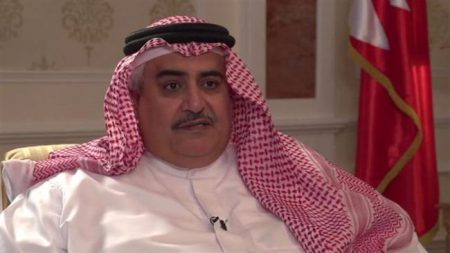
Bahrain Foreign Minister Sheikh Khalid bin Ahmed al-Khalifa
Press TV – September 29, 2016
The Bahraini foreign minister’s surprising tribute to former Israeli president Shimon Peres who died Wednesday has triggered a wave of outcry in the region where he is known as a criminal.
“Rest in Peace President Shimon Peres, a Man of War and a Man of the still elusive Peace in the Middle East,” Sheikh Khaled bin Ahmed al-Khalifa posted on his Twitter account.
The tribute drew the ire of many online users as well as opposition figures, given that a large number of Arabs view Peres as the man responsible for the successive wars that have rocked the Middle East.
“The foreign minister is paying tribute and praying for the Zionist terrorist and the killer of children,” complained former opposition lawmaker Jalal Fairooz.
Another critic, Khalil Buhazaa, tweeted, “Diplomacy does not mean rudeness.”
Manama does not have diplomatic relations with Tel Aviv but some Arab states, chiefly Saudi Arabia, have recently moved to warm relations with the Israeli regime.
Bahrain is under the heavy influence of Saudi Arabia which is spearheading the push for rapprochement with Israel.
Among Arab leaders, only Palestinian Authority President Mahmoud Abbas has offered condolences to Peres’s family, describing him as a partner in peace.
However, many across the world would remember Peres as a “war criminal” especially in light of the 1996 Qana massacre. In that Israeli attack on a southern Lebanese village, at least 106 people were killed. Peres was then prime minister.
Born in Poland in 1923, Peres emigrated to what was then British-mandated Palestine when he was 11. He joined the Zionist movement and met David Ben-Gurion, who would become his mentor and Israel’s first prime minister.
Peres became director general of the nascent ministry of military affairs at just 29. He was also seen as a driving force in the development of the Israel’s undeclared nuclear program.
Palestinians say Peres has their blood on his hands. Like other Zionist leaders, Peres also allowed Israeli settlement construction to take place in Palestinian land during his years in leadership positions.
The impoverished Gaza Strip witnessed two full-scale wars under Peres’s tenure as president, which claimed the lives of more than 3,700 Palestinians in total.
The Palestinian resistance movement Hamas has called on Palestinians to hold a “Day of Rage” on Friday which will coincide with the funeral of Peres.
The call is meant to mark the one-year anniversary of the beginning of what is described as the third Intifada throughout the occupied West Bank and Jerusalem al-Quds.
Canadian firm sells Bahrain software to censor Internet
Press TV – September 24, 2016
A Canadian company has sold Bahrain technology used to block opposition websites and human rights content on the Internet, Canadian activists say.
Specialists from internet watchdog Citizen Lab said in a report that Canadian Netsweeper website-blocking applications had been identified on nine internet service providers (ISPs) in Bahrain.
The report further disclosed that testing on the ISP of the state-run Bahrain Telecommunication Company (Batelco) showed that at least one of the Netsweeper installations was in use in the small Persian Gulf kingdom.
Citizen Lab researchers highlighted that the installations appear to have become active between May and July of this year.
That is “a few months after the release of a public tender by Bahrain’s Telecommunications Regulatory Authority in January 2016 indicating Netsweeper won a bid to provide a ‘national website filtering solution.’”
The contract is worth either 1.1 million or 3.1 million dollars, the researchers said.
Citizen Lab said, “The sale of technology used to censor political speech and other forms of legitimate expression, to a state with a highly problematic human rights record, raises serious questions.”
Since February 14, 2011, thousands of anti-regime protesters have held numerous demonstrations in Bahrain on an almost daily basis, calling on the Al Khalifah family to relinquish power.
Manama has been relentlessly cracking down on dissent. Troops from Saudi Arabia and the United Arab Emirates have been deployed to the country to assist in the crackdown on peaceful protests.
Scores of people have been killed and hundreds of others injured or arrested in the Bahraini crackdown on the anti-regime activists.
UK police under fire for training Bahraini forces
Press TV – August 14, 2016
A British parliamentary committee has criticized UK police for training Bahraini forces who are accused of ruthlessly suppressing public protests and dissent.
Under a confidential agreement in 2015 obtained by the Observer, the UK’s College of Policing agreed to train forces of Bahrain’s Interior Ministry.
The deal, however, does not mention human rights issues.
The UK parliament’s home affairs select committee has slammed the college’s agreements with regimes that have poor human rights records. The committee also blasted UK’s Foreign Office for refusing to disclose such contracts.
The committee said “opaque” agreements with foreign governments, which have been criticized for human rights abuses, “threaten the integrity of the very brand of British policing that the college is trying to promote”.
A law firm representing a tortured Bahraini activist has written a letter to the Foreign Office, saying the agreement with Bahrain raises concerns about the UK’s commitment to protecting human rights.
“We know the college provides a wide range of training programmes domestically that are of potential concern, such as the use of communications data obtained by telecoms operators, the use of interception material, surveillance and undercover policing, and the scope of its courses to overseas customers is not limited in any accountable way,” said Daniel Carey, of DPG Law.
He also argued that the college must have acquired the parliament’s approval for its profit-making activities. “The College of Policing is doing something unusual for government in selling services overseas.”
Anti-regime protesters have staged numerous demonstrations in Bahrain on an almost daily basis since February 14, 2011, calling on the Al Khalifah regime to relinquish power.
Troops from Saudi Arabia and the United Arab Emirates — themselves repressive Arab regimes — were deployed to the country in March that year to assist the Manama government in its crackdown on peaceful and pro-democracy rallies.
Scores of people have been killed and hundreds of others injured or arrested in Manama’s crackdown on the anti-regime activists.
Bahrain Strips Leading Shia Majority Cleric Figure of Citizenship
Sputnik — 20.06.2016
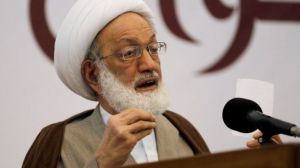 Sunni-ruled Bahrain has deprived leading Shia cleric Sheikh Isa Qassim of his citizenship, media reported Monday.
According to the BBC, Bahrain stripped Qassim, who is the spiritual leader of Al-Wefaq, Bahrain’s biggest opposition group, and holds the senior religious title of Ayatollah, of his citizenship.
On June 14, Bahrain’s Court of Cassation ruled to close all offices of Al-Wefaq in a response to an appeal lodged by the country’s Ministry of Justice.
Al-Wefaq has organized mass protest rallies against the current constitutional monarchy in Bahrain. Al-Wefaq’s leader, Sheikh Ali Salman, was arrested in 2014 and sentenced to four years in prison for inciting hatred and disobedience as well as insulting public institutions in 2015. Earlier in June, the court decided to increase the sentence to nine years.
Since 2011, the Sunni regime in Bahrain became locked in a struggle with an opposition movement led primarily by Shiites, who form a majority in the country. The protesters were calling for political freedom, equality and a parliamentary system that operates independently of Bahrain’s Sunni royal family.
Related:
UK ‘Unconditional Ally’ of Bahrain Despite ‘Inhumane Human Rights Record’
Dismantling Civil Society in Bahrain
By Rannie Amiri | CounterPunch | June 3, 2016
Like a vise which first grips its object and then slowly, deliberately and inexorably crushes it, the al-Khalifa regime has done similarly to civil society in Bahrain. It did not stop when peaceful, pro-democracy, reform protests erupted in 2011 and were violently put down by government forces aided by an invasion of Saudi troops in March of that year. Indeed, the vise continues to close and relentlessly so.
Nationalities have been revoked, mosques razed, citizens deported, human rights activists imprisoned on flimsy charges of insulting the monarchy at the least or plotting its overthrow at worst, and the most perfunctory of dialogues with the opposition abandoned. By smothering the figures and institutions who dare challenge the authority of the ruling dynasty in the most benign of fashions – a tweet, waving the country’s flag, tearing up a photo or merely questioning the tenure of the world’s longest serving prime minister – the Bahraini regime and its Gulf allies would like to believe monarchal rule has been preserved. Such desperate measures however, only speak to its precarity.
The stalwart activist Zainab al-Khawaja was given a sentence of three years and one month in Dec. 2014 for (again) tearing up a picture of King Hamad. She refused to be separated from her infant son whom she took with her to prison. Al-Khawaja has just been released on “humanitarian” grounds after serving 15 months in jail.
Her father though, Abdulhadi al-Khawaja, remains imprisoned serving a life sentence on trumped-up charges of attempting to topple the government. While authorities may have set Zainab al-Khawaja free, they simultaneously doubled the sentence of Sheikh Ali Salman, head of al-Wefaq, an opposition political party. Initially given a term of four years incarceration for alleged incitement against the regime, it was increased to nine years on appeal. The unflinching President of the Bahrain Center for Human Rights (BCHR) and founding Director of the Gulf Centre for Human Rights Nabeel Rajab, remains banned from leaving the country despite the need to secure medical treatment for his wife.
Busy highlighting the nation’s cordial relations with the United Kingdom and United States, the latter of which headquarters its Navy’s Fifth Fleet in the capital Manama, the Western media has largely ignored the plight of Bahrain’s ordinary citizens. The arrest and torture of disabled youth has now been documented by the BCHR. Indeed, for more than a decade, the Center has meticulously chronicled the dismantling of Bahrain’s civil society in all its forms by the al-Khalifa regime.
Most recently, with the passage of a law preventing any religious figure from joining political societies or engaging in political activities, the BCHR issued a statement condemning, “… the Bahraini parliament and Shura Council’s passage of amendments to the Political Societies Law, which places a ban on participation in political decision-making based on discriminatory religious grounds. In defense of this draft amendment, lawmakers supporting this motion argued it would prevent religious acts from being politicized. This decision restricts people’s ability to freely engage in religious practices, as those members willing to join political activities pertinent to the legislative process in Bahrain would now need to refrain from any activities carrying religious connotations.”
In the face of widespread and open abuses in civil society, lack of proportional parliamentary representation, curfews, detentions, and imprisonment and torture of those who dissent, these practices have nonetheless failed to adversely impact the ties enjoyed between Bahrain and the United States. But when a regime becomes alienated from those whom it rules and for example, gives lengthy jail sentences for tweets it finds offensive, it speaks to a tenuous reign.
The pillars of civil advocacy in Bahrain – Nabeel Rajab, Abdulhadi al-Khawaja, Maryam and Zainab al-Khawaja, Abduljalil al-Singace (sentenced to life in prison for participating in pro-democracy protests), Naji Fateel, Hussain Jawad and countless others both named and unnamed – have consistently engaged in purely secular, non-sectarian activism. Unlike the practice of the regime, the designations Sunni and Shia need not be applied when discussing the ongoing struggle for legal, political and socioeconomic rights in Bahrain. The people have waited too long for the West to recognize their demands are not based on sect, but on equity.
Despite an oppressive regime and the long shadow cast by the U.S. Fifth Fleet, resilient Bahrainis remain unintimidated.
Rannie Amiri is an independent commentator on Middle East affairs.
Hillary Clinton’s Memoir Deletions, in Detail
By Ming Chun Tang | The Americas Blog | May 26, 2016
As was reported following the assassination of prominent Honduran environmental activist Berta Cáceres in March, former Secretary of State Hillary Clinton erased all references to the 2009 coup in Honduras in the paperback edition of her memoirs, “Hard Choices.” Her three-page account of the coup in the original hardcover edition, where she admitted to having sanctioned it, was one of several lengthy sections cut from the paperback, published in April 2015 shortly after she had launched her presidential campaign.
A short, inconspicuous statement on the copyright page is the only indication that “a limited number of sections” — amounting to roughly 96 pages — had been cut “to accommodate a shorter length for this edition.” Many of the abridgements consist of narrative and description and are largely trivial, but there are a number of sections that were deleted from the original that also deserve attention.
Colombia
Clinton’s take on Plan Colombia, a U.S. program furnishing (predominantly military) aid to Colombia to combat both the FARC and ELN rebels as well as drug cartels, and introduced under her husband’s administration in 2000, adopts a much more favorable tone in the paperback compared to the original. She begins both versions by praising the initiative as a model for Mexico — a highly controversial claim given the sharp rise in extrajudicial killings and the proliferation of paramilitary death squads in Colombia since the program was launched.
The two versions then diverge considerably. In the original, she explains that the program was expanded by Colombian President Álvaro Uribe “with strong support from the Bush Administration” and acknowledges that “new concerns began to arise about human rights abuses, violence against labor organizers, targeted assassinations, and the atrocities of right-wing paramilitary groups.” Seeming to place the blame for these atrocities on the Uribe and Bush governments, she then claims to have “made the choice to continue America’s bipartisan support for Plan Colombia” regardless during her tenure as secretary of state, albeit with an increased emphasis on “governance, education and development.”
By contrast, the paperback makes no acknowledgment of these abuses or even of the fact that the program was widely expanded in the 2000s. Instead, it simply makes the case that the Obama administration decided to build on President Clinton’s efforts to help Colombia overcome its drug-related violence and the FARC insurgency — apparently leading to “an unprecedented measure of security and prosperity” by the time of her visit to Bogotá in 2010.
The Trans-Pacific Partnership
Also found in the original is a paragraph where Clinton discusses her efforts to encourage other countries in the Americas to join negotiations for the Trans-Pacific Partnership (TPP) trade agreement during a regional conference in El Salvador in June 2009:
So we worked hard to improve and ratify trade agreements with Colombia and Panama and encouraged Canada and the group of countries that became known as the Pacific Alliance — Mexico, Colombia, Peru, and Chile — all open-market democracies driving toward a more prosperous future to join negotiations with Asian nations on TPP, the trans-Pacific trade agreement.
Clinton praises Latin America for its high rate of economic growth, which she revealingly claims has produced “more than 50 million new middle-class consumers eager to buy U.S. goods and services.” She also admits that the region’s inequality is “still among the worst in the world” with much of its population “locked in persistent poverty” — even while the TPP that she has advocated strongly for threatens to exacerbate the region’s underdevelopment, just as NAFTA caused the Mexican economy to stagnate.
Last October, however, she publicly reversed her stance on the TPP under pressure from fellow Democratic presidential candidates Bernie Sanders and Martin O’Malley. Likewise, the entire two-page section on the conference in El Salvador where she expresses her support for the TPP is missing from the paperback.
Brazil
In her original account of her efforts to prevent Cuba from being admitted to the Organization of American States (OAS) in June 2009, Clinton singles out Brazilian President Luiz Inácio Lula da Silva as a potential mediator who could help “broker a compromise” between the U.S. and the left-leaning governments of Venezuela, Ecuador, Bolivia and Nicaragua. Her assessment of Lula, removed from the paperback, is mixed:
As Brazil’s economy grew, so did Lula’s assertiveness in foreign policy. He envisioned Brazil becoming a major world power, and his actions led to both constructive cooperation and some frustrations. For example, in 2004 Lula sent troops to lead the UN peacekeeping mission in Haiti, where they did an excellent job of providing order and security under difficult conditions. On the other hand, he insisted on working with Turkey to cut a side deal with Iran on its nuclear program that did not meet the international community’s requirements.
It is notable that the “difficult conditions” in Haiti that Clinton refers to was a period of perhaps the worst human rights crisis in the hemisphere at the time, following the U.S.-backed coup d’etat against democratically elected president Jean-Bertrand Aristide in 2004. Researchers estimate that some 4,000 people were killed for political reasons, and some 35,000 women and girls sexually assaulted. As various human rights investigators, journalists and other eyewitnesses noted at the time, some of the most heinous of these atrocities were carried out by Haiti’s National Police, with U.N. troops often providing support — when they were not engaging in them directly. WikiLeaked State Department cables, however, reveal that the State Department saw the U.N. mission as strategically important, in part because it helped to isolate Venezuela from other countries in the region, and because it allowed the U.S. to “manage” Haiti on the cheap.
In contrast to Lula, Clinton heaps praise on Lula’s successor, Dilma Rousseff, who was recently suspended from office pending impeachment proceedings:
Later I would enjoy working with Dilma Rousseff, Lula’s protégée, Chief of Staff, and eventual successor as President. On January 1, 2011, I attended her inauguration on a rainy but festive day in Brasilia. Tens of thousands of people lined the streets as the country’s first woman President drove by in a 1952 Rolls-Royce. She took the oath of office and accepted the traditional green and gold Presidential sash from her mentor, Lula, pledging to continue his work on eradicating poverty and inequality. She also acknowledged the history she was making. “Today, all Brazilian women should feel proud and happy.” Dilma is a formidable leader whom I admire and like.
The paperback version deletes almost all references to Rousseff, mentioning her only once as an alleged target of NSA spying according to Edward Snowden.
The Arab Spring
By far the lengthiest deletion in Clinton’s memoirs consists of a ten-page section discussing the Arab Spring in Jordan, Libya and the Persian Gulf region — amounting to almost half of the chapter. Having detailed her administration’s response to the mass demonstrations that had started in Tunisia before spreading to Egypt, then Jordan, then Bahrain and Libya, Clinton openly recognizes the profound contradictions at the heart of the U.S.’ relationship with its Gulf allies:
The United States had developed deep economic and strategic ties to these wealthy, conservative monarchies, even as we made no secret of our concerns about human rights abuses, especially the treatment of women and minorities, and the export of extremist ideology. Every U.S. administration wrestled with the contradictions of our policy towards the Gulf.
And it was appalling that money from the Gulf continued funding extremist madrassas and propaganda all over the world. At the same time, these governments shared many of our top security concerns.
Thanks to these shared “security concerns,” particularly those surrounding al-Qaeda and Iran, her administration strengthened diplomatic ties and sold vast amounts of military equipment to these countries:
The United States sold large amounts of military equipment to the Gulf states, and stationed the U.S. Navy’s 5th Fleet in Bahrain, the Combined Air and Space Operations Center in Qatar, and maintained troops in Kuwait, Saudi Arabia, and the UAE, as well as key bases in other countries. When I became Secretary I developed personal relationships with Gulf leaders both individually and as a group through the Gulf Cooperation Council.
Clinton continues to reveal that the U.S.’ common interests with its Gulf allies extended well beyond mere security issues and in fact included the objective of regime change in Libya — which led the Obama administration into a self-inflicted dilemma as it weighed the ramifications of condemning the violent repression of protests in Bahrain with the need to build an international coalition, involving a number of Gulf states, to help remove Libyan leader Muammar Gaddhafi from power:
Our values and conscience demanded that the United States condemn the violence against civilians we were seeing in Bahrain, full stop. After all, that was the very principle at play in Libya. But if we persisted, the carefully constructed international coalition to stop Qaddafi could collapse at the eleventh hour, and we might fail to prevent a much larger abuse — a full-fledged massacre.
Instead of delving into the complexities of the U.S.’ alliances in the Middle East, the entire discussion is simply deleted, replaced by a pensive reflection on prospects for democracy in Egypt, making no reference to the Gulf region at all. Having been uncharacteristically candid in assessing the U.S.’ response to the Arab Spring, Clinton chose to ignore these obvious inconsistencies — electing instead to proclaim the Obama administration as a champion of democracy and human rights across the Arab world.
Featured Video

Trump asks Iran not to retaliate after he strikes Pickaxe Mountain
or go to
Aletho News Archives – Video-Images
Book Review
‘Why Fauci Must Rot in Prison’: A Tale of Two Diaries
By Jill Erzen | The Defender | October 13, 2026
Dr. Anthony Fauci’s private diary reveals a “mind-numbing” contradiction between what the former top U.S. infectious disease official knew about COVID-19 and what he told the public, senior White House adviser Peter Navarro, Ph.D., said last week on “American Thought Leaders.”
In his new book, “Why Fauci Must Rot in Prison,” due out Oct. 20, Navarro compares Fauci’s private entries to his own pandemic-era diary, and uses what he calls “a tale of two diaries” to argue that Fauci should face criminal prosecution.
“I show, actually, how a prosecution can and should happen … at the state level, most likely,” Navarro said. “He should wind up in prison, and we’ve got the receipts in this book to put him there.”
Navarro said Fauci repeatedly acknowledged important facts in private, then publicly pursued policies that contradicted those facts — with devastating consequences.
“What he says many times privately in his diary is so at odds with both his public behavior and public statements that it’s mind-numbing,” Navarro said.
Navarro examines the lasting damage caused by lockdowns and other pandemic policies, and the ongoing toll of long COVID.
His book also addresses questions about vaccine safety, including why healthy young people faced COVID-19 vaccination mandates despite concerns about myocarditis, and why women were not warned about miscarriage risks linked to the shots. … continue
Blog Roll
 Aletho News
- Trump asks Iran not to retaliate after he strikes Pickaxe Mountain – w/ Prof. Marandi
- Vice President J.D. Vance’s Deceptive ‘Antiwar’ Campaign Speech
- Iran: Palestinians’ rights must not be compromised in Gaza’s future; US, Israel to blame for Hormuz situation
- Ongoing tales of Syrian chemical weapons
- Moscow blasts UN for ignoring torture of Russian POWs
- Millions of Books Could Have Been Destroyed in Lebanon During Israeli Bombings
- Moscow warns of ‘hunt for Russians’
- Calling of an Angel: The True Story of Rene Caisse and an Indian Herbal Medicine Called Essiac (1988)
- South Korean Assistance to the U.S. in the War with Iran: Between Allied Duty and National Interests
- Pharma- and Gates-Funded GAVI Seeks to Assure Parents
- If Americans Knew
- Israeli soldiers debunk Israel’s talking points
- In West Bank, Israeli settlers are totally out of control – Daily Update
- NPR investigation finds evidence of widespread fraud at mall kiosks tied to Israeli skincare brand
- Tucker Carlson exposes Israeli Lies about the Oct 7th attack, Charlie Kirk, and the U.S.
- Israel has detained thousands of Palestinian children since Oct 7th – over half spent time in solitary, many uncharged
- Israeli Analysis: Is Netanyahu Planning an ‘October Surprise’ Attack Before Israel’s Election?
- Israeli settlers brutally attack Palestinians and Washington Post female photographer, 65
- Words Have Changed, Occupation Continues: The Reality of the Gaza Ceasefire
- Gaza’s child amputees are growing faster than their prosthetics allow
- Israel keeps Palestinians struggling just to survive–Daily Update
- No Tricks Zone
- New Study Suggests Large Regions Of The Pacific Ocean Have Been Cooling For The Last 80 Years
- Germany’s Green Energy Debacle: High Energy Costs Force Kahla Porzellan to Close After 182 Years!
- New Study: 50 Years Of The Most Aggressive ‘Net Zero’ Policies Can Only Affect The Global Climate By 0.03°C
- US September “Heat” Was No Record…Many Records Set Decades Ago
- Latest European Green Energy Debacle; Portugal’s Largest Flagship Solar Park Insolvent!
- Green Energy Debacle: German Expert Professor Fritz Vahrenholt Warns Of Severe Economic And Social Consequences
- Two More Paleo Reconstructions Affirm Meters-Higher Sea Levels Across Ireland, Brazil 7000-6000 Years Ago
- New Study: Earth And Venus Surface Warmth Largely Explained By Convection And Lapse Rate, Not CO2 Or Radiation
- 2025 Nature Paper Claiming Worsening Global Drought Gets RETRACTED …Heavily Flawed
- New Study: ‘Global Drought Shows No Detectable Recent Acceleration Under Climate Warming’

