New Quebec premier scraps tuition hike plan
Press TV – September 21, 2012
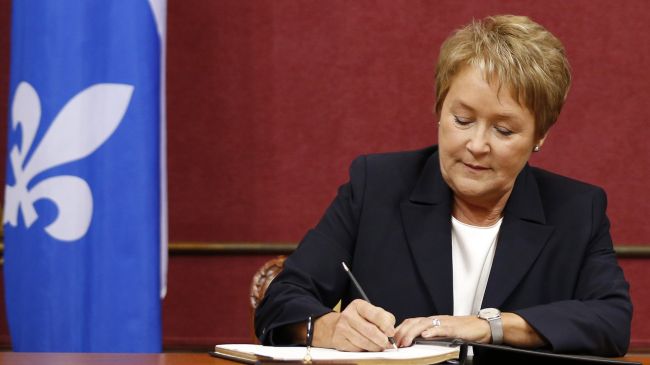
Newly-elected Quebec Premier Pauline Marois has reversed a planned tuition hike that touched off months of violent protests in Canada’s French-speaking province.
Marois, who started her job on Thursday, delivered on her electoral pledge to reinstate the USD 2,220 tuition.
“The new government is now in place,” she told reporters after the first cabinet meeting. “I intend to act rapidly to offer results to Quebecers, starting today, Day One of our mandate.”
The former premier, Jean Charest, had planned to increase tuition fees in a bid to make up for the country’s budget deficit.
Marois said she will also cancel the Liberals’ controversial anti-protest law, known as Bill 78. The draconian law, whose main objective was to restrict freedom of assembly, criminalizes students’ strike and sets rules for gatherings of more than 50 people, requiring organizers to provide an eight-hour notice of the itinerary and length of the event.
“These two decisions will allow us to return peace to our streets and to reestablish rights and liberties,” Marois was quoted as saying.
The new premier’s move drew applause from student groups.
“It’s a victory for justice and equality,” said Martine Desjardins, president of the FEUQ university student association.
“Together, we have written a chapter in the history of Quebec. Together, we have just proven that we can stand up and reach one of the student movement’s greatest victories,” he added.
Ahead of elections earlier this month, Marois had said that if her party – Parti Quebecois (PQP) – won and was able to form a new Quebec government, she would call for a referendum on the separation of Quebec from Canada.
Related articles
- University of Montreal cancels classes for fear of protest (alethonews.wordpress.com)
Party Quebecois members take down Canadian flag
Press TV – September 18, 2012
The newly-elected separatist party in Canada’s French-speaking province of Quebec takes down the Canadian flag from parliament, vowing independence of the eastern province.
The flag which had been there for the past nine years was removed on Monday as 54 Party Quebecois (PQ) members took office in the ornate old upper chamber, known as the Red Room.
Meanwhile, the new parliament members could not escape the oath of allegiance to Queen Elizabeth the second, which is a prerequisite to take office under Canadian law.
Some PQ members expressed their discontent on Twitter, saying it was a shame to be forced to swear an oath to the Crown.
The separatist Parti Quebecois (PQ) leader, Pauline Marois who won provincial elections on September 5, also suggested that the election of a PQ government would pave the way for restoring Quebecers’ pride.
“When a people rediscovers its pride and its confidence nothing, absolutely nothing, becomes impossible for it,” said Marois on Monday.
The Party Quebecois (PQ) lawmakers officially take office on Wednesday, when separatist leader Pauline Marois will introduce her cabinet members.
Separatists win Quebec elections
RT | September 5, 2012
The separatist Parti Quebecois has won Quebec’s regional elections and will form a new government there, once again raising the possibility of a referendum on independence being held in Canada’s French-speaking province.
Canadian Broadcasting Corp and the Canadian Press reported that Parti Quebecois (PQ) won or were leading in nearly 60 districts, just short of the 63 needed for a majority government.
The party’s leader, Pauline Marois, will replace head of the Liberal party, Jean Charest, as the province’s leader, becoming Quebec’s first female premier.
Crowds of jubilant PQ followers, cheered and waved flags as election results indicated their party was heading back to power after nine years of Liberal Party rule.
Should PQ win a majority it will make it easier for them to call a referendum on independence. Quebec has held two referendums in the past – one in 1980 and another in 1995- with the last narrowly rejecting independence from Canada.
However PQ claim their short-term priority would be picking the economy up off its knees, instead of pushing for a separation vote straight away.
“It’s very important for me to manage our finances responsibly. That is without doubt why our engagements are the least costly of all parties,” Pauline Marois earlier told Canadian media, while outlining a program that sets out new spending at $1 billion over a five year period.
At the same time she stated that she would hold an independence vote “tomorrow morning” if the conditions were right.
The long-ruling Liberal Party’s loss comes after months of student and union protests raging this spring and summer against tuition hikes in the province and the controversial new Bill 78, which restricts mass gatherings in the province.
Tens of thousands of students have made their outrage public by demonstrating and clashing with police, making headlines across the world. Protests began in February, resulting in about 2,500 arrests. Tuesday’s vote is seen by many as an echo of this public discontent.
University of Montreal cancels classes for fear of protest
Press TV – August 30, 2012
Administrators at the University of Montreal (UdeM), the most prestigious French-speaking University in North America, have been forced to cancel dozens of classes for the rest of the week for fear of fresh protests.
The university issued a notice in Tuesday evening, saying that it had suspended classes in the departments that have been targeted by striking students since Monday, the CBC reported.
“They were the classes that we saw in the last two days [in which] the students were giving us trouble,” said Mathieu Filion, a spokesman for the university administration.
The classes were supposed to resume this week after the winter semester was suspended following massive months-long protests across Canada’s French-speaking province of Quebec against proposed tuition fee hikes.
Over Monday and Tuesday, the police stormed the university and arrested more than 30 protesters. The protest erupted following the passage of a new controversial bill, which outlawed obstructing classes and all non-pre-approved gatherings of more than 50.
Students in Quebec have been protesting university tuition hikes since February 2011. The protests later turned into a larger movement, dubbed the “maple revolution,” which, analysts say, reveals deeper social unrest.
The developments come ahead of next week’s provincial elections, which will decide whether Quebec Prime Minister Jean Charest’s ruling Liberal Party, which insists on a plan to increase tuition fees by 82 percent, could be reelected.
The latest opinion survey shows that the separatist Parti Quebecois (PQ), led by Pauline Marois, is heading for a victory in the September 4 polls.
The PQ has promised to hold a referendum on the separation of Quebec from Canada if 850,000 Quebecers sign a related petition.
Related articles
- Quebec police arrest 19 protesting students as classes resume (alethonews.wordpress.com)
- Canadian students arrested after clashing with police (PHOTOS) (rt.com)
Quebec police arrest 19 protesting students as classes resume
Press TV – August 28, 2012
 Canadian police have stormed the University of Quebec making 19 arrests, as angry students prevent the beginning of the new semester.
Police arrested 19 students Monday under the terms of Bill 78, which ordered a suspension of university classes back in May and their reinstatement in August even if the students planed to continue their strike. The bill also restricts the student demonstrations and imposes fines for those who impeded classes, starting at CAD 1,000.
The classes were supposed to resume this week, as the winter semester was suspended following massive months-long protests across Canada’s French-speaking province against proposed tuition fee hikes.
Some 2,000 students at the departments of anthropology and cinema voted to continue their protest and prevented the start of classes.
The recent protest comes ahead of next week’s provincial election, which will decide whether the province’s ruling Liberal Party, which insists on a plan to increase tuition fees by 82 percent, could be reelected.
The latest opinion poll shows that the separatist Parti Quebecois (PQ) led by Pauline Marois heading for a victory in the election to be held on September 4th. Marois is the protester’s favorite candidate and has been wearing the red square, the symbol of the demonstrators’ cause, on several public occasions.
If the separatist PQ is elected in the upcoming provincial election, it will consider holding a referendum on separation of Quebec from Canada.
Since February, students have been protesting against the hikes and the provincial government’s controversial anti-protest Bill 78. The protests later turned into a larger movement dubbed the “maple revolution,” which reveals deeper social unrest.
United Church of Canada Decides To Boycott Settlement Products
By Saed Bannoura | IMEMC & Agencies | August 16, 2012
Following around six hours of deliberation, the United Church of Canada (UCC), the largest Protestant denomination in the country, voted for boycotting products made in Israel’s settlements in the occupied West Bank and occupied East Jerusalem.
The Toronto Star reported that a spokesperson of the UCC general council identified as Bruce Gregersen, stated that the decision is considered a significant step.
The UCC will be holding another vote on Friday to decide whether this boycott would be a regarded as a permanent policy of the church.
Israeli Ynet News reported that the Centre for Israel and the Jewish Affairs in Canada said that it was “outraged by this decision”, and considered it “a move that singled out Jewish communities for boycott”.
The Centre claimed that this decision is considered a “reckless path”, and added that the decision just dismisses the concerns of the Jewish community in Canada.
According to the Ynet, Chairman of the Centre for Israel and Jewish Affairs, David Koschitzky, stated that mainstream Jewish organization, including the Canadian Friends of Peace Now, “do not approve of this boycott decision”.
He added that this decision ignored around 100.000 families, members of different Jewish federations in Canada, and said that this decision “also ignores written rejection letters of 70 Canadian Rabbis, representing tens of thousands of Jewish families in the country”.
Israel’s settlements are located in the occupied Palestinian territories, including in and around occupied East Jerusalem. There have been several churches and organizations around the world, including educational facilities that have previously voted in favor of boycotting products made in Israel’s settlements.
Israel’s settlements in occupied Palestine are illegal under International Law, and even violate the Fourth Geneva Convention to which Israel is a signatory.
Related articles
Don’t Expand NAFTA
The United States is leading the way to another corporate-friendly free-trade agreement, and it’s bringing its NAFTA partners along for the ride.
By Manuel Perez-Rocha and Stuart Trew · IPS · July 26, 2012
The United States recently announced that Canada and Mexico will join negotiations for the Trans-Pacific Partnership (TPP)—a secretive U.S.-led multinational trade and investment agreement currently being negotiated with eight other countries in the Pacific Rim region.On the other side of the Pacific, Japanese legislators are defecting in droves to try to stop the country’s entry into the negotiations. But the situation is much different in Canada and Mexico, which were admitted to the table with much fanfare during the G20 summit in June. The Japanese response is justifiable, and a recent statement of solidarity against the TPP by North American unions offers a good building block for resisting an agreement that for Mexicans and Canadians amounts to a neoliberal expansion of NAFTA on U.S. President Barack Obama’s terms.Mexico and Canada had been trying to secure a spot at the TPP table for months prior to the G20, and it became a leading story in both countries. Their anxiety played nicely into Obama’s hands, allowing the U.S. trade representative to put humiliating entry conditions on both countries — essentially giving these NAFTA neighbors a second-rate status, or what in Spanish is called convidados de palo (to be invited but without a say). Neither Canada nor Mexico will be able to see any TPP text until they finally join the negotiations in December, following the required 90-day U.S. congressional approval process. Once at the table, they will not be able to make any changes to the finished text or propose any new text in the finished chapters. There is a very real possibility that the existing TPP countries, the United States in particular, will use the following months to fashion a trap for the TPP latecomers.
North American Labor Solidarity
While most media outlets welcomed the NAFTA partners to the TPP table, national labor federations from the United States, Mexico, and Canada were cautious for very good reasons, and it wasn’t just the obviously imbalanced negotiating dynamic. On July 11, the AFL-CIO, the Canadian Labour Congress, and the National Union of Workers (UNT) of Mexico outlined some of those reasons in an important statement of solidarity, which included a vision of what they believe a 21st-centry trade agreement should look like.
The labor unions state that although they “would welcome a TPP that creates good jobs, strengthens protection for fundamental labor rights—such as freedom of association and authentic collective bargaining—protects the environment, and boosts global economic growth and development for all, American, Canadian, and Mexican workers cannot afford another corporate-directed trade agreement.” The joint statement explains that to have any positive effect on the region, “the TPP must break from NAFTA, which imposed a destructive economic model that expands the rights and privileges of multinational corporations at the expense of working families, communities, and the environment.”
The unions conclude that if “the TPP follows the neoliberal model and substitutes corporate interests for national interests, workers in all three countries will continue to pay a high price in the form of suppressed wages, a more difficult organizing environment, and general regulatory erosion, even as large corporations will continue to benefit.” Unfortunately, by all accounts, including leaked TPP chapters and statements from the U.S. trade representative, this is exactly what the Obama administration hopes to achieve through these negotiations.
Expanding Investor Rights
Instead of breaking with NAFTA, the TPP expands it in almost every chapter, from intellectual property rights to “regulatory coherence,” and from rules for increased “competition” in state-owned enterprises to opening government purchases to foreign bidders.
Particularly worrying to Canadians and Mexicans, and not mentioned in the joint statement from North American unions, are the extreme investors’ rights foreseen in the TPP. Under NAFTA, Mexico and Canada continue to be pummeled by investor-state lawsuits from U.S. and Canadian companies, or international firms using their U.S. registration to challenge government measures that can be shown to interfere with profits, even if that interference is not intended. These investment disputes, launched under NAFTA’s Chapter 11 protections, have resulted in hundreds of millions of dollars in fines or settlements to be paid out from public funds. Two recent cases against Mexico and Canada help describe the problem.
In 2009, two separate NAFTA investment panels established through the International Center for Settlement of Investment Disputes (ICSID) ruled in favour of U.S. companies Cargill and Corn Products International in their nearly identical cases against a Mexican tax on drinks containing high fructose corn syrup (HFCS), a sugar alternative. The tax was a means of levelling the playing field for Mexican cane sugar producers, who were having no luck accessing the U.S. market on equal terms to U.S. sugar producers despite NAFTA’s promises of open borders.
Cargill and CPI argued in part that the Mexican tax made soft drinks sweetened with HFCS less competitive on the Mexican market, depriving them of their national treatment rights in NAFTA. The ICSID panels did not agree that the HFCS tax amounted to a form of regulatory expropriation or performance requirement as the firms had also argued, but did agree on the national treatment claim. Cargill was awarded more than $77 million and CPI more than $58 million in damages. In the CPI case, the ICSID panel deprived Mexico of any countermeasures to defend against a one-way inflow of cheap sugar supplements from the United States.
Canada also just lost an important investor-state dispute with Exxon Mobil, which could cost the Canadian government as much as $65 million. At issue were measures requiring offshore oil and gas producers in the province of Newfoundland and Labrador to turn over a portion of their profits to research and development or education and training programs. A NAFTA investment panel ruled in favor of the company, which claimed that the measures were an illegal performance requirement on the firm. Three Canadian courts had previously upheld the legality of the measures, and the Canadian government had excluded the legislation enforcing the measures from national treatment and other investment protections in NAFTA, making the investment panel ruling extremely perplexing. The frustration is worsened by the fact that Exxon Mobil was the richest company in the world in 2011. Under NAFTA and the TPP, investors have rights but no enforceable responsibilities to the countries in which they are operating.
These are just two local cases amid a myriad of investor lawsuits against countries all over the world. Though the Obama administration recently released a new model Bilateral Investment Treaty, it is almost identical to NAFTA, with only modest safeguards for regulation in the public interest — safeguards that closed-door tribunals are under little obligation to take into account. In fact, the trend globally is for these secret tribunals to rule expansively in the interest of corporations, perhaps as a means of perpetuating the system by making it more attractive to investors. There is simply no justification for reproducing the investor-state dispute regime in the TPP. In fact, NAFTA should be renegotiated to remove investor-state dispute settlement from Chapter 11.
This outcome—removing extreme investment protections from the TPP—is not out of the question. In June of this year, before a negotiating round in San Diego, California, 130 state legislators from all 50 states and Puerto Rico signed a letter to President Obama’s senior trade official warning that they will oppose the deal unless the administration alters its current approach. In the letter they say that “Our experience with NAFTA and other trade deals shows that investor-state dispute settlement is used by large corporations to undermine state and federal laws they don’t like – laws that are fully constitutional, that do not discriminate, and that are needed to protect public health and safety.”
There is also the question of Australia, the one TPP partner refusing to abide by these investment rules. In April 2011, the Australian government released a new trade policy that discontinues the inclusion of investor-state dispute settlement in bilateral or regional trade agreements. Despite their second-rate status at the TPP table, Canada and Mexico could eventually help the United States put pressure on Australia and others who doubt the value of these extreme corporate rights. But public pressure might prove strong enough to foil these efforts, as it did when the Multilateral Agreement on Investment was ditched in 1999, followed by the Free Trade Area of the Americas (FTAA) in 2005.
A New FTAA, A New Struggle
With Canada and Mexico joining the TPP, the agreement is looking more and more like a substitute for the FTAA. So it is not surprising that opposition to the TPP is growing as quickly as it did against that former attempt to expand the neoliberal model throughout the Western hemisphere.
The intense secrecy of the TPP negotiations is not helping the Obama administration make its case.In their statement, North American unions “call on our governments to work with us to include in the TPP provisions to ensure strong worker protections, a healthy environment, safe food and products, and the ability to regulate financial and other markets to avoid future global economic crises.” But the truth is that only big business is partaking in consultations, with 600 lobbyists having exclusive passwords to online versions of the negotiating text.
A majority of Democratic representatives (132 out of 191) have expressed that they are “troubled that important policy decisions are being made without full input from Congress.” They have written to U.S. Trade Representative Ron Kirk to urge him and his staff to “engage in broader and deeper consultations with members of the full range of committees of Congress whose jurisdiction touches on the wide-ranging issues involved, and to ensure there is ample opportunity for Congress to have input on critical policies that will have broad ramifications for years to come.” In their letter, the representatives also challenge “the lack of transparency of the treaty negotiation process, and the failure of negotiators to meaningfully consult with states on the far-reaching impact of trade agreements on state and local laws, even when binding on our states, is of grave concern to us.”U.S. Senators, for their part, have also sent a letter complaining of the lack of congressional access to the negotiations. What openness and transparency can we in Canada and Mexico expect when the decision to join the TPP, under humiliating conditions, was made without any public consultation?
NAFTA turns 20 years old in 2014. Instead of expanding it through the TPP we must learn from NAFTA’s shortcomings, starting with the historic lack of consultation with unions and producers in the three member countries. It is necessary to correct the imbalances in NAFTA, which as the North American union statement explains enhanced corporate power at the expense of workers and the environment. In particular, we need to categorically reject the investor-state dispute settlement process that has proven so costly, in real terms and with respect to our democratic options in Canada and Mexico. The unions’ statement of solidarity provides a strong foundation for the growing trinational opposition to the TPP in Leesburg, Virginia, and beyond.
Related articles
- TPP plus NAFTA plus SOPA=Big Trouble (intrepidreport.com)
Canadian Senator: ‘Bring Omar Khadr home’
Rehmat’s World | July 16, 2012

Canadian Senator Lt. Gen. Roméo A. Dallaire, (Ret’d) has issued an open petition to Israel-Firster Stephen Harper’s Public Safety Minister Vic Toews to bring former Canadian child soldier, Omar Khadr, from America’s notorious Guantánamo Bay concentration camp to Canada.
“The case of Omar Khadr – a Canadian citizen and former child soldier – is a stain upon our society and shows a blatant disregard for Canada’s obligations under international law,” says Roméo A. Dallaire.
Omar Khadr, who turns 26 this year – was captured in 2002 by America’s Afghan collaborators, Northern Alliance warlords, for killing a US army medic while visiting his parents’ family in Afghanistan at the age of 15. He was first kept at the US detention facility at the Bagram air base in Afghanistan before being transfered to Guantánamo Bay. Omar was tried as “a terrorist” and not a juvenile prisoner, by a military commission conceived by Israel-Firster former vice-president Dick Cheney and his Zionist advisers.
Omar was sentenced to 40 year in jail via a kangroo trail which was unrelated to any other form of US justice or the Optional Protocol to the UN Convention on the Rights of the Child – which specifically recognizes “the special needs of those children who are particularly vulnerable to recruitment or use in hostilities,” and requires its signatories to promote “the physical and psychosocial rehabilitation and social reintegration of children who are victims of armed conflict.”
Both the US and Canada are signatory to the Optional Protocol. The way Omar has been tortured, humiliated and kept in isolation at Guantánamo Bay for the last ten years and the way Ottawa has abdicated its responsibilities towards him – should be a source of shame for the moral citizens of both countries.
A declassified report prepared by US Department of Defense (DoD) deputy inspector-general in September 2009 – admitted that detainees in custody of the US military were interrogated while drugged with powerful antipsychotic and other medications that “could impair an individual’s ability to provide accurate information“.
Omar’s defense lawyers have asked the federal court to force Vic Toews to make decision as to whether Khadr can return to Canada to serve his remaining sentence.
Just days ago, Marine Col. Jeffrey Colwell, chief defense counsel for military commissions openly chastised Canada for crippling US efforts to enter into plea agreements: If the US “can’t carry through on their end of the bargain, it has a chilling effect on the willingness of others to plead. There was an expectation by all parties involved that Khadr was going to be home last fall. It’s July, and he’s not.”
The pro-Israeli groups have turned Khadr’s case into an Islamophobia war. For example, the Toronto book launch of Omar Khadr, Oh Canada was met by threats of violence and a demonstration by the the Jewish Defense League, a Jewish militant group which is declared a terrorist group by FBI and known for violence at Canadian Campuses.
Israeli propaganda and hacker website, BlazingCatFur, put the headline: “Vic Toews, Canadian Minister of Public Safety can Block Omar Khadr’s return to Canada by refusing to sign the ‘Prisoner Transfer Agreement’.”
Vic Toews’ parents and grandparents were immigrants from Ukraine.
Israel, Canada ink energy research deal
By Tony Cadwalader | DED | July 6, 2012
In case you missed it, earlier this week Canada and Israel signed a new energy cooperation agreement, according to YnetNews. The deal was inked during Canadian Natural Resources Minister Joe Oliver’s visit to Israel last week, the site reported.
“The World Energy Council believes that the recent oil and gas deposits found in Israel’s coastal plains is one of the largest in the world. If estimates of the basin containing up to 250 billion barrels of shale oil prove accurate, Israel will become one of the world’s top-three countries in shale oil resources, behind just the United States and China, the report said.”
Russia has taken a keen interest in Israel lately, and with these discoveries it is likely Russia would offer its help. This would have larger geopolitical ramifications in the region as Turkey’s efforts to block gas production in the region could be rebuffed by Russia, a long time strategic partner. […]
“Gazprom and other Russian companies are also likely to do well in any gas exploration deals developed with the strongly pro-Moscow (and very cash hungry) Greek Cypriot government.
“The stakes are not small: the offshore Levantine Basin (which Syria, Lebanon, Turkey, Greece, Cyprus, Israel and even Gaza will all have some claim to) is believed to have 120 trillion cubic feet of natural gas and ‘considerable’ oil. Drillers working in Israeli waters have already identified what look to be 5 billion barrels of recoverable oil in addition to over a trillion cubic feet of gas. (US firms were involved in these finds.) Israel’s undersea gas reserves are currently estimated at about 16 trillion cubic feet and new fields continue to be rapidly found.
“The new Israeli-Russian agreement is part of a conscious strategy by the Israeli government to use its nascent energy wealth to improve its embattled political position. With Italy reeling under the impact of big wrong-way bets on Iran, Rome may also begin to appreciate the value of good ties with a closer and more dependable [sic] neighbor. Another sensible target for Israeli energy diplomacy would be India: the two countries are already close in a number of ways, including trade and military technology, and India is eager to diversify its energy sources.
“Gas is one thing, but potential for huge shale oil reserves under Israel itself, however, is a new twist. According to the World Energy Council, a leading global energy forum with organizations and affiliates in some 93 countries, Israel may have the third largest shale oil reserves in the world: something like 250 billion barrels. (The US and China are both believed to have larger shale oil reserves, with the US believed to have the equivalent of well over 1 trillion barrels of potentially recoverable shale and China having perhaps one third of that amount. Canada’s Athabaskan oil sands reserves may contain the equivalent of 2 trillion of barrels conventional oil, or more than all the conventional oil known to exist in Saudi Arabia, Iraq and Iran combined.) If the estimates of Israeli shale oil are correct, Israel’s gas and shale reserves put its total energy reserves in the Saudi class, though Israel’s energy costs more to extract.”
Related articles
- Canada, Israel sign energy deal (business.financialpost.com)
Featured Video
Seyed M. Marandi: Toward Total War in the Middle East
or go to
Aletho News Archives – Video-Images
From the Archives
The Geopolitics behind the War in Yemen (I)
By Mahdi Darius NAZEMROAYA | Strategic Culture Foundation | 30.03.2015
The United States and the Kingdom of Saudi Arabia became very uneasy when the Yemenese or Yemenite movement of the Houthi or Ansarallah (meaning the supporters of God in Arabic) gained control of Yemen’s capital, Sanaa/Sana, in September 2014. The US-supported Yemenite President Abd-Rabbuh Manṣour Al-Hadi was humiliatingly forced to share power with the Houthis and the coalition of northern Yemenese tribes that had helped them enter Sana. Al-Hadi declared that negotiations for a Yemeni national unity government would take place and his allies the US and Saudi Arabia tried to use a new national dialogue and mediated talks to co-opt and pacify the Houthis.
The truth has been turned on its head about the war in Yemen. The war and ousting of President Abd-Rabbuh Manṣour Al-Hadi in Yemen are not the results of «Houthi coup» in Yemen. It is the opposite. Al-Hadi was ousted, because with Saudi and US support he tried to backtrack on the power sharing agreements he had made and return Yemen to authoritarian rule. The ousting of President Al-Hadi by the Houthis and their political allies was an unexpected reaction to the takeover Al-Hadi was planning with Washington and the House of Saudi. … continue
Blog Roll
 Aletho News
- US lawmaker admits American people footing bill for Trump’s failed aggression against Iran
- Pfizer Gave $500,000 to Groups That Lobbied to End Religious Exemption in Massachusetts
- HE SAVED LIVES. NOW HE FACES PRISON.
- Israeli lobby seeks to bind US fate to ‘Israel’: Araghchi
- Pakistan-Iran talks secure LNG shipment to Islamabad through Hormuz
- Black Sea grain crisis puts global wheat supplies under pressure
- IRGC air defenses destroy another US MQ-1 drone over Strait of Hormuz
- Imran Khan’s entire immediate family detained in Pakistan ahead of mass protest demanding his release
- EU nation detains former presidential frontrunner
- Leaked: Britain’s Sham Conviction Of Hashim Thaci
- If Americans Knew
- Israeli Attacks in Gaza Kill at Least Seven Palestinians Over Three Days, including Woman and Child
- Trump’s militarization of Washington DC as he pursues Israel’s war against Iran
- Why Israel Fears This Searing New Documentary
- Huckabee aide solicited cash gifts from Israelis
- This isn’t sci-fi, AI is already killing people
- ‘The Most Brutal Thing’: Investigation Reveals Execution of Elderly Woman in Rafah
- Inside Israel’s ‘soft’ ethnic cleansing plan for Gaza through the eyes of its victims
- New online database tracks pro-Israel political donations in the United States
- Israeli president pardons soldier convicted for killing wounded Palestinian
- Singer Ed Sheeran says his ‘heart broken’ by Gaza devastation, addresses Macklemore controversy
- No Tricks Zone
- 2025 Nature Paper Claiming Worsening Global Drought Gets RETRACTED …Heavily Flawed
- New Study: ‘Global Drought Shows No Detectable Recent Acceleration Under Climate Warming’
- Economic Masterminds: German Socialists Suggest Taxing Productivity Gains Stemming From Using AI
- The South China Sea Has Not Been Cooperating With The Climate Change Narrative
- Energy Crisis: Germany Enters Heating Season With Historically Low Gas Reserve Fill Levels
- New Study: The Antarctic Ice Sheet Gained Mass From 2020-2024 Due To Staggering Snow And Ice Accumulation
- Study: Ocean Heating Rates From Thousands Of Years Ago ‘Dwarf’ Modern Ocean Heating Rates
- Climate Extremists Target, Attack Large-Scale Power Grid Infrastructure In Germany!
- New Study: Antarctic Ice Melt Has Contributed Less Than 1 Centimeter To Sea Level Rise In The Last 30 Years
- Fear Of Debate: Alarmist German Climate Scientist Calls On Mainstream Media To Discredit Skeptic Voices
 Aletho News