Here is How China-US Trade War Impacts Iran
By Salman Rafi Sheikh – New Eastern Outlook – 18.09.2019
In the last week of August, China added crude oil imports from the US to its tariff list for the first time in a retaliatory decision against the US decision to impose fresh tariffs on Chinese products. China imports about 6 per cent of its crude oil from the US. For an economy that increasingly relies on crude oil imports, this decision carries a lot of significance. While China is also preparing to impose high tariffs on import of US cars and the trade-war is likely to continue in the days to come, the all-important question is: why would China impose tariffs on import of oil, the life-line of its economy? According to some latest figures, China’s reliance on imported crude oil has already jumped to 70 per cent and gas moving towards 50 per cent. Most certainly, China would never have taken such a decision unless its leadership had first secured an alternative source of supply of oil. Here is where Iran and cheap/tariff free Iranian oil comes into play and the larger geo-political chessboard becomes active, allowing China to counter the US on three levels.
First, in terms of trade war, Chinese tariffs on oil imports from the US will undermine the US position as the world’s ‘new champion oil producer.’ Second, in terms of regional geo-politics, import of oil from Iran will boost Iran’s economy in the face of US sanctions and help the Iranian economy keep afloat. Needless to say, Iran is a key territorial link for China’s Belt and Road Initiative to expand beyond Asia. Third, if the US and China fail to reach a compromise on trade disputes and their bi-lateral economic and political relations remain cold, China’s continuous reliance on US oil would become a big disadvantage. Therefore, by ridding itself of the US oil, China is preparing for a long-term war with the US, or at least doesn’t see the current dispute resolving any time soon; hence, the move towards diversification through defiance.
Although China has recently decided to increase its domestic production of gas in Sichuan province, increasing from roughly 20 per cent at present to about 33 per cent of the country’s needs, this isn’t going to be enough for a huge economy that China is; hence, China’s increasing investment in Iran’s huge and sanctioned energy sector.
According to reports, China is set to invest about 280 billion dollars in Iran’s oil, gas and petrochemical sectors. This investment will in turn allow China to buy energy products from Iran at discounted prices, certainly a lot cheaper than the US oil. Although there will be a risk of the US sanctioning Chinese companies involved in buying Iranian oil, China is ready to tackle this. Entering the deal with Iran, China announced that it is not intimidated by the `secondary sanctions` the US has threatened to impose on companies and countries which continue to have economic ties with Iran.
China’s decision has massive geo-political ramifications. China can expand the use of Turkmenistan-China gas pipeline to import oil and gas from Iran and can even build new pipelines, allowing it to not only conveniently meet its energy needs but also massively reduce its reliance on a number of US-friendly oil and gas suppliers from the Middle East i.e., UAE and Saudi Arabia.
China, accordingly, is also investing about 120 billion dollars in Iran’s transport and manufacturing infrastructure. Significantly enough, this Chinese-built infrastructure in Iran, which includes high-speed rail on several routes, will provide China with additional avenues for its overland trade through Iran and Turkey to and from Europe and maritime trade through Iranian ports to the Middle East, Africa and beyond. Interestingly enough, one of the ports that China is eyeing is the Indian built port of Chabahar. Due to India’s full compliance with the US directive to bring oil imports from Iran to zero, Iran’s relations with India have gone down massively, allowing China to move in and grab the space.
China’s investment also comes with Chinese troops on the ground in Iran. Sending a clear message to the US, about 5,000 Chinese security personnel will be placed in Iran to protect Chinese projects from possible sabotage attempts by rival countries through their sponsored non-state actors, or even directly. Importantly enough, this security presence in Iran will be as big as the US has in today’s Iraq or what the Pentagon aims to leave in Afghanistan in 2020. Also, it intends to deter any US adventurism (visible in Iraq and Afghanistan), inasmuch as any major US military strike on or action against Iran would risk hitting Chinese army personnel and spiking tensions with a nuclear power that has the ability to hit the US both militarily and economically; hence, the increasing emphasis on materialising a true strategic partnership between Iran and China. A binding force will, of course, be US sanctions on Iran and its trade war with China.
Emphasising the same point, Iran’s foreign minister wrote in an Op-Ed for Global Times and said, “China has become an indispensable economic partner of Iran and the two countries are strategic partners on many fronts…’” and that both China and Iran “ favor multilateralism in global affairs but that has come under attack now more than ever.” Hitting the US directly, Zarif noted, “China and Iran support fair and balanced commercial ties around the world and we both face overseas [US] hostility by populist unilateralist bigotry.”
A deep Chinese presence in Iran and a willingness to defy the US is a big boost to the countries, including Russia, Turkey, Syria, and Pakistan, which are trying to build an ‘Asian order’ around Chinese Belt and Road Initiative and other regional connectivity programs i.e., Eurasian Economic Union and even the SCO. As the saying goes, for a new order to emerge, the old must dismantle. Chinese defiance signifies a major step towards the new order.
Salman Rafi Sheikh is a research-analyst of International Relations and Pakistan’s foreign and domestic affairs.
Rapprochement with Russia?
By Gilbert Doctorow | September 16, 2019
Starting in July and running to the present day, there have been repeated calls from mainstream media, from leading statesmen and from diplomats, in the United States and in Europe, for some kind of rapprochement with Russia to be put in place. This is remarkable given the continually escalating informational, economic, military confrontation between Russia and the US-led West over the past five years. That confrontation has emerged in two waves of anti-Russian hysteria: the first, after the daring (or brazen) Russian reunification with (or annexation of) Crimea in March 2014, and the second, with still greater momentum towards war, following the November 2016 election of Donald Trump to the presidency, which was accompanied by allegations of Russian collusion with candidate Trump and other meddling in the U.S. election processes.
Since the United States initiated the New Cold War, it is only fitting that the first steps towards its resolution are coming from there. And it is not in the least surprising that these steps were taken in the aftermath of the April 2019 release of the Mueller Report, which showed that the allegations of Russiagate were without merit or not actionable. Trump’s political enemies were compelled to move on to other issues of contention that would serve better in the next presidential campaign, which is quickly approaching.
That is the context in which I place the fairly amazing editorial of The New York Times dated 21 July 2019 entitled “What’s America’s Winning Hand if Russia Plays the China Card?” The NYT, which along with The Washington Post, had been among the most fervent disseminators of Russiagate theories and of poisonous characterizations of the “Putin regime” now was calling for… re-establishing civilized relations with Russia in order to draw the country back from its growing alliance with China.
While the editorial opens by citing a recent Defense Department report on the serious security threat to the U.S. from any Sino-Russian alliance, the fact of such alliance in formation has been obvious to anyone following the growing cooperation between these two countries in energy, aviation, military exercises, common positions taken in the UN Security Council and much more. It was also obvious for years that a major factor encouraging the Russian-Chinese embrace was the political, military and economic pressure each was receiving from the United States going back to the administration of George W. Bush and running through the Obama and Trump administrations. What is new is only the Times’ using this impending geopolitical tectonic shift to justify an extensive reversal of U.S. policy towards Russia. Now we read that “… President Trump is correct to try to establish a sounder relationship with Russia and peel it away from China.”
This is not to say that the NYT raised the white flag and abandoned its identification of Russia as a malevolent rival: “America can’t seek warmer relations with a rival power at the price of ignoring its interference in American democracy.” Nor did it abandon its identification of Russia as a “declining power” which it very inaccurately ranks as “not even in the top 10” economies, when in fact Russia is close to taking the fifth largest economy slot when purchasing power parity is applied.
Specifically, The Times called for cherry-picking topics for cooperation with Russia such as space travel, managing the Arctic and arms control “especially by extending the New Start Treaty.”
I have taken time with this editorial because the reasoning did not come from nowhere. Moreover, the same logic underlies most, though not all of the calls for rapprochement with Russia that have punctuated the past two months on both sides of the Atlantic.
As for where it came from, I would put forward the name of Henry Kissinger, who exerted considerable influence on candidate Trump in 2016 and continued to have his ear in the early days of the new administration. There can be little doubt that Kissinger urged Trump to reach out to Putin precisely to halt the dangerous drift of Moscow towards Beijing under pressure from successive US administrations. After all Kissinger was Nixon’s man who drew China into an informal alliance with the United States, implementing the policy whereby Washington was closer to both Moscow and Beijing than either was to the other. He did not need to wait for Pentagon white papers in 2019 to know what was afoot and what had to be done to avert the worst, which spelled the destruction of his single greatest achievement during his time in power.
At the same time, Kissinger would have been advising only selective cooperation with Moscow, not full-blown détente. This is precisely the position that he and other ‘wise men’ from the Reagan and George H.W. Bush administrations urged upon both candidate Barack Obama and candidate John McCain during the electoral campaign of 2008, when relations between Russia and the United States were fraught with danger relating to the August 2008 war in Georgia. Their recommendations eventually became the “re-set” policy approved by Obama and implemented by Vice President Joe Biden and Secretary of State Hilary Clinton early in 2009.
“Re-set” achieved progress on the various select issues for cooperation chosen by the Americans, in particular on arms control, resulting in the New START that today faces expiration. However, the ‘’re-set,’’ like what the New York Times editors now call for, did not begin to address the overriding issue driving the Russian foreign and military policy which the U.S. finds so unacceptable: Russia’s exclusion from the security arrangements that the Europeans have put in place together with the U.S., an architecture that is in fact directed against them. That very issue was the subject of the single most important diplomatic initiative of Russia’s President in 2008, Dmitry Medvedev: his call for negotiations to establish new security arrangements for Europe, outside of NATO, where Russia could be an equal member. That initiative met with no response whatsoever from either the United States or its European allies, and so the days of ‘’re-set’’ were numbered.
* * * *
In the period just before, during and after the G7 meeting in Biarritz on 24—26 August 2019 there have been several widely noted remarks from senior Euro-Atlantic statesmen on the need to improve relations with Russia.
A week before the summit, French President Emanuel Macron received Vladimir Putin for talks at his summer residence on the Côte d’Azur. Macron “played up efforts ‘to tie Russia and Europe back together’ and underscored his belief that ‘Europe stretches from Lisbon to Vladivostok.’…. In his Facebook post [after the meeting] Macron said …. ’I’m convinced that, in this multilateral restructuring, we must develop a security and trust architecture between the European Union and Russia…” (The Moscow Times, 20 August 2019).
Before and during the G7, Donald Trump told reporters that Russia should be there with them. At the summit’s conclusion, he indicated he was thinking of inviting Russia to the meeting when he hosts the group in Florida next year. Implicitly this means reviving full lines of communications with Russia which were cut at the insistence of Obama to punish Moscow for its misbehavior in Ukraine.
On 27 August, the day after the G7 closed, in the course of a speech to the assembled ambassadors of France in the Elysée palace, President Macron spoke at some length about the need to ‘reconsider’ ties with Russia within the context of facing up to the major challenges of a world in which the West had lost its hegemony. He called the exclusion of Russia from the New Europe following the fall of the Berlin wall a ‘’profound mistake.” He insisted that “if we do not know how to do something useful with Russia, then we will remain with a profoundly sterile tension, we will continue to have frozen conflicts everywhere in Europe, to have a Europe which is the theater of a strategic struggle between the United States and Russia, thus to have the consequences of the Cold War on our soil.” (http://www.liberation.fr ).
Several days later, on 4 September, in an interview with the Financial Times, Finnish Foreign Minister, Pekka Haavisto used his country’s current position as rotating president of the EU to make a similar point, saying “It’s very difficult to imagine a solution [to global crises] without Russia – or a solution that Russia is not somehow an active partner on.”
The FT deemed it worthwhile to quote him extensively:
“Mr Haavisto also said that the uncertainties created by Brexit and statements by US president
Donald Trump’s administration ‘distancing themselves from European affairs” meant EU states
needed to do more themselves to maintain stability in Europe. ‘It creates a space where
European countries need to think … ’how can we guarantee security here and what can we
do… together?’ he said.”
It went on to note: “Finland’s thinking is significant both because of its EU presidency and its unique relationship with Russia.”
Finally, in this listing of statements by public figures advocating better relations with Russia, I call attention to another article in the Financial Times, dated 15 September setting out the contents of an internal diplomatic note written by EU ambassador to Russia Dr. Markus Ederer. Dated 3 September, the addressees of the report were Ederer’s senior colleagues, the managing director for Asia Pacific at the EU’s External Action Service, and the acting managing director for Europe and Central Asia. The paper sets out arguments and options for engaging with Russia ‘taking into account the political environment, but also Russia’s natural relevance for EU-Asia connectivity.” It was drafted in preparation for the forthcoming 27 September meetings in Brussels on EU-Asia links to which Japanese Prime Minister Shinzo Abe has been invited and in which European Commission president Jean-Claude Juncker is expected to take part.
Among the choice quotations from the report which the FT shares with its readers we find:
“[The EU] would have everything to lose by ignoring the tectonic strategic shifts in Eurasia.”
“Engaging not only with China but with Russia, selectively, is a necessary condition to be part of the game and play our cards where we have comparative advantage.”
The FT article calls attention to five areas for prospective cooperation with Russia: the Arctic, digital, the Eurasian Economic Union, regional infrastructure and the ‘Northern Dimension’ joint policy between the EU, Russia, Norway and Iceland. In these areas, the EU could ‘’engage effectively, on concrete, technical matters’’ with Russia. The paper concludes that ‘’[t]he aim would be to set up a ‘framework of exchanges with Russia on longstanding issues in the EU interest’ involving European business and commission officials.”
* * * *
Considering where we stand today in relations with Russia, at a low point more dangerous than any time since the Cuban Missile Crisis of 1962, all of the aforementioned calls for improving relations made by very prominent and influential heads of state, public officials and media deserve a round of applause. The wise saying “jaw–jaw is always better than war–war” attributed to Winston Churchill applies with equal relevance today.
Looking at all the calls for better relations cited above, I believe the leitmotiv of them all is geopolitical considerations rather than fear of war, particularly nuclear war between the major world powers. Arms control is cited as only one of several objectives for cooperation. Concerns about the future alignment of those powers around the global board of governors are predominant. If humankind is said to be driven by the contradictory emotions of fear and greed, it would seem that our global leaders are presently acting in the spirit of greed rather than fear.
In his 27 August speech to the French diplomatic corps, President Macron called for an “audacious” foreign policy, effectively one that would move outside the box of conventional thinking. Correspondingly, thus far he is the only advocate of improved relations with Russia from among world leaders who had broached the subject of a comprehensive détente with Russia rather than cooperation in selective areas of greatest convenience to us. He is the only leader to have raised the question of revising the architecture of security in Europe to accommodate the fellow Europeans to the East.
Those who follow closely the political démarches of President Macron will object that his thinking about Russia has been all over the place since taking office. And I am among the first to consider him a shallow opportunist rather than the tower of intellect that he styles himself. The summit meetings he called with both Presidents Putin and Trump soon after moving into the Elysée palace had only one objective: to position himself as a prospective power broker in resolving the New Cold War in formation; they had no material content.
In the two years that have passed since he assumed power in France, Macron has been unlucky in domestic politics when his ill-considered fuel tax sparked the Gilets Jaunes movement. But he has been very lucky in foreign policy, because the dominant personality in European politics for the past decade or more, German Chancellor Angela Merkel, entered into the twilight period of her reign and the path opened for Macron to take the lead of EU politics with what he now calls an audacious roadmap.
The specific concept that emerges from Macron’s recent statements is an entente between Russia and the European Union based on shared values and creating a third force in global affairs alongside the United States and China. The alternative, which is looming absent any initiative such as Macron is proposing, will be for the EU to remain a junior partner to the USA and for Russia to be a junior partner to China while their two principals square off. Let us hope that in the days and months ahead Macron can muster the consistency of purpose and powers of successful execution to see through to conclusion what he has begun.
Gilbert Doctorow is an independent political analyst based in Brussels. His latest book, “Does the United States Have a Future?” was published on 12 October 2017.
©Gilbert Doctorow, 2019
Prematurely assigning blame for attack on Saudi oil facilities is irresponsible, says China
RT | September 16, 2019
Beijing has warned that it would be irresponsible to guess who is the culprit behind the attacks on Saudi Arabia’s oil facilities without conducting a proper investigation. The US had immediately blamed Iran for the operation.
“Pondering who is to blame in the absence of a conclusive investigation, I think, is in itself not very responsible. China’s position is that we oppose any moves that expand or intensify conflict,” Hua said on Monday during a press briefing.
She implored all parties concerned to “restrain themselves” in order to “safeguard peace and stability” in the Middle East.
Washington wasted little time in pointing the finger at Iran. In an ominous tweet, President Donald Trump said on Sunday that his country’s military was “locked and loaded” for a potential response to the attack. Tehran has denied any involvement in the incident, accusing the Trump administration of trying to tarnish the Islamic Republic’s image in order to justify “future actions” against the country.
Contradicting the US narrative, Houthi rebels in Yemen have already admitted responsibility for the attack. The group said they used 10 armed drones to hit two Aramco oil refineries on Saturday. The attacks caused massive fires and other damage to the sites, halving Saudi Arabia’s oil output.
In a statement, the Houthis said that Aramco facilities remained a target and could be attacked again at “any moment.”
EU’s $15bn Credit Line Has Nothing to Do with Sanctions Relief: Oil Minister
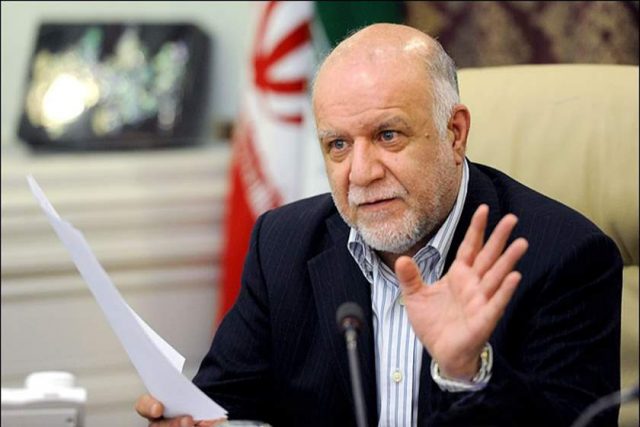
Iran’s oil minister, Bijan Namdar Zanganeh
Al-Manar | September 14, 2019
Iranian oil minister Bijan Zanganeh said Saturday that the France-proposed $15 billion credit line for Iran has nothing to do with easing of US sanctions on the country.
“In the eye of the country’s oil industry, sanctions relief means selling oil,” Oil Minister Bijan Zanganeh told reporters on Saturday.
He was speaking on the sidelines of a signing ceremony for a deal between Pars Oil and Gas Company (POGC) and Petropars Company for developing Belal Gas Field in the Persian Gulf.
“The point was for the oil sanctions to be lifted so that we could freely sell our oil. This credit line will put Iran in debt in the future,” he added, according to Mehr news agency.
The $15 billion credit line has been proposed by the French side in a bid to salvage the 2015 Iran nuclear deal in the wake of US’ unilateral withdrawal and Iran’s countermeasures in reducing commitments to the agreement.
The package is meant as an incentive to keep Iran in the nuclear agreement in the face of US’ efforts to drive the country’s oil exports to zero.
The sum is said to account for about half the revenue Iran normally would expect to earn from oil exports in a year.
Elsewhere, Zanganeh maintained that the development of the phase 11 of South Pars has not yet been exempted from US sanctions.
He then refused to confirm data of Iran’s oil reserves or answer any questions regarding Iran’s measures to bypass US sanctions.
He noted, however, that Iran is in talks with China to peacefully resolve the issue of the East Asian country’s decision to leave the SP11 development project.
Pro-Hong Kong rally in DC against ‘CHINAZI regime’ being sponsored with US govt-linked money
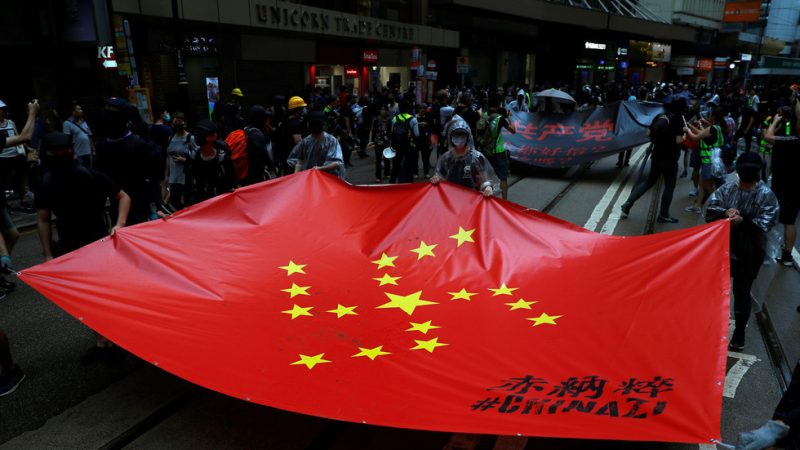
A version of the ‘Chinazi’ flag © Reuters / Kai Pfaffenbach
RT | September 11, 2019
A planned Washington DC protest in support of Hong Kong activists and promoting the ‘Chinazi’ flag is being sponsored by at least six organizations backed by the notoriously shady, US-funded National Endowment for Democracy (NED).
Posters for the event circulated online contain an image of the so-called ‘Chinazi’ flag – an altered version of the Chinese national flag with the yellow stars arranged to form a swastika and with a hammer and sickle placed in the center.
Protesters plan to form a human chain encircling the Chinese Embassy in Washington to protest the “Chinazi regime” and call for an independent Hong Kong. The #Chinazi hashtag has also become popular with activists on Twitter.
The list of event sponsors proves that the anti-China movement in Hong Kong is backed not only by American politicians, but also by American money – through US government-funded groups.
A DC-based organization called Citizen Power Initiatives For China, which describes itself as a “grassroots movement” dedicated to promoting democracy in China through “non-violent struggle” and “overseas assistance” to “influence” Beijing’s policies, appears to be the chief event organizer.
Information on the group’s funding is not easily found on its website, but a search of the NED database shows it received $206,500 from the US-funded organization between 2015 and 2016.
The NED, founded in 1983, claims to promote democracy abroad by offering government grants to civil society groups around the world. In reality, it has been used mainly as a soft-power vehicle to advance the US foreign policy and military agenda through sowing chaos in countries targeted for ‘regime change.’
The NED is “explicitly dedicated to meddling in other countries’ affairs, interfering in elections, toppling democratically elected leaders, and spreading public relations campaigns to sow chaos against countries that resist Washington’s agenda,” award-winning journalist Max Blumenthal told RT last year. Indeed, even one of the NED’s former presidents, Carl Gershman, has admitted it was created in order to continue the work of the CIA without the stigma of being attached to the spy agency.
Six more of the ‘Chinazi’ rally’s sponsors have also partnered with or received significant funding from the NED in recent years. Those include the Princeton China Initiative (received $323,811 between 2015-2017), Students for a Free Tibet (received $270,810 between 2015-2018), International Campaign for Tibet (received $35,558 in 2015), the Southern Mongolian Human Rights Information Center (received $104,496 in 2015), and the Uyghur American Association (received $295,000 in 2015). ChinaAid lists the NED and the US-funded Freedom House as partners.
Other sponsors of the event are also US-based, including Dialogue China (Maryland), The China Organ Harvest Research Center (New York) and The East Turkestan National Awakening Movement (Washington DC) – but information on their funding is not clear.
While Initiatives For China claims to support “non-violent struggle,” protests raging in recent weeks in Hong Kong have turned increasingly violent. Video footage has documented activists wielding bats and metal rods, attacking public property and throwing bricks and Molotov cocktails at police. “Using force is one of our methods to protect ourselves and to protest,” one masked protester told Ruptly video agency.
The NED’s focus on Hong Kong fits with the typical US approach to anti-government protest activity abroad. A government memo, leaked in 2017, confirmed that it is US policy to “emphasize” pro-democracy movements in adversary nations, while playing them down or ignoring them in friendly nations – Beijing has accused the US of orchestrating the movement and analysts have argued that encouraging unrest in Hong Kong is seen to be beneficial for Washington as US President Donald Trump wages a trade and tech war with China.
Indeed, protesters have been seen waving US flags and key figureheads of the movement visited Washington to meet with high-ranking officials, including Secretary of State Mike Pompeo, at the height of the chaos.
The links between US officials, anti-China activists and shady US government-funded organizations is reminiscent of countless US regime-change or ‘color revolution’ efforts seen around the world, from Ukraine to Syria, Libya and Venezuela.
Now, more evidence is stacking up to prove that the US is playing an active role in fueling turmoil in Hong Kong.
Are India and Japan Challenging the BRI in Russia’s Far East?
By Paul Antonopoulos | September 11, 2019
Although the Russian Far East has huge investment potential in the fields of raw materials, mineral resources, fisheries, forestry’s and tourism, it still remains a sparely populated area of only around 7 million people. With China, India, Japan, Indonesia and Russia projected to be some of the world’s biggest economies by 2030 according to many experts, the 21st Century has been dubbed as the “Asian Century,” and it is for this reason that Russian President Vladimir Putin has prioritized the rapid development of the Russian Far East.
The region is not only resource rich, but is also conveniently located in northeast Asia, bordering Mongolia, China and North Korea, while sharing a maritime border with Japan. It is so strategic and rich that only weeks ago French President Emmanuel Macron expressed his belief that Europe stretches from Lisbon on the Atlantic Coast to the Russian Pacific port of Vladivostok. Vladivostok has hosted the Eastern Economic Forum annually ever since its establishment 2015, in part to attract foreign investors to diversify from only Chinese investments in the Russian Far East. China has invested tens of billions into the region, making it easily the biggest foreign investor in the region.
However, with Indian Prime Minister Modi on the eve of Vladivostok’s 5th Eastern Economic Forum proposing a trilateral cooperation between India, Russia and Japan by jointly developing the Russian Far East, it appears that China’s economic influence in the region will be challenged. Although China emphasizes peaceful relations through mutual economic development and prosperity, it still has frosty relations with Japan and India. It is therefore unsurprising that India and Japan have opted to invest in the Russian Far East to challenge China’s economic might in a region that also shares a vast border with China.
India, Japan and Sri Lanka signed an agreement to build a new container terminal in the port of Colombo, demonstrating that New Delhi and Tokyo have experience in cooperating in a trilateral format. With India opting to be the only South Asian country not involved in the Belt and Road Initiative (BRI), India continues to show coldness to China as the latter continues to rapidly develop neighboring countries, especially with Nepal and rival Pakistan. With the BRI developing Sri Lanka, it appears India and Japan are creating a new economic duo to match China’s economic strength, and are now prepared to take this to a new front away from Sri Lanka and to the Russian Far East.
Japan’s investments in the Russian Far East’s economy already exceeds $15 billion and will continue to develop, according to Japanese Prime Minister Shinzo Abe. And with India also expressing its interest, the Russian Far East has become a promising place for all prospectors. With Russian President Vladimir Putin offering free land handouts in the Far East to Russians and naturalized citizens in May 2016, it demonstrates that Russia has identified that if it wants to benefit from Asia’s rapid development and economic dominance in the 21st century, it needs to develop its regions in Asia.
With the development of the region naturally meaning increased trade and cultural exchanges with China, tens of thousands of Chinese citizens have now migrated to the region in search of opportunities and establish themselves as merchants and entrepreneurs. Whether we begin seeing Indian and Japanese merchants in the Russian Far East remains to be seen.
With India and China competing in Nepal and border issues on the Indian-Chinese frontier remaining unresolved in New Delhi’s eyes, it appears that India is now wanting to compete against China in a region that has had connections with China for millennia. Russia has been encouraging more and diversified investments in the Far East and Japan and India will take every opportunity to do this.
Russia and China remain strategic partners and are also pragmatic international players that continue to pursue a policy of non-interference. Therefore, although China has frosty relations with Japan and India, it can respect Russia’s ties with both countries. This pragmatism has now allowed India and Japan to engage in a friendly competition for economic influence over Russia’s resource rich region. Although both Japan and China invest in raw material and energy projects in the Far East, India will be a new player to this sector with Indian Oil and Gas Minister Dharmendra Pradhan expressing his long-term interest in the Russian coal and steel sector during his visit to Russia last week.
With India becoming increasingly energy hungry because of its enormous and growing population, alongside its economic development, it is easily seen why the resource rich Russian region is of critical importance to it. For Japan, the region presents unmatched economic opportunities. Most interestingly to observe is whether India and Japan will continue to work in trilateral formats to continue expanding their economic interests and challenge the BRI in other regions. It appears now that after their cooperation in Sri Lanka, their second step is to challenge the expansion of the BRI in Russia’s Far East by competing for lucrative contracts and opportunities that the region can offer.
Paul Antonopoulos is the director of the Multipolar research centre.
‘The New Normal’: Trump’s ‘China Bind’ Can Be Iran’s Opportunity
By Alastair Crooke | Strategic Culture Foundation | September 9, 2019
There is consensus among the Washington foreign policy élite that all factions in Iran understand that – ultimately – a deal with Washington on the nuclear issue must ensue. It somehow is inevitable. They view Iran simply as ‘playing out the clock’, until the advent of a new Administration makes a ‘deal’ possible again. And then Iran surely will be back at the table, they affirm.
Maybe. But maybe that is entirely wrong. Maybe the Iranian leadership no longer believes in ‘deals’ with Washington. Maybe they simply have had enough of western regime change antics (from the 1953 coup to the Iraq war waged on Iran at the western behest, to the present attempt at Iran’s economic strangulation). They are quitting that failed paradigm for something new, something different.
The pages to that chapter have been shut. This does not imply some rabid anti-Americanism, but simply the experience that that path is pointless. If there is a ‘clock being played out’, it is that of the tic-toc of western political and economic hegemony in the Middle East is running down, and not the ‘clock’ of US domestic politics. The old adage that the ‘sea is always the sea’ holds true for US foreign policy. And Iran repeating the same old routines, whilst expecting different outcomes is, of course, one definition of madness. A new US Administration will inherit the same genes as the last.
And in any case, the US is institutionally incapable of making a substantive deal with Iran. A US President – any President – cannot lift Congressional sanctions on Iran. The American multitudinous sanctions on Iran have become a decades’ long knot of interpenetrating legislation: a vast rhizome of tangled, root-legislation that not even Alexander the Great might disentangle: that is why the JCPOA was constructed around a core of US Presidential ‘waivers’ needing to be renewed each six months. Whatever might be agreed in the future, the sanctions – ‘waived’ or not – are, as it were, ‘forever’.
If recent history has taught the Iranians anything, it is that such flimsy ‘process’ in the hands of a mercurial US President can simply be blown away like old dead leaves. Yes, the US has a systemic problem: US sanctions are a one-way valve: so easy to flow out, but once poured forth, there is no return inlet (beyond uncertain waivers issued at the pleasure of an incumbent President).
But more than just a long chapter reaching its inevitable end, Iran is seeing another path opening out. Trump is in a ‘China bind’: a trade deal with China now looks “tough to improbable”, according to White House officials, in the context of the fast deteriorating environment of security tensions between Washington and Beijing. Defense One spells it out:
“It came without a breaking news alert or presidential tweet, but the technological competition with China entered a new phase last month. Several developments quietly heralded this shift: Cross-border investments between the United States and China plunged to their lowest levels since 2014, with the tech sector suffering the most precipitous drop. US chip giants Intel and AMD abruptly ended or declined to extend important partnerships with Chinese entities. The Department of Commerce halved the number of licenses that let US companies assign Chinese nationals to sensitive technology and engineering projects.
“[So] decoupling is already in motion. Like the shift of tectonic plates, the move towards a new tech alignment with China increases the potential for sudden, destabilizing convulsions in the global economy and supply chains. To defend America’s technology leadership, policymakers must upgrade their toolkit to ensure that US technology leadership can withstand the aftershocks.
“The key driver of this shift has not been the President’s tariffs, but a changing consensus among rank-and-file policymakers about what constitutes national security. This expansive new conception of national security is sensitive to a broad array of potential threats, including to the economic livelihood of the United States, the integrity of its citizens personal data, and the country’s technological advantage”.
Trump’s China ‘bind’ is this: A trade deal with China has long been viewed by the White House as a major tool for ‘goosing’ the US stock market upwards, during the crucial pre-election period. But as that is now said to be “tough to improbable” – and as US national security consensus metamorphoses, the consequent de-coupling, combined with tariffs, is beginning to bite. The effects are eating away at President Trump’s prime political asset: the public confidence in his handling of the economy: A Quinnipiac University survey last week found for the first time in Trump’s presidency, more voters now say the economy is getting worse rather than better, by a 37-31 percent margin – and by 41-37 percent, voters say the president’s policies are hurting the economy.
This is hugely significant. If Trump is experiencing a crisis of public confidence in respect to his assertive policies towards China, the last thing that he needs in the run-up to an election is an oil crisis, on top of a tariff/tech war crisis with China. A wrong move with Iran, and global oil supplies easily can go awry. Markets would not be happy. (So Trump’s China ‘bind’ can also be Iran’s opportunity …).
No wonder Pompeo acted with such alacrity to put a tourniquet on the brewing ‘war’ in the Middle East, sparked by Israel’s simultaneous air attacks last month in Iraq, inside Beirut, and in Syria (killing two Hizbullah soldiers). It is pretty clear that Washington did not want this ‘war’, at least not now. America, as Defense One noted, is becoming acutely sensitive to any risks to the global financial system from “sudden, destabilizing convulsions in the global economy”.
The recent Israeli military operations coincided with Iranian FM Zarif’s sudden summons to Biarritz (during the G7), exacerbating fears within the Israeli Security Cabinet that Trump might meet with President Rouhani in NY at the UN General Assembly – thus threatening Netanyahu’s anti-Iran, political ‘identity’. The fear was that Trump could begin a ‘bromance’ with the Iranian President (on the Kim Jong Un lines). And hence the Israeli provocations intended to stir some Iranian (over)-reaction (which never came). Subsequently it became clear to Israel that Iran’s leadership had absolutely no intention to meet with Trump – and the whole episode subsided.
Trump’s Iran ‘bind’ therefore is somehow similar to his China ‘bind’: With China, he initially wanted an easy trade achievement, but it has proved to be ‘anything but’. With Iran, Trump wanted a razzmatazz meeting with Rohani – even if that did not lead to a new ‘deal’ (much as the Trump – Kim Jung Un TV spectaculars that caught the American imagination so vividly, he may have hoped for a similar response to a Rohani handshake, or he may have even aspired to an Oval Office spectacular).
Trump simply cannot understand why the Iranians won’t do this, and he is peeved by the snub. Iran is unfathomable to Team Trump.
Well, maybe the Iranians just don’t want to do it. Firstly, they don’t need to: the Iranian Rial has been recovering steadily over the last four months and manufacturing output has steadied. China’s General Administration of Customs (GAC) detailing the country’s oil imports data shows that China has not cut its Iranian supply after the US waiver program ended on 2 May, but rather, it has steadily increased Iranian crude imports since the official end of the waiver extension, up from May and June levels. The new GAC data shows China imported over 900,000 barrels per day (bpd) of crude oil from Iran in July, which is up 4.7% from the month before.
And a new path is opening in front of Iran. After Biarritz, Zarif flew directly to Beijing where he discussed a huge, multi-hundred billion (according to one report), twenty-five-year oil and gas investment, (and a separate) ‘Road and Belt’ transport plan. Though the details are not disclosed, it is plain that China – unlike America – sees Iran as a key future strategic partner, and China seems perfectly able to fathom out the Iranians, too.
But here is the really substantive US shift taking place. It is that which is termed “a new normal” now taking a hold in Washington:
“To defend America’s technology leadership, policymakers [are] upgrading their toolkit to ensure that US technology leadership can withstand the aftershocks … Unlike the President’s trade war, support for this new, expansive definition of national security and technology is largely bipartisan, and likely here to stay.
… with many of the president’s top advisers viewing China first and foremost as a national security threat, rather than as an economic partner – it’s poised to affect huge parts of American life, from the cost of many consumer goods … to the nature of this country’s relationship with the government of Taiwan.
“Trump himself still views China primarily through an economic prism. But the angrier he gets with Beijing, the more receptive he is to his advisers’ hawkish stances toward China that go well beyond trade.”
“The angrier he gets with Beijing” … Well, here is the key point: Washington seems to have lost the ability to summon the resources to try to fathom either China, or the Iranian ‘closed book’, let alone a ‘Byzantine’ Russia. It is a colossal attenuation of consciousness in Washington; a loss of conscious ‘vitality’ to the grip of some ‘irrefutable logic’ that allows no empathy, no outreach, to ‘otherness’. Washington (and some European élites) have retreated into their ‘niche’ consciousness, their mental enclave, gated and protected, from having to understand – or engage – with wider human experience.
To compensate for these lacunae, Washington looks rather, to an engineering and technological solution: If we cannot summon empathy, or understand Xi or the Iranian Supreme Leader, we can muster artificial intelligence to substitute – a ‘toolkit’ in which the US intends to be global leader.
This type of solution – from the US perspective – maybe works for China, but not so much for Iran; and Trump is not keen on a full war with Iran in the lead up to elections. Is this why Trump seems to be losing interest in the Middle East? He doesn’t understand it; he hasn’t the interest or the means to fathom it; and he doesn’t want to bomb it. And the China ‘bind’ is going to be all absorbing for him, for the meantime.
JCPOA Negotiations are a test of the EU’s geo-political credibility
By Padraig McGrath | September 5, 2019
On September 4th, Iranian President Hassan Rouhani said that Iran would give the EU a further 60 days to come back into compliance with its economic commitments under the JCPOA before Iran would initiate a third phase of withdrawal from its own obligations under the deal. On September 29th, the International Atomic Energy Agency confirmed that Iran has been enriching uranium to a purity of 4.35%, which marginally exceeds the limit of 3.67% stipulated under the terms of the JCPOA.
Furthermore, Iran has at this point exceeded the stockpile of 300 kilograms of nuclear fuel which was agreed upon in 2015. These measures are quickly reversible, but likewise, Iran also has the technical capacity to very quickly implement any decision to further suspend its commitments. The Iranian government has said that it has the technical capacity to resume production of 20% enriched uranium within 48 hours, were it to take such a decision.
The stumbling-block in the negotiations is that, with the United States having withdrawn from the JCPOA and re-imposed sanctions on Iran following Donald Trump’s assuming office as US president in 2017, the EU finds compliance with its own JCPOA-obligations extremely difficult, as European banks fear being hit by sanctions themselves if they un-freeze Iranian assets or facilitate transactions relating to Iranian oil-exports. US federal law states that, ultimately, all dollar-denominated banking-transactions worldwide ultimately have to pass through the US banking-system. Therefore, the strategic advantage conferred on the US by dollar-hegemony is not simply that it artificially inflates the value of the dollar, but also that it brings all dollar-denominated transactions worldwide under US legal jurisdiction.
In an attempt to find a workaround, French president Emanuel Macron has proposed that the EU should extend a $15 billion letter of credit to Iran, which would be guaranteed by Iranian oil-exports, thereby compensating Iran for losses of revenue owing to US sanctions. The Iranians have already rejected the first version of this offer, wherein this $15 billion package was classified as a loan rather than as a letter of credit. The distinction is crucial, as classifying the $15 billion package as a letter of credit would prevent the western powers from trapping Iran in a vice-grip composed simultaneously of an oil-embargo in addition to the obligation to service debt. Iran’s Deputy Foreign Minister Abbas Araqchi has explained that such a letter of credit would in effect be a pre-sale of oil.
However, the crucial weakness in this solution is that it will still require a waiver from the US government, which seems improbable considering Trump’s intransigence and US National Security Advisor John Bolton’s opposition to the plan.
Although, in the interests of fairness, we should extend some credit to President Macron for his diplomatic initiatives in an effort to find a way out of the impasse, the situation which exists still amounts to a very serious test of the EU’s credibility as a distinct negotiating-entity. The principal EU negotiator in the talks which led to the 2015 JCPOA-deal, EU High Representative for Foreign Affairs and Security Policy Federica Mogherini, has shown extreme weakness and passivity since the American withdrawal in 2017. Having worked hard to hammer out the terms of a deal, she has subsequently done absolutely nothing to defend it.
The net result is that the EU is currently in violation of its JCPOA-obligations because it has folded in the face of US economic bullying. What exactly is the point of bothering to negotiate with the EU if it is incapable of maintaining an independent policy on foreign relations, finance or security?
Another question thrown up by this diplomatic shambles is, considering that the number of countries worldwide being targeted by unilateral US economic sanctions is ever-increasing, when do we hit a tipping-point wherein this increasingly trigger-happy US policy, hitting the sanctions-button on reflex, has an accelerating effect in de-dollarization as a global process?
Banking-systems are dependent on a certain minimal level of systemic trust. How can the US hope to maintain its financial role in the world economy if everybody else is continuously reminded that their dollar-denominated assets worldwide can arbitrarily be frozen or seized at any time?
Already, the four largest banks in the world are Chinese. The only factor which has so far delayed China’s assumption of the role of the world’s banker is that the Chinese government has not yet decided to make the Yuan a more easily tradable currency. Further preparation is still required before the Chinese decide to flick that switch. Once they eventually do, it’s game over for the Dollar.
It is understandable that the Chinese have not yet decided to make the Yuan as tradable as other reserve-currencies, but their principal concern is not fears of vulnerability to speculators and raids. The capitalization of China’s state-owned financial institutions is such that, together, they could easily mobilize enough volume to defend the Yuan’s value against raids, or for that matter to suppress its value, any time they needed to.
I believe that the preparation which the Chinese government most centrally has in mind prior to any decision to make the Yuan fully tradable is the completion of the fibre-optic component of the Belt and Road Initiative. The strategic importance of these fibre-optic pipelines is the most under-emphasized aspect of Belt and Road. Once this physical infrastructure is in place, it will be possible to entirely circumvent American efforts toward virtual piracy in the form of unilateral sanctions. That will have a transformative effect on the world economy. The erosion of dollar-hegemony has been very gradual over the past 15 years, but if we are to see a sudden acceleration, a tipping-point, then that will be it.
It is quite probable that, in anticipation of this, odes to the Petro-Yuan are already being written in Farsi.
Padraig McGrath is a political analyst with InfoBRICS
Hands off Hong Kong: The Cry Seldom Heard
Where are the self-styled anti-war activists – like Democracy Now?
By John V. Walsh | Dissident Voice | September 4, 2019
Through the summer the world has watched as protests shook Hong Kong. As early as April they began as peaceful demonstrations which peaked in early June, with hundreds of thousands, in protest of an extradition bill. That bill would have allowed Hong Kong, a Special Administrative Region of China, to return criminals to Taiwan, mainland China or Macau for crimes committed there – after approval by multiple layers of the Hong Kong judiciary. In the wake of those enormous nonviolent demonstrations, Carrie Lam, CEO of Hong Kong, “suspended” consideration of the extradition bill, a face-saving ploy. To make sure she was understood, she declared it “dead.” The large rallies, an undeniable expression of the peaceful will of a large segment of the Hong Kong population had won an impressive victory. The unpopular extradition bill was slain.
But that was not the end of the story. A smaller segment continued the protests. (The Hong Kong police at one point estimated 4,000 hard core protesters.) pressed on with other demands, beginning with a demand that the bill be “withdrawn,” not simply “suspended.” To this writer death by “suspension” is every bit as terminal as death by “withdrawal.” As this piece is sent to press, news comes that Corrie Lam has now formally withdrawn the bill.
As the summer passed, two iconic photos presented us with two human faces that captured two crucial features of the ongoing protests; they were not shown widely in the West.
First, Fu Guohao, a reporter for the Chinese mainland newspaper, Global Times, was attacked, bound and beaten by protesters during their takeover of the Hong Kong International Airport. When police and rescuers tried to free him, the protesters blocked them and also attempted to block the ambulance that eventually bore him off to the hospital. The photos and videos of this ugly sequence were seen by netizens across the globe even though given scant attention in Western media. Where were the stalwart defenders of the press in the US as this happened? As one example, DemocracyNow! (DN!) was completely silent as was the rest of the U.S. corporate media.
Fu’s beating came after many weeks when the protesters threw up barriers to stop traffic; blocked closure of subway doors, in defiance of commuters and police, to shut down mass transit; sacked and vandalized the HK legislature building; assaulted bystanders who disagreed with them; attacked the police with Molotov cocktails; and stormed and defaced police stations. Fu’s ordeal and all these actions shown in photos on Hong Kong’s South China Morning Post, a paper leaning to the side of protesters, gave the lie to the image of these “democracy activists” as young Ghandis of East Asia. (The South China Morning Post is based in Hong Kong and its readership is concentrated there so it has to have some reasonable fidelity in reporting events; otherwise it loses credibility – and circulation. Similarly, much as the New York Times abhorred Occupy Wall Street, it could not fail to report on it.)
Which brings us to the second photo, much more important to U.S. citizens, that of a “Political Counselor” at the U.S. Consulate General in Hong Kong who in August was pictured meeting with, Joshua Long and Nathan Law, at a hotel there. The official was formerly a State Dept functionary in the Middle East – in Jerusalem, Riyadh, Beirut, Baghdad and Doha, certainly not an area lacking in imperial intrigues and regime change ops. That photo graphically contradicted the contention that there is no US “black hand,” as China calls it, in the Hong Kong riots. In fact, here the “black hand” was caught red-handed, leading Chen Weihua, a very perceptive China Daily columnist, to tweet the picture with the comment: “This is very very embarrassing. … a US diplomat in Hong Kong, was caught meeting HK protest leaders. It would be hard to imagine the US reaction if a Chinese diplomat were meeting leaders of Occupy Wall Street, Black Lives Matter or Never Trump protesters.”
And that photo with the protest leaders is just a snap shot of the ample evidence of the hand of the U.S. government and its subsidiaries in the Hong Kong events. Perhaps the best documentation of the U.S. “black hand” is to be found in Dan Cohen’s superb article of August 17 in The Greyzone entitled, “Behind a made-for-TV Hong Kong protest narrative, Washington is backing nativism and mob violence.” The article by Cohen deserves careful reading; it leaves little doubt that there is a very deep involvement of the US in the Hong Kong riots. Of special interest is the detailed role and funding, amounting to over $1.3 million, in Hong Kong alone in recent years, of the U.S. National Endowment for Democracy (NED), ever on the prowl for new regime change opportunities. Perhaps most important, the leaders of the “leaderless” protests have met with major US political figures such as John Bolton, Vice President Pence, Secretary Pompeo, Senator Marco Rubio, Democratic Rep. Eliot Engel, Nancy Pelosi and others, all of whom have heartily endorsed their efforts. This is not to deny that the protests were home grown at the outset in response to what was widely perceived as a legitimate grievance. But it would be equally absurd to deny that the U.S. is fishing in troubled Hong Kong waters to advance its anti-China crusade and regime change ambitions.
That said, where is the U.S. peace movement on the question of Hong Kong?
Let us be clear. One can sympathize with the demand of many citizens of Hong Kong to end the extradition bill or even the other four demands: an inquiry into police handling of their protests; the retraction of a government characterization of the demonstrations as riots; an amnesty for arrested protesters; and universal suffrage. (The first three all grow out of violence of the protests, be it noted.) But that is the business of the citizens of Hong Kong and all the rest of China. It is not the business of the U.S. government. Peace activists in the US should be hard at work documenting and denouncing the US government’s meddling in Hong Kong, which could set us on the road to war with China, potentially a nuclear war. And that is a mission for which we in the U.S. are uniquely suited since, at least in theory, we have some control over our government.
So, we should expect to hear the cry, “US Government, Hands Off Hong Kong”? Sadly, with a few principled exceptions it is nowhere to be heard on either the left or right.
Let’s take DemocracyNow! (DN!) as one example, a prominent one on the “progressive” end of the spectrum. From April through August 28, there have been 25 brief accounts (“headlines” as DN! calls them, each amounting to a few paragraphs) of the events in Hong Kong and 4 features, longer supposedly analytic pieces, on the same topic. Transcripts of the four features are here, here, here and here. There is not a single mention of possible US involvement or the meetings of the various leaders of the protest movement with Pompeo, Bolton, Pence, or the “Political Counselor” of the US Hong Kong consulate.
And this silence on US meddling is true not only of most progressive commentators but also most conservatives.
On the Left when someone cries “Democracy,” many forget all their pro-peace sentiment. And similarly on the Right when someone cries “Communism,” anti-interventionism too often goes down the tubes. Forgotten is John Quincy Adams’s 1823 dictum, endlessly quoted but little honored, “We do not go abroad in search of monsters to destroy.” Where does this lapse on the part of activists come from? Is it a deep-seated loyalty to Empire, the result of endless indoctrination? Is it U.S. Exceptionalism, ingrained to the point of unconsciousness? Or is it at bottom a question of who the paymasters are?
On both sides anti-interventionism takes an especially hard hit when it comes to major competitors of the US, powers that could actually stand in the way of US global hegemony, like Russia or China. In fact on its August 12 program, DN! managed a story taking a swipe at Russia right next to the one on Hong Kong – and DN! was in the forefront of advancing the now debunked and disgraced Russiagate Conspiracy Theory. In contrast, the anti-interventionist movement is front and center when it comes to weaker nations, for example Venezuela – and quite properly so. But when one puts this advocacy for weaker nations together with the New Cold War stance on China and Russia, one must ask what is going on here. Does it betoken a sort of imperial paternalism on the part of DN and like-minded outlets? It certainly gains DN!, and others like it, considerable credibility among anti-interventionists which can help win them to a position in favor of DN!’s New Cold War stance. And the masters of Empire certainly understand how valuable such credibility can be at crucial moments when support for their adventures is needed from every quarter.
Fortunately, there are a handful of exceptions to this New Cold War attitude. For example, on the left Popular Resistance has provided a view of the events in Hong Kong and a superb interview with K.J. Noh that go beyond the line of the State Department, the mainstream media and DN! And on the libertarian Right there is the Ron Paul Institute for Peace and Prosperity and the work of its Executive Director Dan McAdams.
We would all do well to follow the example of these organizations in rejecting a New Cold War mentality which is extremely dangerous, perhaps fatally so. A good beginning for us in the U.S. is to demand of our government, “Hands Off Hong Kong.”
John V. Walsh can be reached at john.endwar@gmail.com.
America Loses Asia-Pacific as Full Spectrum Dominance Continues to Fail
By Matthew Ehret | Strategic Culture Foundation | September 2, 2019
Always working a little harder than most to stay a step below reality, US Secretary of Defense Mark Esper made especially candid remarks this week that America’s INF pullout was timed for a targeting of forces against China.
Speaking to Fox on August 21st, Esper said: “We want to make sure that we, as we need to, have the capability to deter Chinese bad behavior… China is the number one priority for this department. It’s outlined in the national defense strategy, why we think it’s a long term strategic competitor and one that is pursuing a maximization campaign, if you will, throughout the indo-Pacific theater, whether its politically, economically or militarily…”
Echoing a little Dr. Strangelove, Esper stated that there is “a coming shift” from “low intensity conflict that lasts 18 years to high intensity conflicts against competitors such as Russia and China.”
While American military exercises in the Pacific have played out on China’s doorstep at an accelerating rate since the Pivot to Asia was announced in 2011 with the most recent US-Australia Talisman Sabre bi-annual exercise and US-South Korea Ulchi Freedom war games this month, China has not remained idle.
In response to America’s vast array of military infrastructure built up on China’s border, China has responded by the unveiling of cutting edge anti-ballistic missile technologies, including hypersonic weaponry to counteract the American threat. A large part of China’s defensive response includes the Russian S400 anti-missile system which is also being adopted by India, Turkey, Syria and the United Arab Emirates as a unified system which renders the American THAAD and ABM systems impotent and obsolete. Although unconfirmed, American generals have freaked out that China is building a joint China-Cambodia naval base in Preah Sihanouk Province that gives China easy access to coastal waters on the Gulf of Thailand and ready access to the South China Sea.
America’s military impotence when faced with the new cutting edge technologies unveiled by Russia and China was outlined in a recent report released by the US Studies Center at the University of Sydney which stated that “America no longer enjoys military primacy in the indo Pacific and its capacity to uphold a favorable balance of power is increasingly uncertain.” Referring to China’s advanced anti-aircraft weapons, the report says “Chinese counter-intervention systems have undermined America’s ability to project power in the Indo-Pacific region” which the authors say, could be rendered impotent within the first 8 hours of conflict.
Rather than use this information to propose a new security doctrine premised on cooperation and dialogue as China has offered on countless occasions, the report’s authors join the fantasy world of Esper calling instead for a “collective defense” strategy akin to a Pacific NATO, whereby all of America’s Pacific allies could join in an anti-Chinese military alliance together, and relieving America of the burden of carrying WWIII on its own.
We know that this Pacific NATO has been discussed for some time and was at the heart of recent Pacific Vanguard naval drills conducted between the USA, Australia, Japan and South Korea in May 2019 which saw the participation of 3000 soldiers, two Japanese destroyers, a South Korean destroyer and two Australian frigates in their first joint war game. This outlook was also behind the August naval drill played out by Malaysia, USA, New Zealand and Australia in Guam. The USA has 54,000 troops in Japan and 28,000 in South Korea.
When China and Russia conducted their first long range joint air patrol in the Asia Pacific in July 2019, South Korea and Japan scrambled jets to intercept the Chinese and Russian aircraft, with South Korea firing hundreds of warning shots. Backed up by the USA, both Asian countries screamed loudly (and without evidence) that their air space had been violated.
In response to the belligerent comments by Esper and the Australian report, the Chinese Foreign Ministry said “China is firmly on a path of peaceful development and our national defense policy is defensive in nature”. China has gone further by providing a cooperative framework under the Belt and Road Initiative which is built around the brilliant political agenda of providing diplomatic solutions to geopolitical points of tension through economic development strategies that enrich all participants. This approach has provided China great payback through the defusing of tensions with other nations claiming territory within the South China Sea- especially under the pro-BRI orientation of Malaysia’s Dr. Mahathir Mohammed and the Philippines’ President Duterte.
Not feeling at ease being caught in the crossfire of a nuclear exchange, Japan and South Korea have also gone so far as to create a new trilateral cooperation agreement with China on August 21 premised on “next generation exchange projects in three countries… We hope to discuss future-oriented partnerships and regional affairs, including North Korea.” The agreement also enables international joint investment in all countries operating under the BRI framework. Together the three countries account for over a quarter of the world’s productivity and have everything to gain by working together.
Those American military officials promoting the obsolete doctrine of Full Spectrum dominance are dancing to the tune of a song that stopped playing some time ago. Both Russia and China have changed the rules of the game on a multitude of levels, and can respond with fatal force to any attack upon their soil with next generation weaponry beyond the scope of anything imagined by ivory tower game theorists in the west.
The ship of world history has changed course away from the rapids of war and economic collapse, as the Belt and Road Initiative has grown to proportions not imagined possible just a few years earlier and the coming months will be decisive as the west does some soul searching and decides which future it would like to have.
YouTube axes anti-protest channels as US Ministry of Truth battles China over Hong Kong
RT | August 23, 2019
YouTube has disabled 210 channels for posting content related to the Hong Kong protests “in a coordinated manner,” following in the footsteps of Facebook and Twitter in restricting its arbitrary censorship to pro-China accounts.
“Channels in this network behaved in a coordinated manner while uploading videos related to the ongoing protests in Hong Kong,” Google threat analyst Shane Huntley claimed in a blog post on Thursday, adding that the Google team’s “discovery” was “consistent with recent observations and actions related to China announced by Facebook and Twitter.”
Translation? The channels were “sowing political discord” on behalf of the Chinese government, and had to be stopped. How did Google know it was the Chinese nefariously attempting to poison the minds against the protesters? The “use of VPNs” and “other methods of disguise” – widespread in the era of mass surveillance – was all the proof required to wipe the channels out of existence.
Twitter got the anti-China censorship ball rolling earlier this week, in perhaps the first-ever social media preemptive strike “proactively” deplatforming hundreds of thousands of accounts for the capital crime of “sowing discord.” Their crimes included “undermining the legitimacy and political positions of the protest movement on the ground.” One could argue that the protests themselves are a form of political discord, but resistance is futile when charged with such an inchoate offense.
None of the social media platforms have ever defined what exactly constitutes “attempting to sow discord,” though a common thread running through the mass deplatformings of the past year suggests it involves posting in support of a government the US doesn’t like – whether Russia, Iran, Venezuela, or China.
The social media Ministry of Truth has become increasingly open about the irrelevance of truth in what constitutes actionable disinformation. One group of “experts” in the spread of disinfo online even published a paper this week explaining that true statements could constitute disinformation if they were arranged to serve a purpose, calling for platforms to expand their definition of “inauthentic behavior” to include anyone reposting information portraying the “good guys” in a negative light.
The Chinese government challenged Twitter to explain its decision to ban state-owned media from advertising, asking “Why is it that China’s official media’s presentation is surely negative or wrong?”
Beijing has pointed to a US role in fanning the flames of unrest, a charge that grows more plausible with every day the protests continue despite having succeeded in forcing the Hong Kong government to withdraw a bill that would have allowed criminal suspects to be extradited to China. Armies of pro-protest tweeters swarm any post by Secretary of State Mike Pompeo with pleas to intervene in their plight, even as US lawmakers threaten to rain down fire and fury should anyone harm a hair on a protester’s head. And photos of the protest leaders meeting with US diplomats suggest there is certainly some “coordinated inauthentic behavior” at play on the other side.
YouTube, as a subsidiary of Google, has been exposed as even more partisan than Twitter’s arbiters of truth. A whistleblower released nearly 1,000 pages of internal documentation earlier this month showing YouTube’s algorithms were aimed more at shaping reality than at accurately portraying it. The platform removed Iranian state media channels as Washington ramped up tensions with Tehran in the Strait of Hormuz, and its deactivation of pro-China channels now suggests the protests – despite achieving their initially stated goal – are far from over.
Featured Video

The Truth About the Trump Shootings with Ken Silva
or go to
Aletho News Archives – Video-Images
From the Archives
Trans ‘milk’ as good as the real thing – NHS
RT | February 18, 2024
The drug-induced nipple secretions of trans women are as good as mothers’ breast milk for babies, the University of Sussex Hospitals NHS Trust claimed in a letter to campaigners made public in a report by British think tank the Policy Exchange on Sunday.
The healthcare trust’s medical director, Rachel James, argued that the off-label prescription drug cocktail men transitioning to female take in order to produce milk was “similar to the natural hormones which encourage lactation to develop when the baby is newly born.”
“The evidence which is available demonstrates that the milk is comparable to that produced following the birth of a baby,” James wrote in the letter, sent to Children of Transitioners last August.
Biological men who wish to lactate must first take hormones to grow milk glands and then take high doses of either domperidone or metoclopramide to stimulate milk production. Neither drug is approved for this use, though they are occasionally prescribed off-label to biological women who have trouble lactating.
However, domperidone’s own manufacturer, Janssen, warns patients the drug “may cause unwanted side effects affecting the heart in a breastfed baby” and “should be used during breastfeeding only if your physician considers this clearly necessary.” … continue
Blog Roll
 Aletho News
- Seyed M. Marandi: U.S. Strike Imminent – Toward Total War in the Middle East
- Russia Voted Under Fire. Washington Is Loading the Tankers.
- 12 Things Your Oncologist Was Trained Not to Tell You
- Anthrax Attacks Paved Way for COVID-Era ‘Junk Drugs and Vaccines’
- How Real Is the Impact of Western Sanctions on Israel?
- France, You Are Guilty: How Paris Turned Western Sahara into the Maghreb’s Powder Keg
- 2025 Nature Paper Claiming Worsening Global Drought Gets RETRACTED …Heavily Flawed
- Your Milk Is Not the Problem
- The Truth About the Trump Shootings with Ken Silva
- ARE PATIENTS BEING PROPERLY INFORMED ABOUT OZEMPIC?
- If Americans Knew
- Salah Sarsour’s Legal Team Says DHS Has Not Met Its Burden to Prove He Is Deportable
- An analysis of tax forms by The Intercept show Kraft’s charity and LLC have donated to Friends of the IDF and AIPAC’s super PAC.
- Israeli attacks kill four Palestinians in Gaza – Daily Update
- Inside Gaza’s death trap of collapsing, bombed-out buildings
- The everyday items Israel bans from Gaza every day
- Inside the siege, the ruined buildings of Gaza – Daily Update
- Debunking The Claim That Macklemore Has A “History Of Antisemitism”
- CPJ demands release of arrested Palestinian-US journalist near Bethlehem
- Robert Kraft: The Billionaire Friend of Netanyahu Pulling The Strings Behind the Macklemore/Ed Sheeran Blow Up
- Columbia Administered Fund Gives Big Money to Pro-Israel Groups
- No Tricks Zone
- 2025 Nature Paper Claiming Worsening Global Drought Gets RETRACTED …Heavily Flawed
- New Study: ‘Global Drought Shows No Detectable Recent Acceleration Under Climate Warming’
- Economic Masterminds: German Socialists Suggest Taxing Productivity Gains Stemming From Using AI
- The South China Sea Has Not Been Cooperating With The Climate Change Narrative
- Energy Crisis: Germany Enters Heating Season With Historically Low Gas Reserve Fill Levels
- New Study: The Antarctic Ice Sheet Gained Mass From 2020-2024 Due To Staggering Snow And Ice Accumulation
- Study: Ocean Heating Rates From Thousands Of Years Ago ‘Dwarf’ Modern Ocean Heating Rates
- Climate Extremists Target, Attack Large-Scale Power Grid Infrastructure In Germany!
- New Study: Antarctic Ice Melt Has Contributed Less Than 1 Centimeter To Sea Level Rise In The Last 30 Years
- Fear Of Debate: Alarmist German Climate Scientist Calls On Mainstream Media To Discredit Skeptic Voices
 Aletho News