A Sino-Russian firewall against US interference
By M. K. BHADRAKUMAR | Indian Punchline | August 11, 2019
China has explicitly accused the United States and Britain for fomenting the “pro-democracy” protests in Hong Kong. Beijing has taken up the matter via the diplomatic channel demanding that the US intelligence should stop inciting and abetting the Hong Kong protestors. Last week photographic evidence appeared in the media showing the political counsellor in the US consulate in Hong Kong Julie Eadeh confabulating in the lobby of a local luxury hotel with the student leaders involved in Hong Kong’s pro-democracy movement.
Washington has taken umbrage that Julie’s cover has been blown. She is apparently an expert who organised “colour revolutions” in other countries and it has been disclosed that she was involved in plotting “subversive acts” in the Middle East region. The Global Times wrote a blistering editorial. It said:
“The US administration has played a disgraceful role in the Hong Kong riots. Washington publicly supports the protests and never condemns violence that targets police. The US consulate general in Hong Kong is stepping up its direct interference in Hong Kong’s situation. The US administration is instigating turmoil in Hong Kong the way it stoked “colour revolutions” in other places worldwide.”
Is the Chinese allegation plausible? Writing in the Asia Times, the noted Canadian academic, economist and author Ken Moak made a good point recently that the protests are lavishly funded and their logistics and organisation are of a scale taxing resources that “only foreign governments or wealthy individuals who might profit from them” would commit. He detailed past instances of Anglo-American attempts to destabilise China.
Moak anticipates “more intense and violent” subversive operations against China by the US in the future.
Indeed, agents provocateurs are calibrating the protests almost on daily basis such as burning the Chinese flag and occupying the Hong Kong airport. The game plan is to force Beijing to intervene so that the deluge follows — western sanctions, et al.
With the 5G technology just about rolling out, this is an opportune time for the US to frogmarch its western allies into an economic boycott of China when countries like Germany and Italy that have flourishing trade and investment ties with China are loathe to get into the American bandwagon.
The well-known Italian journalist and author and long-time China watcher based in Beijing, Francesco Sisci wrote recently that Hong Kong is in reality Beijing’s “safety valve” and choking it can cause asphyxiation to the entire Chinese system. Sisci compares Hong Kong with “a compensation chamber, a safety valve between the closed economy of mainland China and the open economies of the rest of the world.”
If China could globalise avidly and yet keep its economy closed, it was because it had Hong Kong, which was completely open and provided the third-largest financial market in the world. If large-scale capital flight ensues in Hong Kong, China will have to work its future financial arrangements through countries over which it it doesn’t have political control. To quote Sisci, “Hong Kong’s present status can help Beijing buy time, but the crucial issue is still the status of China. The time of being both in and out the global commercial system thanks to a complex architecture of special agreements is rapidly running out.”
Simply put, the unrest in Hong Kong becomes a template of the US’ maximum pressure approach to break China’s growth momentum and its ascendancy as a rival in technology globally in the 21st century. The influential China hands in the US are already opening the champagne bottle that “revolution is in the air in Hong Kong” — and, it will mark “the end of communism on Chinese soil.”
Enter Russia. Coincidence or not, small fires are being lit lately on the Moscow streets as well, and they are spreading into significant protests against President Vladimir Putin. If the extradition law was the pretext for the Hong Kong turmoil, it is the election to the Moscow Duma (city legislature) that has apparently triggered the Russian protest.

Protestors in Moscow, August 10, 2019
Just as there is economic and social discontent in Hong Kong, the popularity of Putin has declined lately which is attributed to the stagnation of the Russian economy.
In both cases, the American agenda is blatantly “regime change”. This may seem surprising, since the Chinese and Russian leaderships appear rock solid. The legitimacy of the Chinese Communist Party over which President Xi Jinping presides and the popularity of Putin still at a level that is the envy of any politician anywhere in the world, but the doctrine of “colour revolutions” is not built on democratic principles.
Colour revolutions are about upturning an established political order and it has no correlation with mass support. The colour revolution is coup by other means. It is not even about democracy. The recent presidential and parliamentary elections in Ukraine exposed that the colour revolution of 2014 was an insurrection that the nation disowns.
Of course, the stakes are very high when it comes to destabilising China and Russia. Nothing less than the global strategic balance is involved. The US’ dual containment strategy against Russia and China is quintessentially the New American Century project — US’ global hegemony through the 21st century.
The US wagered that Moscow and Beijing would be hard pressed to cope with the spectre of colour revolutions and that would isolate them. After all, authoritarian regimes are exclusive and into the sanctum sanctorum of their internal politics not even their closest friends or allies are allowed in.
This is where Moscow has sprung a nasty surprise for Washington. The Russian Foreign Ministry spokesperson Maria Zakharova said in Moscow on Friday that Russia and China should exchange information on the US interference in their internal affairs. She flagged that Moscow is aware of the Chinese statements that the US interferes in Hong Kong affairs and treats this information “with all seriousness.”
“Moreover, I think it would be right and useful to exchange such information through respective services,” Zakharova said, adding that the Russian and Chinese sides will discuss the issue soon. She added that the US intelligence agency is using technology to destabilise Russia and China.
Earlier on Friday, the Russian Foreign Ministry had summoned the head of the Political Section in the US embassy Tim Richardson, and presented him with an official protest against the US encouraging an unauthorised opposition rally in Moscow on August 3.
Indeed, Moscow is far more experienced than Beijing in neutralising covert operations by the US intelligence. It is a hallmark of the great skill and expertise as well as the tenacity of the Russian system that through the entire Cold War era and “post-Soviet” period, there has never been anything like the turmoil on Tiananmen Square in Beijing (1989) or Hong Kong (2019) triggered by the US intelligence.
Moscow’s message to Beijing is direct and candid — ‘United we stand, divided we fall.’ No doubt, the two countries have been in consultation and wanted the rest of the world to know. Indeed, the message Zakharova transmitted — on a joint firewall against US interference — is of epochal significance. It elevates the Russia-China alliance to a qualitatively new level, creating yet another political underpinning of collective security.
Amazon Plant In China Accused Of Forcing High School Interns To Work 60 Hour Weeks

By Tyler Durden – Zero Hedge – 09/2019
In addition to not paying taxes and putting the entire brick and mortar retail industry out of business single-handedly, Amazon has now opened itself up to even more criticism. The company is being accused of using a Chinese assembly plant that relies on temporary workers, including high school interns, and overtime limits set beyond law, according to Bloomberg.
In fact, Foxconn fired two executives from the plant, which assembles Echo speakers and Kindle e-readers, in response to a labor group’s allegation that it cut wages and broke labor laws. This marks the second time that Amazon and its Taiwanese peer have been under scrutiny for the treatment of workers at the Hengyang plant.
The plant’s chief and head of human resources were fired, while managers at the plant who were responsible for using interns were “punished”, according to Foxconn.
China Labor Watch said:
“Amazon and Foxconn responded that they would make improvements to the factory’s working conditions. However, CLW’s 2019 investigation found that Foxconn’s working conditions did not improve, and instead deteriorated.”
The labor group deemed the factory’s wages too low to support a “decent standard of living last year”. Since then, they’ve been slashed another 16% in 2019.
The poor salary hasn’t been enough to fill the company’s 58 assembly lines, which require 7,000 people to operate during peak production, which begins in July. To fill the void, Foxconn instead tapped interns as young as 16 from vocational schools, some of which were forced to work overtime.
One 17 year old computing major at a vocational school, who was responsible for putting protective film over Amazon Echo Dots, said she worked 40 hour work weeks. She was then asked to start working overtime and put in 60 hour work weeks. When she complained to the manager, she reportedly was warned by her teacher that turning down the work could jeopardize her graduation.
Foxconn admits that its proportion of contract workers and student interns had “on occasion exceeded legal thresholds and that some interns had been allowed to work overtime or nights”.
“We were not in full compliance with all relevant laws and regulation,” Foxconn said. The company continued, in a statement:
“Effective immediately, the percentage of interns assigned to that facility will be brought into full compliance with the relevant labor law.”
The specific allegations made by the China Labor Watch report included:
- Interns from local vocational schools accounted for more than 20% of the plant’s current workforce, double the levels permitted by law
- Such student workers were forced to work night shifts and overtime, in violation of the law, and that some interns were physically and verbally abused by teachers overseeing their work
- The factory used “dispatch workers” — similar to temporary staff in the U.S. — for around one in three positions at the plant, in excess of the 10% permitted by law
- Some 375 workers had been asked to work overtime on Sunday without receiving makeup days off, contrary to labor rules that stipulate at least one scheduled day off per week
Foxconn has battled criticism of how it has treated its workers for over a decade now. Those critiques came to a head in 2010 when a rash of suicides by workers at the company forced it to make a major overhaul of how it treated workers.
A report from China Labor Watch last year once again shone a spotlight on the company, as well as on Amazon. Amazon claims that it asked Foxconn to make changes in 2018 after a labor audit of the Hengyang facility showed similar overtime violations. Amazon’s investigators arrived on site Wednesday and the company says it has started doing “weekly audits” of the labor issue. Let’s see how long that lasts.
Amazon commented: “We are urgently investigating these allegations and addressing this issue with Foxconn at the most senior level.”
China backs the opening of Kashmir file in UNSC
By M. K. BHADRAKUMAR | Indian Punchline | August 10, 2019
The “special and emergency visit” by Pakistani Foreign Minister Shah Mahmood Qureshi to Beijing on Friday August 9 has been highly successful in getting China to voice open support for Islamabad’s proposed move to raise the Kashmir issue in the UN Security Council.
From both Pakistani and Chinese accounts, the outcome of the meeting between the Chinese State Councilor and Foreign Minister Wang Yi and Qureshi conveys a significant “pro-Pakistan” shift in Beijing’s stance apropos the situation around J&K, which was more or less on neutral ground initially. (See my blog China reacts to J&K, India demands reciprocity.)
How far the reference to China’s “internal affairs” in the MEA spokesman’s remarks on August 6 (which appeared to be a knee-jerk reaction) provoked Beijing is a moot point now. Indeed, Qureshi’s air dash to Beijing signalled Pakistan’s desperate need of Chinese open support and China cannot afford to be seen wanting.
According to the Xinhua report, the cutting edge of Wang’s remarks lies in his listing of the UN Charter (which upholds international peace and security, fundamental human rights, adherence to international law and obligations of member states to adhere to treaties, etc.), relevant resolutions of the UN SC on Kashmir (on the status of J&K, holding of plebiscite, UNMOGIP, etc.) and the bilateral agreements between Pakistan and India (Shimla Agreement and the Lahore Declaration) — in that sequence as the road map on Kashmir.
China has de facto pledged support to Pakistan when the latter raises the Kashmir issue in the UN SC. Wang doubled down on Beijing going the whole hog to support Pakistan: “China and Pakistan are all-weather strategic partners and have always understood and supported each other on issues concerning core interests, which is also a good tradition that both countries should cherish. China will continue to firmly support Pakistan in safeguarding its legitimate rights and uphold fairness for Pakistan in international affairs.”
Qureshi reciprocated subsequently by telling the media in Beijing, “Pakistan is not looking at the military option. We are rather looking at political, diplomatic and legal options to deal with the prevailing situation.” Wang reportedly advised Qureshi that Pakistan should prioritise its national development and peace in South Asia and seek a new path of peaceful co-existence with India.
The Radio Pakistan reported that the Wang-Qureshi meeting lasted for two and half hours, which suggests that substantive discussions took place regarding strategy on Kashmir. The Pakistani report said Wang also agreed that “steps taken by India are unilateral that have changed the status quo and structure” of J&K and “could jeopardize the peace and stability in the region.” It added that Wang “was in concurrence that Jammu and Kashmir has been recognized as a disputed region and its resolution should also be in the light of UN resolutions.”
The overt, dramatic shift in the Chinese stance against Indian interests would have taken into account the ambivalence in the US position on Kashmir. Against the backdrop of the controversial remarks by President Trump to mediate on Kashmir, the US state department spokesperson, when asked on Friday’s press briefing in Washington, blithely passed the buck to the White House.
The spokesperson also underscored, “Obviously, we just had Prime Minister (Imran) Khan here, not just because of Kashmir. That’s certainly an incredibly important issue and something that we follow closely, but we have a host of issues that we work with India on quite closely and that we work with Pakistan on quite closely. I would say that we are – as a State Department, we are incredibly engaged in Southeast Asia.”
During the coming week, two senior US officials are landing in Delhi at the same time — US deputy secretary of state John Sullivan (corresponding to ministerial rank) and Acting deputy secretary of state in charge of South Asia Alice Wells. Sullivan is reaching Delhi from Bhutan while Wells who was on a scheduled visit to Islamabad has extended her tour by travelling to India as well.
By the way, Sullivan becomes the highest ranking US official to visit Bhutan in decades. His visit signals a Churchillian approach in the US policies toward China lately — “We shall fight on the beaches, we shall fight on the landing grounds, we shall fight in the fields and in the streets, we shall fight in the hills.” Historically, this is the first time that Bhutan finds itself being courted as a frontline state in the Cold War cockpit.
Clearly, Sullivan’s visit augurs the same centrality to Bhutan in the US geo-strategy that Washington has lately begun attaching to Mongolia. In June, US National Security Advisor John Bolton visited Ulaanbaatar; in July, President Trump hosted Mongolian President Khaltmaa Battulga in the White House; by August already, the US Defence Secretary Mark Esper touched down in Ulaanbaatar on a daylong follow-up visit “to expand their military training, joint exercises and defense intelligence sharing”, according to Stratfor, US think tank wired into the security and defence establishment.
The big question is, whether Sullivan is delivering an invitation from Trump to the Dragon King of the Kingdom of Bhutan, Jigme Khesar Namgyel Wangchuck.
Equally, there is the likelihood that the US may seek the establishment of intelligence outposts in Bhutan. En route to Mongolia, Def Secy Esper told reporters openly that the US is working to build relationships with key countries in the Indo-Pacific that share values and respect for each other’s sovereignty, “whether it’s Mongolia this trip, Vietnam, a future trip, Indonesia, other countries who I think are key.”
In a reference to China, Esper said, “We’ve got to be able to compete with them.” An AP report quoted a senior US official that the US seeks to expand its defense and intelligence cooperation with Mongolia, noting that its location makes it ideal for listening posts and monitoring stations for peering into both U.S. adversaries.
According to the US state department, Sullivan “will explore expanding and deepening our ties with the government and people of Bhutan.” Of course, any significant expansion of US-Bhutan relations can only happen with the concurrence and approval of India. This is where Chinese sensitivities arise.
Possibly, Beijing senses that Sullivan’s Bhutan trip figured in the meeting between foreign minister S. Jaishankar and his American counterpart Mike Pompeo in Thailand recently. Sullivan is expected to meet Jaishankar.
Most importantly, the state department announcement on Thursday implied that Sullivan’s visits to Thimpu and Delhi are a back-to-back mission with the aim “to advance the United States’ partnership with two nations that are critical to preserving the rules-based order in the Indo-Pacific region.”
To be sure, Beijing would have taken note that the fizz has gone out of the Wuhan Spirit — with just a couple of months left for the visit by Chinese President Xi Jinping to India in October. The Wang-Qureshi meeting testifies to it.
Thoughts on China’s Currency
By Dean Baker | Beat the Press | August 9, 2019
There is a conventional wisdom on China’s currency that gets repeated almost everywhere and never seems to be challenged in the media. The basic story is that in the bad old days China ‘manipulated” its currency, but that stopped years ago. At present, its currency controls are actually keeping the value of its currency up, not down. As much as I hate to differ with the conventional wisdom, there are a few issues here that deserve closer examination.
First, it’s great see that everyone now agrees that China managed its currency in the last decade. (I prefer the term “manage” to “manipulate,” since the latter implies something sneaky and hidden. There was nothing sneaky about China’s undervalued currency. It had an official exchange rate that it bought trillions of dollars of foreign reserves to maintain.) Unfortunately, almost none of these people acknowledged China’s actions at the time, when the under-valuation of China’s currency was costing the United States millions of manufacturing jobs. Oh well, it wasn’t like the Wall Street bankers were losing their jobs.
The second point is that there is a common assertion that only the buying, not the holding, of reserves affects currency prices. It is easy to show that China is not currently buying large amounts of reserves. In fact, it has been selling some in recent years to keep its currency from falling.
Okay, let’s take a step back. The Federal Reserve Board bought more than $3 trillion in assets to try to boost the economy following the Great Recession. This was done to directly reduce long-term interest rates by increasing the demand for bonds. While it stopped buying assets several years ago, it still holds more than $3 trillion in assets.
Virtually all economists agree that by holding these assets, the Fed is keeping down long-term interest rates. If this additional $3 trillion in assets were on the market, then long-term interest rates would be higher. (The size of the impact is debated, but not the direction.)
If the holding (not buying) of assets has an impact on interest rates, why does China’s holding of more than $3 trillion in foreign reserves not have an impact on the price of the dollar and other reserve currencies relative to the RMB? (It would actually be well over $4 trillion if we add in the trillion plus dollars held in China’s sovereign wealth fund.)
In the magical world of make it up as you go along conventional wisdom economics there can be peaceful coexistence of this logical conflict, but those of us who are not part of the club need not accept it.
It’s also worth adding that the Fed has raised interest rates several times in the last three years, just as China has occasionally sold reserves. Would anyone say that this means that the net effect of the Fed’s actions at the moment is to raise interest rates above the level they would be at if the Fed were not holding assets?
Finally, we get the story that if China were to remove all capital controls then the value of the RMB would fall, as Chinese sought to diversify their holdings. While this is true, it is at best half of the story as every fan of I.M.F. policies knows. The I.M.F. always tells countries to eliminate capital controls because it will increase the amount of capital that flows into the country. Investors are more likely to put their money into a country where they can freely withdraw it than one where they can’t.
While the capital inflow story needs some qualifications, there is a basic logic to it. Obviously, foreign investors will feel more comfortable putting money into a country where they can get back their investment quickly than in one where they can’t. In spite of the fact that this logic is imposed on developing countries all the time, it is virtually invisible in discussions of China’s currency.
As a practical matter we continually see stories about how European retirees are unhappy with the negative interest rates they get on the bonds of countries like Germany and France. Getting an interest rate of more than 3.0 percent on long-term bonds issued by the Chinese government would look pretty good in comparison. Furthermore, with China’s purchasing power parity GDP almost twice its GDP measured by exchange rates, most people would probably expect the general direction of its currency over the long-term to be upward, as it has been in the past. This would further increase the potential gains from holding Chinese government debt relative to the debt of European countries or the United States.
It seems as though the conventionally wise people never thought about this issue, or at least if they have, they don’t mention it in public discussions. Anyhow, it is not surprising that the conventional wisdom is missing much of the story here. After all, the conventional wisdom in economics could not see the $8 trillion housing bubble ($12 trillion in today’s economy), the collapse of which sank the U.S. economy and gave us the Great Recession. The conventional wisdom doesn’t seem any wiser today.
US Leaves INF Because “Russia,” But Points Missiles at China
By Ulson Gunnar – New Eastern Outlook – 08.08.2019
We’re told that the US withdrawal from the Intermediate-Range Nuclear Forces (INF) Treaty singed in 1987 between the US and Soviet Union was based on claims that Russia had violated it.
While we continue waiting for Washington to provide evidence to prove these claims, the US itself admitted it had already long begun developing missiles that violated the treaty.
A February 2018 Defense One article titled, “Pentagon Confirms It’s Developing Nuclear Cruise Missile to Counter a Similar Russian One,” admitted that:
The U.S. military is developing a ground-launched, intermediate-range cruise missile to counter a similar Russian weapon whose deployment violates an arms-control treaty between Moscow and Washington, U.S. officials said Friday.
The officials acknowledged that the still-under-development American missile would, if deployed, also violate the Intermediate-Range Nuclear Forces Treaty.
Just as the US did when it unilaterally walked away from the 1972 Anti-Ballistic Missile Treaty in 2002, the goal is to blame Russia for otherwise indefensible and incremental provocations aimed at Moscow. For example, after the US walked away from the ABM Treaty in 2002, the US began deploying anti-missile systems across Europe.
But if Russia is the problem, why did the US also begin deploying similar missiles in Asia?
It is Washington’s goal of hemming in its competitors anywhere and everywhere that is at the heart of these serial treaty terminations, not any particular “violation” on Moscow’s part.
China Too
That the US already had missiles under development that would undoubtedly violate the INF Treaty before it accused Russia of such violations, is one indicator of Washington’s true intentions. Another is the fact Washington is rushing to encircle China with both defensive and offensive missile systems as well.
China is not a signatory of either the ABM Treaty or the INF Treaty. Its missiles are deployed strictly within its mainland territory with no plans by Beijing to deploy them anywhere else in the future.
The only threat they pose is to any nation that decides to wage war on China, in or around Chinese territory.
Washington’s behavior post-INF Treaty indicates that it was its intent to violate the treaty all along, creating the same precarious security crisis in Asia the treaty sought to prevent in Europe.
The New York Times in its article, “U.S. Ends Cold War Missile Treaty, With Aim of Countering China,” would explain:
The United States on Friday terminated a major treaty of the Cold War, the Intermediate Nuclear Forces agreement, and it is already planning to start testing a new class of missiles later this summer.
But the new missiles are unlikely to be deployed to counter the treaty’s other nuclear power, Russia, which the United States has said for years was in violation of the accord. Instead, the first deployments are likely to be intended to counter China, which has amassed an imposing missile arsenal and is now seen as a much more formidable long-term strategic rival than Russia.
The moves by Washington have elicited concern that the United States may be on the precipice of a new arms race, especially because the one major remaining arms control treaty with Russia, a far larger one called New START, appears on life support, unlikely to be renewed when it expires in less than two years.
Here, the NYT admits that despite Washington claiming its termination of the INF Treaty was prompted by Moscow, its own actions since indicate Washington was already well underway of violating it itself. It did so not only to threaten Russia, but also to threaten China.
After months of accusing Russia of undermining the INF Treaty, the NYT itself reveals it was Washington who solely benefited from it, and specifically in terms of targeting China:
… the administration has argued that China is one reason Mr. Trump decided to exit the I.N.F. treaty. Most experts now assess that China has the most advanced conventional missile arsenal in the world, based throughout the mainland. When the treaty went into effect in 1987, China’s missile fleet was judged so rudimentary that it was not even a consideration.
The prospects of the US signing a new treaty with either Russia or China (or both) are nonexistent. The NYT article also reported that:
Chinese officials have also balked at any attempt to limit their missiles with a new treaty, arguing that the nuclear arsenals of the United States and Russia are much larger and deadlier.
The NYT fails to mention the other, and perhaps most important factor preventing Beijing from signing any treaty with Washington; Washington has already demonstrated categorically that it cannot be trusted. It just walked away from the INF Treaty based on deliberate lies implicating Russia while Washington all along was developing missiles it planned to deploy around the globe to hem in both Russia and China.
Dangerous Desperation
While the Cold War is remembered as a precarious time, it was a time when agreements like the ABM and INF treaties were not only possible, they were signed and for the most part adhered to by two global powers who could agree an uneasy balance of global power was preferable to large scale war (nuclear or not) between the two.
During the Cold War, Washington was confident that it could not only maintain that balance of power, but eventually tip it in its favor, resulting in global hegemony. The collapse of the Soviet Union and the US invasion of Iraq certainly seemed to prove those behind this mindset right. But the window was already closing on the establishment of an uncontested US-led international order.
Today, Russia, China and a number of other emerging regional and global powers have all but assured US hegemony is no longer a viable geopolitical objective. The confidence that allowed the US to sign previous treaties and uphold them along with their Soviet counterparts no longer exists.
We live in a world today where the US has become a tremendous danger to global peace and security. The inability of treaties to exist that were even possible during the tense days of the Cold War takes us into unprecedented and dangerous territory.
Only time will tell if both Moscow and Beijing can find other mechanisms to avoid a dangerous and wasteful arms race in their backyards as a stubborn United States not only refuses to leave, but insists on bringing in incredibly dangerous weapons that will wreak havoc not on the territorial United States, but on the nations of Europe and East Asia should Washington’s desperation progress even further amid its waning global power.
It Doesn’t Matter At All That Oil is Priced in Dollars #43,656
By Dean Baker | Beat the Press | August 5, 2019
The New York Times ran a piece on China’s devaluation of its currency, which warned that the move could hurt China because commodities like oil, which are priced in dollars, will become more expensive for companies in China. While it is true that the devaluation will make imported goods more expensive, the fact that some are priced in dollars is irrelevant.
Suppose oil was priced in yen. Other things equal, the decision to devalue against the dollar would also mean that Chinese yuan is devalued against the yen. This would lead to the same increase in the price of oil as if oil were priced in dollars. The pricing in dollars is simply a convention, there is special importance to it in international trade.
The piece also raises the prospect that the drop in the value of the yuan, “could spur wealthy Chinese to take their money out of the country.” While it could have this effect, it may also have the opposite effect. Once the yuan has dropped in value the question is whether it is likely to fall further. This drop may lead many investors to believe that a further decline is unlikely, just as if the stock market fell by 20 percent, investors may come to believe that further decline is unlikely and therefore may be anxious to buy into the market.
It is also important to put the drop of the yuan in some context. The devaluation reduced the value of the yuan by less than 1.5 percent against the dollar. This is a large single day movement, but it is not that unusual for currencies to move around by this amount against each other even without government intervention. Also, a 1.5 percent reduction in the value of the yuan will not have large effects on the price in China of oil or other commodities.
Beijing urges Canada not to ‘naively’ rely on U.S. to pressure China

CGTN | July 3, 2019
Chinese Foreign Ministry spokesman Geng Shuang said on Wednesday that Canada is “fully responsible” for difficulties facing bilateral relations, stressing that Canada should not “naively” rely on the United States to pressure China.
Geng made the remarks at a regular press conference in response to recent remarks by Canadian Prime Minister Justin Trudeau regarding China’s detention of two Canadian citizens.
China confirmed last December that two Canadians – former diplomat Michael Kovrig and business consultant Michael Spavor – were being investigated on suspicion of “engaging in activities that endangered China’s national security.”
Trudeau said on Tuesday that he was “confident” that U.S. President Donald Trump had made good on his promise to raise the cases during his meeting with Chinese President Xi Jinping on the sidelines of the G20 summit in Japan’s Osaka last week.
Geng said China had published a news report on the meeting between Xi and Trump, noting that he has nothing to add.
“We hope the Canadian side would not be too naïve,” he said. “Don’t think naively that asking certain ‘ally’ to pressure China would work.”
China, whose judicial authorities work independently in accordance with the law, does not allow other countries to interfere in its judicial sovereignty, the spokesman stressed.
“The Canadian side should not naively believe that its so-called allies would make real efforts for it,” he said.
“Relations between China and Canada are currently undergoing severe difficulties and the Canadian side is fully responsible for that,” Geng said, urging Canada to take actions as soon as possible to bring bilateral ties back on the right track.
Tensions rose between Beijing and Ottawa late last year over the arrest of Chinese telecom giant Huawei’s Chief Financial Officer Meng Wanzhou in Canada.
Read more:
Wang Yi: Meng Wanzhou case ‘deliberate political move’
Huawei: Confident in the innocence of its CFO Meng Wanzhou
Meng was arrested on December 1, 2018, at Vancouver International Airport at the request of the United States, which is seeking her extradition on fraud charges. Both Meng and Huawei have repeatedly denied any wrongdoing. And Beijing has repeatedly demanded Washington to withdraw its arrest warrant and the extradition request against Meng.
Hope for a Breakthrough in Korea
By Ray McGovern – Consortium News – July 1, 2019
There is hope for some real progress in U.S.-North Korean relations after Sunday morning’s unscheduled meeting between President Donald Trump and North Korean leader Kim Jong-Un, largely because Russia and China seem more determined than ever to facilitate forward movement.
Sitting down before the talks began, Kim underlined the importance of the meeting.“I hope it can be the foundation for better things that people will not be expecting,” he said. “Our great relationship will provide the magical power with which to overcome hardships and obstacles in the tasks that needs to be done from now on.”
Trump was equally positive speaking of Kim:
“We’ve developed a very good relationship and we understand each other very well. I do believe he understands me, and I think I maybe understand him, and sometimes that can lead to very good things.”
Trump said the two sides would designate teams, with the U.S. team headed by special envoy Stephen Biegun under the auspices of Secretary of State Mike Pompeo, to start work in the next two to three weeks. “They’ll start a process, and we’ll see what happens,” he said.
New Impetus
Russian President Vladimir Putin and Chinese President Xi Jinping, who met individually with President Trump at the G20 in Osaka, have been singing from the same sheet of Korea music — particularly in the wake of Xi’s visit to North Korea on June 20-21. Putin’s remarks are the most illuminating.
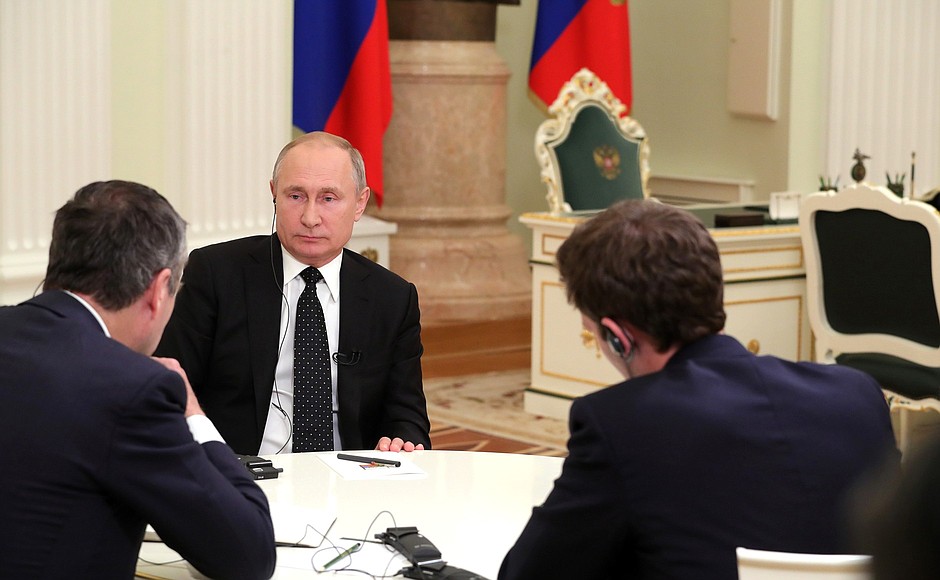
Putin at FT interview. (Kremlin photo)
In an interview with The Financial Times, Putin pointed to “the tragedies of Libya and Iraq” — meaning, of course, what happened to each of them as they lacked a nuclear deterrent. Applying that lesson to North Korea, Putin said,
“What we should be talking about is not how to make North Korea disarm, but how to ensure the unconditional security of North Korea and how to make any country, including North Korea, feel safe and protected by international law. …”
“We should think about guarantees, which we should use as the basis for talks with North Korea. We must take into account the dangers arising from … the presence of nuclear weapons,” he said, adding that if a way can be found to satisfy North Korea’s understandable determination to protect its security, “the situation may take a turn nobody can imagine today.”
“Whether we recognize North Korea as a nuclear power or not, the number of nuclear charges it has will not decrease. We must proceed from modern realities …” And those realities include fundamental, immediate security concerns for both Russia and China. Putin put it this way:
”[W]e have a common border, even if a short one, with North Korea, therefore, this problem has a direct bearing on us. The United States is located across the ocean … while we are right here, in this region, and the North Korean nuclear range is not far away from our border. This is why this concerns us directly, and we never stop thinking about it.”
Xi’s ‘Reasonable Expectations’
Last week in Pyongyang, Chinese President Xi Jinping said China is waiting for a desired response in stalled nuclear talks with the United States.
“North Korea would like to remain patient, but it hopes the relevant party will meet halfway with North Korea to explore resolution plans that accommodate each other’s reasonable concerns,” he said.
A commentary in China’s official Xinhua news agency said China could play a unique role in breaking the cycle of mistrust between North Korea and the U.S, but that both sides “need to have reasonable expectations and refrain from imposing unilateral and unrealistic demands.”
There is little doubt that the Russians and Chinese have been comparing notes on what they see as a potentially explosive (literally) problem in their respective backyards, the more so inasmuch as the two countries have become allies in all but name.
On a three-day visit to Moscow earlier this month, President Xi spoke of his “deep personal friendship” with Putin, with whom he has “met nearly 30 times in the past six years.” For his part, Putin claimed “Russian-Chinese relations have reached an unprecedented level. It is a global partnership and strategic cooperation.”
A Fundamental Strategic Change
Whether they are “best friends” or not, the claim of unprecedented strategic cooperation happens to be true — and is the most fundamental change in the world strategic equation in decades. Given the fear they share that things could get out of hand in Korea with the mercurial Trump and his hawkish advisers calling the shots, it is a safe bet that Putin and Xi have been coordinating closely on North Korea.
The next step could be stepped-up efforts to persuade Trump that China and Russia can somehow guarantee continued nuclear restraint on Pyongyang’s part, in return for U.S. agreement to move step by step — rather than full bore — toward at least partial North Korean denuclearization — and perhaps some relaxation in U.S. economic sanctions. Xi and Putin may have broached that kind of deal to Trump in Osaka.
There is also a salutary sign that President Trump has learned more about the effects of a military conflict with North Korea, and that he has come to realize that Pyongyang already has not only a nuclear, but also a formidable conventional deterrent: massed artillery.
“There are 35 million people in Seoul, 25 miles away,” Trump said on Sunday. “All accessible by what they already have in the mountains. There’s nothing like that anywhere in terms of danger.”
Obstacles Still Formidable
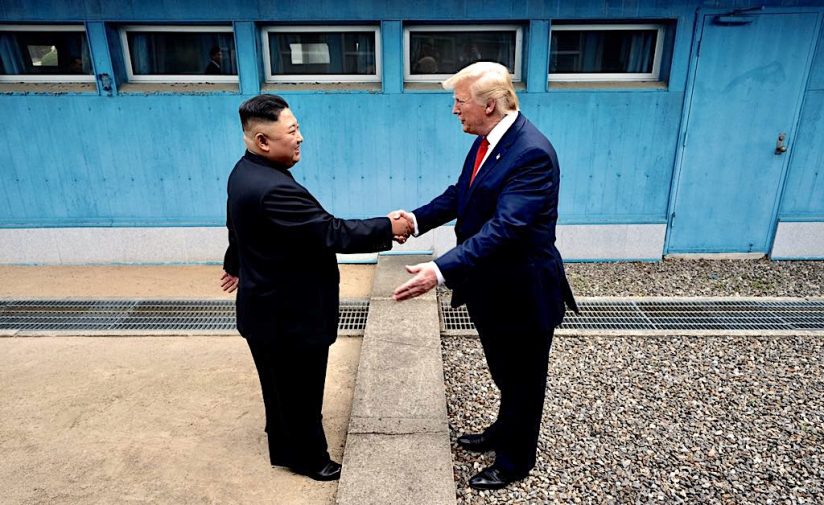
Trump and Kim meet Sunday before Trump became first US president to step on North Korean territory. (White House photo)
Trump will have to remind his national security adviser, John Bolton, and Secretary of State Mike Pompeo, that he is the president and that he intends to take a firmer grip on reins regarding Korean policy. Given their maladroit performance on both Iran and Venezuela, it would, at first blush, seem easy to jettison the two super-hawks.
But this would mean running afoul of the Military-Industrial-Congressional-Intelligence-Media-Academe-Think-Tank (MICIMATT) complex, in which the corporate-controlled media play the sine-qua-non role today.
In a harbinger of things to come, The Washington Post’s initial report on the outcome of the Trump-Kim talks contained two distortions: “Trump … misrepresented what had been achieved, claiming that North Korea had ceased ballistic missile tests and was continuing to send back remains of U.S. servicemen killed in the Korean War.”
The Trump administration could reasonably call that “fake news.” True, North Korea tested short-range ballistic missiles last spring, but Kim’s promise to Trump was to stop testing strategic not tactical missiles, and North Korea has adhered to that promise. As for the return of the remains of U.S. servicemen: True, such remains that remain are no longer being sent back to the U.S., but it was the U.S. that put a stop to that after the summit in Hanoi failed.
We can surely expect more disingenuous “reporting” of that kind.
Whether Trump can stand up to the MICIMATT on Korea remains to be seen. There is a huge amount of arms-maker-arms-dealer profiteering going on in the Far East, as long as tensions there can be stoked and kept at a sufficiently high level.
Ray McGovern works with Tell the Word, a publishing arm of the ecumenical Church of the Saviour in inner-city Washington. His first portfolio at CIA was referent-analyst for Soviet policy toward China, Korea, Vietnam, and Japan. In retirement he co-founded Veteran Intelligence Professionals for Sanity (VIPS).
US Coastguard Ships Sent Over 8,000 km From Own Shores to South China Sea for ‘Law Enforcement’
Sputnik – June 11, 2019
The US Coast Guard has deployed two cutter vessels, the USCGC Bertholf and the USCGC Stratton, with the US Seventh Fleet in Yokosuka, Japan to help challenge China’s claims over wide swaths of the South China Sea, Coast Guard Pacific Area commander Vice-Admiral Linda Fagan has said.
Speaking at a press call on Tuesday morning, Fagan indicated that the vessels were being sent to the region to assist with “law enforcement and capacity-building in the fisheries enforcement realm.”
Earlier this year, the USCGC Bertholf took part in one of the US Navy’s regular demonstrative transit sails through the Taiwan Strait in March, with China criticising that effort and saying it served only to strain China-US relations.
Last month, the Bertholf also joined two Philippine coast guard vessels for “maritime security” training operations in the South China Sea, with the drills taking place near a shoal area contested by both Beijing and Manila.According to Vice-Admiral Fagan, the Coast Guard’s mission in the region is to support its local partners. “We are very much interested in engaging with partner nations in using our authorities and capacity building in a way that is helpful,” she stressed.
Earlier this month, Chinese Defence Minister Wei Fenghe accused Washington of deliberately escalating tensions in the South China Sea, accusing ‘countries from outside’ of coming in “to flex muscles, in the name of freedom of navigation.”
“The large-scale force projection and offensive operations in the region are the most serious destabilising and uncertain factors in the South China Sea,” the defence minister said.
Formally charged with ensuring coastal defence and maritime security near America’s shores, the US Coast Guard has been regularly deployed abroad since the days of the Cold War, and has engaged in security and anti-piracy, search and rescue and other missions around the globe since then. The two Coast Guard vessels’ deployment to the South China Sea takes the ships over 8,000 km southwest of the westernmost US island in the Bering Sea, north of the Pacific Ocean.
China controls the vast majority of islands, reefs, and shoals in the South China Sea, and has regularly expressed concerns about the deployment of US vessels in the area. Along with China, portions of the strategic sea zone are claimed by the Philippines, Vietnam and Malaysia, as well as Taiwan, an island nation which Beijing considers part of its territory.The South China Sea is a major strategic passageway, with over $5 trillion worth of maritime cargo, including much of China’s Middle Eastern oil supplies, passing through the area each year. Much of the sea territory is also rich with fishing stocks and energy resources.
The Geo-Port-Politics of Gwadar and Chabahar
By Salman Rafi Sheikh – New Eastern Outlook – 08.06.2019
In a highly surprising move, Iran’s foreign minister, on an unscheduled and unannounced visit to Pakistan on Thursday (May the 23rd), announced the proposal to link Pakistan’s port of Gwadar with Iran’s Chabahar port. This announcement signals tectonic geo-political shift taking place in the region in the wake of increasing tensions between the US and Iran. The US has already successfully forced India, its chief South Asian ally, to scrap its purchase of oil from Iran, a country India was not long ago claimed to have entered into a strategic alliance with. Although the US has somehow left Chabahar out of its net of sanction, India’s decision to follow the US in its footsteps does signal its participation in the US policy of crippling Iranian economy and take Iran to the verge of massive political disruption and eventual regime change. Iran, obviously, is not unmindful of the implications of this particular decision of India.
Iran’s proposal to link Chabahar with Gawadar, despite the fact that the US sanctions don’t apply on the post, shows the deep sense of Indian betrayal prevailing in Tehran and a counter-manoeuvre to avoid isolation. Iran, obviously, does not expect India to be as robust and committed to building the rest of the port as it would have in a peaceful and sanction-less scenario. Iran, logically enough, is boosting its ties with its immediate neighbour, a country that already is deeply allied with China and aims to expand CPEC to Iran to increase regional connectivity. With Chabahar and Gwadar being linked, Iran will thus have two major regional states on its side i.e., Pakistan and China and will be far better placed in China’s extended regional connectivity programme than it is now. Zarif’s connectivity proposal itself tells everything. To quote him:
“We believe that Chabahar and Gwadar can complement each other. We can connect Chabahar and Gwadar, and then through that, connect Gwadar to our entire railroad system, from Iran to the North Corridor, through Turkmenistan and Kazakhstan, and also through Azerbaijan, Russia, and Turkey.”
As far as the US—Iran tension is concerned, unlike India, Pakistan has already said that it will not take sides in the conflict. Pakistan’s neutrality in the on-going scenario suits Tehran far more than it does for the US, that is if it does at all.
There is also no gainsaying that Tehran’s proposal to connect the two ports couldn’t have come with prior consultation with the Chinese, who are practically running the port in Pakistan. Accordingly, before coming to Pakistan, Zarif was in China where he met his Chinese counterpart and certainly discussed this proposal, leading Chinese foreign minister to “Welcome Iran” to actively take part in the joint building of the Belt and Road Initiative (BRI) through Chabahar.
China also re-affirmed its support for Iran. “China firmly opposes unilateral sanctions and the so-called ‘long-arm jurisdiction’ imposed by the United States on Iran,” Wang said, pledging to maintain the Joint Comprehensive Plan of Action and safeguard the authority of the United Nations and basic norms governing international relations.
Chinese support’s major manifestation came a few days ago when Chinese oil tanker Pacific Bravo left the Persian Gulf with 2 million barrels of Iranian light crude, ignoring the US sanctions and practically challenging the US unilateralism.
Pacific Bravo is owned by Bank of Kunlun, a financial institution that is owned by the Chinese state oil company CNPC. Bank of Kunlun has long been the financial institution at the heart of China-Iran bilateral trade—a role for which the company was sanctioned during the Obama administration. Despite already being designated, Bank of Kunlun ceased its Iran-related activities in early May when the oil waivers were revoked. But Bravo’s current moves point to a change in Chinese policy. Importantly enough, Bravo sailed from the Persian Gulf on the same day that Zarif arrived in Beijing and met Chinese foreign minister to discuss Iranian participation in the BRI (through linking Gwadar and Chabahar).
With Iran now taking this fundamental shift, what is apparent is that a major foreign policy shift in Iran has taken place whereby its leadership has come to an understanding that their relations with the US are unlikely to take a positive turn for a long time and that a necessary adjustment in the foreign policy is absolutely needed. As a matter of fact, it was only a few days ago when Iran’s supreme leader criticised Iran’s foreign policy and dropped a major hint about why changing the course of foreign policy was an utmost necessity.
Of course, its major manifestation is reorienting Iran’s relations with Pakistan via participation in the BRI. Pakistan will be least concerned about any US reaction over linking Gwadar with Chabahar, for the US sanctions do not apply to the Iranian port. But the fact that the geo-political significance of the port will undergo a significant change after a successful linkage between the two ports and that China will become a major player, the US might feel ‘compelled’ to direct its sanctions toward the port eventually.
Guyana Could be the United States’ ‘Secret Weapon’ Against Venezuela – Scholar
Sputnik – June 1, 2019
In 2015, ExxonMobil discovered large oil fields just off the coast of Guyana. The reserves are estimated at 5.5 billion barrels. What does this hold in store for the Latin American country’s future? And what does Venezuela have to do with this?
Today, Guyana is the second poorest country in the region. According to some estimates, over the next few decades, it may become one of the world’s largest oil producers per capita. However, the availability of resources doesn’t always mean economic prosperity. The small Caribbean country could just become another piece of the puzzle that the United States is putting together in the region, said Tamara Lajtman, an expert at the Latin American Strategic Centre for Geopolitics (CELAG).
The entire history of relations between the United States and Latin American nations and the Caribbean region indicates that American transnational companies will be the ones who will benefit most from this discovery.
Guyana vs Venezuela
Lajtman shared the viewpoints of American experts who believe that Washington can replace Venezuelan oil from a “regional petroleum regime” with a much more stable supplier.
The expert said that at the end of last year, the American Security Project (ASP) organised a conference called “Guyana: Building Sustainable Security”. This organisation studies national security issues, among the members of its board, are former US Secretary of State John Kerry and former US Secretary of Defence Chuck Hagel. The participants in the said event included Vice Admiral Kevin Green, the former head of US Naval Forces Southern Command.As a result of the meeting, a document was drafted in which it was suggested that American politicians establish closer relations with Guyana in order to guarantee long-term security. The report also noted that since the crisis in Venezuela continues to escalate, a prosperous and developing Guyana could become an axis of stability in the Caribbean, Lajtman added.
According to the Stratfor agency [an American private intelligence and analysis company], some major oil producing companies in the United States have already begun working in Guyana. However, although the revenues of Guyana’s government will increase, a large part of the country won’t feel the economic benefits of oil production, since basically all the jobs in the sector have been designated for foreigners.
Military Presence
In early May, the US Navy Southern Command began New Horizons drilling in Guyana. According to the ASP (American Security Project), they are being held at just the right moment, “when Guyana is at the very centre of regional geopolitics”.
There are two reasons for this: the crisis in neighbouring Venezuela and the energy future of the Caribbean country. The situation is aggravated by a land dispute between Caracas and Georgetown over the Essequibo River. A zone of 160,000 km2 has been claimed by Venezuela for several centuries and the dispute is still unresolved. The United States sees a threat to drilling operations near the maritime border between the two countries.
Economic Aspect
For many decades, Guyana was considered a transit country for cocaine on its way from Colombia to the United States. In light of this, the government has implemented various anti-drug assistance programmes and enacted laws to combat money laundering and the financing of terrorism. With the growth of oil revenues more could be done about this.
In July 2018, Guyana joined China’s New Silk Road initiative, which includes investments in the construction of ports and roads. This would be the largest project ever carried out in the country. It is of key geostrategic importance since it will reduce the time of transportation for goods to northern Brazil (China’s main trading partner in the region) and make the route to the Panama Canal faster.The expert also noted that one of China’s largest national oil companies — CNOOC (China National Offshore Oil Corporation), owns a 25% stake in ExxonMobil’s Stabroek block.
Hungary’s Foreign Minister Calls Western Europe ‘Hypocrites’ for China Criticism
teleSUR | May 23, 2019
Hungary’s foreign minister Thursday accused major Western European nations of “hypocrisy” and “hysteria” for criticizing central European countries’ business dealings with China, and defended Hungary’s use of Huawei 5G mobile phone technology.
Sixteen central and eastern European countries, including 11 European Union members, held a summit with China in April during which it pledged to increase trade and provide more support for big cross-border infrastructure projects.
The area is part of China’s Belt and Road Initiative, which aims to link China by sea and land with Southeast and Central Asia, the Middle East, Europe and Africa.
France and Germany oppose such independent moves, which they fear might make Europe appear disunited at a time when the EU is trying to forge a more defensive strategy towards China.
On Tuesday, speaking to reporters in Paris, France’s Finance Minister Bruno Le Maire criticized “negotiations of 16 states from the east with China in parallel to negotiations that the EU is leading with China”.
But Hungarian Foreign Minister Peter Szijjarto, who is serving in the government of far-right Prime Minister Victor Orban, rejected such criticism, saying Germany and France do far more business with China than the central European states, and often negotiate directly with Beijing.
“There is such a bad hypocrisy in the European Union when it comes to China,” Szijjarto told Reuters on the sidelines of an OECD meeting in Paris. “The 11 central and eastern European member states … represent 9.9 percent of EU trade with China.”
“When the German chancellor and French president meet China’s leadership nobody thinks that’s a problem,” he said. “Nobody raises a question about how it is possible that they sell 300 aircraft to China, which is a bigger deal than the (entire) trade represented by the 11 central European countries.”
He said it was also unfair for Western European states to criticize Hungary for using technology from Chinese firm Huawei in its 5G mobile phone networks, when those networks were being built under license by German and British companies, Deutsche Telekom and Vodafone.
Hungary’s government has been at odds with Brussels for the erosion of media and judicial independence, attacks on civil organizations, treatment of migrants, laws against poverty, and the ousting of educational institutions like the progressive Central European University.
Featured Video

The Truth About the Trump Shootings with Ken Silva
or go to
Aletho News Archives – Video-Images
From the Archives
Trans ‘milk’ as good as the real thing – NHS
RT | February 18, 2024
The drug-induced nipple secretions of trans women are as good as mothers’ breast milk for babies, the University of Sussex Hospitals NHS Trust claimed in a letter to campaigners made public in a report by British think tank the Policy Exchange on Sunday.
The healthcare trust’s medical director, Rachel James, argued that the off-label prescription drug cocktail men transitioning to female take in order to produce milk was “similar to the natural hormones which encourage lactation to develop when the baby is newly born.”
“The evidence which is available demonstrates that the milk is comparable to that produced following the birth of a baby,” James wrote in the letter, sent to Children of Transitioners last August.
Biological men who wish to lactate must first take hormones to grow milk glands and then take high doses of either domperidone or metoclopramide to stimulate milk production. Neither drug is approved for this use, though they are occasionally prescribed off-label to biological women who have trouble lactating.
However, domperidone’s own manufacturer, Janssen, warns patients the drug “may cause unwanted side effects affecting the heart in a breastfed baby” and “should be used during breastfeeding only if your physician considers this clearly necessary.” … continue
Blog Roll
 Aletho News
- Seyed M. Marandi: U.S. Strike Imminent – Toward Total War in the Middle East
- Russia Voted Under Fire. Washington Is Loading the Tankers.
- 12 Things Your Oncologist Was Trained Not to Tell You
- Anthrax Attacks Paved Way for COVID-Era ‘Junk Drugs and Vaccines’
- How Real Is the Impact of Western Sanctions on Israel?
- France, You Are Guilty: How Paris Turned Western Sahara into the Maghreb’s Powder Keg
- 2025 Nature Paper Claiming Worsening Global Drought Gets RETRACTED …Heavily Flawed
- Your Milk Is Not the Problem
- The Truth About the Trump Shootings with Ken Silva
- ARE PATIENTS BEING PROPERLY INFORMED ABOUT OZEMPIC?
- If Americans Knew
- An error has occurred; the feed is probably down. Try again later.
- No Tricks Zone
- 2025 Nature Paper Claiming Worsening Global Drought Gets RETRACTED …Heavily Flawed
- New Study: ‘Global Drought Shows No Detectable Recent Acceleration Under Climate Warming’
- Economic Masterminds: German Socialists Suggest Taxing Productivity Gains Stemming From Using AI
- The South China Sea Has Not Been Cooperating With The Climate Change Narrative
- Energy Crisis: Germany Enters Heating Season With Historically Low Gas Reserve Fill Levels
- New Study: The Antarctic Ice Sheet Gained Mass From 2020-2024 Due To Staggering Snow And Ice Accumulation
- Study: Ocean Heating Rates From Thousands Of Years Ago ‘Dwarf’ Modern Ocean Heating Rates
- Climate Extremists Target, Attack Large-Scale Power Grid Infrastructure In Germany!
- New Study: Antarctic Ice Melt Has Contributed Less Than 1 Centimeter To Sea Level Rise In The Last 30 Years
- Fear Of Debate: Alarmist German Climate Scientist Calls On Mainstream Media To Discredit Skeptic Voices
 Aletho News