Will China engage in arms control?
By M. K. BHADRAKUMAR | Indian Punchline | May 5, 2019
US President Donald Trump’s phone call to his Russian counterpart Vladimir Putin on Friday comes within 3 weeks of the release of the redacted report of the Robert Mueller inquiry into his ‘Russia collusion’. It was a 90-minute phone conversation, which underscored Trump’s determination to foster good relations with Putin notwithstanding the narrative that he and the people around him were engaged in improper activities with Russia.
The Kremlin readout listed economic ties, ’strategic stability’, North Korea, Ukraine and Venezuela as topics that figured in the conversation.
But the headline-hogging news is that Trump proposed to Putin the idea of expanded arms control talks that would also include China. Trump claimed that China is on board. Talking to the media at the White House, he said:
“We’re talking about a nuclear agreement where we make less and they make less, and maybe even where we get rid of some of the tremendous firepower that we have right now. We’re spending billions of dollars on nuclear weapons, numbers like we’ve never spent before. We need that, but they are also — and China is, frankly, also — we discussed the possibility of a three-way deal instead of a two-way deal. And China — I’ve already spoken to them; they very much would like to be a part of that deal. In fact, during the trade talks, we started talking about that. They were excited about that. Maybe even more excited than about trade. But they felt very strongly about it.”
“So I think we’re going to probably start up something very shortly between Russia and ourselves, maybe to start off. And I think China will be added down the road. We’ll be talking about nonproliferation. We’ll be talking about a nuclear deal of some kind. And I think it will be a very comprehensive one.”
Trump sees a potential signature foreign policy achievement. Trump is known to have a penchant for big deals. The Washington Post reported last week that Trump “has ordered his administration to prepare a push for new arms-control agreements with Russia and China after bristling at the cost of a 21st-century nuclear arms race.” The reports from Washington indicate that the White House is conducting intense interagency talks to develop options for the president to pursue such a deal.
The CNN quoted a senior White House official as saying, “The President has made clear that he thinks that arms control should include Russia and China and should include all the weapons, all the warheads, all the missiles. We have an ambition to give the President options as quickly as possible to give him as much space on the calendar as possible.”
Trump is giving conflicting signals. Even as he talks about arms control, Trump has backed the $500 billion Obama-era project to modernize the US atomic arsenal, pulled out of the INF Treaty with Russia, and updated the US nuclear posture to be more aggressive. But then, earlier last month, in a meeting with Chinese trade envoy and vice premier Liu He, Trump bemoaned the levels of military spending by major powers, suggesting all that money could be better spent on other things.
Clearly, in any emergent scenario, the broader context of relations will be the key factor. Bringing China on board arms control talks is a common Russian-American agenda. To understand this, we need to go back in time to the negotiation of the Intermediate-Range Nuclear Forces (INF) Treaty.
Fundamentally, China’s approach to arms control has been different from the US or Russia’s. Washington and Moscow have been historically driven by the strategic imperative of parity that generated in turn the Cold-War era arms race and its ‘anti-thesis’ — arms control and reductions. And the concept of mutual nuclear deterrence and stability was shared and interdependent.
China, on the contrary, never sought parity and had no reason to enter into an arms race or to engage in arms control. Today, China reportedly has an arsenal of less than 300 strategy warheads (as against 1550 that the New START Treaty of 2010 allows the US and Russia to keep.) Simply put, China stayed on the sidelines, maintaining that the US and Russia need to reduce their arsenals first before its participation in limitations and reductions.
When the INF Treaty was negotiated in the 1980s, although its leitmotif was European security, the pact also had implications for East Asian security. China was on adversarial terms with Russia at that time and joined hands with the western powers to ensure two things: a) Britain and France were kept out of the INF Treaty (lest that set precedent for China’s inclusion), and, b) INF Treaty also included Soviet deployments east of the Urals.
China scored a big diplomatic coup when the Soviet leader Mikhail Gorbachev made the unilateral announcement in July 1987 agreeing to the so-called global ‘zero option’ by the Soviet Union (ie., elimination of Soviet INF missiles in both Europe and Asia.) In essence, China ensured the complete elimination of Soviet missile threat to its nuclear arsenal.
Moscow never quite reconciled with Gorbachev’s compromise. Meanwhile, the Cold War ended and the Soviet Union imploded. Yet, by the beginning of 2005, Moscow began to voice unease that INF Treaty banned only the US and Russia from having INF missiles, while other countries were free to deploy them. In 2007, then Russian Defense Minister Sergei Ivanov called the INF Treaty a relic of the Cold War, and President Putin thereafter proposed in October 2007 that the INF Treaty become multilateral—a global ban on INF missiles.
Now, the political-military relationship between Russia and China is vastly different today. China’s nuclear capability has dramatically improved, especially with submarine-launched ballistic missiles. On the other hand, US’ relations with both Russia and China have become tense while Sino-Russian partnership is at its highest level today in history. Equally, Russia and China have common shared threat perceptions regarding the US.
Since there are consultative mechanisms between Moscow and Beijing to mitigate substantive concerns regarding deployment or force projection, China is today more concerned with US missiles (and missile defence systems.) Nonetheless, China has to come to terms with the reality that any significant increase in its nuclear warhead numbers henceforth also concerns the security interests of Russia. It is entirely conceivable that Moscow will also strive to maintain its qualitative and quantitative nuclear predominance over China.
To be sure, China’s rapidly growing missile forces have long troubled the US. China now has the second largest defense budget behind the US – and China’s fire power is largely concentrated in one critical region, East Asia. The trends are worrisome for Washington, too. If in 2000 US defence expenditure was nine times that of China, by 2010, this was down to less than six times, and in 2017 to less than three times.
Russian officials have repeatedly stated that any future reductions of strategic weapons would have to be multilateral, including the UK, France, and China. Chinese officials have stated that the US and Russia would have to make much deeper cuts before China is prepared to join the process. However, we still don’t know the US position apropos extension of New START Treaty beyond 2021 and in further nuclear reductions.
US ends waiver on India’s Iran oil imports. What next?
By M. K. BHADRAKUMAR | Indian Punchline | May 3, 2019
China’s stance vis-a-vis the US sanctions against Iran’s oil exports is evolving. These are early days. Quite obviously, the Chinese assessment that Iran is not going to wilt under US pressure gives a realistic picture. But it means that there is a long haul ahead and India needs to do some creative thinking. In the improved climate of Sino-Indian relations, a window of opportunity is opening for New Delhi to take a coordinated approach with Beijing.
No sooner than the Trump administration announced in a statement on April 22 its decision that it will not extend the exemption period beyond May 2 for countries buying oil from Iran — so-called “waiver” — the Chinese Communist Party tabloid Global Times came out with an editorial acknowledging that the US decision poses a “tough choice.”
China is the biggest importer of Iranian oil. The Global Times editorial blasted Washington for this “typical manifestation of unilateralism and hegemony” and weighed in on China’s policy options. The editorial offered the following advice: “We think China should clarify its interests and principles surrounding the purchase of oil from the Middle East nation and strive to minimize the loss to China’s national interests.”
That is to say, first, China should no doubt “oppose the hegemonic approach of the US but it can’t take the lead in confronting the US on issues involving Iran.” China will push back at the US by rallying world opinion against its Iran sanctions, but will not take a confrontationist approach.
Second, “Beijing needs to coordinate with other major powers to respond to US sanctions against Iran… There is a need to strengthen coordination among countries. If the issue can be dragged, then let it drag. Otherwise, the issue can be modified. If it cannot be modified, let it be dealt with on a case-by-case basis.”
Third, “The operational safety of Chinese enterprises should be given priority and they have the right to continue to cooperate with Iran or withdraw, keeping in mind the situation on the ground.” The editorial sums up: “China does not want to have a showdown with the US over Iran, nor can Beijing just let Washington do what it wants… we cannot disregard principles or interests. This is a time to test wisdom.”
However, an editorial by the government-owned China Daily on April 23 was more forthright: “Major importers of Iranian oil, China included, have the legitimate right to have normal business ties and conduct trade with Iran, including importing oil from it, should they so choose. The Chinese government is committed to safeguarding the legitimate rights and interests of its enterprises and willing to play an active and constructive role in promoting the stability of the international energy market.”
Significantly, China Daily also hinted at willingness to make coordinated moves with other affected countries such as India.
China has skirted US sanctions against Iran before. This time around too, the likelihood of that happening is being discussed by western analysts. China will find the back door, inevitably. Apart from ship-to-ship transfers of oil, China also has the option to continue to buy some Iranian crude through the banks in China that are already under US sanctions.
The US-China trade talks do not complicate Beijing’s policy calculus on Iran oil. The trade negotiations envisage US exports of oil / LNG to China worth tens of billions of dollars. (The Wall Street Journal reported in March that in a move that would be announced as part of a broader US-China trade deal, China’s state-owned China Petroleum & Chemical Corp., known as Sinopec, will agree to a long-term contract to buy about $18 billion of liquefied natural gas from Cheniere,) This eases the US pressure on China.
On the contrary, the pressure is much higher on India, which meets 80% of its oil demand through imports. Iran used to be the third largest source of supply till the US butted in. The “waiver” allowed India to import 1.25 million tonnes of oil from Iran per month (which itself meant a 30% reduction in the level of imports).
Most important, India could avail of concessional terms, which meant a saving of around a quarter of combined costs due to favourable conditions such as prices, transportation and insurance. Equally, the rupee payment mechanism worked to India’s advantage.
India has to pay Iran in rupees for oil imports and money is deposited in a special account in India, which Iran uses to purchase humanitarian supplies such as rice and medicines from India. In essence, it was barter trade that committed Iran to buy Indian products, creating export earnings for Indian business.
President Trump is notoriously tight-fisted and will never compensate India for all this financial loss. On the other hand, he hopes to take the opportunity to expand US oil exports to India, which are not based on attractive trade terms. (Besides, why should India want Trump to navigate its energy security?)
Suffice to say, with the expiry of the “waiver” on May 2, India’s oil import costs (and its US dollar payouts) will rise, and its export revenue will decrease. India’s economic growth and exchange rate’s stability will come under great pressure. The expert opinion uniformly warns that the US sanctions against Iran will push up international oil prices, thereby increasing India’s overall oil import bills. Washington claims to be generous in leaving India-Iran cooperation over Chabahar port out of the purview of the sanctions. But the US sanctions will in due course severely stymie cooperation between India and Iran over Chabahar.
The question must be frontally asked: What are the US’ intentions toward India? New Delhi has reason to be worried about Washington’s real interests, long-term strategy and the uncertainty in ties with the US. The US’ interests and strategy appear to narrow down to using India to contain China.
Mike Pompeo has rushed to claim credit for the blacklisting by the UN of Masood Azhar. Sections of the Indian media are beside themselves with joy. But the same man went into hiding a couple of weeks ago when EAM Sushma Swaraj telephoned him in Washington seeking flexibility in the US sanctions against Iran oil.
According to media reports, EAM said India should be allowed to import Iranian crude for some more time without being impacted by US secondary sanctions, as the general election is underway in the country, and that the next government with a fresh mandate will take a final call on this issue.
But Pompeo ducked, pleading helplessness — only to resurface from hiding ten days later on May 1 with the astounding claim that his boys got China to lift the block on Azhar. What to make out of such friends?
Unfortunately, the government is waffling by claiming it is ready to deal with the impact of US sanctions against Iran by getting extra supplies from other oil producing countries to compensate for loss of Iranian oil. The matrix is not about the availability of oil — as explained above — but about the huge economic costs. Simply put, India is called upon to underwrite Trump’s maverick Iran policies.
From the Indian perspective, what matters most in the coming period will be the scope to create a trading bloc with China that would allow the two countries to buy Iranian oil without going through the US banking sector.
Trump’s Arms Proposal Is Really All About The Space Race
By Andrew Korybko | EurasiaFuture | 2019-04-26
There’s nothing that anyone can argue about in principle concerning the spirit behind Trump’s arms proposal, but peel back a few strategic layers and it becomes clear that it’s really all about the Space Race and weakening the Russian-Chinese Strategic Partnership.
Trump’s arms proposal is making waves all across the world after officials in his administration told the media that “he thinks that arms control should include Russia and China and should include all the weapons, all the warheads, all the missiles”, suggesting a comprehensive global military pact that could in theory change the course of International Relations in the 21st century. On the surface, there’s nothing that anyone can argue about in principle concerning the spirit behind this idea, but peel back a few strategic layers and it becomes clear that it’s really all about the Space Race and weakening the Russian-Chinese Strategic Partnership.
The US evidently believes that its much-touted “Space Force” gives it a noticeable edge over its competitors and will eventually neutralize Earth-based weapons platforms, something that Russia already suspects is the case after First Deputy Chief of the Russian General Staff’s Main Operations Department Lt. Gen.Viktor Poznikhir told the Moscow Conference on International Security (MCIS) earlier this week that “the US had developed a concept of pre-launch interception and planned to destroy intercontinental ballistic missiles of Russia, China and other countries while they are still in launchers”, strongly hinting at its strategic adversary’s impressive space-based military capabilities.
It’s likely for this reason why Deputy Foreign Minister Sergey Ryabkov cautiously welcomed this proposal but qualified his country’s support for it by saying that “further steps towards nuclear disarmament will require creating a number of prerequisites and taking into account many factors that have a direct impact on strategic stability – from the emergence of a missile defense system and the possibility of weapons deployment in space to fundamental changes in the sphere of conventional weapons, the emergence of cyber weapons and many other factors.” Evidently, Russia senses a trap, and not without good reason.
Trump knows that his proposal is misleading but will probably generate a lot of positive coverage in the global press, which not only boosts his re-election prospects next year but also improves the US’ international image to an extent. In addition, his strategists are aware that the proposal is more attractive to Russia than it is to China, which experts interviewed by CNN about this noted when they described the People’s Republic as not “even in the same ballpark” with those other two Great Powers and “not even playing the same game” when it comes to the weapons that Washington wants to limit.
Knowing that his proposal will probably flounder, Trump likely intends to use it for short-term soft power purposes and to exploit its likely failure as the long-term pretext for doubling down on the US’ military-industrial complex and specifically its missile defense and space-based component that will greatly offset the strategic stability that relatively stabilized International Relations up until this point. In the event that Russia plays along with the US for appearance’s sake in entering into some degree of negotiations about this topic while China predictably stays away, then Washington might seek to exploit this divergence between its two Great Power rivals in order to divide them further.
That, however, will probably only be as successful as Trump’s arms proposal (which is to say, that it’ll likely also fail) because President Putin just proudly proclaimed that Russia and China’s supercontinental integrational projects of the Eurasian Economic Union and the Belt & Road Initiative (BRI) will begin the process of merging into a multipolar megastructure during the speech that he gave at the ongoing BRI Forum in Beijing. Despite the occasional differences between these two strategic partners and their underwhelming real-sector economic cooperation so far, neither of them wants the US to get its way in dividing and ruling Eurasia at their expense.
Russia’s Response To India’s ASAT Missile Test Wasn’t What New Delhi Expected
By Andrew Korybko | EurasiaFuture | 2019-03-31
India probably thought that Russia would enthusiastically accept its entry into the “space super league” as Prime Minister Modi described it, but Moscow is actually pretty critical of New Delhi’s anti-satellite missile tests and urged it to join a Russian-Chinese multilateral mechanism for preventing the weaponization of space, something that it curiously announced around the same time as the Pakistan-Russia Consultative Group on Strategic Stability met in Islamabad and “agreed on the need for preserving multilateralism in the field of international security and disarmament”.
Indian Boasting Meets Russian “Balancing”
India’s anti-satellite (ASAT) missile test was heralded by Prime Minister Modi as an unprecedented achievement that catapulted his nation into the “space super league” of only four countries capable of pulling off this military feat, which he thought would boost his reelection prospects ahead of the upcoming onset of general elections that will continue into May. The Indian leader also intended to send a strong signal to China and Pakistan, one that he anticipated would be positively received by his American ally and passively accepted by his country’s Old Cold War-era Russian one, but while Washington is behaving as expected, Moscow is not. In fact, it can even be said that the Russian reaction took India off guard because New Delhi has yet to recognize the new reality of its relations with Moscow, which have undergone a drastic change since the Pulwama incident that accelerated previous trends.
Russia’s 21st-century grand strategy is to “balance” between the various forces of Afro-Eurasia in order to facilitate the emerging Multipolar World Order and maintain harmony in the Eastern Hemisphere, to which end it commenced a game-changing rapprochement with former rival Pakistan that’s since seen Moscow prioritize its relations with the global pivot state in order to “make up for lost time”. Russia announced its “Return to South Asia” by offering to mediate between Pakistan and India following the recent uptick in bilateral tensions between them, but while this was warmly welcomed by Islamabad, it was shot down by New Delhi whose Ambassador to Russia was later proven to have lied about the reason for rejecting this unprecedented diplomatic outreach. It’s therefore not for naught that Russia’s response to India’s ASAT test was “diplomatically critical” and nothing like what New Delhi anticipated.
Russia’s Carefully Worded Response
The Russian Ministry of Foreign Affairs put out a carefully worded statement about this a day after the test on 28 March, with the Google Translated version being shared below because an official English translation has yet to be published on their website at the time of writing:
“We drew attention to the anti-satellite weapon test conducted by India on March 27, as a result of which an Indian spacecraft in a low near-earth orbit was hit by a interceptor ballistic missile as a target. We note the non-directionality of this test against a specific country declared by the Indian leadership, as well as their confirmation of the immutability of the New Delhi foreign policy to prevent the deployment of weapons in outer space and thereby the development of an arms race in it.
At the same time, we are compelled to state that this step of India in many respects was the result of the substantially degraded situation in the field of arms control. Russia has repeatedly warned that the destructive actions of the United States to undermine the entire architecture of international security and strategic stability, including the one-sided and unlimited expansion of the global US missile defense systems, as well as the reluctance to abandon plans for putting weapons into space, make other states think about improving their own similar potentials in the interests of strengthening their national security. We urge Washington to take a responsible position, think again and abandon the insane, and most importantly – absolutely unrealizable – the idea of universal military domination. It is still possible to stop the arms race unfolding in various regions of the world. It is important to assist the responsible states in maintaining an adequate level of international security and stability.
For our part, we intend to continue taking all the necessary steps to prevent an arms race in outer space. With the support of a solid group of like-minded people, the idea of developing a multilateral legally binding instrument for keeping outer space peaceful based on the Russian-Chinese draft treaty on preventing the placement of weapons in outer space, the use of force or the threat of force against space objects, as well as a multilateral initiative – political obligations not to place weapons first in space. We offer our Indian partners to actively join these joint efforts of the international community.”
As can be seen, Russia hinted that India is a “rogue state” whose strategically destabilizing test was influenced by the US, which sent the signal that it would be acceptable for its ally to do this at the time that it did after recently pulling out of the INF Treaty and creating its so-called “Space Force”.
The Chinese & Pakistani Angles
Another important point to pay attention to is the last one where Russia urged India to join the multilateral mechanism that it proposed together with China to prevent the weaponization of space. It’s extremely unlikely that India will do this, however, seeing as how the whole point of this test was to send an aggressive signal to its Asian Great Power neighbor and “fellow” BRICS “frenemy”, though it’s not surprising that Russia would play the part of the Eurasian “balancer” by publicly suggesting that it join that framework. Although Russia’s intentions were positive in doing so and aimed at preserving peace in the supercontinent, India’s ruling Hindutva supremacists must have taken supreme offense at its suggestion because it implies that the two rising powers are equals unlike the BJP’s implied attitude towards its neighbor, especially in the hyper-jingoist run-up to the general elections.
Furthermore, it’s extremely curious that Russia’s statement came a day before the Pakistan-Russia Consultative Group on Strategic Stability met in Islamabad and “agreed on the need for preserving multilateralism in the field of international security and disarmament”, with this outcome once again showing that Islamabad is much more responsible of a regional actor than New Delhi is which has yet to signal any interest whatsoever in Moscow’s multilateral security proposal. Both the symbolism and timing of this development shouldn’t be dismissed as a mere coincidence since it undoubtedly sent a powerful political signal that the previous state of affairs has changed in South Asia and that Russia seems to have more in common with Pakistan nowadays than it does with India, with the first-mentioned aiming to unite Eurasia through its global pivot state grand strategy while the latter is trying to divide it through the US’ “Indo-Pacific” paradigm.
Concluding Thoughts
India’s present leadership has proven itself to be remarkably short-sighted in recent weeks when it comes to advancing the country’s strategic interests, having been both humiliated by Pakistan after its reckless response to the Pulwama incident and now “diplomatically criticized” by Russia following its irresponsible election gimmick of an ASAT test. Just like the latest events accelerated previous trends involving Russia’s position towards South Asia, so too have they also done the same for India’s one towards Eurasia, with it now being evident that New Delhi is siding more closely with Washington than with its notional BRICS “partners” in Moscow and especially Beijing. Given the clear pattern that’s visibly being established, it can be expected that India will continue to engage in strategically destabilizing unilateral action at the behest of its new American patron as it moves away from its erstwhile policy of “multi-alignment” and towards a new US-influenced model instead.
The Military Industrial State Confronts Russia and China
By Brian CLOUGHLEY | Strategic Culture Foundation | 26.02.2019
The swaggering arrogance of Washington’s Military-Industrial Complex never ceases to intrigue the rest of the world, much of which shrugs collective shoulders but has to acknowledge that the swaggering reflects the US National Defence Strategy which informs us that the military is going to concentrate on confronting Russia and China.
One of the loudest voices in the confrontation chorus is that of the Commander of US Naval Forces in Europe, Admiral James Foggo III, who knows that the noisier he is, the more money will be allocated by government to acquire more and more ships. And he is very good at being noisy. In 2016 he wrote a particularly bellicose piece for the US Naval Institute, titled ‘The Fourth Battle of the Atlantic’ in which he castigated Russia for not acknowledging that the United States is supreme. He declared that “the new Russian national security-strategy depicts the United States and NATO as threats to Russian security and accuses us of applying ‘political, economic, military, and information-related pressure’ on Russia.”
He is absolutely right about the US-NATO threat, because it has been growing for almost twenty years. As I’ve written before, after the Warsaw Pact disbanded in March 1991, NATO, although deprived of any reason to continue in existence, managed to keep going, and in 1999 added Poland, the Czech Republic and Hungary to its 16 members. As the BBC noted, these countries became “the first former Soviet bloc states to join Nato, taking the alliance’s borders some 400 miles towards Russia.”
With good reason Moscow wondered what on earth the US-NATO military cabal might be planning.
The New York Times recorded that the 1999 expansion was “opening a new path for the military alliance” and expressed delight that the ceremony took place in the town of Independence, Missouri, where “the emotional Secretary of State Madeleine K Albright watched the three foreign ministers sign the documents of accession, signed them herself, then held them aloft like victory trophies.” Ms Albright was born Marie Korbelová in Prague and “made no secret today of her joy as her homeland and the two other nations joined the alliance.” But neither she nor anyone else is on record as explaining what “new path” would be taken by NATO.
NATO continued to expand around Russia’s borders, inviting Bulgaria, Estonia, Latvia, Lithuania, Romania, Slovakia and Slovenia to join in 2002, which they did two years later.
There is little wonder that Russia is apprehensive about NATO’s intentions, as the muscle-flexing coalition lurches ever more eagerly towards conflict.
Further, the US itself has hundreds of military bases, spread all round the world. As noted by Nick Turse “Officially, the Department of Defense maintains 4,775 “sites,” spread across all 50 states, eight US territories, and 45 foreign countries. A total of 514 of these outposts are located overseas, according to the Pentagon’s worldwide property portfolio… But the most recent version of that portfolio, issued in early 2018 and known as the Base Structure Report, doesn’t include any mention of al-Tanf [the US Special Forces base in Syria] or for that matter, any other base in Syria. Or Iraq. Or Afghanistan. Or Niger. Or Tunisia. Or Cameroon. Or Somalia. Or any number of locales where such military outposts are known to exist and even, unlike in Syria, to be expanding.”
Yet Admiral Foggo insists that “an enduring objective of Russian foreign policy today is to challenge NATO and elevate Russia on the European stage once again.” Well, certainly Russia wants to be on the European stage, and it must be pointed out that it’s closer to that stage than is the US. It wants to trade with Europe — as is appreciated by the main European powers, Germany and France — and would be crazy to take action that would work against this mutually beneficial cooperation.
Unfortunately, Poland and the Baltic States of Estonia, Latvia and Lithuania are verging on the paranoid about Russia’s supposed “threat” to them — but there has been no indication of any sort by Moscow that Russia has any intention of moving against them in any way. Trade with these countries is important, too, but this hasn’t stopped the paranoid quartet from indulging in a vastly expensive operation to “decouple power grids from Russia” in spite of the fact that “Russia, on which the Baltic states currently rely to balance their power flows, has never cut power or threatened to do so.”
This is all part and pattern of the anti-Russia obsession that is mounting in much of the West, and plays into the hands of such as Admiral Foggo who now, some three months after an incident in the Kerch Strait last November, announced it “irritates me to no end” that Russia detained and charged 24 Ukrainian sailors who were involved in the illegal passage of some Ukrainian vessels. Foggo’s fury lies in his belief that “They are uniformed Ukrainian sailors and officers and chiefs. They’re not criminals, and they are being charged under a criminal code.”
None of his pronouncements make sense, but on February 19 Foggo despatched the guided-missile destroyer Donald Cook to the Black Sea where it is to conduct “maritime security operations and enhance regional maritime stability, combined readiness and naval capability with our NATO allies and partners in the region.” The provocative sortie by the Donald Cook will achieve absolutely nothing other than the heightening of tension between the US and Russia, which, unfortunately, is the object of the exercise.
Which brings us to the other region where the US Navy fandangos for freedom, the South China Sea.
On that side of the world the US is represented militarily by Admiral Philip S Davidson, the Commander US Indo-Pacific Command, who doesn’t like China. On February 12 he warned the US Senate Armed Services Committee that China’s “first aircraft carrier group, centered around its refurbished Soviet-built carrier, reached initial operational capability in mid-2018” and its “first domestically-built aircraft carrier has completed four sets of sea trials since May 2018 and will likely join the PLA Navy fleet in 2019.” This is very interesting, but what he doesn’t say is that the United States has eleven fully operational carrier strike groups, one of which, headed by the carrier John C Stennis, as recorded by Stratfor, “is underway in the US 7th Fleet area of operations in support of naval operations to ensure maritime stability and security in the Central Region.” It is, as noted by the US Naval Institute “in the South China Sea” where it will contribute to tension by sailing through waters averred by China to be its own. Admiral Davidson announced that China was not abiding by the UN Convention on the Law of the Sea and naturally failed to note any amusing irony in the fact that the United States has not ratified the Convention. But in any event, in the eyes of Washington’s Military Industrial State, UN rules are valuable only when they coincide with US policy.
On January 7 the US Pacific Fleet announced that the USS McCampbell, a guided missile destroyer, had carried out a “freedom of navigation” operation, sailing within 12 nautical miles of China’s Paracel Islands “to challenge excessive maritime claims.” Then on February 11 they were at it again, with CNN reporting a 7th Fleet announcement that the guided-missile destroyers USS Spruance and USS Preble had sailed within 12 nautical miles of the Spratly Islands “to challenge excessive maritime claims and preserve access to the waterways as governed by international law.”
Washington has woven a pattern of military confrontation, from the Baltic and the Kerch Strait to the South China Sea, that is intended to antagonise Russia and China. It may be claimed that provocational manoeuvres in the air, at sea and on land are undertaken with the aim of altering Chinese and Russian policies, but the only consequence of these juvenile jamborees is to heighten tension, increase distrust, and pave the way to war. That’s the path envisaged by the New York Times in 1999, and it’s being followed faithfully.
One can only hope that Trump might see the beckoning light of cooperation and prosperity rather than following the path of confrontation, but he seems to be at the mercy of the Military Industrial State. If so, there can only be grave trouble ahead.
Zionist Media Cites Bin Salman’s Failure to Provoke Pakistan, India & China against Iran
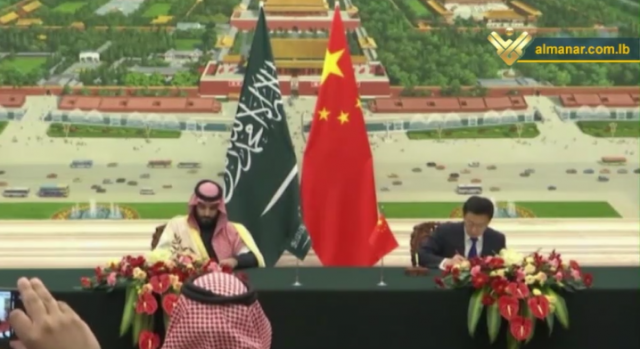
Al-Manar | February 23, 2019
The Pakistani State-run TV Channel muted the broadcast of the speech delivered by the Saudi state minister for the foreign affairs Adel Al-Jubeir while he was tackling the Iranian cause, one Zionist political analyst said.
The Israeli media channels cited the Saudi crown prince Mohammad bin Salman’s failure to provoke Pakistan, India and China against Iran, adding that India rejected his offer to sell it the same amount of oil it purchases from Tehran for a lower price.
The Zionist analysts considered that Bin Salman tried to build more political partnerships and alliances in order to improve his conditions in his relation with the United States.
Maduro stays put, mediation can help
By M. K. BHADRAKUMAR | Indian Punchline | January 31, 2019
Russia is doing the right thing by switching tack from strident ‘anti-American’ rhetoric to focus on tamping down the tensions over Venezuela. China had counseled such an approach right from the outset when the crisis erupted last week.
On day one of a looming US-Venezuelan standoff on January 24, the Chinese foreign ministry spokesperson called upon “all relevant parties to stay rational and cool-headed and seek a political solution to the issue of Venezuela through peaceful dialogue within the framework of the Venezuelan Constitution.”
This was alongside Beijing’s vehement support for the efforts of the Venezuelan government of President Nicolas Maduro “to uphold national sovereignty, independence and stability” as well as China’s unequivocal opposition to “foreign interference in Venezuela’s affairs.”
It stands to reason that Moscow too began toning down its rhetoric and harmonizing with the Chinese stance. The heart of the matter is that the Venezuelan crisis holds the danger of putting a dagger into the heart of the international system in an already unstable world order full of potential for chaos, which of course is not in the interest of any of the three big powers that are ‘stakeholders’ – the US, Russia and China.
Thus, Russian Foreign Minister Sergey Lavrov’s remarks to the media on Wednesday in Moscow offering mediation between the government and the opposition in Venezuela can be put in perspective. Lavrov acknowledged China and Russia’s role as Venezuela’s “leading partners” in the economic sphere. He then recalled the various ideas floated by different quarters – the European Union, the Caribbean Community, Uruguay and Mexico – to provide a platform for mediation. And Lavrov added, “The Non-Aligned Movement should probably have its say, all the more so that Venezuela chairs it now.” Lavrov regretted that so far all such initiatives to start a dialogue have been “bluntly rejected” by the opposition due to instigation by its “Western sponsors.”
Lavrov said Moscow is striving to “create conditions for the start of dialogue” and is discussing it with the Venezuelan government, China, Latin American countries and the EU. He underscored Russia’s readiness “to take part in the relevant international efforts in the formats that will suit the Venezuelan parties” – that is to say, “all mediation initiatives should be unbiased and their future format should be balanced”; mediation “should represent a broad range of international players that can influence the Government and the opposition”; and, “it is necessary to understand from the very start what goal is pursued by a potential mediation format.”
Significantly, Lavrov singled out Moscow’s ongoing contacts with Brussels in regard of the EU’s proposal to establish a contact group for mediation, notwithstanding the ultimatum given to Caracas “by some EU countries, including influential ones” (read UK, France, Spain and Germany). He said the picture will be clear soon as to “who is talking about what” (in Brussels), but the bottom line is that “such opportunities exist and I believe the said initiative can be rather useful if unbiased.”
Lavrov welcomed Maduro’s readiness to accept international mediation and he urged the opposition “to display a similar constructive approach, give up ultimatums and act independently, relying primarily on the interests of the Venezuelan people.”
Indeed, it is far from clear whether in the prevailing new Cold War conditions, such a denouement through mediation by an international contact group including Russia will suit Washington, which has just declared an economic war against Venezuela. From all appearances, the Trump administration is carrying out the agenda of Wall Street for a regime change in Venezuela and the project is fairly well advanced already. The intention is to cripple Venezuela’s state-owned oil company with sanctions and make Maduro submit to the US diktat. In the US estimation, Venezuela’s oil industry cannot recover without significant reinvestment, which can only come from the US or China.
On the other hand, one silver lining on the horizon is that there are no signs as yet of the Pentagon being on a war footing. In a situation such as this, typically, the US state department ought to have requested evacuation support from Pentagon by now, but no such thing has happened so far.
Suffice to say, a protracted diplomatic slugfest is beginning, involving the US and some of its allies on one side and Russia and China on the other. An ouster of Maduro, in these circumstances, seems a very remote possibility – and can even be ruled out – so long as he enjoys sufficient support among the Venezuelan military and the ruling party’s social and political base remains so very substantial as at the moment. The strong likelihood is that Maduro will weather the storm and the US-led diplomatic and economic pressure cannot dislodge him from power.
The transcript of Lavrov’s media comments is here.
De-Dollarization? Analysts on Why Beijing Won’t Slash Its US Bonds Holdings
By Ekaterina Blinova | Sputnik | 25.01.2019
Beijing will not significantly reduce its investment in US government bonds, China Securities Regulatory Commission’s Fang Xinghai told the World Economic Forum. Speaking to Sputnik, CCTV editor Tom McGregor and Wall Street analyst Charles Ortel shared their views on the hidden meaning of Fang’s statement.
“China will continue to be a savings surplus country for some time, though the saving is declining. We have to invest abroad, and the US government bond market turns out to be a good place to invest”, Fang Xinghai, vice chairman of the China Securities Regulatory Commission, remarked while speaking at the World Economic Forum in Davos on 22 January.
Sputnik reached out to Tom McGregor, a Beijing-based political analyst, senior editor and commentator for China’s national broadcaster CCTV, and Charles Ortel, Wall Street journalist, investor and investigative journalist, asking them to share their views on Fang’s “message” that came amid trade tensions between Washington and Beijing.
What’s Behind China’s Message
“US President Donald J. Trump and Chinese President Xi Jinping are still in the middle of a 90-day trade truce”, McGregor pointed out while commenting on the issue. “Beijing does not wish to see a return of Trump as ‘Tariff Man’, so of course, they would announce at the 2019 World Economic Forum in Davos, Switzerland, that Beijing would not intentionally sabotage US financial markets by slashing its US bond holdings”.
According to the Beijing-based commentator, “China believes they can score a win-win trade deal with President Trump”. And they are making much progress, McGregor highlighted.
In a July 2018 interview with Sputnik, the commentator strongly rejected speculations that Beijing may dump US government bonds in response to Trump’s tough tariff measures that the US kicked off in March 2018.
For his part, Ortel noted that Beijing is motivated by nothing less than “brutal reality”.
“There is only one debt market deep enough to absorb the massive sums that China already has, and may have, which it allocates towards ‘capital preservation’ as opposed to ‘equity speculation’ and that is the market for US government debt instruments”, the Wall Street analyst underscored.
He noted that Beijing’s choice is obvious given the fact that the US dollar “remains strong and could even appreciate against others in which liquid debt instruments are denominated”.
“In addition, an actual move by China away from US Treasury instruments would quickly be discerned and might add to building pressures towards a global markets panic”, he presumed.
According to Ortel, the People’s Republic also faces mounting internal pressures “because they have inflated a massive investment bubble in projects that likely are loss-making using strict accounting”.
“Considering the above, I imagine that China will retain massive holdings of US government debt even, and perhaps especially in a full-scale trade war, should one materialize”, the Wall Street analyst predicted.
Drifting Away From the Greenback
However, at the same time, China has clearly demonstrated its intent to move away from the greenback step by step. The People’s Republic is boosting its gold reserves and switching to national currencies in bilateral trade with Russia, Iran, Pakistan. It also signalled support for Turkey’s plan to ditch the dollar.
Furthermore, the Beijing-led One Belt and One Road project envisages the introduction of swap facilities in the countries of the region involved in the endeavour to promote the use of the yuan.
McGregor argues that one should not overestimate the apparent shift.
“The US dollar, the euro and Japanese yen are considered safe haven investments and will continue to be so”, he said. “China is forbidden to use the US dollar when conducting trade deals with North Korea and Iran due to economic trade sanctions. If the Chinese use US dollars on such occasions they stand the risk of getting arrested just like Meng Wanzhou if they make an appearance in Canada”.
He admitted that “in regards to Russia, Chinese law has encouraged Chinese companies to use the Russian rouble on financial transactions, but not sure if it’s on account of Washington-led economic sanctions imposed on Moscow”.
A Rush Out of US Treasury Debt by China Highly Unlikely
Commenting on the role of US Treasuries in China’s financial strategy, Ortel noted that “‘modern’ economists do not think clearly enough about the natural balances that emerge as nations develop their economies under a competitive global system”.
“In the early period, before citizens and nations build up substantial net worth, policies that accept devaluation arguably serve export-driven strategies”, the Wall Street analyst said. “However, nations such as China eventually become more concerned about where to invest their combined net worth for the longer term — and this is why US dollar sovereign debt becomes an attractive proposition”.
The investor elaborated that “if you are asked to develop a strategy for protecting the value of a ‘mere’ billion US dollars, you might flirt with betting against the US dollar with a portion of your holdings”. He continued that “if you, instead, are asked to protect one or more trillion dollars today and for the future, you will conclude that a substantial allocation to US Treasuries makes sense”.
“Until China proves that foreign investors are welcome inside their borders (coming and going) and reaches a trade and operating deal with the United States, our nations will be joined at the hip in the US government debt market”, Ortel emphasised, reiterating that “a rush out of US Treasury Debt by China is a low probability scenario”.
Economic Slowdown and Yuan Internationalisation
Sharing his prognosis for China’s economic growth in 2019-2020, McGregor suggested that it will continue to slowdown.
“If I had to pick a number for this year, I think 6.4 percent is a safe bet, but willing to go down to 6.2 percent”, the Beijing-based commentator predicted. “That’s pretty good, considering that China has enjoyed strong economic growth for so many years, successively”.
He pointed out, however, that “the Chinese are not panicking right now”.”Right now, China has introduced big-time tax cuts and that has already boosted Chinese consumption. I anticipate the tax cuts will really help Chinese households this year”, McGregor opined.
The journalist underscored that the expected trade deal between Washington and Beijing remain the focus of the Chinese’ attention.
“In order for Beijing to reach a trade agreement with Washington, China will be required to open up its financial markets to US banks and promote the renminbi internationalization”, McGregor explained. “Therefore, the People’s Bank of China must stop its strict restrictions on Chinese money flooding into overseas capital accounts”.
As a result, initially, the Chinese yuan may “drop in value as companies pour Chinese cash holdings out of the country and into overseas bank accounts”, he foresees. According to him, “this trend will be ongoing for 1-2 years before it settles down and some of that cash flows back into the China market”.
Pakistan wriggles out of IMF clutches
By M. K. BHADRAKUMAR | Indian Punchline | January 13, 2019
The visit by Saudi Arabia’s Energy Minister Khalid A Al-Falih on Saturday to Gwadar to inspect the site allocated for a multibillion oil refinery in the port city suggest that Riyadh and Islamabad are giving the final touch to reaching agreement for a Saudi Aramco Oil Refinery in Pakistan. Reports say that Saudi Arabia will be investing $10 billion in the proposed project.
Without doubt, this is a major development in the region. The Saudi-Pakistan relationship, which has been traditionally close and fraternal, is moving on to a new level of dynamism. The Saudi investment decision can be taken as signifying a vote of confidence in the Pakistani economy as well as in Prime Minister Imran Khan’s leadership. It comes on top of the $6 billion package that Saudi Arabia had pledged last year (which included help to finance crude imports) to help Pakistan tide over the current economic difficulties.
The visiting Saudi minister Khalid al-Falih told reporters in Gwadar, “Saudi Arabia wants to make Pakistan’s economic development stable through establishing an oil refinery and partnership with Pakistan in the China Pakistan Economic Corridor.” This remark highlights that Saudi Arabia is openly linking up with the China-Pakistan Economic Corridor (CPEC). China has welcomed this development, but countries that oppose the CPEC such as the US and India will feel disappointed.
From the Indian perspective, the Saudi investment in Gwadar becomes a game changer for the port city, which was struggling to gain habitation and a name. Inevitably, comparisons will be drawn with Chabahar. India has an added reason to feel worried that its Ratnagiri Refinery project, which has been described as the “world’s largest refinery-cum-petrochemical project” is spluttering due to the agitation by farmers against land acquisition. The Saudi Aramco was considering an investment in the project on the same scale as in Gwadar. Will Gwadar get precedence over Ratnagiri in the Saudi priorities? That should be the question worrying India.
The Saudi energy minister disclosed that Crown Prince Mohammed bin Salman will be visiting Pakistan in February and the agreement on the Gwadar project is expected to be signed at that time. Of course, it signifies that Saudi Arabia is prioritizing the relations with Pakistan. The fact remains that Saudi Arabia has come under immense pressure of isolation following the killing of Jamal Khashoggi.
There is much uncertainty about the dependability of the US as an ally and security provider. Riyadh is diversifying its external relations and a pivot to Asia is under way. Suffice to say, under the circumstances, a China-Pakistan-Saudi axis should not look too far-fetched. There is also some history behind it.
To be sure, Iran will be watching the surge in Saudi-Pakistani alliance with growing trepidation. The Saudi presence in Pakistan’s border region with Iran (such as Gwadar) has security implications for Tehran. Iran has been facing cross-border terrorism.
Tehran cannot but take note that Imran Khan has not shown any interest in reciprocating the overtures it made when he came to power. He is yet to visit Iran. The expectation in Tehran was that Imran Khan who often voiced the political idiom of justice and resistance as an opposition leader would have empathy with Iran. But, as it happened, Imran Khan appears to be far more comfortable as prime minister with the crown princes of Saudi Arabia and the UAE.
Simply put, Tehran misjudged Imran Khan. But Imran Khan’s priorities today are quite understandable. He wants the Gulf Sheikhs to make big investments in the Pakistani economy. He senses that left-wing slogans have served their purpose when he was seeking power but they become liabilities today. Why should he put Pakistan as a torchbearer of resistance politics? In his interview with WaPo, he didn’t mince words in implying that he intended to follow neo-liberal economic policies.
Besides, in strategic terms, one important fallout of the Saudi bailout of Pakistani economy is that there may be no more need for Islamabad to approach the International Monetary Fund for a rescue package. The earlier indication was that Pakistan might seek a $8 billion bailout package. From present indications, the help from Saudi Arabia, China and the UAE will enable Pakistan to avoid seeking IMF assistance. (The UAE and Pakistan formalized a $6.2 billion bailout package last week in Islamabad.)
The US had openly threatened that any IMF bailout would be conditional on a close scrutiny of the CPEC projects. Ironically, it proved counterproductive. As a result, in geopolitical terms, Washington’s capacity to leverage Pakistani policies is significantly diminishing. The impact will be most keenly felt in Afghanistan.
Featured Video

The Truth About the Trump Shootings with Ken Silva
or go to
Aletho News Archives – Video-Images
From the Archives
Trans ‘milk’ as good as the real thing – NHS
RT | February 18, 2024
The drug-induced nipple secretions of trans women are as good as mothers’ breast milk for babies, the University of Sussex Hospitals NHS Trust claimed in a letter to campaigners made public in a report by British think tank the Policy Exchange on Sunday.
The healthcare trust’s medical director, Rachel James, argued that the off-label prescription drug cocktail men transitioning to female take in order to produce milk was “similar to the natural hormones which encourage lactation to develop when the baby is newly born.”
“The evidence which is available demonstrates that the milk is comparable to that produced following the birth of a baby,” James wrote in the letter, sent to Children of Transitioners last August.
Biological men who wish to lactate must first take hormones to grow milk glands and then take high doses of either domperidone or metoclopramide to stimulate milk production. Neither drug is approved for this use, though they are occasionally prescribed off-label to biological women who have trouble lactating.
However, domperidone’s own manufacturer, Janssen, warns patients the drug “may cause unwanted side effects affecting the heart in a breastfed baby” and “should be used during breastfeeding only if your physician considers this clearly necessary.” … continue
Blog Roll
 Aletho News
- Seyed M. Marandi: U.S. Strike Imminent – Toward Total War in the Middle East
- Russia Voted Under Fire. Washington Is Loading the Tankers.
- 12 Things Your Oncologist Was Trained Not to Tell You
- Anthrax Attacks Paved Way for COVID-Era ‘Junk Drugs and Vaccines’
- How Real Is the Impact of Western Sanctions on Israel?
- France, You Are Guilty: How Paris Turned Western Sahara into the Maghreb’s Powder Keg
- 2025 Nature Paper Claiming Worsening Global Drought Gets RETRACTED …Heavily Flawed
- Your Milk Is Not the Problem
- The Truth About the Trump Shootings with Ken Silva
- ARE PATIENTS BEING PROPERLY INFORMED ABOUT OZEMPIC?
- If Americans Knew
- An error has occurred; the feed is probably down. Try again later.
- No Tricks Zone
- 2025 Nature Paper Claiming Worsening Global Drought Gets RETRACTED …Heavily Flawed
- New Study: ‘Global Drought Shows No Detectable Recent Acceleration Under Climate Warming’
- Economic Masterminds: German Socialists Suggest Taxing Productivity Gains Stemming From Using AI
- The South China Sea Has Not Been Cooperating With The Climate Change Narrative
- Energy Crisis: Germany Enters Heating Season With Historically Low Gas Reserve Fill Levels
- New Study: The Antarctic Ice Sheet Gained Mass From 2020-2024 Due To Staggering Snow And Ice Accumulation
- Study: Ocean Heating Rates From Thousands Of Years Ago ‘Dwarf’ Modern Ocean Heating Rates
- Climate Extremists Target, Attack Large-Scale Power Grid Infrastructure In Germany!
- New Study: Antarctic Ice Melt Has Contributed Less Than 1 Centimeter To Sea Level Rise In The Last 30 Years
- Fear Of Debate: Alarmist German Climate Scientist Calls On Mainstream Media To Discredit Skeptic Voices
 Aletho News