China and Russia to establish joint rating agency
RT | June 3, 2014
No more Fitch, Moody’s, or Standard & Poor’s for Russia and China, as they have agreed to establish a rating agency on joint projects, and later, international services, Russian Finance Minister Anton Siluanov said Tuesday.
“The establishment of an independent rating system is being discussed. Many countries would like to have more objectivity in the assessment of rating agencies,” Siluanov said.
“There will be a Russian-Chinese rating agency, which will use the same tools and criteria for assessing countries and regional investments that existing rating agencies use,” the minister said.
UK announces Yuan clearing Bank in London
The BRICS Post | June 2, 2014
The UK government has agreed to establish a yuan-clearing bank in London that would “act as a signal for London’s growing yuan activities”.
Mark Boleat, policy chairman for the City of London Corp said consultations were ongoing for a long time with the People’s Bank of China, Bank of England and many banks in London, and the PBOC has now decided to appoint the clearing bank.
“We assume it’s going to be a Chinese bank, because that’s the way the PBOC does things,” Boleat said in an interview to a Chinese daily in London.
China and the UK had signed an agreement last year to establish a reciprocal 3-year sterling/renminbi (RMB, or Chinese yuan) currency swap line.
UK Chancellor of the Exchequer George Osborne had said earlier this year that a clearing bank was the next logical step to take in building trade ties with China.
“It would be an important further milestone both in the development of the renminbi as a currency of the world’s economic future, but also of London and the U.K. as the western center for renminbi trading,” said Osborne.
China has also signed an agreement with Germany to work on appointing a clearing bank in Frankfurt.
Meanwhile, the UK administration would also allow Chinese banks to open new branches in the country soon.
Previously, Chinese banks, as well as many other international banks, were only allowed to set up subsidiaries, which are subject to the strict capital requirements that apply to Britain’s local banks, hence the lending and financing capacity is proportional to the balance sheet of the subsidiary.
China to ditch US consulting firms over espionage suspicion
RT | May 26, 2014
State-owned Chinese companies will cease to work with US consulting companies like McKinsey and Boston Consulting Group over fears they are spying on behalf of the US government.
US consulting companies McKinsey, BCG, Bain & Company, and Strategy&, formerly Booz & Co., will all be snubbed by state-owned Chinese companies, the Financial Times reported, citing sources close to senior Chinese leaders.
“The top leadership has proposed setting up a team of Chinese domestic consultants who are particularly focused on information systems in order to seize back this power from the foreign companies,” a senior policy adviser to the Chinese leadership was quoted by the FT as saying.
“Right now the foreigners use their consulting companies to find out everything they want about our state companies,” the adviser said.
Last Thursday China announced that all foreign companies would have to undergo a new security test. Any company, product or service that fails will be banned from China. The inspection will be conducted across all sectors – communications, finance, and energy.
China has already banned Microsoft’s Windows 8 operating system from government computers, according to Chinese state media agency Xinhua.
“Under President Xi Jinping, technology and implementation will look to be converging, so foreign tech firms should be very worried about their prospects,” Bill Bishop, an independent consultant based in Beijing, told the FT.
Chinese officials have said that government ministries, companies, universities, and telecoms networks are victims of US hacking, and will try to avoid using US technology in order to protect “public interest”.
The dictate follows the US Justice Department’s indictment of five Chinese military officers it suspects of committing cyber crimes against a number of major US companies, including US Steel, Westinghouse and Alcoa. The US accused the army officers of stealing trade secrets and even published their photos.
Beijing responded by calling the US a ‘robber playing cop’, and more recently said the US is a “mincing rascal” and involved in “high-level hooliganism”.
The US-China fallout came after revelations made by NSA contractor Edward Snowden that the US uses economic cyber espionage to spy on international competitors, including China.
The dispute is only the latest setback in relations between the world’s two largest economies. Issues like Ukraine, Syria, and North Korea have been divisive topics between the two superpowers.
FBI threatens to go after Russian hackers
RT | May 23, 2014
On the heels of a high-profile indictment announced earlier this week by the United States Department of Justice against five Chinese military officers, sources say Russian hackers could be among the next individuals targeted by the DOJ.
The Wall Street Journal, Foreign Policy magazine and the Chicago Tribune all reported this week that officials close to the US government’s hunt for foreign hackers say Russians are on the radar of the Justice Department, and could be named in the next DOJ indictment.
All three outlets hesitated to name their sources, but the Journal reported that people familiar with the government’s investigations said alleged cybercriminals in Russia are likely to be charged soon.
“For several years, the Obama administration has put Chinese and Russian cyber spies and criminals at the top of its list of worst offenders in what officials describe as a relentless campaign targeting American businesses for the benefit of those countries’ own industries,” Shane Harris wrote for FP. “Estimates on the true cost of cyber-espionage range widely, but are generally believe by experts and officials to be in the tens of billions of dollars annually.”
As Harris reported, Federal Bureau of Investigation Director James Comey told members of the Senate Judiciary Committee this week that the FBI was aggressively pursuing further criminal investigations pertaining to foreign hacking cases, but fell short of announcing the filing of new charges. Now with Monday’s indictment out of the way and the US officially charging members of the Chinese military for the first time ever, however, multiple sources said that American authorities are gearing up to throw the book at Russian hackers.
Earlier this week, the Justice Dept. said that five Chinese individuals working within a highly-secretive cyber unit inside the People’s Liberation Army have stolen trade secrets and sensitive communications from six American entities, including major metal companies that compete with Chinese businesses and the US Steel Workers union.
“The range of trade secrets and other sensitive business information stolen in this case is significant and demands an aggressive response,” US Attorney General Eric Holder said in a statement on Monday.
“This administration will not tolerate actions by any nation that seeks to illegally sabotage American companies and undermine the integrity of fair competition in the operation of the free market,” Holder added.
Nevertheless, the Chinese government fired back and accused the US of hypocrisy, and its Foreign Ministry demanded a withdrawal of the indictment and called the US “the biggest attacker of China’s cyberspace.” As RT reported earlier this week, leaked National Security Agency documents released by former US government contractor Edward Snowden have revealed that the US does, in fact, conduct economic cyberespionage in order to spy on competitors in Brazil, France, Mexico and, indeed, China. As with China, the Russian government has adamantly denied any involved in cyber spying, and claims to lack the same technical abilities as the NSA.
And although the Justice Dept. declined to name any other targets of investigation while touting their latest cyber indictment on Monday, reports for years have suggested that Russian hackers have targeted US businesses in a similar way to what China’s PLA Unit 61398 are accused of doing.
Most recently, American cybersecurity firm CrowdStrike reported in January that the Russian government spied on hundreds of US, European and Asian companies, which Reuters called the first time ever that Moscow has been linked to conduct economic espionage over the web.
“These attacks appear to have been motivated by the Russian government’s interest in helping its industry maintain competitiveness in key areas of national importance,” Dmitri Alperovitch, CrowdStrike’s chief technology officer of CrowdStrike, said to Reuters at the time.
“They are copying the Chinese play book,” he said. “Cyber espionage is very lucrative for economic benefit to a nation.”
In March, researchers in the US also traced a piece of malicious malware known as Turla back to Moscow.
“It is sophisticated malware that’s linked to other Russian exploits, uses encryption and targets western governments,” Jim Lewis, a senior fellow at the Center for Strategic and International Studies in Washington, told Reuters then. “It has Russian paw prints all over it.”
The Chinese-Russian ‘Power of Siberia’ … thanks to EU, US foot-in-mouth
By Dmitry Babich | The BRICS Post | May 22, 2014
The Russian press is rarely unanimous in its opinions, but there are two points in today’s coverage of the Russia-China gas deal where all the experts agree.
First, it is not yet clear whether the new deal is a boon for Russia.
But it is certainly a huge failure for the US and the European Union, who lose out on Eastern Siberia’s gas.
Second, in light of the sharp deterioration of Russia’s relations with the West because of the mishandled Western-supported “revolution” in Ukraine, the deal with China now becomes a strategic necessity for Moscow.
The West’s hostile attitudes toward both Russia and China (during his Asia tour last month, US President Barack Obama sided 100 per cent with Japan and the Philippines in their maritime disputes with China), pushed Beijing and Moscow closer together.
The Russo-Chinese contract, which had been in the works for 10 years, was finalized at 4 O’clock in the morning on Wednesday, on the second day of the visit to Beijing by Russian President Vladimir Putin.
It became a dramatic ending to several months of marathon negotiations.
The new contract is supposed to determine the next 30 years of Russo-Chinese cooperation in developing the Russian natural gas fields in Siberia (the eastern part of Russia) and the Russian Far East.
According to the words of Alexei Miller, the head of Russia’s largest gas company, Gazprom, the total cost of the contract is $400 billion.
The volume of gas to be delivered is estimated at a gargantuan amount of over 1 trillion cubic metres. Mr. Miller refused to reveal the price tag, as it is usually done after signing these sorts of deals.
He simply said it was a “commercial secret” for the moment.
“The Force of Siberia”
Nevertheless, most experts agree that Russia has been lucky to sign the deal.
The competition among countries willing to supply energy to China is very intense.
In the ten years that have passed since the start of Russo-Chinese negotiations on the deal, Beijing managed to sign contracts with several Central Asian states, including Turkmenistan, a country boasting gas deposits second only to Russia’s in the former Soviet Union.
Experts estimate an average price of $387 per thousand cubic metres for the 38 billion cubic meters of gas Russia is going to supply to China in the first years of deliveries beginning in 2018.
The deliveries will start once the construction of the pipeline nicknamed “The Force of Siberia” has been completed.
The pipeline is supposed to connect the Russian gas reserves in Eastern and possibly (in future) Western Siberia with the Chinese border.
The project will require investments, which both Russia and China agreed to provide.
The Russian participation is estimated at $55 billion and the Chinese are expected to add $22 billion.
Alexander Birman, a journalist specializing in energy issues, writes in the respected Russian daily Izvestia that the Chinese leader Xi Jinping showed a certain nicety to his Russian counterpart, since he did not pressure Moscow given its deteriorated ties with the EU and US.
“If the West had started applying the so called “sector-geared” economic sanctions, targeting Russia’s energy companies – if such sanctions had been applied, even the price of $350 [per thousand cubic metres of gas] would look good to Gazprom [Russia’s leading energy provider],” he writes of the gas deal.
However, Birman notes that the current standoff between Russia and the West is hurting first and foremost the West’s long-term interests.
(This standoff was made possible by the coup d’etat in Ukraine at the end of February when the legally elected president Viktor Yanukovich was toppled by crowds of pro-Western protesters in the Ukrainian capital Kiev.)
“Having assured for itself the supply of cheap energy, China will reaffirm its position as the world’s most competitive cost-cutting workshop,” Birman writes.
Obama, the pro-Russian lobbyist?
For Russia, diversifying the directions of its gas supplies has become a vital necessity.
The gas deal opens a market corridor for Gazprom to potentially access Asian super guzzlers Japan and South Korea, and allow it to become a player in the Liquefied Natural Gas (LNG) sector.
This is particularly poignant when considering that EU ministers day and night publicize how they want to decrease their “energy dependence” on Russia.
The Soviet Union and Russia have maintained a good reputation with the West since they began supplying gas to Western Europe in the 1960s.
There was a ‘pause’ only once in the winter of 2008-2009, when the Ukrainian authorities stole the Russian gas destined for Western Europe.
Despite this reputation, however, EU member countries make no secret of their preference for gas from Qatar, Algeria, Norway or even the US, where fracking technology has led to a surplus of gas at the domestic market.
“Politically, the Russo-Chinese contract is a success,” says Grigory Vygon, the Director of the Energy Center of the prestigious Skolkovo Business School, near Moscow.
“The Ukrainian risks and the position of Europe make diversification a vital necessity.”
One could add that Obama revealed himself (inadvertently) to be the best lobbyist for Russo-Chinese rapprochement during his recent visits to countries having territorial disputes with China.
By directly supporting the “revolution” in Kiev and by lending support to all of China’s challengers in the South China Sea and East China Sea, Obama helped Moscow and Beijing to bridge during their intense negotiations the gap in desired prices for their mammoth deal.
~
Dmitry Babich is a senior journalist based in Moscow who has worked with the Komsomolskaya Pravda newspaper, Moscow News and Ria Novosti. He is currently a political analyst for Voice of Russia.
The West’s Non-Linear Warfare and the Right for the Rest to Resist
By Andrew Korybko | Oriental Review | May 19, 2014
Nearly two weeks ago, Peter Pomerantsev, writing for Foreign Affairs, published an article about “How Putin Is Reinventing Warfare”. He alleges that Russia is engaging in “non-linear warfare”, strongly alluding that this poses a threat to the West. If one can read between the lines of his biased and subjective approach, he is in actuality describing a very real and objective development – the restoration of Russian power and global standing. His ire is likely due to Russia now being able to deflect international information and media assaults against it and its policies and finally promote the truth. Pomerantsev then goes on a peculiar ranting spiel where he alleges a convoluted metaphor of Russia conspiring to be a “corporate raider”, an exercise in exasperation which will likely only reach those with pre-existing anti-Russian beliefs. It is the end of his article, however, that forms the basis of this response to it. Pomerantsev uses the analogy of the West’s “global village” versus Russia’s “non-linear warfare” to make his final point in throwing mud at Russia. In reality, there is not one “global village”, but rather, many regional civilizational villages that are experiencing Western raids and “non-linear warfare”, and they have finally started to band together to stop the marauders.
The liberal end of history (aka “the global village”) does not exist outside of ideological fantasy, and the world is instead divided into civilizational zones (regional villages) united around certain actors (Russia, China, Islamic pillars, the West). This forms the basis of the running metaphor that will be utilized below to advance the claim of the West waging non-linear warfare against the Rest.
Repeated raids from Western marauders and bandits, whose village is the only one seeking to expand, loot, and plunder, has resulted in parts of the other villages being burnt down. In the past decade, the Islamic village experienced this the worst, with conflagrations decimating its Afghan, Iraqi, Libyan, and now Syrian neighborhoods. Currently, the Eurasian village is having to deal with a fire in Ukraine, one that was purposely set to spread to the Russian core. However, as a result of these repeated raids, the regional villages have formed self-defense forces and are now working together to put out the fires and stop the raiding. Experience has taught them how to successfully resist and defy the Western village. In the real world, the success of international media firms (RT, Press TV, CCTV, Telesur) shows that media and information assaults can in fact be deflected and that perception management and national PR initiatives are not under the sole monopoly of the West.
Pomerantsev’s claims that “(economic) interconnection also means that Russia can get away with aggression” could not be more opposite to the truth. The Western village is actually two large ones, the US and the EU, and the American village grew out of the EU one and now controls its creator. In this case, the suburb controls the center, so to speak. It is the interconnection between the Eurasian (Russian) and EU villages that serves as the real check on further US aggression against the former. When not marauding and raiding, the Western village also tries to infiltrate the others via NGOs and Color Revolutions. Once it flips some members of the village and/or installs its pick as village leader, these turncoat individuals can “open the gates from within”, promote mutiny, and lead to the annexation of the village into the Western-dominated expanding sprawl.
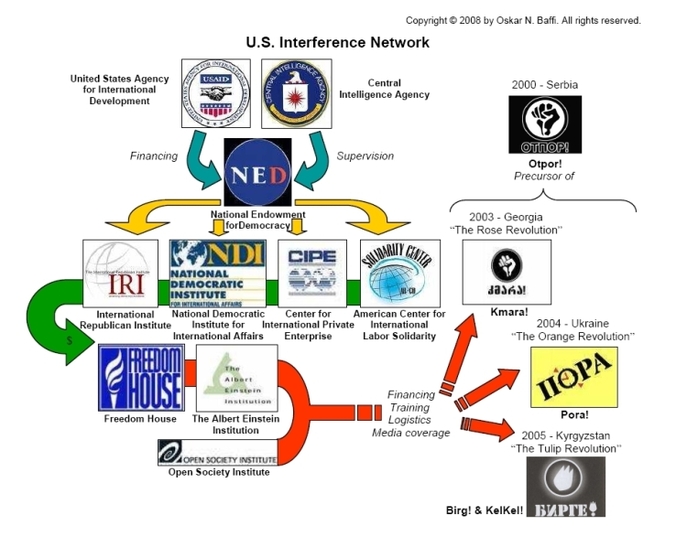
Pulling back from the metaphor, the Brzezinski Doctrine (“The Eurasian Balkans”) is the definition of non-linear warfare and subversive destabilization. It uses NGOs as destabilizing elements within the targeted states, and for this reason, foreign-funded NGOs are required to register as “foreign agents” inside the Russian Federation. Gene Sharp’s writings have also provided pivotal tactical advice in advancing the West’s non-linear warfare strategy. Taking the use of non-state actors even further, the West has a history of promoting militarized proxy groups to carry out its policies. This is most clearly seen in Kosovo, Afghanistan, Iraq, Libya, and Syria, although other countries have also been victims of this underhanded method of war. On the other hand, the West obviously engages in conventional warfare as well. Nowhere is this more evident than in the 2003 Iraq War. Mixing the two methods together is the new trend of American foreign policy. A non-linear campaign of militarized proxy destabilization culminated in a conventional NATO bombing in Libya. After this “success”, the West then turned its sights on Syria, but as a result of adroit Russian foreign policy maneuvers, non-linear warfare was stymied from mutating into its conventional form.
Pomerantsev’s article also uses fear mongering and heavy hype to scare the audience into thinking that Russia is proactively forming some kind of imaginary coalition against the West from within. If there happens to exist an overlap of perceived interests and objectives between Russia and domestic Western actors, it is because both parties arrived at the same conclusions after undergoing the same process – experiencing Western unipolar dominance and discriminatory targeting for two decades. For example, “Euro-scepticism” is also seen in Southeast Asia by the ASEAN members’ reluctance to form an EU-like union. The flower of New Leftism and resistance ideology in South America organically began to bloom in the 2000s, tended over by Hugo Chavez. In a similar fashion, the traditionally conservative societies of India, China, and Africa are just as disgusted as Russia’s by certain Western-centric values, such as the “bearded woman” of Eurovision. In laboratory conditions, the cause (Western dominance) has thus been proven to repeatedly result in similar effects all across the world, thereby confirming the hypothesis that Russia and others arrive at their conclusions on their own. There is no “contradictory kaleidoscope of messages”, as each actor’s resistance and defiance to the West, for various reasons and in differing forms, were a natural development.
To conclude, there are currently multiple civilizational liberation struggles playing out in the Pandora’s Box-setting of Western-led post-modernism. This is not a new page in the old historical story, but an absolutely new edition that is still being written. The Rest, absolutely diverse in their identity and overall mission, are coming together to stop the Western steamroller. They must work together to repel its aggression and safeguard the right to practice their identity and move forward with their historical mission as they individually deem fit. It is the democratic and sovereign choice of each civilization to be able to conduct itself how it pleases, but in order to get to that point, they must be liberated from the terror of the Western threat. These villages do not want to raze the Western one, so to speak, but they understand that the West will raze them if they can’t be annexed. In this manner, they are engaged in a do-or-die struggle, and at no time before in their histories has the situation been more dire. The Rest is slowly coalescing into providing a unified front against the Western menace, hoping to neutralize its raids and incursions so that they can once more go about their civilizational business in constructing and solidifying their societies. If, as Pomerantsev states, Russia and the Rest are anti-Western “raiders”, then yes, the future surely does belong to these resistant and defiant actors.
Andrew Korybko is the American Master’s Degree student at the Moscow State University of International Relations (MGIMO).
Obama Ends Asian Tour With Little to Show for it
Prensa Latina | April 29, 2014
 Manila – U.S. President Barack Obama ended a tour today that included four Asian countries, accomplishing only the signing of a military agreement with the Philippines.
Of all the issues in Obama’s agenda, that was the only agreement to be brought to fruition, while Japan delayed its joining to a free trade agreement and Malaysia did not sign on either.
Obama’s South Korean stopover included a confirmation of Washington’s military reinforcement to Seoul, but the president met with no success in his attempt to improve relations with Tokyo, a regional ally.
The defense and security agreement with the Philippines will facilitate a greater U.S. naval presence in the archipelago, but thousands of people took the streets to protest the visit and the agreement.
Although the White House backs the Philippines in a territorial dispute with China, Obama clarified that the bilateral agreement does not aim at Beijing, with whom the United States maintains a constructive relationship.
Obama’s Asian tour cost taxpayers almost one billion USD, taking into account that a single day abroad for Obama costs more than $100 million USD.
BRICS countries to set up their own IMF
By Olga Samofalova | Russia Beyond the Headlines | April 14, 2014
The BRICS countries (Brazil, Russia, India, China and South Africa) have made significant progress in setting up structures that would serve as an alternative to the International Monetary Fund and the World Bank, which are dominated by the U.S. and the EU. A currency reserve pool, as a replacement for the IMF, and a BRICS development bank, as a replacement for the World Bank, will begin operating as soon as in 2015, Russian Ambassador at Large Vadim Lukov has said.
Brazil has already drafted a charter for the BRICS Development Bank, while Russia is drawing up intergovernmental agreements on setting the bank up, he added.
In addition, the BRICS countries have already agreed on the amount of authorized capital for the new institutions: $100 billion each. “Talks are under way on the distribution of the initial capital of $50 billion between the partners and on the location for the headquarters of the bank. Each of the BRICS countries has expressed a considerable interest in having the headquarters on its territory,” Lukov said.
It is expected that contributions to the currency reserve pool will be as follows: China, $41 billion; Brazil, India, and Russia, $18 billion each; and South Africa, $5 billion. The amount of the contributions reflects the size of the countries’ economies.
By way of comparison, the IMF reserves, which are set by the Special Drawing Rights (SDR), currently stand at 238.4 billion euros, or $369.52 billion dollars. In terms of amounts, the BRICS currency reserve pool is, of course, inferior to the IMF. However, $100 billion should be quite sufficient for five countries, whereas the IMF comprises 188 countries – which may require financial assistance at any time.
BRICS Development Bank
The BRICS countries are setting up a Development Bank as an alternative to the World Bank in order to grant loans for projects that are beneficial not for the U.S. or the EU, but for developing countries.
The purpose of the bank is to primarily finance external rather than internal projects. The founding countries believe that they are quite capable of developing their own projects themselves. For instance, Russia has a National Wealth Fund for this purpose.
“Loans from the Development Bank will be aimed not so much at the BRICS countries as for investment in infrastructure projects in other countries, say, in Africa,” says Ilya Prilepsky, a member of the Economic Expert Group. “For example, it would be in BRICS’ interest to give a loan to an African country for a hydropower development program, where BRICS countries could supply their equipment or act as the main contractor.”
If the loan is provided by the IMF, the equipment will be supplied by western countries that control its operations.
The creation of the BRICS Development Bank has a political significance too, since it allows its member states to promote their interests abroad. “It is a political move that can highlight the strengthening positions of countries whose opinion is frequently ignored by their developed American and European colleagues. The stronger this union and its positions on the world arena are, the easier it will be for its members to protect their own interests,” points out Natalya Samoilova, head of research at the investment company Golden Hills-Kapital AM.
Having said that, the creation of alternative associations by no means indicates that the BRICS countries will necessarily quit the World Bank or the IMF, at least not initially, says Ilya Prilepsky.
Currency reserve pool
In addition, the BRICS currency reserve pool is a form of insurance, a cushion of sorts, in the event a BRICS country faces financial problems or a budget deficit. In Soviet times it would have been called “a mutual benefit society”, says Nikita Kulikov, deputy director of the consulting company HEADS. Some countries in the pool will act as a safety net for the other countries in the pool.
The need for such protection has become evident this year, when developing countries’ currencies, including the Russian ruble, have been falling.
The currency reserve pool will assist a member country with resolving problems with its balance of payments by making up a shortfall in foreign currency.
Assistance can be given when there is a sharp devaluation of the national currency or massive capital flight due to a softer monetary policy by the U.S. Federal Reserve System, or when there are internal problems, or a crisis, in the banking system. If banks have borrowed a lot of foreign currency cash and are unable to repay the debt, then the currency reserve pool will be able to honor those external obligations.
This structure should become a worthy alternative to the IMF, which has traditionally provided support to economies that find themselves in a budgetary emergency.
“A large part of the fund goes toward saving the euro and the national currencies of developed countries. Given that governance of the IMF is in the hands of western powers, there is little hope for assistance from the IMF in case of an emergency. That is why the currency reserve pool would come in very handy,” says ambassador Lukov.
The currency reserve pool will also help the BRICS countries to gradually establish cooperation without the use of the dollar, points out Natalya Samoilova. This, however, will take time. For the time being, it has been decided to replenish the authorized capital of the Development Bank and the Currency Reserve Pool with U.S. dollars. Thus the U.S. currency system is getting an additional boost. However, it cannot be ruled out that very soon (given the threat of U.S. and EU economic sanctions against Russia) the dollar may be replaced by the ruble and other national currencies of the BRICS counties.
BRICS rejects sanctions against Russia over Ukraine
Press TV – March 25, 2014
The group of five major emerging national economies known as the BRICS has rejected the Western sanctions against Russia and the “hostile language” being directed at the country over the crisis in Ukraine.
“The escalation of hostile language, sanctions and counter-sanctions, and force does not contribute to a sustainable and peaceful solution, according to international law, including the principles and purposes of the United Nations Charter,” foreign ministers of the BRICS countries – Brazil, Russia, India, China and South Africa – said in a statement issued on Monday.
The group agreed that the challenges that exist within the regions of the BRICS countries must be addressed within the framework of the United Nations.
“BRICS countries agreed that the challenges that exist within the regions of the BRICS countries must be addressed within the fold of the United Nations in a calm and level-headed manner,” the statement added.
The White House said earlier on Monday that US President Barack Obama and the leaders of Britain, Canada, France, Germany, Italy and Japan decided to end Russia’s role in the G8 over the crisis in Ukraine and the status of Crimea.
Meanwhile, the G7 group of top economic powers has snubbed a planned meeting that Russian President Vladimir Putin was due to host in the Black Sea resort city of Sochi in June.
The G7 said they would hold a meeting in Brussels without Russia instead of the wider G8 summit, and threatened tougher sanctions against Russia.
Russia brushed off the Western threat to expel it from the G8 on the same day. The Autonomous Republic of Crimea declared independence from Ukraine on March 17 and formally applied to become part of Russia following a referendum a day earlier, in which nearly 97 percent of the participants voted in favor of the move.
On March 21, Putin signed into law the documents officially making Crimea part of the Russian territory. Putin said the move was carried out based on the international law.
China backs Russia on UNSC Ukraine vote
BRICS Post | March 16, 2014
After abstaining on the US-backed UN resolution vote that sought to brand the Crimea referendum as invalid, China on Sunday said it would not back a ‘confrontational route’ on the crisis.
Beijing said the Western-backed resolution does not conform to common interests of the people of Ukraine and that of the rest of the world.
“The vote on the draft resolution by the Security Council at this juncture will only result in confrontation and further complicate the situation, which is not in conformity with the common interests of both the people of Ukraine and those of the international community,” said Chinese Foreign Ministry spokesman Qin Gang in Beijing on Sunday.
Russia, a permanent member of the UNSC, has vetoed the UNSC resolution that declared that a planned referendum slated for Sunday on the status of Ukraine’s Crimea region “can have no validity” and urged nations and international organizations not to recognize it.
“China does not agree to a move of confrontation,” the Chinese Ministry spokesperson said on Sunday while asking all parties to “refrain from taking any action that may further escalate the situation”.
Authorities in Kiev and international leaders have condemned the referendum as illegitimate and threatened Moscow with sanctions over its apparent plan to annex the region.
Crimea is one of several Ukrainian regions that have rejected as illegitimate the government in Kiev that ousted President Viktor Yanukovych on February 22 after months of street protests following his step back from closer ties with the European Union.

Art of drills: 10 NATO war games that almost started armed conflicts
RT | February 28, 2014
The world’s largest military alliance seems annoyed about Russia’s “lack of transparency” over military drills at a very “delicate time.” NATO, however, has its own long history of war games all over the globe.
Western politicians have leveled criticism at Russia for planned drills on its own territory, seemingly glossing over the many joint military exercises Western powers, namely the US and NATO forces, have conducted on foreign soil over the years.
South Korea
This week, US and South Korean forces began their annual joint military drills, which will last until mid-April. The Foal Eagle exercise is conducted near Iksan and Damyan, South Korea.
The drills prompted a stern reaction from North Korea, which slammed the exercises as “a serious provocation” that could plunge the region into “a deadlock and unimaginable holocaust.”
Israel
The US joined Greece, Italy, and Israeli forces at Ovda air base in southern Israel for the ‘Blue Flag’ air-training drills in November 2013. The drills were called the “largest international aerial exercise in history,” by Israeli news outlet Haaretz.
According to Israel National News reports the exercises are geared towards “simulating realistic engagements in a variety of scenarios, based on Israel’s experience with air forces of Arab armies in previous engagements.”
Poland and Latvia
NATO’s ‘Steadfast Jazz’ training exercise was held in November 2013, in Latvia and Poland. The drills included air, land, naval, and special forces.
Over 6,000 military personnel from around 20 NATO countries and allies took part in the largest NATO-led drills of their kind since 2006.
Bulgaria
In October, NATO also held anti-aircraft drills in Bulgaria, along with the Greek and Norwegian air forces. The exercises were held to test responses in conditions of radio interference, according to the Bulgarian Ministry of Defense.
Persian Gulf
In May 2013, the US joined 40 other countries in the Persian Gulf for maritime war games. The US Navy said the mass exercises are aimed at “enhancing capability to preserve freedom of navigation in international waterways.”
The drills provoked a sharp response from the Iranian government who voiced concerns at how the maneuvers came in the run-up to the Iranian elections.
Japan
In August 2012, US Marines joined Japanese troops for military drills in the western Pacific. The drills were held in part in Guam, a US holding, just as an old territory dispute reemerged between Japan and China over islands in the East China Sea.
“China will not ignore hostile gestures from other nations and give up on its core interests or change its course of development,” the Chinese Communist Party stated in response to the drills, warning the US and Japan not to “underestimate China’s resolve to defend its sovereignty.”
Jordan
The US joined 16 other nations in May 2012 for military exercises in Jordan near the Syria border. The ‘Eager Lion’ drills included 12,000 soldiers from the participating countries, Turkey, France, and Saudi Arabia among them.
Denying accusations that the violence in Syria had nothing to do with the drills, the US claimed it was “designed to strengthen military-to-military relationships through a joint, entire-government, multinational approach, integrating all instruments of national power to meet current and future complex national security challenges.
Vietnam
In August 2010, the US Navy joined Vietnamese forces for drills in the South China Sea, to the dismay of China. Sovereignty claims in the South China Sea have long been a subject of debate and animosity among Taiwan, the Philippines, Brunei, Vietnam, and Malaysia, though China’s territorial declarations have been the most aggressive.
Ukraine
Ukraine welcomed a fleet of NATO warships for a two-week period of military drills in July 2010. Operation ‘Sea Breeze-2010’ focused on joint anti-terror exercises, despite Kiev’s decision not to enter the NATO alliance. Some 3,000 international military personnel were said to be a part of the drills.
Ukraine began hosting the Sea Breeze exercises in 1997, as part of its commitment to join the alliance. In 2009, the Ukrainian parliament voted against the drills, curtailing then-President Viktor Yuschenko’s efforts to seek NATO membership.
Georgia
In May 2009, 15 NATO countries held a series of controversial military exercises in Georgia less than a year after it launched an offense against its breakaway region of South Ossetia. Russia called the maneuvers “dubious provocation” saying it may encourage the country’s regime to carry out new attacks.
Featured Video

The Truth About the Trump Shootings with Ken Silva
or go to
Aletho News Archives – Video-Images
From the Archives
The Geopolitics behind the War in Yemen (I)
By Mahdi Darius NAZEMROAYA | Strategic Culture Foundation | 30.03.2015
The United States and the Kingdom of Saudi Arabia became very uneasy when the Yemenese or Yemenite movement of the Houthi or Ansarallah (meaning the supporters of God in Arabic) gained control of Yemen’s capital, Sanaa/Sana, in September 2014. The US-supported Yemenite President Abd-Rabbuh Manṣour Al-Hadi was humiliatingly forced to share power with the Houthis and the coalition of northern Yemenese tribes that had helped them enter Sana. Al-Hadi declared that negotiations for a Yemeni national unity government would take place and his allies the US and Saudi Arabia tried to use a new national dialogue and mediated talks to co-opt and pacify the Houthis.
The truth has been turned on its head about the war in Yemen. The war and ousting of President Abd-Rabbuh Manṣour Al-Hadi in Yemen are not the results of «Houthi coup» in Yemen. It is the opposite. Al-Hadi was ousted, because with Saudi and US support he tried to backtrack on the power sharing agreements he had made and return Yemen to authoritarian rule. The ousting of President Al-Hadi by the Houthis and their political allies was an unexpected reaction to the takeover Al-Hadi was planning with Washington and the House of Saudi. … continue
Blog Roll
 Aletho News
- Pakistan-Iran talks secure LNG shipment to Islamabad through Hormuz
- Black Sea grain crisis puts global wheat supplies under pressure
- IRGC air defenses destroy another US MQ-1 drone over Strait of Hormuz
- Imran Khan’s entire immediate family detained in Pakistan ahead of mass protest demanding his release
- EU nation detains former presidential frontrunner
- Leaked: Britain’s Sham Conviction Of Hashim Thaci
- Seyed M. Marandi: U.S. Strike Imminent – Toward Total War in the Middle East
- Russia Voted Under Fire. Washington Is Loading the Tankers.
- 12 Things Your Oncologist Was Trained Not to Tell You
- Anthrax Attacks Paved Way for COVID-Era ‘Junk Drugs and Vaccines’
- If Americans Knew
- Trump’s militarization of Washington DC as he pursues Israel’s war against Iran
- Why Israel Fears This Searing New Documentary
- Huckabee aide solicited cash gifts from Israelis
- This isn’t sci-fi, AI is already killing people
- ‘The Most Brutal Thing’: Investigation Reveals Execution of Elderly Woman in Rafah
- Inside Israel’s ‘soft’ ethnic cleansing plan for Gaza through the eyes of its victims
- New online database tracks pro-Israel political donations in the United States
- Israeli president pardons soldier convicted for killing wounded Palestinian
- Singer Ed Sheeran says his ‘heart broken’ by Gaza devastation, addresses Macklemore controversy
- Israel Has Imprisoned Female Journalist Bushra Al-Tawil Without Trial Or Charge In Solitary Confinement For Past Month
- No Tricks Zone
- 2025 Nature Paper Claiming Worsening Global Drought Gets RETRACTED …Heavily Flawed
- New Study: ‘Global Drought Shows No Detectable Recent Acceleration Under Climate Warming’
- Economic Masterminds: German Socialists Suggest Taxing Productivity Gains Stemming From Using AI
- The South China Sea Has Not Been Cooperating With The Climate Change Narrative
- Energy Crisis: Germany Enters Heating Season With Historically Low Gas Reserve Fill Levels
- New Study: The Antarctic Ice Sheet Gained Mass From 2020-2024 Due To Staggering Snow And Ice Accumulation
- Study: Ocean Heating Rates From Thousands Of Years Ago ‘Dwarf’ Modern Ocean Heating Rates
- Climate Extremists Target, Attack Large-Scale Power Grid Infrastructure In Germany!
- New Study: Antarctic Ice Melt Has Contributed Less Than 1 Centimeter To Sea Level Rise In The Last 30 Years
- Fear Of Debate: Alarmist German Climate Scientist Calls On Mainstream Media To Discredit Skeptic Voices
 Aletho News