CIA-linked private “security” companies are fighting in Yemen for the US-backed Saudi military campaign. Al-Qaeda-affiliated mercenaries are also being deployed. Melding private firms with terror outfits should not surprise. It’s all part of illegal war making.
Western news media scarcely report on the conflict in Yemen, let alone the heavy deployment of Western mercenaries in the fighting there. In the occasional Western report on Al-Qaeda and related terror groups in Yemen, it is usually in the context of intermittent drone strikes carried out by the US, or with the narrative that these militants are “taking advantage” of the chaos “to expand” their presence in the Arabian Peninsula, as reported here by the Washington Post.
This bifurcated Western media view of Yemen belies a more accurate and meaningful perspective, which is that the US-backed Saudi bombing campaign is actually coordinated with an on-the-ground military force that comprises regular troops, private security firms and Al-Qaeda type mercenaries redeployed from Syria.
There can be little doubt in Syria – despite Western denials – that the so-called Islamic State (IS, formerly ISIS/ISIL)) jihadists and related Al-Qaeda brigades in Jabhat al-Nusra, Jaish al-Fateh, Ahrar ash-Sham and so on, have been infiltrated, weaponized and deployed for the objective of regime-change by the US and its allies. If that is true for Syria, then it is also true for Yemen. Indeed, the covert connection becomes even more apparent in Yemen.
Last November, the New York Times confirmed what many Yemeni sources had long been saying. That the US-backed Saudi military coalition trying to defeat a popular uprising was relying on mercenaries supplied by private security firms tightly associated with the Pentagon and the CIA.
The mercenaries were recruited by companies linked to Erik Prince, the former US Special Forces commando-turned businessman, who set up Blackwater Worldwide. The latter and its re-branded incarnations, Xe Services and Academi, remain a top private security contractor for the Pentagon, despite employees being convicted for massacring civilians while on duty in Iraq in 2007. In 2010, for example, the Obama administration awarded the contractor more than $200 million in security and CIA work.
Erik Prince, who is based primarily in Virginia where he runs other military training centers, set up a mercenary hub in the United Arab Emirates five years ago with full support from the royal rulers of the oil-rich state. The UAE Company took the name Reflex Responses or R2. The NY Times reported that some 400 mercenaries were dispatched from the Emirates’ training camps to take up assignment in Yemen. Hundreds more are being trained up back in the UAE for the same deployment.
This is just one stream of several “soldiers of fortune” going into Yemen to fight against the uprising led by Houthi rebels, who are in alliance with remnants of the national army. That insurgency succeeded in kicking out the US and Saudi-backed president Abed Rabbo Mansour Hadi in early 2015. Hadi has been described as a foreign puppet, who presided over a corrupt regime of cronyism and vicious repression.
Since last March, the Saudis and other Persian Gulf Arab states have been bombing Yemen on a daily basis in order to overthrow the Houthi-led rebellion and reinstall the exiled Hadi.
Washington and Britain have supplied warplanes and missiles, as well as logistics, in the Saudi-led campaign, which has resulted in thousands of civilian deaths. The involvement of Blackwater-type mercenaries – closely associated with the Pentagon – can also be seen as another form of American contribution to the Saudi-led campaign.
The mercenaries sent from the UAE to Yemen are fighting alongside other mercenaries that the Saudis have reportedly enlisted from Sudan, Eritrea and Morocco. Most are former soldiers, who are paid up to $1,000 a week while serving in Yemen. Many of the Blackwater-connected fighters from the UAE are recruited from Latin America: El Salvador, Panama and primarily Colombia, which is considered to have good experience in counter-insurgency combat.
Also among the mercenaries are American, British, French and Australian nationals. They are reportedly deployed in formations along with regular troops from Saudi Arabia, Qatar, Bahrain and the UAE.
In recent months, the Houthi rebels (also known as Ansarullah) and their allies from the Yemeni army – who formed a united front called the Popular Committees – have inflicted heavy casualties on the US-Saudi coalition. Hundreds of troops have been reportedly killed in gun battles in the Yemeni provinces of Marib, in the east, and Taiz, to the west. The rebels’ use of Tochka ballistic missiles has had particularly devastating results.
So much so that it is reported that the Blackwater-affiliated mercenaries have “abandoned the Taiz front” after suffering heavy casualties over the last two months. “Most of the Blackwater operatives killed in Yemen were believed to be from Colombia and Argentina; however, there were also casualties from the United States, Australia and France,” Masdar News reports.
Into this murky mix are added extremist Sunni militants who have been dispatched to Yemen from Syria. They can be said to be closely related, if not fully integrated, with Al-Qaeda or IS in that they profess allegiance to a “caliphate” based on a fundamentalist Wahhabi, or Takfiri, ideology.
These militants began arriving in Yemen in large numbers within weeks of Russia’s military intervention in Syria beginning at the end of September, according to Yemeni Army spokesman Brigadier General Sharaf Luqman. Russian air power immediately began inflicting severe losses on the extremists there. Senior Yemeni military sources said that hundreds of IS-affiliated fighters were flown into Yemen’s southern port city of Aden onboard commercial aircraft belonging to Turkey, Qatar and the UAE.
Soon after the militants arrived, Aden residents said the city had descended into a reign of terror. The integrated relationship with the US-Saudi coalition can be deduced from the fact that Aden has served as a key forwarding military base for the coalition. Indeed, it was claimed by Yemen military sources that the newly arrived Takfiri militants were thence dispatched to the front lines in Taiz and Marib, where the Pentagon-affiliated mercenaries and Saudi troops were also assigned.
It is true that the Pentagon at times wages war on Al-Qaeda-related terrorists. The US airstrike in Libya on Friday, which killed some 40 IS operatives at an alleged training camp, is being trumpeted by Washington as a major blow against terrorism. And in Yemen since 2011, the CIA and Pentagon have killed many Al-Qaeda cadres in drone strikes, with the group’s leader being reportedly assassinated last June in a US operation.
Nevertheless, as the broader US-Saudi campaign in Yemen illustrates, the outsourcing of military services to private mercenaries in conjunction with terrorist militia is evidently an arm of covert force for Washington.
This is consistent with how the same groups have been deployed in Syria for the purpose of regime change there.
The blurring of lines between regular military, private security contractors with plush offices in Virginia and Abu Dhabi, and out-and-out terror groups is also appropriate. Given the nature of the illegal wars being waged, it all boils down to state-sponsored terrorism in the end.
Finian Cunningham (born 1963) has written extensively on international affairs, with articles published in several languages. Originally from Belfast, Northern Ireland, he is a Master’s graduate in Agricultural Chemistry and worked as a scientific editor for the Royal Society of Chemistry, Cambridge, England, before pursuing a career in newspaper journalism. For over 20 years he worked as an editor and writer in major news media organizations, including The Mirror, Irish Times and Independent. Now a freelance journalist based in East Africa, his columns appear on RT, Sputnik, Strategic Culture Foundation and Press TV.
February 21, 2016
Posted by aletho |
Deception, Militarism, Timeless or most popular, War Crimes | Academi, al-Qaeda, Blackwater, Central Intelligence Agency, CIA, Qatar, Saudi Arabia, Syria, Turkiye, UAE, Xe Services, Yemen |
Leave a comment
Call it a Freudian slip, but US President Barack Obama appears to have come clean, for once, on the connection between American foreign policy and the so called Islamic State (ISIS) terror group.
In an address earlier this week to the leaders of the Association of South East Asian Nations (ASEAN), gathered in California, Obama was answering questions from news reporters on various international topics. On the matter of terrorist groups expanding their foothold in Libya, the president said the following: “With respect to Libya… we will go after ISIS wherever it appears, the same way we went after al Qaeda wherever they appeared.”
In casual parlance the phrase “go after” can mean “to destroy”. But the more literal meaning and perhaps the one that Obama inadvertently let slip is simply “to follow”–as in a partnered way.
In that case, what Obama is referring to is the actual foreign policy function of ISIS and its related al Qaeda terror network. Wherever these groups appear, then Washington appoints itself to follow them under the pretext of fighting terrorism.
This pretext works very efficiently to nullify problems of international law. When the US sends its military into a foreign country to ostensibly combat terrorism then it is untrammeled by legal objections that it is violating other countries’ sovereignty. What would normally be seen as a gross violation –a military invasion by the US –is neatly transformed into an “anti-terror”operation. And if the incumbent foreign government complains about the “benevolent US assistance” then it can be toppled because it is “siding with the terrorists”.
This is, of course, the whole rationale behind the so-called War on Terror that Washington crafted in the aftermath of the 9/11 attacks. Just uttering the phrase War on Terror gives Washington license to invade and ransack any foreign state it chooses, as in Afghanistan and Iraq, where more than one million people were killed by US forces “hunting down terrorists”.
Before that, the official pretexts were “War on Communism”or “War on Drugs”. But with the collapse of the “Evil Soviet Empire”, the first of these pretexts became redundant. Although, Washington and its NATO allies are trying their best to revive the “Russian Scare” by demonizing Vladimir Putin as the “new Hitler in Europe”. As for the War on Drugs, it didn’t quite have the required kick to pump up the Pentagon’s $600 billion annual budget, or to enthuse the American public, many of whom rather enjoy drugs anyway.
But the War on Terror, now that is, or at least was, a satisfying wheeze. It also has the added benefit of allowing federal authorities to crack down on civil rights and make all sorts of invasive controls over individual liberty, as in the latest controversy of the FBI demanding that Apple give them a digital key for unlocking phones and computers.
The primary function, however, remains: the terror groups, whether they go by the name of al Qaeda or ISIS, give Washington the convenient cover to militarily invade any country on the globe. The real agenda being regime change or commandeering the natural resources of the target country for the gratification of Wall Street banks and other American corporations –in the exact same scam that pertained in the old days of Marine Corps Major General Smedley Butler, who later confessed to being a henchman on behalf of US capitalism, by overthrowing governments in Central America and the Caribbean during the early 1900s.
Admittedly, sometimes the terrorists do get whacked by the Pentagon. No doubt about it that Obama and his generals have killed numerous al Qaeda-linked operatives with assassination drone strikes in Afghanistan, Pakistan, Libya, Somalia and Yemen. Many more innocent civilians have also been murdered along the way by US drones.
The assassination of terror cadres by Washington may seem like a contradiction to the overall argument here that there is a mutual connection between the two. However, we shouldn’t think of Washington as a monolith. There are no doubt people within the US establishment who are dedicated to genuinely fighting terrorism, and sometimes they succeed.
But that doesn’t negate the central point that the US has covertly created these same terrorist groups to expedite its own foreign policy and geopolitical ambitions. We can’t go into the full history here, but it is well documented that the CIA engendered, mobilized and weaponized al Qaeda “the database” to fight the Soviet Union in Afghanistan during the 1980s. It wasn’t just the CIA. British MI6, French DGSE and Pakistani ISI were involved, as were the Saudi regime who provided the billions of dollars of finance and fundamentalist Wahhabi ideology that perversely empowers cadres to kill anyone –men, women and children –whom is designated an “infidel”. In other words, perfect proxy killers for the powers-that-be.
Despite the propaganda pumped out in the Western mainstream media of a US-led coalition “fighting terrorism” in Syria, the hard fact is that al Qaeda, ISIS and a plethora of other terrorist mercenary brigades were sent into Syria by the same US-led coalition for the purpose of regime change against the Russian and Iranian-allied government of President Bashar al-Assad. Readers can look up the candid admission of Lt General Michael Flynn, the former chief of US Defense Intelligence Agency as to the cynical calculations that Washington made in unleashing the terrorists on Syria.
If the US were really fighting terrorism in Syria then how do you explain this headline from McClatchy News referring to the huge discrepancy in Russian bombing raids compared with American. “Russia hit 1,888 targets in Syria in a week; the US count? Just 16”.
Face it. Until Russia intervened last September, the ISIS terror network had proliferated under US “bombing” to such an extent that Syria was in danger of being overthrown (as according to Washington’s plan).
Having failed in that mission largely because of Russia’s military intervention over the past five months, the fallback option provided by the terror groups is that they could be used to justify an outright military invasion of Syria by the US-led coalition, in the form of NATO-member Turkey and Saudi Arabia along with the other American-Arab puppet-regimes.
As Obama let slip at the ASEAN summit this week: “Wherever ISIS or al Qaeda appears, we will go after them.”
Well said Mr President. For once, you told the plain truth.
PS. The ASEAN venue where Obama was speaking at in Sunnylands, California is called “Rancho Mirage”. Kind of appropriate, don’t you think?
February 20, 2016
Posted by aletho |
Deception, Illegal Occupation, Militarism, Progressive Hypocrite, Timeless or most popular | Afghanistan, Africa, al-Qaeda, Central Intelligence Agency, CIA, ISIS, Libya, MI6, Middle East, Obama, Syria, United States |
Leave a comment
According to the psychologists who teamed up with the CIA to design, implement, and oversee the agency’s post-9/11 torture program, torture is just politics. That’s what James Mitchell and John “Bruce” Jessen, CIA contractors who profited enormously from torture, told a federal court last month.
Facing a lawsuit by three of their victims, the psychologists argued that courts can’t even hear claims of U.S. government torture — because judges can’t condemn torture “without implicitly questioning, and even condemning, U.S. policy on the war against al-Qa’ida.” In other words, Mitchell and Jessen argue torture is a political decision that the executive branch gets to make without any judicial oversight.
Mitchell and Jessen are trying to avoid answering for what they did. Last week the ACLU responded on behalf of our clients, Suleiman Abdullah Salim, Mohamed Ahmed Ben Soud, and the family of Gul Rahman. All three were kidnapped by the CIA and tortured and experimented upon according to Mitchell and Jessen’s protocols. Mr. Rahman died as a result of his torture, while Mr. Salim and Mr. Ben Soud were eventually released. None was ever charged with a crime by the United States.
As we explain in our brief, torture is unequivocally illegal under both U.S. and international law. Every branch of our government has recognized that the courts have an essential responsibility in enforcing the prohibition on torture. Over two decades ago, Congress expanded the judiciary’s existing ability to provide remedies to victims because “universal condemnation of human rights abuses ‘provide[s] scant comfort’ to the numerous victims of gross violations if they are without a forum to remedy the wrong.” The State Department has repeatedly claimed to international human rights bodies that our courts remain open to victims of torture.
Mitchell and Jessen argue that they should be immune from accountability to their victims — even though they personally made millions of dollars from CIA torture. They say that because the federal government has unique immunity from lawsuits, federal contractors should also be immune. But contractors don’t share the government’s immunity because they face a completely different set of incentives and restrictions than government employees. This case illustrates the dangers posed by contractors who seek profit at any cost.
The CIA itself belatedly acknowledged Mitchell and Jessen’s conflict of interest in the torture program that the contractors created and oversaw. But before that happened, the corporation they formed was paid $81 million by the CIA — or in other words, the American taxpayer. Our brief explains that, contrary to Mitchell and Jessen’s claims, they don’t get to torture with impunity.
Torture isn’t politics; it’s a crime condemned around the world. It’s essential that we hold accountable those responsible for torturing in our name. A critical step in that process is letting victims have their day in court.
Suleiman Abdullah Salim, Mohamed Ahmed Ben Soud, and the family of Gul Rahman should get the chance to seek justice from the psychologists who tortured and experimented on them. Anything less would be unconscionable. Our country can’t turn the page on torture and put this shameful practice behind us until wrongdoers provide apologies and redress to the victims and survivors.
February 17, 2016
Posted by aletho |
Subjugation - Torture, War Crimes | Central Intelligence Agency, CIA, Human rights, United States |
Leave a comment
Clinton’s role in Syria has been to help instigate and prolong the Syrian bloodbath, not to bring it to a close.
In the Milwaukee debate, Hillary Clinton took pride in her role in a recent UN Security Council resolution on a Syrian ceasefire:
But I would add this. You know, the Security Council finally got around to adopting a resolution. At the core of that resolution is an agreement I negotiated in June of 2012 in Geneva, which set forth a cease-fire and moving toward a political resolution, trying to bring the parties at stake in Syria together.
This is the kind of compulsive misrepresentation that makes Clinton unfit to be President. Clinton’s role in Syria has been to help instigate and prolong the Syrian bloodbath, not to bring it to a close.
In 2012, Clinton was the obstacle, not the solution, to a ceasefire being negotiated by UN Special Envoy Kofi Annan. It was US intransigence – Clinton’s intransigence – that led to the failure of Annan’s peace efforts in the spring of 2012, a point well known among diplomats. Despite Clinton’s insinuation in the Milwaukee debate, there was (of course) no 2012 ceasefire, only escalating carnage. Clinton bears heavy responsibility for that carnage, which has by now displaced more than 10 million Syrians and left more than 250,000 dead.
As every knowledgeable observer understands, the Syrian War is not mostly about Bashar al-Assad, or even about Syria itself. It is mostly a proxy war, about Iran. And the bloodbath is doubly tragic and misguided for that reason.
Saudi Arabia and Turkey, the leading Sunni powers in the Middle East, view Iran, the leading Shia power, as a regional rival for power and influence. Right-wing Israelis view Iran as an implacable foe that controls Hezbollah, a Shi’a militant group operating in Lebanon, a border state of Israel. Thus, Saudi Arabia, Turkey, and Israel have all clamored to remove Iran’s influence in Syria.
This idea is incredibly naïve. Iran has been around as a regional power for a long time–in fact, for about 2,700 years. And Shia Islam is not going away. There is no way, and no reason, to “defeat” Iran. The regional powers need to forge a geopolitical equilibrium that recognizes the mutual and balancing roles of the Gulf Arabs, Turkey, and Iran. And Israeli right-wingers are naïve, and deeply ignorant of history, to regard Iran as their implacable foe, especially when that mistaken view pushes Israel to side with Sunni jihadists.
Yet Clinton did not pursue that route. Instead she joined Saudi Arabia, Turkey, and right-wing Israelis to try to isolate, even defeat, Iran. In 2010, she supported secret negotiations between Israel and Syria to attempt to wrest Syria from Iran’s influence. Those talks failed. Then the CIA and Clinton pressed successfully for Plan B: to overthrow Assad.
When the unrest of the Arab Spring broke out in early 2011, the CIA and the anti-Iran front of Israel, Saudi Arabia, and Turkey saw an opportunity to topple Assad quickly and thereby to gain a geopolitical victory. Clinton became the leading proponent of the CIA-led effort at Syrian regime change.
In early 2011, Turkey and Saudi Arabia leveraged local protests against Assad to try to foment conditions for his ouster. By the spring of 2011, the CIA and the US allies were organizing an armed insurrection against the regime. On August 18, 2011, the US Government made public its position: “Assad must go.”
Since then and until the recent fragile UN Security Council accord, the US has refused to agree to any ceasefire unless Assad is first deposed. The US policy–under Clinton and until recently–has been: regime change first, ceasefire after. After all, it’s only Syrians who are dying. Annan’s peace efforts were sunk by the United States’ unbending insistence that U.S.-led regime change must precede or at least accompany a ceasefire. As the Nation editors put it in August 2012:
The US demand that Assad be removed and sanctions be imposed before negotiations could seriously begin, along with the refusal to include Iran in the process, doomed [Annan’s] mission.
Clinton has been much more than a bit player in the Syrian crisis. Her diplomat Ambassador Christopher Stevens in Benghazi was killed as he was running a CIA operation to ship Libyan heavy weapons to Syria. Clinton herself took the lead role in organizing the so-called “Friends of Syria” to back the CIA-led insurgency.
The U.S. policy was a massive, horrific failure. Assad did not go, and was not defeated. Russia came to his support. Iran came to his support. The mercenaries sent in to overthrow him were themselves radical jihadists with their own agendas. The chaos opened the way for the Islamic State, building on disaffected Iraqi Army leaders (deposed by the US in 2003), on captured U.S. weaponry, and on the considerable backing by Saudi funds. If the truth were fully known, the multiple scandals involved would surely rival Watergate in shaking the foundations of the US establishment.
The hubris of the United States in this approach seems to know no bounds. The tactic of CIA-led regime change is so deeply enmeshed as a “normal” instrument of U.S. foreign policy that it is hardly noticed by the U.S. public or media. Overthrowing another government is against the U.N. charter and international law. But what are such niceties among friends?
This instrument of U.S. foreign policy has not only been in stark violation of international law but has also been a massive and repeated failure. Rather than a single, quick, and decisive coup d’état resolving a US foreign policy problem, each CIA-led regime change has been, almost inevitably, a prelude to a bloodbath. How could it be otherwise? Other societies don’t like their countries to be manipulated by U.S. covert operations.
Removing a leader, even if done “successfully,” doesn’t solve any underlying geopolitical problems, much less ecological, social, or economic ones. A coup d’etat invites a civil war, the kind that now wracks Afghanistan, Iraq, Libya, and Syria. It invites a hostile international response, such as Russia’s backing of its Syrian ally in the face of the CIA-led operations. The record of misery caused by covert CIA operations literally fills volumes at this point. What surprise, then, that Clinton acknowledges Henry Kissinger as a mentor and guide?
And where is the establishment media in this debacle? The New York Times finally covered a bit of this story last month in describing the CIA-Saudi connection, in which Saudi funds are used to pay for CIA operations in order to make an end-run around Congress and the American people. The story ran once and was dropped. Yet the Saudi funding of CIA operations is the same basic tactic used by Ronald Reagan and Oliver North in the Iran-Contra scandal of the 1980s (with Iranian arms sales used to fund CIA-led covert operations in Central America without consent or oversight by the American people).
Clinton herself has never shown the least reservation or scruples in deploying this instrument of U.S. foreign policy. Her record of avid support for US-led regime change includes (but is not limited to) the US bombing of Belgrade in 1999, the invasion of Afghanistan in 2001, the Iraq War in 2003, the Honduran coup in 2009, the killing of Libya’s Muammar Qaddafi in 2011, and the CIA-coordinated insurrection against Assad from 2011 until today.
It takes great presidential leadership to resist CIA misadventures. Presidents get along by going along with arms contractors, generals, and CIA operatives. They thereby also protect themselves from political attack by hardline right-wingers. They succeed by exulting in U.S. military might, not restraining it. Many historians believe that JFK was assassinated as a result of his peace overtures to the Soviet Union, overtures he made against the objections of hardline rightwing opposition in the CIA and other parts of the U.S. government.
Hillary Clinton has never shown an iota of bravery, or even of comprehension, in facing down the CIA. She has been the CIA’s relentless supporter, and has exulted in showing her toughness by supporting every one of its misguided operations. The failures, of course, are relentlessly hidden from view. Clinton is a danger to global peace. She has much to answer for regarding the disaster in Syria.
February 15, 2016
Posted by aletho |
Deception, Illegal Occupation, Mainstream Media, Warmongering, Militarism, Timeless or most popular, Wars for Israel | Central Intelligence Agency, CIA, Hillary Clinton, Saudi Arabia, Syria, Turkiye, United States |
Leave a comment
The covert Syrian intervention could not have gone any worse for the Western powers involved in the attempt to oust Assad.
The Russian military has successfully closed the Azaz Corridor, a narrow strip of land connecting Turkey to the rebel forces in Aleppo, which was being used as a major supply route for the terrorist forces currently wrecking havoc throughout Syria.
Russian Foreign Minister Sergei Lavrov was reportedly hounded by his American counterpart John Kerry at least six times to keep the Azaz corridor open.
A new report now explains why:
‘Mr. Kerry enters the negotiations with very little leverage: The Russians have cut off many of the pathways the C.I.A. has been using for a not-very-secret effort to arm rebel groups, according to several current and former officials.’
‘Mr. Kerry’s supporters inside the administration say he has been increasingly frustrated by the low level of American military activity, which he views as essential to bolstering his negotiation effort.’
For the last three years, the CIA has been smuggling arms into Syria via Turkey using the Azaz Corridor, and without it they have no leverage over Assad or the Russians.
Interestingly, now that the corridor has been essentially destroyed by Russian airpower, the US is now seeking to establish a peace deal in Syria meaning that the foreign interference could finally be coming to an end.
Assad has vowed to continue his fight with the Russians to finally liberate Syria and has openly decried the foreign support for terrorism.
Can the conflict in Syria now finally come to an end?
February 13, 2016
Posted by aletho |
War Crimes | Central Intelligence Agency, CIA, Turkiye, United States |
Leave a comment
Seeing the government in Damascus as too far to the left, Washington has been trying to orchestrate a regime change in Syria since at least 2003
Documents prepared by US Congress researchers as early as 2005 revealed that the US government was actively weighing regime change in Syria long before the Arab Spring uprisings of 2011, challenging the view that US support for the Syrian rebels is based on allegiance to a “democratic uprising” and showing that it is simply an extension of a long-standing policy of seeking to topple the government in Damascus. Indeed, the researchers made clear that the US government’s motivation to overthrow the government of Syrian president Bashar al-Assad is unrelated to democracy promotion in the Middle East. In point of fact, they noted that Washington’s preference is for secular dictatorships (Egypt) and monarchies (Jordan and Saudi Arabia.) [1] The impetus for pursuing regime change, according to the researchers, was a desire to sweep away an impediment to the achievement of US goals in the Middle East related to strengthening Israel, consolidating US domination of Iraq, and fostering free-market, free enterprise economies. Democracy was never a consideration.
The researchers revealed further that an invasion of Syria by US forces was contemplated following the US-led aggression against Iraq in 2003, but that the unanticipated heavy burden of pacifying Iraq militated against an additional expenditure of blood and treasure in Syria. [2] As an alternative to direct military intervention to topple the Syrian government, the United States chose to pressure Damascus through sanctions and support for the internal Syrian opposition.
The documents also revealed that nearly a decade before the rise of Islamic State and Jabhat al-Nusra that the US government recognized that Islamic fundamentalists were the main opposition to the secular Assad government and worried about the re-emergence of an Islamist insurgency that could lead Sunni fundamentalists to power in Damascus. A more recent document from the Congress’s researchers describes a US strategy that seeks to eclipse an Islamist take-over by forcing a negotiated settlement to the conflict in Syria in which the policing, military, judicial and administrative functions of the Syrian state are preserved, while Assad and his fellow Arab nationalists are forced to leave office. The likelihood is that if this scenario plays out that Assad and his colleagues will be replaced by biddable US surrogates willing to facilitate the achievement of US goals.
+++
In 2005, Congress’s researchers reported that a consensus had developed in Washington that change in Syria needed to be brought about, but that there remained divisions on the means by which change could be effected. “Some call for a process of internal reform in Syria or alternatively for the replacement of the current Syrian regime,” the report said. [3] Whichever course Washington would settle on, it was clear that the US government was determined to shift the policy framework in Damascus.
The document described the Assad government as an impediment “to the achievement of US goals in the region.” [4] These goals were listed as: resolving “the Arab-Israeli conflict;” fighting “international terrorism;” reducing “weapons proliferation;” inaugurating “a peaceful, democratic and prosperous Iraqi state;” and fostering market-based, free enterprise economies. [5]
Stripped of their elegant words, the US objectives for the Middle East amounted to a demand that Damascus capitulate to the military hegemony of Israel and the economic hegemony of Wall Street. To be clear, what this meant was that in order to remove itself as an impediment to the achievement of US goals—and hence as an object of US hostility—Syria would have to:
o Accept Israel’s right to exist as a Jewish state on territory seized from Palestinians, and quite possibly also Syrians and Lebanese, possibly within borders that include the Golan Heights, annexed from Syria by Israel in 1987 and occupied by Israel since 1967.
o End its support for militant groups seeking Palestinian self-determination and sever its connections with the resistance organization Hezbollah, the main bulwark against Israeli expansion into Lebanon.
o Leave itself effectively defenceless against the aggressions of the United States and its Middle East allies, including Israel, by abandoning even the capability of producing weapons of mass destruction (while conceding a right to Israel and the United States to maintain vast arsenals of WMD.)
o Terminate its opposition to US domination of neighboring Iraq.
o Transform what the US Congress’s researchers called Syria’s mainly publicly-owned economy, “still based largely on Soviet models,” [6] into a sphere of exploitation for US corporations and investors.
+++
US government objections to Syrian policy, then, can be organized under three US-defined headings:
o Terrorism.
o WMD.
o Economic reform.
These headings translate into:
o Support for Palestinian and Lebanese resistance groups.
o Self-defense.
o Economic sovereignty.
Terrorism (support for Palestinian and Lebanese resistance groups)
The researchers noted that while Syria had “not been implicated directly in an act of terrorism since 1986” that “Syria has continued to provide support and safe haven for Palestinian groups” seeking self-determination, allowing “them to maintain offices in Damascus.” This was enough for the US government to label Syria a state sponsor of terrorism. The researchers went on to note that on top of supporting Palestinian “terrorists” that Damascus also supported Lebanese “terrorists” by permitting “Iranian resupply via Damascus of the Lebanese Shiite Muslim militia Hezbollah in Lebanon.” [7]
US Secretary of State Colin Powell travelled to Damascus on May 3, 2003 to personally issue a demand to the Syrian government that it sever its connections with militant organizations pursuing Palestinian self-determination and to stop providing them a base in Damascus from which to operate. In “testimony before the Senate Foreign Relations Committee on February 12, 2004, Powel complained that ‘Syria has not done what we demanded of it with respect to closing permanently of these offices and getting these individuals out of Damascus’.”
The Syrian government rejected the characterization of Hezbollah and Palestinian militants as “terrorists,” noting that the actions of these groups represented legitimate resistance. [8] Clearly, Washington had attempted to discredit the pursuit of Palestinian self-determination and Lebanese sovereignty by labelling the champions of these causes as terrorists.
WMD (self-defense)
“In a speech to the Heritage Foundation on May 6, 2002, then US Under Secretary (of State John) Bolton grouped Syria with Libya and Cuba as rogue states that… are pursuing the development of WMD.” [9] Later that year, Bolton echoed his earlier accusation, telling the US Senate Foreign Relations Committee that the Bush administration was very concerned about Syrian nuclear and missile programs. By September 2003, Bolton was warning of a “range of Syrian WMD programs.” [10]
Syria clearly had chemical weapons (now destroyed), though hardly in the same quantities as the much larger arsenals of the United States, Russia and (likely) its regional nemesis, Israel. [11] Citing the Washington Post, Congress’s researchers noted that Syria had “sought to build up its CW and missile capabilities as a ‘force equalizer’ to counter Israeli nuclear capabilities.” [12] It should be noted, however, that the idea that chemical weapons can act as a force equalizer to nuclear weapons is not only untenable, but risible. In WWI it took 70,000 tons of gas to produce as many fatalities as were produced at Hiroshima by a single US atom bomb. [13] To have any meaning at all, the concept of WMD must include weapons that kill massive numbers of people (nuclear weapons) and exclude those that don’t (chemical weapons.) Otherwise, it is a propaganda term used to magnify the non-threat posed by countries seeking independence outside the US orbit which have CW and biological weapons, but which weapons are no match for the United States’ nuclear weapons and are dwarfed by the Pentagon’s own CW and BW arsenals. Deceptively labelling these weapons as WMD, makes a non-threat a large threat that must be dealt with through military intervention and thereby provides a public relations rationale for a war of aggression.
As to the substance of Bolton’s assertion that Syria had a wide range of WMD programs, the CIA was unable to produce any evidence to corroborate his claim. Alfred Prados, author of a 2005 Congressional Research Service report titled “Syria: U.S. Relations and Bilateral Issues,” listed CIA assessments of Syrian nuclear and BW programs but none of the assessments contained any concrete evidence that Syria actually had such programs. For example, the CIA noted that it was “monitoring Syrian nuclear intentions with concern” but offered nothing beyond “intentions” to show that Damascus was working to acquire a nuclear weapons capability. Prados also noted that Syria had “probably also continued to develop a BW capability,” this based on the fact that Damascus had “signed, but not ratified, the Biological Weapons Convention.” Prados conceded that “Little information is available on Syrian biological programs.”
US president George H.W. Bush is responsible for rendering the concept of WMD meaningless by expanding it to include chemical agents. Before Bush, WMD was a term to denote nuclear weapons or weapons of similar destructive capacity that might be developed in the future. Bush debased the definition in order to go to war with Iraq. He needed to transform the oil-rich Arab country from being seen accurately as a comparatively weak country militarily to being seen inaccurately as a significant threat because it possessed weapons now dishonestly rebranded as being capable of producing mass destruction. It was an exercise in war propaganda.
In 1989, Bush pledged to eliminate the United States’ chemical weapons by 1999. Seventeen years later, the Pentagon is still sitting on the world’s largest stockpile of militarized chemical agents. US allies Israel and Egypt also have chemical weapons. In 2003, Syria proposed to the United Nations Security Council that the Middle East become a chemical weapons-free zone. The proposal was blocked by the United States, likely in order to shelter Israel from having to give up its store of chemical arms. Numerous calls to declare the Middle East a nuclear weapons-free zone have also been blocked by Washington to shelter Israel from having to give up its nuclear arsenal.
Bolton, it will be recalled, was among the velociraptors of the Bush administration to infamously and falsely accuse Saddam Hussein’s Iraq of holding on to WMD that the UN Security Council had demanded it dismantle. In effect, Iraq was ordered to disarm itself, and when it did, was falsely accused by the United States of still being armed as a pretext for US forces to invade the now defenceless country. Bolton may have chosen to play the same WMD card against Syria for the same reason: to manufacture consent for an invasion. But as Congress’s researchers pointed out, “Although some officials… advocated a ‘regime change strategy’ in Syria” through military means, “military operations in Iraq… forced US policy makers to explore additional options,” [14] rendering Bolton’s false accusations academic.
Since the only legitimate WMD are nuclear weapons, and since there is no evidence that Syria has even the untapped capability of producing them, much less possesses them, Syria has never been a WMD-state or a threat to the US goal of reducing WMD proliferation. What’s more, the claim that Washington holds this as a genuine goal is contestable, since it has blocked efforts to make the Middle East a chemical- and nuclear-weapons-free zone, in order to spare its protégé, Israel. It would be more accurate to say that the United States has a goal of reducing weapons proliferation among countries it may one day invade, in order to make the invasion easier. Moreover, there’s an egregious US double-standard here. Washington maintains the world’s largest arsenals of nuclear, chemical and biological weapons, but demands that countries it opposes should abandon their own, or forswear their development. This is obviously self-serving and has nothing whatever to do with fostering peace and everything to do with promoting US world domination. One US grievance with Assad’s Syria, then, is that it refused to accept the international dictatorship of the United States.
Economic reform (economic sovereignty)
In connection with Syria impeding the achievement of US goals in the Middle East, the Congressional Research Service made the following points in 2005 about the Syrian economy: It is “largely state-controlled;” it is “dominated by… (the) public sector, which employs 73% of the labour force;” and it is “still based largely on Soviet models.” [15] These departures from the preferred Wall Street paradigm of free markets and free enterprise appear, from the perspective of Congress’s researchers, to be valid reasons for the US government to attempt to bring about “reform” in Syria. Indeed, no one should be under the illusion that the US government is prepared to allow foreign governments to exercise sovereignty in setting their own direction economically. That this is the case is evidenced by the existence of a raft of US sanctions legislation against “non-market states.” (See the Congressional Research Service 2016 report, “North Korea: Economic Sanctions,” for a detailed list of sanctions imposed on North Korea for having a “Marxist-Leninist” economy.)
+++
To recapitulate the respective positions of Syria and the United States on issues of bilateral concern to the two countries:
On Israel. To accept Israel’s right to exist as a settler state on land illegitimately acquired through violence and military conquest from Palestinians, Lebanese (the Shebaa Farms) and Syrians (Golan), would be to collude in the denial of the fundamental right of self-determination. Damascus has refused to collude in the negation of this right. Washington demands it.
On Hezbollah. Hezbollah is the principal deterrent against Israeli territorial expansion into Lebanon and Israeli aspirations to turn the country into a client state. Damascus’s support for the Lebanese resistance organization, and Washington’s opposition to it, places the Assad government on the right side of the principle of self-determination and successive US governments on the wrong side.
On WMD. Syria has a right to self-defense through means of its own choosing and the demand that it abandon its right is not worthy of discussion. The right to self-defense is a principle the United States and its allies accept as self-evident and non-negotiable. It is not a principle that is valid only for the United States and its satellites.
On opposition to the US invasion of Iraq. The 2003 US-led aggression against Iraq was an international crime on a colossal scale, based on an illegitimate casus belli, and a fabricated one at that, and which engendered massive destruction and loss of life. It was the supreme international crime by the standards of the Nuremberg trials. Applying the Nuremberg principles, the perpetrators would be hanged. US aggression against Iraq, including the deployment of “sanctions of mass destruction” through the 1990s, which led to hundreds of thousands of Iraqi deaths, and was blithely accepted by then US Secretary of State Madeleine Albright as “worth it,” was undertaken despite the absence of any threat to the United States. The deliberate creation of humanitarian calamities in the absence of a threat, as a matter of choice and not necessity, in pursuit of economic gain, is an iniquity on a signal scale. What, then, are we to think of a government in Damascus that opposed this iniquity, and a government in Washington that demands that Damascus reverse its opposition and accept the crime as legitimate?
Whatever its failings, the Assad government has unambiguously adopted positions that have traditionally been understood to be concerns of the political left: support for self-determination; public ownership and planning of the economy; opposition to wars of aggression; and anti-imperialism. This is not to say that on a spectrum from right to left that the Assad government occupies a position near the left extreme; far from it. But from Washington’s point of view, Damascus is far enough to the left to be unacceptable. Indeed, it is the Syrian government’s embrace of traditional leftist positions that accounts for why it is in the cross-hairs of the world’s major champion of reactionary causes, the United States, even if it isn’t the kind of government that is acceptable to Trotskyists and anarchists.
+++
In 2003, the Bush administration listed Syria as part of a junior varsity axis of evil, along with Cuba and Libya, citing support in Damascus for Hezbollah and groups engaged in armed struggle to achieve Palestinian self-determination. [16] An invasion of Syria following the US take-over of Iraq in 2003 was contemplated, but was called off after the Pentagon discovered its hands were full quelling resistance to its occupations of Iraq and Afghanistan. As an alternative to direct military intervention to topple the Syrian government, the United States chose to pressure Assad through sanctions and by strengthening the opposition in Syria, hoping either to force Assad to accept Israel’s territorial gains, end support for Hezbollah and Palestinian militant groups, and to remake the economy—or to yield power. However, as Congress’s researchers reveal, there were concerns in Washington that if efforts to bolster the opposition went too far, Assad would fall to “a successor regime (which) could be led by Islamic fundamentalists who might adopt policies even more inimical to the United States.” [17]
On December 12, 2003, US president George W. Bush signed the Syria Accountability Act, which imposed sanctions on Syria unless, among other things, Damascus halted its support for Hezbollah and Palestinian resistance groups and ceased “development of weapons of mass destruction.” The sanctions included bans on exports of military equipment and civilian goods that could be used for military purposes (in other words, practically anything.) This was reinforced with an additional (and largely superfluous) ban on US exports to Syria other than food and medicine, as well as a prohibition against Syrian aircraft landing in or overflying the United States. [18]
On top of these sanctions, Bush imposed two more. Under the USA PATRIOT Act, the US Treasury Department ordered US financial institutions to sever connections with the Commercial Bank of Syria. [19] And under the International Emergency Economic Powers Act, the US president froze the assets of Syrians involved in supporting policies hostile to the United States, which is to say, supporting Hezbollah and groups fighting for Palestinian self-determination, refusing to accept as valid territorial gains which Israel had made through wars of aggression, and operating a largely publicly-owned, state-planned economy, based on Soviet models. [20]
In order to strengthen internal opposition to the Syrian government, Bush signed the Foreign Operations Appropriation Act. This act required that a minimum of $6.6 million “be made available for programs supporting democracy in Syria… as well as unspecified amounts of additional funds (emphasis added).” [21]
By 2006, Time was reporting that the Bush administration had “been quietly nurturing individuals and parties opposed to the Syrian government in an effort to undermine the regime of President Bashar Assad.” Part of the effort was being run through the National Salvation Front. The Front included “the Muslim Brotherhood, an Islamist organization that for decades supported the violent overthrow of the Syrian government.” Front representatives “were accorded at least two meetings” at the White House in 2006. Hence, the US government, at its highest level, was colluding with Islamists to bring down the Syrian government at least five years before the eruption of protests in 2011. This is a development that seems to have escaped the notice of some who believe that violent Islamist organizations emerged only after March 2011. In point of fact, the major internal opposition to secular Syrian governments, both before and after March 2011, were and are militant Sunni Islamists. Syria expert Joshua Landis told Time that White House support for the Syrian opposition was “apparently an effort to gin up the Syrian opposition under the rubric of ‘democracy promotion’ and ‘election monitoring,’ but it’s really just an attempt to pressure the Syrian government into doing what the United States wants.” [22]
+++
The US Congress researchers noted that despite “US calls for democracy in the Middle East, historically speaking, US policymakers” have tended to favor “secular Arab republics (Egypt) and Arab monarchies (Jordan and Saudi Arabia.)” [23] They noted too that since “the rise of political Islam as an opposition vehicle in the Middle East decades ago, culminating in the 1979 overthrow of the Shah of Iran, US policymakers have been concerned that secular Arab dictatorships like Syria would face rising opposition from Islamist groups seeking their overthrow.” [24] “The religiously fundamentalist Muslim Brotherhood,” which the Bush administration enlisted to pressure the Assad government, had long been at odds with the secular Syrian government, the researchers noted. [25]
Today, Islamic State operates as one of the largest, if not the largest, rebel groups in Syria. A 2015 Congressional Research Service report cited an “unnamed senior State Department official” who observed:
[W]e’ve never seen something like this. We’ve never seen a terrorist organization with 22,000 foreign fighters from a hundred countries all around the world. To put it in context—again, the numbers are fuzzy—but it’s about double of what went into Afghanistan over 10 years in the war against the Soviet Union. Those Jihadi fighters were from a handful of countries.” [26]
Islamic State differs from other militant Islamist opponents of the Syrian government in seeking to control territory, not only in Syria, but in Iraq and beyond. As such, it constitutes a threat to US domination of Iraq and influence throughout the Middle East and north Africa. In contrast, ideologically similar groups, such as Jabhat al-Nusra, limit the scope of their operations to Syria. They, therefore, constitute a threat to the Syrian government alone, and have proved, as a consequence, to be more acceptable to Washington.
The US government has publicly drawn a distinction between Islamic State and the confined-to-Syria-therefore-acceptable rebels, seeking to portray the former as terrorists and the latter as moderates, regardless of the methods they use and their views on Islam and democracy. The deception is echoed by the US mass media, which often complain that when Russian warplanes target non-Islamic State rebels that they’re striking “moderates,” as if all rebels apart from Islamic State are moderates, by definition. US Director of Intelligence James Clapper acknowledged that “moderate” means little more than “not Islamic State.” He told the Council on Foreign Relations that “Moderate these days is increasingly becoming anyone who’s not affiliated with” Islamic State. [27]
The rebels are useful to the US government. By putting military pressure on Damascus to exhaust the Syrian army, they facilitate the achievement of the immediate US goal of “forcing a negotiated settlement to the conflict that will see President Assad and some his supporters leave office while preserving the institutions and security structures of the Syrian state,” [28] as Congress’s researchers summarize US strategy. Hence, Islamic State exists both as a useful instrument of US policy, and as a threat to US domination and control of Iraq and the broader Middle East. To Washington, the terrorist organization is a double-edged sword, and is treated accordingly. US airstrikes on Islamic State appear calculated to weaken the terrorist group enough that it doesn’t gain more territory in Iraq, but not so much that pressure is taken off Damascus. A tepid approach to fighting the hyper-sectarian terrorist group fits with US president Barack Obama’s stated goal of degrading and ultimately destroying Islamic State, which appears to mean destroying it only after it has served its purpose of exhausting the Syrian army. In the meantime, the anti-Shiite cut-throats are given enough latitude to maintain pressure on Syrian loyalists.
Congress’s researchers concur with this view. They conclude that “US officials may be concerned that a more aggressive campaign against the Islamic State may take military pressure off the” Syrian government. [29] This means that the US president is moderating efforts to destroy Islamic State to allow a group he decries as “simply a network of killers who are brutalizing local populations” [30] continue their work of brutalizing local populations. If he truly believed Islamic State was a scourge that needed to be destroyed, the US president would work with the Syrian government to expunge it. Instead, he has chosen to wield Islamic State as a weapon to expunge the Syrian government, in the service of building up Israel and fostering free market and free enterprise economies in the Middle East to accommodate US foreign investment and exports on behalf of his Wall Street sponsors. [31]
REFERENCES
1. Alfred B. Prados and Jeremy M. Sharp, “Syria: Political Conditions and Relations with the United States After the Iraq War,” Congressional Research Service, February 28, 2005.
2. Prados and Sharp.
3. Ibid.
4. Ibid.
5. Ibid.
6. Ibid.
7. Alfred B. Prados, “Syria: U.S. Relations and Bilateral Issues,” Congressional Research Service, March 13, 2006.
8. Ibid.
9. Ibid.
10. Ibid.
11. Israel signed the global treaty banning the production and use of chemical weapons, but never ratified it.
12. Ibid.
13. Stephen Gowans, “Rethinking Chemical Weapons,” what’s left, August 14, 2015.
14. Prados and Sharp.
15. Ibid.
16. Steve R. Weisman, “US threatens to impose penalties against Syrians,” The New York Times, April 14, 2003.
17. Prados and Sharp.
18. Prados.
19. Ibid.
20. Ibid.
21. Ibid.
22. Adam Zagorin, “Syria in Bush’s cross hairs,” Time, December 19, 2006.
23. Prados and Sharp.
24. Ibid.
25. Ibid.
26. Christopher M. Blanchard and Carla E. Humud, “The Islamic State and U.S. Policy,” Congressional Research Service, December 28, 2015.
27. James Clapper: US Director of Intelligence: http://www.cfr.org/homeland-security/james-clapper-global-intelligence-challenges/p36195
28. Blanchard and Humud.
29. Christopher M. Blanchard, Carla E. Humud Mary Beth D. Nikitin, “Armed Conflict in Syria: Overview and U.S. Response,”Congressional Research Service,” October 9, 2015.
30. Blanchard and Humud.
31. Virtually every member of the Obama administration, past and present, is a member of the Wall Street-dominated Council on Foreign Relations, or additionally, has spent part of his or her career on Wall Street. Wall Street was a major source of Obama’s election campaign funding. The strong interlock between Wall Street and the executive branch of the US government is not unique to the Obama administration. See my “Aspiring to Rule the World: US Capital and the Battle for Syria,” what’s left, December 15, 2015.
February 11, 2016
Posted by aletho |
Ethnic Cleansing, Racism, Zionism, Mainstream Media, Warmongering, Progressive Hypocrite, Timeless or most popular, War Crimes, Wars for Israel | Central Intelligence Agency, CIA, Hezbollah, Israel, Jabhat al-Nusra, Lebanon, Libya, Middle East, Palestine, Syria, United States, WMDs, Zionism |
Leave a comment
For decades, America’s Central Intelligence Agency (CIA) has been relying on its partner’s money in discrete and covert operations; the money of the Saudi oil-rich kingdom.
Citing several current and former US officials, the New York Times reported on Jan. 23 that from the very beginning of the US operations against the Assad government in Syria, Saudi money was largely the supporter.
The most recent example of this ‘close bond’ between the US and Saudi Arabia has came to light in the New York Times article, which reported that US President Barack Obama knew well the US could rely on Saudi money when, in 2013, he secretly gave the CIA the green light to arm militant groups in Syria that were fighting against President Bashar al-Assad’s government.
Code-named Timber Sycamore, the deal stipulates that the Saudis contribute both weapons and large sums of money and the CIA takes the lead in training the rebels on AK-47 assault rifles and tank-destroying missiles.
In 2012, the US repeatedly claimed that the Timber Sycamore program was designed to deliver what it claimed to be ‘non-lethal’ aid, yet months later, Obama gave his approval for the CIA to begin directly arming and training the rebels from a base in Jordan, amending the Timber Sycamore program to allow lethal assistance.
Also, the NY Times report noticeably underlines that such a long intelligence relationship helps explain why the United States has been reluctant to openly criticize Saudi Arabia for its human rights abuses, its treatment of women and its support for the extreme ideology Wahhabism, that has inspired many of the very terrorist groups.
In the latest violation which brought uproar across the Muslim world in particular, Saudi Arabia executed a prominent Shia cleric, Sheikh Nimr al-Nimr, for challenging the oppression of the royal family and demanding human rights, yet the Obama administration did not publically condemn the action. Also, another form of Saudi human rights abuses to which the US has had no clear condemnation is its war on Yemen that has so far claimed the lives of more than 8,270 people including women and children.
The CIA covert operations in Syria began in 2013, in which more than 10,000 Wahhabi terrorists were armed, funded and trained. The trainings were taking place inside Jordan’s territories, and estimates have put the total cost of the ops at several billion dollars.
“They understand that they have to have us, and we understand that we have to have them,” said Mike Rogers, the former Republican congressman who was chairman of the House Intelligence Committee when the CIA operation began.
The operation was described as part of the so-called “counterterrorism” program. On this note, a former State Department counterterrorism adviser and the author of a book on the Islamic State, William McCants points out “The more that the argument becomes, ‘We need them as a counterterrorism partner,’ the less persuasive it is. If this is purely a conversation about counterterrorism cooperation, and if the Saudis are a big part of the problem in creating terrorism in the first place, then how persuasive of an argument is it?”
Even though the biggest contributor was Saudi Arabia, yet its allies also had their share in the game. According to the NY Times, when Obama signed off on arming the rebels in the spring of 2013, the Qataris, Turkish and Saudis had been funneling weapons into Syria for more than a year. The Qataris had even smuggled in shipments of Chinese-made FN-6 shoulder-fired missiles over the border from Turkey.
MORE…
January 30, 2016
Posted by aletho |
Deception, Progressive Hypocrite, War Crimes | Central Intelligence Agency, CIA, Obama, Qatar, Saudi Arabia, Syria, Timber Sycamore, Turkiye, United States, Yemen |
Leave a comment
 In the “free and democratic system” being pushed upon all other states in the world by the United States and its Western allies, journalists are increasingly unhappy about the repressions they’ve been facing over the last decade, along with constant surveillance and the demand to cooperate with intelligence services. That is why German-speakers have even coined a special term for the Western media – Lügenpresse or “lying press”. It’s no wonder that the credibility of the most famous Western media outlets recently has hit a new low.
Since the days of Richard Nixon no American president was as hostile to the media as Barack Obama – this was stated by the former editor-in-chief of the Washington Post, Leonard Downie in a report that he drafted on the dire situation of the freedom of speech in the United States. According to this report, the Obama Administration has been routinely spying on journalists, while punishing harshly all sorts of whistleblowers. Moreover, the members of the administration feel personally offended when a critical article about its actions appears somewhere in the media. In order to prevent such perceived slights, government officials are being accused of violating the Espionage Act of 1917 that in the first 90 years of its existence was used only three times to convict foreign spies. Yet, in the period from 2009 to 2013 eight US officials went to jail on accusations of providing journalists with the information that could lead to a major scandal. As for US journalists, Leonard Downie notes, they are living in the atmosphere of constant fear, under a sense of being monitored daily.
Despite promises to put an end to the “excessive secrecy” that was imposed by the Bush Administration, Obama has only expanded it further still. It happens so that even the documents that pose no threat to national security whatsoever are being classified today in the West as “Top Secret” to ensure that reporters never get access to them. Since October 2011, civil servants in all US government bodies are being officially encouraged to spy on their colleagues, while employees of federal departments since 2012 are forced to regularly report their contacts with the press, as well as to inform superiors about “suspicious behavior” of their colleagues. The former head of the CIA, Michael Hayden, stated that these measures were adopted to “prevent any contact.” Even the employees of media outlets obedient to Washington, such as the Associated Press and Fox News have been targeted by the Obama Administration.
There’s growing evidence that suggests that Operation Mockingbird, launched by the CIA in the 1950s, has never ceased to exist. The main objective of this operation was to influence both the US and foreign media through agents that were planted among genuine journalists. When the operation was made official, US authorities had more than three thousand permanent and contracted agents of the CIA in hundreds of Western media outlets. And it seems that nothing has changed since those days, since the Western media spreads disinformation, produces propaganda and whitewashes anything that might harm the well-being of Western elites.
But the worst part is that it’s not simply the American media that has been destroyed, since the European media has suffered a similar fate. How else can the bias of the European press be explained?
The Western media is usually tasked with targeting specific individuals who dare oppose Washington. It will suffice to recall the rigid disinformation campaign against Saddam Hussein and the so-called “weapons of mass destruction” that never existed in the first place. Libya’s leader Muammar Gaddafi was subjected to a similar treatment, and now we are hearing revelations made by Hillary Clinton that regime change in Libya was carried out in the best interests of Washington, since Gaddafi had considerable oil and gold reserves at his disposal. A similar propaganda campaign has been launched by the United States against Syria, and especially Russia in light of the Ukrainian crisis. Even the revelations made by the French journalist Laurent Bravard or the speech given by the Director of French Military Intelligence Christophe Gomart in front of the National Assembly of France were ignored by the absolute majority of Western media sources.
The total control of the media by Western intelligence services has become painfully obvious recently. A while ago a German journalist contributing to Frankfurter Allgemeine Zeitung, Dr Udo Ulfkotte, admitted that all authors are receiving gifts in the form of expensive watches, exotic tours, or stays in luxurious hotels. One can easily live a life of the rich and famous if he’s writing good things about NATO and demonizes Russia. In his book, published under the title Gekaufte Journalisten (Corrupt Journalists), Udo Ulfkotte says that those who write as they were told to, especially those “inspired” by the CIA or other Western intelligence services, are enjoying full protection and regular promotions. The utter and complete control over the Fourth Estate (as the press is usually referred to) exercised by intelligence services and oligarchs has turned the Western press into a political fifth column. As for those people who do not agree with this state of affairs, they simply have no say in the West.
It is impossible to publish facts in the West not simply because of the rigid censorship, but due to the fact that the better part of media outlets are owned by a small group of wealthy individuals. The world’s media, as well as the leading centers of Europe are being dominated by the Wall Street and the City of London, and none of these people, even if they understand the danger of obeying the orders of the few, dare to speak up against the actions of the US. For this reason European media outlets are facing a serious crisis these days.
The extensive amount of pressure that media is forced to live under has become so distinct and apparent that some Western reporters have decided to revolt against the system. A while ago, an American economist and author Paul Craig Roberts noted that we are a witnessing a complete decomposition of Western journalism, while journalists are forced to lie or simply give up their chosen profession.
According to the data published by the Insurge Intelligence project it’s not the media alone that is being used for propaganda purposes, but also search engines like Google as well. While bypassing the democratic norms and laws, Western intelligence agencies are influencing policies and public opinions in the United States and other states, to ensure “information superiority”. It is therefore not surprising that in 2015 the US took 49th place in the World Press Freedom Index, along with El Salvador, Burkina Faso and the Republic of Niger.
Martin Berger is a Czech-based freelance journalist and analyst.
January 29, 2016
Posted by aletho |
Full Spectrum Dominance, Mainstream Media, Warmongering, Progressive Hypocrite, Timeless or most popular | Central Intelligence Agency, CIA, European Union, Obama, Operation Mockingbird, United States |
Leave a comment
The New York Times has exposed a long-standing CIA partnership with Saudi Arabia, whose latest endeavor is a program to arm Syrian rebels authorized by President Obama in early 2013. Under the “Timber Sycamore” program the Saudis provide funding and purchase weapons for Syrian rebels, while the CIA trains them in secret camps in Jordan.
The Saudi-CIA partnership dates back many years, and involves the British secret service. During the years when Ronald Reagan was president of the United States, the Saudis poured money into the Afghan mujahedeen as it fought Soviet forces, matching U.S. funding dollar for dollar. The mujahedeen funding was run through CIA-managed bank accounts in Switzerland. Those accounts were said to be part of the “Al Yamamah” program, dating to 1985, in which the British and the Saudis used an oil-for-arms barter deal to create massive offshore “black” accounts, including in the Cayman Islands, to bankroll and arm a wide array of global insurgencies. These accounts provided a major source of funds in the Afghan war against the Soviets.
This revelation by NYT adds additional weight to the allegations made in a book by Mike Springmann, former head of the US visa section in Jeddah, Saudi Arabia, from1987-1989. In Visas for al-Qaeda: CIA Handouts that Rocked the World, Springmann details how, “during the 1980s, the CIA recruited and trained Muslim operatives to fight the Soviet invasion of Afghanistan. Later, the CIA would move those operatives from Afghanistan to the Balkans, and then to Iraq, Libya, and Syria, traveling on illegal US visas. These US-backed and trained fighters would morph into an organization that is synonymous with jihadist terrorism: al-Qaeda.”
In an exclusive interview with Sputnik News, Springmann shared his first-hand experience of issuing US visas to would-be terrorists, a flagrant violation of US law.
“I know. I was there. I issued the visas,” Springmann told Sputnik News.
Upon his arrival at Jeddah, Springmann found that, as a visa officer, he was expected to winnow over a hundred applications a day, separating them into “issuances,” “refusals,” and what he later termed, “free passes for CIA agents.”
“One day,” Springmann recalls, “Eric Qualkenbush, the [then] CIA Base Chief, stopped me while I was walking on the consulate’s huge compound. He had a request. Could I issue a visa to one of his agents, an Iranian whose family owned an Oriental rug store? Eric said, ‘Mike, make it look good (wink, wink). We want him in Washington for consultations.’”
Springmann told Sputnik News he had almost daily battles with Jay Freres, the Consul General, along with several other CIA officials, who would consistently demand visas for people that law and regulation would ordinarily require him to refuse. He also had running fights with applicants who told him to approve their visas or they would complain to Freres, and have him overruled.
Most of these that Springmann now considers ‘unsavory types’ did, in fact, receive visas to go to the USA for training, debriefing, and other purposes. In enabling their passage, American government officials violated the Immigration and Nationality Act, as well as many regulations codified in the State Department’s Foreign Affairs Manual, says Springmann. As a purported guardian of US immigration principles, he objected to the blatant violations of law and regulation. His objections fell on deaf ears.
Springmann details that eventually he came to realize that his Consular Section job duty in Jeddah was primarily to secure visas for CIA agents, i.e., foreigners recruited by American case officers.
“As I later learned to my dismay, the visa applicants were recruits for the war in Afghanistan against the Soviet Union’s armed forces. Further, as time went by, the fighters, trained in the United States, went on to other battlefields: Yugoslavia, Iraq, Libya, and Syria.”
But why would the CIA rely on a “genuine” state department visa employee when they could have easily planted one of their own into the Consular Section? According to Springmann, “at Jeddah, to the best of my knowledge, out of some twenty US citizens assigned to the consulate, only three people, including myself, worked for the Department of State. The rest were CIA or NSA officials or their spouses.”
Ignorant Pawns
The explanation to the above question was simple if cynical, Springmann told Sputnik News : it had to be an arms-length operation, to avoid exposure of the CIA program and to blame visa violations, if they became known, on “incompetent” office clerks, including himself.
The Department of State and the Central Intelligence Agency collaborated in sending innocent workers like Springmann to Jeddah, a location that handled some forty-five-thousand visa applications annually. If a visa officer processed the paperwork and didn’t ask awkward questions about the applicants, that officer would keep his job. If the visa officer strictly followed the law, resisting illegal pressure to overlook those who did not have a legitimate reason for traveling to the United States, that employee “wasn’t with the program” and could be exposed to dismissal as an incompetent, an occurrence that eventually happened to the author.
“My name was on the visa plate that stamped applications to enter the United States, making me personally responsible for my actions,” he said. “In our spook-ridden Jeddah consulate, I sometimes found it was a daily battle to do my job,” he remarked, offering examples of two such battles.
“Two Pakistanis came to me for a visa. According to their story, they were traveling on a Commerce Department– organized trade mission to an automotive parts exhibition in the United States. However, they couldn’t name the trade show or identify the city in which it would be held. I denied their visa request. Within sixty minutes, Paul Arvid Tveit called and demanded visas for these same Pakistanis. I explained the reasons for my refusal, citing § 214(b) of the Immigration and Nationality Act and the Foreign Affairs Manual. Ignoring the law and regulation, Tveit went to Justice Stevens and the visas were issued.”
“Then, a political officer demanded a visa for a Sudanese who was a refugee from his own country and unemployed in Saudi Arabia. Following the letter and the spirit of the law, I refused. She immediately went to Justice, and a visa was issued. When I later asked Justice why he authorized a visa to someone with no ties to the Sudan or the kingdom, he replied simply ‘national security,’ a phrase without legal definition.”
The dubious games played by the CIA in the name of “national security” are common in many Foreign Service posts, Springmann contends. “In a subsequent conversation with Celerino Castillo, a former Drug Enforcement Agency official, I learned that the CIA’s involvement in the visa process was a successful program of long-standing in Latin America, he stated, adding that, it was also “I presume, a model for Saudi Arabia. South of the border the Agency would slip passports and applications from its contacts into packages sent to the local US consulate or embassy by travel agents. Sandwiched between legitimate applications, ‘Agency assets’ would not be carefully examined by consular officers and would thus get a free ride to the United States.”
A Visa for the Blind Sheikh
Likewise, Springmann says, it was a CIA “consular officer” at Khartoum in Sudan who issued a tourist visa to Sheikh Omar Abdel Rahman, later linked to the World Trade Center bombing in 1993. The “blind” Sheikh had been on a State Department terrorist watch list when he was issued the visa, entering the United States by way of Saudi Arabia, Pakistan, and Sudan in 1990.
Springmann believes the sheikh attempted to obtain a US visa from him via a proxy. The author states that he turned the application down.
The former state department employee pointed out to his superiors that, according to US law, passport and visa crimes are federal offenses, punishable by up to 10 years in prison and a fine of $250,000. The maximum prison sentence is increased to 15 years if the offense is connected to drug trafficking, and to 20 years if connected to terrorism.
In a chance meeting, Joe Trento, a journalist at the Public Education Center in Washington, DC, put into perspective for Sprigmann what had been really going on with the CIA in Jeddah.
“It wasn’t a garden variety visa fraud as I had once thought, but something much more serious: it was a ‘visas for terrorists program,’ set up to recruit and train (in the United States) murderers, war criminals, and human rights violators for combat in Afghanistan against the Soviet Union. These men became the founding members of al-Qaeda, the Arab-Afghan Legion.”
“Former President Jimmy Carter and his National Security Advisor, Zbigniew Kazimierz Brzezinski, began the campaign to assemble these goons to engage in blowing things up and shooting things down, preferably with Soviet soldiers inside.”
But the Saudis and other regional players in the “jihad” did not want those “saddle-tramps” on their soil, fearing that they would eventually use their newly acquired skills to promote “regime change” at home. That explains the reason many of these recruits were sent to the US, Springmann says, where there were up to 52 induction and training centers, the primary one in Brooklyn, New York City.
During his two years in Jeddah, Springmann says, he wrangled daily with intelligence officers who staffed and ran the US consulate.
“These were the people who arranged for recruiting and training what were then the mujahedeen, who later became al-Qaeda, who then transformed themselves into ISIS. I saw, but didn’t recognize, their start at Jeddah. We’ve all seen their later development and what happens when the intelligence services control foreign policy and diplomacy: the people they assembled aided the breakup of Yugoslavia, the destruction of Iraq, the collapse of Libya, and the savaging of Syria.”
Springmann attempted to protest the illegal visa practices at the highest levels of government for over 20 years, but was repeatedly stonewalled. During that time, he says, the Arab-Afghan Legion, created by the CIA to undermine the Soviet Union, has been marching from strength to strength.
January 26, 2016
Posted by aletho |
Deception, False Flag Terrorism, Timeless or most popular, War Crimes | Afghanistan, al-Qaeda, Central Intelligence Agency, CIA, Iraq, ISIS, Latin America, Libya, Saudi Arabia, Syria, United States |
Leave a comment
The implication of a report written for the US Congress is that the United States is a state sponsor of terrorism in Syria. At the same time, the report challenges widely held beliefs about the conflict, including the idea that the opposition has grass-roots support and that the conflict is a sectarian war between Syrian president Bashar al-Assad’s Alawite sect and the majority Sunnis.
Written in October 2015, the report was prepared by the Congressional Research Service, an arm of the United States Library of Congress. The Congressional Research Service provides policy and legal analysis to committees and members of the US House and Senate.
Titled “Armed Conflict in Syria: Overview and US Response,” the report reveals that:
1. The Syrian conflict is between Islamists and secularists, not Sunnis and Alawites.
Media reports often emphasize the dominant Sunni character of the rebels who have taken up arms against the Syrian government, while depicting the Syrian government as Alawite-led. What is almost invariably overlooked is that the largest Sunni fighting force in Syria is the country’s army. Yes, the rebels are predominantly Sunni, but so too are the Syrian soldiers they’re fighting. As Congress’s researchers point out, “most rank and file military personnel have been drawn from the majority Sunni Arab population and other (non-Alawite) minority groups” (p. 7). Also: “Sunni conscripts continue to fight for Assad” (p. 12). Rather than being a battle between two different sects, the conflict is a struggle, on the one hand, between Sunni fundamentalists who want to impose their version of Islam on Syrian politics and society, and on the other hand, Syrians, including Sunnis, who embrace a vision of a secular, non-sectarian government.
2. The Syrian Opposition Coalition is dominated by Islamists and is allied with foreign enemies of Syria.
According to the report, the Syrian National Council (whose largest member is the Syrian Muslim Brotherhood) is the “largest constituent group” of the Syrian Opposition Coalition (SOC). The SOC is based “in Turkey and considered to be close to foreign opponents of Assad.” (p. 14) The Muslim Brotherhood seeks to base political rule on the Quran, which it sees as divinely inspired, rather than on a secular constitution.
3. “Political opposition coalitions appear to lack…grass roots support” (p. 27).
This is consistent with the findings of a public opinion poll taken last summer by a research firm that is working with the US and British governments. That poll found that Assad has more support than the forces arrayed against him.
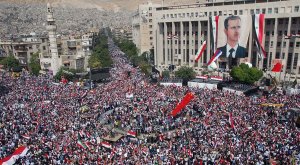
Syrians rally for Assad, October, 2011.
The survey, conducted by ORB International, a company which specializes in public opinion research in fragile and conflict environments, found that 47 percent of Syrians believe that Assad has a positive influence in Syria, compared to only 35 percent for the Free Syrian Army and 26 percent for the SOC. [1]An in-country face-to-face ORB poll conducted in May 2014 arrived at similar conclusions. That poll found that more Syrians believed the Assad government best represented their interests and aspirations than believed the same about any of the opposition groups. [2]
According to the poll, only six percent believed that the “genuine” rebels represented their interests and aspirations, while the ‘National Coalition/transitional government,” a reference to the SOC, drew even less support, at only three percent.
Assad has repeatedly challenged the notion that he lacks popular support, pointing to his government surviving nearly five years of war against forces backed by the most powerful states on the planet. It’s impossible to realistically conceive of his government’s survival under these challenging circumstances, he argues, without its having the support of a sizeable part of its population. [3]
4. A moderate opposition doesn’t exist. The United States is trying to build one to act as its partner.
The report refers to US efforts to create partners in Syria, a euphemism for puppets who can be relied upon to promote US interests.
“Secretary of Defense Carter described the ‘best’ scenario for the Syrian people as one that would entail an agreed or managed removal of Assad and the coalescence of opposition forces with elements of the remaining Syrian state apparatus as U.S. partners ….” (emphasis added, pp. 15-16).
Also: The Pentagon “sought to…groom and support reliable leaders to serve as U.S partners…” (emphasis added, p. 23).
To create partners, the United States is engaged in the project of building a “moderate” opposition. According to the report:
“On June 18, Secretary of Defense Carter said, ‘…the best way for the Syrian people for this to go would be for him to remove himself from the scene and there to be created, difficult as it will be, a new government of Syria based on the moderate opposition that we have been trying to build…” (emphasis added, footnote, p. 16).
In the report summary the researchers write that US strategy seeks to avoid “inadvertently strengthening Assad, the Islamic State, or other anti-U.S. armed Islamist groups” (emphasis added.) What’s left unsaid is that armed Islamist groups that are not immediately anti-U.S. may be looked upon favorably by US strategy. However, that “political opposition coalitions…appear to lack grass-roots support,” and that Washington can’t rely on an already-formed moderate opposition but needs to build one, shows that the set of rebels on which the US can rely to act as US partners who will rule with elements of the existing Syrian state in a post-Assad Syria is virtually empty. The conclusion is substantiated by the failure of a now-abandoned Pentagon program to train and equip vetted rebel groups. Gen. Lloyd J. Austin III, the top American commander in the Middle East, told the Senate Armed Services Committee that despite the Pentagon spending $500 million training and equipping “moderate” rebels, only “four or five” were “in the fight.” [4] As the Wall Street Journal observed in late December, moderate rebels don’t exist. They’ve either been absorbed into Jabhat al-Nusra, Ahrah al-Sham and ISIS—the extremist terrorist groups which dominate the opposition—or were Islamist militants all along. [5]
5. The United States is arming sectarian terrorists indirectly and possibly directly and covertly.
The report points out that not only has the Pentagon openly trained and equipped rebels, but that the United States has also covertly armed them. According to the Congress’s researchers:
“Then Secretary of Defense Chuck Hagel said in a September 2013 hearing before the Senate Foreign Relations Committee that the Administration was taking steps to provide arms to some Syrian rebels under covert action authorities” (p. 23).
Also:
“Secretary Hagel said, ‘it was June of this year that the president made the decision to support lethal assistance to the opposition….we, the Department of Defense, have not been involved in this. This is, as you know, a covert action’” (footnote, p.23).
If the United States was prepared to overtly arm some rebel groups, why is it covertly arming others? A not unreasonable hypothesis is that it is arming some rebel groups covertly because they have been designated as terrorist organizations. To be sure, a number of press reports have revealed that rebels who have received training and arms from the United States are operating with terrorist groups in Syria. According to the Wall Street Journal, “insurgents who have been trained covertly by the Central Intelligence Agency…are enmeshed with or fighting alongside more hard-line Islamist groups, including the Nusra Front, Al Qaeda’s Syria affiliate” [6]. Another report from the same newspaper notes that “al-Nusra has fought alongside rebel units which the U.S. and its regional allies have backed” [7]. A third report refers to collaboration between “CIA-backed Free Syrian army factions and extremist elements such as Nusra Front and Ahrar al Sham” [8]. Let’s be clear. Anyone who is enmeshed with and fighting alongside Al-Qaeda is a terrorist.
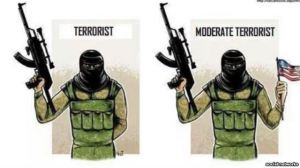 According to Congress’s researchers, weapons the US furnished to selected groups have made their way to jihadists. “Some Syrian opposition groups that have received U.S. equipment and weaponry to date have surrendered or lost these items to other groups, including to extremist groups such as Jabhat al-Nusra” (p. 23).
When you consider that, as The Washington Post reported, “the CIA has trained and equipped nearly 10,000 fighters sent into Syria over the past several years” [9] and that, at best, there are 700, and more likely only 70 “moderate” rebels in Syria [10], then the bulk of the large rebel force the CIA has trained and equipped is very likely made up of Islamist extremists. Concealing this shameful reality from the US public is probably the principal reason the program is covert.
6. Washington wants to contain ISIS, but not eliminate it, in order to maintain military pressure on the Syrian government.
Based on the US coalition’s less than vigorous air campaign against ISIS, many observers have questioned whether the United States is at all serious about eliminating ISIS just yet, and is simply trying to contain it, to keep pressure on the Syrian government. For example, veteran Middle East correspondent Robert Fisk says: “I don’t think the U.S. is serious. Very occasionally, you can hear the rumble of American bombs. But they’re certainly not having much effect.” [11]
One day, soon after Russia began air operations in Syria, journalist Patrick Cockburn noted that “Russian planes carried out 71 sorties and 118 air strikes against Islamic fighters in Syria over the past two days compared to just one air strike by the US-led coalition – and this single strike, against a mortar position, was the first for four days.” [12] After ISIS captured Palmyra, and pushed into Aleppo, the US coalition did nothing to push back the ISIS advance, leading even rebels to question “the U.S.’s commitment to containing the group.” [13] Assad too has expressed scepticism about whether the United States is serious about destroying ISIS, pointing to the terrorist organization’s continued successes in Syria, despite the US coalition’s presumed war against it. “Since this coalition started to operate,” observed the Syrian president, “ISIS has been expanding. In other words, the coalition has failed and it has no real impact on the ground.” [14]
A tepid approach to fighting ISIS in Syria would fit with US president Barack Obama’s stated goal of degrading the Al-Qaeda offspring organization. Destroying it may be an ultimate goal, to be achieved after ISIS has served the purpose of weakening the Syrian government. But for now, the United States appears to be willing to allow ISIS to continue to make gains in Syria. The Congressional Research Service report concurs with this view: It concludes that “U.S. officials may be concerned that a more aggressive campaign against the Islamic State may take military pressure off the” Syrian government (p. 19).
By contrast, Moscow has pursued a more vigorous war against ISIS, and for an obvious reason. Unlike Washington, it seeks to prop up its Syrian ally, not give ISIS room to weaken it. It should be additionally noted that Russia’s military operations in Syria are legal, carried out with the permission of the Syrian government. By contrast, the US coalition has brazenly flouted international law to enter Syrian airspace without Damascus’s assent. It has, in effect, undertaken an illegal invasion and committed a crime of aggression, compounded by its training and arming of terrorists.
Conclusion
The report says that in the absence of grass-roots support for political opposition coalitions in Syria, the United States is relying on a number of tactics to pressure the current government in Syria to step down, including:
• Keeping ISIS alive as a tool to sustain military pressure on Damascus.
• Arming jihadist groups indirectly and (we can assume) directly (albeit covertly) to pressure Assad.
• Seeking to create a moderate opposition that will act as a US partner.
• Trying to co-opt parts of the existing Syrian state to take a partnership role in governing a post-Assad Syria.
The implication of points 1 and 2 is that the United States—as the trainer of, and supplier of arms, to rebels who are enmeshed with and fighting alongside Al-Qaeda in Syria, and in keeping ISIS alive, in order to use these terrorist organizations to achieve its political goal of installing a US-partner government in Syria—is a state sponsor of terrorism.
1. http://www.opinion.co.uk/perch/resources/syriadata.pdf
2. http://www.opinion.co.uk/perch/resources/syriadatatablesjuly2014.pdf
3. “President al-Assad: Russia’s policy towards Syria is based on values and interests, the West is not serious in fighting terrorists,” Syrian Arab News Agency, December 11, 2015, http://sana.sy/en/?p=63857
4. Philip Shishkin, “U.S. weighs talks with Russia on military activity in Syria,” The Wall Street Journal, September 16, 2015.
5. Stuart Rollo,“Turkey’s dangerous game in Syria,” The Wall Street Journal, December 28, 2015.
6. Anne Barnard and Michael R. Gordon, “Goals diverge and perils remain as U.S. and Turkey take on ISIS,” The New York Times, July 27, 2015.
7. Farnaz Fassihi, “U.N. Security Council unanimously votes to adopt France’s counterterrorism resolution,” The Wall Street Journal, November 20, 2015.
8. Sam Dagher, “Syria’s Bashar al-Assad Tries to Force the West to Choose Between Regime, Islamic State,” The Wall Street Journal, October 9, 2015.
9. Greg Miller and Karen DeYoung, “Secret CIA effort in Syria faces large funding cut,” The Washington Post, June 12, 2015.
10. Robert Fisk, “Is David Cameron planning to include al-Qaeda’s Jabhat al-Nusra in his group of 70,000 moderates?”, The Independent, December 1, 2015.
11. Thomas Walkom, “Journalist Robert Fisk explains why Canada should abandon ISIS war,” The Toronto Star, September 25, 2015.
12. Patrick Cockburn, “Russia in Syria: Air strikes pose twin threat to Turkey by keeping Assad in power and strengthening Kurdish threat,” The Independent, October 28, 2015.
13. Raja Abdulrahim, “Islamic State advances further into Syria’s Aleppo province,” The Wall Street Journal, June 1, 2015.
14. “President Assad’s interview with Russian media outlets, Syrian Arab News Agency, September 16, 2015 http://sana.sy/en/?p=54857
January 21, 2016
Posted by aletho |
Timeless or most popular, War Crimes | al-Qaeda, Central Intelligence Agency, CIA, ISIS, Nusra Front, Syria, United States |
Leave a comment
Coercive Engineered Migration: Zionism’s War on Europe (Part 2 of an 11 Part Series)
During the 1920s General Secretary of the Communist Party of the Soviet Union Josef Stalin formulated what he considered to be the essential contribution of Lenin to Marxist political economy. Leninism, he wrote, is Marxism in the era of proletarian revolution. Since 1989 proletarian and national liberation revolutions throughout the world have been overturned by a general, global counter-revolutionary upsurge. It is a counter-revolutionary upsurge that has seen the onslaught of US colour revolutions, which seek to do away with the bourgeois nation-state itself, the last barrier to the total exploitation of the world by the global corporate and financial elite.
In this essay we have argued that the contemporary form of this counter-revolutionary ideology, of this imperial drive for global domination, is Zionism. One could therefore assert that Zionism is imperialism in the age of capitalist counter-revolution. In other words, Zionism is the very form of contemporary Western imperialism. Therefore, unlike Russian and Chinese imperialism, Western imperialism or Zionism has both a religious and ethnic dimension. Zionism is a Messianic and racist ideology based on Talmudic Judaism.
Zionism, through its control of Western finance capitalism, is striving for global governance. Lenin, writing in 1915, described as ‘indisputable’ the fact that ‘development is proceeding towards monopolies, hence, towards a single world monopoly, towards a single world trust’. But Lenin also pointed out that this drive towards unipolar global power would also intensify the contradictions in the global economy. A cogent example of this today is the low-intensity covert war currently being waged by the United States/Israel against Germany: The Western imperial alliance is turning on itself.
However, no people’s resistance to Zionism can be mounted if the empire continues to outsmart its opponents. The aforementioned General Barnett understands his enemies well. He used to teach Marxism in Harvard university and has written a book comparing the African policies of the German Democratic Republic and the Socialist Republic of Romania. In his book Blueprint For Action, he points out that the father of Fourth Generation Warfare is Mao Tse Tung. Imperial grand strategy is now waging war using techniques developed during the Chinese revolution, one of the greatest anti-colonial struggles in history. The key for anti-imperialist resistance today is, therefore, to understand how to turn the tools of imperialism against imperialism.
Marxism is a useful and indispensable tool but is insufficient for an full understanding of the complexities of the information age in the context of imperial strategy and tactics. Barnett and many other US and Israeli military strategists are keen students of social psychology, and in particular General Boyd’s OODA Loop Theory. The OODA stands for observation, orientation, decision, action. According to Boyd, decision-making occurs in a recurring cycle of observe-orient-decide-act. An entity (whether an individual or an organization) that can process this cycle quickly, observing and reacting to unfolding events more rapidly than an opponent, can thereby “get inside” the opponent’s decision cycle and gain the advantage.
One could see this psychology at work during the Arab Spring. The rigid ideological orientation of the average ‘leftist’ saw the uprisings in Tunisia as proof that people were rebelling against a US-backed dictator and his ‘neo-liberal’ regime. This interpretation was reinforced by strategically placed ‘critics’ of US-foreign policy in the news station of Zionism’s ancillary regime, Qatar, while the initial indifference of the Western press confirmed the interpretation of the Tunisian revolt as a genuine, grass roots uprising against US imperialism.
US and Israeli strategists were capable of doing this through their deep understanding of ‘leftist’ discourse. They also understood that the ‘anti-globalisation’ form of the protest movement would fool genuine critics of US imperialism, thereby impeding their ability to react to the US-orchestrated revolutions in a rational manner.
In the Arab Spring, inverted Marxian dialectics, Systems Theory, Psychology, Military Science and Utility Theory were waged against a feckless and discombobulated anti-war movement who would repeat the sound bites of ‘popular uprising’ and the ‘defeat of US imperialism in the Middle East’ implanted in their minds by one of the most impressive and successful US/Israeli geostrategic operations in modern history.
On the eve of NATO’s bombing of Libya, the BBC predictably called upon an old reliable ‘critic of US foreign-policy’ Noam Chomsky. The veteran American philosopher agreed that the West had a “duty” to “stop the massacres” in Libya thus ensuring there would be no moral outrage among the so-called anti-war movement. The invitation of Noam Chomsky by the Zionist-controlled BBC shows the importance for British intelligence of ideologically disarming potential ‘leftist’ opponents in the run-up to meticulously planned wars of aggression, disguised as ‘humanitarian interventions’.
Given Chomsky’s anarchist ideology, the very ideology instrumentalised by the CIA in colour revolutions, the BBC knew he would go along with their fake ‘popular uprising’ in Benghazi, thus providing justification to wage ‘humanitarian’ warfare in support of the ‘revolution’.
In 2013, a massive military destablisation of Brazil was undertaken by US NGOs, operating under the guidance of the CIA, in order to weaken the popularity of a government moving far too close to Russia and China in the eyes of Washington. Again, the CIA’s ‘Vinegar revolution‘ received full support from most ‘leftist’ quarters. Once again, military geostrategy had triumphed over anti-imperialist analysis.
The current refugee crisis proves that US/Israeli military geostrategy is running circles around its opponents, who, instead of identifying the culprits who are using human beings as weapons, are unwittingly collaborating with Zionism’s plan to inundate Europe with migrants for the purposes of fomenting civil war in the European peninsula, in a desperate effort to prevent Eurasian integration, a prospect inimical to what the Pentagon refers to as ‘full spectrum dominance’, US/Zionist global hegemony.
Those who have joined in the chorus of welcoming the refugees/migrants are unwitting participants in an extension of Zionism’s neo-colonial wars in Africa and the Middle East. They are also complicit in the endorsement and cover-up of a modern slave trade. Opposing imperialism requires study of the logic of its geostrategic operations. Imperialism’s deliberate flooding of Europe with a Wahhabised lumpen-proletariat from a war-torn Southern Hemisphere will not help the cause of labour, the cause of human freedom. Rather, it will contribute to prevent the unification of the European-peninsula with Russia and Asia. It will contribute towards the further colonisation and destruction of independent African and Middle Eastern nations such as Eritrea and Syria.
An example of Marxist Leninist parties’ inability to deal with imperialism’s weaponization of migrants comes from the Communist Party of Great Britain (Marxist Leninist). Their argument in favour of immigration is sound under normal circumstances but they fail to address the problem of when immigration becomes a tool of imperialism, a specific geopolitical strategy aimed at destabilizing both the country of origin and the destination of the migrant.
The recent resolution of the CPGBML is worth reproducing here in full:
This party firmly believes that immigration is not the cause of the ills of the working class in Britain, which are solely the result of the failings of the capitalist system.
Immigration and asylum legislation and controls under capitalism have only one real goal: the division of the working class along racial lines, thus fatally weakening that class’s ability to organise itself and to wage a revolutionary struggle for the overthrow of imperialism.
These controls have the further effect of creating an army of ‘illegal’ immigrant workers, prey to super exploitation and living in dire conditions as an underclass, outside the system, afraid to organise and exercising a downward pull on the wages and conditions of all workers.
The scourge of racism, along with all other ills of capitalism, will only be finally abolished after the successful overthrow of imperialism. But since immigration can no more be abolished under capitalism than can wage slavery, our call should not be for the further control and scapegoating of immigrants, but the abolition of all border controls, as part of the wider fight to uproot racism from the working-class movement and build unity among workers in Britain, so strengthening the fight for communism.
The problem here is that no distinction is made between immigration into imperialist countries and immigration into semi-colonial type countries. For example, Syria has been forced to close its borders due to the passage of terrorists in the service of imperialism. In such circumstances, it would be ludicrous to condemn the Syrian government for erecting fences to protect its borders. Similarly, Hungary, a small country which has just taken modest steps towards escaping from the clutches of US imperialism under the control of the IMF, has decided to erect fences to protect its borders from what it perceives as an attempt by US imperialism to destablize the country. Under these conditions, such a decision is entirely justified. The CPGBML argues correctly that “the scourge of racism, along with all other ills of capitalism, will only be finally abolished after the successful overthrow of imperialism.” The erection of fences in Hungary is part of that fight against imperialism, when migrants are clearly being used as weapons of imperialist strategy against recalcitrant nation-states.
The fact that Zionism is using the refugee crisis to further its imperialist agenda does not mean, however, that all refugees in the world are being used for this purpose. Rather, just as in the Arab Spring where the social inequalities of capitalism were used by imperialism to further the cause of capitalism, so are many refugees coming from the Middle East and Africa being used for the same purpose.
Throughout the world Homo sapiens is being supplanted by homo economicus: a vacuous, brain-washed, rootless cosmopolitan, a deterritorialised and acculturated nomad, hopelessly blown hither and thither by the exigencies of capital. Meanwhile, Zionism continues to stoke up the incessant and utterly fraudulent ‘War on Terror’, with omnipresent mass surveillance of the “nations” (goyim) while at the same time Jews are being encouraged by the Israeli regime to leave Europe for settlement on Arab lands, ruined and depopulated by Zionism’s wars.
The ‘refugee crisis’ is indubitably one more step towards the creation of a Greater Israel. Benjamin Netanyahu recently told the Israeli National News that Israel must become a “world power”.
To politically correct pundits, Victor Orban’s fence might appear inhumane and xenophobic, but at this moment in history the concrete choice presented to us is between temporary fences designed to protect nations from imperialism or Zionist walls built to imprison humanity.
Part I
January 17, 2016
Posted by aletho |
Deception, Ethnic Cleansing, Racism, Zionism, Timeless or most popular | Africa, BBC, Brazil, Central Intelligence Agency, CIA, Germany, Israel, Judaism, Libya, Middle East, Noam Chomsky, Syria, United States, Zionism |
Leave a comment
A Portuguese court of appeals has ordered the extradition of a former CIA officer who was convicted in absentia for her alleged role in the rendition of a suspected terrorist.
Sabrina De Sousa could face four years in jail.
The dual American and Portuguese citizen traveled to Lisbon in April with her husband. When she attempted to fly to the Indian state of Goa to visit her ailing mother in October, she set off a travel-alert indicating she was wanted in Italy. Authorities then arrested her and seized the dual citizen’s American and Portuguese passports.
De Sousa was charged in 2005 for her alleged role in the kidnapping of suspected terrorist and Egyptian cleric Hassan Mustafa Osama Nasr, also known as Abu Omar. More than 20 other Americans including CIA officials were also convicted in the operation.
After Omar’s release, the cleric said he had been snatched off the streets of Milan after leaving his apartment on Feb. 17, 2003. He said he was thrown into a van, and flown to Egypt where he underwent torture including beatings and electrocution.
Judge Sergio Silocchi reads the sentence of the appeal trial on a CIA-led kidnapping of an Egyptian terror suspect, Muslim cleric Osama Moustafa Hassan Nasr, also known as Abu Omar, at the Milan’s court, Italy, Wednesday, Dec. 15, 2010.
At the time, De Sousa was registered in Italy as a State Department official at the U.S. Consulate in Milan. However, she was actually a CIA officer.
She maintains that she was chaperoning her son’s ski trip the day Omar was taken. She also says the operation was approved and carried out by higher-ranking CIA officials, who had the backing of Italy’s intelligence community.
She admits she was a translator for the team that led the capture and coordinated with Italian authorities.
Following her charges, De Sousa sued the CIA and the Justice Department for not invoking diplomatic immunity on her behalf. Later in 2009, 23 Americans also were convicted by Italian courts in absentia. None has served prison terms.
During an interview Friday with the Washington Post, De Sousa said she plans to appeal the ruling to Portugal’s Supreme Court.
“I am really shocked,” De Sousa told the Post. “From what I understood, extradition was off the table because it was a trial in absentia. I was not served or told of the charges against me and had zero opportunity to defend myself adequately because the U.S. did not acknowledge the rendition took place and the evidence was classified. Italy also covered all pertinent evidence with ‘state secrets.’”
January 17, 2016
Posted by aletho |
Subjugation - Torture | Central Intelligence Agency, CIA, Human rights, Portugal, Sabrina De Sousa, United States |
Leave a comment
 In the “free and democratic system” being pushed upon all other states in the world by the United States and its Western allies, journalists are increasingly unhappy about the repressions they’ve been facing over the last decade, along with constant surveillance and the demand to cooperate with intelligence services. That is why German-speakers have even coined a special term for the Western media – Lügenpresse or “lying press”. It’s no wonder that the credibility of the most famous Western media outlets recently has hit a new low.
 According to Congress’s researchers, weapons the US furnished to selected groups have made their way to jihadists. “Some Syrian opposition groups that have received U.S. equipment and weaponry to date have surrendered or lost these items to other groups, including to extremist groups such as Jabhat al-Nusra” (p. 23).

 Aletho News
