A growing number of parents oppose vaccine mandates as a precondition for public school attendance, and interest among adults in receiving COVID-19 booster shots is waning, according to a national poll by the Kaiser Family Foundation (KFF).
The results of the latest KFF COVID-19 Vaccine Monitor survey, released today, show more than one-third (35%) of parents now believe they should be the ones to decide whether their children receive a slate of childhood vaccines.
The poll encompassed a nationally representative sample of 1,259 adults who were interviewed between Nov. 29 and Dec. 8. According to The New York Times, the KFF is a “nonpartisan health care research organization.”
“It’s unfortunate that it took a wave of injuries and deaths from vaccines that never should have been released into the market — much less mandated — to draw long-overdue attention to the issue of vaccine safety,” said Robert F. Kennedy, Jr., chairman and chief litigation counsel for Children’s Health Defense.
Kennedy told The Defender :
“This latest poll is encouraging for those parents, physicians and scientists who for decades have been calling for an investigation into the relentless promotion by FDA, CDC and Big Pharma of inferior medical products without rigorous safety testing.
“As more parents begin to question the forced, routine administration of vaccines on healthy children, perhaps we will move closer to protecting children and holding vaccine makers and government agencies accountable for the harm these products cause.”
26% of parents today: ‘Risks of childhood vaccines for measles, mumps, and rubella outweigh the benefits’
According to the KFF poll, 65% of parents of children under age 18 “think healthy children should be required to be vaccinated to attend public schools.”
More than one-third of parents surveyed (35%) “now believe parents should be able to decide not to vaccinate their children, up from 23% in 2019.”
The poll also revealed declines in support for specific vaccines. For instance, 71% of respondents said “healthy children should be required to get vaccinated for MMR in order to attend public schools” compared with 82% who supported the MMR vaccine mandate for healthy children in 2019.
Nearly 3 in 10 parents (28%) said parents should be able to choose whether their children receive the MMR vaccine, compared with 16% in the 2019 poll.
A similar percentage (26%) responded that the “risks of childhood vaccines for measles, mumps, and rubella outweigh the benefits.”
A smaller decline was noted in the percentage of adults (85%) who felt the benefits of childhood MMR vaccination outweigh the risk. This represented a three-percentage-point decline from the 2019 Pew Research Center poll (88%).
These declines were driven by increased vaccine “skepticism” and a growing movement toward parental choice, on the part of Republicans and Republican-leaning independents — 44% of whom responded that parents should have a choice about whether or not their children receive the MMR vaccine, up from 20% in 2019.
Only 11% of Democrats provided the same response.
Moreover, only 56% of Republicans and Republican-leaning independents said “healthy children should be required to be vaccinated to attend public schools,” a decline of 23 percentage points compared to 2019.
A similar divide was apparent among respondents in reference to their COVID-19 vaccination status. While 83% of vaccinated respondents said healthy children should be required to be vaccinated in order to attend public schools, 63% of unvaccinated parents said parents should instead decide.
‘Tepid’ interest in COVID ‘boosters’ and flu vaccine
Interest in the updated COVID-19 booster is “tepid,” according to the KFF poll, which showed only 1 in 5 adults (22%) surveyed said they have received the updated bivalent booster and an additional 16% said they plan to receive it “as soon as possible.”
However, 12% of respondents said they would “wait and see” before deciding whether to get the new booster, 13% said they would get it only if required and 9% said they would “definitely not” get it.
An additional 27% were unvaccinated or only “partially” vaccinated, which means they are not eligible to get the booster.
Interest in the bivalent booster was highest among adults 65 and older (39%) and Democrat voters (38%), though both figures fall significantly short of a majority. Conversely, only 12% of Republicans and 11% of young adults under 30 said they had received a dose of the updated booster.
Also, 36% of “fully vaccinated” adults 65 and older said they don’t think they need the updated booster, while a “similar percentage,” according to KFF, said they did not think the benefit of the updated booster was worth it.
Overall, fewer than half of parents of children under 18 said their child has received the updated booster or is likely to do so.
Combined with children who have not been vaccinated and who are therefore ineligible for the booster, 58% of parents of 12- to 17-year-olds and 70% of parents of 5- to 11-year-olds responded in this manner.
Republicans and Republican-leaning independents, even if vaccinated, expressed skepticism toward the updated booster, with 64% stating they do not think they need it, and 61% saying they did not believe the benefit was worth it.
Even among Democrats, a majority (51%) said they were too busy or hadn’t had the time to get the updated booster, indicating it was not a high priority for them.
Even in the face of a so-called “tripledemic” of COVID-19, flu and RSV (respiratory syncytial virus) this fall and winter, and despite the majority of parents saying they are worried their children will get sick from RSV (56%, and 73% of parents of children under the age of 5), only 34% of parents said their child has gotten a flu shot this season.
Parents’ rights movement growing in prominence
According to The Times, “The shift in positions appears to be less about rejecting the shots than a growing endorsement of the so-called parents’ rights movement.”
Dr. Sean O’Leary, chairman of the American Academy of Pediatrics’ Committee on Infectious Diseases told The Times :
“The talking point that has been circulated is the concept of taking away parents’ rights. And when you frame it that simply, it’s very appealing to a certain segment of the population.”
O’Leary said he worried that the parental rights movement might slow down compliance with state-mandated childhood immunization schedules, telling The Times “We do have a global dip in vaccine coverage. So this is not a time to be considering a rollback of these laws.”
Michael Nevradakis, Ph.D., based in Athens, Greece, is a senior reporter for The Defender and part of the rotation of hosts for CHD.TV’s “Good Morning CHD.”
My first true crime book—about the Austrian author, journalist, and international serial killer, Jack Unterweger—recounted a strange dilemma suffered by Austria’s intelligentsia after evidence emerged that Jack had murdered several women. The trouble for them was, they had, just a few years earlier, vehemently advocated (through letters and a petition to the Justice Ministry) Jack’s early release from his life sentence in prison for a brutal murder he’d committed in his youth. Their passionate desire to liberate him arose after he published an “autobiographical novel” titled Purgatory. They (a Who’s Who of Austrian writers, artists, journalists, and scientists) found his book so moving, and so apparently expressive of his mature self-awareness, that they asserted it was evidence of his rehabilitation.
About 18 months after he was released from prison with great fanfare, an Austrian daily newspaper reported that a warrant had been issued for his arrest for murdering 7 women in three Austrian cities. Shortly thereafter he also fell under suspicion for murdering three women in Los Angeles and one in Prague, for a total of eleven women.
The lead police investigator, Ernst Geiger, discovered that many Austrian journalists and public commentators were extremely reluctant to acknowledge the extensive circumstantial evidence that Jack was the killer. Especially embarrassing for the Austrian National Broadcasting Corporation was the strange fact that Jack had gotten an assignment to produce a major radio story on the mysterious killer who was stalking Vienna’s red light district, much like “Jack the Ripper” had done in London a century earlier.
Those who’d advocated the extremely risky social experiment did not want to face up to the fact that their gamble had gone the wrong way, resulting in the terrible deaths of eleven young women. Many even seemed to prefer that the arrest warrant be rescinded and the investigation suspended.
This afternoon I was reminded of my first book when I read Dr. Paul Alexander’s reflections on the sudden death of celebrity soccer commentator, Grant Wahl, in the press box at the World Cup in Qatar. Mr. Wahl’s wife, Dr. Celine Gounder, was a member of President Biden’s COVID-19 Advisory Board and a vehement advocate for mass vaccination using the mRNA gene transfer shots developed by Pfizer-BioNTech and Moderna.
Dr. Gounder’s high profile endorsement of “The Great Gamble of COVID-19 Vaccine Development” (as Dr. McCullough characterized this massive experiment) raises the concern that she will be reluctant to examine the distinct possibility that these products caused or contributed to her fit young husband’s death.
Florida Governor Ron DeSantis recently hosted a roundtable forum of experts challenging the science coming from federal public health agencies surrounding the COVID-19 vaccine. Surgeon General, Joseph Ladapo announced the creation of the state’s new Public Health Integrity Committee, and Gov. Desantis announced he is requesting a grand jury investigation of vaccine-makers. Will other states follow?
The attempt to remask the public has started. And it’s rapidly moved past COVID as a reason to know of any basic respiratory illnesses. But does science justify it? Jefferey and Del break down the latest PR push surrounding masking.
As I sat down to write a report of Conservative MP Andrew Bridgen’s remarkable speech in Parliament this week to an all-but-empty chamber, I lighted upon this email from TCW reader Michael Carr:
‘It’s not often (never these days) that you can put the words “brave” and “UK MP” in the same sentence. But have we just witnessed one brave MP speaking out about the unprecedented human harm done by the mRNA Covid vaccine, and his call to have it halted immediately? It seems that MP Andrew Bridgen is just such a guy.
‘Notice the virtually empty chamber when he brings this subject up. Cowardly MPs decided they didn’t even want to be present when Andrew delivered his scathing attack on what the political, medical and mainstream media establishment had pushed (or kept silent) over the last two and a half years.’
I couldn’t have expressed it better. But what was the response? Despite the empty chamber did this remarkable speech prompt the MSM into reporting him and the great unspoken issue of the year, vaccine injury? The tragedy is that it did not. Bridgen’s calls for an immediate halt to the Covid vaccines have been, to date, ignored by all newspapers bar the Express. And their report, couched in terms of Bridgen’s ‘use of’ Parliamentary privilege to make ‘a bombshell allegation’ that a senior member of the British Heart Foundation had covered up a report showing ‘the mRNA Covid vaccine increases inflammation of the heart arteries’, was not exactly on point.
It shifted the focus from the main thrust of his adjournment debate which he intended to highlight the important issue of Covid vaccine harms, and his belief, unlike that of most of his colleagues, that the debate about vaccine harms should be based on data rather than fear.
It was in anticipation of media queries that Bridgen, the Conservative member for North West Leicestershire, forwarded in advance a comprehensive list of the data on which his speech is drawn to the mainstream media. No one can say he had not done his homework. It is just a crying shame – a disgrace, in fact – that no journalists bothered to do theirs. I know because I was sent by his office an extensive and comprehensive list of references. These included the government’s own evidence of serious adverse reactions affecting nearly half a million people; evidence showing that in the past vaccines have been completely withdrawn from use for a much lower incidence of serious harm – for example, the swine flu vaccine was withdrawn in 1976 for causing Guillain Barré syndrome in 1 in 100,000 adults and in 1999 the rotavirus vaccine was withdrawn for causing a form of bowel obstruction in children affecting 1 in 10,000; reference to the 25 per cent increase in heart attack and cardiac arrest calls in 16-to-39-year-olds in Israel associated with the first and second doses of vaccine and not associated with Covid infection, findings replicated in Florida; and to UK reports of an extra 14,000 out-of-hospital cardiac arrests in 2021 compared with 2020 following the vaccine rollout.
In conclusion he said: ‘As the data clearly shows to anyone who wants to look at it, the mRNA vaccines are not safe, not effective and not necessary. I implore the Government to halt their use immediately. As I have demonstrated and as the data clearly shows, the Government’s current policy on the mRNA vaccines is on the wrong side of medical ethics, it is on the wrong side of scientific data, and ultimately it will be on the wrong side of history.’
His speech was remarkable, not because his oratory was remarkable but because his bravery and independence of mind was. He is one of those rare amongst men and even rarer amongst MPs, a man with moral courage. To stand out as one man against the crowd, in defiance of received wisdom and judgment, is the most difficult thing any human being is called on to do. Andrew Bridgen did it.
You can watch the full speech or the snippet below. Please note the supportive intervention by one of the two other MPs to have clearly stuck his head above the parapet on this all-important issue, Danny Kruger (Conservative, Devizes); the other being that great warrior for truth Sir Christopher Chope (Conservative, Christchurch).
What is behind the rise in sudden fatalities among young, healthy Americans? According to Edward Dowd’s book, “‘Cause Unknown’ – The Epidemic of Sudden Deaths in 2021 and 2022,” there was an increase in deaths in America in 2020, though it was less severe than you might expect during a pandemic. Some of these deaths were linked to COVID-19 and ineffective initial treatment methods.
However, in 2021, the statistics that many had anticipated went in an unexpected direction. The CEO of OneAmerica, Scott Davison, publicly disclosed that during the third and fourth quarters of 2021, death in people of working age (18–64) was 40 percent higher than it was before the pandemic — and the majority of the deaths were not attributed to COVID-19.
A 40-percent increase in deaths is earth-shattering. Even a 10-percent increase in excess deaths would have been a “1-in-200-year flood.” An increase that high, Davison said, “is just unheard of.”
And therein lies a story with obvious questions:
What has caused this historic spike in deaths among younger people?
What has caused the shift from old people, who are expected to die, to younger people, who are expected to keep living?
What accounts for the astounding 84-percent increase in excess mortality among millennials between the ages of 25 and 44 in the second half of 2021?
What is causing an ominous pattern of media stories reporting sudden deaths of fit young athletes?
Why would healthy, young athletes be dying suddenly, often on the playing field, despite having on-site EMTs trained in resuscitation?
Why have there been hundreds of cardiac deaths in athletes since June 2021, when a Swiss study documented an average of 29 per year prior to that?
Were the sudden deaths related to the known risk of myocarditis (heart inflammation) associated with mRNA COVID-19 vaccinations?
Why did the term “sudden adult death syndrome (SADS)” start appearing often in the media in 2022 to describe the rise in cardiac occurrences among young people, causing them to be advised to “go and get their hearts checked?”
Since young people are not dying from COVID-19, could the excess deaths be caused by the COVID-19 vaccines?
Dowd presents a compelling argument for his catastrophic thesis in his short yet shocking crucial book: Young individuals in the best health who were, for the most part, never at risk from COVID-19 itself, were tragically affected by a wave of death and disability as a result of COVID-19 vaccine mandates.
“‘Cause Unknown’ – The Epidemic of Sudden Deaths in 2021 and 2022,” by Edward Dowd, was released Dec. 13 by Children’s Health Defense Publishing/Skyhorse Publishing. Foreword written by Robert F. Kennedy, Jr and afterword written by Gavin De Becker.
Today James is joined by Rob Kittredge and Hatim Kheir of the Justice Centre for Constitutional Freedoms to discuss their participation in the Public Order Emergency Commission in Canada (aka the Trucker Commission). We discuss the commission itself and how it was run, the evidence that was (and was not presented), why Mr. Kittredge is now known as a “tow truck aficionado,” what Trudeau and others testified to during the hearings, and what Kittredge and Kheir expect to come from this process.
Newsflash from China: the world’s last bastion of Zero Covid has finally given up the pretence. “Covid China cracks”… this is a message that seems to have penetrated even the mainstream media’s coverage.
What is not, however, entirely clear is how brave BBC reporters can travel around the world to capture footage in the Far East, but were blind to peaceful protests closer to home. Those voices of reason who have been ignored for almost three years have found the cognitive dissonance more than a little unnerving. How can it simultaneously be true that lockdown sceptic protests and protestors in UK are bad, selfish and unscientific, while lockdown sceptic protests and protestors in China are brave and pushing back against regime oppression?
Even in their dissonant apostasy, the media cheerleaders still struggle with fundamental misconceptions due to their alignment with the crumbling narrative and blindness to the obvious: “the main challenge is ensuring the inevitable uptick in infections does not lead to mass deaths” claims the BBC. Really? With almost three years of data now to hand, is it now not blindingly obvious that the UK’s Chief Scientific Officer Patrick Vallance was absolutely correct when he stated on 16 March 2020 that “this is a mild disease in most people”? If these brave reporters want to investigate ‘mass deaths’, how about some hard-hitting investigative reporting on iatrogenesis instead?
This unpalatable (and hard to ignore) charade aside, can we at least hope that this is the end of an era? Can the Zero Covid chapter be closed for good?
Let us hope so. Humanity may – finally – have rid itself of Zero Covid policies, but what of its erstwhile supporters – what new hair-brained schemes are they now supporting? Whether the chaos they were involved in creating was by accident or design is arguably immaterial: how can society protect itself against future periods of collective self-harm?
The precautionary principle “emphasises caution, pausing and review before leaping into new innovations that may prove disastrous”.
Winding back the clock almost three years, it was for this reason that many of us had a principled objection to draconian non-pharmaceutical interventions (NPIs, i.e. lockdowns) from before they were enacted. While this view is now fashionable, many supported these policies at the time and then did not want to back down from this shibboleth. But why was it ever acceptable to deploy this combination of hand grenades to crack a nut? Why did society go along with a perverse inversion of the anti-precautionary principle: “panic; shout ‘fire’, abandon detailed disaster planning and then implement the precise opposite, botch the implementation, shut down constructive debate and then vilify those that challenge the new orthodoxy”?
It is instructive to observe the flailing attempts by vocal proponents of Zero Covid and its associated policies (school closures, rules of six, masks, vaccine mandates) to post-rationalise and excuse their mistakes. This is where lessons will be learned (and not, incidentally, from the preposterous attempts by those who piloted the ship onto the rocks to shift blame onto others or to claim that the right decisions were made “based on all the informationavailable at the time”).
We have previously outlined clear evidence of what was common knowledge by mid-March 2020. Chief Scientific Advisor Vallance, quoted above, went on to state: “Epidemics are like a pole vaulter taking flight: the outbreak starts slowly, takes off rapidly, reaches a peak and then comes back down to earth”. No different to what had happened in previous months on the Diamond Princess, in Wuhan and in Bergamo. This was a known quantity well before the UK launched itself, lemming-like, off the cliffs on 23 March 2020.
From hereon in it was one-way traffic for much of the next two years. Dissent was essentially criminalised, and the full force of far-from-benign authoritarian state machinery was turned against its citizens. Rational discourse was squashed (why would authorities collude with the media to stifle calm voices of reason such as Professor Jay Bhattacharya and instead promote shrill panic-mongers?); the media controlled via carrot (advertising) and stick (OFCOM diktat); dissenters were made an example of. None of this was necessary, and a normally-functioning society and fourth estate could have led us quickly back to balanced rationality, avoiding much of the human cost and unnecessarily-wrought collateral damage of the Coronapanic debacle.
They might prefer us to forget, but we must not. Thankfully, public records exist that will serve as a salutary reminder to future generations of what our own home-grown Zero Covid zealots wanted to perpetrate. For example, in the dark days of February 2021, 47 MPs from Opposition parties tabled an Early Day Motion promoting Net Zero. This Motion – as well as its stated (and implicit) underlying assumptions – has not aged well, the most egregious claim being that harsher draconian measures might avoid “putting huge additional strain on the NHS” – tell that to those on the now-gargantuan waiting lists for essential treatment. Most of the 47 signatories on this Motion are Labour MPs… Labour is currently riding high in the polls. They might well now criticise the UK Government’s handling of the last few years, but it was Labour – and their union paymasters – who were consistently pushing for more and more restrictions. Voters should be careful what they wish for.
So good riddance to Zero Covid, but have we learned any lessons? Unfortunately, there is as yet little evidence to show that society has the strength to resist the siren calls of the next Zero Policy fiasco… for example, could it be that Net Zero is an unholy hysteria rather than a holy grail? We would do well to look a bit more closely before we leap into deindustrialised pauperisation.
Sunlight is the best disinfectant, and in the interests of protecting all that we hold dear, we can only encourage everyone to keep constructively challenging and critiquing the official narrative.
What the graph below shows is that there are 6 codes on death certificates that correspond to “sudden deaths”—unexpected events that happened acutely and resulted in rapid demise.
Use of these codes jumped roughly 2-3 times from their 5 year average (even including the year of severe COVID (2020) in the five year average) in 2021, when the COVID vaccines began rolling out. The data are consistent for all 5 quarters in 2021-2022 for which data are available. The vaccines are killing us. Not COVID. Simply look at the data or the press conference (in German) where they were discussed..
Below is what the wonderful Jane Orient had to say:
If you have dependents, you need to protect them in case you die suddenly. Life insurance is the method used by most. Sudden, unexpected death of a breadwinner is not new, but the constant stream of hazards in the news should focus your attention.
Many scare stories turn out to be hype—especially those based on computer modeling (and serving an agenda). But the graph below shows actual occurrences. Sudden Adult Death Syndrome is real.
The source is the National Association of Statutory Health Insurance Physicians (KBV), which insures 72 million lives. Remember that if actuaries, in contrast to public health authorities, make a mistake, they and the companies they work for face consequences—including bankruptcy.
Just after the rollout of COVID-19 injections, there was a sharp, unprecedented spike in unexpected deaths, a 1,000% increase. The KBV denies a causal relationship to vaccination. The cause for the deaths is unknown, but it is not COVID-19. Authorities have not yet done appropriate studies to investigate a possible vaccine connection. Mainstream media did not attend a press event where data analyst Tom Lausen presented the figures, which he calls a “risk signal.”
From CDC data, equity investment advisor Edward Dowd calculates that Millennials, age 25 to 40, experienced an 84% excess mortality in the fall of 2021, coinciding with vaccine mandates and boosters—a Vietnam War-size event.
When it comes to New Year’s resolutions, number 1 should be providing as best you can for your family’s future, and carefully examining the risks you might be taking.
I’ve given partial replies here and there, but I’ve never laid out all of my ideas in one place. I think these strange exercises seem much less bizarre when considered against the broader backdrop of the pandemicists and the beliefs they share. You might call their most central article of faith pandemicism, which is the doctrine that pandemics represent a serious threat to human health, and that they can be prevented or substantially ameliorated with the right scientific interventions.
Aspects of pandemicism are as old as 1918, but the proximate origins of this mind virus are much more recent. Tellingly, they don’t lie with any kind of pandemic at all, but rather with the WHO campaign to eradicate smallpox. This started in 1967, and it took ten years to complete. Any institutionalised enterprise that persists for a full decade will acquire institutional momentum, such that it can’t simply be turned off when the mission is over. Just as the push for trans rights and trans acceptance owes a lot to the institutional forces accumulated by the gay rights movement since the 1970s, pandemicism became the next stage of advocacy for the smallpox eradicators after they had put themselves out of business. All the careers, institutions and grand funding schemes that had been thrown at smallpox needed a second act.
The smallpox eradicators began their transition to a post-smallpox world by fantasising that the virus they had killed off would someday return. Donald Henderson, director of the eradicators, founded the Johns Hopkins Center for Civilian Biodefense Strategies in 1998, a key pandemicist think tank that was later rechristened as the Center for Health Security, and that went on to hold a series of notorious and well-publicised pandemic war games. The earliest of these – Dark Winter and Atlantic Storm – were funded by the US Department of Defence and involved elaborate fictional scenarios of smallpox biowarfare. Later on, with the rise of billionaire philanthropy and the ever waning cultural significance of Variola, the Johns Hopkins pandemicists began peddling horror scenarios of other pandemic pathogens. Event 201 was their first major tabletop exercise featuring a pathogen other than smallpox that entered humans via a natural spillover event.
There are, then, two pandemicist eras – an early period, fuelled by Defence funding and devoted primarily to biowarfare scnearios, with curious parallels to the 1995 film Outbreak; and a later period driven by banal third-worldist philanthropy, that is more heavily focused on natural pathogens and reflected in the film Contagion. The Hollywood resonances are no accident; the pandemicists are above all interested in publicity and fundraising, and they try hard to make their mark on popular culture. The earliest wargames were at base morality tales intended to convince the US government to increase its smallpox vaccine stockpiles. The second era of pandemicist thought owes a great deal in turn to the SARS outbreak of 2003. Vaccine development at this stage becomes the central concern, and the pandemicist mission expands with novel projects to predict and preempt the emergence of novel human-infecting viruses. The old roots were still there, and the Defence Department funds were a major part of this new research.
The primary problem of pandemicism, is that there just aren’t very many pandemics, which means that most of the time the pandemicists don’t have anything to do. Wargaming attracts publicity and the interest of fundraisers, and it gets scary viruses into headlines in the absence of any reason for them to be there. Pandemicist wargames feature what we should think of as “fundraising viruses.” These are either fictional pathogens with very high infection fatality rates (often modelled on SARS), or real viruses like Nipah that are extremely deadly but not very contagious. The pandemicists almost never bother to wargame the most common pandemic virus, namely influenza, because nobody finds it particularly scary. As founding pandemicist Larry Brilliant said in 2007:
Last year, six hundred thousand people died and we didn’t notice. That’s a little bit of the reason you find so much hyperbole in the whole question of pandemic flu. Because a lot of public health people are saying, oh goody, we have something that’s going to frighten rich people, let’s use it as a chance to build up the public health system.
Fundraising viruses are a fictional threat. Any viral pathogen adapted to spread widely via direct person-to-person contact in human hosts will cause nothing more than influenza-like illness, with mortality well within the familiar range for seasonal respiratory viruses. This important difference, between what grabs attention and what is actually biologically likely to occur, is one reason I think that most scientists, and the pandemicists in particular, ignore the broader behavioural patterns of viruses and the evolutionary pressures to which they’re subject. Looking too deeply into these questions threatens to turn up evidence that we don’t really need the pandemicists at all.
Formally, it seems that this bland pandemic theatre is supposed to familiarise “stakeholders” and “decision-makers” with the expected mitigationist response. As late as Event 201 in Fall 2019, this response consisted of not doing very much. Before Corona, the pandemicists didn’t like the idea of travel restrictions or lockdowns. These might be used to contain very local outbreaks, but once a virus had achieved pandemic status, closures were considered counterproductive and likely to increase poverty and disease in the developing world. The pandemicists preferred things like travel advisories and fast-tracking vaccine development. The idea of mass containment emerged in the wake of SARS; it was never a part of Western pandemicist doctrine, though brief lockdowns were trialled in Mexico in 2009 against the nothingburger Swine Flu, and again in 2014 against Ebola.(1)
As I never tire of typing, what happened in the West was a hybrid response. Via China and pressure from the WHO, mass containment came to be added at the very last minute to the standard mitigationist playbook that the pandemicists had been peddling for a generation. This is why the messaging shifted so suddenly after February 2020. Until that date, we were in the standard world of Event 201, and authorities talked down the risk of the virus in an effort to prepare us all for the inevitable infections and deaths. Mass containment, adopted with the Italian lockdown in March, required a vastly more hysterical and overblown messaging strategy, in an effort to convince all of us to hide at home.
All that wargaming about how we’d stay open didn’t matter very much in the end, because well-publicised pandemic wargames aren’t actually planning exercises and have very little strategic importance. They’re for fundraising and publicity.
Probably the most obtrusive feature of pandemicist material – and the least discussed – is its extremely low quality. This is above all why I have a hard time buying theories that these events reflect any nefarious plan. They are just so, so stupid, it is actually hard to put into words. While earlier wargames were fairly textured and elaborate, there’s been a steady decline, worsened by the arrival of Big Philanthropy. I strongly advise that you not waste your life watching the extremely insipid Event 201 videos. Far more digestible is the SPARS pandemic exercise, which is often cited as another ominously prophetic document, particularly for its lengthy discussions of anti-vaxxers and pro-vaccine public health messaging. There are some parallels to recent events, but if you read carefully, you’ll see that the whole thing is firmly rooted in vintage 2016 anxieties about social media disinformation. And, again, it’s just really, really dumb. Every chapter concludes with tiresome questions for discussion by “public health risk communicators,” whoever they are. It feels like a weird textbook written for virusphobic primary school children in an alternate reality, where the hot new social media platform is called ZapQ and the big antivaxx disinformationist is a “science blogger” named EpiGirl and public health officials recruit a “hip hop icon” named BZee whose fictional tweets get fewer retweets and likes than mine do (see the figures on p. 25).
Nevertheless, the SPARS scenario and others like them have their moments of foreknowledge. I would never exclude malfeasance outright, but the general explanation for this phenomenon is that we get the virus freakouts we plan for. Virus fantasies like Event 201 and SPARS reflect a prior epidemiological interest in specific pathogens, and they serve to focus the attention of the public health brigade further on specific viral species. Monkeypox and the 2009 Swine Flu show that pandemicist attention alone – in the absence of any serious mortality – is enough to generate widespread hysteria. These are prophecies, but they are mostly self-fulfilling ones. That is also why the laboratory origins of SARS-2 are such a big piece of this puzzle.
What’s missing from all these planning scenarios – what every last one of them fails to predict – is the steely biomedical dictatorship that emerged to ruin all of our lives in 2020. Nobody in any of these wargames is ever locked up in their homes. Public health officials respond to the off-message EpiGirl with press releases, not threats and deplatforming. There are no green passes. The unvaccinated are never deplored or fired. Part of the reason is that, before 2020, lockdowns had never been part of the plan, and they gave public health bureaucrats a chance at overt and direct repression, which they’d never counted on before. But it’s also true that the basic project of pandemicism has authoritarian and repressive elements baked into it, which I think the pandemicists themselves never really noticed. They’re just not the most intelligent or introspective people.
(1) In the years after SARS, some public health bureaucrats and pandemicists played with ever more restrictionist mitigation regimes, contemplating school closures and work-from-home orders, but their focus remained firmly mitigationist. The purpose was only to slow infections to spare the healthcare system. Mass containment, by contrast, is eradicationist in outlook, aiming not to slow infections but to stop the virus altogether.
More and more evidence is coming to light that the ‘lockdown and wait for a vaccine’ strategy unleashed in 2020 was being cooked up inside the U.S. Government for decades before COVID-19 appeared and gave too many people an excuse to put the dreadful plan into action.
Recently the role of CISA (Cybersecurity and Infrastructure Security Agency) in producing key lockdown guidance for America in March 2020 came to light.
Now, a pandemic plan from 2007 produced by the National Infrastructure Advisory Council (NIAC) and currently hosted on the CISA website has emerged.
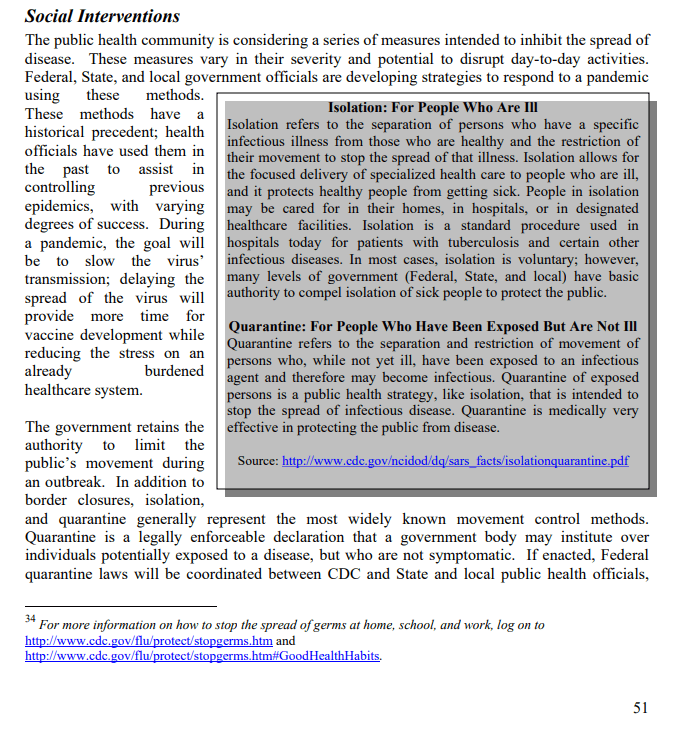
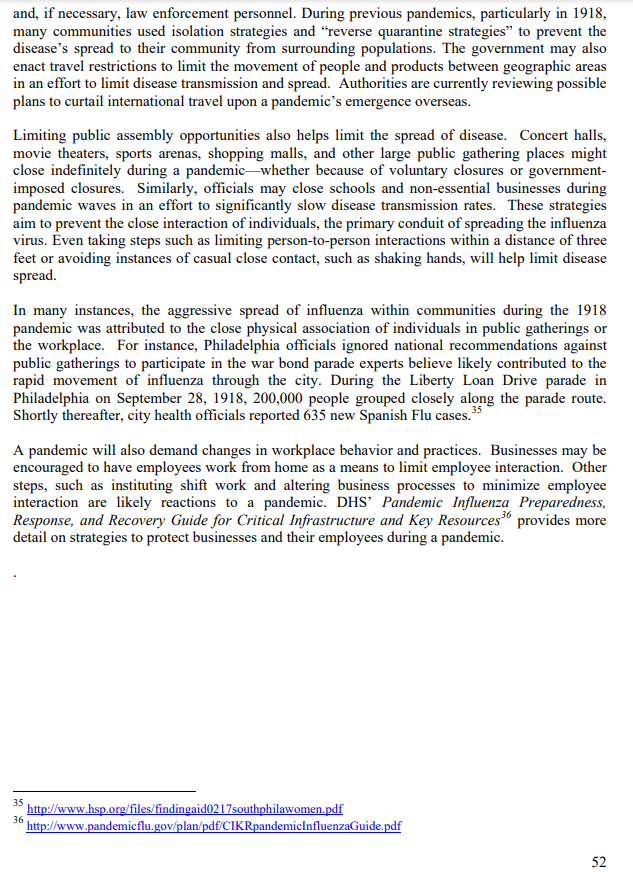
The plan contains the original list of pandemic ‘essential businesses’ that was used by CISA in 2020 to lock down America. The 2007 plan (which was itself based on a Department of Homeland Security plan from the previous year) clearly states the intention to ban large gatherings “indefinitely”, close schools and non-essential businesses, institute work-from-home, and quarantine exposed and not just sick individuals. The aim is simple and clear: to slow the spread to wait for a vaccine.
During a pandemic, the goal will be to slow the virus’ transmission; delaying the spread of the virus will provide more time for vaccine development while reducing the stress on an already burdened healthcare system.
Here’s the relevant section of the 2007 NIAC plan in full.
2006 and 2007 were a turning point in U.S. biodefence planning. Prior to 2006, such planning had been focused on biological attacks, but after that point major mission creep set in and the new draconian ideas were applied wholesale to general pandemic planning. This controversial switch in focus so riled leading U.S. disease expert D.A. Henderson, who had been involved with the project up to that point, that he issued his famous riposte objecting in the strongest terms to the new ideas. He and his fellow dissenters wrote, presciently:
Experience has shown that communities faced with epidemics or other adverse events respond best and with the least anxiety when the normal social functioning of the community is least disrupted. Strong political and public health leadership to provide reassurance and to ensure that needed medical care services are provided are critical elements. If either is seen to be less than optimal, a manageable epidemic could move toward catastrophe.
I’m told by someone who was involved with the programme in the early days that the original biodefence planning in 2002-2003 assumed a targeted biological weapons attack with smallpox as the viral case and anthrax as the bacterial case – both considered worst case scenarios. It was recognised that the old smallpox vaccine was too risky to try to use on a wider population to protect them if such an attack occurred, thus the effort for a new vaccine. But very quickly, within a year or two (not least due to the SARS outbreak in 2003), there was a massive expansion of the original mission and suddenly every infectious agent, whether dangerous or not, was cast into the web of biodefence.
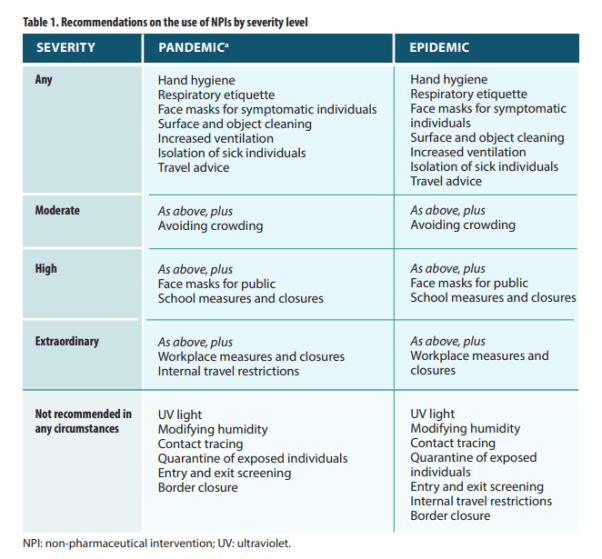
Outside the U.S. there was more resistance to this kind of totalitarian nonsense. However, even the 2019 World Health Organisation pandemic guidance bears many of its marks. While this guidance commendably did not recommend “in any circumstances” contact tracing, border closures, entry and exit screening and quarantine of exposed individuals, it did make conditional recommendations for use of face masks by the public, school and workplace closures and “avoiding crowding” i.e., social distancing.
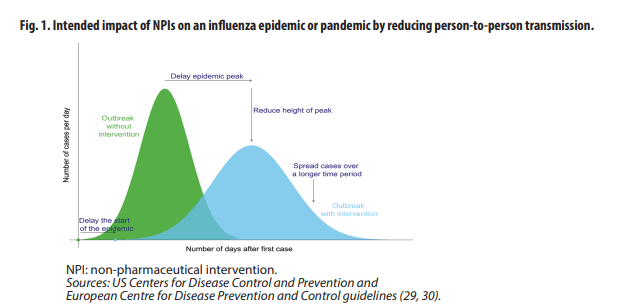
The purpose was also the same: to ‘flatten the curve’ to wait for a vaccine, as illustrated in the diagram below. The WHO guidance states: “NPIs are often the most accessible interventions, because of the time it takes to make specific vaccines available”; “specific vaccines may not be available for the first six months”; NPIs are “used to delay the peak of the epidemic… allowing time for vaccines to be distributed”.
These untested ideas, which the WHO’s own guidance rightly admitted had no good quality evidence to support them, have now become a terrible orthodoxy for global pandemic response. This is despite them utterly failing to achieve any of their goals – a point that no one who backs them seems to have noticed.
Somehow, the world must learn the right lessons from this debacle. Yet it keeps threatening to learn all the wrong ones.
New science, including a study on Covid Shot Cord blood, raises new concerns amid the reported rise in the prevalence of miscarriages, infant mortality, and stillbirth rates.
This site is provided as a research and reference tool. Although we make every reasonable effort to ensure that the information and data provided at this site are useful, accurate, and current, we cannot guarantee that the information and data provided here will be error-free. By using this site, you assume all responsibility for and risk arising from your use of and reliance upon the contents of this site.
This site and the information available through it do not, and are not intended to constitute legal advice. Should you require legal advice, you should consult your own attorney.
Nothing within this site or linked to by this site constitutes investment advice or medical advice.
Materials accessible from or added to this site by third parties, such as comments posted, are strictly the responsibility of the third party who added such materials or made them accessible and we neither endorse nor undertake to control, monitor, edit or assume responsibility for any such third-party material.
The posting of stories, commentaries, reports, documents and links (embedded or otherwise) on this site does not in any way, shape or form, implied or otherwise, necessarily express or suggest endorsement or support of any of such posted material or parts therein.
The word “alleged” is deemed to occur before the word “fraud.” Since the rule of law still applies. To peasants, at least.
Fair Use
This site contains copyrighted material the use of which has not always been specifically authorized by the copyright owner. We are making such material available in our efforts to advance understanding of environmental, political, human rights, economic, democracy, scientific, and social justice issues, etc. We believe this constitutes a ‘fair use’ of any such copyrighted material as provided for in section 107 of the US Copyright Law. In accordance with Title 17 U.S.C. Section 107, the material on this site is distributed without profit to those who have expressed a prior interest in receiving the included information for research and educational purposes. For more info go to: http://www.law.cornell.edu/uscode/17/107.shtml. If you wish to use copyrighted material from this site for purposes of your own that go beyond ‘fair use’, you must obtain permission from the copyright owner.
DMCA Contact
This is information for anyone that wishes to challenge our “fair use” of copyrighted material.
If you are a legal copyright holder or a designated agent for such and you believe that content residing on or accessible through our website infringes a copyright and falls outside the boundaries of “Fair Use”, please send a notice of infringement by contacting atheonews@gmail.com.
We will respond and take necessary action immediately.
If notice is given of an alleged copyright violation we will act expeditiously to remove or disable access to the material(s) in question.
All 3rd party material posted on this website is copyright the respective owners / authors. Aletho News makes no claim of copyright on such material.