Egypt demolished 3,600 Sinai buildings in three months: Report
MEMO | May 22, 2018
The Egyptian army has “vastly expanded” the destruction of homes, commercial buildings and farms in Egypt’s North Sinai region since 9 February 2018, a report by Human Rights Watch (HRW) said today.
Since 2014 the Egyptian government has pursued plans to create a buffer zone along its border with Gaza on the pretext that fighters and weapons are being smuggled through the tunnels that connect the peninsula to the Strip.
Activists have said this war on terror is better described as a war on civilians. Between July 2013 and August 2015 the Egyptian Army demolished at least 3,250 buildings to this effect, according to HRW.
In late 2017 authorities resumed demolitions with the view to creating another buffer zone around Al-Arish airport following a missile attack on an air base and military helicopter. On 9 February 2018 the Egyptian military intensified this military campaign with the launch of “Operation Sinai” which they said would rid the region of terrorism once and for all.
Under this operation demolitions have escalated. By analysing a time series of satellite imagery HRW has revealed that the military destroyed at least 3,ooo homes – the largest number since the 2014 campaign began – in just two months. Homes of alleged terrorists, activists and their relatives in North Sinai’s largest city Al-Arish have also been set on fire and then demolished.
There has been no judicial oversight of the demolitions and the government has cut electricity and water of the houses they are evicting to force people to leave.
According to the report residents were given between 24-48 hours warning to evict, no assistance for moving to temporary housing, no process to appeal compensation decisions or for destruction of or damage to farmland.
Middle East Director at HRW Sarah Leah Whitson said: “Turning people’s homes into rubble is part of the same self-defeating security plan that has restricted food and movement to inflict pain on Sinai residents.”
The Egyptian army claims it is protecting people from militants, but it’s absurd to think that destroying homes and displacing lifelong residents would make them safer.
The demolitions and forced evictions have exacerbated an already dire humanitarian situation in North Sinai, according to HRW, which has calculated that 420,000 residents in North Sinai have been in urgent need of humanitarian assistance since “Operation Sinai” began. With the destruction of farms entire extended families have lost their livelihoods.
Because it is illegal to enter Sinai without a permit, the lack of journalists and human rights workers there means there is an information blackout on the atrocities committed.
Russia welcomes Egypt’s refusal to send troops to Syria on US proposal
Al-Masdar News – 14/05/2018
Russia views positively Egypt’s decision against sending its troops to Syria as was proposed by Washington, Russia’s Foreign Minister Sergey Lavrov said after negotiations between Russian and Egyptian foreign and defense ministers in the 2+2 format on Monday.
“We touched upon this issue in the context of discussing the Syria situation, in the context of discussing actions of the so-called foreign players, including, of course, the United States, because it is precisely its idea to invite Arab countries to send their contingents to the Syrian Arab Republic,” the Russian foreign minister said.
“As I understand, this is done for the dual purpose: on the one hand, to share responsibility for the direct and gross violation of the sovereignty and the territorial integrity of Syria, which did not invite the United States and other participants of the US-led coalition to its territory, and the second goal is to share the financial burden,” Russia’s top diplomat said.
“Washington is talking directly and openly about this. I believe everyone understands what stands behind this invitation and we appreciate the position assumed by Egypt,” Lavrov said.
“We discussed this issue as part of the general discussion. Egypt has numerously stressed that it will not send its troops outside its territory as the Egyptian military doctrine stipulates that Egypt’s armed forces must defend only the borders. We discuss such issues only from the theoretical point of view as possible steps,” Egyptian Foreign Minister Sameh Shoukry said.
Some Western media outlets earlier reported about a possible dispatch of Arab armed forces, including from Egypt, to Syrian districts controlled by the United States instead of the US military contingent present there for the purpose of assisting stabilization in the country’s northern part after the defeat of the Islamic State terrorist organization (outlawed in Russia).
ALSO READ Syrian Army on the verge of liberating all of Hajar Al-Aswad from ISIS
Commenting on this information, Shoukry stated that Egypt did not consider sending a military contingent to Syria as part of the US initiative.
Leaked video appears to show extrajudicial execution in Sinai
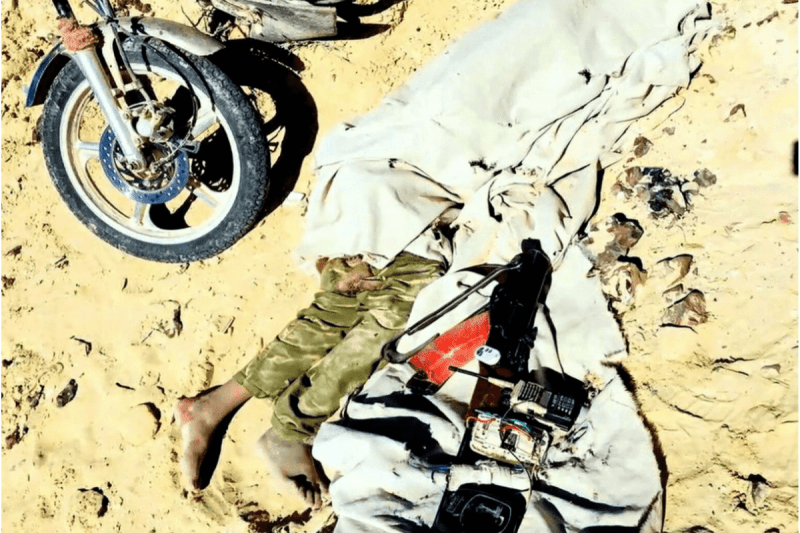
A leaked video appears to show a child being executed at close range in Egypt’s Sinai Peninsula by an army officer [Twitter]
MEMO | May 8, 2018
A leaked video appears to show a child being executed at close range in Egypt’s Sinai Peninsula by an army officer.
In the 30 second video the young boy is lying on a hill partially covered in white material. Moments before his death he asks for his mother.
“Don’t worry,” replies the army officer. “We’ll call your father to pick you up. We’ll cover you,” he adds, before shooting him in the head.
The incident took place in 2015 though the video was leaked today after being sent to Egyptian activist Haitham Ghoneim by a soldier who was serving in Sinai.
Ghoneim drew attention to a statement posted on Twitter in March this year which shows a picture of what looks like the same young boy with bomb-making equipment placed next to his body. The army spokesman vows to destroy terrorist dens and hotbeds and declares success in eliminating a terrorist cell and arresting 345 individuals.
#المتحدث_العسكرى : البيان السادس عشر للقيادة العامة للقوات المسلحة … pic.twitter.com/UaoOCeXlmj
— المتحدث العسكري (@EgyArmySpox) March 19, 2018
Although the video cannot be independently verified, if it is true this young boy is another victim of the heavy-handed war on terror Egyptian security forces are waging in Sinai which purports to be against the local Daesh affiliate, Sinai Province. Under this counterterror operation authorities have forcibly disappeared hundreds of civilians. Several have been extrajudicially executed and then presented to the public as terrorists.
Egyptian authorities released a video last year which alleges to show an anti-terror raid that killed ten Daesh fighters yet experts who analysed the footage said there were indications that it was fake, for example the positions of the bodies suggest they had been moved. At least some of the men in the footage were arrested some months before its release.
In April last year Mekameleen TV station based in Istanbul broadcast a video of an Egyptian military officer executing young men then placing their rifles next to the bodies for photographs to film them and then removing the guns. Two of the victims were identified as 16-year-old Daoud Sabri Al-Awabdah and his brother, 19-year-old Abd Al-Hadi Sabri, who were forcibly disappeared on 18 July 2016.
A violent crackdown in Sinai has been ongoing since 2013 but intensified earlier this year when the government launched Sinai 2018 ahead of Abdel Fattah Al-Sisi’s deadline to “restore stability and security” in the region.
Roads have closed isolating cities from each other and the North Sinai governorate from Egypt’s mainland. There is not enough food, schools and universities have shut and homes are being evacuated and demolished including around Al-Arish airport to create a security buffer zone.
Arbitrary arrests, enforced disappearances, torture and extrajudicial killings are rife yet the details of what takes place in the region are murky. Journalists and human rights organisations are not allowed into Sinai without permission from the government, which is rarely granted.
READ:
Extrajudicial execution of 54 people over ‘terrorism’ allegations
Egypt presidential decree allows Bahrain King to own villas in Sinai
MEMO | May 2, 2018
Egyptian President Abdel-Fattah Al-Sisi has issued a presidential decree permitting the King of Bahrain, Hamad Bin Isa Al Khalifa, to own two villas located in the South Sinai province of Sharm El-Sheikh, Egypt’s state’s official Gazette reported on Monday.
In accordance to the Sinai Development Law No.14/2012, any land on the peninsula can only be owned by Egyptian nationals.
However, a statement released on the State Information Service website claims that Al-Sisi issued a presidential decree approving treating Bahraini King Al Khalifa as an Egyptian citizen in 2016.
“The decree is also applicable to the possession of lands and villas in Naama Bay of Sharm El-Shiekh city for the purpose of residence,” the statement concluded.
The news comes just days after the announcement of a $15 billion project to develop the restive Sinai Peninsula that should be completed by 2022, with a presidential aide describing the scheme as “a project for national security”.
The project includes plans for a comprehensive network of roads, residential and industrial developments, four water desalination plants, hospitals and sewage networks. Funding sources for the initiative remain unclear.
Egypt is reportedly preparing to launch a significant military attack in upcoming days in the area bordering Gaza and Israel, with Egyptian forces amassing near the Rafah crossing.
However, last week, New York based watchdog Human Rights Watch expressed concern over the risk of a looming humanitarian crisis in North Sinai as a result of the Egyptian army’s military operation. Nearly 420,000 residents in four north-eastern cities are in urgent need of humanitarian assistance due to the ongoing battle.
According to the report, security forces have also imposed strict restrictions on the movement of goods and people throughout the governorate.
The report quoted local residents as saying that “the authorities have also banned the sale or use of gasoline for vehicle use in the area and cut telecommunication services for several days at a time. The government has cut water and electricity almost entirely in the most eastern areas of North Sinai, including Rafah and Sheikh Zuwayed.
Egypt has been facing a Daesh insurgency in the remote North Sinai region that has killed hundreds of soldiers and policemen in recent years.
Human rights organisations have, however, accused Egypt of using the fight against terror in Sinai as a ruse to cover up the extrajudicial killing of opponents and critics.
Lebanese Journalist Names Washington’s Goal Number One in Syria
Sputnik – April 19, 2018
Sputnik spoke to Lebanese journalist and commentator Sharmine Narwani to find out more about situation in Syria and Washington’s goals and actions there.
It has been revealed that US Secretary of Defence, James Mattis, tried to urge US President Donald Trump to obtain congressional approval before launching airstrikes on targets in Syria last weekend. According to reports, President Trump was however set on the use of military force, and overruled the Pentagon chief’s advice. In other developments, Saudi Arabia is reportedly holding talks with the United States and Egypt about sending an Arab coalition force into Syria.
Sputnik: We’re hearing news that the US is in talks with Saudi Arabia to build an Arab force and send it to Syria. Saudi Arabia’s foreign minister has said that he is in talks with US National Security Advisor John Bolton to plan building this force – what do you make of this, what do you think its purpose is?
Sharmine Narwani: Look Trump wants to clear exit the debacle in Syria and eliminate the need to spend billions of dollars a year in maintaining US forces there and participating in the war. The recent chemical weapons allegations came shortly after Trump vocalised this desire; but the likelihood of an Arab force to physically base themselves in Syria on the Syrian-Iraqi border is virtually nil. We must view this new tactic with some suspicion. The US has always trumpeted ISIS as its main goal in Syria or the elimination of ISIS. If ISIS is gone, then what’s the need to have foreign forces based on that border? It seemed clear all along that containing Iran’s access from Iran to the borders of Palestine has always been the goal. It’s not as though Saudi Arabia and Egypt have stellar or significant nation-building expertise anyway. And they have many differences – the Saudis and the UEA for instance are heavily involved militarily in Yemen and are overextended there. Egypt has shown reluctance to participate in that Arab conflict, let alone another one with a government that it has actually sort of ideologically supported in the Syrian conflict. So it’s not likely to become a reality.
Sputnik: Of course in the lead up to the Western bombing campaign on Syria the US was saying that President Bashar al-Assad had used sarin gas, but we’ve now found out that they did not have sufficient evidence of this at the time. Also, the New York Times has revealed that Defence Secretary Jim Mattis urged Trump to get congressional approval for the strikes, but the president overruled him on that – what does this all tell you about the lead up to the events of last weekend?
Sharmine Narwani: If we look at the recent events leading up to the alleged chemical weapons incident, it took place under cover of two important developments: one was Trump’s declaration of exiting Syria, and removing US troops from there soon. The second would be the Syrian army’s very rapid defeat of terrorists in Eastern Ghouta and the reclamation of that strategically vital territory around Damascus. I think the sort of bringing up Sarin, the nerve gas sarin, it’s always kind of utilised as an emotional trigger, as is the mention of chemical weapons by itself and the general assumption if we’re talking about sarin would be that only states would have access to that particular substance, and not terrorist groups and non-state actors, unlike say with a substance like chlorine that is readily available. So I think it was very deliberately invoked, meaning sarin, to create an emotional response globally.
But Sarin has been used in Iraq by insurgents since at least 2004, in the form of IEDs. Turkey for instance, in May 2013, way later during the Syrian conflict, captured 12 Nusra members, Nusra is the Al-Qaida arm in Syria, they captured 12 Nusra members with significant amounts of Sarin and that was believed to be heading toward Syria. And major US-UK risk analysis firm IHS Conflict Monitor, in 2016, told us in a report that ISIS has used chemical weapons more than 52 times in both Syria and Iraq.
Sputnik: We’ve heard today that US senators are increasingly becoming concerned at the absence of a coherent US strategy in Syria, where do you see things from here?
Sharmine Narwani: Even during Obama’s term, we talked about there being a lack of coherent strategy. I would say that there is maybe a lack of a coherent verbalised strategy, one that was disseminated to the American public and an international one. There was certainly a strategy behind the scenes, one that was not vocalised and actions speak louder than words, so when we look at the arming, training and financing of terrorists when it was clear that there wasn’t enough Syrian support to topple Assad in the way leaders had been toppled in Tunisia and Egypt. We had the arming, training & financing but there was a very clear strategy, and the goal was number one, regime change, and two, to weaken the most important Iranian Arab state ally. So that was the strategy. When people say there wasn’t a coherent one they probably mean there wasn’t a coherent vocalised one. US actions have certainly shown us that regime change and weakening Iran were in fact the strategy in Syria and this is apparent today because the escalation still continues.
The Egypt-Israel gas deal is scandalous and shameless
Dr Amira Abo el-Fetouh | MEMO | February 21, 2018
After Al-Sisi opened the very large Zohr gas field about two weeks ago the newspapers celebrated and announced the news that Egypt will achieve gas self-sufficiency this year by means of the Zohr, North Alexandria, Nawras, and Atoll gas fields. The Egyptian citizens lived this dream until they awoke to a nightmare where Netanyahu is announcing that Israel is celebrating after signing a historical agreement with Egypt that stipulates Egypt will import gas from Israel for 10 years. The imported gas agreement is worth $15 billion and these billions will be added to the Israeli treasury in order to be spent on education, health services, and welfare for Israeli citizens.
Of course it was no coincidence that Netanyahu announced this great news to the Israeli people on the anniversary of President Anwar Sadat’s visit to Jerusalem, as such an agreement poses a new victory for Israel, no less significant than its victory in 1967 and the signing of the peace treaty. In my opinion, they are crowning their victories with this latest victory, as a result of which they control energy in Egypt and the key to the energy tap is placed in their hands. They can turn it off whenever they please. Whoever controls the energy can suffocate the states that live under its mercy and can control the decisions of these states.
This is a major crime committed against Egypt as a state and against its people. This gas is actually Egyptian gas that was seized by Israel either without the ruling government’s knowledge or in collusion with it. Instead of admitting to this crime and being ashamed of it, the government’s mouthpieces and corrupt media came up with justifications and excuses more criminal and shameless than the act itself. Some examples include but are not limited to the claims that the government has nothing to do with the Israeli gas import deal, overlooking the fact that the government facilitated the deal and prepared a draft bill allowing the private sector to import gas from abroad and sell it in the local market. Of course, the corrupt parliament, which does as the government desires and was formed under its watchful eye, approved the bill. It is foolish to make such claims when everyone knows that no private company can import anything without first obtaining government approval. Moreover, where would an unnamed company that has never operated in this field before, come up with $15 billion from to pay the Israelis?
Another justification included claims that economic interests dictate relations between countries and that there is no problem importing gas, even from an enemy, as long as it serves Egypt’s interests. However, those making these claims forgot that a country’s interests cannot be served by their enemy, and that from a purely national security standpoint, it is a strategic mistake to link Egypt’s energy security to Israel, which can stop exporting gas to Egypt if any conflict between the two countries arises.
The most absurd justification is the claim that Egypt is seeking to turn into a regional centre for energy and that the gas market has become available and open to any private company. No one bothered to mention what happened to the natural gas self-sufficiency claims made two weeks ago and ask why Egypt is importing gas when it has one of the largest gas fields, the Zohr gas field, in addition to the fields discovered in Egyptian regional waters and in the western and eastern deserts.
These mouthpieces also failed to mention why Egypt is importing gas specifically from Israel, especially since there are several alternatives, such as Algerian, Iraqi or Russian gas.
However, what is most astounding is the strange silence of the Egyptian government regarding this suspicious agreement, compared to the historical celebrations in Tel Aviv. Of course these celebrations are completely understandable given the financial, strategic, and moral benefits the agreement will grant Israel. Israel never dreamt of such benefits, even during the rule of Hosni Mubarak, their strategic treasure. What we cannot understand or accept is the fact that the corrupt Egyptian media is celebrating this agreement, despite the fact that such an agreement is the most prominent manifestation of betrayal and treachery, and the secret to the link between Egypt’s energy security and Israel’s gas.
Egypt begins major military operation in Sinai, Nile Delta
Press TV – February 9, 2018
Egypt has begun a sweeping military operation against the militants active in violence-torn North Sinai Province in the extreme northwest and the nearby Nile Delta.
The army announced the launch of ‘Operation Sinai 2018’ on Friday, putting the police and military forces on “maximum alert,” AFP reported.
The goal is to tighten control of border districts and “clean up areas where there are terrorist hotbeds,” it added.
The campaign involves the air force, navy and army as well as police, he said.
“The armed forces calls upon the Egyptian people in all parts of the country to closely cooperate with law enforcement forces to confront terrorism, uproot it and immediately report any elements threatening the security and stability of the country,” the military spokesman, Colonel Tamer al-Rifai, said in a televised address.
Last week, The New York Times reported that President Abdel Fattah el-Sisi had kept northern Sinai a closed military area, barring reporters from the region.
The Associated Press has reported that the Egyptian army was bulldozing homes and olive groves to build “a buffer zone” around North Sinai Province’s only airport in the city of el-Arish.
The report said the buffer zone will destroy dozens of hamlets around the airport, forcing thousands of people to leave their homes for an unknown future, sparking some protest by residents despite the government promises of compensation.
Sisi, who is preparing to seek a second term in the upcoming March elections, has vowed that the army will employ “absolute force” in a bid to eliminate terrorism in the Sinai Peninsula.
The Sinai Peninsula has been under a state of emergency since October 2014, after a deadly terrorist attack left 33 Egyptian soldiers dead.
Over the past few years, terrorists have been carrying out anti-government activities and fatal attacks, taking advantage of the turmoil in Egypt that erupted after the country’s first democratically-elected president, Mohamed Morsi, was ousted in a military coup in July 2013.
The Velayat Sinai group, which is affiliated with the Daesh Takfiri terrorists, has claimed responsibility for most of the assaults.
Featured Video

“Historic Russia”: The Land Putin Will Not Give Back
or go to
Aletho News Archives – Video-Images
Book Review
Why the War on Conspiracy Theories Is Bad Public Policy
By Kevin Barrett • Unz Review • February 1, 2019
 A Review of Conspiracy Theories and Other Dangerous Ideas by Cass Sunstein (based on an earlier paper co-authored with Adrian Vermeule); In Defense of Troublemakers: The Power of Dissent in Life and Business by Charlan Nemeth; and Conspiracy Theories and the People Who Believe Them, edited by Joseph E. Uscinski
On January 25 2018 YouTube unleashed the latest salvo in the war on conspiracy theories, saying “we’ll begin reducing recommendations of borderline content and content that could misinform users in harmful ways—such as videos promoting a phony miracle cure for a serious illness, claiming the earth is flat, or making blatantly false claims about historic events like 9/11.”
At first glance that sounds reasonable. Nobody wants YouTube or anyone else to recommend bad information. And almost everyone agrees that phony miracle cures, flat earthism, and blatantly false claims about 9/11 and other historical events are undesirable.
But if we stop and seriously consider those words, we notice a couple of problems. First, the word “recommend” is not just misleading but mendacious. YouTube obviously doesn’t really recommend anything. When it says it does, it is lying. … continue
Blog Roll
 Aletho News
- “Historic Russia”: The Land Putin Will Not Give Back
- How the Cambridge Analytica scandal still haunts Mark Zuckerberg
- The Ongoing Cancellation Campaign Against a Dissenting Academic in Norway
- Yemen and ‘the Houthis’: Challenging Sami Hamdi’s Narrative
- No, Christians did not invent Zionism
- AIPAC-led lobbying network opens branches in Cypriot, Greek parliaments
- Araghchi blasts ‘parasitic’ alliance as US taxpayers pay for Israel’s war on Iran
- Easy fix for Europe’s chaos? Stop fueling war against Russia
- Putin’s key remarks on peace talks and Europe’s ‘schizophrenia’
- Trita Parsi: Israel Set a Trap for Total War in the Region
- If Americans Knew
- An error has occurred; the feed is probably down. Try again later.
- No Tricks Zone
- Two New Studies Find Thwaites Glacier Melt Cannot Be Driven By Human Activity Or A Warming Ocean
- E-Cars Reduce CO2 Emissions By Only 41% Compared To Internal Combustion Engine Vehicles
- Predictions Made By Renowned Climate Professor Over Past Decades Have Been Proven To Be Poor
- New Study Suggests Large Regions Of The Pacific Ocean Have Been Cooling For The Last 80 Years
- Germany’s Green Energy Debacle: High Energy Costs Force Kahla Porzellan to Close After 182 Years!
- New Study: 50 Years Of The Most Aggressive ‘Net Zero’ Policies Can Only Affect The Global Climate By 0.03°C
- US September “Heat” Was No Record…Many Records Set Decades Ago
- Latest European Green Energy Debacle; Portugal’s Largest Flagship Solar Park Insolvent!
- Green Energy Debacle: German Expert Professor Fritz Vahrenholt Warns Of Severe Economic And Social Consequences
- Two More Paleo Reconstructions Affirm Meters-Higher Sea Levels Across Ireland, Brazil 7000-6000 Years Ago

