Although 2016 looks bleak for Gaza, there is a chink of light
By Dr Daud Abdullah | MEMO | January 5, 2016
Throughout the whole of 2015 the Rafah Crossing between the Gaza Strip and Egypt was open for just 21 days. On 31 December, the Egyptian authorities opened the border to deliver the corpse of a 28 year-old mentally-ill Palestinian, Ishaq Khalil Hassan, who was shot in full view of the cameras after he had strayed into Egyptian waters while swimming in the Mediterranean. As the Israeli-led — and Egyptian-backed — blockade of Gaza enters its tenth year, there is little hope that the Rafah Crossing will be opened for any meaningful number of days in 2016.
In fact, a combination of domestic and external factors are likely to continue to prevent an early end to the siege. The cold-blooded killing of Hassan by the Egyptian army in late December was indicative of a hardening of Cairo’s attitudes toward the Palestinians in Gaza. As a result, many more will pay with their lives, either through being denied unrestricted passage through Rafah to get essential medical treatment, or by attempting to smuggle basic needs through the tunnels once described as Gaza’s “lifeline”; or by falling victim to Israeli or Egyptian state violence.
For now, there is no shortage of excuses for keeping the Rafah Crossing closed; the usual excuse given to the Palestinians is that the security situation in north Sinai necessitates the closure. While it is true that there is a deadly insurgency in the Sinai which is taxing the resources of the Egyptian security forces and needs a massive political effort to resolve, that does not justify the demonisation and extrajudicial killing of Palestinians.
It has not gone unnoticed that on every occasion that the crossing was open last year there was a major security incident on the Egyptian side of the border. Coincidence? Perhaps, or maybe such incidents were planned in order to provide the Egyptian authorities with an excuse to keep Rafah closed. We will probably never know.
Israel’s role in prolonging Gaza’s humanitarian ordeal, however, is far more clear-cut. Soon after Hamas was elected to run the Palestinian Authority in January 2006 the Israelis imposed economic sanctions against the enclave. At the time, Dov Weisglass, an advisor to the then Israeli Prime Minister Ehud Olmert, said, “The idea is to put the Palestinians on a diet, but not to make them die of hunger.”
The following year, Israel declared Gaza to be a “hostile entity” and tightened further its sanctions regime. By adopting this designation, the Israeli cabinet had in effect voted to keep Gaza under a permanent state of siege.
Repeated calls by world leaders, including UN chief Ban Ki-moon, to end the blockade have all fallen on deaf ears. In 2010, Mr Ban condemned the blockade, saying that it caused “unacceptable sufferings.” Today, international aid agencies have confirmed that 80 per cent of Gaza’s inhabitants are aid dependent because of unemployment and poverty created by the Israeli siege.
It has now become abundantly clear that the aims of the blockade have gone well beyond the near-starvation proposed by Weisglass; it has been extended to ensure that young Palestinians in Gaza are even denied the basic right to an education. According to the Palestinian ministry of education, the blockade is currently impeding the building of 55 schools in the territory.
Internally, political analysts and observers in Gaza don’t expect 2016 to be any better than last year. There is a general sense among most that without a resolution of the differences between the two main factions, Fatah and Hamas, things will not improve. Perhaps the most intractable factor in this dossier is who controls the Rafah Crossing.
This week, a new formula has been proposed by the Popular Front for the Liberation of Palestine (PFLP), Islamic Jihad and other factions to resolve the issue. It suggests the appointment of an independent body of technocrats to oversee the border with the reappointment of those Fatah officials who were removed when Hamas took over the territory in 2007. At the same time, it stipulates that those officials employed by Hamas should retain their positions. An agreement on this formula between Fatah and Hamas could pull the rug from under the feet of the Egyptian government and nudge it to reopen the crossing.
Another ray of hope comes from the ongoing talks between Turkey and Israel, both of whom have now decided to normalise relations. While Israel has agreed to some of the Turkish conditions —notably an apology for the Freedom Flotilla attack in 2010 and compensation for the victims’ families — one condition remains hanging in the balance: Ankara’s demand for an end to the blockade of Gaza. As it has done so many times in the past, Israel has agreed to an “easing” of the restrictions but, as before, it has not actually defined what that means. If past experience is anything to go by, it means very little.
Sources close to the talks, though, have told MEMO that Turkey has proposed the construction of a sea port in Gaza and offered to administer it. So far Benjamin Netanyahu and his government remain implacably opposed to this. Nevertheless, although it will be a bitter pill to swallow it may actually be the best face-saving device for the Israelis to accept. After all, Israeli commentators and intelligence officials alike have realised that instead of weakening Hamas the blockade has strengthened the movement.
While it is hard to imagine a year worse than 2015, Gaza is caught in a downward spiral from which it will be difficult to escape. However, this Turkish proposal provides a chink of light that, with goodwill, could lead to 2016 not being as bad as last year after all. Some courageous steps are needed to make it work, but it is possible. to 2016 not being as bad as last year after all. Some courageous steps are needed to make it work, but it is possible.
Journalist sentenced to 3 years imprisonment in Egypt
Mada Masr | January 3, 2015
Journalist Mohamed Abdel Moneim was sentenced to three years imprisonment on Sunday, after a court found him guilty of partaking in an unauthorized protest dating back to April 24, 2015. However, Abdel Moneim’s coworkers at the Tahya Masr news portal insist he was arrested while covering this protest, not participating in it.
Convening at the Police Academy, Cairo Criminal Court ruled that Abdel Moneim had breached the Protest Law by taking part in an unauthorized street protest. The court also ruled that the 22-year-old journalist was guilty of possessing weapons, Molotov cocktails, obstructing traffic, endangering the lives of civilians, as well as damaging both public and private properties.
The privately owned Al-Shorouk newspaper reported that the court had issued an identical sentence against two other defendants on Sunday: a 19-year-old student Essam Abdel Hakim, and 15-year-old student Abdel Rahman Sayyed.
The three-year sentence against the journalist was issued despite the in-court testimony of Tahya Masr’s administrative chief who, according to Al-Shorouk, confirmed that Abdel Moneim was his employee, and had been covering the street protest in question. Abdel Moneim’s boss added that the young journalist was objective in his coverage of protests, siding neither with the current administration, nor with the ousted regime of the Muslim Brotherhood.
According to state-owned Al-Ahram, the court did not recognize that Abdel Moneim was a journalist, as he is not an officially registered member of the Journalists’ Syndicate. However, there are several thousand journalists said to be operating in Egypt who are unable to enter this syndicate due its restrictive preconditions for membership.
As of last month, the Liberties Committee of the Journalists’ Syndicate announced that there are at least 32 journalists in detention across Egypt, from which at least 18 were arrested while reporting in public spaces.
The Liberties Committee has organized several petitions calling for the release of detained journalists and media staffers, along with several legal appeals, protests, and marches along with campaigns for improved treatment of jailed journalists.
According to the chief of the Liberties Committee, Khaled al-Balshy, at least 350 cases of assaults against journalists have been documented over the past two years.
Egypt sends ambassador to Tel Aviv after three-year haitus
Press TV – January 3, 2016
Egypt has sent a new ambassador to Tel Aviv after a three-year lapse in diplomatic presence in the occupied territories.
Israel’s foreign ministry said on Sunday that Egyptian ambassador Hazem Khairat arrived on Friday.
Israeli Prime Minister Benjamin Netanyahu welcomed Khairat’s arrival at his cabinet meeting on Sunday and said this would enable both sides to further “strengthen relations.”
Khairat previously served as Egypt’s ambassador to Chile and the Arab country’s envoy to the Arab League. He was appointed as the ambassador to Tel Aviv by President Abdel Fattah el-Sisi in June, but was deployed on Friday.
Khairat is the first residing Egyptian ambassador in Tel Aviv since former President Mohammed Morsi recalled Cairo’s last ambassador in November 2012 in protest to the Israeli regime’s aggression against Palestinians in the besieged Gaza Strip.
Relations between Egypt and the Israeli regime have been growing since Sisi took power in the Arab country in 2014 after orchestrating a military coup against Morsi, Egypt’s first democratically elected president, a year earlier.
The Israeli regime appointed Haim Koren as its envoy to Cairo in 2014 and opened its embassy in September 2015 after a four-year closure due to security concerns.
The embassy was closed on September 9, 2011, after thousands of protesters stormed the compound following the killing of six Egyptian policemen in August the same year by Israeli forces during cross-border operations on Egyptian soil in the Sinai Peninsula.
Last summer, Egypt launched a project to flood the area along its border with Gaza Strip to destroy the underground lifeline tunnels linking Egypt to the Palestinian territory.
In mid-June 2015, the Egyptian military said it had demolished nearly 1,430 underground tunnels in 18 months.
The Egyptian army claimed that the tunnels were “used by terrorists and criminals” to smuggle weapons to militants in the Sinai Peninsula. The World Food Program (WFP), however, said in a report in February 2014 that the tunnels have represented “the main supply and commercial trade route for goods into Gaza” since 2007.
Dozens of people, mostly Palestinians, have lost their lives during the destruction of tunnels, which has intensified since the 2013 ouster of Egypt’s first democratically-elected President Mohamed Morsi.
Gaza has been under the Israeli air, sea and land blockade since 2007, causing a decline in living standards, unemployment and unrelenting poverty.
The Rafah border crossing, the sole crossing point between Egypt and Gaza, has also largely been shut since the 2013 coup in the African country.
Egypt Loses $300Mln Monthly Amid Absence of Russian, UK Tourists
Sputnik – 23.12.2015
In November, Russia and the United Kingdom suspended flights to Egypt after a Russian Airbus A321 passenger plane crashed in Egypt as a result of a terrorist attack in October.
“The absence of tourists from Russia and the United Kingdom is costing us $300 million a month. Now the second month like this is coming to an end. The figures show what a serious blow the plane crash has dealt to the Egyptian tourism industry and to our economy in general,” the minister said in an interview with the Russian daily Kommersant.
In November, Adviser to the Egyptian Minister of Tourism Mohamed Yousef said that the loss of Russian and UK tourists would deprive Egypt of 70 percent of its tourist traffic. Tourism constitutes over 11 percent of the country’s GDP and accounts for 14 percent of its total foreign currency earnings.
On October 31, a Russian Airbus A321 crashed in Egypt’s Sinai Peninsula while en route from the Egyptian resort city of Sharm el-Sheikh to St. Petersburg, killing all 224 people on board. The Islamic State (IS, or Daesh in Arabic) terrorist group, which is outlawed in Russia and many other countries, claimed responsibility for the crash.
Egypt gets billions in aid from Saudi Arabia, World Bank
Mada Masr | December 16, 2015
Egypt, which is facing dwindling foreign reserves and a yawning budget deficit, will be getting a major boost this month, thanks to large aid packages coming in from Saudi Arabia, the African Development Bank and the World Bank.
On Wednesday, Prime Minister Sherif Ismail announced that Saudi Arabia will increase its investment in Egypt to 30 billion riyals (LE62 billion/US$8 billion), support Egypt’s petroleum needs for five years, and help boost traffic through the Suez Canal.
The announcement came after a Tuesday meeting of the Egyptian-Saudi coordination council. On Monday, Saudi Arabia announced that Egypt, along with 34 other states, was joining a Saudi-led alliance to fight terrorism.
In a Monday press conference, Ismail told reporters that during the meeting he intended to discuss the possibility of Saudi Arabia depositing funds at Egypt’s Central Bank — a more direct form of support for the government than increased investment. Official communications since the meeting have not mentioned this possibility, but an anonymous official told Bloomberg news the Kingdom is considering buying Egyptian treasury bonds and bills instead.
In related news, Egypt’s Minister of International Cooperation Sahar Nasr announced Tuesday that the board of the African Development Bank approved a US$500 million soft loan to Egypt. According to Nasr, the loan is part of a comprehensive economic development program that will loan US$1.5 billion to support Egypt’s general budget over three years, and signals the bank’s trust in Egypt’s economic and social program.
Meanwhile, the World Bank’s executive board is scheduled to meet Thursday to approve a US$1 billion budgetary support loan for Egypt. According to Egyptian officials, the loan is part of a three-year, US$3 billion package. It will be granted in accordance with the World Bank’s new Country Partnership Framework for Egypt, a document that is also expected to be approved on Thursday.
The last time Egypt received a major infusion of foreign support was April 2015, when Saudi Arabia, Kuwait and the United Arab Emirates each deposited US$2 billion at Egypt’s Central Bank. These deposits helped pushed the country’s foreign reserves to over US$20 billion.
Since then, reserves have dwindled, reaching US$16.42 billion at the end of November. In early December, Egypt’s new Central Bank governor, Tarek Amer, said the country’s reserve position was stable, and would improve in the coming months.
Pakistan foreign secretary says surprised at Saudi coalition decision
Press TV – December 16, 2015
Pakistani Foreign Secretary Aizaz Chaudhry says he was surprised that Saudi Arabia included Pakistan in a so-called anti-terror coalition whose formation Riyadh recently announced.
The foreign secretary said Wednesday that he had no knowledge of Saudi Arabia’s decision on the inclusion of Pakistan in the 34-country coalition, adding that Riyadh never gained Pakistan’s consent for the move.
Chaudhry said he was surprised to read the news a day earlier that Pakistan will be part of the Riyadh-led coalition with an alleged goal of combating terrorism in Iraq, Syria, Libya, Egypt and Afghanistan.
The Pakistani foreign secretary has asked the ambassador to Riyadh to get a clarification from Saudis on the matter. In addition, a later report on the website of the Dawn daily quoted a Pakistani Foreign Office statement as saying that Pakistani officials are awaiting details from the regime in Riyadh to decide whether to participate in the coalition.
Pakistan’s army spokesman Lieutenant General Asim Bajwa said Islamabad’s policy is not to look for any involvement ‘outside our region.’
This is the second time in a year that Pakistan regrets Saudi Arabia’s uncoordinated naming of the country in a foreign military mission. In April, Islamabad announced that it will not join a group of Arab countries in the Saudi deadly campaign against Yemen.
Saudi Arabia announced on Tuesday the formation of the military coalition, saying countries such as Egypt, Qatar, the United Arab Emirates, Turkey, Malaysia, Pakistan and several other African and Persian Gulf states form the coalition. Saudi state television said the headquarters of the alliance will be based in Riyadh.
This comes as Saudi Arabia is known as the main supporters of terror groups like Daesh in Syria and Iraq.
100,000 foreign troops incl. Americans to be deployed in Iraq, MP claims
RT | December 10, 2015
The US is to send some 10,000 troops to Iraq to provide support for a 90,000-strong force from the Gulf states, a leading Iraqi opposition MP has warned. The politician said the plan was announced to the Iraqi government during a visit by US Senator John McCain.
During a meeting in Baghdad on November 27, McCain told Prime Minister Haider Abadi and a number of senior Iraqi cabinet and military officials that the decision was ‘non-negotiable’, claimed Hanan Fatlawi, the head of the opposition Irada Movement.
“A hundred thousand foreign troops, including 90,000 from Saudi Arabia, the UAE, Qatar and Jordan, and 10,000 troops from America will be deployed in western regions of Iraq,” she wrote on her Facebook page.
She added that the Iraqi prime minister protested the plan, but was told that “the decision has already been taken.”
McCain and fellow hawk Senator Lindsey Graham have both been calling for a tripling in the current number of US troops deployed in Iraq to 10,000, and also advocate sending an equal number of troops to Syria to fight against the terrorist group Islamic State (IS, formerly ISIS/ISIL) and the government of Syrian President Bashar Assad. The Americans would prop up a 90,000-strong international ground force provided by Sunni Arab countries like Egypt, Turkey and Saudi Arabia.
“The region is ready to fight. The region hates ISIL – they are coming for Sunni Arab nations. Turkey hates ISIL. The entire region wants Assad gone. So there is an opportunity here with some American leadership to do two things: to hit ISIL before we get hit at home and to push Assad out,” Graham argued during the joint visit to Baghdad in November.
“Saudi Arabia, Egypt, Turkey – they have regional armies and they would go into the fight if we put [the removal of] Assad on the table. Most of the fight will be done by the region. They will pay for this war,” he added.
The US currently has about 3,600 troops in Iraq, including 100 special operations troops deployed last month to take part in combat missions involving hostage rescue and the assassination of IS leaders. The White House is reluctant to commit a large ground force, citing the cost in human lives and money and the possible political ramifications of what will be portrayed by America’s opponents as yet another Western invasion of the Arab world.
The McCain-Graham plan also poses the risk of direct confrontation between the proposed coalition force and Russia and Iraq, which are both militarily assisting the Assad government and may not stay out of the fight – something which the hawkish duo have not factored into their plan.
This is especially true after Turkey’s downing of a Russian bomber plane on the Turkish-Syrian border, which Moscow considered a stab in the back and which sent relations with Ankara to a low not seen for decades.
Baghdad has its own concerns about a Turkish presence on its territory after Ankara sent troops into western Iraq and refused to withdraw them, despite Iraqi protests. Ankara claimed the incursion was made under a 2014 invitation from Iraqi Prime Minister Abadi.
Journalists Syndicate decries arrest of 2 reporters in dawn raids
Mada Masr | November 17, 2015
Two journalists were arrested in a dawn raid of their homes in Gharbiya on Saturday, the Journalists Syndicate said in a statement that lambasted security authorities for aggressively targeting media workers and violating their basic rights.
The prosecutor general approved the release of one of the journalists, Sobhy Shoaib, on Sunday after the syndicate released its statement, the Arabic Network for Human Rights Information (ANHRI) said.
But Abdel Rahman Mohamed — deputy editor-in-chief of the privately owned Al-Mesryoon news site and a reporter for the National Company for Distribution — is reportedly still in custody pending investigations into charges that he belongs to a banned organization.
Journalists Syndicate President Yehia Qallash issued a separate statement exhorting the prosecutor general and interior minister to immediately order Mohamed’s release, arguing the charges against him were “baseless and pre-fabricated.”
Al-Mesryoon chief editor Mahmoud Sultan published an op-ed adamantly dismissing claims that Mohamed belonged to any banned or radicalized group. He confirmed that Mohamed was a specialist in the field of political Islam, but did not identify in any way with that school of thought.
Mohamed’s reporting shed light on rampant corruption in Egyptian businesses, Sultan said, but now he’s in jail while many of these corrupt businessmen have gone free.
A 2013 report from the Committee to Protect Journalists found that Egypt was the third most dangerous country for reporters — coming in only after Syria and Iraq — and conditions have only continued to worsen, Sultan wrote.
The Journalists Syndicate denounced tactics like dawn raids, punitive detentions and forced disappearances that security forces wield against reporters. The statement urged media professionals to adopt “a serious and unified stance against the expanding practice of arresting journalists and referring them to criminal hearings on the basis of faulty charges and questionable investigations.”
The statement further condemned the arrests of other journalists, including Mada Masr contributor Hossam Baghat, due to their writing.
The Interior Ministry is directly “responsible for the lives and well-being” of the 33 journalists currently detained or imprisoned, who must all be immediately released, the statement said.
The syndicate called for new legislation to safeguard and uphold basic rights for journalists while deregulating the sector and giving reporters more freedom to do their jobs.
Russia Confirms A321 Brought Down by Terrorist Explosive Device
Sputnik – 17.11.2015
An explosion of the homemade bomb of up to 1kg of TNT equivalent was the cause of the A321 crash in Sinai, Russian Security Service (FSB) head Alexander Bortnikov said.
“According to our specialists’ assessment, a homemade explosive device with an equivalent of 1 kilogram of TNT on board the aircraft exploded, which lead to the plane ‘breaking up’ in midair, which would explain the scattering of the plane’s fuselage across a wide area,” Bortnikov said during a meeting.
Russian Special Forces have determined the A321 passenger jet that crashed over Egypt’s Sinai Peninsula on October 31 killing all 224 on board was a terrorist act.
“We can definitely say this was a terrorist act,” Russian Federal Security Service head Alexander Bortnikov said during a meeting with Russian President Vladimir Putin.
An investigation into A321 crash shows traces of an explosive material in personal items and parts of the plane, Bortnikov added.
“Investigations have been completed on the personal belongings, baggage, and parts of the plane that crashed in Egypt on October 31. As a result of expertise conducted on all of the items, of which I mentioned, traces of foreign explosive material were exposed,” Bortnikov told the Russian president during a meeting on the official conclusion that the aircraft was exploded in mid-air by a homemade explosive device.
He also said that Russia offers $50mln for the information on those who might have been involved in the terrorist attack on the A321.
A Russian Airbus A321 with 224 people on board crashed on October 31 while en route from Egypt’s resort city of Sharm el-Sheikh to St. Petersburg, leaving no survivors. Various possible causes of the tragedy have been set out by aviation experts, ranging from a terrorist act to a technical glitch.
Egypt sentenced nearly 600 to death last year
Reprieve | November 14, 2015
The Egyptian government has sentenced nearly 600 people to death in the last year, with the vast majority of death sentences handed down in relation to political protest, human rights organization Reprieve has found.
Data collected by Reprieve has found that since January 2014, at least 588 people have been sentenced to death in Egypt. In the cases that Reprieve was able to identify, some 72% of sentences were handed down for attending pro-democracy protests.
Reprieve’s report, released today, also found that the Egyptian authorities are overseeing a marked rise in actual executions. Between 2011 and 2013, only one execution was carried out in Egypt; but since January 2014, some months after President Sisi seized power, at least 27 people have been executed. The report also finds that at least 15 mass trials have taken place since March 2014.
Since taking power, President Sisi has overseen a regime of mass trials and sweeping death sentences for protestors – sometimes involving hundreds of prisoners at a time. Among those on trial and facing a potential death sentence is Irish teenager Ibrahim Halawa, who is being assisted by Reprieve. Yesterday, it was revealed that Ibrahim has witnessed torture methods including ‘crucifixion’ and electrocution being carried out in Wadi Natrun prison, where he is being held.
Mr Halawa’s family were last week joined by several British MPs in asking the UK to intervene on the case, during President Sisi’s visit to London for talks with the Prime Minister. The Foreign Office has told Reprieve that the UK is ‘monitoring’ Ibrahim’s case, and has said that it has been raised with the Egyptian authorities.
However, there are concerns over the UK government’s apparent support for the Egyptian security forces. Reprieve has found that the British government invited security and policing firm G4S to be part of the UK delegation at a recent major Egyptian trade conference hosted by President Sisi.
Commenting, Maya Foa, director of the death penalty team at Reprieve, which is assisting Ibrahim Halawa, said: “President Sisi has overseen an unprecedented surge in death sentences as part of a wave of repression that should attract condemnation from Egypt’s allies. Since 2013, many thousands of people – including journalists, activists and juveniles like Ibrahim Halawa – have been locked up for attending protests. Police torture is reported all too often, and Kafkaesque ‘mass trials’ have seen hundreds of death sentences handed down at a time. More than ever, the UK must use its increasingly close relationship with Egypt to urge an end to these terrible abuses – including the release of juveniles like Ibrahim.”
The U.S. Spends $5.9 Billion on Foreign Military Financing. Guess Which 2 countries received 75% of the Total….
HowMuch.net – November 10, 2015
According to the U.S. State Government 2013-2015 Foreign Assistance report, an estimated $5.9 billion was spent on foreign military funding alone in fiscal year 2014. This is equivalent to 17% of the estimated $35 billion spent on total global aid discussed in our previous article. U.S. foreign military aid to countries ranged from $200,000 to $3.1 billion. Of the top 10 recipients, two countries received 75% of the $5.9 billion. Take a look on the map below to see who is getting the most foreign military financing from the U.S.
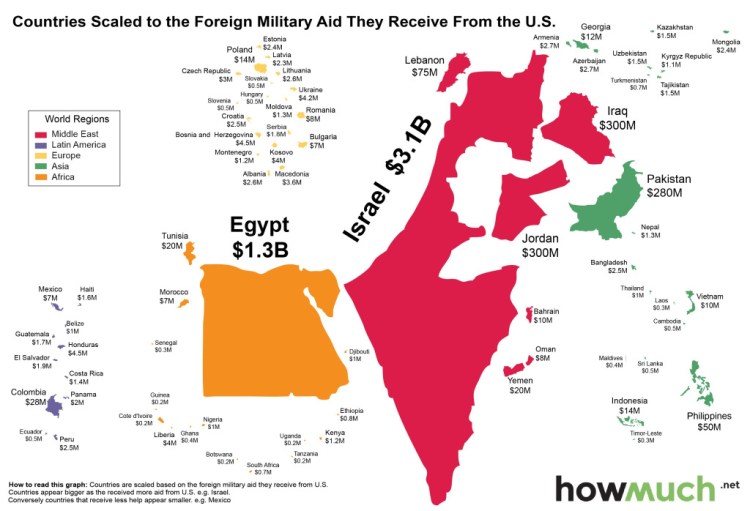
Below is a ranking of the the top 10 recipients and their respective world regions.
-
Israel: $3.1B (Middle East)
-
Egypt: $1.3B (Africa)
-
Iraq: $300M (Middle East)
-
Jordan: $300M (Middle East)
-
Pakistan: $280M (Asia)
-
Lebanon: $75M (Middle East)
-
Philippines: $50M (Asia)
-
Colombia: $29M (Latin America)
-
Tunisia: $20M (Africa)
Research conducted by the World Bank shows that the on average, countries spend approximately 2.2% of GDP on the military. Israel, Iraq, Jordan and Pakistan allocated above average spending towards their military in 2014. The data shows that each country spent approximately 5.2%, 4.3%, 3.5%, and 3.4% of GDP, respectively, on military expenditures. These countries are also part of the top 5 recipients of U.S. foreign military financing, totaling $4.0 billion. … Full article
Featured Video

“Historic Russia”: The Land Putin Will Not Give Back
or go to
Aletho News Archives – Video-Images
Book Review
Why the War on Conspiracy Theories Is Bad Public Policy
By Kevin Barrett • Unz Review • February 1, 2019
 A Review of Conspiracy Theories and Other Dangerous Ideas by Cass Sunstein (based on an earlier paper co-authored with Adrian Vermeule); In Defense of Troublemakers: The Power of Dissent in Life and Business by Charlan Nemeth; and Conspiracy Theories and the People Who Believe Them, edited by Joseph E. Uscinski
On January 25 2018 YouTube unleashed the latest salvo in the war on conspiracy theories, saying “we’ll begin reducing recommendations of borderline content and content that could misinform users in harmful ways—such as videos promoting a phony miracle cure for a serious illness, claiming the earth is flat, or making blatantly false claims about historic events like 9/11.”
At first glance that sounds reasonable. Nobody wants YouTube or anyone else to recommend bad information. And almost everyone agrees that phony miracle cures, flat earthism, and blatantly false claims about 9/11 and other historical events are undesirable.
But if we stop and seriously consider those words, we notice a couple of problems. First, the word “recommend” is not just misleading but mendacious. YouTube obviously doesn’t really recommend anything. When it says it does, it is lying. … continue
Blog Roll
 Aletho News
- BRITAIN’S WARNING: PREPARE FOR WAR
- “Historic Russia”: The Land Putin Will Not Give Back
- How the Cambridge Analytica scandal still haunts Mark Zuckerberg
- The Ongoing Cancellation Campaign Against a Dissenting Academic in Norway
- Yemen and ‘the Houthis’: Challenging Sami Hamdi’s Narrative
- No, Christians did not invent Zionism
- AIPAC-led lobbying network opens branches in Cypriot, Greek parliaments
- Araghchi blasts ‘parasitic’ alliance as US taxpayers pay for Israel’s war on Iran
- Easy fix for Europe’s chaos? Stop fueling war against Russia
- Putin’s key remarks on peace talks and Europe’s ‘schizophrenia’
- If Americans Knew
- An error has occurred; the feed is probably down. Try again later.
- No Tricks Zone
- Two New Studies Find Thwaites Glacier Melt Cannot Be Driven By Human Activity Or A Warming Ocean
- E-Cars Reduce CO2 Emissions By Only 41% Compared To Internal Combustion Engine Vehicles
- Predictions Made By Renowned Climate Professor Over Past Decades Have Been Proven To Be Poor
- New Study Suggests Large Regions Of The Pacific Ocean Have Been Cooling For The Last 80 Years
- Germany’s Green Energy Debacle: High Energy Costs Force Kahla Porzellan to Close After 182 Years!
- New Study: 50 Years Of The Most Aggressive ‘Net Zero’ Policies Can Only Affect The Global Climate By 0.03°C
- US September “Heat” Was No Record…Many Records Set Decades Ago
- Latest European Green Energy Debacle; Portugal’s Largest Flagship Solar Park Insolvent!
- Green Energy Debacle: German Expert Professor Fritz Vahrenholt Warns Of Severe Economic And Social Consequences
- Two More Paleo Reconstructions Affirm Meters-Higher Sea Levels Across Ireland, Brazil 7000-6000 Years Ago

