Why It’s Dangerous to Conflate Hamas and Daesh
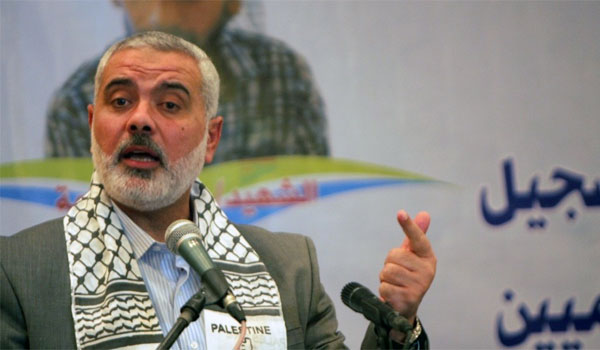
Hamas Prime Minister in Gaza, Ismail Haniyeh
By Belal Shobaki – Al-Shabaka: The Palestinian Policy Network – February 22, 2016
Overview
While Israel’s efforts to link Palestinian resistance to its military occupation to global terrorism are not new, it has expanded its propaganda to address Arab as well as Western audiences. By so doing, it is clearly seeking to exploit the global aversion to movements that have drifted towards extremism and terrorism while claiming to represent Islam. “Hamas is ISIS and ISIS is Hamas,” Israeli Prime Minister Benjamin Netanyahu declared at the United Nations in 2014. Yet better than anyone else, Netanyahu and the Israeli political establishment know that Hamas and Daesh are not related, as do those Arab regimes that also tar all Islamic movements with the same brush to serve their own ends. 1
Not only are Hamas and Daesh unrelated, they are bitter enemies, and Daesh has denounced Hamas as an apostate movement. Al-Shabaka Policy Analyst Belal Shobaki discusses the major ways in which Hamas differs from Daesh including its approach to jurisprudence; the position vis-a-vis the nature of the state; and relations with other religions. He makes the case that it is especially important for the Palestinian national movement to rebut the attempts to conflate Hamas with Daesh and points out the dangers of not doing so.
Serving Short-Term Political Gain
The conflation of Hamas with Daesh ignores reality on the ground. The political environment in Palestine is defined by the occupation, whereas the political environment in the Arab countries where Daesh emerged is defined by authoritarianism and repression as well as sectarian and religious conflicts, an ideal environment for the emergence of a radical ideology motivated by indiscriminate violence.
For Israel, however, the attempt to link the two may pay off regionally and internationally. Many Arabic media outlets have no qualms about referring to this terrorist organization as an “Islamic” State although it is anything but, while many Western media outlets embrace the Israeli conflation of Hamas and Daesh without scrutiny. Arab regimes are uninterested in defending the image of Hamas. Even the Palestinian Liberation Organization (PLO) does not seem concerned with defending Hamas’s international image given the political division between Fatah and Hamas.
Hamas is considered part of the Muslim Brotherhood, which is seen as a threat to authoritarian Arab regimes, particularly in the Arab Mashreq. Thus one way for Arab regimes to fight the Muslim Brotherhood is by claiming it shares common ground or is even synonymous with Daesh, as claimed by the Egyptian regime, and then using this as a justification for excluding the Muslim Brotherhood from participating in political life.
The rapid developments of the past five years in Egypt, the country that provides the only outlet for the Palestinian Gaza Strip, has pushed Hamas into its informal tunnels economy. The official Egyptian stance after Abdel Fattah Sisi’s coup against elected president Mohammad Morsi became tougher against the Gaza Strip, with claims that Hamas was cooperating with Jihadist groups in the Sinai, the same narrative promoted by Israel and its media. However, this narrative is flawed. It is too risky for Hamas to maintain a close relationship with Sinai jihadists, on the one hand, while cracking down on individuals embracing the same ideology in Gaza, on the other. Any links Hamas has established with those groups is limited to securing the needs of the enclave besieged by Israel and Egypt. This interaction is not motivated by a shared ideological identity or shared enmity towards the Egyptian regime. Indeed, Hamas has been eager to keep communication lines open with the Egyptian regime even when accusations conflating Hamas with Sinai’s Salafi Jihadi groups were made in the media. Hamas has also repeatedly said that it is keen on rebuilding the relationship with Egypt in order to ensure the legal flow of goods, services and individuals into Gaza.
It is important to refute this narrative concerning one of the largest Palestinian political movements: Excluding moderate Islamists from political life carries the danger of pushing Palestinian society towards radicalism, in which case both Fatah and Hamas will find themselves fighting takfiri groups. The ensuing discussion will demonstrate the real differences between Hamas and Daesh as well as the very real enmity between them.
Differences in Doctrine
Hamas positions itself as a centrist Islamic movement and an extension of the Muslim Brotherhood, with a rational jurisprudential authority, whereas Daesh adopts a text-based approach that deals with Islamic texts in isolation from their historical context and refuses to interpret them in line with current developments. Hence, for Daesh and other takfiri groups in general, movements like Hamas are secular and un-Islamic, since Hamas is primarily a resistance movement against the Israeli occupation and believes in a moderate Islamic authority. Moreover, Hamas does not take Islamic texts literally; it allows for ijtihad – interpretation and use of discretion. Some scholars have categorized these movements along a horizontal line with the right representing advocates of the text and the left representing advocates of reason. 2 Using this classification, the Muslim Brotherhood can be found a good way down the left of the line, while Daesh is on the far right.
Daesh characterizes Hamas and its discourse as deviant. Hamas for its part has condemned Daesh’s threats and considered these part of a smear campaign that extends beyond Palestine. When threats from Daesh and other takfiri groups materialized into action, Hamas no longer stopped at condemnations. Mahmoud al-Zahar, a prominent Hamas leader, declared “Daesh’s threats can be felt on the ground, and we are handling the situation from a security standpoint. Whoever commits a security offense shall be dealt with in accordance with the law, and whoever wants to debate intellectually shall be debated intellectually; we take this matter seriously”.
Hamas had in fact dealt decisively with a Daesh-like group. In August 2009, Abdul Latif Musa, leader of the “Jund Ansar Allah” (Soldiers of God’s Supporters) armed group, announced the creation of the Islamic Emirate in Gaza at the Ibn Taymiyyah Mosque. The group had previously been accused of destroying cafes and other venues in the Gaza Strip, pushing the Hamas government into a confrontation. Security forces, reinforced by the al-Qassam Brigades (Hamas’ military wing), encircled the Ibn Taymiyyah Mosque and, when Musa’s group refused to surrender, Hamas ended the emirate project in its infancy by killing the members of the group. Hamas was criticized for its use of violence but justified its actions by arguing that the violence that could have been perpetrated by such groups would have been much worse than that used to eradicate extremism in the Gaza Strip.
Daesh’s supporters in Gaza are far fewer than Hamas’s, mainly due to the fact that these groups have not historically contributed to resisting the occupation. Some polls suggest that 24% of Palestinians think positively of jihadist movements, but this percentage is exaggerated. When some Palestinians cheer for the jihadist groups’ hostility towards the US, it is not because they believe in these groups but rather because they see the US, with its infinite support for Israel, as being playing a destructive role.
Different Stances on Statehood
Hamas and Daesh differ in their view of the modern state, in both theory and practice. As noted above, Hamas has always allowed for ijtihad or discretion, evolving its thoughts and opinions. It is thus unfair to assess Hamas’s stance on the civil state and democracy based on the early literature of the mother movement, the Muslim Brotherhood. Hamas maintains that it has embraced new convictions in this regard and has come to fully accept democracy and the concept of the civil state. Indeed, the Muslim Brotherhood itself has evolved. Qatar-based Sheikh Yusuf al-Qaradawi, the jurisprudential authority of the Muslim Brotherhood at large, has stated on multiple occasions, including in his book “The State in Islam”, that the concept of the religious state does not exist in Islam. According to al-Qaradawi, Islam advocates for a civil state founded on respect for the people’s Islam-based opinion, and also founded on the principle of accountability and political pluralism. Although the discussion about the relationship between Islam and democracy predates the Muslim Brotherhood, it gained clarity after the 1950s, when numerous Islamic thinkers, including al-Qaradawi, the Tunisian leader and Ennahda co-founder Rached Ghannouchi and the Algerian philosopher Malek Bennabi, affirmed that Islam and democracy were not in contradiction with each other.
At the opposite end, the movement that Daesh represents rejects democracy in its entirety and considers it an apostate system of governance. Although some jihadist groups do not denounce Islamists who take part in the democratic process as apostates, they do consider their discretion flawed. Daesh views any expression of democracy such as elections as a manifestation of apostasy and any movement or individual taking part in elections as apostates. By contrast, the Muslim Brotherhood participated in elections from its earliest days, when its founder Hassan al-Banna decided to run in the Egyptian parliamentary elections that El-Wafd Party Government sought to hold in 1942. Although al-Banna could not run because the government rejected his candidacy, the Muslim Brotherhood has served in Arab parliaments and sometimes in the executive branch.
When Hamas decided not to participate in 1996 Palestinian Authority elections its position was based on a political and ideological stance towards the Oslo Accords. However, Hamas allowed its members to run in the elections as independents. When the circumstances changed and the 2005 Cairo Agreement became the governing framework for the PA elections instead of the Oslo Accords, Hamas decided to participate. It nominated many members in the movement and some independents to a Change and Reform list to run for the Legislative Council, winning the majority of votes.
By participating in the elections, Hamas has offered evidence that it is willing to function in a modern state and a democratic system. It has called for coalition governments inclusive of leftist and secular parties. Its government as well as its parliamentary list included women and its first government included Muslim and Christian ministers.
Daesh, on the other hand, has turned against all modern institutions in the areas under its control, refusing to recognize borders or national identity. It rules through chaotic and individual decisions. Although Daesh has been eager to use administrative terms derived from the Islamic tradition such as caliphate and shura (consultation), the essence of its governance contradicts the majority of unquestionable texts in the sources of Islamic legislation in many ways. For example, it does not abide by the conditions established in the Quran and sunna (the Prophet Mohammad’s teachings) to declare war or the protection of civilians and treatment of prisoners in wartime. Another example is its imposition of jizya (a tax that was levied on non-Muslim subjects), which is not supposed to be applied to the indigenous inhabitants even if they are non-Muslim. Moreover, it has attacked places of worship and assaulted the faithful in their homes, in clear violation of the Quran and sunna.
Daesh, to some extent, resembles hybrid regimes in the Third World that use modern and democratic vocabulary to describe their political process, even though they remain authoritarian in essence.
Polar Opposites in Treating the Other
The most significant difference between Hamas and Daesh is their position towards followers of other religions. During its formation, Hamas published a charter that used religious vocabulary to describe the conflict. Following severe criticism, Hamas effectively sidelined this Charter and no longer considers it an authoritative reference as some of its leaders have confirmed.
In his interview with The Jewish Daily Forward deputy head of the Hamas politburo Moussa Abu Marzouk confirmed that the Charter was marginal to the movement and not a source for its policies. He added that many members were talking about modifying it because several of Hamas’ present policies contradict it. Hamas’ politburo leaders abroad were not the only ones to disclaim the charter. Gaza-based Hamas leader Ghazi Hamad went even further in an interview with the Saudi Okaz newspaper in which he said the charter was subject to discussion and evaluation in opening up to the world. Sami Abu Zuhri, a young Hamas leader who was the movement’s spokesperson during the Second Intifada, urged in an interview with The Financial Times that focus be shifted away from the 1988 charter, and that Hamas be judged on the statements of its leaders.
Today, Hamas adopts the Quranic verse that reads: “Allah does not forbid you from those who do not fight you because of religion and do not expel you from your homes – from being righteous toward them and acting justly toward them. Indeed, Allah loves those who act justly.” This verse urges kindness and justice when dealing with people of other religions. Unlike Daesh, Hamas has applied this in practice. In addition to appointing Christian ministers to its cabinet, it has celebrated Christmas with Palestinian Christians by sending official delegations to visit during the feast. Meanwhile, Daesh has threatened the lives of those who celebrate Christmas across the world.
Some may argue that these steps are ways in which Hamas tries to beautify its authoritarian rule. However, there is little difference between Hamas’ rule and Fatah’s. The human rights violations committed by Gaza’s government cannot be considered an indication of Hamas’ resemblance to Daesh, but rather an indication of misgovernment. The political leadership of Hamas has spoken out against such practices on occasion, for example as those committed by the Ministry of the Interior under Fathi Hammad.
When some individuals were attacked by extremist groups in Gaza, Hamas and the government acted to ensure their safety and punish the aggressors, as in the case of British journalist Alan Johnston who was freed by Hamas from his radical captors and the killing of Italian solidarity activist Vittorio Arrigoni.
The movement’s position towards the Shiites is similar to that towards Christians. At a time when the Middle East is experiencing a media war between Shiites and Sunnis, Hamas refuses to denounce Shiites as apostates, and has interacted with them politically. When the relationship with Iran became strained during the Syrian crisis, the disagreement was political rather than doctrinal. Daesh, on the other hand, not only thinks of Shiites as apostates, but also all other Sunni groups that hold a different ideology, and believes they must be fought.
Even the two organizations’ treatment of the enemy differs. Hamas identifies the Israeli occupation as the enemy, while Daesh considers everyone else its enemy. Daesh has boasted of its numerous crimes against humanity in its treatment of its abductees and the civilians under its rule, including burning Jordanian pilot Muath al-Kasasbeh alive. It has attempted to legitimize its inhumane conduct by distorting or misinterpreting religious texts. Hamas paid its condolences to al-Kasasbeh’s family and condemned Daesh’s actions. Contrast Daesh’s brutality with Hamas’ treatment of the Israeli soldier Gilad Shalit during his captivity, as even the Jerusalem Post reports.
Moving Forward in Relations with Hamas
Both Hamas and Daesh are on the list of terrorist organizations in many countries, including the member states of the European Union and the United States. However, the listing of Hamas is clearly politically motivated: Unlike Daesh, Hamas has neither targeted nor called for targeting any entity other than the Israeli occupation. Hamas was added to the list of terrorist organizations following the events of September 11, 2001, even though it had nothing to do with this terrorist attack. The political nature of the position against Hamas is underscored by the fact that the General Court of the European Union issued a decision on December 17, 2014, urging the removal of Hamas from the list of terrorist organizations. The Court argued that the order to list Hamas in 2003 was based on media reports rather than solid evidence.
In addition, many European and American dignitaries that are known for their stance against terrorist organizations worldwide have met with Hamas leaders on more than one occasion. Those include European parliamentarians and former US president Jimmy Carter, who met with Ismail Haniyeh in Gaza in 2009 and Khalid Meshaal in Cairo in 2012.
The bottom line is that Israel’s attempt to exploit a chaotic Middle East by implicating Hamas as a terrorist group linked with Daesh is baseless. Hamas is ideologically, intellectually, jurisprudentially and politically different from Daesh. Media outlets that adopt the Israeli narrative hurt their professionalism and credibility.
Palestinian movements must not allow the disagreement with Hamas to justify the accusations that harm the Palestinian cause internationally and create tensions locally. Hamas must also realize that the differences between them and Daesh do not mean that its rule of Gaza is free of abuses and human rights violations, and must therefore revisit its conduct and be more careful in its political discourse. It should move beyond the approach of having one discourse for local consumption and another for global consumption since every word uttered by any Hamas leader is marketed abroad as a message from Hamas to the world.
When the Fatah-led Palestine Liberation Organization (PLO) and Arab regimes, especially in Egypt, do not oppose the efforts to link Hamas with Daesh – or, indeed, occasionally contribute to these efforts – they may “benefit” in the short-term by weakening Hamas as a political opponent. However, this carries the dangers of destabilizing Palestinian society in the medium and long-term. Excluding moderate Islamists could push Palestinian society towards radicalism, in which case both Fatah and Hamas will find themselves fighting takfiri groups.
Notes:
- ISIS: The Islamic State of Iraq and Syria. Daesh is the Arabic acronym for ISIS. Some commentators use ISIL: The Islamic State of Iraq and the Levant. The group itself began to use IS in 2014.
- Samir Suleiman, Islam, Demokratie und Moderene, Herzogenrath: Shaker Media, 2013, P 302. Tariq Ramadan, Muslimesin in Europa, Marburg: Medienreferat, 2001, p15.
Al-Shabaka Policy Member Belal Shobaki is assistant professor in the Department of Political Science at Hebron University, Palestine. He is a member of the American Political Studies Association. He has published on Political Islam and identity and is now working on a book on the Palestinian division. Shobaki is the former Editor-in-Chief of Alwaha Newspaper in Malaysia. He was also a Lecturer in the Department of Political Science at An-Najah National University and the Head of the studies Unit at the Palestinian Centre for Democracy and Studies.
Obama regime seeks to roll back human rights conditions on aid to Egypt
RT | February 11, 2016
Despite reports that state repression in Egypt is taking place on a greater scale than it has been for generations, the Obama administration is seeking to roll back human rights conditions Congress had placed on foreign aid to Egypt’s military.
The request, which was tucked into the Obama administration’s 182-page budget proposal, seeks foreign aid to Egypt’s military regime and “the sale of crowd control weapons to ‘emerging democracies.’” The discovery was made by The Intercept.
If the new proposal, which was released on Tuesday, is adopted, it would end a Congressional restriction stipulating “that 15 percent of aid to Egypt is subject to being withheld based on human rights conditions.”
Interestingly, Congress was able to temporarily waive those restrictions in a foreign aid bill in June of 2015, arguing it was in the national security interest of the United Station, according to Al-Monitor. The conditions were that Egypt would have to hold “free and fair” parliamentary elections and take steps to foster democracy and protect human rights for an additional $1.3 billion in military aid to be released.
The US State Department issued a scathing report in May of 2015, arguing that “while Egypt had implemented parts of its ‘democracy roadmap’ the overall trajectory of rights and democracy had been negative.”
It pinpointed restrictions on freedom of expression, the press, and freedom of association, as well as lack of due process. It further said that “impunity remains a serious problem in Egypt.”
It was well known at the time the Egyptians were “infuriated” by the report.
Cole Bockenfeld, deputy director for policy at the Project on Middle East Democracy, told The Intercept that the White House probably didn’t want to explain why it had to waive restrictions this year.
“They had to basically do an assessment. … Here’s how they’re doing on political prisoners, here’s how they’re doing on freedom of assembly, and so on,” Bockenfeld said.
The Guardian reported in January that Egypt has jailed more journalists than any other country on earth except China under President Abdel Fattah al-Sisi. Three reporters were imprisoned, one forcibly “disappeared” and was later charged with being a member of a banned organization, and six were referred to judicial hearings because of their work.
Also in January, Italian academic Giulio Regeni, who was researching labor unrest and independent trade unions in Egypt, went missing during a security crackdown on the fifth anniversary of the beginning of Egypt’s revolution. His body was discovered nine days later by the side of the road marked with cigarette burns, bruising, and multiple stab wounds. The Guardian reported more than 4,600 academics worldwide have signed an open letter protesting his death and demanding an investigation into the growing number of forced disappearances. Egyptian officials appear to be cooperating with the investigation, according to the Italian foreign minister.
The budget also contains a request that would remove a provision from a law passed in 2012 in reaction to the Arab Spring protests that prohibits the transfer of tear gas and other crowd control weapons to countries that are “undergoing democratic transition.”
“It’s basically going to be free for all,” Husain Abdulla, executive director of Americans for Democracy and Human Rights in Bahrain, told the Intercept when speculating on the results of the administration rolling back that provision.
Among the Middle Eastern countries seeking this equipment are Egypt, Saudi Arabia, and Bahrain – all of which are simmering with pro-democracy challenges.
Egypt’s Foreign Minister defends mass imprisonment on US visit
Reprieve – February 10, 2016
The Egyptian Foreign Minister has defended his government’s mass imprisonment of political activists, and the use of lengthy pre-trial detention periods, during a visit to Washington DC to meet with US Secretary of State John Kerry among other officials.
In an interview with NPR that aired today, Foreign Minister Sameh Shoukry defended the detention without trial of activists and others arrested at protests in 2013, saying that arrests only took place where protestors didn’t have ‘permits’. Asked why many protestors were still imprisoned and awaiting trial two years later, he said: “It is a long time, but I believe justice has to be given the opportunity, within the impartiality of the judicial system, to ascertain all of the facts and to pass a verdict”.
Mr Shoukry added that “no country” has a perfect human rights record, and that “there will always be ups and downs.” He said that “it is our intention to do everything possible to live up to those [human rights] standards and provide the rights of all individuals.”
Since taking power in July 2013, the Sisi government has overseen thousands of arrests of protestors, journalists and others, many of whom have been put through mass trials that fail to meet international standards. International human rights group Reprieve, which assists several prisoners in Egypt, recently established that between 2014 and the end of 2015, nearly 600 death sentences were handed down, the majority in relation to political charges.
Hundreds of other prisoners are enduring lengthy periods of pre-trial imprisonment; one trial involving 494 people has been postponed 12 times since it began in 2014. The defendants, including Ibrahim Halawa – an Irish student, who is being assisted by Reprieve – are currently understood to be undergoing torture, including forms of ‘crucifixion’ and electrocution. Mr Halawa is one of several prisoners in the trial who were arrested as juveniles, and who are being tried as adults in violation of Egypt’s Child Law.
Reprieve has previously written to Secretary Kerry, asking him to press the Egyptian government to end the use of mass trials and release prisoners who were arrested as juveniles.
Saudi invasion of Syria: The bluff that could ignite World War III
By Finian Cunningham | RT | February 7, 2016
The Saudi plan to send ground troops into Syria appears to be just a ruse. But this is precisely the kind of reckless saber-rattling that could ignite an all-out war, one that could embroil the United States and Russia.
Saudi rulers have reportedly amassed a 150,000-strong army to invade Syria on the alleged pretext “to fight against terrorism” and to defeat the so-called Islamic State (also known as ISIS/ISIL). Saudi officials told CNN that in addition to Saudi troops there are ground forces from Egypt, Turkey, Sudan, Morocco, Jordan, Qatar, Bahrain and the United Arab Emirates.
Syria’s Foreign Minister Walid al-Muallem gave a categorical response, saying the move would be seen as an act of aggression and that any invasion force regardless of its stated reasons for entering Syria will be sent back in “wooden coffins”.
Nevertheless, US President Barack Obama has welcomed the Saudi plan to intervene in Syria.
Obama’s Defense Secretary Ashton Carter is this week due to meet in Brussels with counterparts from the US-led so-called “anti-terror” coalition to make a decision on the whether to activate the Saudi plan. A Saudi military spokesman has already said that if the US-led coalition gives its consent then his country will proceed with the intervention.
In recent weeks, Carter and other senior US officials, including Vice President Joe Biden, have been calling for increased regional Arab military action against ISIS in Syria and Iraq. Carter and Biden have also said the US is prepared to send in its own ground troops en masse if the Geneva peace talks collapse.
Now, those talks appear to be floundering. So, does that mean that a large-scale invasion of US-led foreign armies in Syria is on the way?
Let’s step back a moment and assess what is really going on. The Saudi warning – or more accurately “threat” – of military intervention in Syria is not the first time that this has been adverted to. Back in mid-December, when Riyadh announced the formation of a 34-Islamic nation alliance to “fight terrorism”, the Saudis said that the military alliance reserved the right to invade any country where there was deemed to be a terror threat – including Syria.
Another factor is that the House of Saud is not pleased with US-led diplomatic efforts on Syria. US Secretary of State John Kerry’s bustling to organize the Geneva negotiations – supposedly to find a peace settlement to the five-year conflict – is seen by the Saudis as giving too many concessions to the Syrian government of President Bashar al-Assad and his foreign allies, Russia, Iran and Lebanon’s Hezbollah.
The Geneva talks – which came unstuck last week – can be arguably assessed as not a genuine internal Syria process to resolve the war – but rather they are a cynical political attempt by Washington and its allies to undermine the Syrian government for their long-held objective of regime change. The inclusion among the political opposition at Geneva of Al Qaeda-linked militants, Jaish al-Islam and Ahrar al-Sham, with Western backing, illustrates the ulterior purpose.
The Washington Post gave the game away when it reported at the weekend: “The Obama administration has found itself increasingly backed into a corner by Russian bombing in Syria that its diplomacy has so far appeared powerless to stop.”
In other words, the Geneva diplomacy, mounted in large part by Kerry, was really aimed at halting the blistering Russian aerial campaign. The four-month intervention ordered by Russian President Vladimir Putin has turned the tide of the entire Syrian war, allowing the Syrian Arab Army to win back strategically important terrain.
That the Russian military operations have not stopped, indeed have stepped up, has caused much consternation in Washington and its allies.
Russia and Syria can reasonably argue that the UN resolutions passed in November and December give them the prerogative to continue their campaign to defeat ISIS and all other Al Qaeda-linked terror groups. But it seems clear now that Kerry was counting on the Geneva talks as a way of stalling the Russian-Syrian assaults on the regime-change mercenaries.
Kerry told reporters over the weekend that he is making a last-gasp attempt to persuade Russia to call a ceasefire in Syria. Indicating the fraught nature of his discussions with Russian counterpart Sergei Lavrov, Kerry said: “The modalities of a ceasefire itself are also being discussed… But if it’s just talks for the sake of talks in order to continue the bombing, nobody is going to accept that, and we will know that in the course of the next days.”
Moscow last week was adamant that it would not stop its bombing operations until “all terrorists” in Syria have been defeated. Syria’s Foreign Minister al-Muallem reiterated this weekend that there would be no ceasefire while illegally armed groups remain in Syria.
What we can surmise is that because the US-led covert military means for regime change in Syria is being thwarted and at the same time the alternative political means for regime change are also not gaining any traction – due to Russia and Syria’s astuteness on the ulterior agenda – the Washington axis is now reacting out of frustration.
Part of this frustrated reaction are the threats from Saudi Arabia, Turkey and other regional regimes – with US tacit approval – to go-ahead with a direct military intervention.
In short, it’s a bluff aimed at pressuring Syria and Russia to accommodate the ceasefire demands, which in reality are to serve as a breathing space for the foreign-backed terrorist proxies.
From a military point of view, the Saudi troop invasion cannot be taken remotely serious as an effective deployment. We only have to look at how the Saudi regime has been battered in Yemen over the past 10 months – in the Arab region’s poorest country – to appreciate that the Saudis have not the capability of carrying out a campaign in Syria.
As American professor Colin Cavell noted to this author: “Saudi intervention in Syria will have as much success as its intervention in Yemen. History has clearly shown that mercenary forces will never fight external wars with any success or elan, and no Saudi soldier in his right mind truly supports the Saudi monarchy. Everyone in Saudi Arabia knows that the House of Saud has no legitimacy, is based solely on force and manipulation, propped up by the US and the UK, and – if it did not have so much money – is a joke, run by fools.”
Thus, while a military gambit is decidedly unrealistic, the real danger is that the Saudi rulers and their American patrons have become so unhinged from reality that they could miscalculate and go into Syria. That would be like a spark in a powder keg. It will be seen as an act of war on Syria and its allies, Russia, Iran and Hezbollah. The US would inevitably be drawn fully into the spiral of a world war.
History has illustrated that wars are often the result not of a single, willful decision – but instead as the result of an ever-quickening process of folly.
Syria is just one potential cataclysm.
Finian Cunningham (born 1963) has written extensively on international affairs, with articles published in several languages. Originally from Belfast, Northern Ireland, he is a Master’s graduate in Agricultural Chemistry and worked as a scientific editor for the Royal Society of Chemistry, Cambridge, England, before pursuing a career in newspaper journalism. For over 20 years he worked as an editor and writer in major news media organizations, including The Mirror, Irish Times and Independent. Now a freelance journalist based in East Africa, his columns appear on RT, Sputnik, Strategic Culture Foundation and Press TV.
Israeli minister: Egypt flooding Gaza tunnels at our request
MEMO | February 7, 2016
Israeli Infrastructure Minister Yuval Steinitz has said that Egypt’s new policy of flooding the tunnels between the Gaza Strip and the Sinai Peninsula with seawater had come at Israel’s request.
 “Egyptian President Abdel Fattah al-Sisi is flooding the tunnels on his country’s border with the Gaza Strip with water based on a request by Israel,” Steinitz said at a seminar held Saturday in the southern city of Beer Sheva, according to Israel Radio.
“Security coordination between the two countries [Israel and Egypt] is better than ever,” the minister said at the seminar, at which participants discussed the relationship between the two neighbors.
In recent months, the Egyptian army has begun flooding the network of cross-border tunnels linking Egypt’s Sinai Peninsula to the Gaza Strip with seawater.
Subject to a years-long blockade by Israel and Egypt, the Hamas-run Gaza Strip had come to depend on the tunnel network to import desperately-needed commodities, including food, fuel and medicine.
Steinitz is particularly close to Israeli Prime Minister Benjamin Netanyahu and is a member of the latter’s influential security cabinet.
544 Egyptians arrested ahead of revolution anniversary
MEMO – January 25, 2016
Some 544 people have been arrested in Egypt since the start of the year, human rights activists have reported.
In exclusive comments to the Anadolu Agency, Ezzat Ghoneim, of the Egyptian Coordination for Rights and Freedoms, said: “Since the beginning of 2016, this association has flagged 544 detained people, including 34 cases of arrests that took place yesterday [Saturday] and 17 on Sunday, with all of the people involved in such cases still imprisoned.”
He pointed out that Saturday’s arrests were over “seven provinces: one in Cairo, two in Giza, 19 in Al-Gharbia, three in Al-Behairah, four in Aswan, four in Monoufia and one in Kafr El-Sheikh.”
Yesterday, “seven people were arrested in Alexandria and 10 in Ismailia,” Ghoneim said, adding that the organisation is monitoring all arrests.
“The charges range between issues related to demonstrations, incitement of violence, membership of an outlawed group, preparing to commemorate the January 25 Revolution of 2011, or taking part in the January revolution itself. However, we are not concerned with the detainees’ affiliations in our work,” Ghoneim added.
WaPo’s Jennifer Rubin: More Regime Change, Please!

By Daniel McAdams | Ron Paul Institute | January 21, 2016
Most normal people look at the smoldering cemetery that is post-“liberation” Libya, the gruesome graveyard of an almost-“liberated” Syria, the 14 year slow-motion failed regime change in Afghanistan, blood-drenched Iraq, and they are horrified. Washington Post’s neocon nag Jennifer Rubin looks across that bloody landscape and sees a beautiful work in progress.
She writes today in the online edition of the Post that despite what we might be hearing from some “libertarian/populist pols masquerading as conservatives,” the interventionist enterprise is chugging along just fine. Democracy promotion at the barrel of a gun is every American’s “white man’s burden” whether he likes it or not.
Never mind that Syria has been nearly leveled by almost five years of an Islamist insurgency that was but a few weeks from success when Russia stopped it in its tracks. The real villain is the secular Bashar al-Assad, writes Rubin. After all, he “is partnered with Iran and spurs support for Islamist rebels…”
Assad “spur[s] support for Islamist rebels” by waging war on them for six years? Or does she somehow deny that Assad is fighting the insurgents who seek to drive him from power? Both cannot be true.
And on Planet Rubin, funding, training, and arming Islamist rebels, as the US and its allies have done, can in no way be seen as spurring them on.
“It has become fashionable in some circles to pooh-pooh support for democracy,” Rubin moans. Not so fast, she says. This is not a failed project. Her evidence? From all the countries destabilized by US democracy promotion schemes there is “one encouraging success story” — Tunisia!
Yes, after the destruction and killing in places like Egypt, Libya, Syria, Iraq, and the rest, it is the great success in little Tunisia that makes it all worthwhile!
Unfortunately for Rubin, even her little Tunisian success story looks to have an unhappy ending. As reported by BBC News, unrest is spreading throughout Tunisia as demonstrators are clashing with police. Tunisians are in far worse economic shape now than before the US-backed “Arab Spring” brought them their “liberation.” One-third of young people are unemployed in post-liberation Tunisia and 62 percent of recent college graduates cannot find work.
“We have been waiting for things to get better for five years and nothing has happened,” Yassine Kahlaoui, a 30-year-old jobseeker, told the AP as reported by the BBC.
Here is the ugly truth that regime change enthusiasts like Rubin will never admit: it is very easy to destabilize and destroy a country from abroad in the name of “promoting democracy,” but those recipients of America’s largesse in this area soon find that it is all but impossible to return a country to even pre-“liberation” economic levels. They are left missing their “dictator.”
What does Rubin care: she doesn’t have to live in these hellholes she helps create.
Netanyahu: Saudi Arabia sees Israel as an ally
Press TV – January 23, 2016
Israeli Prime Minister Benjamin Netanyahu says Saudi Arabia now sees Tel Aviv “as an ally rather as an enemy” as he claims “a great shift taking place” in the Arab policy toward the Palestinian issue.
“Saudi Arabia recognizes that Israel is an ally rather than an enemy because of the two principle threats that threaten them, Iran and Daesh,” he told CNN’s Fareed Zakaria on the sidelines of the World Economic Forum in Davos Friday.
Both Saudi Arabia and Israel are fiercely opposed to a nuclear accord between Iran and the West which came into force recently. They are worried the agreement could boost Iran’s role in the region.
Last week, The Wall Street Journal reported that Israel was actively seeking to strengthen ties with Arab powers in the wake of the nuclear deal with Iran.
Daesh ideology is rooted in Wahhabism which is widely promoted by Saudi clerics and tolerated by the kingdom’s rulers. Both Saudi Arabia and Israel support Takfiri groups fighting in Syria. Meanwhile, there is no known case of a Daesh attack on either Saudi or Israeli targets.
Netanyahu also said “there is a great shift taking place” in the Saudi-led policy toward the Palestinian issue, citing Israel’s “relationships” with unknown Arab states.
“By nurturing these relationships that are taking place now with the Arab world, that could actually help us resolve the Israeli-Palestinian conflict, and we’re actually working towards that end,” he said.
Netanyahu’s overtures to Saudi Arabia and its allies come in the midst of international outcry after Tel Aviv declared 154 hectares (380 acres) of Palestinian territory in the Jordan Valley as “state lands.”
Yuval Steinitz, Israel’s minister for national infrastructure, energy, and water, returned recently from an energy conference in the UAE, where Tel Aviv recently established a diplomatic mission. Israel’s Channel 2 suggested that the real aim of the trip may have been for the two sides to covertly conduct strategy meetings.
In recent months, Egypt returned its ambassador to Tel Aviv while a group of Jordanian pilots paid a “working visit” to Israel and trained closely with their Israeli counterparts during US-sponsored military exercises.
Turkish President Recep Tayyip Erdogan also recently expressed an interest in easing tensions with Israel after reaching an agreement to restore relations last month. Sudan is also said to be considering normalizing ties with Israel.
Qatar charts a new diplomatic path to Russia
By Firas Al-Atraqchi | The BRICS Post | January 16, 2016
The visit of Qatari Emir Sheikh Tamim bin Hamad Al Thani to Moscow to meet with Russian President Vladimir Putin may be considered by some to be unexpected, but it is hardly surprising.
Although the two countries maintain considerable trade ties to the tune of half a billion dollars a year, they have for more than a decade been erstwhile adversaries.
As two of the greatest gas exporters, they rarely agree on production quotas, vying for control of this essential market. In the past 20 months, Russia has been highly critical of Saudi Arabia and Qatar for refusing to curb oil production output as global prices plummeted.
A major oil exporter, Russia – already reeling from EU and US sanctions – has suffered considerably as prices drop to the $30 mark.
The rhetoric between both countries peaked after Russian fighter bombers and naval vessels began pounding Islamist extremist groups fighting to remove Moscow’s Syrian ally President Bashar Al Assad.
As the Sunni-funded campaign to remove Assad appeared to reach a stalemate, both Qatar and Saudi Arabia have since May 2015 significantly increased their support (financially, logistically and with materiel) to Wahabist Islamist factions in Syria.
The increase in support came as both countries realized that Washington was unable – or unwilling – to provide such groups as Nusra Front and the Free Syrian Army with the upper hand to turn the tide against Assad.
When Russia moved to reinforce its bases in Syria and presence in the Mediterranean, the Qataris in late October 2015 announced they could militarily intervene in the civil war there to aid their Islamist allies.
“If a military intervention will protect the Syrian people from the brutality of the regime, we will do it,” Qatari Foreign Minister Khalid al-Attiyah said at the time.
If such bravado was meant to nudge Washington to up the ante against Assad, it failed.
Russian diplomacy moves forward
A week later, the US appeared to cave in to Russian pressure to bring together senior representatives from Germany, France, Great Britain, Italy, Iraq, Egypt, Lebanon, Qatar, the United Arab Emirates, Jordan, as well as the UN’s special envoy to Syria Staffan de Mistura, and EU foreign policy chief Federica Mogherini to meet in Vienna to resolve the Syrian civil war.
It marked the first time rivals Saudi Arabia and Iran joined discussions on Syria. The two countries have backed opposing sides in the Syrian and Yemeni conflicts.
The armed Syrian opposition – classified as moderates by the US – did not participate in the talks.
By expanding the number of countries meeting on the crisis – and bringing Assad’s critical backer Iran to the table – Russia effectively minimized Qatar’s and Saudi Arabia’s influence in the conflict.
In late November, on the sidelines of the third summit of the Gas Exporting Countries Forum (GECF) in Tehran, Putin thanked Iranian Supreme Leader Ayatollah Seyyed Ali Khamenei for his help in Vienna.
Moscow and Tehran have supported Syria’s President Bashar Al Assad and insisted that he be part of an interim political process and future elections.
“All this is done, of course, in agreement with the Iranian partners … I think that without them it would be impossible,” Putin said in comments carried by Russian news agencies.
Russia also played a critical role in ensuring that Iran and the other permanent Security Council members (and Germany) sign a deal which would curb Tehran’s nuclear program in exchange for a lifting of debilitating sanctions.
If it wasn’t clear yet, a rising Russia was increasingly flexing both its military and diplomatic muscles in the Middle East.
Even Egypt, which has been financially sustained by Saudi Arabia, defied its Riyadh benefactors and backed Russia’s approach to resolving the conflict.
On December 18, Russia and the US agreed to a UN Security Council resolution “to convene representatives of the Syrian government and the opposition to engage in formal negotiations on a political transition process on an urgent basis, with a target of early January 2016 for the initiation of talks, pursuant to the Geneva Communiqué, consistent with the 14 November 2015 ISSG Statement, with a view to a lasting political settlement of the crisis”.
A week later, the previously chest-pumping Qatar Foreign Minister al-Attiyah was in Moscow where he praised his Russian counterpart Sergey Lavrov for Russia’s efforts to stabilize the Middle East.
The two diplomats agreed on the need to move the UNSC resolution forward.
“We discussed in detail what’s necessary to be done to implement the agreements on the Syrian settlement,” Lavrov said at the time.
In early January, Russia’s BRICS ally China, which is also increasingly playing a political role in the Middle East, separately hosted members of both the Syrian government and the opposition. It encouraged the latter to drop its preconditions to meeting with Syrian government representatives.
In less than six months, the momentum to bring Assad down has shifted toward ensuring that a political peace process get off the ground.
So, what changed?
Qatar’s ambitions to become a regional and global player have in recent months been tamed.
Its ‘soft power’ approach to controlling the Middle East has backfired as it rushed head on against countries that have for centuries been well-versed in the art of Machiavellian empire-building and proxy manipulation.
At the same time, Russia’s aggressive immersion in the Middle East muddle has altered not only the narrative in the region but physical realities on the ground.
Anti-Assad forces have been losing significant territory to the Syrian military and its Hezbollah allies.
As Russia pounds and destroys the weapons bought by Qatar and Saudi Arabia, the US appears to have retreated despite Arab Sunni protestations.
As Sheikh Tamim bin Hamad Al Thani himself likes to point out, Qatar is a peace-loving member of nations that will work with the US and Western allies to bring the Middle East back from the brink of chaos and collapse.
He has blamed the international community for not supporting Arab youth in their drive for democracy, justice and economic security. That is really a scolding of the US and the West for not doing more to bring the Assad regime down.
Iran rising, Russia to stay
New realities have been forming in the Middle East.
The Iran nuclear deal, which has alarmed Washington’s Sunni allies, will not only be a moral and propaganda boost for Tehran but also allow tens of billions of dollars to flow into its cash-strapped coffers.
Iran is soon expected to flood already saturated oil markets with an additional one million barrels – a day.
Iran has successfully ‘managed’ its new ally Iraq, kept Assad in power, and maintained its proxy Hezbollah’s influence in Lebanon.
With Iran and the US appearing to be at the very least cordial now, Tehran’s influence is only set to grow.
For Iran to grow as a geopolitical power, other players must first retreat.
Backing the wrong horse
By continuing to back Islamist factions in Libya, Syria and Egypt, Qatar misread and miscalculated the response of erstwhile allies in its own front yard.
Nowhere has that been more evident than in Qatar’s commitment to Egypt following the 2011 uprising which resulted in President Hosni Mubarak stepping down and the Muslim Brotherhood eventually winning power through the ballot box.
Qatar backed the Muslim Brotherhood and Islamist factions in Egypt.
Egyptian hardline cleric Yussuf Al Qaradawi, who was a vociferous critic of the Mubarak government, returned to Cairo from his home in Doha just a week after the president stepped down.
Qaradawi, who is close to Qatar’s ruling family, is also a strong advocate of the Muslim Brotherhood in Egypt.
When the Muslim Brotherhood’s President Mohamed Morsi was forced from power, many in Egypt felt that Qatar’s Al Jazeera was biased in favor of the Islamist group and openly belligerent against the new government.
According to prominent Middle East commentator Sultan Sooud Al Qassemi, Al Jazeera was used by the Qatari leadership to the service of the Muslim Brotherhood.
Even after Morsi was imprisoned and put on trial, Al Jazeera continued to support the Muslim Brotherhood despite the advice to the contrary and objections of many of its allies in the Gulf Cooperation Council (GCC).
Saudi Arabia and the UAE, the latter having been directly threatened by Brotherhood officials in 2012 and 2013, urged Qatar to back away from supporting the group.
After failing to persuade Qatar to terminate its ties to the Muslim Brotherhood, and in the wake of Saudi Arabia classifying the group as a terrorist organization, key GCC states turned on Qatar.
They accused Doha of failing to live up to a 2013 GCC security agreement to end support for the Muslim Brotherhood and stop providing sanctuary to its leaders and members.
GCC, oil and Al Jazeera America
In March 2014, Saudi Arabia, the UAE and Bahrain withdrew their ambassadors from Doha.
This was unprecedented among the usually unified and resolute GCC.
The diplomatic rift indicated that there were significant fissures within the GCC and marked a shift in Qatar’s fortunes. How could it influence the region like it once did if it was becoming a pariah among its closest friends and allies?
As Europe, the US, China, Russia, Saudi Arabia, and the UAE declared support for the new Egyptian President Abdel-Fatah El-Sissi, Qatar was growing increasingly isolated.
The drastic fall of global oil prices has also delivered a debilitating blow to GCC countries, Qatar included.
Brent Crude was at nearly $110 in 2013; on January 15, 2015 it closed below $30 a barrel – more than a 75 per cent drop.
Funding a civil war that is not paying dividends is not the best of financial decisions given the current oil glut.
Some media analysts have speculated that the drop in oil prices played a role in Qatar deciding to shut down its media operations in the US – Al Jazeera America.
Having lost leverage, Qatar is adopting a more pragmatic approach to carefully chart a way back to international cooperation.
Ahead of his trip to the US last year, Sheikh Tamim said in a New York Times editorial that Qatar sees itself as a force of good. It aggressively seeks to resolve conflict and enjoys playing the role of mediator and arbiter.
Russia has in recent months made significant overtures to several Arab countries, including Jordan, Saudi Arabia and the United Arab Emirates.
Qatar cannot afford to be left out. When Sheikh Tamim arrives in Moscow this weekend he will likely discuss current gas and oil crises with his Russian counterpart as both seek ways to raise global prices.
Qatar could also offer to mediate between Russia and Turkey, one of its strongest allies in the region, following the diplomatic spat between Moscow and Ankara in the wake of the downing of a Russian fighter jet over Syrian air space.
Middle East commentator Camille Otrakji, however, cautions that “one can expect Qatar’s ruler to talk to Russia, without necessarily being ready to stop financing and arming the Jihadists”.
“[The] Qataris show interest in any promising investment, and Russia is today looking very attractive,” he added.
In 2006, then Secretary of State Condi Rice said that the Middle East map was being redrawn.
She likely could have never predicted the Qatar-Russia detente we see today.
Egypt builds more prisons

MEMO | January 14, 2016
Instead of fulfilling his promises to improve the country’s deteriorating economy, provide new job opportunities for thousands of unemployed youth and build at least one million housing units to accommodate young couples, Egypt’s President, Abdel Fatah Al-Sisi has only managed to build more prisons and detention centres to accommodate the growing number of opposition activists.
Less than two months after his election in June 2013, Al-Sisi opened the first maximum security prison in the Dakahlia Governorate.
As many as five new prisons have been constructed since 2013.
Yesterday, the president issued a decree to allocate a plot of state-owned land that spreads over more 103.22 acres to construct a new central prison in Giza.
With the new prison, Egypt will have 42 prisons as well as 382 detention centres in police stations.
A report by the Arab Organisation for Human Rights revealed that the cost of building Gamasa prison was 750 million Egyptian pounds ($95.8 million), adding that the interior ministry did not publish the costs incurred during the construction of the other prisons because they probably cost billions of Egyptian pounds.
According to the organisation, Egypt does not need to build more detention centres to solve a capacity crisis; the problem is imprisoning tens of thousands of innocent people without justification.
Authorities have increased arbitrary arrests because of political opinion and the number of detainees has reached more than 41,000 prisoners, the human rights group said.
4 journalists sentenced to 3 years for disseminating false news, belonging to banned group
Mada Masr | January 12, 2016
In what appears to be an ongoing security crackdown on media personnel, four journalists were sentenced to three years in prison by the Sayeda Zeinab Criminal Court on Sunday. They were convicted of disseminating false information and belonging to a banned organization.
 Electronic Media Syndicate chairperson Abu Bakr Khallaf was the only defendant present in the courtroom for the sentencing — the three other journalists were tried in absentia.
Khallaf allegedly made his LE1,200 bail on Monday, defense lawyer Hany al-Sadeq told the local rights group Journalists Against Torture Observatory, but it is unclear whether he has yet been released from detention. The first hearing in his appeal has been scheduled for March 17.
Khallaf was arrested on July 21 after the state-run Egyptian Trade Union Federation summoned him to their headquarters for interrogation on charges of operating the Electronic Media Syndicate (which was established in 2011) without a license. He was also accused of affiliation with the Muslim Brotherhood.
The other journalists in the case — Mohamed Adly of the privately owned Al-Tahrir newspaper, Hamdy Mokhtar of the privately owned Al-Shaab newspaper and videographer Sherif Ashraf — were arrested while reporting outside the Zeinhom morgue on July 1. The journalists say they were there to report on the deaths of nine Muslim Brotherhood leaders fatally shot by police forces in a 6th of October City apartment on that day.
Rights organizations including the New York-based Human Rights Watch have questioned whether police claims of a “shootout” with the nine men were covering up a case of “extrajudicial execution.”
The Journalists Syndicate’s Liberties Committee will hold a session on Tuesday to discuss the three prison sentences issued in absentia, according to a statement posted to the syndicate’s official website. In that meeting, the committee also plans to discuss the referral of six journalists — including three chief editors — to judicial hearings at the request of Justice Minister Ahmed al-Zend.
The committee will seek to resolve these cases in favor of the journalists, as well as five other lawsuits that have been filed against media workers, the syndicate said.
On Monday, the prosecutor general ordered investigations into charges that high-profile journalist and editor Ibrahim Eissa and his colleague Ahmed Samer insulted the judiciary. The investigations were ordered after a lawsuit was filed against the two men for defamation.
Samer was targeted for his article, “The state that spurns itself,” published in the privately owned Al-Maqal newspaper, which is edited by Eissa. The article discussed the recent prison sentence levied against reformist preacher Islam al-Beheiry for religious commentary on his talk show.
As of last month, at least 32 journalists were in detention across Egypt, the Liberties Committee said, of whom 18 were arrested while reporting in public space.
Featured Video

“Historic Russia”: The Land Putin Will Not Give Back
or go to
Aletho News Archives – Video-Images
Book Review
Why the War on Conspiracy Theories Is Bad Public Policy
By Kevin Barrett • Unz Review • February 1, 2019
 A Review of Conspiracy Theories and Other Dangerous Ideas by Cass Sunstein (based on an earlier paper co-authored with Adrian Vermeule); In Defense of Troublemakers: The Power of Dissent in Life and Business by Charlan Nemeth; and Conspiracy Theories and the People Who Believe Them, edited by Joseph E. Uscinski
On January 25 2018 YouTube unleashed the latest salvo in the war on conspiracy theories, saying “we’ll begin reducing recommendations of borderline content and content that could misinform users in harmful ways—such as videos promoting a phony miracle cure for a serious illness, claiming the earth is flat, or making blatantly false claims about historic events like 9/11.”
At first glance that sounds reasonable. Nobody wants YouTube or anyone else to recommend bad information. And almost everyone agrees that phony miracle cures, flat earthism, and blatantly false claims about 9/11 and other historical events are undesirable.
But if we stop and seriously consider those words, we notice a couple of problems. First, the word “recommend” is not just misleading but mendacious. YouTube obviously doesn’t really recommend anything. When it says it does, it is lying. … continue
Blog Roll
 Aletho News
- BRITAIN’S WARNING: PREPARE FOR WAR
- “Historic Russia”: The Land Putin Will Not Give Back
- How the Cambridge Analytica scandal still haunts Mark Zuckerberg
- The Ongoing Cancellation Campaign Against a Dissenting Academic in Norway
- Yemen and ‘the Houthis’: Challenging Sami Hamdi’s Narrative
- No, Christians did not invent Zionism
- AIPAC-led lobbying network opens branches in Cypriot, Greek parliaments
- Araghchi blasts ‘parasitic’ alliance as US taxpayers pay for Israel’s war on Iran
- Easy fix for Europe’s chaos? Stop fueling war against Russia
- Putin’s key remarks on peace talks and Europe’s ‘schizophrenia’
- If Americans Knew
- An error has occurred; the feed is probably down. Try again later.
- No Tricks Zone
- Two New Studies Find Thwaites Glacier Melt Cannot Be Driven By Human Activity Or A Warming Ocean
- E-Cars Reduce CO2 Emissions By Only 41% Compared To Internal Combustion Engine Vehicles
- Predictions Made By Renowned Climate Professor Over Past Decades Have Been Proven To Be Poor
- New Study Suggests Large Regions Of The Pacific Ocean Have Been Cooling For The Last 80 Years
- Germany’s Green Energy Debacle: High Energy Costs Force Kahla Porzellan to Close After 182 Years!
- New Study: 50 Years Of The Most Aggressive ‘Net Zero’ Policies Can Only Affect The Global Climate By 0.03°C
- US September “Heat” Was No Record…Many Records Set Decades Ago
- Latest European Green Energy Debacle; Portugal’s Largest Flagship Solar Park Insolvent!
- Green Energy Debacle: German Expert Professor Fritz Vahrenholt Warns Of Severe Economic And Social Consequences
- Two More Paleo Reconstructions Affirm Meters-Higher Sea Levels Across Ireland, Brazil 7000-6000 Years Ago

