Hamas slams ‘terrorist’ label by Egypt court

Hamas spokesperson, Sami Abu Zuhri
MEMO | February 28, 2015
Palestinian faction Hamas on Saturday denounced as “shocking” an Egyptian court decision to designate the movement a “terrorist organisation”.”Labeling Hamas as a terrorist organisation is a dangerous decision that represents a shift in Egyptian-Palestinian relations,” Hamas spokesman Sami Abu Zuhri told Anadolu Agency.
“Unfortunately, the situation has been turned upside down: Israel the enemy has become a friend of Egypt while Hamas – which is an integral part of the Palestinian people – has become a terrorist,” Abu Zuhri said.
The spokesman, however, said that Hamas will not be affected by the Egyptian court verdict as it came to “export Egypt’s domestic problems.”
Earlier Saturday, an Egyptian court designated Hamas as a “terrorist” group over claims that the group had carried out terrorist attacks in Egypt through tunnels linking the Sinai Peninsula to the Gaza Strip.
In March 2014, the same court outlawed Hamas’ activities in Egypt and confiscated its offices.
The court had said that the ban would be temporary until another court – which is trying ousted President Mohamed Morsi for alleged “collaboration” with Hamas to carry out “hostile” acts in Egypt – delivers its final verdict.
Last month, the same court declared the Ezzedine al-Qassam Brigades, the military wing of Hamas, a terrorist organisation.
A number of Hamas members have been among the defendants in two trials that Morsi – a Muslim Brotherhood leader – currently faces for alleged espionage and jailbreak.
Egypt’s media has blamed Hamas, an ideological offshoot of the Brotherhood, for a series of deadly attacks on security forces since Morsi’s ouster. Hamas has consistently denied the allegations.
Egypt Refers 271 Muslim Brotherhood Supporters to Military Court
Al-Akhbar | February 27, 2015
Egyptian prosecutors referred 271 people to a military court on charges of belonging to the outlawed Muslim Brotherhood group and attacking court buildings in central Egypt two years ago.
The defendants were charged with ransacking and torching a court building, as well as a prosecution office in the city of Malawi in the Minya province, in August of 2013.
The attack on Malawi’s official buildings happened following the dispersal of two major protest camps staged by supporters of ousted President Mohammed Mursi in Cairo and Giza, during which police and security forces killed more than 1,400 people.
Egyptian prosecutors are legally permitted to refer cases to the military prosecution in cases involving charges of vandalizing government property.
In October of last year, Egyptian President Abdel Fattah al-Sisi issued a law that allows the referral of violations against state institutions to military courts.
The move was widely criticized by local and international rights organizations, which voiced fear that defendants would not receive fair trials before military courts.
In recent days, prosecutors referred 570 people to military trials on similar charges.
After Sisi’s rise to power, more than 15,000 Mursi supporters were imprisoned, while scores have been sentenced to death after speedy trials which the United Nations has denounced as “unprecedented in recent history.”
Mursi and many top leaders of his now-banned Muslim Brotherhood are themselves in jail and on trial in cases in which they face the death penalty if convicted.
Besides Islamists, many of the leading secular activists behind the 2011 uprising have also found themselves on the wrong side of the new political leadership, getting locked up for taking part in peaceful demonstrations following a ban on unlicensed protests.
(Anadolu, Al-Akhbar)
Sisi passes anti-terrorism law
Mada Masr | February 24, 2015
President Abdel Fattah al-Sisi issued a new law on terrorism, announced in the official Gazette on Tuesday morning.
The law’s 10 articles focus on defining terrorist entities, listing such groups and bodies, and stipulating legal processes for appealing these lists.
The law has been widely criticized since it was first drafted, with some claiming it restricts civil liberties.
Article one of the law defines terrorist entities as: “any association, organization, group or gang that attempts to, aims to, or calls for destabilizing public order; endangers the wellbeing or safety of society; harms individuals or terrorizes them, or endangers their lives or freedoms or rights or safety; endangers social unity; harms the environment or natural resources or monuments or communications or transportation or funds or buildings or public or private property, or occupies them; obstructs the work of public authorities or the judiciary or government entities or local municipalities or houses of worship or hospitals or scientific institutions or diplomatic missions or international organizations; blocks public or private transportation, or roads; harms national unity or threatens national peace; obstructs the implementation of the constitution or laws or bylaws; uses violence or power or threats or acts of terrorism to achieve any of its goals.”
The second article gives the prosecution the right to draw up lists of identified terrorist entities, including groups that are officially ruled as terrorist organizations. The prosecution will also be tasked with generating lists of “terrorists” found guilty of organizing identified terrorist groups.
The law stipulates that organizations designated as terrorist entities must remain on such lists for three weeks, and if no judicial order is issued to confirm the nature of these organizations, the prosecution retains the right to extend the period for further investigation.
Penalties against designated terrorist entities can include dissolving the organization, suspending its activities, shutting down its headquarters, banning meetings held by its members, halting funding to the organization directly or indirectly, freezing assets owned by the organization or its leaders, banning membership to, or promotion of, the group, and temporarily banning the group from political participation.
Mohamed Zaree, Egypt program manager at the Cairo Institute for Human Rights Studies (CIHRS) told Mada Masr previously that the law broadens the definition of a terrorist act to such an extent that it could encompass “crimes and even legal activities that do not relate to terrorism, including terms which are difficult to define legally, such as ‘severely undermining public order,’ ‘subjecting the safety, interest, or security of society to danger,’ ‘disrupting the authorities from carrying out some of their activities,’ ‘subjecting the lives, rights, or freedoms of citizens to danger,’ ‘preventing educational institutions from carrying out their work,’ and ‘[carrying out] acts which seek to hinder the implementation of the constitution or the law’.”
Given this broad definition, political groups, activists and civil society organizations could potentially be targeted under the law, he warned.
“It is clear that the principle aim of this bill in its current form is not to counter terrorism, but rather to restrict such groups, movements, and organizations from existing. This provision could easily be interpreted to punish individuals or organizations which call for constitutional or legal reforms, even if done peacefully,” Zaree claimed.
Court acquits Mubarak petroleum minister, 5 officials in Israeli gas export deal
Mada Masr | February 21, 2015
The Cairo Criminal Court overturned prison sentences which had been issued against the Mubarak-era Petroleum Minister Sameh Fahmy and other petroleum officials on Saturday, clearing them of any criminal charges pertaining to the massive losses incurred in the course of Egypt’s natural gas exports to Israel.
Fahmy had been sentenced to 15 years imprisonment in 2012 on charges of misappropriation and squandering public funds. The court had also ruled that he should be dismissed from all his professional duties. Mubarak’s associate, the fugitive business tycoon Hussein Salem, had also been sentenced to 15 years in absentia on the same charges. Three of their co-defendants had also been issued prison sentences ranging from three years to 15 years imprisonment.
According to state-owned media outlets and news agencies, Saturday’s court-ordered acquittals did not include Hussein Salem.
Fahmy had served as Mubarak’s petroleum minister from 1999 to 2011. He was also a member of Mubarak’s then-ruling National Democratic Party (NDP), as well as a member of the NDP’s policy secretariat.
During his tenure as petroleum minister, Fahmy had overseen the sale and export of natural gas to Israel since 2005. The sale of its natural gas to Israel for well below its market value meant that Egypt was incurring hefty losses, along with dwindling national supplies, in the course of this gas export deal.
While the exact extent of losses through this deal are not known, it is estimated that Egypt accumulated several hundred million dollars worth of losses in the six years that it exported its gas to Israel, and perhaps several billions more in light of other sub-market priced deals with Spain and Jordan.
Following dwindling national supplies, and repeated attacks on its natural gas pipeline to Israel, Egypt halted its gas exports to Israel in 2012.
With its subsequent chronic shortage of natural gas supplies, Egypt has recently been considering and discussing the import of natural gas from Algeria, Russia, Cyprus, and potentially even Israel.
Hamas says no militants crossed into Egypt from Gaza
MEMO | February 21, 2015
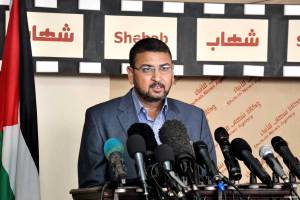
Hamas spokesman Sami Abu Zuhri
Palestinian faction Hamas on Saturday denied reports of militants crossing into Egypt’s Sinai Peninsula from the Gaza Strip.
“There haven’t been any militants crossing [into Egypt from Gaza], especially after the destruction of all underground tunnels and the deployment of [Egyptian and Palestinian] security forces on border,” Hamas spokesman Sami Abu Zuhri said in a statement.
Abu Zuhri called on Arab parties to shoulder their responsibility in standing against any form of “slander and incitement” against the Palestinian people.
He also went on to appeal to scholars and intellectuals to organize a major media campaign to expose what he described as “pro-Israel media”.
On Friday, the United Arab Emirates-based Sky News Arabia reported that the Egyptian army raised the alert level in the country’s eastern Sinai Peninsula following reports that militants from self-styled “Army of Islam” group crossed into Egypt from Gaza.
The Egyptian army has not commented on the report.
Last month, an Egyptian court declared the military wing of Hamas, Izzedine al-Qassam Brigades, a “terrorist organisation.”
Abu Zuhri had described the court verdict as “politically-motivated”, and reiterated that his movement does not interfere in Egypt’s internal affairs.
Egypt seizes assets of 30 opposition figures
MEMO | February 20, 2015
The Egyptian authorities have confiscated the assets of 30 members of the revolutionary council; an opposition coalition founded by members living in exile.
Mohammed Yasser Abu El-Fotouh, the secretary-general of the government panel tasked with managing the Muslim Brotherhood’s seized funds, said yesterday that the committee headed by first assistant justice minister, Ezzat Khamis, decided to confiscate all the funds and property belonging to the 30 members of the Egyptian Revolutionary Council.
Reuters quoted a source in the committee as saying that “the revolutionary council’s members met in Turkey three months ago mainly with members of the Muslim Brotherhood international organisation with the aim of supporting the group”.
The same source added that the list of members whose assets will be confiscated include, advisor, Walid Sharabi, a spokesman for the judges for Egypt movement, Amr Darraj, and journalist Ayat Orabi, advisor Imad Abuhashim, as well as Osama Rushdie, Ali Khalifa, Maha Azzam and others.
The committee announced on January 22 that it had confiscated the assets of more than 1,000 charities and 532 companies, and dozens of schools owned by members and leaders of the Muslim Brotherhood, only one day after the issuance of a court ruling invalidating the decisions to withhold the money.
In August last year, Egyptian politicians, academics and intellectuals representing different spectrums of the political forces which oppose the current authorities in Egypt launched the Egyptian Revolutionary Council in Istanbul, to be “an entity that represents Egyptians abroad who maintain the principles of the January 25 2011 Revolution”.
The council expressed concern two days ago over the sale of French Rafale fighter jets to Egypt, saying the country does not need the fighter jets at this time and does not have the financial capacity to pay for them.
The council said in a statement that it had sent a message to the French president and the French Ministries of Defence and Foreign Affairs stressing it rejection of the deal specially “since the current regime does not represent the Egyptian people” and explaining that “this agreement will not be financially or politically binding for the Egyptian people after the coup falls”.
The committee chairman, Ezzat Khamis said in previous statements that the committee has confiscated the assets of 901 members and leaders of the Muslim Brotherhood while lifted the confiscation orders for five members” adding that “the committee considers the confiscation of assets for 166 new people.
Khamis declined to disclose the confiscated assets total value citing “confidentiality”.
Detained Egyptian journalist protests arrest, as researchers debate number of journalist detentions
Mada Masr | February 7, 2015
Mahmoud Abou Zaid, a freelance photojournalist who was arbitrarily detained during the dispersal of the Rabea al-Adaweya protest last August, released an open letter via Facebook condemning his arrest and continued detainment, on Saturday.
In the letter published by the official campaigners for his freedom, Abou Zaid known professionally as Shawkwan, condemned his long detainment stating, “I have reached day 550 of “temporary” imprisonment. It is an imprisonment that has no color, taste, shape or even a scent. It is senseless!”
He also pointed to hypocrisy of the Egyptian government’s treatment of Egyptian journalists as opposed to foreign ones. “I will send my condolences to myself and to all my fellow Egyptian journalists who don’t own another passport or have a big organization to stand with them,” he wrote referencing the recent release of Australian journalist Peter Greste,“I am an Egyptian. My quarrel with my country is simply that I am an Egyptian, an Egyptian journalist.”
President Abdel Fattah al-Sisi issued a decree in November allowing for the deportation of foreign nationals currently detained in Egyptian prisons. The decree led to Greste’s release in early February and his Egyptian-Canadian colleague Mohamed Fahmy renounced his Egyptian citizenship in anticipation of his release. However, fellow Al-Jazeera journalist Baher Mohamed, who has been jailed for more than 400 days, is solely an Egyptian citizen and his fate remains uncertain.
Shawkan and Mohamed are only two of the many journalists currently detained, however their exact number is debated by researchers and rights organizations.
In December Ahmad Atwan, a journalist at the Brotherhood-affiliated Misr Alan news channel, released a list of the names of 74 journalists that, according to Atwan, are currently detained on charges relating to their profession. However the New York based Committee to Protect Journalists (CPJ) asserts there are only 11 journalists currently in prison, while the Arab Network of Human Rights Information (ANHRI) states that 60 journalists are in custody.
The Journalists Syndicate legal consultant Sayed Abou Zeid stated to Mada Masr that they also will soon be releasing a report documenting the number of detained journalist, but did not give any further details.
Shaimaa Aboul Khier, a former researcher at CJP and current coordinator of Shawkan’s campaign, told Mada Masr that the numbers dispute revolves around the conditions under which journalists were arrested.
“We are listening to contradictory numbers, and here we have to differentiate between journalists who were arrested while covering events, and those who were participating in these political events. This line is not clear with most of these calculations,” she explained.
For Khier, there is a difference between investigating crackdown on the right of free speech and association, and specific targeting of journalists. “Were those arrested reporting at the time of arrest, or chanting in the march, for example. It is very difficult to determine that,” she explained. “Some people are said to be journalists just because they were holding a camera. Not everyone who holds a camera is a journalist, it is a very important distinction that no one is paying attention to.”
Mada Masr did a random check of the names included on Atwan’s list and found out that many of those listed were journalists, but their arrests were not due to journalism. For example Emad Abo Zeid, who works for al-Ahram Gate in Beni Suef, was arrested from his home while he was sitting with three al-Azhar sheikhs and faces terrorism and violence charges.
Gamal Eid, a rights lawyer and executive director of the Arab Network of Human Rights Information (ANHRI,) explained to Mada Masr that the network gathered a list of 60 imprisoned journalists who were arrested either while reporting or due to reasons related to their profession.
“For example, our list includes chief editor of al-Shaab newspaper Magdy Hussien who was jailed for his journalistic position not due to his affiliation with the Brotherhood’s legitimacy alliance,” he explained. However, Eid said the list does not include journalists who were arrested due to their political activity; for example Magdy Qorqor, the former spokesperson of the outlawed legitimacy alliance.
Eid added that most journalists are detained pending investigations, although there are a few currently serving prison sentences.
Al-Qaeda, Saudi Arabia and Israel
By Robert Parry | Consortium News | February 4, 2015
The disclosure that convicted al-Qaeda operative Zacarias Moussaoui has identified leading members of the Saudi government as financers of the terrorist network potentially reshapes how Americans will perceive events in the Middle East and creates a risk for Israel’s Likud government which has forged an unlikely alliance with some of these same Saudis.
According to a story in the New York Times on Wednesday, Moussaoui said in a prison deposition that he was directed in 1998 or 1999 by Qaeda leaders in Afghanistan to create a digital database of the group’s donors and that the list included Prince Turki al-Faisal, then Saudi intelligence chief; Prince Bandar bin Sultan, longtime Saudi ambassador to the United States; Prince al-Waleed bin Talal, a prominent billionaire investor; and many leading clerics.
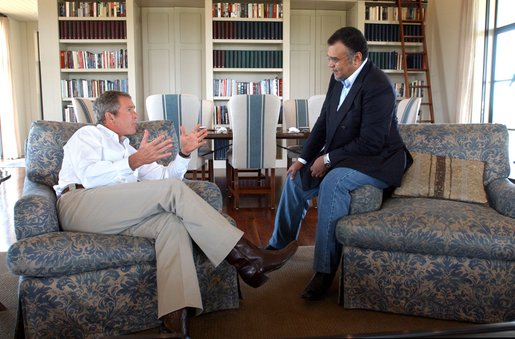
Prince Bandar bin Sultan, then Saudi ambassador to the United States, meeting with President George W. Bush in Crawford, Texas. (White House photo)
“Sheikh Osama wanted to keep a record who give money,” Moussaoui said in imperfect English — “who is to be listened to or who contributed to the jihad.”
Although Moussaoui’s credibility came under immediate attack from the Saudi kingdom, his assertions mesh with accounts from members of the U.S. Congress who have seen a secret portion of the 9/11 report that addresses alleged Saudi support for al-Qaeda.
Further complicating the predicament for Saudi Arabia is that, more recently, Saudi and other Persian Gulf oil sheikdoms have been identified as backers of Sunni militants fighting in Syria to overthrow the largely secular regime of President Bashar al-Assad. The major rebel force benefiting from this support is al-Nusra Front, al-Qaeda’s affiliate in Syria.
In other words, the Saudis appear to have continued a covert relationship with al-Qaeda-connected jihadists to the present day.
The Israeli Exposure
And, like the Saudis, the Israelis have sided with the Sunni militants in Syria because the Israelis share the Saudi view that Iran and the so-called “Shiite crescent” – reaching from Tehran and Baghdad to Damascus and Beirut – is the greatest threat to their interests in the Middle East.
That shared concern has pushed Israel and Saudi Arabia into a de facto alliance, though the collaboration between Jerusalem and Riyadh has been mostly kept out of the public eye. Still, it has occasionally peeked out from under the covers as the two governments deploy their complementary assets – Saudi oil and money and Israeli political and media clout – in areas where they have mutual interests.
In recent years, these historic enemies have cooperated in their joint disdain for the Muslim Brotherhood government in Egypt (which was overthrown in 2013), in seeking the ouster of the Assad regime in Syria, and in pressing for a more hostile U.S. posture toward Iran.
Israel and Saudi Arabia also have collaborated in efforts to put the squeeze on Russia’s President Vladimir Putin, who is deemed a key supporter of both Iran and Syria. The Saudis have used their power over oil production to drive down prices and hurt Russia’s economy, while U.S. neoconservatives – who share Israel’s geopolitical world view – were at the forefront of the coup that ousted Ukraine’s pro-Russian President Viktor Yanukovych in 2014.
The behind-the-scenes Israeli-Saudi alliance has put the two governments – uncomfortably at times – on the side of Sunni jihadists battling Shiite influence in Syria, Lebanon and even Iraq. On Jan. 18, 2015, for instance, Israel attacked Lebanese-Iranian advisers assisting Assad’s government in Syria, killing several members of Hezbollah and an Iranian general. These military advisors were engaged in operations against al-Qaeda’s Nusra Front.
Meanwhile, Israel has refrained from attacking Nusra Front militants who have seized Syrian territory near the Israeli-occupied Golan Heights. One source familiar with U.S. intelligence information on Syria told me that Israel has a “non-aggression pact” with these Nusra forces.
An Odd Alliance
Israel’s odd-couple alliances with Sunni interests have evolved over the past several years, as Israel and Saudi Arabia emerged as strange bedfellows in the geopolitical struggle against Shiite-ruled Iran and its allies in Iraq, Syria and southern Lebanon. In Syria, for instance, senior Israelis have made clear they would prefer Sunni extremists to prevail in the civil war rather than Assad, who is an Alawite, a branch of Shiite Islam.
In September 2013, Israel’s Ambassador to the United States Michael Oren, then a close adviser to Israeli Prime Minister Benjamin Netanyahu, told the Jerusalem Post that Israel favored the Sunni extremists over Assad.
“The greatest danger to Israel is by the strategic arc that extends from Tehran, to Damascus to Beirut. And we saw the Assad regime as the keystone in that arc,” Oren told the Jerusalem Post in an interview. “We always wanted Bashar Assad to go, we always preferred the bad guys who weren’t backed by Iran to the bad guys who were backed by Iran.” He said this was the case even if the “bad guys” were affiliated with al-Qaeda.
And, in June 2014, speaking as a former ambassador at an Aspen Institute conference, Oren expanded on his position, saying Israel would even prefer a victory by the brutal Islamic State over continuation of the Iranian-backed Assad in Syria. “From Israel’s perspective, if there’s got to be an evil that’s got to prevail, let the Sunni evil prevail,” Oren said.
Skepticism and Doubt
In August 2013, when I first reported on the growing relationship between Israel and Saudi Arabia in an article entitled “The Saudi-Israeli Superpower,” the story was met with much skepticism. But, increasingly, this secret alliance has gone public.
On Oct. 1, 2013, Israeli Prime Minister Netanyahu hinted at it in his United Nations General Assembly speech, which was largely devoted to excoriating Iran over its nuclear program and threatening a unilateral Israeli military strike.
Amid the bellicosity, Netanyahu dropped in a largely missed clue about the evolving power relationships in the Middle East, saying: “The dangers of a nuclear-armed Iran and the emergence of other threats in our region have led many of our Arab neighbors to recognize, finally recognize, that Israel is not their enemy. And this affords us the opportunity to overcome the historic animosities and build new relationships, new friendships, new hopes.”
The next day, Israel’s Channel 2 TV news reported that senior Israeli security officials had met with a high-level Gulf state counterpart in Jerusalem, believed to be Prince Bandar, the former Saudi ambassador to the United States who was then head of Saudi intelligence.
The reality of this unlikely alliance has now even reached the mainstream U.S. media. For instance, Time magazine correspondent Joe Klein described the new coziness in an article in the Jan. 19, 2015 issue.
He wrote: “On May 26, 2014, an unprecedented public conversation took place in Brussels. Two former high-ranking spymasters of Israel and Saudi Arabia – Amos Yadlin and Prince Turki al-Faisal – sat together for more than an hour, talking regional politics in a conversation moderated by the Washington Post’s David Ignatius.
“They disagreed on some things, like the exact nature of an Israel-Palestine peace settlement, and agreed on others: the severity of the Iranian nuclear threat, the need to support the new military government in Egypt, the demand for concerted international action in Syria. The most striking statement came from Prince Turki. He said the Arabs had ‘crossed the Rubicon’ and ‘don’t want to fight Israel anymore.’”
Though Klein detected only the bright side of this détente, there was a dark side as well, as referenced in Moussaoui’s deposition, which identified Prince Turki as one of al-Qaeda’s backers. Perhaps even more unsettling was his listing of Prince Bandar, who had long presented himself as a U.S. friend, so close to the Bush Family that he was nicknamed “Bandar Bush.”
Moussaoui claimed that he discussed a plan to shoot down Air Force One with a Stinger missile with a staff member at the Saudi Embassy in Washington, at a time when Bandar was the ambassador to the United States.
According to the New York Times article by Scott Shane, Moussaoui said he was assigned to “find a location where it may be suitable to launch a Stinger attack and then, after, be able to escape,” but that he was arrested on Aug. 16, 2001, before he could carry out the reconnaissance mission.
The thought of anyone in the Saudi embassy, then under the control of “Bandar Bush,” scheming with al-Qaeda to shoot down George W. Bush’s Air Force One is shocking, if true. The notion would have been considered unthinkable even after the 9/11 attacks, which involved 15 Saudis among the 19 hijackers.
After those terror attacks which killed nearly 3,000 Americans, Bandar went to the White House and persuaded Bush to arrange for the rapid extraction of bin Laden’s family members and other Saudis in the United States. Bush agreed to help get those Saudi nationals out on the first flights allowed back into the air.
Bandar’s intervention undercut the FBI’s chance to learn more about the ties between Osama bin Laden and the 9/11 perpetrators by giving FBI agents only time for cursory interviews with the departing Saudis.
Bandar himself was close to the bin Laden family and acknowledged having met Osama bin Laden in the context of bin Laden thanking Bandar for his help financing the jihad project in Afghanistan during the 1980s. “I was not impressed, to be honest with you,” Bandar told CNN’s Larry King about bin Laden. “I thought he was simple and very quiet guy.”
The Saudi government claimed to have broken ties with bin Laden in the early 1990s when he began targeting the United States because President George H.W. Bush had stationed U.S. troops in Saudi Arabia, but – if Moussaoui is telling the truth – al-Qaeda would have still counted Bandar among its supporters in the late 1990s.
Bandar and Putin
Bandar’s possible links to Sunni terrorism also emerged in 2013 during a confrontation between Bandar and Putin over what Putin viewed as Bandar’s crude threat to unleash Chechen terrorists against the Sochi Winter Olympics if Putin did not reduce his support for the Syrian government.
According to a leaked diplomatic account of a July 31, 2013 meeting in Moscow, Bandar informed Putin that Saudi Arabia had strong influence over Chechen extremists who had carried out numerous terrorist attacks against Russian targets and who had since deployed to join the fight against the Assad regime in Syria.
As Bandar called for a Russian shift toward the Saudi position on Syria, he reportedly offered guarantees of protection from Chechen terror attacks on the Olympics. “I can give you a guarantee to protect the Winter Olympics in the city of Sochi on the Black Sea next year,” Bandar reportedly said. “The Chechen groups that threaten the security of the games are controlled by us.”
Putin responded, “We know that you have supported the Chechen terrorist groups for a decade. And that support, which you have frankly talked about just now, is completely incompatible with the common objectives of fighting global terrorism.”
Bandar’s Mafia-like threat toward the Sochi games – a version of “nice Olympics you got here, it’d be a shame if something terrible happened to it” – failed to intimidate Putin, who continued to support Assad.
Less than a month later, an incident in Syria almost forced President Barack Obama’s hand in launching U.S. air strikes against Assad’s military, which would have possibly opened the path for the Nusra Front or the Islamic State to capture Damascus and take control of Syria. On Aug. 21, 2013, a mysterious sarin attack outside Damascus killed hundreds and, in the U.S. media, the incident was immediately blamed on the Assad regime.
American neocons and their allied “liberal interventionists” demanded that Obama launch retaliatory air strikes even though some U.S. intelligence analysts doubted that Assad’s forces were responsible and suspected that the attack was carried out by extremist rebels trying to pull the U.S. military into the civil war on their side.
Yet, pushed by the neocons and liberal war hawks, Obama nearly ordered a bombing campaign designed to “degrade” the Syrian military but called it off at the last minute. He then accepted Putin’s help in reaching a diplomatic solution in which Assad agreed to surrender his entire chemical weapons arsenal, while still denying any role in the sarin attack.
Later, the Assad-did-it case crumbled amid new evidence that Sunni extremists, supported by Saudi Arabia and Turkey, were the more likely perpetrators of the attack, a scenario that became increasingly persuasive as Americans learned more about the cruelty and ruthlessness of many Sunni jihadists fighting in Syria. [See Consortiumnews.com’s “The Mistaken Guns of Last August.”]
Targeting Putin
Putin’s cooperation with Obama to head off a U.S. military strike in Syria made the Russian president more of a target for the American neocons who thought they finally had reached the cusp of their long-desired “regime change” in Syria only to be blocked by Putin. By late September 2013, a leading neocon, National Endowment for Democracy President Carl Gershman, announced the goal of challenging Putin and recognizing his sore point in Ukraine.
Taking to the Washington Post’s op-ed page on Sept. 26, 2013, Gershman called Ukraine “the biggest prize” and an important step toward ultimately ousting Putin. Gershman wrote, “Ukraine’s choice to join Europe will accelerate the demise of the ideology of Russian imperialism that Putin represents. … Russians, too, face a choice, and Putin may find himself on the losing end not just in the near abroad but within Russia itself.” [See Consortiumnews.com’s “Neocons’ Ukraine-Syria-Iran Gambit.“]
However, in early 2014, Putin was obsessed with Bandar’s implicit threat of terrorism striking the Sochi Olympics, thus distracting him from the “regime change” – being pushed by NED and neocon Assistant Secretary of State for European Affairs Victoria Nuland – next door in Ukraine.
On Feb. 22, 2014, putschists, spearheaded by well-organized neo-Nazi militias, drove elected President Viktor Yanukovych and his government from power. Putin was caught off-guard and, in the resulting political chaos, agreed to requests from Crimean officials and voters to accept Crimea back into Russia, thus exploding his cooperative relationship with Obama.
With Putin the new pariah in Official Washington, the neocon hand also was strengthened in the Middle East where renewed pressure could be put on the “Shiite crescent” in Syria and Iran. However, in summer 2014, the Islamic State, which had splintered off from al-Qaeda and its Nusra Front, went on a rampage, invading Iraq where captured soldiers were beheaded. The Islamic State then engaged in gruesome videotaped decapitations of Western hostages inside Syria.
The Islamic State’s brutality and the threat it posed to the U.S.-backed, Shiite-dominated government of Iraq changed the political calculus. Obama felt compelled to launch airstrikes against Islamic State targets in both Iraq and Syria. American neocons tried to convince Obama to expand the Syrian strikes to hit Assad’s forces, too, but Obama realized such a plan would only benefit the Islamic State and al-Qaeda’s Nusra Front.
In effect, the neocons were showing their hand – much as Israeli Ambassador Oren had done – favoring the Sunni extremists allied with al-Qaeda over Assad’s secular regime because it was allied with Iran. Now, with Moussaoui’s deposition identifying senior Saudi officials as patrons of al-Qaeda, another veil seems to have dropped.
Complicating matters further, Moussaoui also claimed that he passed letters between Osama bin Laden and then Crown Prince Salman, who recently became king upon the death of his brother King Abdullah.
But Moussaoui’s disclosure perhaps cast the most unflattering light on Bandar, the erstwhile confidant of the Bush Family who — if Moussaoui is right — may have been playing a sinister double game.
Also facing potentially embarrassing questions is Israeli Prime Minister Netanyahu, especially if he goes through with his planned speech before a joint session of Congress next month, attacking Obama for being soft on Iran.
And, America’s neocons might have some explaining to do about why they have carried water not just for the Israelis but for Israel’s de facto allies in Saudi Arabia.
~
Investigative reporter Robert Parry broke many of the Iran-Contra stories for The Associated Press and Newsweek in the 1980s. You can buy his latest book, America’s Stolen Narrative, either in print here or as an e-book (from Amazon and barnesandnoble.com).
230 Egyptian Activists, Including Ahmed Douma, Get Life Sentences

Leading Egyptian opposition campaigner Ahmed Douma
Al-Akhbar | February 4, 2015
An Egyptian court sentenced prominent activist Ahmed Douma along with 229 other anti-Mubarak activists to life in prison on Wednesday after the court held hearings for 269 people connected to “the cabinet headquarters events” of December 2011, judicial sources said.
Douma and 268 others were accused of staging “riots” outside central Cairo’s cabinet headquarters and assaulting policemen during a sit-in back in December 2011 against a decision by Egypt’s then-ruling military council to appoint as prime minister Kamal al-Ganzouri, who had served in this position under ousted autocrat Hosni Mubarak.
In addition to “rioting,” the activists were accused of possessing white arms like knives, attacking police officers and armed forces, burning the al-Majmaa al-Alami and attacking other government buildings including the cabinet headquarters.
Thirty-nine other defendants, all minors, were sentenced to 10 years in prison. All 269 defendants were found guilty of taking part in clashes with security forces near Cairo’s Tahrir Square in December 2011, the sources said.
In April, Douma along with two other prominent activists, were sentenced to three years in prison and ordered to pay a 10,000 Egyptian pound (around $1,300) fine. The fine was raised on Wednesday to 17 million Egyptian pounds (around $2 million).
In December an Egyptian court dismissed charges against Mubarak for ordering security forces to kill protesters during the 2011 uprising.
That verdict, and others handed down to Mubarak-era figures, has led some to conclude that the old regime that existed before the uprising has been reestablished under a different name.
Wednesday’s ruling, which can be appealed, is the harshest court order delivered so far against non-Islamist activists, amid a government crackdown on dissent overseen by President Abdel Fattah al-Sisi.
Authorities banned the Muslim Brotherhood following Mursi’s ouster and launched a heavy crackdown on its members, leaving at least 1,400 dead and 15,000 jailed, including hundreds sentenced to death for allegedly taking part in deadly riots in August 2013.
Egypt was brought in November in front of the UN’s top human rights body for a litany of rights abuses, including its crackdown, mass arrests and unfair trials targeting Mursi supporters, journalists and activists, described as “unprecedented in recent history.”
Besides the heavy crackdown on Muslim Brotherhood supporters, many of the leading secular activists behind the 2011 uprising have also found themselves on the wrong side of the new political leadership, getting locked up for taking part in peaceful demonstrations following the recent ban on unlicensed protests.
Critics accuse Sisi of taking Egypt back to authoritarian rule. Sisi says he is committed to democracy in Egypt, a strategic US ally with influence across the Arab world.
(Reuters, AFP, Al-Akhbar)
Egypt Lists Hamas as “Terrorist Organization”
Al-Akhbar | January 31, 2015
An Egyptian court on Saturday banned the armed wing of the Palestinian resistance group Hamas and listed it as a terrorist organization.
Hamas is an offshoot of Egypt’s Muslim Brotherhood which the Egyptian authorities have also declared a terrorist group and have repressed systematically since the army ousted one of its leaders, Mohammed Mursi, from the presidency in 2013.
“The court ruled to ban the Qassam Brigades and to list it as a terrorist group,” said the judge of the special Cairo court which deals with urgent cases.
Egypt had previously banned Hamas from operating in Egypt.
Egyptian officials claim weapons are smuggled from the Hamas-ruled Gaza Strip into Egypt, where they end up with militant groups fighting to topple the Western-backed Cairo government.
Islamist militants based in Egypt’s Sinai region, which has a border with Gaza, have killed hundreds of police and soldiers since Mursi’s political demise. The insurgency has spread to other parts of Egypt, the most populous Arab country.
Hamas on Saturday dismissed Egyptian media accusations for the group of standing behind deadly attacks in the Sinai Peninsula.
“Neither Hamas nor the Gaza Strip have anything to do with what happened in Sinai or any other place in Egypt,” Hamas spokesman Fawzi Barhoum said in a statement.
Barhoum termed claims by Egyptian media that Hamas was behind the attacks as “an attempt to demonize” the Palestinian group.
“Hamas does not interfere in the affairs of any Arab country, particularly Egypt,” he said.
The Palestinian faction has repeatedly denied accusations that it has carried out attacks in the North African state, saying it cannot act against Egypt’s national security.
Since then-army chief Abdel Fattah al-Sisi rose to power in Egypt in 2013 and was elected president, the country’s relationship with the besieged Gaza Strip has worsened.
In November, Egypt decided to create a one kilometer-deep buffer zone in the Sinai Peninsula along the border with Gaza by clearing more than 800 houses, displacing more than 1,100 families, and destroying and neutralizing hundreds of subterranean tunnels.
Gaza, which has been under a brutal illegal Israeli blockade for almost eight years, relied heavily on smuggling tunnels across the Egyptian border to obtain vital supplies. The only border crossing between Egypt and Gaza has also been routinely closed, leaving many Palestinians stranded or without access to important medical treatment.
The Egyptian Muslim Brotherhood has also repeatedly condemned the militant attacks in Egypt and denied any involvement.
However, the Sisi regime has clamped down severely on Mursi supporters. The crackdown has left at least 1,400 people dead and more than 15,000 imprisoned, with hundreds sentenced to death in trials the United Nations described as “unprecedented in recent history.”
(Reuters, Anadolu, Al-Akhbar)
Featured Video
BRITAIN’S WARNING: PREPARE FOR WAR
or go to
Aletho News Archives – Video-Images
From the Archives
British weapons and personnel doing much of the killing in Yemen
Press TV – June 18, 2019
A detailed report published by the Guardian newspaper has shown how Britain is massively contributing to Saudi Arabia’s devastating war on Yemen as it suggests that London is not only supplying the bombs that fall on Yemenis, but it provides the personnel and expertise that keep the war going.
The comprehensive report by Arron Merat published on Tuesday showed that Britain was doing much of the killing in Yemen as the country continues to provide Saudi Arabia with everything it needs to turn its southern impoverished neighbor into a graveyard.
“Every day Yemen is hit by British bombs – dropped by British planes that are flown by British-trained pilots and maintained and prepared inside Saudi Arabia by thousands of British contractors,” said Merat in the report. … continue
Blog Roll
 Aletho News
- Yemen denounces European Parliament’s ‘hypocritical’ push to blacklist Ansarullah
- Qalibaf: UAE’s UN bid aims to ‘clear the runway’ for ‘Greater Israel’, whitewash genocide
- Pakistan reopens Iran border after boosting security: Report
- Why are so many Brazilians voting for Flávio Bolsonaro?
- Democrats Put Anti-Russia Agenda Ahead of American Workers
- Elijah Magnier: Yemen’s Strikes Are Shattering Saudi Arabia’s Long-Term Strategy
- Pentagon designates Chinese cultural centers national security threat
- Israel Demolishes Home Of Lebanese Journalist Whose Viral Film Exposed Pager Attack
- Record Oil, Empty Tanks: The UAE’s Miracle Recovery
- Burnham tackles Britain’s poverty with aggression in Yemen
- If Americans Knew
- An error has occurred; the feed is probably down. Try again later.
- No Tricks Zone
- Sudden Stratospheric Warming, Powerful El Niño Combination May Lead To Extreme Europe Cold, Energy Crisis!
- Two New Studies Find Thwaites Glacier Melt Cannot Be Driven By Human Activity Or A Warming Ocean
- E-Cars Reduce CO2 Emissions By Only 41% Compared To Internal Combustion Engine Vehicles
- Predictions Made By Renowned Climate Professor Over Past Decades Have Been Proven To Be Poor
- New Study Suggests Large Regions Of The Pacific Ocean Have Been Cooling For The Last 80 Years
- Germany’s Green Energy Debacle: High Energy Costs Force Kahla Porzellan to Close After 182 Years!
- New Study: 50 Years Of The Most Aggressive ‘Net Zero’ Policies Can Only Affect The Global Climate By 0.03°C
- US September “Heat” Was No Record…Many Records Set Decades Ago
- Latest European Green Energy Debacle; Portugal’s Largest Flagship Solar Park Insolvent!
- Green Energy Debacle: German Expert Professor Fritz Vahrenholt Warns Of Severe Economic And Social Consequences

