Russia’s top lawmaker slams Biden’s ‘new world order’ plan
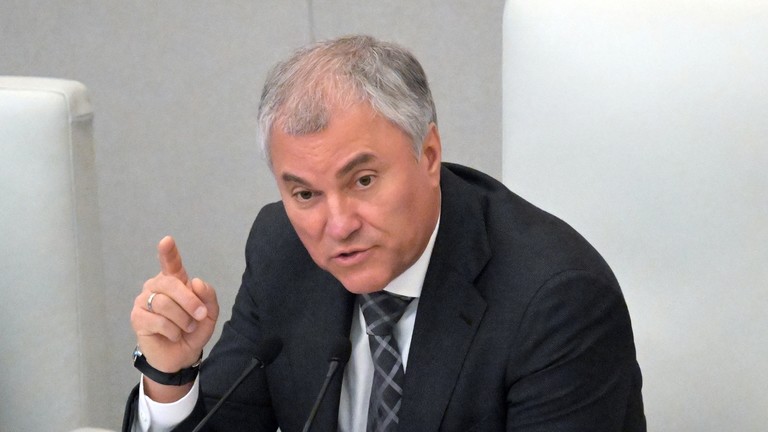
Russian State Duma Chairman Vyacheslav Volodin © Sputnik / Vladimir Fedorenko
RT | October 24, 2023
Russia’s State Duma chairman has compared the US government to a company executive, who has run a business into the ground and now wants to try again with a new corporation.
Vyacheslav Volodin was reacting on Tuesday to remarks by US President Joe Biden, who said last week that a new international order was needed, and that Washington can “unite the world in ways that it never has been”.
The speaker of the lower house of the Russian parliament said that just as a corporate manager with a bankruptcy on their hands would not be trusted with someone else’s money again, “nobody in the world will accept Biden and the US, who have destroyed the global security system, to build a new world order in their interests.”
The Russian official claimed the US has inflicted harm on the world “in attempting to save its hegemony,” causing a disruption of international commerce through trade wars, a deep crisis in the European Union, tensions over Taiwan, and hostilities in Ukraine and the Middle East.
“Attempts to reshape [the world] to fit the American mold will not lead to anything good and can only result in a global disaster,” Volodin warned, urging the US leader to be isolated “before he unleashes a world war”.
Biden’s “new world order” remark came on Friday, while he was meeting with donors as part of his re-election campaign. He touted the US as an indispensable nation and exemplified whipping up support of Washington-friendly governments for Ukraine as an example of his administration’s unifying endeavors.
He insisted that the US was up to the task of leading humanity, and that there has never been a crisis from which the country did not emerge stronger.
Kremlin spokesman Dmitry Peskov said on Monday that Biden was correct in saying that the old system of global governance has become obsolete, but that Moscow rejects the notion that another “American-centric world order” should replace it. Peskov stressed that Russia supports a multipolar world, in which the US would be one stakeholder among many equals.
Europe is suffering from ‘war psychosis’ in its unyielding military support for Ukraine: Hungary’s foreign minister
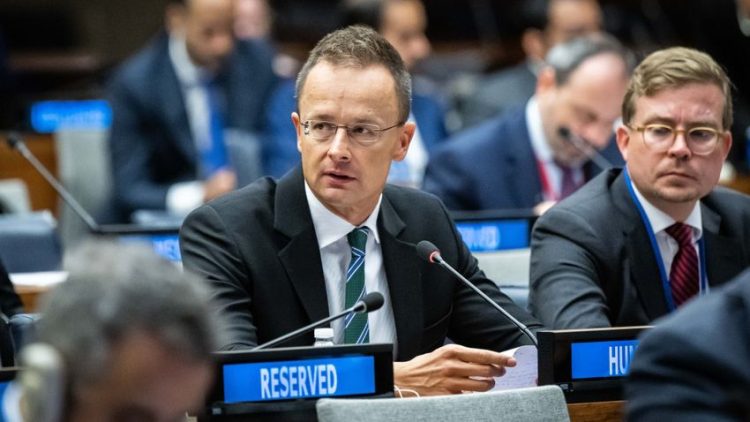
MAGYAR NEMZET | October 24, 2023
Instead of looking for ways to foster peace, the European Union’s current and planned actions only serve to extend the war, Hungarian Minister of Foreign Affairs and Trade Péter Szijjártó said after a meeting of the EU’s Foreign Affairs Council.
“It is all about war, there is no peace. Brussels is still pro-war, as shown by the fact that they would give €5 billion a year for arms over the next four years, which also shows that they expect the war to continue,” Szijjártó said. “No one in Western Europe is talking about peace, Europe is suffering from a war psychosis.”
He added that it is clear there will be no solution to the war on the battlefield. Europeans expect nothing but destruction and death, and the conditions for peace are getting worse.
“Taking arms production and training to Ukraine would drag the EU into an immediate war. We find this totally unacceptable. Nor should arms transfers be just about supplying the Ukrainians with as many weapons as possible, because the EU is not a security organization, and justifying a country’s future accession on security grounds is completely unacceptable,” Szijjártó added.
Energy sanctions are hurting Hungary, Szijjártó claimed
Speaking of the EU’s bans on Russian fossil fuels, Szijjártó said that Hungarians do not want to give up energy security in the name of some ill-defined ideals.
“On energy supplies: We didn’t talk nonsense by saying that it’s not a political issue, it’s a physical issue. We are not willing to risk the security of Hungary’s energy supply or the results of cuts in tariffs. Hungarians are not responsible for the war, we are not willing to make them pay for it,” he said.
The Hungarian foreign minister accused other member states of being covert about their dealings with Russia, unlike Prime Minister Viktor Orbán who has been honest and transparent through his recent meeting with Russian President Vladimir Putin in Beijing.
“My colleague, the Lithuanian foreign minister was blunt. He said that he expected me to clarify whether what is being said here is our own position or the Kremlin’s position. This is unacceptable to me. I reassured him that Hungary is a sovereign country with a sovereign opinion,” Szijjártó explained.
“As long as this government is in power, we are not prepared to accept any opinion from anywhere, from any geographical direction, whether there is a lot of water between us or not. I said to my Lithuanian colleague that I hope he can say the same thing with his hand on his heart,” he added.
German MP announces formation of new anti-establishment party
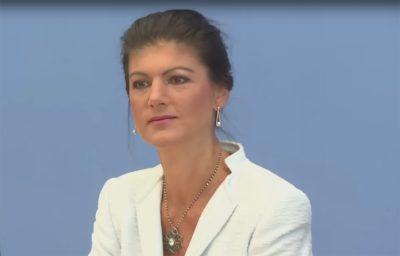
RT | October 23, 2023
Germany will have a new left-wing political grouping in 2024 after prominent Left Party MP Sahra Wagenknecht announced the formation of her own party. Its platform will include the normalization of relations with Russia and a peace-oriented foreign policy.
Wagenknecht broke the news during a press conference in Berlin on Monday, saying she and fellow Left Party defectors had “decided to establish a new party.” Explaining the need for a new political force, she argued that things “can’t continue like this” or Germans “will probably not recognize our country in ten years.”
The politician plans for the new party to run candidates in regional elections in the eastern regions of Saxony, Thuringia and Brandenburg, as well as in the European Parliament election next year.
A fresh poll commissioned by Bild am Sonntag indicated that some 27% of Germans would not rule out voting for Wagenknecht’s new political force.
Until the party’s official formation at the start of 2024, Wagenknecht and nine other Bundestag colleagues who resigned from the Left Party said they wished to keep their current seats. Party leadership has, however, already indicated that the defectors could lose their mandates much earlier. In September, Wagenknecht hinted at her plans to branch out, claiming that many Germans felt that none of the existing political forces represented their views.
Not long after that, the “Sahra Wagenknecht Alliance – for reason and justice” was registered with the aim of laying the groundwork for the establishment of a new party. The politician clarified that the Left Party had, in her opinion, become increasingly irrelevant. She also blasted Chancellor Olaf Scholz’s government on Monday as the “worst government in the history of the federal republic.”
Wagenknecht said she would seek to preserve Germany’s “economic strengths” as well as work toward more social justice. With respect to foreign policy, Berlin should switch to diplomacy rather than weapons deliveries when dealing with conflicts, the politician insisted.
She has been a vocal critic of Scholz’s policies toward Moscow over the Ukraine conflict, arguing that the current approach risks leading to a global, and potentially nuclear conflict. Berlin, according to Wagenknecht, should assume the role of a peacemaker.
Commenting previously on the EU’s anti-Russia sanctions, the politician has repeatedly claimed that the punitive measures are doing more harm to the German economy than to the Russian one, and thus should be lifted.
Wagenknecht is also a prominent critic of the European Union’s “elite project” and NATO, and argues for more independence for national states.
The EU Demands “Disinformation” Answers From Meta and TikTok

By Christina Maas | Reclaim The Net | October 22, 2023
The European Union has instigated investigations into two technological titans, Meta, the company that owns Facebook, and TikTok. The probes focus on assessing the actions these two companies have taken to halt the proliferation of “illegal content and disinformation” in the aftermath of the recent Hamas assault on Israel and subsequent escalation of conflict.
Notably, this process represents one of the first set of actions initiated under the newly minted EU legislation targeting online speech.
Prior to this, the EU had sparked similar inquiries into X. The request for information from Meta hinges specifically around the amplification and spread of “disinformation” and illicit content linked to the Israel-Hamas conflict. In a parallel vein, the EU is seeking to garner insight into TikTok’s strategy to combat the diffusion of terrorist provocation, violent material, and “hate speech.”
This legal altercation raises significant questions about internet censorship and its potential impact on free speech. With the EU demanding more details from Meta about its “mitigation measures to protect the integrity of elections,” there’s a looming fear of global tech behemoths capable of influencing political narratives and public opinion.
The two companies under probe have, respectively, October 25 and November 8 deadlines to answer to the EU’s demand for information, with the latter date serving for less urgent inquiries.
The DSA was enforced in August for “very large” platforms, encompassing Meta and TikTok, which boast more than 45 million monthly European users. The DSA threatens tech companies with potential fines equivalent to six percent of a firm’s global turnover if they permit the hosting of illegal online speech.
Thierry Breton, the EU’s chief tech enforcer, sent cautionary letters to various tech CEOs, such as TikTok’s Shou Zi Chew, Meta’s Mark Zuckerberg, and Alphabet’s Sundar Pichai.
In response, Meta announced it was allocating special resources to tackle problematic and illegal content related to the Israel-Hamas conflict, exemplifying the pressure exerted by the EU’s censorship crusade.
Ukraine’s leaders are controlled by US – German ex-chancellor

Former German Chancellor Gerhard Schroeder © Photo by Kay Nietfeld/dpa via Getty Images
RT | October 21, 2023
Former German Chancellor Gerhard Schroeder has argued in a newspaper interview that the US government didn’t “allow” any compromises that could have brought an end to the Russia-Ukraine conflict just weeks after Moscow’s military offensive began in February 2022.
Speaking in an interview published by Germany’s Berliner Zeitung newspaper on Friday, Schroeder said he was asked to help mediate the March 2022 peace negotiations between Ukrainian and Russian officials in Istanbul. He said that although representatives of Ukrainian President Vladimir Zelensky were open to making concessions on such key issues as renouncing efforts to join NATO, “the Ukrainians did not agree to peace because they were not allowed to. They first had to ask the Americans about everything they discussed.”
Russian officials have repeatedly claimed that the US and other Western backers of Ukraine discouraged Zelensky’s government from agreeing to a peace settlement. Schroeder, who has defended his continuing friendship with Russian President Vladimir Putin, essentially confirmed that allegation in the Berliner Zeitung interview. “My impression: Nothing could happen because everything else was decided in Washington,” he said.
The ex-chancellor described Washington’s strategy as “fatal,” saying it resulted in closer ties between Russia and China. “The Americans believe they can keep the Russians down,” Schroeder said. “Now, it is the case that two actors, China and Russia, who are limited by the USA, are joining forces. Americans believe they are strong enough to keep both sides in check. In my humble opinion, this is a mistake. Just look how torn the American side is now. Look at the chaos in Congress.”
Washington’s allies in Western Europe “failed” to seize the opportunity to push for peace in March 2022, Schroeder said. At the time, he added, Zelensky was open to compromise on Crimea and breakaway territories in the Donbass region. Since that time, hundreds of thousands of Ukrainian troops have been killed as Western military aid prolongs the conflict. Putin estimated earlier this month that Kiev lost over 90,000 soldiers in the failed counteroffensive that began in June.
“The arms deliveries are not a solution for eternity, but no one wants to talk,” Schroeder said. “Everyone is sitting in trenches. How many more people have to die? It’s a bit like the Middle East. Who are the victims on one side and on the other? Poor people who lose their children.”
Schroeder argued that only French President Emmanuel Macron and German Chancellor Olaf Scholz can revive peace talks in Eastern Europe. “Scholz and Macron should actually support a peace process in Ukraine because it’s not just an American matter, but above all a European matter.” He added, “Why did Scholz and Macron not combine the arms deliveries with an offer to talk? Macron and Scholz are the only ones who can talk to Putin.”
Russian leaders were threatened by the US push to bring NATO to Moscow’s western border by adding Ukraine to the Western military alliance, Schroeder said. However, he claimed that one of the justifications for arming Ukraine – alleged Russian expansionism – had no basis in reality.
“This fear of the Russians coming is absurd,” Schroeder said. “How are they supposed to defeat NATO, let alone occupy Western Europe?” He added, “That is why no one in Poland, the Baltics and certainly not in Germany – all NATO members, by the way – has to believe they are in danger.”
On the other hand, Schroeder insisted, Western leaders must understand that no matter who is in power in Moscow, Russia won’t allow either Ukraine or Georgia to be absorbed by NATO. “This threat analysis may be emotional, but it is real in Russia,” he said. “The West must understand this and accept compromises accordingly. Otherwise, peace will be difficult to achieve.”
Chinese Businessmen Literally Laughing at West’s Anti-Russian Sanctions

By Ilya Tsukanov – Sputnik – 21.10.2023
Chinese businessmen are literally laughing at the West’s sanctions packages against Russia, Russian Foreign Ministry spokeswoman Maria Zakharova has revealed.
Citing a media report from Friday indicating that the 12th package of EU sanctions may include a Lithuania-proposed ban on the export of European-made nails, tacks, drawing pins, sewing and knitting needles, radiators, and other odds and ends to Russia, Zakharova said that judging by past experience, she can hardly fathom how Russia’s Chinese partners will react to the news.
“A year ago I was at a meeting with representatives of Chinese business circles in Moscow. We were talking, and suddenly a message popped up on my phone with news that the US had adopted yet another sanctions package banning the supply of elevators and related equipment to Russia. According to the sanctions’ authors, this measure would ‘paralyze the construction industry in Russia.’ When I read this news to my Chinese colleagues, they burst out in Homeric laughter. They literally howled and roared with laughter,” Zakharova recalled in a Telegram post on Saturday.
“After the ‘sanctions hara-kiri’ of the Japanese automobile industry on the Russian market, the most incredible dream of Chinese automotive manufacturers came true. Within six months, they confirmed the veracity of the saying ‘nature abhors a vacuum’,” the spokeswoman added.
“It’s scary to imagine what kind of hysteria will begin among Chinese manufacturers of knitting needles and buttons if they learn about this Lithuanian plan to ‘destroy Russian industrial capabilities.’ Where will Lithuania put its wares if such a decision is made? I don’t know, they could put the inscription ‘to spite Russia’ on their highway made of buttons, nails, sewing and knitting needles,” Zakharova summed up.
Russian-Chinese trade has hit back-to-back-to-back record highs in recent years, reaching the equivalent of over $176 billion by the end of the third quarter of the current year. The Asian industrial giant has taken to importing record quantities of Russian energy and other natural resources, and has helped fill the gap left by European and Japanese finished goods manufacturers after their exodus from Russia in 2022.
Speaking with Chinese media ahead of his visit to the Belt and Road Initiative forum earlier this week, Russian President Vladimir Putin reported a “32 percent growth” in Russia-China trade turnover over the past year, and said that “there is every reason to believe that we will reach the $200 billion mark” by the end of 2023.
The reorientation of trade from Europe to China, India and other countries in the developing world has helped Russia weather the storm of Western sanctions and trade restrictions, with the country’s GDP growth expected to reach up to 2.5 percent in 2023 after contracting by 2.1 percent a year earlier.
Hungary warns of ‘knockout blow’ to EU economy
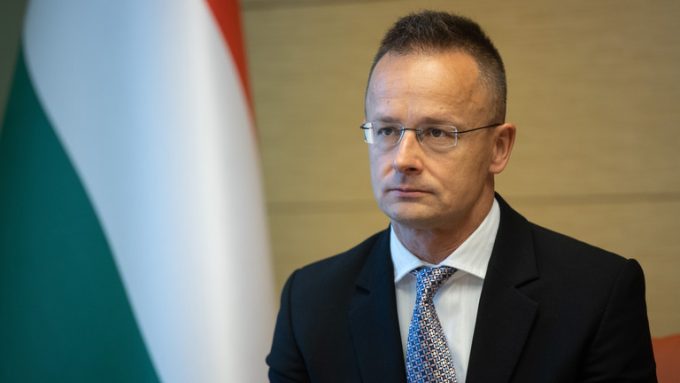
Hungarian Trade and Foreign Minister Peter Szijjarto. © Omer Taha Cetin/Getty Images
RT | October 21, 2023
The EU should pursue cooperation with China and Asia as a whole, which have already become more competitive than the bloc in economic terms, according to Hungarian Foreign Minister Peter Szijjarto.
Speaking at an informal meeting of EU trade ministers in Valencia on Friday, Szijjarto emphasized that the global economy has turned upside down over the past few years, resulting in a fall in the bloc’s economic position, which Brussels is making worse with its indiscriminate sanctions policies. He reiterated that recent sanctions against Russia and the drive to abandon Russian energy “shot the European economy first in the foot and then in the knee.”
“Today we pay four times as much for gas in Europe as Americans do at home and three times as much for electricity as people pay in China,” he pointed out, noting that while distancing itself from Russia has already caused problems, doing the same with China would be even more destructive for the EU economy.
Szijjarto noted that China has already surpassed the EU in terms of gross domestic product (GDP): its share of global GDP jumped from 9% in 2010 to the current 18%, while the EU’s share dropped from 22% to 17%.
“The overall structure of the world economy is being transformed, and this great transformation also means that the West’s automatic competitive advantage has ended. The Eastern world has strengthened significantly, they have at the very least caught up with the Western world from a financial and technological point of view, while they have always been ahead of us in terms of human resources,” he stated. Szijjarto added that the Eastern and Western economies are more strongly interdependent nowadays than ever before, and said the EU should not shy away from this trend.
“Whether we like it or not, it’s a fact. Whoever denies all this can cause very serious damage to the European economy,” he warned.
Szijjarto noted that the basis of the EU’s economic growth previously lay in the combination of advanced Western technologies and cheap Russian energy, but this line of cooperation has now been severed.
“Unfortunately, there are Western Europeans… who strive to cut off economic cooperation between Europe and China in the same way. If this were to happen, it would practically be a knockout blow to the European economy. That is why we are against any effort to isolate the Chinese and European economies from each other,” he stated.
The minister said the consequences of such actions would be especially felt by the European automotive industry, which relies on Chinese suppliers.
“This would practically suffocate the car industry. And if we strangle the European car industry, we will destroy the European economy,” he declared.
“Everyone in the economy understands this, but Western European politicians don’t want to see the reality, they don’t want to hear the facts, but rather they politicize out of ideology and anger.”
The EU relationship with China has been strained over the past several years, with Brussels viewing Beijing as an economic rival, and each side increasingly unhappy with the other’s policies.
Rights groups push back against EU censorship chief Thierry Breton after he pressured platforms to censor “disinformation”
By Didi Rankovic | Reclaim The Net | October 20, 2023
European (EU) Commissioner for Internal Market Thierry Breton is asked to answer some tough questions after his (latest) escapade, now seen as a new attempt to pressure tech platforms to censor content – while he was explaining that as, combating “disinformation.”
Both politicians, and tech platforms, have been hearing this for a long time, many years now, from people opposed to the obvious censorship: don’t let it “find a home” in the heart of your governments and media, or political discourse – because once it does, it may never leave.
Sure, on any given day, it might feel great to suppress information about an election, a side you don’t like in a war, etc, by just labeling it as “disinformation.”
But what happens once those causes you do support start to get affected, as well? Unfortunately, that’s all there seems to be to it, regarding Breton’s latest outrageous moves – although one would hope and wish for a more universal understanding of the importance and need of protection of free speech, full stop.
Now groups like the Center for Democracy & Technology (CDT Europe), Access Now, Article 19, and about two dozen others are expressing their extreme discomfort with Breton’s letter to X, TikTok, Google (YouTube) and Meta.
We obtained a copy of the letter for you here.
It has to do with the latest Middle East escalation. The groups behind the initiative are attempting to influence Breton mainly by asserting that his actions – penning a letter pressuring tech platforms demanding the censorship of “disinformation” on this particular geopolitical issue – as essentially contravening EU’s own Digital Services Act (DSA).
The long and the short of the civil society groups’ attempt here is that Breton is creating “a false equivalency” between illegal content and disinformation – as per the DSA.
To be honest – the EU is such a winding and “blinding” bureaucracy, that it’s not entirely impossible that some of its scriptwriters don’t fully understand their own plot.
Regardless, the letter the CDT now joins claims that Commissioner Breton – in his “censor-right-now” letter to big platforms – “incorrectly and confusingly invoked obligations under DSA to make several demands from these online platforms to swiftly address this content, which are not in fact required by the law.”
Obviously, nobody from these groups is ready to address the EU’s core policy – it’s all procedural.
Or – maybe they do – just a little bit?
“The Commissioners’ (Breton’s) highly politicized engagement risks pressuring online platforms to take actions in ways that are not guided by the law and may undermine human rights, which in this case disproportionately affects human rights defenders, advocates, and journalists. His actions further risk undermining the authority and independence of the Commission’s DSA Enforcement Team,” CDT’s Asha Allen is quoted.
The EU has discredited itself in the Israel-Palestine conflict
By Timur Fomenko | RT | October 20, 2023
European Commission President Ursula von der Leyen’s showboating in support of Israel in the current Middle East conflict has reportedly provoked a backlash from EU lawmakers and diplomats.
When the Israel-Gaza war broke out just over a week ago, von der Leyen made the decision to offer unconditional support to West Jerusalem rather than urge for calm or mediation, having Israel’s flag projected onto the European Commission headquarters and paying a visit to Israel herself. She clearly did so out of an inclination to appear in line with the US. But her actions have aged poorly as reports of civilian deaths and humanitarian disaster in the besieged Gaza Strip continue to mount.
Anyone familiar with von der Leyen knows that she is an unapologetic neoconservative and transatlanticist who is single-handedly undermining the autonomy, respect, and foreign policy stature of the EU by actively working to make the bloc subordinate to the US in multiple areas, all while attempting to showcase herself as a true regional leader. If the EU sees itself in a fundamental competition with China and Russia, there could not be a worse advert to the rest of the world than her leadership, and her Israel blunders may be her most damaging decisions yet.
Von der Leyen’s foreign policy legacy involves dragging the EU into several confrontations it could have done without. This week, she is heading to Washington DC to try to forge a deal on steel and aluminum trade targeted at China, but that will ultimately result in throwing the EU market under the bus, again. Other acts have included backing the American position on Ukraine and striving for full escalation of the war there, promoting energy decoupling with Russia, as well as inventing the term “de-risking” with China and seeking to undermine the bloc’s lucrative relationship with Beijing. Throughout this, she has been repeatedly eager to pull large sums of money out of thin air and propose fantasy projects which amount to little more than posturing, and which her office alone is not even able to authorize.
For example, that includes offering Belarus billions if it goes ahead with a US-backed regime change, or inventing numerous “infrastructure” schemes to compete with China, such as the Global Gateway, among other things. She has thus repeatedly used the stature of her office to follow American objectives and try to shape the continent without establishing any kind of due consensus. Almost immediately after the war in Gaza broke out, the European Commission announced all EU aid to Palestine would be frozen. Regardless of what you think of Hamas, with hindsight that decision now appears spiteful, reactionary and inhumane, which tells you how fast the Commission was to jump to the American position of unconditional support for Israel.
But this time there is a widespread feeling it has gone too far. Rather than allowing Europe to have staked out a moderate position on the Gaza conflict, even if it would not be too sympathetic to Palestine, the decision was essentially outsourced to the US, discrediting the EU and only serving to contribute to the growing backlash starting to emerge among Muslim communities in response to the conflict. For countries such as France, this is disastrous. This hurts the EU’s image across the Islamic world and the Global South by seemingly siding with the oppressors.
Soon enough, a series of embarrassing U-turns followed, including the reinstatement of aid, combined with tweets in Arabic, but the damage had already been done, because Israel has long been given the green light to pursue unparalleled destruction in Gaza, at seemingly whatever the cost. In doing so, von der Leyen has in fact undermined, in yet another way, the bloc’s ability to present itself as a serious and comprehensive political actor. She seems to have no love for the idea that the EU should have strategic autonomy and be capable of calibrating its own interests and place in the world, and would prefer that it instead be a simple parrot of the US.
Of course, if she took into greater consideration the interests and positions of member states it would be less of a problem. But she does not and instead essentially serves as a completely disruptive force, in practice undermining European diplomacy and preventing the EU from building relations with a wide range of states. In the end, this favors only the US.
West has ‘lost’ Global South over Israel hypocrisy – FT

FILE PHOTO: Destruction in Gaza © Mustafa Hassona / Anadolu via Getty Images
RT | October 19, 2023
Attempts by the US and its allies to “paint Moscow as a global pariah” have been “poisoned” by their rush to support Israeli retaliation against Hamas in Gaza, the Financial Times reported on Wednesday, citing more than a dozen officials.
Western nations have long framed the Ukraine conflict as an act of “unprovoked aggression” and blasted Moscow for the suffering of civilians.
However, the same nations have appeared reluctant to condition their support for Israel on exercising restraint in the wake of the deadly incursion by the Palestinian militant group Hamas, earlier this month. Israel has cut off essential supplies to the enclave and subjected it to intense bombardment.
“We have definitely lost the battle in the Global South,” one senior G7 diplomat was quoted as saying. “All the work we have done with the Global South [over Ukraine] has been lost… Forget about rules, forget about world order. They won’t ever listen to us again.”
“What we said about Ukraine has to apply to Gaza. Otherwise we lose all our credibility,” the official added. “The Brazilians, the South Africans, the Indonesians: why should they ever believe what we say about human rights?”
Meanwhile, an Arab official noted an apparent lack of consistency: “if you describe cutting off water, food and electricity in Ukraine as a war crime, then you should say the same thing about Gaza.”
White House National Security Adviser Jake Sullivan was confronted over the issue on CNN. Host Jack Tapper stressed that “civilians are civilians” regardless of where they reside. The official declined to say whether Washington was putting pressure on Israel to let supplies into Gaza.
According to The Huffington Post, the US State Department last week instructed high-level diplomats working in the Middle East not to use three specific phrases regarding the Israeli-Palestinian conflict: “de-escalation/ceasefire,” “end to violence/bloodshed,” and “restoring calm.”
This week, a Russian-proposed draft resolution denouncing violence against civilians and urging a ceasefire was rejected by the UN Security Council. Another one submitted by Brazil was later vetoed by the US, after 12 members voted for it.
Russia abstained on the second proposal, after its amendment to include a call for a truce was rejected.
“You, colleagues, will certainly come up with some formal justification citing ‘unbalanced language,’ but at this point they would sound pathetic. You have made your choice,” Moscow’s envoy, Vassily Nebenzia, said about the non-inclusion of the wording.
Hungary PM Orbán meets with Putin in Beijing
BY THOMAS BROOKE | REMIX NEWS | OCTOBER 17, 2023
Hungarian Prime Minister Viktor Orbán met with Russian President Vladimir Putin in Beijing on Tuesday to discuss ongoing bilateral agreements between the two nations.
The pair were snapped shaking hands in the Chinese capital — the first photographed handshake between Putin and an EU leader since the Russian invasion of Ukraine in February last year.
Orbán told the Russian president that “Hungary has never sought to confront Russia” and has always and will continue to “pursue the goal of building and expanding the best communication,” reported Russia’s state-run news agency TASS.
“In Europe today, one question is on everyone’s mind: Will there be a ceasefire in Ukraine? For us Hungarians, too, the most important thing is that the flood of refugees, the sanctions, and the fighting in our neighboring country should end,” Orbán posted on X following the meeting.
Budapest has maintained relatively close relations with Moscow and faced the wrath of the European Union for steering its own course through the conflict in Ukraine and refusing to present a united front with other EU leaders.
Orbán’s administration has long opposed the provision of arms to Kyiv, which it claims is prolonging the conflict and increasing the death toll, and has advocated for an immediate ceasefire and peace talks.
The rendezvous exerts further pressure on Brussels, which requires Hungary’s approval for proposed budget reforms in order to unlock further funding for Ukraine.
“Given the fact that in today’s geopolitical conditions the opportunities for maintaining contacts and developing relations are very limited, it can only cause satisfaction that our relations with many European countries are maintained and developed. One of these countries is Hungary,” Putin told Orban.
The meeting was criticized by U.S. Ambassador to Hungary David Pressman who accused Orbán of “pleading for business deals” while Russia continues its aggression in Ukraine.
“Hungary’s leader chooses to stand with a man whose forces are responsible for crimes against humanity in Ukraine, and alone among our Allies,” he posted on X.
This interpretation of the meeting was questioned by the Hungarian prime minister’s political director, Balázs Orbán, who claimed that Budapest was “fed up” with Pressman’s “hypocrisy.”
“If the question is who’s doing business with the Russians, the Americans should turn down the volume. They are buying more than twice as much nuclear fuel alone as they used to, and we have a whole list of them,” he added.
“Since your president refuses to talk about ending this war, someone has to,” quipped Koskovics Zoltán, a geopolitical analyst at the Budapest-based Center for Fundamental Rights.
Both leaders arrived in Beijing at the invitation of Chinese President Xi ahead of an international forum on China’s Belt and Road Initiative.
Earlier on Tuesday, Orbán met with the Chinese leader to discuss the strengthening of Hungarian-Chinese relations.
“Connectivity instead of decoupling: This is the Hungarian model. Our aim is to strengthen Hungarian-Chinese relations. This is good for Hungary and good for the European economy,” he said in a statement.
Featured Video

Racist Seinfeld Dances for Joy as Bibi Unveils His New Map
or go to
Aletho News Archives – Video-Images
TV Drama Review
Japanese drama projects Japan’s wartime atrocities onto Chinese characters

Global Times | October 25, 2026
By portraying Chinese characters as perpetrators of ruthless violence while casting Japanese Self-Defense Forces (SDF) intelligence operatives as defenders, the season 2 of the Japanese drama Vivant has recently drawn criticism from Chinese netizens, who argue that its depiction turns historical reality on its head while ignoring Japan’s wartime atrocities.
The TBS drama series – a spy suspense story in which an alleged unofficial intelligence unit of the SDF operates across the globe — has attracted a passionate fanbase. Its currently airing season 2 opened with a household rating of 18.8 percent, the highest for a TV drama this year, according toa commentary article by Japanese media Toyo Keizai.
What draws attention is the portrayal of the enemies in the series, the article noted. Scenes in which the Chinese organization subjects kidnapped members of the SDF unit to brutal torture are repeated with unrelenting intensity.
It is rare for Japanese TV dramas to explicitly portray a real-life country as the enemy, the article noted.
Japanese Prime Minister Sanae Takaichi also made a reference to the drama, saying that she has been recording Vivant and hopes to binge-watch it over the year-end and New Year holidays, according to Japanese media outlets.
China’s CCTV News report on Sunday revealed that the drama features scenes in which Chinese personnel cut off the fingers of and stab Japanese intelligence operatives in the abdomen. Such acts bear striking similarities to the torture inflicted on Chinese nationals by invading Japanese troops during the World War II.
The drama distorts the truth by attributing these atrocities to modern Chinese characters. Beneath the surface, it subtly glorifies Japan’s cross-border overseas operations, blurs the functional boundaries of the SDF and implicitly promotes an expansionist narrative, per CCTV News. … continue
Blog Roll
 Aletho News
- Iran FM Araghchi: “Hormuz Will No Longer Be the Same”
- EU facing trillion-euro debt hole while seeking more cash for Kiev
- How US, Europe, Persian Gulf states exhausted missile stockpiles, splurged billions to defend Israel
- Up in arms… Koreans reject U.S. empire’s plan to make South Korea the next Ukraine
- Iran, Turkey, Pakistan, Saudi Arabia could advance region-led security framework in Tehran: FM spox
- Netizens condemn Japanese drama for projecting Japan’s wartime atrocities onto Chinese characters
- Racist Seinfeld Dances for Joy as Bibi Unveils His New Map
- A West Bank War for Netanyahu’s Election Campaign, Could It Backfire?
- Yemen denounces European Parliament’s ‘hypocritical’ push to blacklist Ansarullah
- Qalibaf: UAE’s UN bid aims to ‘clear the runway’ for ‘Greater Israel’, whitewash genocide
- If Americans Knew
- An error has occurred; the feed is probably down. Try again later.
- No Tricks Zone
- Sudden Stratospheric Warming, Powerful El Niño Combination May Lead To Extreme Europe Cold, Energy Crisis!
- Two New Studies Find Thwaites Glacier Melt Cannot Be Driven By Human Activity Or A Warming Ocean
- E-Cars Reduce CO2 Emissions By Only 41% Compared To Internal Combustion Engine Vehicles
- Predictions Made By Renowned Climate Professor Over Past Decades Have Been Proven To Be Poor
- New Study Suggests Large Regions Of The Pacific Ocean Have Been Cooling For The Last 80 Years
- Germany’s Green Energy Debacle: High Energy Costs Force Kahla Porzellan to Close After 182 Years!
- New Study: 50 Years Of The Most Aggressive ‘Net Zero’ Policies Can Only Affect The Global Climate By 0.03°C
- US September “Heat” Was No Record…Many Records Set Decades Ago
- Latest European Green Energy Debacle; Portugal’s Largest Flagship Solar Park Insolvent!
- Green Energy Debacle: German Expert Professor Fritz Vahrenholt Warns Of Severe Economic And Social Consequences

