Ukraine ‘cynically’ not interested in minority rights – Hungary
RT | November 13, 2023
Ukraine has no intention of resolving concerns about its treatment of Hungarians and other minorities living in its western province, Hungarian Foreign Minister Peter Szijjarto told reporters in a meeting broadcast on his Facebook page on Monday.
Instead, the government in Kiev has focused on duping the rest of the world into believing the minority rights issue is “resolved or almost resolved” – even as the situation for Hungarians living in the province of Transcarpathia “deteriorates” even further.
“I think it’s very cynical on the part of Ukrainians that, as can be clearly seen, they in no way want to resolve issues that are important to us, in no way want to return the rights taken away from Transcarpathian Hungarians,” Szijjarto said.
To illustrate the minority’s worsening plight, Szijjarto described a letter sent by the Ukrainian Ministry of Education instructing schools that the Ukrainian language “should be used as the state language not only during classes, but also during breaks between teachers and students,” even in schools where the majority of students – and teachers – are Hungarian.
Last month, Szijjarto demanded Ukraine repeal several laws seen as impinging on the rights of ethnic Hungarians, warning that Budapest would block Kiev’s efforts to join the EU so long as the discrimination continued.
Hungarian President Viktor Orban took things one step further, declaring Hungary would not support its neighbor “on any issue in international life until it restores the laws that guaranteed the rights of Transcarpathian Hungarians.”
Approximately 156,000 ethnic Hungarians living in Ukraine have seen their situation worsen dramatically since 2015, according to Szijjarto. The nation’s other ethnic minorities – including 150,000 Romanians and 250,000 Moldovans – have similarly suffered under a series of laws mandating the use of the Ukrainian language in official settings.
The legislation, which has come under fire from human rights groups and the Council of Europe, has led to the closing of some 100 Hungarian schools in Ukraine, leaving just 20% of the country’s Hungarian population receiving lessons in their own language.
The Council of Europe’s Venice Commission urged Ukraine to improve the recognition of its national minorities if it hopes to enter the EU in a report published earlier this year. Its proposed reforms include publishing official state documents in minority languages, delaying the introduction of Ukrainian as a principal language in schools, providing interpreter services at Ukrainian public events, and ditching Ukrainian-language content quotas for minority media outlets. Currently, just 10% of a media outlet’s content can be broadcast in the minority language.
Czech Republic prosecuting citizens for supporting Russia
RT | November 12, 2023
Czech law enforcement is dealing with a growing number of cases linked to the public approval of Russia’s military operation in Ukraine, iRozhlas media outlet reported on Saturday, citing police data. The EU nation’s authorities have made it a crime to publicly express support for Moscow in its conflict with Kiev.
Endorsing Russia’s military operation in Ukraine at demonstrations or on the internet, as well as praising or supporting senior Russian officials can be treated as ‘approval of a crime’, or “denying, questioning, approving or justifying a genocide” under the Czech Criminal Code, the nation’s Public Prosecutor’s Office warned in February 2022.
Police say they have investigated hundreds of complaints related to these types of actions since the beginning of the conflict. The number of criminal cases opened over public endorsements of Russia has reached 384, Police Spokesman Ondrej Moravcik told iRozhlas. Almost 100 people have been charged, he added.
According to the spokesman, the courts have already passed judgment in some of the cases. The official did not reveal how many cases reached the courts or if anyone has received time in prison for supporting Russia. According to Moravcik, the police stop following these cases after handing them over to the prosecutor’s offices for indictments.
Under the Czech Criminal Code, approval of a crime is punishable by up to one year behind bars. Those found guilty of denying or justifying “genocide” could spend between six months and three years in jail.
The Czech authorities have faced heavy public criticism over its support for Kiev and its ties to the US. In September, around 10,000 people took part in a rally in the capital, Prague, demanding the government resign due to its pro-Western policies.
The demonstration was organized by the opposition Law, Respect, Expertise (PRO) party. The protesters demanded that Prague veto any attempts by Ukraine to join NATO, adding that the Czech Republic should withdraw from the US-led bloc.
Ukraine says it is ready to meet Hungary’s demands on minority rights
MANDINER | November 10, 2023
Ukraine is ready to reach an agreement with Hungary on meeting EU requirements for the protection of the rights of national minorities, Deputy Prime Minister for European and Euro-Atlantic Integration of Ukraine Olga Stefanishyna told a press conference in Kyiv on Thursday.
She vowed to guarantee the rights of the ethnic Hungarian minority living in modern-day Ukraine, but rejected claims that Hungarians were particularly affected by the ongoing Russian aggression in the country.
“The Hungarian minority has suffered much less than, say, the Greek minority in the Azov region,” she noted.
The Ukrainian minister said that Hungary reserves the right to arbitrarily block Ukraine’s EU accession process, but stated that she did not believe the Hungarian problem should be the main obstacle in the EU enlargement process.
“I am confident that we will be able to overcome this challenge. I am confident that we will find political understanding,” she stressed.
Hungary has been at odds with Ukraine for years mainly on account of the erosion of rights for its 100,000-strong ethnic Hungarian minority there, mainly based in the Transcarpathia region. Besides nationalist threats against Hungarians, there have also been reports that Ukraine conscripts ethnic Hungarians above their ratio in the overall population.
Stefanishyna noted that a dialogue is ongoing with the EU on how Ukraine is preparing to improve the protection of the Hungarian community in Ukraine. The Ukrainian delegation presented a detailed roadmap to Hungary in September, which included both practical steps, such as the provision of textbooks for Hungarian-speaking children, and plans for legislative amendments.
Asked whether Ukraine had any “red lines” for legislative changes, the deputy prime minister said that these amendments must “in no way affect knowledge of the Ukrainian language.”
Barcelona dock workers refuse to deal with weapons ships heading to Israel
MEMO | November 7, 2023
Workers at the Spanish port of Barcelona announced their refusal to allow any ships carrying weapons to operate inside the port, rejecting the violence practiced by Israel in the occupied territories, and accusing the UN of failing to carry out its role.
The workers said in a statement to their association that it is their duty to adhere to and defend the Universal Declaration of Human Rights, at a time when the signatory countries have forgotten about it.
The statement continued: “We decided within the association not to allow ships containing war materials to operate in our port, for the sole purpose of protecting any civilian population, regardless of their location, as there is no justification for sacrificing civilians.”
The statement called for an immediate ceasefire in Gaza, the search for peaceful solutions to conflicts, and for the UN to stop its complicit and negligent behaviour in order to maintain international peace and security and defend international law.
Earlier last week, the Belgian transport workers’ unions called on their members to refuse to load or unload arms shipments being sent to Israel.
“While genocide is under way in Palestine, workers at various airports in Belgium are seeing arms shipments in the direction of the war zone,” the trade unions said in a joint statement.
A Belgian government spokesman declined to comment on whether weapons were being shipped to the region via Belgium.
The unions said that loading or unloading these weapons means contributing to supplying regimes that kill innocent people.
The unions added: “We, several unions active in ground logistics, call on our members not to handle any flights that ship military equipment to Palestine/Israel, like there were clear agreements and rules at the start of the conflict with Russia and Ukraine.”
Hungary calls for new European security architecture

Hungarian Prime Minister Viktor Orban addresses the 5th Demographic Summit in the Fine Arts Museum in Budapest on September 14, 2023. © Attila KISBENEDEK / AFP
RT | November 3, 2023
Hungary wants to see the creation of a new security architecture in Europe that would take into account both Russian and Ukrainian interests, Prime Minister Viktor Orban has said.
Speaking at the summit of the Organization of Turkic States in Astana, Kazakhstan, on Friday, the Hungarian leader stated that the West’s strategy of supporting Ukraine with money and arms had failed and, against this backdrop, Budapest was “advocating a plan B.”
The initiative, he continued, “is aimed at a ceasefire, peace negotiations and the construction of a new European security architecture that will be reassuring for Ukraine and acceptable to the Russians.” According to Orban, Türkiye, which has remained neutral in the stand-off between Moscow and Kiev while acting as a mediator between the two, will also play a prominent role in this potential arrangement.
Since the start of open fighting in the Ukraine conflict, Budapest has consistently urged Kiev and Moscow to engage in talks, while also resisting calls to support EU sanctions against Russia, particularly in the energy sector, arguing that the measures are detrimental to the bloc’s own economy. In May, Orban also predicted that “poor Ukrainians” would not be able to prevail over Russia given the circumstances, particularly NATO’s reluctance to send its troops directly to the battlefield.
Hungary, along with Slovakia, also opposed an aid package to Ukraine to the tune of €50 billion ($53.5 billion) approved by the European Parliament last month. The two nations pointed in particular to concerns about corruption in Kiev and argued that the aid was not working.
While Moscow has never closed the door on talks with Kiev, Ukrainian President Vladimir Zelensky signed a decree last autumn barring all talks with Moscow, after four former Ukrainian regions overwhelmingly voted to join Russia.
In December 2021, shortly before the years-long Ukraine conflict moved to open fighting, Russia submitted proposals To NATO and the US on security guarantees, demanding that the West ban Ukraine’s accession to the military bloc and insisting that the alliance retreat to its borders of 1997, before it expanded. The overture in late 2021, however, was rebuffed by the West.
Orban is not the only EU leader to have raised the prospect of security guarantees as hostilities continued. Last December, French President Emmanuel Macron suggested that Western capitals should consider setting up a security architecture that would take into account Russian interests, once Moscow and Kiev engage in talks. These remarks, however, triggered outrage, both in Kiev and in several EU member states.
Spanish MP calls for coercive measures against Israel

Palestine Information Center | November 3, 2023
MADRID – Spanish MP and member of the European Parliament Idoia Villanueva has condemned what is happening in the Gaza Strip as a “real genocide in 2023 with complete impunity and complicity from the international community, the US administration and the European Union as well.”
“The ongoing atrocities and war crimes committed by Israel, the colonial power, against the population under occupation are considered a war crime, and all this is done in the dark,” she said.
“The cutting off of supplies, electricity, water and fuel exacerbates the situation and further harms the civilian population, which is another crime against the international humanitarian law, causing hospitals to stop functioning and causing massive loss of life,” she said.
“The attempted forced displacement of populations is also a war crime and contrary to the international humanitarian law, and a few days ago, communications and the internet were cut off in an attempt to carry out this genocide,” Villanueva said.
The Spanish MP called on the international community to do much more, adding that “it is unfortunate that the European Union is lost in the maze of expressions and words calling for a ceasefire.”
She called for coercive measures, such as arms embargoes and sanctions, against Israeli officials, as well as the suspension of European funds to Israeli arms companies currently contributing to these systematic human rights violations.
Villanueva also called for “the suspension of the EU-Israel Association Agreement due to these crimes and violations, accountability before the International Criminal Court, and moving forward with the recognition of the State of Palestine in order to somehow pressure Israel.”
“If the international community and Europe do not act and put an end to this genocide, they will carry a horrific stigma,” the lawmaker warned.
EU may become complicit in ‘genocide’ – Spanish official

RT | October 30, 2023
Spanish Social Rights Minister Ione Belarra has urged European leaders to take immediate action against Israel, including severing diplomatic ties and imposing economic sanctions, amid the intensified bombing and expanded ground operations against Hamas militants in the besieged Palestinian enclave.
She also called for Israeli Prime Minister Benjamin Netanyahu to be prosecuted for the alleged war crimes committed against civilians in Gaza.
“After this hellish night in Gaza, I have a very simple but very important message for European leaders. Do not make us complicit in genocide. Act. Not in our name,” Belarra said in a passionate video message on X on Saturday.
More than 8,000 Palestinians, including 3,342 children, have been killed in Gaza since Israel’s air campaign began, according to the latest figures from the Gaza Health Ministry. The unprecedented Hamas raid into Israel, as well as hundreds of rocket strikes on Israeli territory earlier this month, left around 1,400 people dead, while 230 Israelis and foreigners were taken hostage, according to the Israel Defense Forces (IDF).
Addressing the severity of the current situation in Gaza and Israel’s disproportionate retaliation, the minister highlighted the termination of internet and telephone services in the strip, claiming that the move “has a very clear objective” of guaranteeing that “Israel commits crimes against humanity without consequences.”
“Our inaction is turning us into accomplices,” the minister stressed, arguing that “Israel believes that its international alliances guarantee its impunity.”
“We have to act now, tomorrow will be too late,” she continued, voicing her message to the EU leaders: “Cut diplomatic relations with the State of Israel. Carry out exemplary economic sanctions against those responsible for this genocide. And without a doubt, let’s take Netanyahu before the International Criminal Court, so that he can be tried for what he is, a war criminal.”
She also appealed to EU citizens to take to the streets and raise their voice so that “this genocide” comes to an end.
The IDF escalated air and ground attack on Gaza on Friday, causing a near-total communication blackout. Connectivity was partially restored over the weekend, but the Israeli blockade of Gaza continues; Netanyahu announced the “second stage” of the war against Hamas on Saturday.
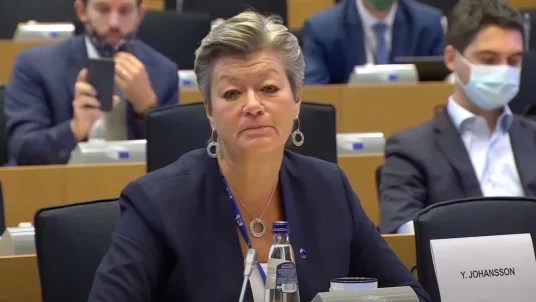
Pro-surveillance EU Commissioner Ylva Johansson Dismisses Concerns About Lobbyists in Message Surveillance Bill
By Didi Rankovic | Reclaim The Net | October 29, 2023
The various EU institutions’ “entanglement” with the bloc’s own idea to try to substantially and dangerously undermine online encryption via a legislative effort known colloquially as “chat control” seems to be nearing a (positive for the internet) resolution – but the bureaucrats who support it appear to be unwilling to go down without a fight.
On Wednesday, European Parliament member (MEP) from Germany Patrick Breyer posted on his blog about EU Home Affairs Commissioner Ylva Johansson laboring to downplay concerns that lobbyists were reportedly part and parcel of drafting the regulation, supposedly there to protect children (stop the proliferation of CSAM content) – but in the process, thanks to its aggressive anti-encryption provisions, destroy the privacy of everyone on the web – including children!)
A day later, Breyer announced that the EP (European Parliament) negotiators had a majority to push through not what the EU Commission wanted – said to be indiscriminate bulk scanning of private communications – but to instead allow “only for a targeted surveillance of specific individuals and groups reasonably suspicious of being linked to child sexual abuse material, with a judicial warrant.”
Even with this development, it’s well worth taking a look at what the likes of Johansson had in mind just a day earlier (which they still could find some of the many EU loopholes to push through, mind you) – and how they justified it.
So, on Wednesday, the LIBE (European Parliament’s Committee on Civil Liberties, Justice and Home Affairs) grilled Johansson on the issue of the alleged lobbying, in the context of “chat control.”
Reports about this first emerged in the press in September, and implied that the EU Commission was basically in cahoots with what’s described as “a foreign network” while coming up with what the critics dismiss as at once dangerous, and not even a smart scheme.
However, Johansson, as Breyer put it – “insisted no mistakes had been made.” (And here you see what it apparently takes to become a high-ranked EU official – the ability not to even wince when faced with overwhelming facts).
But for every bureaucrat speaking in circles, there are representatives of the public unwilling to mince their words.
“It was only to be expected that Johansson would respond to the revelations with her usual propaganda, such as citing a biased and suggestive Eurobarometer survey that violates the rules of good public opinion research,” Breyer spelled it out on Wednesday.
“In order to really hold Johansson accountable for her foreign-influenced bill and her lobbying in office, my committee, on our initiative, has demanded full access to all correspondence of her office with lobbying organizations – such as the secret letters of the dubious US foundation Thorn. Only then can we see the full extent of the entanglement with our own eyes” – he added at the time.
Canadian Lawmakers Want to Punish Online Platforms For Allowing “Misinformation” Spread
By Cindy Harper | Reclaim The Net | October 27, 2023
The Canadian Parliament has become the latest global player in a widening tug-of-war geared towards constraining the tide of “misinformation” seeping into the digital landscape.
The House Ethics Committee in the North American province of Ottawa is calling for the imposing of stringent repercussions on tech giants whom they claim are complicit in disseminating “unverified” or “deceptive” content online.
The Committee’s directives come after an exhaustive ten-month investigation focused primarily on the mounting concern of foreign interference, particularly from powerhouse nations such as China and Russia. It held eight separate public consultation sessions throughout its investigatory period, featuring input from 23 key witnesses.
Vice-chair of the Committee, Bloc Quebecois MP Rene Villemure, emphasized the urgent need for decisive action, mirroring similar controversial legislative combat seen by the European Union, which has imposed significant online regulations to control the spread of digital falsehoods.
“At some point companies will have to understand that they’re actors and they’re not the government,” Villemure said.
“What happens online is basically shaping society, and if we’re not acting in a decisive manner, they will shape society to the bottom.”
Villemure refrains from laying down a specific strategy but looks to the European Union as a potential model. He refers to the European Commission’s recent judicious testing of its new digital laws during the Israel-Hamas conflict.
Slovakia Says Europe Should Not Supply Arms to Ukraine

By Kyle Anzalone | The Libertarian Institute | October 26, 2023
The new government of Slovakia has followed through with its campaign pledge to terminate arms transfers and is calling on the rest of Europe to adopt Bratislava’s policy. Slovakia’s new leader, Robert Fico, has called for the European Union to take on a peacekeeper role in the Ukraine war, and Bratislava will not support further sanctions on Moscow.
Fico told members of Slovakia’s legislature on Thursday that Bratislava was abandoning the West’s proxy war against Russia. “I will support zero military aid to Ukraine… An immediate halt to military operations is the best solution we have for Ukraine. The EU should change from an arms supplier to a peacemaker,” he said. Adding, Slovakia will “no longer supply weapons to Ukraine.”
As well as terminating support for Kiev’s war effort, Fico explained Slovakia will no longer support Washington’s economic war on Moscow. “I will not vote for any sanctions against Russia unless we see analyses of their impact on Slovakia.” He continued, “If there are to be such sanctions that will harm us, like most sanctions have, I can see no reason to support them.”
Additionally, Fico said, “the people in Slovakia have bigger problems than (dealing with) Ukraine” and “further killing [in Ukraine] will not help anyone.”
Fico’s left-wing Smer-SD won Slovakia’s election early this month on a platform that highlighted ending arms transfers to Ukraine.
While President Joe Biden insists that Washington will support Ukraine for “as long as it takes,” several Eastern European countries have started to terminate support for Kiev. Poland announced it would end weapons transfers after Ukrainian President Volodymyr Zelensky slammed Warsaw during his UN address.
Tyson to Build Insect Protein Factory — Critics Say It’s About Money, Not Health or Environment
By Michael Nevradakis, Ph.D. | The Defender | October 24, 2023
Industrial meat giant Tyson Foods is teaming up with Dutch insect ingredient producer Protix to construct an insect ingredient manufacturing facility in the U.S.
In an announcement last week, Tyson said it is acquiring an ownership stake in Protix, and forming a joint venture to construct “the first at-scale facility of its kind to upcycle food manufacturing byproducts into high-quality insect proteins and lipids which will primarily be used in the pet food, aquaculture, and livestock industries,” Tyson Foods stated.
In a statement, Protix said, “The strategic investment will support the growth of the emerging insect ingredient industry and expand the use of insect ingredient solutions to create more efficient sustainable proteins and lipids for use in the global food system.”
Tyson Foods, Protix and proponents of insect-based foods argue that the production of such food products is more sustainable than rearing conventional livestock.
But food safety experts who spoke with The Defender said companies like Tyson are motivated by financial and other incentives, not sustainability. Citing scientific studies to back their claims, they also questioned the safety of insect ingredients.
“This is not about public health or even environmental health,” Nina Teicholz, science journalist and founder of The Nutrition Coalition, said. “The food industry likes bugs, because producing them involves multiple, patent-protected steps that enable companies to make a profit and control our food sources.”
Dutch journalist Elza van Hamelen, who has investigated Protix, told The Defender, “The takeover and transformation of our food system — toward synthetic lab-grown meat, GMO [genetically modified organism] vertical farming and insect farms — is an attack from many fronts.”
“Venture capital is investing in this, even though there is not a clear business case,” she said. “Governments are setting up ‘ecosystems’ in which government representatives, NGOs [nongovernmental organizations], academia and business join hands to get ‘alternative proteins’ off the ground.”
Science communicator Dr. Kevin Stillwagon, a retired chiropractor and airline pilot who investigates health issues on his Substack page, said, “There are already efforts underway to convince us that the way we raise food for human consumption is harming the environment by using up too much land and water and emitting excess greenhouse gasses.” He added, “They will try to convince us that even by using insects as animal feed, the environmental problem is not going to get solved.”
Howard Vlieger, a member of the board of advisers of GMO/Toxin Free USA, told The Defender that Tyson could leverage its market power and its entry into the insect ingredient market to place further financial pressure on cattle suppliers.
“Tyson is one of just four large companies that livestock producers rely on to market their cattle,” he said. “Tyson could potentially leverage its alternative foods interests against cattle purchases, thus lowering the demand and price for the cattle they buy.”
Tyson’s deal with Protix move marks the latest instance in a recent trend that has seen several prominent food producers, including Cargill, invest in insect ingredient manufacturers.
‘Stomach contents of cattle’ to be used as ‘a viable feed source for insects’
John R. Tyson, chief financial officer of Tyson Foods, told Food Ingredients First his company will use its own “by-products,” including “the stomach contents of processed cattle,” to produce “a viable feed source for insects.”
In Tyson Foods’ press release, Kees Aarts, CEO of Protix, said, “Tyson Foods’ and Protix’s strategic partnership advances our joint work towards creating high-quality, more sustainable protein using innovative technology and solutions. Moreover, we can immediately use their existing byproducts as feedstock for our insects.”
According to CNN, “Byproducts like animal fats, hides and inedible proteins, if not used or reduced, can end up in landfills. In this case, Tyson can send what’s in the stomach of cattle it has processed to a Protix facility, where it’s fed to insects.”
“For the company, creating a larger market for this type of waste can not only reduce waste but offer a larger revenue stream,” CNN reported.
The Tyson Foods statement said, “Protix contributes to a circular food chain by using waste from the food industry as feed for the black soldier fly (BSF). In turn, the insects are processed into valuable nutrients such as proteins and lipids.”
“Protix’s customers use these proteins and lipids as high-quality ingredients for feed and food” while “residual streams from the insects are used as organic fertilizer,” it added.
Aarts told CNN the black soldier fly “can grow on almost every type of food waste and byproduct you can imagine,” while according to Food Ingredients First, the flies “can eat up to twice their body weight daily, which can be used to enable a closed-loop recycling system,” creating a reusable protein source while using less water and land.
When completed, the Tyson Foods-Protix facility will “centre on all aspects of production, from breeding and incubating to the hatching of insect larvae,” Just Food reported, quoting a Tyson Foods spokesperson as saying the two companies are currently looking to “identify” the location where their plant will be constructed.
The joint-venture facility is expected “to be ready for ramping up operations towards the end of 2025,” according to Feed Navigator, which also reported that “The facility’s capacity will be three to four times the output of [Protix’s] existing plant” in The Netherlands. It will be able to produce “up to 70,000 tons of live larvae equivalent annually.”
According to Just Food, the precise size and cost of the minority stake Tyson Foods acquired in Protix has not been disclosed, but according to Feed Navigator, “When asked to disclose how much the U.S. company has invested, a spokesperson for Protix [said] funding from existing backers along with Tyson Foods” totaled $58 million.
Tyson’s insects not headed for human food supply — yet
The companies claim that the insect-based products they will manufacture will not enter the human food supply — for now. Tyson told CNN “Today, we’re focused on more of [an] ingredient application with insect protein than we are a consumer application.”
But a Tyson Foods spokesperson told Just Food that “Human food compositions exist, and Protix is leading the development of high-quality proteins from animal and fish feeds to consumer-level products.”
“While consumer adoption is very low and human-food applications are not the focus of this joint venture, opportunities exist in the long term to create more sustainable protein products,” the Tyson Foods spokesperson added.
Tyson told Food Ingredients First that he views his company as a “catalyst” that can create a more sustainable and equitable food system, and that “Partnerships with those across industries are an important part of that journey, working together to advance our collective sustainability ambitions and transform the global food system.”
According to Stillwagon, inserting insects into the human food supply is the goal of major food producers.
“Livestock and fish that are fed with insect-based proteins and lipids will most definitely enter the human food supply. This may change the taste of these foods to some degree,” he said.
“Also, the fish and livestock may need to be genetically modified so they will grow to sizes necessary for harvesting since they would be consuming something that is not natural to them,” Stillwagon added.
Not ‘adequately tested for safety’
According to CNN, “The meat industry places a large burden on the planet, in part because of the land, water and energy it takes to grow crops that feed the animals we eat,” adding that “Some experts say that reducing the environmental footprint of animal feed can help make the system more sustainable.”
“Making food out of insects is one way to do that: Bugs take up less space and subsist on waste that would otherwise be discarded,” CNN reported.
According to Food Dive, “Insect protein has grown in prominence in recent years with companies debuting cricket-based snacks and powders,” citing claims by cricket ingredient brand Exo that crickets are 20 times more efficient to grow than cattle.
CNN quoted Reza Ovissipour, Ph.D., professor in sustainable food systems at Texas A&M University, who said that flies operate as “mini bioreactors” that can convert animal waste into “the protein or fat from the insects,” which can then be used as animal feed.
“And these mini bioreactors, they are very inexpensive,” he said. “You don’t need to apply that much energy. It’s very sustainable,” he said.
Experts who spoke with The Defender expressed a different view.
“Due to the insect exoskeletons, which humans are not adapted to eat, it’s not clear that this new ‘foodstuff’ is safe for humans — or pets,” Teicholz said. “Insects and bugs have not been adequately tested for safety.”
“We know that meat, eggs and fish are sources of complete, whole proteins that humans (and dogs) have evolved to eat over millions of years,” she added. “We should be trying to figure out how to make these natural proteins more sustainable rather than shift to new, potentially dangerous food sources.”
Along similar lines, Alexis Baden-Mayer, political director for the Organic Consumers Association, said, “We don’t need to replace meat, milk or eggs with anything, we just have to raise animals on pasture. This is incredibly beneficial to the environment, really productive and produces the most nutrient-dense food possible.”
Baden-Mayer also said there are several risks that insects, when consumed as food, pose for human health, noting that insects contain allergens known as chitins and toxins known as mycotoxins — which also cause mold to be toxic to humans.
Stillwagon said insects pose other risks to human health.
“Since allergies to insect proteins, known as entomophagy allergies, have been reported, food producers must label insect-based products accurately to provide allergen information,” he said.
“The second risk is the microbiome and virome of the insect itself,” Stillwagon said. “It is possible that in some people with weakened immune systems, the consumption of bacteria and viruses that are naturally part of the insect could become pathogenic,” he added.
“Chemicals that are used to kill bacteria and viruses during the processing of insects on a massive scale for food may be harmful to humans,” Stillwagon said. “Also, the plants that the insects feed on may have been treated with chemicals like glyphosate or pesticides that will be absorbed into the insects and be consumed by humans.”
A February 2017 article in eBioMedicine, published by The Lancet, states that “Infections with viruses, bacteria and parasites have been recognized for years to be associated with human carcinogenicity.”
And an article published in July in the Nutrients journal stated that “Insect protein is an adequate protein source with promising health benefits” but noted that “further research is needed to fully understand its potential and optimise its inclusion into the human diet.”
WEF, WHO, major banks and investment firms promoting insect-based food
Yet, CNN reports that “interest in insects as ingredients for animal food has been growing” even if it “hasn’t caught on in the mainstream.”
CNN cited a 2021 report by the Netherlands-based Rabobank, claiming that “the demand for insect protein, mainly as an animal feed and pet food ingredient, could reach half a million metric tons by 2030, up from today’s market of approximately 10,000 metric tons.” Rabobank and Rabo Investments are investors in Protix.
A report by Grand View Research says the global insect protein market is expected to expand by an annual compound growth rate of 27.4% by 2028.
Protix says it aims to increase its “global gross revenue to around €1bn [$1.06 billion] by 2035 through international partnerships.”
Tyson Foods is an investor in Upside Foods, a company that recently won approval from the U.S. Department of Agriculture (USDA) to produce lab-grown chicken. Upside has attracted more than $600 million in research and development investments, including from Bill Gates, Richard Branson, Elon Musk’s brother Kimbal Musk and Cargill.
Tyson Foods has also invested in Future Meat Technologies, another company seeking to develop cultivated meat products.
According to Food Ingredients First, “Earlier this year, Tyson Foods felt the impact of high inflation and low meat demand, which plunged its stocks by 45.36% from a year ago,” leading the company to close two of its U.S. chicken plants in March.
Yet, last year, Tyson Foods invested $355 million in a bacon production facility in Kentucky, “to meet rising retail and foodservice demand for bacon products.”
Other “Big Food” players have also made significant investments in this space, including Cargill, which in 2022, expanded a partnership with Innovafeed for the production of “sustainable” insect-based fertilizer and animal food, from three to 10 years.
ADM (Archer-Daniels-Midland) has also partnered with Innovafeed to commercialize insect protein for pet food sold in the U.S. and for the construction and operation of an insect production facility in Illinois, adjacent to an ADM corn processing complex.
In 2017, PepsiCo said it was researching insect-based snacks and their potential for future products, while in 2021, Mars launched a line of 100% insect-based cat food.
According to van Hamelen, “There is a lot of financial and policy support to get these ‘foods’ off the ground. Corporations are steered towards moving their portfolios into ‘novel foods’ as part of ESG investment rating criteria,” adding that “It may be interesting to review the ownership of these corporations and the agenda they pursue.”
Notably, Vanguard and BlackRock, the world’s two largest institutional investment firms, are also the two top institutional holders of Tyson Foods shares. BlackRock, and its CEO, Larry Fink, have been strong proponents of “sustainable” corporate practices.
Governments have also gotten into the act, van Hamelen told The Defender.
“The legislative framework is being prepared to approve these ‘foods’ as ‘novel food’ — in the EU, U.S. and also at the U.N. [United Nations] level under the Codex Alimentarius,” she said. “In addition, ‘behavioral government’ approaches, a.k.a. social engineering, used to steer people towards alternative protein choices, are part of government policy.”
For instance, in June, the EU authorized yellow mealworm powder to be used in bread, cakes, mashed potatoes, pasta and vegetables, following a novel food application French firm Nutriearth submitted in 2019. According to Food Ingredients First, “Final authorization on this is expected later this year or early 2024.”
In May, the U.K. Edible Insect Association declared that the house cricket was deemed “within the scope of novel foods regime and valid.”
The European Commission has found that consumers are already aware of insects as an ingredient in foods, and has called on food manufacturers to display the Latin names of the insects contained in the food on the packaging for the product.
Baden-Meyer said that companies like Tyson Foods are looking to the future — and to applications of insect-based products going beyond just food.
“As we saw with the COVID-19 vaccines, cells are the new factories. Maybe that’s the bacterial cells used in ‘precision fermentation,’ maybe it’s the cells living within our own bodies,” she said. “Vaccines are first, but I expect all drugs to be delivered via mRNA or DNA ‘gene therapy’ instructions for the cell to produce a protein.”
“Maybe that will be the way ‘food’ will eventually be ‘delivered’ too,” Baden-Meyer said, citing the Defense Advanced Research Project Agency’s “Living Foundries” program, which seeks to program “the fundamental metabolic processes of biological systems to generate a vast number of complex molecules that are not otherwise accessible.”
Stillwagon identified a danger stemming from insects consuming byproducts of animals that had previously received mRNA vaccines. He said:
“Another danger is the potential use of mRNA encapsulated in lipid nanoparticles (LNPs) as ‘vaccines’ in the animals or insects to try to prevent diseases. The animals would most likely be injected. The insects and aquaculture would ingest them.
“The use of ingested mRNA encapsulated in LNPs has already been investigated in some insects, shrimp and fish. The possibility of these encapsulated mRNA particles entering the human food supply is very real.”
Last month, the U.S. House of Representatives passed an amendment ending government funding to the U.S. Food and Drug Administration and the USDA during fiscal year 2024 for the development of transgenic edible vaccines, that would deliver mRNA “vaccines” through foods such as lettuce.
“My guess is this is what the ‘Great Resetters’ plan to feed us with and make everything else out of, too,” Baden-Meter said, referring to the “Great Reset” promoted by the World Economic Forum (WEF). “Bacteria is the new petroleum, the ‘plastics’ of our generation, but it’s going to take a while to make this shift,” she added.
Notably, Aarts is a member of the WEF and a member of the WEF’s Future Council on Food Security and Agriculture. In 2015, Protix was one of the recipients of the WEF’s “Technology Pioneer” award, for its work in agrifood technologies.
A 2019 paper by the WEF, “Alternative Proteins,” published as part of the “Meat: the Future” series, says such proteins can meet “the nutritional needs and food demands of a predicted mid‑century population of 10 billion, in a healthy and sustainable manner.”
“The benefits of these products is not sufficient for consumers to adopt them,” the report states. “A much wider set of interventions will be required to accelerate uptake,” including the development of “narratives.”
The report also notes that “it is unlikely that alternative proteins will achieve scale unless use is made of the production and marketing expertise of the traditional protein sector.”
The WEF stated “We need to fundamentally transform our food systems to provide all humanity with affordable, nutritious and healthy food within the limits of nature by 2030,” in accordance with the U.N. Sustainable Development Goals (SDGs).
Stillwagon said that organizations like the WEF and the World Health Organization (WHO) will seek to sway public opinion in favor of insect consumption.
“The possibility exists for the WHO to declare a climate emergency over this, and force countries to change food production. They will show that insects have been consumed by many cultures in various parts of the world for centuries, opening the door for cultural acceptance in the U.S.,” he said.
“Overcoming the ‘yuck’ factor is a significant challenge, which is why I think a declaration of a climate emergency and promoting the idea that ‘it’s for the common good” will be necessary,” Stillwagon added.
According to van Hamelen, Dutch state entities, including Dutch public investment fund Invest-NL, have invested in Protix, despite official denials from the Dutch government.
The European Circular Bioeconomy Fund, funded by the EU’s European Investment Bank, and firms connected to Belgium (10.3%), Luxembourg (1.0%) and Monaco (via Monaco Asset Management), are also investors in Protix, van Hamelen said.
A 2021 memorandum of understanding between the Dutch government and the WEF, representative of close ties between the two, foresees the development of a “food innovation hub” in The Netherlands, with agrifood as one of its focus areas.
Last year, Dutch farmers protested government plans to “drastically” reduce nitrogen pollution from livestock farming by buying out or otherwise expropriating farmland.
Michael Nevradakis, Ph.D., based in Athens, Greece, is a senior reporter for The Defender and part of the rotation of hosts for CHD.TV’s “Good Morning CHD.”
This article was originally published by The Defender — Children’s Health Defense’s News & Views Website under Creative Commons license CC BY-NC-ND 4.0. Please consider subscribing to The Defender or donating to Children’s Health Defense.
Featured Video

Racist Seinfeld Dances for Joy as Bibi Unveils His New Map
or go to
Aletho News Archives – Video-Images
TV Drama Review
Japanese drama projects Japan’s wartime atrocities onto Chinese characters

Global Times | October 25, 2026
By portraying Chinese characters as perpetrators of ruthless violence while casting Japanese Self-Defense Forces (SDF) intelligence operatives as defenders, the season 2 of the Japanese drama Vivant has recently drawn criticism from Chinese netizens, who argue that its depiction turns historical reality on its head while ignoring Japan’s wartime atrocities.
The TBS drama series – a spy suspense story in which an alleged unofficial intelligence unit of the SDF operates across the globe — has attracted a passionate fanbase. Its currently airing season 2 opened with a household rating of 18.8 percent, the highest for a TV drama this year, according toa commentary article by Japanese media Toyo Keizai.
What draws attention is the portrayal of the enemies in the series, the article noted. Scenes in which the Chinese organization subjects kidnapped members of the SDF unit to brutal torture are repeated with unrelenting intensity.
It is rare for Japanese TV dramas to explicitly portray a real-life country as the enemy, the article noted.
Japanese Prime Minister Sanae Takaichi also made a reference to the drama, saying that she has been recording Vivant and hopes to binge-watch it over the year-end and New Year holidays, according to Japanese media outlets.
China’s CCTV News report on Sunday revealed that the drama features scenes in which Chinese personnel cut off the fingers of and stab Japanese intelligence operatives in the abdomen. Such acts bear striking similarities to the torture inflicted on Chinese nationals by invading Japanese troops during the World War II.
The drama distorts the truth by attributing these atrocities to modern Chinese characters. Beneath the surface, it subtly glorifies Japan’s cross-border overseas operations, blurs the functional boundaries of the SDF and implicitly promotes an expansionist narrative, per CCTV News. … continue
Blog Roll
 Aletho News
- Iran FM Araghchi: “Hormuz Will No Longer Be the Same”
- EU facing trillion-euro debt hole while seeking more cash for Kiev
- How US, Europe, Persian Gulf states exhausted missile stockpiles, splurged billions to defend Israel
- Up in arms… Koreans reject U.S. empire’s plan to make South Korea the next Ukraine
- Iran, Turkey, Pakistan, Saudi Arabia could advance region-led security framework in Tehran: FM spox
- Netizens condemn Japanese drama for projecting Japan’s wartime atrocities onto Chinese characters
- Racist Seinfeld Dances for Joy as Bibi Unveils His New Map
- A West Bank War for Netanyahu’s Election Campaign, Could It Backfire?
- Yemen denounces European Parliament’s ‘hypocritical’ push to blacklist Ansarullah
- Qalibaf: UAE’s UN bid aims to ‘clear the runway’ for ‘Greater Israel’, whitewash genocide
- If Americans Knew
- An error has occurred; the feed is probably down. Try again later.
- No Tricks Zone
- Sudden Stratospheric Warming, Powerful El Niño Combination May Lead To Extreme Europe Cold, Energy Crisis!
- Two New Studies Find Thwaites Glacier Melt Cannot Be Driven By Human Activity Or A Warming Ocean
- E-Cars Reduce CO2 Emissions By Only 41% Compared To Internal Combustion Engine Vehicles
- Predictions Made By Renowned Climate Professor Over Past Decades Have Been Proven To Be Poor
- New Study Suggests Large Regions Of The Pacific Ocean Have Been Cooling For The Last 80 Years
- Germany’s Green Energy Debacle: High Energy Costs Force Kahla Porzellan to Close After 182 Years!
- New Study: 50 Years Of The Most Aggressive ‘Net Zero’ Policies Can Only Affect The Global Climate By 0.03°C
- US September “Heat” Was No Record…Many Records Set Decades Ago
- Latest European Green Energy Debacle; Portugal’s Largest Flagship Solar Park Insolvent!
- Green Energy Debacle: German Expert Professor Fritz Vahrenholt Warns Of Severe Economic And Social Consequences

