Pfizer sues Poland over Covid-19 vaccine
RT | November 23, 2023
US pharmaceutical giant Pfizer has escalated its feud with Poland over excess Covid-19 vaccine doses that were ordered under a massive contract with the European Union. The company is suing the country over what it claims is an unfulfilled contract for Covid-19 vaccines.
Warsaw was locked into buying tens of millions of doses under a controversial contract the European Commission had signed with Pfizer in 2021 on behalf of EU nations. Pfizer is demanding 6 billion zloty ($1.5 billion) in compensation for 60 million doses that Poland’s government declined, after it stopped taking delivery of the jabs in April 2022.
The entire bloc wound up ordering 1.1 billion doses under the contract, saddling EU states with a vaccine glut as the Covid-19 pandemic waned. The EU prosecutor’s office has already announced an investigation into the procurement process amid allegations of corruption and secret backroom deals while Polish Health Minister Katarzyna Sojka has warned other EU states could be next to face prosecution.
Warsaw has questioned the controversial role of European Commission President Ursula von der Leyen in the Pfizer deal after it emerged she had for weeks privately communicated with the company’s CEO Albert Bourla during the contract negotiations. However, the European Commission claimed last year that her text messages with the big pharma boss on deals worth multiple billions of dollars executive could not be found.
The first hearing in Pfizer’s lawsuit is scheduled to take place in Brussels on December 6. Earlier this year the pharma giant offered to give the EU more time to complete its minimum vaccine purchases under the binding contract, but insisted that the bloc must pay in full for the contractually specified number of doses. Poland since refused to sign a revised EU agreement with the drugmaker.
Sojka told broadcaster TVN24 on Wednesday that there is some hope of resolving the Pfizer lawsuit “in a positive way.”
A Pfizer company spokesman told Politico however that the company decided to go forward with the lawsuit “following a prolonged contract breach and a period of discussions in good faith between the parties”.
Millions of Poles refused to receive Covid-19 vaccines, and Warsaw halted deliveries of the jabs as an influx of Ukrainian refugees in early 2022 strained the government’s finances.
Pfizer Sues Poland, Demanding Money for Undelivered and Unwanted COVID Vaccines.
BY IGOR CHUDOV | NOVEMBER 24, 2023
After achieving a modest 57% COVID vaccination rate and seeing the vaccines not live up to the promise, Poles refused additional Pfizer COVID vaccine doses around April 2022.
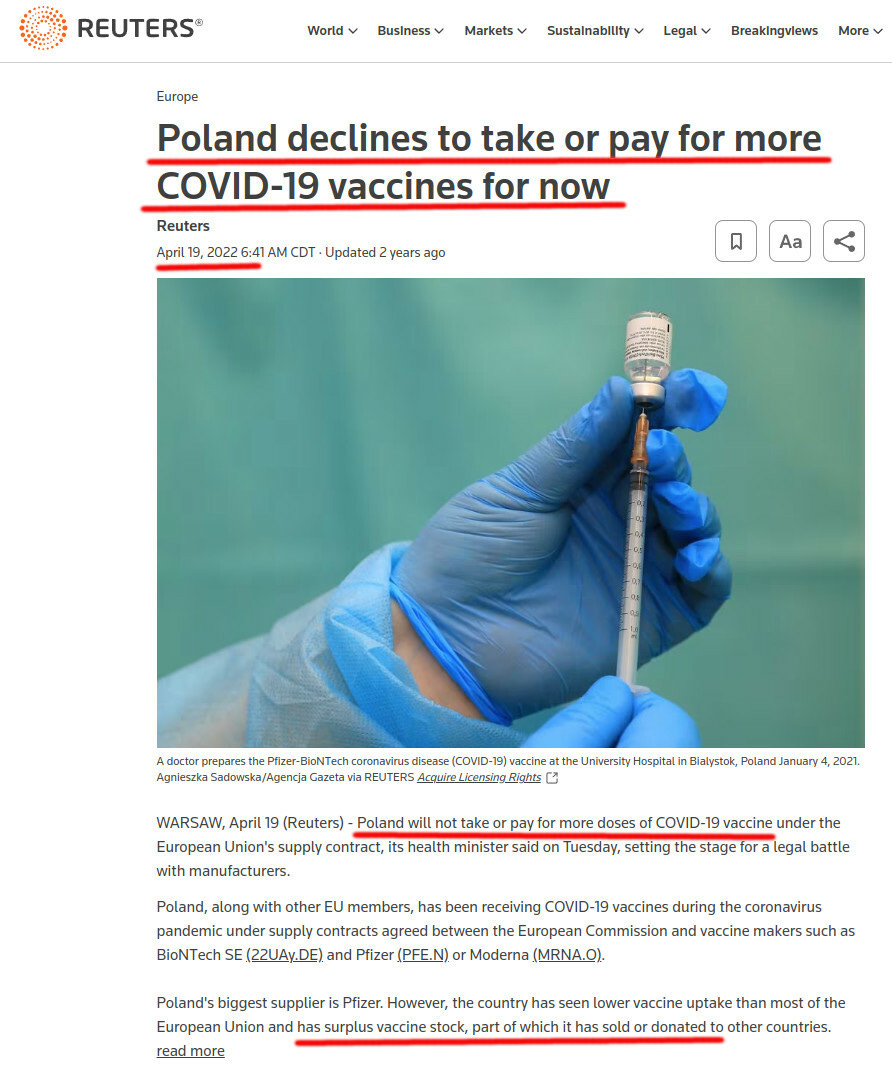
“At the end of last week, we used the force majeure clause and informed both the European Commission and the main vaccine producer that we are refusing to take these vaccines at the moment and we are also refusing to pay,” health minister Adam Niedzielski told private broadcaster TVN24.
“Indeed, the consequence of this will be a legal conflict, which is already taking place,” he said.
Poland cannot directly terminate the contract for the supply of vaccines as the parties to the contracts are the European Commission and manufacturers, he said.
The value of the contract for vaccine supplies to Poland up to the end of 2023 with one producer alone was worth over 6 billion zlotys ($1.4 billion), with over 2 billion zlotys of that for supply in 2022.
Pfizer said its agreement over the supply of its COVID-19 vaccine to European Union member states was with the EU Commission.
“Our discussions with Governments and the details of vaccine deliveries are confidential,” it added.
Somehow, Poland is a party to the EU/Pfizer contract that was kept confidential from the country but still obligates it to pay.
Pfizer CEO Albert Bourla and EU’s Ursula von der Leyen negotiated the contract in secret. (see picture below)

Anyway, now in 2023, Pfizer filed a suit, suing Poland for the monies due under the contract that was confidential and unavailable for Poland to even look at.
How a party can be obligated to pay under a contract that could not ever be assented to due to secrecy is a mystery to me, but I guess the legal minds in Europe see it differently.
Pfizer is suing in Brussels because Polish courts cannot see the contract and are unlikely to be very receptive to enforcing a contract that the court can review.
According to Polish newspaper Gazeta Prawa, Pfizer brought the civil case before a Brussels court because the doses were purchased through EU joint procurement contracts, drawn up under Belgian law.
Can Poland, perhaps, bring forth some novel defenses?
Perhaps Poland can ask Pfizer to comment on the dramatic fall in fertility that Poland is experiencing.
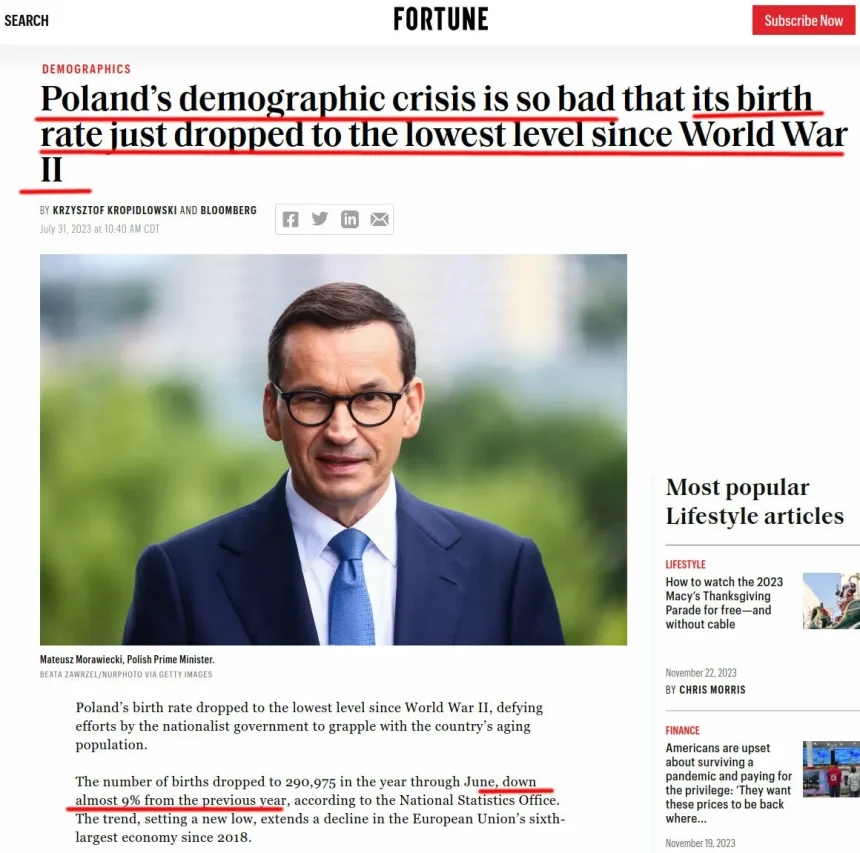
Poland may ask its local courts to make Pfizer compensate Polish COVID vaccine victims. (fortunately, there are fewer of them compared to the vax-crazy countries).
Pictures of some of the Polish victims of Covid vaccines, beautiful healthy humans who never needed the “vaccine” and yet died from it, are displayed by their bereaved relatives:

ht tps://twitter.com/DominateREALITY/ status/1488214087259459584/photo/3
Can Pfizer explain, for example, why Sweden’s deaths continued to go up as the country was vaccinated, while Poland’s deaths went down after Poland refused COVID vaccines?

I am not an international lawyer, and I do not specialize in the enforceability of secret contracts that cannot even be seen by the parties which they obligate.
But I expect that Pfizer will lose.
A hard truth about the Russia-Ukraine conflict is finally dawning on the West
By Tarik Cyril Amar | RT | November 24, 2023
On November 16, the Wall Street Journal, one of the most prestigious and influential American media outlets, published an essay under the title “It’s Time to End Magical Thinking About Russia’s Defeat.”
The authors, Eugene Rumer and Andrew S. Weiss, are influential representatives of America’s national security and international relations establishment. After a career in government service, Rumer now directs the Russia and Eurasia program at the Carnegie Endowment for International Peace; Weiss is Carnegie’s vice president for studies. This is an important text, and both its message and the timing of its publication matter.
The message is simple: “Putin” (by which they mean Russia) has “withstood the West’s best efforts” to roll back the military operation against Ukraine; Moscow’s political system has proven resilient and even become stronger; and “America and its allies” must now switch to a strategy of “containment.”
The timing is more complex. Clearly, the current Israeli war on Gaza – referred to as “tumult in the Middle East” – is one of three key factors. The other two are the approaching presidential elections in the US, and, of course, the failure of Ukraine’s summer counteroffensive, by now acknowledged even in gung-ho outlets such as the British Daily Telegraph.
In addition, America’s hold over the non-Western majority of humanity is continuing to decline. China, in particular, is successfully resisting Washington’s pressure. Domestically, President Joe Biden’s government faces tough headwinds from both the official Republican opposition and a growing movement in the American street, where widespread and deep dissatisfaction with politics and the economy is now combining with an unprecedented groundswell of protest against US complicity in Israel’s genocidal war on the Palestinians.
American polls are unambiguous. In September, even before the Middle East crisis, the Pew Research Center found that “Americans’ views of politics and elected officials” are now unusually and “unrelentingly negative, with little hope of improvement on the horizon.” By now, a majority of Americans also contradict the Biden administration – and the rest of almost the whole bipartisan political establishment – by wanting a cease fire in Gaza, while the number of those supporting Israel is decreasing quickly and significantly.
Against this background, this Wall Street Journal article clearly serves as an authoritative call for retrenchment. The object of this signal to retreat is the proxy war in Ukraine, that is, the single most aggressive, most risky, and most defeated US foreign policy strategy in the past two years (if we count from the moment Washington recklessly decided to stonewall Moscow’s clear warning as well as its urgent offer to find a grand bargain-style off-ramp in late 2021).
So far, so telling. But not surprising. For two reasons: the turn away from Ukraine is already fairly old non-news. Even mainstream media spotted the onset of a severe, probably terminal, bout of Ukraine fatigue well before the eruption of the fresh war in the Middle East. Secondly, the skeptical insights now given prominence in the Wall Street Journal as reasons to wrap up its proxy war investment in Ukraine are very old hat indeed. As a matter of fact, the most interesting question the essay – inadvertently – raises is what took you so long?
It would be tedious to address every point raised now in the Wall Street Journal. But since they all have in common that they have been predicted or were utterly predictable, a few highlights will do.
We learn, for instance, that the West’s attempts to isolate Russia have failed. Yet how hard was it to foresee that the Global South has no reason to follow the West except fear, and that fear is abating? And was it impossible to know in advance that China would answer “No, thank you very much,” when the US and the EU did two things at the same time: urge it to abandon Russia, which would have meant giving up Beijing’s single most important partnership, and signal that China would be next to be cut down to size? China, in essence, initially gestured a little in the direction of distancing itself from Russia, but the strategic fundamentals of the situation determined its real behavior and have become explicit by now. This outcome was predicted, not by every expert but by enough of them to matter.
We are also reminded that this is a war of attrition, i.e. one favoring Russia by its very nature. Even on CNN, we heard that much as early as April 2022, and the militantly Atlanticist Economist magazine admitted it in a backhanded way (using the euphemism “war of endurance”) in September.
Every war is a matter of competitive military performance. But in a war of attrition, three fundamental things matter the most: the size, productive and technological capacity, and resilience of the economy; the stability of the political system, including its real-life popularity and the elites’ legitimacy; and, of course, demography. The Wall Street Journal observes that Russia’s economy has “been buffeted but is not in tatters” (really understating its success, but let’s not quibble) and that its political system draws on “solid” popular support and elites that have neither rebelled nor deserted.
In the West at least, this was harder to predict. Not because of Russia being so difficult to decipher, but due to Western bias and groupthink, or, bluntly put, wishful thinking. Even before the post-February 2022 Ukraine war, Western politics, media, think tanks, and even academia have rewarded unrealistically pessimistic assessments of both Russia’s economy and political stability. Consider, as a pars pro toto, Western reactions to the Wagner rebellion in June. Quite a few of them predicted the imminent collapse of Russia into anarchy and civil war or, at least, a great and lasting domestic and international weakening of Russia. Yet none of this has come to pass.
The importance of this comprehensive, almost total failure of analysis and prediction lies in how typical it was, reflecting a dominant culture of politicized sloppiness vitiating Western thinking about Russia. A sloppiness that is all the more astonishing as precisely Moscow’s opponents cannot afford it without serious self-harm.
For self-harm is the main result. It is true that Russia has to bear some of the cost of Western shortsightedness. Obviously, Moscow as well would be better off if it could work with reasonable, if competitive, partners instead of irrationally hostile opponents who constantly underestimate Russia and overestimate themselves. Yet the West is suffering even more from its pattern of repetitive mistakes.
The costs of the proxy war in Ukraine demonstrate this fact, and not only in terms of arms and money, but of political prestige as well. Regarding the quantifiable costs, the US Congress, for instance, has approved $113 billion worth of aid for Ukraine since February 2022. Currently, a request for even more is turning into a major domestic headache for the Biden administration, and most likely, a defeat. The EU has shelled out almost €85 billion.
Of course, not all of these funds have really been appropriated, and much of them have really been fueling corruption in Ukraine or served the donors and especially their arms industries, as US politicians have repeatedly pointed out with proud cynicism. Yet the overall picture remains one of severe fiscal overstretch spent on a losing gamble. Add the self-inflicted losses that the EU’s economies in particular have incurred from their misconceived sanctions policy and the picture is grim. Add, moreover, how much the West will have to spend if it really wishes to finance the rebuilding of Ukraine, and the prospect turns catastrophic. Good luck, EU, with those membership plans.
In addition, intangibles matter as well. Clearly, “losing” Ukraine (which the West should not have tried to “own” in the first place) will reveal the bloc’s weakness more sharply than the failures in, for instance, Iraq, Libya, Syria, or Afghanistan. For two reasons. First, unlike these countries, Russia is a great power; that means it is in a position to exploit the Western setback. Moscow, put differently, is big enough to geopolitically counterattack.
Whether or when exactly it will do so, and what shape such a new “snapping back” of Russian President Vladimir Putin’s metaphorical “rubber band” will take this time, remains to be seen. What is clear is that such payback is a realistic possibility. Secondly, the West is committed as never before, substantially and rhetorically, when trying to use Ukraine to reduce Russia. Hence, failing to do so exposes Western limits as never before. Rumer and Weiss are not naïve. They cannot say it – and maybe they can’t even quite think it – but in their heart of hearts they know that packaging this defeat as a mere change of strategy to “containment” will not fool anyone who does not want to be fooled.
It is good to finally see some hard facts appear prominently in mainstream Western debates. But it is not enough. For one thing, the West has to ask itself painful questions why it has stayed so obsessively one-sided for so long. Otherwise, the same pattern will be repeated in starting and waging the next war, for instance, against China or Iran. Secondly, a shift to “containment” will not repair the damage but merely stretch it out. What the West really needs is a complete rethinking of not merely its methods but its aims.
Tarik Cyril Amar is a historian from Germany working at Koç University, Istanbul, on Russia, Ukraine, and Eastern Europe, the history of World War II, the cultural Cold War, and the politics of memory.
Spanish PM ‘whitewashing war criminal Netanyahu,’ outspoken ex-minister suggests
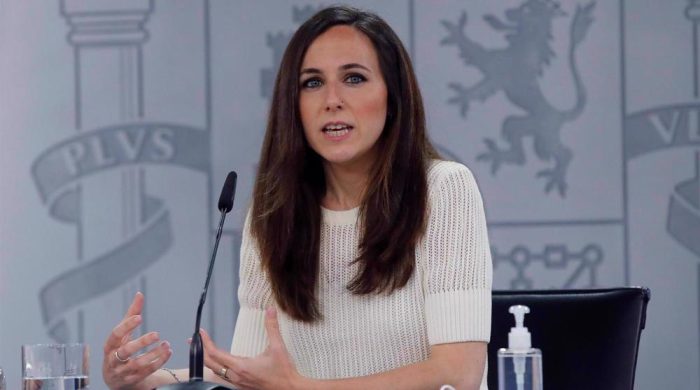
Ione Belarra, Spain’s former minister for social rights
Press TV – November 24, 2023
A former Spanish minister, who has been openly censuring the West’s silence over the Israeli regime’s genocidal war against the Palestinians in the Gaza Strip, persists with her outspoken criticism.
Ione Belarra was Spain’s minister for social rights until she was removed from her post by Prime Minister Pedro Sánchez on Monday over her targeting of the “deafening silence” of her country and the regime’s other Western allies on Tel Aviv’s ferocious ongoing warfare against Gaza.
Belarra, currently secretary-general of Spain’s ruling left-wing Podemos Party, fired her latest jab at Madrid on Thursday.
Posting on X she said she and her colleagues were “concerned” that a trip made by Sánchez to the occupied territories earlier in the day “could be used to whitewash [Israeli Prime Minister Benjamin] Netanyahu, who is a war criminal.”
Sánchez should be instead traveling to Brussels, where decisions were made that could “truly exert pressure on Israel and Netanyahu to achieve a permanent ceasefire.”
The Israeli regime launched the war on October 7 following an operation, dubbed al-Aqsa Storm, by Gaza’s resistance groups.
More than 14,800 Palestinians, including over 6,150 children, have been killed in the war so far.
Belarra said, “In Brussels, exemplary economic sanctions against Netanyahu and his political leadership could be agreed upon…”
Sánchez should be working with European leaders in Brussels towards suspension of diplomatic relations with Tel Aviv, she added.
“From our point of view, people are exhausted, tired of the EU (European Union)’s doing absolutely nothing while a genocide against the people of Palestine is taking place, and we need concrete actions.”
EU must reconsider Ukraine policy – Orban
RT | November 22, 2023
Hungarian Prime Minister Viktor Orban has demanded that the European Union re-examine its strategy of funding Ukraine’s battle with Russia, saying he would stand in the way of further aid unless the bloc’s leaders make sure their objectives are “realistically attainable” without continued US support.
Orban made his threat in a letter to European Council chief Charles Michel, saying that no discussion on funding for Ukraine, Kiev’s accession to the EU, or further sanctions against Russia can happen until a “strategic discussion” is held, Politico reported on Wednesday. According to the outlet, the letter called for such a review to take place when EU leaders meet in Brussels next month.
“The European Council should take stock of the implementation and effectiveness of our current policies towards Ukraine, including various assistance programs,” Orban wrote.
He added that with future aid from Kiev’s chief benefactor, the US, imperiled by partisan bickering in Washington, European leaders need to reassess whether they should stay the course.
“The European Council must have a frank and open discussion on the feasibility of the EU’s strategic objectives in Ukraine,” Orban wrote.
Do we still regard these objectives realistically attainable? Is this strategy sustainable without robust support from the United States? Can we take continuing support from the United States for granted? How do we conceive the security architecture of Europe after the war?
The European Council isn’t prepared to make key decisions on Ukraine policies – including security guarantees, further aid, Russia sanctions, and expansion of the EU – until member states reach a consensus on their strategy, according to Orban.
The Hungarian leader could use Budapest’s veto power as an EU member to block delivery of €50 billion ($54.4 billion) in economic aid pledged to help fund Ukraine’s government amid the conflict with Russia, as well as €500 million in military assistance. Orban could also stall the decision on opening formal negotiations with Kiev to join the EU.
Orban has repeatedly clashed with the EU on issues ranging from Russia sanctions to illegal immigration to LGBTQ propaganda. The EU is withholding €13 billion in funding to Hungary over the country’s alleged breaches of the bloc’s “rule-of-law” standards.
The Hungarian PM has called for a negotiated end to the Russia-Ukraine conflict, rather than prolonging the crisis and risking further escalation. Last month, he likened the bloc’s domineering tactics to the Soviet Union, calling Brussels a “bad contemporary parody” of the USSR.
Hungarian Foreign Minister Peter Szijjarto suggested on Saturday that some European leaders have lost touch with reality when it comes to the Ukraine crisis.
“Some people imagine themselves in Fortnite,” he said, referring to the popular video game. “They suffer from military psychosis and, for some reason, believe that arms shipments can bring peace.”
European liberals lose it over Hungarian government’s latest billboard campaign
BY THOMAS BROOKE | REMIX NEWS | NOVEMBER 20, 2023
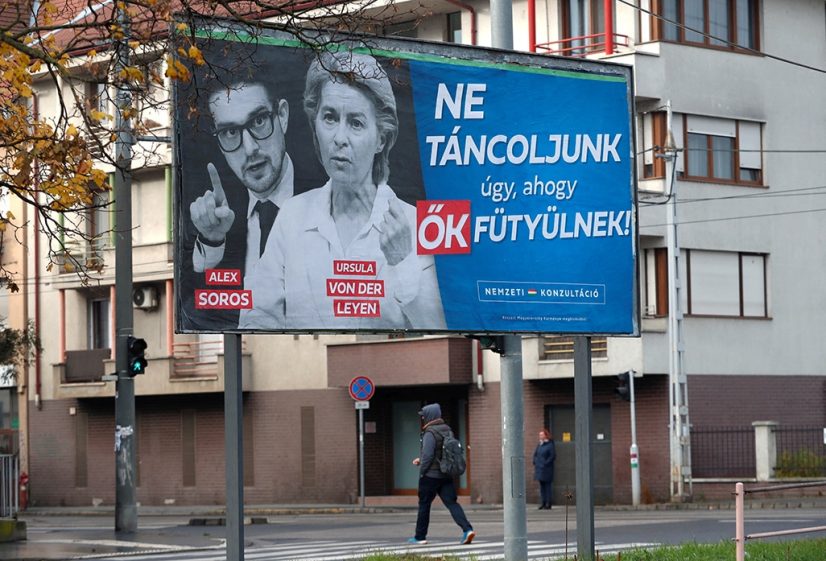
Liberal lawmakers in the European Parliament have expressed their outrage at a recent billboard campaign by Hungary’s governing party ahead of next year’s parliamentary elections targeting European Commission President Ursula von der Leyen.
Hundreds of billboards have been erected across the country depicting von der Leyen with Alex Soros, the son of U.S.-Hungarian billionaire George Soros whom Prime Minister Viktor Orbán’s Fidesz party claims is the financier of several liberal organizations attempting to discredit the Hungarian government and undermine conservative administrations across the West.
Images of the duo are shown alongside the caption, “Let’s not dance to their tune,” a quote taken from a speech by Orbán last month in which he labeled the European Union a “bad parody” of the former Soviet Union. He also insisted his administration would continue to run Hungary as it saw fit despite attempts by Brussels to wrestle control from national governments.
Budapest has ramped up its rhetoric against the European Commission in recent weeks, and Orbán again targeted the bloc’s executive during a speech at his party’s congress on Saturday as he called for the current model of EU governance to be replaced.
“The Union must not be left but changed, but this is only possible if there are radical changes in Brussels. Otherwise, the end will come. If it continues like this, the Union will not explode, it will simply fall apart,” he told attendees.
The advertising campaign appears to have angered all the right people as far as Fidesz is concerned, with arch-Eurofederalist MEP Guy Verhofstadt calling it “scandalous” and accusing Orbán of “dangerous Putinism and despicable anti-semitism,” the latter accusation borne solely from the fact that Alex Soros is Jewish.
Similarly, German Green MEP Daniel Freund, seemingly perennially enraged by the conservative administration in Budapest, called for the European Commission to suspend Hungarian’s upcoming presidency of the European Council.
“For von der Leyen, there is only one reaction to this dirty campaign: Suspend all preparatory meetings for the council presidency between the EU Commission and the Hungarian government,” he raged.
Von der Leyen, at least publicly is understood to have been unfazed by the campaign, according to the European Commission’s spokesperson Eric Mamer.
“I showed the pictures to the president. She didn’t bat an eyelash … completely unfazed. Let’s be clear: We know this is not the first time, it’s probably not the last time, we have business to do,” he told journalists at Monday’s press briefing.
“We have crises to manage, we have policies to implement, Hungary is part of the European Union … It sits at the table,” he added.
Ukraine reveals size of new international loan
RT | November 19, 2023
The Ukrainian government expects to get a loan of $1.1 billion from the World Bank, Prime Minister Denis Shmigal said on Saturday, adding that the aid will be used for social benefits, education, medicine, and other priorities.
“Ukraine continues to attract money from partners, with an almost $1.1 billion loan expected from the World Bank,” Shmigal wrote in a Telegram post.
The prime minister added that the country also expects to obtain €162 million ($177 million) in financial support from the European Investment Bank as part of programs to restore Ukraine, while $190 million and $70 million would be allocated by Norway and Switzerland, respectively.
Earlier this week, the Ukrinform news agency reported that EU military aid for Ukraine had reached €27 billion euros (some $28.8 billion) since the beginning of the conflict, marking a record high in the bloc’s history. The military assistance includes ammunition, air defense systems and tanks.
Meanwhile, financial, military, humanitarian, and refugee assistance provided by EU member states to Ukraine has already amounted to about $89 billion.
Last month, Gavin Gray, the head of the International Monetary Fund’s (IMF) mission in the country, said that over time international support for Ukraine would inevitably decrease, urging Kiev to develop internal resources for self-financing.
In April, Ukrainian Finance Minister Sergey Marchenko said the monthly deficit of the Ukrainian budget had totalled $5 billion, with two-thirds covered by foreign loans and grants, while three-quarters of spending goes to military needs.
In August, the Finance Ministry reported that Ukraine’s national debt had exceeded $132 billion, having increased by $4 billion in July alone.
The IMF previously projected that Ukraine’s state debt would amount to 88.1% of GDP in 2023, and would exceed 100% of GDP in 2025.
EU politicians have Ukraine ‘military psychosis’ – Hungarian FM
RT | November 19, 2023
Many high-ranking politicians from the European Union are out of touch with reality when it comes to the Russia-Ukraine conflict, Hungarian Foreign Minister Peter Szijjarto said on Saturday.
Unlike other EU countries, Hungary has refused to send weapons or other lethal aid to Ukraine, insisting that it is focused on finding a peaceful resolution to the hostilities.
“A significant part of the European political elite has practically lost common sense. Some people imagine themselves in Fortnite,” Szijjarto said at a political event in Budapest, referring to the popular multiplayer video game.
“They suffer from military psychosis, and, for some mysterious reason, believe that arms shipments can bring peace.”
“It is clear to us that we need peace instead of weapons. Whoever brings weapons into our neighborhood, prolongs the war. And the longer the war, the more people will die and greater destruction will occur,” the diplomat added.
Budapest has harshly criticized the European bloc’s sanctions on Russia over its actions in Ukraine. Prime Minister Viktor Orban has described the restrictions as a failure that have only exacerbated the energy crisis and the already high inflation rates across the continent.
Earlier this month, Orban said Kiev is “light years away” from joining the EU. Ukraine formally applied to become a member of the bloc in February 2022, hoping for an expedited admission process in light of Russia’s military operation.
EU tells Moldova to sanction Russia
RT | November 14, 2023
The European Union expects Moldova to fully implement sanctions against Russia in order to demonstrate “European values,” the bloc’s ambassador in the former Soviet republic said on Tuesday.
If Chisinau truly wants to join the EU some day, it needs to implement all of the bloc’s laws, rules and regulations – as well as foreign policy, Ambassador Janis Mazeiks said in an interview for the Moldovan channel TV8.
“Sanctions are not introduced just like that. For each of them, there was a reason why it was introduced,” the Latvian diplomat who represents Brussels told host Anatoly Golya in the Russian-language broadcast. “Therefore, we expect those countries that want to join the EU to gradually increase their adherence to sanctions.”
Mazeiks was addressing Golya’s claim that Moldova was already 78% in compliance with the bloc’s embargo on Russia, introduced to support Kiev in the Ukraine conflict.
“I hope this percentage will increase, as we look at the Republic of Moldova as a future EU member,” the diplomat said, adding that it was important for Brussels to see the implementation of all EU laws and regulations, “including joining the EU sanctions, since this is also a manifestation of our values.”
Moldova, which is located between Romania and Ukraine, became an independent state in 1991. Its government has been pushing for EU and NATO membership since 2020, going so far as to ban critics and ask Brussels to sanction those opposed.
The policies of President Maia Sandu defy the wishes of the Moldovan people, Russian Security Council Secretary Nikolay Patrushev warned last week, accusing the government in Chisinau of “Romanianization, rejection of sovereignty and national identity,” and making Moldova “a new victim of the Western colonialist policy.”
Sandu’s Party of Action and Solidarity (PAS) faced backlash in the local elections earlier this month, losing almost all major cities and Chisinau itself. The party’s deputy chairman insisted that the “pro-European choice has won confidently across the whole country,” however.
Hungary to introduce new ‘sovereignty’ law
RT | November 14, 2023
Hungary’s ruling Fidesz party is set to introduce a bill to the nation’s parliament which will create a special office to monitor activities that “threaten the sovereignty of the country.”
The new department would be tasked with overseeing the inflow of foreign funding to political parties, media, and public organizations thought to be targeted for influence or manipulation by hostile governments or financial interests, such as Hungarian-American billionaire and serial financier of liberal causes George Soros.
Gergely Gulyas, the chief of staff for Prime Minister Viktor Orban, declined to give specifics of the new office’s remit on Thursday, when he announced the impending submission of the draft legislation, merely stating that it “could probe all sorts of activities … that would violate the sovereignty of the country.”
When plans to create the new authority were made public in September, a Fidesz party member suggested the measure could apply to “left-wing journalists, quasi-civil organizations,” and political parties.
Orban had recently complained at a party meeting that foreign actors were manipulating the levers of Hungarian society through civil society groups and media “financed by Brussels or through the Soros network.”
“They have openly said that they want a change of government in Hungary,” he said in a speech earlier this year, accusing his enemies of using “every means of political corruption to finance the Hungarian opposition.”
Orban and other Fidesz lawmakers have specifically accused the EU of interfering in the country’s political process by withholding €28 billion ($30 billion) in funds until it fulfills a laundry list of 27 judicial, media, and economic reforms. While Brussels has long accused Hungary of failing to meet EU standards regarding the rule of law, Budapest has argued such accusations are politically motivated.
Hungary previously passed legislation in 2017 targeting NGOs receiving foreign funding, a law condemned by the EU Court of Justice for allegedly introducing “discriminatory and unjustified restrictions” on fundamental rights.
Critics, like the Hungarian Civil Liberties Union, have similarly argued the current legislation aims to “limit participation in public life and the operation of the free press.” Noting that political parties are already justifiably banned from accepting foreign funding, the group’s strategy director Stefania Kapronczay told The Guardian the new authority is likely to further the government’s narrative that any foreign funding runs contrary to Budapest’s interests.
Banning the AfD would be dangerous for democracy, says hard-left firebrand Wagenknecht
BY THOMAS BROOKE | REMIX NEWS | NOVEMBER 14, 2023
The right-wing populist Alternative for Germany (AfD) party has found an unlikely defender in Sahra Wagenknecht, the hard-left firebrand nationalist who called moves by establishment politicians to ban the increasingly popular party “completely wrong” and dangerous for democracy.
In an interview published on Sunday with the ARD broadcaster, Wagenknecht insisted that attempts to suppress political adversaries with unconstitutional bans are contradictory to Germany’s democratic principles.
“I think the call for a ban on the AfD is completely wrong, and I find the discussion about it dangerous. Banning unpopular parties because they are becoming too strong is incompatible with a free society,” she told viewers.
The former Die Linke leader, who recently split from her old left-wing party to form a new political group, BSW — For Reason and Justice, called for unsavory parties to be beaten on the political battlefield and their ideas challenged, rather than martyring them and creating further civil unrest among an increasingly disillusioned electorate.
Wagenknecht added that she hoped her new party could win around voters thinking of supporting the AfD based on its policies, instead of simply eradicating the opposition.
“I will be happy if AfD voters choose us in the future because they find our offer more serious and convincing,” she told the broadcaster.
Wagenknecht’s new political outfit shares the same view as the AfD when it comes to uncontrolled mass migration and calls for greater restrictions on newcomers to the country. The left-wing politician even praised her political competition for bringing the issue of mass migration to the forefront of the political debate in Germany.
“Because (the AfD) has become stronger, the question of ‘How do we reduce uncontrolled migration’ has finally arrived in politics,” she said.
Wagenknecht revealed her belief that the longstanding pro-migration policies of her previous party, Die Linke, would struggle to resonate with an electorate becoming increasingly more socially conservative on the issue, and expressed her desire for the party to change course and “find itself” once more.
There is no political desire for a party that advocates “open borders, the right to stay for everyone, and radical climate activism,” she claimed.
On this point, the former communist reserved unlikely praise for Hungarian Prime Minister Viktor Orbán, who she claimed was right to stand up for the interests of his own citizens, even if she disagrees with him politically.
“I don’t have to like Orbán to say that what he’s doing is wiser in terms of the interests of his country,” she said.
Orbán has been a staunch opponent of Brussels’ proposed migration pact, which would see EU member states obliged to receive migrant quotas or face financial penalties for non-compliance. He has remained opposed to the continuous funding of the Ukraine war and is a long-standing advocate for peace in the region.
His administration has continued to import Russian gas and oil despite protestations from Brussels and recently became the first EU leader to shake hands with Russian President Vladimir Putin since Moscow’s invasion of eastern Ukraine in February last year as he attempts to navigate a peaceful solution to the ongoing conflict.
The media’s Nord Stream lies just keep coming
Why do billionaires and governments scramble to control the media? Because the power over our minds is the greatest power there is.
BY JONATHAN COOK | NOVEMBER 14, 2023
Want to understand why the media we consume is either owned by billionaires or under the thumb of government? The latest developments in the story about who was behind the explosions that destroyed the Nord Stream pipelines that brought Russian gas to Europe provide the answer.
Although largely forgotten now, the blasts in the Baltic Sea in September 2022 had huge and lasting repercussions. The explosion was an act both of unprecedented industrial sabotage and of unparalleled environmental terrorism, releasing untold quantities of the most potent of the greenhouse gases, methane, into the atmosphere.
The blowing up of the pipelines plunged Europe into a prolonged energy crisis, tipping its economies deeper into a recession from which they are yet to recover. Europe was forced to turn to the United States and buy much more expensive liquified gas. And one of the long-term effects will be to accelerate the de-industrialisation of Europe, especially Germany.
There can be almost no one in Europe who did not suffer personal financial harm, in most cases significant harm, from the explosions.
The question that needed urgently answering at the time of the blasts was one no media organisation was in a hurry to investigate: Who did it?
In unison, the media simply recited the White House’s extraordinary claim that Russia had sabotaged its own pipelines.
That required an unprecedented suspension of disbelief. It meant that Moscow had chosen to strip itself both of the lucrative income stream the gas pipelines generated, and of the political and diplomatic leverage it enjoyed over European states from its control of their energy supplies. This was at a time, remember, when the Kremlin, embattled in its war in Ukraine, needed all the diplomatic influence it could muster.
The need to breathe credibility into the laughably improbable “Russia did it” story was so urgent at the time because there was was only one other serious culprit in the frame. No media outlet, of course, mentioned it.
The United States had both the motive and the means.
US officials from Biden down had repeatedly threatened that Washington would intervene to make sure the Nord Stream pipelines could not operate. The administration was expressly against European energy dependency on Russia. Another gain from the pipelines’ destruction was that a more economically vulnerable Europe would be forced to lean even more heavily on the US as a guarantor of its security, a useful chokehold on Europe when Washington was preparing for prolonged confrontations with both Russia and China.
As for the means, only a handful of states had the divers and technical resources enabling them to pull off the extremely difficult feat of successfully planting and detonating explosives on the sea floor undetected.
Had we known then what is gradually becoming clear now, even from establishment media reporting – that the US was, at the very least, intimately involved – there would have been uproar.
It would have been clear that the US was a rogue, terrorist state, that it was willing to burn its allies for geostrategic gain, and that there was no limit to the crimes it was prepared to commit.
Every time Europeans had to pay substantially more for their heating bills, or filling up their car, or paying for the weekly shop, they would have known that the cause was gangster-like criminality by the Biden administration.
Which is precisely why the establishment media were so very careful for the first months after the explosions not to implicate the Biden administration in any way, even if it meant ignoring the mass of evidence staring them in the face.
It is why they ignored the incendiary report by legendary investigative journalist Seymour Hersh – who has broken some of the most important stories of the last half century – detailing exactly how the US carried out the operation. When his account was occasionally referenced by the media, it was solely to ridicule it.
It is why, when it became obvious that the “Russia did it” claim was unsupportable, the media literally jumped ship: credulously reporting that a small group of “maverick” Ukrainians – unknown to President Volodymyr Zelensky, of course – had rented a yacht and carried off one of the most daring and difficult deep-sea stunts ever recorded.
It is why, later, the media treated it as entirely unremarkable – and certainly not worthy of comment – that new evidence suggested the Biden administration was warned of this maverick Ukrainian operation against the whole of Europe. It apparently knew what was about to happen but did precisely nothing to stop it.
And it is why the latest reporting from the Washington Post changes the impossible-to-believe “maverick” Ukrainian operation into one that implicates the very top of the Ukrainian military. Still, the paper and the rest of the media steadfastly refuse to join the dots and follow the implications contained in their own reporting.
The central character in the new drama, Roman Chervinsky, belongs to Ukraine’s special operations forces. He supposedly oversaw the small, six-man team that rented a yacht and then carried out the James Bond-style attack.
The ingenuous Post claims that his training and operational experience meant he was “well suited to help carry out a covert mission meant to obscure Ukraine’s responsibility”. It lists his resistance activities against Russia. None indicate that he had the slightest experience allowing him to mastermind a highly challenging, extremely dangerous, technically complex attack deep in the waters of the Baltic Sea.
If the Ukrainian military really was behind the explosions – rather than the US – all the indications are that the Biden administration and Pentagon must have been intimately involved in the planning and execution.
Not least, it is extremely unlikely that the Ukrainian military had the technical capability to carry out by itself such an operation successfully and undiscovered.
And given that, even before the war, the Ukrainian military had fallen almost completely under US military operational control, the idea that Ukraine’s senior command would have been able to, or dared, execute this complex and risky venture without involving the US beggars belief.
Politically, it would have been quite extraordinary for Ukrainian leaders to imagine they could unilaterally decide to shut down energy supplies to Europe without consulting first with the US, especially when Ukraine’s entire war effort was being paid for and overseen by Washington and Europe.
And of course, Ukrainian leaders would have been only too aware that the US was bound to quickly work out who was behind the attack.
It would be telling indeed that, in such circumstances, the Biden administration would apparently choose to reward Ukraine with more money and arms for its act of industrial sabotage against Europe rather than punish it in any way.
It would be equally astonishing that the three states supposedly investigating the attack – Germany, Sweden and Denmark – would not also soon figure out for themselves that Ukraine was culpable. Why would they decide to cover up Ukraine’s attack on Europe’s economy rather than expose it – unless they were worried about upsetting the US?
And of course, there is the elephant in the room: the Washington Post’s earlier reporting indicated that the US had prior knowledge that Ukraine was planning the attack. That is even more likely if the pipeline blast was signed off by Ukrainian military commanders rather than a group of Ukrainian “mavericks”.
The Washington Post’s new story repeats the line that the Biden administration was forewarned of the attack. Now, however, the Post casually reports that, after expressing opposition, “US officials believed the attack had been called off. But it turned out only to have been postponed to three months later, using a different point of departure than originally planned”.
The Washington Post simply accepts the word of US officials that the most powerful country on the planet fell asleep at the wheel. The CIA and Biden administration apparently knew the Ukrainian military was keen to blow up the Nord Stream pipelines and plunge Europe into an energy crisis and economic recession. But US officials were blindsided when the same small Ukrainian operational team changed locations and timings.
On this account, US intelligence fell for the simplest of bait and switches when the stakes were about as high as could be imagined. And the Washington Post and other media outlets report all of this with a faux-seriousness.
Either way, the US is deeply implicated in the attack on Europe’s energy infrastructure and the undermining of its economy.
Even if the establishment media reporting is right and Ukraine blew up Nord Stream, the Biden administration must have given the green light, overseen the operational planning and assisted in the implementation and subsequent cover-up.
Then again, if as seems far more likely, Hersh is right, then there was no middle man – the US carried out the attack on its own. It needed a fall guy. When Russia no longer fitted the bill, Ukraine became the sacrificial offering.
A year on, these muffled implications from the media’s own reporting barely raise an eyebrow.
The establishment media has played precisely the role expected of it: neutering public outrage. Its regimented acceptance of the initial, preposterous claim of Russian responsibility. Its drip-feed, uncritical reporting of other, equally improbable possibilities. Its studious refusal to join the all-too-visible dots. Its continuing incuriousness about its own story and what Ukraine’s involvement would entail.
The media has failed by every yardstick of what journalism is supposed to be there for, what it is supposed to do. And that is because the establishment media is not there to dig out the truth, it is not there to hold power to account. Ultimately, when the stakes are high – and they get no higher than the Nord Stream attack – it is there to spin narratives convenient to those in power, because the media itself is embedded in those same networks of power.
Why do billionaires rush to own media corporations, even when the outlets are loss-making? Why are governments so keen to let billionaires take charge of the chief means by which we gain information and communicate between ourselves. Because the power to tell stories, the power over our minds is the greatest power there is.
Featured Video

Racist Seinfeld Dances for Joy as Bibi Unveils His New Map
or go to
Aletho News Archives – Video-Images
TV Drama Review
Japanese drama projects Japan’s wartime atrocities onto Chinese characters

Global Times | October 25, 2026
By portraying Chinese characters as perpetrators of ruthless violence while casting Japanese Self-Defense Forces (SDF) intelligence operatives as defenders, the season 2 of the Japanese drama Vivant has recently drawn criticism from Chinese netizens, who argue that its depiction turns historical reality on its head while ignoring Japan’s wartime atrocities.
The TBS drama series – a spy suspense story in which an alleged unofficial intelligence unit of the SDF operates across the globe — has attracted a passionate fanbase. Its currently airing season 2 opened with a household rating of 18.8 percent, the highest for a TV drama this year, according toa commentary article by Japanese media Toyo Keizai.
What draws attention is the portrayal of the enemies in the series, the article noted. Scenes in which the Chinese organization subjects kidnapped members of the SDF unit to brutal torture are repeated with unrelenting intensity.
It is rare for Japanese TV dramas to explicitly portray a real-life country as the enemy, the article noted.
Japanese Prime Minister Sanae Takaichi also made a reference to the drama, saying that she has been recording Vivant and hopes to binge-watch it over the year-end and New Year holidays, according to Japanese media outlets.
China’s CCTV News report on Sunday revealed that the drama features scenes in which Chinese personnel cut off the fingers of and stab Japanese intelligence operatives in the abdomen. Such acts bear striking similarities to the torture inflicted on Chinese nationals by invading Japanese troops during the World War II.
The drama distorts the truth by attributing these atrocities to modern Chinese characters. Beneath the surface, it subtly glorifies Japan’s cross-border overseas operations, blurs the functional boundaries of the SDF and implicitly promotes an expansionist narrative, per CCTV News. … continue
Blog Roll
 Aletho News
- Iran FM Araghchi: “Hormuz Will No Longer Be the Same”
- EU facing trillion-euro debt hole while seeking more cash for Kiev
- How US, Europe, Persian Gulf states exhausted missile stockpiles, splurged billions to defend Israel
- Up in arms… Koreans reject U.S. empire’s plan to make South Korea the next Ukraine
- Iran, Turkey, Pakistan, Saudi Arabia could advance region-led security framework in Tehran: FM spox
- Netizens condemn Japanese drama for projecting Japan’s wartime atrocities onto Chinese characters
- Racist Seinfeld Dances for Joy as Bibi Unveils His New Map
- A West Bank War for Netanyahu’s Election Campaign, Could It Backfire?
- Yemen denounces European Parliament’s ‘hypocritical’ push to blacklist Ansarullah
- Qalibaf: UAE’s UN bid aims to ‘clear the runway’ for ‘Greater Israel’, whitewash genocide
- If Americans Knew
- Israel punishes Palestinian prisoners with solitary confinement for making a cake
- US midterms: Where do candidates in key Senate races stand on Israel, Gaza, and Iran?
- Israeli forces demolish Hebron homes, displace thousands of Palestinians as raids expand
- Their Son Died in Israeli Prison. No Answers. No Body
- Biden’s Israel Catastrophe
- Why Israel’s latest assault on Hebron is so significant for the West Bank
- Israel Used “Where’s Daddy?” AI to Relentlessly Murder Palestinian Journalists and Their Families in Their Homes from October to December 2023
- DAILY UPDATE: Latest essential news on Palestine, Israel, & region
- Netanyahu Says Israel Must Prepare for Banking Sanctions, Floats Crypto as a Possible Bypass
- Latest updates from Israeli assault on West Bank
- No Tricks Zone
- Sudden Stratospheric Warming, Powerful El Niño Combination May Lead To Extreme Europe Cold, Energy Crisis!
- Two New Studies Find Thwaites Glacier Melt Cannot Be Driven By Human Activity Or A Warming Ocean
- E-Cars Reduce CO2 Emissions By Only 41% Compared To Internal Combustion Engine Vehicles
- Predictions Made By Renowned Climate Professor Over Past Decades Have Been Proven To Be Poor
- New Study Suggests Large Regions Of The Pacific Ocean Have Been Cooling For The Last 80 Years
- Germany’s Green Energy Debacle: High Energy Costs Force Kahla Porzellan to Close After 182 Years!
- New Study: 50 Years Of The Most Aggressive ‘Net Zero’ Policies Can Only Affect The Global Climate By 0.03°C
- US September “Heat” Was No Record…Many Records Set Decades Ago
- Latest European Green Energy Debacle; Portugal’s Largest Flagship Solar Park Insolvent!
- Green Energy Debacle: German Expert Professor Fritz Vahrenholt Warns Of Severe Economic And Social Consequences

