IMF Head Wants World Wide Carbon Taxes
By Kit Knightly | OffGuardian | December 7, 2023
IMF Chief Kristalina Georgieva has called for every government to implement some form of carbon taxes or “carbon pricing” in the near future.
Yes, we’re into week two of the UN’s COP28 climate change summit, and the hits just keep on coming.
For example, yesterday it was announced sixty-three world governments have pledged to reduce the emissions from air conditioners and electrics fans.
[You can read a detailed breakdown of the other pledges made during COP28’s first week here.]
Speaking at COP28 in Dubai, and repeated in an interview with the Guardian, Georgieva extolled the virtues of “carbon pricing” and heaped praise on the EU and Canada for their implementation:
When you put a price on carbon, decarbonisation accelerates. The Europeans introduced the emission trading scheme [in 2005] and they have been growing and yet emissions went down by 37%. You see the same thing in Canada with their carbon tax.”
While both the speech and interview discuss the proposed carbon taxes in terms of corporations as “major polluters”, any tax applied to big business would be directly passed onto private citizens via price increases.
The Guardian acknowledges this, but of course, decides to add a weasel-word qualification [emphasis added]:
However, attractive though a carbon price may be in economic theory, in practice governments are reluctant to impose such explicit prices and taxes, because they can easily be attacked, and because they hit poorer people hardest, if badly applied.
“If badly applied”, sure.
The truth is economic destruction, designed to lower the standard of living for ordinary people, is the whole point of “carbon taxes”. just as it was the point of lockdowns.
Deceptive language aside, the undeniable fact that any carbon tax – corporate or individual – would directly harm the poorest is clearly understood by the people who would seek to enforce them.
Not that they have a problem with that, you understand, their concern is merely that purely public rage and/or civil disobedience makes direct taxation difficult to implement. The Guardian article gives the game away by referencing France’s Gilets Jaunes protests as an example.
So, even as Georgieva names carbon taxes the “perfect” solution to climate change, she recognizes the need to rely on more indirect methods.
Yes, the best way to introduce implement carbon prices [is] a carbon tax…But it is not politically feasible in some countries … We can also use regulatory compliance in which standards lead to implicit prices on carbon.”
These “regulations” and “implicit” prices would not be “carbon taxes” in name, but they would very much be so in spirit.
Again the Guardian cites an example, the EU’s recent “carbon border adjustment mechanisms”, which charge more import duties on goods coming from countries with “lax” emissions policies.
A global version of those rules is likely just one of many such measures we can expect moving forward since, according to Georgieva, the world’s biggest financial institutions are all working together on this issue:
[T]he IMF, World Bank, OECD and World Trade Organization [have] set up a taskforce to examine the different carbon prices that are implied in countries around the world by their carbon policies and regulations.”
The head of IMF has spoken, and the World Bank and World Trade Organization are all on board: Carbon Taxes are inevitable. The only question is what they decide to call them.
All the world’s biggest financial heavy-hitters are coming together to figure out the best way to scam people out of their hard-earned money… for the good of the planet, obviously.
How Russia Strategically Counters Western Economic Pressure
Sputnik – 08.12.2023
Russia has confounded the West’s sanctions strategy to outstrip Europe in economic growth, pundits say.
Speaking at the plenary session of VTB Bank’s investment forum “Russia Calling!”, Putin highlighted that Russia’s gross domestic product (GDP) had grown by 3.2% in the first 10 months of this year and is expected to reach 3.5% by the end of the year.
“Despite Western sanctions against Moscow over the conflict in Ukraine, the Russian economy manages to stay afloat due to various factors, including the restrictive economic policy of the EU and strategic alliances Russia has formed around the world,” Imelda Ibanez, a specialist in the history of Russian diplomacy and foreign policy at St. Petersburg State University, told Sputnik.
When the United States and its European allies decided to impose sanctions on Moscow, commodity prices rose significantly, resulting in an increased trade deficit for those countries.
“One factor [influencing the strengthening of the Russian economy] is the monetary policy of the European Union and the United States, as well as high commodity prices,” Ibanez said.
However, she emphasized that “Russia is one of the world’s leading producers of raw materials, including hydrocarbons, coal and even diamonds.”
“Russia has been able to strategically resist sanctions because it has relied on a geopolitical strategy that is aligned with its allies,” she added.
Isela Valdez, a lecturer in economics at the National Autonomous University of Mexico (UNAM), also speaking to Sputnik, noted that although European countries were strong partners for Moscow before the Ukrainian crisis, they were not the only ones.
“They are not Russia’s only trading partners; yes, they are obviously among the strongest, but there are also the Middle East, Asia, Latin America, and even parts of Africa, which are alternative markets with which [Moscow] can develop trade relations,” she noted.
According to Ibanez, Russia’s strategic, commercial and economic link is China, a country with which it shares a common space in BRICS, the group of developing nations founded in 2009 that currently represents more than 31.5 percent of the world’s GDP and 42 percent of its population.
What will happen if the conflict in Ukraine drags on for even longer?
Western countries will find themselves in an even more difficult position in 2024, as another conflict between Israel and Palestine has burst onto the geopolitical chessboard, Valdez warned.
“It is more of an economic containment mechanism that we are beginning to see [in the West]. Next year, the situation for Europe will be very complex because it is on the central axis of the conflicts, almost acting as a mediator, and this will affect its production levels,” the expert noted.
Ibanez noted that Russia has managed to build bridges and alliances with the Global South through BRICS and the Shanghai Cooperation Organization — and these are platforms where Moscow could stand out.
Hungary: EU’s Covid-19 vaccine purchases reek of corruption
Remix News | December 7, 2023
In the European Commission, the procurement of Pfizer vaccines has been surrounded by suspicions of corruption for some time, especially regarding negotiations between EC President Ursula von der Leyen and Pfizer CEO Albert Bourla, which were conducted over text messages that subsequently “disappeared.”
“It is clear that these vaccines were ordered and forced on member states in unnecessarily large quantities,” the Hungarian Government Information Center said in response to a request from daily Magyar Nemzet, after it emerged that Pfizer and BioNTech had filed a lawsuit against the Hungarian government in January this year over the purchase of some of the Covid-19 vaccines.
According to documents obtained by Politico, the plaintiffs are demanding payment from Hungary for 3 million BioNTech/Pfizer vaccines worth around €60 million.
Von der Leyen held preliminary talks with the head of Pfizer in March 2021 on the purchase of the coronavirus vaccine, and virtually agreed to the details by text message with the pharmaceutical giant’s CEO, Albert Bourla. An investigation into the deal, worth around €35 billion, was launched in January 2022, but the European Commission president’s team failed to find the text messages in question.
EU Ombudsman Emily O’Reilly concluded that von der Leyen had deliberately obstructed her work by claiming not to have found any text message between the EU commission president and Bourla. It later emerged that they had allegedly only reviewed internal document registers, not text messages, saying they were too short-lived and therefore not covered by EU law on the retention of policy documents.
The anti-Hungarian EU commissioner Vera Jourová, also previously suspected of corruption, could only defend von der Leyen, citing the short-lived, ephemeral nature of text messages.
However, according to the Ombudsman, Emily O’Reilly, the behavior of the committee members did not comply with the transparency required by EU rules, and no attempt was made to carry out a comprehensive investigation into the matter.
The European Commission president also defended herself by saying that she was not involved in the negotiations and that the messages did not influence the course of the deal. It is no coincidence that von der Leyen has tried to play down the importance of the text message negotiations, as the purchase of Pfizer vaccines has also caused a financial loss for the European Union: Under the terms of the mega-contract with Pfizer and BioNTech, Brussels will buy 900 million doses of vaccines worth $35 billion between the end of 2020 and 2023, with an option for a further 900 million doses.
Towards a Palestine Without Palestinians
Israel’s ethnic cleansing continues with no end in sight
BY PHILIP GIRALDI • UNZ REVIEW • DECEMBER 7, 2023
On Friday December 1st active Israeli combat operations resumed directed against Gaza after a one week “pause” to exchange hostages and prisoners. It should surprise no one to learn that Israel’s ultimate objective in its sustained war crime directed against Gaza is to kill and/or drive out its 2.3 million Palestinian inhabitants. The adopted policy, which has been revealed through a top level Israeli intelligence document relating to options for operations in Gaza that was leaked to the media, “…recommends a full population transfer as its preferred course of action. …” to include “the evacuation of the civilian population from Gaza to Sinai.” And Israel should “Make It Clear [to the refugees that] there Is No Hope of Returning [home]” with the final objective being “wiping Gaza off the map.”
Less widely observed or even reported in the western media, however, is the associated campaign to drive out the Palestinians living in the other major Arab enclave the West Bank, where armed settlers and soldiers have been shooting to kill and imprisoning local residents, to include children, to set the stage for forcing the local population across the Jordan River into Jordan itself. Part of the program has been to destroy the livelihoods of the 3 million plus Palestinians who have resisted previous efforts to pressure them into leaving what remains of Palestine. It is the harvest season in Palestine and the major cash crop is olive oil, so settlers and soldiers have been destroying olive trees and closing off roads so that the olives cannot be harvested and brought to market. It is just one measure of the hardships being inflicted on the Palestinians by an Israeli government that clearly believes that the way to treat Arabs is to regularly force them to endure maximum pain and suffering. Many would also argue that it is precisely those policies that produced the armed incursion into Israel by Hamas.
The Israeli intelligence assessment also cites the need to keep “friends” in the US and NATO supportive, or at least not critical, of the ethnic cleansing or genocide of the Palestinians while it is taking place. That would seem to be rather tricky as there have been large demonstrations in most European capitals as well as in American cities calling for a ceasefire and supporting the Palestinians. Against that, European leaders have been reluctant to directly criticize Israel and have repeatedly voiced their delusional view that Israel has a “right to defend itself,” a punchline that one often hears in the halls of the US Congress and coming from the White House.
UN Special Rapporteur for the Occupied Palestinian Territories Francesca Albanese has dismissed the “defense” argument as “Israel cannot claim self-defense from a threat that emanates from a territory that it occupies – from a territory that is kept under belligerent occupation.” Beyond that, defending oneself should not necessarily include the targeted killing of thousands of helpless civilians together with the wholesale destruction of infrastructure to include hospitals, schools, apartment buildings, churches and mosques, which never seems to occur to the Nancy Pelosis and Chuck Schumers who unfortunately share our planet with us. Nor to Joe Biden, apparently, as he is dependent on Jewish donations and friendly media to support his next presidential campaign.
To help the ethnic cleansing succeed as smoothly as possible, the Israeli intelligence produced document encourages the Israel government to work through all its friendly media and lobbying groups to develop a publicity campaign in the Western world to promote the transfer plan by obtaining international support “in a way that does not incite or vilify Israel.” This would be done by presenting the expulsion of Gaza’s population in a positive light as a humanitarian necessity, arguing that relocation will lead to “fewer casualties among the civilian population compared to the expected casualties if the population remains.” The document also recommends that the United States should be enlisted in the process to exert pressure on Egypt to absorb the Palestinian residents of Gaza.
No doubt the gutless Mr. Biden will do whatever it takes to help his Zionist friends and it is interesting to note that the Israeli government is already heavily engaged in its propaganda blitz in the United States, where it helps to have a strongly Jewish Hollywood as an ally. A notorious video of a choir of Jewish children singing angelic praise for mass murder is being circulated both by the Israeli government and by Jewish Lobby groups. The production, entitled in Hebrew translated into English as “The Friendship Song 2023,” was produced by Israel’s Rosenbaum Communications and it could quite possibly represent a new low in manipulative war propaganda, even low for Israel. The video was so objectionable that it was removed from its biggest platform “for violating You Tube’s Terms of Service.” The children affirmed in their song that “we will show the world how we destroyed our enemy… within a year we will annihilate everyone.” “Everyone” was intended to mean all the Palestinians.
There is also a film entitled “Bearing Witness,” which was produced by the Israeli army’s so-called Spokespersons Unit, which has been making the rounds on the West Coast and also in private showings before members of congress. The film shows alleged “Hamas atrocities” and has been viewed at select gatherings for the past three weeks, with one showing in New York City hosted by actress Gal Gadot, an Israeli army veteran last seen playing Wonder Woman, causing a riot when protesters showed up. A recent showing to a group of Senators on Capitol Hill concluded with America’s Solons staggering out crying and otherwise expressing both their horror and their emotion as well as their love for Israel. Interestingly, the “evidence” presented in the film has been contradicted by a number of eyewitnesses and Jewish hostage/survivors of the October 7th attack by Hamas, who have stated that they were treated well and that most of the deaths came not from Hamas but from the counter-attack by the Israeli military.
But truly the biggest surprise in where the catastrophe of Gaza might be leading is coming from the Europeans. One would expect maneuvering to avoid too deep involvement in the Gaza conflict, but quite to the contrary some European leaders are eager to help Israel out in its search for a “final solution” for dealing with the Palestinians. Referring to the mass expulsion of millions of people as any kind of “solution” is apparently a polite expression for what has surfaced regarding the EU’s attempted bribery of Egypt and Jordan. Reportedly, the EU President, Ursula von der Leyen, has recently visited Egypt and Jordan to present them with financial inducements ($10bn for Egypt and $5bn for Jordan), in exchange for the transfer of the inhabitants of the Gaza Strip to their territory – effectively to facilitate the evacuation of the Palestinian population from the Strip in line with Israel’s intention to ethnically cleanse Gaza.
And there should be no doubt that the Netanyahu government has clearly decided to use the Hamas attack as an excuse to finally put an end to what it sees as the Gaza problem. The Israeli view on the proper outcome has been several times outlined by government officials, one of whom is prepared to use his country’s nominally secret nuclear weapons to clear out the Gaza Strip completely. On the day after the Hamas attack, Defense Minister Yoav Gallant notoriously announced that the “human animals” in Gaza would be subjected to a “siege” including being cut off from all food, water, and electricity. Likud Knesset Member Ariel Kallner has elaborated how “the solution… to move the population to Egypt, is a logical and necessary solution.” Former minister Ayalet Shaked’s tweet “After we turn Khan Yunis into a soccer field, we need to tell the countries that each of them take a quota: We need all 2 million to leave.” That’s what Israel’s leadership increasingly sees as its own version of the “solution” for Gaza. And nobody is mentioning how there will, of course, be a payoff in getting rid of the Gazans when the oil and gas fields off the Gaza shoreline fall into Israel’s hands to be exploited.
Another Israeli leadership bright spark is not intimidated by words like “genocide” and is prepared to unleash plague to get rid of the Gazans. Major General Giora Eiland has been arguing that all Palestinians in Gaza are legitimate enemy terrorist targets and that even a “severe epidemic” in Gaza will only serve a good cause, i.e. to “bring victory closer.” And it does not end there. Government minister in charge of the West Bank Bezalel Smotrich wants to apply the Gaza solution to the remaining Palestinian territory that he oversees as the occupying power. Smotrich, a settler himself, has submitted a plan for Israel to annex the entire West Bank. He claims that Palestinian territories on the West Bank are “home” to two million nazis who will have to be forced to leave.
Is there no end to the carnage in sight? Not really, as even the Israelis are predicting a drawn-out months long campaign amidst the rubble of Gaza to completely destroy Hamas. The key to some kind of admittedly temporary resolution is for the United States to actually use its considerable leverage over Israel due to the money and weapons that it is supplying to keep the war going. A ceasefire driven by Washington would create some space to consider the damage that is being done to all sides involved while seeking a solution that gives Israel security and the Palestinians some kind of real sovereignty where they will not feel trapped and persecuted. Alas, however, such forward thinking is not about to come out of Washington and hopes for a European initiative are likely to be squashed by EU President Ursula von der Leyen and her advisers, all of whom seem intent on vindicating Israel’s actions. And, like the slaughtered Ukrainian soldier-victims in that other senseless and avoidable conflict, the ones who will be paying the biggest price will inevitably be the ordinary defenseless Palestinians who will wind up bereft of their homes, their jobs and, all too often, their very lives.
Philip M. Giraldi, Ph.D., is Executive Director of the Council for the National Interest, a 501(c)3 tax deductible educational foundation (Federal ID Number #52-1739023) that seeks a more interests-based U.S. foreign policy in the Middle East. Website is councilforthenationalinterest.org, address is P.O. Box 2157, Purcellville VA 20134 and its email is inform@cnionline.org.
EU ‘Overpaid’ €185 Bln for Gas Due to Russia Sanctions
By Svetlana Ekimenko – Sputnik – 06.12.2023
Disruption of Russian gas supplies due to Western sanctions on Moscow over Ukraine have left Europe grappling with spiraling inflation and surging energy bills, with the costs of liquefied natural gas (LNG) exports from the US adding to the pressures on European households’ budgets.
The European Union has been forced to overpay some €185 billion for gas imports since it imposed self-harming sanctions against Russia over Ukraine, according to Sputnik’s calculations based on Eurostat data.
Since February 2022, when Brussels first started to levy restrictions on Moscow, the EU’s average monthly gas import expenditures have risen to €15.2 billion. Of this, €7.7 billion has been spent on liquefied natural gas (LNG), while the remaining €7.5 billion has gone to pipeline gas. Meanwhile, during the year before the introduction of sanctions, European countries paid an average of €5.9 billion for gas (€3.6 billion for pipeline gas; €2.3 billion for liquefied gas).
Thus, it is estimated that EU member states over the course of 20 months spent a total of €304 billion on gas imports, while previously such expenses were accrued over several years. For example, from April 2017 to the end of 2021, the EU spent €186 billion on gas imports, and from 2013 to 2021 the value of such imports was at €292 billion.
While Europe has been reeling from the fallout from the backfiring sanctions, the United States has been raking in profits estimated to be worth €53 billion. Other countries that have benefited from the EU’s struggle to find alternatives to Russian energy are the UK (€27 billion), Norway (€24 billion), and Algeria (€21 billion).
Russia, on the other hand, despite the reduction in supply volumes, has received an additional €14 billion due to surging prices. The EU’s shortsighted crusade to limit Moscow’s energy-related income has resulted in Qatar earning the same amount – an additional €14 billion, while Azerbaijan brought in a bonus worth €12 billion. A look at some of the other beneficiaries of this EU gas policy revision shows that Angola banked €5 billion, Egypt – €4 billion, and Trinidad and Tobago – €3 billion. An additional €2 billion were received by Nigeria and Cameroon, and another billion each by Libya, Oman and Equatorial Guinea. Another 12 countries earned relatively small sums, totaling almost €2 billion.
Before the Ukraine crisis and the sanctions unleashed against Moscow over its special military operation in the neighboring country, Europe received approximately 40 percent of the gas it consumed from Russia. Ever since the Ukraine conflict escalated, Brussels has been cobbling together package after package of sanctions targeting Russia. However, to anyone with a clear understanding of the energy needs of the 27-member bloc, it was evident that it was backing itself into a corner by opting to “wean itself” off Russian gas. The Ukraine conflagration and the punitive restrictions have led to disruptions of supply chains and a surge in energy prices worldwide. Furthermore, the Nord Stream pipeline sabotage added to the continent’s woes.
The Nord Stream pipelines, built to deliver gas under the Baltic Sea from Russia to Germany, were hit by explosions on September 26, 2022. Denmark, Germany, and Sweden left Russia out of their investigations into the attack, prompting Moscow to launch its own probe with charges of international terrorism. In the absence of any official results so far, Pulitzer Prize-winning US investigative journalist Seymour Hersh published a report in February 2023 alleging that the blasts were organized by the US with Norway’s support. Washington has denied any involvement.
Western countries and their allies were left facing an energy crisis and struggling to fill their gas reserves. Overall, the sanctions have triggered in the West everything from raging inflation, recession fears, to looming deindustrialization, with Germany being hit the hardest.
At the same time, oil and gas revenues of the Russian budget have been significantly outpacing those of the last year since September despite external pressure, Russian Prime Minister Mikhail Mishustin said earlier in the autumn.
Furthermore, the World Bank reported in August that by the end of 2022, Russia’s wealth in purchasing power parity (PPP) terms had exceeded $5 trillion for the first time — putting it ahead of Western Europe’s three biggest economies, namely, France, financial giant the United Kingdom, and industrial powerhouse Germany.
Romanian Prosecutors Request Criminal Inquiry into Former PM’s Billion Dollar Spend on Unused Pfizer Vaccines

By Patricia Harrity | The Exposé | December 1, 2023
Governments worldwide have disbursed substantial sums, amounting to tens of billions of dollars, to pharmaceutical companies such as Pfizer for COVID-19 vaccines that will remain unused due to insufficient demand. In a recent development, the Romanian Senate has granted permission for prosecutors to scrutinize Florin Citu, who served as Romania’s prime minister in 2021, for allocating $1.1 billion towards the purchase of 53 million mRNA COVID-19 vaccine doses from Pfizer. Remarkably, these acquired vaccines were never used in Romania.
Florin Citu, is presently a senator within the ruling Liberal Party, a role that ordinarily grants him immunity from prosecution, however, on Thursday, anti-corruption prosecutors in Romania formally requested parliament and the president to authorise a criminal inquiry into the actions of the former Prime Minister and also of his former health ministers.
Florin Citu led a centrist coalition government after the December 2020 general election which was in power for less than a year amid the peak of the coronavirus pandemic with Vlad Voiculescu and Ioana Mihaila, were both members of the junior party USR, served as health ministers in his administration.
Abuse of Power
The investigation centers on suspected abuse of office related to the procurement of COVID-19 vaccines. The prosecutors aim to scrutinize Citu, Voiculescu, and Mihaila for allegedly acquiring an excessive number of Pfizer and Moderna vaccine doses between January and May 2021 without proper documentation or assessments justifying the scale of the purchase, but Florin Citu has emphasised that he exercised his duties as prime minister “in accordance with Romanian legislation.”
Under Romanian law, prosecutors need parliament’s and the president’s approval to investigate and detain sitting lawmakers and former cabinet ministers for graft offences allegedly committed while they were in office, according to Reuters, who add that “Lawmakers have a patchy record of approving such requests, but Citu has been a vocal critic of the current coalition government which includes his party, ahead of local, European, general and presidential elections in 2024.”
Unfortunately for Citu, but rightly so, the Senate voted 90-2 to lift that immunity to enable the investigation to move forward. Romanian news outlets reported all three may be charged with “abuse of power” (also translated as “abuse of office”), prosecutors have said.

SOURCE
The Fall of the mRNA
The criminal investigation is the latest sign of how far, and how fast, mRNA Covid shots have fallen, particularly in Europe, according to Alex Berenson, who says, “In May 2021, European countries were so desperate to get mRNAs that they agreed to spend over $20 billion to buy 900 million Pfizer shots – on top of 600 million they had already purchased. (The May deal included an option to buy yet another 900 million shots, for 1.8 billion total – four shots for every person in the EU.).” Source
During that period, Europe had been trailing behind both the United States and the United Kingdom in COVID-19 vaccinations, there was significant pressure on European leaders to bridge the gap. It had been initially anticipated that AstraZeneca’s DNA vaccine was to contribute substantially to Europe’s vaccine supply, that was until the product was withdrawn following the safety concerns emerging about its vaccine and the link to blood clots.
As a consequence, the mRNA vaccines from Pfizer and Moderna dominated the market in wealthy nations with Pfizer, in particular, accelerating its manufacturing at a faster pace than Moderna, resulting in a more abundant supply of vaccine doses over the months.
The European Union
The European Union happily agreed to pay 19.5 euros per jab – almost $24 based on exchange rates at the time. (The doses were to be split proportionally among EU members so they would not bid against each other for them.) (Source) “Good news for our long term fight to protect European citizens against the virus and its variants!” Ursula von der Leyen, the president of the European Commission, crowed in a press release announcing the deal. “Production and delivery in the EU of up to 1.8 billion doses are guaranteed.”
In May 2021 a report from Brussels announced that the European Commission had signed a third contract with BioNTech-Pfizer for an additonal 1.8 billion doses. SOURCE
Western European countries passed the United States in the percentage of the adult population they vaccinated, and demand remained relatively high for the first booster dose in winter 2021/22. But after the mRNA jabs proved largely worthless against Omicron infections, demand collapsed in Europe, as it did in the United States. (Europe was always more skeptical than the United States of the value of Covid jabs for infants and children under 12.).
Germany was reported to have binned 83 million doses of coronavirus vaccines in July, at an approximate cost of €1.6 billion and a further 120 million more doses were sitting as unused stock, according to Politico, “even as it is set to receive more jabs at a time when vaccination has flatlined” […] and “according to data provided by the country’s health ministry, Germany scrapped 54 million COVID-19 vaccine doses by the end of 2022 and another 29 million in the first quarter of 2023.”
“However, the real tally is likely to be higher. The ministry didn’t provide waste figures for the second quarter of the year and also stressed that federal states and health care providers aren’t required to report vaccine waste. “Accordingly, a total volume of total disposed COVID-19 vaccine doses acquired by the Federal Republic of Germany cannot be quantified,” it said in an email to POLITICO.
Hundreds of millions of shots bought by the United States have also expired unused, though American health authorities have never provided even ballpark estimates, Alex Berenson writes, “But the oversupply problem is worst in poorer Eastern European countries, where demand for the jabs is lower – and the budget hit harder to tolerate. Last week, Pfizer sued the government of Poland to force it to pay about $1.5 billion for 60 million shots the Poles do not want. In Romania, which is even smaller and poorer and has strong anti-vaccine sentiment, the anger is even deeper.” — Source
The Romanian Sense of Smell
The Romanian vote now means that their National Anticorruption Directorate, or DNA, can officially open an investigation into Citu and the former health ministers, as the DNA requested last week in making a 27-volume-report to the Senate. The prosecutors claimed their initial investigation showed that Citu and the other ministers ordered the shots without considering the demand or need for them.
Health Minister Voiculescu, however, is denying his part, saying the purchase decisions were “exclusively made by the prime minister” and the former Prime Minister Citu too has denied any wrongdoing, and says “I fully trust the justice act and I am convinced the ongoing procedures will uncover the truth” and “he has always respected the law.”
The truth is they are all complicit and were happy enough to follow an agenda without question, lining the pockets of Big Pharma and their stakeholders. While the accused may have respected the law, they certainly did not respect the people of Romania who were the European Union’s second-least vaccinated state after Bulgaria.
Reuters, who still tout the World Health Organization data, which they say showed the “virus has killed 68,590 people to date in the country of 20 million” of course attributed this to “poor vaccine education,” nevertheless, they also say that they have been “plagued by distrust in state institutions” which is certainly more accurate. As one commenter on Unreported Truths stated:

We can only hope the rest of the world has now acquired that “super sensitive” sense of smell.
———————————————————————————————
Sources Used
Alex Berenson – Unreported Truths
Politico –
‘If We Get Away With It, It’s Legal’: Documents Reveal New Details on U.S. Government’s ‘Censorship-Industrial Complex’
By Michael Nevradakis, Ph.D. | The Defender | November 29, 2023
Government agencies, private-sector firms, academia and nonprofits were collaborating to combat alleged “misinformation” and “disinformation” as far back as 2017, according to new documents released Tuesday.
The “CTIL Files” — which refer to the Cyber Threat Intelligence League, or CTI League, a key player in the so-called “Censorship-Industrial Complex” — are based on documents received from an unnamed but “highly credible” whistleblower, according to investigative journalists Michael Shellenberger, Alex Gutentag and Matt Taibbi, who released the files.
The new documents rival or exceed the “Twitter Files” and “Facebook Files” in “scale and importance,” according to the journalists, two of whom — Shellenberger and Taibbi — were instrumental in releasing many of the “Twitter Files” that first called attention to the “Censorship-Industrial Complex.”
A comprehensive picture of the birth of the ‘anti-disinformation’ sector
The documents, which the journalists detailed on Substack, center around the activities of the CTI League, which “officially began as the volunteer project of data scientists and defense and intelligence veterans but whose tactics over time appear to have been absorbed into multiple official projects, including those of the Department of Homeland Security (DHS).”
According to the journalists, the CTI League documents “offer the missing link … to key questions not addressed in the Twitter Files and Facebook Files” and “offer a comprehensive picture of the birth of the ‘anti-disinformation’ sector.”
“The whistleblower’s documents describe everything from the genesis of modern digital censorship programs to the role of the military and intelligence agencies, partnerships with civil society organizations and commercial media, and the use of sock puppet accounts and other offensive techniques,” the journalists wrote.
Documents in the “CTIL Files” show members of the CTI League, DHS officials and key figures from social media companies “all working closely together in the censorship process.”
This “public-private model” laid the groundwork for “anti-misinformation” and “anti-disinformation” campaigns launched by the U.S. and U.K. governments in 2020 and 2021, the journalists wrote, including attempts to circumvent First Amendment protections against government censorship of speech in the U.S.
Such tactics included “masking censorship within cybersecurity institutions and counter-disinformation agendas; a heavy focus on stopping disfavored narratives, not just wrong facts; and pressuring social media platforms to take down information or take other actions to prevent content from going viral,” they added.
The CTI League went still further though, the journalists wrote, engaging “in offensive operations to influence public opinion, discussing ways to promote ‘counter-messaging,’ co-opt hashtags, dilute disfavored messaging, create sock puppet accounts, and infiltrate private invite-only groups.”
Such censorship lies at the heart of Missouri et al. v. Biden et al., a First Amendment censorship case where injunctions were issued against several federal agencies and government officials, barring them from communicating with social media companies regarding user content. The injunctions are now under review by the U.S. Supreme Court.
Former British intelligence analyst charged with creating counter-disinformation project
The journalists wrote that while previous releases of the “Twitter Files” and “Facebook Files” revealed “overwhelming evidence of government-sponsored censorship,” they had not revealed “where the idea for such mass censorship came from.”
The whistleblower alleged that a key figure in the CTI League, “a ‘former’ British intelligence analyst, was ‘in the room’ at the Obama White House in 2017 when she received the instructions to create a counter-disinformation project to stop a ‘repeat of 2016.’”
By 2019, this analyst, Sara-Jayne “SJ” Terp, had “developed the sweeping censorship framework,” leading a team of U.S. and U.K. “military and intelligence contractors” who “co-led CTIL.” Previously, in 2018, Terp attended a 10-day military exercise organized by the U.S. Army Special Operations Command, according to the journalists.
It was there that Terp met Pablo Breuer, a former U.S. Navy commander, who became a key figure in the CTI League. According to Wired, the two realized that misinformation “could be treated … as a cybersecurity problem.” This led to the development of CogSec, which soon housed the “MisinfoSec Working Group.”
“Terp’s plan, which she shared in presentations to information security and cybersecurity groups in 2019, was to create ‘Misinfosec communities’ that would include government,” the journalists wrote.
By spring 2020, it appears Terp achieved this plan, as the CTI League partnered with the Cybersecurity and Infrastructure Security Agency (CISA), which has been implicated in prior releases of the “Twitter Files” for its role in the “Censorship-Industrial Complex.”
The MisinfoSec Working Group included Renee DiResta, a former CIA operative who worked for the Election Integrity Partnership (EIP) — later renamed the Virality Project (VP). This group “created a censorship, influence, and anti-disinformation strategy called Adversarial Misinformation and Influence Tactics and Techniques (AMITT).”
According to the journalists, AMITT adapted “a cybersecurity framework developed by MITRE, a major defense and intelligence contractor that has an annual budget of $1 to $2 billion in government funding.” MITRE is a backer of the Vaccination Credential Initiative and the SMART Health Card — a digital “vaccine passport.”
Terp used AMITT to develop the DISARM framework, which the World Health Organization (WHO) applied in “countering anti-vaccination campaigns across Europe.”
The same framework “has been formally adopted by the European Union and the United States as part of a ‘common standard for exchanging structured threat information on Foreign Information Manipulation and Interference’” according to the journalists.
‘Can we get a troll on their bums?’
According to the journalists, MisinfoSec’s motivation for counter-misinformation was the “twin political earthquakes of 2016: Brexit and the election of Trump.”
“There’s something off kilter with our information landscape,” Terp and other CTI League members wrote, according to documents.
“The usual useful idiots and fifth columnists — now augmented by automated bots, cyborgs and human trolls — are busily engineering public opinion, stoking up outrage, sowing doubt and chipping away at trust in our institutions. And now it’s our brains that are being hacked,” they added.
In spring 2020, the CTI League set its sights on COVID-19-related narratives, targeting users who engaged in messaging that ran contrary to official policy.
“CTIL began tracking and reporting disfavored content on social media, such as anti-lockdown narratives like ‘all jobs are essential,’ ‘we won’t stay home,’ and ‘open America now,’” the journalists wrote.
“CTIL created a law enforcement channel for reporting content as part of these efforts. The organization also did research on individuals posting anti-lockdown hashtags … and kept a spreadsheet with details from their Twitter bios. The group also discussed requesting ‘takedowns’ and reporting website domains to registrars,” they added.
Regarding the “we won’t stay home” narrative, internal documents revealed by the whistleblower showed that CTI League members wrote, “Do we have enough to ask for the groups and/or accounts to be taken down or at a minimum reported and checked?” and “Can we get all troll on their bums if not?”
They also called posters circulating online promoting anti-lockdown posters “disinformation artifacts,” saying, “We should have seen this one coming” and asking “can we stop the spread, do we have enough evidence to stop superspreaders, and are there other things we can do (are there countermessagers we can ping etc).”
During CTI League brainstorming sessions to develop strategies for “counter-messaging for things like encouraging people to wear masks,” statements such as “Repetition is truth” were uttered by CTI League staff, the journalists noted.
The CTI League also sought to go “beyond simply urging Twitter to slap a warning label on Tweets, or to put individuals on blacklists.”
According to the journalists, “The AMITT framework calls for discrediting individuals as a necessary prerequisite of demanding censorship against them” and “trying to get banks to cut off financial services to individuals who organize rallies or events.”
As part of these efforts, even truthful information was targeted. In a 2019 podcast on “Disinformation, Cognitive Security, and Influence,” Terp admitted, “Most information is actually true … but set in the wrong context.”
“You’re not trying to get people to believe lies most of the time,” she said. “Most of the time, you’re trying to change their belief sets. And in fact, really deeper than that, you’re trying to change, to shift their internal narratives … the set of stories that are your baseline for your culture.”
Previous “Twitter Files” releases have revealed that true information was targeted for censorship by the U.S. government and social media platforms like Twitter if the information contradicted official policy regarding COVID-19 vaccines and restrictions.
‘Cognitive security’ a euphemism for censorship
In the same podcast, according to the journalists, Terp said, “Cognitive security is the thing you want to have. You want to protect that cognitive layer. It basically, it’s about pollution. Misinformation, disinformation is a form of pollution across the Internet.”
The journalists wrote, “A key component of Terp’s work through CTIL, MisinfoSec, and AMITT was to insert the concept of ‘cognitive security’ into the fields of cybersecurity and information security.”
Such “cognitive security” was seen as being threatened by the erosion of the mass media’s control on information and influence over public opinion.
Documents revealed by the whistleblower included a MisinfoSec report stating “For a long time, the ability to reach mass audiences belonged to the nation-state (e.g. in the USA via broadcast licensing through ABC, CBS and NBC).”
“Now, however, control of informational instruments has been allowed to devolve to large technology companies who have been blissfully complacent and complicit in facilitating access to the public for information operators at a fraction of what it would have cost them by other means,” the report said.
The same report also called for a form of “pre-bunking,” to “preemptively inoculate a vulnerable population against messaging,” suggesting that DHS-funded Information Sharing and Analysis Centers could be used to promote such pre-bunking.
‘If we get away with it, it’s legal’
Public-private partnerships were specifically sought out in an attempt to circumvent First Amendment free speech protections in the U.S., the documents revealed, even while Bloomberg, The Washington Post and Wired wrote glowing articles portraying the CTI League as a mere group of “volunteer” cybersecurity experts.
Yet, according to the journalists, “In just one month, from mid-March to mid-April [2020], the supposedly all-volunteer CTIL had grown to ‘1,400 vetted members in 76 countries’” and had “helped to take down 2,833 cybercriminal assets on the internet” including some which impersonated government organizations, the United Nations and WHO.
On the same 2019 podcast, according to the journalists, Breuer explained how the CTI League was getting around the First Amendment, by working to get “nontraditional partners into one room,” including “maybe somebody from one of the social media companies, maybe a few special forces operators, and some folks from Department of Homeland Security.”
Together, they would “talk in a non-attribution, open environment in an unclassified way so that we can collaborate better, more freely and really start to change the way that we address some of these issues,” Breuer said.
Breuer even likened these tactics to those employed by the Chinese government, saying “If you talk to the average Chinese citizen, they absolutely believe that the Great Firewall of China is not there for censorship. They believe that it’s there because the Chinese Communist Party wants to protect the citizenry and they absolutely believe that’s a good thing.”
“If the US government tried to sell that narrative, we would absolutely lose our minds and say, ‘No, no, this is a violation of our First Amendment rights.’ So, the in-group and out-group messaging have to be often different,” he said.
The whistleblower told the journalists that CTI League leaders did not discuss their potential violation of the First Amendment.
“The ethos was that if we get away with it, it’s legal, and there were no First Amendment concerns because we have a ‘public-private partnership’ — that’s the word they used to disguise those concerns. ‘Private people can do things public servants can’t do, and public servants can provide the leadership and coordination,’” the whistleblower said.
According to the journalists, the authors of the MisinfoSec report also “advocated for police, military, and intelligence involvement in censorship, across Five Eyes nations, and even suggested that Interpol should be involved.”
The CTI League documents also suggest that the organization was involved in a form of domestic spying, with one document noting that while censorship activities abroad are “typically” performed by “the CIA and NSA and the Department of Defense,” such efforts “against Americans” necessitate the use of private partners because the government lacks the “legal authority” to do so.
According to the whistleblower, CTI League members also went to great lengths to conceal their activities, with a CTI League handbook recommending the use of burner phones, online pseudonyms and the generation of fake AI faces. One document advised, “Lock your s**t down … your spy disguise.”
One suggested list of questions to be posed to prospective CTI League members proposed asking whether those individuals had ever “worked with influence operations (e.g. disinformation, hate speech, other digital harms etc) previously” and whether those efforts included “active measures” and “psyops” (psychological operations).
Indeed, according to the documents, several CTI League members had worked for the military or intelligence agencies, while according to the whistleblower, “roughly 12-20 active people involved in CTIL worked at the FBI or CISA” — even, for a time, displaying their agency seals alongside their names on the CTI League’s internal Slack channel.
Terp, for instance, previously designed machine learning algorithms and unmanned vehicle systems for the U.K.’s Ministry of Defence.
According to the whistleblower, the CTI League sought “to become part of the federal government.”
Shellenberger, Taibbi to testify before Congress this week
According to the journalists, the FBI declined to comment, while CISA, Terp and other CTI League figures did not respond to requests for comment.
However, one CTI League member, Bonnie Smalley, did respond to the journalists’ request. She wrote, verbatim, “all i can comment on is that i joined cti league which is unaffiliated with any govt orgs because i wanted to combat the inject bleach nonsense online during covid. … i can assure you that we had nothing to do with the govt though.”
“CTIL appears to have generated publicity about itself in the Spring and Fall of 2020 for the same reason EIP did: to claim later that its work was all out in the open and that anybody who suggested it was secretive was engaging in a conspiracy theory,” the journalists wrote.
“But as internal messages have revealed, much of what EIP did was secret, as well as partisan, and demanding of censorship by social media platforms, contrary to its claims,” they said, adding that “EIP and VP, ostensibly, ended, but CTIL is apparently still active, based on the LinkedIn pages of its members.”
The journalists said the documents will be presented to Congressional investigators and made public, while protecting the identity of the whistleblower.
Shellenberger and Taibbi will testify at Thursday’s hearing of the U.S. House of Representatives’ Select Subcommittee on the Weaponization of the Federal Government. They previously testified before the same committee in March.
On Tuesday, Taibbi appeared in a live YouTube webcast presenting some of the key revelations from the first release of the “CTIL Files.”
Michael Nevradakis, Ph.D., based in Athens, Greece, is a senior reporter for The Defender and part of the rotation of hosts for CHD.TV’s “Good Morning CHD.”
This article was originally published by The Defender — Children’s Health Defense’s News & Views Website under Creative Commons license CC BY-NC-ND 4.0. Please consider subscribing to The Defender or donating to Children’s Health Defense.
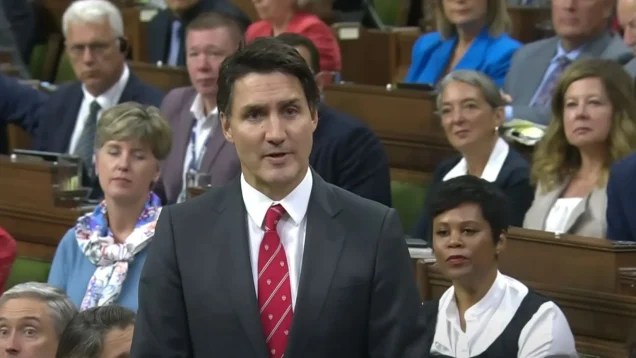
Trudeau Supports Partnership With EU For Digital ID Push, Suggests it Will Help Curb Online “Disinformation”
By Dan Frieth | Reclaim The Net | November 28, 2023
Canadian Prime Minister, Justin Trudeau, a proponent of centralized control, has finalized a controversial collaborative digital partnership with the European Union. This agreement exhibits full commitment to the introduction of a digital identity system in Canada and the government is pursuing it, in part, under the guise of fighting online “disinformation.”
The Trudeau government’s announcement delineates the terms of the Canada-EU Digital Partnership, which aims not only to institute digital credentials for Canadians but also to bolster cooperation in the field of artificial intelligence (AI).
The contentious partnership insists on a joint effort from Canada and the EU to bolster their respective bilateral and multilateral cooperation in forums like the G7 and the G20.
“The Digital Partnership will allow Canada and the EU to have a stronger common voice in multilateral fora, where appropriate, and bring jointly developed solutions to international partners and advance our joint strategic priorities,” the announcement states.
The G20, an influential conglomerate of the globe’s 19 major countries and the EU, has previously encouraged exploring the creation of “digital public infrastructure,” including potential digital identification systems and perhaps even a centralized digital currency.
This “digital public infrastructure” phrase is the same buzzword being used by the likes of The Gates Foundation and the UN, when it comes to pushing digital ID and payment systems.
Alarmingly for many Canadians that support the protection of civil liberties, Trudeau has demonstrated a seemingly unwavering allegiance to this digital ID agenda.
There is no sharing in settler-colonialism, Josep Borrell, only land theft
By Ramona Wadi | MEMO | November 28, 2023
When the so-called humanitarian pause is over, said Israeli Prime Minister Benjamin Netanyahu, “We are returning full power to carry out our aims: destroy Hamas, ensure that Gaza won’t return to what it was, and of course to free all of our hostages.” No one ever doubted that, but the international community has descended into further disgrace with its silence over Israel’s next round of ethnic cleansing in Gaza.
Netanyahu’s agreement to the hostage deal served as relatively good publicity, of course: “These incredible images of people being reunited with their families — the humanity of it, the sense of accomplishment of that and the possibility and promise that more and, ultimately, all of the hostages will come home.” This was despite the fact that it is possible that not all Israeli hostages will be freed by the end of the pause.
Those who are left run the risk of becoming part of Israel’s “collateral damage” in the enclave.
Meanwhile, as the focus on Gaza and the pause continues, Israel is ramping up its arrests of Palestinians in the occupied West Bank, ensuring that the number of prisoners it releases as part of the deal is negligible in comparison. Since 7 October, Israel has arrested 3,260 Palestinians in the occupied Palestinian territory.
On top of this, extreme far-right Finance Minister Bezalel Smotrich is requesting funds for “security and security infrastructure” in the West Bank. The EU’s High Representative for Foreign Affairs, Josep Borrell, was “appalled” by this, according to a post on X, in which he described settlements as “Israel’s greatest security liability.” Even so, according to Borrell, Israel and the Palestinians “both have equal and legitimate right to the same land, so they have to share it,” imparting colonialism in the most erroneous way possible.
If Israeli settlements are a liability, they always were, including the early colonial settlements that paved the way for Israel’s colonisation of Palestine. The UN’s differentiation of settlement expansion is merely an excuse to justify Israel’s colonial enterprise and the international community’s recognition of it as a state. For Borrell, and the rest of the EU, sharing the land is equal to enforcing the two-state paradigm, in which, hypothetically, Palestinians get some slivers of land while Israel owns and manages it all.
The scenario unfolding in Gaza should at least prompt Western leaders to reconsider their two-state rhetoric. Netanyahu has stated that Gaza will not return to what it was; that overt threat speaks of the next phase of Israel’s ethnic cleansing of the enclave. The entire world has watched Israel kill thousands of Palestinians and displace most of the population of Gaza, while diplomats debated over pauses – “humanitarian”, of course – in accordance with the hypocritical politics they espouse. Is there any consideration in the West for Israel’s genocide about to resume after the pause? How many more Palestinians will Israel kill before it is determined that there is no humanitarianism in this lull which has the world focused on hostages and not the process of settler-colonisation?
Settler-colonialism is not a sharing concept; it is theft. So, when will Borrell and all diplomats and politicians who speak of the two-state compromise face any accountability for encouraging genocide by refusing to acknowledge the reality of Israeli settler-colonialism, which seeks to replace the indigenous population with settlers?
United for Gaza: Time now for Palestinians to protect their collective sumud

By Ramzy Baroud | MEMO | November 28, 2023
Shortly after the start of a four-day ceasefire in the war on Gaza, the prime ministers of Spain and Belgium, Pedro Sanchez and Alexander De Croo, appeared in a joint press conference at the Rafah Crossing.
While Sanchez described “what is happening (as) a disaster,” De Croo called for a “permanent cessation of hostilities” and for an end to the killing of children.
Equally significant, the two European leaders declared that “we may decide to recognise the State of Palestine, if the European Union does not.”
Coupled with the strong position of Ireland, some in Europe seem to be waking up to the fact that the Israeli occupation is the primary cause of the recent Gaza ‘hostilities’.
Israel was not pleased by the evolving European position. It immediately summoned the ambassadors of both countries and sharply ‘rebuked’ them. This exaggerated response comes to show that Israel is not willing to give Europe even the narrowest of margins – as in condemning the killing of children or, expecting some kind of a peaceful settlement centered round Palestinian sovereignty.
Spain and Belgium’s phrase of “we may decide” to recognise Palestine even without EU consensus is indicative of an actual foreign policy schism within Europe itself. It turned out that not all EU governments have the same tolerance towards the genocide in Gaza as, for example, Germany and Britain.
Interestingly, other EU officials, too, are calling for a Palestinian State, though their intention is neither to ensure Palestinian freedom nor to safeguard Palestinian rights.
EU chief diplomat Josep Borrell, for example, argued on 20 November that “the creation of a Palestinian state would be the best way of ensuring Israel’s security”.
Even the former British prime minister, now secretary of state for foreign affairs, used similar logic. Israel will not have security unless it guarantees “long-term safety, security and stability” for the Palestinian people, David Cameron said.
Regardless of the reasoning behind the growing emphasis on a ‘solution’ and rights for the Palestinians, this language was almost entirely absent from the Western political discourse prior to 7 October.
The truth is that Palestinians have succeeded, through their resistance and sumud, to reassert Palestine on the global agenda. But how did Palestinians succeed in doing so, despite the utter marginalisation of their cause before the war?
First, unlike previous wars, especially those that preceded the Unity Intifada of May 2021, this time around Palestinians spoke in unison.
Without rehearsing or even coordinating, it felt as if the Palestinian message flew seamlessly, when all Palestinians, regardless of their ideological backgrounds, placed the focus on the Israeli atrocities, without falling into the trap of the typical factional blame game.
Even children who have lost members of their families in Gaza would stand bravely in front of cameras reiterating that they will never weaken and that nothing would remove them from their homeland. Young and old repeated the same logic, used similar language, even from their hospital beds.
This led Israel to do everything in its power to excommunicate the 2.3 million Palestinians in Gaza from the rest of the world, shutting down the internet, electricity and any form of communications, even among Palestinians themselves.
Yet, somehow, a clear, united Palestinian message continued, amplified countless times by an army of social media activists who impressively helped balance out mainstream media bias, eventually overpowering corporate media’s control over the war narrative altogether.
The Palestinians have done this, and more, without powerful lobby groups, media consultants or a hasbara machine, like that which attempted, to no avail, to sway the public opinion in favour of Israel.
Secondly, the factional Palestinian suddenly disappeared.
For years, factional narratives, dividing Palestinians into conflicting interest groups, have thwarted the Palestinian people’s attempt to unify behind a single leadership – one that is capable of conveying, representing and defending Palestinian political aspirations.
Yet, all the Fatah-Hamas talks and agreements have failed, leaving the people with no other alternative but to explore different manifestations of unity that go beyond the interests of politicians.
This unity is now on full display, compelling everyone, including those affiliated with the Palestinian Authority itself, to adhere to the line of the people. While Gazans fought to free prisoners in the West Bank, West Bankers rose, and died in large numbers, in defence of Gaza.
This popular unity must continue, so that it would eventually be harnessed in the form of political unity, which will bring all Palestinian groups together under a single leadership. This is the only way to ensure the tremendous Palestinian sacrifices and the precious blood that spilled in Gaza, eventually translate into the freedom that all Palestinians covet.
Thirdly, unity beyond Palestine also proved critical.
Arabs and Muslims served as the core of Palestinian solidarity throughout the Israeli war on Gaza. They protested, boycotted, fought and mobilised. Moreover, tens of millions of people, beyond the confines of the Arab and Muslim worlds, also marched around Palestinian rights and priorities.
Indeed, whole new conversations on Palestine are now occupying many public spheres around the globe. The Global South is once more embracing the struggle for Palestine, while the Global North is challenging governments, big corporations and mainstream media for justifying, supporting and financing the Israeli genocide.
The Palestinian people will now have to lead and direct this momentum of solidarity so that it may serve their righteous objectives, those of equality, justice and freedom – all enshrined in international law.
No public space should be left without engagement, no audience should be overlooked or neglected, and no stone should be left unturned in the search of that critical mass needed to hold Israel accountable for its crimes.
Western leaders and officials are speaking out now because they understand that the Palestinian cause has become a global one, and that the prolonging of Israeli occupation and apartheid will not bode well, neither for Tel Aviv nor for the collective West.
It is time for Palestinians to utilise this significant moment. It is time for them to lead the process of their own liberation. In fact, in Gaza, Jenin and elsewhere, this process has already begun.
After Hungary rejects billions in aid to Ukraine, European Council President flies to Budapest to meet with Orbán
Magyar Nemzet | November 28, 2023
European Council President Charles Michel flew to Budapest on Monday in an attempt to smooth over current disagreements with Hungary, reports daily Magyar Nemzet.
On the European Council agenda, there are three summits in December: one with China on Dec. 7, one on the Western Balkans on Dec. 13, and on the heels of the second, the European Council proper summit from Dec. 14 to Dec. 15. This last is the one that will be the most critical, with aid to Ukraine and the country’s potential EU membership topping the agenda.
Neither side revealed details of the two-hour meeting: Prime Minister Viktor Orbán only posted a handshake image with Michel, with the laconic text: “Useful consultations ahead of the December EU summit with the president of the European Council.”
However, political analyst Zoltán Kiszelly told daily Magyar Nemzet that the meeting probably revolved around a letter from Viktor Orbán, in which the prime minister wrote that until a strategic evaluation of aid to Ukraine is carried out, his country is not ready to make new commitments.
“So, we should not rush into Ukraine’s admission negotiations or the €50 billion loan without an impact assessment, and the heads of state and government who make the fundamental decisions have not discussed this,” Kiszelly said.
According to him, Michel knows that if the strategic debate were to take place and the case studies were to be carried out, it would become clear that Kyiv cannot even account for the €85 billion it has so far spent on Ukraine. It would also turn out that, in the case of membership, Ukraine would take everything in agricultural or cohesion aid and most EU member states would become contributors.
“This is what Brussels wants to avoid,” Kiszelly said.
“The more details the European public learns, the less they would support Brussels’ ambitions. And we see everyone from Dutch farmers to Polish truckers protesting against Ukraine. The Brussels elite is imposing the consequences of its decisions on the people of Europe,” he added.
The European Commission is racing to push Ukraine into the EU, and disburse ever higher sums of money to a non-EU member state. Hungary, in turn, has been denied €10.4 billion in EU recovery funds that had been earmarked for the country over alleged rule of law violations.
Europe worries about the rise of “populism”, but real specter haunting EU is “maidanization”
By Uriel Araujo | November 27, 2023
In the Netherlands, the PVV (Freedom Party), led by controversial politician Geert Wilders, often described as “far-right” and “populist”, won about 37 of the 150 seats in the Dutch parliament. While talks have started to form the new government, Wilders and his party are now in a leading position. Predictably, much is being written now about the rise of “populism” in Europe, while Western discourses try to link it to far-right Nazi-Fascism.
Whether one likes the “populist” wave or not, this being an umbrella term for a variety of movements, it would be simply inaccurate to equate all such groups with Fascism in general. The supposed connection to Russia in turn only appears “sinister”, thanks to a wave of Russophobia, if one suffers from memory loss: as recently as 2021, the (now gone) Nord Stream 2 German-Russian pipelines project was being completed to deliver Russian gas directly to Western Europe. It had been opposed from the very start by Washington, while Berlin resisted American pressures all the way to almost completion – and then pipelines got blown up in a sabotage explosion, just as US President Joe Biden himself on February 7 had promised would happen, when he said: “If Russia invades (…) there will be no longer a Nord Stream 2. We will bring an end to it.”
According to Pulitzer Prize-winning journalist Seymour Hersh, the sabotage was indeed carried out by Washington. However, thus far, the only voices that vehemently demand an active investigation about such an act of terrorism come from the populist camp, such as the Die Linke and the Alternative für Deutschland (AfD) political parties in Germany. It is no wonder then that populism is on the rise in the continent.
Notwithstanding any valid criticism one may have of the current Russian military campaign in Ukraine, the roots of today’s conflict lie on this energy angle and American interests – as much as they also lie on US geopolitical goals pertaining to “encircling” Russia and to NATO’s enlargement for the sake of maintaining unipolarity.
This month Moldova, a country which is trying to join the European Union (EU), banned a “pro-Russian” party (the Chance Party) from taking part in local elections, two days before the vote, on the basis of “national security” concerns. The measure is in line with the latest European trend, which can only be described as Neo-Mccarthyism: in France, Marine Le Pen, who vowed to pull Paris out of NATO’s military command last year, was questioned for four hours, on June, during what was described as a witch trial, and her Rassemblement National party was described as a “communication channel” for Russia by a report published by the French government.
The same month, Poland’s President Andrzej Duda signed a law allowing Warsaw to conduct political repression against the opposition, the justification being, of course, “to investigate Russian influence on Polish politics”. The commission created for that purpose can ban people from public office for a decade. Such measures, as I wrote, mirror post-Maidan Ukraine’s own anti-Russian initiatives pertaining to banning vaguely defined “pro-Russian” political parties (at least 11 thus far) and the opposition. The Ukrainian President Volodymyr Zelensky has also been advancing moves to outlaw (Russian) Orthodox communities, something which even the head of the Ukrainian Catholic Church, Archbishop Sviatoslav Shevchuk of Kyiv-Halych, has denounced.
France, particularly, had always boasted of being the land of demonstrations, but that has changed. Last month, the country’s Interior Ministry banned all pro-Palestinian rallies nation-wide. Violent clashes between police and defiant protesters ensued, and organizing such demonstrations can now lead to arrest. Similarly, protests have also been banned or restricted in Germany, the United Kingdom, Switzerland, Hungary, Poland, and Austria, among other European nations. Esther Major, Amnesty International’s Deputy Director for Research in Europe voiced the organization’s concern, stating, on October 20, that “in many European countries, the authorities are unlawfully restricting the right to protest (…) In some cases, protests have been banned altogether.”
According to Julia Hall, Amnesty International’s expert on counter-terrorism and human rights (in Europe), “what people can say and do is narrowing by the day”, with France proposing to “criminalize people who criticize Israel”, which is “something new”. She adds that “free speech in Europe has been narrowed in record time. It is leaving victims without any voices. I do not think this will be a one-off.” The United Nations (UN) rapporteur Clement Voule has also voiced his concern about such “disproportionate and arbitrary” blanket bans on protests and the like setting “a very worrying precedent that could have a great impact on the exercise of our fundamental rights and freedoms” because in times of crisis people should have “space to raise their voices, grievances and solidarity, and calls for peace, justice and security.”
All such measures clearly violate human rights in Europe in Europe’s own terms, in accordance with article 11 of the European convention on human rights, by stigmatizing minorities such as Muslims and others, and by violating the freedom of peaceful assembly and the freedom of expression. The thing is this trend has not started now with the issue of Palestine at all: in fact, this year Germany banned Russian and Soviet flags during its “World War II commemorations” on Victory Day, this being the very day when the Soviet Union defeated Nazi Germany.
While European Establishment voices may try to demonize populism, we are witnessing in fact the “Maidanization” of the continent, with rising anti-Russian neo-McCarthyism, talks about banning political parties and demonstrations, the Western mainstreamization of the far-right and even Nazism (as long as it is not “pro-Russian”) plus Europe agreeing with Kyiv on “no Russian minority” in Ukraine. Rather than expecting Ukraine to adapt to European norms and values, it would seem Europe is changing in such a way that post-Maidan Ukraine will just feel at home if its accession ever materializes.
Featured Video

Racist Seinfeld Dances for Joy as Bibi Unveils His New Map
or go to
Aletho News Archives – Video-Images
TV Drama Review
Japanese drama projects Japan’s wartime atrocities onto Chinese characters

Global Times | October 25, 2026
By portraying Chinese characters as perpetrators of ruthless violence while casting Japanese Self-Defense Forces (SDF) intelligence operatives as defenders, the season 2 of the Japanese drama Vivant has recently drawn criticism from Chinese netizens, who argue that its depiction turns historical reality on its head while ignoring Japan’s wartime atrocities.
The TBS drama series – a spy suspense story in which an alleged unofficial intelligence unit of the SDF operates across the globe — has attracted a passionate fanbase. Its currently airing season 2 opened with a household rating of 18.8 percent, the highest for a TV drama this year, according toa commentary article by Japanese media Toyo Keizai.
What draws attention is the portrayal of the enemies in the series, the article noted. Scenes in which the Chinese organization subjects kidnapped members of the SDF unit to brutal torture are repeated with unrelenting intensity.
It is rare for Japanese TV dramas to explicitly portray a real-life country as the enemy, the article noted.
Japanese Prime Minister Sanae Takaichi also made a reference to the drama, saying that she has been recording Vivant and hopes to binge-watch it over the year-end and New Year holidays, according to Japanese media outlets.
China’s CCTV News report on Sunday revealed that the drama features scenes in which Chinese personnel cut off the fingers of and stab Japanese intelligence operatives in the abdomen. Such acts bear striking similarities to the torture inflicted on Chinese nationals by invading Japanese troops during the World War II.
The drama distorts the truth by attributing these atrocities to modern Chinese characters. Beneath the surface, it subtly glorifies Japan’s cross-border overseas operations, blurs the functional boundaries of the SDF and implicitly promotes an expansionist narrative, per CCTV News. … continue
Blog Roll
 Aletho News
- EU facing trillion-euro debt hole while seeking more cash for Kiev
- How US, Europe, Persian Gulf states exhausted missile stockpiles, splurged billions to defend Israel
- Up in arms… Koreans reject U.S. empire’s plan to make South Korea the next Ukraine
- Iran, Turkey, Pakistan, Saudi Arabia could advance region-led security framework in Tehran: FM spox
- Netizens condemn Japanese drama for projecting Japan’s wartime atrocities onto Chinese characters
- Racist Seinfeld Dances for Joy as Bibi Unveils His New Map
- A West Bank War for Netanyahu’s Election Campaign, Could It Backfire?
- Yemen denounces European Parliament’s ‘hypocritical’ push to blacklist Ansarullah
- Qalibaf: UAE’s UN bid aims to ‘clear the runway’ for ‘Greater Israel’, whitewash genocide
- Pakistan reopens Iran border after boosting security: Report
- If Americans Knew
- An error has occurred; the feed is probably down. Try again later.
- No Tricks Zone
- Sudden Stratospheric Warming, Powerful El Niño Combination May Lead To Extreme Europe Cold, Energy Crisis!
- Two New Studies Find Thwaites Glacier Melt Cannot Be Driven By Human Activity Or A Warming Ocean
- E-Cars Reduce CO2 Emissions By Only 41% Compared To Internal Combustion Engine Vehicles
- Predictions Made By Renowned Climate Professor Over Past Decades Have Been Proven To Be Poor
- New Study Suggests Large Regions Of The Pacific Ocean Have Been Cooling For The Last 80 Years
- Germany’s Green Energy Debacle: High Energy Costs Force Kahla Porzellan to Close After 182 Years!
- New Study: 50 Years Of The Most Aggressive ‘Net Zero’ Policies Can Only Affect The Global Climate By 0.03°C
- US September “Heat” Was No Record…Many Records Set Decades Ago
- Latest European Green Energy Debacle; Portugal’s Largest Flagship Solar Park Insolvent!
- Green Energy Debacle: German Expert Professor Fritz Vahrenholt Warns Of Severe Economic And Social Consequences

