EU could stop Hungary voting on Ukraine – FT
RT | December 18, 2023
The possibility of Hungary temporarily forfeiting its voting rights within the European Union is reportedly being considered, the Financial Times has claimed. This development comes after heightened discussions, especially after Budapest opposed a €50 billion ($54 billion) four-year financial aid package for Ukraine during last Thursday’s EU summit.
While Hungary did not ultimately block the initiation of EU accession talks with Kiev, as previously threatened, the Central European nation maintains a divergent stance on Ukraine compared to the bloc’s official position. Prime Minister Viktor Orban’s government has consistently criticized Brussels’ plans for Ukraine’s full EU membership and Western countries’ belief in Kiev’s military capability against Russia.
According to the Financial Times’ report published on Monday, citing anonymous officials, some EU members are considering activating Article 7 of the Treaty on European Union, which allows states to lose certain rights if persistently in breach of core EU principles.
The report pointed out, however, that many countries are hesitant to use this perceived nuclear option. Instead, these nations prefer revealing to Budapest the “full costs” of its isolation.
An anonymous EU staffer told the media outlet that while “Hungary can create more trouble,” it will not be able to “stop us providing money to Ukraine.” The official disagreed with those who like to paint Orban as “Putin’s puppet,” adding that the Hungarian prime minister is pursuing his own agenda.
The FT quoted another unnamed EU diplomat as saying that Orban is “always transactional, never ideological” and is merely seeking the unfreezing of €20 billion worth of EU funding, which Brussels had suspended over concerns related to the rule of law in the Central European country.
The Hungarian prime minister and his foreign minister, Peter Szijjarto, however, dismissed such claims last week.
On the other hand, Lithuanian MEP Rasa Jukneviciene asserted on Friday that Orban is working for Russia and undermining the EU from within.
“I appeal to the Commission, to the leaders of the Council: Let’s start to think about the procedure to suspend the voting rights of Hungary,” the lawmaker implored.
Speaking to Hungary’s Radio Kossuth on Friday, Orban highlighted that Budapest still has approximately 75 opportunities to impede Kiev’s path to EU membership. He has raised concerns about what he describes as endemic corruption in Ukraine on multiple occasions.
Putin: “Odessa is a Russian city”
BY M. K. BHADRAKUMAR | INDIAN PUNCHLINE |DECEMBER 17, 2023
At the year-end news conference on Thursday lasting four hours, Russian President Vladimir Putin made some key remarks on the conflict in Ukraine which throw light on the likely trajectory of the war through 2024. To be sure, Russia will not accept a “frozen conflict” that falls short of realising the objectives Putin had laid out at the commencement of the special military operations in February last year.
Putin stated: “There will be peace when we achieve our goals… Now let’s return to these goals – they have not changed. I would like to remind you how we formulated them: denazification, demilitarisation, and a neutral status for Ukraine.”
He spelt out denazification and demilitarisation as work in progress while leaving out the crucial question of a neutral status for Ukraine, a notion which the collective West outright rejects while pressing ahead with its intervention in newer forms despite the failure of Kiev’s months-long counteroffensive. Ironically, the accent in the revised western narrative is to create a strong resilient defence industry in Ukraine eventually with western technology and capital to ward off any Russian military threats in future.
On denazification specifically, Putin said that during the negotiations in Istanbul last year in March, Kiev showed receptiveness towards the idea of legislating against the spread of extremist ideology, but that lies buried in the past. As for demilitarisation, that idea also never caught on as Ukraine began receiving weaponry “even more than what was promised by the West.”
Therefore, Russia is left with no other option but to keep destroying the Ukrainian military capability as the core of the demilitarisation process. But Putin believed that certain parameters can still be negotiated, and, in fact, “We actually agreed on them [with Ukrainian negotiators] during the Istanbul talks; although these were thrown out later, we managed to reach agreement.” The alternative to reaching an agreement on demilitarisation is to “resolve the conflict by force. This is what we will strive for.” However, to this end, Putin ruled out another mobilisation as already “there will be about half a million people [in the war zone] by the end of this year.”
These remarks bear the hallmark of a statesman speaking from a position of strength who is conscious of it, too. Putin asserted that Russian forces are “improving their position almost along the entire line of contact. Almost all of them are engaged in active combat. And the position of our troops is improving along [the entire line of contact.]” Putin conveyed no willingness to compromise with the US and EU.
Significantly, Putin said that the southern part of Ukraine has “always been Russian territory… Neither Crimea nor the Black Sea has any connection to Ukraine. Odessa is a Russian city.” This is an ominous statement implying that the Russian operation may after all extend to Odessa which is on the western side of the Dnieper and even further westward along the Black Sea coast to Moldova that renders Ukraine a land-locked country. A prolonged conflict is in the cards.
On the contrary, the reports from the US media quoting American officials convey the impression that there is no willingness to throw in the towel at the present stage. That is of course predicated on the belief that Russia will be hard put to realise its objectives and by the end of 2024, the tide of war can change and Russia may be compelled to compromise. Thus, a new strategy is being worked out between the US and Ukrainian military that can be executed by the early part of 2024 with the American accent on holding the territory that Ukraine controls as of now and digging in.
The New York Times reported that the Ukrainian military subscribes to a “forward policy.” The Pentagon is stationing a three-star general in Kiev with a view to “stepping up the face-to-face military advice it provides to Ukraine.” This could be the beginning of deployment of American military advisors to Ukraine to oversee the war, which will put the Pentagon in a direct role in the management of the operations from both the tactical as well as strategic perspectives.
Meanwhile, the final word is not yet spoken by the US Senate on the Administration’s demand of $61 billion as additional funds for Ukraine. The likelihood is that the senate will eventually pass the bill since there is a big groundswell of support among Republican lawmakers for the war effort. The Administration is driving home that Russia has an “imperial” agenda toward NATO countries and vital US interests are at stake in preventing Russia from winning the war.
Interestingly, in a related development two days ago, Congress approved legislation that would prevent any president from withdrawing the US from NATO without approval from the Senate or an Act of Congress. Equally, Europe is also circling the wagons and taking a long-term view that Russia’s scale-up of arms production to sustain its operations in Ukraine poses a real threat to Europe, especially to the Baltic states, Georgia and Moldova. NATO Secretary-General Jens Stoltenberg last week warned that “If Putin wins in Ukraine, there is real risk that his aggression will not end there.”
The German Defence Minister Boris Pistorius echoed that sentiment when he said on Saturday that Europe must ramp up its security and defence capabilities to respond to the threat Russia poses, as the US will likely reduce its involvement on the Continent in the coming years and increasingly turn its attention to the Pacific region in the next decade. As he put it, “This isn’t just sabre-rattling. Dangers could lie ahead at the end of this decade.”
The message from the European Council meeting in Brussels last Friday is also that in circumventing Hungary’s opposition, EU leaders are navigating a pathway to ensure Ukraine will still get its €50 billion aid package to help prop up its hollowed out economy — if necessary, by taking the radical step of sacrificing EU unity and providing the money on a bilateral basis. The EU leaders are expected to reconvene at the end of January or early February to unlock the issue.
On Friday, Ukraine’s foreign ministry released a statement lauding the opening of EU membership negotiations and voicing optimism about the €50 billion aid package from Brussels. The tough talk notwithstanding, Russia too must be sensing that the EU will ultimately find a way somehow to solve the financial question. For the present, though, the deadlock in Brussels and Washington on aid has generated an air of uncertainty, which is bad optics for Kiev and plays into the Russian narrative.
All in all, Putin’s tough remarks on Thursday factor in that the US isn’t going anywhere but stays put in Ukraine and the Biden administration’s game plan is to revamp the war strategy to put it on a stronger footing and make it sustainable through the period ahead till the November 2024 election.
Kremlin’s hope that US support for Ukraine is on the wane seems misplaced. Curiously, spokesman Dmitry Peskov added in good measure in an interview on Friday with broadcaster NBC News that Putin would prefer an American president who is “more constructive” toward Russia and understands the “importance of the dialogue” between the two countries. Peskov added that Putin would be ready to work with “anyone who will understand that from now on, you have to be more careful with Russia and you have to take into account its concerns.”
Between now and the presidential election in March in Russia, domestic politics will be hotting up. After Putin’s re-election for a fresh 6-year term as president, which is widely expected, by the time the new government is formed, the campaign for the US election will have accelerated and it is a safe bet that the Ukraine war will be on auto-pilot with the priority almost entirely lying on averting any serious embarrassment to Biden’s reelection bid.
Suffice to say, staving off a military defeat in Ukraine and keeping the stalemate on track will be the Biden administration’s singular aim through 2024. The big question is whether Putin would “cooperate” or have some surprises in store. Peskov has begun looking beyond the Biden presidency.
Fresh anti-Russia sanctions to cause more damage to EU: Moscow
Press TV – December 17, 2023
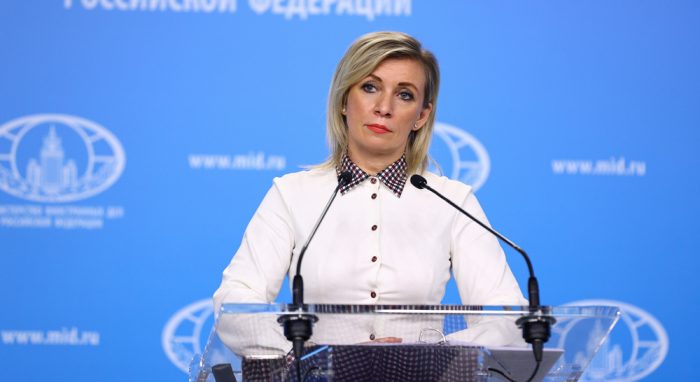
Russian Foreign Ministry spokesperson Maria Zakharova said on Saturday that the latest European Union sanctions against Russia will cause more harm to the EU than Russia.
Zakharova added that the EU’s “dictatorial” behavior reveals how Brussels is “denying” member states of their right to “protect their interests.”
She also warned the EU of the “heavy price” the Europeans must pay for the accession of Ukraine and Moldova to the bloc.
“It goes as far as absurdity, when through some unscrupulous manipulations – when certain heads of state and government are not present at the table, – some legally questionable and obviously politicized decisions are made, which are as follows: on the start of pre-accession negotiations with Ukraine and Moldova, which not only fail to meet the EU’s elementary criteria but directly run counter to them, as well as on another ‘package’ of unilateral restrictive measures against Russia, which, like all the previous ones, will cause bigger harm to the European Union itself,” the diplomat said.
“This dictatorial behavior of Brussels reveals in all its magnitude that the member states are denied their democratic right to a dissenting opinion and the protection of their own interests.”
She went on to add that the EU’s confrontational “policy and the consequences of its opportunistic decisions regarding Ukraine and Moldova will have to be paid by the population of European countries.”
EU members agreed on a 12th package of sanctions against Russia, the European Council said on Thursday, meaning that a phased ban on Russian diamond imports among other measures will come into effect from January 1, 2024.
Moreover, after the summit, European Council President Charles Michel also announced that the EU members had decided to open accession negotiations with Ukraine and Moldova, which may start in March 2024 or later.
The accession talks regarding Ukraine and Moldova started after Hungarian Prime Minister Viktor Orban left the summit in protest to the move. Budapest had earlier threatened to veto the accession of Ukraine into the European Union. “Hungary does not want to be part of this bad decision!” Orban said in a statement on Facebook.
Russia started the “special military operation” in its eastern neighbor in late February 2022 to defend the pro-Russian population in the eastern Ukrainian regions of Luhansk and Donetsk against persecution by Kiev.
Ever since the beginning of the war, Kiev’s Western allies, led by the United States, have been pumping Ukraine with advanced weapons and slapping Russia with a slew of sanctions, steps that Moscow says would only prolong the hostilities.
Zakharova also said that the EU is continuing to “swiftly lose both political and economic weight around the world” under the pressure of the United States’ missteps.
“The EU’s resources, so much needed for its domestic growth, are not funneled into resolving multiple problems and asserting its own place in the emerging multipolar world order, but into serving the US interests, including into the enrichment of the US military-industrial complex,” she said.
Zakharova added that it looks quite natural that against this backdrop, “the most responsible politicians in European countries are more and more frequently prioritizing national interests over some mantras of ‘European solidarity,’ which are out of touch with real needs.”
Zelensky’s Global Begging Tour Is an Obscene Fiasco
Strategic Culture Foundation | December 15, 2023
The United States’ proxy war in Ukraine against Russia has cost the lives of up to 400,000 Ukrainian soldiers. In the last six months alone, it is estimated that over 120,000 Ukrainian troops have been killed in a failed counteroffensive.
Even Western media are coyly admitting the grim reality of failure after much-vaunted predictions last year of imminent victory against Russia.
Yet nearly two years after the conflict erupted, the leader of the puppet regime in Kiev persists in begging for billions more in funds from his Western sponsors to continue the bloodbath – the biggest armed confrontation in Europe since the Second World War.
The hostilities can be traced back to the 2014 coup in Kiev orchestrated by the CIA and precipitated by the European Union and Washington trying to cleave traditional Ukrainian relations with Russia. Those hostilities culminated in February 2022 in what can be seen as a U.S.-led proxy war against Russia. A war that has failed for the Western powers and needs to be peacefully negotiated to spare further death and destruction.
This week, however, saw Ukrainian President Vladimir Zelensky going to Washington to plead for $60 billion in additional funds. His begging mission failed. The U.S. Congress refused to pass the supplemental bill requested on his behalf by President Joe Biden for Ukraine.
After that humiliation, Zelensky then turned his solicitation to the European Union. The EU, by turn, failed to agree on a requested fund for $54 billion for Ukraine.
As a sort of consolation prize, the EU leaders at their two-day summit in Brussels declared that Ukraine could start negotiations for eventually gaining access to the 27-member bloc. That decision was bombastically hailed as “historic” but it seemed more theatre than substance given that the negotiations will take several years to conduct and there is no guarantee at the end of the tedious process that Ukraine will actually gain EU membership. Will Ukraine even exist as a state in a few years, as our columnist Stephen Karganovic ponders in an article this week?
The EU membership talks were granted no doubt as a way to distract from the fact that the EU funds were not forthcoming and especially following the miserable response from U.S. lawmakers.
The whole sorry saga indicates that the U.S.-led proxy war in Ukraine has become a deplorable black hole for Western public money. Given the military debacle and the futile bloodshed, it is becoming politically untenable for Washington and Brussels to keep shovelling billions of taxpayer money into this abyss.
Up for the asking this week was a total of nearly $100 billion between the U.S. and Europe for Ukraine. How many badly needed public services in Western states could do with – and are denied – that kind of financial sustenance?
The spectacle of Zelensky touring the world scrounging for more money is as shameful as it is sordid.
Official figures show that the Western governments have already donated a combined total of $200 billion to Ukraine since the conflict escalated in February 2022.
To put that largesse into perspective, it is estimated that the U.S. Marshall Plan for the reconstruction of the whole of Europe following World War Two was equivalent to $173 billion in today’s money.
Think about that. The Western funding to Ukraine already exceeds this historic salvage package by some $30 billion. And yet Western governments are trying to muster another $100 billion on top of that.
There are several conclusions to be made. First of all, the U.S.-led proxy war against Russia is indisputably a calamitous failure. Despite the unprecedented financing of weapons and other support to the Kiev regime, the war is a dead-end for the Western powers. The 30-member NATO military alliance is staring at a defeat unparalleled in its 75-year history.
Secondly, it is patent that the Kiev regime is only being propped up by the transfer of colossal flows of aid from the West. Without those transfusions of weapons and capital, the regime is finished. It has already lost grievous numbers of troops on the battlefield. Conscription drives are scraping the barrel. Without the lifeline of aid, the regime is finished. The Kiel Institute for World Economy reported last week that Western capital pledges to the Kiev regime have fallen off a cliff since the summer.
Russian President Vladimir Putin said this week in his annual marathon televised Q&A with the public and journalists that Russia will push on with its objectives of eradicating the NATO-backed Nazi forces in Ukraine. There seems little doubt that the objective will be achieved given the parlous state of the Kiev regime.
Another conclusion to draw is the scale of corruption that Ukraine is mired in. For all the funds pumped into this regime so much of it has been siphoned off from the stated purposes.
The obscenity of this war racket is the inordinate corruption, deaths and destruction of economies across Europe while Western weapons corporations have raked in mega-profits.
Zelensky’s global begging tour is a desperate attempt to keep the war racket going for a while longer. He and his wife Olena have enriched themselves with overseas properties and shopping trips to Paris and New York. Zelensky and his cronies have been paid off with blood money for their role in peddling the biggest war scam in modern history. A scam that is funded by hard-pressed and hoodwinked Western taxpayers who have been gaslighted by their politicians and media about “defending democracy and freedom”.
To keep this grotesque charade going, Western politicians in the pay of arms companies and NATO think tanks are resorting to desperate scaremongering and blackmail.
President Biden has repeatedly warned that if extra funds were not released to Ukraine to “defend against Russian aggression” the rest of Europe will be overrun by Moscow.
In Washington this week, U.S. lawmakers who refused to pass the supplemental funding bill for Ukraine were, in effect, accused of being traitors by helping Russia.
Zelensky appealed to European leaders by saying that Putin would exploit any negativity towards Ukraine, and he pleaded with the EU to not “betray” Ukrainians.
On the eve of the EU leaders’ summit in Brussels, the European Commission declared that it was finally releasing €10 billion in withheld funds to Hungary. That was a bribe to Hungarian premier Viktor Orban to concede to the proposed €50 billion in extra aid for the Kiev regime. In the end, Orban did not concede to the multi-billion-euro handout, however, he gave way to his objection to talks for Ukraine’s membership of the EU. Such is the shoddy business of propping up the Kiev regime that arm-twisting and bribery are the order of business in Brussels.
The horrendous waste of lives and financial resources in Ukraine by the Western elite – instead of pursuing diplomacy and peace – is the hallmark that these regimes are terminally corrupt and doomed to failure.
The conflict in Ukraine has recklessly stoked tensions between nuclear powers and has condemned generations of Americans and Europeans to debt. The war in Ukraine is a historic dead-end for the U.S. and its European vassals. Zelensky’s begging bowl is a death rattle.
Iran: EU sanctions others, looks the other way on Gaza genocide, ethnic cleansing
Press TV – December 12, 2023
Iran has denounced the EU’s recent sanctions on its defense industry over “baseless” allegations of drone delivery to Russia, slamming the block for turning a blind eye on Israel’s “genocide” unfolding in the Gaza Strip.
In a statement on Tuesday, Iran’s Foreign Ministry spokesman Nasser Kan’ani “strongly condemned” European Council’s “destructive actions” and imposing sanctions against 6 persons and 5 entities involved in Iran’s development and production of unmanned aerial vehicles (UAV).
“The desperate efforts of some malicious actors with political motives in order to use the inefficient sanctions and spread of false information only create more self-made obstacles in the path of relations between the Islamic Republic and Europe and prove ineffective,” he said.
Kan’ani said the EU talks about international law and the United Nations Charter, while it is “practically turning a blind eye on Israel’s war crimes” and violation human rights and international humanitarian laws.
He further criticized EU for not making any tangible efforts to stop Israel’s “unquestionable genocide and ethnic cleansing” against the “oppressed Palestinians in Gaza and the West Bank.”
Kan’ani also reaffirmed the Islamic Republic’s supports for efforts aimed at finding a solution to the Ukraine military conflict through peaceful means.
Tehran says it reserves the right to retaliate after the European Union imposed new sanctions against Iran in connection with the allegation, he concluded.
The European Union and the US have long accused Iran of supplying drones to Russia for use in Ukraine.
The Council’s sanctions, announced on Monday, imposed restrictive measures against the Shahed drone-maker Shakad Sanat Asmari, its CEO, deputy CEO and chief scientist.
The other companies hit were the Baharestan Kish Company, Saad Sazeh Faraz Sharif, the Sarmad Electronic Sepahan Company and the Kimia Part Sivan Company.
The US has also imposed similar sanctions on a number of entities and individuals based in Iran and other countries, accusing them of supporting Tehran’s drone development.
Iran has repeatedly rejected the West’s claim, saying it has not sold any weapons to Russia for the the war against Ukraine, and asked the West to offer evidence for the allegation.
Hungary PM Orbán vindicated, poll finds 71% of Europeans want ‘immediate end’ to Ukraine war and peace talks
Viktor Orbán claimed the recent polling showed that Brussels is not on the side of the European people
BY THOMAS BROOKE | REMIX NEWS | December 12, 2023
Bureaucrats in Brussels do not represent the European people, Hungarian Prime Minister Viktor Orbán has claimed after a recent study revealed that an overwhelming majority of Europeans want peace talks between Ukraine and Russia and an immediate end to the ongoing conflict.
The poll, conducted by Hungary’s Századvég Foundation, found that 71 percent of EU and U.K. citizens believe the war should “end immediately and the parties should be brought to the negotiating table,” while just 20 percent support its continuation until such a time that “Ukraine defeats Vladimir Putin”.
Similarly, 67 percent of respondents were against the deployment of their own countrymen to Ukraine, compared with 25 percent in favor of such a move.
Another question showed that respondents in every EU member state believed that the economic sanctions imposed by Brussels against Russia had been detrimental to the European Union, and saw the United States and China as the biggest winners of the policy.
Only non-EU Norway believed the sanctions had benefited their own country while just five European nations — Norway, Lithuania, Finland, Estonia, and Denmark — believed the move had been beneficial for Ukraine in its ongoing fight with Moscow.
A clear geographical divide between the northern and southern European nations was seen when asked about Europe’s foreign policy concerning China. A majority from every mainland European nation with the exception of Poland and the Baltic states called for more “peaceful economic cooperation” to be sought with the superpower, insisting a “tougher approach is not needed”.
However, Poland, the Baltics, the U.K. and Ireland, and Scandinavian nations believed a tougher approach is necessary “because of its relation to Russia”.
Europeans were also split on Brussels’ policy of sending military aid to Ukraine. Eastern European nations, with the exception of Poland and the Baltics, had a majority of respondents against the provision of weapons to Kyiv, while Ireland, Switzerland, Austria, France, and Italy were also against the move.
A majority in favor of military aid, however, was found in Scandinavian nations, the Baltics, the U.K., Spain, and Portugal
Commenting on the Századvég Foundation’s findings, Prime Minister Viktor Orbán said the numbers were “clear” that the European Union was out of touch with European citizens and its policy to continue funding Ukraine in its conflict with Russia contravene public opinion across the continent.
Hungary has long been an advocate for peace talks, much to the dismay of the European liberal elite which has chastised Orbán’s administration for refusing to toe the line of Brussels.
Hungary has also remained vehemently opposed to the European Commission’s plans to advance EU membership talks with Kyiv despite the ongoing conflict, with Hungarian officials warning Brussels it risks bringing “war to Europe”.
Another study by the Századvég Foundation published on Monday found that 72 percent of Hungarians supported their government’s stance against EU membership for Ukraine, a monthly mood-checker that has seen opposition against the move increase each month since September.
The conservative think-tank warned that if Ukraine joined, “almost all Member States would become net contributors or current agricultural subsidies would have to be reduced by an average of 20 percent” in order to accommodate “Ukrainian farmers working on the richest farmland in Europe”.
EU states consider ‘Plan B’ for Ukraine aid – FT
RT | December 12, 2023
Kiev’s main backers in the EU may overcome Hungarian opposition to the proposed allocation of $54 billion in long-term aid for Ukraine by providing funds outside of the bloc’s joint budget, the Financial Times reported on Tuesday.
The European Commission is seeking to provide the funding over the next four years through the so-called Ukraine Facility. The money is intended to help Kiev with its conflict with Russia, as well as for its reconstruction efforts.
Hungary, which has been highly critical of Brussels’ approach to the Ukraine crisis, has indicated that it would veto the decision during a summit of leaders on Thursday.
The Ukrainian government is counting on the money for its 2024 budget and has warned of “devastating consequences” if the EU comes up short, Foreign Minister Dmitry Kuleba told journalists on Monday ahead of a meeting with his European counterparts in Brussels.
Ukraine’s Deputy Prime Minister Olga Stefanishina said a failure to allocate the money would be “a failure of the entire European Union” that would impact Kiev’s chances of getting more aid from the US as well.
According to the FT, Kiev’s supporters in Brussels want to sweeten the deal for Budapest by releasing EU budget funds that were frozen due to Hungary’s perceived lapses in the rule of law and corruption.
The alternative is to have the other 26 members pool resources, the newspaper said, citing people familiar with the talks on what one of the sources called a “plan B.” Diplomats are privately discussing “the feasibility and technical details” of such a move.
EU foreign policy chief Josep Borrell urged national leaders to “stubbornly support” Ukraine for the sake of bloc unity after the ministerial meeting.
Hungarian Minister for EU Affairs Janos Boka told the FT that his government was not likely to change its position. He claimed that the reported consent-for-frozen-funds deal would amount to “political blackmail not from Hungary, but against Hungary” by Brussels.
However, he added that it was feasible for assistance outside of the EU budget to be provided. This would involve “member state contributions, mutual member state guarantees, a much shorter planning period of one year instead of four years,” and would be “under the clear political leadership of the member states.”
Budapest has argued that the tens of billions of dollars and euros poured into Ukraine by Western donors have failed to end the bloodshed. Nations should instead pressure Kiev and Moscow into peace talks, the Hungarian government believes.
Russia says Ukraine’s uncompromising position and refusal to accept the reality on the ground is standing in the way of resolving the crisis. Moscow wants its neighbor to be “neutral, non-aligned and nuclear-free” as well as respectful of the rights of its ethnic Russian minority, Foreign Ministry spokeswoman Maria Zakharova said last week.
Ireland’s Media Commissioner Is Poised To Gain Substantial Authority Over Online Speech
By Dan Frieth | Reclaim The Net | December 11, 2023
Jeremy Godfrey has been named the executive chairperson of Ireland’s Media Commission, an organization tasked with overseeing social media regulation and censorship in Ireland.
This new role aligns with Ireland’s implementation of the EU’s censorship law, the Digital Services Act (DSA). The DSA mandates that online platforms with more than 45 million monthly active users prioritize the moderation of content deemed “harmful.”
According to Politico, roughly about nine months into his role as the chairman of the Media Commission, Godfrey and his assembly of specialists, currently numbering 75, are still meticulously working out the intricacies of their novel directive. Their yet to be inaugurated authority, slated for activation early next year, will count among its arsenal the ability to stipulate severe fines for speech violations.
The Commission’s powers will intersect with those of Brussels, as the two seek to unify their efforts under the world’s pioneering social media legislation which is designed to curtail the propagation of online hate speech and misinformation.
“We are striving for a mutual objective,” Godfrey told Politico. Godfrey, however, candidly admitted that how the responsibilities will be shared between the European Commission and the Irish body remains an unresolved issue and will necessitate further deliberation.
Citizens in Ireland are currently facing a dark turn when it comes to free speech. The country is facing a controversial shift in its approach to freedom of expression and speech, with proposed laws targeting so-called “hate speech.”
Under the proposed legislation, actions or materials that could incite violence or hatred based on “protected characteristics” like disability, nationality, ethnicity, religion, sexual orientation, or gender would be criminalized.
The bill’s scope is alarmingly extensive, penalizing not only the articulation or publication of such speech but also the mere possession of it. This could include anything from a meme on a cellphone to text messages, with non-compliance in surrendering device passwords to authorities potentially leading to a year’s imprisonment.
Putin’s Middle East Trip Deals a Blow to Washington
By Salman Rafi Sheikh – New Eastern Outlook – 11.12.2023
Russian President Vladimir Putin’s recent visit to the Middle East – and the 21-gun salute welcome he received there – shows the failure of Washington’s consistent attempts to ‘isolate’ and defeat Russia. The visit also points to the Middle East’s increasing shift away from, and sole reliance on, Washington. Ever since the beginning of the Gaza War on October 7, the Middle East has been keeping contact with China, rather than the US, its first priority. The reason for this is not simply the fact that the US is supporting, militarily and diplomatically, Israel against Palestine, but also because the Middle East is strategically realigning itself with the realities of what is increasingly – and undeniably – a multipolar world. To the extent that the Middle East, a region where the US remained the most dominant extra-regional force for many decades, has made this shift also reflects the ongoing demise of US dominance more generally in the world. To the extent that China and Russia are two major proponents of multipolarity, connect the dots of this anti-US but pro-China and pro-Russia shift.
Putin’s trip to the UAE and Saudi Arabia has many dimensions. One of these dimensions is bilateral. Between 2017-2022, the trade turnover between Russia and the UAE has grown by almost six times. In 2022, the overall trade increased by almost 68% amounting to US$9 billion. The UAE is Russia’s largest trading partner in the Gulf Region, accounting for 55% of Russia’s total trade with the Persian Gulf.
It, therefore, makes sense for Washington to pressure the UAE government to drastically limit their trade ties with Moscow. Earlier in September, several Western officials from the United Kingdom, EU and US visited the UAE to persuade the UAE to review its trade ties with Russia. Western officials have been assuming that, in the wake of the threats of the Israel-Gaza war spreading to other parts of the Middle East, the UAE would go back to its ultimate security guarantor: the US. This would, however, happen only if the UAE has good ties with the US. Good ties, under the present context of the Russia-Ukraine conflict, mean the UAE ending its trade ties with Russia, especially the ones that may have military implications.
The UAE has been resisting these pressures. In fact, its decision to welcome Putin himself means that the UAE is considering an alternative means of protecting itself in the wake of a wider war in the region. It is ensuring Russian (and Chinese support), and it is using this (possible) source of support to send a message to Washington, i.e., multiple options are possible in a multipolar world. The message is quite similar to the message that the Saudis have been giving to the Americans since the beginning of the Russia-Ukraine military conflict.
If the Americans have been doing their best to convince the Saudis to break out of the OPEC+ deal and increase the production of oil to help reduce its prices and consequently help control the inflation in the West, the Saudis have not submitted. In this context, Putin’s visit to Saudi Arabia sought to reinforce the ‘oil alliance’ – which is also a major dimension of Russia-Saudi bilateral ties – at a time when the burden of wars (supporting Ukraine plus Israel) on the West is increasing manifold. For Putin, an appropriate message to the Middle East in particular and the Global South in general is this: the West supports aggression against all states, regardless of whether it is Russia or Palestine, and it expects other states (e.g., the Middle East) to support that aggression.
Russia understands that the West is fighting two wars, and it does not have any narrative to justify them both simultaneously. As even the US-based Carnegie Endowment said in one of its recent reports, “Washington’s pro-Israel stance undermines the legitimacy of the West’s broader reasons for supporting Ukraine in the eyes of many in the Global South. The moral argument against Russia’s invasion of Ukraine now looks like empty words, particularly in Middle East nations”. In this sense, the timing of Putin’s visit was far from coincidental. It aimed to tap into the opportunity to wean powerful states in the Middle East, who are also keen to expand ties with the non-Western world via BRICS, away from the US as much as possible.
Therefore, the purpose of Putin’s visit, as some Western media analysed and sought to trivialise, was not simply to “discuss” the Gaza war. It was part of Moscow’s wider outreach to the Middle East at an appropriate time to reorient the Middle East’s strategic priorities. Soon after coming back, Putin hosted Iran’s president in Moscow to build on the success of his visit and deepen Russia’s foothold in the region, a region that allows Russia to fight the West in the economic field by, for instance, coordinating the production of oil.
Still, the Gaza war was discussed. But that discussion was underpinned by the strategic failure of Washington’s plans to create a new Middle East. The failure of the US in the Middle East becomes yet another opportunity for Moscow to present itself as a potential peace broker rather than, and unlike the US, a troublemaker. If it was simply a war of narratives, Russia (and China) are clearly winning it in the Middle East.
Migrant-loving Western leaders are at war with their own people
By Tony Cox | RT | December 10, 2023
The ongoing ruling-class meltdown over the recent Dublin riots tells us a lot about the breadth and depth of the gulf fixed between Western governments and their citizens. It’s as if those in charge are outraged by the temerity of their subjects to cry out over the pain and death inflicted upon them by their supposed leaders.
Angry Irish citizens took to the streets, chanting “Enough is enough,” after suffering the latest consequence of mass migration: The November 23 stabbing attack in which three children and two adults were injured in central Dublin. Having failed to be heard by the policymakers who are destroying their quality of life, they burned buses, torched police cars, and clashed violently with officers.
The suspect hasn’t been identified or officially arrested. Unlike the Irish people, he’s being protected by their government, and he’s reportedly too incapacitated to be questioned by police because of injuries suffered during the stabbing spree. He has been described as a 49-year-old Algerian who was given Irish citizenship.
A media controversy erupted days after the attack when independent journalist John McGuirk reported – incorrectly – that the suspect was an Algerian migrant who had been living in Ireland, at taxpayer expense, since 2003. McGuirk referred to a man who faced a deportation order after an arrest years ago, but he was allowed to stay in the country and was later given an Irish passport. Earlier this year, he was arrested for illegal knife possession and damaging a car. He was let go by the court because of a mental health issue, according to media reports.
McGuirk was assailed by establishment mouthpiece media figures not for getting the story wrong, which wasn’t initially known, but for deciding not to withhold sensitive information from his readers. Pressed in a television interview by host Ciara Doherty on whether he “inflamed” a “hostile situation” by reporting details about the suspect’s background, he replied, “Your essential position is that you, as a journalist, sitting in that chair, should decide what information the people watching this program have, and if you decide they can’t handle it, you don’t give it to them.”
Police subsequently revealed that McGuirk had identified the wrong Algerian migrant. Although he wasn’t named in the article, the details of his background made it possible for online sleuths to identify him. Police are now protecting the man who was misidentified, according to media reports, while continuing to withhold information about the actual suspect.
McGuirk took down his erroneous article from the internet and issued a statement saying that the source who gave him false identification was a senior police official. He also cross-checked the information with a senior official in the Irish justice system before posting his story. His media outlet, Gript Media, is now investigating whether the false tip was a deliberate act of sabotage.
It would be easy to see why powerful figures in the Irish government would be pleased to have such a story misreported by an adversarial journalist. The discussion has turned to the spread of “misinformation” and the inciting of angry citizens rather than excessive immigration and poor public safety.
The situation is reminiscent of when WikiLeaks reported on emails showing that America’s Democratic National Committee had rigged the party’s 2016 presidential primaries in favor of its chosen candidate, Hillary Clinton. Rather than focusing on the scandal, legacy media outlets made the story about Clinton’s unproven claims that Russian hackers stole the emails and gave them to WikiLeaks.
The thing is, even if you knew that an adversary with ulterior motives had revealed that your spouse was cheating on you, wouldn’t you be more concerned about the infidelity than the source? The story in Ireland should be destructive immigration policies, not identifying the wrong Algerian migrant criminal.
Ironically, the distraction and misdirection in the Dublin story doesn’t really matter. The fact is that the dangerous migrant identified by McGuirk has been allowed to stay in Ireland by a government that doesn’t prioritize the safety of its own people. He didn’t perpetrate this particular assault, but he’s a criminal migrant, and if and when he commits another crime, it will be an unforced error inflicted on the Irish people by their government. The fact also remains that the real suspect is an Algerian migrant, meaning he came from a country more than 1,000 miles away that isn’t at war. If he was a legitimate refugee, Ireland wasn’t the nearest available safe haven – not by a long shot.
However, if Ireland’s leaders can help it, attention will be shifted away from the country’s migration crisis. Never mind the policies that endanger Irish citizens and diminish their quality of life. There won’t be a serious discussion, either, of why illegitimate asylum seekers and other migrants are allowed to stay in the country, even after they’ve committed crimes.
Rather than decrying the stabbing of children or confronting the policy questions raised by the rampage, Irish government officials and their media stenographers are focusing their ire on the citizens who violently demanded change, dismissing them as “emboldened racists.”
National police chief Drew Harris blamed the riots on a “complete lunatic hooligan factor driven by far-right ideology.” Justice Minister Helen McEntee pledged tougher police tactics to quell any such revolts by the “thugs and criminals” who were using the stabbing attack to “sow division.” Kenyan-born UK politician Lilian Seenoi-Barr blamed the unrest on a small far-right minority and called the rioters an “organized terrorist group of people who want to harm immigrants.”
Prime Minister Leo Varadkar insisted that people shouldn’t connect the stabbing spree to the mass migration that is transforming Ireland’s population. The PM said the rioters couldn’t possibly have been motivated by a desire to protect their way of life; rather, they were “filled with hate, they love violence, they love chaos, and they love causing pain to others.” He also called for enhancements to Ireland’s hate-speech legislation. “We will modernize our laws against incitement to hatred and hatred in general.”
To the extent the mob was whipped up, it was whipped up by reality – the reality created by the policies of the country’s tone-deaf leaders. The influx of migrants – many of them illegitimate asylum seekers from outside war zones – has swelled Ireland’s population to 5.15 million, up 31% in the past two decades. One in five residents of Ireland isn’t Irish-born. Many young people have given up on looking for homes because of the housing crisis and crushing inflation. Rates of murder and other crimes have risen sharply.
As for the notion that people are violently angry about their collapsing quality of life, recent polling shows that 75% of Irish people believe their country is taking in too many asylum seekers. An even larger majority, 76%, agreed that it was justifiable for people to be angry when migrants were moved into their communities. Presumably, most of those citizens aren’t inclined to torch trams or burn buses, but if even one in 100 of the people who oppose what’s being done to their country are angry enough to rise up, you have a mob nearly 40,000 strong.
Not all of the rioters were motivated by real grievances. Some, for instance, took the unrest as an opportunity to loot. In any case, a strong majority of the Irish people aren’t getting what they want from policymakers. Their message isn’t being heard when they burn things, just as it was ignored when they held peaceful protests. So, what comes next?
Irish leaders have responded by demonizing their critics and criminalizing dissent. For example, Irish MMA legend Conor McGregor is reportedly among the many people being investigated for alleged “incitement to hatred.” McGregor posted on social media that the stabbing suspect was a “grave danger among us in Ireland that should never be here in the first place.” Deputy Prime Minister Micheal Martin denounced the fighter’s accurate comment as “absolutely disgraceful,” to which McGregor responded by calling the politician “worthless and spineless.”
McGregor doubled down on his criticism last week, saying Irish officials were trying to use him as a “scapegoat.” He added, “The truth of the many failed policies of this government, however, will never stop being the reason we have innocent children in hospital on life support after being stabbed by a deranged criminal.” The fighter even hinted on Monday about running for president.
Contrast the reaction in Dublin with how the Western ruling class treated the Black Lives Matter riots in 2020. There were scenes of police kneeling with the protestors rather than calling them extremist hooligans. Rather than calling for everyone to hush up about the racial overtones of the triggering event – the death of a black criminal, George Floyd, after a white police officer kneeled on his neck – the story was made all about racism.
Even as cities burned and dozens of people were killed, many politicians agreed with the mob’s demands to “defund the police” and “reimagine policing.” The future US vice president, Kamala Harris, promoted a fundraising campaign to bail out rioters who had been arrested during the mayhem. Nike, Google, Apple, and other big names in Corporate America pledged massive donations to “racial justice” causes.
And while inflaming the Dublin rioters by linking the crime to migration has been deemed irresponsible, inflaming the BLM mob with falsehood may even have been a government strategy. A new documentary on Floyd’s death has claimed that the original autopsy found no indication that he had died from injury to his neck; however, he was infected with Covid-19 and had fatal levels of fentanyl in his blood. A day after the medical examiner met with FBI agents, the documentary said, the autopsy was altered to suggest that Floyd had been killed by police.
The cop who was found guilty of killing Floyd, Derek Chauvin, is still serving a long sentence in prison, where he was stabbed 22 times by another inmate last month. His attacker was a former FBI informant.
Western rulers seem to base their reaction to civil unrest and violent crimes on the ideology of the perpetrators. If it aligns with the political agenda, the message is amplified and treated sympathetically. If it exposes the folly of destructive policies, it must be crushed. The BLM riots provided an opportunity for race-baiters to further divide the people and promote “reforms” that favor criminals over law-abiding citizens and non-white people over whites. The Dublin riots screamed that the people had reached their breaking point with mass migration and leaders who refused to serve the interests of their citizens.
The same criteria were on display when an election fraud protest at the US Capitol escalated into a riot in January 2021. Rioters breached the Capitol to disrupt congressional certification of Joe Biden’s presidential election victory. Biden reacted by calling the riot the “worst attack on our democracy since the Civil War.” More than 1,100 people have been arrested for their alleged roles in the riot. Many have received long prison sentences. One man who wasn’t even in Washington on the day of the riot – but who sent messages cheering on the breach from his Baltimore hotel room – was sentenced to 22 years in prison.
A similar approach is taken to other high-profile crimes. When a white gunman wounded four people at a Missouri Walmart last month, the FBI came out just two days later to report that the shooter may have been motivated by racist ideology. Never mind that two of his victims were white, and two were black.
And yet, more than eight months on from an incident in which a transgender shooter killed three children and three adults at a Christian elementary school in Tennessee, police are still refusing to release the “manifesto” written by the murderer. In fact, seven officers have been suspended on suspicion that they may have leaked part of the document online. In leaked pages of the manifesto, shooter Audrey Hale spoke of killing “all you little crackers” with “white privileges.” Similarly, it took seven months for police to reveal that the man who killed five people and wounded eight at a Kentucky bank wanted to inspire tougher gun control laws by killing “upper-class white people.”
The suppression of truth, the lying, and the situational outrage cannot be sustained forever. Leaders who cram down policies that destroy their countries and harm their citizens, whom they supposedly represent, cannot endlessly evade a real reckoning of their betrayals. The critics can no longer be completely silenced, no matter how aggressive the censorship efforts.
How sustainable is being at war with your own people? How long can a government defy the interests of its citizens and vilify those who complain? Short of replacing the native-born population quickly enough to avert accountability, the leaders will have to answer to their subjects at some point.
The same voices that call for tamping down the rhetoric and even suppressing the facts to avoid inflaming the mob in Dublin are only inciting more escalation by dismissing the rioters as extremist, racist thugs. People whose lives are being destroyed – at their own expense, as taxpayers, and by the traitorous leaders who have a moral duty to serve their interests – will eventually find a way to be heard.
Tony Cox is a US journalist who has written or edited for Bloomberg and several major daily newspapers.
EU-aspiring president to punish opposition-controlled cities
RT | December 9, 2023
Moldovan municipalities controlled by “anti-European” forces will be deprived of funds provided by the EU, the country’s President Maia Sandu has said.
The president issued the threat on Saturday while speaking at a forum in Chisinau that brought together some 500 mayors, although the gathering was boycotted by certain opposition parties.
“Regarding European money, I want to ask you: those mayors who are against the EU, do you think that the European Union should give you money if you do not support the EU? Where is the logic here?” Sandu stated.
All municipalities will receive “state funds,” yet only those supporting Moldova’s EU aspirations and “European values’’ will be provided with money coming from “from the EU and taxpayers of EU countries,” the president explained. Sandu also accused Eurosceptic politicians of populism, stating that some of them use “anti-European rhetoric to collect votes,” while a “simple analysis shows that Moldova has survived and even begun to develop only thanks to the support of our external partners.”
In recent weeks, the Moldovan president has repeatedly threatened to slash funding to opposition-controlled municipalities. The hostile rhetoric comes in the aftermath of local elections held in early November when 898 mayoral positions were contested across the country.
Sandu’s ruling Party of Action and Solidarity (PAS) failed to score a decisive victory, winning 291 races, with the main opposition force, the Party of Socialists, led by ex-President Igor Dodon taking 144. The rest were taken by either minor parties or independents. PAS suffered losses in key localities, including the country’s capital of Chisinau and the second-largest city of Balti.
Earlier, Dodon dismissed Sandu’s threats to slash funding to opposition controlled municipalities as “absurd,” stating that the external support to the country has not exactly been coming for free.
“The loans that the government is now actively taking from EU countries, in an attempt to plug the holes that have emerged due to the failures in the country’s governance, will have to be paid back by all citizens of the republic, including those who, according to Sandu and members of her party, voted incorrectly,” Dodon stated.
IMF Head Wants World Wide Carbon Taxes
By Kit Knightly | OffGuardian | December 7, 2023
IMF Chief Kristalina Georgieva has called for every government to implement some form of carbon taxes or “carbon pricing” in the near future.
Yes, we’re into week two of the UN’s COP28 climate change summit, and the hits just keep on coming.
For example, yesterday it was announced sixty-three world governments have pledged to reduce the emissions from air conditioners and electrics fans.
[You can read a detailed breakdown of the other pledges made during COP28’s first week here.]
Speaking at COP28 in Dubai, and repeated in an interview with the Guardian, Georgieva extolled the virtues of “carbon pricing” and heaped praise on the EU and Canada for their implementation:
When you put a price on carbon, decarbonisation accelerates. The Europeans introduced the emission trading scheme [in 2005] and they have been growing and yet emissions went down by 37%. You see the same thing in Canada with their carbon tax.”
While both the speech and interview discuss the proposed carbon taxes in terms of corporations as “major polluters”, any tax applied to big business would be directly passed onto private citizens via price increases.
The Guardian acknowledges this, but of course, decides to add a weasel-word qualification [emphasis added]:
However, attractive though a carbon price may be in economic theory, in practice governments are reluctant to impose such explicit prices and taxes, because they can easily be attacked, and because they hit poorer people hardest, if badly applied.
“If badly applied”, sure.
The truth is economic destruction, designed to lower the standard of living for ordinary people, is the whole point of “carbon taxes”. just as it was the point of lockdowns.
Deceptive language aside, the undeniable fact that any carbon tax – corporate or individual – would directly harm the poorest is clearly understood by the people who would seek to enforce them.
Not that they have a problem with that, you understand, their concern is merely that purely public rage and/or civil disobedience makes direct taxation difficult to implement. The Guardian article gives the game away by referencing France’s Gilets Jaunes protests as an example.
So, even as Georgieva names carbon taxes the “perfect” solution to climate change, she recognizes the need to rely on more indirect methods.
Yes, the best way to introduce implement carbon prices [is] a carbon tax…But it is not politically feasible in some countries … We can also use regulatory compliance in which standards lead to implicit prices on carbon.”
These “regulations” and “implicit” prices would not be “carbon taxes” in name, but they would very much be so in spirit.
Again the Guardian cites an example, the EU’s recent “carbon border adjustment mechanisms”, which charge more import duties on goods coming from countries with “lax” emissions policies.
A global version of those rules is likely just one of many such measures we can expect moving forward since, according to Georgieva, the world’s biggest financial institutions are all working together on this issue:
[T]he IMF, World Bank, OECD and World Trade Organization [have] set up a taskforce to examine the different carbon prices that are implied in countries around the world by their carbon policies and regulations.”
The head of IMF has spoken, and the World Bank and World Trade Organization are all on board: Carbon Taxes are inevitable. The only question is what they decide to call them.
All the world’s biggest financial heavy-hitters are coming together to figure out the best way to scam people out of their hard-earned money… for the good of the planet, obviously.
Featured Video

Racist Seinfeld Dances for Joy as Bibi Unveils His New Map
or go to
Aletho News Archives – Video-Images
TV Drama Review
Japanese drama projects Japan’s wartime atrocities onto Chinese characters

Global Times | October 25, 2026
By portraying Chinese characters as perpetrators of ruthless violence while casting Japanese Self-Defense Forces (SDF) intelligence operatives as defenders, the season 2 of the Japanese drama Vivant has recently drawn criticism from Chinese netizens, who argue that its depiction turns historical reality on its head while ignoring Japan’s wartime atrocities.
The TBS drama series – a spy suspense story in which an alleged unofficial intelligence unit of the SDF operates across the globe — has attracted a passionate fanbase. Its currently airing season 2 opened with a household rating of 18.8 percent, the highest for a TV drama this year, according toa commentary article by Japanese media Toyo Keizai.
What draws attention is the portrayal of the enemies in the series, the article noted. Scenes in which the Chinese organization subjects kidnapped members of the SDF unit to brutal torture are repeated with unrelenting intensity.
It is rare for Japanese TV dramas to explicitly portray a real-life country as the enemy, the article noted.
Japanese Prime Minister Sanae Takaichi also made a reference to the drama, saying that she has been recording Vivant and hopes to binge-watch it over the year-end and New Year holidays, according to Japanese media outlets.
China’s CCTV News report on Sunday revealed that the drama features scenes in which Chinese personnel cut off the fingers of and stab Japanese intelligence operatives in the abdomen. Such acts bear striking similarities to the torture inflicted on Chinese nationals by invading Japanese troops during the World War II.
The drama distorts the truth by attributing these atrocities to modern Chinese characters. Beneath the surface, it subtly glorifies Japan’s cross-border overseas operations, blurs the functional boundaries of the SDF and implicitly promotes an expansionist narrative, per CCTV News. … continue
Blog Roll
 Aletho News
- EU facing trillion-euro debt hole while seeking more cash for Kiev
- How US, Europe, Persian Gulf states exhausted missile stockpiles, splurged billions to defend Israel
- Up in arms… Koreans reject U.S. empire’s plan to make South Korea the next Ukraine
- Iran, Turkey, Pakistan, Saudi Arabia could advance region-led security framework in Tehran: FM spox
- Netizens condemn Japanese drama for projecting Japan’s wartime atrocities onto Chinese characters
- Racist Seinfeld Dances for Joy as Bibi Unveils His New Map
- A West Bank War for Netanyahu’s Election Campaign, Could It Backfire?
- Yemen denounces European Parliament’s ‘hypocritical’ push to blacklist Ansarullah
- Qalibaf: UAE’s UN bid aims to ‘clear the runway’ for ‘Greater Israel’, whitewash genocide
- Pakistan reopens Iran border after boosting security: Report
- If Americans Knew
- An error has occurred; the feed is probably down. Try again later.
- No Tricks Zone
- Sudden Stratospheric Warming, Powerful El Niño Combination May Lead To Extreme Europe Cold, Energy Crisis!
- Two New Studies Find Thwaites Glacier Melt Cannot Be Driven By Human Activity Or A Warming Ocean
- E-Cars Reduce CO2 Emissions By Only 41% Compared To Internal Combustion Engine Vehicles
- Predictions Made By Renowned Climate Professor Over Past Decades Have Been Proven To Be Poor
- New Study Suggests Large Regions Of The Pacific Ocean Have Been Cooling For The Last 80 Years
- Germany’s Green Energy Debacle: High Energy Costs Force Kahla Porzellan to Close After 182 Years!
- New Study: 50 Years Of The Most Aggressive ‘Net Zero’ Policies Can Only Affect The Global Climate By 0.03°C
- US September “Heat” Was No Record…Many Records Set Decades Ago
- Latest European Green Energy Debacle; Portugal’s Largest Flagship Solar Park Insolvent!
- Green Energy Debacle: German Expert Professor Fritz Vahrenholt Warns Of Severe Economic And Social Consequences

