Europe ‘dancing on the edge of a volcano’ – Sarkozy
RT | August 24, 2023
The Western push to incorporate Ukraine into NATO can only lead to an escalation of the conflict with Russia, former French President Nicolas Sarkozy has said, expressing doubt that the opposing parties in the stand-off have used all the tools at their disposal to achieve peace.
Speaking to TF1 TV on Wednesday, Sarkozy stressed that he believes Ukraine must remain “neutral” and refrain from joining the EU and NATO.
“This is not the solution. The solution is to discuss, for reasonable people to sit around the table, for us to give Ukraine security guarantees and for us to engage in a discussion to see at least if we can get out of it other than by annihilating either Ukraine or Russia,” he said.
Victory in the conflict can be achieved either by destroying an enemy, or finding a compromise, according to the French president, who called on the West to “stop talking about buying planes, ammunition, tanks.” He added that the international community must “find a solution that preserves the interests of Ukraine,” noting that “Russia won’t go anywhere, with or without [Russian President Vladimir] Putin.”
“My analysis is that the world and Europe are dancing on the edge of a volcano. It can get out of hand at any moment. There have been enough deaths, and it seems to me that the path of diplomacy and discussion has not been used to the end and that it is now appropriate to use it.”
Last week, Sarkozy said that despite the current stand-off, Russia will always be Europe’s neighbor, suggesting that Ukraine “must remain” a bridge between the two.
He also stated that any compromise with Moscow would involve recognizing Crimea as part of Russia. The peninsula voted in a referendum to become part of the country in 2014 following a Western-backed coup in Kiev.
His comments, however, sparked outrage in Kiev, with Mikhail Podoliak, an aide to Ukrainian President Vladimir Zelensky, calling the proposal “criminal,” and accusing Sarkozy of complicity in organizing “genocide and war.”
Moscow has repeatedly said that it is open to talks with Kiev. Last year, however, Zelensky signed a decree banning any talks with the current Russian leadership after four former Ukrainian regions overwhelmingly voted in referendums last autumn to join Russia.
No security for Europe without Russia – Austrian FM
By Lucas Leiroz | August 23, 2023
Showing political realism, a major Austrian official criticized the European Union’s efforts to “cancel” Russia, recalling the role of geography in determining Europe’s policy towards Russia. In fact, the current crisis in relations between Russia and Western Europe is due to the end of the pragmatic search for good diplomatic ties with Moscow, which tends to be a “suicidal” policy considering that Europe and Russia are geographically close and will always have to maintain dialogue to guarantee regional peace.
The statement was made by the Austrian Minister of Foreign Affairs, Alexander Schallenberg, at an international panel discussion organized by a university in Spain on August 22nd. According to him, it is not possible to create an efficient security architecture for Europe without Russia, considering both the geographical proximity and the relevant military and economic role played by Russia. Therefore, he is against the anti-Russian isolation campaign, believing it to be an inefficient and anti-strategic policy for Europe itself.
“Whatever happens, Russia will be our biggest geographic neighbor. Whatever happens, it will probably be still number one as far as nuclear warheads are concerned. It is still a permanent member of the Security Council of the UN (…) We cannot cancel Russia. We cannot do ghosting on it”, he said during the event.
At the event, Schallenberg mentioned the legacy of Egon Bahr, an important 20th Century German diplomat, notorious for his attempt to bring West and Eastern Europe closer during the Cold War’s bipolarity. Bahr’s doctrine is known as “Ostpolitik“, being summarized in the permanent search for the normalization of ties between Europe and Russia, given the inevitability of dialogue due to geographical proximity. Bahr said that “America is irreplaceable, but Russia is unmovable”, something Schallenberg seems to agree with.
It is important to note that Schallenberg is obviously not “pro-Russian”, but a European official concerned about the future of his own region. At the event, which was also attended by EU top diplomat Josep Borrell and Ukrainian Foreign Minister Dmitry Kuleba, Schallenberg severely criticized Russia, blaming it for the conflict and endorsing the Western narrative that Moscow violated international law by “invading” Ukraine. Furthermore, Schallenberg also reminded the conflict with Georgia in 2008, calling it another violation of international norms.
At a certain point in his speech, Schallenberg even asked: “What in heaven has to happen for us to actually trust this country again?”, clearly showing the “lack of trust” that Europeans have in Russia today – despite the fact that until now only the EU, not Moscow, has acted hostilely in bilateral relations. Also, Schallenberg tried to justify the policy of aid that Austria has been giving to Ukraine. He said that, despite being neutral, Austria advocates a rules-based global order, which is why aid would be “justified”. Until now, Vienna has not sent weapons to Kiev, but has spent millions on financial and humanitarian aid to the Ukrainian side, which sounds like hypocrisy when the Russian population is also affected by the conflict, being simply ignored by the West.
However, despite condemning Russia, Schallenberg shows realistic pragmatism by considering Moscow necessary for the success of European security. He argues that, despite the disagreements, Europe and Russia must work together to build a mutually favorable security architecture, recovering the principles of Bahr’s “Ostpolitik”, which has now been completely abandoned by the EU in favor of automatic alignment with the US. In addition, Schallenberg emphasized that by excluding Russia from European diplomacy, the EU ends up also excluding Central Asia and the Southern Caucasus. In other words, instead of isolating Russia, Europe is isolating itself with its policies.
Schallenberg’s words sound like hope for a resurgence of realism and political pragmatism in the EU. In the midst of so many unnecessary hostilities, including even informal declarations of war, it is positive to see that there are still diplomats who advocate classic principles of peaceful coexistence, ignoring the irrational attempts to apply the “cancel culture” in international relations. However, this is still insufficient.
Russian-European dialogue will not be possible as long as the EU continues to believe in a “rules-based global order”. For any serious specialist in international law, it seems evident that the so-called “rules” are imposed to defend the interests of the West, this “global order” being nothing more than a system of geopolitical unipolarity led by the US. Europe has been collaborating with this system for decades, passively accepting to submit to American orders, even when these violate Europe’s own interests – as we can see in the Ukrainian case.
To really live peacefully with Russia, Europe needs to break with this kind of mentality and understand the importance of the rise of a multipolar world. Only in a polycentric geopolitical system will it be possible for Europe to adequately coexist with Russia, since then it will no longer be subservient to the orders of a hegemonic power. More than that, only in a multipolar world will Europe itself be able to become a relevant center of power, capable of defending its own interests.
West has shown its ‘true Russophobic face’ – Lavrov
RT | August 18, 2023
Washington and Brussels have openly unleashed a hybrid war against everything Russian, dropping their masks after decades of pretending to be civilized and adequate international partners, Foreign Minister Sergey Lavrov said in an interview with International Affairs, published on Saturday.
“Many of our former partners have been concealing their Russophobic nature under the veil of hypocrisy, but have now shown their true face in all its glory,” he said. “However, there is also the flip side of the coin here, since the Global Majority saw the true face of those who went as far as [to] aspire to a monopoly in defining the so-called universal values.”
“Today’s West is steered by people like Josep Borrell who divide the world into a blooming ‘garden’ and ‘the jungle,’ where the latter clearly applies to most of humanity,” Lavrov added.
The West has spent decades cynically transforming neighboring Ukraine into a “hostile military bulwark against Russia by nurturing an entire generation of politicians ready to declare war on our shared past, culture and everything Russian,” according to Lavrov.
Western capitals even openly admitted that reaching a peaceful settlement in Ukraine was never part of their plan, and that the Minsk agreements were originally designed to “buy some time to prepare a military scenario and deliver weapons to Kiev.”
“I think that the essential thing we must understand in this regard is that the West wants to do away with our country as a serious geopolitical rival,” the top Russian diplomat said “They have not hesitated to use subversive methods and perform acts of sabotage, as was the case with the explosion of the Nord Stream pipelines under the Baltic Sea.”
Lavrov also accused Washington and its allies of using all possible coercive means to prevent Russia’s partners from engaging in economic and other kinds of cooperation, while also “making outrageous efforts to disconnect Russia from international cooperation mechanisms in culture, education, research, and sports.”
One thing that the West fails to understand, according to Lavrov, is that “Russia will use all means to defend its people and its vital interests,” and thus would be better for the opponents to realize that “confrontation with Russia is futile and switch to more civilized” means for achieving a balance of interests.
Russians gained wealth amid war in Ukraine while Western countries lost trillions of dollars: Report
Press TV – August 18, 2023
Russia got richer last year amid the war in Ukraine, while the Western countries that provided funds and weapons to Kiev to fight against Moscow lost trillions of dollars of their wealth.
Russia added $600 billion of total wealth in 2022, the Business Insider (BI) reported this week, citing the latest annual Global Wealth Report of the Union Bank of Switzerland (UBS) published on Tuesday.
According to the BI, the number of Russian millionaires rose from around 350,000 to about 408,000 last year. However, in 2022, about 1 million of an estimated 23.7 million lost their millionaire status in the United States.
It said 4,500 Russians joined the super-rich people’s club of ultra-high-net-worth individuals (UHNW) — people with more than $50,000,000 — last year.
In the meantime, the collective West, North America and Europe together, lost $10.9 trillion, UBS said, noting that the US alone shed $5.9 trillion of its wealth.
The Swiss bank suggested that Russia’s gains might be attributed to the rising price of oil, a major export commodity and a key economic engine for Russia.
Russia’s added wealth came amid the West’s unprecedented anti-Moscow economic sanctions.
Western officials have admitted that the West’s sanctions on Russia had backfired, hurting Europeans instead.
Amid the West’s planning for anti-Moscow sanctions shortly after the start of war in Ukraine, President Vladimir Putin warned European buyers of Russian oil and natural gas that punitive measures imposed by the West would backfire, and those Western countries would be hit worse by the bans.
After Western countries banned Russia’s oil, Moscow turned to the East and increased its sales of crude to other countries which in turn re-exported oil to the European countries.
As a result, Mexico, India, and Brazil also gained significant amounts of wealth in 2022, while the US, Japan, Canada, and Australia lost the most, the UBS report suggested.
Diplomacy with Russia necessary for Europe – former French President
By Lucas Leiroz | August 18, 2023
Showing realism and willingness for dialogue, former French President Nicolas Sarkozy strongly criticized the West’s stance on the Ukrainian crisis and demanded more diplomatic efforts. For the former politician, it is necessary for Europeans to live peacefully with Russia, as it is not possible to continue a policy of confrontation and aggression in the long term.
Sarkozy’s criticisms were made during an interview with the French newspaper “Le Figaro”. He spoke with journalists about possible solutions to the current conflict in Ukraine and endorsed the need to pursue peace through diplomacy. Sarkozy condemned the policy of prolonging the war through unlimited military assistance to Kiev, which has been one of the main points of Emmanuel Macron’s foreign policy.
For Sarkozy, Macron failed to continue to deal with the reality of the conflict mainly “due to pressure from [some] eastern Europeans”. Last year, Macron was severely slammed by Polish leader Mateusz Morawiecki because he was trying to negotiate with Moscow in the early weeks of the special military operation. In May 2022, Morawiecki compared Macron’s stance to an “attempt to negotiate with Hitler”. Sarkozy sees this event as an important point of international pressure, boosting Macron’s decision to adhere to the policy of unlimited support to Kiev.
The former president also negatively assessed the project of Ukrainian membership in the European Union. For him, these plans are merely “fallacious promises that will not be held”. Sarkozy compared the Ukrainian access to the Turkish one, making it clear that in both cases the projects are unlikely to succeed.
Also, Sarkozy emphasized the importance of maintaining good relations with Russia due to the geographical factor. Considering the proximity between the EU and Russia, it is necessary that both sides are diplomatically close, without friction and conflicts. Sarkozy admits that the confrontation with Russia is only of American interest, not European, and therefore there must be a reformulation of Europe’s Ukraine policy.
“Russia is a neighbor of Europe and will remain so (…) In this regard, European interests are not aligned with American interests. We cannot stick to the strange idea of ’fighting a war without fighting”, he said.
Another subject commented by Sarkozy was the territorial issue. For him, peace negotiations will have to deal rationally with the possibility of recognizing Crimea and Russian historic territories. Sarkozy states that with Ukraine’s impossibility to win the war, there are only two alternatives: freeze the conflict or recognize the territorial loss. The first option seems inadequate because a new war situation would arise in the future, while on the other hand the recognition of territories can be legitimate, if done by referendum with international observers.
“When it comes to this territory (Crimea), which was Russian until 1954 and where a majority of the population has always felt Russian, I think any step back is illusory (…) If the Ukrainians do not completely manage to win them back, then the choice will be between a frozen conflict – which we know will inevitably lead tomorrow to a new hot conflict – or we can come out on top by resorting, again, to referendums strictly supervised by the international community to settle these territorial questions in a definitive way”, he added.
It is necessary to note that Sarkozy does not adopt a “pro-Russian” opinion. He echoes the Western “consensus” of criticizing Russia’s decision to intervene militarily in Ukraine, even referring to the special military operation by the biased word “invasion”. The very proposal to redo the referendums in Crimea and other regions shows Sarkozy’s distrust of Russia, since Moscow has already held referendums that have been widely verified by invited international observers, having no need to redo them. So, the former president’s opinion is undoubtedly aligned only with European interests, with no pro-Russian bias.
The problem is that Europe is now conditioned to believe that American interests are its own. And this is precisely what Sarkozy is criticizing. He reminds how geography is a basic principle of international politics. Neighboring regions must strive to maintain friendship and respect so that there are no conflicts, as they will always be close and have to deal with each other, rationally overcoming disagreements. And this is what Sarkozy advocates for EU-Ukraine-Russia relations – that, despite disagreements, a peaceful [and realistic] solution is found as soon as possible.
Obviously, the Ukrainian neo-Nazi regime rejected Sarkozy’s proposal. Zelensky’s aide Mikhail Podoliak accused the former French leader of “deliberately participating” in “genocide and war” by simply advocating diplomacy. For the Ukrainian official, Sarkozy’s ideas are “fantastic” and “criminal”, as Crimea and Donbass are supposedly “unconditional territories of Ukraine”. In fact, this type of position on the part of Kiev is not surprising, since in addition to being one of the sides directly involved in the conflict, the regime works as a proxy for Washington, completely adhering to American anti-Russian narratives.
What really matters is whether French and European politicians will be attentive to Sarkozy. The former president is denouncing an obvious reality: to satisfy American interests, Europe is destroying itself and harming its relations with a neighboring power. Current politicians need to be aware of this scenario and reverse it. However, unfortunately, it seems the current generation of heads of state does not have the same strategic understanding as Sarkozy.
Lucas Leiroz, journalist, researcher at the Center for Geostrategic Studies, geopolitical consultant.
WHY IS THE WEST SO WEAK (AND RUSSIA SO STRONG)?
THE ROLE OF HUMAN CAPITAL AND WESTERN EDUCATION

BY GAIUS BALTAR | AUGUST 2, 2023
It is becoming increasingly clear to more and more people in the West that something has gone terribly wrong with the Ukraine project. Predictions and projections didn’t pan out and the West doesn’t seem to know what to do. The Russian economy wasn’t a house of cards as predicted, Russian weapons weren’t inferior as predicted, Russian soldiers and commanders weren’t incompetent as predicted, and Russian technology wasn’t inferior as predicted.
In some respects the Russians even seem to be superior to the West. Their weapons are effective and in many cases outright technologically superior, as clearly demonstrated by their hypersonic missiles, SAM systems and electronic warfare systems. Their economy appears to be surprisingly advanced and diversified and based on real wealth creation rather than financialization and debt like the West’s. Their strategic and tactical thinking also seems to work, while the West‘s clearly doesn‘t.
The whole mess is often explained as a result of a miscalculation by the western elites – they underestimated Russia and overestimated the West. The situation, however, is far worse than that. Every day that passes reveals the impotence of the West more and more and the situation is becoming outright humiliating. At this point the rest of the world either shakes their heads or simply laughs at the West and its politicians and diplomats – not to mention its crazed populations.
The dysfunction of the West is far deeper than just the situation around the Ukraine project. It’s absolutely everywhere. The West can’t do diplomacy in general, it can’t run its cities or countries except into the ground, its high-tech projects fail almost as a rule, its infrastructure is crumbling, its economies are crumbling, and all public policies seem to have a civilizational suicide as a final goal. The West’s control mechanisms over the rest of the world are also crumbling, including the dollar, sanctions, color revolutions, military interventions and threats. Nothing seems to work and everything the West does seems to make things worse.
Any rational person upon hearing a western leader, diplomat or “expert” speak, asks himself this question: “Are they just lying or are they really this incompetent and delusional?” The answer is “both” but the incompetence factor is far greater than most people can imagine.
Why has this happened? It’s clear that the cause is far deeper than the deindustrialization of the West or economic problems in general. The economy doesn’t explain the incredible incompetence shown by the West before and during the war in Ukraine.
I suggest that the cause of this unfolding disaster is a serious structural problem in the West – which Russia seems to have largely avoided. This structural problem is a necessary condition for the current western system and has been purposely created to bring it about and maintain it. This problem is the subject of this article – as well as the “mechanism” behind it. This is unfortunately a long article, but the subject matter demands it.
The current ideologically-based power structure of the West outright requires that certain types of people be in positions of influence and certain types of people be sidelined. This applies to all steps of the social ladder; from kindergarten teachers to university teachers and corporate executives, and all the way up to the leaders of society itself. This has been progressing steadily for the last five decades or so, and has resulted in a major structural problem for the West. That problem is the obvious and massive degradation and misallocation of human capital in the West.
Human capital can be described as the quality of a company’s or nation’s workforce, or more specifically how competent the employee pool is – how well they are trained, how quickly they can be trained, how they are educated in general, and how they make decisions. In order to understand what competence really means, let’s define it further.
Competence can be described as specific or general. This distinction is extremely important and must be understood by anyone who attempts to manage human capital on a small or large scale.
Specific competence is the ability to do a certain type of work. This can be carpentry, coding, chemistry, medicine, piloting an airliner, and so on and so forth. Some of these types of jobs may require a lot of competence, training and intelligence, but what they have in common is that their scope is limited and clearly defined. They exist within clear boundaries, separate from the complexities and vagueness of the world in general. Each type of work requires certain abilities innate in the person, as well as varying degrees of training. People, of course, differ a lot in their level of specific competence within each field.
General or high-level competence is the ability to do work that is beyond clearly defined boundaries. The subject matter of those types of work exists in a complex “variable universe” and can be exceedingly vague and confusing. It requires the ability to be adaptive and be able to transfer skills between different types of work. This also applies to expertise in one field being applied to a completely different field – such as applying psychology to economics or astrophysics to climate science.
Examples of positions requiring general or high-level competence people are corporate executives, all kinds of planners and administrators, product developers, inventors, high-level consultants and analysts, military leaders and planners, diplomats, judges, political leaders, and high-level scientists and theoreticians, to name a few.
Specific and general competence types of work are not two separate things. Types of work or “jobs” can be said to range from almost completely specific up to almost completely general. Almost all types of work have elements of both but in varying proportions. To illustrate this I will take an example from a company I’m personally familiar with. This is a software company with several owners, most of whom work at the company. One of the owners is an exceptionally competent database specialist. However, when he contributes to decision making for the company as a whole, he becomes an outright problem. The management structure of the company had to be “modified” to neutralize him in that role, as well as a few others. This employee has exceptional specific competence but very poor general competence. He cannot “transfer” his specific database competence over to competence in moving the company into the future. He simply cannot operate objectively or sensibly outside his database job.
So what makes this employee have such poor general competence – or more specifically – what is general competence? General competence requires three necessary conditions: a) High general intelligence or IQ, b) the ability to be objective, even in situations where the result of your conclusions may not be to your liking, and c) the ability to reach conclusions without being influenced by others (i.e. independent thinking). The latter two conditions are a direct result of how the human brain interacts with the environment. The mechanism behind it is too complicated to describe here, but in simplistic terms it can be said that humans range in their relationship with reality from the emotional-outward/subjective to the introspective/objective. This variable, like all evolutionary traits, including IQ, is normally distributed. This has rather disturbing implications which may be difficult for some people to understand.
Let’s first look at IQ, or general intelligence. In order to be able to deal with seriously complicated work or get through a real university program, an IQ of about 125 is necessary. Only about 5% of the population in the West has this IQ or higher. This means that the pool of potentially high-level competence people is very small to begin with. Even if we use a cut-off of an IQ of 115, which is sufficient for most semi-complicated work, the potential pool only goes up to 16% of the population.
Now let’s take a look at the other variables, i.e. objectivity and independent thinking. Those two are correlated and we will, for the sake of convenience, handle them as the same variable or trait, even though they aren’t. They are normally distributed, much like IQ, with most in the middle and fewer toward the extremes in both directions. On one side of the distribution are people who, to state it bluntly, are incapable of thinking objectively about any issues that may interact with their personal views about anything at all. They can be competent in a limited field which is “neutral” to them (such as databases), but not involving anything else. They can’t run a company in a competitive environment, except into the ground. They can’t run a city, a country, a military campaign, an economy, or anything requiring general competence, except into the ground, regardless of their intelligence. These people are clearly not suitable for general/high-level competence jobs.
So, what is the proportion of the population that is objective enough and independent thinkers enough to be suitable for those jobs? That’s difficult to determine but it’s clear that it is maximum 50% of the population. In reality it’s far less but let’s be generous and say it’s 30%. What does that mean?
IQ and objectivity/independent thinking are somewhat correlated but let’s assume they are not. Let’s say that we have a pool of potentially objective and rational people that is 30% and a pool of people with IQ of 125 that is 5%. That means that the pool of high-level general competence people is 5% of 30%, or 1.5% of the population.
If we are really generous and assume that 50% of the population is objective and rational and an IQ of 115 is sufficient for those jobs, then we have 16% of 50%, which is a pool of 8% of the population.
The importance of this cannot be overstated. This group, whether we define it as 1.5% of the population or 8% of the population, is extremely valuable. This is essentially the only group in society that can reliably evaluate complex situations and make subsequent rational decisions. Without it, modern technological society simply cannot be built or maintained – let alone advanced. Let me rephrase this – if we do not identify and utilize this group, we cannot run our complicated societies except into the ground.
Modern western society is from a governance standpoint ideologically motivated and ideologically controlled. It is being pushed in a very clearly defined ideological direction, led by the European Union and the current US administration. This ideology is not the subject matter of this article, but it can be seen everywhere by any rational and independent-thinking person. For the uninformed-curious a good place to start is the website of the EU’s policy-making body; the World Economic Forum.
In order to achieve these ideological goals for the West, two things must happen: a) The right people must be put into power at all levels of society and b) any disruptive elements must be eliminated or suppressed. Since all ideological goals tend to be more or less in conflict with reality, there is no group more disruptive to them than the one who operates objectively and independently. People like that simply cannot be allowed into positions of power, and if they must be, they must be kept quiet and/or forced to toe the line.
The objective/rational/general competence group, whether it is 1.5% or 8% of the population, therefore becomes a problem rather than a resource. This is exactly the situation in the West today.
Many people have noticed that meritocracy has been systematically abandoned in the West and the relationship between competence and reward severed in giant swaths of the economy – and almost completely in government. What few people seem to realize is that this is a necessity for the West’s ideological goals to be reached. High-level competence cannot be promoted because it is a threat. It cannot therefore be rewarded.
In order to illustrate this, let’s take a look at what happens when a member of the 1.5% is allowed to gain significant power. Elon Musk is a smart man, probably with an IQ of 150 or more. He is also quite objective and realistic in his assessments, and an independent thinker. His ownership and governance of Twitter/X is a major problem for western ideological goals. Free speech is an obvious threat to any ideology and, to rub salt in the wounds, Musk belittled the guardians of the Ideology at Twitter by making fun of them, then by firing them all and only keeping the competent ones. This cannot be allowed to stand and we can already see the response. The EU is planning to use force to stop this affront to the Ideology and may actually block Twitter in Europe. Ideological champion (and suspected lizard robot) Mark Zuckerberg was even instructed to cook up an ideologically pure Twitter copy in response – but seems to have failed. We eagerly await further responses, which may range from lawfare up to more “direct” actions, and will most likely be directed at Musk personally.
As previously noted, two things must happen for the ideological goals to become reality: The right people must be promoted and the wrong people must be suppressed. This process of elevation/suppression has become the main goal of the western education system – all the way from kindergarten up to university. If we look at what the education system has been doing, this becomes extremely obvious. Here are a few examples:
- Evaluation of competence is being systematically degraded to avoid comparison between the competent and the incompetent. Exams are being discarded in favor of constant “projects” and students work in groups so the incompetent may hide. Schools avoid testing the individual directly as much as they can – and thereby comparing him to others. The competent ones must not be encouraged, and if at all possible, they themselves must not realize that they are above others.
- Universities are increasingly basing admittance on other criteria than competence, including quotas based on non-competence variables. The most insidious selection method is the “personal essay” which applicants must submit – and is sometimes even more important than grades. All applicants know that the more they signal virtue in the essay, the more likely they are to be admitted. On the basis of the essay, the universities can pick the ideologically pure – which is the only purpose of the essay requirement to begin with.
- Almost every academic subject is being turned from the objective to the subjective to assist the irrational-incompetent student. This even applies to hard subjects such as mathematics – where nowadays 2+2 doesn’t necessarily equal 4. Even intelligence is now subjective and the stupid can be as smart as the intelligent – it’s just a question of perspective, the right measuring tools, and idiotic inventions such as “emotional intelligence.”
- Almost every subject has been made easier than before to help the incompetent students and even critical fields such as medicine are now graduating people who are utterly incompetent and clueless – on a large scale. This systematic lowering of standards also has the added benefit of creating disinterest in smart and rational students. A smart student performs better and better relative to others as the subject gets harder. If the subject is easy or made uninteresting, he will sink down to mediocracy – which is a part of the purpose of lowering the standards to begin with.
- Disciplines which may be a threat to the irrationality of the Ideology have been massively subverted and corrupted. This applies to several fields, but particularly to psychology and history, which in their proper forms would be a massive threat to western ideological goals. Psychology has been twisted into an almost unrecognizable abomination, and history is mostly just lies these days.
- Fake disciplines have been invented from the ground up for the purpose of training the ideologically pure without the need for competence or intelligence or any connection to reality. These disciplines can be found in lists of “most useless university degrees” all over the internet, but that is a misunderstanding. Those degrees are not useless at all – they elevate the ideologically pure in society by awarding them university “certification.” This certification justifies giving them important positions in society.
I could go on but you get the picture. What we are looking at here is not the failure of the western education system, but a very carefully planned “pivoting” toward new objectives. The primary purpose of the education system is no longer education. The entire education system of the West has been reconfigured to carry out a “filtration” process. The purpose of this process is to identify, instruct and elevate the ideologically pure while suppressing the dangerous 1.5/8 group. The education system, particularly the universities, has largely abandoned real education and is almost solely focused on this mission. This mission is not just carried out by the education system, but by all institutions of governments and a large part of the corporate sector. A side-result of this filtration process is the degradation of all education in the West, and subsequently, degradation of its human capital in general.
Western society, in general, has abandoned rationality and replaced it with subjectivism (formally designated as “post-modernism”). The purpose of that is not just to train and advance the ideologically pure, but to use subjectivism as an oppression tool against the 1.5/8 group and the rational part of the population outside of it. The best way to suppress a rational person is to subject him to an existence of total and constant irrationality. It is essentially gaslighting on a civilizational scale, directed at the dangerous rational group.
While the dangerous rational group is being suppressed and subverted, the ideologically pure “leaders of tomorrow” are indoctrinated rather than educated, given university certifications rather than real degrees, and finally provided with an unending amount of fake and well paid jobs in both the private and public sector. This well-paid ideologically pure group then becomes the power base of the new ideological system.
The goal of this deliberate intervention into the educational system is to create what you might call a “migration pattern” in society based on (lack of) competence and ideological purity. The right people need to be put into the right positions and the right jobs, and since they are incompetent, this needs to be managed for them. After they leave school with their certifications, government and the private sector take over and actively push them upward, while pushing the dreaded 1.5/8 group away from influence and well-paid jobs.
Two developments in the West have been godsends for these efforts: the outsourcing of western manufacturing to Asia and the virtual abolition of competition in the corporate sector. This massively decreased the complexity level of the western economy and subsequently the need for the 1.5/8 group. When most companies operate services in a protected environment, there is far less need for high-level/rational people – while in a “real economy” these people simply cannot be sidelined. Also, when you can get away with operating a fake economy based on the dollar reserve status, you can also operate a fake society run by incompetents.
Let’s take a closer look at how this upward migration of the ideologically pure is managed after they receive their university certifications – and how the 1.5/8 group is systematically blocked. There are five main methods being employed – which together form a long-term takeover process of society. These methods are the following:
- Public sector filtering
- Public sector stuffing
- Job-creation by decree
- Private sector filtering
- Private sector stuffing
Public sector filtering – This describes the job selection process in the public sector. Initially the “foot-in-the-door” method is used. A few ideologically pure politicians and bureaucrats position themselves within the system and start controlling who is hired. This increases exponentially over the decades as more and more purists gain access to the levers of power. Currently the process is so overt that it is starting to become expressed in recruitment policy papers – such as the recent example of the British government excluding “white men” from becoming fighter pilots. The West has almost completely been able to exclude the 1.5/8 group from public-sector positions using this method – including its armed forces.
Public sector stuffing – As the public sector filtering process advances, the purists inside the system start creating more and more positions for their purist brethren. New departments are created, work groups and committees appear, and the public sector expands. Publicly owned companies, such utility companies, hospitals and schools are also often used as storage units for large numbers of the ideologically pure. This is extremely obvious in the West. Every unnecessary law or initiative requires more and more people – and these people are all carefully selected.
Job-creation by decree – This method is directed at the private sector, as well as the semi-public sector. Government purists start creating new laws and standards which all companies must fulfill. Those are justified on the basis of “goodness” and usually involve the environment, equality, safety and such things. This creates a large number of positions within private companies which are tailored for the ideologically pure – particularly in support functions such as human resources, compliance functions and others. This enables a “foot-in-the-door” situation in the private sector and gives the purists access to the levers of powers there – much like they already have in the public sector.
Private sector filtering – As the purists have gained access to the private sector – particularly human resources (which is the standard purist Trojan horse in private companies) – they start filtering new recruits exactly the same way the public sector does. As in the public sector, this filtering process is becoming more obvious. A significant number of companies are now specifying which groups will not be hired in their job advertisements. Since they can’t overtly say “we don’t hire smart, independent thinkers” they usually use “white men” as a proxy for that group for some reason. That group is considered to be a particular threat, although you can be sure that anyone who doesn’t follow the program will be fired, regardless of their gender or the color of their skin.
Private sector stuffing – Shortly after Elon Musk bought Twitter he fired something like 80% of its employees. That 80% was the company’s private sector stuffing ratio – quite high. Companies, particularly in sectors which can influence public opinion – but not solely, are increasingly creating a large number of positions which are either totally superfluous or intended for influence operations against the public.
Those filtering and stuffing methods are the primary mechanisms that have been used for the takeover of western societies by the ideologically pure. There are other mechanisms, such as ESG, filtering by certain banks and investment funds regarding who gets financing and who doesn’t – and the uncontrolled immigration engineered by the ideologically pure which is seen by them as a continuation of the internal migration process. However, all that is beyond the scope of this article.
The ideologically pure have systematically been moved into almost all positions of power in the public sector and a large part of the private sector – and the situation in the private sector is increasingly mirroring the public sector in hiring practices and employee stuffing. The dangerous 1.5/8 group is being kept away by all means, and with great success. The power base of the Ideology is firmly in place.
This job migration program hasn’t been cheap. Millions of unnecessary jobs cost money and it is clear that a significant part of western public debt can be attributed to this program, a fact which doesn’t seem to have been noticed by many people.
The consequences
The main thing to understand is that western societies and economies have been put on an ideological footing. Productivity, competitiveness, technology and science are simply not priorities anymore in the West. Explaining the consequences of this process for the West would take many articles, or a book of several hundred pages. Still, let’s mention a few examples.
The inverse competence crisis – The goal of this entire project has been to place the ideologically pure in all positions of power at all levels of society. These positions are, in a normal and competitive society, occupied by the highly competent 1.5/8 group. The process has now reached near-completion with most positions of power occupied by the ideologically pure. Some of those people have high IQs but they are neither objective nor independent thinkers. The Ideology they must subscribe to is simply incompatible with those qualities. This has some serious consequences.
Remember that positions of power and influence are more likely to demand general competence than other positions (as opposed to specific competence). The greater the power, the more the position demands general competence. The people in these positions now are selected by ideological fervor and reliability – so the higher you go, the more ideologically enthusiastic the people who hold them. This means that the least objective and independent thinking people hold the positions which require the greatest objectivity and independent thinking. Therefore, in the West incompetence becomes greater and more common the higher you go. As someone said – “a general is an incompetent colonel.” This can be seen absolutely everywhere except in some holdout private companies. Those exceptions are of course being addressed as we speak.
The second problem is that many of the irrational/subjective people holding all the power have reasonably high IQs. That may seem to be a positive thing but it has a major disadvantage. Moderate to high IQ irrational/subjective people are the easiest to brainwash of all people. The reasons for that are complicated and need to be addressed in another article – but what this means is that the top tier in the West is not only the most incompetent it can possibly be in comparison to what their jobs require – but are also the most malleable and delusional.
The cost and debt crisis – The migration of the ideologically pure into the ideological power base and positions of influence has created millions of jobs in western societies which create no value. These jobs are much more numerous and more widespread than most people realize, and I wouldn’t be surprised if something like 20%-30% of the entire labor force of the West could be fired without any adverse effect. In fact, the effect would be positive, especially if those people could be made to work the (mostly menial) real-economy jobs they are suitable for.
Deindustrialization has been blamed for the extreme debt levels and tax burdens of the West. That is, as far as it goes, true – but maintaining this giant group of incompetents in their fake jobs is also placing an extreme burden on the West. Western societies are now completely unsustainable and cannot be run without constant debt increase.
The competition crisis – This crisis can be explained by the following example: Let’s say there are three companies with combined 100% market share in some sector. There is no real competition between them and everybody can just relax because the customers can’t go anywhere else. These companies can get away with absolute incompetence on most levels, including in management. They don’t need to think about efficiency, safety, productivity or costs, except on their websites and in annual reports. However, if a competitor with competent employees manages to infiltrate the sector, those three companies will hit a wall. There will be an enormous crisis and one or more of them will most likely go under.
This is exactly the situation in the western economies now. Monopoly and oligopoly is the rule and the main objective of most large western companies is to prevent anyone from infiltrating their sector – usually by bribing regulators or by buying the competition. This is a necessity because a huge number of western companies are now run by incompetent management and staffed by incompetent people, particularly in support and management functions. The immortal words of the nameless Boeing employee about the 737 MAX apply to most large western companies; “this airplane is designed by clowns who in turn are supervised by monkeys.” Western companies are no longer competitive. They cannot compete with Chinese companies now and soon they won’t be able to compete with companies in general outside the West. They simply can’t function except inside an economic safe-space. In fact, the situation is such that the Chinese already do the real work for many of them and reshoring the work is problematic because of (surprise!) the human capital degradation in the West caused by the repurposing of its education system.
This also applies to western societies as a whole. The entire leadership and diplomatic classes of the West are no longer competitive against the rest of the world for exactly these reasons. They are being outmaneuvered by the Chinese, the Russians, the Indians, and everybody else at every turn. Even African leaders are now more competent than western leaders. They have consistently made decisions that are better for their people than leaders in the West – for the last few years anyway.
The complexity crisis – Earlier in this article I stated that the 1.5/8 group is extremely valuable for modern societies and without it complicated modern societies cannot be managed. In the West this group has been successfully sidelined to a great degree and a good part of it doesn’t even bother with university education anymore. The situation, however, is even worse than that. The reconfiguration of the education system and the break between competence and reward in the job market has fundamentally changed the decision making process behind the selection of university education. Why study engineering (which is hard) when you can get an even better paying job with a degree in psychology (which is easy nowadays)? The reconfiguration of the western education system has changed the reward structure, encouraging young people to pursue easy and useless education – simply because the “system” will provide them with jobs.
This has already caused a major crisis in western societies, particularly in the US. The “maintenance” of complex aspects of US society needs a large group of engineers and people with related education. This maintenance is faltering now, and significantly relies on foreign engineers educated in US universities. You see, why would Americans study engineering in a system which doesn’t reward it? If China and India could somehow recall their engineers and others with hard education from the US, the US system could probably not be maintained, let alone advanced. This will get progressively worse and we will soon reach a point where complex systems which underpin society cannot be kept running. That will require some kind of “reset” to a less complex society, with less prosperity of course.
There are far more crises than those four, but I wouldn’t want to sound like a doomsayer by listing more.
So, what about Russia? Firstly, there are clear signs that the Russians have figured out what is happening in the West and are learning from it. Recently they left the “Bologna process” which is a European education standardization system. The Bologna system has the express purpose of diluting education in member states, implementing certifications rather than real degrees, and filling European societies with badly educated and generally incompetent “experts” who follow the consensus, no matter what. The Russians saw this system as a threat to their country, which it is, and have, at least partly, reverted to the older and more hardcore Soviet system.
Secondly, the Russians seem to be carrying out purges of the incompetent and corrupt within state structures, including the military. Meritocracy seems to be on the agenda, a radical concept these days. The Russians most likely see these efforts as critical to the continuation of their state and nation – and they would be right.
The situation in China is much the same and there are indications that the rest of the non-western world is catching on. Remember that one of the results of the recent Russia-Africa summit was a Russian-organized education effort in Africa. I doubt that women’s studies will be a part of that curriculum.
The current clash between the West and Russia – and increasingly between the West and the rest of the world – is becoming a clash between the incompetent and irrational and the competent and rational. The result is obvious – but what happens when an irrational person who is backed into a corner has access to nuclear weapons? That’s anybody’s guess.
By putting its societies on an ideological footing the western elite has backed itself into a corner. They can’t compete; they can’t develop their economies or societies; and they can’t go back. Fixing the problems of the West will require an economic revival, where a real economy will replace the current fake financialized service economy. This cannot be done without putting the hated 1.5/8 group into positions of power. Therefore, it will not be done as long as the current western ruling class is in power. Western societies will not survive an economic revival in their current ideological configuration. Conflict is therefore the only remaining option for the ruling class to hang on to power.
The EU is a ‘failed project’ – AfD
RT | August 7, 2023
The European Union’s migration, climate, and monetary policies have “completely failed,” according to a policy document adopted by the right-wing Alternative for Germany (AfD) party on Sunday. However, the party aims to change the EU from within rather than withdraw from the bloc.
AfD delegates adopted the document at a party conference in the eastern city of Magdeburg on Sunday. The paper describes the EU as a “failed project,” and calls for the bloc to be reformed as a “federation of European nations,” with significant sovereignty ceded back to its member states.
“The EU and the globalist elites that support it have strayed from the original idea of the founding fathers of a European community adopted many years ago,” the document states, citing the 2007 Lisbon Treaty – which gave the EU the power to act as a single legal entity and made EU law supersede national law – as the moment when the bloc became “an EU super state.”
Among a lengthy list of reforms, the AfD is proposing that the EU strengthen its external borders, lessen its military reliance on the US by following a policy of “strategic autonomy,” and protect the “diversity of cultures and traditions of the peoples of Europe” from immigration.
While a draft version of the document released in June called for the “orderly dissolution of the EU,” this language is absent from the final version.
The party also chose 35 candidates to contest next year’s European Parliament elections at the Magdeburg conference. The list is led by Maximilian Krah, who has been an MEP since 2019. The AfD currently holds nine seats in the parliament, and is the third-largest German party in the EU legislature.
At home, the AfD is currently polling at a record high of 21%, according to Politico. This figure puts the party ahead of Chancellor Olaf Scholz’s Social Democrats (SPD) and behind only former chancellor Angela Merkel’s Christian Democratic Union (CDU). However, Germany’s mainstream parties have repeatedly ruled out entering into coalition with AfD, and a government-funded watchdog group recently called for the party to be banned for its “racist and nationalist” positions.
The latest polling figures suggest a doubling in the AfD’s support since 2021, when it garnered 10.3% of votes in the parliamentary elections. This surge in popularity comes as Germany’s economy reels in the wake of Berlin’s decision to impose sanctions on Russia, which was formerly the country’s leading energy supplier. At a rally last year, AfD co-leader Tino Chrupalla accused Scholz’s government of waging an “economic war” on the German people by cutting the country off from Russian energy imports.
Vilnius Memo: Who’s Going to Bankroll This War?
By Martin Jay | Strategic Culture Foundation | August 1, 2023
Apparently it wasn’t Abert Einstein who said “The definition of insanity is doing the same thing over and over again, but expecting different results”. But we like to think it was, so it became a quotation attributed to him. How else to describe the West’s stalwart determination to impale itself further with the agony of the Ukraine war as we are led to believe that NATO and the U.S. are determined now to dig in for a long war. The belief is still upbeat, despite the huge anti-climax of Ukraine’s so-called “offensive” which didn’t even break through the Maginot Line which Russia has built along a 900-km fortified line.
The blinded dogma of NATO members at last month’s Vilnius Summit stems from being drunk on their own fake news which media dutifully pumps out each day from the propaganda factory in Kiev. There’s just so much of it, that it’s hardly surprising that Biden and his European lap dogs overconsume on it without looking at the hard facts. It isn’t simply that Ukraine “has run out of ammo” as Biden put it. It’s more than that. It’s that it has been proven over and over again that they don’t have the will, resources or rank ability to take on the Russian army and that sending more and more military hardware will only delay the inevitable loss. Or at least armistice which is bound to happen on an unofficial level at some point, if an official one can’t be signed.
Zelensky looked worried at the Vilnius conference. And it’s hardly surprising. Even when you look at the pledges made by western countries for military hardware, there’s no question that the speed of these deliveries and the actual quantity has radically dropped. So how can Ukraine or NATO believe that it can win the war, even in years to come? Fighting a war without ammunition is like baking bread without flour, after all.
The truth is that most western leaders already know that the time is up. They know that three key elections are going to play a huge role in putting the brakes on the campaign to continuously supply the Kiev cabal, who by some accounts, are buying 7 million euro villas in Cannes with the money which is being syphoned off. War is a racket after all and Ukraine is one of the most corrupt countries in the world. Should we be surprised that a government minister there has this kind of cash to blow on a wedding present for his offspring?
The three elections are of course the UK general election, The U.S. presidential elections and the European parliamentary elections. All three will take place at the end of 2024 and it will be the first time people will have a real opportunity to make a statement about the war and the abysmal hardship it is imposing on people in western countries. It’s as though Joe Biden knows also that it will be very hard for him to stand again as president when he has to explain why he has sent over 130 billion dollars of taxpayers’ money to a country that few Americans can even find on a map of the world.
Money matters. Finally, it matters. The argument on the American side that it doesn’t matter as it is being printed and given over to the industrial military complex has some validity, as this secures jobs and keeps these companies buoyant. But it’s public money. And so, rightfully, people will want to know why couldn’t the same money be spent on the very poor.
For the Europeans it’s very different. They pay a very high price for the Ukraine war and the folly of their governments who indulge themselves with the military aid like children gouging themselves on chocolate cake while the parents are away. Germany’s economy is flat broke. For the UK, homeowners are facing losing their house due to colossal mortgage rate hikes with an entire generation now unable to get on the housing ladder. How will these politicians explain this at the polls?
It really is about the money. NATO knows that it needs much more than just the miniscule offering of 2 % of GDP, which in reality only 11 NATO members adhere to. All western countries’ military stockpiles are depleted and so, not only do NATO and its members need to find trillions of dollars of new cash just to bring their stocks back up to what they were, but also trillions more for Ukraine. The numbers just don’t add up. Even on an EU level, Ursula von der Leyen, who is almost certainly going to be NATO secretary general, when her term as EU Commission president runs out in about a year, has her begging bowl out. She is hoping to raise 20 billion euros to be given to Ukraine over 4 years as military aid. For the Ukraine war, it is pretty meagre.
For the EU itself, there is no clear sign how she will get it when she is already asking member states to contribute 30 billion euros more to the budget to pay for another egregious scam of COVID vaccinations, which at one point she was being accused of having corrupt connections to, until colleagues managed to cover the scandal up. Europe not only has no cash or military kit left to offer Ukraine, it has serious financial problems to tackle of its own for its own elites to retain the power they wield. The only respite would have to be much more cash from the U.S. only which is probably not what Biden is planning on. The Europeans have paid too much. We are an empty Amazon warehouse with all the workers at the foodbank.
Calls to ban Russian aluminum ‘expose EU market manipulation’ – industry association
RT | July 31, 2023
Five EU-based business associations representing aluminum consumers have called on the London Metal Exchange (LME) to reject demands for sanctions on Russian primary metal, describing the pressure as “obvious market manipulations,” according to a statement by the Federation of Aluminium Consumers in Europe (FACE) released on Friday.
Last week, Norwegian producer Norsk Hydro urged the LME, the world’s largest and oldest market for industrial metals, to reconsider a decision made in March not to ban Russian aluminum from its warehouse network. Norsk Hydro argued that Russian aluminum, which is subject to US sanctions, dominates the LME warehouse stock and poses risks to the market.
According to the letter sent to the LME on Friday by the Belgium-based FACE along with four associations from Germany and Italy, the calls to ban Russian aluminum are “obvious market manipulations by vested interests,” as they were made by major metal producers who are direct competitors of Russian manufacturer Rusal.
Such a ban would be “suicidal” in the current context of the “huge metal deficit” in Europe, high energy prices, and inflation, the FACE statement claimed.
Calls for sanctions “seem one more oligopolistic attempt to easily eliminate a competitor with non-market practices and to turn Europe into a captive market, with full knowledge of the devastating impact any restriction of Russian metal supplies will have on the EU aluminum industry value-chain”, said Mario Conserva, FACE’s secretary general.
He pointed out that small and medium-sized businesses represent 90% of the EU aluminum industry workforce and 70% of its output, but their interests are not taken into account when trade and supply policy decisions are made.
Earlier this month, Reuters reported that EU industry group European Aluminium had warned against placing sanctions on Rusal “due to its strategic importance on the global aluminum market.”
According to FACE, the EU is dependent on other countries for nearly 90% of its primary aluminum needs. Rusal accounts for about 12% of the bloc’s current demand, the association said. The industry body described Rusal’s output as competitive and fairly priced, and claimed that it helps decrease the carbon footprint of the entire European aluminum industry.
The Russian aluminum industry has increasingly become a target for Western restrictions. In February, the US imposed 200% duties on imports of Russian-made aluminum products, while the following month Canada banned imports of Russian aluminum and steel. In May, the UK also revealed plans to ban imports of Russian aluminum. The EU has so far restricted imports of only a limited number of specific aluminum products from Russia.
Russia has won the oil war
The West doesn’t seem too keen to enforce its $60 price cap on Russian crude
BY PÉTER G. FEHÉR | MAGYAR HÍRLAP | JULY 31, 2023
Moscow’s leadership may not have been cheering loudly, but they probably still celebrated quietly within the walls of the Kremlin. After all, Russia has won the oil war. The news has been widely reported among economists and even in Western press, but it cannot be said to have come as a surprise shock. Those involved in the global oil business knew that they could not win such a war against Russia.
The United States and the European Commission’s measures to reduce Russian energy exports aimed to produce problems for the Russian treasury by reducing its revenues. However, it seems that the punitive measures introduced without any impact assessment have been seriously misguided, especially on the part of the EU. Rather, the EU has punished itself by foregoing cheap Russian gas and being forced to buy expensive U.S. natural gas.
Strange as it may sound, the Brussels officials knew exactly that this would be the consequence of the sanctions they imposed. It is worth looking to Russia expert Christopher Davis, professor at Oxford University: Davis has claimed nothing less than that the European Commission only began to address the impact of the punitive measures after the sanctions against Russia were introduced. At that time, it produced a secret study that was not shared with EU citizens. It said that the decisions were taken too quickly and that they were taken under political pressure without any prior economic impact assessment. The EU thus did not look into the potential impacts of sanctions; it was in essence an abrupt and thoughtless decision.
Moscow, meanwhile, looked for other buyers of its black gold, which was also predictable, and China was one of the first to come forward. Moscow has now built infrastructure to handle the increased traffic between Russia and Asia. Before the war in Ukraine, China was buying 1.5 million barrels of oil a day from Russia. Today, it takes in 2.5 million barrels a day.
Now, publications such as the Wall Street Journal are acknowledging that Russia has achieved a real global victory in the oil wars. The price of the Russian Ural blend oil has for the first time exceeded the $60 cap per barrel imposed by the U.S. and its allies last December. Although this happened just last Thursday, there is no sign that anyone is willing to enforce the sanction.
It is now no longer a mere assumption that the EU and the U.S. have made spontaneous sanctions decisions against Russia with unforeseen consequences. It is understandable that the European Commission does not want to publicly admit the consequences of such clumsy measures.
The question has to be asked again, for the umpteenth time: Why are there no consequences for a disastrous decision taken by the European Commission that once again went over the heads of the member states without even consulting them?
***
Qatar to provide Ukraine $100mln as war profits soar
The Cradle | July 29, 2023
Qatar will provide Ukraine with $100 million in humanitarian aid, Ukrainian Prime Minister Denys Shmyhal announced on 28 July following the visit of Qatari Prime Minister Sheikh Mohammed Bin Abdulrahman Al-Thani to Kiev.
“This money will be channeled for reconstruction in the health and education sectors, humanitarian de-mining, and other important social and humanitarian projects,” Shmyhal told a briefing.
Sheikh Mohammad also met with Ukrainian President Volodymyr Zelensky to discuss global food security and the expired Black Sea grain deal in his first visit to Ukraine since the start of the war with Russia last year.
“We appreciate this visit and consider it an important manifestation of Qatar’s support and solidarity with our country. We are sincerely grateful for all the assistance received from Qatar,” Zelensky said.
The grain deal, brokered by Turkiye and the UN in July 2022, ensured that Ukrainian grain could still be exported from its southern Black Sea ports, despite the fighting and that Russian grain and fertilizers could still be exported despite western-imposed sanctions.
The deal came amid fears that a disruption in Russian and Ukrainian grain exports would cause price increases in world food markets, leading to humanitarian disasters in poor countries.
Russia withdrew from the agreement on July 17, claiming Ukraine and the UN had not lived up to their end of the deal.
Sheikh Mohammad and Zelensky’s talks also focused on the Ukrainian Peace Formula and the Ukraine Recovery Plan. Zelensky emphasized the opportunities for Qatari investment funds and business circles to participate in Ukrainian reconstruction, according to the Office of the Presidency of Ukraine.
Qatar has benefited significantly from the war in Ukraine. US and EU sanctions cut off Russian natural gas supplies to Europe, causing prices to skyrocket and allowing Qatar to emerge as an important alternative natural gas supplier.
In late November, QatarEnergy and ConocoPhillips signed agreements to export 2 million tons of liquified natural gas yearly to Germany for at least 15 years, starting in 2026.
Europe’s newfound need for Qatari liquefied natural gas comes after Qatar started a $30 billion project to boost its exports by 60 percent by 2027.
Before the start of the Ukraine war, some analysts doubted there would be enough natural gas demand to justify the expansion plan, Bloomberg noted.
The Western establishment just gave itself a ‘World Peace and Liberty’ award
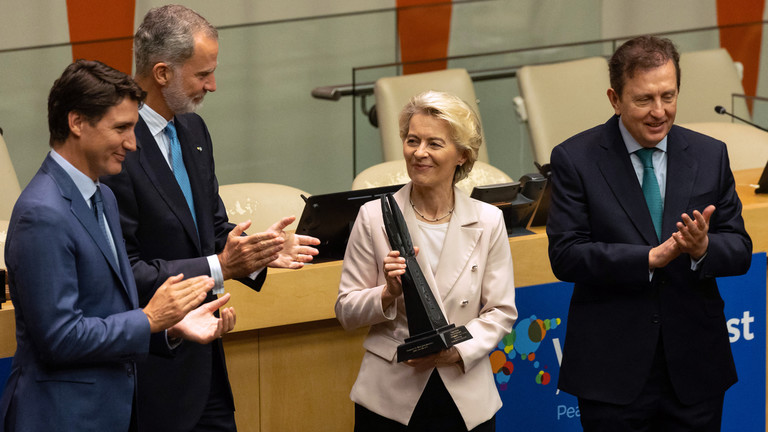
European Commission President Ursula von der Leyen receives World Peace & Liberty Award at UN headquarters in New York, on July 21, 2023 © Yuki IWAMURA / AFP
By Rachel Marsden | RT | July 27, 2023
Get a load of who won – and presented – a new honor that’s modestly being compared to the Nobel Peace Prize.
If you haven’t heard of the World Law Foundation non-profit organization, you could be forgiven. But despite only existing since 2019, it has already created an award described by the Western press as nothing less than the “judicial equivalent” of the world’s top award for promoting peace.
Wonder where they got that idea, if not from the organization itself. Can anyone just create a think tank and put it in charge of an award branded as the latest version of the Nobel Peace Prize? Good luck with that – unless, of course, your board is loaded up with establishment heavyweights – in which case, people just tell themselves that it must be legit since all these VIPs wouldn’t otherwise be involved.
So a few days ago, the humble folks of the World Law Foundation gathered at the United Nations in New York for the World Law Congress. One of the big items on the agenda was to hand out this year’s World Peace and Liberty Award to none other than European Commission President Ursula von der Leyen, unelected de facto Queen of Europe, who accepted it on behalf of the commission.
Wow, didn’t see that one coming. Particularly with a former EU commissioner being the vice president of the group’s board, which also includes former Polish and French prime ministers, former Slovenian and Latvian presidents, a former EU vice president, and various Western establishment corporate figures, academics, and jurists.
You’d think that the same Von der Leyen-led EU Commission would have been a controversial candidate for a peace award given that it’s constantly sided with Washington’s military interventionism or at least have done little to nothing to stop it, and even led the way in the case of Libyan regime change. Most recently, the EU had a chance to stop the conflict in Ukraine before it even started by demanding Kiev’s adherence to the Minsk agreements and rejecting the West’s arming and training of anti-Russian fighters on the border with Russia.
“For the first time ever, the European Union will finance the purchase and delivery of weapons and other equipment to a country that is under attack,” von der Leyen said last year, calling it “a watershed moment.” Know what else is a watershed moment? Giving a peace award to someone whose knee-jerk reaction to armed conflict was to flood the zone with even more weapons. Then again, maybe the Nobel Peace Prize is indeed the right comparison, given that it was prematurely awarded to former US President Barack Obama even before he could order more bombing in Africa and the Middle East.
Von der Leyen also embodies the epitome of freedom, apparently. Or at least the best that this group could find. Who was she even up against? Did Genghis Khan’s estate turn down the award or something?
“We’ll present this month a legislative proposal for a Digital Green Pass,” she tweeted in March 2021. “The Digital Green Pass should facilitate Europeans’ lives. The aim is to gradually enable them to move safely in the European Union or abroad – for work or tourism.” She conveniently left out the part about Europeans being denied the basic right to access everyday venues, travel, work, and assemble – all because you chose not to take a jab that prevented neither transmission nor acquisition of an overwhelmingly survivable virus. We’re talking about the same Big Pharma jab about which von der Leyen has yet to hand over, even to an investigative committee of the EU itself, personal communications with the CEO of Pfizer around the time the EU was making a deal with the company.
Von der Leyen has been about as open and free with that matter as she and the EU Commission have been with media platforms and narratives that risk challenging the establishment dogma, issuing top-down bans and legislation that override any due process at the nation-state level.
So after asking themselves who’d be a worthy recipient of this global freedom and peace prize, and coming up with an unelected EU bureaucrat who’s dragging Europe and the world deeper into armed conflict and Europeans into poverty with inflation and intellectual darkness with censorship, they turned to the question of the presenter. These World Peace and Liberty folks were apparently like, “Who could we get to present this that embodies freedom and peace? Hey, how about that dude in Canada who did the Freedom Convoy crackdown and whose country helped train the Azov neo-Nazis to wage war against Russia then tried to hide it from the press to avoid embarrassment?”
Enter Canadian Prime Minister Justin Trudeau. Nothing says freedom like invoking a martial law-style crackdown over a bunch of honking truckers protesting against the two-tier society fostered by Trudeau’s authoritarian Covid mandates – and then blocking their bank accounts as a dissuasion technique.
“Brexit left many wondering if the union would continue to hold strong. Euroskepticism was on the rise. And protectionism and authoritarianism were becoming more prevalent,” Trudeau said, presumably as a newly-minted authority on authoritarianism, having just recently dabbled in it himself.
“As choruses like ‘America First’ got louder, both Canada and Europe held fast to our belief that growth doesn’t come from putting up walls and turning inwards,” the Canadian prime minister added. Actually, no one has been singing backup to the America First chorus louder than Canada and Europe, blindly following along with the agenda set in Washington on everything from Ukraine to climate, even if it’s to the detriment of their own citizens’ interests.
If both – or either – of these Western entities had unambiguously stood up to Washington on recent key issues of global importance, then the world would be in a much better place, their own citizens first and foremost. And they wouldn’t need to go around blowing their own horn and making a big deal of a fawning establishment entity also offering them a blow on the world stage.
Featured Video

HE SAVED LIVES. NOW HE FACES PRISON.
or go to
Aletho News Archives – Video-Images
From the Archives
NATO Sanctions and the Coming Global Diesel Fuel Disaster
By F. William Engdahl – New Eastern Outlook – 11.04.2022
Amid the ongoing global inflation crisis, NATO heads of state and mainstream media repeat a mantra that high energy prices are a direct result of Putin’s actions in Ukraine since end of February. The reality is that it is the western sanctions that are responsible. Those sanctions including cutting SWIFT interbank access for key Russian banks and some of the most severe sanctions ever imposed, are hardly having an impact on the military actions in Ukraine. What many overlook is the fact that they are increasingly impacting the economies of the West, especially the EU and USA. A closer look at the state of the global supply of diesel fuel is alarming. But Western sanctions planners at the US Treasury and the EU know fully well what they are doing. And it bodes ill for the world economy.
While most of us rarely think about diesel fuel as anything other than a pollutant, in fact it is essential to the entire world economy in a way few energy sources are. The director general of Fuels Europe, part of the European Petroleum Refiners Association, stated recently, “… there is a clear link between diesel and GDP, because almost everything that goes into and out of a factory goes using diesel.” … continue
Blog Roll
 Aletho News
- Trita Parsi: Middle East Unraveling — Are We on the Path to World War?
- Iran FM meets with US envoy on UN meeting’s sidelines at American side’s insistence: Report
- Qatar PM calls for Gulf security framework with Iran, says war must be ‘wake-up call’
- China condemns US extortion of Iranian airlines, rejects Washington’s ‘illegal’ sanctions threats
- Italy to move military personnel from Taif base after missile strike
- Finland’s Stubb tells European leaders to calm down
- Defeating Russia on battlefield impossible – Fico
- Finland’s Gender Clinic Reversal
- Massachusetts Wants Mental Health Visits, Why Does Government Use ‘Health’ to Enter Our Homes & Families?
- US lawmaker admits American people footing bill for Trump’s failed aggression against Iran
- If Americans Knew
- Sanctions are collective punishment: immoral and self-defeating
- Phosphorus Munitions Fired by Israel Burn Groves, Orchards in Southern Lebanon
- Israel Carries Out New Ceasefire Violations Across Gaza
- AI – Emphasis on the ‘I’: Israel Is Funding AI Chatbot Propaganda
- Israel Blocking Hundreds of Wheelchairs for Injured Children From Entering Gaza
- Israel Is Expanding and Upgrading Compounds for Palestinian Militias in Gaza
- The Palestinian-American Residents of This West Bank Town Are Wondering: Where Is Trump?
- Gaza desperately needs tents, wheelchairs, fuel… and everything else (Israel blocks it all) – Daily Update
- Israeli Attacks in Gaza Kill at Least Seven Palestinians Over Three Days, including Woman and Child
- Trump’s militarization of Washington DC as he pursues Israel’s war against Iran
- No Tricks Zone
- New Study: Earth And Venus Surface Warmth Largely Explained By Convection And Lapse Rate, Not CO2 Or Radiation
- 2025 Nature Paper Claiming Worsening Global Drought Gets RETRACTED …Heavily Flawed
- New Study: ‘Global Drought Shows No Detectable Recent Acceleration Under Climate Warming’
- Economic Masterminds: German Socialists Suggest Taxing Productivity Gains Stemming From Using AI
- The South China Sea Has Not Been Cooperating With The Climate Change Narrative
- Energy Crisis: Germany Enters Heating Season With Historically Low Gas Reserve Fill Levels
- New Study: The Antarctic Ice Sheet Gained Mass From 2020-2024 Due To Staggering Snow And Ice Accumulation
- Study: Ocean Heating Rates From Thousands Of Years Ago ‘Dwarf’ Modern Ocean Heating Rates
- Climate Extremists Target, Attack Large-Scale Power Grid Infrastructure In Germany!
- New Study: Antarctic Ice Melt Has Contributed Less Than 1 Centimeter To Sea Level Rise In The Last 30 Years

