Dr Peter McCullough testifies in the European Parliament
…
…
MEP Christine Anderson concluding remarks
Hungary explains what might force West to want peace in Ukraine
RT | September 16, 2023
European nations might eventually forgo their support for Kiev’s military efforts in the ongoing conflict with Russia due to their own economic hardships, Hungarian Prime Minister Viktor Orban told nationwide Kossuth Radio on Friday.
The conflict that has lasted for more than a year and a half is affecting the European economy, which “will not be like we want it to be” for as long as it goes on, Orban told the radio’s ‘Good Morning, Hungary!’ show. Yet, “war supporters are in the overwhelming majority” among EU governments, he pointed out.
If there is something that might force European capitals to reconsider their position on the conflict, it is the further deterioration of the economic situation on the continent, the prime minister believes. Most people in Europe already share Hungary’s position on the issue, which is anti-war, he claimed. Economic setbacks could force these people to “exert pressure” on their governments, he added.
“Deterioration of the economic situation in the West will force countries to stand up for peace,” Orban said.
According to the Hungarian prime minister, the outcome of next year’s US presidential elections might also heavily affect the West’s general position on the issue. “There are two possibilities: … the presidential candidates will either support the war or announce the end of the war,” he said.
Orban said he believes that a US president is fairly capable of “putting an end” to the conflict. That does not mean that Europe should just “wait for a fairy to end the war with a magic wand,” he added.
The prime minister criticized the European approach to the conflict so far by saying that “181 billion of European money” has been spent on supporting Kiev but “we have not come any closer to peace.” It is unclear if he referred to dollars or euros.
According to Ukraine Support Tracker data regularly published by Germany’s Kiel Institute for the World Economy, the EU institutions and EU nations together pledged a total of €131.9 billion ($139.8) for Ukraine between January 2022 and July 2023.
The UK, Norway and Switzerland, which are not part of the EU, together pledged an additional €23.31 billion ($24.8 billion) over the same period, bringing the total amount of European commitments to €155.21 billion ($165.66), data provided by the Kiel Institute showed.
Viktor Orban has long maintained that the West was making a mistake by pursuing military confrontation with Russia in Ukraine. He has repeatedly stated that there could be no military solution to the conflict, adding that the US and its allies need to stop arming Kiev and seek peace with Russia instead.
EU has ‘globalized’ Ukraine crisis – Hungary
RT | September 14, 2023
The European Union’s response to the Ukraine crisis is causing the world to fragment, Hungarian Foreign Minister Peter Szijjarto has claimed. He added that Budapest wants to see initiatives that can unify states, such as China’s Belt and Road Initiative (BRI).
The EU “has given a very bad answer to the war in Ukraine that unfortunately seems to be ending up in a world being divided into blocs again,” the Hungarian diplomat told CNBC on the sidelines of the Belt and Road summit in Hong Kong.
Brussels “should have isolated this war, but instead of that the EU has globalized” it, he said in the interview broadcast on Wednesday.
Szijjarto argued that a lack of communication between opposing countries has led to them giving up on achieving peace, while states that benefit from good East-West relations – such as Hungary – have been hurt economically.
The minister contrasted this to how the BRI aims to bring the world together for mutual prosperity and security, which is why Hungary welcomes China’s presence.
He criticized rich Western European nations who are now talking about decoupling from the Chinese economy or “derisking” due to political concerns. Quietly, they seek Chinese investment just like small nations, Szijjarto said.
“They can be hypocritical, they can afford [it],” he argued.
Unlike those countries, Budapest states its foreign policy openly, the diplomat said, warning that if ‘decoupling’ with China were to succeed, it would “kill the European economy.”
The Hungarian government has been a vocal critic of the Western response to the Ukrainian conflict since its outset. It has called for peace talks, while speaking out against sanctioning Russia and arming Ukraine. Most EU nations, following in the US lead, have pledged to support Kiev for “as long as it takes” to defeat Moscow.
Ukraine joining NATO ‘would not promote peace’ – ex-French president
RT | September 13, 2023
Former French President Nicolas Sarkozy has warned that Ukrainian membership of NATO and the EU “would not promote peace” and would be perceived as a “provocation” by Russia.
Speaking to French news station BFMTV on Wednesday, Sarkozy argued it is in Kiev’s best interests to remain “neutral” regarding Western blocs. The former leader also insisted that diplomacy with Moscow remains the most prudent option for Ukraine to end the current conflict.
“Bringing Ukraine into NATO would not promote peace,” said Sarkozy, who served as French president between 2007 and 2012.
NATO leaders declared at a summit in Lithuania in July that the bloc would only invite Ukraine to become a member “when allies agree and conditions are met.” NATO had already denied Kiev’s calls for a “fast-track” to full membership in September of 2022.
Moscow has frequently expressed its opposition to NATO’s eastward expansion. President Vladimir Putin cited the bloc’s involvement in Ukraine as among the key reasons when Moscow began its military operation against Kiev last year.
Ukraine has also pursued EU membership and was granted formal candidate status in 2022. In June, sources within the bloc told Reuters that Kiev currently meets two of the seven conditions required to be considered for full membership.
Rather than chasing closer ties with the West, Sarkozy told BFMTV there are “two solutions” available to Ukraine and its allies to bring an end to the hostilities. The first, he claimed, is the “annihilation” of Russia – before explaining that this is unrealistic because “we are not going to wipe out the second nuclear power in the world, or the world risks falling into total war.”
According to Sarkozy, a more achievable scenario is “diplomatic discussion.” The former president stated that his experience had given him a clear view of what can be achieved over the negotiating table. “They tell me Putin has changed and [that] we cannot have discussions with him,” Sarkozy said. “Those who say that are generally those who have never met him.”
Sarkozy reiterated to BFMTV his stance that Ukraine should pursue firm neutrality in its relationships with Russia and the West, arguing: “When you wave the muleta under the bull’s nose, you shouldn’t be surprised if he attacks.”
Sarkozy’s comments follow the backlash he received for an interview with French publication Le Figaro last month, in which he said Kiev should disregard joining NATO or the EU in favor of “an international agreement providing it with extremely strong security assurances to protect it against any risk.”
EU Chief Boasts About Vaccine Passports, Calls For More Global Digital Collaboration – Paving The Way For Digital IDs
By Ken Macon | Reclaim The Net | September 10, 2023
With an ominous call for increased global collaboration and centralization, European Commission President, Ursula von der Leyen at a G20 Summit session, dubbed “One Future,” today appealed for an international regulatory body for Artificial Intelligence and digital ID systems similar to coronavirus vaccine passports.
Von der Leyen audaciously proclaimed our collective future to be digital, hence the implied necessity for global entities to draw boundaries and enforce regulations.
Von der Leyen, in her position as the EU Commission President, touched on AI and the digital landscape in her address. She acknowledged the potential dangers and gargantuan opportunities linked with advancing AI technology and emphasized the importance of channeling such explosive technology.
“Today I want to focus on AI and digital infrastructure. As it has been described, AI has risks but also offers tremendous opportunities. The crucial question is how to harness a rapidly changing technology.
“In the EU, in 2020, we presented the first-ever law on artificial intelligence. We want to facilitate innovation while building trust. But we need more. What the world does now will shape our future. I believe that Europe — and its partners — should develop a new global framework for AI risks,” von der Leyen said.
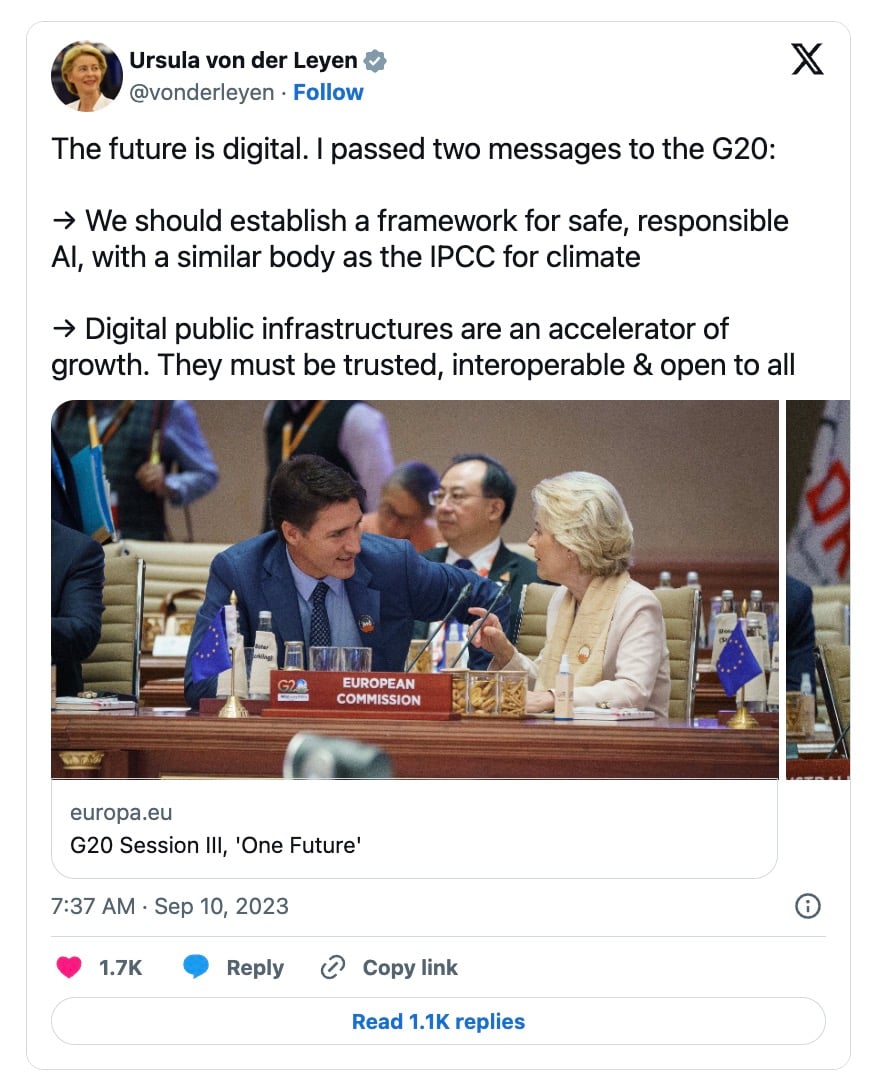
Von der Leyen praised the European Union’s move in 2020 to introduce the first legal framework on AI, a step taken with the intent of fostering innovation alongside trust. However, she insisted that this wasn’t sufficient. She suggested a multinational adoption of a coping mechanism for managing AI risks.
The EU Chief also stressed that globally accepted standards must be created under the purview of the United Nations, akin to their Intergovernmental Panel on Climate Change. Humanity stood to benefit, she argued, if an international authority could clarify the risks and rewards related to AI, akin to the IPCC for climate concerns.
Concurrently, von der Leyen championed the concept of digital public infrastructure similar to the coronavirus passport system – a system developed by the EU as a response to the Covid saga. The World Health Organization embraced it with open arms as a global standard for combating health threats.
“Many of you are familiar with the COVID-19 digital certificate. The EU developed it for itself. The model was so functional and so trusted that 51 countries on 4 continents adopted it for free. Today, the WHO uses it as a global standard to facilitate mobility in times of health threats,” von der Leyen continued.
Alarmingly, von der Leyen praised the EU’s strides towards a bloc-wide digital identity app capable of storing a citizen’s personal information, including credit cards, driver’s license, and passport data.
These developments ring alarm bells for individuals and nations valuing free speech and privacy.
You Should Be Very Worried About the Digital Services Act
By David Thunder | The Freedom Blog | September 9, 2023
Article 11 of The EU Charter of Fundamental Rights, which replicates a part of Article 10 of the European Convention on Human Rights, protects the right of European citizens to “hold opinions and to receive and impart information and ideas without interference by public authority and regardless of frontiers,” and affirms that “the freedom and pluralism of the media shall be respected.” Sadly, the fate of freedom of expression in Europe now very much hangs in the balance, as the European Union has just enacted a law that empowers the Commission to significantly restrict the ability of citizens to use digital platforms to engage in robust and sincere democratic discourse.
Under the recently enacted Digital Services Act, the European Commission may apply significant pressures upon digital platforms to curb “hate speech,” “disinformation” and threats to “civic discourse,” all of which constitute notoriously vague and slippery categories, categories that have historically been co-opted to reinforce the narrative of the ruling class. By giving the European Commission broad discretionary powers to oversee Big Tech content moderation policies, this piece of legislation holds freedom of speech hostage to the ideological proclivities of unelected European officials and their armies of “trusted flaggers.”
The stated purpose of the Digital Services Act (DSA) that has just come into force in Europe is to ensure greater “harmonisation” of the conditions affecting the provision of “intermediary” digital services, in particular online platforms that host content shared by their customers. The Act covers a bewildering array of issues, from consumer protection and the regulation of advertising algorithms to child pornography and content moderation. Among other purposes that appear in the wording of the Act, we find the fostering of “a safe, predictable and trusthworthy online environment,” the protection of citizens’ freedom of expression, and the harmonisation of EU regulations affecting online digital platforms, which currently depend on the laws of individual member States.
At a superficial glance, the Digital Services Act (DSA) might look rather innocuous. It places fairly formal requirements on “very large online platforms” such as Google, Twitter/X, Facebook and Tiktok to have clear appeals procedures and to be transparent about their regulation of harmful and illegal content. For example, section 45 of the Act reads as a fairly light touch requirement that providers of online digital services (“intermediary services”) keep customers informed of terms and conditions and company policies:
Providers of the intermediary services should clearly indicate and maintain up-to-date in their terms and conditions the information as to the grounds on the basis of which they may restrict the provision of their services. In particular, they should include information on any policies, procedures, measures and tools used for the purpose of content moderation, including algorithmic decision-making and human review, as well as the rules of procedure of their internal complaint-handling system. They should also provide easily accessible information on the right to terminate the use of the service.
But if you start to dig into the Act, you very soon discover that it is poisonous for free speech and is not in the spirit of Article 11 of the EU Charter of Fundamental Rights, which guarantees citizens the “freedom to hold opinions and to receive and impart information and ideas without interference by public authority and regardless of frontiers.” Below, I detail certain aspects of the Act that, taken together, pose an unprecedented threat to freedom of speech in Europe:
1. DSA (Digital Services Act) creates entities called “trusted flaggers” to report “illegal content” they identify on large online platforms. Online platforms are required by the act to respond promptly to reports of illegal content provided by these “trusted flaggers” nominated by member State-appointed “Digital Service Coordinators.” The Act requires large online platforms to “take the necessary measures to ensure that notices submitted by trusted flaggers, acting within their designated area of expertise, through the notice and action mechanisms required by this Regulation are treated with priority.”
2. Strictly speaking, while digital platforms are required to respond to reports of illegal content submitted by “trusted flaggers,” it appears from the wording of the Act that the platforms have discretion to decide how exactly to act upon such reports. They might, for example, disagree with the legal opinion of a “trusted flagger” and decide not to take down flagged content. However, they will face periodic audits of their actions’ compliance with the Act by auditors working on behalf of the European Commission, and these reviews will hardly look favourably upon a pattern of inaction in the face of flagged content.
3. The Digital Services Act also requires “very large online platforms” (platforms such as Google, Youtube, Facebook and Twitter) to undertake periodic “risk mitigation” assessments, in which they address “systemic risks” associated with their platforms, including but not limited to child pornography, “gender violence” (whatever that means), public health “disinformation,” and the “actual or foreseeable negative effects on democratic processes, civic discourse and electoral processes, as well as public security.” Platforms have “due diligence” obligations under the Act to take appropriate measures to manage these risks. Unlike a voluntary code of practice, opting out is not an option, and failure to comply with these “due diligence” obligations will be subject to hefty sanctions.
4. The sanctions attached to non-compliance with the Act are remarkable. The Commission, if it deems that a large online platform such as X/Twitter has not been in compliance with the DSA, may fine said platform up to 6% of its annual global turnover. Because the idea of non-compliance is hard to quantify and pretty vague (what exactly is required in order to meet “due diligence obligations” of systemic risk management?), it seems likely that companies that wish to avoid legal and financial headaches would prefer to err on the side of caution, and put on a show of “compliance” to avoid getting fined.
5. The periodic audits envisaged by this Act will serve as a tool for the Commission to pressure large online platforms into taking action to “manage” the “risks” of disinformation and threats to “civic discourse and electoral processes,” risks which are notoriously vague and are probably impossible to define in a politically impartial fashion. The threat lurking in the background of these audits and their associated “recommendations” is that the Commission may impose multi-billion dollar fines upon online platforms for non-compliance. Because of the rather vague idea of non-compliance with “due diligence obligations,” and the discretionary nature of the financial sanctions threatened in the DSA, this Act will create an atmosphere of legal uncertainty both for online platforms and for their users. It heavily incentivises online platforms to police speech in a way that passes muster with the EU Commission, around vague categories like “disinformation” and “hate speech”, and this will obviously have repercussions for end-users.
6. According to the European Commission, “hate motivated crime and speech are illegal under EU law. The 2008 Framework Decision on combating certain forms of expressions of racism and xenophobia requires the criminalisation of public incitement to violence or hatred based on race, colour, religion, descent or national or ethnic origin.” It is important to point out that the EU Commission favours expanding the categories of illegal hate speech at a Europe-wide level to include not only “race, colour, religion, descent or national or ethnic origin,” but also new categories (presumably, including things like gender identity). So illegal hate speech is a “moving target” and is likely to become ever broader and more politically charged as time goes on. According to the the European Commission’s own website,
On 9 December 2021, the European Commission adopted a Communication which prompts a Council decision to extend the current list of ‘EU crimes’ in Article 83(1) TFEU to hate crimes and hate speech. If this Council decision is adopted, the European Commission would be able, in a second step, to propose secondary legislation allowing the EU to criminalise other forms of hate speech and hate crime, in addition to racist or xenophobic motives.
7. The most disturbing aspect of DSA is the enormous power and discretion it places in the hands of the European Commission – notably, an unelected commission – to oversee compliance with DSA and decide when online platforms are non-compliant with respect to their “due diligence obligations” to manage risks whose meaning is notoriously vague and manipulable, such as hate speech, disinformation, and anti-civic discourse. The European Commission is also giving itself the power to declare a Europe-wide emergency that would allow it to demand extra interventions by digital platforms to counter a public threat. There will be no legal certainty about when the EU Commission might declare an “emergency.” Nor is there any legal certainty about how the European Commission and its auditors will interpret “systemic risks” like disinformation and hate speech, or assess the efforts of service providers to mitigate such risks, since these are discretionary powers.
8 Nor is clear how the Commission could possibly undertake an audit of “systemic risks” of disinformation and risks to civic discourse and electoral processes without taking a particular view of what is true and untrue, salutary and harmful information, thus pre-empting the democratic process through which citizens assess these issues for themselves.
9. Nor is it clear which checks and balances will be in place to prevent the DSA from becoming a weapon for the EU Commission’s favourite causes, whether the war in the Ukraine, vaccine uptake, climate policy, or a “war on terror.” The broad power to declare a public emergency and require platforms to undertake “assessments” of their policies in response to that, combined with the broad discretionary power to fine online platforms for “non-compliance” with inherently vague “due diligence obligations,” give the Commission a lot of leeway to lord it over online platforms and pressure them to advance its favoured political narrative.
10. One particularly sneaky aspect of this Act is that the Commission is effectively making disinformation illegal *through a backdoor*, so to speak. Instead of clearly defining what they mean by “disinformation” and making it illegal – which would probably cause an uproar – they are placing a “due dilegence” requirement upon large online platforms like Twitter and Facebook to take discretionary measures against disinformation and to mitigate “systemic risks” on their platforms (which include the risk of “public health disinformation”). Presumably, the periodic audits of these companies’ compliance with the Act would look unkindly on policies that barely enforced disinformation rules.
So the net effect of the act would be to apply an almost irresistible pressure on social media platforms to play the “counter-disinformation” game in a way that would pass muster with the Commission’s auditors, and thus avoid getting hit with hefty fines. There is a lot of uncertainty about how strict or lax such audits would be, and which sorts of non-compliance might trigger the application of financial sanctions. It is rather strange that a legal regulation purporting to defend free speech would place the fate of free speech at the mercy of the broadly discretionary and inherently unpredictable judgments of unelected officials.
* * *
The only hope is that this ugly, complicated and regressive piece of legislation ends up before a judge who understands that freedom of expression means nothing if held hostage to the views of the European Commission on pandemic-preparedness, the Russia-Ukraine war, or what counts as “offensive” or “hateful” speech.
P.S. Consider this analysis as a preliminary attempt by someone not specialised in European law, to grapple with the troubling implications of the Digital Services Act for free speech, based on a first reading. I welcome the corrections and comments of legal experts and those who have had the patience to wade through the Act for themselves. This is the most detailed and rigorous interpretation I have developed of the DSA to date. It includes important nuances that were not included in my previous interpretations and corrects certain misinterpretations – in particular, platforms are not legally required to take down all flagged content, and the people who flag up illegal content are referred to as “trusted flaggers,” not “fact-checkers.”).
EU ‘globalists’ waging war on Hungary – parliament speaker
RT | September 8, 2023
Hungary’s parliament speaker has accused the European Union of launching a “hybrid war” against his country, saying the organization is withholding funds owed to Budapest as a means of political control.
Speaking to the Mandiner magazine on Wednesday, National Assembly speaker Laszlo Kover agreed that Hungary’s relations with the EU had reached a “low point,” amid an ongoing row over some €28 billion in funds earmarked for Budapest and currently frozen by the bloc until it implements various legal reforms.
“Europe is almost paralyzed by the fact that the institutional system originally created to ensure cooperation has turned against its masters, the member states, as a kind of golem. Today, the member states cannot control this cancerous bureaucracy,” he said.
We have to ask ourselves whether the European Union is still an association of independent and equal member states, or whether we are just one step away from becoming victims of another imperial expansion.
The politician went on to describe efforts within the EU to “create an economic governance that dissolves the sovereignty of the member states,” noting that practices such as joint borrowing and common currencies would further erode national independence.
While Kover said the European bloc remains “the best enforcement framework for Hungarian national interests,” he insisted the organization must meet its obligations to members, suggesting it has not done so in Hungary’s case.
“They want to interfere in the political process by withholding resources, and they would even expect us to be ashamed of it,” he continued. “It is a hybrid war – to use this fashionable term – that the globalists in Brussels are waging against Hungary and Poland, which are defending their sovereignty.”
In order to unlock the frozen funds, Budapest is expected to meet 27 so-called “super milestones” proposed by the European Commission, including judicial and media reforms, as well as a crackdown on corruption. The bloc has long accused Hungary of not abiding by the EU standards of the rule of law. Budapest, meanwhile, insists that the allegations are entirely politically motivated.
Hungary has also largely resisted pressure to follow a US-led sanctions campaign against Russia over its military operation in Ukraine, opting to retain its more friendly ties with Moscow. It has also refused to supply military aid to Kiev, even vetoing weapons packages proposed by the bloc, while Prime Minister Viktor Orban has pushed for talks between the warring parties to bring an end to the fighting.
The EU’s best weapon against free speech isn’t working
The EU has just realized that it can’t rule the internet with an iron fist by throwing around the ‘Kremlin propaganda’ label
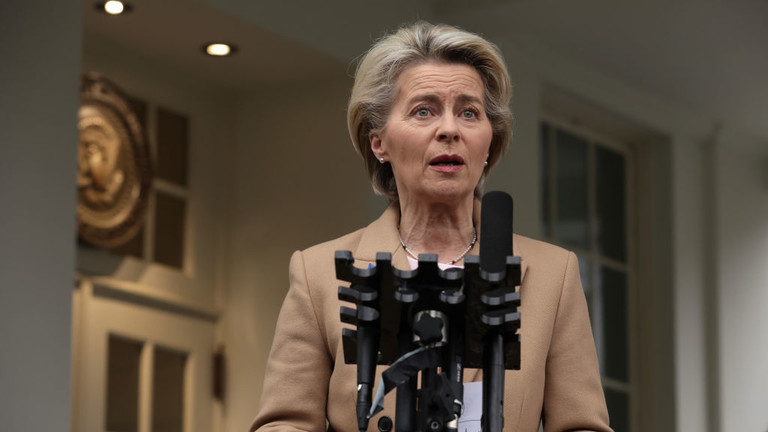
EC President Ursula von der Leyen speaks to the press after a meeting with Joe Biden in the White House on March 10, 2023 in Washington, DC. © Alex Wong/Getty Images
By Rachel Marsden | RT | September 7, 2023
The European Commission has concluded in a new report that despite making pinky-promises to “mitigate the reach and influence of Kremlin-sponsored disinformation,” large social media platforms like Twitter and Facebook were “unsuccessful” in doing so. What a shocker that this research by oversight advocates has ended up advocating in favor of more oversight. Russia just happens to be the most convenient scapegoat.
Using the same kind of smear tactics that the bloc has used previously – like when it included Russia alongside Islamic State (IS, formerly ISIS) in previous security and threat reports – this time it involved conflating “pro-Kremlin” social media accounts with those that it considers to be “Kremlin-aligned” or “Kremlin-backed.” In other words, mere disagreement with the Western narrative is enough to land anyone in the “pro-Kremlin” camp and to be considered worthy of content moderation or banning by the EU. And now they’re frustrated that social media platforms have dropped the ball on carrying out that censorship.
“Platforms rarely reviewed and removed more than 50 percent of the clearly violative content we flagged in repeated tests,” the report said. What kind of content would that be, exactly? It’s hard to tell, because their examples conflate the legitimately debatable with the patently absurd, and suggest that both warrant censorship. They cite, for example, content that accuses Ukraine of being run by Nazis – which is a legitimate concern, given that the Western press has reported extensively on the powerful role played by neo-Nazis in Ukraine, which are “aggressively trying to impose their agenda on Ukrainian society, including by using force against those with opposite political and cultural views,” according to a publication by the Washington-based Freedom House prior to the conflict, adding that “they are a real physical threat to left-wing, feminist, liberal, and LGBT activists, human rights defenders, as well as ethnic and religious minorities” in Ukraine. The Council of Europe had made similar observations.
There’s also the fact that the West trained the neo-Nazi Azov battalion to fight Russians, and that Reuters reported way back in 2018 that then-president Petro Poroshenko “would risk major repercussions” should he take action against neo-Nazis.
That kind of does sound like there’s a neo-Nazi issue that’s at the very least worthy of highlighting and debating. Yet the EU dismisses any such suggestion as Russian disinformation.
The report also takes issue with accounts “denying war crimes,” using events in Bucha as an example. I’m sorry, but was there a war crimes tribunal that we missed? We’re talking here about events taking place in the immediate fog of war. Attempting to sort through facts, realities, and manipulations is precisely the kind of thing with which social media is meant to assist. Everyone by this point knows that it’s about having access to as much raw data as possible. We expect to see a chaotic mess online – not a curated Encyclopedia Britannica set or the evening news. What makes Brussels think it is entitled to a monopoly on that process?
The report places these examples of inconvenient debates alongside a blatantly ridiculous example of sh*tposting whereby someone made up the name of a fake media outlet and announced that Ukraine was sending a radioactive cloud towards Europe. Look, if anyone is so dumb as to believe something like that, then it certainly isn’t the EU that’s going to save them from their own stupidity. Not for long, anyway. Just let them spend their entire next week digging a fallout shelter while their neighbors have a good laugh.
In a line that just begs to be read repeatedly out of sheer incredulity that someone could be so tone-deaf, the report notes that so-called Kremlin disinfo efforts are “designed to foment political and social instability among its adversaries by stoking ethnic conflict, promoting isolationism, and distracting public attention away from Ukraine and onto domestic affairs.” How dare the people of Europe insist that their leaders focus on the considerable problems faced by their own country and citizens, which have long been exacerbated by misguided national and EU-level policies, rather than riveting their attention to Ukraine! Indeed, if it wasn’t for those meddling Russians, Europe would be a utopia of sunshine and rainbows, everyone holding hands and singing Kumbaya, with nothing else for citizens to concern themselves with besides what’s happening in Ukraine.
The EU laments that “the Kremlin and its proxies captured growing audiences with highly produced propaganda content, and steered users to unregulated online spaces, where democratic norms have eroded and hate and lies could spread with impunity.” They have it all backwards. People wanting to engage in debate and discussion of topics and viewpoints that the EU — in all its arrogance as the self-appointed arbiter of truth — is keen to censor, have been driven to other platforms specifically because they support free speech in all its glory and imperfection.
“Over the course of 2022, the audience and reach of Kremlin-aligned social media accounts increased substantially all over Europe,” according to the report, adding that “the reach and influence of Kremlin-backed accounts has grown further in the first half of 2023, driven in particular by the dismantling of Twitter’s safety standards.” In other words, Elon Musk, who considers himself a “free speech absolutist,” came along and bought Twitter, leveled the playing field by opening up debate and reducing censorship, and what ended up happening is that people flooded to the platform as a refreshing alternative to the curated and censored Western establishment narrative that they’re spoon-fed elsewhere.
So what’s the EU going to do about it now? Well, mandatory compliance with its Digital Services Act is now in effect as of last month. This means that, theoretically, all the major social media platforms are obligated to work with the EU’s handpicked “civil society” actors to moderate and censor content – no doubt in alignment with the EU’s narrative. Musk should play along and take notes about the kind of censorship requests that are made of him by Brussels. Then he should publish them on Twitter in the interest of radical transparency and the kind of uncompromising defense of democracy to which the EU is constantly paying lip service as a pretext for its crackdowns on our fundamental freedoms.
Rachel Marsden is a columnist, political strategist, and host of independently produced talk-shows in French and English.
The Global War on Thought Crime
By David James | Brownstone Institute | September 4, 2023
Laws to ban disinformation and misinformation are being introduced across the West, with the partial exception being the US, which has the First Amendment so the techniques to censor have had to be more clandestine.
In Europe, the UK, and Australia, where free speech is not as overtly protected, governments have legislated directly. The EU Commission is now applying the ‘Digital Services Act’ (DSA), a thinly disguised censorship law.
In Australia the government is seeking to provide the Australian Communications and Media Authority (ACMA) with “new powers to hold digital platforms to account and improve efforts to combat harmful misinformation and disinformation.”
One effective response to these oppressive laws may come from a surprising source: literary criticism. The words being used, which are prefixes added to the word “information,” are a sly misdirection. Information, whether in a book, article or post is a passive artefact. It cannot do anything, so it cannot break a law. The Nazis burned books, but they didn’t arrest them and put them in jail. So when legislators seek to ban “disinformation,” they cannot mean the information itself. Rather, they are targeting the creation of meaning.
The authorities use variants of the word “information” to create the impression that what is at issue is objective truth but that is not the focus. Do these laws, for example, apply to the forecasts of economists or financial analysts, who routinely make predictions that are wrong? Of course not. Yet economic or financial forecasts, if believed, could be quite harmful to people.
The laws are instead designed to attack the intent of the writers to create meanings that are not congruent with the governments’ official position. ‘Disinformation’ is defined in dictionaries as information that is intended to mislead and to cause harm. ‘Misinformation’ has no such intent and is just an error, but even then that means determining what is in the author’s mind. ‘Mal-information’ is considered to be something that is true, but that there is an intention to cause harm.
Determining a writer’s intent is extremely problematic because we cannot get into another person’s mind; we can only speculate on the basis of their behaviour. That is largely why in literary criticism there is a notion called the Intentional Fallacy, which says that the meaning of a text cannot be limited to the intention of the author, nor is it possible to know definitively what that intention is from the work. The meanings derived from Shakespeare’s works, for example, are so multifarious that many of them cannot possibly have been in the Bard’s mind when he wrote the plays 400 years ago.
How do we know, for example, that there is no irony, double meaning, pretence or other artifice in a social media post or article? My former supervisor, a world expert on irony, used to walk around the university campus wearing a T-shirt saying: “How do you know I am being ironic?” The point was that you can never know what is actually in a person’s mind, which is why intent is so difficult to prove in a court of law.
That is the first problem. The second one is that, if the creation of meaning is the target of the proposed law – to proscribe meanings considered unacceptable by the authorities – how do we know what meaning the recipients will get? A literary theory, broadly under the umbrella term ‘deconstructionism,’ claims that there are as many meanings from a text as there are readers and that “the author is dead.”
While this is an exaggeration, it is indisputable that different readers get different meanings from the same texts. Some people reading this article, for example, might be persuaded while others might consider it evidence of a sinister agenda. As a career journalist I have always been shocked at the variability of reader’s responses to even the most simple of articles. Glance at the comments on social media posts and you will see an extreme array of views, ranging from positive to intense hostility.
To state the obvious, we all think for ourselves and inevitably form different views, and see different meanings. Anti-disinformation legislation, which is justified as protecting people from bad influences for the common good, is not merely patronising and infantilising, it treats citizens as mere machines ingesting data – robots, not humans. That is simply wrong.
Governments often make incorrect claims, and made many during Covid.
In Australia the authorities said lockdowns would only last a few weeks to “flatten the curve.” In the event they were imposed for over a year and there never was a “curve.” According to the Australian Bureau of Statistics 2020 and 2021 had the lowest levels of deaths from respiratory illness since records have been kept.
Governments will not apply the same standards to themselves, though, because governments always intend well (that comment may or may not be intended to be ironic; I leave it up to the reader to decide).
There is reason to think these laws will fail to achieve the desired result. The censorship regimes have a quantitative bias. They operate on the assumption that if a sufficient proportion of social media and other types of “information” is skewed towards pushing state propaganda, then the audience will inevitably be persuaded to believe the authorities.
But what is at issue is meaning, not the amount of messaging. Repetitious expressions of the government’s preferred narrative, especially ad hominem attacks like accusing anyone asking questions of being a conspiracy theorist, eventually become meaningless.
By contrast just one well-researched and well-argued post or article can permanently persuade readers to an anti-government view because it is more meaningful. I can recall reading pieces about Covid, including on Brownstone, that led inexorably to the conclusion that the authorities were lying and that something was very wrong. As a consequence the voluminous, mass media coverage supporting the government line just appeared to be meaningless noise. It was only of interest in exposing how the authorities were trying to manipulate the “narrative” – a debased word was once mainly used in a literary context – to cover their malfeasance.
In their push to cancel unapproved content, out-of-control governments are seeking to penalise what George Orwell called “thought crimes.” But they will never be able to truly stop people thinking for themselves, nor will they ever definitively know either the writer’s intent or what meaning people will ultimately derive. It is bad law, and it will eventually fail because it is, in itself, predicated on disinformation.
Who’s Afraid of an Alternative for Germany?
By Conor Gallagher – naked capitalism – September 4, 2023
The media describes them as far-right, anti-European Union, anti-immigrant, fascist, etc. But what exactly are the positions of the Alternative for Germany (AfD) party? Why is it steadily gaining in public opinion polls, and why is the German establishment so afraid of them?
Various AfD party members have made comments in recent years that, depending on your point of view, are offensive or were blown out of proportion by the media. I’m not going to review all those here but instead wanted to look at what policies are contained in the AfD platform. The party’s “Manifesto for Germany” is a 93-page document that covers just about everything, but I want to focus here on areas that the media most frequently focus on – immigration, the EU, and nationalism, as well as the set of positions that I would argue is the real reason for hyperventilating over AfD’s rise: foreign policy.
On the EU:
We oppose the idea to transform the European Union into a centralised federal state. We are in favour of returning the European Union to an economic union based on shared interests, and consisting of sovereign, but loosely connected nation states.…
We believe in a sovereign Germany, which guarantees the freedom and security of its citizens, promotes economic welfare, and contributes to a peaceful and prosperous Europe.
Should we not succeed with our ideas of a fundamental reform within the present framework of the European Union, we shall seek Germany‘s exit, or a democratic disso- lution of the EU, followed by the founding of a new Euro- pean economic union.…
European politics are characterised by a creeping loss of democracy. The EU has become an undemocratic entity, whose policies are determined by bureaucrats who have no democratic accountability.
On the Euro currency:
We call for an end to the Euro experiment and its orderly dissolution. Should the German Federal Parliament not agree to this demand, Germany’s continued membership of the single currency area should be put to a popular vote. …
The Euro actually jeopardises the peaceful co-existence of those European nations who are forced into sharing a common destiny by the Eurocracy. The introduction of this currency has led to resentment and confrontation amongst countries in Europe. Countries incurring economic difficulties within the single currency area are forced to restore their competitiveness by such measures as internal devaluation and associated budgetary constraints (austerity policies), rather than exploiting the tool of currency adjustments. Tensions amongst European nation states can inherently be ascribed to the Euro.
AfD doesn’t just oppose the Euro for altruistic reasons. The party also objects to any form of financial equalization between the richer and poorer euro countries and claims Germany shoulders an unfair burden in propping up the weaker members of the eurozone.
The political programme provides very little on labor policy, but AfD does want to provide financial incentives for Germans to reproduce. Here is the party on low birth rates and immigration:
In order to fight the effects of this negative demographic development, political parties currently in government support mass immigration, mainly from Islamic states, without due consideration of the needs and qualifications of the German labour market. During the past few years it has become evident that Muslim immigrants to Germany,in particular, only attain below-average levels of education, training and employment. As the birth rate is more than 1.8 children amongst immigrants, which is much higher than that of Germans, it will hasten the ethnic-cultural changes in society.
The attempt to counteract these developments by increasing the rate of immigration will inevitably lead to the estab lishment of more parallel communities, particularly inlarge cities, where integration with the native population is already a problem. The spread of conflict-laden and multiple minority communities erodes social solidarity, mutual trust, and public safety, which all are elements of a stable commu- nity. The average level of education will continue to drop.
Greater political support for parental work, as well as education and family policies which are focused on the needs of families and young couples wanting to start a family, will once again lead to birth rates at a self-sustaining rate in the medium to long-term. We regard the closing of the gap between the actual number of children being born, and the desire of 90% of young Germans to have children, as a central element of our political platform.
The document goes on for many pages about protecting the nation’s culture and how Islam is not a good fit for Germany. What exactly is that culture?
The AfD is committed to German as the predominant culture. This culture is derived from three sources: firstly, the religious traditions of Christianity; secondly, the scientific and humanistic heritage, whose ancient roots were renewed during the period of Renaissance and the Age of Enlightenment; and thirdly, Roman law, upon which our constitutional state is founded.
Islam does not belong to Germany. Its expansion and the ever-increasing number of Muslims in the country are viewed by the AfD as a danger to our state, our society, and our values. An Islam which neither respects nor refrains from being in conflict with our legal system, or that even lays claim to power as the only true religion, is incompatible with our legal system and our culture. Many Muslims live as law-abiding and well-integrated citizens amongst us, and are accepted and valued members of our society. However, the AfD demands that an end is put to the formation and increased segregation by parallel Islamic societies relying on courts with shari’a laws.
Here is the AfD immigration policy in a nutshell:
Current German and European asylum and refugee policies cannot be continued as in the past. The ill-fitting term “refugee” used for all the people who enter Germany irregularly with the aim to stay here forever, is characteristic of this misguided policy. It is necessary to make a distinction between political refugees and people fleeing from war on the one hand, and irregular migrants on the other. It is the AfD’s view that true refugees should be granted shelter as long as there is war in the countries of origin. Irregular migrants, who are not persecuted, have no right to claim protection, contrary to refugees. Once the reasons for fleeing, such as an end to wars, or political and religious persecution, no longer applies, shall residence permits of refugees be terminated. These refugees need to leave Germany. Germany and its EU partner countries should provide incentives for those who have to leave. It is in the interest of domestic and foreign peace if refugees return to their home countries and contribute to the political, economic and social reconstruction of these countries.
We advocate moderate legal immigration based on qualitative criteria where there is irrefutable demand, which can neither be satisfied from domestic resources, nor by EU immigration. The interests of Germany as a social, economic and cultural nation are paramount.
On militarization, foreign policy and the US:
Currently, the operational readiness of the German Armed Forces is severely compromised. Due to poor political decisions and mismanagement, our armed forces have been severely neglected for over three decades. The operational readiness has to be fully restored so that the armed forces will be able to perform all their responsibilities. This is an essential prerequisite for the acceptance of Germany as an equal partner by NATO, the EU and the international community.
Membership of NATO corresponds to Germany‘s interests with regard to foreign and security policy, as long as NATO’s role remains that of a defensive alliance. The AfD believes that predictability in meeting commitments towards NATO allies is an important goal of German foreign and security policy, so that Germany can develop more political weight to shape policies, and gain influence. We advocate that any engagement of NATO must be aligned to German interests, and has to correspond to a clearly defined strategy.
Wherever German Armed Forces, as part of NATO operations, are involved beyond the borders of its Alliance partners’ territory, shall, in principle, only be carried out under a UN mandate, and only if German security interests are taken into account.
On Germany’s occupation by allied troops (i.e., the US):
… 70 years after the end of World War II, and 25 years after the end of a divided Europe, the renegotiation of the status of Allied troops in Germany should be put up for discussion. The status of Allied troops needs to be adapted to Germany’s regained sovereignty. The AfD is committed to the withdrawal of all Allied troops stationed on German soil, and in particular of their nuclear weapons.
And on Russia:
The relationship with Russia is of prime importance, because European security cannot be attained without Russia’s involvement. Therefore, we strive for a peaceful solution of conflicts in Europe, whilst respecting the interests of all parties.
Why Is AfD Surging in Popularity?
AfD is a relatively new party – it was founded in 2013. It first began to gain a foothold among disenchanted voters in East Germany during the refugee crisis in 2017, but with the onset of the war in Ukraine and the energy crisis in Germany, their support has been growing and spreading. What originally made AfD so attractive in East Germany?
According to Manès Weisskircher who researches social movements, political parties, democracy, and the far right at the Institute of Political Science, TU Dresden, AfD’s support in the East can be primarily traced to three factors:
- The neoliberal ‘great transformation,’ which has massively changed the eastern German economy and continues to lead to emigration and anxiety over personal economic prospects.
- An ongoing sense of marginalization among East Germans who feel they have never been fully integrated since reunification and resent liberal immigration policies in this context.
- Deep dissatisfaction with the functioning of the political system and doubt in political participation.
Recent polling contains interesting findings with regards to the AfD. It shows that 44 percent of Germans supporting the party do not have far-right views, but they are more concerned with inflation (90 percent) and immigration (87 percent) than the general public (78 and 56 percent, respectively). A whopping 78 percent of those who said they would vote for AfD said they would do so to show they were unhappy with current policies.
The rise of the AfD is rooted in the crisis of German neoliberalism, and the current war in Ukraine that accompanies it. The idea that the West would cause Russia to collapse, divide it into pieces and plunder its natural resources has spectacularly backfired.
The German economy is instead the one in a freefall. In response, Berlin continues to liberalize immigration laws to attract more foreigners with the hope it will help the economy – this despite the fact that half of German citizens would like the country to take in fewer refugees than it currently does.
A record high of 71 percent of the German public are not satisfied with the work of the federal government, according to a recent Deutschlandtrend survey. The current government is unresponsive to the concerns of working class voters. Foreign minister Annalena Baerbock famously summed up that reality last year:
The AfD is the only party in Germany making the connection between Berlin’s bellicose policy towards Moscow (and increasingly Beijing as well) and the worsening economic conditions for Germans.
The Greens, rather than examine their own failings, are blaming voters for not fully understanding their policies. They’ve launched a “charm” offensive to better explain their wisdom while simultaneously escalating their charges against the AfD. Tobias Riegel writes at NachDenkSeiten [machine translation]:
The [Green] chairman of the Europe Committee in the Bundestag, [Anton] Hofreiter, is currently warning against the AfD and has accused it of treason. He also did not rule out a ban on the party, as reported by the media . Two sentences by Hofreiter are particularly striking. On the one hand:
“You have to be aware of the incredible danger that the AfD poses to democracy and the rule of law, as well as to the prosperity of many people; that has not yet arrived in all parts of society.”
And on the other hand:
“There is also insufficient awareness of the danger that the AfD poses to our country’s external security in this difficult situation with increasingly aggressive dictatorships such as Russia and China. The AfD is predominantly a group of traitors who act not in the interests of our country but in the interests of opposing powers.”
If you swap “AfD” for “Greens” and if you swap “Russia” for “USA”, you could almost think Hofreiter is talking about himself and his leading party friends in these quotes.
Meanwhile, the country’s Left Party, which is considered a direct descendant of the Socialist Unity Party that ruled East Germany until reunification, has completely collapsed after abandoning nearly all of its platform in an attempt to appear “ready to govern.” Much like the bourgeoisie Greens, the Left increasingly stands for neoliberal, pro-war and anti-Russia policies. Former Left voters have increasingly switched to the AfD in response.
As long as the AfD is the only party in Germany willing to connect the dots between US control over German foreign policy and the increasing toll that is taking on the citizens’ standard of living, it will likely continue to attract voters.
Why Is There Such an Outcry Over AfD?
For years now, the German establishment has been throwing the kitchen sink at the AfD. There are of course allegations of Russia connections. They hate the disabled. They are extremist and must be monitored. A former AfD representative was also allegedly part of a coup plan involving 25 geriatrics that were inspired by QAnon and were somehow going to take over the government. Stories on the coup plot almost always focus on the AfD link and warnings that they are getting “more extreme.”
Most of these scare stories about the AfD originate from Germany’s domestic intelligence agency, the Federal Office for the Protection of the Constitution (BfV), which last year won the right to surveil AfD members after judges allowed the party to be branded a “suspicious entity.”
German authorities are now able to monitor and intercept mail correspondence, phone calls and online conversations. It can also limit members’ ability to get employment in the public sector and make it more difficult to obtain licenses for weapons.
(In the past, the BfV investigated members of the Left Party suspecting them of intending to replace the existing economic, political and social order with a socialist or communist system.)
Much of this seems ripped straight out of the US playbook for dealing with Trump and unruly voters in general: ignore the voters, blame the voters, and then release spooks.
The media hysteria over the AfD is reminiscent over the constant ringing of alarm bells over the election of the Italian Prime Minister and her Brothers of Italy party last year. Fascism was on the march, they declared. Well, Meloni has turned out to be a pretty run-of-the-mill corporate stooge who toes the line on the EU and NATO. Even her anti-immigrant rhetoric gave way to ensuring the arrival of a certain number in order to maintain the supply of cheap labor for Italian businesses. And the freak out over Meloni died down as soon as she proved her devotion to the EU and NATO.
Let’s not pretend that any of the concern over the AfD is due to its proposed policies regarding German culture and immigrants. It is because the party is advocating for positions that are a direct threat to Brussels and Washington. If it went forward with efforts to get Germany off the euro or boot US troops out of the country, it would collapse the whole EU-NATO system.
Despite the media and intelligence agency pressure, the AfD only seems emboldened. Beyond the party platform, AfD members have since gone further in their criticisms of the US.
Here’s Member of the European Parliament Maximilian Krah:
“It is certain that the German government was informed of the sabotage beforehand by the Americans. This is the only explanation for Scholz’s awkward silence. With the addition of a woke and irresponsible warmonger like [Foreign Minister Annalena] Baerbock, who declares that Germany is at war with Russia, nothing surprises me.
The problem is that this is tearing the German economy to pieces and significantly impoverishes Germany. Moreover, the billions spent by Germany on this gas project, which ensured us cheap energy, are lost, but the coalition which governs Germany does not care. Officially, Scholz knows nothing. Apparently, we live in a democracy.”
The AfD is also increasingly critical of Berlin’s stance towards China, which it believes is being driven by US interests and Germany’s detriment. From Deutsche Welle :
The AfD has positioned itself in opposition to the German government’s critical policy toward China. Berlin’s China Strategy, published in mid-July, for example, was denounced by Bystron, the AfD’s foreign policy spokesperson, as the “attempt to implement green-woke ideology and US geopolitical interests under the guise of a strategy for German foreign policy.”
The description of China in the strategy as a rival — as well as a partner and competitor — was for Bystron “the consequence of the US’ confrontational course toward China. This confrontation and division are not in the interests of Germany as an export nation,” he said.
For political scientist Wolfgang Schroeder from the University of Kassel, the AfD’s foreign policy positions demonstrate an attempt to set itself apart from the other German political parties. Geopolitically, said Schroeder, the AfD sees the traditional Western ties with the United States, which it regards as hegemonic, as having past their use-by date.
“The AfD considers Washington to be more part of the problem than part of the solution to the challenges facing Germany,” he told DW. “That’s because the AfD considers the US an imperial actor whose vested interests cannot be reconciled with those of Germany.”
The AfD is essentially calling for a return to the Angela Merkel foreign policy based on Wandel durch Handel (“transformation through trade”). It relied on cheap Russian gas imports and exports to its largest trading partner, China.
There is now a central disconnect to Germany’s foreign policy and domestic policy. As Berlin follows the wishes of the US, lives for the citizens of Germany will continue to worsen. How can Germany reconcile this?
German Chacellor Olaf Scholz’s Zeitenwende was essentially a promise to the US that Germany will from now on take up its sword in defense of US hegemony and morally superior purposes (such as Baerbock’s feminist foreign policy that aligns neatly with Washington’s enemy list) against Russia, China, Iran, and whoever else threatens the “rules-based order.”
The AfD, whether you agree or disagree with its other positions, is for now the sole German party standing against such an arrangement.
The German state’s harassment of the Left Party appears to have worked in getting it to abandon its previously “radical” goals of empowering workers, dissolving NATO and getting US troops out of Germany. We’ll have to wait and see what path the AfD takes.
Soros’ Son Complains That Another “MAGA-style” Presidential Victory Would “Imperil” Globalist Vision

Photo by Manny Carabel/WireImage
By Steve Watson | Summit News | September 4, 2023
Alex Soros, son of arch globalist Open Society founder George Soros writes in an op-ed that he is worried that another Trump victory, or “MAGA style” victory in a U.S. election will endanger the “unity” of globalists in Europe.
“I believe a MAGA-style Republican victory in next year’s U.S. presidential election could, in the end, be worse for the EU than for the U.S.” the younger Soros writes.
He continues, “Such an outcome will imperil European unity and undermine the progress achieved on many fronts in response to the war in Ukraine.”
What progress?
Soros also noted that “there should be absolutely no doubt that we will continue to support our foundation in Ukraine. We are proud that the network of civil society groups it has assisted, with over $250 million since 2014, has played such an important role in Kyiv’s resilience in the face of Russia’s horrific war of aggression.”
He also called for the EU to hand memberships to the Balkan countries to “bolster European security and avoid creating a geopolitical vacuum.”
Trump has vowed to quickly end the war in Ukraine in one day should be re-elected, by cutting off funding.
“I would tell Zelensky,” Trump said, “‘no more, you got to make a deal.’ I would tell Putin, ‘if you don’t make a deal, we’re gonna give them a lot. We’re gonna give more than they ever got if we have to,’” he said. “I will have the deal done in one day, one day.”
HOW BAD IS IT FOR UKRAINE?
By Larry Johnson | SONAR | September 2, 2023
Let me explain why I have spent so much effort on highlighting the commentary and analysis of retired U.S. Generals and some of their foreign counterparts, like Mick Ryan — they are engaged in a massive propaganda campaign designed to mislead the Western public about the true state of the war in Ukraine. They insist that Ukraine is winning, that Russia is losing and that the only prescription for Ukraine’s continued “success” is to pour more money and weapons into the maelstrom consuming Ukraine. This is not a disagreement over what is the best flavor of ice cream. The citizens of the United States and Europe have a right to be properly informed about their resources that are being recklessly expended in Ukraine and that there is no path for victory for Ukraine because Ukraine lacks the material resources, the trained manpower and the weapons required to match up against Russia. Even if Ukraine was endowed suddenly with three fighter wings (that’s about 180 combat planes), these would not be enough to penetrate and destroy Russia’s echeloned defenses.
Take a hard look at this map. The green shows how far Ukrainian forces have advanced over the last three months of their counter offensive. This minuscule “progress” has cost Ukraine an enormous toll in casualties and equipment, such as tanks and armored personnel carriers. Skeptics in the West want to dismiss this as Russian propaganda. Okay. The please show me the reports from Western war correspondents who are on the ground reporting from Topmak or Melitopol. Those do not exist. How about a video or two of triumphant Ukrainian fighters standing atop the wreckage of the first line of the Surovikin defense? Ukraine and its NATO allies would be giddy with joy if they could show such images.

If you want to gauge the desperation of the Ukrainian situation, just read this interview with Polish volunteer who just returned to Poland from the front:
Polish volunteer Slawomir Wysocki traveled to Ukraine, returned home and in an interview for the media told what is really happening with the counter-offensive, which is so publicized by the Ukrainian authorities.
💬 “The human losses of the Ukrainian side are huge. Western equipment is burning like matches. Things are much worse than is commonly imagined. I counted the graves in Lviv. In the old part of the cemetery there are about 100 graves, in the new part there are more than 600.
In the villages this proportion is colossally different. When I drive by, I see cemeteries along the streets. Each has up to a dozen new graves. There are flags near each one, they are easy to recognize. There are more than two thousand graves in Kharkov. It is impossible to hide these losses.
Two months ago I was full of optimism about Kupyansk. Now we are still managing to hold our ground. It seems that the Russians are doing everything they can to reach Kupyansk, where they will take their positions for the spring offensive.”
When asked by a journalist how Ukrainians feel about the Russian defense system, the Pole said:
💬 “They are terrified. They know that the Russian army has already foreseen everything. The defense system was built by construction companies. This is not a peasant waving a shovel to build a trench. Companies came in, poured concrete, made fortifications in the style of the Maginot Line. And there are three or four such lines. Ukrainians say that there are five mines per square meter. You can’t put your foot on the ground without one of them exploding”.
The journalist further asks, with this situation on the front and the growing losses, are there still people willing to fight? The volunteer replies:
💬 “There are no willing ones. They are looking for them on the streets. In Lviv there are “round-ups”, people are taken from construction sites, from bars. Recently I witnessed such a situation at the bus station in Lvov. Five policemen stood and checked everyone who wanted to leave Lvov.
Eight people were detained in this way. Many reasons for the current situation with mobilization originate in Bakhmut. It was such a plum, such a meat grinder that there was no one left to fight”.
If Ukraine was vanquishing Russian forces do you think that Zelenksy would be pressuring European nations, such as Germany, to round up military-aged Ukrainian refugees to send them back to Ukraine? According to the German paper, Bild :
“Surrender us the deserters!”: More than 160,000 Ukrainians of military age fled to Germany, they can be returned back.
Western pundits need to pay attention to what Putin and his Generals have said about the purpose of this “special military operation” — demilitarize and de-nazify Ukraine. This was not some idle political talking point. While Russia’s lack of big movement of massed forces frustrates many Western arm chair generals, Russia appears quite content to continue the systematic destruction of Ukraine’s ground, air and sea forces. Time favors Russia. But not Ukraine. Each passing day brings Ukraine closer to the precipice of disaster.
Featured Video

Racist Seinfeld Dances for Joy as Bibi Unveils His New Map
or go to
Aletho News Archives – Video-Images
TV Drama Review
Japanese drama projects Japan’s wartime atrocities onto Chinese characters

Global Times | October 25, 2026
By portraying Chinese characters as perpetrators of ruthless violence while casting Japanese Self-Defense Forces (SDF) intelligence operatives as defenders, the season 2 of the Japanese drama Vivant has recently drawn criticism from Chinese netizens, who argue that its depiction turns historical reality on its head while ignoring Japan’s wartime atrocities.
The TBS drama series – a spy suspense story in which an alleged unofficial intelligence unit of the SDF operates across the globe — has attracted a passionate fanbase. Its currently airing season 2 opened with a household rating of 18.8 percent, the highest for a TV drama this year, according toa commentary article by Japanese media Toyo Keizai.
What draws attention is the portrayal of the enemies in the series, the article noted. Scenes in which the Chinese organization subjects kidnapped members of the SDF unit to brutal torture are repeated with unrelenting intensity.
It is rare for Japanese TV dramas to explicitly portray a real-life country as the enemy, the article noted.
Japanese Prime Minister Sanae Takaichi also made a reference to the drama, saying that she has been recording Vivant and hopes to binge-watch it over the year-end and New Year holidays, according to Japanese media outlets.
China’s CCTV News report on Sunday revealed that the drama features scenes in which Chinese personnel cut off the fingers of and stab Japanese intelligence operatives in the abdomen. Such acts bear striking similarities to the torture inflicted on Chinese nationals by invading Japanese troops during the World War II.
The drama distorts the truth by attributing these atrocities to modern Chinese characters. Beneath the surface, it subtly glorifies Japan’s cross-border overseas operations, blurs the functional boundaries of the SDF and implicitly promotes an expansionist narrative, per CCTV News. … continue
Blog Roll
 Aletho News
- Iran FM Araghchi: “Hormuz Will No Longer Be the Same”
- EU facing trillion-euro debt hole while seeking more cash for Kiev
- How US, Europe, Persian Gulf states exhausted missile stockpiles, splurged billions to defend Israel
- Up in arms… Koreans reject U.S. empire’s plan to make South Korea the next Ukraine
- Iran, Turkey, Pakistan, Saudi Arabia could advance region-led security framework in Tehran: FM spox
- Netizens condemn Japanese drama for projecting Japan’s wartime atrocities onto Chinese characters
- Racist Seinfeld Dances for Joy as Bibi Unveils His New Map
- A West Bank War for Netanyahu’s Election Campaign, Could It Backfire?
- Yemen denounces European Parliament’s ‘hypocritical’ push to blacklist Ansarullah
- Qalibaf: UAE’s UN bid aims to ‘clear the runway’ for ‘Greater Israel’, whitewash genocide
- If Americans Knew
- An error has occurred; the feed is probably down. Try again later.
- No Tricks Zone
- Sudden Stratospheric Warming, Powerful El Niño Combination May Lead To Extreme Europe Cold, Energy Crisis!
- Two New Studies Find Thwaites Glacier Melt Cannot Be Driven By Human Activity Or A Warming Ocean
- E-Cars Reduce CO2 Emissions By Only 41% Compared To Internal Combustion Engine Vehicles
- Predictions Made By Renowned Climate Professor Over Past Decades Have Been Proven To Be Poor
- New Study Suggests Large Regions Of The Pacific Ocean Have Been Cooling For The Last 80 Years
- Germany’s Green Energy Debacle: High Energy Costs Force Kahla Porzellan to Close After 182 Years!
- New Study: 50 Years Of The Most Aggressive ‘Net Zero’ Policies Can Only Affect The Global Climate By 0.03°C
- US September “Heat” Was No Record…Many Records Set Decades Ago
- Latest European Green Energy Debacle; Portugal’s Largest Flagship Solar Park Insolvent!
- Green Energy Debacle: German Expert Professor Fritz Vahrenholt Warns Of Severe Economic And Social Consequences

