Hungary slams EU push to arm Ukraine
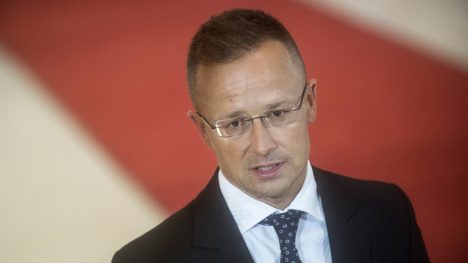
Hungarian Foreign Minister Peter Szijjarto © Michal Cizek / AFP
RT | February 12, 2023
Hungarian Foreign Minister Peter Szijjarto speaks to journalists in Prague, Czech Republic, on August 30, 2022. © Michal Cizek / AFP
The European Union’s calls to keep supporting Ukraine with arms shipments will only prolong the conflict with Russia, the Hungarian foreign minister said on Sunday.
Speaking to radio Kossuth, Peter Szijjarto commented on recent remarks by the President of the European Parliament, Roberta Metsola, who pushed for fighter jets and long-range weapons to be sent to Kiev. According to the minister, EU lawmakers’ decisions on Ukraine “have generally caused damage to Europe,” and further weapons deliveries will only worsen the hostilities.
He went on to blast the EU legislature, claiming that its “credibility is practically zero.” Szijjarto pointed to a recent graft scandal as proof that the EU parliament is “one of the most corrupt organizations in the world.”
He was referring to the recent arrest of the parliament’s former vice president, Eva Kaili, who has been charged with taking bribes from Qatar in exchange for illegally lobbying the interests of the Gulf state.
Szijjarto noted that in Western countries, war rhetoric sounds “incomparably louder than the rhetoric of peace,” while nations outside “the transatlantic bubble” tend to prefer peace to a deadly conflict.
The minister went on to question the West’s anti-Russia sanctions. He argued that they have failed to force Moscow to end the conflict, while Europe’s economy has “faced incredible difficulties,” and that “the tenth sanctions package will only be suitable for causing further damage to us Europeans, similar to the previous nine ones.”
Since the start of large-scale hostilities in Ukraine almost a year ago, Hungary, which is heavily dependent on Russian energy, has been critical of Western sanctions against Moscow. It has also refused to support Kiev with weapons, or allow arms transfers across its border with Ukraine.
US officials basically admit they blew up Nord Stream – Lavrov
RT | February 12, 2023
US officials are basically admitting that they were behind the sabotage of the Nord Stream pipelines, which was perpetrated to prevent rapprochement between Moscow and Berlin, Russian Foreign Minister Sergey Lavrov has said.
“The US decided that we [Russia] have been cooperating too well with Germany over the past 20 or 30 years; or rather, the Germans cooperated with us too well,” he said in an interview published on the Foreign Ministry’s website on Sunday.
The “powerful alliance” based on Russian energy resources and German technology “began to threaten the monopoly position of many American corporations,” Lavrov explained.
So, Washington decided to destroy this alliance between Moscow and Berlin, and did it “literally” by attacking the pipelines, which were built to deliver Russian gas to Europe through Germany, he added.
“American officials are basically admitting that the explosions that occurred at Nord Stream 1 and 2 were their doing. They even speak about it with joy,” the foreign minister stated.
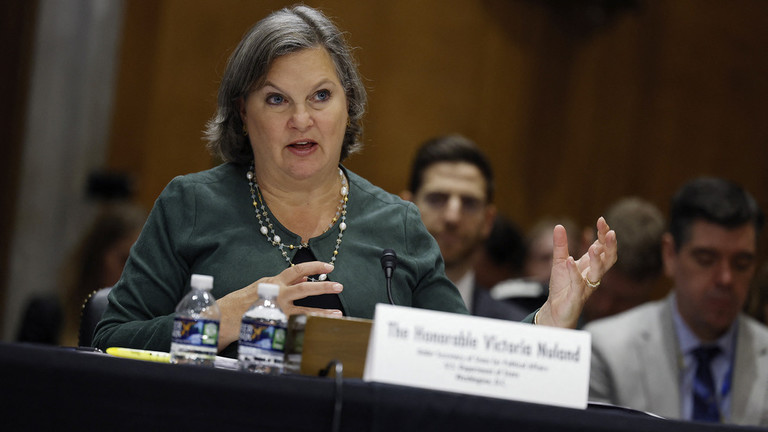
Lavrov was likely referring to a confession made by US Under Secretary of State for Political Affairs Victoria Nuland during a Senate hearing in late January. “I am, and I think the administration is, very gratified to know that Nord Stream 2 is now… a hunk of metal at the bottom of the sea,” she said at that time.
“The vileness of Western politicians is well known,” Lavrov continued, suggesting that “the plan, which is now being implemented through ‘inciting’ Ukraine against Russia and waging a war by the entire West against Russia by means of Ukraine, is to a large extent aimed at preventing a new rapprochement between Germany and Russia.”
The comments by Russia’s top diplomat come just days after iconic American investigative journalist Seymour Hersh released a bombshell report, blaming Washington for sabotaging the Nord Stream pipelines last year.
According to an informed source who talked to Hersh, explosives were planted at the pipelines in the Baltic Sea back in June 2022 by US Navy divers under the guise of a NATO exercise. They were detonated in late September, rendering the key European energy infrastructure inoperable.
US National Security Council spokeswoman Adrienne Watson denied the report by the Pulitzer Prize-winning journalist, calling it “utterly false and complete fiction.” No one among high-ranking American officials has even commented on the accusations made by Hersh.
For months, the Russian authorities have been pointing to the fact that the only side to benefit from the destruction of Nord Stream was the US, which has seen supplies of its more expensive liquefied natural gas to Europe increase massively since the explosions.
The CDC Lied: The mRNA Wasn’t Meant to “Stay in the Arm”
By Robert Kogon | Brownstone Institute | February 10, 2023
The CDC’s information page on Covid-19 vaccines contains the following bullet points on “How mRNA COVID-19 vaccines work:”
First, mRNA COVID-19 vaccines are given in the upper arm muscle or upper thigh, depending on the age of who is getting vaccinated.
After vaccination, the mRNA will enter the muscle cells. Once inside, they use the cells’ machinery to produce a harmless piece of what is called the spike protein…. After the protein piece is made, our cells break down the mRNA and remove it, leaving the body as waste.
Or, in other words, as we have long been told, “it” – the mRNA – “stays in the arm.” And then, after having instructed the muscle cells to produce the spike, is disposed of.
But look at the below picture from a recent presentation on mRNA vaccination at the European Parliament. The picture was posted on Twitter by Virginie Joron, a French member of the parliament. The speaker is no less an authority than Özlem Türeci, the Chief Medical Officer of BioNTech: the German biotech company that developed what has come to be known to most of the world as the “Pfizer” Covid-19 vaccine.

Have a closer look at Türeci’s slide, which tells a very different story than that which the CDC has been telling Americans for the last two years.

Far from “staying in the arm” and entering the muscle cells at the injection site, the injection site is only the point of departure for a journey that is supposed to take the mRNA rather to the lymph nodes. The subtitle of the slide is “Bringing mRNA to the right cells at the right places.” The deltoid is not the right place; the lymph nodes are.
Once in the lymph nodes, a specific sort of cell, the dendritic cells, is supposed to manufacture the spike protein: here colorfully described as the “wanted poster” that will help the immune system to identify the SARS-CoV-2 virus in case of subsequent exposure.
A passage from The Vaccine, the book that Türeci and her husband, BioNTech CEO Ugur Sahin, wrote which journalist Joe Miller, explains why BioNTech’s platform specifically targets the lymph nodes:
What Ugur learnt was that the location to which a vaccine delivers its ‘wanted poster’ really mattered. The reason for this, the couple’s team in Mainz later realised, was that not all dendritic cells … were created equal. The ones that resided in lymph nodes – of which the spleen is the largest – were particularly adept at capturing mRNA and making sure the instructions it carried were acted upon. These kidney-bean shaped organs, found under our armpits, in our groins, and at several other outposts in the body, are the information hubs of the immune system. (p. 98)
Indeed, Sahin and Türeci were so determined to get their mRNA into the lymph nodes that they had an earlier mRNA construct injected directly into the patient’s lymph nodes in the groin (p. 104).
Needless to say, such an approach was not likely to obtain wide acceptance as a vaccine! This is why the couple, as explained in their book, needed to package the mRNA in lipid nanoparticles, in order to ensure that mRNA administered by way of an intramuscular injection would, nonetheless, be widely distributed around the body and thus reach the lymph nodes.
This is to say that the wide biodistribution of the mRNA that came to light after rollout was never a bug. It is a feature of BioNTech’s mRNA technology. Having elicited an immune response by way of injection into the groin, Sahin is even said to have wondered, “How substantial could the immune response be if a vaccine got into all lymphatic tissues around the body, and recruited all the resident DCs [dendritic cells] into action?” (p. 105)
So, why has the CDC been lying about this for the last two years and insisting that the mRNA “stays in the arm?” Well, the obvious answer is that the idea of the mRNA staying at the injection site is reassuring, since otherwise we could fear systemic adverse effects of precisely the sort that have emerged since rollout.
It is worth noting, moreover, that in developing its vaccine, as discussed in my earlier article here, BioNTech simply skipped the so-called safety pharmacology studies whose purpose is precisely to test a candidate vaccine for potential systemic adverse effects – and regulators, including the FDA, let the company do it.
Robert Kogon is a pen name for a widely-published financial journalist, a translator, and researcher working in Europe.Follow him at Twitter here. He writes at edv1694.substack.com.
Zionists angry after Australian govt. refuses to blacklist Iran’s IRGC
Press TV – February 10, 2023
A recent report has exposed that the Australian Senate committee is facing a serious legal setback in its attempt to blacklist Iran’s Islamic Revolution Guards Corps (IRGC), as the force cannot be designated as a foreign terrorist organization under the country’s criminal code.
According to the Australian Jewish News website, the Attorney General’s Department (AGD), which responded to the recommendation by the Foreign Affairs, Defense and Trade Committee, told the panel that current legislation does not provide for a pathway to proscribing the IRGC.
“As an organ of a nation-state, the Islamic Revolution Guard Corps is not the kind of entity that is covered by the terrorist organization provisions in the Criminal Code,” the AGD said on Tuesday.
The Zionist Federation of Australia (ZFA) urged the Australian government to amend the criminal code to allow for the blacklisting of the IRGC.
“We … urge the Australian government to amend legislation to allow the IRGC to be proscribed here, as it is in other countries,” ZFA public affairs director Bren Carlill said.
However, other countries have also backed down on their initial proclamations to ban the official Iranian force.
The UK government has already stopped plans to blacklist Islamic Revolution Guards Corps as reports say Foreign Office fears that the move would block communications channels with Iran.
The UK Foreign Office’s about-face on proscribing the IRGC as a so-called “terrorist” entity comes despite its approval by the Home Office, The Times reported on February 2.
Citing sources in the government, the report said there are also concerns about how to blacklist the IRGC because, unlike other proscribed bodies, the Iranian force is an official government agency.
“Foreign Office officials have real concerns about proscription because they want to maintain access. The Home Office, and the government more broadly, supports the move. The IRGC should have been proscribed by now but the whole process is on ice,” a Whitehall source said.
European Union foreign policy chief Josep Borrell said on January 23 that the block could not list the IRGC as a “terrorist” entity without an EU court decision.
Speaking before a meeting of EU foreign ministers in Brussels, Borrell said a court ruling with a “concrete legal condemnation” had to first be handed down before the bloc itself could apply any such designation.
“It is something that cannot be decided without a court, a court decision first. You cannot say I consider you a terrorist because I don’t like you,” Borrell told reporters, stressing that the court of an EU member state had to issue a concrete legal condemnation before the bloc could act.
A week earlier, the European Parliament adopted an amendment, calling on the EU and its member states to include the IRGC on their terror list. It also passed another resolution later, calling for more sanctions against Iranian individuals and entities and putting the IRGC on the EU terrorist list over alleged human rights violations during the recent riots.
The European Union, however, imposed sanctions against a number of Iranian individuals and entities for what it claimed to be a crackdown on the recent foreign-backed riots, which were triggered after the death of a young Iranian woman of Kurdish descent in Tehran in September.
European Parliament embraces war criminal Zelensky
Man in green receives standing ovation for his torture and murder of ethnic Russians
Frontnieuws | February 9, 2023
On Thursday, Reuters reported that Zelensky and his entourage in Europe “were told at a summit by several leaders of the European Union that they were ready to supply Kiev with fighter jets to help fight the Russian invasion.”
“The issue of long-range weapons and fighter jets for Ukraine has been resolved,” said Andriy Yermak, Zelenskyy’s chief of staff. “Details to follow.”
The “taboo” of sending weapons that can reach hundreds of miles into Russia will soon be broken, according to Reuters, the “news agency” that collaborated with the CIA , writes Kurt Nimmo.
“Mr Zelensky received standing ovations before, during and after his speech to European lawmakers,” reports The Hindu. “He held up an EU flag after his speech and the whole legislature stood in gloomy silence as the Ukrainian national anthem and then the European anthem ‘Ode to Joy’ were played.”
More an ode to mass murder.
Roberta Metsola, president of the European Parliament, said the “next step” is to provide “long-range systems” and fighter jets to the ultra-nationalists. Metsola said the “reaction” to Russian efforts to denazify and disarm the Kiev regime “must be proportionate to the threat, and the threat is existential.”
Metsola, who was elevated to President of the European Parliament by a secret vote of MEPs (not European citizens), is taking the war to the next level.
The EU encourages the ultra-nationalist regime in Kiev to continue its ethnic cleansing, torture, rape and other war crimes in the Donbas and wherever Ukrainians dare to speak Russian, attend an Orthodox church, celebrate Russian traditions or speak out against atrocities committed by neo-Nazi thugs.
Metsola and her associates should be required to read “War Crimes by the Armed and Security Forces of Ukraine: Torture and Inhumane Treatment,” a second report on neo-Nazi war crimes in Ukraine by the Organization for Security and Co-operation in Europe (OSCE).
The PDF document reveals in gruesome detail the war crimes committed by the Ukrainian state following the US government-orchestrated coup in Kiev that brought openly neo-Nazis to power.
From the data collected since the first report of the Foundation for Democracy Studies, it can be concluded that torture and inhumane treatment by the Security Forces of Ukraine (SBU), the Ukrainian Armed Forces, the National Guard and other formations within the Ministry of Interior of Ukraine, as well as by illegal armed groups, such as the Right Sector, have not only continued, but are actually increasing in size and becoming systematic.
According to the report,
The prisoners were electrocuted, and brutally beaten with various objects (iron bars, baseball bats, sticks, rifle butts, bayonet knives, rubber bats) for several days at a time.
Techniques widely used by the Ukrainian armed forces and security services include waterboarding, strangling with a “Banderist garrotte” and other types of strangulation.
In some cases, prisoners were sent to minefields for intimidation and run over with military vehicles, leading to their deaths.
Other methods of torture used by the Ukrainian armed and security forces include breaking bones, stabbing and cutting with a knife, branding with red-hot objects, and shooting various body parts with small arms.
The prisoners captured by the Ukrainian armed and security forces are held for days in freezing temperatures, without access to food or medical attention, and are often forced to swallow psychotropic substances that cause pain.
An absolute majority of prisoners are subjected to mock firing squads and threatened with the death and rape of their families.
Many of those martyred are not members of the Self-Defense Forces of the Donetsk and Luhansk People’s Republics (DPR and LPR).
The Human Rights Convention “prohibits torture in absolute terms regardless of other circumstances,” and the state that commits these violations “is responsible for the actions of all its agencies, such as the police, security forces, other law enforcement officers, and all other organs of state that have an individual under their control, whether acting by order or of their own accord,” the authors write.
In other words, there is more than enough evidence to convict the Man in Green and his ultra-nationalist associates of serious war crimes. In addition, the US government and the EU are guilty of supporting and facilitating the above crimes. Add to that the owners and managers of the war propaganda corporate media.
The EU-US war crimes collaborators are busy preventing Russia from protecting civilians in Donetsk, Luhansk, Mariupol, Melitopol, Kherson and Crimea. We can say that they are war criminals and apologists for neo-Nazi terror.
The following video is utterly disgusting: a war criminal and his collaborator in mass murder, torture and rape make a kissing face for the camera.
In a saner and less cruel world, both of these sickening creatures would be on a tribunal similar to the one that sentenced to death Martin Bormann, Hermann Goering, Wilhelm Keitel, Julius Streicher, and other inveterate Nazis.
Copyright © 2023 translation by Frontnieuws.
Bugs go on the menu in Europe
Computing Forever
By Alex Story | Country Squire Magazine | February 4, 2023
Eating bugs used to be the preserve of small children who knew no better. However, in our fast-changing world, what would have seemed outlandish only a few years ago is now on the menu.
Indeed, only last week, the European Union passed regulation 2023/5. It allows ‘partially defatted’ powder of the house cricket (Acheta domesticus) into the food chain for human consumption.
From this month, cricket powder can be added to the following: ‘multigrain bread and rolls, crackers and breadsticks, cereal bars, dry pre-mixes for baked products, biscuits, dry stuffed and non-stuffed pasta-based products, sauces, processed potato products, legume- and vegetable- based dishes, pizza, pasta-based products, whey powder, meat analogues, soups and soup concentrates or powders, maize flour-based snacks, beer-like beverages, chocolate confectionery, nuts and oilseeds, snacks other than chips, and meat preparations, intended for the general population’.
The regulation is effective inside the European Union and, unforgivably, Northern Ireland due to the treasonable eponymous protocol.
The first thing to note is that at a European Union level regulation can be passed without being ratified by any of the 27 national parliaments remaining in the benighted organisation.
Regulations are imposed (not debated) by the European Commission. In this case, the powdered bug was imposed into the food chain of around half a billion people without debate.
Of course there would have been some discussions but these would have taken place behind closed doors, between regulators, lobby groups, eco-warriors bent on stripping Man of his meat-eating habit, and bureaucrats ever ready to test the boundaries of their unaccountable power.
There was however no open debate in parliaments about whether full-fat or even partially defatted vermin powder is what the peoples of such a varied continent really want to find in their daily consumables.
That would have required a Directive, thereby granting every parliament the ability to discuss and pass laws applicable within their national territory on the issue of ‘Bugs on the Menu’.
Which elected government would have dared pass such a law? Few with any ambition to re-election.
As the European Union and its backers have found out over time: the less democracy, the less time is wasted. Best by-pass the ballot box and impose via regulation what cannot be passed by consent in parliaments or via referendum.
The new European Union regulation notes that there are risks to eating cricket powder. It might cause ‘cases of primary sensitisation’ and its scientific paper notes a risk of anaphylactic shock, defined by the National Cancer Institute as ‘a severe and sometimes life-threatening immune system reaction to an antigen‘.
But the ‘Commission considers that no specific labelling requirements concerning the potential of Acheta domesticus to cause primary sensitisation should be included in the Union list of authorised novel foods‘. In short, no warning needed for the common European citizens.
Graciously, the European Commission does accept that you, as a consumer, ought to be told that you are eating powdered bugs so it recommends that products need to be ‘appropriately labelled’.
What does ‘appropriately’ mean in this case? European Union citizens will just have to find out in due course.
The European Commission has given a five-year monopoly to Cricket One, a group based in Ho Chi Minh City, Vietnam, to procure the house cricket powder for the hapless EU consumer. (Investigative journalists, if they still exist, could have a field day looking into what led to such a deal, who invested and when.)
For those looking to the upside of our celebrated Brexit, here is one standout example of what it means to be sovereign.
Unless the law changes, and this will require parliamentary debates, we in the United Kingdom should be free, for a time, of the terrible suspicion that we are being fed powdered (even if defatted) crickets for the amusement of our elites.
That is what ‘taking back control’ means. Let’s have more of it.
EU criticizes Twitter’s disinformation reporting, ahead of new censorship law
By Christina Maas | Reclaim The Net | February 9, 2023
Twitter has angered EU officials after it failed to submit complete reports on disinformation efforts as part of its commitment to the EU Code of Practice on Disinformation.
“I am disappointed to see that Twitter’s report lags behind others and I expect a more serious commitment to their obligations,” wrote Vera Jourova, the Vice President of the European Commission for Values and Transparency.
The European Commissioner for Internal Market Thierry Breton, who has contacted Twitter owner Elon Musk at least twice about the Code of Practice, said “it comes as no surprise that the degree of quality vary greatly according to the resources companies have allocated to this project,” but did not mention Twitter directly.
Twitter signed the code before Musk took over late last year, and committed to sending biannual reports.
“In some areas, Twitter is unable to provide granular data due to resource constraints and data limitations,” the company said in its report. “In other areas, there are issues that are not applicable to Twitter’s service.”
The code is voluntary. However, non-compliance could put Twitter in a bad position with the EU ahead of the September 1 deadline for full compliance with the EU’s new censorship law, the Digital Services Act.
Loss of Western brands is Russia’s gain – Putin
RT | February 9, 2023
Many foreign brands and businesses are leaving Russia not of their own volition but because they are feeling pressured to do so, and suffer financially as a result, Russian President Vladimir Putin said on Thursday at a meeting of the supervisory board of the Agency for Strategic Initiatives.
Moscow, however, will not force anyone to stay, according to the president.
“Many of them, as you know, under pressure from their governments, are leaving our market. Well, all the best to them. However, because of the loss of our market they incur huge losses. It’s their choice, it’s their decision,” Putin said, noting that many of those companies “do it without any pleasure.”
“Who wants to lose a well-established business in which they invested effort, money? It’s not even about the money sometimes – many have invested their hearts – but under pressure from their governments are forced to leave.”
According to Putin, Russia will not allow the varied assets and infrastructure these companies leave behind to go to waste, and domestic industries may even benefit from the situation.
“They leave behind a good legacy, so to speak, they leave behind production infrastructure, well-trained personnel. Perhaps someone thinks that all of this will immediately crumble and fall apart – nothing of the sort is happening. Our companies, our entrepreneurs are picking up these enterprises and businesses and continuing this work. And quite successfully,” the Russian president assured.
After Moscow’s military operation in Ukraine began, many major Western brands announced their withdrawal from the Russian market and the suspension of investment. According to economists from Switzerland’s University of St. Gallen, more than 1,400 companies decided to quit Russia over the past year, including electronics manufacturers, automakers, hotels, banks and restaurant chains.
However, Russia managed to secure supplies of goods through alternate routes – via the so-called ‘parallel imports’ – where products continue to be delivered to Russia through third countries without a brand license from the rights holder.
In addition to this, the Russian government has launched a number of programs and initiatives to support domestic manufacturers, which fall within the framework of ‘import substitution’. According to Putin, the country produces a lot of quality products, which until recently had a hard time making their way to the domestic market due to competition from global players.
However, the departure of Western brands means “our domestic manufacturers received unique opportunities for development and we must take advantage of them,” Putin stated.
EU mulls ways to censor Russian views

VOLTAIRE NETWORK | FEBRUARY 2, 2023
The European Union is organizing a conference entitled: “Beyond disinformation – EU responses to the threat of foreign information manipulation.”
Its main thrust is to seek ways of expunging any trace of a Russia-friendly outlook within the Union.
The EU has already censored Russia Today TV channels and the Sputnik agency. It is now extending its reach to EU citizens relaying content from these portals, whether they agree with it or not.
The event will be chaired by Josep Borrell, High Representative of the Union for Foreign Affairs and Security Policy, assisted by Stefano Sannino, Secretary General of the European External Action Service,.
MEP Raphaël Glucksmann, Chairman of the European Parliament’s Special Committee on Foreign Interference, will address the meeting along with representatives of the Swedish Psychological Defense Agency, the British Foreign Office and the US State Department, and of course of NATO.
The star of the show will be Nina Jankowicz (pictured), who, after serving as communications adviser to President Volodymr Zelensky, was appointed by President Joe Biden to chair the Disinformation Governance Board, the short-lived US censorship structure.
With the exception of Mr. Glucksman, all the speakers are senior, though unelected, officials.
World Health Organization zero draft pandemic treaty pushes for increased surveillance powers

By Tom Parker | Reclaim The Net | February 6, 2023
The World Health Organization (WHO) has released the latest zero draft of its international pandemic treaty which will give the unelected global health agency new sweeping surveillance powers if passed.
The treaty requires the WHO’s 194 member states (which represent 98% of all the countries in the world) to strengthen the WHO’s “One Health surveillance systems.”
One Health is a WHO system that aims to “optimize the health of people, animals and ecosystems” and “uses the close, interdependent links among these fields to create new surveillance and disease control methods.”
The WHO’s One Health fact sheet points to Covid-19 as one of the main reasons for expanding its One Health approach and states that it “put a spotlight on the need for a global framework for improved surveillance.”
The draft treaty also orders WHO member states to strengthen surveillance functions for “outbreak investigation and control through interoperable early warning and alert systems.”
Additionally, it requires member states to recognize the WHO as the “directing and coordinating authority on international health work, in pandemic prevention, preparedness, response and recovery of health systems, and in convening and generating scientific evidence, and, more generally, fostering multilateral cooperation in global health governance.”
We obtained a copy of the zero draft of the WHO’s pandemic treaty for you here.
Although the draft treaty doesn’t mention surveillance tools that were used during Covid, such as contact tracing, testing, and vaccine passports, the WHO has previously confirmed that it’s a big supporter of vaccine passports. In the early stages of the pandemic, the WHO also lauded China’s Covid response, which utilized intense digital surveillance, before changing its position and criticizing China’s zero-Covid policy.
This draft treaty has been in the works since December 2021. A final report on the treaty is expected to be presented to the WHO’s decision-making body, the World Health Assembly (WHA), in May 2024.
If passed, this treaty will be adopted under Article 19 of the WHO Constitution — an article that allows the WHO to impose legally binding conventions on the WHO’s 194 member states if two-thirds of the member states’ representatives vote in favor of the conventions.
Unlike the lawmaking process in most democratic nations, where elected officials implement national law, this WHO process allows a small number of global representatives, often unelected diplomats, to impose international laws on all of the WHO’s member states.
While some politicians have pushed back against this international pandemic treaty, it has the support of many powerful nations including the United States (US), United Kingdom (UK), Canada, Australia, New Zealand, and the European Council (EC) (which represents 27 European Union (EU) member states).
This treaty is just one of the global surveillance proposals with ties to the WHO that is being pushed by influential global figures. At Business (B20) 2022, a summit of business leaders from Group of 20 (G20) countries, numerous countries agreed on a digital health passport that uses WHO standards. This digital health certificate will track whether people have been vaccinated or tested.
Ban on Russian media protects ‘freedom of expression’ – Borrell
RT | February 7, 2023
The EU’s crusade against Russian media does not seek to curb free speech but in fact pursues the opposite goal, the bloc’s top diplomat, Josep Borrell, said on Tuesday. His remarks triggered criticism from Moscow, with Foreign Ministry spokeswoman Maria Zakharova saying that Russia has viewed the media crackdown as a sign of a dictatorship.
Speaking at a conference dedicated to the EU’s response to foreign disinformation, Borrell said that the sanctions on Russian media “effectively banned them from operating” within the bloc.
“In doing that, we are not attacking the freedom of expression, we are just protecting the freedom of expression,” he argued.
Borrell also noted that the EU is trying to support those media organizations that Russia has classified as ‘foreign agents’, a designation meaning that an entity is either funded from abroad or is under “foreign influence.”
“What I’m saying is not just rhetoric. I cannot go into detail, but believe me, we try to support them in practical terms,” he said, adding that he would not say how in order not to do them “a bad favor.”
In an attempt to defend the EU’s media policies, Borrell claimed that Russia is using “manipulation and interference as a crucial instrument” in the Ukraine conflict. In light of this, the diplomat said that the EU would launch a platform called the Information Sharing and Analysis Center to combat falsehoods.
“We need to understand how these disinformation campaigns are organized … to identify the actors of the manipulation,” he stressed.
Commenting on Borrell’s remarks, Zakharova stated that in the past Moscow regarded the media crackdown as “a manifestation of liberal dictatorship.” But the way the diplomat described these policies in his latest speech made them “sparkle with fresh colors with a shade of delusion,” she added.
In recent years, the EU has unleashed a campaign against Russian media which only intensified when Moscow launched its military operation in Ukraine in February 2022. In March, the EU suspended the broadcasting activities of Sputnik and RT, with the number of blacklisted channels only growing in the following months as the bloc introduced new sanctions against Russia.
Returning to COVID19

By Dr. Malcolm Kendrick | January 31, 2023
With the resignation of Jacinda Ardern, my thoughts were dragged back to Covid once more. Jacinda, as Prime Minster of New Zealand was the ultimate lockdown enforcer. She was feted round the world for her iron will, but I was not a fan, to put it mildly. Whenever I heard her speak, it brought to mind one of my most favourite quotes:
‘Of all tyrannies, a tyranny sincerely exercised for the good of its victims may be the most oppressive. It would be better to live under robber barons than under omnipotent moral busybodies. The robber baron’s cruelty may sometimes sleep, his cupidity may at some point be satiated; but those who torment us for our own good will torment us without end for they do so with the approval of their own conscience.’ C.S. Lewis
At one point she actually said the following:
“We will continue to be your single source of truth” “Unless you hear it from us, it is not the truth.’
If I ruled the world, anyone who said, that, or anything remotely like that, would be taken as far as possible from any position of power, never to be allowed anywhere near it again. Ever.
Yet, there are still many who believe her to have been a great and caring leader. She certainly hugged a lot of people with that well rehearsed pained/caring expression on her face.
Enough of that particular woman. But it got me thinking about lockdowns again and the whole worldwide madness of Covid. This was a time of such blundering idiocy that I find increasingly difficult to believe it ever happened. A bad dream.
‘The sky is falling, the sky is falling…’ Cue, everyone running about in panic. People, allegedly, dropping dead on the streets. Mortuaries, allegedly, overflowing. Freezer lorries, allegedly, stacked with dead bodies. Bring out your dead!
I worked with doctors who strode around the wards in positive pressure protective gear. There were GPs who simply refused to visit elderly residents in nursing homes. On my patch this was all GPs and all nursing homes. Meanwhile I happily visited away with a mask stuck to the top of my head.
During the Covid pandemic I travelled far past angry, to reach a point of utter weariness. Instead of becoming outraged by the latest rubbish that was being pronounced, I very nearly washed my hands of it. However, after learning of Jacinda’s resignation I roused myself to have another look at what actually did happen. Or to be more specific, what was the impact of Covid on overall mortality. The only outcome that really matters.
Rid your mind of the numbers claimed to have died of Covid. The, never to be clarified distinction between those who died ‘of’ or ‘with’ Covid. Or those who read an article on Covid and then, overwhelmed with fear, stepped out in front of a bus. Thus, becoming a Covid related… associated, something, anything to do with Covid, death.
Over time the Covid figures became so ridiculous and unreliable as to become meaningless. I should know, I wrote some of the death certificates myself. Let me think… ‘She died of COVID, she died of COVID not. Eeny, meeny, miney mo…’
I am not saying that Covid did not kill a large number of people. But the fact that deaths from influenza disappeared completely for two years tells me all I need to know. ‘Roll up, roll up, Ladies and Gentlemen, to see the amazing lady influenza disappear before your very eyes.’ An astonishing trick, all the way from La La Land. ‘You expect me to believe that? Ho, ho, ho, very funny…. Oh, sorry, you actually do.’
Anyway, to clear my internal database of horribly unreliable figures, I went back to look at my favourite graphs on EuroMOMO. This website looks at overall mortality, and only overall mortality. Their data comes from countries who do know how to record deaths, honestly. Unlike some others, who shall be nameless … China.
However, the main reason to focus on EuroMOMO is that overall mortality is something you cannot fake. About the only thing you can do to manipulate the figures is hold back data for a month or two – which has been done, but not to any great degree. So, without further ado, let us move onto EuroMOMO. Below is a recent graph. I have deliberately removed most of the information you need to know what it is showing. I wanted people to avoid jumping to conclusions … that they might then find it difficult row back from.

I found myself examining this graph idly and thought. Imagine if you had no idea what you were looking at here. What would you think? It’s a squiggly line, yes. Very good, gold star. What else?
To give you a bit more detail. This is a graph of overall mortality, across a large number of European countries. All of those who provide data to the EuroMOMO database anyway. Norway, the ultimate European lockdown champion, has mysteriously disappeared from the database. Maybe they shall return …. I have begun to see everything as a conspiracy nowadays.
The graph itself begins in January 2017 and finishes in January 2023. As you can see (if not terribly clearly) there are two wavy dotted lines. These lines rise up in the winter, and then fall back down in the summer. Something seen every year. This is because, every year, more people die in the winter than in the summer.
Everyone thinks they know the reason for this winter summer effect, but I am not so sure they do. But that is an enormously complicated topic for another time.
The lower, dotted lines represent the ‘average’ mortality you would expect to see [with upper and lower ‘normal’ limits] year on year. Above those wavy dotted lines sits a solid spikey line. This represents the actual number of deaths that occurred. Not just from Covid, but from everything.
This does raise an immediate question. If we keep seeing more deaths than we would expect in the winter, year on year, then the ‘average’ number of deaths should rise? Thus, the wavy dotted lines ought to be going up and up, in the winter. But they don’t.
I am not entirely sure why this is not the case. But it is a statistical question of such mind-boggling complexity that I am, frankly, unable to answer it. I have looked into it, but I was scared off by the sheer scale and difficulty of the mathematics involved. Too many equations for my poor wee brain.
Anyway, this graph starts in the winter of 2017 and ends about now. The vertical lines are drawn at midnight on Dec 31st each year. Which means that we have almost exactly six years of data. Excellent data, not manipulated in any way. I say this because, whilst the diagnosis of ‘Covid death’ may be disputed, the diagnosis of death cannot.
What stands out? Well, there was a very sharp peak of deaths in early 2020. This, as you have probably worked out, was when Covid first hit. I find it fascinating that it was so transient. It came, it went… gone. For a bit anyway.

Was the precipitous fall due to strict lockdowns? Some will doubtless argue this. However, we all locked down again in autumn 2020 and the death rate went up, and stayed up, for about six months. Until, that is, January came along, and it all settled down again. Which follows pretty much the pattern of 2017, 2108 and 2019. And the pattern of all pandemics. They come, and they go. Some a little earlier, some a little later.
What else do you see – now that we are all pretty much fully vaccinated? I think another thing that stands out is the sudden and sharp rise in mortality in November 2022. Which is virtually identical to the spike in 2020. Strange?
However, to my mind, the thing that shouts most loudly about this graph is that the years of Covid pandemic panic really do not look that much different from the previous three years. Half close your eyes, and there is almost nothing to see. The Covid peaks were a little higher, and a little longer – maybe.
If you knew nothing about the Covid pandemic I don’t think you would exclaim. ‘My God, look at these vast waves of death in 2020, 2021. What amazing, never seen before thing, happened here?’ Yes, first spike of early 2020 was certainly sharp, and unusual, but it was short. And very little different to the spike at the end of 2022. As for the rest?
Now, I would like to turn your attention to Germany. The most populous country in Europe. Here it is even more clear that the years of the Covid pandemic are not remotely unusual. If I had removed the calendar years off this graph, you would be hard pressed to spot the Covid pandemic. In truth, you would be more than hard pressed. You couldn’t.

The 2018 influenza spike was equally dramatic to Covid peak of 2021, if not more so. [You may have noticed that there was no peak in 2020] In addition, at the end of 2022, we have the highest peak of all. Future historians might well look at this graph and ask. ‘Tell me, why did the world go mad in 2020, and remain mad through 2021? Why did everyone lockdown in March 2020, and then do nothing whatsoever in December 2022?’
It almost goes without saying that, had we locked down again in November 2022, it would have been claimed that lockdown saved us all. Look at how quickly it came, then went. Well, they could have claimed it. But we didn’t lock down again, did we? In direct contrast to Germany. What of the people living in Luxembourg?

Luxembourg is surrounded by Belgium France and Germany. People move freely from one to the other, always have done, and still do. The ‘deadly’ Covid pandemic raged all around them. Here, absolutely nothing happened. Mind you, they also seem to have been unaffected by influenza.
Whilst the Germans were dying in large numbers in 2018, the Luxembourgians carried on serenely, not an extra death to be seen. Why? Discuss. [It seems that most/all countries unaffected by Covid, were also unaffected by earlier flu epidemics].
I know some of you may be thinking that Germany is much bigger than Luxembourg so … so what? If you are going to see an effect on mortality, you are more likely to see it happen, more dramatically, and rapidly, in a country with fewer people.
I should explain that the figures on the left axis, on the German and Luxembourg graphs (unlike the first one), do not represent total deaths, they are the ‘Z score’. That is, the deviation from the mean.
The upper dotted line represents a Z score of five. That means, five standard deviations above the mean. It has been decreed that if you hit more than five standard deviations above the mean, for any length of time, this is a signal that ‘something bad’ is happening. The alarm starts goes off, and epidemiologists run around bumping into each other. ‘The sky is falling… etc.’
If you use the Z score it makes no difference how large the population is. It has been specifically designed to make it possible to compare changes in overall mortality, in populations of very different sizes. I feel the need here to make it clear that Luxembourg is not that small. It has more than twice the population of Iceland, for example.
Enough of the maths already.
So, deep breath, and trying to bring all these random thoughts together. What does EuroMOMO tell us? It tells us that Covid was a bit worse than a bad flu season, with 2018 being a good reference point. [There have been far worse flu epidemics than 2018, and I am not talking about 1918/19].
What EuroMOMO makes most clear, at least to me, is that Covid was not, repeat not, a pandemic of unique power, and destructiveness. It could have never remotely justified the drastic actions that were taken to combat it.
Belatedly, this is becoming recognised, as has the damage associated with lockdowns. Here is the abstract of an article from 2022. A bit dry, but worth a read. ‘Are Lockdowns Effective in Managing Pandemics?’
‘The present coronavirus crisis caused a major worldwide disruption which has not been experienced for decades. The lockdown-based crisis management was implemented by nearly all the countries, and studies confirming lockdown effectiveness can be found alongside the studies questioning it.
In this work, we performed a narrative review of the works studying the above effectiveness, as well as the historic experience of previous pandemics and risk-benefit analysis based on the connection of health and wealth. Our aim was to learn lessons and analyze ways to improve the management of similar events in the future.
The comparative analysis of different countries showed that the assumption of lockdowns’ effectiveness cannot be supported by evidence—neither regarding the present COVID-19 pandemic, nor regarding the 1918–1920 Spanish Flu and other less-severe pandemics in the past.
The price tag of lockdowns in terms of public health is high: by using the known connection between health and wealth, we estimate that lockdowns may claim 20 times more life years than they save. It is suggested therefore that a thorough cost-benefit analysis should be performed before imposing any lockdown for either COVID-19 or any future pandemic.’ 1
In the face of such evidence, the argument for lockdown seems to be transforming into a somewhat pathetic whinge. ‘We didn’t know. It’s all very well people saying we shouldn’t have locked down now. We didn’t hear you saying it at the time. We were just following The Science, don’t blame us. Better safe than sorry. Don’t blame us … I think you’re being very nasty to us.’
This, of course, is nonsense. There were plenty of scientists arguing against lockdown at the time. However, they were all ruthlessly censored, attacked, and silenced. Experts such as Prof. John Ioannidis, Prof. Karol Sikora, Prof. Sunetra Gupta, Prof. Carl Heneghan. These last two UK professors argued very strenuously against lockdowns. They were ignored, then vilified. Here from an article written in January 2021:
‘… Sunetra Gupta. She’s been getting flak from the mob for months but it reached a crescendo yesterday when she was on the Today programme. Why is the BBC giving space to a nutter, people asked? She isn’t a nutter, of course. She’s an infectious disease epidemiologist at Oxford University. But she bristles against the COVID consensus and that makes her a bad person, virtually a witch, in the eyes of the zealous protectors of COVID orthodoxy. Professor Gupta has written about the barrage of abuse she receives via email. ‘Evil’, they call her.’
‘… her chief crime, judging from the hysterical commentary about her, is that she is critical of harsh lockdowns. She is a founder of the Great Barrington Declaration, which proposes that instead of locking down the whole of society we should shield the elderly and the vulnerable while allowing other people to carry on pretty much as normal. It is this perfectly legitimate discussion of a social and political question — the question of lockdown — that has earned Gupta the most ire.’ 2
I would like to point out that I was arguing against lockdown, right from the very beginning. Yes, I do enjoy saying, ‘I told you so’ from time to time. It is one of the few satisfactions I get in life nowadays. Here is a section from a blog I wrote in March 2020. Once again, right from the start:
‘… However, there is also a health downside associated with our current approach. Many people are also going to suffer and die, because of the actions we are currently taking. On the BBC, a man with cancer was being interviewed. Due to the shutdown, his operation is being put back by several months – at least. Others with cancer will not be getting treatment. The level of worry and anxiety will be massive.
Hip replacements are also being postponed and other, hugely beneficial interventions are not being done. Those with heart disease and diabetes will not be treated. Elderly people, with no support, may simply die of starvation in their own homes. Jobs will be lost, companies are going bust, suicides will go up. Psychosocial stress will be immense.
In my role, working in Out of Hours, we are being asked to watch out for abuse in the home. Because we know that children will now be more at risk, trapped in their houses. Also, partners will suffer greater physical abuse, stuck in the home, unable to get out. Not much fun.
Which means that we are certainly not looking at a zero-sum game here, where every case of COVID prevented, or treated, is one less death. There is a health cost.
There is also the impact of economic damage, which can be immense. I studied what happened in Russia, following the breakup of the Soviet Union, and the economic and social chaos that ensued. There was a massive spike in premature deaths.
In men, life expectancy fell by almost seven years, over a two to three-year period. A seven-year loss of life expectancy in seventy million men, is forty-nine million QALYs worth. It is certainly a far greater health disaster than COVID can possibly create…’ 3
And lo, the damage is coming to pass. Maybe not so many people dying of starvation as I predicted, at least not in the West. In poorer countries, however …
Another terrible thing that happened during lockdown was the vilification of anyone who dared question the official narrative. Yet almost everything they predicted has come true. Have the likes of Professor Gupta been forgiven and welcomed back into the fold? Have a wild guess on that one.
What of those who deliberately whipped up the panic and led the dreadful behavioural psychology teams. They quite deliberately frothed the population into a state of terror. What of those, whose ridiculous models kicked the whole damned thing off? The Professor Neil Fergusons of this land? Yes, you.
These people are all still comfortably ensconced, advising away. Their positions fully secure. In the UK they were mostly given knighthoods, damehoods, and other shiny gongs to impress their friends with. This, I find hard to swallow.
More worrying is that there will never be an honest review on the pandemic. Why, because so many people in positions of power would be seriously threatened by it. Which means that any such review will end up as a completely bland whitewash. ‘In general the actions taken were reasonable, and in a situation where so much was unknown, it was better to try and protect the public … blah, blah.’ Case closed.
The reality is that these lockdowns were a complete disaster. A complete disaster. The fact that we will never have a proper debate about them, means that we will learn nothing from what happened. This, in turn, means that another disaster is on the way. Those who should be listened to will be attacked, silenced and censored, again.
Those who got it all horribly wrong last time will be handed even greater powers … next time. The reason why lockdowns did not work, they will argue, is because they were not strict enough, or long enough. We need proper lockdowns next time. You have been warned. Cast your eyes over China.
I will leave you with the conclusion of the paper ‘Are lockdowns effective in managing pandemics?’
- Neither previous pandemics nor COVID19 provide clear evidence that lockdowns help to prevent death in pandemic
- Lockdowns are associated with a considerable human cost. Even if somewhat effective in preventing COVID19 death, they probably cause far more extensive (an order of magnitude or more) loss of life
- A thorough risk-benefit analysis must be performed before imposing any lockdown in future.
Which can probably be summed in in the words: Primum non nocere. First, do no harm.
The central guiding principle of medicine that was hurled out of the window in March 2020 by people who seem not to exhibit a scrap of humility, or humanity. Nor apology.
1: https://www.ncbi.nlm.nih.gov/pmc/articles/PMC9368251/
2: https://www.spectator.co.uk/article/the-censorious-war-on-lockdown-sceptics/
3: https://drmalcolmkendrick.org/2020/03/29/a-health-economic-perspective-on-covid-19/
Featured Video

Trita Parsi: Middle East Unraveling — Are We on the Path to World War?
or go to
Aletho News Archives – Video-Images
From the Archives
Why Saudi Ties to 9/11 Mean U.S. Ties to 9/11
By Kevin Ryan | Dig Within | September 27, 2015
Media interest in Saudi Arabian connections to the crimes of 9/11 has centered on calls for the release of the 28 missing pages from the Joint Congressional Inquiry’s report. However, those calls focus on the question of hijacker financing and omit the most interesting links between the 9/11 attacks and Saudi Arabia—links that implicate powerful people in the United States. Here are twenty examples. … continue
Blog Roll
 Aletho News
- Neria Leiter Was A Legitimate Military Target
- Integrity Initiative: UK-funded network framed dissent as Russian disinformation for years
- ‘We don’t seek permission to defend our country’: Snippets from President Pezeshkian’s UNGA address
- NATO chief wants Europeans to fight American wars [for Israel]
- German chemicals giant reveals details of downsizing
- Refaat Al-Areer Was The Canary In The Coal Mine In Israel’s War On The Truth
- Israeli election committee bars candidate from Knesset race over Gaza war opposition
- French-Lebanese man files war crimes complaint over Israeli attacks
- Mahan Air Flight Lands in China Despite US Threat against Iranian Airlines
- US eyes $10bn fund to rebuild war-battered Gulf infrastructure
- If Americans Knew
- Caught on Tape: AIPAC CEO Boasted of Controlling Trump’s National Security Officials
- Why Hamas Attacked Israel in October 2023 – Israeli professor Ilan Pappé
- They see them, then kill them: Israeli quadcopters track, deliberately target civilians in Gaza
- Winter could turn Gaza’s treacherous, war-damaged buildings into deathtraps
- Majority of Democratic Voters Want to Prosecute Both Biden and Trump Administration Officials Over Gaza
- As Gaza languishes, world leaders gather at the UN – Daily Update
- Sanctions are collective punishment: immoral and self-defeating
- Phosphorus Munitions Fired by Israel Burn Groves, Orchards in Southern Lebanon
- Israel Carries Out New Ceasefire Violations Across Gaza
- AI – Emphasis on the ‘I’: Israel Is Funding AI Chatbot Propaganda
- No Tricks Zone
- New Study: Earth And Venus Surface Warmth Largely Explained By Convection And Lapse Rate, Not CO2 Or Radiation
- 2025 Nature Paper Claiming Worsening Global Drought Gets RETRACTED …Heavily Flawed
- New Study: ‘Global Drought Shows No Detectable Recent Acceleration Under Climate Warming’
- Economic Masterminds: German Socialists Suggest Taxing Productivity Gains Stemming From Using AI
- The South China Sea Has Not Been Cooperating With The Climate Change Narrative
- Energy Crisis: Germany Enters Heating Season With Historically Low Gas Reserve Fill Levels
- New Study: The Antarctic Ice Sheet Gained Mass From 2020-2024 Due To Staggering Snow And Ice Accumulation
- Study: Ocean Heating Rates From Thousands Of Years Ago ‘Dwarf’ Modern Ocean Heating Rates
- Climate Extremists Target, Attack Large-Scale Power Grid Infrastructure In Germany!
- New Study: Antarctic Ice Melt Has Contributed Less Than 1 Centimeter To Sea Level Rise In The Last 30 Years

