Who Blew Up Nord Stream Pipelines? | A Mystery!
Matt Orfalea | October 23, 2022
By Motasem A Dalloul | MEMO | February 17, 2023
Early this week the European Commissioner for Energy Kadri Simson delivered the opening speech at the Egypt Petroleum Show 2023 Strategic Conference, the largest oil, gas and energy conference and exhibition across Egypt, North Africa and the Mediterranean.
Simson highlighted the EU’s need to diversify its energy sources, pointing out that this became a necessity after the Russian-Ukrainian war. In an attempt to decrease the bloc’s energy imports from Russia, Simson said, it had started to look for new energy sources. Fortunately, the EU found Israel and Egypt.
“The EU is serious about investing in trusted, reliable energy partnerships,” Simson told attendants. “That describes Egypt perfectly.” Referring to the base of their partnership, she said: “In the immediate wake of the crisis a year ago, the very first energy agreement the EU concluded was the Memorandum of Understanding with Egypt and Israel on trade, transport and natural gas cooperation.”
Simson referred to that MoU as a “remarkable political milestone for energy,” stressing that it was “something we are very proud of,” reiterating “how grateful” she is “to both Egypt and Israel, for their cooperation to turn the political vision of mutual cooperation into a reality.”
The European commissioner for energy also made it very clear that “the EU could count on the partnership” with Israel and Egypt due to the “landmark” agreement, which came “at the height of the energy crisis,” stressing “it was central to our efforts to diversify and stabilise the supplies for our citizens.”
But has Simson thought about the source of this energy? How much blood was shed, how many people were forced out of their homes, or how many villages and cities were destroyed in order to get this energy? Has she questioned the human rights situation of the countries which are selling this energy?
The energy which comes from Israel is stolen from Palestinians from whom the Zionists stole land with the help of many countries, mainly the United States and the United Kingdom. Israel was created on bodies of thousands of Palestinians, the ruins of their homes, mosques, schools, villages and cities. Israel has been stealing Palestinian land, resources, history and culture.
Has Simson not seen reports of the daily killing of Palestinians, their detention, the demolition of their homes, stealing of their land, suppression of their freedoms, the night raids, desecration of their holy sites, restriction of their movement, the apartheid policies imposed on them and the deadly blockade hindering life for those living in Gaza over the past 16 years?
Numerous international rights groups, even Israeli rights groups, have investigated Israeli aggression on the Palestinians and found that the Israeli occupation state has committed war crimes against the Palestinians. In February last year, Human Rights Watch issued a report that proved Israeli war crimes against Palestinians.
Gerry Simpson, associated crisis and conflict director at HRW, said: “Israeli forces carried out attacks in Gaza in May [2021] that devastated entire families without any apparent military target nearby.” The UN and many other official bodies have condemned the Israeli occupation and its continuous aggression against Palestinians.
In a statement issued in 2020, the UN Special Rapporteur on the Human Rights Situation in the Palestinian Territory Occupied since 1967 said: “The Israeli occupation continues to deepen. The number of announced new Israeli settlement units has risen dramatically. Gaza remains besieged and beleaguered.”
Throughout its occupation, Israel has prevented Palestinians from accessing their natural resources, water, land and the offshore gas fields.
The UN Special Rapporteur said in his statement: “Israel has maintained a comprehensive land, air and sea blockade on Gaza … and it controls virtually everything and everybody that enters or leaves the Strip. The blockade has contributed mightily to the civilian suffering in Gaza, which has a collapsed health care system, an aquifer with almost completely undrinkable water, enormous rates of unemployment and poverty, intermittent electrical power and densely packed housing.”
While Simson is praising Israel for selling stolen Palestinian gas to the EU to help it through its energy crisis, Palestinians are languishing under a brutal occupation and suffering in the cold without access to electricity and gas.
There is so much I could highlight about the brutality of the occupation and how deals with it are emboldening it and encouraging the oppression of Palestinians. But here I lay down only the foundations for what Simon has to learn about the deal she is praising.
It is very clear the EU deals with the Russian occupation of Ukraine differently from the Zionist occupation of Palestine; ending trade deals with Moscow while strengthening ties to Tel Aviv. Proof of apartheid practices have done little to change the ‘moral’ EU’s stance on the occupation state because its needs are greater than its will to protect the lives and rights of others.
By Scott Ritter | February 17, 2023
In the Christian faith, God comes in the form of three persons: the Father, Son, and Holy Spirit.
Together, these three beings form the Trinity.
In a recent interview with the German writer Fabian Scheidler, Pulitzer Prize-winning investigative journalist Seymour Hersh discussed his bombshell article that appeared in his inaugural posting on Substack, “How America Took Out the Nord Stream Pipeline”.
When Scheidler thanked Hersh for his courageous reporting, the veteran reporter shot back, “What’s so courageous about telling the truth? We’re supposed to tell the truth!”
I’ve known Sy Hersh for coming on a quarter century. While I was too young to experience first-hand the impact of his reporting on the My Lai massacre in Vietnam, I had a front row seat to the masterful job he did in bringing to light the horrible facts about what the United States was doing in the Abu Ghraib prison, in Iraq.
Legendary status isn’t given—it is earned. And Sy Hersh has earned the absolute right to be called the GOAT when it comes to investigative journalism. He is, simply put, the best.
I’ve read nearly everything Sy Hersh has written, and am able to put his considerable journalistic output in its proper historical perspective. It is therefore that I feel very comfortable in concluding that, in terms of its potential for bringing about tectonic geopolitical change, Sy’s Nord Stream reporting is his most important work ever.
The GOAT has produced what I call the Trinity of Truth.
Truth One: The President of the United States, Joe Biden, by conspiring with members of his national security team to deliberately bypass constitutionally-mandated reporting requirements to Congress regarding acts of war undertaken by the United States, has committed an impeachable offense unmatched by any other president in the history of the United States.
Truth Two: The blow-back that will occur inside Germany to the revelations put forward by Seymour Hersh that the United States carried out an economic Pearl Harbor by destroying energy infrastructure critical to the well-being of the German nation has the potential of breaking up the North Atlantic Treaty Organization (NATO) and the European Union (EU), upending more than eighty years of post-war European security and stability, and resulting in the diminishment of the United States on the world stage as it becomes isolated from long-time European allies that served as the foundation of the global acceptance of the so-called “rules based international order” that has served as the means by which the United States exerted global hegemony.
Truth Three: The decision to attack the Nord Stream pipeline puts a lie to the US contention that Russia’s invasion of Ukraine was an unprovoked act of aggression, instead underscoring the harsh truth that the United States had a strategic plan which hinged on provoking a conflict with Russia in Ukraine to provide the geopolitical cover for ending Europe’s reliance upon cheap Russian natural gas by demonstrating that every time Russia sought a negotiated end to the crisis, whether before the invasion through implementation of the Minsk Accords, or after in the Istanbul round of talks scheduled for April 1, the United States sabotaged the effort, keeping the conflict alive long enough to implement its major objective—the destruction of Nord Stream.
In short, Sy Hersh, through his reporting, has exposed truths which have the potential of bringing down a presidency, destroying NATO, and proving Russia right in the eyes of the world.
Name one other piece of journalism in the past half-century that packs such a punch.
You can’t.
Sy Hersh is a national—no, an international—treasure, something this Trinity of Truth underscores.
Be sure to treat him as such.
Europe needs to call the economic suicide hotline…

By P Gosselin | No Tricks Zone | February 15, 2023
The EU’s increasingly centrally-planned society has taken another huge leap forward, as it bans fossil fuel mobility.
Beginning in 2025, it will no longer be possible to register new fossil fuel vehicles in the EU. They will be completely banned.
This is what the European Union decided after MEPs approved its new draconian car-emissions measure on February 14. Though used diesel and gasoline engine vehicles will not be affected, they will end up being phased out as they reach their end of life.
EU’s fast track to zero
Car manufacturers, a major engine of the European economy, will have to gradually reduce the total CO₂ emissions of all the passenger cars they sell within a year. By 2035, CO₂ emissions from newly registered passenger cars will have to be zero.
Proponents argue that it provides European automakers a clear timeframe to switch production over to electric vehicles and will ultimately force them to become more completive internationally. It’s for their own good, Europe believes. The European Union’s aims to be “climate neutral” by 2050. Greens are calling it a victory for the planet.
Millions of jobs at risk
Critics, however, claim nobody is ready for such a draconian end to internal combustion engine vehicles and that the measure will put millions of jobs at risk. In Germany alone some 600,000 people work on gasoline and diesel engine car production. And approximately 20% of all German jobs are at least partly dependent on the automotive industry.
Also, both the European and German power grids are far from ready for the massive extra load. A fully electric transportation sector likely will not be possible without severe rationing and charging restrictions.
Experts also warn cars will become a luxury good affordable only for the rich and that overall mobility for regular citizens will be massively limited.
The center-right European People’s Party (EPP) warned of the “Havana effect”, where Europeans will be forced to drive vintage fossil fuel-burning cars after new sales are banned – because they won’t be able afford electric cars.
Another dream to be smashed by reality?
So what are the chances this new EU draconian policy will actually work in practice in the future? To get some hints, one only needs to look at Europe’s overall green movement and progress so far. It’s not pretty:
Already, due to its power grid instability, the German government has been forced to extend the operating time of 3 nuclear power plants that had been planned to be taken off line December 31st, 2022. Policy reversals are unavoidable whenever pie-in-the-sky ideologies clash with realty.
Violent clash with reality
Europe’s dream of a “clean”, zero-emissions electric mobility also will lose in the collision with reality. Too many major drawbacks have been dismissed or outrightly denied by Europe’s green central planners. Thus the chances of a major back-to-reality energy policy reversal are almost certain in the future.
There isn’t going to be any soft landing for this reckless blind leap by the EU.
RT | February 17, 2023
Any Western attempts to transfer seized Russian assets to Ukraine would be “barbarism,” Foreign Ministry spokeswoman Maria Zakharova has claimed. If necessary, Moscow is ready to impose a tit-for-tat response, she added.
Speaking at a press briefing on Friday, Zakharova noted that EU nations had invested heavily in Russia, meaning a significant amount of European-owned assets remain in the country. Their value is larger than that of the Russian assets seized by foreign nations, the spokeswoman argued.
Zakharova insisted that Russia wants to operate within the law and would give the US and its allies “every last chance” to reconsider any plans to confiscate Russian property. However, she added that Moscow was fully prepared to defend its interests, including through the use of “equal compensatory measures.”
The remarks referred to a new EU working group, established to explore ways to make Russia fund the future reconstruction of Ukraine.
“This must be done in accordance with EU and international law, and there is currently no direct model for this,” Swedish Prime Minister Ulf Kristersson said, commenting on the new group. Stockholm currently holds the rotating presidency of the EU Council.
Western nations have frozen hundreds of billions of dollars’ worth of Russian sovereign reserves, as well the assets of Russians whom they consider close to the government. Moscow has branded the measures an act of robbery.
Zakharova stressed that property rights should not be subject to the whims and geopolitical needs of a handful of nations, adding that US foreign policy was often prone to wild swings. She claimed that a case in point is Venezuela, where Washington previously referred to Juan Guaido as a legitimate leader with the right to manage the nation’s wealth.
“Now Western delegations visit [Nicolas] Maduro, whom we always considered the legitimate president, as if nothing happened,” Zakharova said. “So everything they say now about Russia, their accusations, threats, and blackmail… can flip-flop in a moment. Mark my words.”
The spokeswoman warned that the international community should oppose the push for the expropriation of Russian property. Countries could otherwise find themselves on the receiving end of the “ostensibly impartial” Western-controlled financial system, Zakharova cautioned.
By Ahmed Adel | February 17, 2023
By accusing Moscow of planning a coup d’état in Moldova, President Maia Sandu is trying to divert public attention from the economic crisis in the country whilst also ingratiating herself with the anti-Russia West. In fact, her accusations reached such ridiculous levels that supporters of football club Partizan Belgrade were implicated in the supposed plot to overthrow the current government and install a pro-Russian regime.
Sandu said that Russia is allegedly planning to use foreign saboteurs to topple her country’s leadership, stop its accession to the European Union and use it in the conflict against Ukraine.
“The plan included sabotage and militarily trained people disguised as civilians to carry out violent actions, attacks on government buildings and taking hostages,” she told reporters on February 13.
She added, without providing the evidence, that citizens of Russia, Montenegro, Belarus and Serbia would be among those entering Moldova to try to spark protests in an attempt to “change the legitimate government to an illegitimate government, controlled by the Russian Federation to stop the EU integration process.”
Fans of Serbian football club Partizan Belgrade were banned from travelling to watch their team play Sheriff Tiraspol on February 16 in the first leg of their Europa Conference League knockout play-off tie. In fact, the game was played behind closed doors due to the supposed fears of the coup.
The match had been relocated to the Moldovan capital of Chisinau from Tiraspol, the capital of the self-declared independent country of Transnistria, which is internationally recognised as part of Moldova but is overwhelmingly Russian and Ukrainian in its ethnic makeup. It is more than likely that Sandu reached ridiculous levels of accusations, even to the point of banning football fans, because the supporters of Partizan Belgrade and Sheriff Tiraspol were likely to make pro-Russian statements – something she did not want to be broadcasted to international audiences.
Sandu’s statement is also connected with the economic crisis in Moldova. The country is not experiencing economic growth and is not receiving cheap gas and oil from Russia. Effectively, Sandu is scaring the Moldovan people by making them believe that war is on their doorstep. This serves to distract them from their economic hardships.
It is recalled that at the beginning of her political career, Sandu talked about economic growth, fighting crime, and reducing corruption. However, the level of corruption has increased, inflation is hovering at about 30% and the country is on the verge of bankruptcy.
Rather than deal with these issues, the Moldovan president is trying to please the West by implicating Russia in another scheme. This will not only further deteriorate Chisinau’s relations with Russia, but justify a tightening of domestic and foreign policy against dissidents. Sandu in this way demonstrates that she is useful for Washington and Brussels as she is stamping out pro-Russian sentiment in an authoritarian manner.
Moldova has long lost its constitutionally “ensured” neutral status and now depends on the Americans and Europeans as she sees the future of her country in NATO. Moldova’s parliament approved pro-Western Prime Minister Dorin Recean and his proposed Cabinet in a confidence vote on February 16.
Sixty-two MPs, all from the Sandu-founded Action and Solidarity Party (PAS), voted in favour of appointing the new Cabinet. PAS holds 63 out of 101 seats in the Moldovan parliament, and therefore comfortably passed the new cabinet, especially as the parliamentary opposition did not vote. In this way, Moldova is now firmly in the Western bloc despite constitutionally being neutral and not even being a member of NATO or the EU.
It is recalled that Sandu previously stated that attacks are being prepared in Moldova with the aim of overthrowing the constitutional order of the country. At the time, she called on the parliament to expand the powers of the security services.
Previously, Ukrainian President Volodymyr Zelensky, when addressing the European Council, said that the Ukrainian intelligence services had intercepted Russia’s plan to overthrow the democratic order in Moldova and that the Ukrainian side informed the Moldovan leadership about it. In this light, Sandu asked Moldova’s parliament to adopt draconian draft laws to equip its Intelligence and Security Service, and the prosecutor’s office, “with the necessary tools to combat more effectively the risks” to the country’s security.
Russia’s Foreign Ministry spokeswoman Maria Zakharova dismissed Sandu’s claims on February 14 as “absolutely unfounded and unsubstantiated.”
“They are built in the spirit of classical techniques that are often used by the United States, other Western countries and Ukraine,” Zakharova said. “First, accusations are made with reference to purportedly classified intelligence information that cannot be verified, and then they are used to justify their own illegal actions.”
In this way, Sandu is making extremely desperate, but also humiliating justifications to introduce authoritarian laws to stamp out Russophilia in Moldova. To achieve this, she is also bulldozing Moldova’s neutral status, and it is all coming at a major economic cost.
Ahmed Adel is a Cairo-based geopolitics and political economy researcher.
RT | February 15, 2023
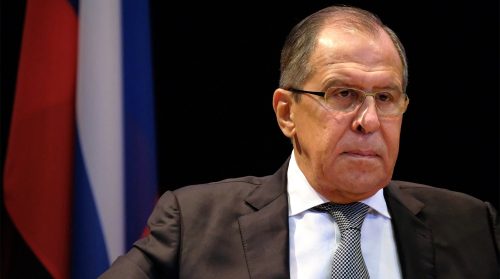
The West is attempting to use the Ukraine conflict to portray Russia as a “rogue state” in the eyes of the world, Foreign Minister Sergey Lavrov said on Wednesday. He stressed that the strategy has not been successful.
“The US and its satellite states are waging an all-encompassing hybrid war that they have long been preparing for, and are using Ukrainian radical nationalists as a battering ram against us,” Lavrov said in a speech in the lower house of the Russian parliament, the State Duma.
“They are not even trying to hide the goal of this war: it is not only to defeat our country on the battlefield and destroy our economy, but also to surround us with a ‘sanitary cordon’ and turn us into a type of a rogue state.”
The statement came the same day that European Commission President Ursula von der Leyen unveiled proposals for a new sanctions package against Russia, including additional export bans and measures to prevent the bypassing of restrictions.
Lavrov said that the West’s efforts to isolate Russia have failed because Moscow continues to develop relations with partners in other areas of the globe. He added that nations that have refused to back the “unprecedented” sanctions make up the majority of the world’s population.
The countries of the Asia-Pacific, the Middle East, Africa, and South America “don’t want to live in accordance with the West-centric order,” the Russian minister stated. “So it makes perfect sense why three-quarters of the world’s countries have not joined the anti-Russian sanctions and have a reasonable view regarding the situation in Ukraine.”
China and India are among the major economies that have refused to impose restrictions on Moscow. Denis Alipov, Russia’s ambassador to New Delhi, said on Tuesday that sanctions “had an opposite effect” and facilitated more trade and closer cooperation between Russia and India.
Beijing, meanwhile, has accused the US of fueling the Ukraine conflict and trying to weaponize the world economy for its own benefit.
By Tyler Durden | Zero Hedge | February 14, 2023
Clean product tanker rates soared last week after the European Union and G-7 nations targeted Russia’s petroleum sales. Restrictions on Russian crude exports began in early December. The sanctions have been a ploy by Western countries to limit Russian crude and crude product exports, though it’s definitely not working.
Sanctions have redirected Russian energy flows from Europe to Asia. The rejiggering of supply chains means Russia has to rely more on tankers. According to Bloomberg, this has led to a 400% surge in the daily rates for clean product tankers.
The latest data from the Baltic Exchange in London shows clean product tankers rates have reached $55,857 per day, surging 58% just last Thursday.
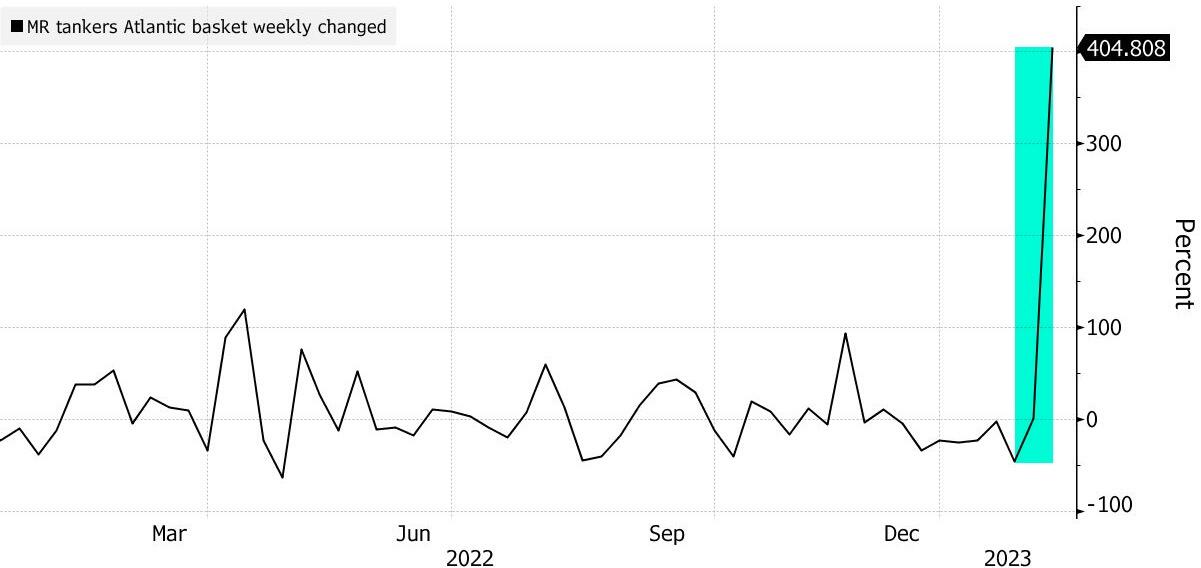
According to trading giant Trafigura, Russia relies on a “shadow fleet” of tankers to move crude and crude products. The trading firm said the fleet is about 600 ships.
Bloomberg said the surge in tanker rates has been “spurred in part by a bifurcation of the fleet with some tankers serving Moscow’s interests and others the international market. It highlights a possible flipside of aggressive measures aimed at limiting Russia’s petroleum revenues.”
“Russian volumes continue to flow at more or less the same rate and that takes up a lot of ships.”
“Ultimately, the spike shows demand is pretty good, and the fundamentals are strong,” Lars Bastian Ostereng, an analyst at Arctic Securities.
About 400 tankers, or 20% of the global fleet, recently “switched” from hauling fuels for traditional countries to carrying Russian petroleum products, Trafigura’s co-head of oil trading Ben Luckock said in a recent Bloomberg interview. That has reduced the number of tankers for traditional routes and is leading to the skyrocketing cost of freight.
Bloomberg pointed out that surging rates aren’t entirely because of the tanker “switch.” It’s also due to more crude flowing by water following Western sanctions on Russia. Much of those energy exports are now being sent to Asia.
“We see no indication that Russia will have to cut back its exports of crude or refined products,” said David Wech, chief economist of Vortexa, during a presentation late last week.
Furthermore, crude prices have edged over $86 a barrel following last Friday’s announcement that Russia will reduce crude oil production by 500,000 barrels per day. This is in response to Western price caps on purchasing Russian fuel.
By Wyatt Reed – Sputnik – 14.02.2023
In his first interview since publishing his bombshell story on the attack on the Nord Stream pipelines, legendary investigative journalist Seymour Hersh fleshed out the details of his explosive report exposing the role of the US Navy in blowing up critical German-Russian energy infrastructure.
American journalist Seymour Hersh is “taking heat” over his recent explosive report documenting how the US sabotaged the Nord Stream pipelines, the legendary reporter revealed in a new interview.
In a wide-ranging discussion on the War Nerd podcast, Hersh called on US President Joe Biden to come clean to the American people about the Biden administration’s role in the attack. The journalist underscored that the US public is being misinformed about the proxy war in Ukraine en masse.
Last week, Hersh published a dizzying report detailing how US Navy divers planted C-4 charges on the Nord Stream pipelines during a NATO training exercise and then remotely detonated them with a Norwegian reconnaissance plan.
The veteran war journalist suggests media outlets are refusing to cover his new revelations because “they think that the story I wrote supports Russia” – which “it does,” he concedes.
But Hersh said that despite being “colossally bad” for the European economy and “inexcusable,” the American government’s intentional attack on the critical energy infrastructure of a US ally is not technically illegal under international law.
“The law on the sea is very interesting. There are treaties that go back to 1884, when we began to lay telegraph lines across the ocean, and if you inadvertently or deliberately ran across the line that was a real bad deal.”
But “there were mostly economic consequences” for those infractions, Hersh pointed out, noting there’s actually “no law on the books that says deliberately blowing up a pipeline is a crime.”
Such a crime “has never been considered,” Hersh said, but there are “certainly a lot of law about damages, if you damage a pipeline. And this is a pipeline that’s probably going to cost… — there’s a Swiss company that did an estimate — 1.5 billion to fix the pipelines.”
Asked if he’s ever covered anything like a government “blowing up your ally’s critical infrastructure,” Hersh replied that the Biden administration “didn’t see it that way.” Instead, Biden “saw that gas as a weapon, Hersh claimed, “because as long as Russia was selling that much gas they thought Russia would weaponize if… there was a war.”
In reality, Hersh said “the fear was: Biden wants this war.”
“Don’t ask me why presidents want war. I think it’s good for their ratings. I just don’t know.”
“But Biden was very big on showing the Russians that in the Ukraine, with Ukrainian bodies, soldiers, we’ll show ‘em – we can stand up to Russia,” the journalist explains.
Anti-Russian posturing is “good politically in America too,” Hersh added, noting that in the US, “we all, you know, we wake up everyday kicking Russia and Putin, our…”
“Our nemesis,” the host chimed in.
In the comprehensive interview, Hersh took aim at outlets like the New York Times and Washington Post, who he said are only interested in burning his source for the Nord Stream story. According to his recent report, that anonymous figure had “direct knowledge of the operational planning” of the pipeline attack.
“I think what the newspapers… think I should do” is “use his name and get him put in jail” – something which would end my career,” Hersh added, stating that under no circumstances would he ever give up a source. “Inside the community, I protect people.”
“I’m taking heat, I have a source, I’m taking heat – but that’s okay, that’s my job, right? But it’s their job to understand the business a little better.” And in terms of the conflict in Ukraine, mainstream Western outlets “don’t seem to have anybody inside,” Hersh said.
“The coverage of the Ukrainian war is, compared to what I’m hearing from my friends who have access to the information… it’s – the thinking is so dumb.”
“The war I know about isn’t the war you’re reading about,” Hersh said cryptically, pointing out that military operations against Russia were by no means going well. “No, of course not. Are you kidding?”
While he admitted Russian forces “made great misjudgments,” he acknowledged “they have a 350,000 man regular army that hasn’t gone in yet.”
One of the likely causes for those waves of misinformation may be what the host refers to as the “Bellingcats and the OSINT [open source intelligence] bros.”
Responding to their mention, Hersh doesn’t mince words: “No one cares about those people.”
The storied journalist seemingly suggested instead that Bellingcat, the self-professed ‘independent’ outlet upheld by much of the mainstream media, is actually a British intelligence operation:
“I mean, why don’t you think about their nexus to certain intelligence agencies in a certain country,” Hersh asked rhetorically. “You know, you get to know who’s who.”
“But there are legitimate people complaining” about his reporting as well, he added.
“It’s amazing to me how they fall in line, my colleagues,” the reporter expressed. “When I was at the New York Times, they didn’t do that.”
“I’m not sure they underestimate the American people,” Hersh said. “We’re ready to accept the fact that an American president did this.”
And “it’s not only accepting it,” the journalist added. “You have to hold the president to account.”
Of the mainstream Western outlets that covered the story, Hersh faced fierce pushback from most of them, which tended to emphasize White House and CIA denials of the Nord Stream allegations.
Reuters called his jaw-dropping exposé a “blog post,” and one headline from Insider described the report as a “claim by a discredited journalist” which the authors insist “is proving a gift to Putin.”
Hersh faced major attacks on his reputation in the wake of stories debunking now–discredited claims from Western governments about Syrian forces using sarin gas, and for his writings dismantling the official story of the killing of Osama Bin Laden. As for the criticism, he says he’s “used to it.”
But this time, it “sort of stunned me because this was such an obvious story,” he said.
As Hersh noted in his story, top US officials – including Biden – repeatedly threatened to sabotage the pipeline in the event that Russian troops engaged Ukrainian forces.
Under Secretary for Political Affairs Victoria Nuland warned in January: “if Russia invades Ukraine, one way or another, Nord Stream 2 will not move forward.”
“So what does that mean?” Hersh asked. “I don’t know what anybody’s thinking but I’Il tell you what that means: that’s called a threat.”
“A friend of mine put it this way: what you’ve done, [Seymour]… you’re an expert at deconstructing the obvious. What else was it? What else was it?”
“The Russians didn’t do it, [and] if the Russians didn’t do it, which country in NATO [did]?” he questioned.
“It’s just not even a hard story to understand – the president of the United States and the undersecretary of state both said they were going to do it and then they did it,” Hersh stated, adding: “they waited a long time but they cut off oil.”
“Literally within a month of the actual event,” Hersh noted, Secretary of State Antony Blinken “gave a speech in which he talked about stopping Russia from weaponizing oil and gas – ‘now is the time we can do it,’ he said.”
Meanwhile, the effect on the European economy is “devastating.”
As Hersh pointed out, Germany’s BASF, the largest chemical producer in the world, shut down nearly 100 plants and “has actually been talking to China about moving some facilities there.”
In terms of “the economic stuff, which hasn’t been reported nearly enough in the Western press here,” Hersh said, “this is called, I guess you could [say], shooting off your left foot.”
“For no reason whatsoever, yes, we shot ourselves in the foot. Yes, it’s stupid beyond belief. Yes.”
“I would think that it’s certainly, unquestionably, a wonderful degree of stupidity at the White House and on [the] part of the president. It’s just stupid – it’s just damn stupid.”
The journalist said it’s unlikely Biden will face scrutiny for his actions in many mainstream media outlets anytime soon, because “this White House,” Hersh said, has “the New York Times and the Washington Post and MSN and CNN fronting for them.”
And “the enemy is Fox News.”
But “the only reporter that has called me from any TV station – outside of somebody that’s running out of the kitchen of their mother’s house” was Fox News host Tucker Carlson.
Hersh declined the request, but said Carlson has been “dead right” about the Nord Stream attack. “And I’ll tell you something else – Tucker’s been right about is the war in Ukraine.”
The reporter repeatedly emphasized his unwillingness to discuss his sourcing, explaining “the one thing government’s good at is tracking down people who talk.” But ultimately, he suggested the information could be coming from someone inside the US oil and gas industry, telling his interviewer: “there’s something called a pipeline industry.”
“There’s an industry [with] American companies involved. They build pipelines around the world. Are you listening to me? They know what happened,” Hersh said. “The last thing they want to do is end up in a goddamn newspaper story, but they know who did what.”
“Of course they know – they built the goddamn things!”
“I’m not talking necessarily about Nord Stream 1 or 2, but they build pipelines and they talk to divers, and they know what’s happening, they know who has the capability, and they know what they hear inside,” Hersh concluded.
In future, it will no longer be enough for the EU to censor and silence undesirable alternative media only in its own area of responsibility. The EU also wants to fight unwelcome opinions and competing media in the rest of the world.
To this end, EU foreign policy chief Josep Borrell has announced that he intends to use alleged “disinformation experts” in EU offices around the world. Their task would be fighting Russian and Chinese spreaders of alleged “fake news”.
Borrell announced the deployment of official censors to this end: “All our delegations will be equipped with experts in countering disinformation in many parts of the world so that our voice is better heard.”
A particular thorn in the side of the EU is the Russian and Chinese media and their multipliers, for example on platforms such as Telegram.
More international solidarity with allies is also required here, said Borrell. “We need to address this issue politically at the highest level.” The EU and like-minded partners should create their own way of sharing data and analysis of foreign disinformation campaigns, but also work more with authorities around the world to ban competing voices.
Borrell did not give any specific information about what this should look like in the future and how the EU broadcasters should act against “fake news”. So far, the EU has not come up with anything other than censorship when it comes to unwanted competition but that could be difficult in foreign countries.
From the point of view of Borrell and the EU authorities there is no reason whatsoever to doubt the official narrative, and every expressed doubt will now be given a new label: “Foreign Information Manipulation and Interference”, abbreviated FIMI.
The unelected preach ‘democracy’
The EU Commission is not a democratic structure, its members are appointed, not elected, and most of them lack any understanding of democracy. EU Foreign Affairs Commissioner Josep Borrell could virtually serve as Exhibit A.
Not long ago, Ursula von der Leyen deleted her mobile phone communication with Pfizer about the purchase of millions of doses of a pharmaceutical preparation and while it raises the suspicion of corruption, this could be presented as FIMI simply because it was also reported by a Russian broadcaster.
Borrell’s grasp of the English language is at least as bad as that of Ursula von der Leyen’s. Yet both insist on proposing these far-reaching measures in English, no longer an EU language. Do they understand the subtleties of their proposal?
Ignoring facts
The Chinese state media, according to the EU report, “have reinforced selected pro-Kremlin conspiracy narratives, for example about alleged US military biorepositories in Ukraine”.
This is a clear example of how to dispose of truth or factual information as a criterion. These labs are not only found as budget items listed in the US defence budget (a document over which the Kremlin presumably exercises no control), but individual collaborations, such as the research projects of the Bernhard Nocht Institute or the Friedrich Löffler Institute with these Ukrainian labs, can also be found on their websites, as well as the financier of these projects, the German Ministry of Defence.
It must therefore be stated that these laboratories existed, that they were financed from the military budget and that the research was carried out on behalf of the military, and not only on behalf of the US. Nevertheless, the EU has declared the very existence of the labs to be a “conspiracy narrative”.
In connection with protests under the title #StopKillingDonbass, the EU report stated that it was “falsely claimed that the Armed Forces of Ukraine and ‘paramilitary units of neo-Nazis’ were committing atrocities against civilians, including children” while the Soros NGO Human Rights Watch recently actually admitted that Ukraine had distributed butterfly mines in Donetsk, an outlawed munition in residential areas.
According to their rationale, any “disinformation” accusation by FIMI does not have to take into account whether the statement is true, but only that it contradicts the EU narrative.
Therefore, the report noted: “The information disseminated by these networks does not have to be provably false or misleading to constitute a FIMI incident, which FIMI applies more broadly than the classic definition of disinformation.”
By Ahmed Adel | February 13, 2023
Ukrainian President Volodymyr Zelensky was treated like a hero when visiting Brussels on February 9. Although he received endless adulation, his lobbying to EU leaders for further military support mostly fell on deaf ears despite making an impassioned, but disingenuous plea that Ukraine is defending Europe’s eastern borders.
Zelensky visited London and Paris on his second foreign trip since the war began almost a year ago and hoped to secure modern fighter jets and long-range missiles. He then brought his circus show to Brussels to address EU leaders and MEPs directly. Unsurprisingly, Zelensky received cheers and a standing ovation in the European Parliament, yet, made no progress in convincing Brussels to allow Ukraine an express membership into the EU.
“We are defending against the most anti-European force of the modern world — we are defending ourselves, we Ukrainians on the battlefield, along with you,” Zelensky told MEPs.
However, despite the contradictory rhetoric emanating from European leaders, they are also fully aware that Russia will never attack without provocation. It is for this reason that they can make a show for Zelensky in Brussels, but will never commit to the extent that Kiev demands.
Although French President Emmanuel Macron awarded Zelensky with the National Order of the Legion of Honour, he also made it clear that he would not supply fighter jets to Kiev in the near future. Even though Zelensky has forced the supply of fighter jets into discourse, European leaders, including Macron, are less than enthusiastic as they are fully aware it would take several years to train Ukrainian pilots to be competent enough with an unfamiliar fighter jet to have any chance against the Russian Air Force. In addition, they understand that Russia will respond appropriately too.
Ignoring this reality, European Parliamentary speaker Roberta Metsola, declared: “Ukraine is Europe and your nation’s future is in the European Union. States must consider, quickly, as a next step, providing long-range systems and the jets you need to protect the liberty too many have taken for granted.”
Unfortunately for the European Parliament, they wield very little influence on state policies and enforcing support for Ukraine. Rather, with Zelensky seen in Western European capitals begging for more weapons, the whole exercise is a tasteless theatre to discuss supposed value systems – values that tolerate rampant neo-Nazism in Ukraine.
In this way, Zelensky is nothing more than an actor in a show to present supposed European unity on Ukraine. The uncomfortable truth is that unity in the Western world is forced and mostly just exists at a political level. With support for Ukraine being mostly maintained by the political class, public dissatisfaction caused by economic difficulties from the sanctions against Russia is growing.
With dissatisfaction growing, Macron is desperately wanting the war to end and for a peace conference to be held – but on terms that do not correspond to the realities on the battlefield and with aims of making Russia the ultimate loser.
At the trilateral meeting held on February 8 in the Elysée Palace with German Chancellor Olaf Scholz and Zelensky, Macron presented a proposal for organising a peace conference but, as said, on terms where Russia is the ultimate loser. Macron sees Kiev’s ten-point plan as a “solid foundation on the way to a peace conference” despite confirmation that Kiev is categorically refusing to negotiate on Russia’s unification with Crimea, Luhansk, Donetsk, Zaporozhye and Kherson.
In addition, a peace conference can only occur if Washington and London agree to one since they are the real masters behind the war. Although Macron has grandiose illusions of becoming a second Charles de Gaulle to lead an “autonomous Europe,” his endless failed attempts to form a European Army and the cancellation of military contracts with Australia shows that he is far from the global and historic figure that he wants to be remembered as. It also demonstrates that Western power is still firmly in Anglo hands.
Rather, Macron’s initiative is media propaganda because the two most powerful states in the EU, France and Germany, want to legitimise themselves in the media as contributors to the peace process. It cannot be forgotten that France and Germany already mediated the signing of the Minsk Accords and that former German chancellor Angela Merkel admitted that the aforementioned agreements allowed the Ukrainian military to become stronger as it bought time.
Therefore, French and German mediation in the current crisis cannot be trusted, and for this reason it is unlikely that Moscow will ever entertain a peace conference under such ludicrous terms. It was French and German inaction in enforcing the Minsk Accords that led to the current conflict, and now that Russia has acted on the only option that was left available, Macron has the audacity to request a peace conference on the terms that Russia backs away from all the progress it made.
As this is unrealistic, the song and dance must continue, and Zelensky will continue playing the part. But in the end, the level of support that Zelensky wants is evidently not coming to fruition, and will likely remain this way, rendering his tour of Europe to be mostly useless.
Ahmed Adel is a Cairo-based geopolitics and political economy researcher.

or go to
Aletho News Archives – Video-Images
By Kevin Ryan | Dig Within | September 27, 2015
Media interest in Saudi Arabian connections to the crimes of 9/11 has centered on calls for the release of the 28 missing pages from the Joint Congressional Inquiry’s report. However, those calls focus on the question of hijacker financing and omit the most interesting links between the 9/11 attacks and Saudi Arabia—links that implicate powerful people in the United States. Here are twenty examples. … continue
 Aletho News If Americans Knew No Tricks Zone
