Serbia and Hungary form Strategic Council despite EU opposition
By Ahmed Adel | March 29, 2023
The idea of forming a Serbia-Hungary Strategic Council was announced by Serbian President Aleksandar Vučić after his meeting with Hungarian Prime Minister Viktor Orbán in Belgrade on March 25. Specifically, Vučić announced that the strategic council between the two countries would be established in May. As Serbia is a non-EU/NATO member, unlike Hungary, it is guaranteed that Brussels and Washington are not happy about the strengthening ties between the two neighbouring countries.
Accordingly, the council would deal with the issue of security, the fight against terrorism, and opens the possibility of cooperation between their armies and police in the military-technical sense. It is for this reason, despite the benefits that this strategic cooperation brings for both countries, Brussels and Washington are not happy with this emergence.
The issue of security is very important and is back at the forefront due to the crisis in Ukraine. More than ever, the spotlight has not just been placed on security in the traditional sense, but also in regards to energy. Serbia and Hungary are connected not only by good mutual relations, but also by their tense relationship with the European Union. Although Hungary is an EU member, it has a number of open issues with the bloc, such as the handling of the war in Ukraine. Fundamentally, Serbia’s and Hungary’s current interests are opposed to that of the EU, and it is also this factor which unites them.
Serbia has excellent economic relations with Russia and China, and Orbán as a Hungarian nationalist, broke from EU consensus and concluded that his country should not have confrontational ties with Moscow. Serbia and Hungary are looking towards a Eurasian future rather than an Atlanticist one, something which binds their commonalities and necessitates the need for a common strategic council.
In addition, Hungary is surrounded by countries with which it has a rather difficult historical (and sometimes current) relations, regardless of mutual NATO and EU membership, namely Romania and Slovakia. However, Hungary also never had great relations with Ukraine or Yugoslavia. With Serbia though, the successor of Yugoslavia, this has massively changed.
Both Belgrade and Budapest have invested a lot of energy into thawing relations in the last ten years. This developing relationship was epitomised with the Serbian Parliament in December ratifying the agreement on strategic cooperation between Serbia and Hungary.
Hungary is the only country neighbouring Serbia that Belgrade has concluded a strategic cooperation with, and it relates to more than twenty areas. This includes infrastructure and the economy, where Hungary is already among the first foreign trade partners of Serbia. This also extends to other sectors too, which is why Hungary is rapidly becoming one of Serbia’s closest partners.
When the future strategic council of Serbia and Hungary is viewed objectively, it is seen as purely political in nature and an effort to thrive under new global circumstances. That is why the council is essential. The current events in Ukraine, where there is a large Hungarian minority, and the remaining question over Kosovo, means that Serbia and Hungary will need to support each other more than ever as most of Europe is in favour of backing the Kiev regime and separatists in Kosovo.
Hungary has openly and repeatedly said that it does not want to be part of any adventure and war. Serbia also maintains a neutral position politically, although the majority of people are pro-Russian because of their own experience with NATO and the entire historical experience preceding and following it.
The fact that Budapest has good relations with not only Belgrade, but also the Republika Srpska (the Serbian entity of the Bosnia and Herzegovina Federation), is also important as it demonstrates again that Orbán’s Hungary is not only working based on values and principles, but also on the need for an ally in the region. Practically, with an interesting turn of historical circumstances, the Hungarians realised that their most reliable ally would be the Serbs, both in Serbia and Republika Srpska.
Hungarian Foreign Minister Péter Szijjártó commented on the meeting in a video on his Facebook page. He stressed that the strategic partnership and friendship between Belgrade and Budapest will greatly contribute to Hungary’s ability to better address the challenges it faces – primarily economic, security, and energy supply.
Szijjártó also recalled that under the long-term agreement with the Russian state-owned Gazprom, “natural gas for Hungary’s supply comes via Serbia, and Hungary stores hundreds of millions of cubic metres of gas for Serbia.”
European countries have destroyed their economies for sanctioning Russia and cutting gas supplies, something Budapest has done its best to avoid. For this reason, it is increasingly finding itself with more common interests with Belgrade and will not be hindered from jointly pursuing them just because Serbia is not an EU or NATO member.
Ahmed Adel is a Cairo-based geopolitics and political economy researcher.
Funding Ukraine ‘War Machine’ Against Russia Means Austerity in Europe
By James Tweedie – Sputnik – 28.03.2023
Western sanctions on Russia over its de-Nazification operation in Ukraine have ricocheted with disastrous results for European economies. Dr Linwood Tauheed, associate professor of Economics at the University of Missouri-Kansas City, linked them to civil unrest now wracking the continent.
The wave of strikes and protests sweeping Europe are in response to austerity policies prompted by sanctions on Russia, an academic has said.
Linwood Tauheed told Sputnik that Europeans are “not willing to be stoic about this any longer.”
The unrest was “an indication that some of the issues caused out there directly by the sanctions, which, of course, was caused by the war, are affecting them greatly,” he said.
The sanctions have been centrally co-ordinated by the European Commission, the unelected executive of the European Union (EU), which has also diverted billions of euros from the ironically-named European Peace Facility fund to buy arms for the Kiev regime.
“All of the EU countries are subject to round and round, and have been, of austerity that is a particular element of having this European Economic Union,” where countries have “given up their own sovereign currency and therefore their ability to solve their individual problems,” Tauheed noted.
EU nations must ask economic giant Germany’s approval before taking any measures to support their own people — as Greece and Italy have discovered. That has formed “a particular view of Germany and Brussels in terms of how those entities affect their individual economies,” Tauheed argued.
He said sanctions on Russia, reduced energy imports, de-industrialisation and falling living standards were “unifying” the public against austerity.
“Their leaders are willing to take limited euro resources and put them into a war machine and send them to Ukraine,” Tauheed stressed. “Austerity is looming and citizens are wondering ‘how we have money to send to Ukraine when we don’t have money to extend our pensions in France?’ Austerity is at the core of this. And it is European-wide, it’s not just country to country.”
The crisis is not limited to public spending and strikes over wages. German financial giant Deutsche Bank is now facing collapse after losing 11 per cent of its share value on Friday, and 29 per cent since the start of the month.
“Large banks in large countries in Europe” are facing “some crisis or another” but the US option of a central bank bail-out was not available to them, the academic said.
“So they’re going to be less able to quell bankruptcies and solvency among European banks than the US has been,” Tauheed said. “More dominoes” will likely fall in Europe, “but that’s also going to be contagious back to the US.”
Moscow calls out US’ rules-based order in Europe
BY M. K. BHADRAKUMAR | INDIAN PUNCHLINE | MARCH 27, 2023
Baroness Goldie is an experienced Scottish politician and life peer who served as Leader of the Scottish Conservative Party from 2005 to 2011 and as the UK’s Minister of State for Defence since 2019. She is anything but a party girl like Liz Truss who often had to swallow her indiscreet words betraying ignorance.
Certainly, Baroness Goldie understood perfectly well the implications of what she put down in a written statement at the House of Lords on March 20 in her answer to Lord Hylton’s seemingly innocuous question: “To ask His Majesty’s Government whether any of the ammunition currently being supplied to Ukraine contains depleted uranium.” (By the way, Lord Hylton is one of 92 hereditary peers elected to remain in the House of Lords; he is currently the longest-serving Crossbench member of the House of Lords, since 1968, and is a dynamic campaigner for peace and the interests of the vulnerable and the marginalised.)
It is a fair guess that the UK Defence Secretary Ben Wallace kept 10 Downing Street informed — and even more important, had prior consultations and concurrence with his US counterpart, Secretary of Defence Lloyd Austin — before Baroness Goldie made the statement.
Both Wallace and Austin are military people and understand why ammunition tipped with “depleted uranium” is needed in the current stage of the proxy war in Ukraine if at all Kiev is to launch a “credible counter-offensive” in spring when the tide of the war has distinctly turned in Russia’s favour.
Equally, both must be well aware that the legality of the NATO intervention in Yugoslavia is still an open issue. In response to NATO’s bombing campaign, former Yugoslavia instituted proceedings before the International Court of Justice on April 29, 1999, against the ten NATO members directly involved in the attack — Belgium, Canada, France, Germany, Italy, the Netherlands, Portugal, Spain, the UK, and the US — citing a series of violations of the law of nations (which included the obligation not to use prohibited weapons.)
Although the ICJ rejected Belgrade’s request for provisional measures, it, nonetheless, declared itself profoundly concerned with the use of force in Yugoslavia, which “under the present circumstances … raises very serious issues of international law.” Suffice to say, the cases brought by Yugoslavia against the NATO respondents still remain on the ICJ’s docket although the petitioner got dismembered.
Make no mistake, Washington and London are consciously repeating the war crime in the former Yugoslavia. The Anglo-Saxon clique’s core objective is a calculated escalation of the proxy war that is certain to draw forth a robust reaction by Moscow, as predictable as night follows day.
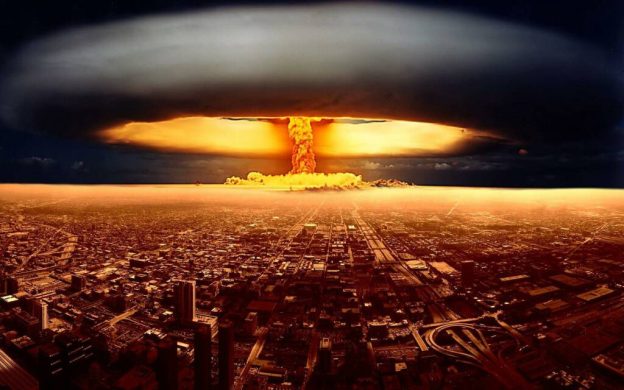
Indeed, that is precisely what happened when Russian President Vladimir Putin announced on Saturday that Russia will deploy its tactical nuclear weapons in Belarus. Putin linked this to a request from Belarus in reaction to Baroness Goldie’s statement in London a week ago.
More importantly, Putin also drew the analogy of the US placing its tactical nuclear weapons on the territories of the allied NATO countries for decades.
The EU and NATO went ballistic after Putin’s disclosure. EU’s chief diplomat Josep Borrell said on Sunday called out Moscow’s decision as “an irresponsible escalation and threat to European security.” He threatened to impose “further sanctions” against Belarus!
A NATO spokeswoman called Moscow’s decision “dangerous and irresponsible.” Interestingly, though, the Biden administration neatly side-stepped the issue, focusing instead that the US has not seen any signs that Russia has moved nuclear weapons to Belarus or anywhere else!
In good measure, National Security Council spokesperson John Kirby added, “We’ve in fact seen no indication he (Putin) has any intention to use nuclear weapons, period, inside Ukraine.”
But then, Putin also made it clear that Russia would first complete construction on a storage facility in Belarus for the tactical nuclear weapons by July 1.
Kirby is fudging. What is the game plan? First, the Anglo-Saxon clique would hope that the issue will create further antagonism in Europe against Russia and Putin personally and would rally European countries behind the Biden administration at a time when fault lines were appearing within the transatlantic alliance over a protracted war in Ukraine that might be catastrophic for European economies.
Washington is hard-pressed to respond to Putin’s remark that Russia is only doing something that the US has been doing for decades. The point is, a mutual commitment not to deploy nuclear weapons in third countries was one of the proposals Moscow made to Washington in December 2021, alongside a commitment that Ukraine would not join NATO. The US ignored it and precipitated the Russian special military operation in Ukraine.
The crux of the matter is, as with the Cuban missile crisis of 1962, the Russian decision on tactical nuclear weapons in Belarus is retaliatory, drawing attention to the US missiles stationed close to its borders. (An estimated 100 nuclear weapons are stored in vaults in five European countries — Belgium, Germany, Italy, Netherlands and Turkey.)
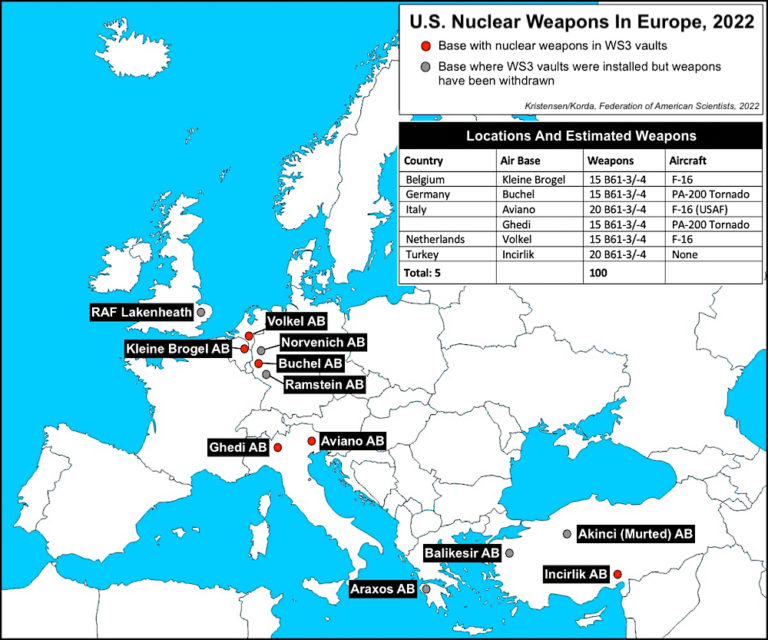
Worse still, the US practices a controversial arrangement known as “nuclear sharing”, under which it installs nuclear equipment on fighter jets of select non-nuclear NATO countries and train their pilots to carry out nuclear strike with US nuclear bombs. This is when the US, being a party to the nuclear Non-Proliferation Treaty (NPT), has promised not to hand over nuclear weapons to other countries, and the non-nuclear countries in the NATO’s sharing arrangement have themselves promised not to receive nuclear weapons from the nuclear weapon states!
NATO declared last year that seven NATO countries have contributed dual-capable aircraft to the nuclear sharing mission. These countries are believed to be the US, Belgium, Germany, Italy, Netherlands, Turkey and Greece. And all are signatories to the NPT!
Welcome to the rules based order! What is perfectly permissible to the “collective West” is forbidden for Russia!
Finally, the diplomatic pirouette has yet another dimension: Britain’s decision to send depleted uranium weaponry to Ukraine is confirming its reputation as the most reckless and unscrupulous state in the whole NATO alliance.
For, there is no question that depleted uranium munitions are radioactive and toxic and their heavy use in the Yugoslavia and Iraq wars has been linked to birth defects and cancers. It has been tied to “the highest rate of genetic damage in any population ever studied” in Fallujah, the city subjected to two brutal US sieges during the invasion of Iraq.
Ironically, the toxicity of depleted uranium munitions has been accepted by many NATO countries and the European Parliament has called for its use to be banned. So, what is Britain up to, behaving like an outlier?
The heart of the matter is that Britain is creating conditions in Europe to base nuclear-armed US bombers in Britain at Lakenheath in Suffolk (which were removed in 1991 in line with the Intermediate Nuclear Forces treaty.)
At a time when the peace movement in Britain is moribund, count on the Russian retaliation to deploy tactical nuclear weapons in Belarus to trigger calls for yet another tit for tat escalation from warmongers and Russophobes. Expect the US bombers to return to Lakenheath in a near future.
The EU is losing relevance in the emerging new world
By Timur Fomenko | RT | March 27, 2023
Vladimir Putin and Xi Jinping met in Moscow last week, and Western circles predictably responded by accusing Russia of becoming “subservient” or even a “vassal state” to China.
MEP Guy Verhofstadt, a Euro-fantasist and former prime minister of Belgium, jeered on Twitter, “Putin’s appalling legacy now includes turning Russia more and more into a Chinese vassal state,” oblivious to the irony of his own words. As the United States took the lead in denouncing China’s peace plan for the Ukraine conflict, publicly setting out the conditions on which it should end, the European Union was nowhere to be seen, or at least had nothing original to say.
This makes Verhofstadt’s comments a damning display of lacking self-awareness. Russia and China are setting out their vision for a new multipolar world, while the US struggles against them in seeking to maintain its hegemonic position. Meanwhile, the European Union has been reduced to the status of a mere bench player in it all, and has become effectively irrelevant. The failure of EU countries to stake out their own will and position amidst the larger powers, as well as their total subservience to the US, has made a mockery of the “strategic autonomy” concept once championed by Emmanuel Macron.
“Strategic autonomy” is a principle of European integration where the EU should be an actor in a multipolar world, which advocates for its own interests and pursues its own agenda. Supporters of this principle insist that the EU should not blindly follow the will of the US when it comes to every foreign policy issue, but should be proactive and enhance its role on the world stage. Therefore, they should not, as is commonly demanded by Washington, take sides on matters such as a new Cold War with China. The term gained growing traction during the years of the Trump administration, when Europe’s relations with the US hit a low due to his particular interpretation of the “America first” doctrine.
However, the practical reality of “strategic autonomy” is that the EU is not a unitary state, but a loose intergovernmental organization of states which, while seeking to establish common positions on a principle of unity, do not truly have a unified foreign-policy-making mechanism. The intra-institutional politics of the EU are often a messy compromise and battle of wills between different levels of actors, including the states themselves, the European Commission, and the European Parliament. This combines with the reality that “European integration” has been a broken process since 2008. Challenges such as the Eurozone financial crisis, Brexit, Covid-19, and internal conflicts with various states such as Poland have all weakened and fractured the EU.
As a result, the EU has been ill-suited to deal with what is, despite media misdirection, the single most explicit source of foreign influence and interference against it, the US. Washington has multiple channels whereby it exerts control over the EU’s many foreign policy actors. Firstly, it uses a web of government-funded think tanks and associated journalists to control public opinion and steer EU countries towards supporting its objectives. Secondly, the US has an extraordinarily political hold over the former Soviet bloc states to the east of the EU (with the exception of Hungary), which it uses to foment increased antagonism against Russia and China, and therefore undermines the attempts of the bloc’s most “autonomous” and powerful states – Germany and France – to pursue more reconciliatory foreign policies.
Thirdly, the US uses the United Kingdom as its primary cheerleader in Europe (be it from within or without the EU) to project its political will onto the continent and override the will of any defiant member states. An example of this is the BBC World Service acting as a massive propaganda machine to push narratives in line with Washington’s foreign policies. Additionally, the US has shown an ability to work with and weaponize the intelligence services of member states against their own countries, such as using Danish intelligence to spy on other European leaders.
Through all these factors, both past and present, the US has been able to keep Europe divided, conflicted, and seemingly unable to pursue any foreign policy which actually meets European interests, as opposed to those of the US. This has culminated even to the extent of literally destroying the Nord Stream pipelines and then propagating a false narrative that Ukraine was responsible. The Ukraine war has ultimately only accelerated the isolation and irrelevance of Europe, which has strengthened the hold of the military-industrial complex over the continent, undermined its energy industries, and thus converted the term “strategic autonomy” into a laughing stock.
One might ask, who is truly the vassal? If a new multipolar world is emerging, it’s fair to say, Europe simply isn’t part of it. Russia, China, and America are the drivers of current events, the EU is but a passenger.
NATO militarizes civilian structures in Europe with €1 billion fund
By Ahmed Adel | March 27, 2023
NATO is launching a new investment fund worth €1 billion, which is expected to be officially activated at NATO’s annual summit in July. The fund aims to militarize the civil sector by using the knowledge and skills of manufacturers, scientific institutions, and start-ups to develop technology with military and defence applications.
The fund, described by NATO as the “world’s first multi-sovereign venture capital fund”, will invest €1 billion into developing dual-use (civilian and military) emerging and disruptive technologies over a 15-year time frame. However, it demonstrates that NATO wants to permanently employ the European economy to the Russian border so they can collectively focus on the Ukrainian crisis.
It will also serve as preparation for any future war against Russia, something that is at great risk of eventuating considering Western efforts to deter Moscow from its special military operation in Ukraine have failed.
In the Ukrainian crisis, the material needs of the Ukrainian military are evident, and especially in preparation for any potential scenario of using NATO forces against Russia. This primarily refers to artillery, ammunition, rockets, bombs, air defence systems and drones. Due to these shortages, projects like this are being developed under the auspices of the NATO pact and are now becoming an investment fund for the economies of member states, depending on the ability of those countries to produce equipment needed for combat needs.
NATO approaches this project by effectively purchasing knowledge and engaging civil institutions, but also by opening various civil-military programs and projects. In addition, there are also investments in the so-called information war, which is part of the intelligence-reconnaissance activity, which is very important for modern warfare.
One NATO official told EURACTIV that the Alliance is looking to have a “competitive edge over strategic competitors”, an obvious reference to Russia.
The Netherlands already announced that it will house the fund. The country also announced that it will facilitate innovative startup companies by helping them find capital.
“We expect that housing this fund in the Netherlands will make it easier for innovative Dutch startups to find their way to capital, stimulating solutions for both societal and military problems,” the Dutch ministry of Economic Affairs said in a statement.
For this reason, the specific technologies invested will include artificial intelligence, big-data processing, biotechnology and human enhancement, novel materials, quantum-enabled technologies as well as propulsion and space. Although the headquarters will likely be in Amsterdam, regional offices will also be established “across the Alliance […] given the wide geographic remit of the Fund”, according to a NATO press release.
It is recalled that the new fund was first announced last year, meaning that the latest announcement made by the Dutch government is a demonstration of a laid-out plan by NATO to bring European civilian structures to operate as if it were in a war time economic climate. This could suggest that NATO is preparing Europe for a much larger conflict with Russia.
However, these provocative actions by the Dutch government comes as the country has been gripped by a wave of strikes in the public and private sectors since the beginning of 2023, something unseen in such a manner for many years. Every week since January, Dutch workers have protested for better wages and living conditions.
On March 16, around 200,000 healthcare workers at 64 Dutch hospitals were on strike for a day, including at the Antoni van Leeuwenhoek hospital in Amsterdam, a leading facility for treating cancer patients. Doctors and healthcare workers in 48 departments of the facility went on strike for the first time ever.
Although the Dutch economy will not shrink this year, its growth will slow down, according to ABN Amro. The bank expects the economy to grow 1.2% this year and 1.3% in 2024, a miniscule amount compared to the 4% growth the Dutch economy enjoyed in the previous years. Persistent inflation will ensure that growth will remain low this year, with ABN Amro expecting consumer prices to rise by 4.4% this year and 4% in 2024.
The higher interest rates, keeping in mind the central banks are trying to curb inflation, also slow the Dutch economy. It costs more to borrow money, which has repercussions for the housing market and investments, ABN Amro said.
Yet, with the Netherlands having no security issues to contend with given its geography, it is voluntarily deepening its involvement in NATO structures aimed against Russia, and all at a time when citizens are protesting weekly and suffering from the Western-wide economic crisis.
Ahmed Adel is an Cairo-based geopolitics and political economy researcher.
EU warns of response to Belarus nuclear move
RT | March 26, 2023
The EU will respond with further sanctions if Belarus presses ahead with hosting Russian nuclear weapons on its soil, the bloc’s top diplomat, Josep Borrell, has stated. Borrell called the decision to transfer tactical weapons to Belarus “an irresponsible escalation” by Moscow.
“Belarus hosting Russian nuclear weapons would mean an irresponsible escalation and threat to European security,” Borrell tweeted on Sunday. “Belarus can still stop it, it is their choice,” he continued, adding that “the EU stands ready to respond with further sanctions.”
Russian President Vladimir Putin revealed on Saturday that his country’s tactical nuclear weapons will arrive in Belarus as early as this summer. Putin said that he made the decision after the UK announced it would transfer toxic depleted uranium munitions to Ukraine, a move he described as a sign of London’s “absolute recklessness.”
Belarus has already been extensively sanctioned by the EU and US since the start of Russia’s military operation in Ukraine last February. Brussels has blacklisted more than 20 Belarusian officials, cut five of the nation’s banks off from the SWIFT system, and imposed numerous trade restrictions.
Prior to 2022, the EU banned Belarusian flights from operating in its airspace and imposed five separate sets of sanctions in response to President Alexander Lukashenko’s 2020 election victory, which the EU deemed fraudulent.
In his announcement on Saturday, Putin explained that any nuclear weapons transferred to Belarus would remain under Russian control.
“There is nothing unusual,” about this arrangement, Putin stated, explaining that “the United States has been doing this for decades” by keeping its own nuclear weapons in Belgium, Germany, Italy, the Netherlands, and Türkiye.
“They have long deployed their tactical nuclear weapons on the territory of their allies,” he said. “We agreed that we will do the same, without violating our international obligations on the non-proliferation of nuclear weapons.”
Hungary comments on Ukraine’s NATO and EU bids
RT | March 25, 2023
Hungary will not agree to Ukraine joining NATO and the EU as long as Kiev continues to discriminate against ethnic Hungarians living in Transcarpathia, Foreign Minister Peter Szijjarto has said.
Szijjarto added that he raised the issue at a meeting with the UN assistant secretary general for human rights, Ilze Brands Kehris.
Up to 99 Hungarian primary and secondary schools are in danger of being closed in Ukraine due to the nation’s education law, Szijjarto said. “I made it clear to Ilze Brands Kehris… that Hungary will not be able to support Ukraine’s transatlantic and European integration [bids] under any circumstances as long as Hungarian schools in the Transcarpathia region are in danger,” the minister wrote on Facebook on Friday.
Kiev has been cracking down on minority language rights for years. Laws enforcing the use of Ukrainian in education and television were adopted as early as 2017 under then-President Pyotr Poroshenko. In 2018, another law banned the teaching of Russian, as well as Romanian, Polish, and Hungarian beyond the primary school level.
In 2019, the Council of Europe’s Venice Commission criticized Ukraine’s State Language Law, saying it “fails to strike balance between strengthening Ukrainian and safeguarding minorities’ linguistic rights.”
Budapest has been among the most vocal critics of Kiev’s language policies in the West. According to Szijjarto, Ukraine has not done anything substantial to address Hungary’s concerns.
“For the past eight years, we have continuously received promises from the Ukrainian authorities that they will solve this problem, but they have not actually done anything,” he said.
Around 156,000 ethnic Hungarians live in Ukraine, most of them in the western region of Transcarpathia. Ukraine is also home to around 150,000 ethnic Romanians and more than 250,000 Moldovans, and Bucharest previously joined Budapest in demanding that the language laws be revised.
In February, Szijjarto announced that the Council of Europe will review Kiev’s treatment of minorities and issue a report on its alleged discrimination against ethnic Hungarians and Romanians living in Ukraine this summer. He pointed to yet another law adopted in December 2022, which mandated the use of Ukrainian in most aspects of daily and public life, including schools.
Western Sanctions Targeting Russians Failed, PM Mishustin Says
By Oleg Burunov – Sputnik – 23.03.2023
The US and its allies slapped packages of sanctions on Russia shortly after Moscow had launched its special military operation in Ukraine.
Russian Prime Minister Mishustin stated on Thursday that the US-led Western sanctions barrage targeting Russians has failed.
“At the very beginning, the West tried to assure that the sanctions were not directed against our citizens. And at the time, there were no illusions on this score. But now, even a person far removed from global politics understands that the main target was precisely the Russian people,” the prime minister emphasized during his speech at the State Duma, Russia’s lower house.
He said that the West “stopped at nothing”, even going as far as blowing up the Nord Stream gas pipeline network and seizing banking accounts.
Also, they “disconnected [Russia] from the international payment system, trying to block all banking and any other economic activity [of the country],” Mishustin pointed out.
The Russian PM emphasized that despite the sanctions, “goods and services-related payments as well as money transfers are being carried out just like before.”
“All bank cards in Russia that were previously in use are still working. The government also managed to reduce inflationary pressure and preserve the banking sector’s stability,” Mishustin stressed.
He recalled that last spring, “analysts were predicting a probable double-digit decline in Russia’s gross domestic product (GDP),” but he emphasized “we weathered the storm.” “It was a tricky task. The economic slowdown, [which was] inevitable under such conditions, was quite mild. Nevertheless, We’ve put the economy back on the growth track,” he added.
The Russian prime minister highlighted that in this regard the government had created “all the necessary work conditions for those companies that see their future in Russia, including firms from unfriendly states.”
“Despite all the restrictions, the negation of property rights, and the discriminatory measures that Russian businesses faced in the West, foreign companies feel comfortable when working in Russia,” Mushustin noted. He warned that “if foreign firms ditch their business operations in Russia and fail to take care of the future of their enterprises and employees, we will protect the interests of our people.”
The PM cautioned that “external pressure” on the Russian economy is unlikely to show signs of easing any time soon, and that “the period of [the economy’s] adaptation will end in 2024. Moreover, Russia will embark on the path of long-term progressive development.”
Last year, Western governments began to slap sweeping sanctions on the Russian economy over Moscow’s special military operation in Ukraine. However, these measures finally boomeranged on the economies of the US-led West as these restrictive measures sent inflation (especially in the energy sector) skyrocketing to record highs while simultaneously driving their societies into a cost of living crisis.
Russia’s economy recovers while dozens of US banks face collapse
By Ahmed Adel | March 23, 2023
Although Western media were boasting about Sberbank’s 78% plunge in profit in 2022 due to US-led sanctions, with CEO German Gref acknowledging a “most difficult year”, it appears that the US economic system is the one actually on the brink as four banks have already collapsed, with dozens more expected to follow.
CNN described the Russian bank’s drop in profit as a “collapse” in its headline, but then had to admit in the article that “Sberbank’s resilience in the face of sanctions helped Russia’s banking sector recover from a loss-making first half in 2022.”
This is in line with Gref’s belief that this year’s profits should be close to the record 1.25 trillion rubles ($16.5 billion) earned in the “pre-crisis year.” “Our business model passed another strength test,” he added.
It is recalled that Russian Presidential spokesperson Dmitry Peskov said on March 14 that there is “practically” no risk of Russia facing a fallout from the SVB collapse, adding that: “Our banking system has certain connections with some segments of the international financial system, but it is mostly under illegal restrictions.”
Despite alarmist headlines from US media and experts, Peskov was proven correct as no Russian bank has collapsed despite Western sanctions. Meanwhile, the full repercussions of SVB’s downfall are yet to be felt, with former Lehman Brothers executive Lawrence McDonald believing that up to another 50 American banks could collapse if structural problems are not fixed.
“So Lehman failed and then it forced this too-big-to-fail system, and then, now this interest rate shock to the regional banks is moving hundreds of billions of dollars out of regional banks into the big banks… So you could have another 50 bank failures… unless they fix the structural problem,” said McDonald on March 22.
“There’s going to be further damage. They have to cut rates and then they have to have a deposit guarantee, a larger one, that’s what they’re going to come up with… That’s a bailout. That’s basically the federal government taking on bank deposit risk,” he added.
By being cut-off from the Western banking system, Russia is effectively protected from the series of bank collapses that are expected to follow. Russia faced a credit crunch due to the fallout from the US subprime mortgage crisis in 2008, which ultimately led to the Global Financial Crisis, a demonstration of how it too was exposed to weaknesses in the US economy.
Although Russia was cut-off from SWIFT only two-days after the special military operation began, in addition to many other Western restrictions, including a $60 per barrel oil price cap, President Vladimir Putin boasted about the resilience of the Russian economy.
The IMF reported that Russia’s economy contracted by 2.2% in 2022 and will start growing again in 2023, expanding by 0.3%, and then 2.1% in 2024. This is impressive when considering that fellow European countries, which are not sanctioned, will be struggling immensely. The UK is expected to contract by 0.6% and Germany will have a growth of only 0.1%.
At the same time, the OECD forecasts that US economic growth would slow from 1.5% this year to 0.9% next year. This is due to higher interest rates slowing down demand. Bloomberg on March 21, citing sources, reported that the US Treasury Department is studying the possibility of guaranteeing all bank deposits in the event of a recession in the banking sector.
The current banking crisis has forced economists, including from the esteemed JPMorgan Chase, to make new recession forecasts after any hopes of recovery were snuffed away.
“The Fed is facing a difficult task on Wednesday, but it is likely already past the point of no return,” JPMorgan strategists wrote in a note to clients on March 22. “A soft landing now looks unlikely, with the airplane in a tailspin (lack of market confidence) and engines about to turn off (bank lending).”
Goldman Sachs also echoed JPMorgan and said in mid-March that the banking crisis could deliver a severe blow to economic growth.
For his part, former Treasury Secretary Larry Summers has warned multiple times, including as recently as March 9 but even from before the banking crisis, that the economy could be heading for a “Wile E. Coyote moment,” referencing a Looney Tunes character who was always blissfully unaware that he was about to hit the ground after running off the edge of a cliff.
However, the expected collapse of many banks in the US and the impending economic crisis has not deterred the determination of the Biden administration to fanatically arm, fund and train the Ukrainian military and regime. With millions of Americans on the verge of dropping out of the Middle Class, Washington continues to send tens of billions of dollars to Ukraine, and all the while Western sanctions are now beginning to have a minimum effect on the Russian economy, thus effectively rendering them nearly useless.
Ahmed Adel is a Cairo-based geopolitics and political economy researcher.
Hungary gives Ukraine ultimatum on EU and NATO membership
RT | March 21, 2023
Ukraine will not be allowed to join the EU or NATO until it restores the rights of ethnic Hungarians living in its Transcarpathian Region, Hungary’s Foreign Minister Peter Szijjarto said on Tuesday.
Speaking at a press conference in Brussels, Szijjarto added that the US-led military bloc was violating its own rules by pushing ahead with a set of meetings involving the Kiev government despite Budapest’s objections.
“I would like to say that we will not support any significant integration movement of Ukraine towards the EU or NATO until the rights of the Hungarian ethnic community that it had prior to 2015 are restored in Ukraine,” the foreign minister told reporters.
Around 150,000 ethnic Hungarians live in modern Ukraine’s Transcarpathian Region, just across the border from Hungary. Budapest will not give up on them “under any circumstances,” despite pressure from both sides of the Atlantic to do so, Szijjarto added.
He also objected to the convening of the NATO-Ukraine Committee on ministerial level despite Budapest’s objections.
“This decision violates NATO’s unity and procedures for the unity of will,” Hungarian government spokesman Zoltan Kovacs said on Tuesday, referring to the bloc’s consensus requirement.
Szijjarto has voiced his objections to NATO Secretary General Jens Stoltenberg, but agreed to attend the April 4 meeting for the “opportunity to discuss minority protections.”
Hungary became a member of NATO in 1999 and joined the EU in 2004. In recent months, Brussels has withheld funding from Budapest in an attempt to compel the government of Prime Minister Viktor Orban to implement a set of policies championed by the bloc, which he has rejected as harmful.
Hungary has consistently argued for a negotiated end to the hostilities in Ukraine. Budapest continues to prohibit any transit of weapons or ammunition through Hungarian territory, and has not agreed to supply Kiev with arms or ammunition.
Featured Video

Iran FM Araghchi: “Hormuz Will No Longer Be the Same”
or go to
Aletho News Archives – Video-Images
From the Archives
Sam Husseini: The entire US establishment helped lie their way into the Iraq war
By Slava Zilber | American Herald Tribune | October 14, 2019
Sam Husseini is a senior analyst with the Institute for Public Accuracy, independent journalist and contributor to The Nation and FAIR.
Slava Zilber: Sam, three years ago, you appeared on Talk Nation Radio with David Swanson and spoke about the case of the GCHQ whistleblower Katharine Gun. You pointed out that the people involved in the spying on the UN and the people authorizing the Iraq War were not held accountable:
“Virtually everybody who went along with the war, whether it is Kerry or Clinton, of course, the Bush administration themselves has falsified their own records in terms of why, what they did, when they did, why they did it, to the extent that they’ve been scrutinised at all.”
You also address it in a recent article. And recently, Joe Biden has been lying about his position on the Iraq War. How can such an important issue escape meaningful scrutiny? … continue
Blog Roll
 Aletho News
- Oman FM: Persian Gulf states, Iran, Iraq should form security pact excluding US
- Trump peddles fresh falsehoods, claims Iran ‘started the war’ as US aggression drags on
- Ukraine quagmire? Yes, but it’s for NATO, not Russia
- US intelligence hypes Chinese, Russian space threats while accelerating its own military buildup in orbit
- Iran FM Araghchi: “Hormuz Will No Longer Be the Same”
- EU facing trillion-euro debt hole while seeking more cash for Kiev
- How US, Europe, Persian Gulf states exhausted missile stockpiles, splurged billions to defend Israel
- Up in arms… Koreans reject U.S. empire’s plan to make South Korea the next Ukraine
- Iran, Turkey, Pakistan, Saudi Arabia could advance region-led security framework in Tehran: FM spox
- Netizens condemn Japanese drama for projecting Japan’s wartime atrocities onto Chinese characters
- If Americans Knew
- An error has occurred; the feed is probably down. Try again later.
- No Tricks Zone
- Sudden Stratospheric Warming, Powerful El Niño Combination May Lead To Extreme Europe Cold, Energy Crisis!
- Two New Studies Find Thwaites Glacier Melt Cannot Be Driven By Human Activity Or A Warming Ocean
- E-Cars Reduce CO2 Emissions By Only 41% Compared To Internal Combustion Engine Vehicles
- Predictions Made By Renowned Climate Professor Over Past Decades Have Been Proven To Be Poor
- New Study Suggests Large Regions Of The Pacific Ocean Have Been Cooling For The Last 80 Years
- Germany’s Green Energy Debacle: High Energy Costs Force Kahla Porzellan to Close After 182 Years!
- New Study: 50 Years Of The Most Aggressive ‘Net Zero’ Policies Can Only Affect The Global Climate By 0.03°C
- US September “Heat” Was No Record…Many Records Set Decades Ago
- Latest European Green Energy Debacle; Portugal’s Largest Flagship Solar Park Insolvent!
- Green Energy Debacle: German Expert Professor Fritz Vahrenholt Warns Of Severe Economic And Social Consequences

