Chad Expelled The German Ambassador A Month After The US Claimed Russia Was Meddling
By Andrew Korybko | April 9, 2023
Chad’s expulsion of the German Ambassador for his “impolite attitude and the non-respect of diplomatic customs”, which reports suggested was a euphemism for his meddling in its internal affairs, wasn’t what the US expected when it reportedly passed along intelligence about Russia in late February. The Wall Street Journal wrote at the time that American officials informed their Chadian counterparts about Moscow’s alleged plots to arm anti-government rebels and even assassinate the president.
There were reasons to be skeptical of this at the time, not least because the Russian Embassy in N’Djamena warned in January about Western efforts to divide these two states, especially after Moscow shared its expectation that the Chadian President will attend summer’s second Russia-Africa Summit. To be sure, bilateral relations have come a long way since their low point in September 2021 when the Chadian Foreign Minister claimed that Wagner posed a threat to his country’s interests.
Its presence in the neighboring countries of the Central African Republic (CAR) and Libya was allegedly being exploited to arm anti-government rebels, according to him, hence why US spies probably thought that Chad would fall for a remixed version of this narrative. His words led to the conclusion that “Chad Wants To Lead The Charge Against Russia’s Inroads In Françafrique” for several self-interested reasons, not least of which was to ensure Paris’ continued support for the authorities amidst rising discontent.
Everything radically changed in Africa over the last 18 months since then, however. France’s “sphere of influence” in the Central and Western parts of the continent has been shattered as a result of Russia’s successful “Democratic Security” policies in the CAR and Mali, with Paris now needing N’Djamena much more than the inverse. Furthermore, not a single African country complied with the West’s demands to sanction Moscow for its special operation in Ukraine, thus exposing the limits of its influence nowadays.
These interconnected developments contributed to changing Chad’s perceptions of Russia’s rising role in Africa, hence the possibility of its president attending summer’s second Russia-Africa Summit. It also accounts for why this country didn’t fall for the US’ claims that Moscow is meddling in its affairs, instead choosing to expel the German Ambassador a little over a month later instead of the Russian one like Washington likely expected would happen after sharing its so-called “intelligence”.
To be clear, there’s still a chance that some influential forces in Chad could do the geopolitical bidding of their country’s traditional French patron by lobbying for decisionmakers to authorize an anti-Russian provocation of some sort, but it’s important to point out that this hasn’t yet happened. The preceding observation extends credence to the conclusion that Chad’s perceptions of Russia are changing for the better, so much so that it didn’t fall for the US’ latest attempt to divide-and-rule them.
This is admittedly impressive since Chad is a bastion of French influence in Africa, but as was earlier written, it’s nowadays the case that France needs Chad more than the inverse after Paris’ “sphere of influence” in the Central and Western parts of the continent was shattered over the last 18 months. N’Djamena can now at least in theory consider demanding more aid and other sorts of benefits from France in exchange for continuing to host its forces without having to do its regional bidding like before.
Chadian officials can also more confidently confront the West since the scenario of the latter initiating any serious deterioration in their ties is no longer all that troubling because their country could just shift towards Russia in that event like the CAR, Mali, and a growing number of others are presently doing. In fact, this pivot could be held above their heads as a Damocles’ sword for squeezing more benefits from that de facto New Cold War bloc, which fears the consequences of pushing Chad into Russia’s arms.
Expelling an ambassador is a major move, however, let alone a traditionally Western-aligned African country doing this to one who represents the EU’s de facto leader. For that reason, this development probably wasn’t the result of a failed effort by Chad to get more money from Germany. Rather, it’s most likely the case that reports about that official’s meddling in his host state’s internal affairs are accurate, hence why N’Djamena took this unprecedented step.
The authorities want to avoid a repeat of last October’s deadly unrest that was officially driven by discontent over them delaying their country’s democratic transition but was exploited by certain forces to carry out a spree of violence across the capital. The West specializes in organizing Color Revolutions so it might have been the case that the recently expelled German Ambassador was trying to initiate another round of similar unrest to pressure the Chadian President against possibly visiting Russia in July.
His attendance at the second Russia-Africa Summit would be a coup de grace for Moscow by proving that its pragmatic engagement with the continent has succeeded in turning the leaders of traditionally Western-aligned countries like Chad into important partners who refuse to do third parties’ bidding. It would be Russia’s top diplomatic victory over the West since NATO began waging its proxy war in Ukraine to have him and other such leaders all meet with President Putin in the latter’s hometown.
Moscow has no reason to meddle in any of these countries’ affairs and thus risk spoiling this opportunity, especially not with Chad, which previously positioned itself as France’s vanguard force for pushing back against Russia all across Paris’ “sphere of influence”. The West, however, has every reason to meddle via disinformation disguised as “intelligence” and the cultivation of Color Revolution pressure in a desperate attempt to preemptively avert its rival’s impending diplomatic victory.
That’s why it was ultimately the German Ambassador that was expelled from Chad and not the Russian one despite the US claiming a little over a month ago that Moscow was plotting to kill its president. He didn’t extend credence to those reports otherwise Russia’s representative would have already been kicked out of the country. By ordering the German Ambassador’s expulsion, however, Chad just signaled that it now fears that its traditional Western partners are the ones who are truly conspiring against it.
RT International extends reach via new platforms
RT | April 7, 2023
RT International is now freely available via satellites operated by the Arab Satellite Communications Organization, which is based in Saudi Arabia, and Egypt’s Nilesat. The channel has also been added to India’s DD Free Dish service.
The Russian news network’s English-language channel is now broadcast by Arabsat’s Badr 4 satellite and the Nilesat 201 satellite. No subscription is required for either service.
Both transmitters predominantly serve audiences in North Africa and the Arab Peninsula. The Badr 4 signal can also be picked up in numerous European countries, according to its stated coverage. Viewers in some parts of Sub-Saharan Africa can likewise tune in to Badr 4 and Nilesat 201.
The receiver settings for the two satellites and the list of places where they are available are as follows:
Badr 4
Position: 26.0°E
Frequency (MHz): 12054
Polarization: V
Modulation: DVB-S (QPSK)
Symbol Rate (SR): 27500
FEC: 5/6
SID: 1850
VPID: 2140
APID: 2255
Albania, Algeria, Andorra, Austria, Bahrain, Belgium, Bosnia and Herzegovina, Bulgaria, Croatia, Cyprus, Czech Republic, Denmark, Djibouti, Egypt, Eritrea, Faroe Islands, France, Gaza Strip, Germany, Gibraltar, Greece, Hungary, Iran, Iraq, Ireland, Israel, Italy, Jordan, Kuwait, Lebanon, Libya, Liechtenstein, Luxembourg, Malta, Monaco, Montenegro, Morocco, Netherlands, North Macedonia, Oman, Palestine (PNA), Poland, Portugal, Qatar, Romania, SADR (Western Sahara), San Marino, Saudi Arabia, Serbia, Serbia (Kosovo), Slovakia, Slovenia, Sudan, Sweden, Switzerland, Syria, Tunisia, Türkiye, UAE, United Kingdom, Vatican City, West Bank, Yemen.
Nilesat 201
Position: 7.0°W
Frequency (MHz): 11958
Polarization: H
Modulation: DVB-S (QPSK)
Symbol Rate (SR): 27500
FEC: 5/6
SID: 839
VPID: 554
APID: 555
Algeria, Bahrain, Cyprus, Djibouti, Egypt, Eritrea, Ethiopia, Gaza Strip, Gibraltar, Iraq, Israel, Jordan, Kenya, Kuwait, Lebanon, Libya, Malta, Mauritania, Morocco, Oman, Palestine (PNA), Qatar, SADR (Western Sahara), Saudi Arabia, Somalia, South Sudan, Sudan, Syria, Tunisia, UAE, Uganda (in some parts), West Bank, Yemen.
Residents of India can now find RT International on the DD Free Dish satellite service operated by state-owned broadcaster Prasar Bharati. The channel was added to its content on April 1.
The US and its allies have been working for years to reduce RT’s international presence, claiming that the outlet serves as an instrument of Russian propaganda. After the conflict in Ukraine escalated last year, many Western nations demanded that platforms ban RT content from being shown on their territory.
READ MORE: Ban on Russian media protects ‘freedom of expression’ – Borrell
RT offers a viewpoint that it believes Western mainstream media outlets fail to present to their audiences, and urges people to “question more” when consuming news. RT programming is available in several languages, including Arabic, English, French, German, Serbian, and Spanish.
Macron & Von Der Leyen’s Trip To China Served A Very Pragmatic Purpose
By Andrew Korybko | April 8, 2023
Many in the Alt-Media Community (AMC) dismissed the importance of French President Macron and European Commissioner Von Der Leyen’s trip to China, implying that President Xi wasted his precious time meeting with them over several days all for nothing. In truth, their trip actually served a pragmatic purpose in that it allowed each party to speak candidly about their concerns at this pivotal moment in the global systemic transition, hence why all sides made the time to meet with one another in Beijing.
While it’s true that the two European representatives wishfully hoped that they’d sway their Chinese counterpart around to seeing the NATO-Russian proxy war in Ukraine the same way that they do, that wasn’t the primary reason why everyone took the time out of their busy schedules last week. What really brought them all together in Beijing was the impending inflection point that’s quickly approaching in that aforementioned conflict.
Kiev’s upcoming counteroffensive will be a make-or-break moment. On the one hand, it could wildly succeed in pushing Russia back to its pre-2014 borders, in which scenario China could then feel compelled to arm Moscow as a last resort in order to preemptively avert the possibility of it losing. That would in turn prompt the US to pressure the EU into sanctioning the People’s Republic, thus spiking the chances that they’ll swiftly decouple, which would harm both of their interests while advancing the US’.
On the other hand, however, Kiev’s counteroffensive might not ultimately achieve all that much as evidenced by the Washington Post’s report a month back about how poorly its troops are faring. In that scenario, Russia could either flip the momentum to make a major breakthrough across the Line of Contact and beyond or seriously encourage Kiev to agree to a ceasefire. The last-mentioned possibility would certainly be supported by China and most likely France now too.
Considering the grand strategic stakes connected to the outcome of Kiev’s upcoming counteroffensive, which will probably lead either to a Chinese-EU decoupling per the first scenario or China and France jointly mediating a ceasefire per the second, it made sense why they’d all meet ahead of time. The real drivers of events are the US, its Polish-led Central European partners (which includes the Baltic States), and their proxies in Kiev, whose success or lack thereof will shape the future of Chinese-EU ties.
It doesn’t have to be this way, of course, but the fact of the matter is that the EU is unlikely to be able to effectively resist the US’ sanctions pressure in the event that China feels compelled into arming Russia as a last resort as was earlier explained. They know how painful it would be for their already struggling economies, especially since this dramatic scenario could push them over the edge into a full-fledged recession, but that’s precisely why two of their top representatives wanted to speak to President Xi.
He wanted to speak to them too in order to clarify that China hasn’t yet armed Russia but perhaps also explain why it might feel compelled to do so in the hypothetical sense without directly confirming this contingency plan due to how sensitive it is. Simply put, the EU wanted to know what would have to happen for China to cross Brussels’ “red line” by arming Russia, while China wanted to know whether the EU would be willing to cross Beijing’s “red line” in that scenario by sanctioning it in response.
Both sides also wanted to explore just how far the other would go if they felt compelled by circumstances or pressured by the US respectively, ergo another reason why they all felt it important enough to take the time out of their busy schedules to meet over the past few days. If the whole purpose was just for the European representatives to spew propaganda to President Xi aimed at swaying him to their side in the NATO-Russian proxy war, then the trip wouldn’t have taken place.
The AMC’s top influencers were therefore far off the mark in assessing the purpose of last week’s visit, which failed to account for the pragmatic reason why all three parties prioritized meeting at this specific time. It was important for them to speak candidly about how they’ll react to the two most likely forthcoming scenarios to emerge from Kiev’s upcoming counteroffensive, which will result in them either decoupling under US pressure or working together to broker a ceasefire.
In the interim between their meeting and whichever of those two trajectories their ties are pushed along, all sides at least had something tangible to show with respect to the statements released by Macron and Von Der Leyen after their respective meetings with President Xi. Russia’s TASS drew attention to three highlights from the former concerning their support for a UN-enshrined multipolar world order, peace in Ukraine based on international law, and overlap on many other issues.
While cynics might claim that these statements have more symbolism to them than substance, they’re at least something that all parties can build upon in the scenario that China doesn’t feel compelled to arm Russia as a last resort or the EU largely resists the US’ pressure to sanction it if that happens. In any case, President Xi wouldn’t waste his valuable time staging a multi-day photo-op just for the sake of releasing several perfunctory statements so it should be taken for granted that China’s intent is sincere.
This insight further discredits the AMC’s over-simplistic conclusion that the whole trip was a gigantic waste of everyone’s time and failed to achieve anything worth the three parties’ while. It might not result in avoiding the worst-case sequence of events that was earlier described regarding their accelerated decoupling under US pressure, but the intent was to candidly discuss the future of their ties in that context in an attempt to mitigate the mutually disadvantageous consequences if that unfolds.
Xi divides and conquers during Macron’s China visit
By Timur Fomenko | RT | April 8, 2023
French President Emmanuel Macron has wrapped up a three-day visit to China, accompanied partly by European Commission Chief Ursula von der Leyen, who went home a day earlier.
The dual visit came at a time when EU nations, worried about a growing Sino-Russian partnership, are looking for ways to strengthen their own diplomatic engagement with Beijing.
Von der Leyen’s presence on the trip was widely seen as a “check” on Macron, there to ensure he complied with “European unity” on the matter of the EU’s relationship with China. Before the visit, she gave a hawkish address warning China against supporting Russia in the Ukraine conflict and slamming Beijing for becoming “more repressive at home and more assertive abroad.”
While she urged the bloc to reduce “dependencies” on China, she also opposed full “decoupling” of economies, as called for by the US. Enduring trade relations were made abundantly clear by the fact that Macron was accompanied by a 50-strong delegation of business leaders who came to Beijing to sign deals.
It is unusual that Macron, an advocate of the EU’s so-called “strategic autonomy” in negotiating with other actors on the world stage, and von der Leyen, an ardent atlanticist who is reportedly in the wings to be the next NATO secretary general, were both in China together.
Despite their somewhat conflicting agendas, their visit was a net positive for Beijing and a net negative for US attempts to force the EU to fully take its side in its own geopolitical crusade against Beijing. The US looks upon all attempts by the EU to engage with China with disdain, and does its best to undermine it where possible.
Likewise, when it comes to the Ukraine conflict, China’s effort to open talks by presenting its 12-step peace plan was immediately dismissed by Washington, with US Secretary of State Antony Blinken accusing Beijing of providing “diplomatic cover” for what he called Russia’s attempts to “freeze the war.” However, Xi Jinping’s recent visit to Moscow has apparently shown EU leaders, who would prefer the war to end rather than drag on indefinitely, the potential consequences of “losing China” – and now Macron is urging Xi to mediate a return to the negotiating table by “bringing Russia to its senses.”
In other words, many EU leaders, bar the overzealous and fanatical ones in states such as Lithuania, now realize that they must pursue a diplomatic effort to “keep China on board,” which in turn illustrates the tactical shrewdness of Xi Jinping in preserving his partnership with Moscow without explicitly endorsing the Ukraine conflict. This has given China geopolitical leverage.
It should also be noted that China has never sought to oppose Europe, but its principal objective has been to try and keep Europe out of the American camp at all costs. The EU, after all, collectively represents the largest export market China has in the developed world and is therefore critical to China’s growth and development.
Of course, on the other hand, the US has long been pushing very aggressively to undermine China’s prospects in the EU. It has been waging a public opinion war against Beijing, using its own state-sponsored think-tanks, and pushing issues such as human rights to create negative sentiment and to block engagement, such as on the Comprehensive Agreement on Investment (CAI), which was proposed back in 2013 and is still pending ratification a decade later. Similarly, the US uses bilateral and unilateral diplomacy to undermine China’s relationships with specific European countries in a bid to wreck its attempts to engage with the bloc as a whole.
For example, the US explicitly supported Lithuania in undermining the ‘One China’ principle by opening a “Taiwan representative office.” It also forced the Netherlands to agree to new export controls on sending advanced lithography machines (used for making computer chips) to China. Similarly, because the EU could never agree to a comprehensive ban of Huawei’s application in 5G networks in 2020, the US simply resorted to bilaterally approaching countries one by one, making them agree to the ban until those states that were not on board, such as Germany, were effectively isolated and could not drive the EU agenda.
Ultimately, the EU is a bloc which can only operate by consensus between all of its member states, but if the US can undermine that consensus, it can throw a spanner in the works and break the entire machine. This is why it is so difficult for Europe to truly create an “autonomous” foreign policy capable of serving coherent “European interests.” This means when nations such as France and Germany declare their desire for engagement with China, they of course have influence, but the overall effect is never truly consistent. The bloc is being subjected to a constant tug of war in its foreign policy direction, which ultimately shows that Europe remains more of a passenger, rather than a player, in the world of US-China competition.
However, despite the traditional dominance of the US over Europe, Beijing is by no means out of the game, because as much as the US can play divide and conquer against EU countries, so can China – and the outcome of the visit demonstrates that very well. Having given von der Leyen and her message of “unity” a noticeably cooler reception, the Chinese hosted a cordial tea ceremony for Macron, after signing a joint communique that spoke at length about improving trade, economic and cultural ties, but made barely any mention of the main political sticking point between China and the EU – Beijing’s good relations with Moscow and Xi’s refusal to condemn Russian President Vladimir Putin over the Ukraine crisis.
For China, this is a clear win. For France, this is a win in terms of enduring business and economic relations with China, but a loss in that all of Macron’s attempt to change Xi’s mind on Putin and Ukraine were comprehensively stonewalled.
For von der Leyen, whose mission in Beijing was purely political, it was a complete failure. Not only did her message fall on deaf ears, the wooing of France continued unabated under her nose. But perhaps most importantly, the result of this visit dealt a blow to US agenda, showing that positive relations between China and the EU are worth working towards and Washington’s attempts to drive wedges between them are, so far, futile.
Why Most of the World Isn’t on Board with the NATO-Russia War
By Weimin Chen | Mises Wire | March 28, 2023
As the war in Ukraine drags on into its second year, protest demonstrations have been taking place in major European cities. They express the growing sentiment that the people are tired of the protracted conflict and fearful of what could come should the war continue even longer. Memories of the catastrophic world wars that ravaged Europe in the first half of the last century and the terrible threat of nuclear annihilation that divided the continent in the second half of the century form the traumatic foundation from which Europeans are voicing their aversion to this conflict, which has the potential to spiral out of control and bring a major war to Europe and the world again.
Broad Opposition to War
There have been protest demonstrations occurring in Germany, France, the Czech Republic, Greece, Spain, Great Britain, Belgium, Austria, Italy, Albania, Moldova, and others. European protests surrounding the anniversary of the start of the conflict notably span the Left-Right spectrum in opposing US-led North Atlantic Treaty Organization (NATO) imperialism as well as the economic hardships that have befallen ordinary Europeans against the backdrop of sanctions on Russia and the funding of Ukraine.
Italian port workers aligned with the Left protested in Genoa specifically to resist the use of Italian ports to supply arms deliveries to Ukraine. Meanwhile in France, demonstrations organized by the right-wing Les Patriotes party in various locations across the country called for France’s withdrawal from both NATO and the European Union.
In all cases, the people on the streets at these events identify involvement in the war as harmful to general economic well-being and have been expressing frustration with their countries’ acquiescence to these intergovernmental and supranational organizations in fueling the violence while simultaneously discouraging dialogue. Feelings of skepticism toward NATO, the European Union, and the United States have become increasingly vocal in Europe due to the way that western countries are handling the war. In the minds of many Europeans, their governments are recklessly following the will of Washington, which could lead them into a serious escalation to a wider war.
German Memory
Germany suffered tremendously during the two World Wars and continued to endure the pressures of division and foreign occupation during the Cold War. A century of pain and turmoil brought about by militarism and intervention still informs the collective consciousness of the country. As part of the anniversary protests, thousands of people gathered around the iconic Brandenburg Gate in Berlin for an event called the “Uprising for Peace,” organized by prominent Left party member Sahra Wagenknecht and the feminist journalist Alice Schwarzer. The rally was a show of support for a “manifesto for peace,” which had already received well over half a million signatures by the time of the rally. It calls for the end of military exports to Ukraine and for negotiations between Kyiv and Moscow. Demonstrations have also taken place in Nuremberg (in response to the German government’s plan to send tanks to Ukraine), in Munich (during the Munich Security Conference), and outside of the prominent US air base in Ramstein where important matters regarding the Ukraine conflict are discussed among Western leaders.
At the rally in Nuremberg, one demonstrator recalled the historical record, explaining that if Germany gets involved in another war with Russia, then “based on history, it is the worst sign that we can send.” He emphasized that “no war must go through Germany, neither with arms deliveries nor anything else, because otherwise, Germany will be in the middle of it again.”
The last time war broke out in Europe between the two countries, it was one of the most catastrophic events in human history. This view echoes the glimmer of hope from just a few months before the start of Russia’s invasion that the completion of the Nord Stream 2 pipeline could have strengthened ties and prevented conflict in Europe, especially with regard to Russia and Germany. Of course, the mysterious destruction of Nord Stream a year later and the report by Seymour Hersh identifying US and allied hands in the sabotage mission completely turned that hope on its head. Those who strive for peace and an end to the bloodshed are understandably disheartened, yet they are motivated to vocally speak out to European leaders to push for peace.
Across the Atlantic and Beyond
These gatherings have run parallel to the Rage Against the War Machine rally in Washington, DC, where Americans protested against the US’s funding and arming of Ukraine as well as the diplomatic negligence in preventing the negotiation of an end to the fighting. Those speaking and demonstrating against US involvement in Ukraine have parallel grievances toward their government and echo those in Europe.
Voices spanning the political spectrum from socialists to libertarians have found common ground in opposing the many rounds of weapons packages and financial aid to Ukraine, as well as the lack of diplomatic responsibility on the part of Secretary of State Antony Blinken in communicating with his counterpart, Russian foreign minister Sergey Lavrov. Since the rally, President Joe Biden has included $6 billion in Ukraine and NATO funding as part of his $842 billion defense-budget request for 2024. Meanwhile, Blinken met briefly with Lavrov on the sidelines of a G20 meeting in New Delhi with no tangible progress on the subject of ending hostilities in Ukraine. While hopes from the American side remain dim, perhaps the protests in Europe may influence decisions at the levels of leadership in their respective countries.
The West’s commitment to Ukraine has also struck opposition from other regions. At this year’s Munich Security Conference, leaders from non-Western countries expressed the necessity of finding peaceful solutions. Brazil’s foreign minister Mauro Viera called upon the world to “build the possibility of a solution,” while Colombia’s vice president Francia Marquez said, “We don’t want to go on discussing who will be the winner or the loser of a war. We are all losers, and, in the end, it is humankind that loses everything.”
Namibia’s prime minister Saara Kuugongelwa-Amadhila stressed the waste of money and resources in the name of hostility which “could be better utilized to promote development in Ukraine, in Africa, in Asia, in other places, in Europe itself, where many people are experiencing hardships.” China went so far as to outline a political settlement to the Ukraine crisis on the anniversary of the invasion.
These statements and efforts show their acknowledgment of the much poorer state of affairs the world finds itself in as the war drags on. The Russian war in Ukraine must come to an end one day, and more people around the world are demanding a solution now.
Estonia cracks down on Russian media
RT | April 5, 2023
Estonia has blocked access to 53 websites that were used to watch banned Russian TV channels, the Baltic country’s Consumer Protection and Technical Regulatory Authority (TTJA) said on Wednesday.
The regulator added that the crackdown was conducted in accordance with the EU sanctions on Russian media.
TTJA Director General Kristi Talving cited a poll commissioned by the Estonian government, which found that the trust of Russian channels has fallen from 40% to 18%. “Based on these numbers, we can say that the work to protect the Estonian information space has been effective,” Talving said.
Nearly 40% of people living in Estonia speak Russian, according to the official census. The country has had a sizable Russian minority from the time that it was part of the Soviet Union.
The EU banned the broadcasting of content from multiple Russian news organizations, including RT, in response to Moscow’s military operation in Ukraine, which was launched in February 2022. The EU’s top diplomat, Josep Borrell, accused the news outlets of spreading disinformation.
Estonia separately banned six Russian TV channels in February 2022. The next month, the TTJA blacklisted seven outlets, including Channel One and news agency TASS.
The Russian Foreign Ministry has described the ban on the country’s news organizations in the EU as an act of censorship aimed at “purging the information space of the presence of any media that is an alternative to Western [media].”
Moscow: International Organizations Ignore Kiev’s Threats to Russian Journalists
Sputnik – 02.04.2023
Russian war correspondent Vladlen Tatarsky was killed in a blast at a cafe in St. Petersburg on Sunday.
Kiev continues to threaten Russian journalists with reprisals while international organizations turn a blind eye to the situation, Russian Foreign Ministry spokeswoman Maria Zakharova stated just hours after war correspondent Vladlen Tatarsky was killed in an explosion in St. Petersburg.
Zakharova stressed that Russian journalists are being intimidated by Kiev and its Western sponsors, “literally marked with special labels” on US social media platforms, and subjected to a witch hunt in Western media.
According to the diplomat, the fact that relevant international organizations ignore this can easily be interpreted as tacit approval if not complicity.
The Russian Foreign Ministry emphasized that Western countries have not investigated any case of violent death of a Russian journalist that was “assessed by the Kiev regime and its thugs as a ‘success’.”
“Not a single case of the violent death of a Russian journalist, assessed by the Kiev regime and its thugs as a ‘success’ has been investigated, or even treated with elementary human sympathy by Western countries, international organizations or foreign professional communities.”
“Up until recently, the West fought extremism and terrorism, marched as a united front in Paris in defense of journalists against whom terrorist attacks were committed. Today, the lack of reaction in the White House, Downing Street, the Elysee Palace, etc., given their alleged concern for the well-being of journalists and freedom of journalism, speaks volumes. The reaction in Kiev is striking, where recipients of Western grants demonstrate undisguised delight over what happened,” Zakharova said.
The spokeswoman added that it is thanks to the Russian war correspondents that the world sees the truth and learns information about what is happening in Ukraine.
“The professional activities of Vladlen Tatarsky, his service to the Fatherland caused hatred with the Kiev regime. He was dangerous for them, but courageously went all the way, fulfilling his duty,” the diplomat added, expressing condolences to Tatarsky’s family.
The 40-year-old Donetsk-born blogger, journalist and war correspondent, whose real name was Maxim Fomin, was killed in an explosion at a cafe in St. Petersburg on Sunday, April 2. The Russian Investigative Committee has launched an investigation into the explosion to establish the circumstances of the blast. Twenty-five people were injured in the explosion. Authorities are yet to determine as to who was behind the blast.
Descent into Hell: Europe’s top diplomats are nearly at the journey’s end
By Gilbert Doctorow | April 2, 2023
On Friday, 31 March Vladimir Putin signed into law the new Foreign Policy Concept which will guide Russian diplomacy in the years to come. It replaces the existing Concept promulgated eight years ago and sets out on 43 pages in logically organized form what we have been witnessing in Russia’s behavior on the world stage since the launch of the Special Military Operation in Ukraine and subsequent nearly complete rupture of relations with the US-led Collective West. There are few surprises in this document though there are some very important new directions taken over from the USSR which I will tweak out in a separate essay later today or tomorrow.
What I wish to call attention to here is how Russia’s new Foreign Policy Concept was greeted by the European Union’s High Representative for Foreign Affairs and Security Policy Josep Borrell and by an unidentified spokesman for the United Kingdom’s Foreign Office.
The UK spokesperson wrote: “April Fool’s Day tomorrow” with specific mention of the document released by the Russians. I have in front of me the respective news item in The Eastern Herald (India).
Borrell, who is not known for originality, picked up this convenient insult and used it to remark on another Russia-related development of the same day. He wrote: “Russia taking over today @UN Security Council presidency is fitting for April Fool’s day.”
Both statements were issued on their Twitter accounts. As they say, the medium (low-brow to be kind about it) is the message.
When diplomacy degenerates into crude insults as the UK and EU showed yesterday, we are well on our way to total war. Our foreign policy is being conducted by intellectually challenged people who have had a bad upbringing, sad to say.
The path before us is what the French call la déscente aux enfers. Whether we will emerge into a second life through Resurrection after hitting bottom depends on your religious beliefs.
©Gilbert Doctorow, 2023
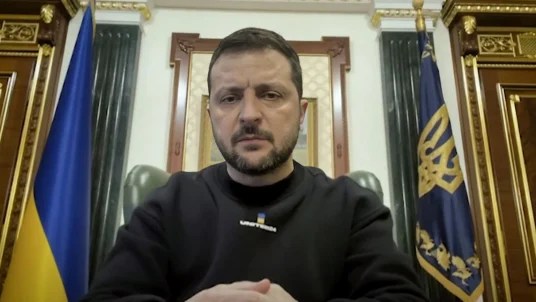
Zelensky regime leads request for social media platforms to censor “disinformation”
By Christina Maas | Reclaim The Net | April 1, 2023
Ukraine has spearheaded a collective call to action, joining forces with seven other Central and Eastern European nations to combat “disinformation” on social media platforms.
In an open letter, the prime ministers of these nations urge prominent tech companies, such as Meta, to implement effective measures that curb the spread of misleading content and foreign interference, which threatens peace, stability, and democracy.
The letter, signed by the leaders of Ukraine, Moldova, Poland, Czech Republic, Slovakia, Estonia, Latvia, and Lithuania, alleges a danger of disinformation campaigns aimed at destabilizing their countries and undermining the European Union‘s support for Ukraine amidst Russia’s aggression.
Tech giants are implored to remain vigilant and avoid inadvertently advancing hostile goals.
Specific steps recommended in the letter include refusing payments from sanctioned individuals, increasing algorithmic transparency, and adjusting algorithms to prioritize accuracy over user engagement.
Furthermore, the leaders insist that platforms dedicate adequate resources to content “moderation” and address the growing challenges posed by deep fakes and AI-generated disinformation.
In response, Meta has stated that it has expanded its fact-checking capabilities in Eastern Europe and implemented measures to combat alleged misinformation related to the conflict in Ukraine.
The company has also restricted access to Russian state-controlled media and added labels to related posts, informing users of the source before they click or share.
EU has abandoned peace and prosperity – Orban

Viktor Orban in Budapest, Hungary, March 27, 2023 © AP / Denes Erdos
RT | April 1, 2023
The EU has forsaken its goal of ensuring peace and prosperity for its members, Hungarian Prime Minister Viktor Orban declared on Friday. Warning that the bloc is considering sending troops into Ukraine, Orban insisted that Hungary will continue pushing for a ceasefire.
“Those who are pro-war have put the whole European Union in danger,” Orban told Radio Kossuth, referring to the ongoing efforts by EU member states to arm Kiev’s forces. To date, Brussels has supplied Kiev with just under $4 billion worth of arms, while individual member states have donated tanks, artillery, and in the case of Poland and Slovakia, fighter jets to Ukraine.
“We expect two things from the European Union; the first is to have lasting peace,” Orban continued. “The second thing we expect of the EU is that it should preserve the prosperity it has achieved, but in comparison war and sanctions are destroying the European economy.”
Energy costs and inflation have soared across the EU since Brussels embargoed Russian fossil fuels following the launch of Moscow’s military operation in Ukraine last February. This embargo and other sanctions have failed to cripple the Russian economy, as their proponents predicted. Instead, Russia’s economy is set to grow faster this year than that of Germany, according to IMF figures.
The prospect of global war is more urgent than the economic threat, Orban said. The Hungarian prime minister claimed in Friday’s interview that EU leaders were considering deploying a “peacekeeping” force to Ukraine. This, he argued, would be a catastrophic escalation.
“When European and American leaders say that if this continues, we could end up in a third world war, it seems incredibly exaggerated at first, but where I work and where I see the events, this is a real danger at this moment,” he said.
Former Russian President Dmitry Medvedev said on Friday that such a force would be Russia’s “direct enemies” and would be “ruthlessly destroyed” on the battlefield.
“Peace talks are not what we should be talking about now, but a ceasefire,” Orban said, explaining that hostilities must be suspended before a settlement can be worked out. Whatever happens in Ukraine, the prime minister stressed that Hungary would not get involved. “They want to squeeze us into this war,” he claimed, referring to EU leaders, but the question of “whether Hungary should take part in the war… or whether it should stay out can only be decided in one place, the Hungarian parliament.”
Facebook ‘disappears’ RT Arabic
RT | March 30, 2023
Mark Zuckerberg’s flagship social network has deleted the page for RT Arabic, rejecting all appeals and handing the address to another user, the channel’s head Maya Manna said on Thursday.
“Two weeks we fought with Facebook to restore the suspended page of RT Arabic, with 17 million subscribers,” Manna said on her Telegram channel. “We tried to get an explanation of what triggered the shutdown, because we never got any strikes or comments.”
After several awkward non-explanations, Facebook’s customer service “simply wished us luck, closed our case, and turned over the URL to another user,” Manna wrote. “Internet democracy in all its glory!”
Facebook blocked the page on March 15, without any explanation or advance warning. Attempts to access the page resulted in the message, “this content isn’t available right now.”
Manna protested the move, calling it proof that the West doesn’t believe in free speech, only “total censorship and blocking.” By way of example, she brought up the EU ban on all “Russian state media” after the military operation in Ukraine began in February 2022, including all of RT’s channels.
“Apparently, this is not enough – the very fact that we exist does not allow them to sleep peacefully,” Manna added.
YouTube was quick to apply the EU ban globally, but continued operating in Russia, its CEO at the time, Susan Wojcicki, told the World Economic Forum in Davos last May. The Ukraine conflict showed that information had “a key role” and “can be weaponized,” said Wojcicki, so YouTube wanted to “help [Russian] citizens know what’s going on and have perspectives from the outside world.”
In November last year, after Facebook’s parent company Meta amended its “violent speech” rules to allow calls of “death to Russians” in the West, the Russian Justice Ministry added it to the register of extremist organizations. The decision affected Facebook and Instagram, but not the messaging platform WhatsApp, because it fell under a different legal category.
THE ARRESTS MORE OR LESS REAL OF KHAN, TRUMP AND PUTIN: THE PANIC OF THE DEEP STATE
By Cesare Sacchetti | The Eye Of The Needle | March 26, 2023
The end of the last week was shaken by an unreal announcement. The ICC tribunal, which has its headquarters in The Hague, announced that it issued a warrant arrest against the President of Russia, Vladimir Putin.
For those who have not any familiarity with this court, it does not have any jurisdiction in Russia due to the simple fact that Russia never signed the treaty that instituted the ICC.
Moreover, the ICC does not have a good reputation at all. We are talking about the court that was illegally prosecuting, according to several jurists, former Serbian president, Slobodan Milosevic with the charge of genocide.
Milosevic was very close to getting an acquittal because he was demolishing the case against him in court. Unfortunately, he could not get one because he died in never clarified circumstances before the end of his trial.
Some observers hold The Hague accountable for his death because Milosevic could have unmasked years of lies spread by NATO against him.
Nevertheless, the ICC prosecutor, Kharim Khan, showed himself before the world press and claimed that Putin was “guilty” of having trafficked Ukrainian children to Russia.
For those who don’t know much about Ukraine before the current war, the truth is quite simple. Ukraine was a world children supermarket. People from every part of the world ordered organs that were harvested from the bodies of innocent Ukrainian children.
Certainly, we are not talking about ordinary people. We are talking about people who travel in private jets. People who attend the WEF and who preach about pseudo-environmentalism while they’re the first to breach the rules of the insane and dystopian world that they imagine.
Therefore, if there is someone here who is guilty of child trafficking that would be the Ukrainian establishment, which is completely corrupt and handled by the foreign puppeteers who installed it in power.
The Euromaidan coup that was defined by Stratfor (a think tank quite close to the US deep state) as the “most blatant coup in history” is the “best” example of how the Ukrainian establishment is fully dependent upon the Anglosphere.
And the ICC has been silent for years about this horrendous traffic. It has not been saying a word about it. So if the ICC is really seeking who is responsible for the abuses suffered by the Ukrainian children, it should look at itself in the mirror. This trafficking has been taking place on the ICC’s watch, which has never lifted a finger to put an end to it.
However, this grotesque and provocative move has nothing to do with juridical issues. As we will see later, this is a political move that is deeply connected with two other announced arrests: that of Donald Trump and the one of the former Pakistani PM, Imran Khan.
The bogus case against Trump
On Friday 17th, Trump announced on Truth Social that the NY’s DA office was planning to arrest him for the Stormy Daniels case.
Basically, the case is founded upon the quite shaky legal grounds that Trump allegedly paid hush money to a pornstar, Stormy Daniels, in order to keep her quiet about his alleged affair with her.
Firstly, we should give a brief introduction about the US legal system and its developments in the latest years.
As many readers probably already know, the DAs in the US are elective assignments. They usually run for the Democratic or the Republican Party and they receive funds for their campaigns. And in recent years, a magnate who has spent a lot of money for getting elected DAs is George Soros. Soros has a very particular type of DA in mind to fulfill his “open society”.
Soros’ idea of a DA is an official who does not prosecute crimes and who allows the streets of his city to be ruled by criminals. The Open Society is literally allowing the dregs of society to have a free hand in harassing, raping, stealing and killing honest citizens.
The globalist world is where everything is upside down and where good is bad and right is wrong.
Therefore, if you happen to live in one of the cities where Soros DAs were elected and you’re a good citizen, you could be in trouble.
As a law abiding citizen, you’re not part of the open society. And you’re even more in trouble if you have political ideas keen to the principles of loving your country and defending it from foreign and domestic enemies.
And this is certainly the case of Donald Trump, who’s the target of never-ending political witch hunts.
In this case, the Soros DA who’s persecuting Trump is Alvin Bragg. Bragg would like to indict Trump for the 130,000 $ of hush money allegedly paid to Daniels. Money that was allegedly transferred to former Trump attorney, Michael Cohen, who, in turn, gave it to Stormy Daniels.
This round of transactions would constitute a falsification of Trump’s business records, according to the NY’s DA. But there’s a problem with all this theory. It is crumbling under the proofs to the contrary that are emerging in these days.
We are talking about crucial exculpatory evidence here like the letter signed by Cohen in which he clearly states that Trump never paid or reimbursed him for the money that he had given to Stormy Daniels in the first place.
In a normal world, the case would have been closed but in Soros’ world, it is not. Bragg’s probe seems to be falling under the blows of this evidence and the Grand Jury that should decide to proceed or not with Trump’s indictment keeps being postponed.
And this is happening because everyone in the legal arena, including Trump’s enemies, knows that Bragg does not have a case, and if he keeps overplaying his hand, he could be the one ending up indicted for abuse of power and for hiding crucial evidence who would immediately exonerate Trump from this bogus probe.
Therefore, Trump’s arrest seems to be less likely as the days go by. Never in the history of the United States, have we seen a President persecuted like Donald Trump.
From the very first moment when he went down the escalator of Trump Tower, he became enemy number one for the deep state.
Immediately, those powers who ruled Washington for decades tried to bar his way to the White House.
They started with the Russiagate hoax, also known as Spygate, which is an international plot that sees involved also British and Italian secret services in order to frame Trump by falsely accusing him of being a “Russian agent”.
They did not stop there. They even tried to physically remove him from the White House with at least two assassination attempts in August 2020 and with another at Mar-a-Lago in January 2021.
They even tried to oust him with the 2020 election fraud, which could be defined as the most blatant electoral fraud in history. Not to mention two attempted and failed impeachments against him, which were both based on preposterous and false accusations.
A war machine was clearly put in motion. It is the machine of those secret powers that have ruled the United States for far too long. Powers that hijacked the history of this country in order to subvert foreign leaders who were not obeying the orders of NATO and of the Israeli lobby. Powers that harmed and killed so many Americans and many other people all around the world.
The American people elected Trump to halt the exploitation of the United States. American people were fed up with seeing their country used to fulfill a global agenda whose only purpose is to establish a world totalitarian government.
And Trump is the political leader who has incarnated that spirit – the spirit of making America great again and of freeing this nation from the chains of her enemies.
The Bragg probe is just the latest attempt of this war against Trump and the American people. Trump is just inches away from officially returning to the White House and, as a result, the deep state launched this bogus investigation. It is an investigation that remains unclear if it will lead to an indictment and an eventual arrest.
The system has a very weak hand and Trump knows it. Most likely, his announcement aimed to expose this plot even if its probabilities of success are very low.
Imran Khan: the man who the deep state wants dead
Someone who is also running the risk of being arrested is former Pakistani PM, Imran Khan. Khan denounced last year a plot that was hatched by NATO’s circles to oust him from power.
Khan was and still is a very dangerous threat for the US deep state powers. The Pakistani leader aimed to establish relations with BRICS and, by doing so, Pakistan would have left the Anglosphere.
If this would come to fruition, NATO would lose another key strategic country in Asia.
That’s why he was removed with a confidence vote that was heavily swayed by foreign influences. But Khan didn’t throw in the towel.
He kept fighting for Pakistan. He keeps gathering massive crowds at his rallies. For the deep state, the risk was too high. They tried to kill him and if Khan is alive today, it is only for the result of miraculous circumstances.
On Saturday 18th, the police stormed his residence. Khan is facing a trial in Islamabad where the charge is of having sold watches that he received as gifts when he was still in charge. It’s not known what is the evidence of this “crime” but this case seems to be quite weak as the one against President Trump.
Therefore, the Pakistani leader could have the opportunity to run at the next election scheduled for this coming October. It’s a nightmarish scenario for the Anglozionist powers because Pakistan would definitely shift towards the multipolar world.
However, there are still some traps set on the way and Khan knows it. This is why he urged his supporters not to engage in any kind of violence because he knows that Sharif, the current PM, is seeking a way to frame him.
So we can see how all these three attempted arrests are connected to each other. Trump, Putin and Khan belong to the international patriotic alliance that is fighting against the globalist side.
On the one hand, we have a side of leaders who are fighting to preserve the sovereignity of their countries. On the other, we have unelected powerful banking families like the Rothschilds who have been trying to destroy the independence and prosperity of every country in the world.
What we saw in the last 14 days is just the latest chapter of this current war between these two sides.
And the globalist side is being inflicted tremendous blows.
Only in this week, Putin received more than 40 African leaders in a conference about the multipolar world. And why he was attending this event, he also received the Chinese president, Xi Jinping.
The BRICS are changing the lines of international politics. The world is shifting from the rule of the Anglosphere empire towards the restoration of the national States.
When Xi Jinping states that the changes that Russia and China are driving are unprecedented in the last 100 years, he’s quite right.
Even Saudi Arabia, a country forged by British and Zionist powers, understood that things went south and restored diplomatic relationships with Iran.
The world is changing at a tremendous speed. We are moving from the old globalized and centralized world towards one when there are no ruling powers. The age of the empires has died. The age of the nations has begun again.
After the defeat of NATO in Ukraine, which is running out of ammunitions, we will have passed the point of no return. NATO’s crisis will be so deep to the point that it could dissolve itself.
At that point, the EU, the last frail bulwark of globalism will be encircled. The crisis of the European establishment will aggravate and people in the EU countries will demand the end of neoliberal austerity and the normalization of relations with Russia.
Italy still seems to be the ideal candidate to run this process considering the fact that she has the most euro skeptical and most pro-Russia people in Europe.
And this is a perspective that scares a lot of members of both the Italian and EU deep state.
The old world of despotism is dying. The new world of free nations is being created.
We are certainly living in one of the most exciting and important times in history.
Featured Video

Iran FM Araghchi: “Hormuz Will No Longer Be the Same”
or go to
Aletho News Archives – Video-Images
From the Archives
Sam Husseini: The entire US establishment helped lie their way into the Iraq war
By Slava Zilber | American Herald Tribune | October 14, 2019
Sam Husseini is a senior analyst with the Institute for Public Accuracy, independent journalist and contributor to The Nation and FAIR.
Slava Zilber: Sam, three years ago, you appeared on Talk Nation Radio with David Swanson and spoke about the case of the GCHQ whistleblower Katharine Gun. You pointed out that the people involved in the spying on the UN and the people authorizing the Iraq War were not held accountable:
“Virtually everybody who went along with the war, whether it is Kerry or Clinton, of course, the Bush administration themselves has falsified their own records in terms of why, what they did, when they did, why they did it, to the extent that they’ve been scrutinised at all.”
You also address it in a recent article. And recently, Joe Biden has been lying about his position on the Iraq War. How can such an important issue escape meaningful scrutiny? … continue
Blog Roll
 Aletho News
- Oman FM: Persian Gulf states, Iran, Iraq should form security pact excluding US
- Trump peddles fresh falsehoods, claims Iran ‘started the war’ as US aggression drags on
- Ukraine quagmire? Yes, but it’s for NATO, not Russia
- US intelligence hypes Chinese, Russian space threats while accelerating its own military buildup in orbit
- Iran FM Araghchi: “Hormuz Will No Longer Be the Same”
- EU facing trillion-euro debt hole while seeking more cash for Kiev
- How US, Europe, Persian Gulf states exhausted missile stockpiles, splurged billions to defend Israel
- Up in arms… Koreans reject U.S. empire’s plan to make South Korea the next Ukraine
- Iran, Turkey, Pakistan, Saudi Arabia could advance region-led security framework in Tehran: FM spox
- Netizens condemn Japanese drama for projecting Japan’s wartime atrocities onto Chinese characters
- If Americans Knew
- An error has occurred; the feed is probably down. Try again later.
- No Tricks Zone
- Sudden Stratospheric Warming, Powerful El Niño Combination May Lead To Extreme Europe Cold, Energy Crisis!
- Two New Studies Find Thwaites Glacier Melt Cannot Be Driven By Human Activity Or A Warming Ocean
- E-Cars Reduce CO2 Emissions By Only 41% Compared To Internal Combustion Engine Vehicles
- Predictions Made By Renowned Climate Professor Over Past Decades Have Been Proven To Be Poor
- New Study Suggests Large Regions Of The Pacific Ocean Have Been Cooling For The Last 80 Years
- Germany’s Green Energy Debacle: High Energy Costs Force Kahla Porzellan to Close After 182 Years!
- New Study: 50 Years Of The Most Aggressive ‘Net Zero’ Policies Can Only Affect The Global Climate By 0.03°C
- US September “Heat” Was No Record…Many Records Set Decades Ago
- Latest European Green Energy Debacle; Portugal’s Largest Flagship Solar Park Insolvent!
- Green Energy Debacle: German Expert Professor Fritz Vahrenholt Warns Of Severe Economic And Social Consequences

