Davos and Abu Dhabi: How the Ukrainian Endgame Exposed Western Decline
By Ricardo Martins – New Eastern Outlook – January 28, 2026
While Russia, the United States, and Ukraine quietly negotiated in Abu Dhabi, Davos revealed Europe’s real position in the emerging world order: excluded from decision-making yet burdened with the costs of war and peace alike.
The 2026 World Economic Forum in Davos will likely be remembered less as a forum for global coordination than as a public autopsy of the Western-led international order.
What emerged in the Alpine setting was not coherence but fragmentation: rhetorical excess, strategic confusion, and an unmistakable sense that the world has already moved beyond the frameworks still defended—often ritualistically—by Euro-Atlantic elites.
Three speeches captured this moment with particular clarity: those of Volodymyr Zelensky, Mark Carney, and, less noticed but arguably most consequential, Chinese Vice-Premier Ding Xuexiang (represented in the Davos debate through He Lifeng’s economic message).
Zelensky and the Public Humiliation of Europe
President Volodymyr Zelensky’s speech was striking not only for its confrontational tone but also for its intended audience. His criticism was not primarily directed at Russia or even the United States, but bluntly at Europe. He accused the European Union of strategic indecision, military weakness, and an inability to guarantee Ukraine’s security, reiterating that Europe “still does not know how to defend itself” and remains structurally dependent on Washington.
Mocking Europe’s symbolic troop deployments to Greenland and its delayed reactions to crises such as Iran reinforced Zelensky’s humiliation of Europe.
This rhetoric can be understood as a final reckoning — an all-or-nothing move in which he burned all bridges and launched a frontal attack without regard for the consequences. By Davos, Kyiv was already aware that negotiations over the territorial concessions of the war were being discussed in Abu Dhabi between the United States, Russia, and Ukraine without European participation.
Zelensky’s speech thus functioned as political coercion aimed at Europe as the remaining actor capable of paying the price of a settlement. By publicly framing Europe as weak and morally indebted, Zelensky attempted to transform guilt into leverage in the final phase of negotiations.
This interpretation is reinforced by reporting in the Financial Times, which revealed that Ukraine’s willingness to consider territorial concessions is conditional upon accelerated EU membership, potentially by 2027. In domestic political terms, this trade-off allows Zelensky to reframe territorial loss as civilisational gain: Ukraine does not lose land; it “joins Europe.”
The bill, however, is addressed to Brussels.
Europe’s Astonishing Response
The European reaction to Zelensky’s speech in Davos bordered on political self-abnegation. Despite being publicly criticised, European Commission President Ursula von der Leyen praised Ukraine’s “heroic struggle” and emphasised Europe’s material commitment rather than responding to the substance of Zelensky’s accusations.
This asymmetry—verbal humiliation met with renewed rhetorical loyalty—reveals a deeper structural problem: Europe’s inability to translate financial power into strategic agency.
Dissent has nevertheless emerged at the national level. Italian politicians, including Rossano Sasso and Matteo Salvini, openly criticised Zelensky’s “ungrateful” tone and questioned continued military and financial support.
Such reactions reflect mounting domestic pressures linked to inflation, energy costs, and war fatigue, documented extensively by Politico and the Kiel Institute.
Yet these voices remain fragmented, and Europe as a collective actor continues to display what can only be described as strategic paralysis.
Mark Carney and the End of the Rules-Based Illusion
If Zelensky exposed Europe’s weakness, Mark Carney articulated its anxiety. His Davos speech openly acknowledged what had long been implicit: the so-called “rules-based international order” is no longer operative—and perhaps never was. Carney framed the current moment as a rupture, arguing that “middle powers” such as Canada and European states must now navigate a world no longer structured by predictable norms but by power, leverage, and economic scale.
Carney’s concept of “value-based realism” deserves close scrutiny. On the surface, it appears as an attempt to reconcile normative language with geopolitical adaptation. In substance, however, it represents an effort to preserve Western managerial influence within a system that has already shifted towards multipolarity. Sovereignty, in Carney’s formulation, is diluted into “managed multipolarity,” administered by the same financial and institutional elites that dominated the previous order.
This is precisely why his discourse fails to resonate in the Global South. For emerging powers—particularly within BRICS—the collapse of the Western order is not a tragedy to be managed but a long-awaited correction. Carney’s speech, far from acknowledging this, sought to repackage decline as stewardship.
That it reportedly irritated Donald Trump is unsurprising: Carney implicitly rejected American unilateralism while simultaneously refusing genuine systemic change.
China and the Silent Centre of Gravity
The most consequential intervention in Davos was arguably not Western at all. Chinese Vice-Premier He Lifeng articulated Beijing’s strategic priority with remarkable clarity: China is positioning itself to become the world’s largest consumer market, making access to Chinese demand the central axis of future global trade.
This message, echoed by analysts such as Pepe Escobar, signals a structural shift in the global economy: dependence is moving eastward.
Unlike Carney’s rhetorical manoeuvres, China’s position was grounded in material capacity: industrial scale, domestic demand, and long-term planning. For much of the Global South, this represents opportunity rather than threat. For Europe, however, it underscores marginalisation.
Abu Dhabi Decides, Europe Pays
The trilateral talks in Abu Dhabi marked a geopolitical turning point. While Europe has committed close to €200 billion in support to Ukraine, it was excluded from negotiations shaping the war’s end.
This exclusion is not accidental. Both Washington and Moscow increasingly view Brussels as incapable of strategic compromise, bound instead by ideological rigidity and proceduralism.
Europe thus faces a brutal dilemma: continue financing a war it does not control, or finance a peace settlement that fundamentally alters the EU through accelerated Ukrainian accession. Neither option strengthens European sovereignty.
Granting Ukraine some lite-sort of membership by 2027—without completed accession chapters—would transform the EU’s budgetary, agricultural, and cohesion policies overnight. Yet postponement risks indefinite financial haemorrhage. As the Financial Times and Reuters have noted, peace may ultimately be cheaper than perpetual war, even if politically uncomfortable.
Conclusion: Europe as the Weakest Link
Davos revealed a system speaking past itself. Zelensky spoke from desperation and tactical clarity. Carney spoke from elite anxiety. China spoke from structural confidence. Europe, by contrast, spoke in platitudes.
The irony is stark. Europe funds Ukraine, absorbs the economic shock, and bears the political consequences—yet is excluded from decision-making. In Abu Dhabi, values were absent, and strategy was outsourced. When the deal is announced, Europe may discover it was not a negotiator, but a guarantor of last resort.
The tragedy is not merely Europe’s weakness, but its refusal to acknowledge it.
Ricardo Martins is a Doctor in Sociology with specialisation in geopolitics and international relations.
Follow new articles on our Telegram channel
G7 Hands Ukraine $40Bln Generated From Frozen Russian Assets
Sputnik – 28.01.2026
The G7 issued $37.9 billion in loans to Ukraine in 2025 using income from Russian assets, which is more than 70% of foreign financing for the Ukrainian budget, Sputnik’s calculations revealed on Wednesday.
Under a 2024 G7 plan, a $50 billion loan for Ukraine was approved, funded by proceeds from frozen Russian assets. As of December 31, 2025, $38.9 billion of this sum had already been allocated.
At the end of 2024, the United States was the first to transfer $1 billion, but since then, no further payments have been reported. The EU was the largest contributor to the scheme, providing Ukraine with $21.1 billion in loans. The remaining funds came from Canada, the UK, and Japan.
Apart from the G7 loan, Ukraine was handed an additional $12.1 billion from the EU, $454 million from Japan, $912 million from the International Monetary Fund, and $733 million from the World Bank in 2025.
In total, the Ukrainian budget raked in $52.1 billion from foreign creditors last year, 73% of which came from the G7 loan.
With the start of Russia’s military operation in Ukraine in 2022, EU and G7 members froze nearly half of Russia’s foreign currency reserves, totaling approximately 300 billion euros ($360 billion). Around 200 billion euros in frozen Russian assets are held in European accounts, primarily at the Belgium-based securities depository Euroclear. The European Commission has been pressing EU members for the green light to use these frozen Russian assets to bankroll Kiev’s war machine.
The Kremlin has cautioned that any attempts to confiscate Russian assets would amount to theft and be in violation of international law.
Following a summit in Brussels on December 19, 2025, the EU opted to abandon its plans temporarily to seize Russian state assets and instead agreed to extend a 90-billion-euro loan to Ukraine from the EU budget. However, Hungary, Slovakia, and the Czech Republic refused to shoulder any responsibility for the loan.
Ukraine expects to join EU next year – Zelensky
RT | January 27, 2026
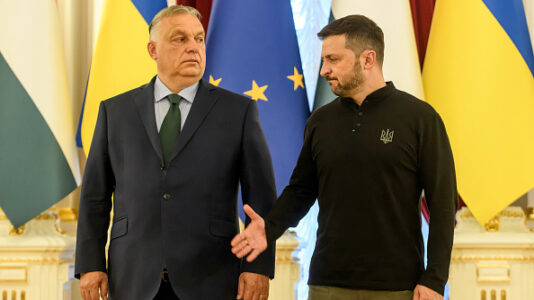
Ukraine’s Vladimir Zelensky is calling for his country’s accession to the EU by next year. The idea has already raised hackles among some member nations.
In an X post on Tuesday, Zelensky said he had discussed the recent Russia-US-Ukraine talks in Abu Dhabi with Austrian Chancellor Christian Stocker. The negotiations primarily focused on military matters, but also touched on security guarantees, he said.
“Ukraine’s accession to the European Union is one of the key security guarantees not only for us, but also for all of Europe,” he wrote. “That is why we are speaking about a concrete date – 2027 – and we count on partners’ support for our position.”
Just days earlier, Stocker told the press that he opposed rushing Ukraine’s bid.
“I’m not a fan of the fast lane. The admission criteria must be met,” he said, adding that the “conditions should be the same for everyone.”
Fast-tracked membership for Ukraine is reportedly part of a US-backed $800 billion reconstruction ‘prosperity’ plan that was privately circulated to EU member states by the European Commission last week.
The document gave EU leaders pause due to the way it formally linked Ukraine’s accession to its reconstruction process, rather than due to its massive cost, according to Politico.
Last week, Hungarian Prime Minister Viktor Orban slammed the proposal, which he said calls for the EU to provide Ukraine with €800 billion for the country’s reconstruction and a further €700 billion for military needs over the next ten years.
“Hear me now, loud & clear: Hungary will NOT pay for this,” he wrote on X.
He has also nixed the idea of letting Ukraine join the EU, arguing that no Hungarian parliament would vote for accession “in the next hundred years.”
Orban has long stood against Ukraine’s bid, arguing that accession would put the bloc at risk of direct confrontation with Russia.
Moscow has long said that it is not opposed to Ukraine joining the EU. However, Kiev’s ambition to join NATO is a red line and one of the core causes of the current conflict, according to Russia.
Here’s what’s behind the US shift on EU allies
The age of institutions is ending, the age of force is back
By Fyodor Lukyanov | Russia in Global Affairs | January 27, 2026
Even invoking international law has become awkward. Institutions look increasingly irrelevant as political and economic processes unfold demonstrably outside them.
This reaction is understandable. The latest targets of actions that violate the UN Charter and other legal norms are leading Western states, the very countries that dominate the global information space. When similar violations affected others in the past, they were treated as regrettable but secondary. The blame was placed on the moral or political shortcomings of the countries involved, including the victims, rather than on a systemic crisis.
Now the system itself is visibly eroding.
The United States has not only discarded conventions; it has begun applying this approach to its own allies. These are partners with whom it once negotiated as equals, or at least as trusted dependents. Decisions are made as if by divine mandate. The result has been consternation in Western Europe and even accusations of betrayal.
Washington is dismantling the world order it once built and led, an order many already regarded as flawed. Since transatlantic ties formed the backbone of the liberal international system, revising them has become a priority for the United States.
After the Cold War, the balance of power was clear. The US and its allies exercised dominance, enforced a single set of rules, and extracted the political and economic “rent” that came with global leadership. But shifts in global power and structural problems in the capitalist system have reduced those benefits while increasing the costs of maintaining hegemony.
The Biden administration represented a final attempt to repair the old model. Its goal was to recreate an ideologically unified and politically invincible West capable of leading the rest of the world – through persuasion when possible, coercion when necessary. That effort failed.
The new slogan is “peace through strength,” paired with “America First.” This approach is now enshrined in key doctrinal documents, including the National Security Strategy and the National Defense Strategy. Power – not only military, but financial, technological and political – is placed at the center of policy. The only real constraint is America’s own capacity.
If the previous era was described as a “rules-based order,” the new one might be called a “precedent-based order.” Actions create precedents, and those precedents justify further actions. However, these precedents apply primarily to the United States. Others may behave similarly only when it suits Washington’s interests. The right of other states to act “the American way” is not rejected in principle, but it is tolerated only when they are strong enough and do not challenge US priorities.
This logic extends to allies, who now find themselves in an especially uncomfortable position. Under the previous system, they benefited greatly from American patronage. Chief among these benefits was the ability to minimize their own strategic spending by delegating responsibility to the United States. Washington encouraged this arrangement because it supported the functioning of the global order it led.
Today, what was once portrayed as mutually beneficial partnership is increasingly viewed in the US as an unprofitable subsidy. Washington wants to recover past costs and avoid future burdens. This abrupt shift has shocked its allies, but from a strictly material perspective, the reasoning is not irrational. Even a future change of administration is unlikely to reverse this basic reassessment of alliances.
Against this background, the Board of Peace solemnly announced in Davos can easily be dismissed as Donald Trump’s personal ornament. Yet it is revealing. In a world defined by power, those who lack it must compensate by offering something to those who have it.
The most effective offering is financial tribute, hence the billion-dollar contributions. If that is too costly, enthusiastic displays of loyalty may suffice. Membership in such a body appears to function as a form of political insurance: protection from the chairman’s displeasure.
For large, independent powers, participation is almost impossible. A structure in which rights are explicitly limited by the founder’s will, and where procedures remain unclear, contradicts the very idea of sovereignty. Whether or not the Council works in practice is secondary. Its symbolic meaning is clear: recognition of the White House’s supremacy.
The Trump administration understands that the world has changed and is searching for ways to preserve, or even expand, American advantages. Other major players in the emerging multipolar order must do the same, but in their own interests and according to their own logic.
If Washington openly advocates rational egoism grounded in power, others have little reason not to draw their own conclusions.
Fyodor Lukyanov is the editor-in-chief of Russia in Global Affairs, chairman of the Presidium of the Council on Foreign and Defense Policy, and research director of the Valdai International Discussion Club.
France and EU clash over UK missiles for Ukraine – Telegraph
RT | January 27, 2026
France has clashed with several EU nations over a proposal that would allow Ukraine to use an EU-backed loan to buy British Storm Shadow missiles, The Telegraph reported on Monday, citing diplomatic sources. Paris has consistently pushed for preferential treatment for the EU’s military industry on procurements destined for Kiev.
In December, EU leaders approved a €90 billion ($107 billion) loan to cover Kiev’s military needs and budgetary gap, with spending rules that prioritize EU-made weapons before allowing purchases from outside the bloc. According to The Telegraph, a coalition of 11 capitals has now proposed loosening the rule so Ukraine can more easily buy weapons such as Britain’s long-range Storm Shadow cruise missiles, which are in short supply.
France, however, has emerged as an “obvious opponent” to the plan, a diplomatic source told the newspaper. The outlet noted that Paris is the center of the EU’s drive for “strategic autonomy” amid concerns about overreliance on US defense after a rift with Washington over its controversial push to acquire Greenland.
Under the current design of the €90 billion loan, spending on weapons would follow a four-layer procurement cascade that prioritizes Ukrainian producers first, then EU defense firms, followed by partner countries such as the UK, with suppliers outside Europe – including the US – treated as a last resort, according to the article. Ukrainian officials have reportedly estimated that around €24 billion of equipment this year will have to come from suppliers outside the EU.
A diplomatic source told The Telegraph that the aim of Britain and its partners was to keep the system “open enough for the UK” to ensure that reaching the third layer of the cascade “is not so hard.”
NATO Secretary-General Mark Rutte earlier warned that the EU loan should not be constrained by “buy European” rules, while acknowledging the bloc “cannot fully supply everything Ukraine needs to defend itself today and deter tomorrow.”
Moscow has condemned Western arms supplies as prolonging the conflict, while Russian Foreign Ministry spokeswoman Maria Zakharova has suggested that the €30 billion portion of the EU loan earmarked for Ukraine’s budget support would be embezzled by local officials.
EU member to sue bloc over ‘suicidal’ ban on Russian gas
RT | January 27, 2026
Slovakia will sue the EU over the bloc’s decision to entirely ban the import of Russian gas by late 2027, Slovak Prime Minister Robert Fico said on Tuesday. He branded Brussels’ move “energy suicide.”
A day earlier, the member nations voted to give their final approval to the REPowerEU regulation, as part of an effort to gradually phase out imports of natural gas from Russia by November of next year.
“We will file a lawsuit against this regulation at the Court of Justice of the EU,” Fico said at a press conference, calling the looming ban the finalization of the bloc’s “energy suicide.”
“It is a solution that was adopted solely out of hatred towards the Russian Federation. I reject hatred as a trait that should determine international relations,” he added.
The EU vote was approved by a qualified majority to bypass the need for unanimous approval in a way that contravened the core treaties of the bloc. The commission knew that if unanimity was required, such nonsense could not pass.
Slovakia and Hungary will lodge separate lawsuits but coordinate their positions further, Fico said.
According to Budapest, the vote was specifically run in such a way as to bypass Hungary’s and Slovakia’s opposition on a matter that pertains to their national interests.
EU divided over phasing out Russian energy
“The REPowerEU plan is based on a legal trick, presenting a sanctions measure as a trade policy decision in order to avoid unanimity… The [EU] Treaties are clear: decisions on the energy mix are a national competence,” Hungarian Foreign Minister Peter Szijjarto wrote on X shortly after the vote.
EU moves to cut off Russian gas – who will pay the price?READ MORE: EU moves to cut off Russian gas – who will pay the price?
Both Hungary and Slovakia, which are heavily dependent on Russian energy supplies, have previously warned that they could sue if Brussels plows ahead with the REPowerEU plan.
Moscow has warned that the bloc is essentially giving up its freedom by banning all Russian gas imports.
“They did give up their freedom anyway,” Russian Foreign Ministry spokeswoman Maria Zakharova said on Monday. “Time will tell” whether EU member nations will be “happy vassals or miserable slaves,” she said.
New US defense strategy downgrades Russian ‘threat’
RT | January 26, 2026
The Pentagon has downgraded the alleged threat level from Russia in its newly released US National Defense Strategy.
A similar document issued under the previous administration of President Joe Biden in October 2022, less than a year after the escalation of the Ukraine conflict, described Moscow as an “acute threat.”
But the updated defense strategy, published by the War Department on Friday, referred to Russia as “a persistent but manageable threat to NATO’s eastern members for the foreseeable future.”
The document also stressed that Moscow “possesses the world’s largest nuclear arsenal, which it continues to modernize and diversify, as well as undersea, space, and cyber capabilities that it could employ against the US Homeland.”
It said the fighting between Moscow and Kiev has proven that Russia “retains deep reservoirs of military and industrial power,” as well as “national resolve required to sustain a protracted war in its near abroad.”
However, according to the Pentagon’s assessment, Moscow is “in no position to make a bid for European hegemony. European NATO dwarfs Russia in economic scale, population, and, thus, latent military power.”
The document said that the US will “continue to play a vital role in NATO” and “remain engaged in Europe,” but from now on it will “prioritize defending the US Homeland and deterring China,” echoing the White House National Security Strategy published in October.
Despite Europe having “a smaller and decreasing share of global economic power,” NATO members on the continent are “strongly positioned to take primary responsibility for Europe’s conventional defense, with critical but more limited US support,” according to the strategy.
The EU and UK should also be “taking the lead in supporting Ukraine’s defense,” the Pentagon stressed. It also reiterated the stance of US President Donald Trump that the conflict between Moscow and Kiev “must end.”
Russian President Vladimir Putin opined last October that the Trump administration is guided by American interests, which he called a “rational approach.”
“Russia also reserves the right to be guided by our national interests. One of which, incidentally, is the restoration of full-fledged relations with the United States,” he stressed.
EU turns to India for defense cooperation as US ties fracture
The Cradle | January 26, 2026
The EU and India are set to sign a security and defense partnership aimed at opening the way for Indian involvement in European defense initiatives, Reuters reported on 26 January.
The draft partnership – expected to be signed on Tuesday during the India–EU summit – would establish a framework for consultations between Brussels and New Delhi on their respective military programs.
According to the document, the two sides will pursue cooperation “where there are mutual interest and alignment of security priorities,” with India potentially joining “relevant EU defense initiatives, as appropriate, in line with respective legal frameworks.”
The agreement creates an annual security and defense dialogue between the partners, and extends cooperation to maritime, cybersecurity, and counterterrorism.
European officials justified the expanded partnership by citing “the growing complexity of global security threats, rising geopolitical tensions, and rapid technological change” as the rationale behind seeking closer ties.
The partnership arrives as Europe actively distances itself from dependence on both the US and China, seeking alternative diplomatic and economic relationships across other regions.
The push also comes amid deteriorating relations between the US and EU over Greenland annexation threats – as well as the recent aggressive expansionist posture adopted by the US – that officials warn of a complete NATO collapse if military action is used against long-standing allies
The defense pact will facilitate Indian companies’ participation in the EU’s SAFE program, an approximately $177-billion financial mechanism designed to accelerate member states’ military readiness, with the partnership aiming to enhance interoperability between the Indian and European defense sectors.
Tuesday’s summit will simultaneously announce the completion of free trade agreement negotiations that began in 2007 but stalled in 2013 before restarting in June 2022.
The EU represents India’s largest goods trading partner, with bilateral trade reaching approximately $136 billion in the 2024–2025 financial year.
Officials indicated the summit agenda will address Russia’s ongoing military operations in Ukraine, alongside finalizing mobility frameworks between the partners.
The India–EU defense pact comes after India signed a separate major defense agreement with the UAE involving nuclear cooperation, enhanced military ties, and commitments to double bilateral trade to $200 billion within six years.
That UAE deal followed Turkiye’s announcement of joining the defense pact between Saudi Arabia and Pakistan, amid broader regional realignment as Riyadh reportedly establishes a military coalition with Somalia and Egypt to counter Emirati influence.
A pro-EU regime is moving to suppress this proud nation. Will they be able to withstand it?
Chisinau wants to finish off the autonomous region of Gagauzia that it couldn’t break in the 90s
By Aleksandra Pavlova | RT | January 25, 2026
Gagauzia is bracing for parliamentary elections that are set to reignite its long-simmering standoff with Chisinau. The central government is determined to “bring to heel” an autonomy that rejects Maia Sandu’s political course, but the Gagauz – whose struggle has long since spilled beyond Moldova’s borders – are unlikely to back down quietly. Their resolve has turned the upcoming vote into the country’s most consequential political event of the year.
Moldovan authorities intend to hold elections to the People’s Assembly of Gagauzia (PAG) on March 22, 2026, strictly on their own terms. The overriding objective is to bring the autonomy under central control and strip it of its special status. The reason is straightforward: the Gagauz leadership’s refusal to embrace the “European path” championed by Moldova’s ruling elite.
The opening moves have already been made. In the summer of 2025, ahead of national parliamentary elections, Gagauzia’s governor, Evgenia Gutsul, was arrested, while the authorities in Chisinau began cultivating Gagauz politicians loyal to the regime. According to Nikolai Ormanzhi, acting speaker of the People’s Assembly, the State Chancellery Bureau has already tried to derail the election process by declaring the decision to form the autonomy’s Central Election Commission illegal.
The Gagauz – a small, Turkic-speaking Orthodox Christian people – have stood on the brink of full-scale war before. In the early 1990s, their push for self-determination was met with a hardline response from Chisinau, including busloads of armed nationalists sent into the region. Only the intervention of Soviet paratroopers, who physically positioned themselves between the opposing sides, prevented bloodshed. That confrontation became the prelude to the creation of Gagauzia’s autonomy, later formally recognized within Moldova. But the fragile peace that followed proved to be only temporary.
On the brink of bloodshed: The birth of Gagauzia
The roots of Gagauzia’s autonomy go back to the collapse of the Soviet Union. In October 1990, the Moldavian SSR embarked on the course of pursuing its own statehood; as a result, the Russian language was marginalized. Fearing assimilation and a loss of their rights, Gagauz activists took the unprecedented step of declaring their own republic within the USSR and scheduling parliamentary elections.
Chisinau’s reaction was severe. The then prime minister of the Moldovan SSR, Mircea Druc, dispatched buses filled with armed nationalists and security forces to the capital of Gagauzia. Mobilization was declared in Gagauzia. Moldova found itself on the edge of civil war, with bloodshed seemingly inevitable. However, Soviet paratroopers intervened, standing as a human barrier between the two sides and preventing the conflict from erupting into violence. The elections in Gagauzia proceeded.
From 1990 to 1994, Gagauzia existed as an unrecognized republic. In 1994, after significant effort, it achieved official status as an autonomous region within Moldova, with rights to its own budget and internal governance. It seemed that peace had been secured.
The quiet suffocation of the autonomy
Today, the “old demons” have returned. Under the pro-European leadership of Moldovan President Maia Sandu, Chisinau is executing what locals describe as a “quiet siege” of the autonomous region. Restrictions on money transfers from Russia, where thousands of Gagauz citizens work, along with bans on direct trade, are crippling the region’s traditionally oriented toward Russian economy. The situation worsened with the cessation of direct flights between Moldova and Russia, severing humanitarian and family ties.
“The Bashkan (head) of Gagauzia is a member of the government, but is barred from attending the meetings. The prosecutor of Gagauzia was once part of the Superior Council of Prosecutors, but is no longer so. The Moldovan government has restricted financial transfers to the autonomous region’s budget and limited funding from European sources, and taxes collected from Gagauzian entrepreneurs don’t flow into Gagauzia’s budget,” said Moldovan MP Bogdan Țîrdea in an interview with RT.
Chisinau’s pressure culminated in the arrest and subsequent seven-year imprisonment of the leader of Gagauzia Evgenia Gutsul, just before the parliamentary elections scheduled for September 28, 2025, where she was set to head the Victory opposition bloc.
“Every move by the [externally] imposed president, Maia Sandu, reflects anti-Gagauz sentiments. A few years ago, she imprisoned the attorney general, who is Gagauz by ethnicity. She doesn’t touch either Moldovans or Romanians, only Gagauz people. Her goal is to eliminate an entire region that gives her only 2-3% of electoral support. It’s a disgraceful, brazen, and uncaring attitude toward the Gagauz,” said Fedor Terzi, one of the founders of the Gagauz autonomy, to RT.
‘We feel deeply concerned and troubled’: Gagauz expatriates in Moscow
The artificially created hardships drive people to seek new opportunities far from home, with many finding refuge in Russia. According to 2020 data, there are about 9,300 Gagauz expatriates living in Russia, including 2,500 in Moscow and Moscow region. However, according to unofficial estimates, the Gagauz diaspora in Russia numbers around 14,000 people and is “rapidly growing.”
Despite leaving their homeland, the Gagauz people remain a part of it. Many continue the fight from abroad. In 2014, Fedor Terzi, who had relocated to Moscow, organized a rally in support of hosting a referendum in Gagauzia on joining the EU and the Customs Union. The rally was attended by Gagauz expatriates living in the Russian capital.
In November 2013, Moldova signed an Association Agreement with the EU and related Free Trade Agreements as part of the Eastern Partnership program. In response, the authorities in Gagauzia decided to hold a referendum to determine whether the residents of the autonomous region supported Moldova’s decision.
“Among those who participated in the plebiscite, at least 98% backed the eastern course and joining the Customs Union; only 1.5% opposed it. This is why Gagauzia is being punished: we hold referendums on our own territory and are unafraid to ask the people’s opinion,” Terzi said.
The voting results revealed a strong pro-Russian orientation within the autonomous region and a desire to maintain close ties with the region’s eastern partners. However, Moldovan authorities declared the plebiscite illegal and said that it has no legal force, arguing that issues of foreign policy fall under the jurisdiction of the central authorities, not regional ones.
“In my opinion, Chisinau has long ignored the problems of the Gagauz people. Recent events have only exacerbated tensions. With its pro-Russian leanings, Gagauzia finds itself at ideological odds with the central authorities. Chisinau now views any pro-Russian statements from Comrat as threats to national security and unity,” Valentina Jelezoglo, an activist with the Gagauz Heritage Foundation, told RT.
Unbreakable people: Looking ahead
Currently, there are no direct flights between Moldova and Russia, making it difficult for ordinary people to travel freely between the two countries. They face high costs and must take roundabout routes. Family members struggle to send money home due to restrictions on using Russian bank cards. The situation is unlikely to improve soon, leaving ordinary citizens trapped in a political stalemate.
Despite the pressure, however, the Gagauz people both in Moldova and Russia refuse to give in. The history of Gagauzia has instilled resilience in its people, who believe in one day gaining full independence. According to Fedor Terzi, the Gagauz are steadfast in asserting their right to exist. “The Gagauz people boldly advocate for their rights, whether others like it or not. They don’t break, kneel, or compromise their principles. I truly believe there is a future [for us]. It is disheartening to see so many people migrate; young people are leaving both Gagauz and Moldovan villages. This situation has been created artificially. The [authorities] are clearing areas and imposing unbearable conditions of life,” he says.
“The most important thing we can convey is the sense of connection. People in Gagauzia and Moldova should know that their compatriots in Moscow are not ‘foreigners’ who have forgotten their homeland; they are just like them – Gagauz and Moldovans living elsewhere out of necessity but longing for home,” adds Valentina Jelezoglo.
The struggle of the Gagauz people today is not about territory. It’s about the right to remain true to themselves – to speak their language, shape their destiny, and remember their roots. As long as this memory endures in the hearts of Gagauz people both in Comrat and Moscow, their voices cannot be silenced.
Orban Hits Out at EU Green Light for $1.5 Trillion Ukraine Aid
RT | January 23, 2026
EU leaders will plunge member states further into debt if they back programs worth $1.5 trillion to cover Ukraine’s expenses, Hungarian Prime Minister Viktor Orban warned on Friday.
Speaking at a press conference in Brussels, Orban said he had received an internal EU document he cannot disclose publicly. Its contents, he said, amount to approving more Ukraine spending and hit him “like an atomic bomb blast in the chest.”
“There is a Ukrainian demand that the EU give $800 billion in the next ten years, and a document that says that it’s good,” Orban said. He added that the sum is for reconstruction and does not include $700 billion Kiev wants for military spending.
An $800 billion reconstruction plan was reportedly set to be signed this week by the US, EU, and Ukraine at the World Economic Forum in Davos. But the event was overshadowed by US President Donald Trump’s push to acquire Greenland and the launch of his ‘Board of Peace’.
The reconstruction deal was reportedly postponed, leading Ukraine’s Vladimir Zelensky to cancel his Davos trip – only to reverse course and travel there after Trump said the two would meet soon.
Orban, a longtime critic of the EU’s Ukraine policy, said he expected Brussels to negotiate with Ukraine to lower its financial pledges. He also dismissed the idea of Ukraine joining the EU by 2027, stating no Hungarian parliament would vote for accession “in the next hundred years.”
Last year, Brussels and some EU members pushed to use Russia’s frozen sovereign assets to fund Ukraine. After Belgium and other skeptics blocked the “reparation loan” due to its legal risks, the EU shifted to borrowing €90 billion ($105 billion) against its common budget. Hungary, Slovakia and the Czech Republic opted out.
European leaders’ shift in their Davos addresses exposes Europe’s strategic anxiety
Global Times | January 21, 2026
The World Economic Forum (WEF) annual meeting recently kicked off in the Swiss resort city of Davos. This year’s forum took place amid rare transatlantic tensions triggered by the US intention to acquire Greenland. The focus of European leaders’ speeches pivoted noticeably from global economic issues to geopolitics, reflecting Europe’s deepening strategic anxiety amid structural contradictions with the US.
French President Emmanuel Macron said the EU should not bend to “the law of the strongest,” while Belgium’s Prime Minister Bart De Wever said the bloc was “at a crossroads” where it must decide on how to get out of a “very bad position” after trying to appease Trump. Even European Commission President Ursula von der Leyen highlighted the “geopolitical shocks” and “a dangerous downward spiral” brought by the US.
“The forum sends a clear political signal of Europe’s growing strategic awakening,” Zhao Junjie, a senior research fellow at the Institute of European Studies at the Chinese Academy of Social Sciences, told the Global Times on Wednesday.
The maximum pressure exerted by the US on the Greenland issue has shaken the long-standing value consensus between Europe and the US. Its unilateral and bullying actions have triggered strong fear and anxiety across Europe, which is a key reason for the heightened emotions and intense reactions toward the US among European representatives at this year’s forum.
The statements made by European leaders at the forum appear to have demonstrated Europe’s resolve to stand firm to the world. Yet it remains to be seen whether such firm commitments can be translated into practical, unified, and effective actions. As senior bankers and corporate executives at Davos noted, they believe the current responses of European leaders to the US are more emotional than pragmatic. Moreover, due to long-standing structural constraints – its deep entanglement with the US in security, energy, and economic affairs – Europe’s response is weak and constrained. Zhao further noted that Europe still lacks systematic measures to effectively counter American unilateralism, with current efforts largely limited to soft multilateral mechanisms.
Europe’s response to US unilateral pressures has been sluggish and lacking in internal coordination. The EU countries have not reached a consensus on the activation of Anti-Coercion Instrument. Meanwhile, Europe continues to grapple with “double standards” in its multilateral engagements. Despite the leaders’ calls for trade diversification, restrictive market-access policies toward certain foreign products have fueled ongoing trade tensions. This contradiction is illustrated by Macron’s appeal for Chinese investment in key sectors, even as the EU moves to phase out components and equipment from tech suppliers such as Huawei in some sectors – a policy that inevitably raises questions about Europe’s consistency and sincerity in pursuing cooperative partnerships.
Canada has already taken action. Prime Minister Mark Carney stated that middle powers are not “powerless” facing “a rupture in the world order.” He called for “honesty about the world as it is” and for building “something bigger, better, stronger, and more just.” Recently, Canada established strategic partnerships with China and Qatar to promote the diversification of its foreign relations. Such strategic sobriety may offer some inspiration for Europe.
Ursula von der Leyen declared in her special address that “Europe will always choose the world, and the world is ready to choose Europe.” Yet Europe must now answer a more pressing question: what path will it choose for itself in the changing global order?
The statements at Davos have sent a clear political signal of Europe’s awakening. Moving forward, Europe must consolidate its strength through unity, steer its own course with greater autonomy, and expand its strategic space through diversification. Confronted with external pressures, only by reinforcing internal solidarity, advancing pragmatic actions, and broadening multilateral cooperation can Europe truly safeguard its own interests and uphold the international multilateral order. Only in this way can Europe genuinely protect its interests amid profound changes. History does not wait for the hesitant – it is time for Europe to act.
Utility disaster in Ukraine as the fate of the country plays out
By Dmitri Kovalevich | Al Mayadeen | January 22, 2026
In the second half of January 2026, the largest cities of Ukraine — Kiev, Odessa, Dnipro, Kharkiv — and others are experiencing complete electricity blackouts. In some, there has been no electricity, heating or running water for more than one week. (Cities in Ukraine are all heated by modern, central heating systems, dating from the years of Soviet Ukraine and the Soviet Union). With cold weather (minus 20 degrees Celsius) having persisted for almost two weeks over the entire country, heating pipes and sewage drainage pipes have burst, even in the Ministry of Energy building in Kiev.
Between 100,000 and 150,000 Kiev residents whose pipes have burst will be left without heat this winter, reports Oleg Popenko, chairman of the Ukrainian Union of Utility Consumers, as reported on Telegram on January 16 by the Strana.ua online news service.
Kiev residents are warming themselves in their apartments with candles, gas cylinders, and gasoline stoves. In Kiev, Kharkiv, and Odessa, supermarkets where people could buy food are closing. Where stores are still open, food prices are skyrocketing. People are blocking roads, demanding electricity for at least a few hours a day. However, the situation overall appears to be nothing less than a collapse of the electricity system in the affected cities and regions.
One of the reasons for the collapses, as detailed in previous reports to Al Mayadeen English by this writer, is the large-scale theft that has taken place for years of Western aid funds otherwise intended to maintain energy sources. These were intended to help construct protective structures around energy producing and transmission facilities. Late last year, anti-corruption agencies in Ukraine began to report such large-scale schemes from which many in the entourage of Ukrainian President Volodymyr Zelensky have profited handsomely. Many of the accused have since managed to flee to Israel.
Legislator Alexei Goncharenko, a pro-Western, ultra-nationalist loyal to former President Petro Poroshenko (2014-2019), has spoken out in Ukraine’s legislature about the energy crisis, as reported on Telegram by Politnavigator on January 16. “Nothing good is happening here, not with the war, not with energy supply, and not for peace. Ok, we are not talking about peace for now, but what about negotiations? There is complete silence from the government. Meanwhile, Miami basks at 23 degrees (Celsius) and Tel Aviv sits at 17 degrees (Celsius). Many of Zelensky’s friends now reside there, while here in Ukraine, ordinary citizens are struggling to survive in minus double-digit temperatures.”
Many Ukrainian analysts cite another reason for the societal disaster now taking place in the country, and that is the so-called energy infrastructure war which Zelensky has been waging against Russia since 2025, as part of what his administration calls “asymmetric actions”. But Ukraine under Zelensky is a much weaker state than Russia and cannot wage such a war on equal terms. It is Kiev’s Western allies that have advised Ukraine to undertake such a war, in the name of reducing Russia’s profits from oil sales. According to their fantastic claims, attacks against Russia’s fossil fuel production and revenues would cause both to decline, leaving insufficient funding for Russia to respond to the aggression by Ukraine and its Western imperialist backers.
Kiev has carried out several strikes against Russian oil tankers in the Black Sea and against Russia’s oil refineries. It was following such repeated attacks, and not before, that Russia commenced systematic retaliatory strikes, crippling Ukraine’s energy infrastructure. Indirectly, ordinary Ukrainians became hostages in a war being waged by Western corporations to redistribute the sales and flows of oil and natural gas in world markets by reducing Russian capacities. Another side of this war is now on full display before the world in the form of U.S. aggression against Venezuela, including the kidnapping of the country’s president on January 3 and pirate-like seizures of oil tankers transporting Venezuelan oil.
Zelensky was warned in 2025 about the dire consequences of waging an infrastructure war with Russia. But the decision was made in the autumn of 2025 to barrel ahead. Zelensky’s presidential office apparently remains confident that it can withstand the pressure of harsh, public reaction to its actions and calmly continue its strategy of protracted war without concessions.
Analysts, however, warn of new problems as the critical situation in energy supply not only leads to blackouts but also hits the country’s economy and provokes new crises, comments the Ukrainian opposition Telegram channel ‘Resident’ carried on January 15. It wrote, “Analysts warn of new problems as the critical situation in the energy industry leads not only to blackouts but also hits the country’s economy and provokes new crises. It is simply impossible to now restore the energy production and distribution network because this will require major repairs for which there are neither financial resources nor time. A new energy strategy is needed, but for now the government is simply reassuring Ukrainians and advising them to ‘keep calm’”.
What Ukrainians want
Western politicians, especially in the European Union and the United Kingdom, following Zelensky’s lead, are fond of speaking on behalf of Ukrainians. They purport to know what conditions that Ukrainians will or will not accept in order to achieve an end to the war. But how can they know? There are no referendums nor elections in Ukraine in wartime conditions, and polling is simply unreliable. Ukrainian citizens live under an authoritarian, wartime regime and do not feel safe in expressing opinions. This has been true since at least the escalation of threats and provocations against Russia which escalated in late 2021.
The constant retreats by Ukraine’s army along the military front lines under the relentless steamroller of the Russian army, the terror of Ukraine’s forced, military conscription, and living in unheated homes without electricity are causing widespread depression among the people of the country. There is also great resentment directed against Zelensky and his administration, blaming them for forcing the population to endure the unendurable.
Even the Western media is being obliged to acknowledge this. Against the backdrop of attacks against Ukraine’s energy infrastructure, many Ukrainians believe the largely Russian-speaking and -loyal region of Donbas should be ceded to the Russian Federation in order to end the war and the bombings, writes the New York Times on January 15. The newspaper cites Kiev lawyer Vladimir Dorodko saying “many in Ukraine are tired”. According to him, “the difficulties are causing some Ukrainians to argue that the war should be ended even at the cost of great sacrifices such as territorial concessions.”
Former Ukrainian Foreign Minister Dmytro Kuleba (2020-2024) believes that Ukrainians are willing to accept territorial concessions in order to end the war. “What everyone sees in the ratings and opinion polls is one thing. But what people say on the streets and in their kitchens is quite another”, reports Strana on January 12.
Legislator Anna Skorokhod has voiced her own indignation over the deteriorating situation in the country, Poliltnavigator reports on January 16. “People have so much hatred for everything that is happening. Every day begins with negativity. People are so angry and so tired. I heard yesterday from a stranger saying ‘I don’t care what flag I live under, as long as my family can live in peace’”, she acknowledges. Skorokhod was elected to the Rada (legislature) in April 2019 as part of Zelensky’s party/machine. She was expelled from the party six months later for voting against bills to liberalise Ukraine’s land market and break up the Naftogaz monopoly of the natural gas industry.
Either Zelensky or millions of Ukrainians
As Strana.ua wrote on January 16, Zelensky says he is entirely unwilling to make concessions in any peace talks with Russia. This was confirmed in a recent statement by Donald Trump, Strana reported, with Trump going so far as to rhetorically accuse Zelensky of impeding a peace process. All signals from the Office of the President, Strana continued, indicate it intends to continue fighting, believing that its military front will not collapse, that the energy industry and the population will somehow hold out until the end of winter, and that a collapse by Russia is ‘just around the corner’ due to the weight of Western sanctions, Ukrainian strikes on oil facilities, and other problems.
Former advisor to Zelesnky’s office, Alexei Arestovich (Dec 2020-Jan 2023), says that only a rapid change in Ukraine’s foreign policy can save the country from outright defeat. According to him, Zelensky is unable to change course because he is hostage to the established policy. “It is safe to say that the continuation of the anti-Russia foreign policy project and the domestic policy of monocultural ethno-nationalism will leave Ukraine in ruins and lead not only to military defeat but also to historic defeat. In the short term, five to seven years, I think the Ukraine state [ethno-nationalist as it became following the demise of Soviet Ukraine in 1991] will be finished”, Arestovich predicts.
Vasily Volga, a former businessman and legislature member, more recently leader (in exile) of the Union of Left Forces, believes that Ukraine’s worsening crisis is caused by the fact that Zelensky is personally trying to survive at any cost and therefore clings to power and a continuation of the war course. “I believe that Zelensky will cling to power with his teeth, to the last. When his teeth are pulled out, he will then use his claws, whatever it takes. He will not leave until the very end. Resignation is becoming less and less likely for Zelensky with each passing day”, says Volga, who is convinced that Zelensky is destined to suffer grave personal consequences at the hands of those still fighting for his government.
On January 14, Alexander Dubinsky, a legislator from Zelensky’s party from 2019 to 2021 and imprisoned since November 2023 under accusations of ‘treason’, has also written that for Zelensky, continuing the war is a guarantee of his personal safety. “He will do everything to disrupt any negotiations. It seems obvious that if this should require striking Russian nuclear facilities, he would do so. From the first days of his presidency, Zelensky surrounded himself with incompetent but very greedy friends who began frantically to plunder the country. There is a huge amount of compromising information on him in the hands of all Western intelligence services.”
All this, however, does not mean that Western imperialists will not try to place a new warmonger in Zelensky’s place. The problem with the current war is not only how quickly the Russian army seems poised to capture the city of Zaporizhia (fifth largest city in Ukraine). It is that the main issue for Russia is not the capture of territory but the creation of the common security system, which was disrupted by the West following the demise of the USSR in 1990-91.
The current war in Ukraine has now lasted longer than the war by Nazi Germany against Soviet Ukraine from June 1941 to October 1944 (1,418 days). The Russian authorities have repeatedly emphasized that what they consider to be the root causes of the current conflict must be settled in any peace agreement. For them, a major root cause is the threat of further NATO expansion to include Ukraine.
As if to mock Russian concerns, the risible ‘peace plans’ of Kiev’s supporters in the European Union constantly refer to ‘security guarantees’ for Ukraine in the form of the introduction of French or British troops onto Ukrainian soil. This, they say, must be part of a peace agreement. This stance is a continued reminder of the EU’s unwillingness to end the war, and a reminder of its crazed goal of establishing British military bases, at any cost, on our Ukrainian soil.
Featured Video
Trita Parsi: Israel Set a Trap for Total War in the Region
or go to
Aletho News Archives – Video-Images
From the Archive
Zionism’s Violent Legacy
By Donald Neff | Washington Report On Middle East Affairs | January 1996
On January 4, 1948, Jewish terrorists drove a truck loaded with explosives into the center of the all Arab city of Jaffa and detonated it, killing 26 and wounding around 100 Palestinian men, women and children.[1] The attack was the work of the Irgun Zvai Leumi – the “National Military Organization,” also known by the Hebrew letters Etzel – the largest Jewish terrorist group in Palestine. The Irgun was headed by Revisionist Zionist Menachem Begin and had been killing and maiming Arabs, Britons and even Jews for the previous ten years in its efforts to establish a Jewish state.
This terror campaign meant that at the core of Revisionist Zionism there existed a philosophical embrace of violence. … continue
Blog Roll
 Aletho News
- Trita Parsi: Israel Set a Trap for Total War in the Region
- Trump’s Iran war is on an Israeli leash
- Saudi oil boss issues global supply warning
- Riyadh Says Its Oil System Is Intact. The Numbers Say Otherwise.
- Trump and Netanyahu Want to “Finish the Job” on Iran
- US ‘one-sided dictation’ not Iran’s beliefs makes rational talks impossible: Baghaei
- Iran’s Next Strike May Not Explode. It Could Shut You Down /Col Doug Macgregor
- Iran: US political targets legitimate if assassinations return
- Iraq shuts key border crossing with Iran under US pressure: Report
- Undersea Internet cables could be targeted in retaliation for attacks on Iran: IRGC deputy chief
- If Americans Knew
- The Israel Lobby’s Changing Fortunes
- AIPAC has become such a political liability that it’s shifting to a more “nimble” approach to buying politicians
- At least 160 Israeli settler attacks in 2 weeks
- Will Gaza’s Ancient Christian Community Disappear Forever?
- Israel’s vision of regional security rests on keeping Arab states weak
- Heidi Levine recounts how Palestinian youths helped save her in settler attack
- DAILY UPDATE: Latest essential news on Palestine, Israel, & region
- Trump’s Intensifying Sabotage of the ICC, for Israel’s Sake
- Israeli military detain US and UK volunteers in West Bank including Democratic NY politician Brad Lander
- Americans at National Conservatism Conference held in Israel this year criticize Israel
- No Tricks Zone
- E-Cars Reduce CO2 Emissions By Only 41% Compared To Internal Combustion Engine Vehicles
- Predictions Made By Renowned Climate Professor Over Past Decades Have Been Proven To Be Poor
- New Study Suggests Large Regions Of The Pacific Ocean Have Been Cooling For The Last 80 Years
- Germany’s Green Energy Debacle: High Energy Costs Force Kahla Porzellan to Close After 182 Years!
- New Study: 50 Years Of The Most Aggressive ‘Net Zero’ Policies Can Only Affect The Global Climate By 0.03°C
- US September “Heat” Was No Record…Many Records Set Decades Ago
- Latest European Green Energy Debacle; Portugal’s Largest Flagship Solar Park Insolvent!
- Green Energy Debacle: German Expert Professor Fritz Vahrenholt Warns Of Severe Economic And Social Consequences
- Two More Paleo Reconstructions Affirm Meters-Higher Sea Levels Across Ireland, Brazil 7000-6000 Years Ago
- New Study: Earth And Venus Surface Warmth Largely Explained By Convection And Lapse Rate, Not CO2 Or Radiation

